Lead QA Analyst full preview

19 QA Analyst Resume Examples

OtterCV

Written by The OtterCV Team

Updated: 2/14/2024•8 min read

See all resume examples in this guide, or generate your own resume example with your personalized prompt

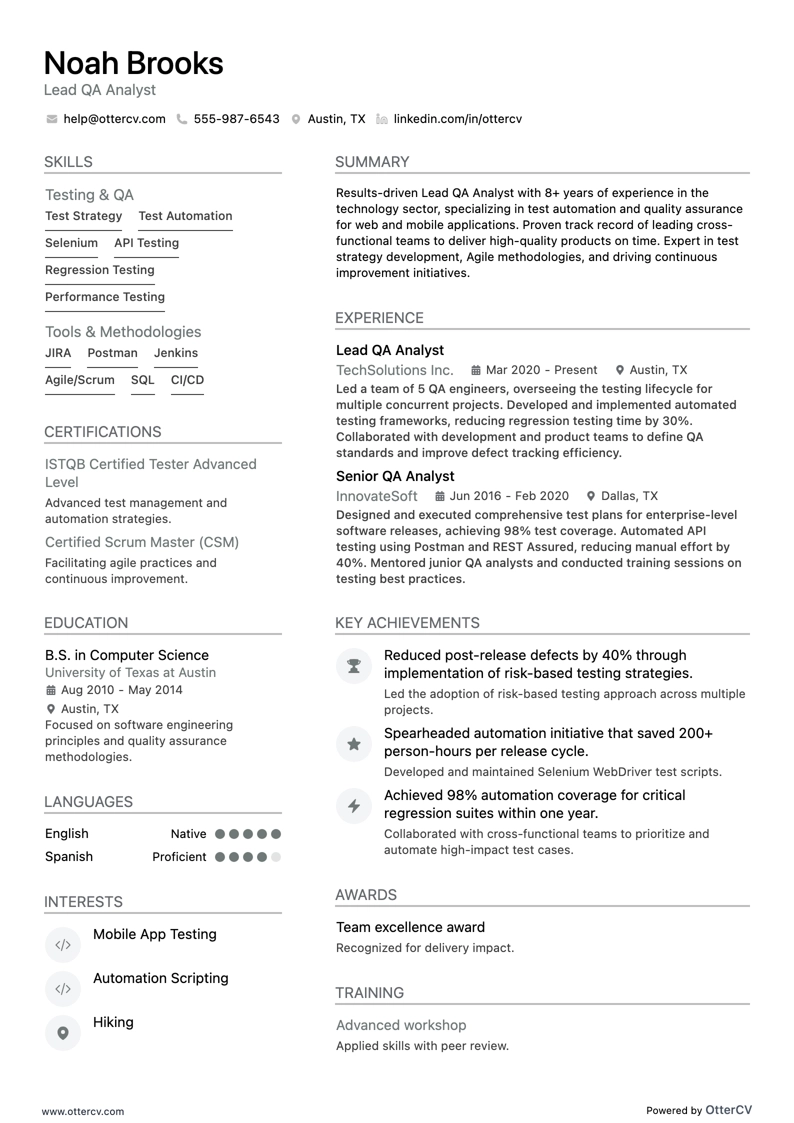
Lead QA Analyst resume example

Lead QA Analyst

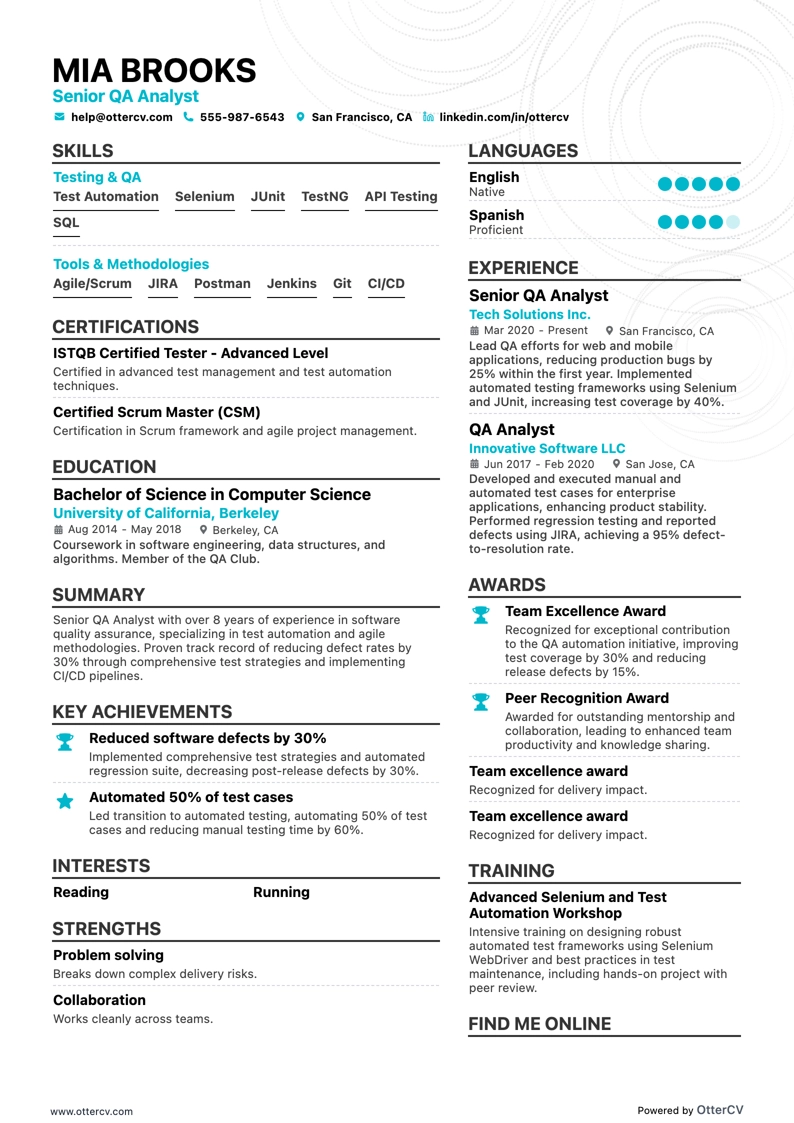
Senior QA Analyst resume example

Senior QA Analyst

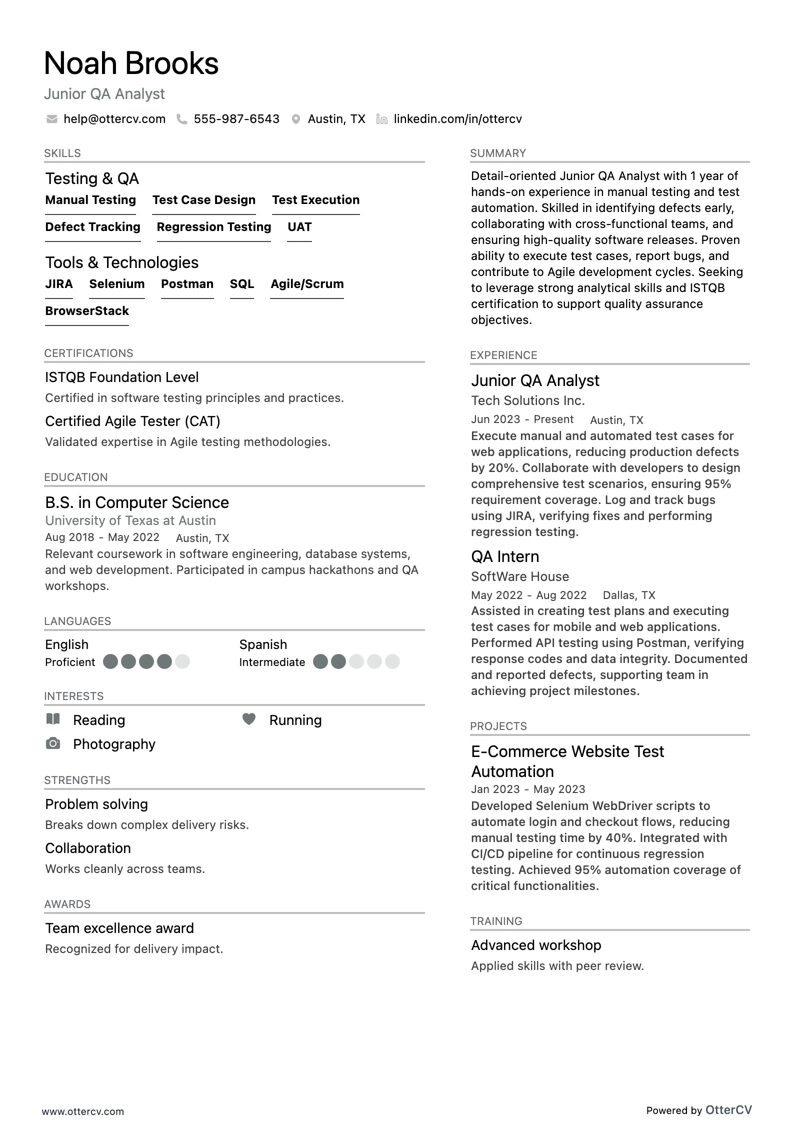
Junior QA Analyst resume example

Junior QA Analyst

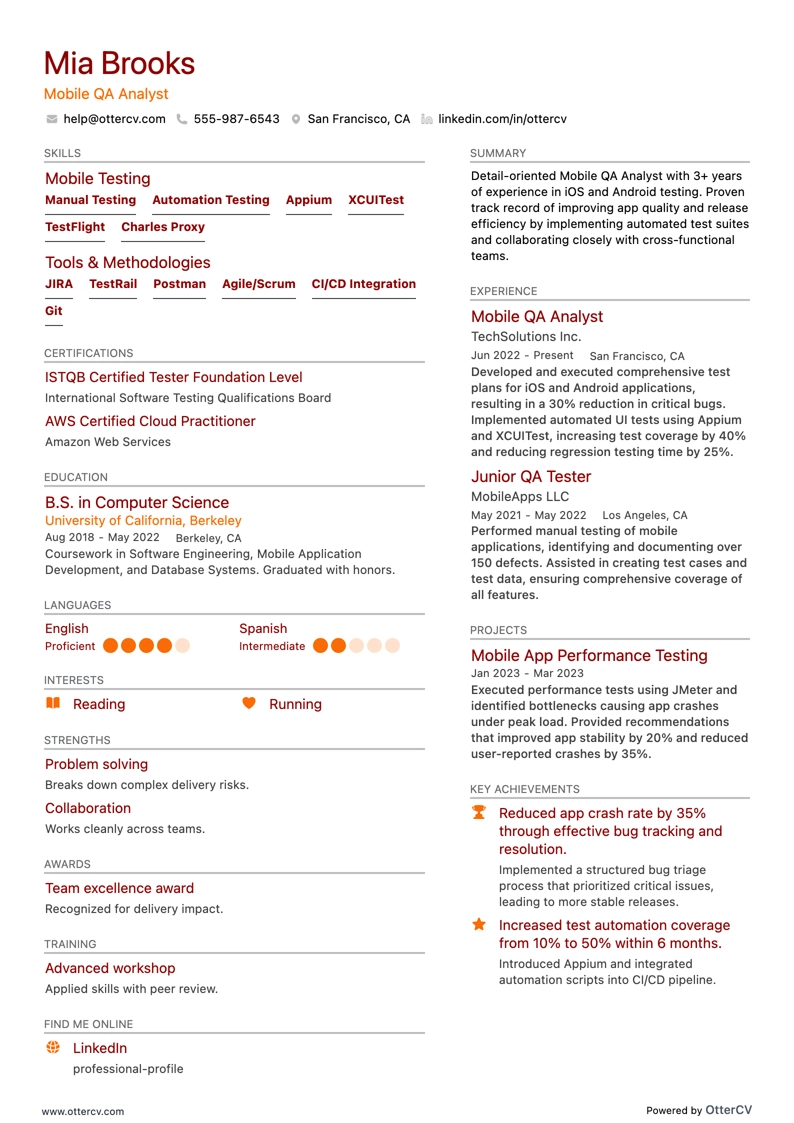
Mobile QA Analyst resume example

Mobile QA Analyst

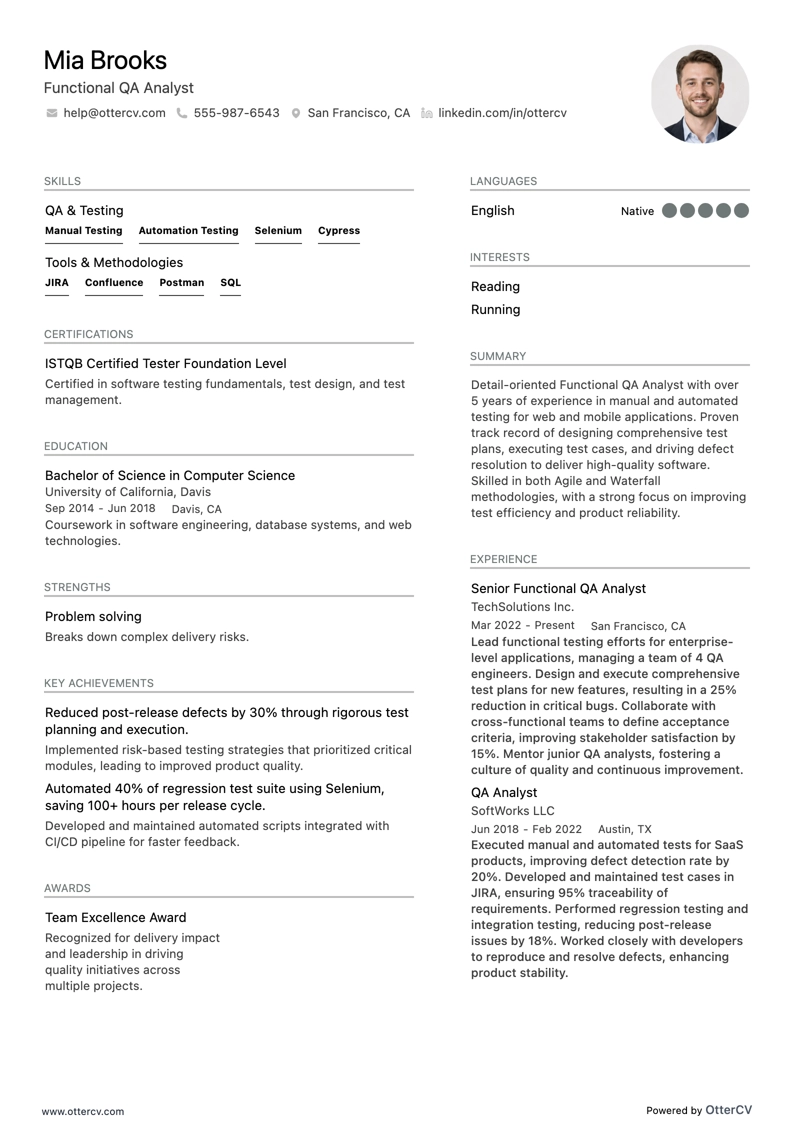
Functional QA Analyst resume example

Functional QA Analyst

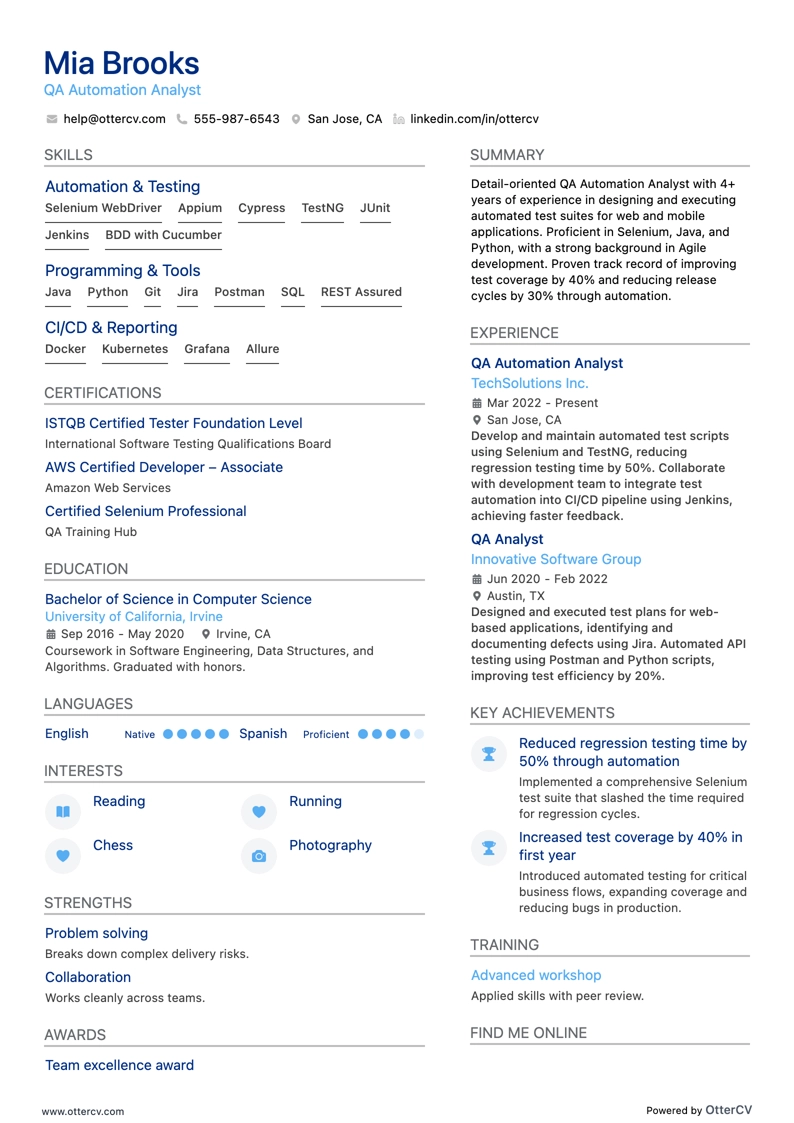
QA Automation Analyst resume example

QA Automation Analyst

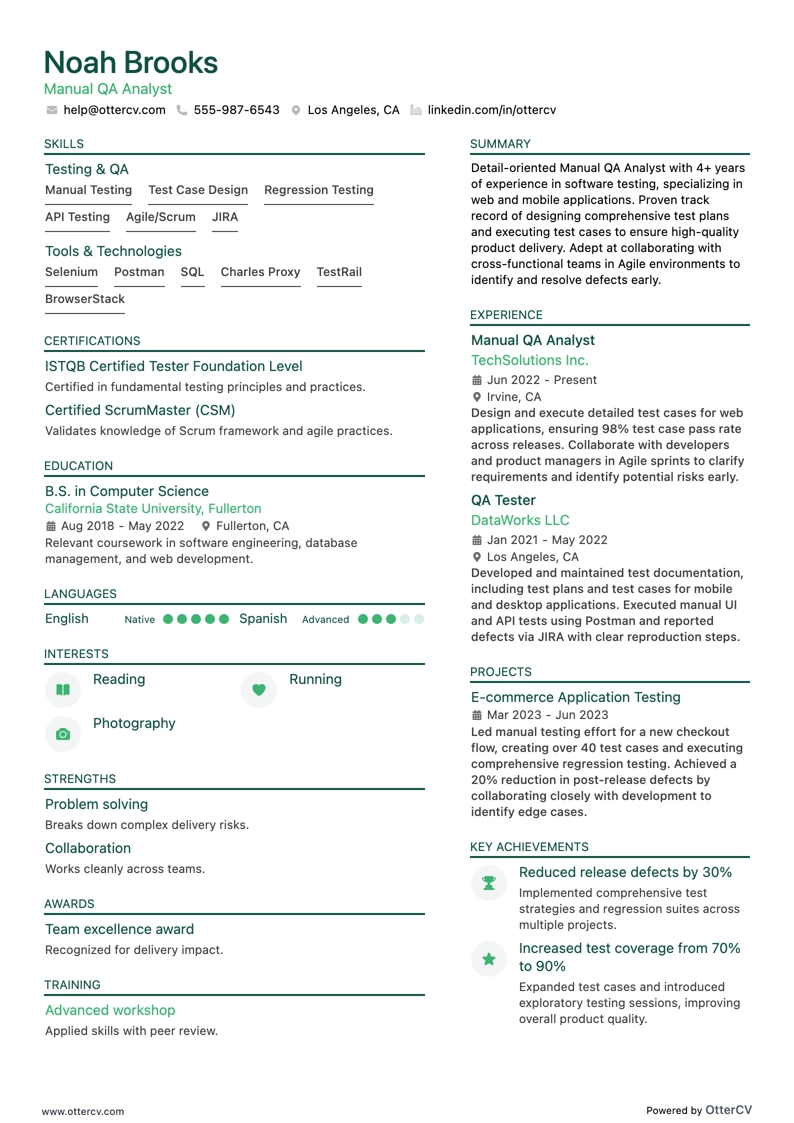
Manual QA Analyst resume example

Manual QA Analyst

QA Test Analyst resume example

QA Test Analyst

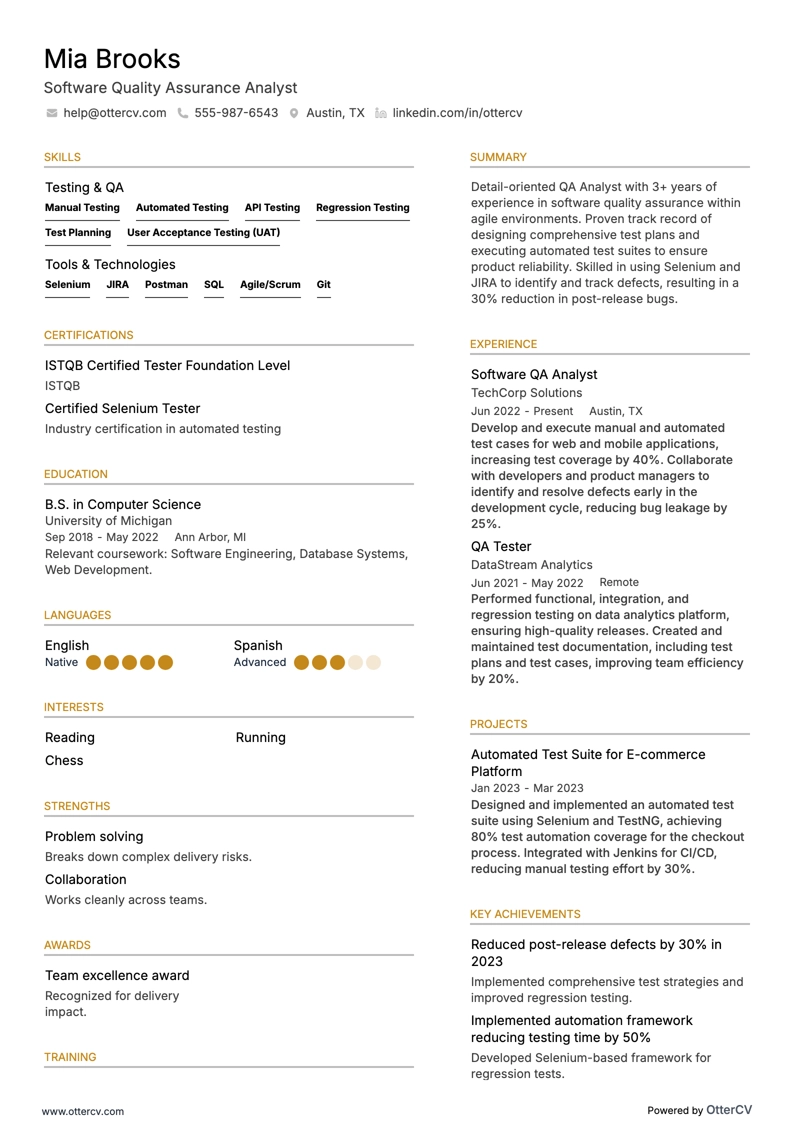
Software Quality Assurance Analyst resume example

Software Quality Assurance Analyst

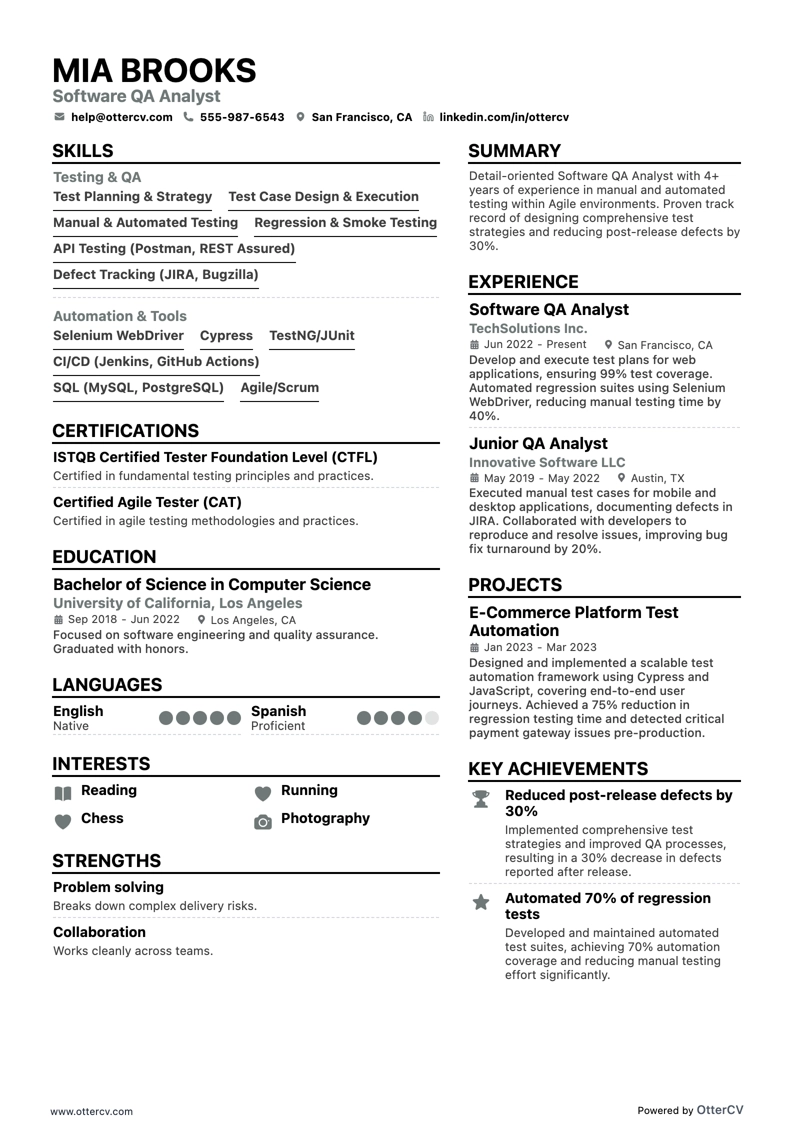
Software QA Analyst resume example

Software QA Analyst

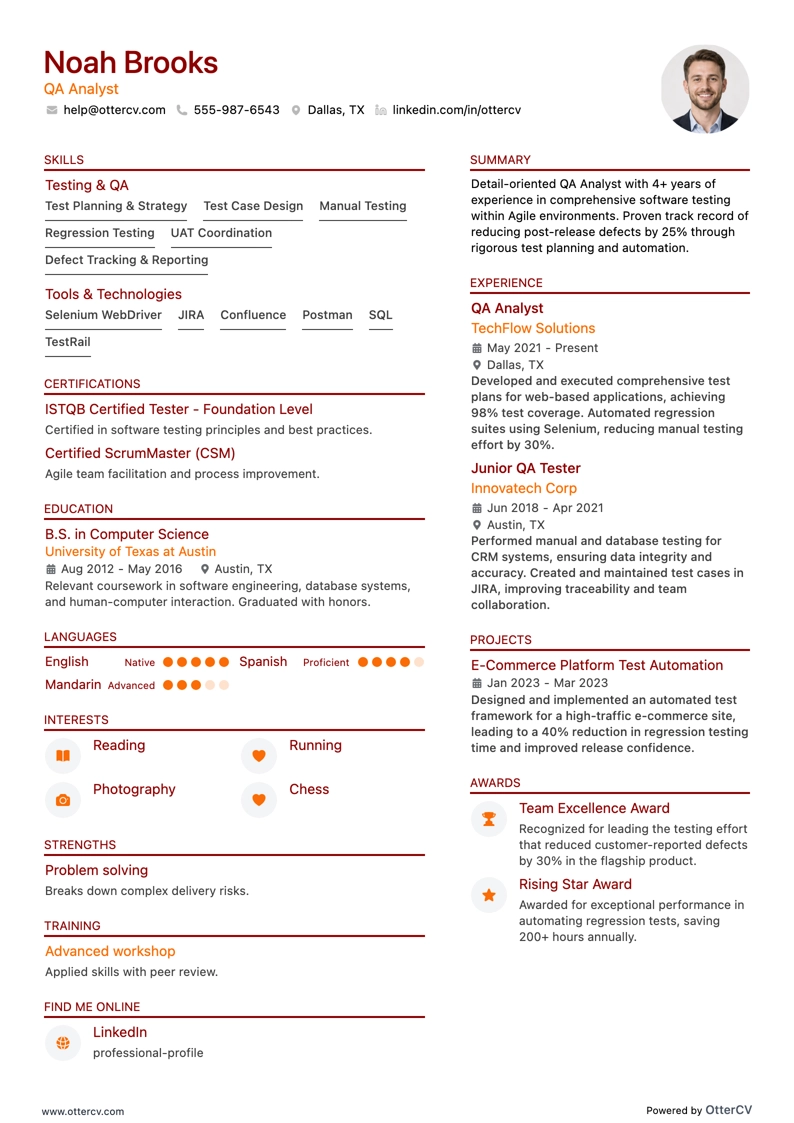
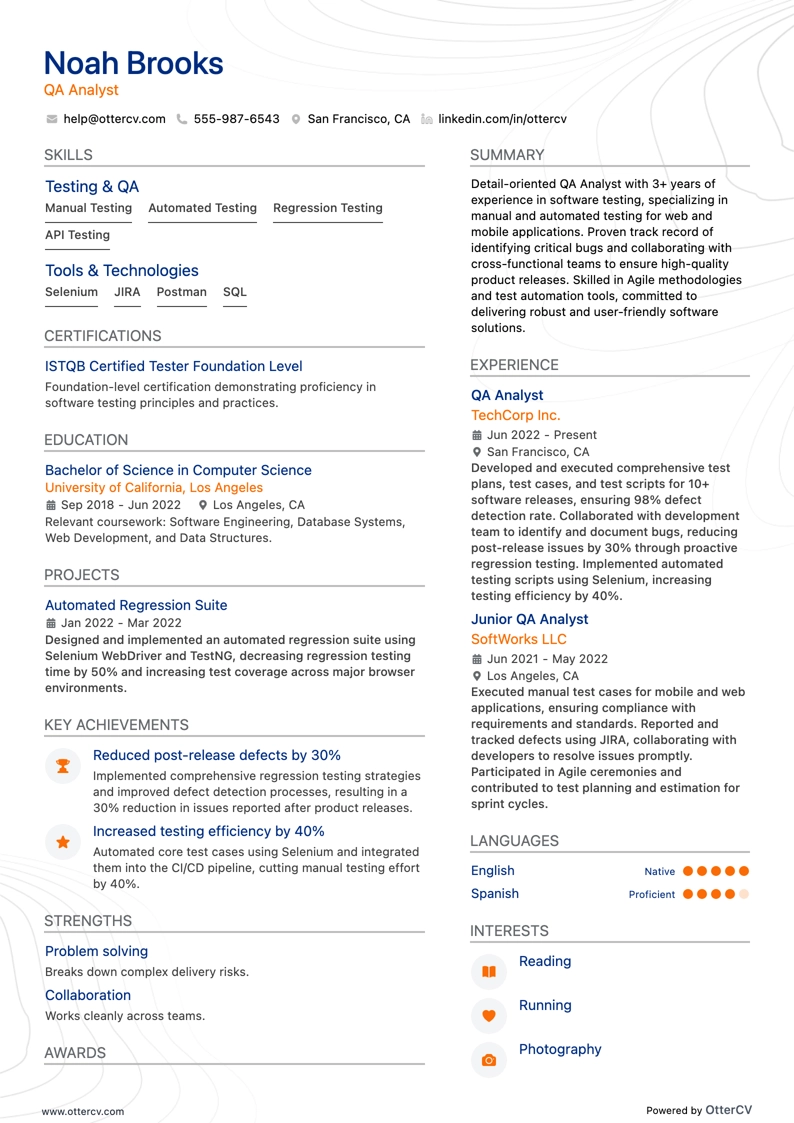
QA Analyst resume example

QA Analyst

Many QA analyst resumes fall short because they list test cases and tools without showing impact. This QA analyst resume guide explains how to pass ATS screening and stand out during quick recruiter scans. If you're not sure where to start, learning how to write a resume from the ground up can help you build a stronger foundation.

A strong resume highlights outcomes: fewer escaped defects, shorter regression cycles, and greater release confidence. Quantify your scope and results with metrics such as test coverage gains, defect leakage reductions, release cadence improvements, and user-impact bugs prevented.

Key takeaways

  • Quantify defect reductions, coverage gains, and cycle time improvements in every experience bullet.

  • Use a reverse-chronological format if you are an experienced analyst, or a hybrid format if you are switching careers.

  • Mirror the exact tools, methodologies, and quality metrics from the job posting in your resume.

  • Place your skills section above experience if you do not have full-time QA work history.

  • Tie every skill you list to a specific project, tool, or measurable outcome.

  • Write a three- to four-line summary that highlights your domain, core tools, and top achievement.

  • Use Echocv to turn vague task descriptions into sharp, metrics-driven resume bullets.

Job market snapshot for QA analysts

We analyzed 72 recent QA analyst job ads across major US job boards. These figures provide a quick view of employer expectations, industry demand, and experience requirements.

What level of experience employers are looking for QA analysts

Years of ExperiencePercentage found in job ads
1–2 years18.1% (13)
3–4 years11.1% (8)
5–6 years15.3% (11)
7–8 years8.3% (6)
Not specified45.8% (33)

QA analyst ads by area of specialization (industry)

Industry (Area)Percentage found in job ads
Finance & Banking38.9% (28)
Healthcare23.6% (17)

Role overview stats

These tables outline the most common responsibilities and employment types for QA analyst roles. Use them to align your resume with employer expectations and understand how the role is structured across the market.

Day-to-day activities and top responsibilities for a QA analyst

ResponsibilityPercentage found in job ads
Agile47.2% (34)
Jira40.3% (29)
Manual testing27.8% (20)
Scrum20.8% (15)
API testing18.1% (13)
Regression testing16.7% (12)
SQL15.3% (11)
Automated testing13.9% (10)
Test plans13.9% (10)
Postman12.5% (9)
QA12.5% (9)
Quality assurance12.5% (9)

Type of employment (remote vs on-site vs hybrid)

Employment typePercentage found in job ads
On-site51.4% (37)
Remote25.0% (18)
Hybrid23.6% (17)

How to format a QA analyst resume

Recruiters reviewing QA analyst resumes look for testing methodologies, defect tracking proficiency, and familiarity with automation tools, supported by clear, measurable contributions to product quality. A well-chosen resume format helps these signals stand out quickly in both ATS parsing and the recruiter’s first scan.

I have significant experience in this role—which format should I use?

I have significant experience in this role—which format should I use?

Use a reverse-chronological format to emphasize your most recent and relevant QA analyst experience.

  • Highlight scope and ownership by specifying the products, platforms, or release cycles you tested across teams or environments.
  • Feature role-specific tools and domains such as Selenium, JIRA, Postman, SQL, API testing, regression suites, and CI/CD pipeline integration.
  • Quantify outcomes related to product quality, release velocity, or defect reduction to show business impact.

Example bullet: “Designed and executed 200+ automated regression test cases using Selenium and Python, reducing post-release defects by 38% and cutting QA cycle time from five days to two across three concurrent product lines.”

I'm junior or switching into this role—what format works best?

I'm junior or switching into this role—what format works best?

A hybrid format works best because it lets you lead with relevant QA skills and tools while still showing your work or project history in context.

  • Place a skills section near the top that highlights testing tools, methodologies, and any certifications, such as ISTQB or CSTE, that recruiters filter for.
  • Include academic projects, freelance work, internships, or personal testing projects that demonstrate hands-on QA experience.
  • Connect every listed skill to a specific action and a measurable or observable result.

Example scaffold: SQL querying → wrote complex validation queries to verify data integrity during a database migration project → identified 15 critical data discrepancies before production release.

Why not use a functional resume?

Why not use a functional resume?

A functional resume removes your QA skills from the workplace or project context where you used them, which makes it harder for recruiters to judge the depth and relevance of your testing experience.

This format may be acceptable if you are changing careers into QA from a related field such as development or technical support, have limited formal work history, or are returning to work after a gap. Even then, each skill should be tied to a specific project, tool, or outcome instead of being listed in isolation.

Once you’ve established a clean, readable format, the next step is choosing the right sections to present your qualifications clearly.

What sections should go on a QA analyst resume

Recruiters expect a QA analyst resume to demonstrate clear testing expertise, tool proficiency, and measurable improvements in product quality. Including the right resume sections helps ensure you don’t leave out anything important.

Use this structure for maximum clarity:

  • Header
  • Summary
  • Experience
  • Skills
  • Projects
  • Education
  • Certifications
  • Optional sections: Awards, Open-source work, Languages

Strong experience bullets should highlight your impact on defect prevention and detection, gains in test coverage and automation, release quality outcomes, and the scope of the systems you validated.

With those resume components in place, the next step is to write your QA analyst resume experience section so it supports each part with specific, relevant proof.

How to write your QA analyst resume experience

Your experience section should show that you shipped reliable, well-tested work, not just that you took part in testing cycles. Hiring managers look for measurable impact, relevant tools and methods, and clear quality outcomes rather than generic task lists.

Each entry should include:

  • Job title
  • Company and location (or remote)
  • Dates of employment (month and year)

Add three to five concise bullet points that explain what you owned, how you executed, and what outcomes you delivered:

  • Ownership scope: the products, platforms, features, or systems you were responsible for testing, along with the teams, releases, or environments you supported as a QA analyst.
  • Execution approach: the testing frameworks, automation tools, defect-tracking systems, or methodologies you used to plan, execute, and validate quality across development cycles.
  • Value improved: the changes you drove in software quality, defect detection rates, release stability, regression coverage, or risk reduction tied directly to your QA analyst responsibilities.
  • Collaboration context: how you worked with developers, product managers, DevOps engineers, or external stakeholders to align testing priorities, resolve defects, and maintain quality standards throughout the delivery pipeline.
  • Impact delivered: the results of your testing efforts, expressed through stronger release confidence, fewer production defects, expanded test coverage, or faster delivery rather than a simple summary of tasks performed.

Experience bullet formula

Experience bullet formula

Action verb + technology + what you built or fixed + measurable result

A QA analyst experience example

QA Analyst

BrightCart | Remote

2022–Present

E-commerce platform supporting two million monthly users across web and mobile checkout, payments, and fulfillment.

  • Designed and executed risk-based test plans in Jira and TestRail across checkout and payments, reducing escaped defects by 28% quarter over quarter.
  • Automated one hundred twenty regression tests with Playwright and TypeScript in a GitHub Actions pipeline, cutting regression time from two days to four hours and increasing release cadence from biweekly to weekly.
  • Implemented API test coverage with Postman and Newman for forty-five critical endpoints, improving pre-release defect detection by 35% and reducing production incident tickets by 18%.
  • Partnered with product managers, designers, and engineers in sprint planning and bug triage, tightening acceptance criteria and lowering reopen rate from 14% to 6%.
  • Built and maintained a cross-browser and device matrix using BrowserStack and real-device testing, decreasing customer-reported UI issues by 22% and improving checkout conversion by 1.3%.

Now that you've seen what a strong experience section looks like, the next step is adjusting yours to fit a specific job posting.

How to tailor your QA analyst resume experience

Recruiters review your QA analyst resume through both human screening and applicant tracking systems. Tailoring your resume to the job description helps your qualifications stand out in both.

Ways to tailor your QA analyst experience:

  • Match the testing tools and technologies listed in the job description.
  • Use the same terminology for QA methodologies and standards.
  • Reflect the specific KPIs or quality metrics the employer prioritizes.
  • Include domain experience relevant to the company's industry.
  • Emphasize compliance or regulatory testing if the posting requires it.
  • Highlight collaboration with development teams using the workflow they mention.
  • Reference accessibility or security testing when the role calls for it.
  • Align your defect tracking process with the systems they name.

Tailoring means aligning your real accomplishments with the role's requirements, not forcing in keywords that don't fit.

Resume tailoring examples for QA analyst

Job description excerptUntailoredTailored
"Execute and maintain automated test scripts using Selenium and Java for our e-commerce platform; track defects in Jira."Tested software and reported bugs to the development team.Built and maintained 120+ automated regression scripts in Selenium (Java) for an e-commerce checkout flow, logging and triaging defects in Jira to cut escaped bugs by 35%.
"Perform API testing with Postman and validate RESTful service responses; collaborate with DevOps to integrate tests into CI/CD pipelines."Worked with different teams to help improve product quality.Validated 50+ RESTful API endpoints using Postman, writing automated collection runs integrated into a Jenkins CI/CD pipeline that reduced post-deployment defects by 28%.
"Design and execute test plans for HIPAA-compliant healthcare applications; conduct regression, smoke, and exploratory testing across iOS and Android."Conducted various types of testing on mobile applications.Designed and executed test plans, including regression, smoke, and exploratory cycles, for a HIPAA-compliant patient portal across iOS and Android, covering 200+ test cases per release with zero compliance audit findings.

Once you’ve aligned your experience with the role’s priorities, quantify your QA analyst achievements to show the impact of your work.

How to quantify your QA analyst achievements

Quantifying your achievements shows how you improved quality, speed, and release confidence. Focus on defect leakage, test coverage, automation impact, cycle time, and risk reduction across releases, environments, and user flows.

Quantifying examples for QA analyst

MetricExample
Defect leakageReduced production defect leakage from 3.2% to 1.1% by adding risk-based regression suites and tightening Jira triage criteria.
Automation coverageIncreased automated regression coverage from 120 to 410 tests using Selenium and TestNG, cutting manual execution by 18 hours per sprint.
Release cycle timeShortened UAT sign-off from five days to two days by parallelizing test runs in CI and standardizing test data refresh steps.
Performance reliabilityImproved checkout API p95 latency from 780 ms to 420 ms by partnering on JMeter tests and validating fixes across three environments.
Risk reductionPrevented two Sev-1 incidents by adding OWASP top ten security checks and enforcing zero critical findings before release for six launches.

Once you’ve refined your bullet points, it’s just as important to clearly present the hard and soft skills that support them.

How to list your hard and soft skills on a QA analyst resume

Your skills section shows how you prevent defects and protect releases. Recruiters and an ATS (applicant tracking system) scan this section quickly for keyword matches, so aim for a resume that emphasizes hard skills first, supported by a smaller group of role-specific soft skills.

QA analyst roles typically require a blend of:

  • Product strategy and discovery skills
  • Data, analytics, and experimentation skills
  • Delivery, execution, and go-to-market discipline
  • Soft skills

Your skills section should be:

  • Scannable with bullet-style grouping
  • Relevant to the job post
  • Backed by proof in your experience bullets
  • Updated with current tools

Place your skills section:

  • Above your experience section if you’re junior or switching careers
  • Below your experience section if you’re mid-level or senior with strong achievements

Hard skills

  • Test planning and design.
  • Manual functional testing.
  • Regression testing.
  • Exploratory testing.
  • API testing with Postman.
  • SQL querying and joins.
  • Test case management with TestRail.
  • Defect tracking with Jira.
  • Selenium WebDriver.
  • Cypress.
  • CI/CD with Jenkins and GitHub Actions.
  • Cross-browser testing with BrowserStack.

Soft skills

  • Prioritizes testing based on risk.
  • Provides clear steps to reproduce defects.
  • Writes concise test documentation.
  • Manages stakeholder expectations effectively.
  • Collaborates well across functions.
  • Communicates release readiness clearly.
  • Asks questions to uncover root causes.
  • Uses sound judgment when escalation is needed.
  • Takes ownership of quality gates.
  • Executes work within time constraints.
  • Pays attention to edge cases.
  • Gives constructive feedback during reviews.

How to show your QA analyst skills in context

Your skills should not appear only as a bulleted list on your resume. Browse examples of resume skills to see how other professionals present them effectively.

Show your skills in these sections:

  • Your summary, which presents your high-level professional identity
  • Your experience, which proves your skills through outcomes

Here’s what that looks like in practice.

Senior QA analyst with eight years in fintech, skilled in Selenium, SQL, and regression testing. Reduced production defects by 43% through automated test frameworks and cross-functional collaboration with development and product teams.

  • Clearly specifies senior-level experience
  • Directly names industry-relevant tools
  • Quantifies impact with a metric
  • Highlights cross-team collaboration skills

Experience example

Senior QA Analyst

Vantage Financial Solutions | Remote

March 2019–Present

  • Built a Selenium-based automation suite that cut regression testing time by 55%, freeing the team for exploratory testing.
  • Partnered with developers and product managers to implement shift-left testing, reducing post-release defects by 38%.
  • Created SQL-driven data validation scripts that identified 12 critical data integrity issues before production deployment.
  • Every bullet includes measurable proof.
  • Skills appear naturally within achievements.

Once you’ve shown your quality assurance analyst skills with specific, results-focused examples, the next step is to apply that same approach to building a quality assurance analyst resume with no experience.

How do I write a QA analyst resume with no experience

Even without full-time experience, you can show you’re ready through projects, hands-on practice, and structured learning. Our guide on writing a resume without work experience explains this approach in more detail. Here are some ways to get started:

  • QA analyst portfolio projects
  • Bug reports from app testing
  • Test cases for sample features
  • Test automation practice scripts
  • GitHub repositories with test code
  • Open-source issue triage contributions
  • QA analyst coursework capstone project
  • Internship or volunteer QA analyst work

Focus on:

  • Clear test cases and traceability
  • Reproducible bugs with evidence
  • Tooling: Jira, Postman, Git
  • Metrics: coverage, defect trends

Resume format tip for entry-level QA analyst

Resume format tip for entry-level QA analyst

Use a skills-based resume format if you do not yet have full-time QA analyst experience. This format helps emphasize your projects, tools, and testing artifacts.

Do the following:

  • Place a Projects section above Work Experience.
  • Quantify results, such as defect counts and coverage.
  • List tools and back them up with proof in your bullet points.
  • Include links to GitHub and reports.
  • Tailor keywords to each job posting.

Example project bullet:

  • Built and executed 60+ test cases in Jira, logged 25 defects with screenshots and repro steps, and improved regression pass rate from 82% to 95%.

Once you’ve structured your resume to highlight transferable skills and relevant projects, the next step is presenting your education clearly to reinforce your qualifications.

How to list your education on a QA analyst resume

Your education section helps hiring teams confirm you have the foundational knowledge needed for a QA analyst role. It shows your technical training, analytical thinking, and relevant academic preparation.

Include:

  • Degree name
  • Institution
  • Location
  • Graduation year
  • Relevant coursework for juniors or entry-level candidates
  • Honors and GPA if 3.5 or higher

Skip the month and day details and list the graduation year only.

Here’s a strong education entry tailored to a QA analyst resume.

Example education entry

Bachelor of Science in Computer Science

University of Texas at Austin, Austin, TX

Graduated 2021

GPA: 3.7/4.0

  • Relevant coursework: Software Testing & Verification, Database Systems, Object-Oriented Programming, Statistics for Data Analysis
  • Honors: Dean's List (six semesters), Magna Cum Laude

How to list your certifications on a QA analyst resume

Certifications on your resume show your commitment to learning, demonstrate tool proficiency, and confirm industry relevance for a QA analyst role, especially if your experience is still growing.

Include:

  • Certificate name
  • Issuing organization
  • Year
  • Optional: credential ID or URL
  • Place certifications below education when your degree is recent and your certifications are older or less relevant to the QA analyst role.
  • Place certifications above education when they are recent and closely aligned with the QA analyst tools, methods, or domains listed in the job posting.

Best certifications for your QA analyst resume

  • ISTQB Certified Tester Foundation Level (CTFL)
  • ISTQB Agile Tester Extension (CTFL-AT)
  • Certified Software Quality Analyst (CSQA)
  • Certified ScrumMaster (CSM)
  • Certified Agile Tester (CAT)
  • Microsoft Certified: Azure Fundamentals (AZ-900)
  • AWS Certified Cloud Practitioner

Once your credentials are easy for hiring managers to spot, use your QA analyst resume summary to reinforce those qualifications upfront and set the context for the rest of your resume.

How to write your QA analyst resume summary

Your resume summary is often the first thing a recruiter reads. A clear, specific opening sets the tone and helps determine whether the rest of your resume gets attention.

Keep it to three to four lines and include:

  • Your title and total years of QA or testing experience.
  • The domain or industry you’ve worked in, such as fintech, healthcare, or e-commerce.
  • Core tools and skills like Selenium, JIRA, SQL, or API testing.
  • One or two measurable achievements that show your impact.
  • Soft skills tied to real outcomes, such as cross-team collaboration that reduced release delays.

PRO TIP

At the QA analyst level, emphasize your technical skills, testing tools, and early contributions that demonstrate results.

Include specific defect metrics or process improvements, and avoid vague phrases like "passionate tester" or "detail-oriented team player" unless you can support them with evidence.

Example summary for a QA analyst

QA analyst with three years of experience in e-commerce testing using Selenium, JIRA, and SQL. Reduced post-release defects by 30% by building automated regression suites and improving cross-team bug triage processes.

Now that your summary is ready to showcase your expertise, make sure the header above it presents your contact details clearly so recruiters can reach you.

What to include in a QA analyst resume header

A resume header is the top section of your resume with your key details. For a QA analyst role, it improves visibility, credibility, and recruiter screening.

Essential resume header elements:

  • Full name
  • Tailored job title and headline
  • Location
  • Phone number
  • Professional email
  • GitHub link
  • Portfolio link
  • LinkedIn

A LinkedIn link helps recruiters verify your experience quickly and supports screening.

Do not include a photo on a QA analyst resume unless the role is explicitly front-facing or appearance-dependent.

Match your header job title and headline to the posting, and keep every link and contact detail current and clickable.

Example

Additional sections for QA analyst resumes

Once your contact details and role identifier are in place at the top of your resume, add targeted sections that strengthen your qualifications and make your QA analyst resume more complete.

When your core qualifications are similar to other candidates, these additional sections can help you stand out by showing role-specific credibility and depth. For example, listing language skills can demonstrate your ability to support global testing teams and multilingual products.

  • Languages
  • Certifications (ISTQB, CSTE, or similar)
  • Publications or technical blog contributions
  • Professional affiliations (ASQ, SQE, or similar)
  • Conferences and speaking engagements
  • Open-source testing projects
  • Hobbies and interests

Once you’ve strengthened your resume with relevant additional sections, the next step is pairing it with a cover letter that adds more context to your application.

Do QA analyst resumes need a cover letter

A cover letter isn’t required for a QA analyst, but it often helps for competitive roles or teams that expect one. If you’re unfamiliar with the format, start by understanding what a cover letter is and how it complements your resume. It can make a difference when your resume needs extra context or when you want to show product understanding.

Use a cover letter to add targeted context your QA analyst resume can’t show:

  • Explain your fit for the role and team by aligning your testing approach with their stack, workflow, and quality goals.
  • Highlight one or two relevant projects or outcomes, such as defect escape reduction, faster release cycles, or improved test coverage.
  • Show understanding of the product, users, and business context by naming key risks, critical paths, or user journeys you would prioritize.
  • Address career transitions or non-obvious experience by connecting past work to QA analyst skills, tools, and results.

Once you’ve decided whether to include a cover letter based on the role and application requirements, you can use AI to strengthen your QA analyst resume and align it more closely with employer expectations.

Using AI to improve your QA analyst resume

AI can improve your resume’s clarity, structure, and impact. It can tighten language and surface measurable results, but overusing it can quickly make your resume sound less authentic. Once your content is clear and tailored to the role, step away from AI. For a deeper look at effective prompts, see our guide on ChatGPT resume writing.

Here are 10 practical prompts to improve specific sections of your QA analyst resume:

  1. Strengthen your summary. “Rewrite my QA analyst resume summary to highlight testing expertise, tools proficiency, and measurable quality improvements in under four sentences.”
  2. Quantify experience bullets. “Add specific metrics like defect detection rates or cycle time reductions to these QA analyst experience bullet points.”
  3. Tighten action verbs. “Replace weak or passive verbs in my QA analyst experience section with strong, precise action verbs relevant to software testing.”
  4. Align skills strategically. “Compare my QA analyst skills section against this job description and suggest missing hard or soft skills to add.”
  5. Refine project descriptions. “Rewrite this QA analyst project description to clearly state the testing scope, tools used, and outcomes delivered.”
  6. Improve certification entries. “Format my QA analyst certifications section for maximum clarity, including issuing body, date earned, and relevance to testing roles.”
  7. Clarify education details. “Revise my QA analyst education section to emphasize coursework, capstone projects, or research directly related to quality assurance.”
  8. Remove redundant phrasing. “Identify and eliminate filler words or redundant phrases throughout my QA analyst resume without changing the meaning.”
  9. Tailor for applicant tracking. “Optimize my QA analyst resume with relevant keywords from this job posting without keyword stuffing or sounding unnatural.”
  10. Sharpen bullet structure. “Restructure each QA analyst experience bullet to follow a clear ‘Action + Context + Result’ format with measurable outcomes.”

Stop using AI once your resume sounds accurate, specific, and grounded in your real experience. AI should never invent experience or inflate claims—if it didn’t happen, it doesn’t belong here.

Conclusion

A strong QA analyst resume shows impact through measurable outcomes, role-specific skills, and a clear structure. Use metrics that demonstrate fewer defects, faster releases, higher coverage, or stronger reliability. Keep every section scannable, consistent, and easy to verify.

This signals that you can support today’s teams and adapt to near-future hiring needs. Your QA analyst resume should show how you test, document, collaborate, and improve quality at speed. When clarity and results lead, recruiters can say yes faster.

QA Analyst resume examples

Explore additional QA Analyst resume samples and guides and see what works for your level of experience or role.

By Experience

Lead QA Analyst

Lead QA Analyst resume preview

Senior QA Analyst

Senior QA Analyst resume preview

Junior QA Analyst

Junior QA Analyst resume preview

QA Analyst resume examples

Explore additional QA Analyst resume samples and guides and see what works for your level of experience or role.

By Role

Mobile QA Analyst

Mobile QA Analyst resume preview

Functional QA Analyst

Functional QA Analyst resume preview

QA Automation Analyst

QA Automation Analyst resume preview

Manual QA Analyst

Manual QA Analyst resume preview

QA Test Analyst

QA Test Analyst resume preview

Software Quality Assurance Analyst

Software Quality Assurance Analyst resume preview

Software QA Analyst

Software QA Analyst resume preview

QA Analyst

QA Analyst resume preview