Lead Pest Control Technician full preview

10 Pest Control Resume Examples

OtterCV

Written by The OtterCV Team

Updated: 6/2/2023•8 min read

See all resume examples in this guide, or generate your own resume example with your personalized prompt

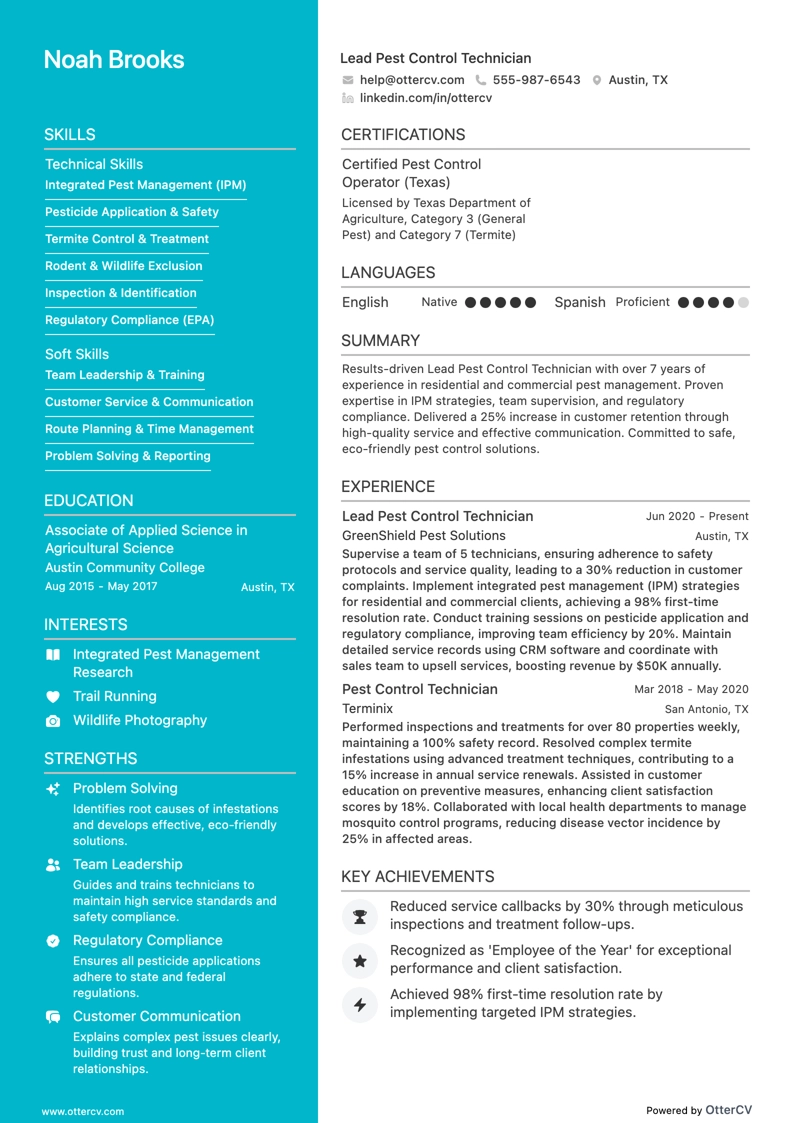
Lead Pest Control Technician resume example

Lead Pest Control Technician

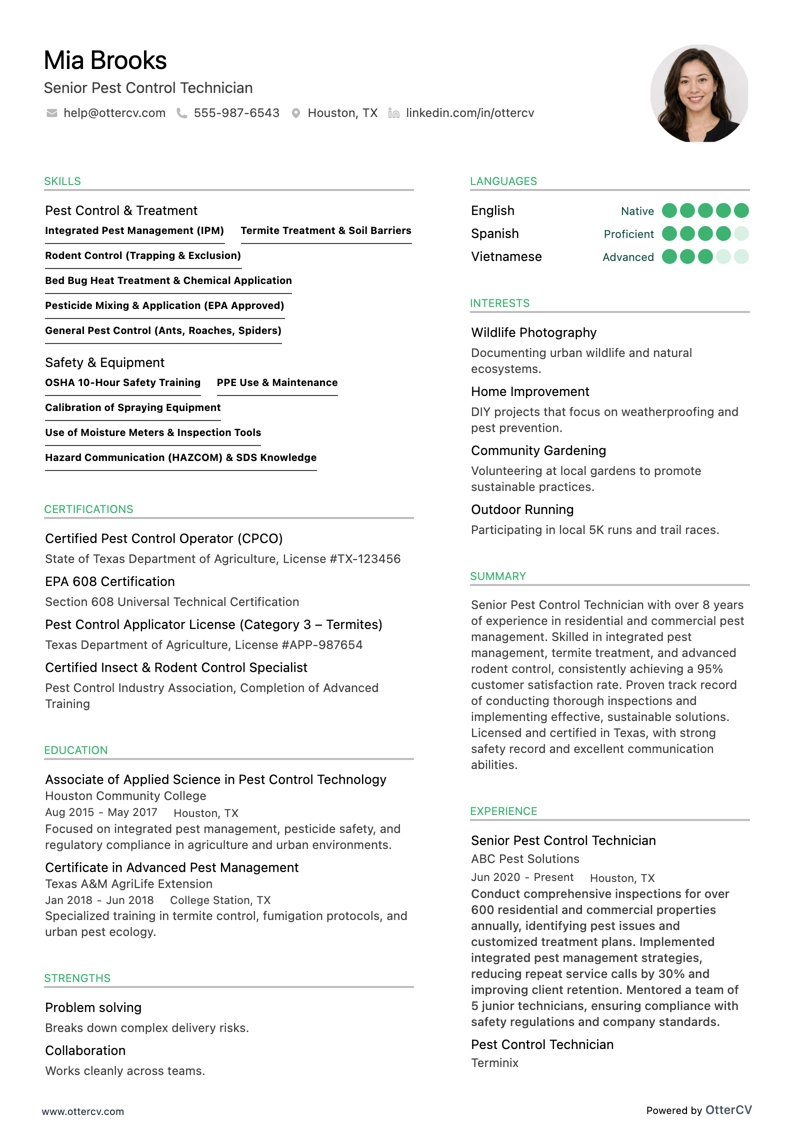
Senior Pest Control Technician resume example

Senior Pest Control Technician

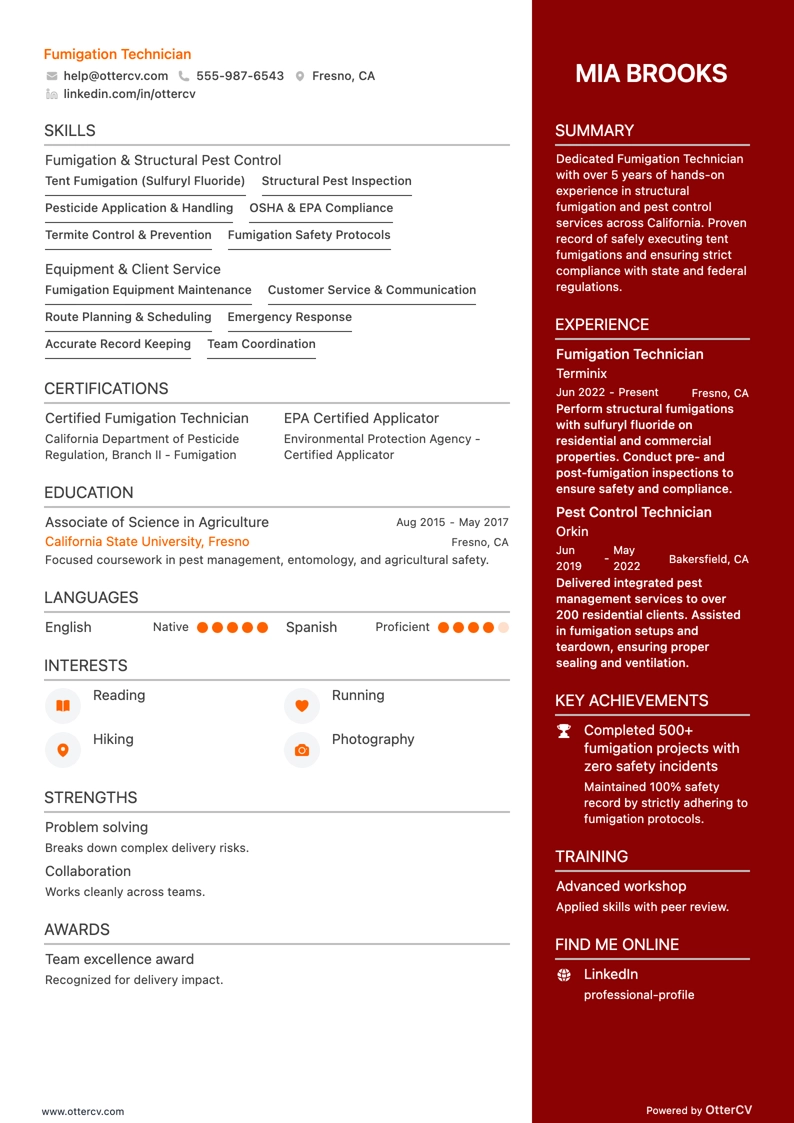
Fumigation Technician resume example

Fumigation Technician

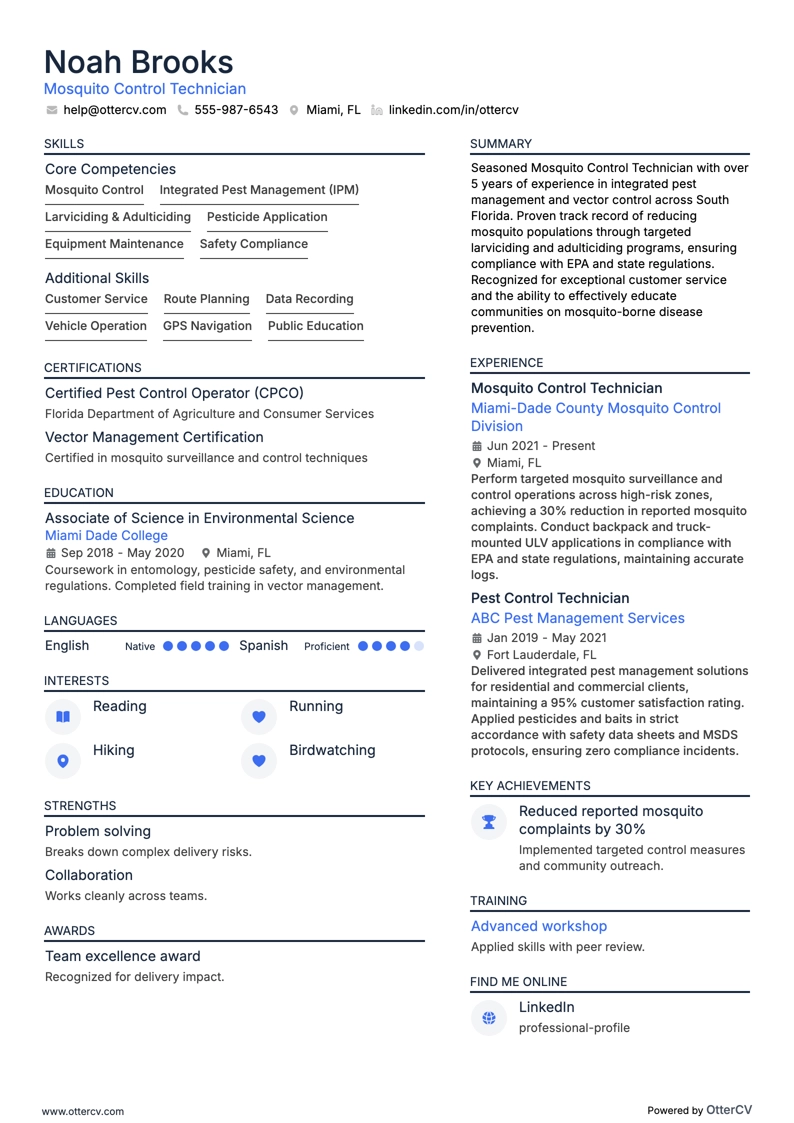
Mosquito Control Technician resume example

Mosquito Control Technician

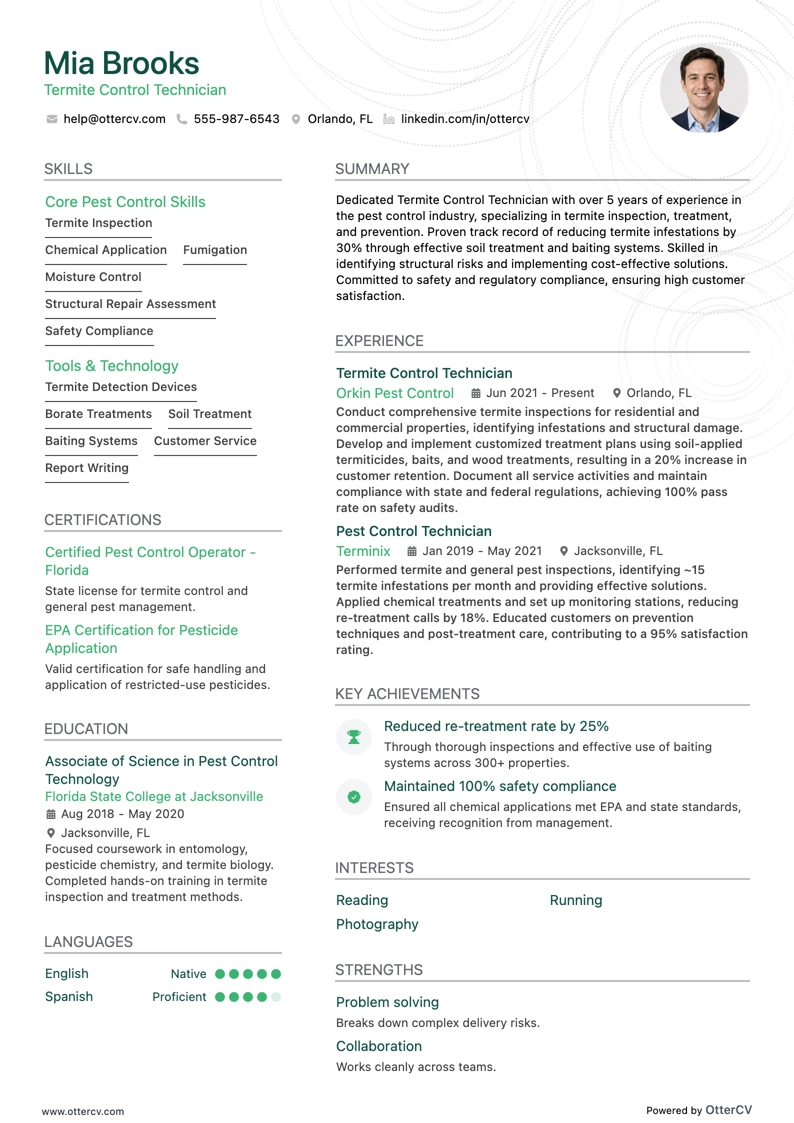
Termite Control Technician resume example

Termite Control Technician

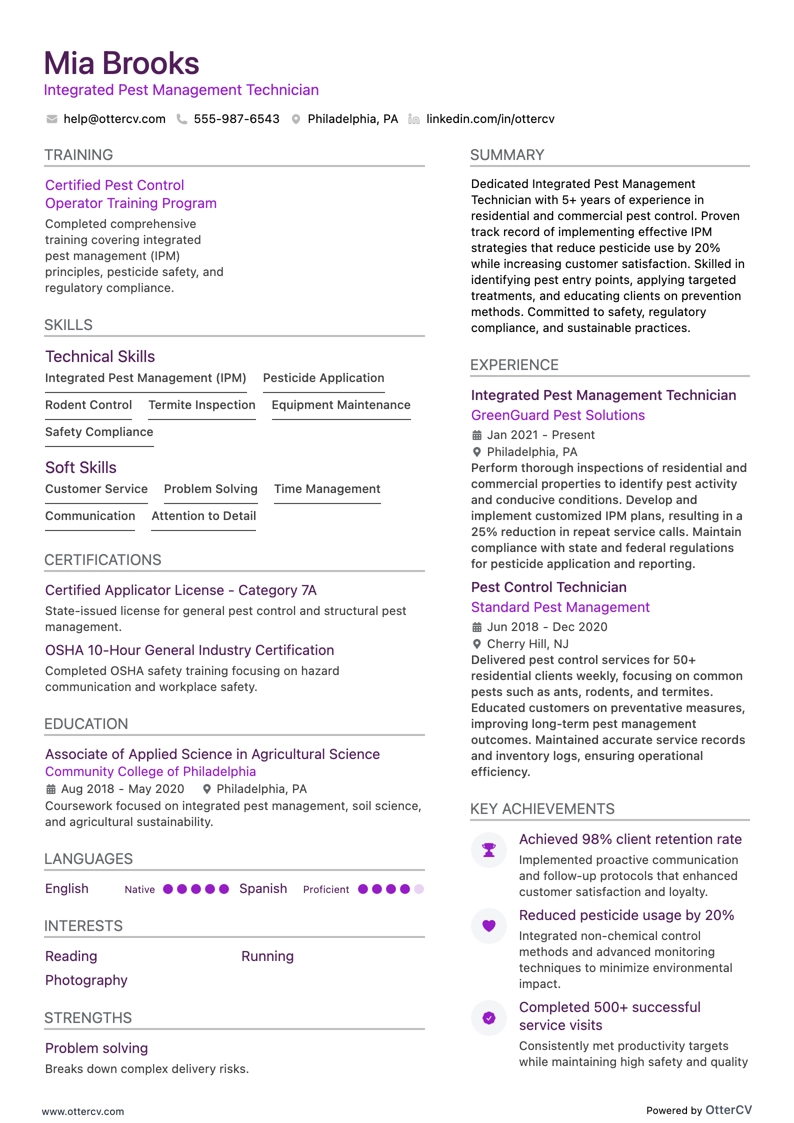
Integrated Pest Management Technician resume example

Integrated Pest Management Technician

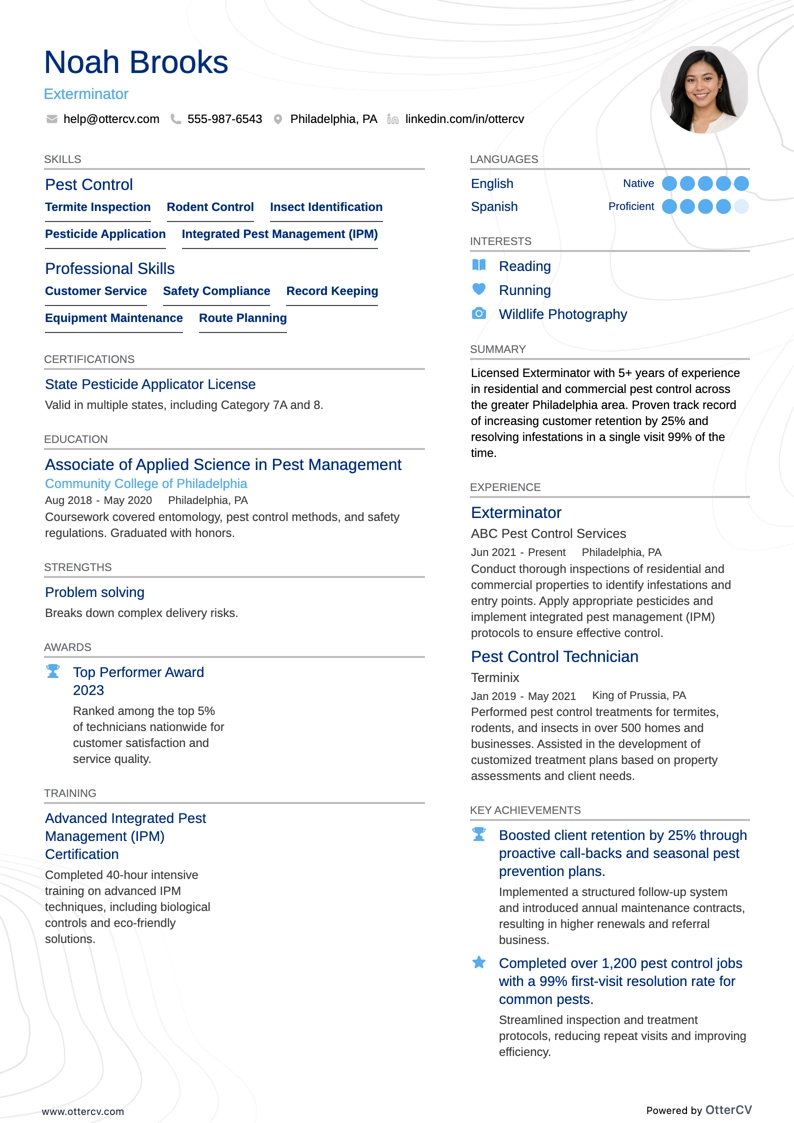
Exterminator resume example

Exterminator

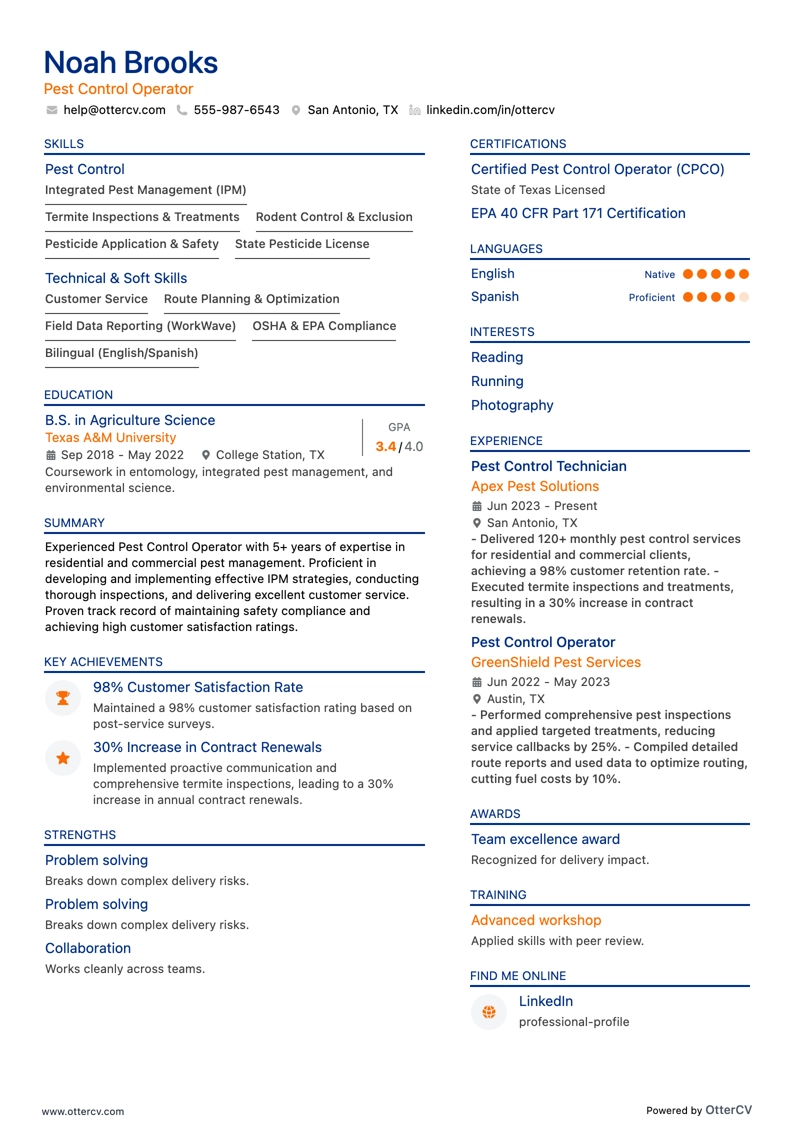
Pest Control Operator resume example

Pest Control Operator

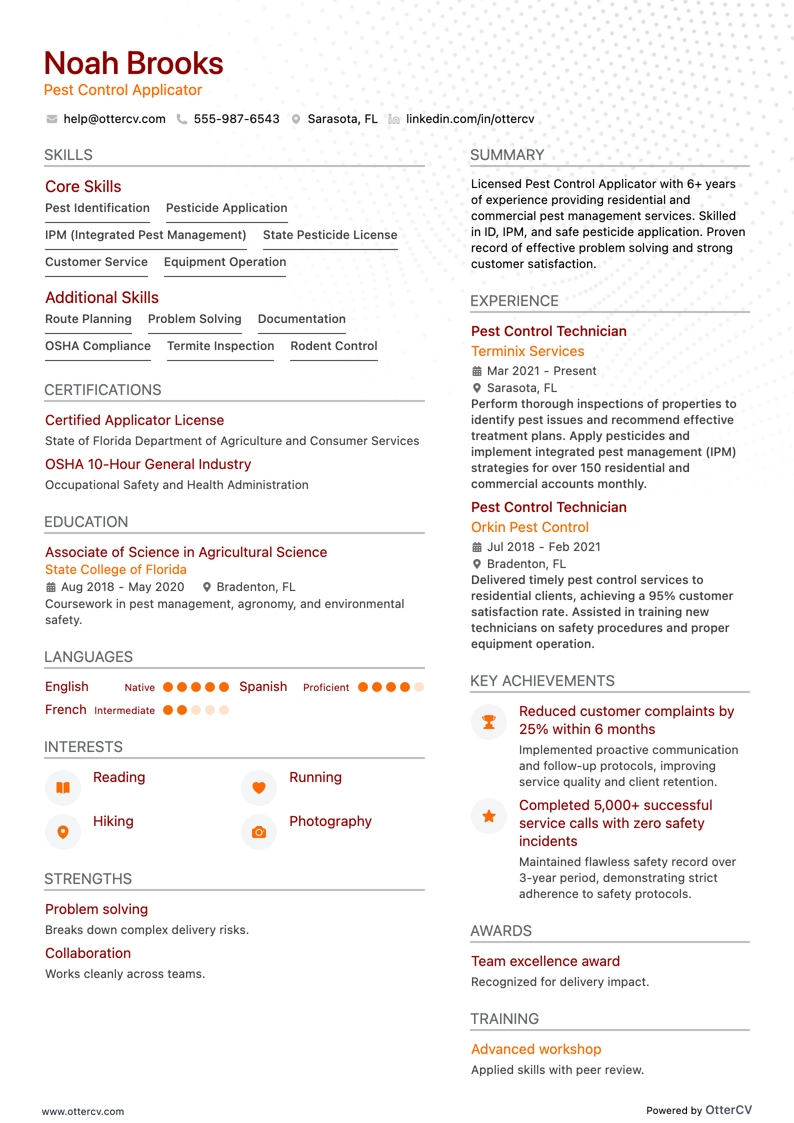
Pest Control Applicator resume example

Pest Control Applicator

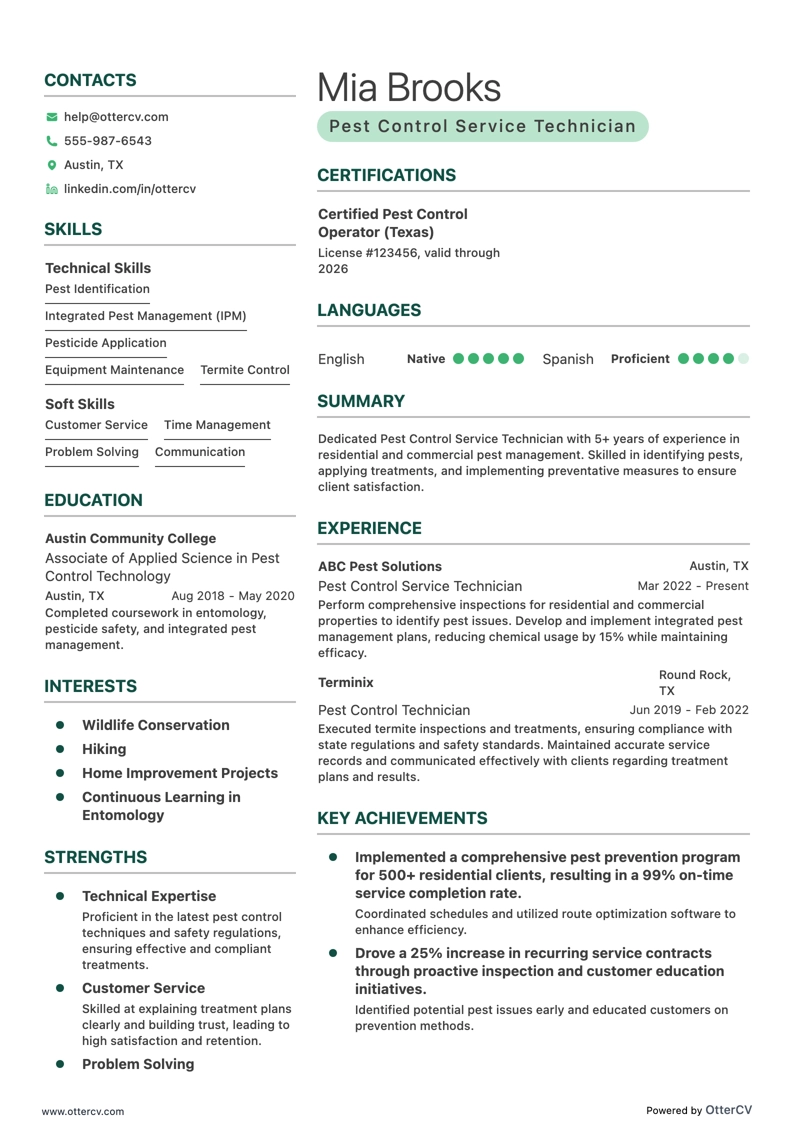
Pest Control Service Technician resume example

Pest Control Service Technician

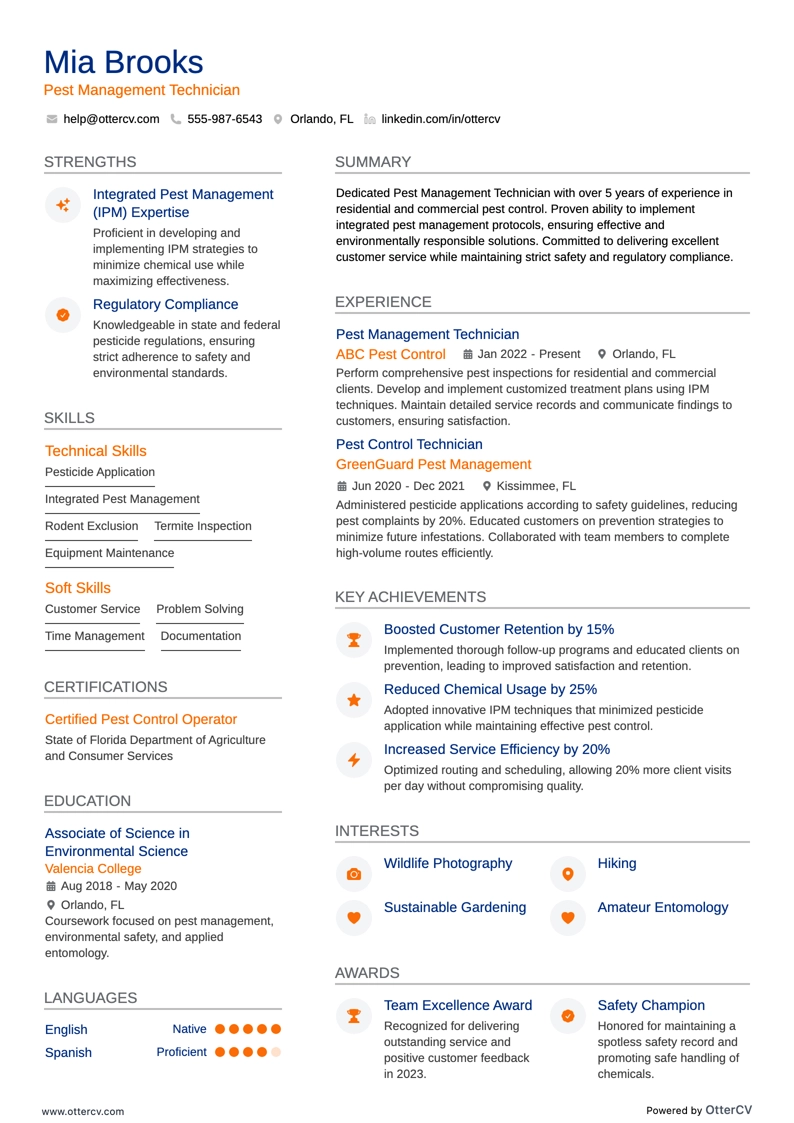
Pest Management Technician resume example

Pest Management Technician

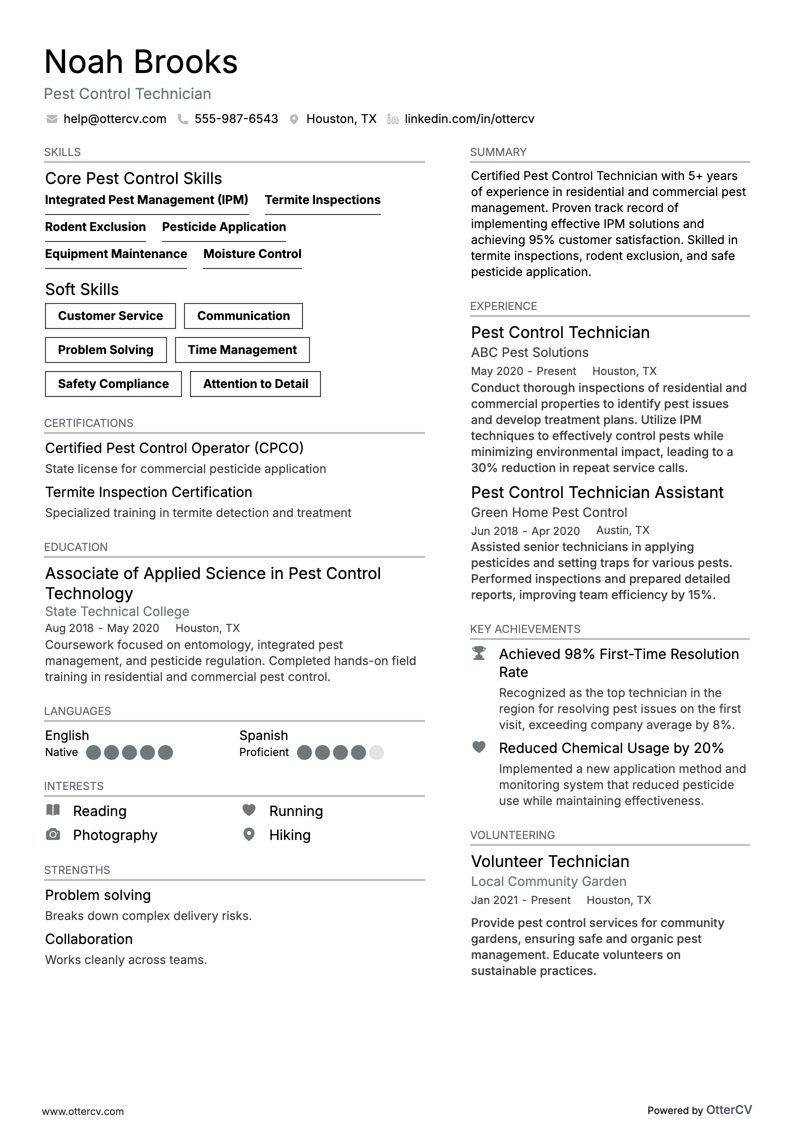
Pest Control Technician resume example

Pest Control Technician

Most pest control technician resumes fail because they read like task logs instead of proof of results. That makes them easy for ATS software to filter out and easy for hiring managers to skim past. In a crowded field, vague duty lists rarely lead to interviews. Learning how to make your resume stand out starts with showing what you improved and how you measured it.

A strong resume helps you stand out quickly by focusing on measurable impact. Highlight results such as reduced callbacks, higher first-visit resolution rates, larger route volume, fewer customer complaints, better inspection pass rates, and stronger renewal revenue.

Key takeaways

  • Quantify pest control results with metrics like callback rates, service volume, and retention instead of relying on vague task lists.

  • Use a reverse-chronological format if you have technician experience, and a hybrid format if you are changing careers.

  • Tailor each experience bullet to the job posting’s specific methods, tools, and certifications.

  • Place certifications above education when they are recent or required for the role.

  • Start your skills section with hard skills, and support each one with proof in your experience bullets.

  • Write a three- to four-line summary that includes your title, specializations, and one measurable win.

  • Use Echocv to turn routine job duties into focused, metric-driven resume bullets faster.

Job market snapshot for pest controls

We analyzed 736 recent pest control job ads across major US job boards to give you a quick view of in-demand skills, the salary landscape, and employment type trends.

What level of experience employers are looking for pest controls

Years of ExperiencePercentage found in job ads
1–2 years3.3% (24)
3–4 years16.0% (118)
5–6 years0.3% (2)
10+ years2.9% (21)
Not specified77.6% (571)

Pest control ads by area of specialization (industry)

Industry (Area)Percentage found in job ads
Finance & Banking86.8% (639)
Healthcare10.9% (80)
Government1.5% (11)

Top companies hiring pest controls

CompanyPercentage found in job ads
ORKIN, LLC29.1% (214)
Aptive Pest Control15.5% (114)
Rentokil Initial14.9% (110)
Ecolab Inc.10.6% (78)
OPC Pest Service10.5% (77)
ARROW EXTERMINATORS , Inc5.7% (42)
Braman Termite & Pest Elimination3.7% (27)
Hughes Exterminators1.4% (10)

Role overview stats

These tables outline the most common responsibilities and employment types for pest control roles. Use them to align your resume with employer expectations and understand how the role is typically structured across the market.

Day-to-day activities and top responsibilities for a pest control

ResponsibilityPercentage found in job ads
Osha-compliant respirator21.5% (158)
Pesticide license21.5% (158)
Personal protective equipment17.7% (130)
Handheld device14.9% (110)
Pest control9.4% (69)
Driver's license9.1% (67)
Handheld computerized equipment6.9% (51)
Pest detection6.8% (50)
Pest elimination6.8% (50)
Pest prevention6.7% (49)
Ppe6.7% (49)
Customer service5.3% (39)

How to format a pest control resume

Recruiters hiring for pest control roles prioritize hands-on technical skills, relevant certifications and licenses, and a clear record of reliable field performance. A clean, well-structured resume format helps make these qualifications immediately visible instead of burying them in cluttered sections or unconventional layouts.

I have significant experience in this role—which format should I use?

I have significant experience in this role—which format should I use?

Use a reverse-chronological format to showcase your growing expertise and consistent track record in pest management.

  • Lead with your most recent position and highlight your scope of responsibility, such as territory size, client volume, or team oversight.
  • Feature role-specific credentials prominently, including pesticide applicator licenses, integrated pest management (IPM) certifications, termite treatment qualifications, and equipment proficiencies.
  • Quantify outcomes that demonstrate business impact, including client retention rates, service efficiency gains, and revenue generated.

Example: “Managed a 120-account residential and commercial route across three counties, achieving a 96% client retention rate and reducing callback frequency by 34% over 18 months through proactive IPM protocols.”

I'm junior or switching into this role—what format works best?

I'm junior or switching into this role—what format works best?

A hybrid resume format works best because it lets you lead with relevant skills and certifications while still showing a concise work history.

  • Place a dedicated skills section near the top of your resume, including pest identification knowledge, chemical handling safety, customer service abilities, and any licenses you have earned or are pursuing.
  • Include hands-on projects, volunteer work, or training programs that show practical exposure to pest control methods, even if they were not formal employment.
  • Connect each skill or experience to a concrete action and a measurable or observable result.

Example scaffold: “IPM coursework (skill) → conducted residential property inspections during a 200-hour field practicum (action) → identified and documented infestations across 40+ properties with zero safety incidents (result).”

Why not use a functional resume?

Why not use a functional resume?

A functional resume removes the timeline and context recruiters need to verify your hands-on pest control experience, which makes it harder for them to judge your reliability and how your skills have developed over time.

  • A functional format may be acceptable if you are entering pest control from a related trade, such as landscaping or facilities maintenance, and have no direct field experience, or if you have significant resume gaps. In either case, tie every listed skill to a specific project, training outcome, or measurable result.
  • Avoid a functional resume entirely if you have any relevant pest control work history, since most hiring managers and applicant tracking systems expect a clear employment timeline.

Once you’ve chosen the right format, the next step is deciding which sections to include so each one earns its place on the page.

What sections should go on a pest control resume

Recruiters expect clear proof that you can inspect, treat, and prevent pest issues safely, compliantly, and efficiently. Knowing what to put on a resume for pest control roles helps you prioritize the right content from the start.

Use this structure for maximum clarity:

  • Header
  • Summary
  • Experience
  • Skills
  • Projects
  • Education
  • Certifications
  • Optional sections: Awards, Leadership, Languages

Strong experience bullets should highlight measurable results, such as reduced callbacks, improved customer satisfaction, higher route efficiency, and consistent compliance with safety and documentation requirements.

With your resume’s key components in place, the next step is to write your pest control resume experience section so it supports each part with clear, role-specific proof.

How to write your pest control resume experience

Your experience section should show real results in pest management, whether through effective treatments, integrated pest management strategies, or client retention. Hiring managers care more about proven impact than task lists, so focus on measurable outcomes tied to the tools and methods you actually used in the field.

Each entry should include:

  • Job title
  • Company and location (or remote)
  • Dates of employment (month and year)

Add three to five concise bullet points that explain what you owned, how you executed the work, and what outcomes you delivered:

  • Ownership scope: the service territories, client accounts, treatment programs, or technician teams you were directly accountable for in your pest control role.
  • Execution approach: the pesticides, application equipment, integrated pest management techniques, inspection protocols, or regulatory frameworks you used to diagnose infestations and deliver treatments.
  • Value improved: changes to treatment effectiveness, customer satisfaction, safety compliance, callback rates, or environmental impact resulting from your pest control work.
  • Collaboration context: how you coordinated with property managers, health inspectors, sales teams, or clients to plan service schedules, resolve infestations, or ensure regulatory compliance.
  • Impact delivered: outcomes expressed through client retention, revenue growth, reduction in pest recurrence, expanded service coverage, or improved safety records rather than routine task descriptions.

Experience bullet formula

Experience bullet formula

Action verb + technology + what you built or fixed + measurable result

A pest control experience example

Pest Control Technician

GreenShield Pest Solutions | Phoenix, AZ

2022–Present

Regional residential and light commercial pest management provider serving more than 8,000 active accounts across Maricopa County.

  • Diagnosed and treated termite, rodent, and general pest activity across 1,100+ service visits per year using integrated pest management protocols, moisture meters, and boroscopes, reducing repeat callbacks by 28%.
  • Created digital service reports, photos, and chemical usage logs in PestPac, improving first-time invoice accuracy to 99% and cutting end-of-day administrative time by four hours per week.
  • Executed targeted baiting and exclusion programs using tamper-resistant stations, snap traps, and sealant-based entry-point remediation, reducing rodent re-infestations by 35% across 52 multi-unit housing units.
  • Calibrated and maintained backpack sprayers and bait applicators, standardized dilution and application rates per label and state requirements, and lowered chemical overuse by 12% while maintaining treatment efficacy.
  • Worked with property managers and homeowners to set treatment plans and follow-up schedules, increasing quarterly renewal conversions by 18% and generating $96,000 in annualized recurring revenue.

Now that you've seen what a strong experience section looks like, the next step is adjusting those details to fit the specific pest control job you're applying for.

How to tailor your pest control resume experience

Recruiters review pest control resumes through both human screening and applicant tracking systems, so tailoring your resume to the job description is essential. When your work history aligns with the role, your qualifications are easier to spot right away.

Ways to tailor your pest control experience:

  • Match the exact pesticide application methods listed in the job posting.
  • Use the same terminology for integrated pest management protocols.
  • Reflect the inspection frequency or service KPIs the employer mentions.
  • Include the certifications or licenses the job description requires.
  • Highlight experience with the pest species or environments named in the posting.
  • Emphasize safety compliance and EPA regulatory knowledge when requested.
  • Reference the route management or scheduling software they specify.
  • Showcase the client communication or reporting workflows described in the role.

Tailoring means aligning your real accomplishments with the employer's stated requirements, not forcing in keywords that do not belong.

Resume tailoring examples for pest control

Job description excerptUntailoredTailored
Perform integrated pest management (IPM) inspections for commercial food processing facilities and document findings using PestPac software.Conducted inspections and handled pest problems for various clients.Performed IPM inspections across 12 commercial food processing facilities, documenting findings and treatment plans in PestPac to maintain FDA and AIB compliance.
Apply termiticide treatments including Termidor and Altriset using trenching, rodding, and sub-slab injection methods for residential accounts.Applied chemicals to treat pest issues at customer homes.Applied Termidor and Altriset termiticide treatments using trenching, rodding, and sub-slab injection methods for 30+ residential accounts, achieving a 98% customer retention rate.
Identify and treat infestations of German cockroaches, bed bugs, and rodents in multi-unit housing using bait stations, gel baits, and exclusion techniques.Treated common pests in apartment buildings using standard methods.Identified and eliminated German cockroach, bed bug, and rodent infestations across 200+ multi-unit housing properties using bait stations, gel baits, and exclusion techniques, reducing callback rates by 35%.

Once your experience is aligned with the role’s priorities, quantify your pest control achievements to show the measurable impact of your work.

How to quantify your pest control achievements

Quantifying your achievements shows that you reduced infestations, protected customers, and managed routes efficiently. Use route logs, inspection reports, and customer feedback to track service volume, callback rates, compliance outcomes, revenue saved, and response times.

Quantifying examples for pest control

MetricExample
Service volumeCompleted 28–32 residential and commercial services per day using ServiceTitan routing, averaging 97% on-time arrivals across a six-month peak season.
Callback rateCut 30-day callbacks from 6.2% to 2.1% by tightening inspection checklists and bait placement standards for German cockroach accounts.
Compliance qualityMaintained 100% label and Safety Data Sheet documentation accuracy across 180 monthly accounts, passing three state audits with zero citations.
Risk reductionReduced rodent activity reports by 55% at a 220,000-square-foot warehouse by sealing 40 entry points and installing twenty-four monitored bait stations.
Revenue retentionRecovered $18,400 in annual renewals by resolving twelve at-risk accounts within forty-eight hours and documenting corrective actions with photos in Jobber.

With strong bullet points in place, the next step is making sure your skills section shows the right mix of hard and soft skills for pest control roles.

How to list your hard and soft skills on a pest control resume

Your skills section should show that you can inspect, treat, and prevent infestations safely and compliantly. Recruiters and an ATS (applicant tracking system) scan this section quickly for keywords, so aim for a hard-skill-heavy mix supported by role-specific soft skills.

Pest control roles require a blend of:

  • Product strategy and discovery skills
  • Data, analytics, and experimentation skills
  • Delivery, execution, and go-to-market discipline
  • Soft skills

Your skills section should be:

  • Scannable, using bullet-style grouping
  • Relevant to the job post
  • Backed by proof in your experience bullets
  • Updated with current tools

Place your skills section:

  • Above your experience if you're junior or switching careers
  • Below your experience if you're mid- or senior-level with strong achievements

Hard skills

  • Integrated pest management (IPM).
  • Structural pest inspections.
  • Pest identification and biology.
  • Baiting systems and monitoring stations.
  • Rodent exclusion and entry-point sealing.
  • Termite treatment, trenching, and drilling.
  • Insecticide application with calibrated sprayers.
  • EPA label compliance and dilution calculations.
  • Safety data sheets and hazard communication.
  • Service documentation and route software.
  • Customer account notes and invoicing systems.
  • Trap placement and humane removal protocols.

Soft skills

  • Explain treatment plans clearly.
  • Set clear expectations and timelines.
  • De-escalate homeowner concerns.
  • Ask targeted inspection questions.
  • Document findings consistently.
  • Prioritize high-risk infestations.
  • Escalate structural issues quickly.
  • Coordinate with office dispatch.
  • Follow up on reservice requests.
  • Protect customer property on-site.
  • Maintain composure under pressure.
  • Work independently on route.

How to show your pest control skills in context

Skills should not appear only in a bulleted list on your resume. Reviewing examples of resume skills used in context can help you see how strong candidates weave them in naturally.

Your skills should be demonstrated in:

  • Your summary (high-level professional identity)
  • Your experience (proof through outcomes)

Here’s what that looks like in practice.

Summary example

Senior pest control technician with 12 years of experience in commercial integrated pest management. Skilled in termite remediation, wildlife exclusion, and Pestroutes scheduling. Reduced recurring infestations by 35% across a 200-property portfolio through data-driven treatment planning.

Key strengths highlighted

  • Specifies senior-level experience immediately
  • Names industry-relevant tools and methods
  • Includes a concrete, measurable outcome
  • Highlights strategic thinking as a soft skill

Experience example

Senior Pest Control Technician

GreenShield Pest Solutions | Tampa, FL

March 2018–Present

  • Implemented integrated pest management protocols across 140 commercial accounts, reducing callback rates by 28% within one year.
  • Worked with property managers and health inspectors to resolve complex rodent infestations, achieving full compliance on every audit.
  • Used Pestroutes and GPS route optimization to increase daily service capacity by 18% while maintaining a 96% customer satisfaction score.
  • Every bullet includes measurable proof.
  • Skills appear naturally through real outcomes.

Once you’ve shown your abilities with specific, results-focused examples, the next step in learning how to write a pest control resume with no experience is to apply that same approach to transferable skills and relevant activities.

How do I write a pest control resume with no experience

Even without full-time experience, you can show that you’re ready for the job through transferable skills and hands-on activities. If you’re building a resume without work experience, focus on practical experience that shows you can handle pest control responsibilities:

  • Volunteer facility pest inspections.
  • Home integrated pest management logs.
  • Food safety or sanitation training.
  • Landscaping and yard maintenance work.
  • Customer service in field roles.
  • Equipment handling and maintenance tasks.
  • Safety training and incident reporting.
  • Route planning for deliveries.

Focus on including:

  • Inspection notes with clear findings.
  • Safety training and compliance records.
  • Tool use and equipment upkeep.
  • Measurable results and documentation.

Resume format tip for entry-level pest control

Resume format tip for entry-level pest control

Use a combination resume format because it puts pest control skills and projects first while still showing steady work history and training.

Do:

  • Add a skills section with tools.
  • List safety training with dates.
  • Use numbers for results and volume.
  • Include documentation, logs, and checklists.
  • Tailor keywords to the job posting.

Example project bullet:

  • Logged eight weeks of home integrated pest management, set and monitored sticky traps, sealed entry points, and reduced indoor ant sightings by 70%.

Even without direct experience, your education section can show relevant knowledge and training that strengthens your candidacy.

How to list your education on a pest control resume

Your education section helps hiring teams confirm that you have foundational knowledge in biology, chemistry, or environmental science relevant to pest control work.

Include:

  • Degree name
  • Institution
  • Location
  • Graduation year
  • Relevant coursework for juniors or entry-level candidates
  • Honors and GPA if 3.5 or higher

Skip the month and day details. List the graduation year only.

Here's a strong education entry tailored to a pest control resume:

Example education entry

Bachelor of Science in Environmental Science

University of Florida, Gainesville, FL

Graduated 2021

GPA: 3.7/4.0

  • Relevant coursework: Integrated Pest Management, Entomology, Soil Science, Chemical Application Safety
  • Honors: Dean's List, Fall 2019–Spring 2021

How to list your certifications on a pest control resume

Certifications on your resume show your commitment to learning, your proficiency with pest control tools and methods, and your relevance to current industry standards.

Include the following details:

  • Certificate name
  • Issuing organization
  • Year
  • Optional: credential ID or URL
  • Place certifications below education when they are older or less relevant than your degree for the pest control role.
  • Place certifications above education when they are recent, required, or closely aligned with the pest control job posting.

Best certifications for your pest control resume

  • Certified Applicator.
  • Certified Operator.
  • Structural Pest Control License.
  • National Pest Management Association QualityPro Certification.
  • Wildlife Control Operator Certification.
  • Termite Control Certification.
  • Integrated Pest Management Certification.

Once your licenses and credentials are easy for hiring managers to spot, use your resume summary to reinforce those qualifications right away and set the tone for the rest of your pest control experience.

How to write your pest control resume summary

Your resume summary is often the first thing a recruiter reads, so it should quickly show that you’re qualified for the pest control role.

Keep it to three to four lines and include:

  • Your job title and total years of hands-on pest control experience.
  • The types of environments you’ve worked in, such as residential, commercial, or industrial settings.
  • Core skills such as integrated pest management, chemical application, and safety compliance.
  • One or two measurable results, such as client retention rates or service efficiency gains.
  • Practical soft skills connected to outcomes, like clear client communication or reliable route management.

PRO TIP

At this level, emphasize technical skills, relevant certifications, and early results that show dependability.

Highlight the specific tools and methods you have used on the job, and avoid vague phrases like "hard worker" or "passionate about pest control."

Example summary for a pest control

Licensed pest control technician with three years of residential and commercial experience. Skilled in integrated pest management and termite treatments. Reduced callback rates by 20% through thorough inspections and client education.

Now that your summary is ready to make a strong first impression, make sure your header presents your contact details clearly so recruiters can easily reach you.

What to include in a pest control resume header

Your resume header should list your key contact details and role focus so pest control recruiters can find you quickly, trust your profile, and screen you accurately.

Essential resume header elements

  • Full name
  • Tailored job title and headline
  • Location
  • Phone number
  • Professional email
  • GitHub link
  • Portfolio link
  • LinkedIn

A LinkedIn link helps recruiters confirm your work history quickly and supports faster screening.

Do not include a photo on a pest control resume unless the role is explicitly front-facing or appearance-dependent.

Match your header title to the pest control job posting, and keep all contact details current, consistent, and easy to scan.

Example

Once your contact details and role information are clear and easy to scan, add extra sections to your pest control resume to strengthen the rest of your application.

Additional sections for pest control resumes

If your core qualifications are similar to those of other applicants, well-chosen additional sections can help your pest control resume stand out and reinforce your expertise. For example, listing language skills can be a strong differentiator if you serve diverse communities.

  • Certifications and licenses
  • Languages
  • Continuing education and training
  • Professional affiliations
  • Volunteer experience
  • Hobbies and interests
  • Awards and recognitions

Once you’ve strengthened your resume with relevant additional sections, the next step is pairing it with a cover letter to give hiring managers a fuller picture of your qualifications.

Do pest control resumes need a cover letter

A cover letter isn’t required for most pest control roles. If you’re unsure what a cover letter is or when it helps, it’s a short document that adds context your resume can’t show. It can make a difference when hiring managers are comparing candidates with similar licenses and experience.

Use a cover letter to add details your pest control resume can’t show:

  • Explain role and team fit: Match your route experience, service style, and communication approach to the company’s pest control model and customer base.
  • Highlight one or two outcomes: Share a specific pest control project, such as reducing callbacks, improving inspection accuracy, or increasing renewal rates.
  • Show business and customer understanding: Reference the company’s services, target customers, and compliance needs, and explain how you’ll protect property and customer trust.
  • Address transitions or non-obvious experience: Connect adjacent work, gaps, or a new market to pest control skills like safety, documentation, and customer education.

Even if you decide to include a cover letter based on the role and employer’s expectations, AI can help you improve your pest control resume faster and more consistently.

Using AI to improve your pest control resume

AI can improve your resume’s clarity, structure, and impact. It can help you choose stronger action verbs and quantify results. But if you rely on it too much, your resume can start to sound robotic. Once your content is clear and aligned with the role, step away from AI. If you’re wondering which AI is best for writing resumes, use tools that strengthen your real experience rather than inventing it.

Here are 10 practical prompts you can copy and paste to improve specific sections of your pest control resume:

  1. Strengthen your summary. “Rewrite my pest control resume summary to highlight years of experience, key specializations, and measurable results in under four sentences.”
  2. Quantify your impact. “Add specific metrics to these pest control experience bullets, focusing on service volume, customer retention rates, or territory coverage.”
  3. Improve action verbs. “Replace weak verbs in my pest control job descriptions with strong, industry-relevant action verbs that show direct contribution.”
  4. Tailor to a job posting. “Compare my pest control resume experience section against this job description and suggest targeted edits for better alignment.”
  5. Refine your skills list. “Reorganize my pest control skills section into technical skills, certifications, and soft skills, removing anything redundant or vague.”
  6. Highlight certifications. “Reformat my pest control certifications section to emphasize license type, issuing body, and expiration date clearly.”
  7. Clarify project contributions. “Rewrite this pest control project description to clarify my specific role, methods used, and measurable outcomes achieved.”
  8. Tighten education details. “Edit my education section to highlight coursework or training directly relevant to pest control operations and safety compliance.”
  9. Remove filler language. “Identify and remove vague or filler phrases from my pest control resume that add no measurable or specific value.”
  10. Check overall consistency. “Review my entire pest control resume for inconsistent tense, formatting errors, and misaligned bullet-point structure.”

Stop using AI once your resume sounds accurate, specific, and grounded in real experience. AI should never invent experience or inflate claims—if it didn’t happen, it doesn’t belong here.

Conclusion

A strong pest control resume shows results with clear numbers and remains easy to scan. Highlight measurable outcomes such as reduced callbacks, faster response times, and higher customer satisfaction, then support them with role-specific skills like inspection, treatment planning, safe chemical handling, and accurate reporting.

Keep the structure clean with clear headings, focused bullet points, and consistent formatting. This demonstrates that you can meet current hiring needs and adapt to near-future expectations. With solid metrics and relevant skills, your pest control resume will stand out.

Pest Control resume examples

Explore additional Pest Control resume samples and guides and see what works for your level of experience or role.

By Experience

Lead Pest Control Technician

Lead Pest Control Technician resume preview

Senior Pest Control Technician

Senior Pest Control Technician resume preview

Pest Control resume examples

Explore additional Pest Control resume samples and guides and see what works for your level of experience or role.

By Role

Fumigation Technician

Fumigation Technician resume preview

Mosquito Control Technician

Mosquito Control Technician resume preview

Termite Control Technician

Termite Control Technician resume preview

Integrated Pest Management Technician

Integrated Pest Management Technician resume preview

Exterminator

Exterminator resume preview

Pest Control Operator

Pest Control Operator resume preview

Pest Control Applicator

Pest Control Applicator resume preview

Pest Control Service Technician

Pest Control Service Technician resume preview

Pest Management Technician

Pest Management Technician resume preview

Pest Control Technician

Pest Control Technician resume preview