Puppeteer full preview

10 Performing Arts Resume Examples

OtterCV

Written by The OtterCV Team

Updated: 3/31/2023•8 min read

See all resume examples in this guide, or generate your own resume example with your personalized prompt

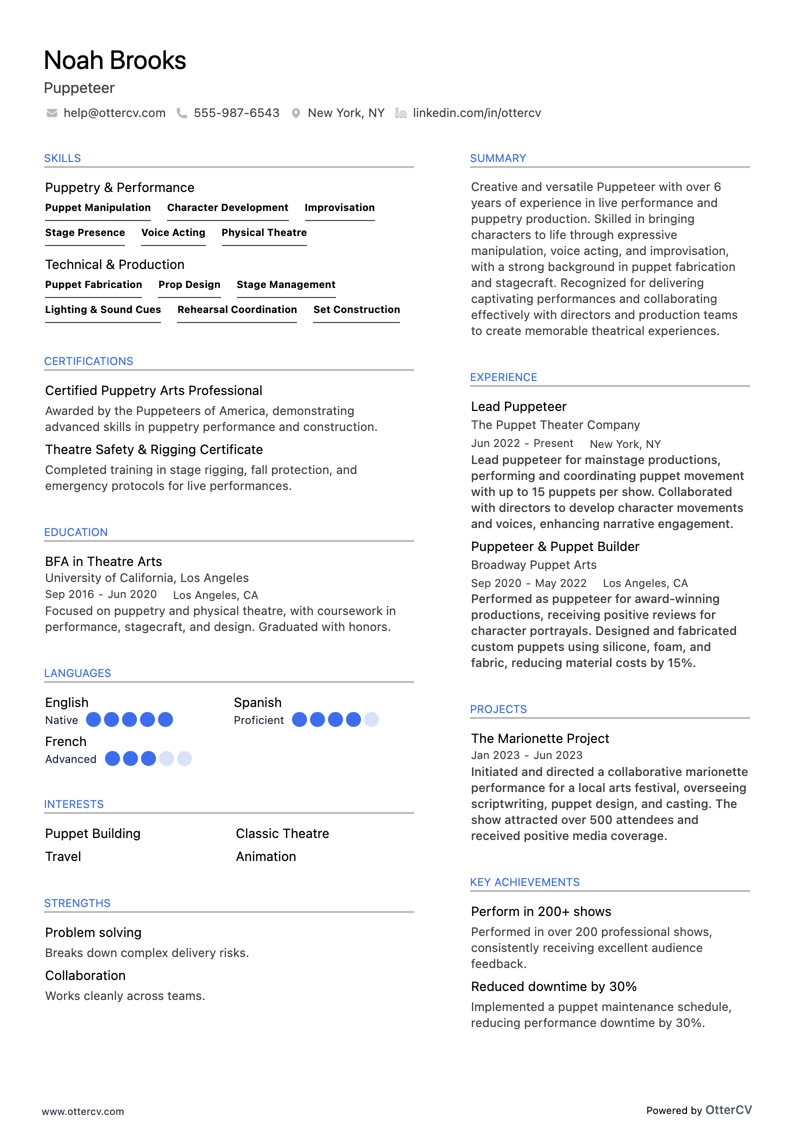
Puppeteer resume example

Puppeteer

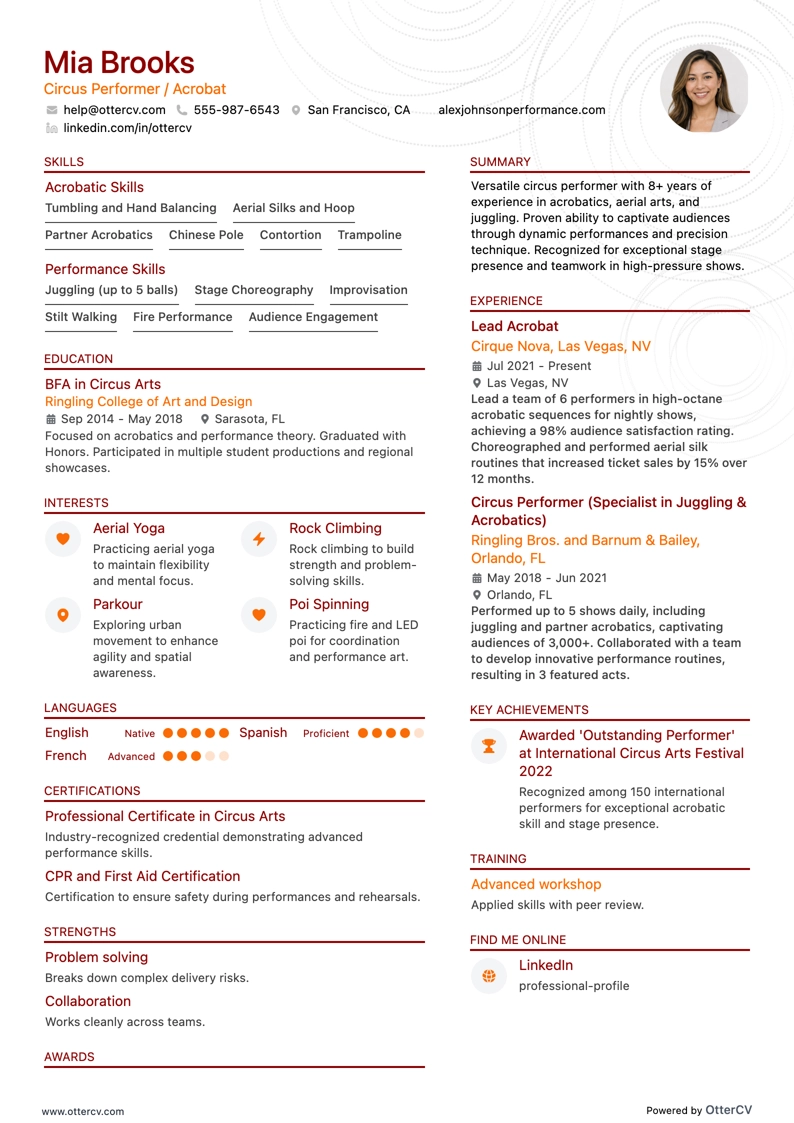
Circus Performer resume example

Circus Performer

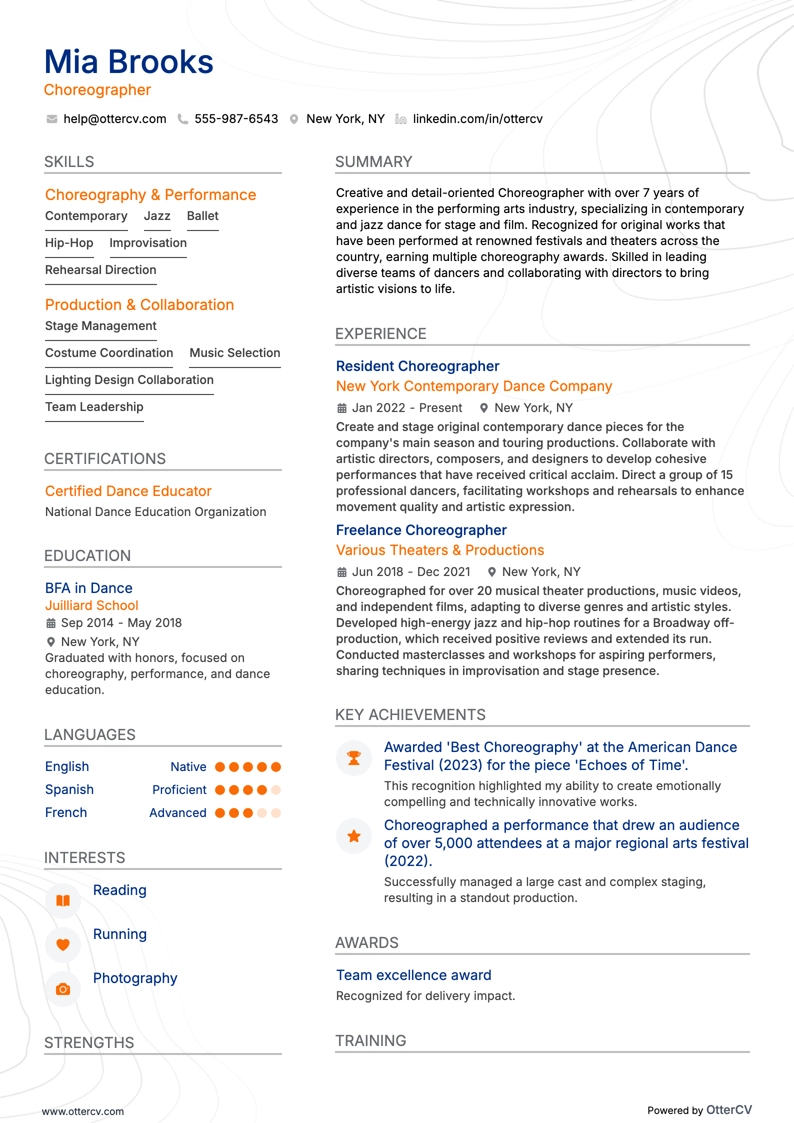
Choreographer resume example

Choreographer

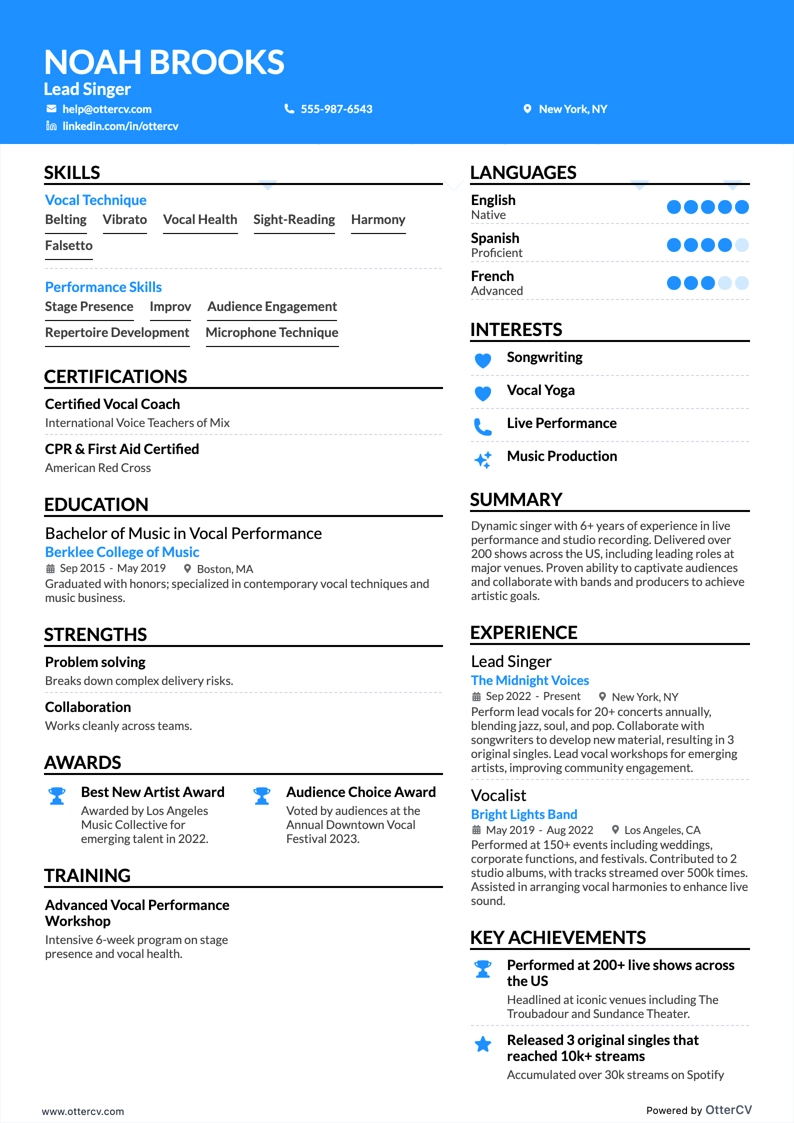
Singer resume example

Singer

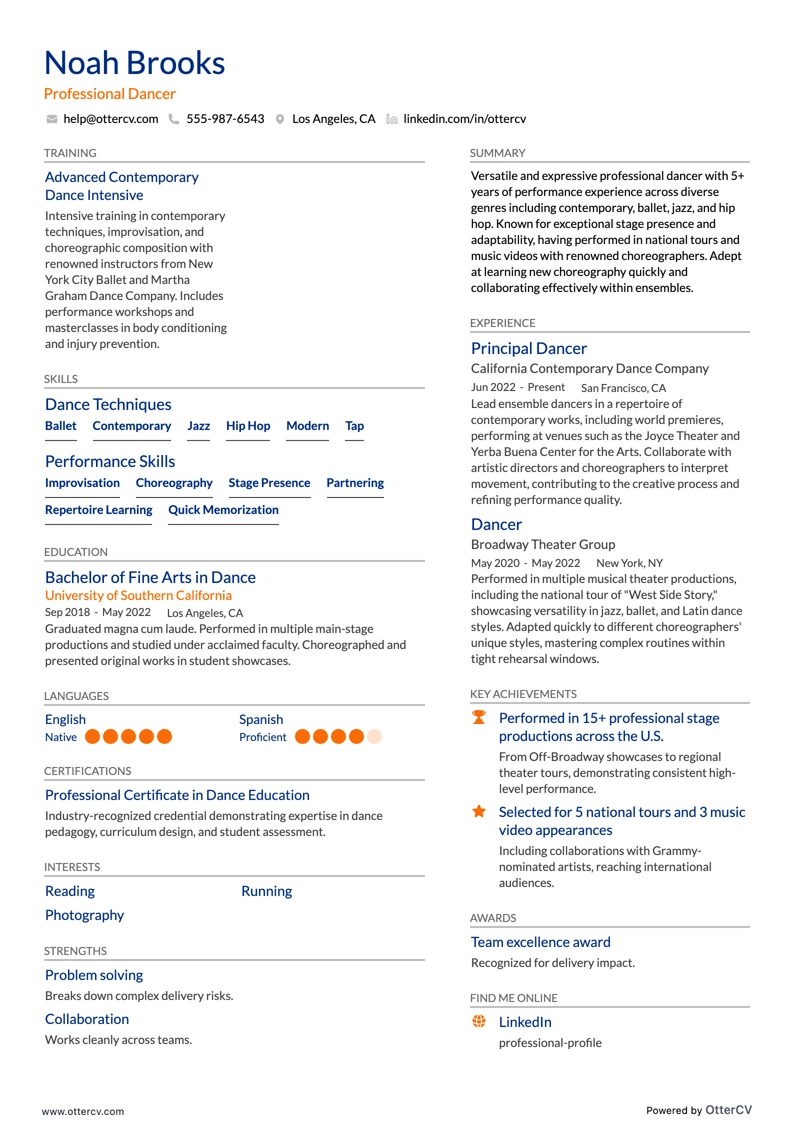
Dancer resume example

Dancer

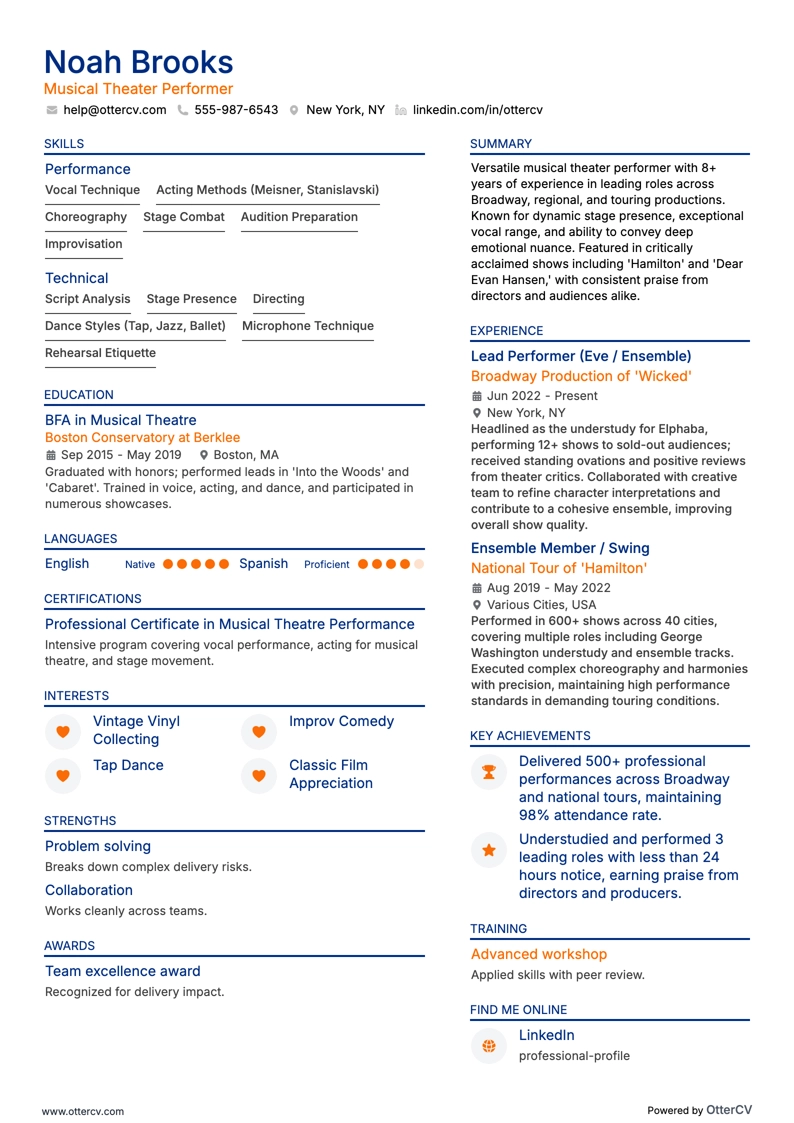
Musical Theater Performer resume example

Musical Theater Performer

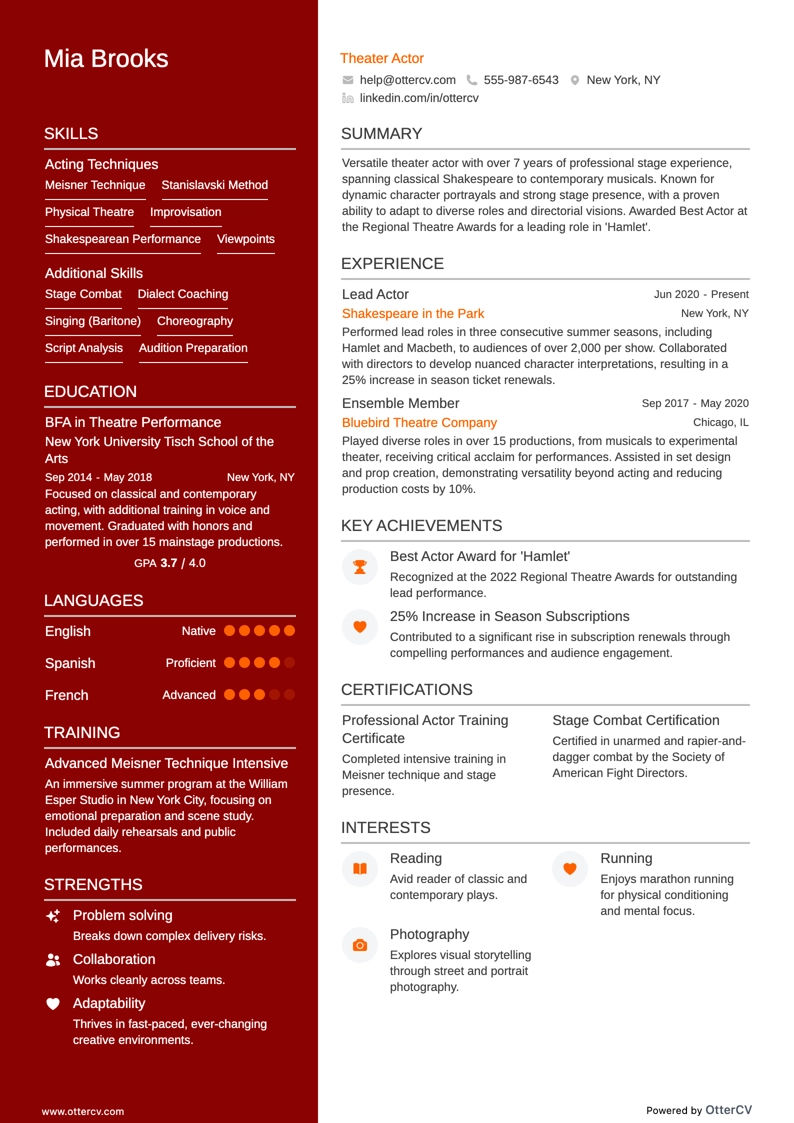
Theater Actor resume example

Theater Actor

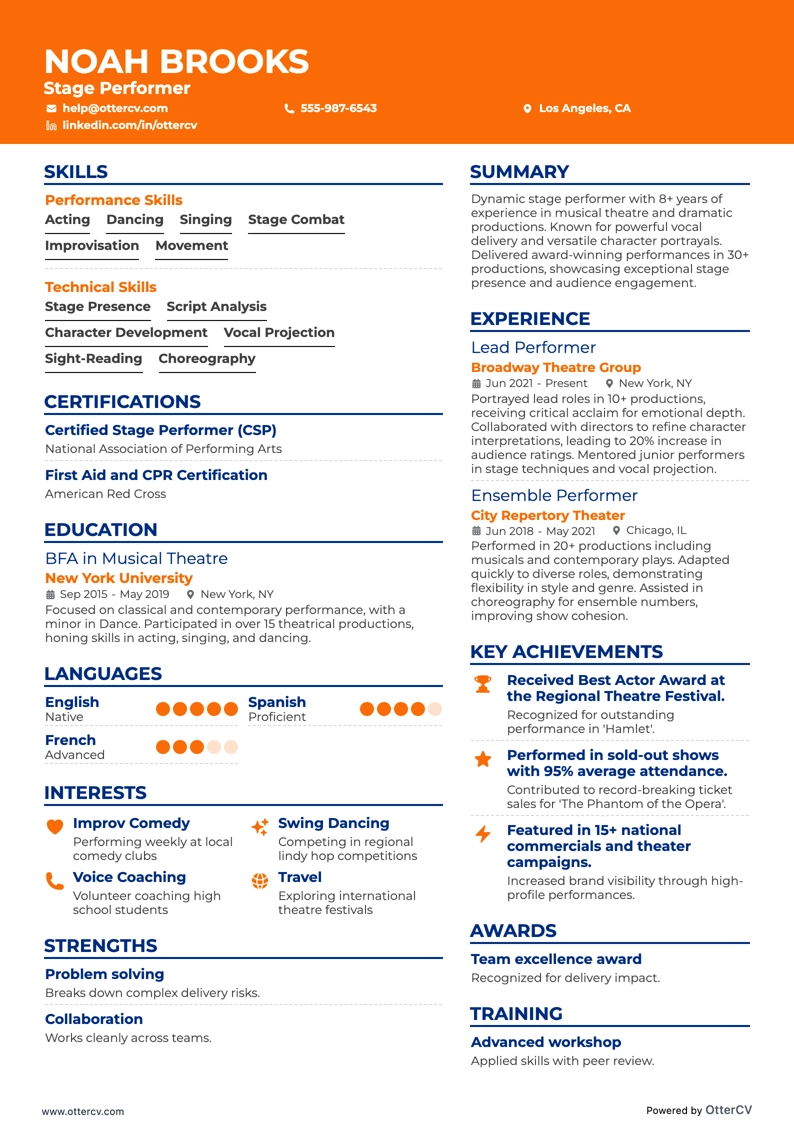
Stage Performer resume example

Stage Performer

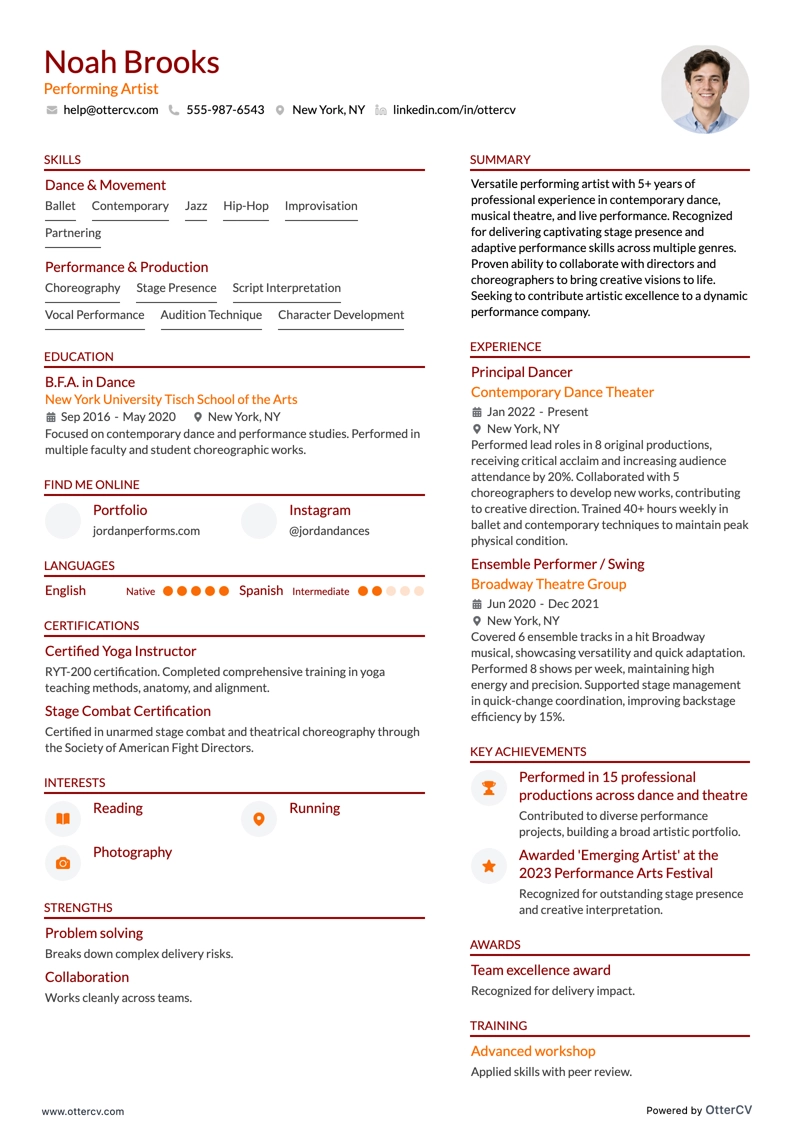
Performing Artist resume example

Performing Artist

How to Make a Performing Arts Resume Stand Out

Many performing arts resumes fall short because they read like a playbill instead of showing real impact. To succeed, a performing arts resume needs to grab attention in seconds, pass ATS screening, and stand out in a competitive audition-to-offer pipeline. Understanding how to make your resume stand out is essential in this field.

A stronger approach is to lead with outcomes: roles booked, houses filled, and productions delivered. Include measurable results such as ticket revenue growth, audience growth, critical reviews, tour dates completed, budget size managed, rehearsal-to-opening timelines met, and improvements in safety and quality.

Key takeaways

  • Lead with measurable outcomes such as audience size, run length, and revenue, not just job titles.

  • Use a reverse-chronological format for deep credits and a hybrid format if you are changing careers.

  • Tailor each resume to the posting’s language, techniques, and production style.

  • Add numbers to every experience bullet, such as cue accuracy, ticket sales, cast retention, or safety records.

  • Place skills above experience if you are junior, and below experience if you are mid-level or senior.

  • Keep your summary under four lines with a clear title, domain, and one quantified result.

  • Use Echocv to turn vague duties into specific, recruiter-ready bullets faster.

Job market snapshot for performing arts

We analyzed 97 recent performing arts job ads across major US job boards. This snapshot highlights in-demand skills, top hiring companies, and employer expectations at a glance.

What level of experience employers are looking for performing arts

Years of ExperiencePercentage found in job ads
1–2 years5.2% (5)
3–4 years1.0% (1)
5–6 years4.1% (4)
10+ years28.9% (28)
Not specified60.8% (59)

Performing arts ads by area of specialization (industry)

Industry (Area)Percentage found in job ads
Education42.3% (41)
Healthcare30.9% (30)
Finance & Banking13.4% (13)

Top companies hiring performing arts

CompanyPercentage found in job ads
New York Edge15.5% (15)
Legends11.3% (11)

Role overview stats

These tables outline the most common responsibilities and employment types for performing arts roles. Use them to align your resume with employer expectations and understand how the role is structured across the market.

Day-to-day activities and top responsibilities for a performing arts

ResponsibilityPercentage found in job ads
Excel3.1% (3)
Audio2.1% (2)
Budgeting2.1% (2)
Canvas2.1% (2)
Computer skills2.1% (2)
Cpr2.1% (2)
Data entry2.1% (2)
First aid2.1% (2)
Lighting2.1% (2)
Microsoft office2.1% (2)
Music education2.1% (2)
Outlook2.1% (2)

How to format a performing arts resume

Casting directors and artistic directors focus on your performance credits, training, and physical or vocal skills. They need to assess your range and fit for a production at a glance. The right resume format keeps these details from getting lost in generic formatting, making it easier for decision-makers to match you to a role within seconds. A clean resume layout also helps applicant tracking systems parse your information correctly.

I have significant experience in this role—which format should I use?

I have significant experience in this role—which format should I use?

Use a reverse-chronological format to present a strong, continuous record of performance credits and artistic growth.

  • Lead with your most prominent credits, organized by category such as theater, film, television, and commercial, so directors can quickly assess the scope and caliber of your work.
  • List relevant training, special skills, and physical attributes—such as vocal range, dance styles, dialects, and stage combat—in dedicated sections that are easy to scan.
  • Add measurable context to credits whenever possible, including named roles, production scale, venue reputation, or a notable director.

Example bullet: “Originated the role of Nina in The Seagull at the Guthrie Theater (1,100-seat mainstage), performing 47 shows over a six-week run to 94% average house capacity.”

I'm junior or switching into this role—what format works best?

I'm junior or switching into this role—what format works best?

A hybrid format works best because it lets you lead with your training and skills while still listing any credits or related experience in chronological order.

  • Place a dedicated skills section near the top highlighting vocal range, dance disciplines, instruments, dialects, and any union affiliations.
  • Include student productions, showcases, workshops, community theater, and any transitional experience that demonstrates commitment to the craft.
  • Connect each credit or project to a clear action and outcome so directors understand what you contributed.

Example scaffold: Stage combat certification (skill) → choreographed and performed a two-minute fight sequence for a university production of Romeo and Juliet (action) → received a regional Kennedy Center American College Theater Association nomination for ensemble work (result).

Why not use a functional resume?

Why not use a functional resume?

A functional resume removes the production-by-production context casting directors use to assess your range, growth, and the caliber of your work. If you are changing careers into the performing arts from another field, have very limited credits, or need to address a significant gap in your performance history, a functional format can still work—but only when each listed skill is tied to a specific project, production, or training outcome rather than presented in the abstract.

Now that you've established a clean, scannable layout, it's time to fill it with the right sections to showcase your talent effectively.

What sections should go on a performing arts resume

Recruiters expect a performing arts resume to show your roles, credits, and measurable performance outcomes at a glance. Knowing which resume sections to include helps ensure you don't leave out anything casting teams need.

Use this structure for maximum clarity:

  • Header
  • Summary
  • Experience
  • Skills
  • Projects
  • Education
  • Certifications
  • Optional sections: Awards, Leadership, Languages

Write experience bullets that emphasize impact, outcomes, scope, and results, such as audience reach, run length, venue caliber, and critical recognition.

Now that you’ve organized the key parts of your performing arts resume, the next step is writing your experience section so those details translate into clear, role-ready impact.

How to write your performing arts resume experience

Your work experience section should show the productions you’ve performed in, the techniques you’ve used, and the results your work created—whether that means audience growth, critical recognition, or successful run completions. Hiring managers in the performing arts care more about demonstrated impact than task lists, so each line should show the value you delivered on stage, on screen, or behind the scenes.

Each entry should include:

  • Job title
  • Company and location (or remote)
  • Dates of employment (month and year)

Add three to five concise bullet points that explain what you owned, how you executed the work, and the outcomes you delivered:

  • Ownership scope: the roles, productions, repertoire, ensembles, or creative projects you were directly responsible for across seasons, tours, or engagements.
  • Execution approach: the performance techniques, rehearsal methods, choreographic frameworks, vocal training disciplines, or creative technologies you used to prepare and deliver your work.
  • Value improved: changes you helped create in production quality, audience experience, artistic consistency, technical precision, performance accessibility, or reduced creative risk.
  • Collaboration context: how you worked with directors, choreographers, musical directors, stage managers, designers, casting teams, or fellow performers to shape and refine the final production.
  • Impact delivered: outcomes such as successful run completions, audience reception, expanded reach, awards or nominations, return engagements, or contributions to a company’s artistic reputation rather than routine activity.

Experience bullet formula

Experience bullet formula

Action verb + technology + what you built or fixed + measurable result

A performing arts experience example

Production Stage Manager

Aurora Repertory Theatre | Chicago, IL

2022–Present

Equity-affiliated regional theater producing eight mainstage shows per season across a four-hundred-seat venue and an education studio.

  • Orchestrated rehearsals and performances in Stage Write and Google Workspace, cutting daily call creation time by 35% and reducing schedule conflicts from six per production to one.
  • Built and maintained prompt books in QLab and Vectorworks, improving cue accuracy to 99.6% across an average of four hundred fifty cues per show and eliminating performance holds for missed cues.
  • Led a twenty-two-person backstage team using Slack and Trello for run-of-show coordination, lowering preset-to-curtain time by six minutes and improving on-time curtain rate from 92% to 99%.
  • Standardized safety and rigging checks with OSHA-aligned checklists and incident reporting in Airtable, reducing near-miss reports by 40% and achieving zero recordable injuries over two seasons.
  • Partnered with the artistic director, lighting designer, sound designer, and front-of-house manager to streamline scene-change choreography, cutting average changeover time by 18% and enabling two additional post-show talkbacks per run without overtime.

Now that you’ve seen what a strong experience entry looks like in practice, the next step is tailoring each part to the specific role you’re targeting.

How to tailor your performing arts resume experience

Recruiters review performing arts resumes through both human screening and applicant tracking systems (ATS), so tailoring your resume to the job description can improve your chances of landing an audition or interview. In practice, tailoring means presenting your background using the same language, priorities, and requirements highlighted in the posting.

Ways to tailor your performing arts experience:

  • Match the performance styles or techniques named in the casting notice.
  • Mirror the exact terminology used for rehearsal processes or methods.
  • Highlight collaboration with directors, choreographers, or music directors when the posting references it.
  • Include venue types or production scales that align with the role.
  • Emphasize union affiliations or compliance standards specified in the posting.
  • Reference specific software or tools listed, such as QLab or Vectorworks.
  • Feature relevant genre or repertoire experience the listing prioritizes.
  • Showcase accessibility or inclusion practices when the organization values them.

Tailoring your experience means aligning real accomplishments with what the role requires, not forcing in keywords where they do not belong.

Resume tailoring examples for performing arts

Resume tailoring examples for performing arts

Job description excerptUntailoredTailored

Once you’ve aligned your experience with the role’s demands, the next step is to quantify your performing arts achievements so hiring teams can quickly understand your impact.

How to quantify your performing arts achievements

Quantifying your achievements shows your value beyond talent by highlighting results in attendance, revenue, quality, and delivery. Focus on numbers related to audience engagement, production efficiency, safety risk, and stakeholder satisfaction.

Quantifying examples for performing arts

MetricExample
Audience engagementIncreased average audience satisfaction from 4.2 to 4.7 out of five across twelve shows using post-show surveys and targeted pacing notes.
Revenue impactDrove $38,500 in incremental ticket revenue by launching a three-tier upsell offer and coordinating email copy with the box office.
Delivery speedCut tech rehearsal time by 22% by standardizing cue sheets in Google Sheets and running a fifteen-minute daily cue review.
Quality accuracyReduced missed cues from eight per show to two by implementing headset call-and-response checks and a pre-show cue audit.
Risk reductionAchieved zero recordable safety incidents over a six-week run by enforcing prop weapon checks and documenting daily safety walk-throughs.

Once you’ve written strong bullet points for your experience section, use that same level of precision when presenting your hard and soft skills.

How to list your hard and soft skills on a performing arts resume

Your skills section highlights your performance range and production readiness. Recruiters and an ATS (applicant tracking system) scan it to match casting and crew needs, so aim for a majority of hard skills supported by role-specific soft skills.

Performing arts roles require a blend of:

  • Product strategy and discovery skills
  • Data, analytics, and experimentation skills
  • Delivery, execution, and go-to-market discipline
  • Soft skills

Your skills section should be:

  • Scannable, using bullet-style grouping
  • Relevant to the job post
  • Backed by proof in your experience bullets
  • Updated with current tools

Place your skills section:

  • Above your experience section if you’re junior or switching careers
  • Below your experience section if you’re mid- or senior-level with strong achievements

Hard skills

  • Script analysis and beat work.
  • Vocal technique and sight-singing.
  • Dance technique and choreography retention.
  • Stage combat and weapon safety.
  • Dialects and the International Phonetic Alphabet (IPA).
  • Mic technique for handheld and lavalier microphones.
  • Rehearsal tracking and line notes.
  • Cue calling and prompt book preparation.
  • Lighting, sound, and video cues.
  • QLab, Pro Tools, and Dante.
  • Zoom auditions and self-tape editing.
  • Union compliance, including Equity and SAG-AFTRA.

Soft skills

  • Takes direction quickly.
  • Adjusts performance in real time.
  • Communicates clear notes.
  • Collaborates across departments.
  • Runs efficient rehearsals.
  • Manages backstage priorities.
  • Stays performance-ready under pressure.
  • Resolves conflicts professionally.
  • Gives and receives feedback.
  • Maintains focus during long calls.
  • Owns preparation between rehearsals.
  • Protects safety and boundaries.

How to show your performing arts skills in context

Skills should not live only in a bulleted list on your resume. Review examples of how professionals present their resume skills across different roles for inspiration.

Show them in context through:

  • Your summary, which presents your high-level professional identity
  • Your experience, which proves your skills through outcomes

Here is what that looks like in practice.

Seasoned theater director with 12 years of experience staging classical and contemporary productions. Skilled in blocking, Vectorworks set design, and ensemble coaching. Increased subscriber attendance by 34% across three regional seasons through audience-focused programming.

  • Reflects senior-level career depth
  • Names industry-specific tools and methods
  • Includes a clear measurable outcome
  • Signals leadership and collaboration strengths

Experience example

Resident Stage Director

Lakeshore Repertory Theatre | Milwaukee, WI

June 2018–March 2024

  • Directed 19 full-scale productions, increasing season ticket renewals by 27% through dynamic audience engagement strategies.
  • Worked with lighting designers using ETC Eos consoles to reduce technical rehearsal time by 15% per production cycle.
  • Mentored a rotating ensemble of 40+ actors, improving cast retention rates by 22% over four consecutive seasons.
  • Every bullet contains measurable proof.
  • Skills appear naturally within achievements.

Once you’ve framed your abilities through specific roles, training, and outcomes, the next step is using that same approach to build a performing arts resume when you don’t have formal experience.

How do I write a performing arts resume with no experience

Even without full-time experience, you can show that you’re ready through training, projects, and community work. If you're building a resume without work experience, focus on transferable skills and measurable contributions such as:

  • Conservatory or studio training credits
  • Student or community theater roles
  • Dance recitals and juried showcases
  • Short film or web series roles
  • Voice lessons and recital programs
  • Stage crew and run crew calls
  • Self-produced monologue reel projects
  • Festival submissions and adjudications

Be sure to highlight:

  • Credited roles and production titles
  • Training hours and named instructors
  • Tools: QLab, Pro Tools, Dante
  • Measurable outcomes such as attendance and awards

Resume format tip for entry-level performing arts

Resume format tip for entry-level performing arts

Use a combination resume format to put training, roles, and projects first while still including any work history that shows reliability.

  • Lead with training, roles, and projects.
  • List productions with venue and dates.
  • Add tools used in each credit.
  • Quantify outcomes, such as audience size or ticket sales.
  • Include links to reels and portfolios.

Example project bullet:

  • Self-produced monologue reel project: recorded and edited a two-minute reel in DaVinci Resolve, delivering a final cut in forty-eight hours and earning three audition callbacks.

Even without formal experience, your education and training can provide a strong foundation for your resume when presented clearly.

How to list your education on a performing arts resume

Your education section helps hiring teams confirm that you have foundational training in the performing arts. It shows the relevant skills, techniques, and academic preparation that support your candidacy.

Include:

  • Degree name
  • Institution
  • Location
  • Graduation year
  • Relevant coursework for juniors or entry-level candidates
  • Honors and GPA if 3.5 or higher

Avoid listing specific months or days. For a cleaner look, use the graduation year only.

Here’s a strong education entry tailored to the performing arts:

Example education entry

Bachelor of Fine Arts in Acting

Carnegie Mellon University, Pittsburgh, PA

2022 | GPA: 3.7

  • Relevant coursework: Movement for Actors, Voice and Speech, Scene Study, Musical Theatre Performance
  • Honors: Dean's List (six semesters), graduated magna cum laude

How to list your certifications on a performing arts resume

Certifications on your resume show your commitment to learning, demonstrate tool proficiency, and signal industry relevance in performing arts. They can also help casting teams and producers trust that you are ready for rehearsals and live work.

Include the following details:

  • Certificate name
  • Issuing organization
  • Year
  • Optional: credential ID or URL
  • Place certifications below education when your degree is recent and more relevant than short courses for your target performing arts role.
  • Place certifications above education when the certification is recent, highly relevant, or required for your performing arts work, and your education is older.

Best certifications for your performing arts resume

  • Society of American Fight Directors (SAFD) Actor Combatant Certification.
  • Association of Yoga Professionals International (AYP) 200-Hour Yoga Teacher Training Certification.
  • American Red Cross Adult and Pediatric First Aid/CPR/AED Certification.
  • Dante's Monologue Slam (DMS) Certified Teacher.
  • ABT National Training Curriculum Certification.
  • Estill Voice Training (EVT) Figure Proficiency Certification.
  • Pro Tools Certified User Certification.

Once your credentials are easy for casting teams to scan, focus on your performing arts resume summary to connect those qualifications to your value at a glance.

How to write your performing arts resume summary

Your resume summary is often the first thing a casting director or recruiter reads. A clear, specific opening sets the tone and encourages them to keep reading.

Keep it to three to four lines and include:

  • Your title and total years of performance experience.
  • Your domain, such as musical theater, contemporary dance, or classical voice.
  • Core skills like choreography, improvisation, sight-reading, or stage combat.
  • One or two quantified achievements that show real impact.
  • Soft skills tied to outcomes, such as collaboration that improved ensemble cohesion.

PRO TIP

At an early-career stage, focus on relevant training, specific skills, and any measurable contributions from productions or showcases.

Highlight your versatility and readiness to perform. Avoid vague descriptors like “passionate” or “hardworking,” and instead use concrete abilities and results that demonstrate your value.

Example summary for a performing arts

Musical theater performer with two years of stage experience across five equity-adjacent productions. Trained in Meisner technique and jazz dance. Contributed to a 12% increase in season ticket renewals through audience engagement initiatives.

Now that your summary highlights your strongest qualifications, make sure the header above it clearly presents your contact and professional details so casting directors can reach you without friction.

What to include in a performing arts resume header

Your resume header should list your key contact details and role focus, helping performing arts recruiters identify you quickly, trust your application, and review it efficiently.

Essential resume header elements

  • Full name
  • Tailored job title and headline
  • Location
  • Phone number
  • Professional email
  • GitHub link
  • Portfolio link
  • LinkedIn

A LinkedIn link helps recruiters confirm credits, training, and timelines quickly during screening.

Do not include photos on a performing arts resume unless the role is explicitly front-facing or appearance-dependent.

Keep your performing arts header consistent with your audition materials by matching your stage name, credits naming, and contact details across platforms.

Once your contact details and role identifiers are in place at the top, you can strengthen the rest of your resume with additional sections that add relevant context and support your candidacy.

Additional sections for performing arts resumes

If your core sections do not fully reflect your artistic range, additional sections can help you stand out and highlight role-specific strengths. For example, listing language skills on your resume can help distinguish you for multilingual productions or international tours.

  • Languages
  • Special skills (dialects, stage combat, instruments, dance styles)
  • Awards and nominations
  • Hobbies and interests
  • Workshops and masterclasses
  • Volunteer and community theater work
  • Publications and press features

Once you’ve strengthened your resume with the right supplementary sections, pairing it with a cover letter can add useful context.

Do performing arts resumes need a cover letter

A cover letter is not always required for performing arts roles, but it can help in competitive situations or when hiring teams want context beyond your credits. If you’re unsure where to begin, learn what a cover letter is and how it complements your resume. It can make a difference when your resume does not clearly show fit, focus, or impact.

Use a cover letter to add value in these situations:

  • Explain role or team fit: Match your strengths to the company’s style, production pace, and collaboration needs.
  • Highlight one or two relevant projects or outcomes: Name a production, your role, and a measurable result, such as audience growth or faster changeovers.
  • Show understanding of the product, users, or business context: Reference their audience, venue constraints, brand, or programming goals, and connect that to your approach.
  • Address career transitions or non-obvious experience: Clarify a shift in discipline, gaps, or freelance work, and link it to the role’s requirements.

Even if you decide a separate letter will not add value, you can still strengthen your performing arts resume itself. Next, here is how to use AI to improve it.

Using AI to improve your performing arts resume

AI can improve your resume’s clarity, structure, and impact. It can help tighten language and bring the most relevant experience forward. But overusing it can quickly strip away authenticity. Once your resume reads clearly and fits the role, step away from AI. If you want a place to start, explore ChatGPT resume writing prompts for practical ideas.

Here are 10 practical prompts you can copy and paste to improve specific sections of your performing arts resume:

  1. Strengthen your summary: “Rewrite my performing arts resume summary to highlight my strongest creative skills and most relevant experience in under four lines.”
  2. Quantify experience bullets: “Add measurable outcomes to my performing arts experience bullets, such as audience size, number of productions, or cast size.”
  3. Tighten skill descriptions: “Edit my performing arts skills section to remove vague language and prioritize techniques casting directors actually search for.”
  4. Align with a role: “Tailor my performing arts resume experience section to match this specific job posting while keeping all details truthful.”
  5. Improve project descriptions: “Rewrite my performing arts project entries to clearly state my role, the production type, and one concrete result.”
  6. Clarify training details: “Restructure my performing arts education section to emphasize relevant coursework, techniques studied, and instructors of note.”
  7. Refine certification entries: “Edit my performing arts certifications section so each entry states the credential, issuing body, and practical relevance.”
  8. Cut redundant phrasing: “Identify and remove repeated or filler words across my entire performing arts resume without changing any factual content.”
  9. Boost action verbs: “Replace weak verbs in my performing arts experience bullets with specific, active alternatives that show creative contribution.”
  10. Check overall consistency: “Review my performing arts resume for inconsistent formatting, tense shifts, or misaligned dates across all sections.”

Stop using AI once your resume sounds accurate, specific, and aligned with your real experience. AI should never invent experience or inflate claims—if it did not happen, it does not belong on your resume.

Conclusion

A strong performing arts resume shows impact through measurable outcomes, highlights role-specific skills, and follows a clear structure. It helps casting and hiring teams quickly find your credits, training, and strengths.

Keep each section focused, consistent, and easy to scan. This approach shows you’re ready for today’s performing arts hiring market and the roles ahead.

Performing Arts resume examples

Explore additional Performing Arts resume samples and guides and see what works for your level of experience or role.

By Role

Puppeteer

Puppeteer resume preview

Circus Performer

Circus Performer resume preview

Choreographer

Choreographer resume preview

Singer

Singer resume preview

Dancer

Dancer resume preview

Musical Theater Performer

Musical Theater Performer resume preview

Theater Actor

Theater Actor resume preview

Stage Performer

Stage Performer resume preview

Performing Artist

Performing Artist resume preview