"There's been an enormous amount of insecurity around the world. I think 2026 is going to be a busy year in terms of cyber attacks."
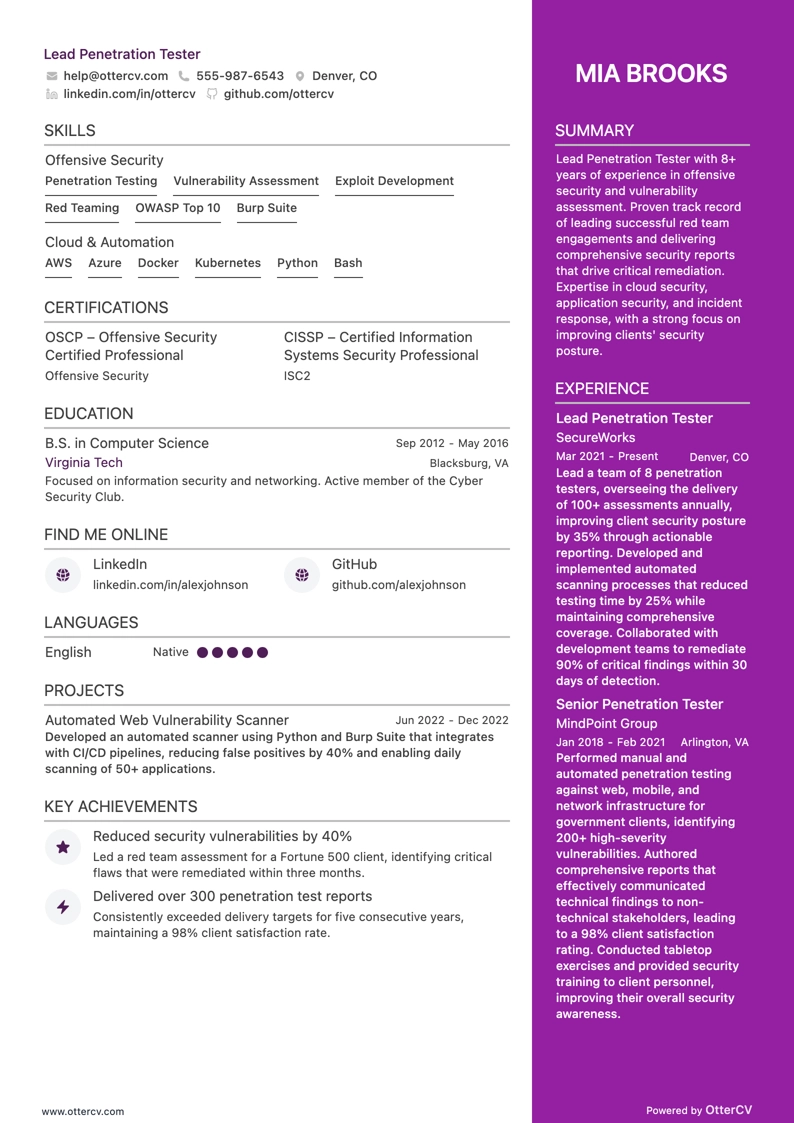
11 Penetration Tester Resume Examples
OtterCV
Written by The OtterCV Team
Updated: 6/7/2025•8 min read
See all resume examples in this guide, or generate your own resume example with your personalized prompt
Lead Penetration Tester
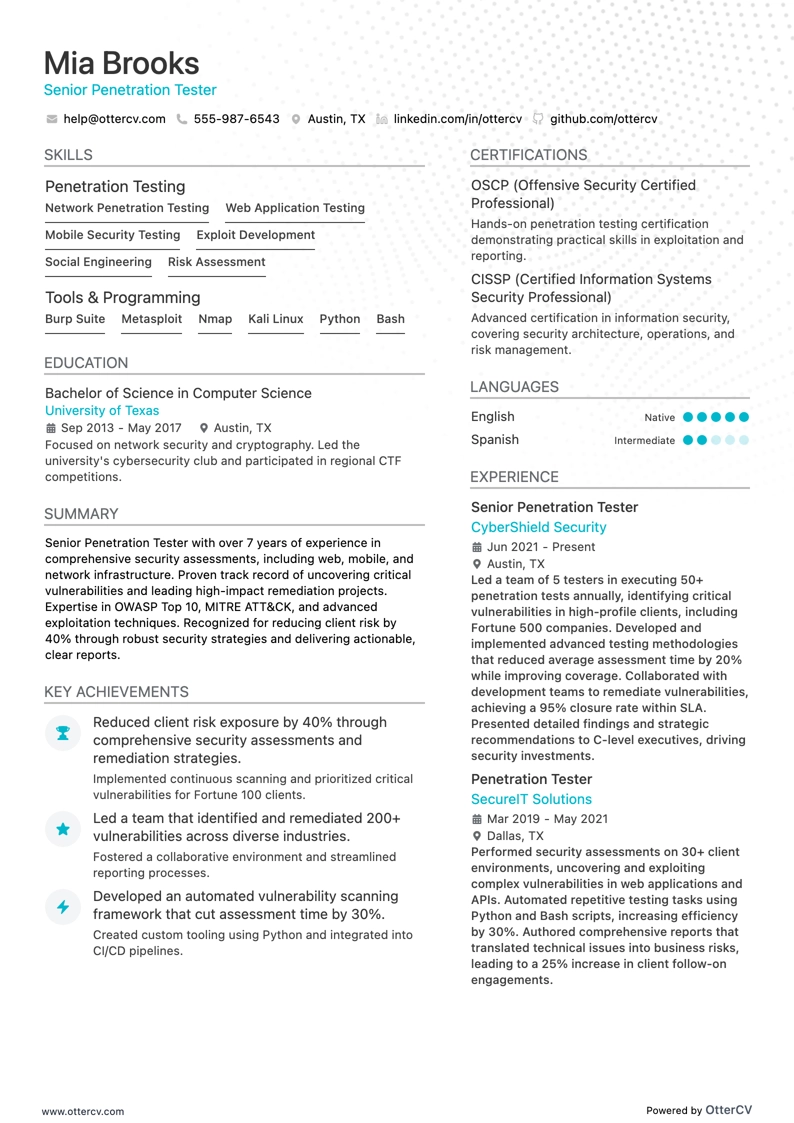
Senior Penetration Tester
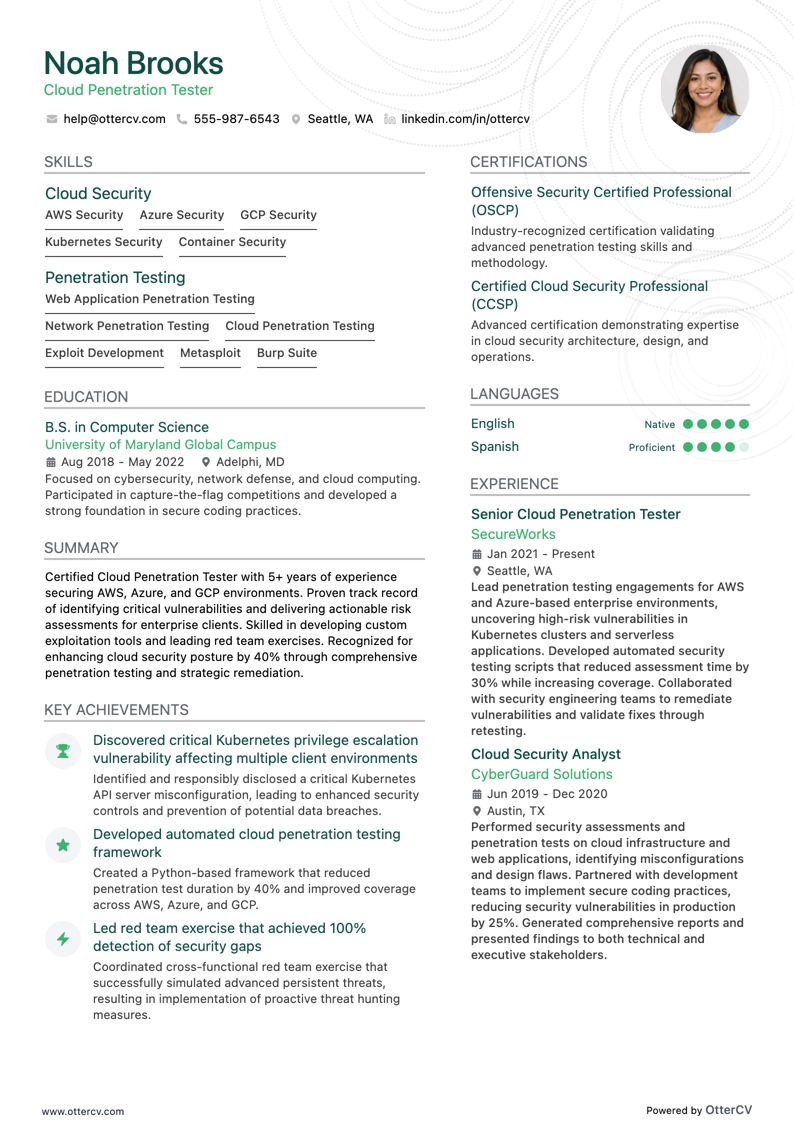
Cloud Penetration Tester
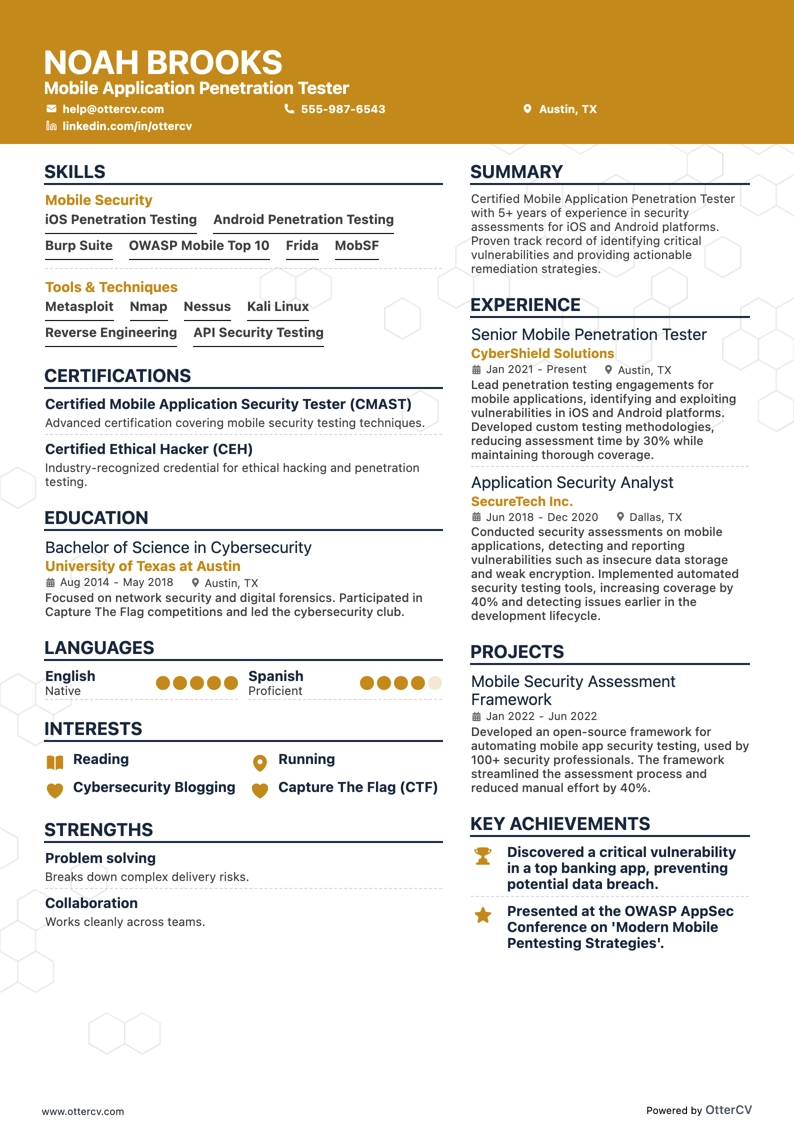
Mobile Application Penetration Tester
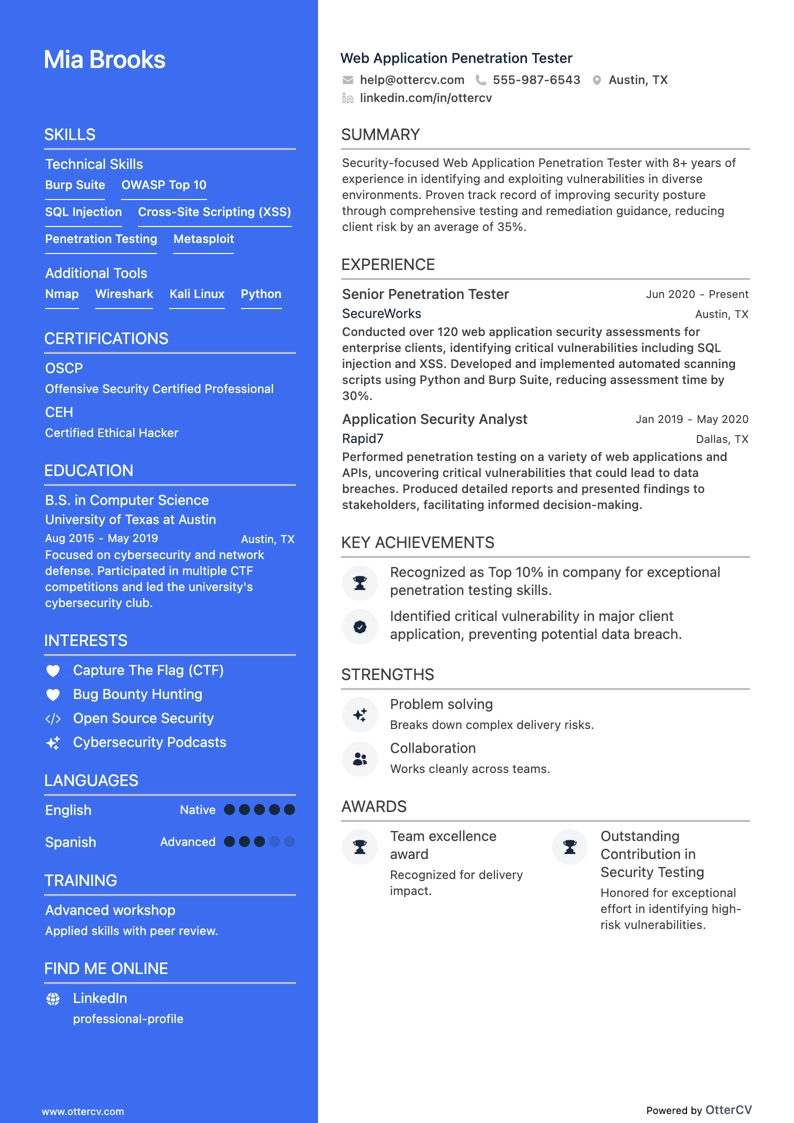
Web Application Penetration Tester
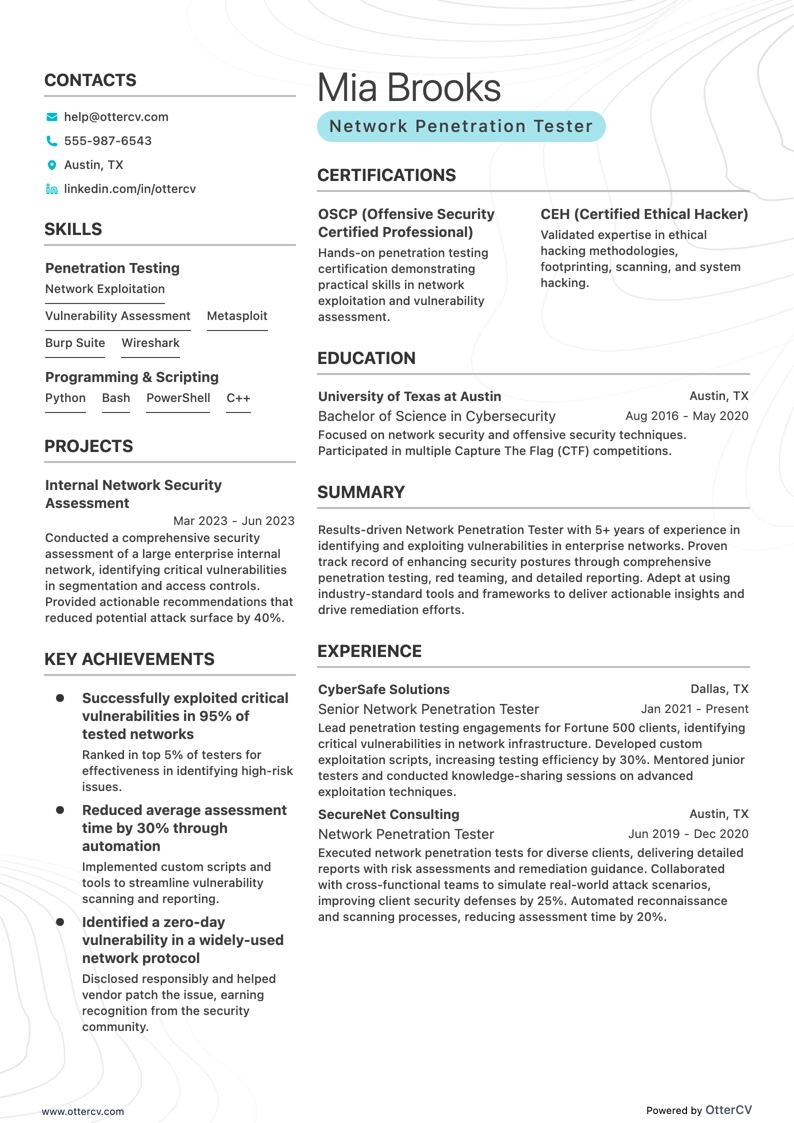
Network Penetration Tester
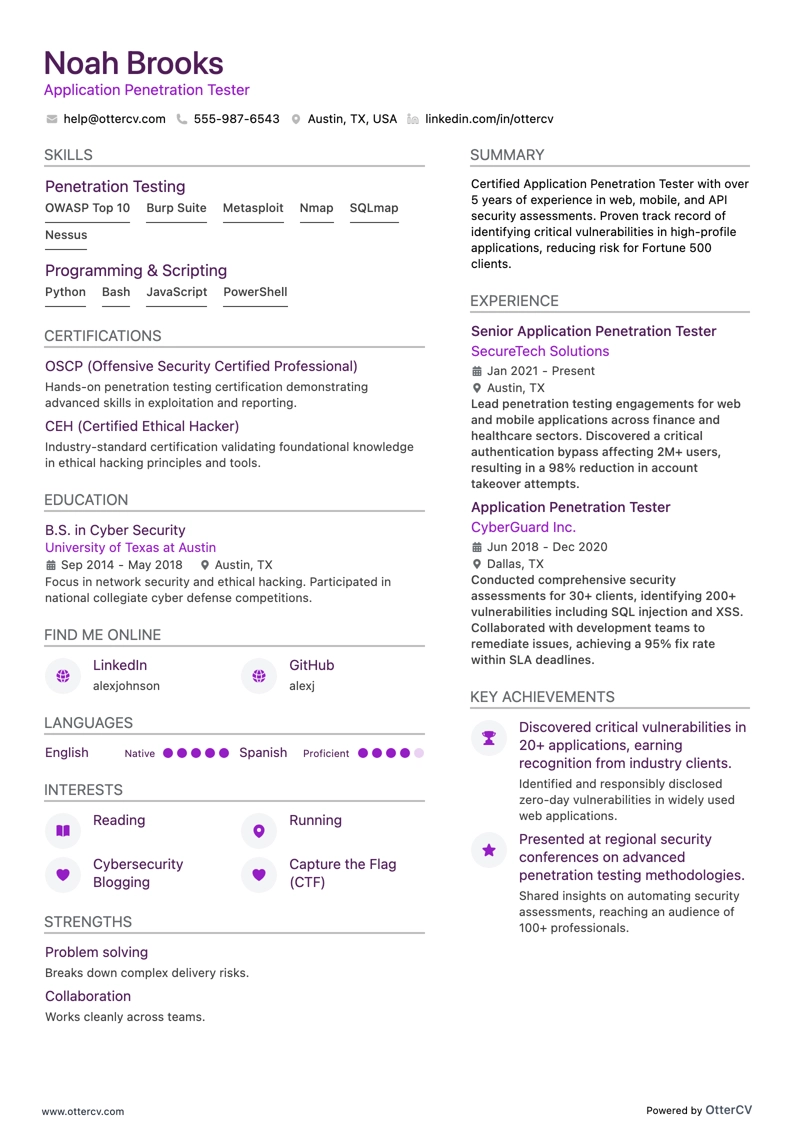
Application Penetration Tester
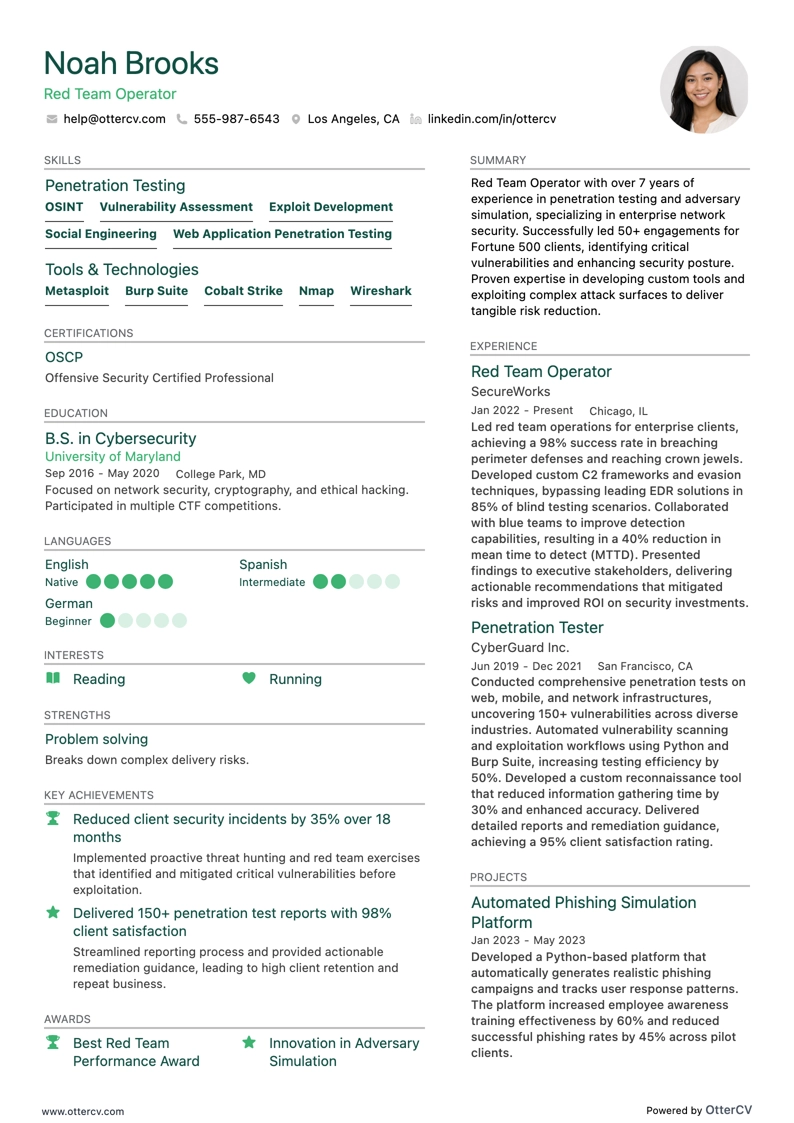
Red Team Operator
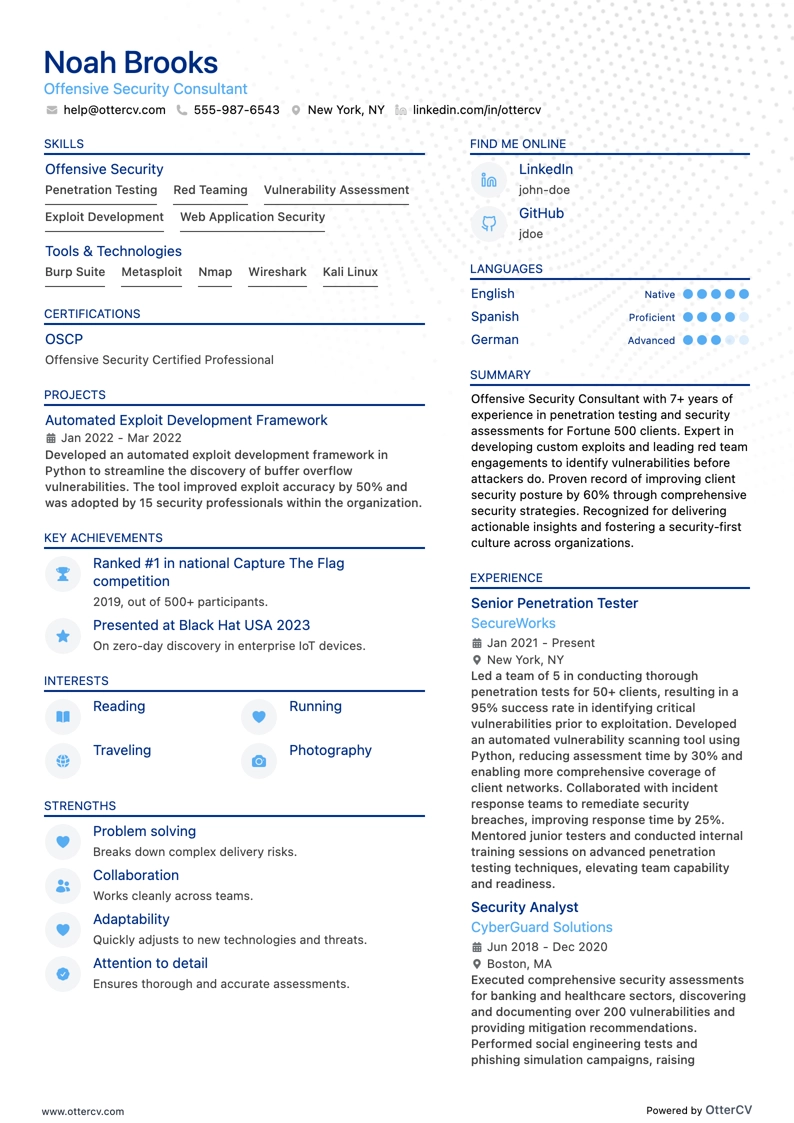
Offensive Security Consultant
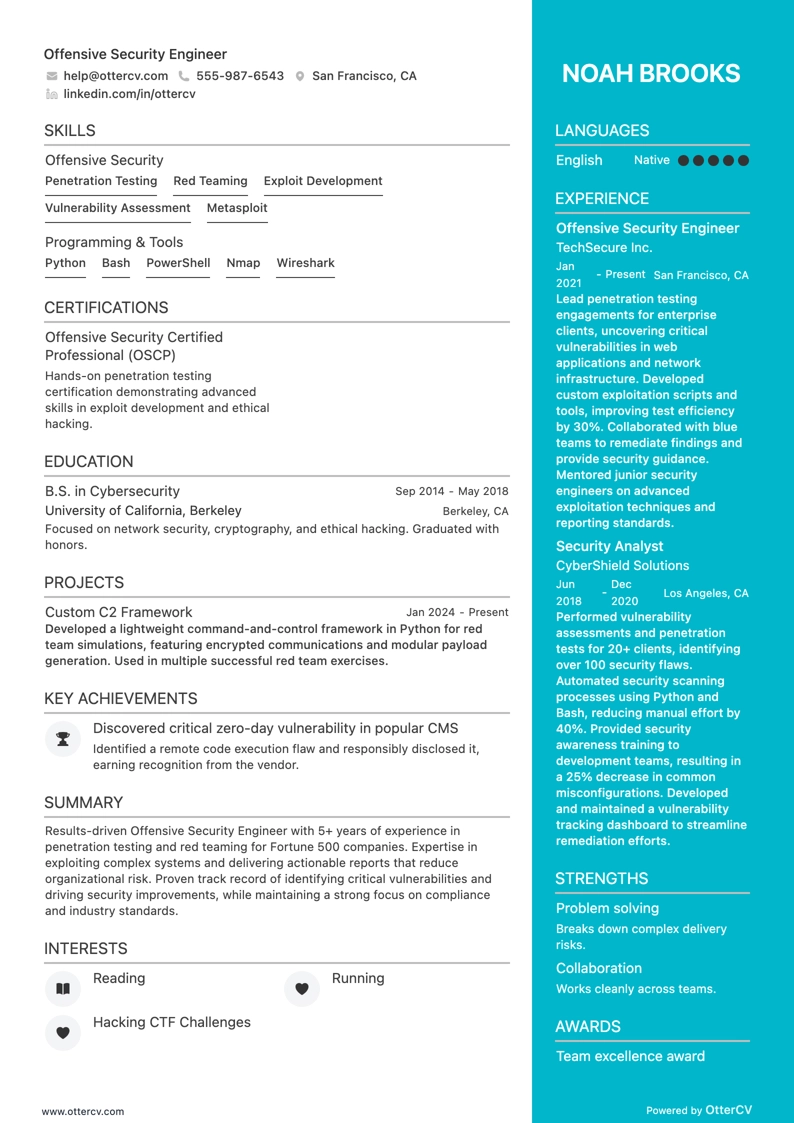
Offensive Security Engineer
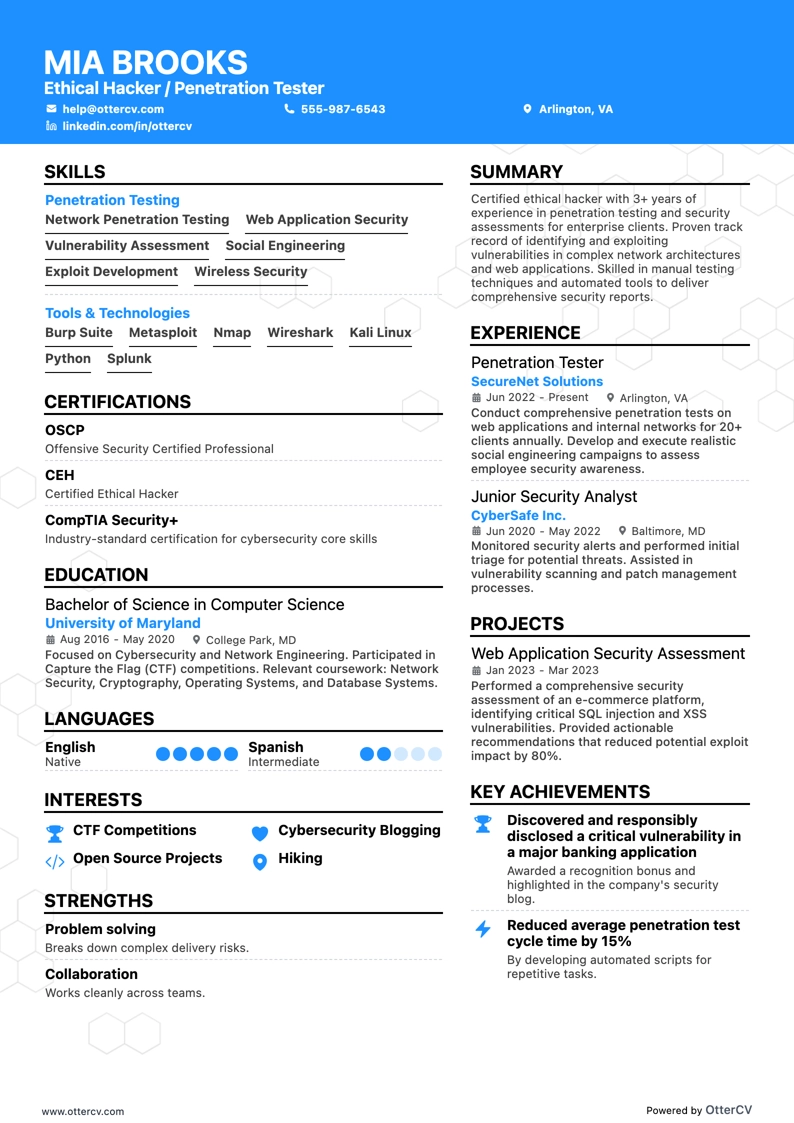
Ethical Hacker
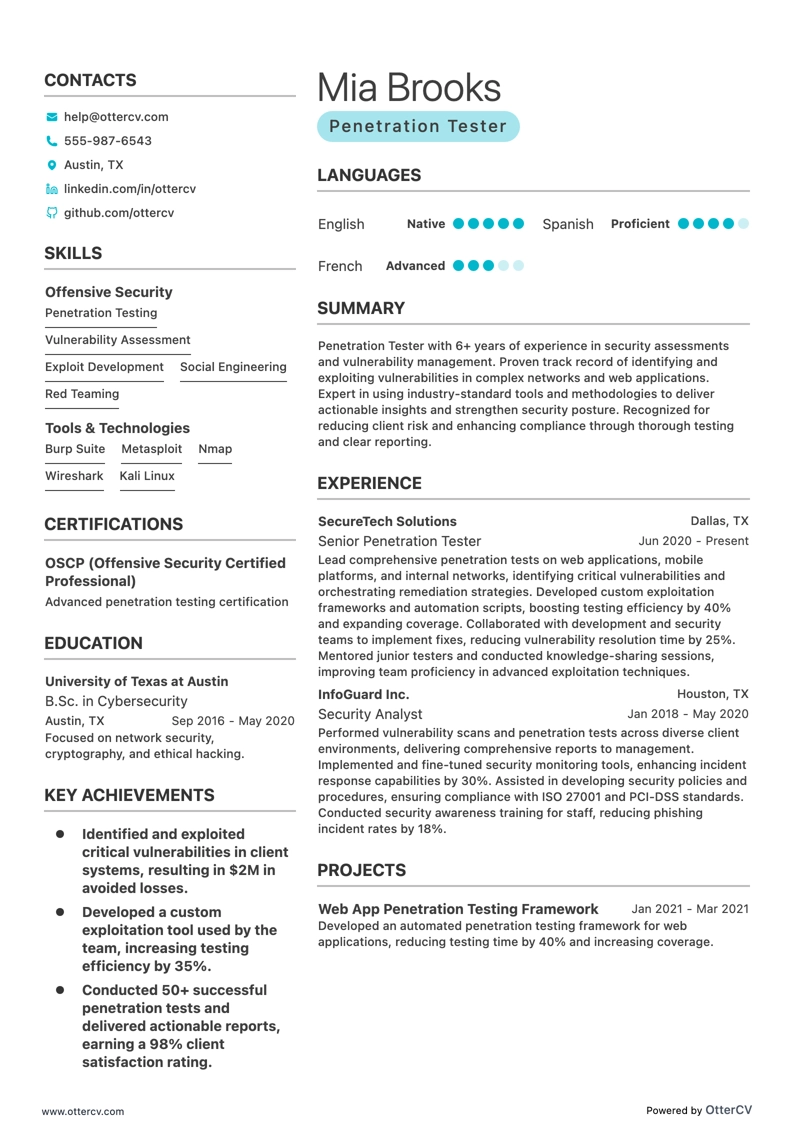
Penetration Tester
These words reflect the exponential growth in cyber attacks since the start of the pandemic. With the rise of hybrid and remote work, hacking has never been easier.
With so many potential corporate and individual targets, it is difficult to monitor everything. As a result, demand for cyber security specialists continues to grow.
Among these professionals, penetration testers stand out for their versatile skill set. Their work is not limited to sitting behind a desk. In some cases, they must go on-site and infiltrate a target’s physical space before moving on to its systems.
So how do you get one foot in the door of this industry? With a great resume.
Whether you are aiming for the blue team or the red team, you need to prove you have what it takes to be a pen tester. This article shares the tips you need to start your pen tester career in 2026.
The examples in our complete guide will teach you
- What recruiters consider the ideal pen tester candidate
- How to choose the best resume format to highlight your strengths
- How to make the most of your resume summary
- Which skills are trending for penetration testers
- Whether formal education is mandatory and which options are preferable
- Which certificates are top choices for cyber security specialists
- How to prepare and plan ahead for the interview
Looking for related resumes?
Penetration tester resume: how to secure an interview with recruiters
There are many ways to enter the cyber security industry, but you must be ready to put in the work, especially if you are switching from a non-tech field.
Can you still apply to become a pen tester without a tech background? Yes.
Some active pen testers started as military personnel. Others came from law enforcement. Some have even made a complete shift from convict to cyber security specialist.
What do vets, police officers, and prisoners have in common? As Bryan Mills, played by Liam Neeson, once said: a very particular set of skills.
They also often share the following traits:
- Drive to learn
- Curiosity
- Willingness to use their skills for good
- Creativity
- Resourcefulness
- A can-do attitude
- Efficiency
That is why it is important to show your character and describe your current abilities, including transferable skills. You never know which ones will prove useful on the job, and the sooner you present them, the better.
We will review each resume section individually later. For now, focus on the resume as a whole.
The format you choose should depend on your skills and your level of experience.
If you are a recent college graduate, it is best to use a functional resume. This format lets you lead with your most relevant skills, along with academic projects or side gigs that support your claims. Then you can list your formal education and mention related majors and courses.
If you are changing careers, assess both your experience and how much overlap exists between your work history and cyber security before choosing a resume format.
If your previous experience is unrelated, the functional resume is still your best option. Highlight your transferable skills and connect them to the job description.
At the same time, you should show some relevant experience, even if it does not belong in your formal work history. Links to completed courses, VDP reports, or bug bounties can improve your chances. You should also be comfortable being tested on any tools listed on your resume.
If your background is closely connected to the high-tech industry, use a hybrid resume. This format helps you show overlap in your work experience as well as the transferable skills you bring.
Finally, if you are a tenured professional, stick with the traditional reverse-chronological resume. The goal is to spotlight your proudest achievements.
Be succinct and direct.
This is what a rough sketch of your resume should look like:
Key resume sections to have on your penetration tester resume
- Include a header that links to your professional profiles and portfolio.
- Add a resume objective or summary that highlights your accomplishments.
- Use an experience section to show the breadth of your expertise.
- Include a skills section to present your versatile skill set.
- Add an education and certifications section to emphasize your qualifications.
- Use extra sections to feature other relevant information.
Very simple and straightforward.
With that in mind, it’s time to focus on what to include on your resume. Frame your experience in a way that does both of the following:
- Appeals to your potential employer’s mission and current goals
- Impresses hiring managers with your abilities
Here are some questions to consider as you write:
What do recruiters focus on when reviewing resumes?
- Why did you choose a career in penetration testing, and why are you making the change now?
- Do you have any related personal projects, and which one is your favorite?
- How do you define penetration testing, and what are its main goals?
- What is the OWASP Top Ten, and can you list all of them?
- Are you familiar with any other pentesting methodologies?
- How many phases are there in a penetration test, and how would you describe them?
- What is the main difference between symmetric and asymmetric cryptography, and can you give examples?
- Can you name the OSI model layers and give examples for each one?
- Which exploit tools do you prefer, and how have you used them in practice?
- Do you have any certifications related to penetration testing?
- Which pentesting technique is your favorite, and why?
- Do you have more experience with blue, red, or purple teams, which do you prefer, and would you consider switching?
Many of the questions above may come up during your interview, so keep track of what you include and avoid lying or exaggerating on your resume.
Being new to an industry can feel intimidating, but misleading hiring managers is never a good idea.
Impressing recruiters with your penetration tester resume header
Although short, this section can have a major impact on your resume’s performance. Hiring managers spend an average of 6 to 7 seconds reviewing a resume, so you need to catch their attention for the right reasons.
How do you do that?
Think of the resume header as your business card or a professional social profile. Include only the most essential information:
- Your first and last name
- Your address (city and state is enough)
- Email and phone number
- Job title, or the name of the position you want to fill
- Links to your portfolio
- Links to your professional profiles (Bug Crowd, HackerOne, Intigriti, GitHub, etc.)
To see how mistakes in your resume header can affect your chances, compare the samples below.
2 penetration tester resume header examples
WRONG
Key issues
Three problems stand out most:
- Jamal’s job title is misleading. It could suggest he works as a security guard rather than someone providing cyber security services.
- The phone number is missing. Some hiring managers prefer to do a short phone interview when vetting candidates.
- There are no links to a portfolio or to an account on a relevant professional platform.
This last point is especially important. Recruiters want to see that applicants are genuinely passionate about what they do.
You need to show that you’re actively involved in pentesting by linking to side projects and bug bounties.
RIGHT
Before moving on, fix any typos or misspelled words and check that all links work properly.
Summarizing your best achievements for your pen tester resume
A strong resume header should be followed by an excellent resume summary.
Keep the 7-second rule in mind. After listing your basic information, you have about 4 seconds left to capture a recruiter’s attention.
Use that space to highlight your proudest pentesting achievements. Share notable successes and mention the skills you used to accomplish them.
If you’re just starting your career, write a resume objective instead.
What’s the difference?
Experienced professionals use summaries to give a quick view of their expertise. College graduates and career changers, on the other hand, should use a resume objective.
Like a summary, an objective highlights relevant skills and experience. It also shows potential employers how you would apply your abilities to benefit them.
2 penetration tester resume summary examples
Have a look at the sample resume objective below:
WRONG
How many mistakes can you spot here? Let’s review a few.
The resume objective does not mention the name of the completed course or the education provider.
Its overall quality is also weak enough that recruiters may not stay long enough to read the rest. As a result, they may never get the chance to verify any credentials, even if they are listed elsewhere.
On top of that, the potential employer’s company name is misspelled. This is exactly where attention to detail matters.
Not only does that look unprofessional, but it also suggests the candidate does not pay attention to detail.
The applicant also lists two technical skills, but provides no evidence to support those claims.
So, how can this resume objective be improved? Take a look at the example below.
RIGHT
Why This Resume Objective Works Better
This version is much stronger. The candidate may be a beginner pen tester, but their passion and enthusiasm are clear.
The applicant also shows some experience, which helps demonstrate that cyber security is more than a hobby. It comes across as a well-considered career choice.
The strongest point is that the candidate has planned their career growth. They have a specific field of interest and are actively pursuing extra training to build their skills.
How to let your resume experience section do all the talking
We’ve come to the most dreaded part: the experience section. But don’t worry—it’s not as difficult as it seems.
The key is how you frame your work experience. Focus on the benefits a potential employer will care about, and align your experience with their mission, goals, and future plans.
If you know they need a red team member, emphasize your offensive pentesting skills.
Keep in mind that your resume will be read by both HR and senior penetration testers, so your experience entries need to be concise and easy to understand.
Presentation skills are also a core strength for pentesters. You need to clearly explain what you do and how you work.
How do you do that? Lead each entry with results, show the impact of your work, and provide context.
2 penetration tester resume experience examples
Take a look at the sample below:
WRONG
There are some clear issues here.
Jamal is appropriately concise, but several important details are missing. The company description is brief without saying much, and there is no link to the company website.
The bigger problem is in the experience entries. Jamal includes some strong achievements, but they lack context. For example, he says he mentored staff to identify email scams, but he does not explain the outcome. Did the training improve awareness or lead to measurable results?
He also overlooks smaller details that affect clarity. It is not clear whether the date listed for the role is a start date or whether the job is still ongoing.
Here is how a few edits can completely change how the entry reads:
RIGHT
Which are the must-have skills for your penetration tester resume?
Let’s move on to the skills section. There are many skills you could include, and the right ones depend on the job description and the role you’re targeting.
That’s why how you describe your skills matters most. As in the experience section, use a similar approach:
- Explain the challenge
- Lead with data
- Provide context
This method is also known as C-A-R, which stands for Challenge-Action-Result.
Be sure to emphasize the role your talents played in each entry. If you have additional strengths worth highlighting, this is the place to do it. Treat the skills section as an extension of your experience section.
How to highlight technical abilities on your resume
You may know your tools well, but as a penetration tester, you also need to explain your work to non-technical people.
Technical managers want to see the methodologies you use and how diligent you are in your work. They also want to know whether you understand the best use of your tools and at what stage of a pentest to apply them.
If you find it hard to organize your hard skill set, review past projects and:
- Describe the case
- Write down the different tools that were at your disposal
- Include a short description of how they were used
If you need inspiration, check out the suggestions in the table below.
Panel: Top technical skills for penetration tester specialists |
Top technical skills for penetration tester specialists
- Core tools include Nmap, Kali Linux, BackTrack, SamuraiWTF, Parrot, Metasploit, Kismet, THC Hydra, soapUI, AppScan, ZAP, SOOS, Canvas, QualysGuard, ArcSight, Splunk, Archer, Nessus, Nikto, Wireshark, WebInspect, Netsparker, Fortify, Ounce Labs, Acunetix, and SQLmap.
- Testing approaches include SAST and DAST, along with the Social-Engineer Toolkit.
- Useful programming and scripting languages include Objective-C, Java, C#, C, C++, Python, SQL, ASP.NET, PHP, JavaScript, Bash, Ruby, and Powershell.
- Common data and interface formats include REST, XML, YAML, and JSON.
- Important protocol knowledge includes FTP, POP3, IMAP, SMB, SSH, and TCP/IP.
- Platform knowledge covers Windows, iOS, Android, Linux, and Unix.
- Infrastructure and environment skills include firewalls, networks, servers, cloud infrastructures, and CI/CD.
- Additional technical knowledge includes keyloggers, cryptography, IDS, IPS, technical writing, hardware, and the OSI layer model.
How to leverage the social talents section on your resume
Hiring managers also want to see strong presentation abilities. This includes soft skills such as writing clear, well-structured, and understandable texts.
Can you write technical documents, negotiate contracts with business owners, or coach non-technical individuals?
These abilities are crucial in cyber security. After all, humans remain the weakest link in any security infrastructure.
Show that you understand:
- How individuals act in different scenarios
- How to exploit the human element, if the role requires it
- How to identify possible security breaches and mentor others on reducing the risk
Always connect your skills to verifiable results.
Have a look at the following examples:
RIGHT
These are excellent examples that can quickly catch a recruiter's attention.
The last one is especially strong because it does more than highlight the applicant's resourcefulness. It also demonstrates creativity, leadership, and teamwork skills, all in the middle of a penetration testing operation.
Think about your own past projects and explain how your soft skills influenced both your work and the people you worked with.
Here are some of the most in-demand social skills for cyber security professionals:
Important social abilities for penetration tester experts
- Be ambitious, passionate, and a self-starter.
- Use analytical, problem-solving, and strategic thinking skills.
- Make sound decisions and stay results-oriented.
- Be inquisitive, open-minded, and willing to learn new things.
- Work well independently and as a team player.
- Stay agile, flexible, quick, and efficient.
- Show patience, attention to detail, and thoughtful judgment.
- Manage time well and handle multitasking effectively.
- Perform effectively under pressure and remain dynamic and resourceful.
- Demonstrate creativity, responsibility, accountability, and trustworthiness.
- Communicate clearly and present ideas effectively.
- Support others through mentoring, coaching, and people management.
- Build relationships, resolve conflicts, and negotiate effectively.
- Show leadership skills and a personable approach.
- Understand psychology and social engineering.
- Apply knowledge of risk and compliance regulations.
- Contribute to risk prevention, vulnerability management, and incident management.
- Use persuasion skills appropriately.
Is formal education mandatory for a pen tester professional?
Yes and no.
Many companies do expect candidates to have an academic background. Some of the most common degrees are:
- BA or BS in Computer Science
- BA or BS in Information Security
- BA or BS in Information Technology
- BS or MS in Computer Engineering
- BS or MS in Network Engineering and Security
- BS or MS in Computer Forensics
- BS or MS in Cybersecurity
That said, you can still apply without a diploma. The key requirement is practical experience and relevant certificates.
Which certificates will grab recruiters’ attention?
In some cases, certificates can matter more than a diploma.
Managers of penetration tester teams often value hands-on experience over formal education. Most college degrees focus heavily on theory, while pentester courses are usually built around practical exercises.
We’ve gathered a list of the trendiest certificates for 2026.
Vital penetration tester certificates for your resume
- DoD 8570.01-m is a notable credential to include on a penetration tester resume.
- CCNA (Cisco Certified Network Associate) is a valuable networking certification.
- CWNA (Certified Wireless Network Administrator) highlights wireless networking knowledge.
- CompTIA Network+ demonstrates foundational network skills.
- CompTIA Security+ shows core cybersecurity knowledge.
- CREST certifications are widely recognized in security and penetration testing.
- IBM certifications can strengthen a technical security resume.
- AWS Security Certificate is useful for cloud security roles.
- AWS Advanced Networking Certificate supports advanced networking expertise.
- Offensive Security Certified Professional (OSCP) certification is a respected penetration testing credential.
- PNPT (Practical Network penetration tester) is relevant for practical offensive security skills.
- EJPT (eLearnSecurity Junior penetration tester) is a useful entry-level penetration testing certification.
- CISSP (Certified Information Systems Security Professional) demonstrates broad security expertise.
- CEPT (Certified Expert penetration tester) is relevant for advanced penetration testing roles.
- CPT (Certified penetration tester) is another credential worth listing.
- LPT (LIcensed penetration tester) can add credibility to a penetration testing resume.
- ECSA (EC-Council Certified Security Analyst ECSA) supports security assessment and analysis experience.
- CEH (Certified Ethical Hacker) remains a well-known ethical hacking certification.
Are there any other sections which can boost your chances?
CTFs
Hackathons
Ethical hacking or computer clubs
Membership associations
Documentation and patents
Bug bounties, VDPs and zero days
Side projects
PentesterLab badges
HackTheBox completed boxes
HackerOne, Intigriti or Bug Crowd badges and rankings
Carefully read the job description and tailor your resume accordingly.
Treat the resume header as a business card, and don’t forget to link your hacker profiles.
Keep your resume summary concise and to the point, and highlight your best achievements.
Provide results and context for each entry in your experience section.
Create a skills list and describe how you have applied each skill in a specific situation.
Mention relevant college majors in the education section if you’re a college graduate.
Add related certificates and bug bounty achievements to get noticed by recruiters.
Penetration Tester resume examples
Explore additional Penetration Tester resume samples and guides and see what works for your level of experience or role.
By Experience
Lead Penetration Tester
Senior Penetration Tester
Penetration Tester resume examples
Explore additional Penetration Tester resume samples and guides and see what works for your level of experience or role.
By Role
Cloud Penetration Tester
Mobile Application Penetration Tester
Web Application Penetration Tester
Network Penetration Tester
Application Penetration Tester
Red Team Operator
Offensive Security Consultant
Offensive Security Engineer
Ethical Hacker
Penetration Tester