Lead Pediatric Dentist full preview

10 Pediatric Dentist Resume Examples

OtterCV

Written by The OtterCV Team

Updated: 10/15/2023•8 min read

See all resume examples in this guide, or generate your own resume example with your personalized prompt

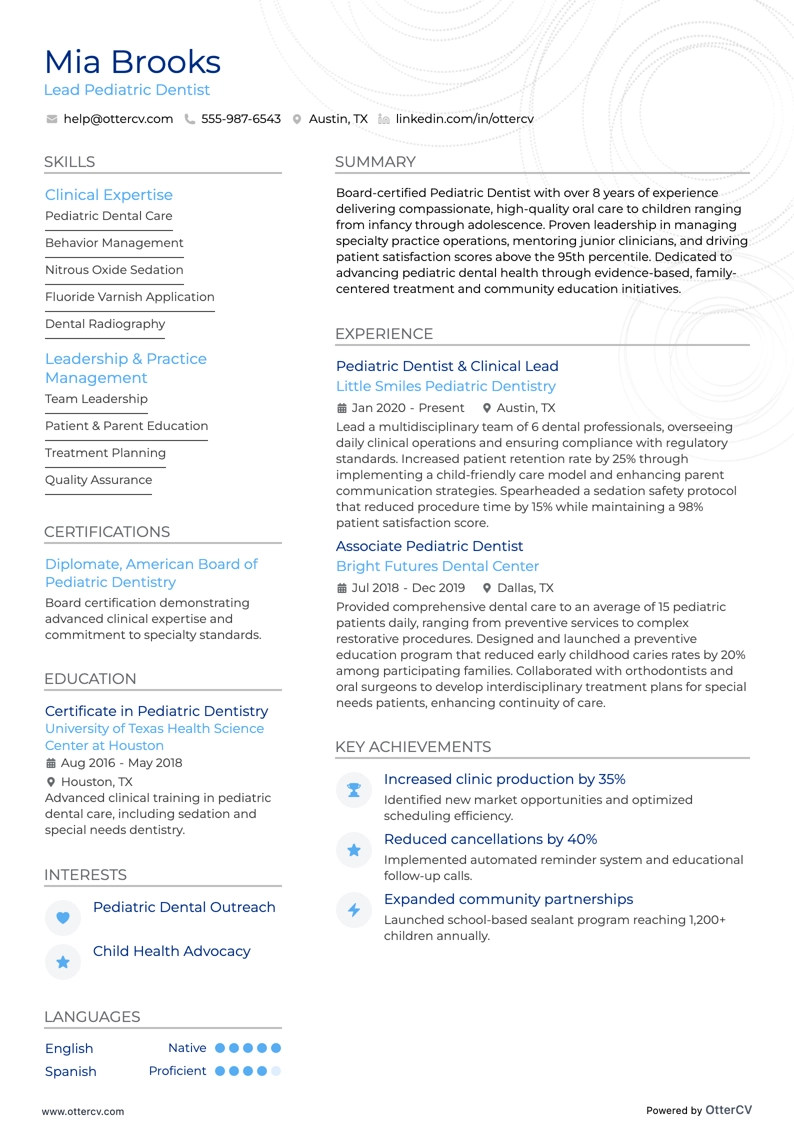
Lead Pediatric Dentist resume example

Lead Pediatric Dentist

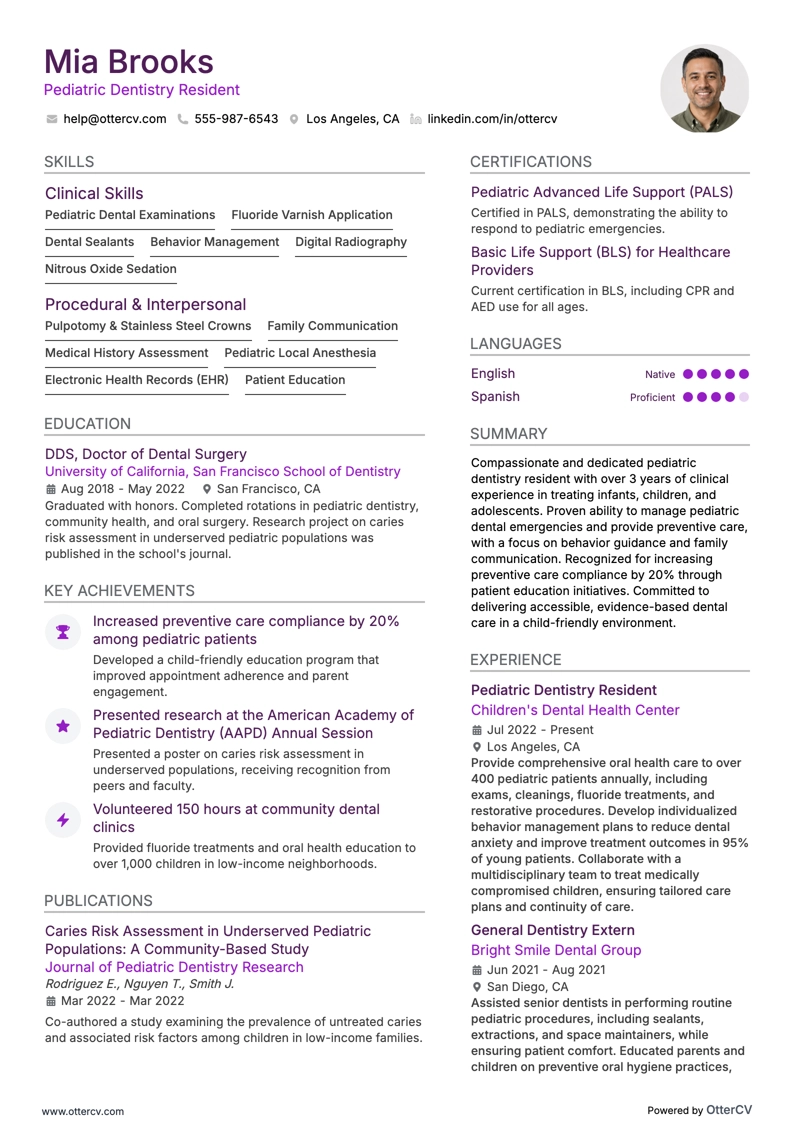
Pediatric Dentistry Resident resume example

Pediatric Dentistry Resident

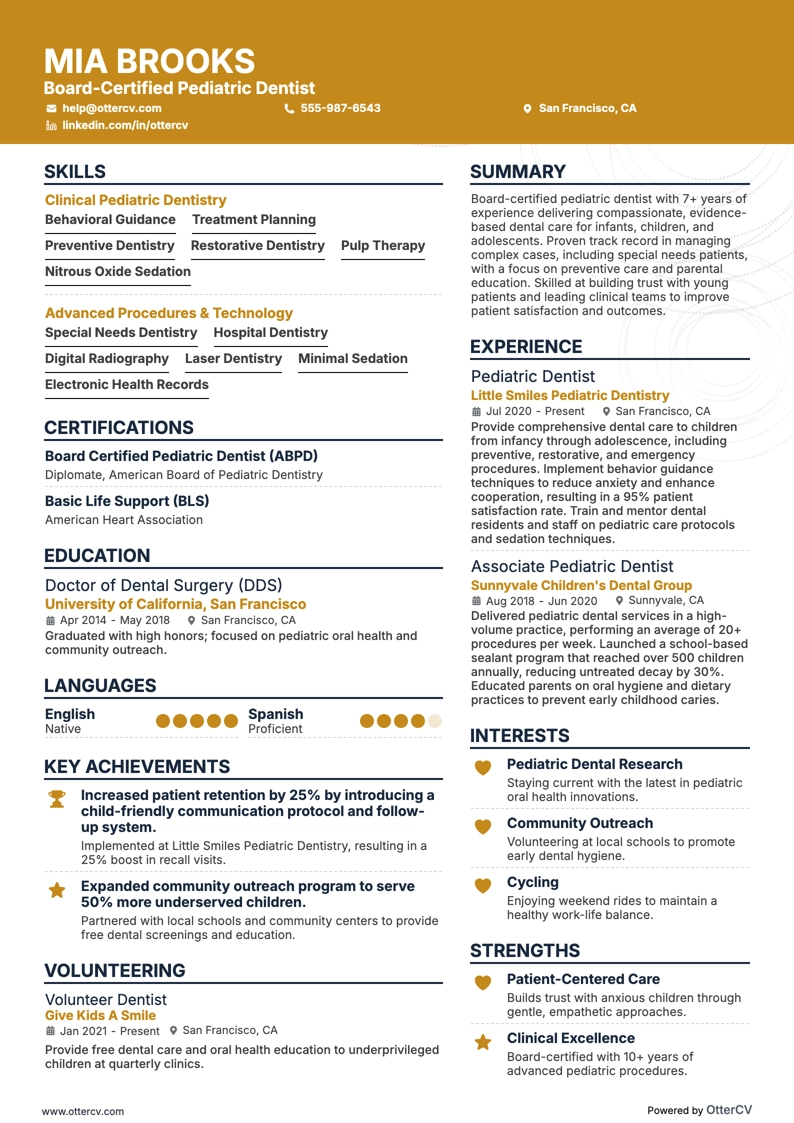
Board-Certified Pediatric Dentist resume example

Board-Certified Pediatric Dentist

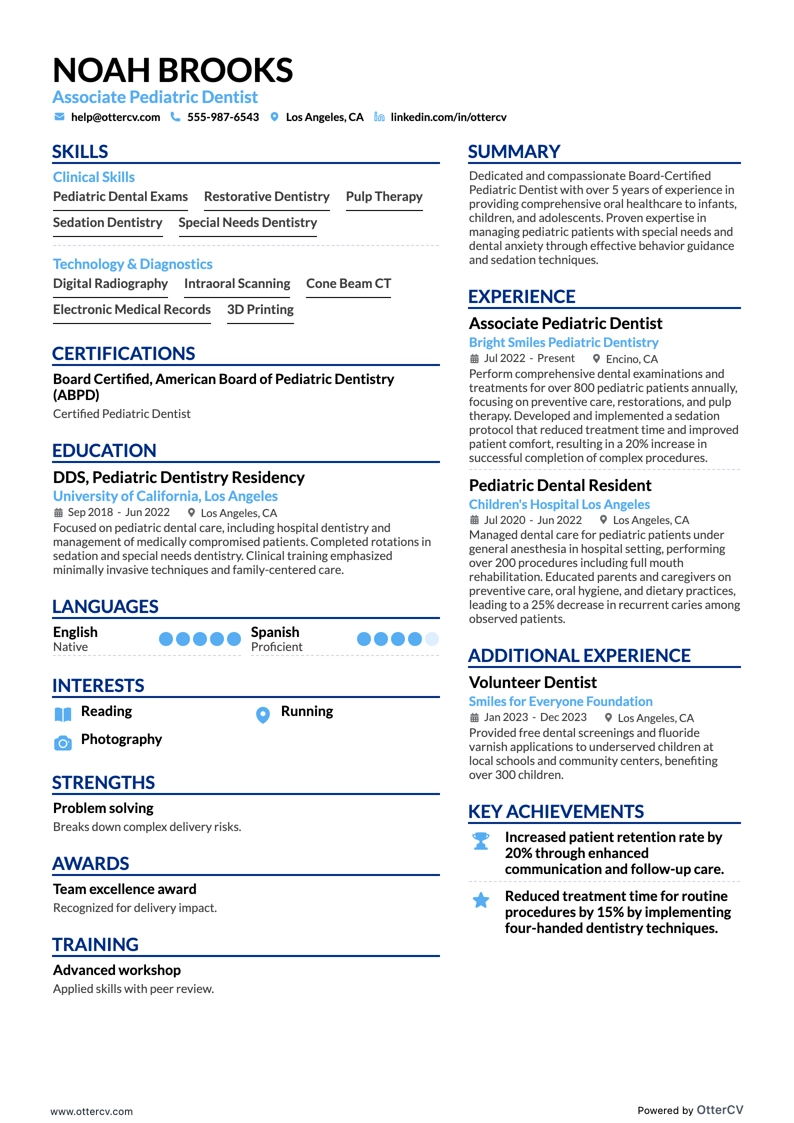
Associate Pediatric Dentist resume example

Associate Pediatric Dentist

Many pediatric dentist resume drafts fall short because they read like duty logs and hide measurable care results. That becomes a problem when applicant tracking systems screen for keywords and recruiters review applications quickly in a crowded market.

A strong resume shows what changed because of you, not just what you did. Understanding how to write a resume that highlights reduced no-show rates, improved recall compliance, higher sealant acceptance, faster chair turnover, smoother behavior management, fewer reappointments, and stronger parent satisfaction scores is essential.

Key takeaways

  • Quantify patient volume, treatment success rates, and satisfaction scores instead of just listing duties.

  • Use a reverse-chronological format if you have experience, and a hybrid format if you are changing careers.

  • Tailor each experience bullet to the target job posting’s terminology and priorities.

  • Show skills through measurable outcomes in your summary and experience sections.

  • Place certifications above education when they are recent or required for the role.

  • Use AI tools like Echocv to tighten language and align bullets, but never fabricate experience.

  • Add a cover letter only when it provides context your resume cannot convey on its own.

Job market snapshot for pediatric dentists

We analyzed 60 recent pediatric dentist job ads across major US job boards to highlight in-demand skills, top hiring companies, and employer expectations at a glance.

What level of experience employers are looking for pediatric dentists

Years of ExperiencePercentage found in job ads
1–2 years3.3% (2)
5–6 years1.7% (1)
Not specified95.0% (57)

Pediatric dentist ads by area of specialization (industry)

Industry (Area)Percentage found in job ads
Healthcare65.0% (39)
Finance & Banking33.3% (20)

Top companies hiring pediatric dentists

CompanyPercentage found in job ads
Blue Cloud Pediatric Surgery Centers25.0% (15)
Dental Care Alliance20.0% (12)

Role overview stats

These tables outline the most common responsibilities and employment types for pediatric dentist roles. Use them to align your resume with employer expectations and understand how the role is structured across the market.

Day-to-day activities and top responsibilities for a pediatric dentist

ResponsibilityPercentage found in job ads
Pediatric dentistry50.0% (30)
Bls25.0% (15)
Exodontia25.0% (15)
General anesthesia25.0% (15)
Restorative care25.0% (15)
Sedation25.0% (15)
Pals23.3% (14)
Pulpotomies23.3% (14)
Stainless-steel crowns23.3% (14)
Treatment planning13.3% (8)
American academy of pediatric dentistry policies11.7% (7)
American academy of pediatric dentistry guidelines10.0% (6)

How to format a pediatric dentist resume

Recruiters hiring pediatric dentists look for clinical competence with young patients, strong behavior management skills, and a proven record of delivering safe, effective dental care in child-focused settings. A clean, well-organized resume format helps make key qualifications—licensure, specialized training, patient outcomes, and practice contributions—easy for both hiring managers and applicant tracking systems to spot quickly.

I have significant experience in this role—which format should I use?

I have significant experience in this role—which format should I use?

Use a reverse-chronological format to highlight your depth of pediatric dental experience and professional growth across clinical settings.

  • Start with your most recent position and describe your scope of practice, including patient volume, age ranges treated, and any supervisory or mentorship responsibilities.
  • Highlight pediatric-specific clinical skills, certifications, and tools, such as sedation dentistry credentials, SDF application, pulp therapy techniques, and experience with special needs populations.
  • Quantify outcomes and contributions that show your impact on practice performance, patient retention, or treatment success rates.

Example bullet:

  • Provided comprehensive dental care to 40+ pediatric patients per week (ages 1–17), achieving a 96% parent satisfaction rate and reducing emergency follow-up visits by 22% through improved preventive treatment protocols.

I'm junior or switching into this role—what format works best?

I'm junior or switching into this role—what format works best?

A hybrid resume format works best. It lets you highlight relevant pediatric dental skills and training first while still presenting your clinical experience in chronological order.

  • Place a dedicated skills section near the top of your resume with pediatric-specific competencies such as behavior guidance techniques, preventive care protocols, interceptive orthodontics, and child-friendly communication.
  • Include clinical rotations, residency placements, volunteer work, or community outreach involving pediatric populations to show hands-on exposure to the role.
  • Connect each experience to a concrete action and measurable result to demonstrate readiness for independent clinical practice.

Example scaffold:

  • Behavior management training → applied tell-show-do and distraction techniques during a pediatric dental residency rotation → reduced patient anxiety-related appointment cancellations by 30% over six months.

Why not use a functional resume?

Why not use a functional resume?

A functional resume removes the clinical timeline hiring managers use to assess where, when, and how you built your pediatric dental skills, which makes it harder for them to verify your hands-on patient care experience.

  • A functional format may be acceptable if you are a general dentist moving into pediatric dentistry, returning to practice after an extended career gap, or have limited formal work history—but only if each skill is clearly tied to specific clinical projects, rotations, or patient outcomes instead of being listed on its own.

Once your layout and formatting choices are set, the next step is choosing resume sections that each serve a clear purpose.

What sections should go on a pediatric dentist resume

Recruiters expect to quickly see your pediatric clinical scope, patient outcomes, and compliance credentials on your pediatric dentist resume. Knowing which resume sections to include helps you organize that information clearly.

Use this structure for maximum clarity:

  • Header
  • Summary
  • Experience
  • Skills
  • Projects
  • Education
  • Certifications
  • Optional sections: Awards, Publications, Volunteering

Strong experience bullets should highlight measurable outcomes in pediatric care, including case volume, behavior management success, sedation safety, treatment quality, and improvements in patient satisfaction or clinic efficiency.

Once you’ve organized your resume with the right structure, focus on writing your pediatric dentist experience section in a way that shows impact and fit.

How to write your pediatric dentist resume experience

Your work experience section should highlight the clinical care you delivered, the pediatric-specific techniques and tools you used, and the measurable outcomes you achieved for young patients and their families. Hiring managers care more about demonstrated impact—such as better patient outcomes, practice growth, and efficient care delivery—than generic task lists.

Each experience entry should include:

  • Job title
  • Company and location (or remote)
  • Dates of employment (month and year)

Add three to five concise bullet points that show what you owned, how you worked, and the results you delivered:

  • Ownership scope: the patient populations, clinical programs, treatment planning processes, or practice areas you were directly responsible for as a pediatric dentist.
  • Execution approach: the diagnostic tools, sedation techniques, behavior management methods, or treatment technologies you used to support clinical decisions and provide age-appropriate care.
  • Value improved: improvements in patient comfort, treatment success rates, appointment efficiency, preventive care compliance, or safety protocols resulting from your work.
  • Collaboration context: how you worked with orthodontists, oral surgeons, hygienists, pediatricians, office staff, or parents to deliver comprehensive, child-centered care.
  • Impact delivered: outcomes such as practice growth, patient retention, reduced procedural complications, or community health improvements instead of routine clinical duties.

Experience bullet formula

Experience bullet formula

Action verb + technology + what you built or fixed + measurable result

A pediatric dentist experience example

Pediatric Dentist

BrightSmiles Pediatric Dentistry | Austin, TX

2021–Present

High-volume pediatric dental clinic serving infants through teens, including sedation and patients with special health care needs.

  • Delivered care for 1,200+ pediatric patients annually using digital radiography (DEXIS), intraoral scanning (iTero), and Eaglesoft practice management, reducing retake imaging by 28% and cutting average visit time by 9 minutes.
  • Implemented silver diamine fluoride and minimally invasive caries protocols aligned with American Academy of Pediatric Dentistry guidelines, improving 6-month recall compliance from 62% to 78% and lowering new caries incidence by 14%.
  • Led nitrous oxide and oral sedation cases with standardized monitoring, including pulse oximetry and capnography, plus emergency readiness drills with dental assistants and front desk staff, decreasing day-of-procedure cancellations by 18% and achieving zero sedation-related adverse events.
  • Partnered with orthodontists and speech-language pathologists to coordinate early interceptive referrals and frenectomy follow-ups, increasing completed referral conversions by 22% and improving on-time treatment starts by 15%.
  • Streamlined insurance documentation and clinical charting with templated notes, intraoral photo workflows, and pre-authorization checklists alongside the billing team, shortening claim turnaround time by 20% and reducing denials by 12%.

Now that you've seen what a strong experience section looks like, here's how to tailor each part of it to the specific pediatric dentist role you're targeting.

How to tailor your pediatric dentist resume experience

Recruiters review your pediatric dentist resume through both human screening and applicant tracking systems. Tailoring your resume to the job description helps you get through both.

Ways to tailor your pediatric dentist experience:

  • Match the specific dental technologies or imaging systems named in the job posting.
  • Use the same terminology for pediatric treatment protocols when it accurately reflects your experience.
  • Include patient volume or caseload metrics the employer prioritizes.
  • Highlight sedation dentistry or behavior management methods they mention.
  • Add relevant experience with special needs or medically compromised children.
  • Emphasize infection control and OSHA compliance standards when listed.
  • Align your experience with their preferred electronic health record platform.
  • Reference interdisciplinary collaboration with orthodontists or pediatricians if the posting includes it.

Tailoring means aligning your real clinical achievements with the employer's stated requirements, not forcing in keywords that don't fit.

Resume tailoring examples for pediatric dentist

Job description excerptUntailoredTailored
Provide behavior management for children ages 2–12, including use of nitrous oxide sedation and Tell-Show-Do technique during restorative procedures.Worked with young patients in a dental office setting.Applied Tell-Show-Do technique and administered nitrous oxide sedation for children ages 2–12 during restorative procedures, reducing procedural anxiety and chair time by 20%.
Diagnose and treat early childhood caries (ECC) using silver diamine fluoride (SDF) and stainless steel crowns, with a focus on Medicaid-eligible patients.Performed dental treatments and fillings for kids.Diagnosed and treated early childhood caries in a caseload of 30+ Medicaid-eligible patients per week, applying silver diamine fluoride and placing stainless steel crowns to arrest decay and preserve primary dentition.
Collaborate with orthodontic and speech therapy teams to develop interceptive treatment plans for patients with craniofacial anomalies.Coordinated with other healthcare professionals on patient care.Partnered with orthodontic and speech therapy teams to create interceptive treatment plans for 15 pediatric patients with craniofacial anomalies, improving functional outcomes across feeding and speech milestones.

Once you’ve aligned your experience with the role’s priorities, quantify your pediatric dentist achievements to show the measurable impact of your work.

How to quantify your pediatric dentist achievements

Quantifying your achievements shows how your care improved patient outcomes and practice performance. Track patient volume, treatment success, safety, visit efficiency, parent satisfaction, and revenue from restorative, preventive, and sedation services.

Quantifying examples for pediatric dentist

MetricExample
Patient volumeIncreased daily patient load from 14 to 18 by redesigning scheduling templates and adding a fluoride varnish fast-track for low-risk recall visits.
Quality outcomesRaised sealant retention at 12 months from 88% to 95% across 220 molars by standardizing isolation steps and using resin-based sealants.
Visit efficiencyCut average hygiene-to-exam cycle time by 12 minutes by implementing chairside iPad intake and pre-staging instruments with the dental assistant.
Risk reductionReduced nitrous oxide adverse events from three per quarter to zero for two consecutive quarters by tightening pre-op screening and monitoring checklists.
Revenue growthGrew monthly production by $28,000 by increasing same-day silver diamine fluoride acceptance from 30% to 55% and improving case presentation scripts.

How to list your hard and soft skills on a pediatric dentist resume

Once you've written strong bullet points for your experience section, make sure your skills section also highlights the hard and soft skills that support your qualifications as a pediatric dentist.

Your skills section should show that you can deliver safe, child-centered dental care. Recruiters and ATS (applicant tracking system) software scan this section for clinical keywords, tools, and behaviors, so aim for mostly hard skills with a smaller set of role-specific soft skills.

Pediatric dentist roles require a blend of:

  • Product strategy and discovery skills
  • Data, analytics, and experimentation skills
  • Delivery, execution, and go-to-market discipline
  • Soft skills

Your skills section should be:

  • Scannable with bullet-style grouping
  • Relevant to the job post
  • Backed by proof in your experience bullet points
  • Updated with current tools

Place your skills section:

  • Above your experience section if you're junior or switching careers
  • Below your experience section if you're mid/senior with strong achievements

Hard skills

  • Uses behavior guidance techniques.
  • Administers nitrous oxide sedation.
  • Follows oral conscious sedation protocols.
  • Provides pediatric local anesthesia.
  • Performs pulpotomy and pulpectomy procedures.
  • Places stainless steel crowns.
  • Uses space maintainers.
  • Applies sealants and fluoride varnish.
  • Performs digital radiography and bitewings.
  • Uses intraoral scanning.
  • Maintains infection control and OSHA compliance.
  • Documents care in electronic health records.

Soft skills

  • Explain procedures clearly to children.
  • Coach parents on prevention.
  • Help de-escalate dental anxiety.
  • Use tell-show-do coaching.
  • Set clear expectations chairside.
  • Collaborate effectively with dental assistants.
  • Coordinate referrals with specialists.
  • Prioritize patient safety in decision-making.
  • Document thoroughly and promptly.
  • Keep appointment flow efficient.
  • Deliver difficult news calmly.
  • Follow up on treatment plans.

How to show your pediatric dentist skills in context

Your skills should not appear only in a bulleted list on your resume. Browse resume skills examples to see how other professionals present their competencies effectively.

Show your skills in these key sections:

  • Your summary, where you present your high-level professional identity
  • Your experience, where you prove your abilities through outcomes

Here’s what that looks like in practice.

Senior pediatric dentist with 12 years of experience in behavior management, SDF application, and interceptive orthodontics. Reduced procedural anxiety scores by 35% using tell-show-do techniques across an annual caseload of 4,000 patients.

  • Reflects senior-level expertise immediately
  • Names specific clinical tools and methods
  • Includes a concrete, measurable outcome
  • Highlights essential soft skills naturally

Senior Pediatric Dentist

Bright Smiles Pediatric Dental Group | Austin, TX

March 2018–Present

  • Treated 3,800+ patients annually using SDF therapy and Hall crowns, reducing repeat sedation visits by 28%.
  • Collaborated with orthodontists and speech therapists to develop early intervention care plans for 200+ children with craniofacial needs.
  • Implemented a visual distraction protocol with nitrous oxide monitoring, improving patient cooperation ratings by 40% within one year.
  • Each bullet includes measurable proof.
  • Skills are demonstrated naturally through real outcomes.

Once you’ve shown your pediatric dentistry strengths with relevant examples, the next step is to use the same approach when building a pediatric dentist resume without formal experience.

How do I write a pediatric dentist resume with no experience

Even without full-time experience, you can show readiness through clinical training and hands-on exposure. If you’re building a resume without work experience, focus on these areas:

  • Pediatric dentistry clinical rotations
  • Community dental outreach screenings
  • Dental assisting in a pediatric clinic
  • Pediatric sedation observation logs
  • Case presentations and treatment planning
  • Electronic health record documentation practice
  • Infection control and sterilization audits
  • Pediatric radiography and imaging labs

Also emphasize:

  • Pediatric dentistry procedures performed, quantified
  • Documented outcomes and quality metrics
  • Tools used, including digital radiography and EHR
  • Licensure, certifications, and exam status

Resume format tip for entry-level pediatric dentist

Resume format tip for entry-level pediatric dentist

Use a hybrid resume format to put pediatric dentistry skills and clinical training first while still showing education and any related work history.

  • Lead with a pediatric dentistry skills summary.
  • Quantify procedures, patients, and hours.
  • List rotations with setting and scope.
  • Add tools used in each entry.
  • Include licensure and certifications upfront.

Example project bullet:

  • Completed eighty pediatric dentistry clinical-rotation sealants using rubber dam isolation and digital radiography; achieved zero retakes and ninety-eight percent charting accuracy in the EHR.

Once you’ve structured your resume to highlight transferable strengths, the next step is presenting your education clearly to build credibility.

How to list your education on a pediatric dentist resume

Your education section helps hiring teams quickly confirm that you have the clinical and academic credentials required for the role. It also reinforces the foundational knowledge expected of a pediatric dentist.

Include:

  • Degree name
  • Institution
  • Location
  • Graduation year
  • Relevant coursework (for juniors or entry-level candidates)
  • Honors and GPA (if 3.5 or higher)

Skip the month and day—list only the graduation year.

Here’s a strong education entry tailored for a pediatric dentist resume:

Example education entry

Doctor of Dental Medicine (DMD)

Tufts University School of Dental Medicine, Boston, MA

Graduated 2021

GPA: 3.8/4.0

  • Relevant coursework: Pediatric Oral Pathology, Behavioral Management in Dentistry, Interceptive Orthodontics, Pediatric Pharmacology
  • Honors: Dean's List (all semesters), Award for Excellence in Pediatric Dentistry

How to list your certifications on a pediatric dentist resume

Certifications on your resume show a pediatric dentist's commitment to ongoing learning, proficiency with clinical tools, and alignment with current standards in pediatric oral health.

Include:

  • Certificate name
  • Issuing organization
  • Year
  • Optional: credential ID or URL
  • Place certifications below education when they're older, less relevant, or when you want your dental degree to lead.
  • Place certifications above education when they're recent, highly relevant, or required for the pediatric dentist role you are targeting.

Best certifications for your pediatric dentist resume

  • Diplomate, American Board of Pediatric Dentistry (ABPD).
  • Pediatric Advanced Life Support (PALS).
  • Basic Life Support (BLS).
  • Nitrous Oxide/Oxygen Inhalation Sedation Permit.
  • Moderate Sedation Permit.
  • Dental Radiology Certification (State Dental Board).

Once your key credentials are easy for hiring managers to spot, use your pediatric dentist resume summary to show why they matter right away.

How to write your pediatric dentist resume summary

Your resume summary is often the first part a recruiter reads. A strong summary quickly shows that you’re qualified to provide high-quality dental care for children.

Keep it to three to four lines and include:

  • Your title and total years of pediatric dentistry experience.
  • Your clinical setting, such as private practice, hospital, or community health center.
  • Core skills such as behavior management, sedation dentistry, and interceptive orthodontics.
  • One or two measurable achievements, such as patient volume or improvements in satisfaction.
  • Interpersonal strengths tied to results, such as parent communication that improved treatment acceptance rates.

PRO TIP

As a pediatric dentist, focus on clinical skills, relevant certifications, and early patient care contributions.

Highlight specific tools or techniques you have mastered, and avoid vague phrases like “passionate about helping kids” or “dedicated team player.”

Example summary for a pediatric dentist

Pediatric dentist with three years of experience in community health settings. Skilled in behavior management and silver diamine fluoride application. Increased patient retention by 18% through improved parent education initiatives.

With your summary creating a strong first impression of your clinical expertise, your header should make it easy for recruiters to contact you by presenting your details clearly and professionally.

What to include in a pediatric dentist resume header

A resume header is the top section of your resume that contains your key details. For a pediatric dentist role, it supports visibility, credibility, and recruiter screening.

Essential resume header elements:

  • Full name
  • Tailored job title and headline
  • Location
  • Phone number
  • Professional email
  • GitHub link
  • Portfolio link
  • LinkedIn

A LinkedIn link helps recruiters verify your experience quickly and supports screening.

Do not include photos on a pediatric dentist resume unless the role is explicitly front-facing or appearance-dependent.

Match your header job title to the posting, and keep every detail consistent across your resume and professional profiles.

Example

Once your contact details and credentials are clearly presented at the top, you can strengthen your application by adding sections that showcase relevant strengths and experience.

Additional sections for pediatric dentist resumes

When your core qualifications are similar to those of other candidates, well-chosen additional sections can show what makes you especially suited for pediatric dentistry. For example, listing language skills on your resume can help you stand out in practices that serve diverse patient populations.

  • Languages
  • Volunteer experience
  • Publications and research
  • Professional affiliations
  • Continuing education and specialized training
  • Community outreach and school programs

Once you’ve strengthened your resume with the right supporting sections, make sure it’s paired with an equally strong cover letter.

Do pediatric dentist resumes need a cover letter

A cover letter isn’t required for every pediatric dentist role, but it can help in competitive markets or at clinics with stricter hiring expectations. If you’re unsure what a cover letter is or when it adds value, it can make a real difference when your resume doesn’t clearly show fit, outcomes, or the reason for your move.

Use a cover letter when it adds context your resume can’t provide:

  • Explain role and team fit: Connect your approach to behavior guidance, parent communication, and clinic workflow to the practice’s model.
  • Highlight one or two outcomes: Share a specific improvement, such as reduced no-shows, faster room turnover, or better case acceptance for preventive care.
  • Show understanding of the practice context: Reference the patient mix, referral sources, sedation policies, or growth goals, and how you’ll support them.
  • Address transitions or less obvious experience: Clarify moves from general dentistry, residency gaps, relocation, or limited pediatric dentist experience with concrete evidence.

Using AI to improve your pediatric dentist resume

Even if you decide a separate cover letter will not add value to your application, AI can still help you strengthen and tailor the pediatric dentist resume hiring teams review first.

AI can improve clarity, structure, and overall impact. It can tighten language and help highlight measurable results, but overusing it can quickly make your resume sound less authentic. If you are wondering which AI is best for writing resumes, start with tools that help refine structure and wording instead of generating content from scratch. Once your resume feels clear and aligned with the role, stop using AI.

Here are 10 practical prompts you can copy and paste to strengthen specific sections of your pediatric dentist resume:

  1. Sharpen your summary: "Rewrite my pediatric dentist resume summary to highlight clinical strengths, patient age groups served, and years of experience in two concise sentences."
  2. Quantify treatment outcomes: "Add measurable results to these pediatric dentist experience bullets, focusing on cavity reduction rates, patient volume, or treatment success percentages."
  3. Strengthen action verbs: "Replace weak verbs in my pediatric dentist experience section with strong, specific action verbs that convey clinical leadership and patient care."
  4. Tailor skills section: "Reorganize my pediatric dentist skills section to prioritize the most relevant clinical, behavioral management, and technical skills for this job posting."
  5. Improve education details: "Rewrite my pediatric dentist education section to emphasize residency training, specialized coursework, and honors relevant to pediatric care."
  6. Refine certification entries: "Format my pediatric dentist certifications section clearly, listing board certifications, sedation permits, and CPR credentials with dates and issuing bodies."
  7. Tighten project descriptions: "Edit my pediatric dentist community outreach project descriptions to emphasize scope, population served, and measurable impact in one bullet each."
  8. Align with job posting: "Compare my pediatric dentist resume experience bullets against this job description and suggest edits to better match their stated requirements."
  9. Remove redundant phrasing: "Identify and eliminate redundant or filler language throughout my pediatric dentist resume without losing any clinical or professional detail."
  10. Clarify career progression: "Restructure my pediatric dentist experience section to clearly show career growth, increasing responsibilities, and expanding clinical scope over time."

Stop using AI once your resume sounds accurate, specific, and grounded in your real experience. AI should never invent experience or inflate claims. If it did not happen, it does not belong on your resume.
Conclusion

A strong pediatric dentist resume highlights measurable outcomes, role-specific skills, and a clear structure. Emphasize patient volume, treatment success, behavior guidance results, and parent satisfaction, while keeping sections easy to scan and aligned with the pediatric dentist role.

Today’s hiring market rewards pediatric dentist candidates who communicate impact and consistency. Use precise, relevant details, keep formatting clean and predictable, and make sure your resume clearly shows results to signal readiness for current and near-future roles.

Pediatric Dentist resume examples

Explore additional Pediatric Dentist resume samples and guides and see what works for your level of experience or role.

By Experience

Lead Pediatric Dentist

Lead Pediatric Dentist resume preview

Pediatric Dentistry Resident

Pediatric Dentistry Resident resume preview

Pediatric Dentist resume examples

Explore additional Pediatric Dentist resume samples and guides and see what works for your level of experience or role.

By Role

Board-Certified Pediatric Dentist

Board-Certified Pediatric Dentist resume preview

Associate Pediatric Dentist

Associate Pediatric Dentist resume preview