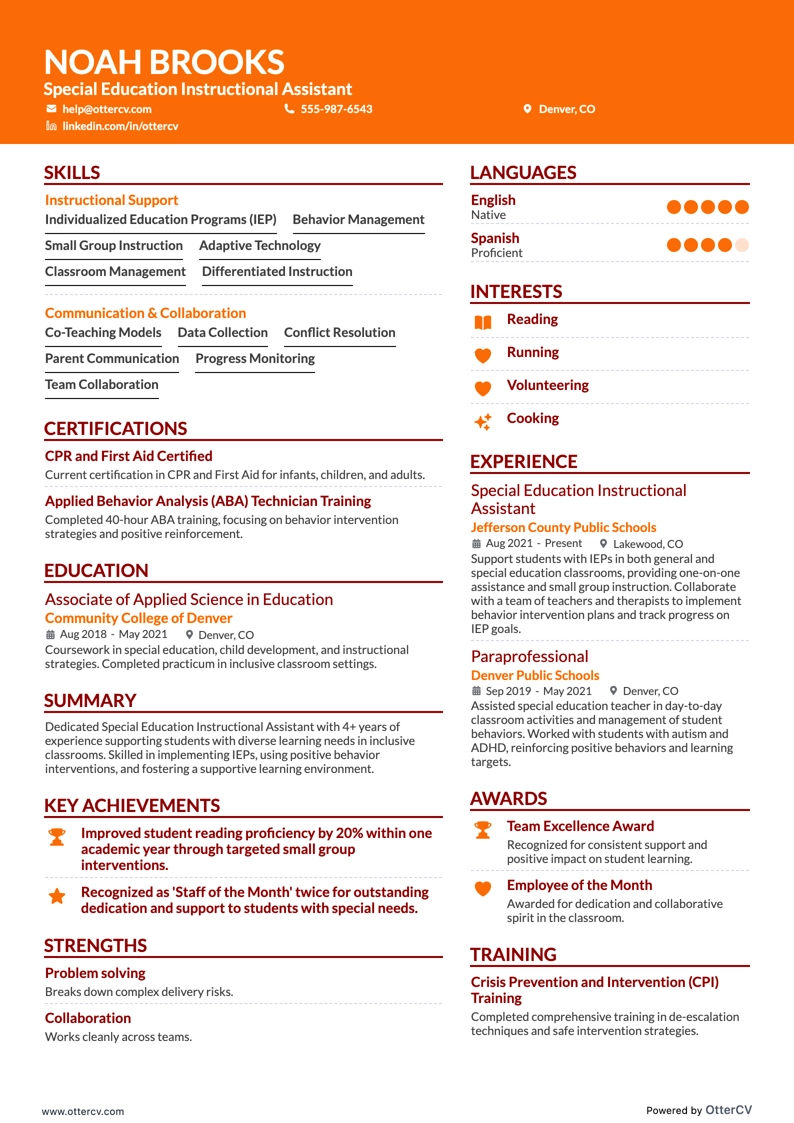
Special Education Instructional Assistant full preview

12 Paraprofessional Resume Examples

OtterCV

Written by The OtterCV Team

Updated: 3/17/2025•8 min read

See all resume examples in this guide, or generate your own resume example with your personalized prompt

Special Education Instructional Assistant resume example

Special Education Instructional Assistant

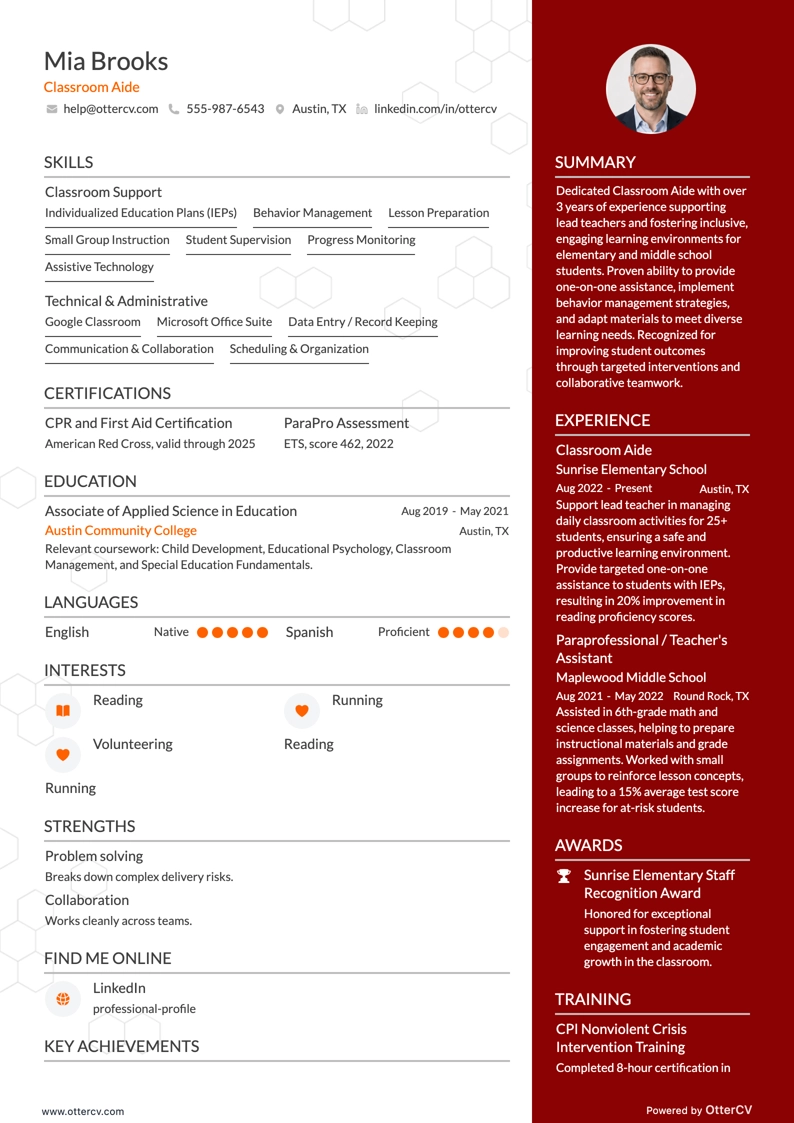
Classroom Aide resume example

Classroom Aide

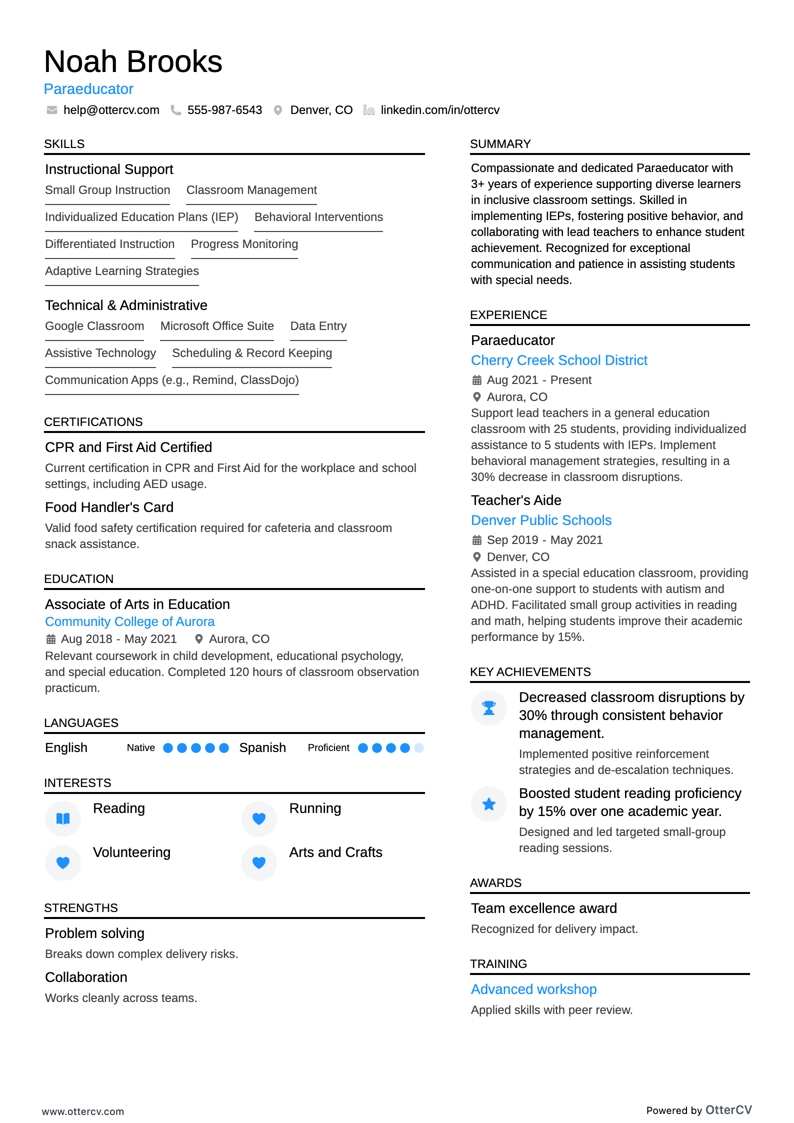
Paraeducator resume example

Paraeducator

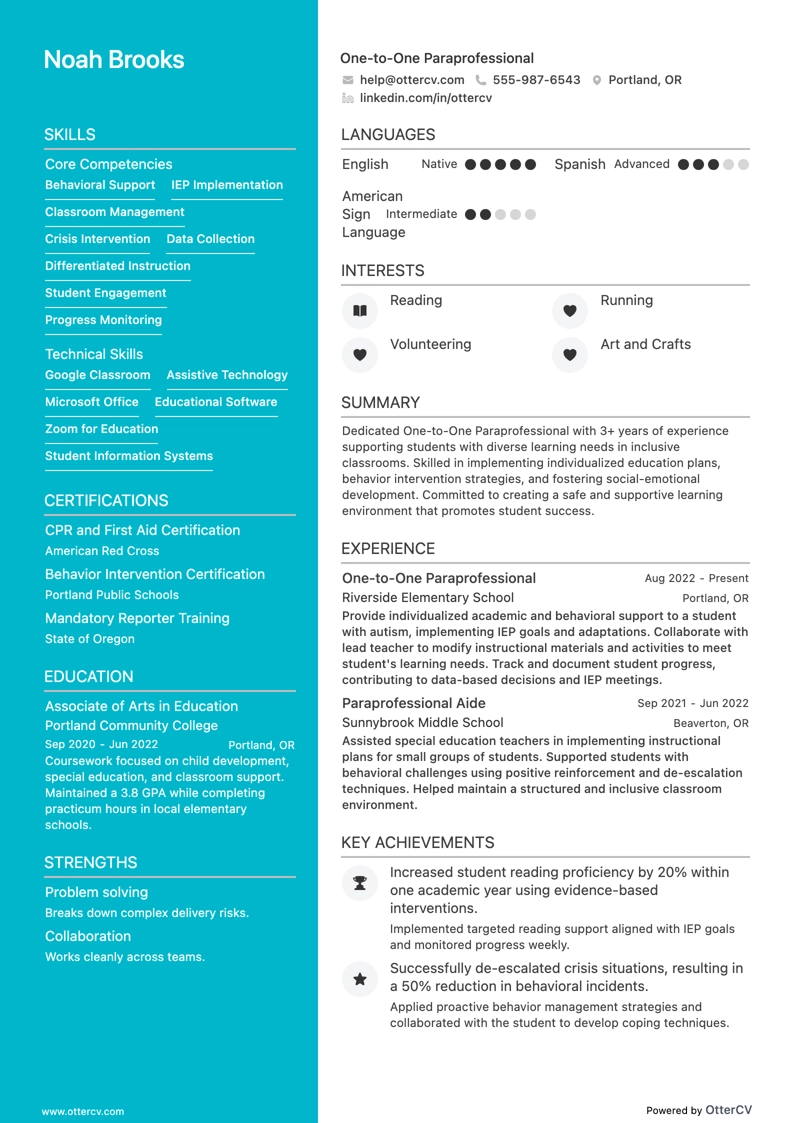
One-to-One Paraprofessional resume example

One-to-One Paraprofessional

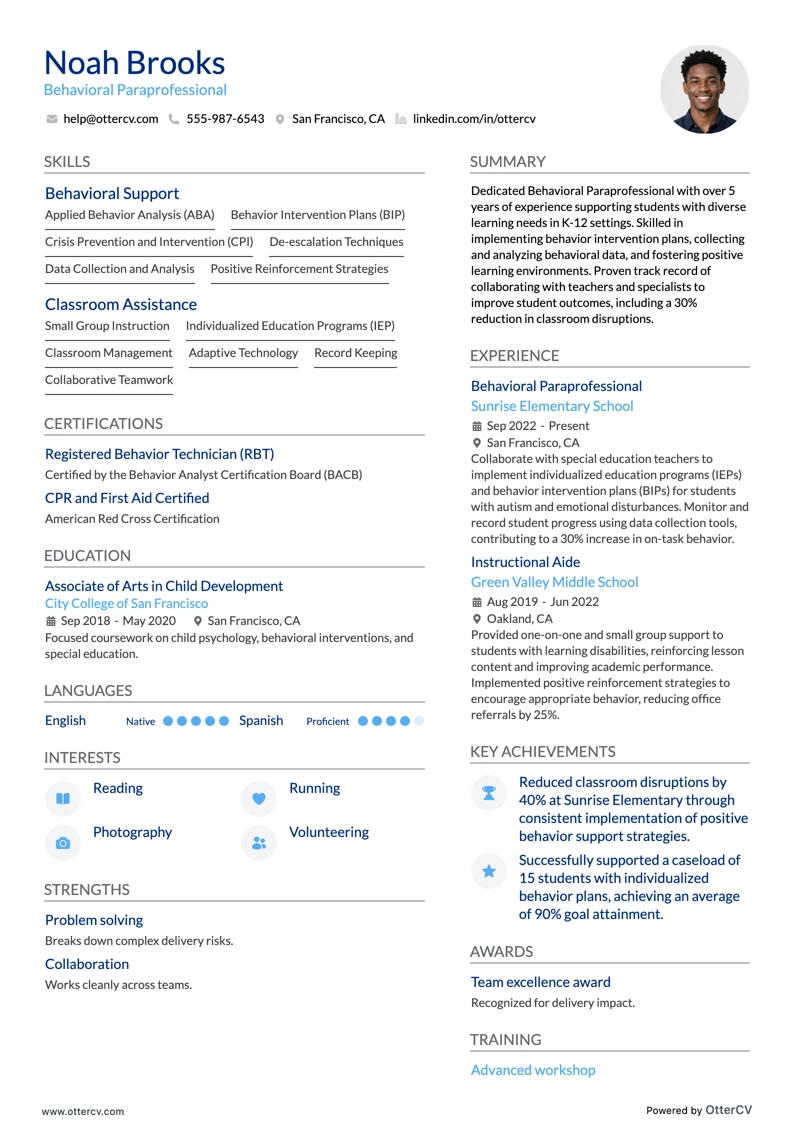
Behavioral Paraprofessional resume example

Behavioral Paraprofessional

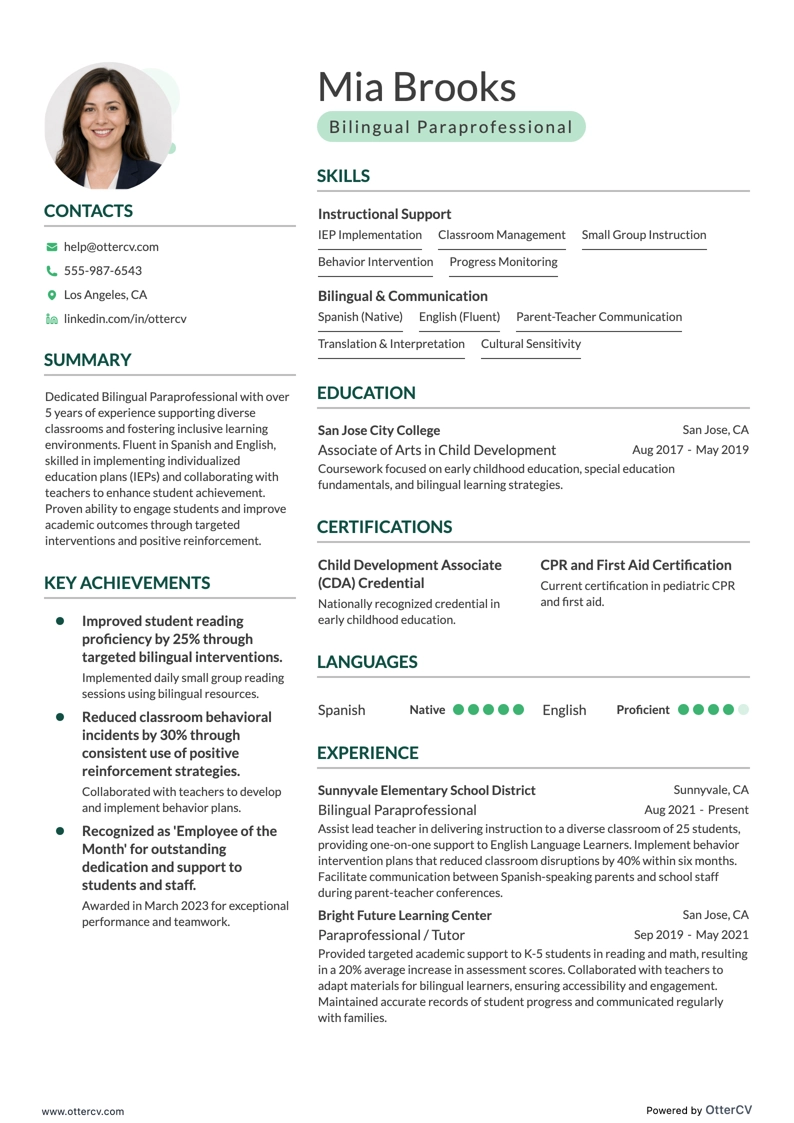
Bilingual Paraprofessional resume example

Bilingual Paraprofessional

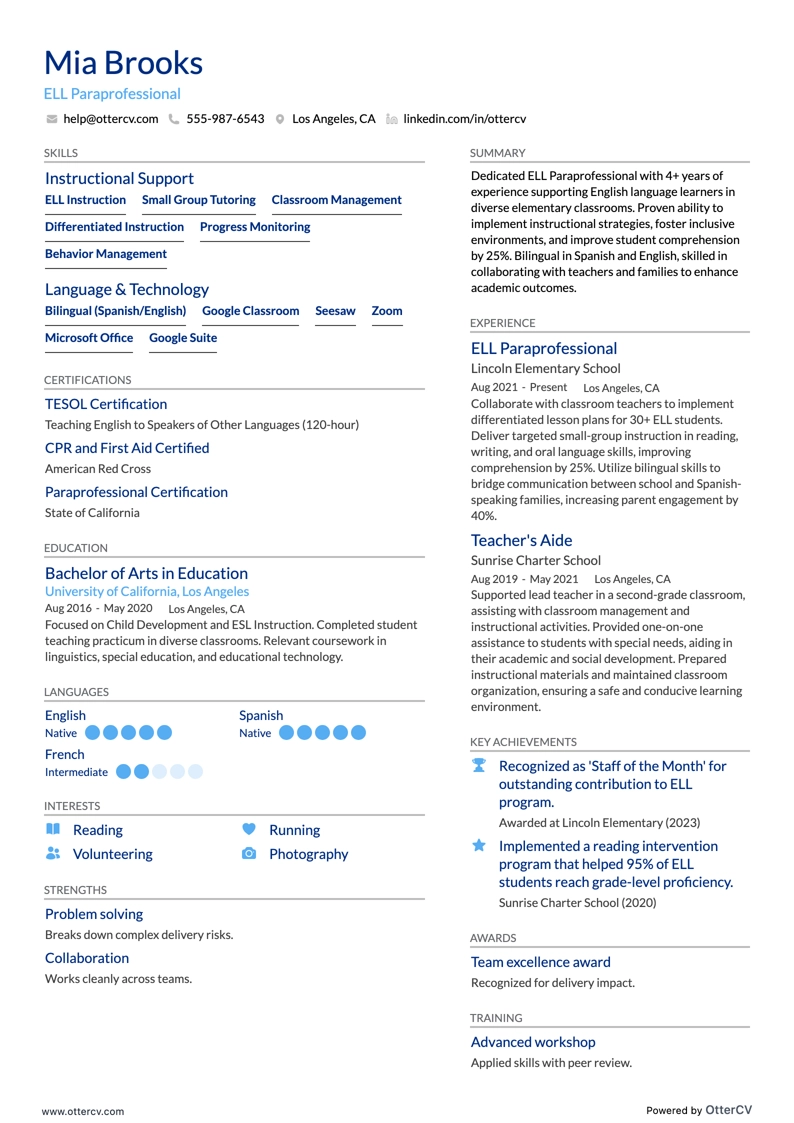
ELL Paraprofessional resume example

ELL Paraprofessional

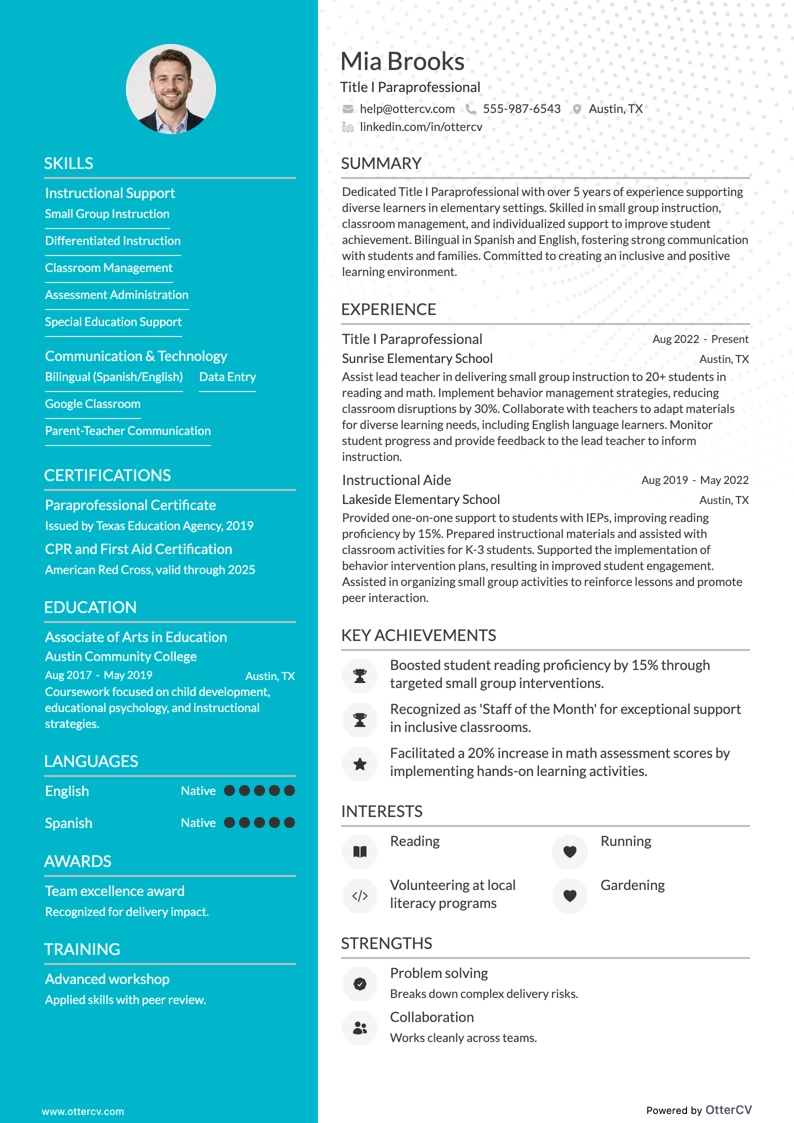
Title I Paraprofessional resume example

Title I Paraprofessional

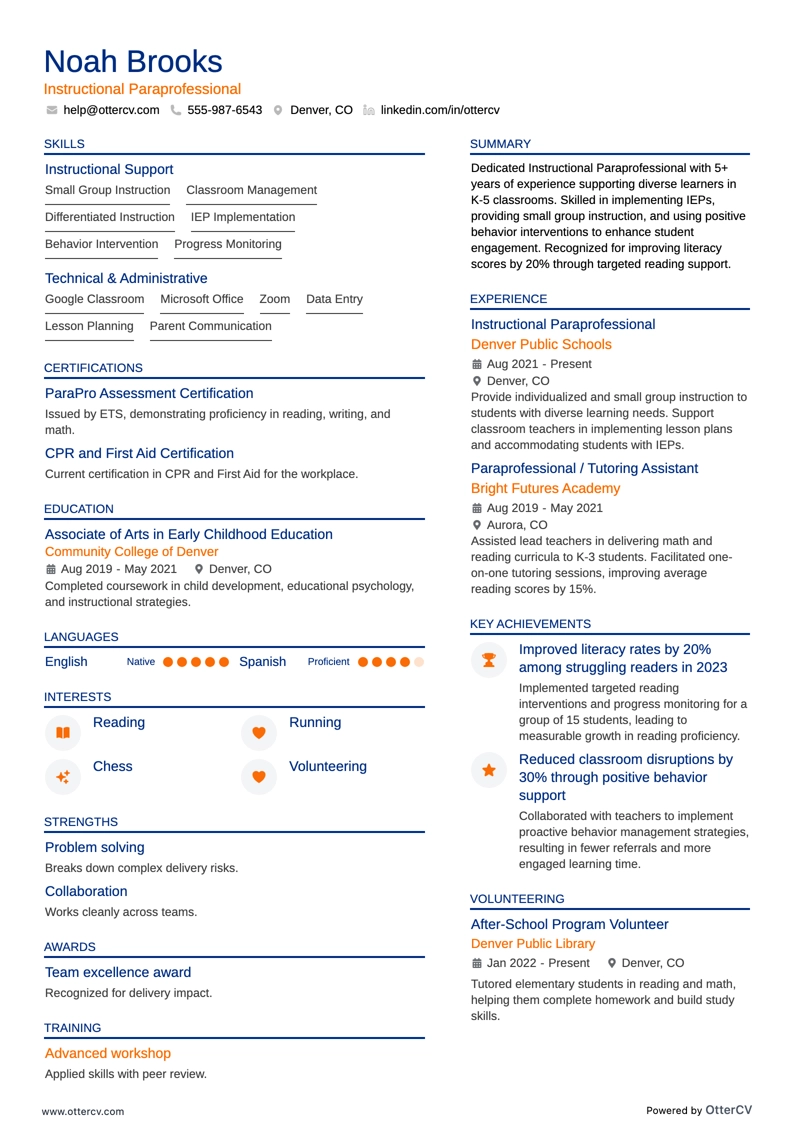
Instructional Paraprofessional resume example

Instructional Paraprofessional

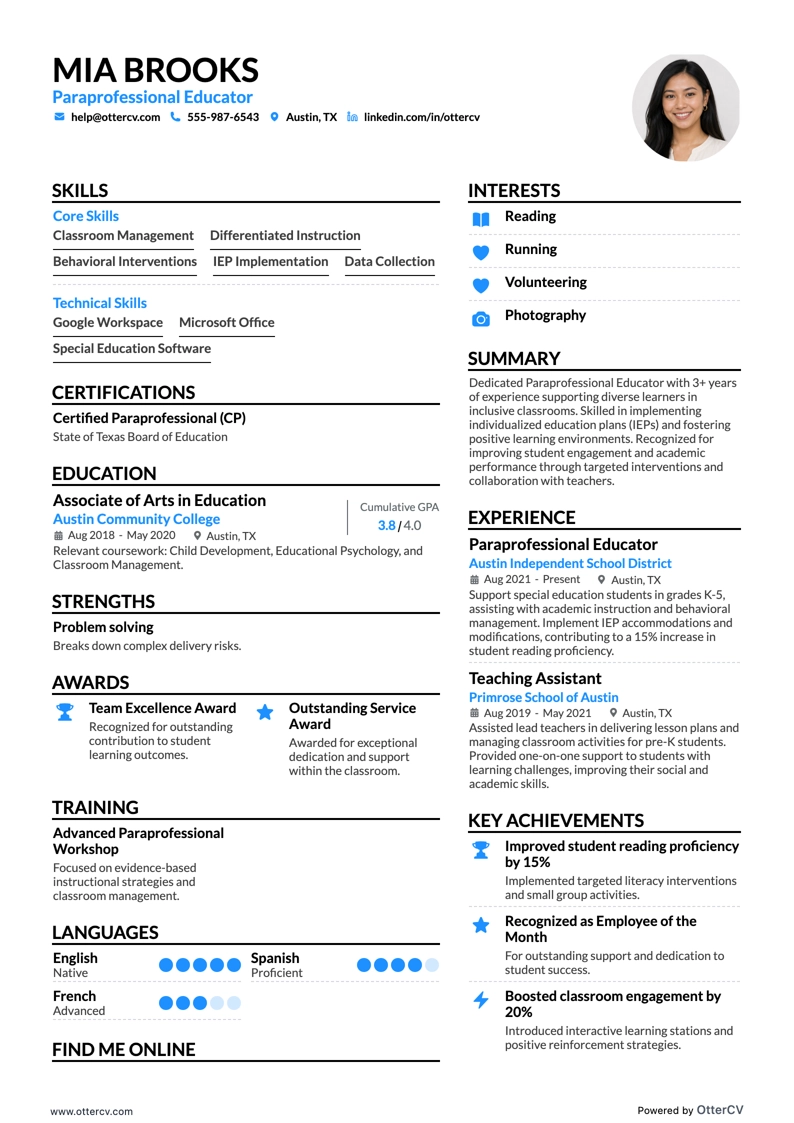
Paraprofessional Educator resume example

Paraprofessional Educator

Many paraprofessional resume drafts fall short because they read like task lists instead of showing evidence of student support. That becomes a problem when an ATS (applicant tracking system) scans for keywords and recruiters skim quickly in a crowded applicant pool.

A strong resume explains what changed because you were there. Knowing how to make your resume stand out means highlighting progress tracked, caseload size supported, behavior incidents reduced, accommodations delivered on time, and small-group gains in reading or math. It should also show accuracy in documentation and smoother classroom routines.

Key takeaways

  • Quantify student outcomes in every experience bullet, including reading gains, behavior reductions, and caseload size.

  • Use a reverse-chronological format if you have classroom experience, or a hybrid format if you are changing careers.

  • Tailor your resume language to each job posting’s specific programs, tools, and frameworks.

  • Place certifications above education when they are required or highly relevant to the role.

  • Show skills in context through your summary and experience instead of listing them separately.

  • Use volunteer hours, tutoring, and practicum work to strengthen an entry-level paraprofessional resume.

  • Use Echocv’s tools to turn vague duties into measurable, recruiter-ready bullet points faster.

Job market snapshot for paraprofessionals

We analyzed 1,325 recent paraprofessional job ads across major US job boards. These figures offer a quick view of in-demand skills, employer expectations, and employment type trends.

What level of experience employers are looking for paraprofessionals

Years of ExperiencePercentage found in job ads
1–2 years1.5% (20)
3–4 years0.3% (4)
5–6 years0.8% (11)
10+ years3.9% (52)
Not specified92.5% (1226)

Paraprofessional ads by area of specialization (industry)

Industry (Area)Percentage found in job ads
Education51.9% (688)
Finance & Banking24.2% (321)
Healthcare22.4% (297)

Top companies hiring paraprofessionals

CompanyPercentage found in job ads
Denver Public Schools8.2% (109)
Connecticut REAP5.0% (66)
The Stepping Stones Group4.1% (54)
Ohio Department of Education3.2% (43)
Boston Public Schools2.3% (30)
South Washington County Schools Isd 8332.1% (28)
Gilbert Unified Schools AZ2.0% (27)
Poudre School District1.9% (25)
National Heritage Academies1.7% (23)
Alaska Teachers and Personnel1.4% (18)

Role overview stats

These tables outline the most common responsibilities and employment types for paraprofessional roles. Use them to align your resume with employer expectations and understand how the role is structured across the market.

Day-to-day activities and top responsibilities for a paraprofessional

ResponsibilityPercentage found in job ads
First aid7.8% (103)
CPR7.2% (95)
Email3.7% (49)
Microsoft Word3.2% (43)
Computer2.8% (37)
Excel2.5% (33)
Data collection2.0% (27)
Word1.9% (25)
Microsoft Office1.8% (24)
Personal computers1.8% (24)
Reading1.7% (23)
Record keeping1.7% (23)

How to format a paraprofessional resume

Recruiters reviewing paraprofessional resumes look for classroom support skills, experience working with diverse student populations, and the ability to collaborate with lead teachers within structured educational settings. Choosing the right resume format helps these qualifications stand out quickly for both human reviewers and applicant tracking systems.

I have significant experience as a paraprofessional—which format should I use?

I have significant experience as a paraprofessional—which format should I use?

Use a reverse-chronological format to show your increasing classroom responsibilities and consistent record of student support.

  • Lead with your most recent role and describe the scope of your support duties, including grade levels served, caseload size, and collaboration with certified teachers.
  • Highlight role-specific skills such as IEP implementation, behavior intervention plans, assistive technology, and literacy or math intervention programs.
  • Quantify your impact with measurable results tied to student progress, attendance, or instructional efficiency.

Example bullet: “Provided one-on-one reading intervention for 12 students with IEPs, contributing to a 30% average improvement in Lexile scores over one academic year.”

I'm junior or switching into a paraprofessional role—what format works best?

I'm junior or switching into a paraprofessional role—what format works best?

A hybrid resume format works best because it lets you lead with transferable skills while still showing relevant experience in a clear timeline.

Do:

  • Place a skills section near the top of your resume that highlights competencies like classroom management support, student behavior documentation, and familiarity with special education protocols.
  • Include volunteer work, student teaching, tutoring, or childcare experience as proof of your ability to work in educational settings.
  • Connect each listed skill to a specific action and a concrete result so recruiters can see your real-world capability.

Example scaffold: Behavior support (skill) → Implemented a daily check-in system for five students on behavior plans (action) → Reduced classroom disruptions by 40% within one semester (result).

Why not use a functional resume?

Why not use a functional resume?

A functional resume removes the timeline hiring committees use to verify your classroom hours, credential progress, and consistency in educational settings, which can make your qualifications harder to trust at a glance.

  • A functional format may be acceptable if you're transitioning from a non-education career, have a significant employment gap, or have limited formal work history—but only if you connect each listed skill to a specific project, volunteer role, or measurable student outcome.

Avoid a functional format entirely if you have any relevant classroom experience, since leaving out your timeline will raise more questions than it answers.

With your format set, the next step is choosing the right resume sections to highlight your qualifications clearly.

What sections should go on a paraprofessional resume

Recruiters want clear evidence that you can support students, manage classroom routines, and work effectively with teachers. Knowing which resume sections to include helps you present your qualifications in the order hiring teams expect.

Use this structure for clarity:

  • Header
  • Summary
  • Experience
  • Skills
  • Projects
  • Education
  • Certifications
  • Optional sections: Volunteering, Leadership, Languages

Strong experience bullets should highlight student support outcomes, the size of your caseload or classroom coverage, and measurable improvements in behavior, participation, or learning progress.

Once you’ve organized your resume with the right core sections, focus on your paraprofessional experience to show how you’ve applied those skills in real classroom and student support settings.

How to write your paraprofessional resume experience

Your experience section is where you show the meaningful support you’ve provided in educational environments through classroom instruction, behavioral interventions, individualized education program (IEP) implementation, and student progress monitoring. Hiring managers care more about your impact on student outcomes and learning environments than a simple list of tasks.

Each entry should include:

  • Job title
  • Company and location (or remote)
  • Dates of employment (month and year)

Add three to five concise bullet points that explain what you were responsible for, how you carried out the work, and what results you achieved.

  • Ownership scope: the classrooms, student caseloads, grade levels, special education programs, or instructional groups you directly supported.
  • Execution approach: the instructional strategies, assistive technologies, behavior management frameworks, data collection tools, or curriculum materials you used to reinforce lessons and support individualized learning plans.
  • Value improved: changes in student achievement, reading or math proficiency, classroom behavior, attendance, accessibility for students with disabilities, or the efficiency of instructional routines connected to your contributions.
  • Collaboration context: how you worked with lead teachers, special education coordinators, speech-language pathologists, school counselors, parents, and administrators to maintain consistent student support and IEP compliance.
  • Impact delivered: outcomes shown through student progress, learning gains, improved behavioral benchmarks, or stronger classroom functioning instead of a list of daily duties.

Experience bullet formula

Experience bullet formula

Action verb + technology + what you built or fixed + measurable result

A paraprofessional experience example

Special Education Paraprofessional

Riverside Unified School District | Riverside, CA

2021–Present

Supported a K–five inclusive elementary campus serving 650+ students, partnering with special education teachers to provide individualized instruction and behavior support.

  • Implemented IEP (Individualized Education Program) accommodations for fourteen students during reading and math blocks using Google Classroom, Seesaw, and visual schedules, improving weekly mastery checks by 18% over one semester.
  • Tracked behavior and academic progress in PowerSchool Special Programs and Google Sheets, producing daily data summaries that reduced IEP documentation errors by 30% and cut teacher prep time by three hours per week.
  • Delivered small-group interventions using evidence-based programs including Lexia Core5 Reading and i-Ready, along with explicit instruction routines, accelerating reading fluency gains by an average of twelve words per minute for six students in ten weeks.
  • De-escalated high-frequency behaviors using CPI (Crisis Prevention Institute) strategies and PBIS (Positive Behavioral Interventions and Supports) plans, reducing classroom removals by 40% while maintaining student safety and dignity.
  • Coordinated with speech-language pathologists, occupational therapists, and families to reinforce AAC (augmentative and alternative communication) goals using Proloquo2Go, increasing independent communication attempts from five to fifteen per day for two students.

Now that you’ve seen what a strong experience section looks like, here’s how to tailor each part to the specific paraprofessional role you’re applying for.

How to tailor your paraprofessional resume experience

Recruiters review paraprofessional resumes through both human screening and applicant tracking systems (ATS). Tailoring your resume to the job description by reflecting the language and priorities in each posting can improve your chances of getting through both.

Ways to tailor your paraprofessional experience:

  • Match the specific instructional methods or intervention programs named in the posting.
  • Use the exact terminology listed for IEP goals or accommodation processes.
  • Mirror the student progress metrics or assessment tools the district references.
  • Include grade levels or student populations relevant to the role.
  • Emphasize behavioral management frameworks mentioned in the job description.
  • Highlight compliance with FERPA or district accessibility standards when applicable.
  • Reflect collaboration models with lead teachers or special education teams.
  • Align classroom technology platforms or assistive tools with the stated requirements.

Tailoring means presenting your real accomplishments in the language and priorities each employer values, not adding keywords that do not reflect your actual experience.

Resume tailoring examples for paraprofessional

Job description excerptUntailoredTailored
"Assist lead teacher with implementation of IEP goals for students with autism spectrum disorder using ABA-based strategies in a self-contained classroom."Helped teachers with student activities and classroom tasks.Supported the lead teacher in implementing IEP goals for 8 students with autism spectrum disorder, using ABA-based strategies such as discrete trial training and visual schedules in a self-contained K–2 classroom.
"Provide one-on-one reading intervention support using the Wilson Reading System for students in grades 3–5 performing below grade level."Worked with students who needed extra help in reading.Delivered one-on-one reading intervention to 12 students in grades 3–5 using the Wilson Reading System, contributing to an average improvement of 1.5 grade levels in reading proficiency over one academic year.
"Monitor student behavior, collect daily behavioral data, and collaborate with the BCBA to adjust behavior intervention plans (BIPs) as needed."Kept an eye on students and reported issues to staff.Collected and recorded daily behavioral data for 6 students on individualized behavior intervention plans, collaborating with the BCBA to adjust reinforcement schedules and de-escalation protocols based on trend analysis.

Once you’ve aligned your experience with the role’s priorities, the next step is to quantify your paraprofessional achievements so hiring managers can clearly see the impact of your work.

How to quantify your paraprofessional achievements

Quantifying your achievements helps show how your support work improves outcomes, not just activity. Track the volume you handled, turnaround time, accuracy, compliance, and satisfaction across students, staff, or clients.

Quantifying examples for paraprofessional

MetricExample
Volume handled"Supported three classrooms daily and delivered one hundred twenty student check-ins per week using Google Sheets tracking."
Turnaround time"Cut parent call-backs from forty-eight hours to twenty-four hours by batching voicemails and using Outlook templates."
Accuracy rate"Reduced IEP paperwork errors from eight per month to two per month by adding a checklist and double-verifying entries in PowerSchool."
Compliance risk"Maintained one hundred percent FERPA-compliant file handling across six hundred student records by standardizing labeling and locked-cabinet storage."
Satisfaction score"Raised teacher satisfaction from 3.8 to 4.5 out of five on quarterly surveys by aligning daily support plans in Microsoft Teams."

Once you’ve written strong, action-driven bullet points for your experience section, use that same precision when presenting your hard and soft skills.

How to list your hard and soft skills on a paraprofessional resume

Your skills section should show that you can support instruction, student needs, and classroom operations. Recruiters and ATS (applicant tracking system) tools scan this section to match your resume to the job posting, so include more hard skills than soft skills, and tie both to daily responsibilities.

Paraprofessional roles require a blend of:

  • Product strategy and discovery skills
  • Data, analytics, and experimentation skills
  • Delivery, execution, and go-to-market discipline
  • Soft skills

Your skills section should be:

  • Scannable, using bullet-style grouping
  • Relevant to the job post
  • Backed by proof in your experience bullets
  • Updated with current tools

Place your skills section:

  • Above your experience if you’re junior or switching careers
  • Below your experience if you’re mid/senior with strong achievements

Hard skills

  • Develop and support Individualized Education Programs (IEPs).
  • Implement Behavior Intervention Plans (BIPs).
  • Collect data using Applied Behavior Analysis (ABA) methods.
  • Track classroom behavior using ABC charts.
  • Provide small-group instruction support.
  • Support reading interventions.
  • Support math interventions.
  • Provide assistive technology support.
  • Use Google Workspace and Microsoft Office.
  • Work with student information systems and attendance tracking.
  • Use learning management systems.
  • Hold CPR and first aid certification.

Soft skills

  • Follow teacher lesson plans.
  • Give students clear directions.
  • De-escalate behavior incidents.
  • Maintain student confidentiality.
  • Document observations accurately.
  • Communicate professionally with caregivers.
  • Collaborate with special education teams.
  • Support inclusive classroom routines.
  • Adapt support to student needs.
  • Manage transitions and time on task.
  • Escalate safety concerns quickly.
  • Take feedback and adjust quickly.

How to show your paraprofessional skills in context

Skills should not appear only in isolated lists on your resume. Reviewing examples of resume skills in context can help you see how strong candidates connect them to real achievements.

Show your skills in these sections:

  • Your summary (high-level professional identity)
  • Your experience (proof through outcomes)

Here’s what that looks like in practice.

Senior paraprofessional with 12 years of experience in special education, with skills in Applied Behavior Analysis, IEP implementation, and assistive technology. Partnered with multidisciplinary teams to improve student goal attainment by 35% across caseloads.

Why it works

  • Reflects senior-level experience immediately
  • Names specific tools and methods
  • Leads with a measurable outcome
  • Highlights collaboration as a soft skill

Experience example

Senior Paraprofessional

Lakeview Unified School District | Milwaukee, WI

August 2017–June 2024

  • Implemented individualized behavior intervention plans using ABA strategies, reducing classroom disruptions by 40% over two semesters.
  • Collaborated with special education teachers and speech therapists to adapt curriculum materials, boosting reading comprehension scores by 25%.
  • Tracked student progress through daily data collection in Google Sheets, enabling IEP teams to make faster, evidence-based goal adjustments.

Why it works

  • Every bullet includes measurable proof.
  • Skills appear naturally within achievements.

Once you’ve shown your strengths through specific classroom examples, the next step is structuring a paraprofessional resume with no experience so those skills still stand out.

How do I write a paraprofessional resume with no experience

Even without full-time experience, you can still show readiness through:

  • Classroom volunteering with small groups
  • Student teaching or practicum hours
  • Tutor sessions with lesson notes
  • After-school program support roles
  • IEP (individualized education program) observation logs
  • Behavior tracking and intervention charts
  • Online paraprofessional training certificates
  • Childcare or camp supervision shifts

If you're building a resume without work experience, focus on:

  • Documented student support hours
  • Data tracking and reporting samples
  • Familiarity with IEP documentation
  • Relevant coursework and certifications

Resume format tip for entry-level paraprofessional

Resume format tip for entry-level paraprofessional

Use a combination resume format. This format puts skills and training first while still showing experience substitutes and measurable results.

Do the following:

  • Put certifications and training near the top.
  • Add bullet points with numbers and results.
  • List classroom tools you used, such as Google Classroom.
  • Include relevant coursework tied to student support.
  • Describe tasks using paraprofessional keywords from job posts.

Example project bullet:

  • Tracked behavior data for five students in Google Sheets during classroom volunteering, improving on-task time by 20% over four weeks.

Even without direct experience, your educational background can show the knowledge and qualifications that make you a strong candidate. Here’s how to present it effectively.

How to list your education on a paraprofessional resume

Your education section helps hiring teams quickly confirm that you have the foundational knowledge needed for a paraprofessional role.

Include:

  • Degree name
  • Institution
  • Location
  • Graduation year
  • Relevant coursework, for juniors or entry-level candidates
  • Honors and GPA, if 3.5 or higher

Skip the month and day details, and list the graduation year only.

Here’s a strong education entry tailored for a paraprofessional resume:

Example education entry

Bachelor of Arts in Education

University of Northern Iowa, Cedar Falls, IA

Graduated 2021

GPA: 3.7/4.0

  • Relevant coursework: Child Development, Classroom Management, Foundations of Special Education, Instructional Strategies
  • Honors: Dean's List (six consecutive semesters), Magna Cum Laude

How to list your certifications on a paraprofessional resume

Certifications on your resume show your commitment to learning, your proficiency with classroom tools, and your alignment with current education standards and practices.

Include the following details:

  • Certificate name
  • Issuing organization
  • Year
  • Optional: credential ID or URL
  • Place certifications below education when your degree is recent and the certifications support it without adding stronger, role-specific value.
  • Place certifications above education when they are recent, highly relevant, or required, and they strengthen your fit for a paraprofessional role right away.

Best certifications for your paraprofessional resume

  • ParaPro Assessment (Educational Testing Service)
  • CPR and First Aid Certification (American Red Cross)
  • Crisis Prevention Institute Nonviolent Crisis Intervention Certification
  • Registered Behavior Technician (Behavior Analyst Certification Board)
  • Child Development Associate Credential (Council for Professional Recognition)
  • Google Certified Educator Level 1

Once you’ve listed your credentials in a clear, easy-to-scan format, turn to your paraprofessional resume summary to show how those qualifications support the role.

How to write your paraprofessional resume summary

Your resume summary is often the first section a recruiter reads, so it should quickly demonstrate your value. A strong introduction tailored to paraprofessional work helps you stand out from generic applicants.

Keep it to three or four lines and include:

  • Your title and total years of classroom or instructional support experience.
  • The setting you know best, such as special education, elementary, or Title I programs.
  • Core skills like behavior management, IEP implementation, or literacy intervention tools.
  • One or two measurable wins, such as improved student reading levels or reduced behavioral incidents.
  • Soft skills tied to real results, such as patience that helped de-escalate 90% of disruptions without office referrals.

PRO TIP

At the paraprofessional level, prioritize clarity, relevant skills, and early impact you can quantify. Highlight the specific student populations you have supported and the tools you use daily.

Avoid vague phrases like “passionate about helping children” or “team player.” Instead, use concrete actions and measurable contributions.

Example summary for a paraprofessional

Paraprofessional with three years of special education experience supporting K–5 classrooms. Skilled in IEP accommodations and behavioral tracking. Helped improve reading proficiency by 20% across a caseload of 15 students.

Before your summary can make an impact, hiring managers need to find your contact details quickly, and a well-structured header makes that possible.

What to include in a paraprofessional resume header

A well-crafted resume header includes your key contact details and role focus, which can improve visibility, credibility, and faster recruiter screening for a paraprofessional.

Essential resume header elements:

  • Full name
  • Tailored job title and headline
  • Location
  • Phone number
  • Professional email
  • GitHub link
  • Portfolio link
  • LinkedIn

A LinkedIn link helps recruiters confirm your experience quickly and supports screening without extra back-and-forth.

Do not include a photo on a paraprofessional resume unless the role is explicitly front-facing or appearance-dependent.

Keep your header to one or two lines per detail, use consistent formatting, and match your job title to the wording in the posting.

Once your contact details and role information are in place, you can strengthen your application by adding relevant resume sections that support the rest of the document.

Additional sections for paraprofessional resumes

When your core qualifications are similar to those of other applicants, additional sections can help you stand out by highlighting role-specific strengths hiring committees value. For example, listing language skills on your resume can be especially helpful in districts with multilingual student populations.

  • Languages
  • Volunteer experience
  • Certifications and training
  • Professional memberships
  • Hobbies and interests
  • Awards and recognition

In addition to strengthening your resume with relevant extra sections, a well-written cover letter can help your application stand out.

Do paraprofessional resumes need a cover letter

A cover letter is not required for most paraprofessional roles, but it can help when the position is competitive or the employer expects one. If you are unsure what a cover letter is or how it supports your resume, it can be useful when your resume needs more context or when you are applying to a specific team.

Use a cover letter to add details your resume cannot include:

  • Explain your fit for the role and team by connecting your strengths to the paraprofessional duties listed in the job posting.
  • Highlight one or two relevant projects or outcomes, and tie them to measurable results or improved workflows.
  • Show that you understand the product, users, or business context by referencing a real need the team supports.
  • Address career changes or less obvious experience by explaining how your past work applies to paraprofessional responsibilities.

Using AI to improve your paraprofessional resume

Even if you decide to submit a cover letter, using AI to improve your paraprofessional resume can help you tailor your skills and experience more precisely to the role.

AI can improve your resume's clarity, structure, and overall impact. It can rephrase awkward bullet points and bring relevant skills into focus. But if you rely on it too much, your resume can start to sound robotic. If you're wondering which AI is best for writing resumes, the key is to choose tools that support your real experience rather than replace it. Once your content is clear and aligned with the role, step away from AI.

Here are 10 practical prompts to strengthen specific sections of your paraprofessional resume:

Strengthen your summary

Strengthen your summary

Rewrite my paraprofessional resume summary to emphasize classroom support experience, collaboration with teachers, and student engagement in under four sentences.

Quantify experience bullets

Quantify experience bullets

Add measurable outcomes to these paraprofessional experience bullets by emphasizing student progress, group sizes, or the frequency of instructional support.

Tailor skills to the role

Tailor skills to the role

Review this skills section and remove entries that are not relevant to a paraprofessional position. Replace them with skills that better reflect classroom assistance and student support.

Improve action verbs

Improve action verbs

Replace weak or repetitive verbs in my paraprofessional experience section with stronger alternatives that better reflect hands-on instructional support.

Align with job posting

Align with job posting

Compare my paraprofessional resume to this job description. Identify missing keywords and suggest where to add them naturally.

Clarify education details

Clarify education details

Rewrite my education section to highlight coursework, training, and credentials that are directly relevant to a paraprofessional role.

Highlight certifications clearly

Highlight certifications clearly

Reorganize the certifications section so the most relevant paraprofessional credentials, such as CPR, first aid, or state aide licenses, appear first.

Tighten project descriptions

Tighten project descriptions

Shorten the project descriptions on my paraprofessional resume, with each one focused on my specific role, the actions I took, and the student outcomes.

Remove filler language

Remove filler language

Identify and remove vague or unnecessary phrases from my paraprofessional resume. Keep every sentence specific and concise.

Check tone and consistency

Check tone and consistency

Review my full paraprofessional resume for inconsistent tense, tone shifts, or formatting errors, and suggest corrections without changing my original meaning.

Conclusion

A strong paraprofessional resume shows impact through measurable outcomes, highlights role-specific skills, and uses a clear, easy-to-scan structure. It demonstrates how you supported learning, improved behavior, and strengthened classroom routines through consistent, documented results.

Keep your resume focused on what hiring teams need now and will continue to need next year: dependable support, strong communication, and student-centered care. With clear sections and specific achievements, you can present yourself as ready to contribute on day one.

Paraprofessional resume examples

Explore additional Paraprofessional resume samples and guides and see what works for your level of experience or role.

By Role

Special Education Instructional Assistant

Special Education Instructional Assistant resume preview

Classroom Aide

Classroom Aide resume preview

Paraeducator

Paraeducator resume preview

One-to-One Paraprofessional

One-to-One Paraprofessional resume preview

Behavioral Paraprofessional

Behavioral Paraprofessional resume preview

Bilingual Paraprofessional

Bilingual Paraprofessional resume preview

ELL Paraprofessional

ELL Paraprofessional resume preview

Title I Paraprofessional

Title I Paraprofessional resume preview

Instructional Paraprofessional

Instructional Paraprofessional resume preview

Paraprofessional Educator

Paraprofessional Educator resume preview