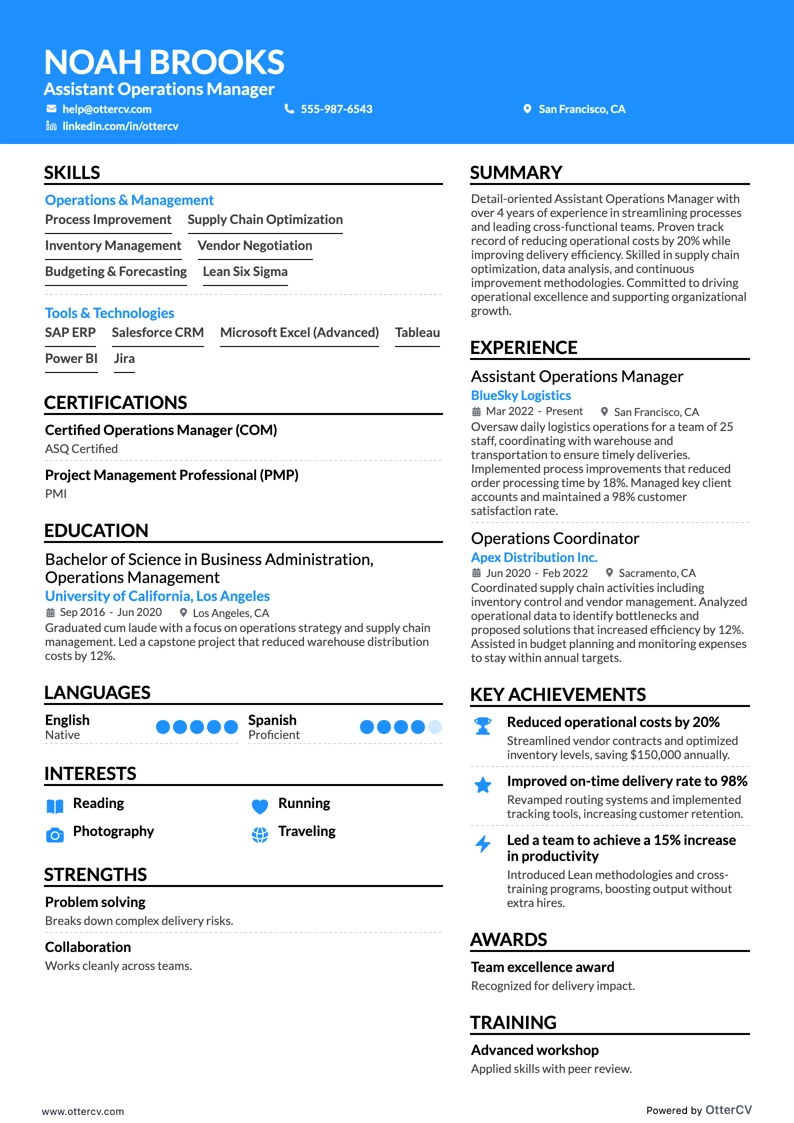
Assistant Operations Manager full preview

25 Operations Manager Resume Examples

OtterCV

Written by The OtterCV Team

Updated: 10/3/2024•8 min read

See all resume examples in this guide, or generate your own resume example with your personalized prompt

Assistant Operations Manager resume example

Assistant Operations Manager

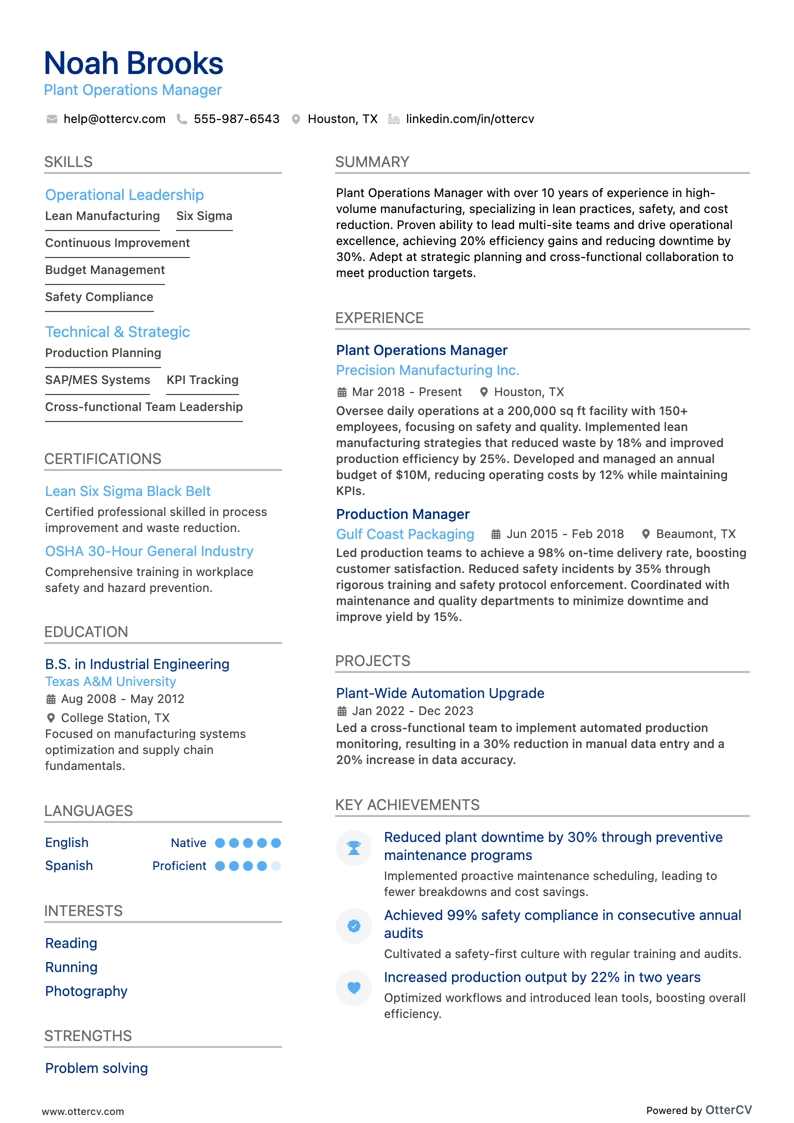
Plant Operations Manager resume example

Plant Operations Manager

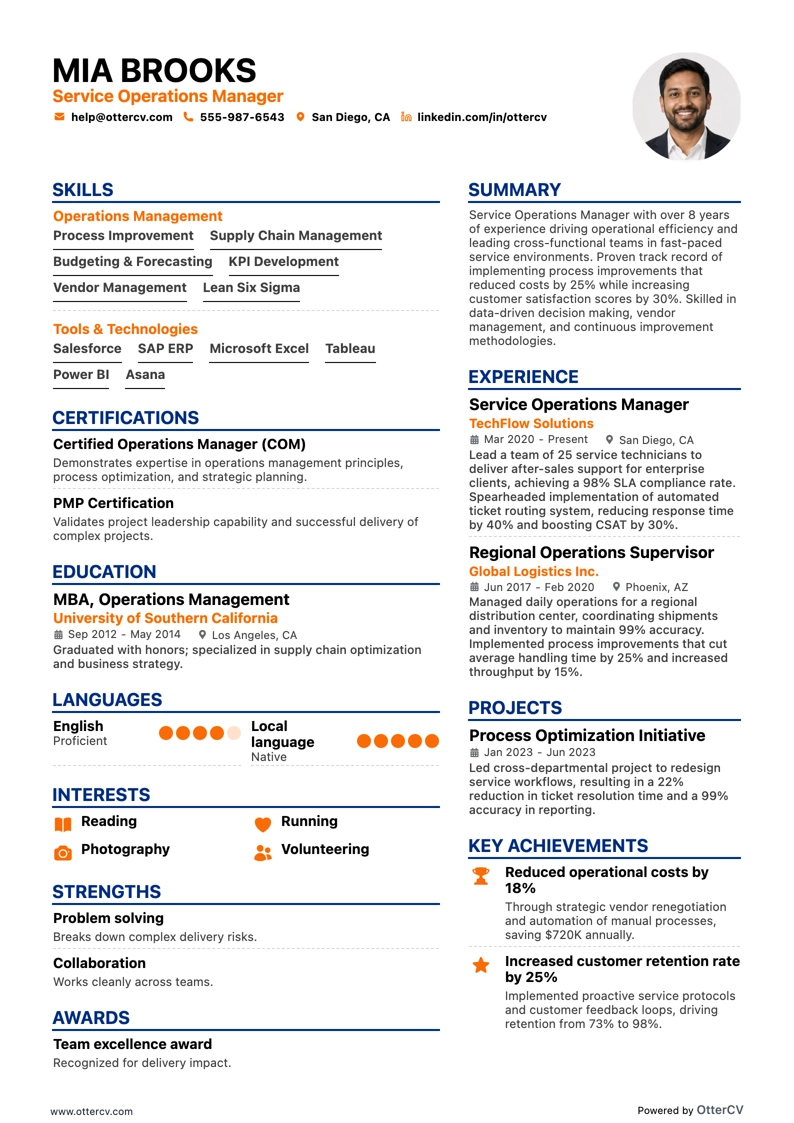
Service Operations Manager resume example

Service Operations Manager

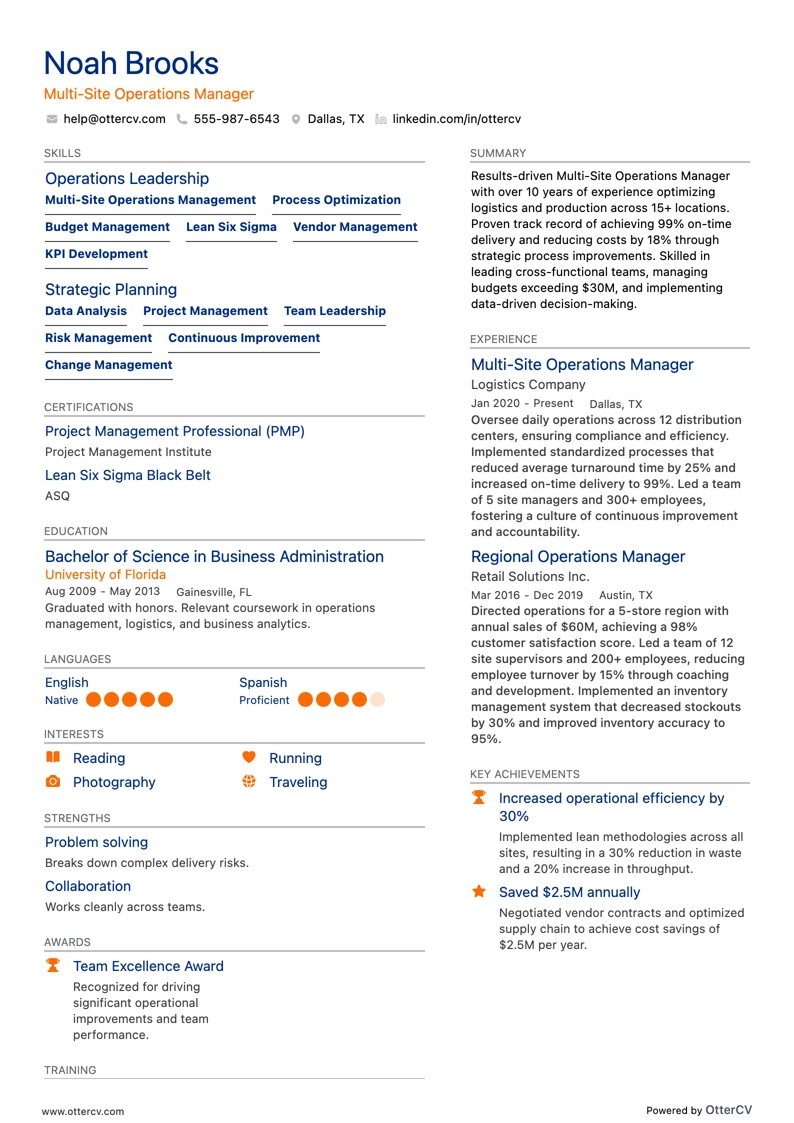
Multi-Site Operations Manager resume example

Multi-Site Operations Manager

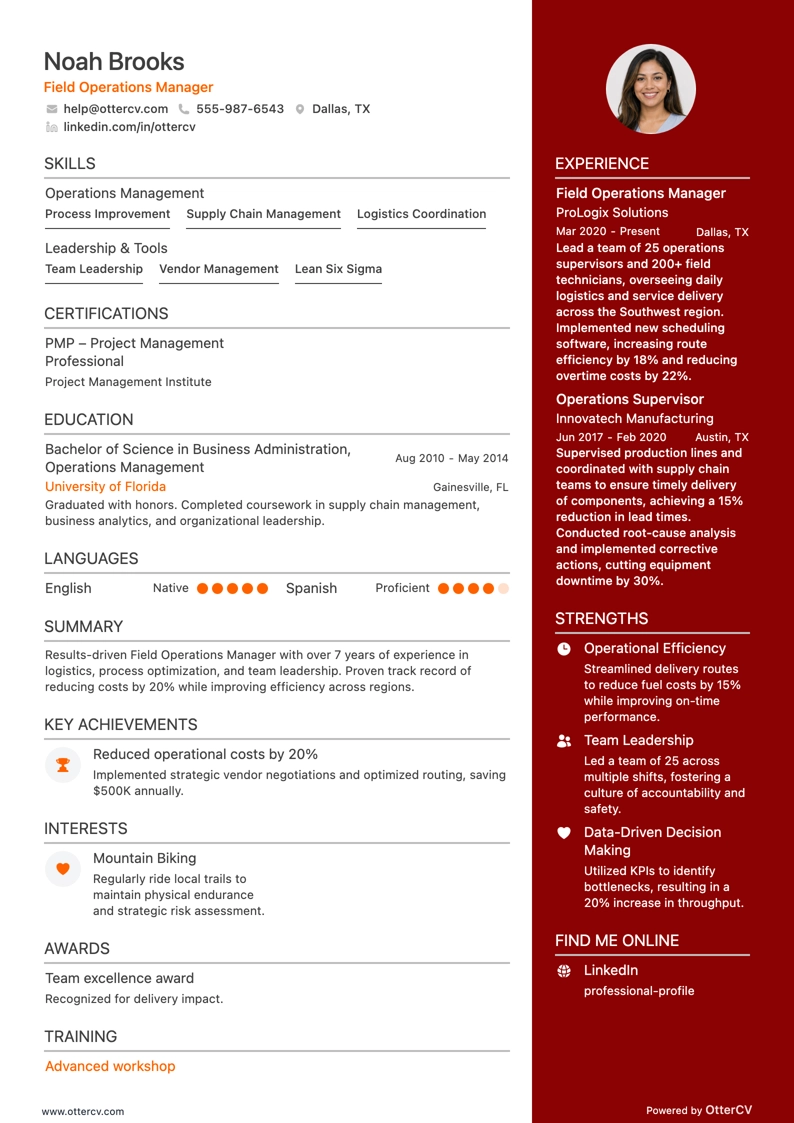
Field Operations Manager resume example

Field Operations Manager

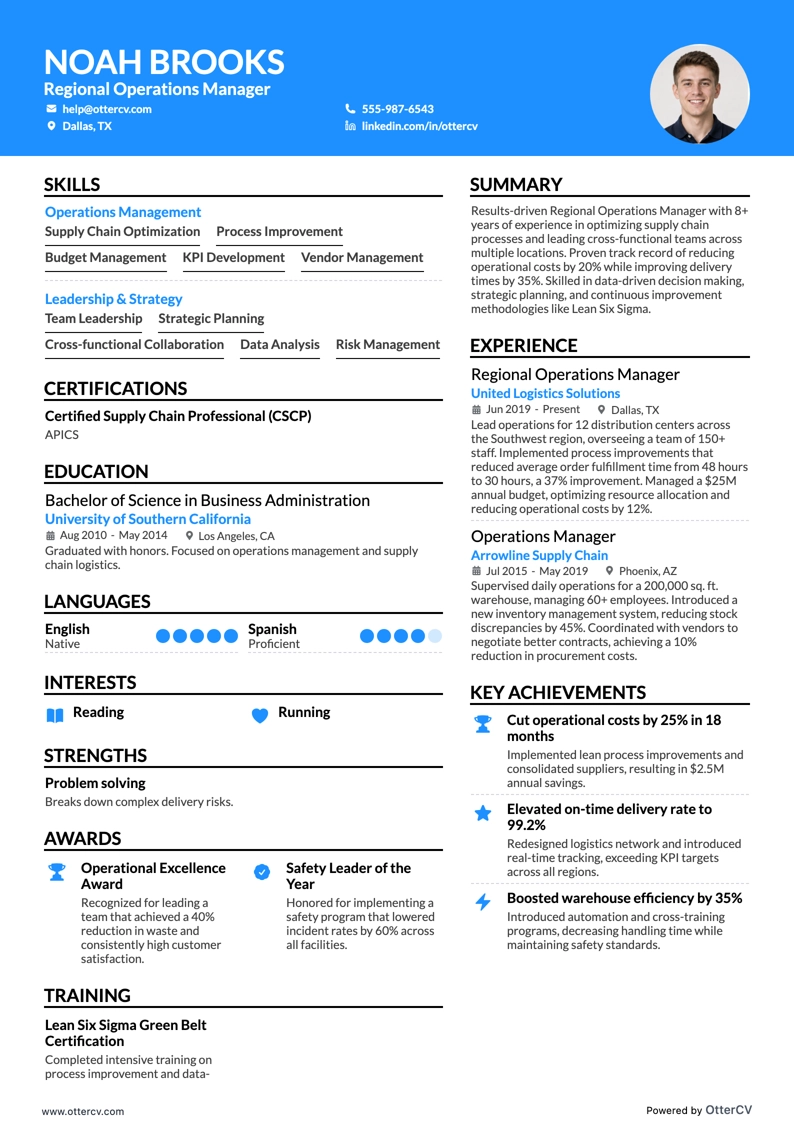
Regional Operations Manager resume example

Regional Operations Manager

With disrupted supply chains and shifting demand, companies are being asked to do more with less, making the operations manager’s role more critical than ever. As recent business analysis shows, employers are not just looking for steady hands. They want leaders who can improve processes, make strategic decisions under pressure, and keep teams moving in the right direction.

Whether you are changing sectors or aiming for a senior role, your resume needs to show how you bring operational clarity and contribute to the bottom line.

This guide will help you build an operations manager resume that presents your impact clearly and confidently. If you want to make the process easier, Echocv’s AI Resume Builder gives you structure, prompts, and polish so your operational strengths are clear to hiring managers.

Key takeaways

  • Show that you can adapt quickly to changing business needs and use modern tools and technology with confidence.

  • Support your achievements with clear metrics, such as efficiency gains, cost reductions, accuracy improvements, or productivity increases.

  • Tailor your resume to the job description by using relevant keywords and prioritizing experience that aligns with the company’s priorities.

  • Highlight how you collaborate across teams and departments to support strategic initiatives and remove operational bottlenecks.

  • Use Echocv’s AI-powered resume tools to organize your content, improve clarity, and present your operational strengths more effectively.

If you want to learn by example, the resumes below show how operations managers in different sectors highlight their strengths.

For those who prefer to build their resume from scratch, the sections below provide the key details you need.

How to format an operations manager resume

For operations managers, the best resume format is typically the reverse-chronological format. It places your most recent role and results first, helping hiring managers quickly assess your impact and leadership readiness.

This format also works well with applicant tracking systems (ATS) and gives you enough space to highlight metrics and team outcomes without making the resume overly complex.

If you’re changing industries or have a less linear work history, a hybrid (combination) resume can work well. It lets you highlight key competencies before moving into your experience section, helping you emphasize relevant strengths even when your previous job titles don’t perfectly match the role you’re targeting.

What sections should go on an operations manager's resume?

When creating your reverse-chronological resume, keep your sections in a clear, familiar order so hiring managers can scan them quickly:

  • Header
  • Summary
  • Professional Experience
  • Education & Certifications
  • Skills & Area of Expertise
  • Key Achievements

Once you’ve laid out the basics, run your resume through Echocv’s resume-checking tool to see how well it performs with applicant tracking systems.

How to write your operations manager resume experience

Now that the structure is in place, focus on the section that carries the most weight: your work experience.

Perfecting your experience section matters most because this is where you prove the impact of your decisions, not just your responsibilities.

Highlight the overlap between your background and the company’s priorities, then write each bullet with strong, active verbs and a clear result.

Using the STAR approach (Situation, Task, Action, Result) helps frame your achievements clearly, showing how you improved processes, solved bottlenecks, or strengthened performance. This is the kind of detail hiring managers look for when evaluating operational leadership.

To see what this looks like in practice, here’s an example of a senior business operations manager in manufacturing:

Good example of an operations manager’s experience section

Senior Business Operations Manager
Norwest Precision Manufacturing | Chicago, IL
2019–Present

  • Led end-to-end plant operations across machining, assembly, and distribution, improving on-time delivery from 87% to 98% within 12 months through targeted workflow redesign.
  • Reduced production costs by 22% by introducing lean manufacturing practices, renegotiating supplier contracts, and consolidating underutilized equipment.
  • Spearheaded a cross-functional initiative to standardize SOPs across three facilities, cutting process variation by 30% and strengthening audit readiness.
  • Managed a team of 45+ across operations, planning, and quality, and implemented a coaching framework that reduced turnover by 18% year over year.
  • Partnered with engineering to roll out a new predictive maintenance program, reducing unplanned downtime by 42% and extending asset life cycles.

To create equally strong entries, tailor your experience to the job description and focus your achievements on the outcomes the company cares about most.

How to tailor your operations manager experience

Aligning your resume with the role makes your application immediately more relevant. It shows that you understand what the company needs and positions your experience as the answer.

Here are a few quick ways to tailor your experience section:

  • Pull out the key skills and priorities from the job description and reflect them in your bullet points.
  • Use metrics that mirror what the company tracks, whether that is throughput, cost savings, or quality improvements.
  • Match your language to the employer’s terms, such as “continuous improvement,” “line efficiency,” and “SOP compliance.”
  • Prioritize achievements that solve the same problems the role is responsible for.

The table below uses a real operations manager job description to show how a generic bullet compares with a tailored, role-ready version.

Resume tailoring examples for operations managers

Job description excerptUntailored bulletTailored bullet
Develop and implement efficient warehouse proceduresResponsible for creating and improving warehouse procedures.Redesigned warehouse procedures to streamline receiving and put-away workflows, cutting processing time by 28% and reducing errors during peak volumes.
Train and develop the warehouse team.Trained warehouse staff and supported team performance.Built a structured coaching programme for 30+ warehouse associates, boosting pick accuracy from 93% to 99% and reducing onboarding time by 40%.
Maintain ideal inventory levels and accurate record-keepingHandled inventory levels and kept records up to date.Introduced weekly cycle counts and a real-time tracking system that increased inventory accuracy to 98% and reduced stockouts by 35%.

Tailoring your resume to a specific role is one of the most effective ways to get a recruiter’s attention—something U.S. hiring managers repeatedly confirmed in our latest study.

Using language that reflects the role’s main tools, processes, and industry terminology makes your resume feel immediately relevant.

With Echocv’s Job Tailoring feature, you can speed up that process. It analyses the job description and shows you how to align your experience with the requirements employers care about most, without manually building a keyword list yourself.

Another effective strategy is to support your claims with real evidence and context. The section below explains how to do that well.

How to quantify your achievements on a resume

Just as metrics and KPIs measure business performance, numbers on your resume highlight your impact. For operations managers, the goal is to make your achievements clear and easy to understand.

Here’s what you can focus on:

Quantify Results With Clear Metrics

  • Mention percentage reductions in costs, such as cutting operational expenses by 15% through process improvements.
  • Quantify increases in efficiency, such as boosting production line output by 20% after implementing new systems.
  • Specify the financial impact of projects, such as saving the company $500,000 annually through improved supply chain management.
  • Include data on time savings, such as reducing order processing time by 30% with streamlined workflows.
  • Highlight growth in key performance indicators (KPIs), such as a 10% increase in customer satisfaction scores due to better service delivery.

You can incorporate these examples throughout your resume, especially in your summary and experience sections. Just remember: if your claims are not quantified, recruiters have no clear way to verify the impact behind them.

PRO TIP

Echocv’s Bullet Point Generator can help you write stronger, clearer resume bullets. It guides you toward the kinds of operational results hiring managers look for, so you can focus on tailoring the details to your own experience.

Operations manager skills on a resume

Operations managers should highlight both the skills they use every day and the ones they are continuing to develop. Staying current is important, as the role increasingly depends on modern systems and technology-enabled processes.

To show this clearly to employers, include a dedicated Skills or Tools & Technologies section. Prioritize the competencies that match keywords in the job description so recruiters can quickly see your fit for the role.

Here are some core hard skills commonly found on operations manager resumes. Use the ones that best match your target role:

Best hard skills for your operations manager resume

  • Enterprise Resource Planning (ERP) systems.
  • Lean Six Sigma methodologies.
  • Customer Relationship Management (CRM) software.
  • Supply Chain Management (SCM) software.
  • Data analysis tools such as Tableau and Power BI.
  • Inventory management systems.
  • Artificial intelligence.
  • Project management software such as Asana, Trello, and Microsoft Project.
  • Manufacturing Resource Planning (MRP) systems.
  • Automation software.
  • Workforce management systems.
  • Business Intelligence (BI) tools.
  • Warehouse management systems.
  • Quality management systems (QMS).
  • Predictive analytics software.
  • Logistics management software.
  • Financial planning and analysis (FP&A) tools.
  • Vendor management systems.
  • Time tracking software.
  • Procurement software.
  • Performance management systems.

As operations become more digital, employers expect managers to be comfortable with modern platforms, not just spreadsheets and email.

You do not need to know every tool on this list, but highlighting the ones you actually use can show that you are prepared for technology-enabled operations.

Tools operations managers increasingly work with

  • Robotic Process Automation (RPA) tools, such as UiPath and Blue Prism.
  • Internet of Things (IoT) monitoring systems for equipment, fleets, or facilities.
  • Predictive maintenance and analytics platforms.
  • Automated workflow and process management systems.
  • Cloud-based ERP and supply chain platforms.
  • Advanced warehouse management systems with barcode/RFID scanning and automation.
  • Business intelligence and dashboard tools.
  • Workforce management and digital scheduling tools.
  • Digital quality and compliance platforms, such as eQMS, audit, and CAPA tools.

When listing skills, provide context whenever possible. For example, many Echocv users place tools and technologies directly within their experience entries. This shows how those skills contributed to real results instead of appearing as isolated buzzwords.

Example: Partnered with QA to standardize deviation reporting through TrackWise, increasing audit readiness scores from 82% to 96%.

The same principle applies to soft skills: they are more convincing when supported by evidence. Instead of only listing “time management,” demonstrate it with a brief example in your strengths or achievements section, such as: “Coordinated operations across three departments, supporting a 17% rise in quarterly production targets.”

Below are some common people skills expected from operations managers:

Another way to strengthen your resume is to highlight education and certifications that support your operations manager profile. These credentials show formal training, industry knowledge, and a commitment to continuous development needed to lead complex operational environments.

How to list your education and certifications on your resume

In operations management, a strong educational foundation can make a difference. Most employers expect at least a bachelor’s degree in business, operations management, supply chain, or a related field, and many professionals build on that with advanced training.

Your education section should include:

Here’s a structure you can adapt for your own resume:

Bachelor of Science in Industrial Engineering

Purdue University | West Lafayette, IN

2010

  • Coursework in Manufacturing Processes and Systems, Lean Manufacturing Principles
  • GPA: 3.6.

Education is not the main deciding factor on an operations manager resume. Once you meet the basic degree requirement, employers focus much more on results, including how you have improved processes, led teams, and solved operational problems.

One of the best ways to stand out is through certifications. Lean, Six Sigma, project management, and supply chain credentials show that you are current with industry tools and committed to continuous improvement.

Below are some specific examples of operations management credentials that can strengthen your resume.

How to write your operations manager resume summary

With your certifications validating your key skills, the next step is writing a resume summary that helps you stand out as an operations manager.

The summary section gives employers a quick overview of your skills and achievements.

For an effective resume summary:

  • Start with your professional title and years of experience in operations management.
  • Highlight key skills and accomplishments, and support them with concrete examples.
  • Mention your familiarity with relevant technologies and methodologies, such as ERP systems or Lean Six Sigma.
  • Keep it concise to three to five strong sentences, using powerful adjectives to describe your accomplishments.
  • Skip the personal pronoun “I” and begin directly with a verb in the present or past tense.

Here’s an example of an assistant operations manager summary that shows clear impact in a high-volume warehouse environment.

Operations manager—professional summary example

Resourceful assistant operations manager with 3+ years of experience supporting daily warehouse and logistics operations in high-volume environments. Improved order processing efficiency by 18% through tighter workflow coordination and more effective use of data tools. Known for strengthening inventory controls, resolving bottlenecks quickly, and helping teams meet performance targets ahead of schedule.

This summary includes quantifiable achievements, such as an 18% increase in processing efficiency, making it easy for recruiters to understand the candidate’s value and impact.

Once the core sections are in good shape, it’s worth addressing a situation many job seekers face: applying for an operations manager role without direct experience.

How to write a resume for operations management without experience

It’s more common than you might think. Many operations managers transition into the field from logistics, administration, customer service, or analyst roles.

If you’re pursuing your first OM position, here’s one way to make your resume work harder for you:

  • Use a resume objective to explain your move: A short objective can highlight your motivation and show that you’re intentionally pursuing operations, rather than applying randomly to any opening.

Resume objective for operations managers—example

Operations professional-in-training transitioning from office administration and customer service, with a track record of improving workflows, coordinating cross-functional projects, and solving day-to-day problems. Eager to apply these strengths in an entry-level operations management role.

How to position your experience for operations management

  • Reframe past roles through an operational lens: Highlight examples where you improved a workflow, coordinated people, or solved day-to-day problems. These are core OM skills.
  • Use a skills-forward or hybrid layout: Put your most relevant strengths at the top, such as organization, scheduling, stakeholder coordination, and data tools. This helps reduce the focus on limited prior experience.
  • Quantify what you can: You do not need the formal title to demonstrate operational value. Efficiency gains, error reduction, throughput improvements, and customer response times all help show impact.
  • Include internal initiatives or side projects: Taking ownership of a shift handover process or helping pilot a new scheduling tool can demonstrate operational thinking.
  • Consider a professional template or AI guidance: Echocv’s layouts and AI Builder can help shape your story, organize your strengths, and make your resume feel focused rather than entry-level.

We encourage people to attend meetings, share their resume, and start building a network within the operations management profession. The best way to break into the field is to build a professional network, and many times that can lead to a job interview.

—Eric Schaudt, Manager of Operations Programs, Material Planning, and Analysis at Northrop Grumman

Looking for help drafting your first operations manager resume? Here’s a sample you can adapt to your needs, whether you’re using Echocv or building it in MS Word or Google Docs.

Operations manager resume sample

James Tyler

Manufacturing Operations Manager

tyler@echocv.com @LinkedIn Foley, AL

Summary

CPIM-certified professional with over 8 years of experience in manufacturing operations, with a focus on process improvement, team leadership, and customer satisfaction. Demonstrated success in managing production requirements, building high-performing teams, and strengthening cross-functional collaboration. Skilled at aligning operations with business objectives and implementing continuous improvement methodologies.

Experience

Manager, Manufacturing Operations

Boeing, Seattle, WA

January 2015 — Present

  • Managed daily operations to meet production goals and addressed deviations with corrective actions.
  • Served as a key liaison between the company and external customers, representing the organization internally and externally.
  • Led and developed a high-performing team through coaching and professional development.
  • Worked with business development, strategy, and engineering teams to identify and secure new business opportunities.
  • Implemented lean manufacturing and continuous improvement practices to improve operational efficiency and cost-effectiveness.
  • Ensured compliance with customer quality, delivery, and cost requirements.
  • Optimized material processes, scheduling, and inventory management.

Operations Supervisor

General Electric Aviation, Cincinnati, OH

June 2010 - December 2014

  • Supervised a team of 30 producing aerospace components while maintaining compliance with industry standards and company policies.
  • Developed and implemented process improvements that reduced waste and increased efficiency by 15%.
  • Coordinated with quality assurance teams to resolve production issues.

Education

Bachelor of Science in Industrial Engineering

Purdue University, West Lafayette, IN

Graduated: May 2010

  • Coursework in Manufacturing Processes and Systems & Lean Manufacturing Principles

Certifications

  • Lean Six Sigma Green Belt (ASQ — American Society for Quality)
  • Certified Manufacturing Engineer (CMfgE) (SME — Society of Manufacturing Engineers)

Skills

  • Manufacturing Operations Management
  • Lean Manufacturing and Continuous Improvement (CORE, QCPC)
  • Team Leadership and Development
  • Customer Relationship Management
  • Strategic Planning and Business Development
  • Inventory Management and Optimization
  • Microsoft Office Suite (PowerPoint, Excel)

Languages

  • German (Fluent)
  • Spanish (Conversational)

Frequently asked questions about operations managers’ resumes

If you’re finishing your resume and still have a few questions, these quick answers can help.

What does an operations manager do (and what are the 7 functions of operations management)?

In simple terms, operations managers keep a business’s day-to-day work running smoothly, efficiently, and in line with its goals. Different sources define the “7 functions” a little differently, but most versions include:

  1. Planning & forecasting: deciding what needs to be done, when, and with what resources.
  2. Process & workflow design: shaping how work gets done, step by step.
  3. Capacity & resource management: matching people, equipment, and time to demand.
  4. Supply chain & inventory management: getting the right materials to the right place at the right time.
  5. Quality & risk management: keeping standards high and operations compliant.
  6. People & performance management: leading teams, assigning work, and coaching for better results.
  7. Continuous improvement: using data and feedback to refine processes over time.

You don’t need to list these as theory on your resume. Instead, demonstrate them through your achievements and hands-on experience. That helps you cover the core functions while staying focused on what hiring managers care about most.

How should I format my operations management resume?

Start with a clear header that includes your contact details and a straightforward headline.

Then format your resume for clarity and easy scanning:

What additional sections can I include as an OM?

Optional sections can help highlight parts of your background that set you apart from other candidates. Include them only if space allows and they add value for the target role.

  • Professional affiliations: List memberships in industry organizations such as APICS or the Institute for Supply Management to show engagement with the field.
  • Volunteer experience: Include relevant volunteer work, especially if it involves leadership or mentoring aspiring managers.
  • Language skills: Mention additional languages you speak, particularly if they matter to the company’s global operations.
  • Publications or speaking engagements: Highlight articles you’ve written or presentations you’ve given on industry topics to demonstrate thought leadership and expertise.

What mistakes should I avoid on my OM resume?

Many strong operations managers undersell themselves on paper. Here are some common mistakes and how to fix them:

  • Listing duties instead of impact: Writing “responsible for day-to-day operations” without showing results can be a red flag. Replace duties with measurable achievements, such as reduced costs, improved throughput, fewer errors, and better on-time delivery.
  • Being too generic for the role or industry: Avoid vague statements like “improved processes” or “led teams.” Add context such as industry, scope, and scale, including manufacturing, SaaS, or logistics, single site versus regional oversight, and budget, FTEs, or number of sites.
  • Hiding tools and methodologies: Don’t mention ERP, WMS, Lean, or Six Sigma only in passing. Use a clear Skills or Tools section and reinforce key systems and methods in your bullets, tied to specific results.
  • Writing a dense, hard-to-scan resume: Avoid long paragraphs and scattered information. Use clear headings, bullet points, and consistent formatting so recruiters can spot your strongest wins quickly.
  • Not tailoring to the job description: Sending the same resume everywhere is a mistake. For each application, mirror the employer’s language and priorities, and move the most relevant projects and achievements to the top.

Do I need a cover letter?

In most cases, yes. A cover letter gives you room to explain your leadership approach or clarify your move into operations, which may not fit neatly into a resume. Hiring managers still use cover letters to assess communication skills and motivation, especially for roles that involve cross-functional collaboration.

If the job posting does not explicitly say not to include one, it is worth sending a brief, tailored cover letter. It shows that you understand the company’s operational priorities and how you can support them.

What are operational skills?

Operational skills are the abilities used to keep a business running effectively, including planning, scheduling, risk management, process optimisation, resource allocation, and problem-solving. They also include technical skills such as using ERP systems, WMS software, dashboards, and inventory tools.

Which industries need operations managers the most?

Operations managers are most in demand in industries where efficiency, safety, and coordinated workflows directly affect output. According to the U.S. Bureau of Labor Statistics (BLS), the highest concentrations of operations management roles are found in:

These sectors consistently hire operations managers because day-to-day performance depends on reliable systems, strong leadership, and measurable productivity gains.

Final thoughts

Titles alone are not enough. Strong operations manager resumes emphasize clarity, evidence, and alignment with the business’s real needs. By selecting the right skills and backing your expertise with the certifications that matter, you position yourself as someone who can stabilize systems, improve performance, and lead teams through change.

Tailor your resume to the industry, keep your story focused, and let your achievements speak for themselves.

Operations Manager resume examples

Explore additional Operations Manager resume samples and guides and see what works for your level of experience or role.

By Experience

Assistant Operations Manager

Assistant Operations Manager resume preview

Operations Manager resume examples

Explore additional Operations Manager resume samples and guides and see what works for your level of experience or role.

By Role

Plant Operations Manager

Plant Operations Manager resume preview

Service Operations Manager

Service Operations Manager resume preview

Multi-Site Operations Manager

Multi-Site Operations Manager resume preview

Field Operations Manager

Field Operations Manager resume preview

Regional Operations Manager

Regional Operations Manager resume preview