Lead Occupational Therapist full preview

16 Occupational Therapist Resume Examples

OtterCV

Written by The OtterCV Team

Updated: 6/8/2023•8 min read

See all resume examples in this guide, or generate your own resume example with your personalized prompt

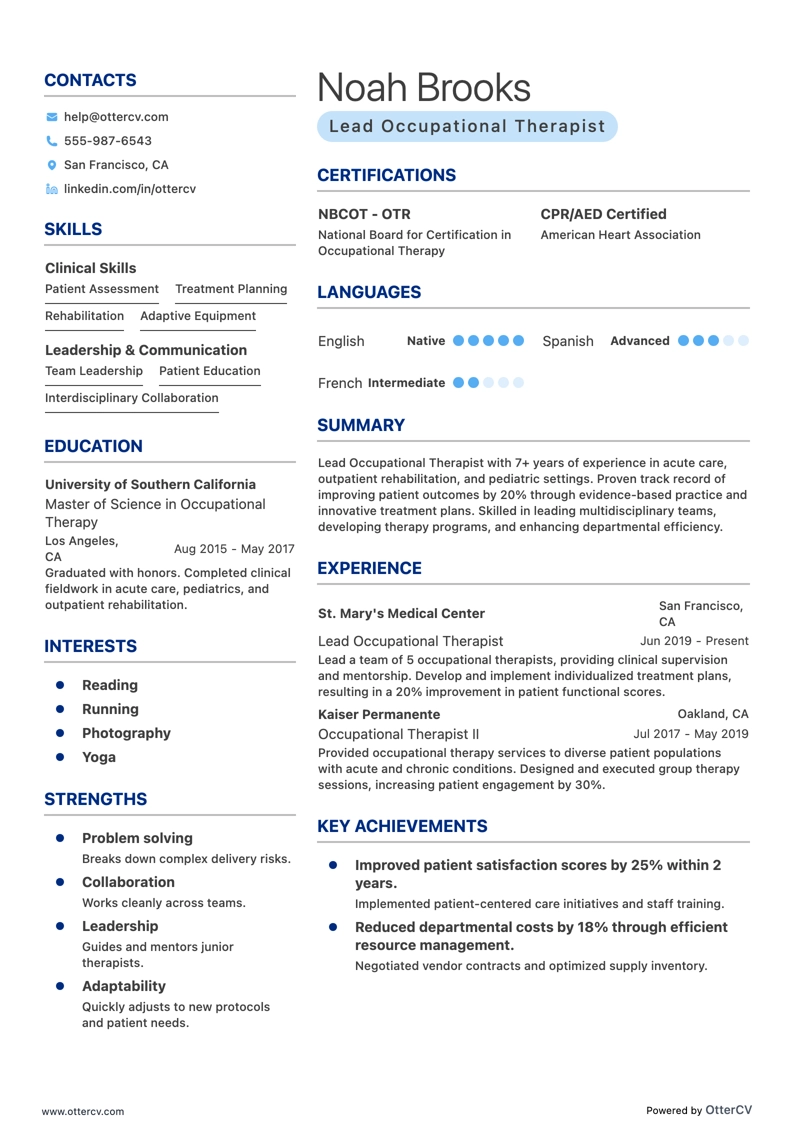
Lead Occupational Therapist resume example

Lead Occupational Therapist

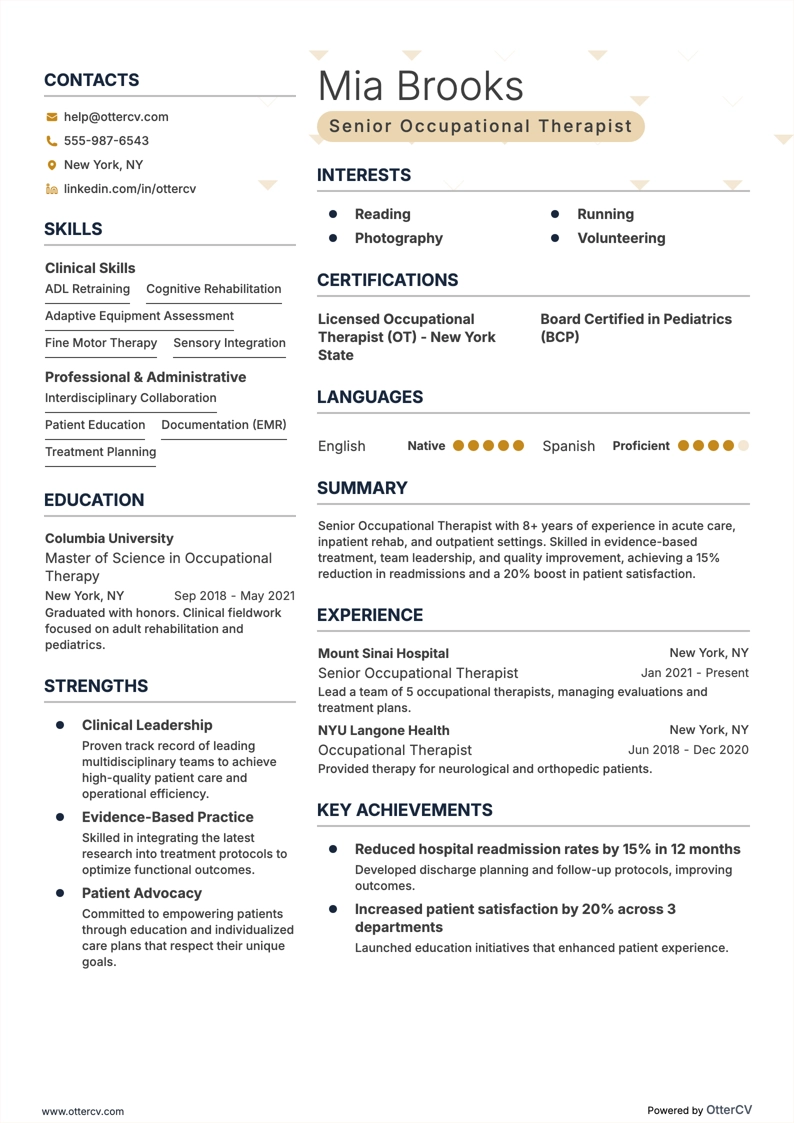
Senior Occupational Therapist resume example

Senior Occupational Therapist

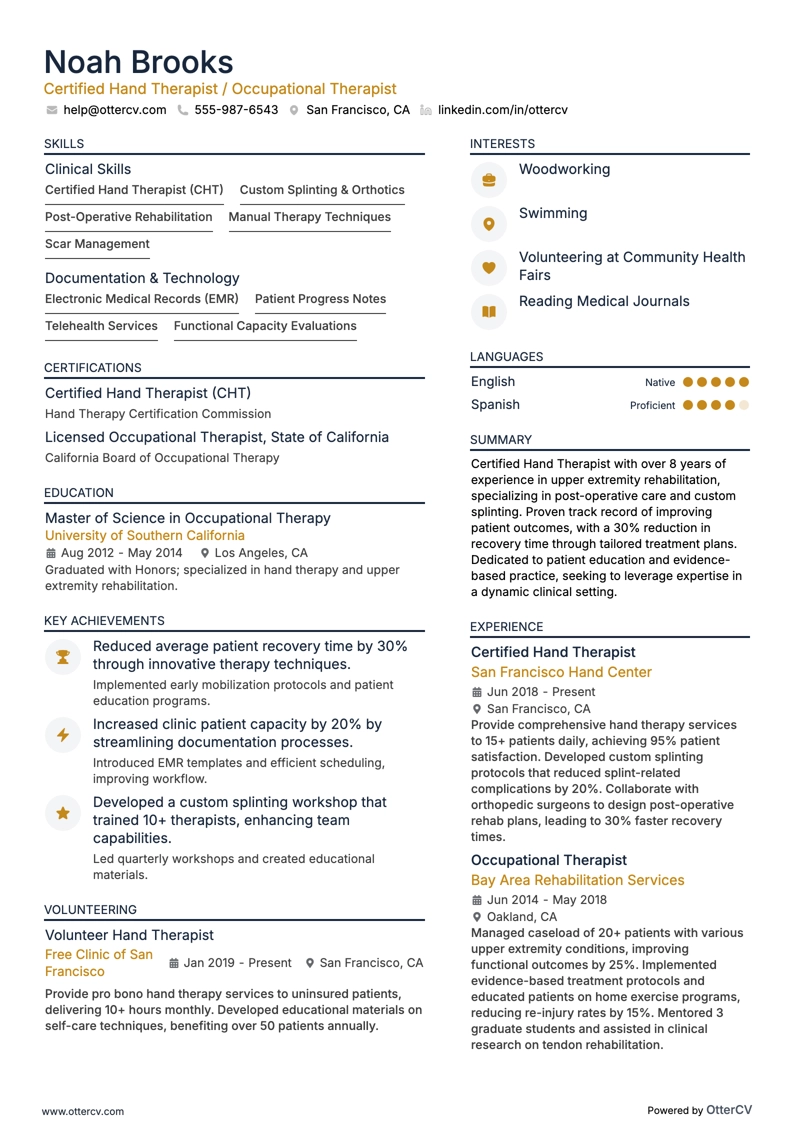
Certified Hand Therapist resume example

Certified Hand Therapist

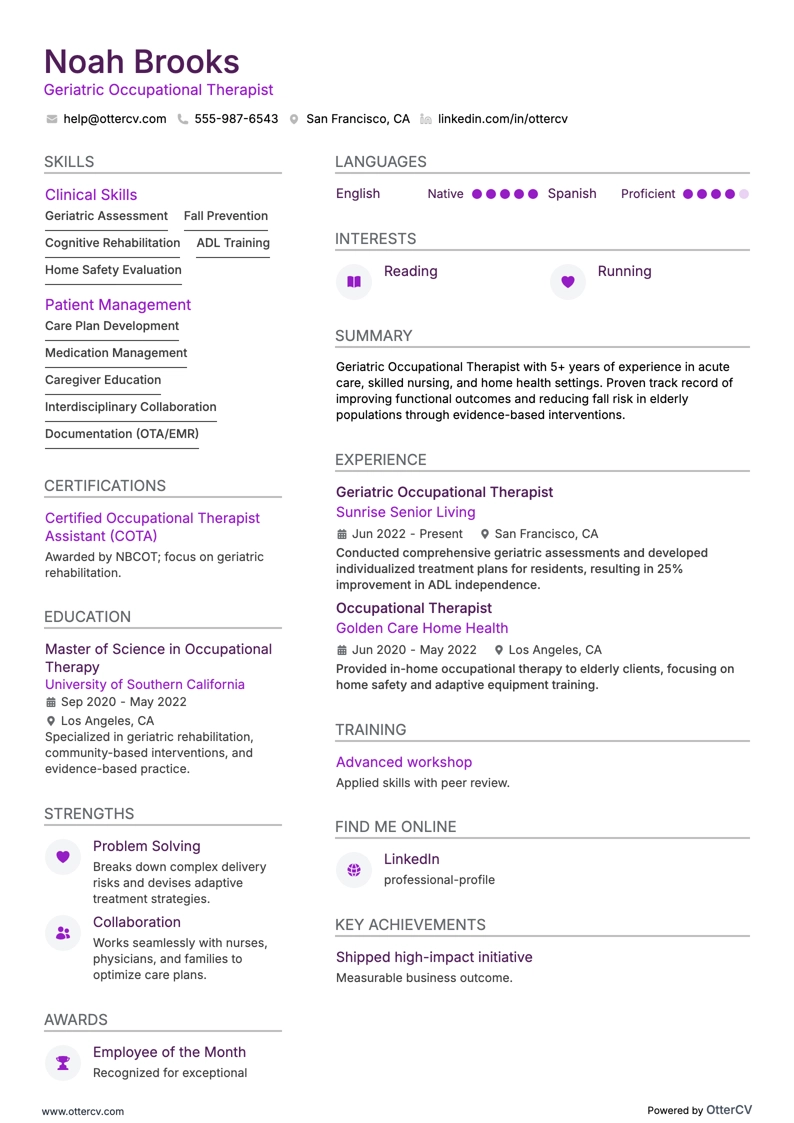
Geriatric Occupational Therapist resume example

Geriatric Occupational Therapist

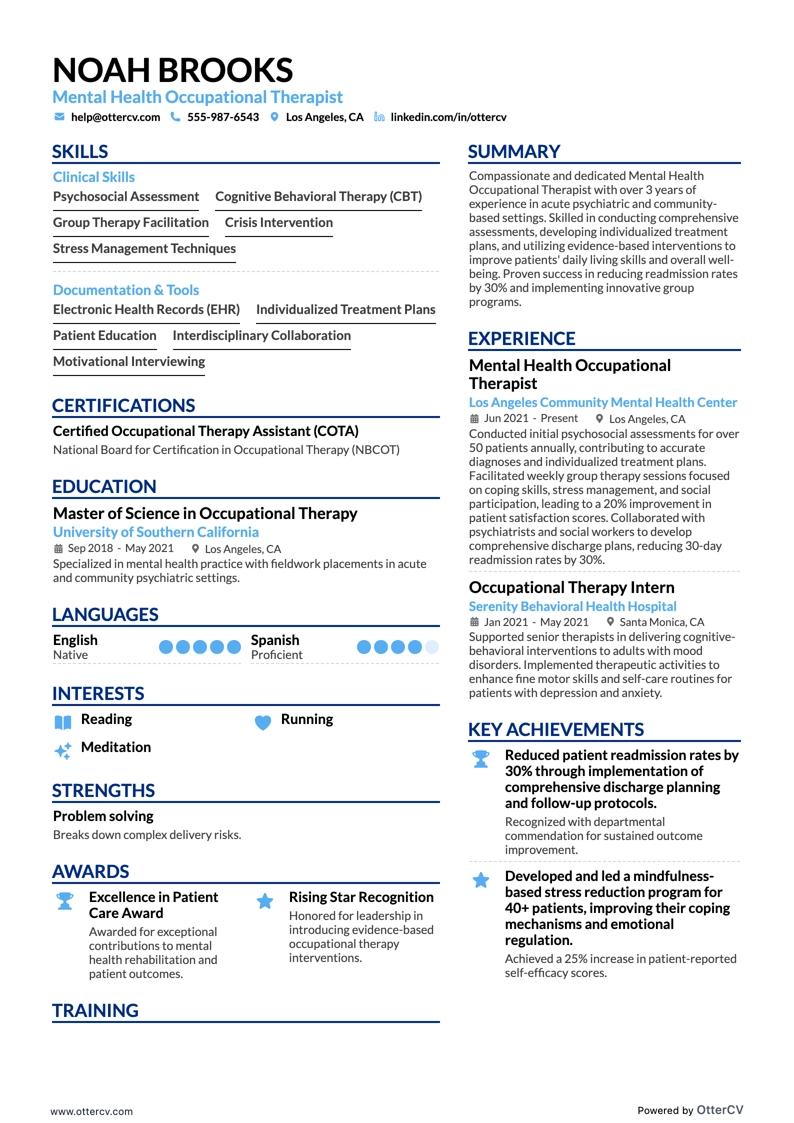
Mental Health Occupational Therapist resume example

Mental Health Occupational Therapist

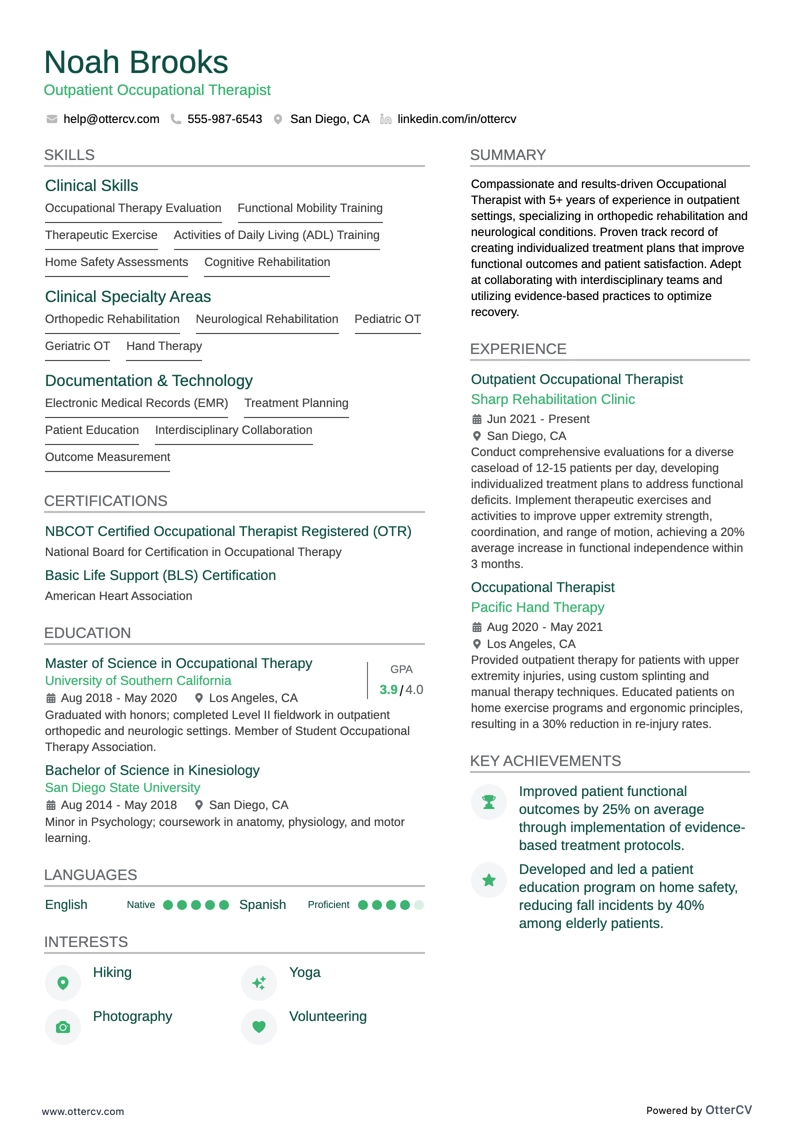
Outpatient Occupational Therapist resume example

Outpatient Occupational Therapist

Inpatient Rehabilitation Occupational Therapist resume example

Inpatient Rehabilitation Occupational Therapist

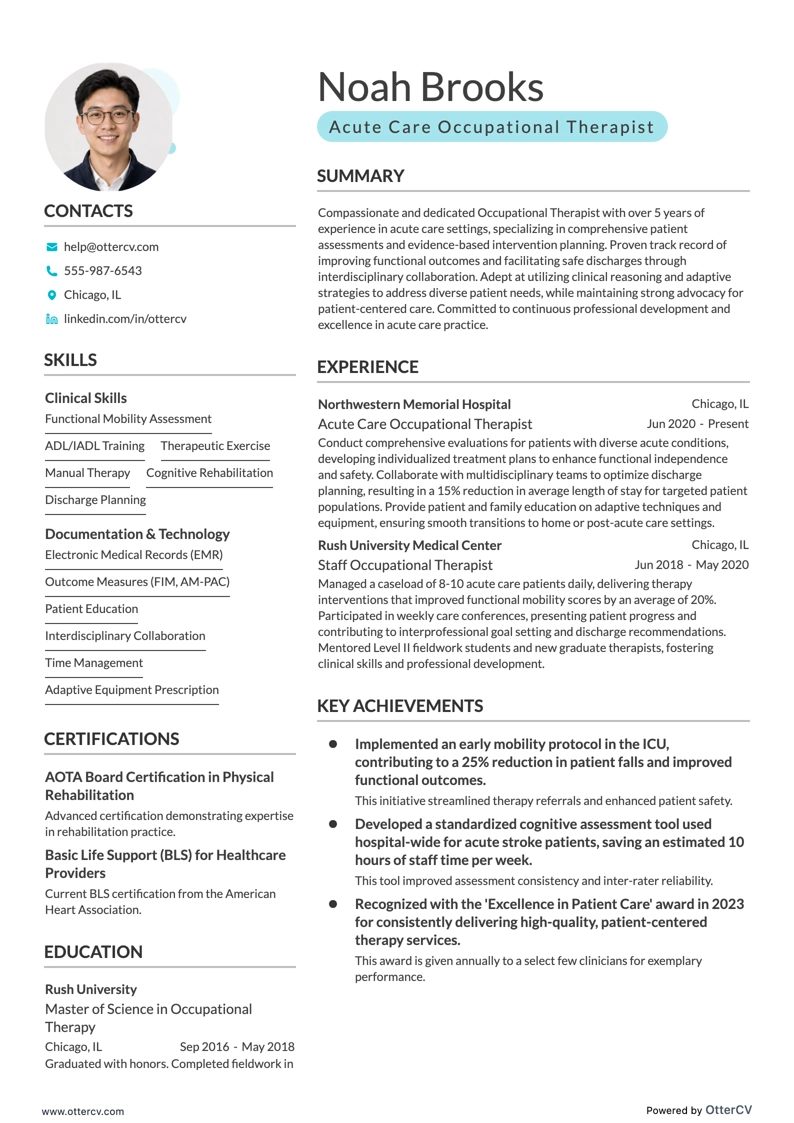
Acute Care Occupational Therapist resume example

Acute Care Occupational Therapist

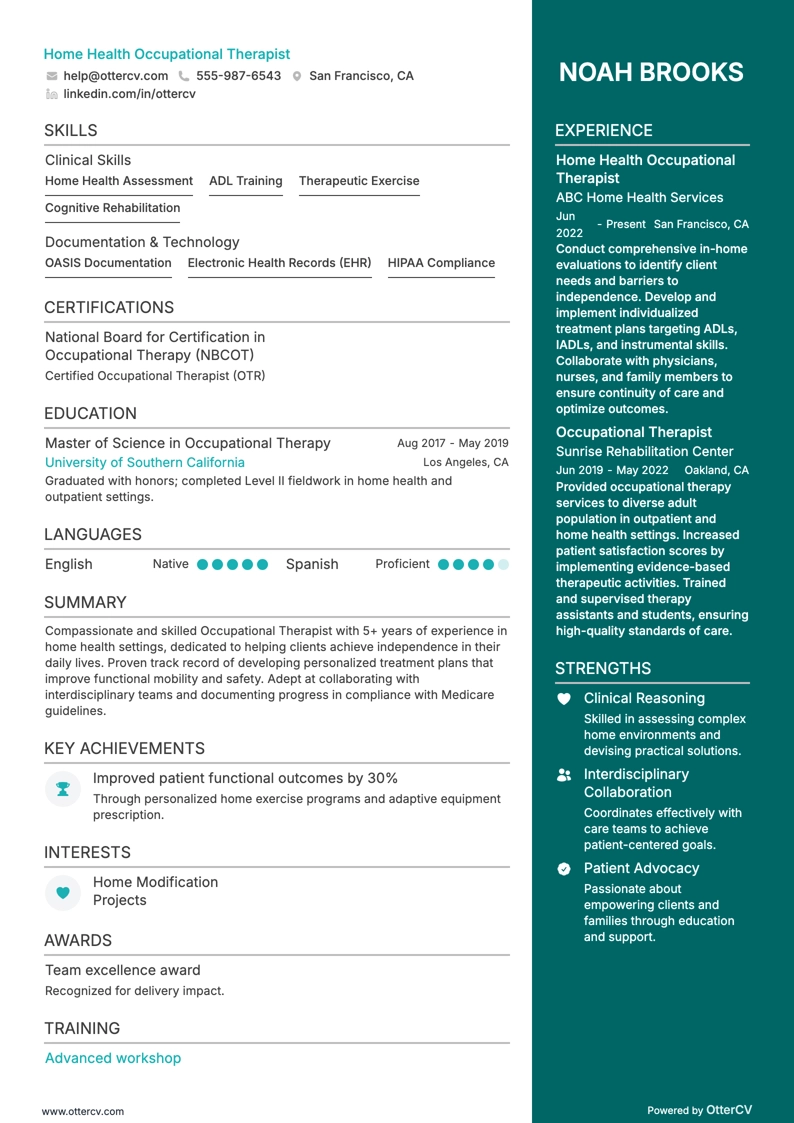
Home Health Occupational Therapist resume example

Home Health Occupational Therapist

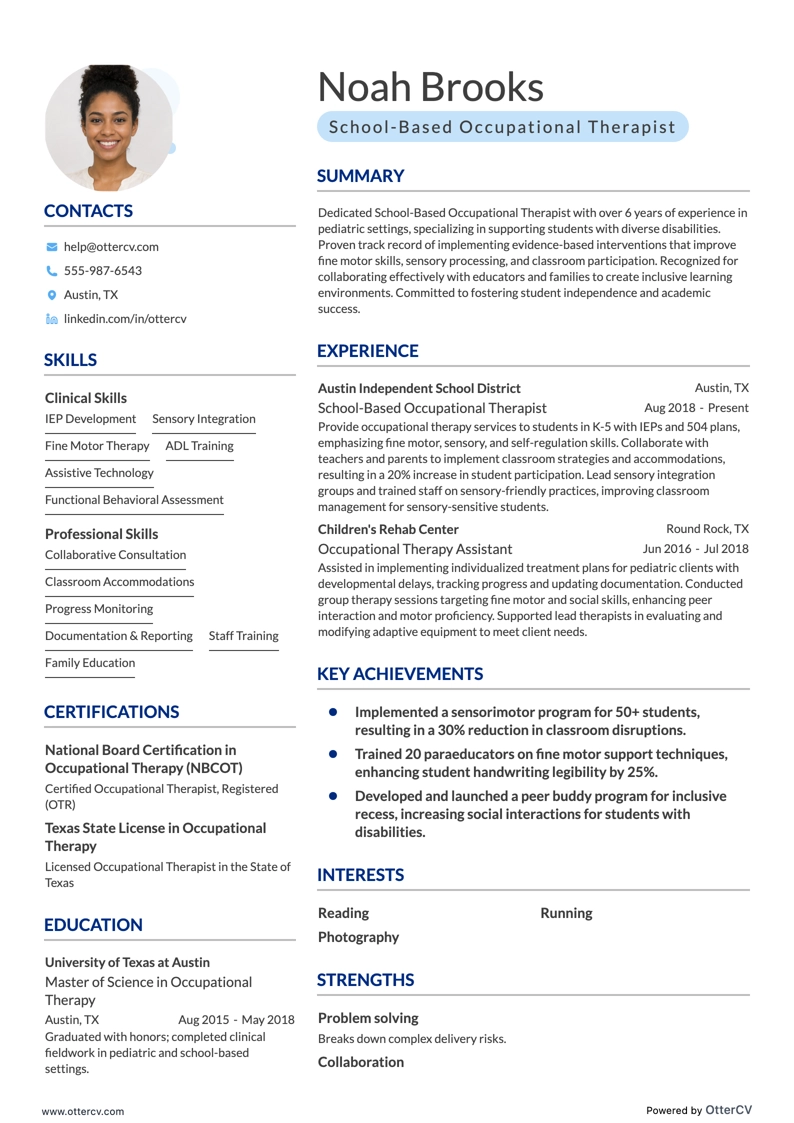
School-Based Occupational Therapist resume example

School-Based Occupational Therapist

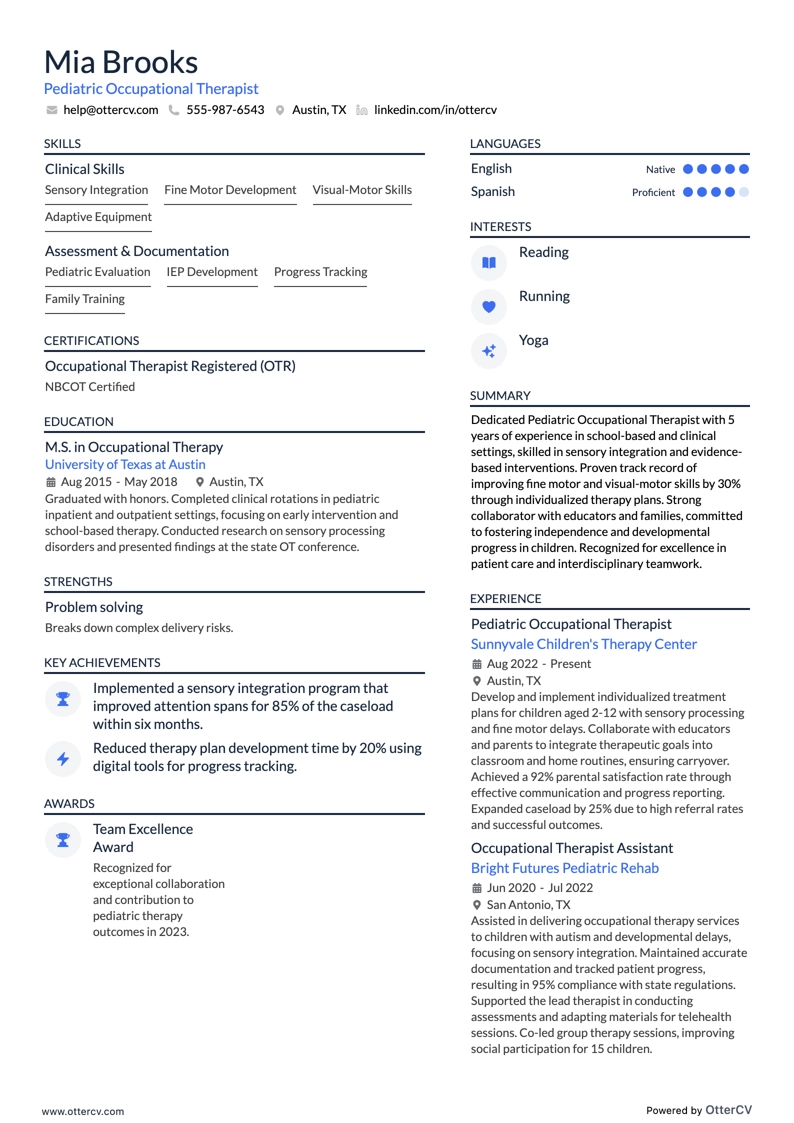
Pediatric Occupational Therapist resume example

Pediatric Occupational Therapist

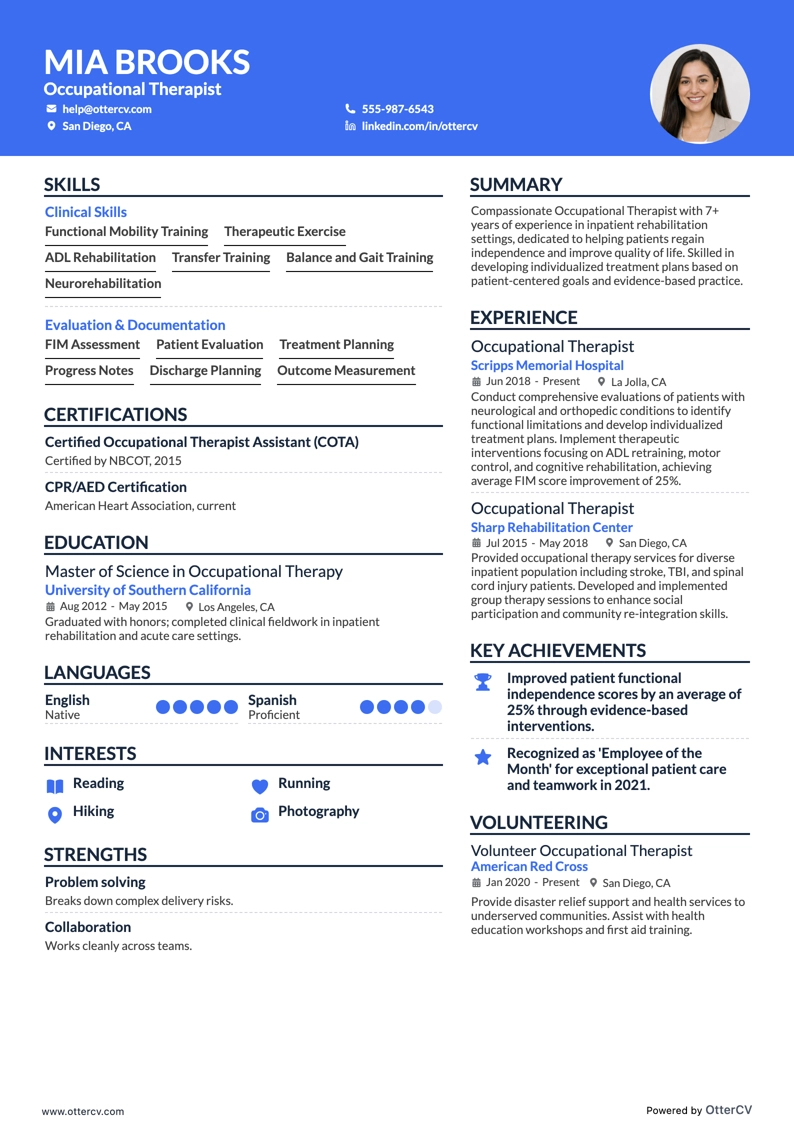
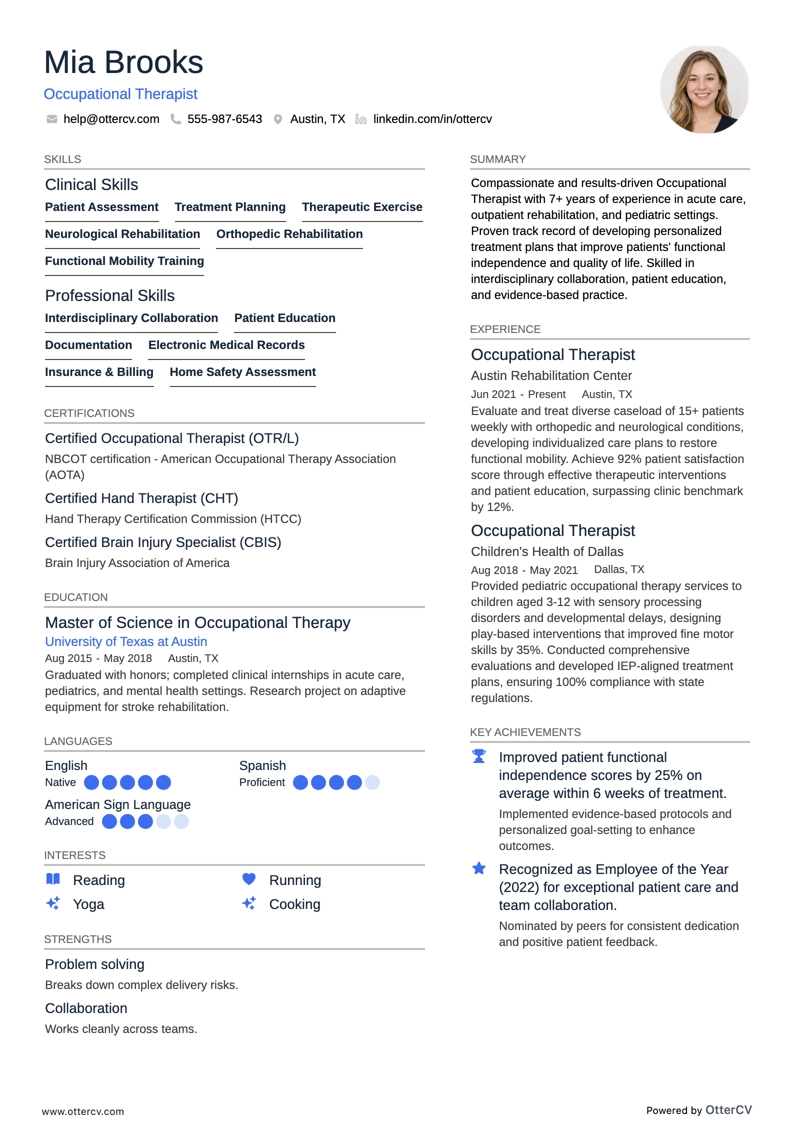
Occupational Therapist resume example

Occupational Therapist

As an occupational therapist, it can be challenging to present a broad range of patient care skills clearly and concisely on a resume. This guide offers practical tips and examples to help you showcase your expertise and stand out to potential employers.

Check out our occupational therapist resume guide to:

  • Review industry-leading examples and learn how to write your best resume yet.
  • Improve your experience, education, and achievements sections with insights from resume-writing professionals.
  • Highlight your technical expertise and personality to stand out from other candidates.
  • Keep the focus on your unique skill set throughout your occupational therapist resume.

If an occupational therapist resume guide is not the right fit, explore these related guides:

Creating the best occupational therapist resume format: four simple steps

The best occupational therapist resume format is precise and well-structured. It should also reflect how recruiters are likely to assess your application. Keep these four essentials in mind when building your resume:

  • Show how your experience or skills match the job. Use the reverse-chronological resume format if your background is directly relevant to the occupational therapist role. Otherwise, choose a functional skill-based resume format or a hybrid resume format to put more emphasis on your skills.
  • Resume header: Include all relevant and accurate information, such as your contact details and a link to your portfolio.
  • Resume length: Unless you have more than a decade of relevant experience, keep your resume to one page. If you need to show more of your professional background, extend it to two pages.
  • Resume file: Submit your occupational therapist resume as a PDF so your formatting stays consistent.

Adjust your resume layout for the market you are applying to. For example, Canadian resumes may follow a unique format.

PRO TIP

Include your occupational therapist certifications across multiple resume sections, such as your summary, objective, and experience.

When possible, quantify their impact with concise details that show how a specific certification improved your on-the-job performance.

Occupational therapist resume sections to answer recruiters' checklists:

  • A header helps recruiters quickly find your contact details and see your most recent portfolio of work.
  • A summary or objective gives an overview of your career highlights, dreams, and goals.
  • Your experience section should align with job requirements and show measurable impact and accomplishments.
  • A skills section highlights the full breadth of your expertise and talents as an occupational therapist candidate.
  • Education and certifications can help fill gaps in experience and show your commitment to the industry.

What recruiters want to see on your resume:

  • Your resume should show relevant education and credentials, such as a Master's degree in Occupational Therapy and required certification or licensure, including NBCOT.
  • It should demonstrate hands-on experience with diverse populations across settings such as pediatric, geriatric, inpatient, and outpatient care.
  • Recruiters look for proficiency in creating and carrying out personalized treatment plans based on patient assessments.
  • They also want to see knowledge of current rehabilitation equipment, assistive devices, and occupational therapy technology.
  • Strong interpersonal and communication skills matter, especially experience with interdisciplinary teamwork and patient or family education.

Creating your occupational therapist resume experience to catch recruiters' attention

For an occupational therapist role, hiring managers want to see how your expertise matches their requirements. Your resume experience section is where you can make that clear. Make sure you:

  • Focus mainly on roles that are relevant to the occupational therapist position you're applying for.
  • Avoid going too far back in your work history unless older experience is especially important for the role.
  • Make each bullet explain what you did, the skills you used, and the end result of your work.
  • Quantify your achievements with numbers whenever possible, including the broader impact on the organization.
  • Highlight transferable skills and personal strengths developed in past roles that could apply to your next workplace and show your unique value as a professional.

Your experience section does not need to be an exhaustive overview of your entire career. Follow the occupational therapist resume examples below to see how industry-leading professionals present their experience.

Occupational Therapy Experience

  • Senior Occupational Therapist , Harmony Health Rehabilitation (01/2019-Ongoing) Led a client-centered therapy program that improved patient outcomes by 35% through adaptive rehabilitation technology. Managed 10 junior therapists to strengthen service delivery and patient satisfaction, and launched an outpatient therapy initiative that reduced readmission rates by 20% while streamlining care transitions.
  • Lead Occupational Therapist , Bright Future Pediatric Therapy (06/2015-12/2018) Introduced a standardized, evidence-based assessment protocol that improved evaluation accuracy by 40%. Partnered with interdisciplinary teams to align occupational therapy with patient care plans, reducing treatment time by 25%, and led health and safety workshops that lowered workplace injuries among clients by 30%.
  • Occupational Therapy Specialist , Ageless Living Home Health (02/2011-05/2015) Developed an ergonomic assessment and intervention program that improved workplace comfort and efficiency by 50%. Researched occupational therapy benefits in geriatric care, helping create a new department service line, and designed personalized activity-based interventions that increased treatment adherence by 60% for patients with chronic conditions.
  • Pediatric Occupational Therapist , Growing Minds Therapy Center (03/2009-01/2011) Implemented a play-based therapy curriculum that improved developmental skills for children with disabilities across more than 120 cases. Helped establish a family education program to support caregivers and collaborated with schools to bring sensory integration strategies into classrooms, benefiting more than 150 students.
  • Occupational Therapist Consultant , Total Rehab Care Consultants (07/2019-Ongoing) Designed a teletherapy program for remote patients that expanded the clinic's reach by 200 miles and increased enrollment by 25%. Advised on assistive technology implementation, raising patient independence in daily living activities by 45%, and led staff training seminars on current occupational therapy techniques.
  • Advanced Practice Occupational Therapist , Reliant Rehabilitation Hospital (04/2013-06/2018) Developed a cognitive rehabilitation program that improved cognitive function test scores by an average of 30%. Worked with interdisciplinary teams to improve discharge planning and reduce hospital stays by an average of 2 days, and integrated occupational therapy with vocational rehabilitation to help more than 50 patients return to work.
  • Home Health Occupational Therapist , HomeCare Therapy Solutions (05/2017-Ongoing) Optimized home visit protocols to increase daily patient visits by 20% while maintaining high satisfaction. Created a fall prevention program that reduced falls by 60% in the serviced community and supported adoption of advanced home exercise equipment, improving patient engagement by 75%.
  • Clinical Occupational Therapist , Total Hand Care Center (08/2014-04/2019) Launched a hand therapy program that improved post-surgical recovery times by 20% and rehabilitated more than 100 patients. Led clinical research on sensory integration therapy published in a leading medical journal and implemented feedback strategies that improved clinic reputation and patient retention by 10%.
  • Clinical Specialist in Occupational Therapy , NeuroCare Network (10/2012-07/2017) Developed a stroke rehabilitation protocol adopted across the network that reduced rehabilitation time by 15%. Contributed to training new occupational therapy graduates and piloted a technology-assisted therapy project that improved care delivery efficiency and earned the clinic's Innovation Award.
  • Rehabilitation Occupational Therapist , RehabResults Health Center (11/2016-Ongoing) Directed expansion of the occupational therapy department, increasing patient capacity by 30% without compromising care quality. Implemented a patient education initiative to improve long-term rehabilitation outcomes and tailored treatment plans based on patient feedback to strengthen effectiveness and rapport.

Quantifying impact on your resume

  • Include the percentage increase in client retention or satisfaction resulting from your therapeutic interventions.
  • State the average number of clients you manage to show your ability to handle a large and diverse caseload.
  • Document how much money you saved the facility by introducing cost-effective treatment modalities or reducing resource use.
  • Note the number of interdisciplinary team meetings you led or participated in to demonstrate collaboration skills.
  • Highlight improvements in treatment outcomes with specific metrics, such as decreased pain levels or increased range of motion.
  • Provide the number of assessments and treatments you completed over a specific timeframe to demonstrate efficiency and expertise.
  • Specify the size of any teams you supervised or mentored, if applicable, to show leadership experience.
  • Mention awards or recognition you received, along with the number of recipients, to emphasize distinction in your field.

Action verbs for your occupational therapist resume

Action and power verbs add depth to your experience and show that you take initiative, solve problems, and make decisions. Use them instead of buzzwords to help your occupational therapist resume stand out.

Read The Guide

What if you don't have any experience?

There are two common situations for candidates with limited experience:

  • Fresh out of college and looking for an occupational therapist role
  • Transitioning from a completely different field

In both cases, you can still land your first job in the industry.

For the experience section of your occupational therapist resume, focus on the following:

  • Highlight your strengths: Think about whether the results from previous roles or any niche skills would impress recruiters, and place those near the top of your resume.
  • Leave out irrelevant experience: Your resume should tell a clear story that aligns you with the ideal candidate for the occupational therapist job.
  • Use personality to your advantage: Your ambition, diligence, and goals may help show why you are a strong fit. Use resume space to demonstrate how those traits helped you succeed in past roles.
  • Tailor your experience to the job: Make sure your occupational therapist resume responds to the job advert as closely as possible.

Recommended reads:

  • How to List Continuing Education on Your Resume
  • Should You Include Eagle Scout On Your Resume?

PRO TIP

Highlight any significant extracurricular activities that demonstrate valuable skills or leadership.

In-demand hard skills and soft skills for your occupational therapist resume

A strong occupational therapist resume should clearly present your skill set.

Recruiters typically assess your:

  • Hard skills — your technological proficiency, including which software and technologies you can use and at what level
  • Soft skills — how effectively you communicate your ideas and how well you adapt to change

The ideal candidate shows a balanced mix of hard and soft skills throughout the resume, especially in a dedicated skills section.

When building your occupational therapist skills section:

  • List up to six skills that match the role requirements and reflect your unique expertise.
  • Include one or two soft skills that define you as both a professional and a person, drawing on feedback from previous managers if helpful.
  • Create up to two skills sections organized by skill type, such as technical skills, soft skills, or occupational therapist skills.
  • If you hold technical certifications that are important to the industry and especially impressive, include them in your skills section.

It can be frustrating to identify all your skills and find the best way to present them.

To make the process easier, we’ve prepared two lists of hard skills and soft skills to help you build your next resume more quickly and efficiently.

Top skills for your occupational therapist resume

HARD SKILLS
  • Therapeutic modalities
  • Assistive technology
  • Rehabilitation software
  • Goniometers
  • Therapeutic exercise programs
  • Adaptive equipment
  • Electronic health records (EHR) systems
  • Manual therapy techniques
  • Splinting and orthotic fabrication
  • Functional assessment tools
SOFT SKILLS
  • Empathy
  • Communication
  • Problem-solving
  • Patience
  • Time management
  • Collaboration
  • Adaptability
  • Critical thinking
  • Motivational skills
  • Cultural competence

PRO TIP

Highlight significant extracurricular activities that demonstrate valuable skills or leadership.

Showcase academic background with education and certifications' sections

Your education and certifications should be a basic part of your resume. Including relevant academic background, such as your higher education degree and niche-specific certificates, helps demonstrate your knowledge of the industry.

For your education section:

  • List your degree first, followed by the start and graduation dates, and the institution.
  • You can add relevant coursework, major/minor, or GPA, but only if you have just graduated from college or if this information would strengthen your application.
  • If you have an ongoing degree, you can still include it if you believe it will impress recruiters or if it is required.

Use a similar approach for your certifications section by listing the institution along with the date you obtained each certificate. For some of the most recent and relevant industry certificates, check out the next part of our guide.

The top 5 certifications for your occupational therapist resume

  • National Board for Certification in Occupational Therapy (NBCOT) — NBCOT Certification.
  • Certified Hand Therapist (CHT) — Hand Therapy Certification Commission.
  • Assistive Technology Professional (ATP) — Rehabilitation Engineering and Assistive Technology Society of North America.
  • Physical Agent Modalities Practitioner (PAM) Certification — state-specific certifying bodies.
  • Driver Rehabilitation Specialist (DRS) — The Association for Driver Rehabilitation Specialists.

PRO TIP

If the certificate you’ve earned is especially important for the industry or company, include it with your name in your resume headline.

Recommended reads:

  • How to List Expected Graduation Date on Your Resume
  • How to List Continuing Education on Your Resume

The summary or objective: focusing on the top one-third of your resume

The top one-third of your occupational therapist resume can make or break your application. A strong resume summary or objective helps strengthen your professional profile right away.

  • Use a resume summary if you have several career highlights to showcase. An occupational therapist summary directs recruiters' attention to the most important parts of your experience.
  • Use a resume objective if you want to balance your achievements with your future goals. It should clearly show how you see yourself in the next few years as part of the company you are applying to.

Both the resume summary and resume objective act as your value pitch to potential employers, explaining what makes your application unique and why you are a strong choice for the occupational therapist role. In either case, your statement should be specific and tailored, since there is no one-size-fits-all approach. Use the occupational therapist examples below as a starting point.

Resume summaries for a occupational therapist job

  • Licensed occupational therapist with over 10 years in a pediatric clinical setting, skilled in individualized treatment plans and sensory integration techniques that support children’s growth; led a team that won the 'Best Children's Therapy Service' award in 2021.
  • Transitioning into Occupational Therapy after an 8-year career as a Special Education Teacher, bringing strong knowledge of child development and adaptive teaching methods to empower individuals with diverse needs.
  • Veteran occupational therapist with 15 years of geriatric care experience, developing rehabilitation programs that improve mobility and quality of life for older adults; served as lead OT on a community mobility project that improved home safety for over 200 seniors.
  • Bringing over 12 years of experience in physical therapy, sports medicine, human kinetics, and rehabilitation to a career in Occupational Therapy, with a strong commitment to patient care, rehabilitation success, and continued professional growth.
  • Recent Master’s graduate in Occupational Therapy seeking to apply evidence-based practices to help clients achieve optimal functioning and independence, despite not yet having professional experience.
  • Recent graduate of an accredited Occupational Therapy program, with internships across various clinical settings, prepared to deliver compassionate and effective interventions to clients in need.

More sections to ensure your occupational therapist resume stands out

If you want your occupational therapist application to get noticed, consider adding extra resume sections such as:

These additional sections can highlight your technical aptitude, including familiarity with specific technologies and software, as well as your people skills developed outside of work.

Key takeaways

  • Use a simple, easy-to-read resume format that reflects your experience and aligns with the occupational therapist role.

  • Be specific in the top one-third of your resume, including the header and summary or objective, to show why you are the ideal candidate.

  • Tailor the content to the job by highlighting relevant skills, achievements, and the actual outcomes of your work.

  • Include your certifications and technical capabilities to demonstrate your proficiency with specific software and technologies.

  • Choose resume sections that showcase both your professional expertise and your personality.

Occupational Therapist resume examples

Explore additional Occupational Therapist resume samples and guides and see what works for your level of experience or role.

By Experience

Lead Occupational Therapist

Lead Occupational Therapist resume preview

Senior Occupational Therapist

Senior Occupational Therapist resume preview

Occupational Therapist resume examples

Explore additional Occupational Therapist resume samples and guides and see what works for your level of experience or role.

By Role

Certified Hand Therapist

Certified Hand Therapist resume preview

Geriatric Occupational Therapist

Geriatric Occupational Therapist resume preview

Mental Health Occupational Therapist

Mental Health Occupational Therapist resume preview

Outpatient Occupational Therapist

Outpatient Occupational Therapist resume preview

Inpatient Rehabilitation Occupational Therapist

Inpatient Rehabilitation Occupational Therapist resume preview

Acute Care Occupational Therapist

Acute Care Occupational Therapist resume preview

Home Health Occupational Therapist

Home Health Occupational Therapist resume preview

School-Based Occupational Therapist

School-Based Occupational Therapist resume preview

Pediatric Occupational Therapist

Pediatric Occupational Therapist resume preview

Occupational Therapist

Occupational Therapist resume preview