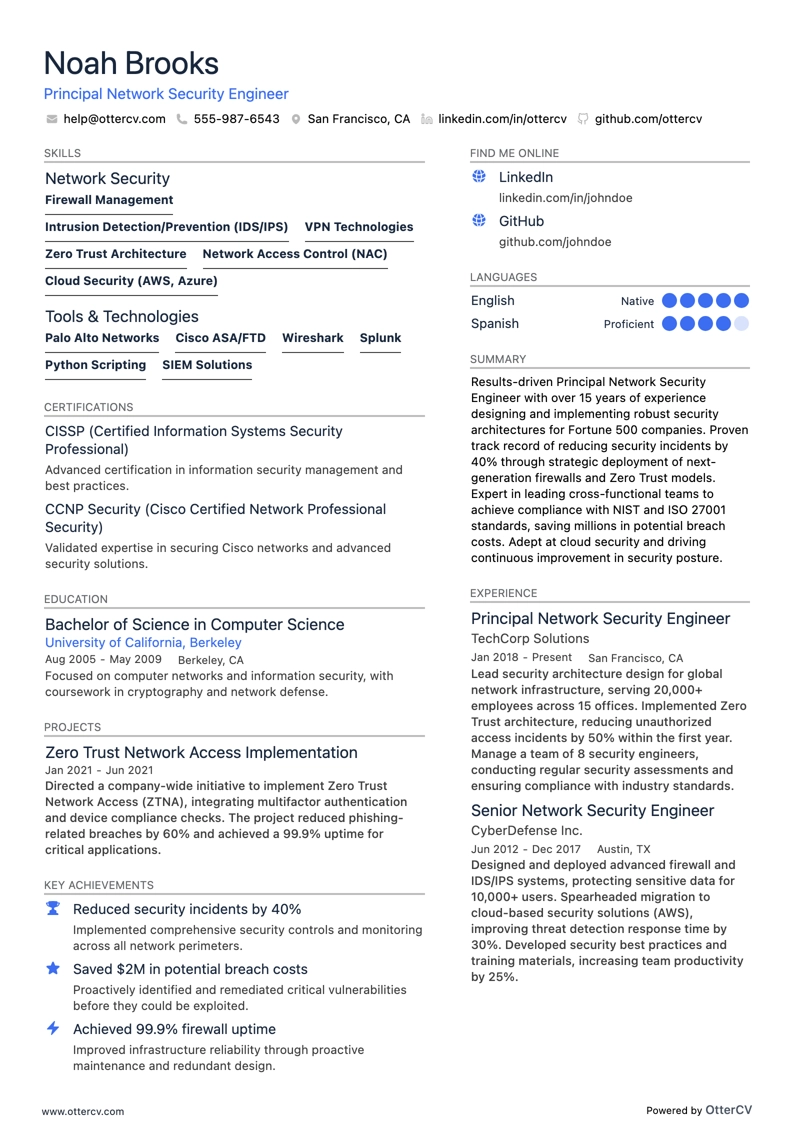
Principal Network Security Engineer full preview

7 Network Security Engineer Resume Examples

OtterCV

Written by The OtterCV Team

Updated: 2/11/2025•8 min read

See all resume examples in this guide, or generate your own resume example with your personalized prompt

Principal Network Security Engineer resume example

Principal Network Security Engineer

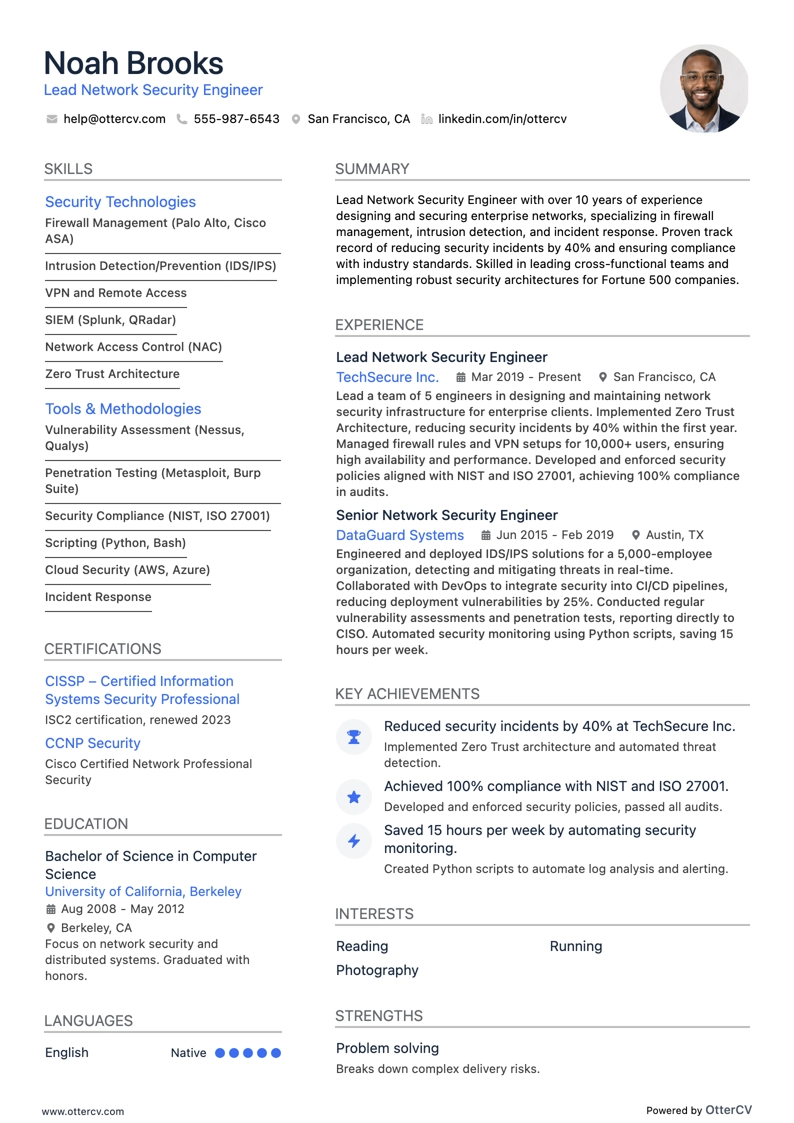
Lead Network Security Engineer resume example

Lead Network Security Engineer

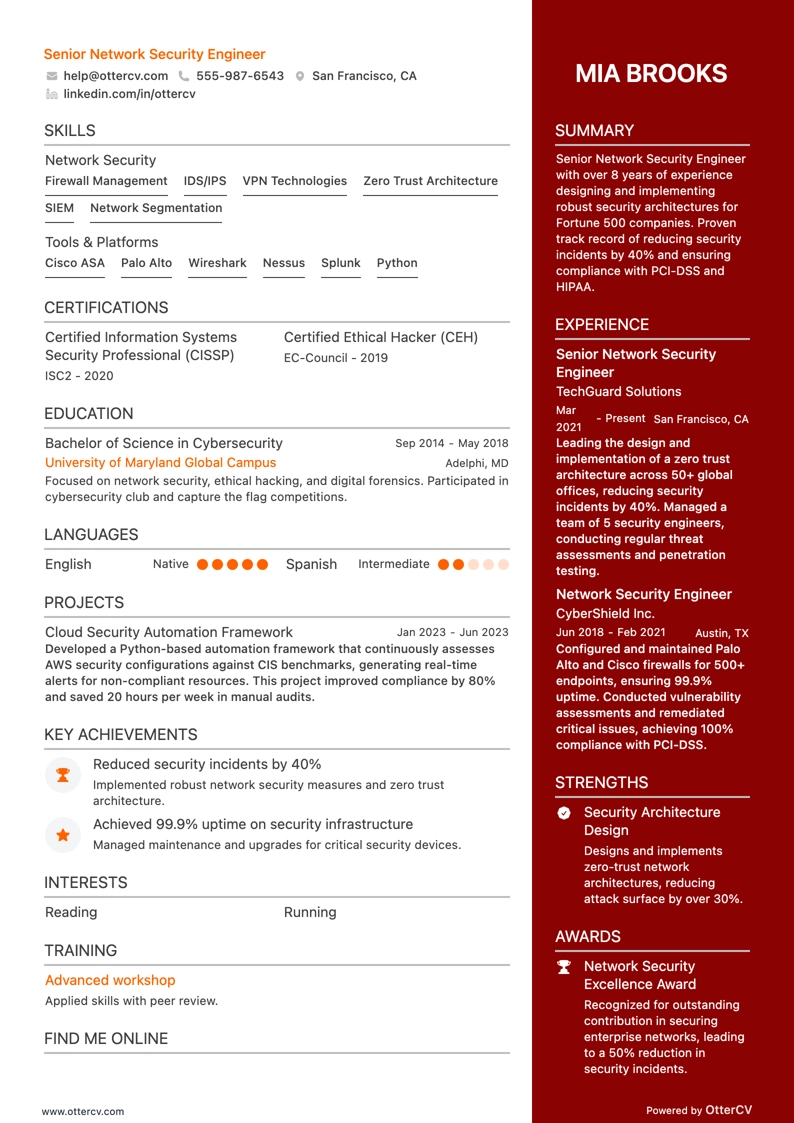
Senior Network Security Engineer resume example

Senior Network Security Engineer

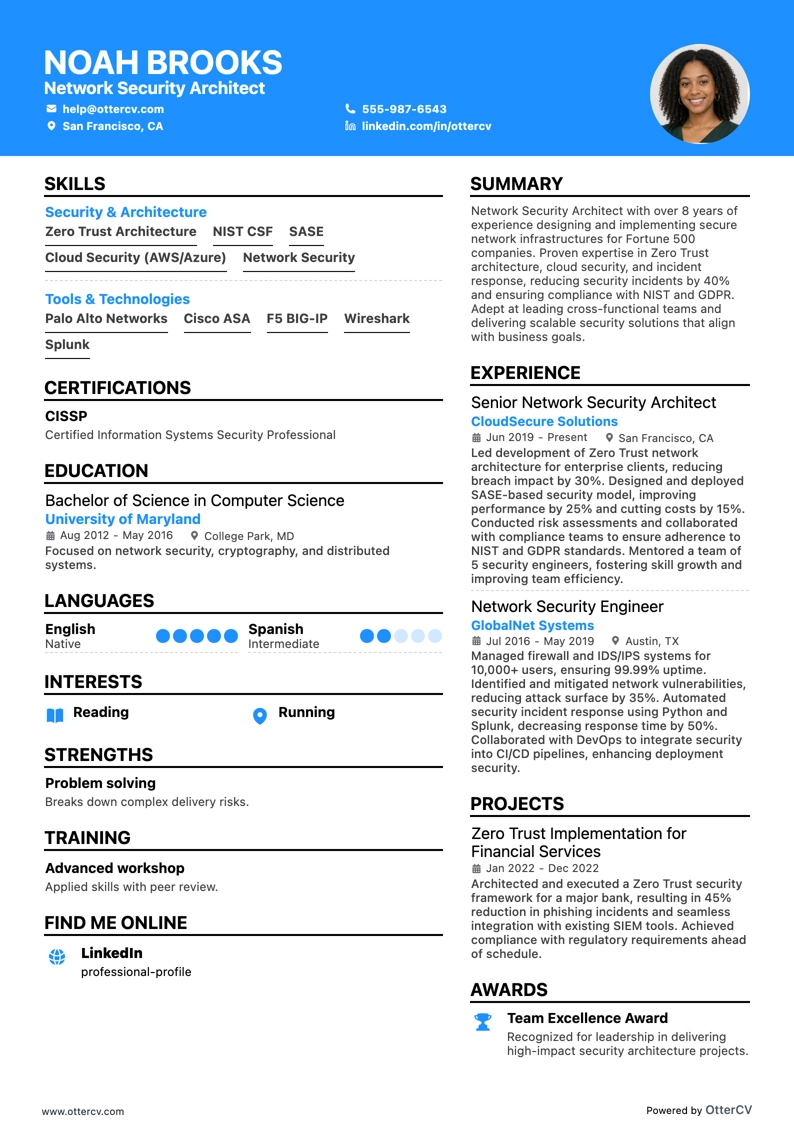
Network Security Architect resume example

Network Security Architect

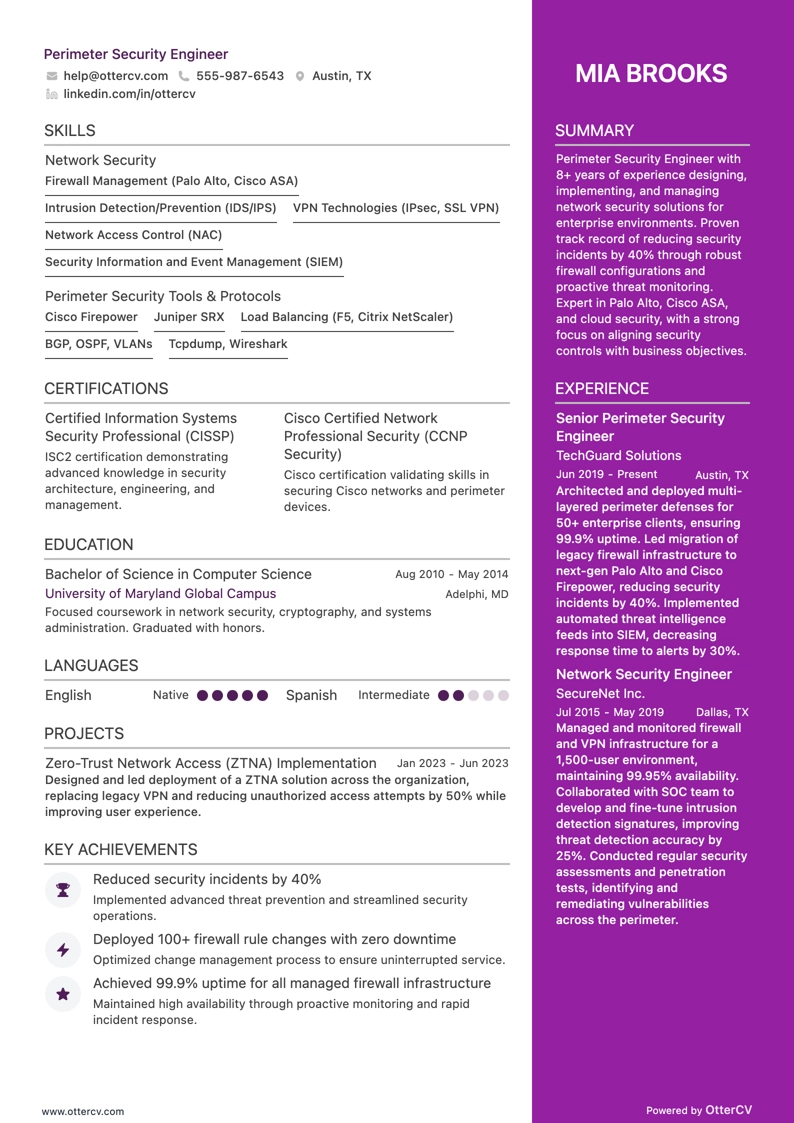
Perimeter Security Engineer resume example

Perimeter Security Engineer

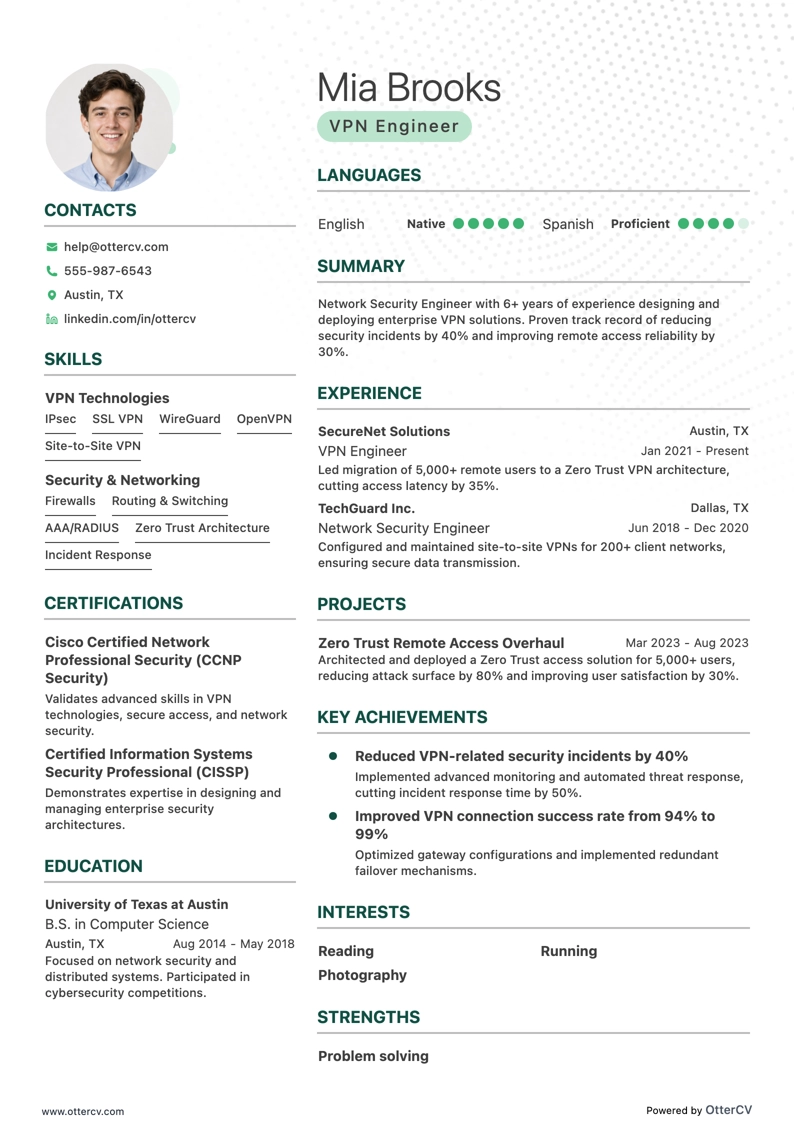
VPN Engineer resume example

VPN Engineer

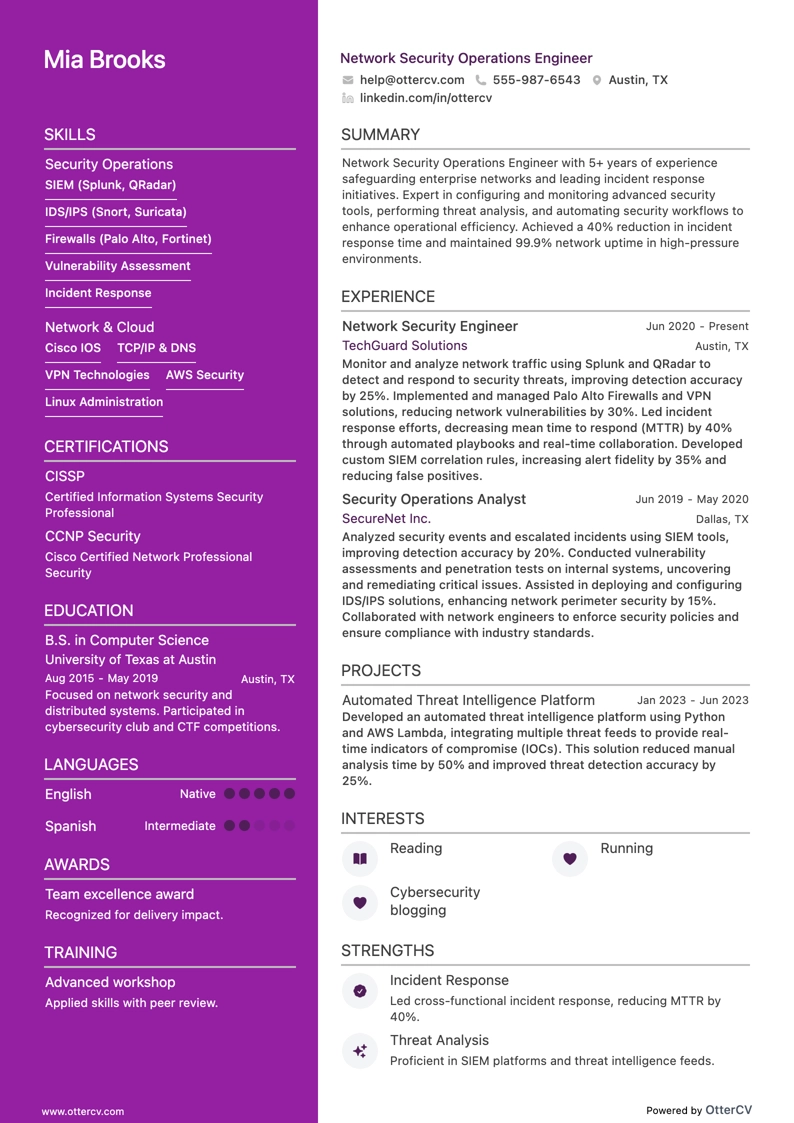
Network Security Operations Engineer resume example

Network Security Operations Engineer

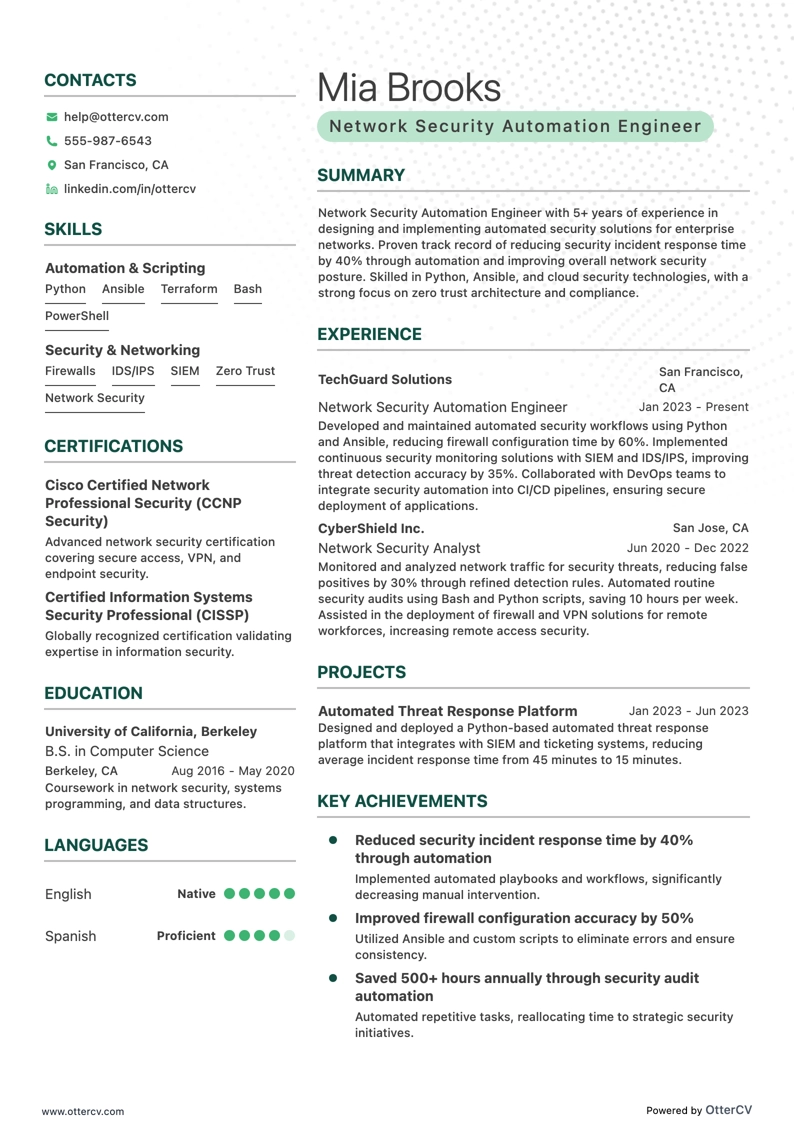
Network Security Automation Engineer resume example

Network Security Automation Engineer

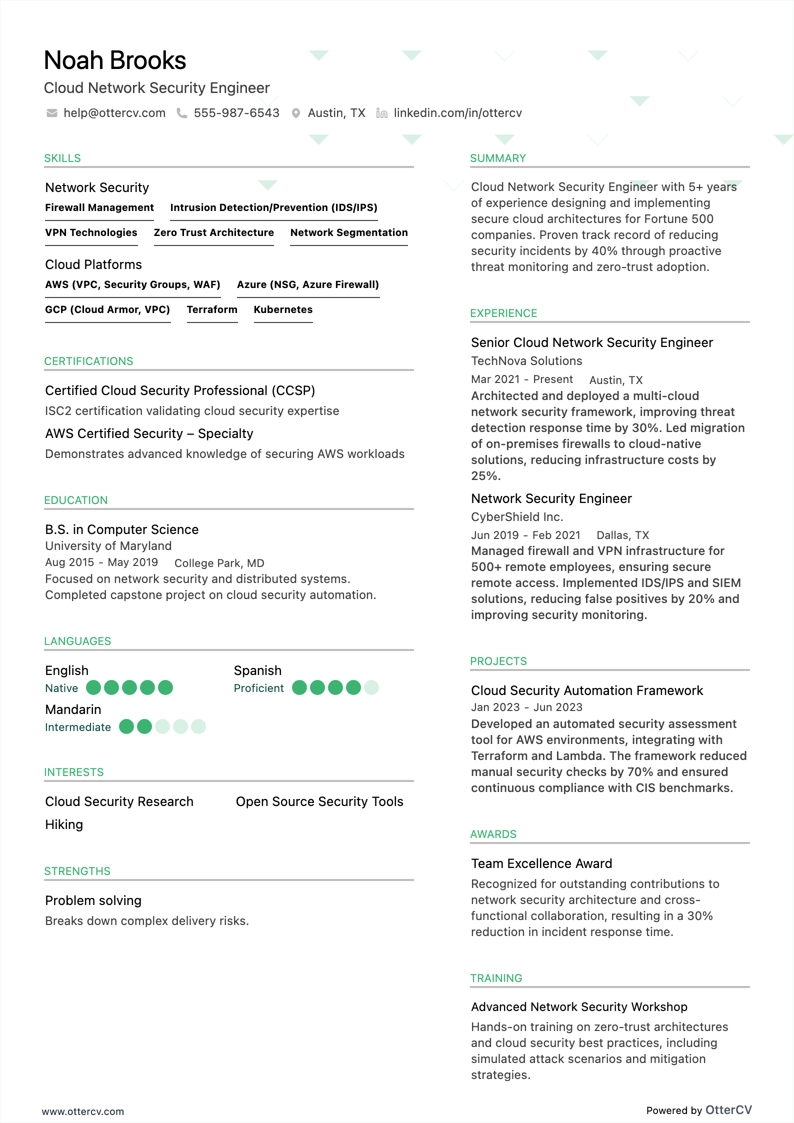
Cloud Network Security Engineer resume example

Cloud Network Security Engineer

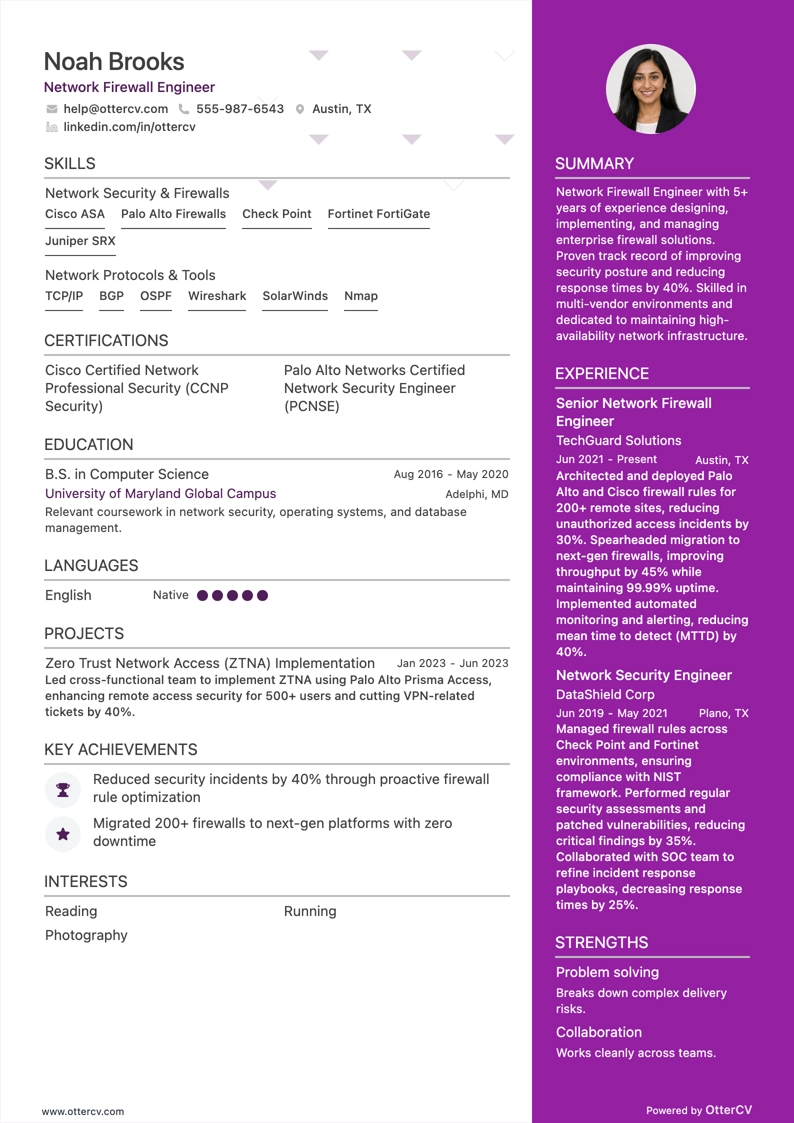
Network Firewall Engineer resume example

Network Firewall Engineer

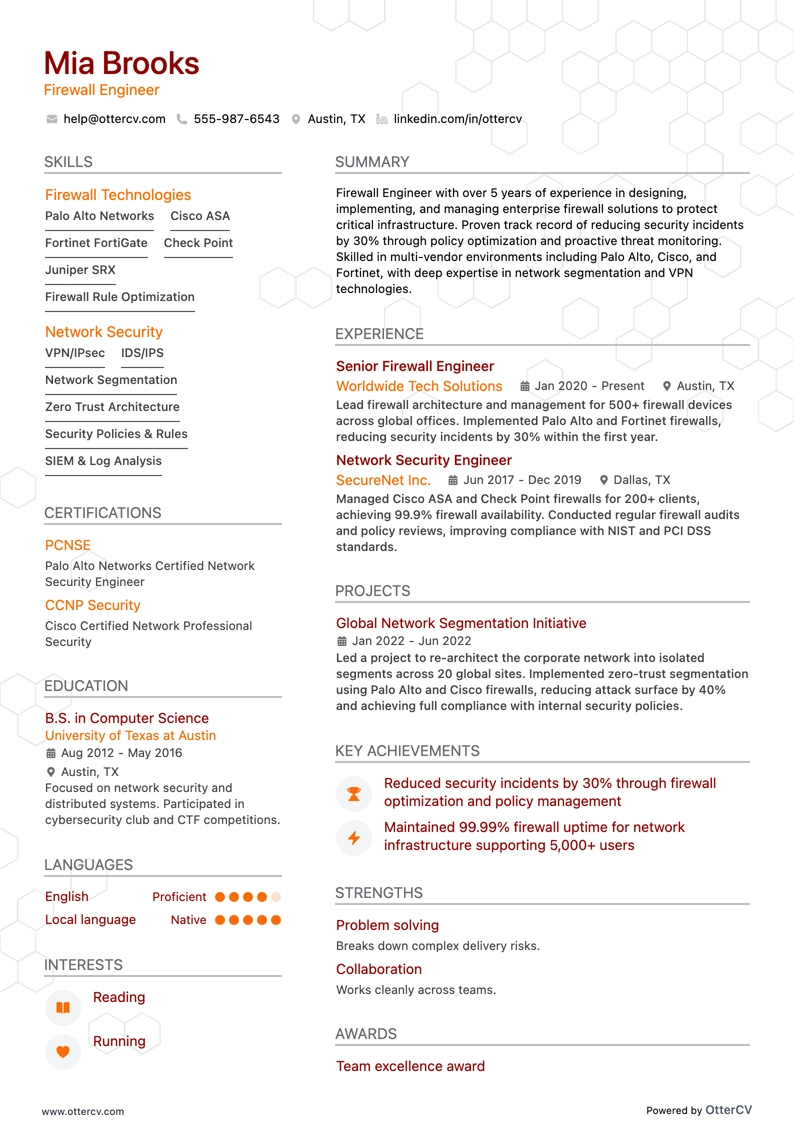
Firewall Engineer resume example

Firewall Engineer

Creating a strong network security engineer resume can be difficult if you are not aware of the common mistakes engineers make when updating it.

Listing your work experience and skills is not enough. You also need to show measurable, practical results from your security assessments and intrusion detection work, especially how those efforts helped protect company data.

In this guide, you will learn how to build a resume that:

  • Explains your technical experience with intrusion detection systems, risk assessment analysis, and related tools in a clear way.
  • Highlights continuing education that shows you stay current with emerging threats and new detection and prevention tools.
  • Demonstrates your ability to protect sensitive or proprietary information without violating NDAs or exposing past employers' metadata or security protocols.
  • Matches your skills and experience to the keywords and technologies listed in the job posting.

We will use real-world network security engineer resume examples from working professionals to show you how to create a well-formatted resume that accurately reflects your accomplishments and technical strengths. We will also explain how to format each section and introduce some of Echocv's customizable sections that can help you make a strong impression.

If this guide is not the right fit for your career path, you can also review these related resume guides:

Just like a secure network starts with a solid foundation, your resume does too. Before writing your professional summary, work experience, education, and hard and soft skills, you need to format it correctly.

How to Format a Network Security Engineer Resume

No matter the role or industry, your resume needs to follow a clear format to be accepted. That does not mean your options are limited, but it does mean the structure should follow standard expectations.

A standard resume format is similar to the default setup in tools like Word or Google Docs. Key formatting choices include:

  • One-inch margins and single-line spacing to keep the document readable and evenly spaced.
  • A black serif or sans serif font in 10-12 point size, which prints well and uses page space efficiently.
  • Clearly separated resume sections for education, experience, and other required information.
  • A single-column or two-column format. Single-column resumes are often best for entry-level network security engineers, while two-column resumes work well for more experienced engineers with more skills and achievements to include.

Your resume should be no longer than two pages. That gives you enough room for your career statement, work history, education, and both technical and interpersonal skills.

When you are ready to apply, submit your resume as a PDF document type (.pdf). PDF is the preferred format because it preserves your layout and remains accessible across operating systems and devices.

Echocv resume templates include the required sections and a range of modern fonts, such as Exo 2, Lato, Montserrat, Railway, Rubix, and Volkhov. They also offer different visual styles, including single- and two-column layouts, colored backgrounds, graphics, icons, embedded QR codes, videos, and other customizable features.

For technical roles like network security engineer, a modern, two-column resume format is often the best choice. It helps you present essential information in concise, easy-to-scan sections.

All of our templates are accepted by applicant tracking systems (ATS), despite common rumors and myths. Because these systems are widely used by staffing agencies and large organizations, proper formatting matters more than ever.

Keep in mind that resume expectations can vary by market. For example, a Canadian resume could vary in layout.

If you already have a network security engineer resume and want feedback, try the resume checker for a free analysis and tips for improvement.

Let’s review the required resume sections covered in this guide.

The top sections on a network security engineer resume

  • Professional summary: Briefly describe your experience, knowledge, and skills while quantifying accomplishments in risk assessments, cloud security, and other technical areas.
  • Skills and proficiencies: List hard and soft skills that show experience with cloud security management, digital forensic tools, problem-solving, leadership, and other essential abilities.
  • Work experience: Detail part-time and full-time roles, contract or temporary work, and freelance projects while quantifying your accomplishments.
  • Certifications and training: Show your foundation of knowledge through post-secondary education, technical certifications, and continuing education courses.
  • Projects or achievements: Highlight security projects such as designing and implementing security systems, employee network security training programs, and other notable accomplishments.

One way to avoid having your resume passed over is to make sure it includes the information hiring managers are looking for.

What recruiters want to see on your resume:

  • Proficiency in security protocols: Show experience with SSL/TLS, IPsec, cloud security, and other protocols that demonstrate your ability to protect all types of data.
  • Experience with firewalls and network security tools: Highlight practical, advanced knowledge of Cisco, Watchguard, or Fortinet firewalls to show your network hardening skills.
  • Certification in network security: Show up-to-date training in the latest security technologies, such as CrowdStrike Falcon and Darktrace.
  • Problem-solving skills: Include examples of problem-solving and creative solutions that helped prevent security breaches and reduce downtime after an attack.
  • Knowledge of encryption algorithms: Demonstrate experience with OpenSSL or Microsoft Bitlocker to show your ability to transform data into ciphertext.

Now that your resume is properly formatted, it is time to add your relevant information.

How to Write Your Network Security Engineer Resume Experience

The resume experience section should show your network security background in a way that goes beyond listing duties and responsibilities. One of the best ways to do that is by adding relevant keywords from the job post and company description.

For example, if a job requirement says, “Create security related artifacts by working with administrators/integrators to create/validate BOE and load into eMASS,” your experience section should naturally include phrases such as “created security-related artifacts” and “create or validate BOE and load into eMASS” in a bullet point.

When listing your past work experience, include:

  • Your official job title.
  • The company name, location, and a brief description of the industry type.
  • Your dates of employment.
  • 3-5 concise bullet points describing the work you did and the results you achieved.

You only need to include the three jobs that best represent your skills and show the duties required for the position. Adding more can make it harder to stay within the two-page limit.

For work history order, the standard format is reverse chronological order, which lists your most recent role first. Engineers with more short-term contract work can use chronological order, placing jobs with the most relevant skills at the top.

Next, let’s look at a real-world network security engineer resume experience example to show how to format this section.

Experience

Network Security Engineer

Hudson PLC

02/2018 - Present · San Francisco, CA

  • Installed Cisco TX 9000 to improve performance at the corporate office.
  • Served as an SME for other engineers.
  • Maintained a multi-vendor core and edge backbone system.
  • Upgraded Cisco routers at locations throughout California.
  • Invoiced clients for managed services.
WRONG

This first example shows a common mistake security engineers make when describing past work experience. They list job duties and responsibilities, but do not explain how they applied their skills and expertise to protect the company’s data.

For example, if you write “upgraded Cisco routers,” recruiters will want more detail. How many routers did you upgrade? What did you upgrade them to? What benefit resulted from the upgrade?

Let’s look at how adding specific details can improve this example.

Experience

Network Security Engineer

Hudson PLC

02/2018 - Present · San Francisco, CA

North America’s largest travel retailer

  • Installed Cisco TX 9000 to improve the company’s video conferencing capabilities while ensuring all incoming and outgoing feeds remained stable and secure.
  • Served as an SME for other engineers, creating scripts that minimized errors and increased delivery speed by 70%.
  • Maintained a 1400+ multi-vendor core and edge backbone for enterprise and consumer traffic, and implemented new monitoring tools that reduced security vulnerabilities by 27%.
  • Upgraded 20+ Cisco ISR G2 VGW/CUBE/SRST routers, improving application performance and WAN offloads by 30%.
  • Invoiced $225,000 in managed services for clients, including firewall performance management, VPN security, compliance management, email security, and related services.
RIGHT

If you were hiring a network security engineer, which example would impress you more? The revised version is stronger because it clearly defines the candidate’s abilities and accomplishments.

It works better by:

  • Using numbers and percentages to quantify work experience.
  • Listing specific network security hardware and software.
  • Highlighting increases in profits generated by their work.
  • Showing teaching and leadership skills.

Failing to quantify past work experience is a common issue for security engineers. Below are several network security metrics you can quantify on your resume.

How to quantify impact on your resume

Quantifying your past work experience helps hiring managers and placement agencies better understand your skills and accomplishments. It adds detail and makes the value of your work easier to evaluate.

Here are real-world examples of network security metrics recruiters want to see quantified:

  • Number of security audits: “Performed twice-weekly threat analysis in a 24/7 environment, mitigating and managing all threats and risks to the company and gaining 99% security data.”
  • Reduction in security incidents: “Conducted a comprehensive security risk assessment, identifying and prioritizing critical risks and recommended security enhancements that resulted in a 40% reduction in overall risks.”
  • Number of security devices implemented or maintained: “Designed, built, configured, and deployed 50+ firewall, intrusion detection, and infrastructure automation technologies.”
  • Number of data breaches mitigated: “Leveraged the Metasploit Framework to perform weekly penetration testing, which reduced potential security breaches by 27%.”
  • Number of employees trained: “Trained and managed a team of 13 security practitioners responsible for delivering security engineering and architectural expertise for customers in the Pacific Northwest.”
  • Size of network infrastructure managed or protected: “Designed and implemented a new network infrastructure for a 350-bed hospital with 1,400 employees, resulting in a 25% increase in network speed and a 15% reduction in downtimes.”
  • Number of software or system vulnerabilities discovered and remediated: “Identified and investigated 100% of threats and vulnerabilities, reducing the risk of successful cyber attacks by 83%.”
  • Percentage improvements in system uptime or network performance: “Collaborated with cross-functional teams to implement security controls and solutions, resulting in a 25% reduction in security incidents and a 20% increase in network performance.”

Which network security metrics should you quantify? Focus on the metrics mentioned in the job post. For example, if the job description says, “Entré Computer Solutions is seeking an experienced professional who has earned their CCNA and is proficient with various Switch Manufacturers and Security Protocols. Ideal candidate will have at least 3 years of experience. Certifications a definite plus.”

In that case, along with highlighting your CCNA certification, you should quantify your experience with Switch Manufacturers and Security Protocols.

You can use Echocv technical section to list the hardware and software you have experience with.

The next section is for candidates with no industry experience who are applying for their first network security job.

How do I write a network security engineer resume with no experience

Applying for an entry-level network security role can feel stressful if you are unsure which jobs to highlight on your resume. Should you include summer retail, bartending, or other non-network security jobs?

You only need to include jobs where you:

  • Configured firewalls, routers, and other networking devices.
  • Learned the fundamentals of security principles.
  • Used simulation software such as GNS3 or Cisco Packet Tracer to simulate network environments.
  • Worked as part of a team to secure and maintain a network.
  • Assisted in implementing and maintaining large-scale networks.
  • Worked in a tech call center helping callers with computer and networking issues.

If you are creating a network security engineer resume with no experience, you can use additional resume sections to show relevant skills. Echocv offers several resume sections that inexperienced engineers can use to strengthen their resumes:

  • Volunteer section: Helping a non-profit or community center improve computer and network infrastructure and protect customer data shows both dedication and practical network security knowledge.
  • Reference section: References from past employers, college professors, or other professionals can help recruiters better understand your abilities and commitment to network security.
  • Projects section: Include personal or freelance projects where you fortified networks, performed threat assessments, or implemented advanced security protocols.

Now that your past work experience is covered, the next step is adding the technical and interpersonal skills that make you a well-rounded network security engineer.

How to List Your Hard Skills and Soft Skills on Your Resume

When describing your past work experience, include only the hard and soft skills required for the job. If the posting asks for experience configuring Cicso switches, you would not include your experience programming a Dell or Netgear switch in the job details.

You can place relevant but non-essential hard skills in smaller technical resume sections.

What are hard and soft skills? Hard skills are technical and business skills gained through college courses, internships, and on-the-job training. Examples include cryptography, risk assessments, firewall hardening, securing wireless networks, and ethical hacking.

Soft skills are the traits that help you lead effectively, solve complex problems creatively, and stay calm during stressful moments. You develop them through daily interactions with friends, family, peers, and mentors.

Showing a broad range of technical skills is important for network security engineers because recruiters want to see experience with multiple types of hardware and software. Echocv technical skills section lets you organize your technical proficiencies into different groups.

Technical Proficiencies

Cloud Security Tools
Cloudfare, AWS Shield, Microsoft Azure Security
Firewall Software
Cisco ASA, Fortinet, Check Point
Vulnerability Scanning & Penetration Testing Tools
Metasploit, Burp Suite, Nessus, OpenVAS
RIGHT

To create a more targeted resume, tailor this section to include the skills listed in the job description.

Below is a list of top hard and soft skills that HR teams and recruiters often look for in candidates.

Best hard skills for your network security engineer resume

  • Firewall administration.
  • Intrusion detection systems.
  • Endpoint security.
  • Network protocols.
  • Virtual Private Networks (VPNs).
  • Cryptography.
  • Risk assessment.
  • Penetration testing.
  • Security information and event management (SIEM).
  • Cloud security.
  • Antivirus and antimalware software.
  • Data loss prevention (DLP).
  • Identity and access management (IAM).
  • Security architecture design.
  • Cybersecurity software tools.
  • Network monitoring software.
  • Ethical hacking.
  • Programming languages like Python and Java.
  • Linux OS.
  • Advanced security training.

To highlight your soft skills, use Echocv’s passions, strengths, or hobbies and interests sections. Each section is fully customizable, including icons, graphics, and titles.

Another essential section on any resume is education. Include any bachelor’s or master’s degrees in computer information, network security, or other accredited technical fields.

How to List Your Certifications and Education on Your Resume

All candidates should include their post-secondary education and any advanced training. Without an education section, you may not be considered qualified for the position.

Network security is a highly skilled technical field, and even minor mistakes can result in the loss of customer data, proprietary information, or digital currency. Your resume should show the foundational knowledge expected of all network security engineers.

Each education entry should include:

  • Degree type and major
  • School name
  • Location
  • Dates of enrollment or graduation
  • Computer and network security-related courses, recognitions, and accomplishments

If you have four or more years of network security engineer experience, you do not need to include details about coursework or school activities. That level of detail is most useful for candidates with little to no work experience or those listing specialized continuing education courses.

Education

Certificate in Ethical Hacking and Security

Udemy University

02/2023 · online

GPA: 4.0 / 4.0

  • 540 hour course covering the fundamental aspects of networking and cyber security.
  • Penetration testing
  • Cisco networking
  • Privilege escalation
  • Attacks & attack vendors
  • Scripting/assembly languages
  • Malware analysis
  • Reverse engineering

Bachelor of Science, Information Technology

Florida State University

02/2016 - 11/2020 · Tallahassee, FL

GPA: 3.97 / 4.0

RIGHT

List all education and specialized courses in reverse chronological order.

If you want to build your skills and increase your earning potential, consider applying for one of these certifications.

You can include this advanced training in the certification section. List the certification name and the organization that provided the training.

Certifications

Certified Information Systems Security Professional (CISSP)
ISC2

RIGHT

How to Write Your Network Security Engineer Resume Summary Or Objective

This section is where you add a professional statement to highlight your accomplishments and make a strong first impression on a potential employer.

It is also one of the first parts recruiters and HR staff will read, so tailor it closely to the job duties and responsibilities.

A resume summary is best for experienced network security engineers with 5 or more years of experience. It should be a concise 3-5 sentence overview of your background and achievements, including quantified key metrics where possible.

A resume objective is more appropriate if you are fresh out of college, applying for your first networking or data security role, or changing careers. This format typically states your career goals in 2-4 sentences and briefly explains how you plan to achieve them.

Next, let’s look at an example of a network security engineer resume summary.

Summary

Experienced Network and Security Engineer specializing in network infrastructure, with strong knowledge of configuring firewalls across multiple platforms. Managed and implemented remote firewalls using various network security tools, supported remote site firewall deployments, and worked closely with customers to tailor firewall settings to their specific needs.

WRONG

This example does not clearly show how long the person has worked as a network security engineer, which industry they specialize in, or how their work affected the company and its customers.

Your summary should cover these points with specific, relevant details written in a way that is easy for anyone to understand.

Summary

Over 7+ years of hands-on experience in network and security engineering and network infrastructure for state and federal agencies. Strong experience with Cisco, Netgear, and Juniper firewalls across multiple platforms. Managed and implemented remote firewalls for state agencies using NSM, SPACE, Smart Dashboard, and CSM. Configured Juniper SRX firewalls for remote site implementations, improving network security by 98%. Worked closely with customers to recommend firewall rules and best-fit configurations to protect their data, leading to a 48% decrease in security breaches.

RIGHT

This resume summary makes a strong first impression by clearly highlighting accomplishments and areas of expertise. In this example, it specifically states:

  • Number of years of experience
  • Type of industry experience
  • Networking and security hardware and tools they have worked with
  • Relevant metrics that are quantified and tailored to the job post

By adding a few specific details, you can turn your professional statement into an attention-grabbing introduction that encourages the reader to keep going.

Additional Sections for a Network Security Engineer Resume

  • Awards and recognitions: Include local or national awards, such as the (ISC)² Global Achievement Awards or the Cybersecurity Excellence Awards .

  • Published articles: List technical how-to articles, research papers, or case studies to show expertise in a specific area.

  • Presentations or teaching seminars: Add speaking engagements, seminars, or classes you have led on network security topics.

  • Professional affiliations: Show that you are active in the network security industry, committed to staying current with new technologies and security threats, and focused on building professional relationships.

  • Wix

  • WordPress

  • GoDaddy

  • Adobe Portfolio

  • Squarespace

  • Demonstrate essential hard and soft skills across multiple resume sections.

  • Use numbers and percentages to quantify network security metrics tailored to the job.

  • Use technical jargon appropriately without becoming too technical or confusing for placement agencies and HR staff.

  • Show your commitment to learning new security procedures and hardening techniques through continuing education courses and technical certifications.

Network Security Engineer resume examples

Explore additional Network Security Engineer resume samples and guides and see what works for your level of experience or role.

By Experience

Principal Network Security Engineer

Principal Network Security Engineer resume preview

Lead Network Security Engineer

Lead Network Security Engineer resume preview

Senior Network Security Engineer

Senior Network Security Engineer resume preview

Network Security Engineer resume examples

Explore additional Network Security Engineer resume samples and guides and see what works for your level of experience or role.

By Role

Network Security Architect

Network Security Architect resume preview

Perimeter Security Engineer

Perimeter Security Engineer resume preview

VPN Engineer

VPN Engineer resume preview

Network Security Operations Engineer

Network Security Operations Engineer resume preview

Network Security Automation Engineer

Network Security Automation Engineer resume preview

Cloud Network Security Engineer

Cloud Network Security Engineer resume preview

Network Firewall Engineer

Network Firewall Engineer resume preview

Firewall Engineer

Firewall Engineer resume preview