Principal Network Engineer full preview

30 Network Engineer Resume Examples

OtterCV

Written by The OtterCV Team

Updated: 12/18/2025•8 min read

See all resume examples in this guide, or generate your own resume example with your personalized prompt

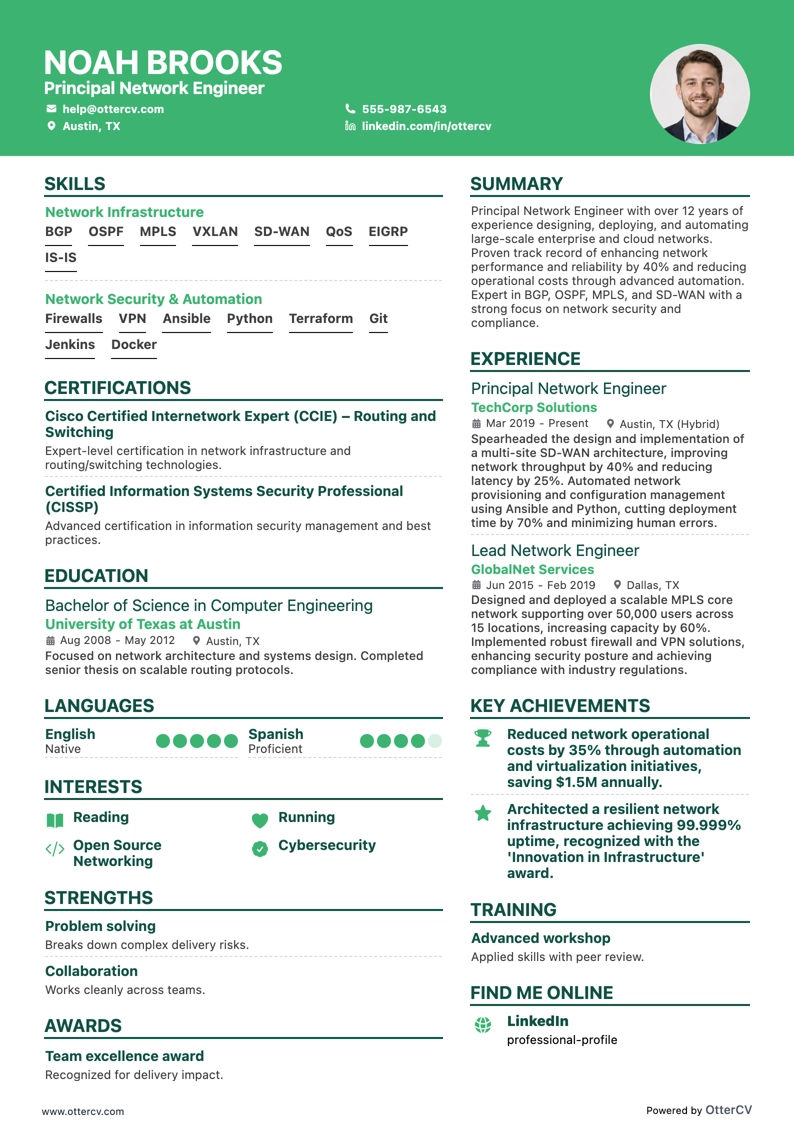
Principal Network Engineer resume example

Principal Network Engineer

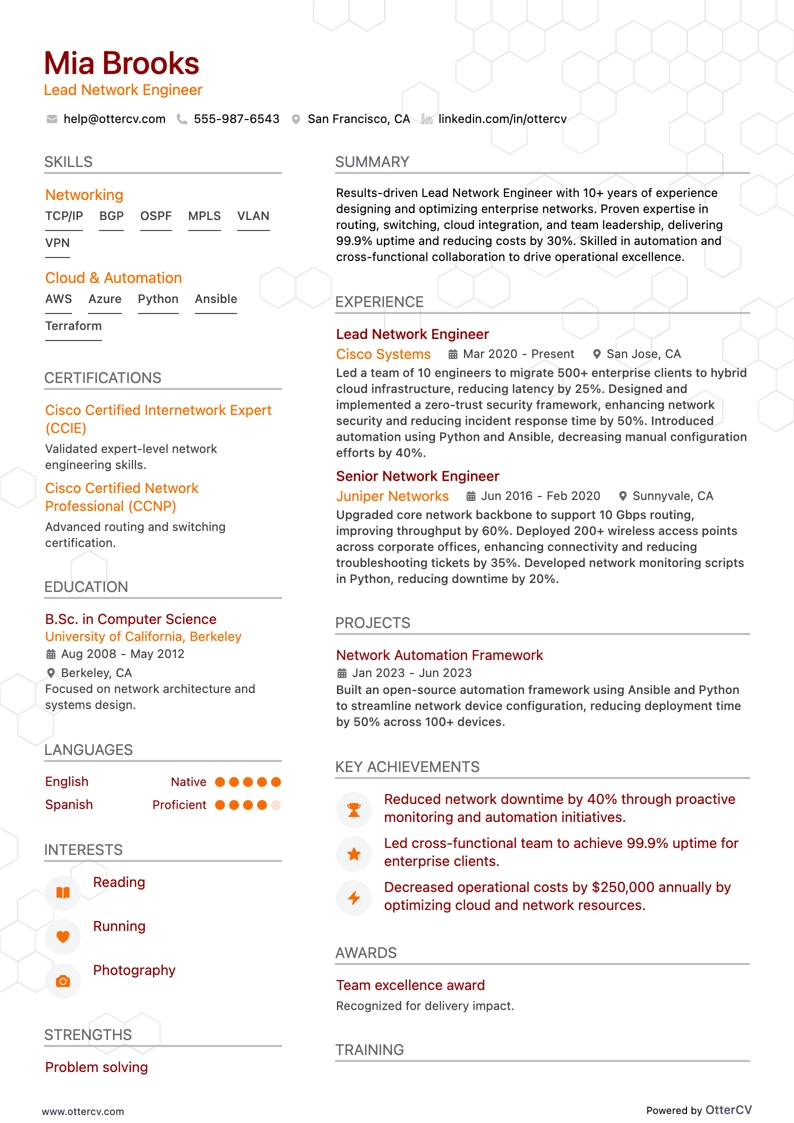
Lead Network Engineer resume example

Lead Network Engineer

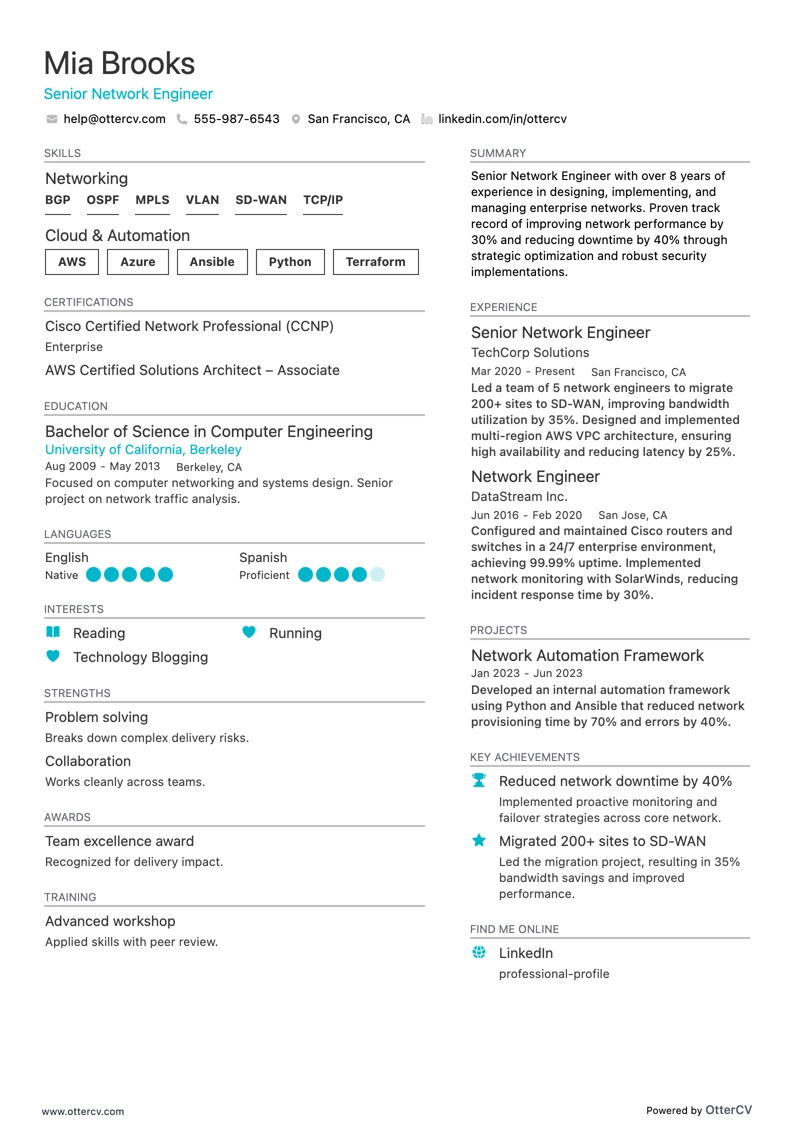
Senior Network Engineer resume example

Senior Network Engineer

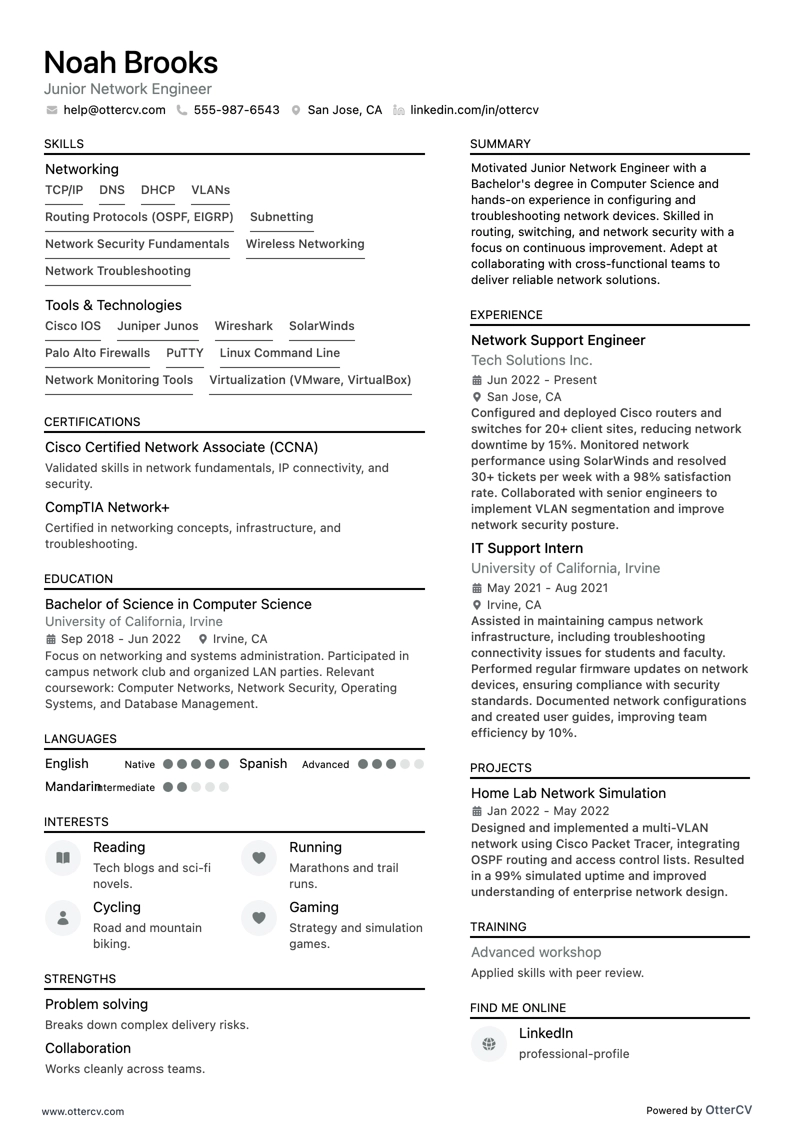
Junior Network Engineer resume example

Junior Network Engineer

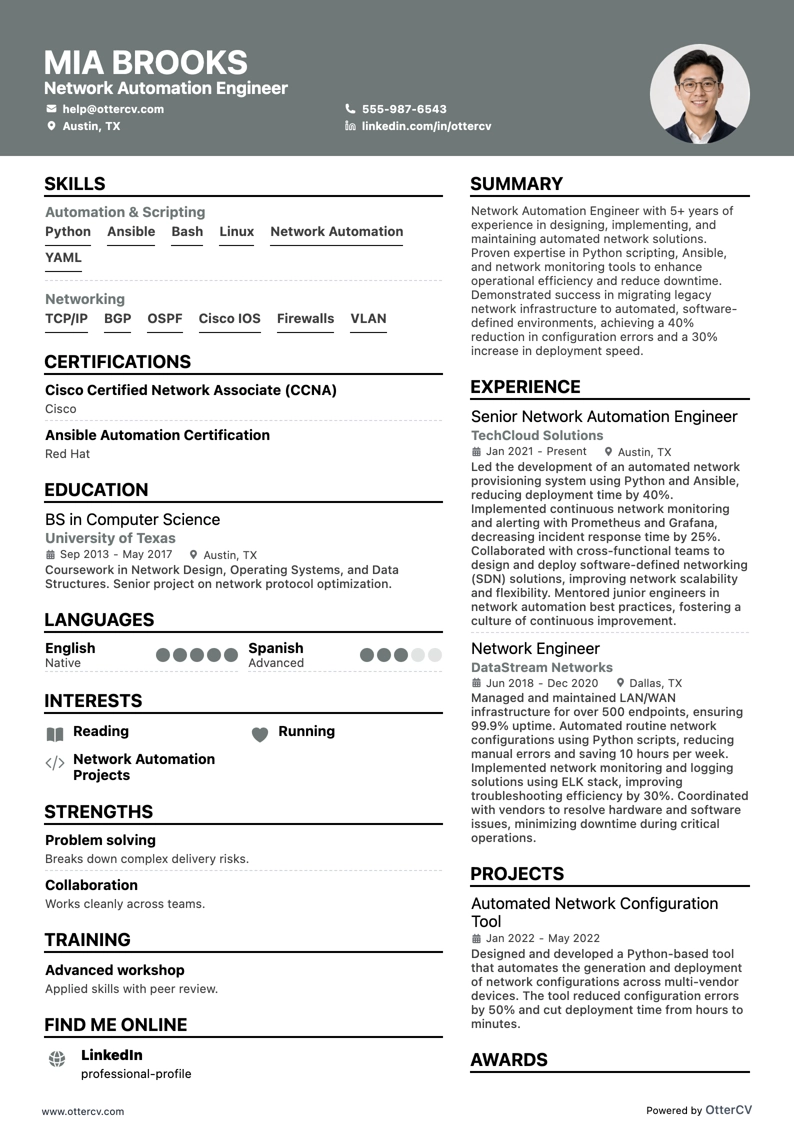
Network Automation Engineer resume example

Network Automation Engineer

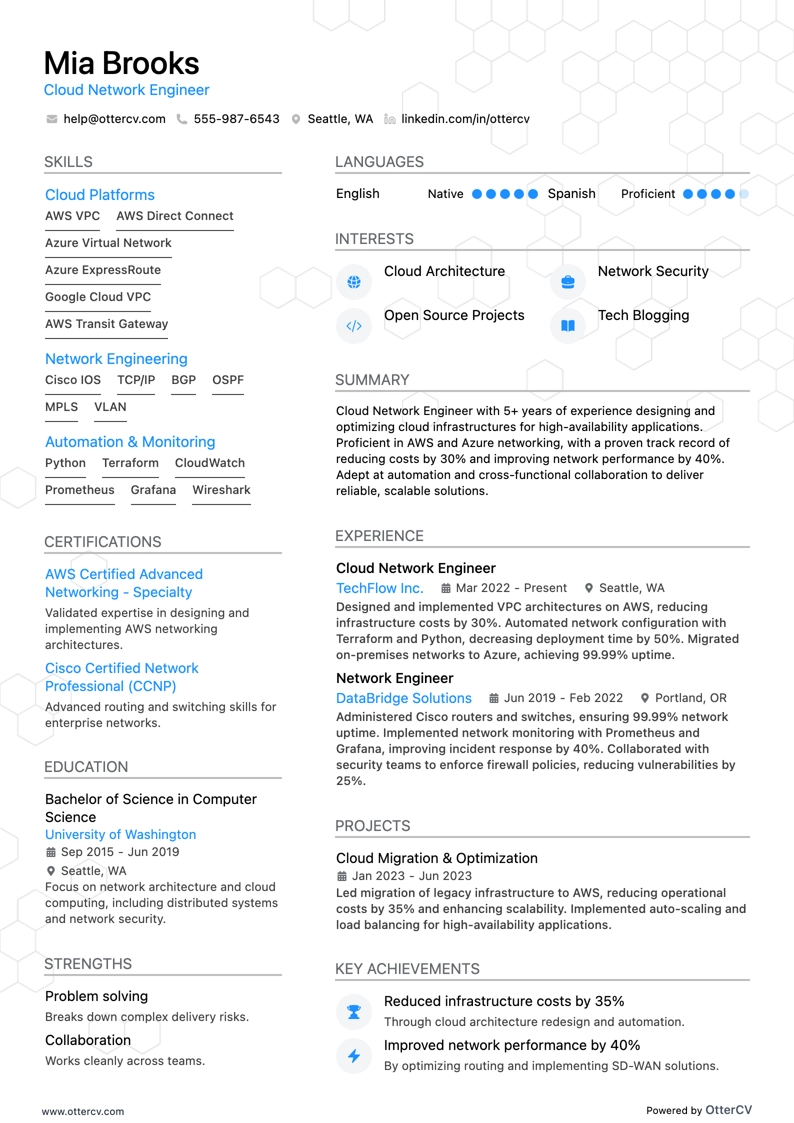
Cloud Network Engineer resume example

Cloud Network Engineer

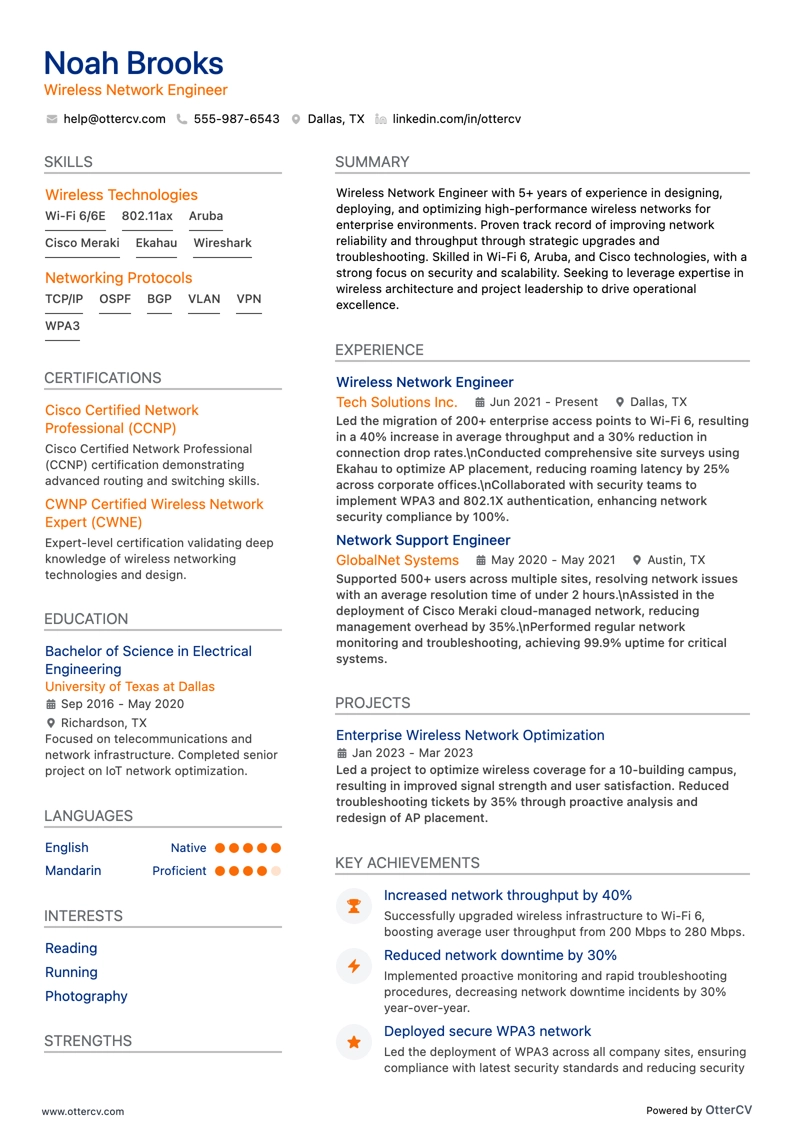
Wireless Network Engineer resume example

Wireless Network Engineer

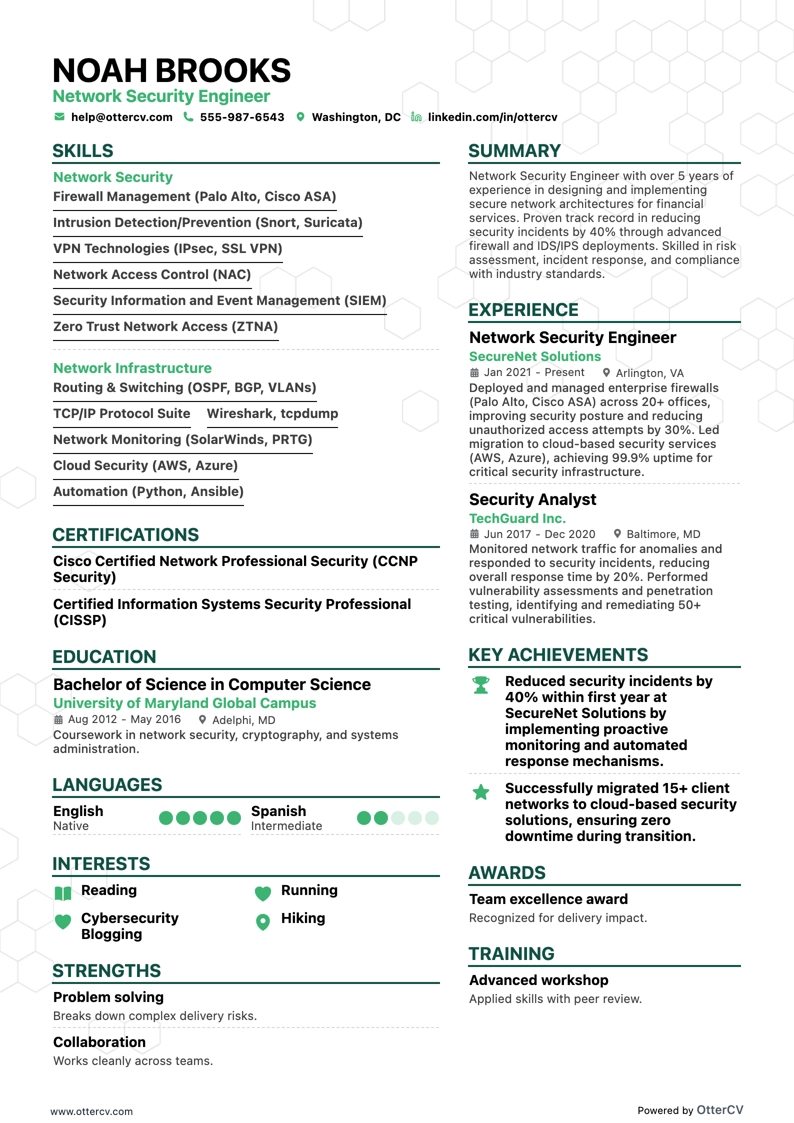
Network Security Engineer resume example

Network Security Engineer

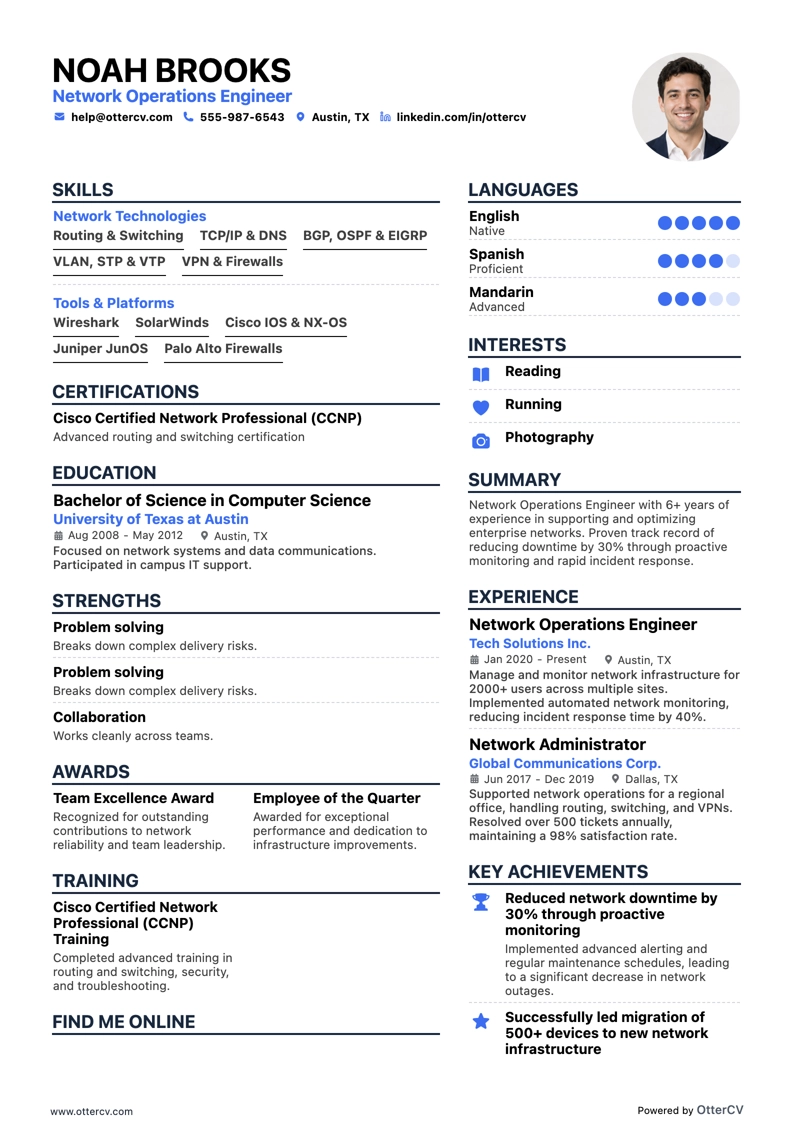
Network Operations Engineer resume example

Network Operations Engineer

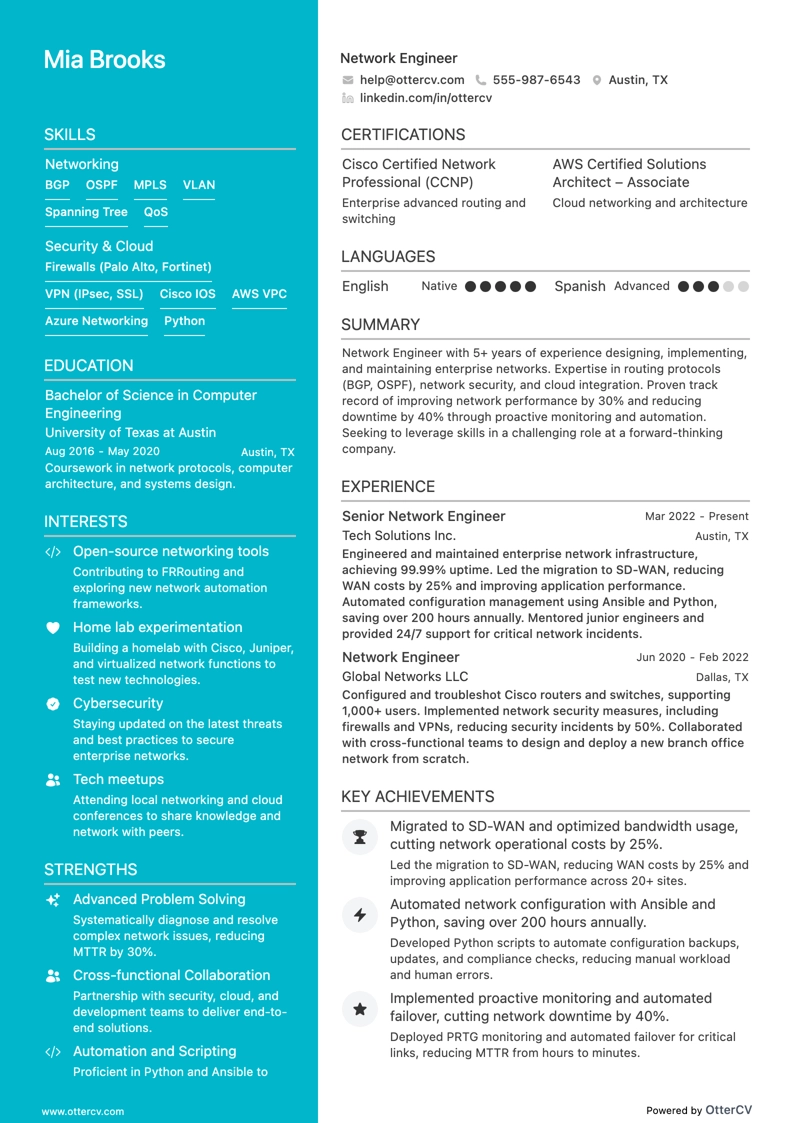
Network Engineer resume example

Network Engineer

You’re ready for a new role as a network engineer, but the interview invitations still aren’t coming. Even with solid qualifications, hands-on experience, and a strong passion for networking, a resume that doesn’t stand out can hold you back.

If you match the job description but still aren’t getting calls, your resume may be the problem. Even network engineers with more than 5 years of experience can struggle when their resumes fail to catch attention.

In many cases, recruiters see your resume before a CTO does. They may not understand the difference between firewalls and VPNs or recognize other technical details that show your expertise. Since not all recruiters are tech experts, your resume needs to be clear and easy for HR to understand.

To improve your chances of getting that call, focus on the following:

  • Choose a resume template that puts your network engineering expertise front and center.
  • Identify the most important resume sections and organize them for maximum impact.
  • Show your experience with network engineering technologies.
  • Describe your achievements and explain your impact on projects and the industry.
  • Highlight key skills from the job description to match employer expectations.
  • Include your educational background, especially degrees or certifications relevant to network engineering.

If you’re looking for more opportunities in the network and security field, browse these resume examples:

How to format a network engineer resume

Choosing the right resume format is an important step when applying for a network engineer role. Here are the three main formats to consider:

  • Reverse chronological resume: Best for candidates with extensive network engineering experience. It lists your most recent job first and works backward.
  • Functional resume: A good choice if you’re new to network engineering, changing careers, just starting out, or have employment gaps. It focuses more on skills than job history.
  • Hybrid resume: Combines the strengths of chronological and functional formats. It lets you highlight relevant skills and achievements first, followed by a concise work history.

To make your resume more effective for recruiters, follow these tips:

As a network engineer, your resume should emphasize strategic leadership and the impact of your projects. Tailoring it with relevant keywords from the job ad can also help it pass through Applicant Tracking Systems used by many employers.

Also consider your target market. For example, resumes in Canada follow different layout conventions.

Want to make sure your resume clears ATS checks? Try our AI resume checker. It evaluates your resume on 16 key points for free and helps make it more appealing to recruiters.

The top sections on a network engineer resume

  • Contact information: Include clear ways for employers to reach you for interviews or follow-up questions.
  • Professional summary: Show your most relevant skills, experience, and career goals for the network engineer role.
  • Work experience: Highlight your previous roles, responsibilities, and achievements in network engineering to demonstrate your competence.
  • Technical skills: List your network engineering abilities, including network protocols, hardware, and software.
  • Certifications and education: Present your academic background and additional training, such as Cisco network certifications, to show your expertise.

These sections help recruiters assess your potential contributions to their organization.

What recruiters want to see on your resume:

  • Proficiency in network protocols: Shows that you understand network communication protocols and can support effective data transmission.
  • Knowledge of network hardware and software: Demonstrates your ability to set up, configure, manage, and troubleshoot both physical and virtual network components.
  • Experience with network security measures: Shows that you can help protect company data and network infrastructure from breaches.
  • Relevant certifications: Certifications like Cisco's CCNA and CCNP help confirm training and tested skills in key areas of network engineering.
  • Problem-solving skills: Suggests you can diagnose and repair network issues quickly and efficiently, helping reduce downtime.

To show your strengths as a network engineer, describe your work experience clearly and specifically. We’ll explore this in more detail in the next section.

How to write your network engineer resume experience

The resume experience section is where you explain your accomplishments as a network engineer. For each role, highlight specific results and projects you completed.

When tailoring your resume, study the job description closely. Identify the skills and tools the employer wants, such as Cisco, Juniper, or network protocols you know, and connect them to your own experience.

Focus on examples where you solved a problem or improved something. These details show that you can do the job and deliver results.

Hiring managers want candidates who solve problems and make things better for the company and its customers. If your experience shows that, you’ll stand out from the competition.

Next, let’s look at two examples of how to present work experience on a resume. First, we’ll review the wrong way to do it.

Experience

Network Engineer

Los Angeles Tech Solutions

02/2018 - 11/2023 · Los Angeles, CA

  • Handled network projects to support business objectives and technology updates.
  • Monitored and adjusted network systems to maintain performance standards.
  • Managed network security measures to protect data.
  • Used standard tools to oversee and optimize network operations.
WRONG

At the moment, your accomplishments may come across as too routine to stand out. Entries like these are also less likely to pass ATS screening. Compare them with the improved version below.

Experience

Network Engineer

Los Angeles Tech Solutions

02/2018 - 11/2023 · Los Angeles, CA

  • Handled over 20 network projects annually to support strategic business objectives and technology updates, increasing overall efficiency by 15%.
  • Monitored and adjusted network systems across 5 locations, achieving 99% uptime while maintaining high performance standards.
  • Managed network security measures that reduced data breaches by 40% through the rigorous implementation of advanced security protocols.
  • Used standard tools to manage and improve network operations, resulting in a 20% faster response time and improved bandwidth management.
RIGHT

The use of action verbs like “handled,” “monitored,” and “managed” helps show the candidate’s role in leading work, solving problems, and overseeing critical tasks.

This section is especially effective because it includes clear metrics: a 15% increase in efficiency, 99% uptime, a 40% reduction in data breaches, and a 20% improvement in system response times. These results make the candidate’s impact easy to understand and show their ability to measure and report achievements.

It also references industry-standard tools, which highlights technical skill in network operations. By combining tools and results in one concise list, the resume avoids needing a separate skills section, saves space, and keeps attention on proven performance.

PRO TIP

Include specific numbers in your resume whenever appropriate to highlight the excellent results you’ve achieved.

How to quantify impact on your resume

Here are practical ways to present measurable success on your resume:

  • Detail the size of the networks you managed to show your ability to support large-scale operations and maintain system integrity across broad environments.
  • Include how many network issues you resolved to demonstrate your problem-solving skills and your role in maintaining network stability and efficiency.
  • State the percentage increase in network efficiency to show how you improved operational speed and supported productivity.
  • Specify the cost reductions you achieved to highlight your resource management skills and your effectiveness in lowering network management and setup expenses.
  • Highlight the number of security vulnerabilities you identified and addressed to show your focus on network security and your contribution to protecting company data.
  • List the number of upgrades or implementations you completed to demonstrate how you modernized and improved the network with new technologies.
  • Mention the overall uptime of the networks you managed so recruiters can understand your success in maintaining a reliable operating environment.
  • Specify the number of disaster recovery plans you implemented to underline your ability to prevent and respond to network failures while supporting business continuity.

PRO TIP

Don’t lie on your resume. It will likely come up during the interview and could lead to your application being rejected.

If you do not have much experience, avoid exaggerating on your resume. If you want to become a network engineer, focus on presenting your background honestly and clearly.

How do I write a network engineer resume with no experience

If you are just starting out as a network engineer, personal projects can help strengthen your resume. Simple work such as setting up small network configurations or adjusting router settings can count as practical experience. You can also use resources like Stack Overflow and GitHub to build your knowledge of network management.

If you have completed projects, you can present them on your resume in the following ways:

  • Describe personal projects as freelance work or academic experience.
  • Include technical workshops or competitions you have attended, especially if you earned awards or certifications.
  • Mention your experience in hackathons or relevant online communities related to network engineering or IT infrastructure.
  • Highlight skills such as teamwork, problem-solving, and system management. Use examples from school projects or previous jobs to show how these abilities apply to network engineering.
  • Begin your resume with a brief objective statement that shows your interest in network engineering and mentions any related experience. Keep it to 3–4 sentences.

These steps can help demonstrate your motivation and ability, making your resume more likely to reach the interview pile.

How to list your hard skills and soft skills on your resume

When writing the skills section of your network engineer resume, keep it clear and focused. Include both your technical knowledge of network tools such as Cisco and Juniper, and soft skills like analytical thinking and problem-solving. Highlight your experience with technologies such as Cisco IOS, Juniper Junos, and network monitoring tools like SolarWinds and Wireshark. Even a basic understanding of Python can add value to your resume.

Best hard skills for your network engineer resume

  • Experience with Cisco networking equipment.
  • Knowledge of network architecture.
  • Understanding of routing protocols.
  • Proficiency with IPv4 and IPv6.
  • Strength in network security.
  • Working knowledge of Linux.
  • Experience with network automation.
  • Familiarity with Wi-Fi and LTE networks.
  • Knowledge of load balancing.
  • Experience with firewall administration.
  • Understanding of Virtual Private Networks (VPNs).
  • Knowledge of TCP/IP.
  • Familiarity with DNS and DHCP.
  • Experience with cloud services such as AWS and Azure.
  • Knowledge of network simulation tools.
  • Understanding of OSPF (Open Shortest Path First).
  • Understanding of BGP (Border Gateway Protocol).
  • Experience with intrusion detection systems.
  • Knowledge of Ethernet and fiber optics.

In addition to hard skills, include a few personal traits on your resume to show that you work well with others and can adapt easily to the company’s environment.

According to LinkedIn data, employees who have both hard and soft skills tend to be promoted 8% faster than those with only hard skills. This pattern is even more pronounced among professionals in the tech industry.

How to list your education and certifications on your resume

The education section of your resume helps validate your qualifications and readiness for a network engineer role. Highlight degrees in computer science, network engineering, or related fields, along with relevant certifications such as Cisco Certified Network Associate (CCNA), Cisco Certified Network Professional (CCNP), and CompTIA Network+.

This section shows your formal training and alignment with industry standards, which can strengthen your credibility with employers.

If you are relatively new to the field, place your education section near the top of your resume. If you have extensive professional experience, it can come after your work experience section.

To structure your academic background clearly, include:

  • Institution name: the university or college where you studied.
  • Institution location: the city and state of the institution.
  • Degree and field of study: the degree you earned and your area of study.
  • Date of graduation: your graduation date or, if you are still studying, your expected graduation.
  • Relevant courses and honors: courses related to network engineering and honors such as cum laude.
  • GPA: your Grade Point Average if it is above 3.5.
  • Professional certifications: any certifications relevant to network engineering.

Here’s how to organize this section of your resume.

Education and Certifications

Master of Science in Computer Networks

Massachusetts Institute of Technology (MIT)

08/2021 - 05/2023 · Cambridge, MA

  • Specialized in advanced networking technologies and network security.
  • Completed a thesis on optimizing network infrastructure through AI-driven solutions.

Bachelor of Science in Network Engineering

Massachusetts Institute of Technology (MIT)

08/2017 - 05/2021 · Cambridge, MA

  • Focused on network architecture, data communications, and systems management.
  • Worked on several projects utilizing Cisco routers and switches for network setup and configuration.
RIGHT

Obtaining advanced certifications highlights your expertise and shows a proactive approach to solving today’s technology challenges. Adding certifications to your resume is simple:

  • List the certifications you’ve earned.
  • Include the names of the issuing institutions.
  • If applicable, note each certification’s expiration date.

Here are the top 5 certifications for network engineers to include on a resume:

Best certifications for your network engineer resume

How to write your network engineer resume summary or objective

Starting your network engineer resume with a personal statement, such as a summary or objective, is an effective way to grab attention. It gives you a chance to introduce your skills, experience, and career goals while making a strong first impression.

Personal statements are especially useful if you have a diverse educational background or a wide range of experiences. They help explain how your background makes you a strong fit for the role.

Here’s the difference between the two:

  • A resume summary focuses on your past work experience and how it prepares you for the position.
  • An objective statement focuses on your career goals and how they align with the job you want.

For entry-level network engineers, an objective is often the better choice because you may not have much experience yet. To write one well:

  • Tailor it to the job description by using relevant keywords and skills.
  • Show your eagerness to learn and grow in the field.
  • Use action verbs to keep the writing engaging.
  • Keep it concise, ideally around 3 sentences.

If you have more experience, use a summary instead. To make it effective:

  • Highlight skills and experience that match the role’s requirements.
  • Include keywords from the job description.
  • Mention past achievements and quantify them when possible.
  • Keep the wording action-oriented.
  • Aim for a brief but impactful summary of about 3–5 sentences.

Tailoring your resume summary for each job application can take time, but it makes a big difference and is well worth the effort.

Now, take a look at this example of a network engineer resume summary:

Summary

A highly experienced and motivated IT professional with a strong background in system administration and a proven track record in troubleshooting. Adapts quickly to a constantly changing industry and works effectively both independently and as part of a team to achieve necessary objectives.

WRONG

If words like “solid background,” “history,” and “experienced” keep showing up, they are likely saying the same thing. Use that space for more meaningful details that can better capture a recruiter’s interest. Look at the example below.

Summary

Professional network engineer with over 7 years of experience in designing and managing network, security, and server infrastructure. Successfully mentored over 50 new engineers, resolved thousands of escalated issues, and implemented innovative solutions to complex business challenges. Eager to advance into a Senior Network Engineer role at Meta.

RIGHT

Now hiring managers know that you:

  • Bring over 7 years of experience in networking, security, and server management.
  • Have mentored more than 50 new engineers, demonstrating strong leadership skills.
  • Have tackled and solved thousands of difficult technical issues.
  • Find innovative solutions to complex business problems.
  • Are ambitious and ready to step into a senior role at Meta.

Additional sections for a network engineer resume

Beyond the essential resume sections, you can add a few extras to highlight your personality and show a more complete picture of who you are. Consider including:

  • Awards and achievements: List notable awards or recognitions you’ve received, such as Best Network Implementation in a company-wide project or recognition for outstanding problem resolution. Keep them relevant and verifiable.
  • Passions: Adding a section for your hobbies and interests outside of work can make you appear more well-rounded. Whether it’s blogging about technologies, participating in hackathons, or non-technical activities like biking or swimming, sharing your passions can reflect a balanced lifestyle.
  • Languages: Fluency in multiple languages can be a strong advantage in today’s global workforce, especially in a multinational corporation.
  • Volunteering: Including volunteer work, particularly if it relates to technology or community service, can demonstrate dedication and a willingness to apply your skills beyond paid roles.

How to put a Projects section on a network engineer resume

Recruiters and CTOs often want to see your work firsthand so they can evaluate whether your approach to network engineering and your technical knowledge fit their ongoing projects. To present a project effectively:

  • State the project name and the location where it was conducted.
  • Provide a concise summary of the project’s objective and the problem it addressed.
  • Specify the dates of your involvement.
  • Highlight a key outcome or advantage that came from the project.
  • If available, include a link where the project can be viewed online.

Projects

Optimization of WAN for Improved Connectivity

06/2021 - 12/2021 | New York, USA

Led the upgrade and optimization of the Wide Area Network (WAN) to improve connectivity and performance across multiple regional branches.

  • Optimized the WAN, increasing network connectivity and performance across regional offices by 35%.

Deployment of Scalable Network Solutions for Startups

09/2020 - 02/2021 | New York, USA

Engineered custom network solutions for startups, with a focus on scalability and robustness to support rapid growth.

  • Designed and deployed scalable network infrastructures for startup ecosystems, resulting in a 50% increase in data handling efficiency.
RIGHT

Key takeaways

  • Choose a resume format that best highlights your experience, such as a reverse chronological layout if you have substantial experience, or a hybrid format if you have less experience or gaps in your work history.

  • Keep your resume ATS-friendly by using standard fonts and formatting and avoiding complex elements that may cause scanning errors.

  • Show your achievements with specific numbers, such as how much you improved efficiency or reduced downtime.

  • Include the technical and soft skills mentioned in the job description to better match employer expectations.

  • List your education and relevant certifications, such as CCNA or CCNP.

  • Add sections for awards, languages, or volunteering to show a well-rounded skill set.

Network Engineer resume examples

Explore additional Network Engineer resume samples and guides and see what works for your level of experience or role.

By Experience

Principal Network Engineer

Principal Network Engineer resume preview

Lead Network Engineer

Lead Network Engineer resume preview

Senior Network Engineer

Senior Network Engineer resume preview

Junior Network Engineer

Junior Network Engineer resume preview

Network Engineer resume examples

Explore additional Network Engineer resume samples and guides and see what works for your level of experience or role.

By Role

Network Automation Engineer

Network Automation Engineer resume preview

Cloud Network Engineer

Cloud Network Engineer resume preview

Wireless Network Engineer

Wireless Network Engineer resume preview

Network Security Engineer

Network Security Engineer resume preview

Network Operations Engineer

Network Operations Engineer resume preview

Network Engineer

Network Engineer resume preview