Chief Medical Scribe full preview

15 Medical Scribe Resume Examples

OtterCV

Written by The OtterCV Team

Updated: 7/23/2023•8 min read

See all resume examples in this guide, or generate your own resume example with your personalized prompt

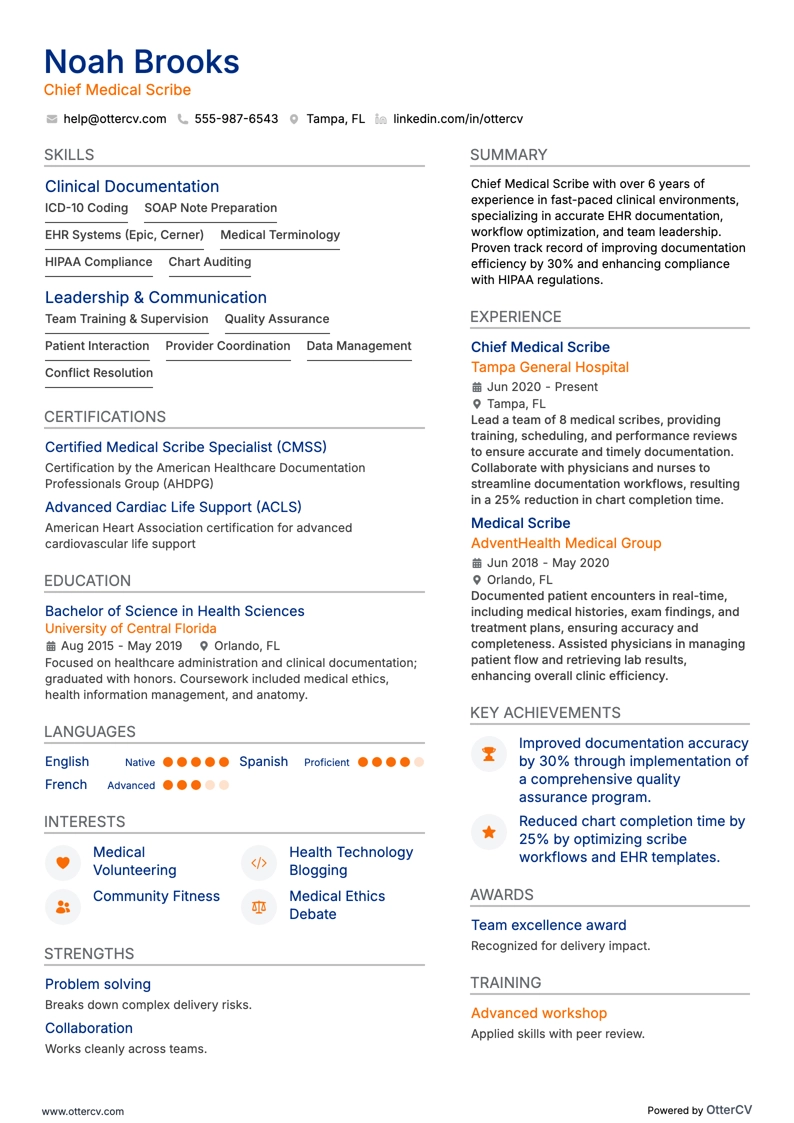
Chief Medical Scribe resume example

Chief Medical Scribe

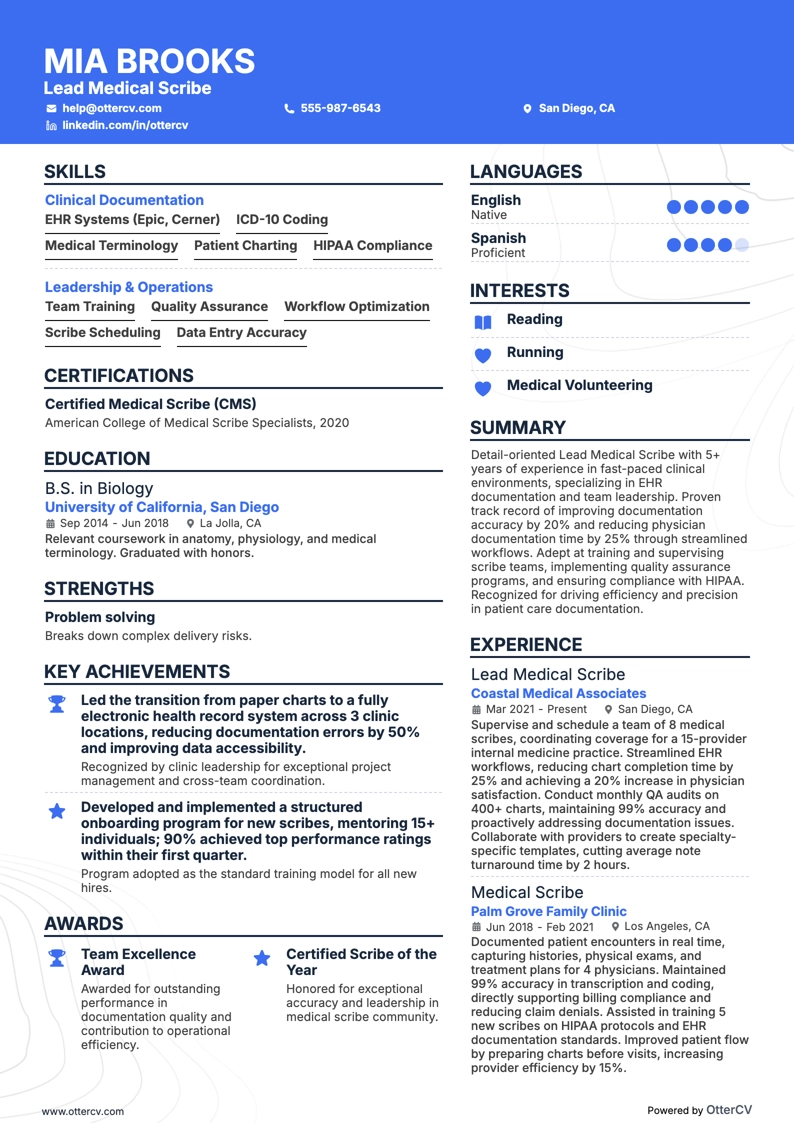
Lead Medical Scribe resume example

Lead Medical Scribe

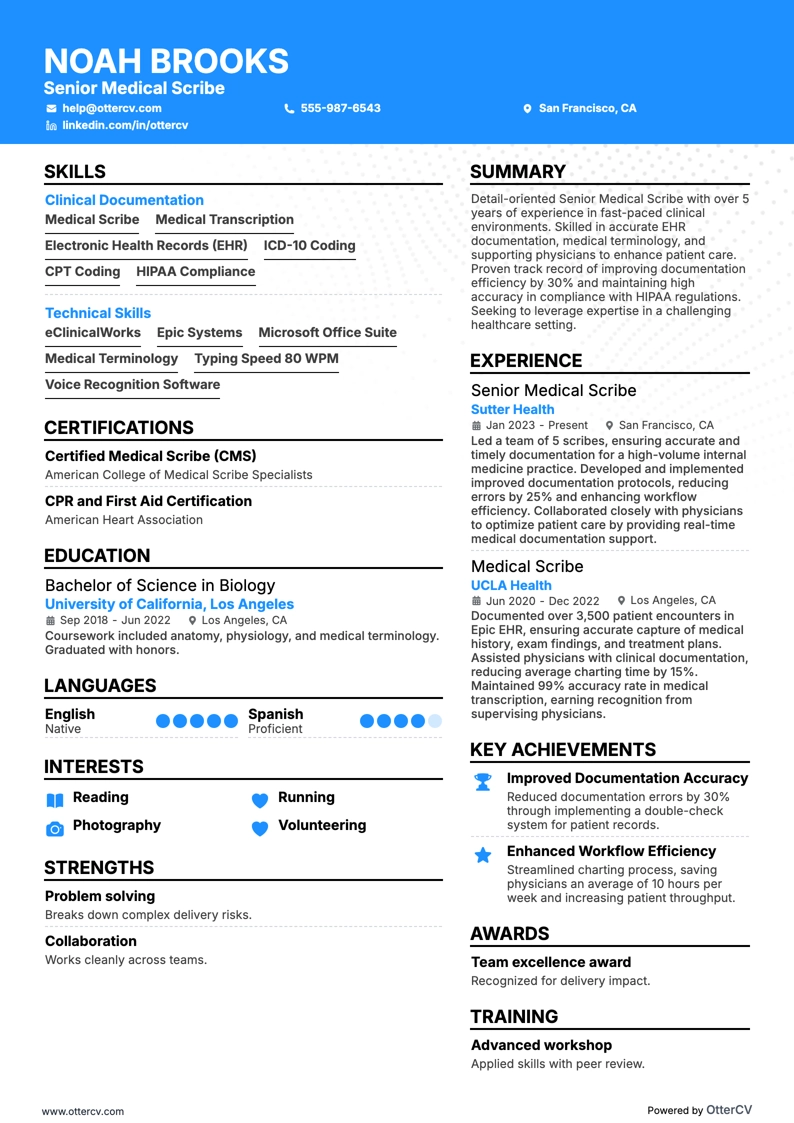
Senior Medical Scribe resume example

Senior Medical Scribe

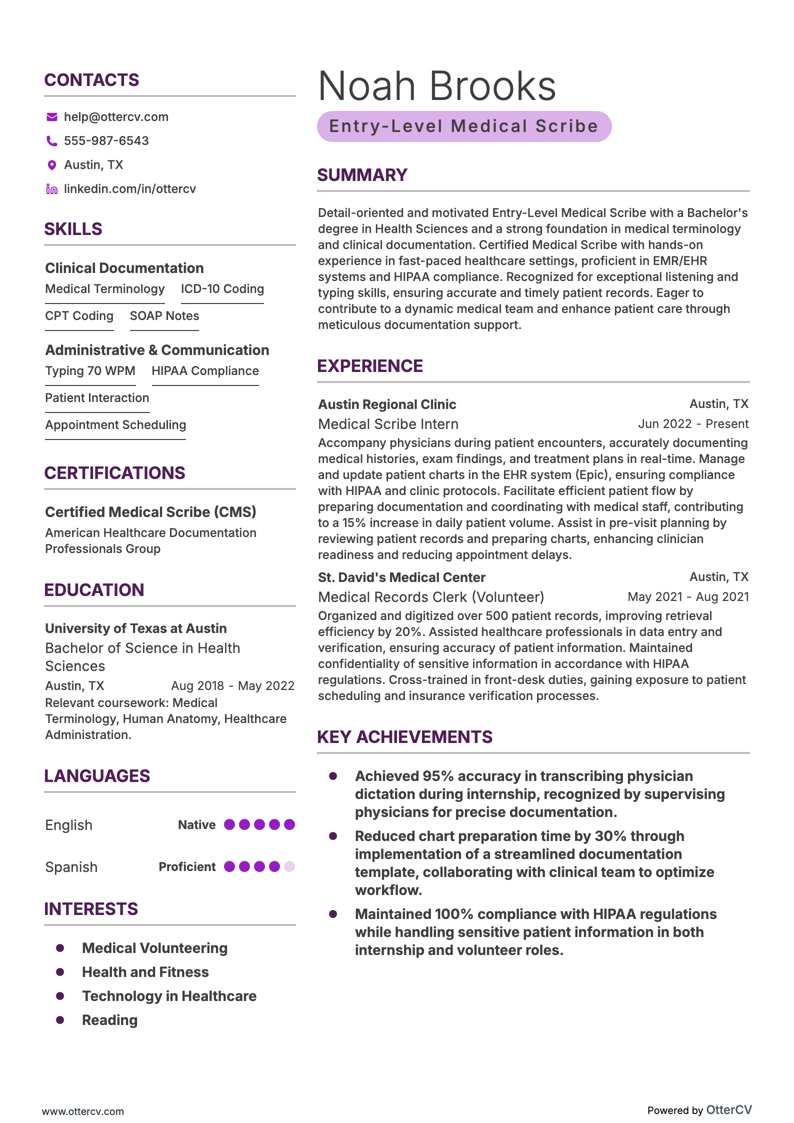
Entry-Level Medical Scribe resume example

Entry-Level Medical Scribe

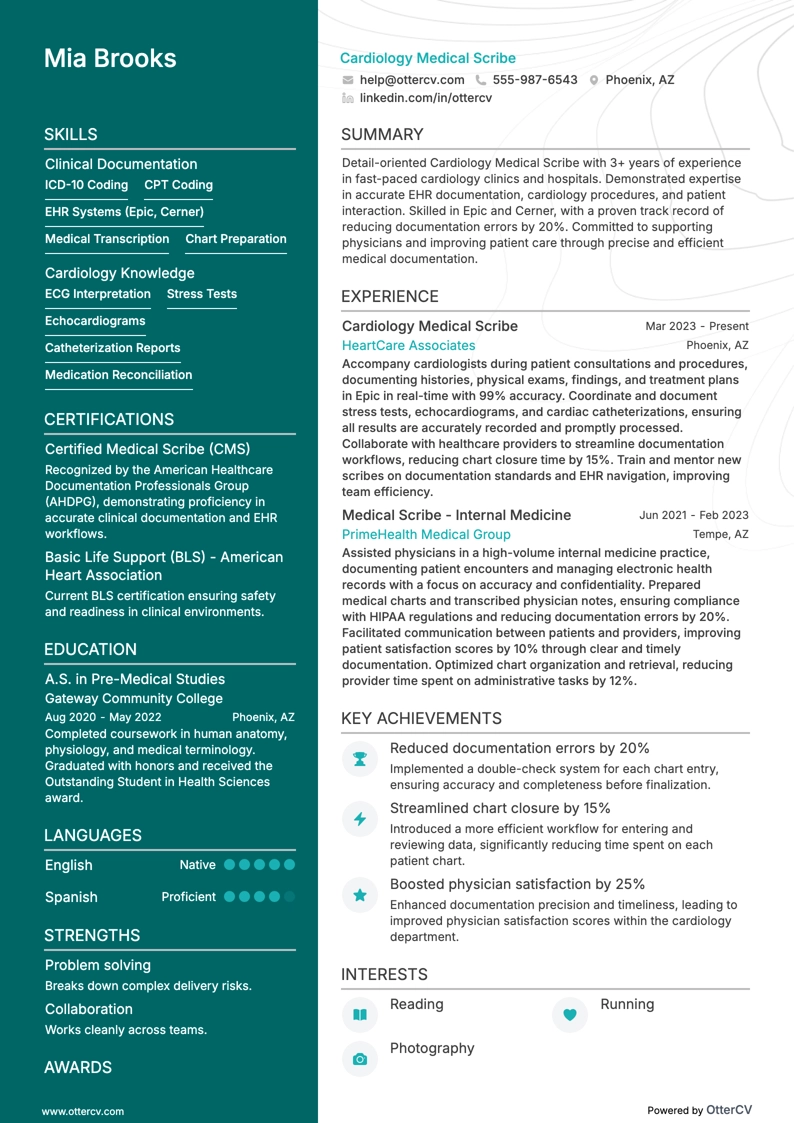
Cardiology Medical Scribe resume example

Cardiology Medical Scribe

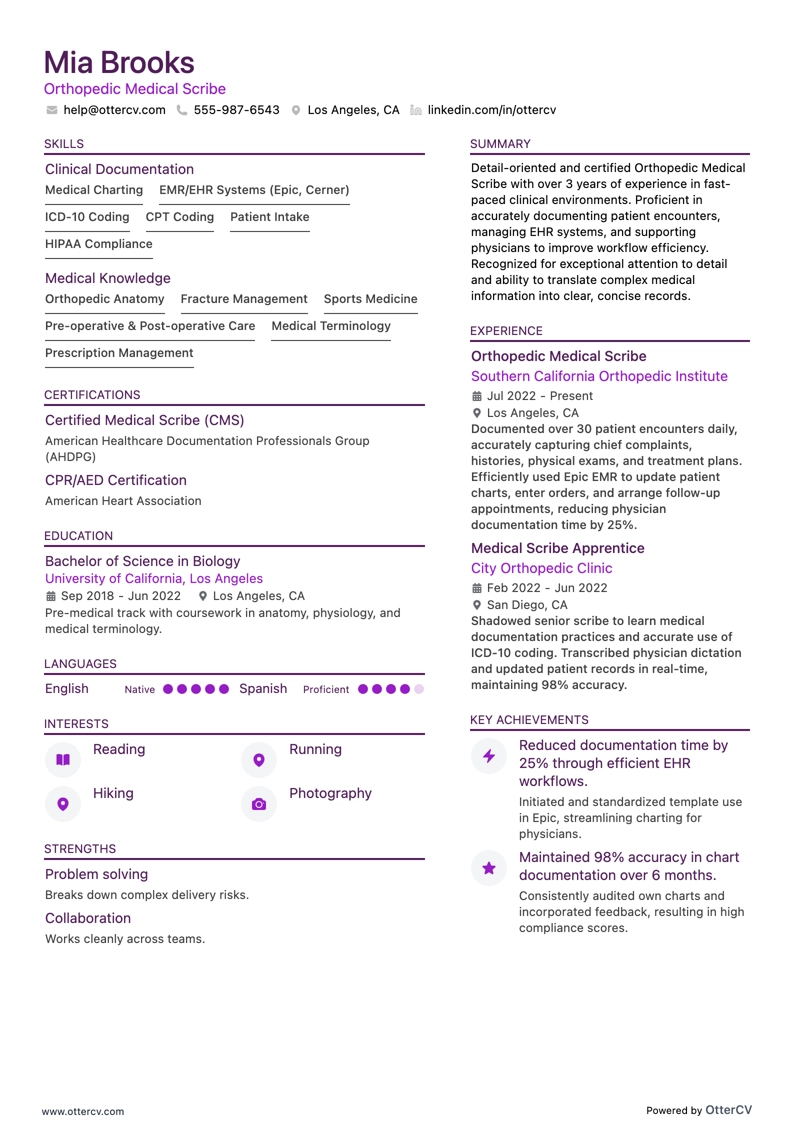
Orthopedic Medical Scribe resume example

Orthopedic Medical Scribe

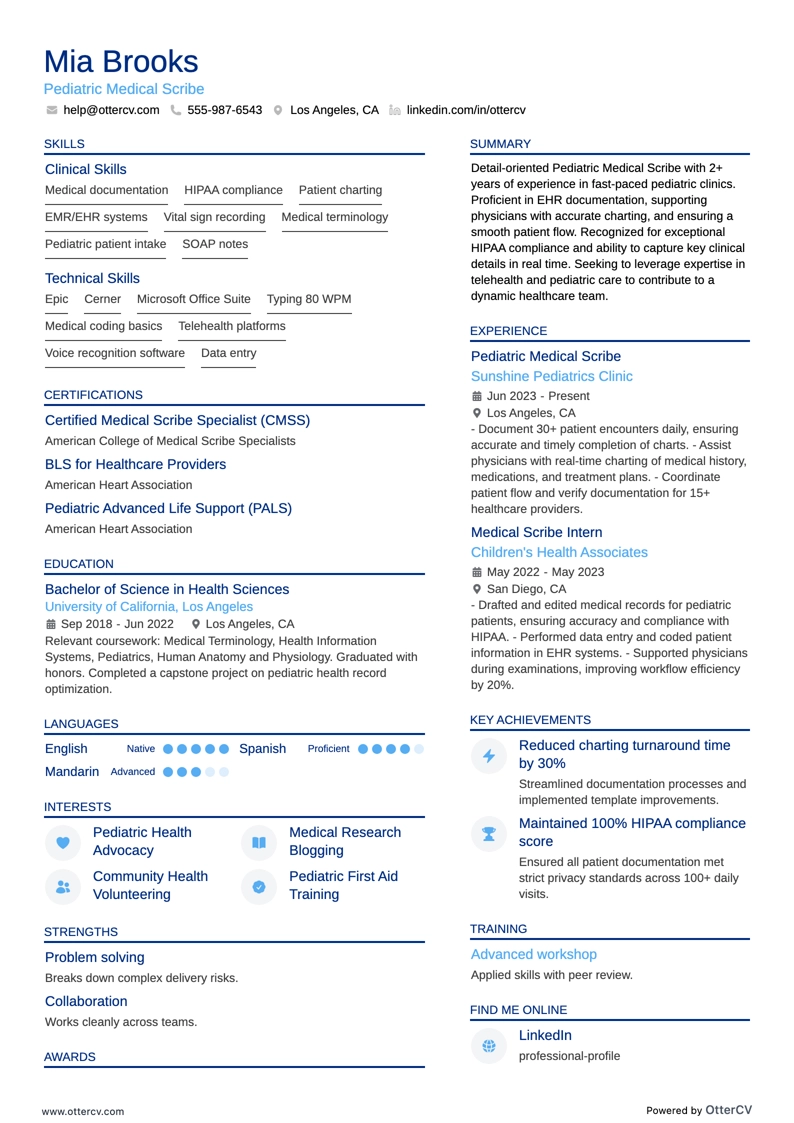
Pediatric Medical Scribe resume example

Pediatric Medical Scribe

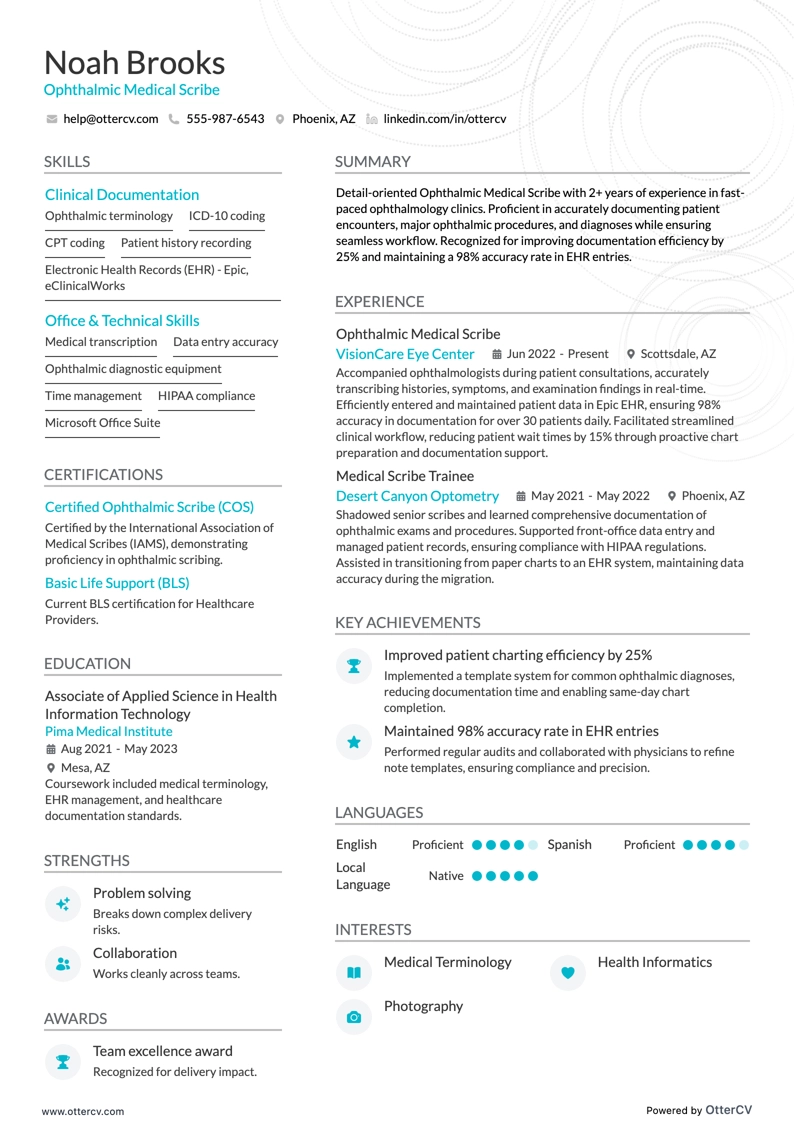
Ophthalmic Medical Scribe resume example

Ophthalmic Medical Scribe

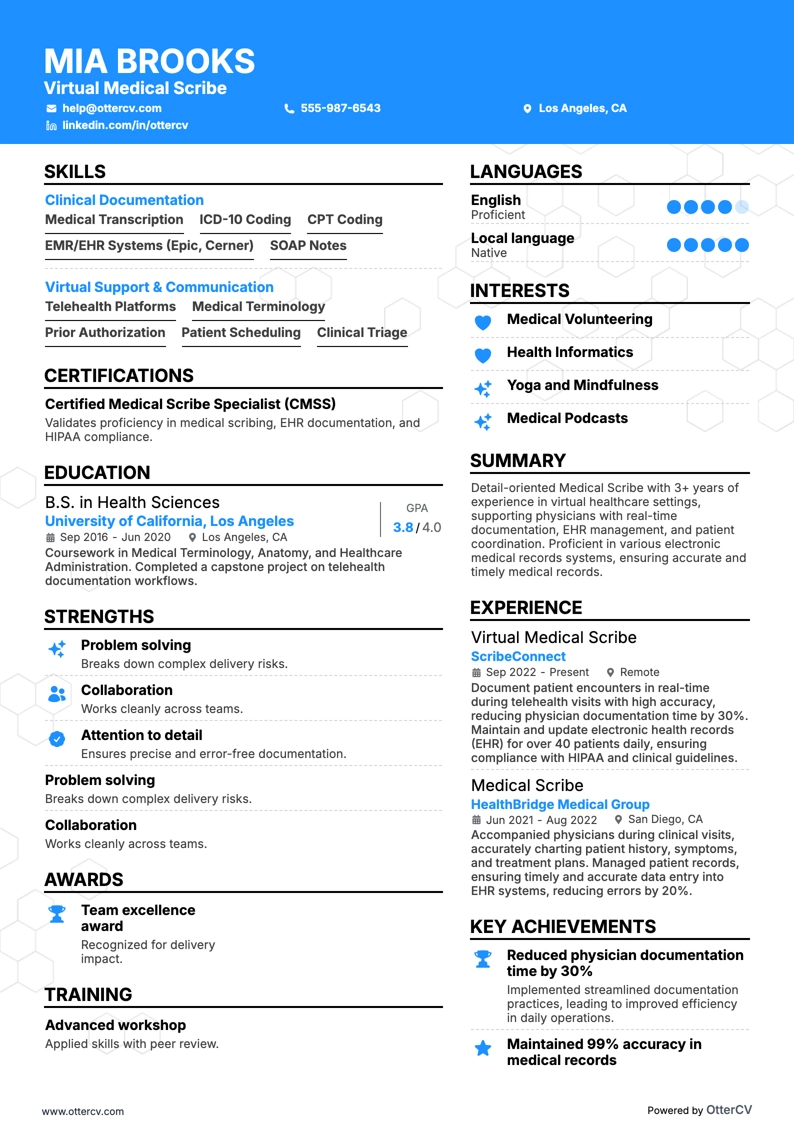
Virtual Medical Scribe resume example

Virtual Medical Scribe

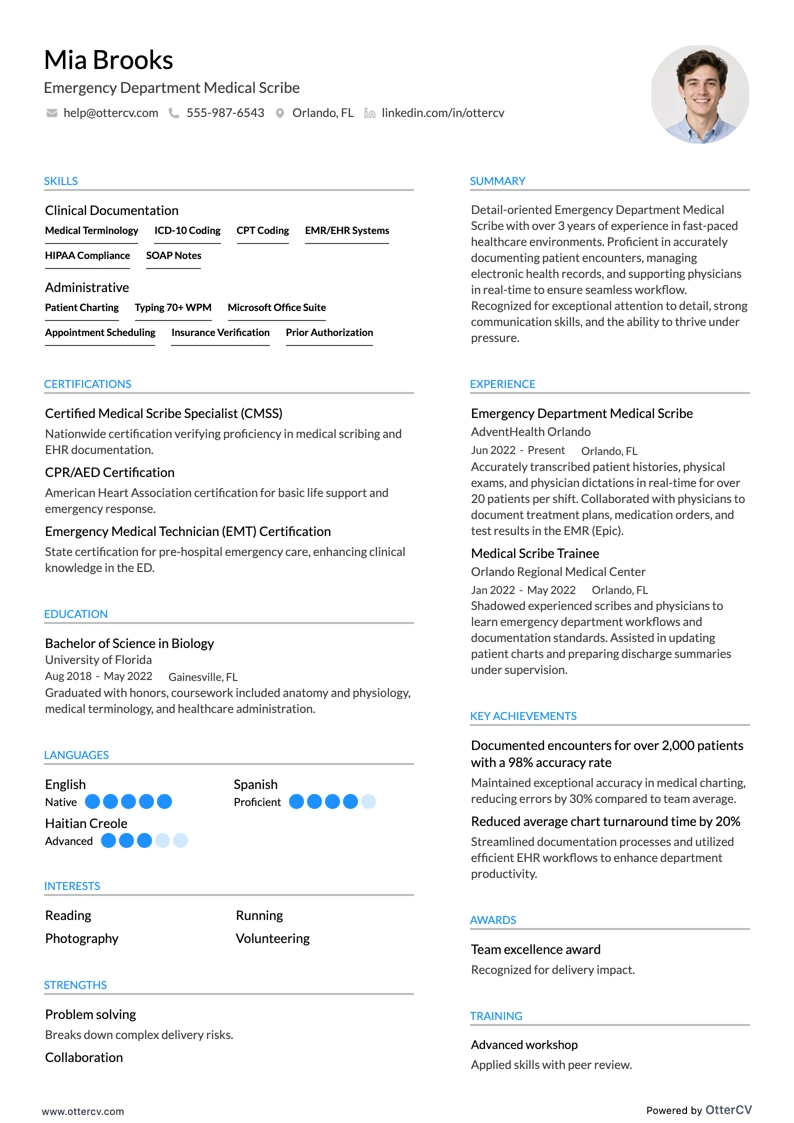
Emergency Department Medical Scribe resume example

Emergency Department Medical Scribe

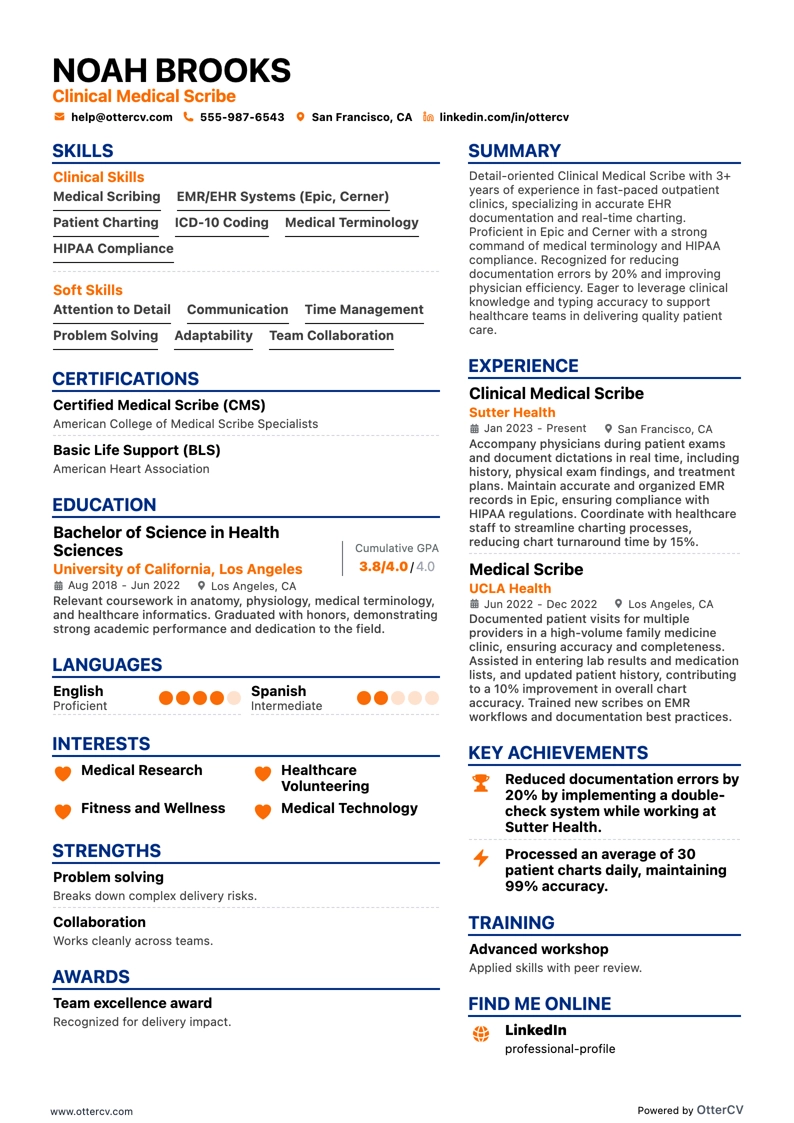
Clinical Medical Scribe resume example

Clinical Medical Scribe

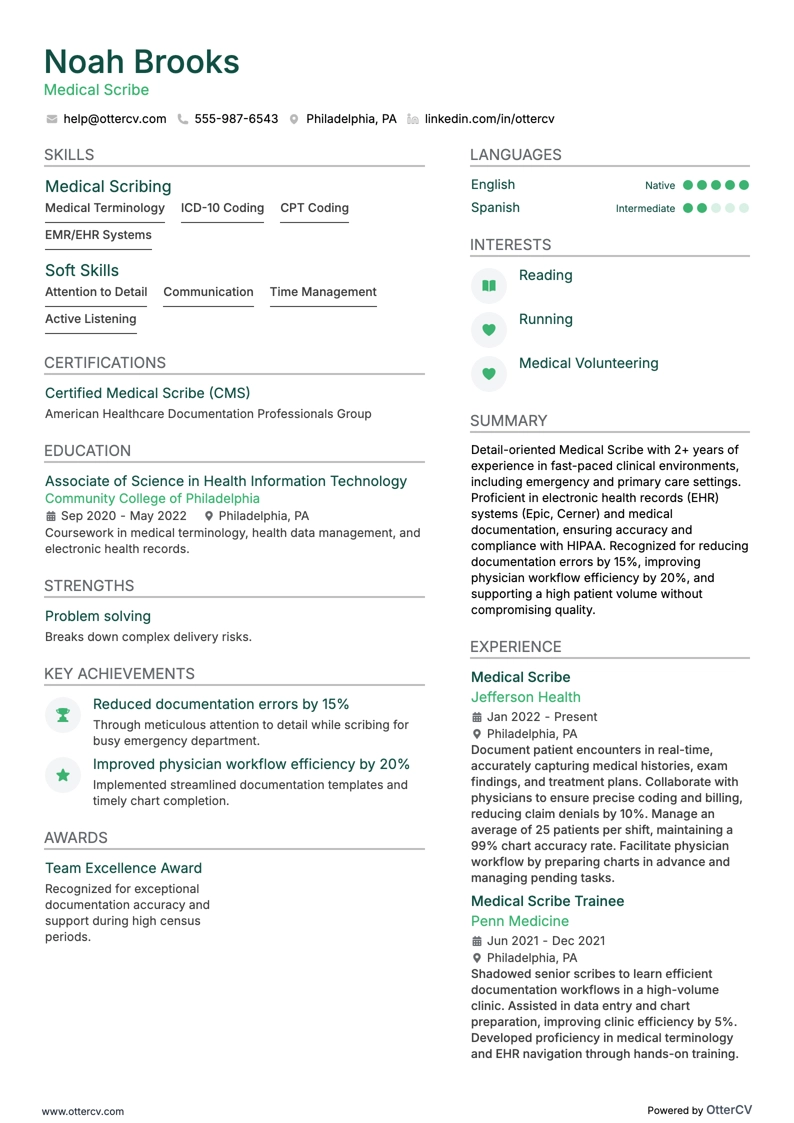
Medical Scribe resume example

Medical Scribe

Most medical scribe resume drafts fail because they read like task logs and bury clinical accuracy, speed, and documentation quality. That becomes a problem when applicant tracking systems filter for keywords and recruiters scan quickly in a crowded applicant pool.

A strong resume shows the outcomes you delivered, not just the tools you used. Highlight charts completed per shift, turnaround time, error-rate reductions, specialty coverage, provider throughput gains, and cleaner notes that reduced addendum requests.

Key takeaways

  • Quantify documentation speed, accuracy, and patient volume instead of listing generic scribe duties.

  • Match the EHR platforms, specialties, and terminology in the job posting on every tailored resume.

  • Use a reverse-chronological format if you have experience, or a hybrid format if you lack paid scribe roles.

  • Tie each listed skill to a specific outcome in your experience or project bullets.

  • Place certifications above education when they are more recent or more relevant than your degree.

  • Write a three- to four-line summary that highlights your specialty, core tools, and one measurable result.

  • Build and refine your medical scribe resume faster with Echocv to stay competitive in a crowded market.

Job market snapshot for medical scribes

We analyzed 252 recent medical scribe job ads across major US job boards. These figures provide a quick view of in-demand skills, employment type trends, and the top companies hiring.

What level of experience employers are looking for medical scribes

Years of ExperiencePercentage found in job ads
1–2 years44.4% (112)
10+ years13.5% (34)
Not specified41.3% (104)

Medical scribe ads by area of specialization (industry)

Industry (Area)Percentage found in job ads
Healthcare88.9% (224)
Finance & Banking6.7% (17)
Education4.0% (10)

Top companies hiring medical scribes

CompanyPercentage found in job ads
CVS Health43.3% (109)
Summit Health, Inc.14.3% (36)
ScribeAmerica13.5% (34)

Role overview stats

These tables outline the most common responsibilities and employment types for medical scribe roles. Use them to align your resume with employer expectations and understand how the role is structured across the market.

Day-to-day activities and top responsibilities for a medical scribe

ResponsibilityPercentage found in job ads
Medical terminology51.2% (129)
Typing42.9% (108)
HIPAA38.1% (96)
Clinical documentation35.7% (90)
ICD-1033.7% (85)
CPT32.5% (82)
Population health tools21.0% (53)
Computer literacy17.5% (44)
EMR16.3% (41)
Computer proficiency15.1% (38)
Basic life support13.9% (35)
Phlebotomy9.9% (25)

How to format a medical scribe resume

Recruiters reviewing medical scribe resumes look for clinical documentation accuracy, familiarity with electronic health record (EHR) systems, and the ability to work efficiently alongside physicians in fast-paced settings. A clean, well-structured resume format helps these strengths stand out quickly during both human review and applicant tracking system (ATS) screening.

I have significant experience as a medical scribe—which format should I use?

I have significant experience as a medical scribe—which format should I use?

Use a reverse-chronological format to show your progression across clinical settings and the depth of your documentation expertise.

  • Start with your most recent medical scribe role, and highlight the specialty, patient volume, and scope of your responsibilities.
  • Include the EHR platforms you have used, such as Epic, Cerner, or Athenahealth, along with your medical terminology knowledge and any relevant certifications.
  • Quantify your impact with metrics related to documentation accuracy, physician efficiency, or turnaround times.

Example bullet: “Documented an average of 45 patient encounters per shift across emergency and internal medicine departments using Epic, reducing physician charting time by 35%.”

I'm junior or switching into a medical scribe role—what format works best?

I'm junior or switching into a medical scribe role—what format works best?

A hybrid resume format works best. It lets you highlight relevant clinical skills and coursework first while still presenting your work history in chronological order.

  • Place a skills section near the top that includes medical terminology, EHR familiarity, typing speed, and any clinical exposure.
  • Include academic projects, volunteer clinical hours, shadowing experience, or healthcare internships that show patient-facing or documentation-related abilities.
  • Connect each skill or experience to a specific action and a measurable or observable result.

Example scaffold: Medical terminology proficiency → transcribed physician dictations during a 200-hour clinical internship → maintained 98% documentation accuracy across 500+ patient charts.

Why not use a functional resume?

Why not use a functional resume?

A functional resume removes the clinical context and work timeline hiring managers use to judge whether you are ready for real-time documentation in a medical setting.

  • Career changers with transferable skills: If you are moving from medical transcription, health information management, or another documentation-heavy healthcare role, a functional format can help highlight relevant competencies.
  • Limited formal scribe experience: If your clinical exposure comes mainly from academic training, volunteer work, or certification programs instead of paid roles, grouping skills by category can create a more cohesive picture.
  • Resume gaps: If you have been away from clinical work but kept relevant certifications or completed continuing education, a functional layout can shift attention to your current qualifications.

Still, functional resumes make it harder for recruiters to confirm where and when you used your skills. Avoid this format if you have any consistent scribe or clinical documentation history, and always connect your skills to specific projects, rotations, or outcomes.

With your format in place, the next step is choosing the right resume sections to present your qualifications clearly.

What sections should go on a medical scribe resume

Recruiters expect a clean, complete resume that shows you can document patient encounters accurately, work efficiently, and support clinicians.

For maximum clarity, include these sections:

  • Header
  • Summary
  • Experience
  • Skills
  • Projects
  • Education
  • Certifications
  • Optional sections: Awards, Volunteering, Languages

Strong experience bullets should highlight documentation accuracy, turnaround time, encounter volume, specialty scope, and measurable improvements to clinic workflow or chart quality.

Now that you’ve organized the key parts of your medical scribe resume, focus on writing your experience section so each role reinforces those details with clear, job-relevant impact.

How to write your medical scribe resume experience

Your experience section is where you show the value you delivered in clinical documentation, patient workflow support, and health information management. Hiring managers look for demonstrated impact—accurate records maintained, systems improved, and provider efficiency increased—rather than generic duty lists with no measurable results.

Each entry should include:

  • Job title
  • Company and location (or remote)
  • Dates of employment (month and year)

Include three to five concise bullet points that explain what you owned, how you executed the work, and the outcomes you delivered:

  • Ownership scope: the clinical documentation workflows, electronic health record (EHR) systems, patient charts, or provider teams you were directly responsible for as a medical scribe.
  • Execution approach: the tools, platforms, and methods you used, such as EHR software, medical terminology standards, templating systems, or real-time charting techniques, to produce accurate and timely documentation.
  • Value improved: the gains you drove in documentation accuracy, chart turnaround time, provider productivity, coding compliance, or reduced transcription errors tied to your medical scribe responsibilities.
  • Collaboration context: how you worked with physicians, nurses, billing specialists, or administrative staff to support seamless clinical documentation and continuity of patient care.
  • Impact delivered: the tangible results of your work, such as faster chart completion, fewer documentation discrepancies, improved provider throughput, or stronger audit performance—not just the activities you performed.

Experience bullet formula

Experience bullet formula

Action verb + technology + what you built or fixed + measurable result

A medical scribe experience example

Medical Scribe

Riverside Orthopedics | Austin, TX

2023–Present

High-volume orthopedic clinic supporting eight providers across sports medicine, joint replacement, and spine care.

  • Documented real-time histories, examinations, assessments, and plans in Epic, reducing provider after-hours charting time by 25% (about forty-five minutes per shift).
  • Built specialty templates and SmartPhrases in Epic for injections, post-op checks, and imaging follow-ups, reducing note completion time by 30% while maintaining a 98% same-day close rate.
  • Reconciled medications, allergies, and problem lists using SureScripts and clinic protocols, decreasing chart discrepancies by 40% and supporting safer prescribing decisions.
  • Coordinated with physicians, medical assistants, and front-desk staff to streamline prior authorization and imaging workflows, improving MRI order-to-schedule turnaround by 18%.
  • Ensured documentation met billing and compliance standards by aligning notes with Evaluation and Management guidelines and ICD-10 specificity, increasing the clean-claim rate from 93% to 97%.

Now that you’ve seen what makes a strong experience section, the next step is adapting those details to the specific job you want.

How to tailor your medical scribe resume experience

Recruiters review medical scribe resumes through applicant tracking systems and manual screening. Tailoring your experience section to each job posting helps show that your qualifications match the hiring team’s priorities.

Ways to tailor your medical scribe experience:

  • Match the exact EHR platform named in the job description.
  • Mirror the clinical documentation standards or methodologies specified in the posting.
  • Use the same medical terminology referenced in the listing.
  • Highlight patient volume or throughput metrics the role emphasizes.
  • Include relevant specialty experience when the position requires it.
  • Emphasize HIPAA compliance and documentation accuracy if they are mentioned.
  • Reference the real-time charting workflows described in the job posting.
  • Align your collaboration style with the provider support model outlined.

Tailoring means presenting your real accomplishments in a way that reflects the role’s stated priorities, not forcing unrelated keywords into your experience.

Resume tailoring examples for medical scribe

Job description excerptUntailoredTailored
"Accurately document patient encounters in real time using Epic EMR during physician-patient visits in a fast-paced emergency department."Assisted with documentation and helped doctors with their notes.Documented an average of 30 patient encounters per shift in real time using Epic EMR, supporting emergency department physicians during high-acuity visits.
"Transcribe physician dictations, update patient histories, and ensure all ICD-10 codes are entered correctly before chart closure."Handled medical records and updated patient information in the system.Transcribed physician dictations and maintained accurate patient histories, verifying ICD-10 code entries across 50+ charts weekly with a 99% accuracy rate before closure.
"Coordinate with nursing staff and lab technicians to track pending orders, lab results, and referral statuses within Cerner."Communicated with other team members and followed up on various tasks.Tracked pending orders, lab results, and referral statuses in Cerner by coordinating directly with nursing staff and lab technicians, reducing result follow-up delays by 20%.

Once your experience aligns with the role’s priorities, quantify your medical scribe achievements to show the impact of your work with clear, measurable results.

How to quantify your medical scribe achievements

Quantifying your work shows how your notes improved clinicians’ speed, accuracy, and compliance. Focus on metrics such as documentation volume, turnaround time, error rates, billing support, and risk reduction related to audits or documentation standards.

Quantifying examples for medical scribe

MetricExample
Visit volumeDocumented an average of 28 emergency department visits per shift in Epic, maintaining complete histories, exams, and procedure notes for two physicians.
Turnaround timeCut note completion time from 18 minutes to 9 minutes per patient by using Epic SmartPhrases and a structured template for review of systems.
Documentation accuracyReduced provider addendum requests by 35% over eight weeks by standardizing medication reconciliation and past medical history capture in each encounter.
Coding supportImproved charge capture by 12% in one quarter by prompting physicians for required elements for Evaluation and Management levels and procedure documentation.
Compliance riskAchieved zero documentation-related compliance findings across three internal audits by consistently recording informed consent, time stamps, and critical result communication.

How to list your hard and soft skills on a medical scribe resume

Once you've written strong bullet points for your experience section, apply that same precision to how you present your hard and soft skills.

Your skills section should show that you can capture accurate clinical documentation quickly. Recruiters and ATS often scan this section to match candidates to specialty workflows and systems, so aim for a roughly even mix of hard skills and role-specific soft skills.

Medical scribe roles require a blend of:

  • Product strategy and discovery skills.
  • Data, analytics, and experimentation skills.
  • Delivery, execution, and go-to-market discipline.
  • Soft skills.

Your skills section should be:

  • Scannable with bullet-style grouping.
  • Relevant to the job post.
  • Backed by proof in your experience bullets.
  • Updated with current tools.

Place your skills section:

  • Above your experience section if you're junior or switching careers.
  • Below your experience section if you're mid- or senior-level with strong achievements.

Hard skills

  • Experienced with Epic, Cerner, and MEDITECH.
  • Skilled in electronic health record navigation.
  • Familiar with clinical documentation workflows.
  • Able to support SOAP note documentation.
  • Knowledge of history and physical documentation.
  • Experienced in review of systems capture.
  • Understands medical terminology and abbreviations.
  • Knowledge of ICD-10-CM basics.
  • Knowledge of CPT basics.
  • Able to support medication reconciliation.
  • Provides order entry support per policy.
  • Experienced in HIPAA-compliant documentation.

Soft skills

  • Practice active listening in real time.
  • Clarify provider intent quickly.
  • Summarize clinical information concisely.
  • Use closed-loop communication with clinicians.
  • Maintain composure under time pressure.
  • Prioritize documentation during high-volume periods.
  • Catch and correct discrepancies.
  • Protect patient confidentiality in practice.
  • Coordinate effectively with nurses and medical assistants.
  • Adapt to specialty-specific workflows.
  • Take ownership of note completion.
  • Ask targeted follow-up questions.

How to show your medical scribe skills in context

Your medical scribe skills should not appear only in a bulleted list on your resume.

Instead, show them in context through:

  • Your summary, where you present your high-level professional identity
  • Your experience, where you prove those skills through outcomes

Here’s what that looks like in practice.

Senior medical scribe with seven years of emergency medicine experience, skilled in Epic EHR documentation and real-time clinical charting. Reduced physician documentation time by 35% while maintaining 99% accuracy across 40+ daily patient encounters.

  • Clearly reflects senior-level experience
  • Names a specific, relevant tool
  • Quantifies a meaningful outcome
  • Signals reliability and attention to detail

Experience example

Senior Medical Scribe

PhysAssist Scribes | Jacksonville, FL

March 2019–August 2024

  • Documented 45+ daily patient encounters in Epic EHR, achieving 99.2% chart accuracy across quarterly audits.
  • Collaborated with a four-physician emergency department team to streamline intake workflows, reducing average charting time by 30%.
  • Trained and mentored 12 new scribes on clinical terminology and documentation standards, shortening onboarding by two weeks.
  • Every bullet includes measurable proof.
  • Skills appear naturally within accomplishments.

Once you’ve shown your strengths with specific, role-relevant examples, the next step is using that same approach to build a medical scribe resume with no experience.

How do I write a medical scribe resume with no experience

Even without full-time experience, you can still show readiness through relevant training and exposure, such as:

  • EHR documentation practice in training
  • Clinical shadowing with physician notes
  • HIPAA training and quiz completion
  • Medical terminology or anatomy coursework
  • Volunteer intake and vitals logging
  • Mock patient encounters and charting
  • Research assistant data abstraction work
  • Clinic front desk scheduling exposure

Focus on highlighting:

  • Accurate, time-stamped chart entries
  • EHR familiarity and workflows
  • Medical terminology used correctly
  • Compliance training with dates

Resume format tip for entry-level medical scribe

Resume format tip for entry-level medical scribe

Use a combination resume format to highlight skills first, followed by projects and relevant experience. This format works well when your clinical exposure comes mainly from training, coursework, and volunteering.

Do:

  • Include EHR, HIPAA, and medical terminology in your Skills section.
  • Add a Projects section for charting practice.
  • Quantify volume, accuracy, and turnaround time.
  • List training dates, hours, and tools used.
  • Mirror keywords from the job posting.

Example project bullet:

  • Completed twenty mock patient charts in Epic training, capturing history, review of systems, and assessment notes with ninety-eight percent rubric accuracy.

Even without direct experience, your education section can show the foundational knowledge and training that qualify you for a medical scribe role.

How to list your education on a medical scribe resume

Your education section helps hiring teams quickly confirm that you have the academic background needed for a medical scribe position, especially in healthcare or related fields.

Include:

  • Degree name
  • Institution
  • Location
  • Graduation year
  • Relevant coursework (for juniors or entry-level candidates)
  • Honors and GPA (if 3.5 or higher)

Avoid listing specific months or days. Use the graduation year only for a cleaner, more professional look.

Here’s a strong education entry tailored to a medical scribe resume.

Example education entry

Bachelor of Science in Health Sciences

University of Florida, Gainesville, FL

Graduated 2024

GPA: 3.7/4.0

  • Relevant coursework: Medical Terminology, Human Anatomy & Physiology, Pathophysiology, Health Informatics, Clinical Documentation
  • Honors: Dean's List (six consecutive semesters), Magna Cum Laude

How to list your certifications on a medical scribe resume

Certifications show a medical scribe’s commitment to learning, proficiency with clinical tools, and alignment with healthcare standards. They also help employers trust your documentation accuracy and readiness for fast-paced clinical workflows.

Include the following details:

  • Certificate name
  • Issuing organization
  • Year
  • Optional: credential ID or URL
  • Place certifications below education when your degree is recent and your certifications support it without being more relevant.
  • Place certifications above education when they are recent, highly relevant, or required, especially if your education is older or unrelated.

Best certifications for your medical scribe resume

  • Certified Medical Scribe Specialist (CMSS)
  • Certified Medical Scribe Professional (CMSP)
  • Registered Health Information Technician (RHIT)
  • Certified Professional Coder (CPC)
  • Basic Life Support (BLS)
  • Certified Electronic Health Record Specialist (CEHRS)
  • HIPAA Compliance Certification

Once your credentials are presented in a clear, easy-to-scan format, use your medical scribe resume summary to show how those qualifications translate into value.

How to write your medical scribe resume summary

Your resume summary is often the first part a recruiter reads, so it needs to capture attention quickly. A strong opening shows that you understand clinical documentation and can work effectively in fast-paced medical environments.

Keep your summary to three to four lines and include:

  • Your title and relevant years of clinical documentation experience.
  • The healthcare setting or specialty you have worked in, such as emergency medicine or family practice.
  • Core tools and skills, including EHR systems, medical terminology, and SOAP note formatting.
  • One or two measurable achievements, such as documentation accuracy rates or the number of charts completed per shift.
  • Soft skills connected to real outcomes, such as attention to detail that reduced physician correction requests.

PRO TIP

At the entry level, emphasize your EHR proficiency, knowledge of medical terminology, and any measurable contributions from clinical rotations or early roles.

Avoid vague phrases like "passionate self-starter" or "team player." Instead, show what you’ve done using specific numbers and tools.

Example summary for a medical scribe

Detail-oriented medical scribe with one year of emergency department experience documenting patient encounters in Epic. Maintained 98% chart accuracy across 40+ daily encounters while reducing physician documentation time by 25%.

Now that your summary highlights your qualifications, make sure recruiters can easily reach you with a clear, professional header.

What to include in a medical scribe resume header

A resume header includes your key identifiers and contact details, helping improve visibility, credibility, and fast recruiter screening for a medical scribe role.

Essential resume header elements

  • Full name
  • Tailored job title and headline
  • Location
  • Phone number
  • Professional email
  • GitHub link
  • Portfolio link
  • LinkedIn

A LinkedIn link helps recruiters verify your experience quickly and supports screening.

Don’t include a photo on a medical scribe resume unless the role is explicitly front-facing or appearance-dependent.

Keep the header to one or two lines, match your job title to the posting, and use consistent formatting so recruiters can scan it quickly.

Once your contact details and key identifiers are in place at the top, add these sections to strengthen your medical scribe resume with relevant supporting information.

Additional sections for medical scribe resumes

When your core qualifications are similar to those of other applicants, thoughtfully chosen additional sections can help you stand out and underscore your clinical readiness.

  • Languages
  • Certifications
  • Volunteer experience
  • Publications
  • Professional affiliations
  • Hobbies and interests
  • Continuing education

Beyond strengthening your resume with targeted sections, pairing it with a well-crafted cover letter can help your application stand out.

Do medical scribe resumes need a cover letter

A cover letter is not required for most medical scribe roles, but it can help with competitive postings or when hiring teams expect one. It is especially useful when your resume needs added context or when a clinic values communication and patient-facing professionalism.

Use a cover letter to add value in these situations:

  • Explain your fit for the role and team by connecting your workflow to the clinic’s pace, specialty, and documentation standards.
  • Highlight one or two relevant projects or outcomes, such as improving note accuracy, reducing chart completion time, or supporting quality audits.
  • Show that you understand the product, users, or business context, including the electronic health record, provider preferences, and patient throughput goals.
  • Address career transitions or less obvious experience by translating skills from other roles into medical scribe responsibilities and expectations.

Whether you include a cover letter or rely on a strong resume, using AI to improve your medical scribe resume can help you refine your content and tailor it more quickly.

Using AI to improve your medical scribe resume

AI can improve your resume’s clarity, structure, and overall impact. It can sharpen phrasing and bring forward the most relevant skills. But overusing it can make your resume feel less authentic. Once your content is clear and aligned with the role, step away from AI tools.

Here are 10 practical prompts to strengthen specific sections of your medical scribe resume:

  1. Strengthen your summary. “Rewrite my medical scribe resume summary to highlight clinical documentation speed, EHR proficiency, and physician collaboration in three concise sentences.”
  2. Quantify experience bullets. “Add measurable outcomes to these medical scribe experience bullets, focusing on patient volume, documentation turnaround time, and accuracy rates.”
  3. Tailor skills to the role. “Review this skills section and remove entries irrelevant to a medical scribe position. Prioritize EHR systems, medical terminology, and real-time charting.”
  4. Improve action verbs. “Replace weak or repetitive verbs in my medical scribe experience section with precise, active alternatives that reflect clinical documentation tasks.”
  5. Align with job postings. “Compare my medical scribe resume bullets against this job description. Identify missing keywords and suggest where to add them naturally.”
  6. Refine certification details. “Reformat my certifications section for a medical scribe resume. Include credential names, issuing organizations, and dates in a consistent structure.”
  7. Clarify education relevance. “Highlight coursework and academic achievements in my education section that directly support a medical scribe role in a clinical setting.”
  8. Tighten project descriptions. “Shorten these medical scribe project descriptions to one or two lines each. Focus on clinical relevance, tools used, and outcomes achieved.”
  9. Remove redundant phrasing. “Scan my medical scribe resume for filler words, redundant phrases, and vague language. Suggest concise replacements for each instance found.”
  10. Check tone and consistency. “Review my entire medical scribe resume for consistent tense, tone, and formatting. Flag any shifts or inconsistencies across sections.”

Stop using AI once your resume sounds accurate, specific, and aligned with your real experience. AI should never invent experience or inflate claims—if it didn’t happen, it doesn’t belong here.

Conclusion

A strong medical scribe resume shows measurable results, role-specific skills, and a clean structure. Use numbers to highlight accuracy, speed, and documentation quality, and show that you can support clinicians, manage workflows, and protect patient privacy.

Keep each section easy to scan and tailor the details to the role. Use clear job titles, dates, and bullet points that demonstrate impact. This approach shows you are ready for today’s hiring market and the systems clinics will use next.

Medical Scribe resume examples

Explore additional Medical Scribe resume samples and guides and see what works for your level of experience or role.

By Experience

Chief Medical Scribe

Chief Medical Scribe resume preview

Lead Medical Scribe

Lead Medical Scribe resume preview

Senior Medical Scribe

Senior Medical Scribe resume preview

Entry-Level Medical Scribe

Entry-Level Medical Scribe resume preview

Medical Scribe resume examples

Explore additional Medical Scribe resume samples and guides and see what works for your level of experience or role.

By Role

Cardiology Medical Scribe

Cardiology Medical Scribe resume preview

Orthopedic Medical Scribe

Orthopedic Medical Scribe resume preview

Pediatric Medical Scribe

Pediatric Medical Scribe resume preview

Ophthalmic Medical Scribe

Ophthalmic Medical Scribe resume preview

Virtual Medical Scribe

Virtual Medical Scribe resume preview

Emergency Department Medical Scribe

Emergency Department Medical Scribe resume preview

Clinical Medical Scribe

Clinical Medical Scribe resume preview

Medical Scribe

Medical Scribe resume preview