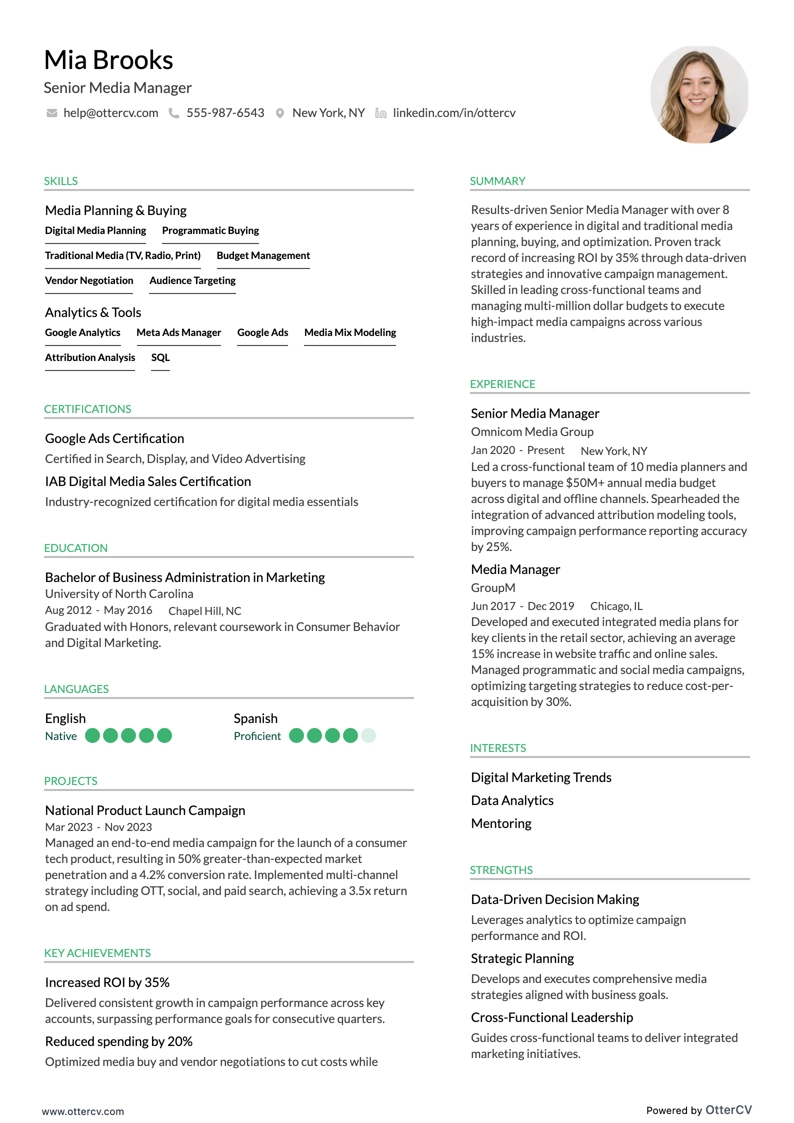
Senior Media Manager full preview

10 Media Manager Resume Examples

OtterCV

Written by The OtterCV Team

Updated: 5/12/2025•8 min read

See all resume examples in this guide, or generate your own resume example with your personalized prompt

Senior Media Manager resume example

Senior Media Manager

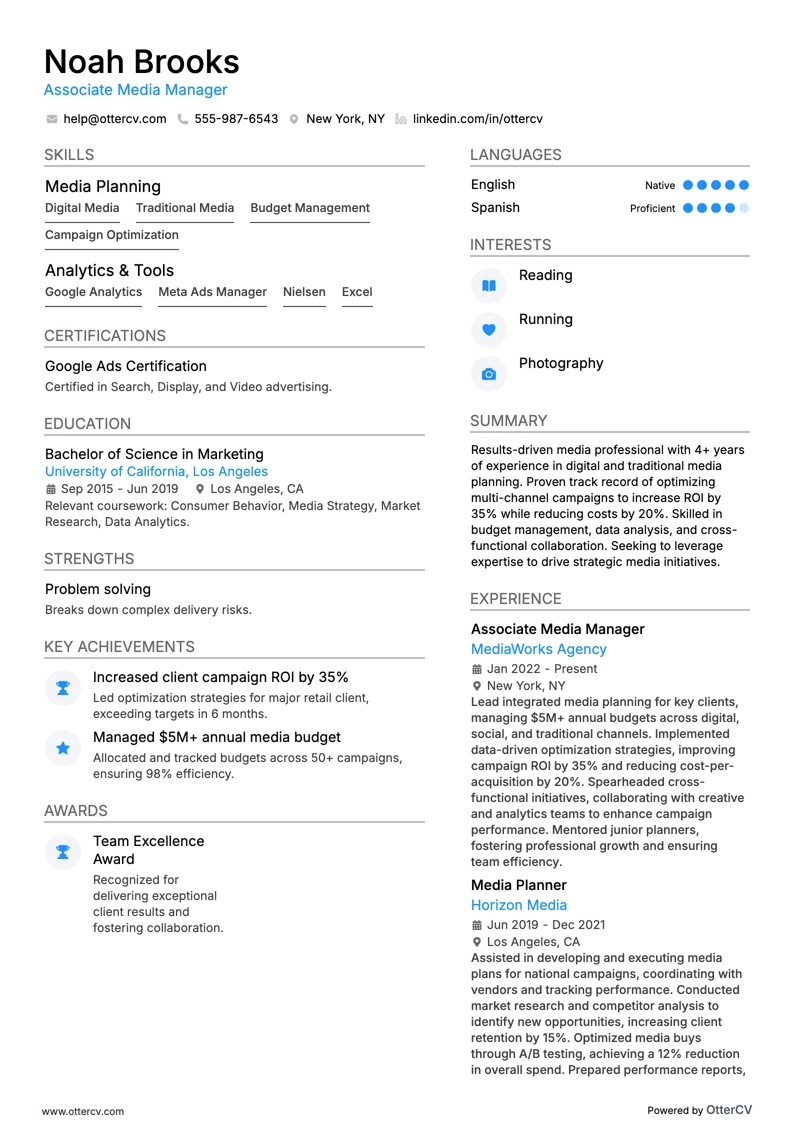
Associate Media Manager resume example

Associate Media Manager

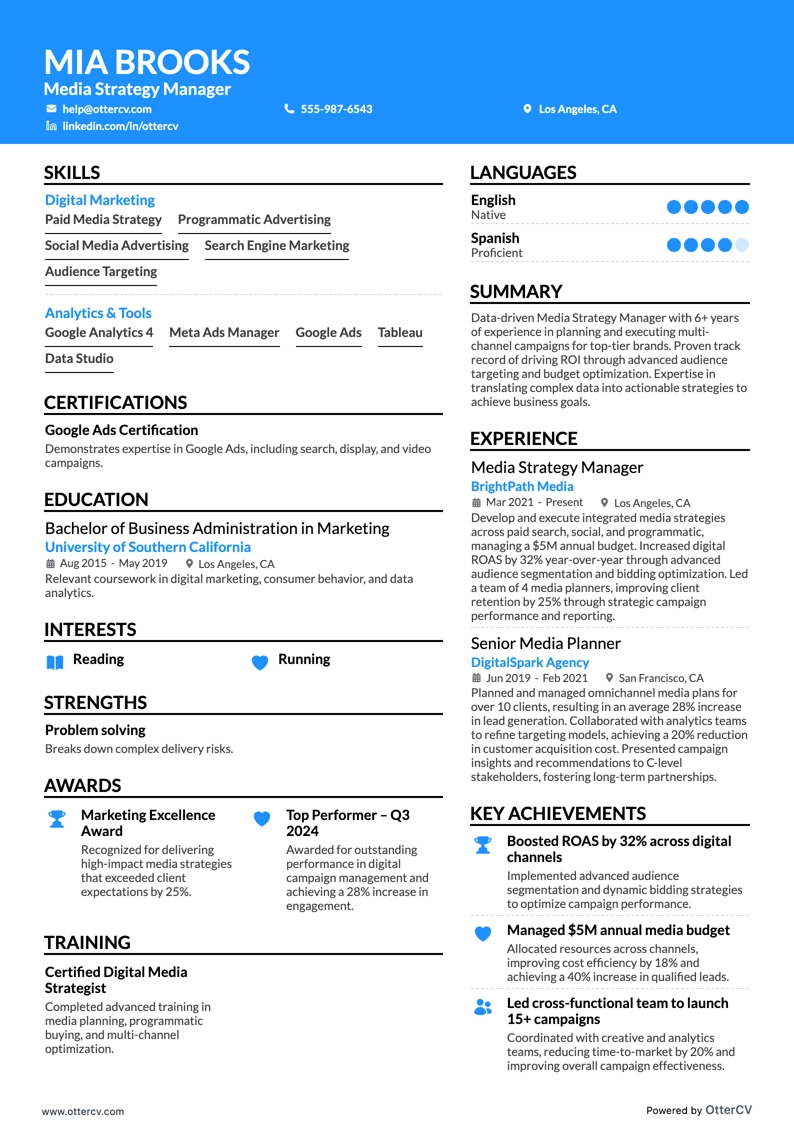
Media Strategy Manager resume example

Media Strategy Manager

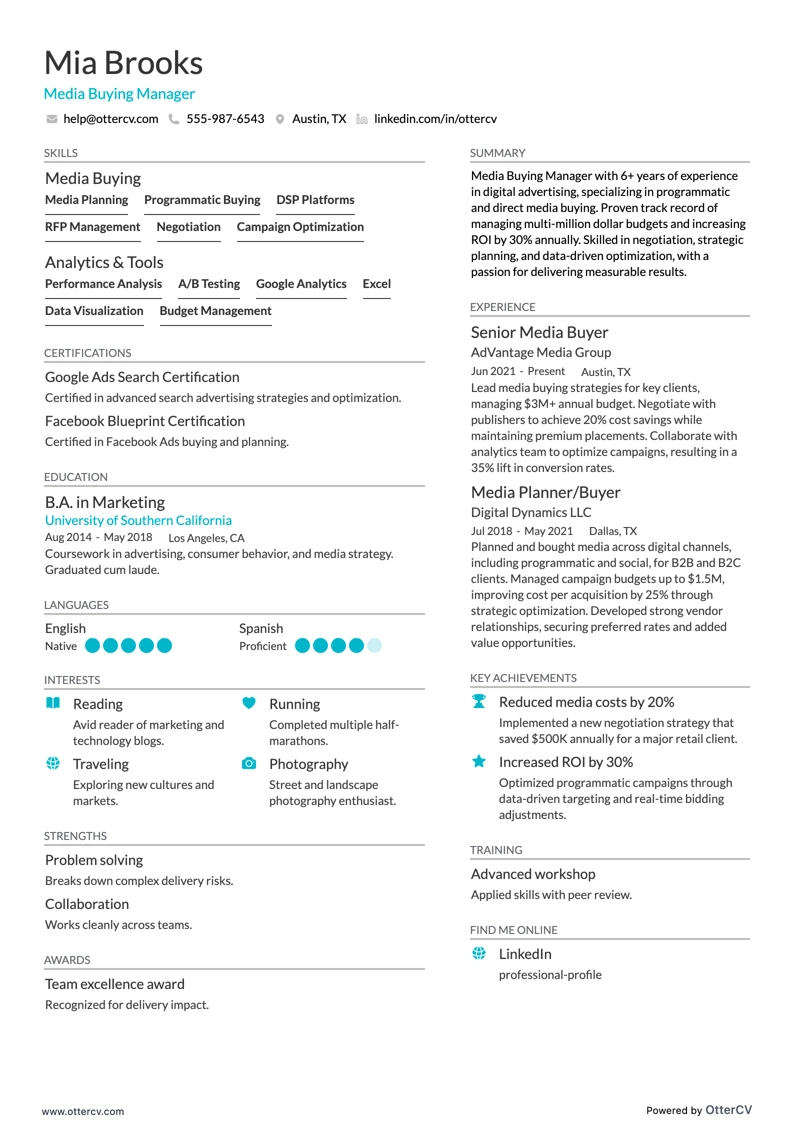
Media Buying Manager resume example

Media Buying Manager

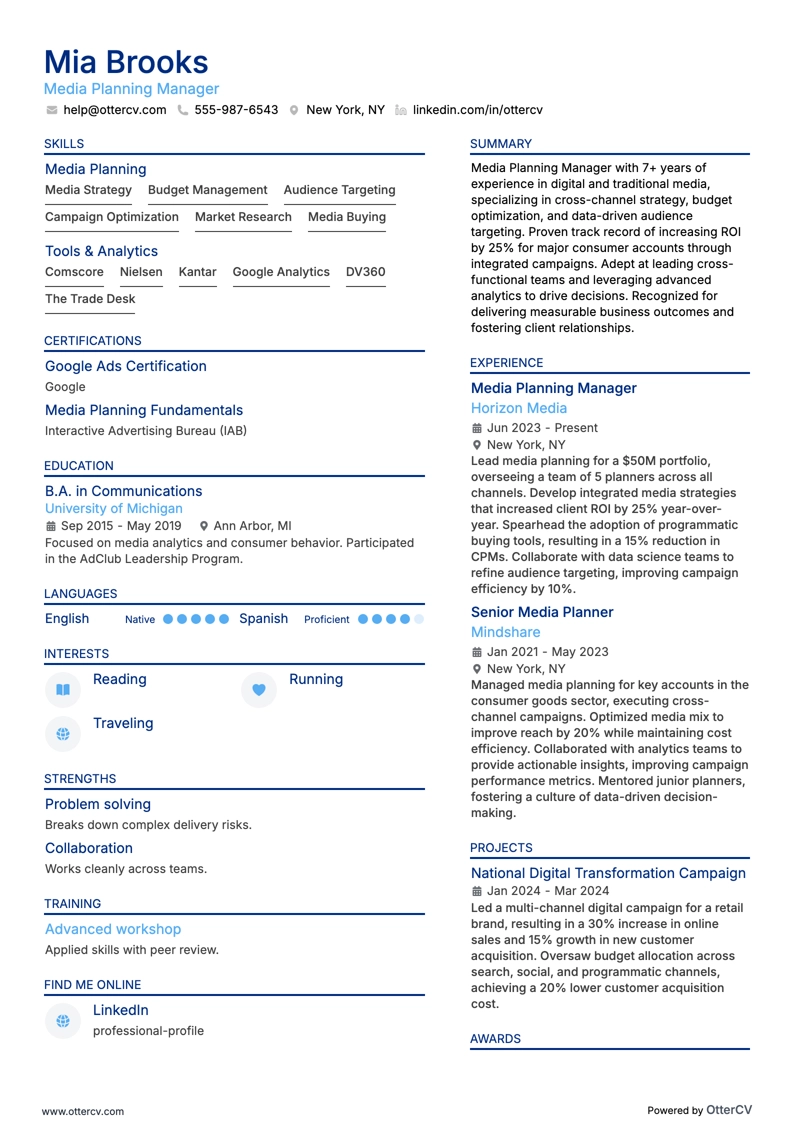
Media Planning Manager resume example

Media Planning Manager

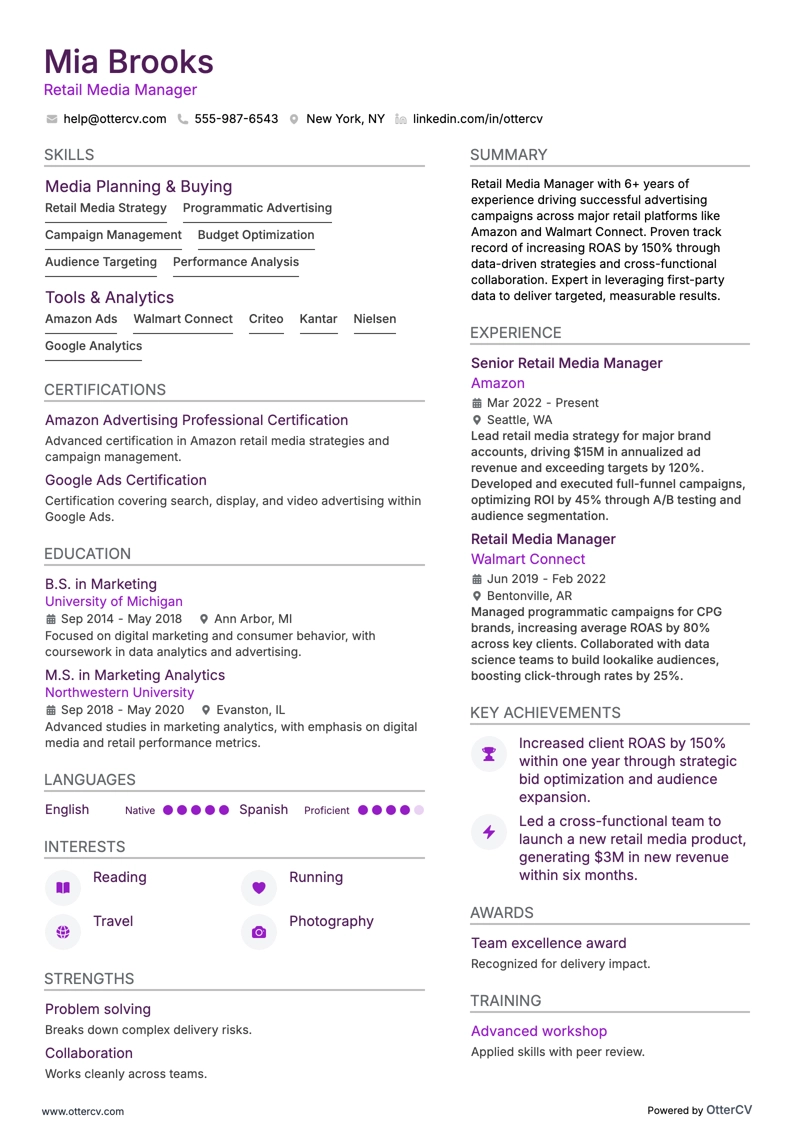
Retail Media Manager resume example

Retail Media Manager

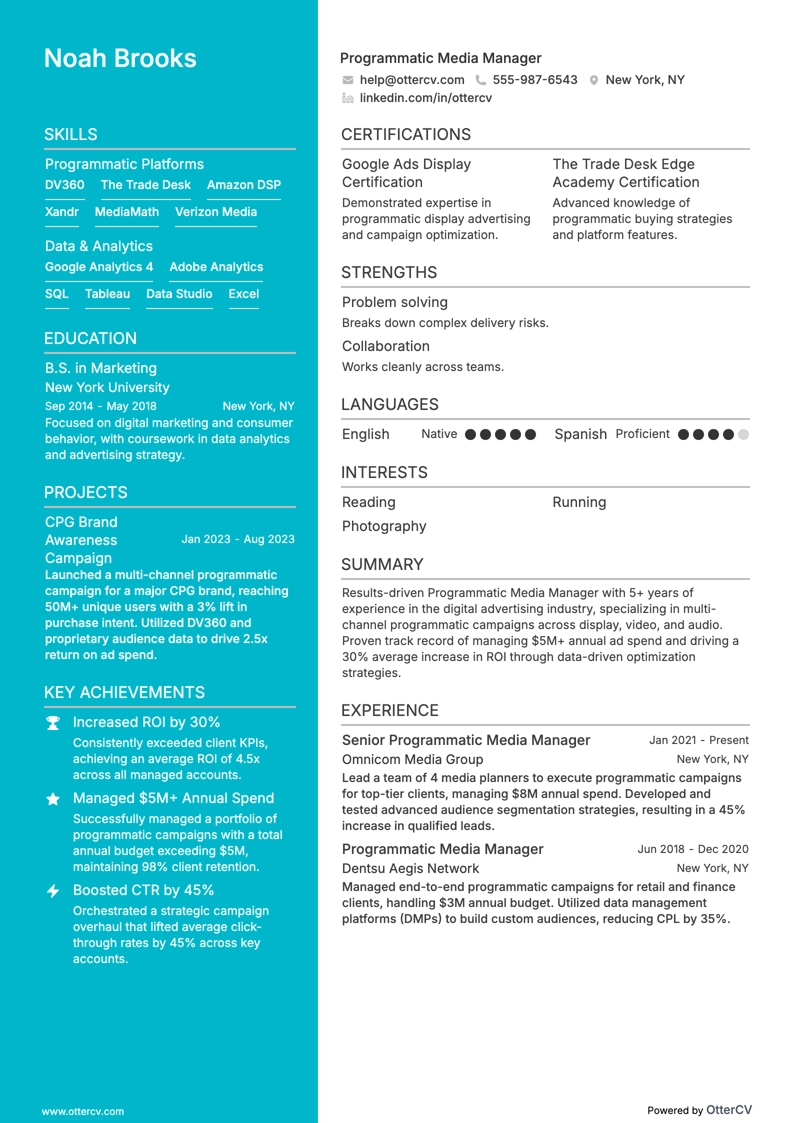
Programmatic Media Manager resume example

Programmatic Media Manager

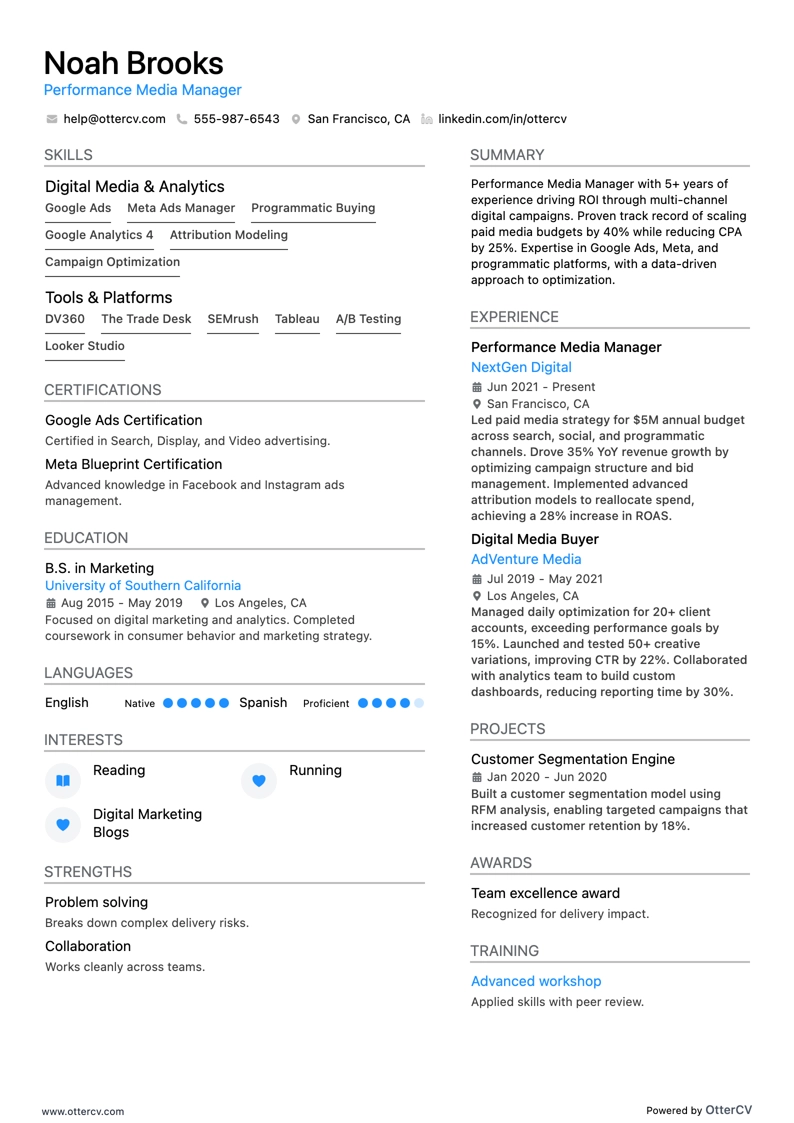
Performance Media Manager resume example

Performance Media Manager

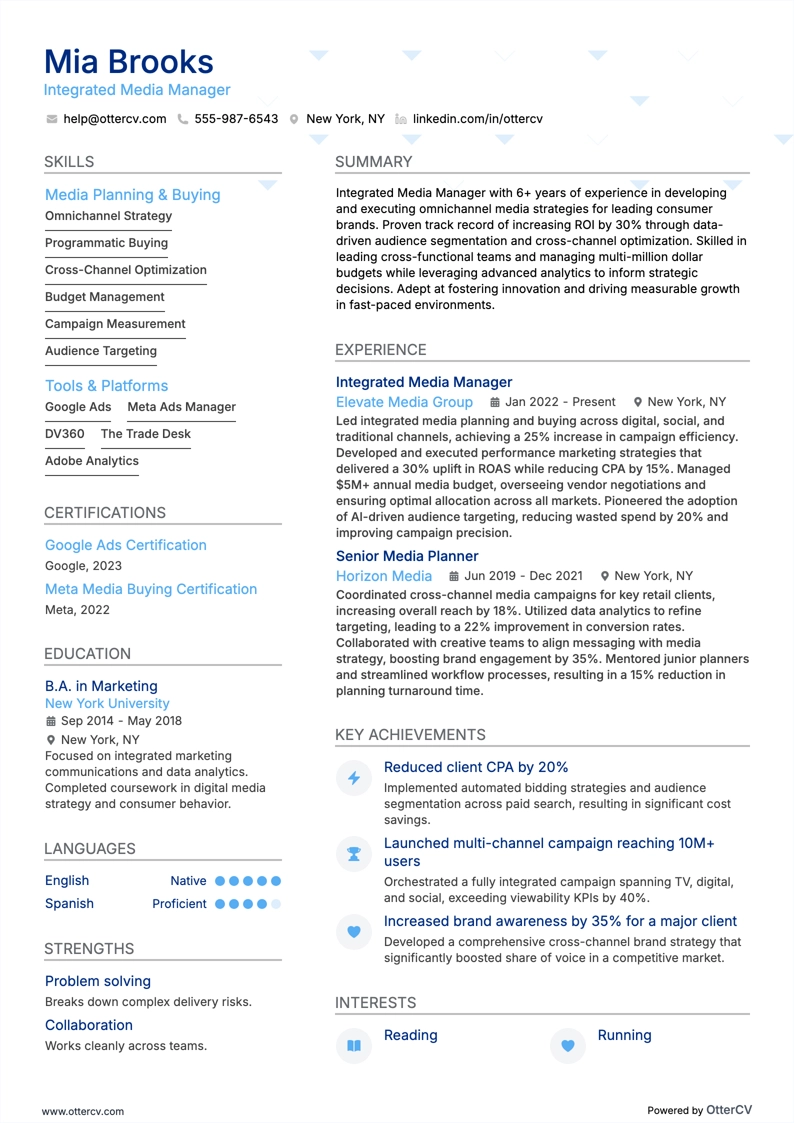
Integrated Media Manager resume example

Integrated Media Manager

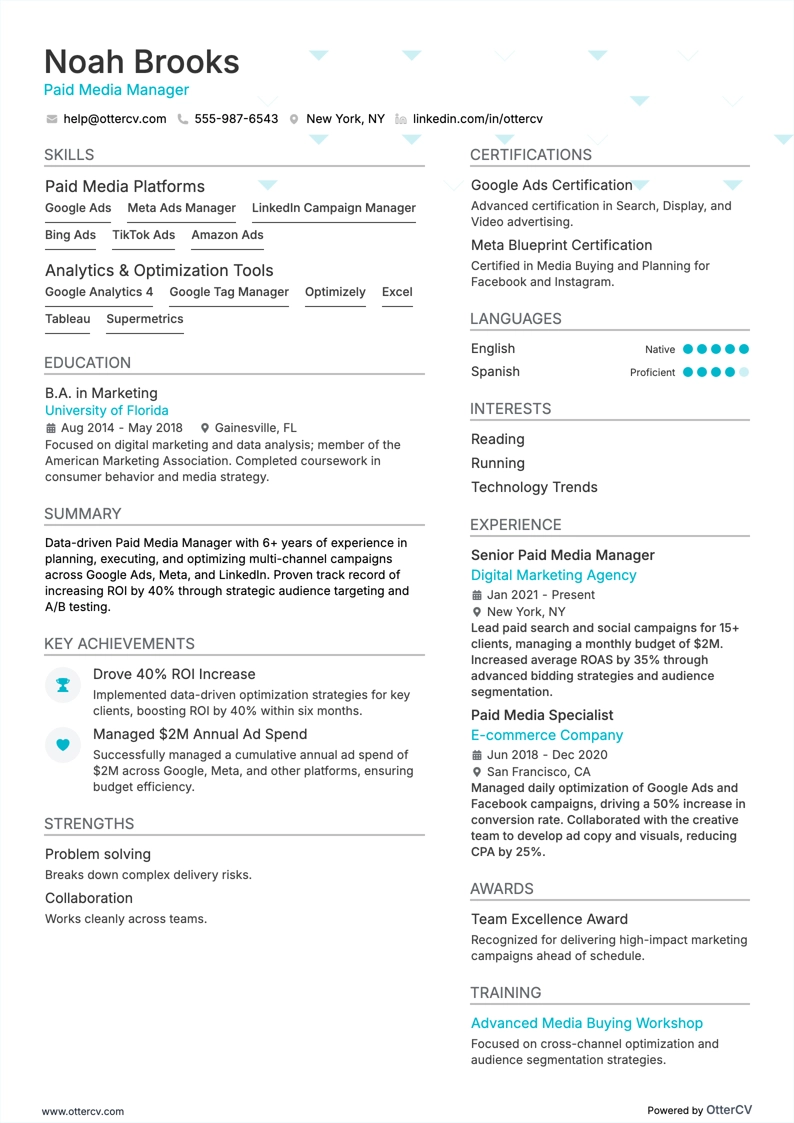
Paid Media Manager resume example

Paid Media Manager

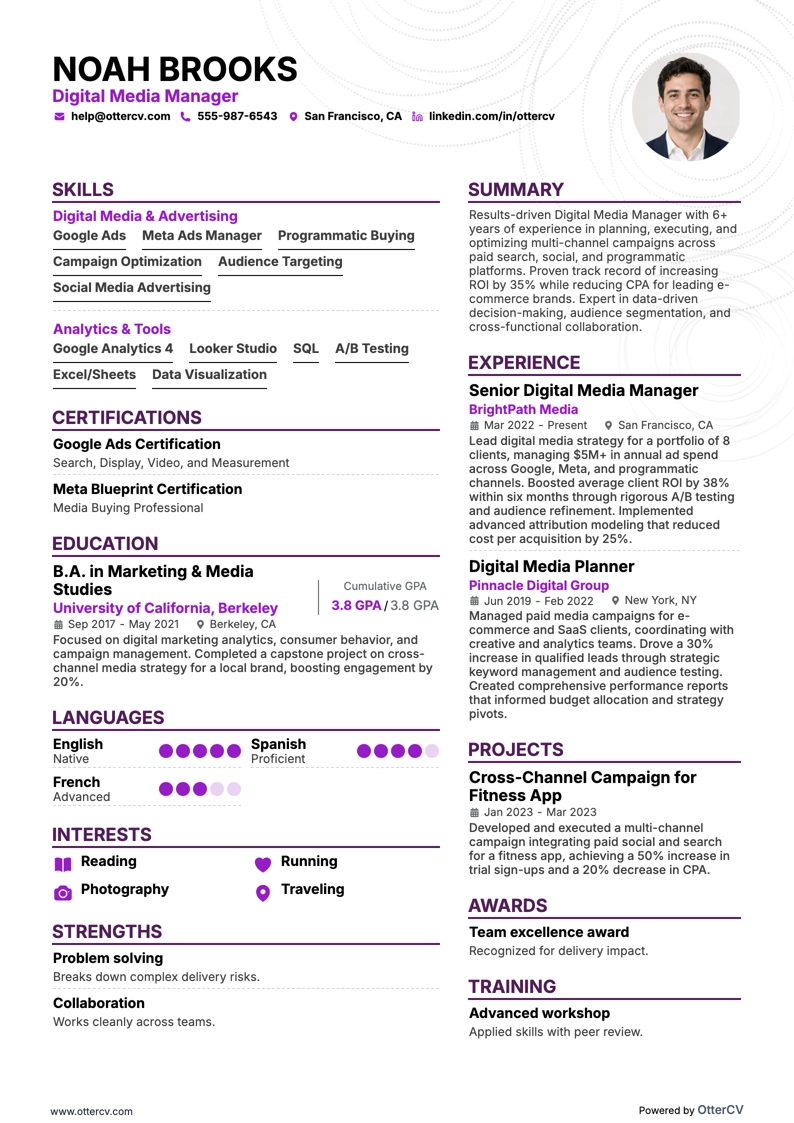
Digital Media Manager resume example

Digital Media Manager

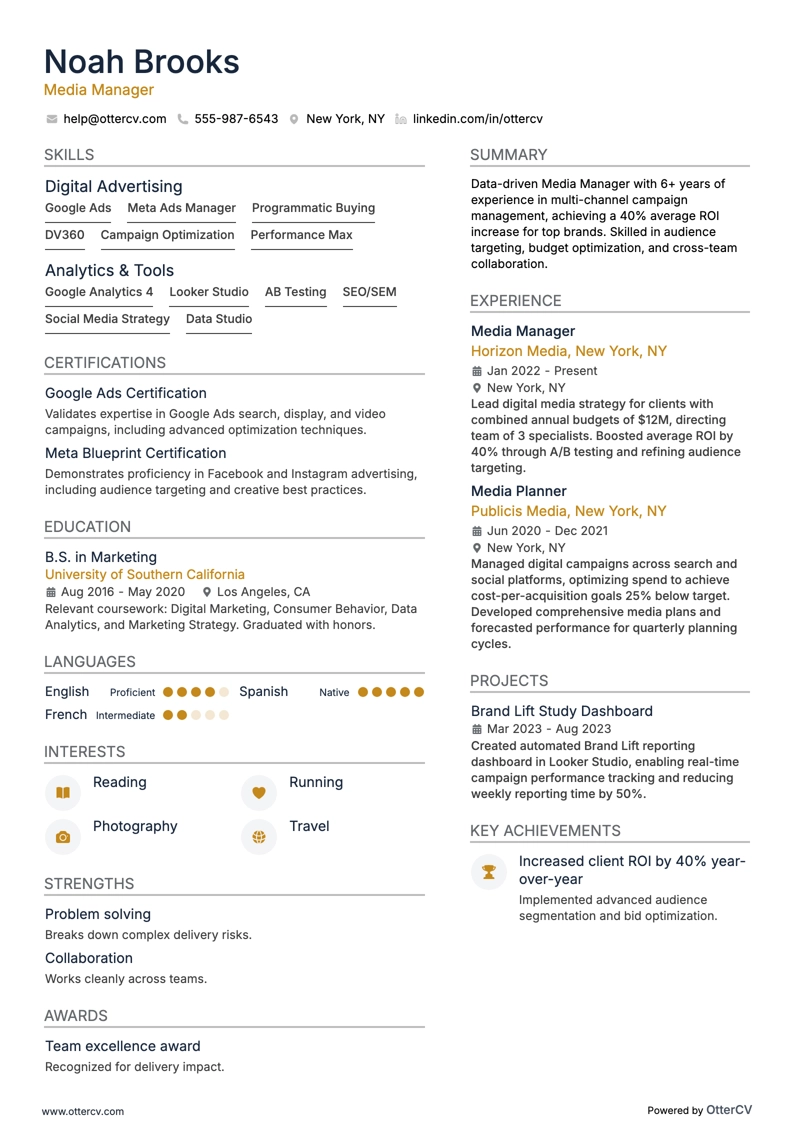
Media Manager resume example

Media Manager

Most media manager resume drafts fall short because they list channels and tasks without showing measurable impact or decision-making. In ATS screening, quick recruiter scans, and crowded applicant pools, that makes your value easy to miss before you ever reach an interview.

A strong resume explains what changed because of your work and connects those results to business goals. Knowing how to make your resume stand out means highlighting audience growth rates, reductions in cost per acquisition, lift in return on ad spend, budget and market scope, campaign delivery speed, brand safety wins, and revenue influence.

Key takeaways

  • Quantify campaign outcomes in every experience bullet, including ROAS, cost per acquisition, and engagement lifts.

  • Use a reverse-chronological resume format if you have experience, or a hybrid format if you're changing careers.

  • Tailor each resume to the job posting's exact platforms, KPIs, and terminology.

  • Place skills above experience if you're junior, and below experience if you're senior.

  • Connect every listed skill to a measurable result in your summary or experience section.

  • Echocv can help turn routine media tasks into strong, quantified resume bullets.

  • Use AI only until your resume accurately reflects your real experience, and never fabricate claims.

Job market snapshot for media managers

We analyzed 171 recent media manager job ads across major US job boards. These figures provide a quick view of industry demand, employer expectations, and the top companies hiring.

What level of experience employers are looking for media managers

Years of ExperiencePercentage found in job ads
1–2 years4.7% (8)
3–4 years17.5% (30)
5–6 years15.8% (27)
7–8 years8.2% (14)
9–10 years2.3% (4)
10+ years4.1% (7)
Not specified49.1% (84)

Media manager ads by area of specialization (industry)

Industry (Area)Percentage found in job ads
Finance & Banking49.1% (84)
Education14.6% (25)
Healthcare12.3% (21)
Retail & E-commerce10.5% (18)

Role overview stats

These tables outline the most common responsibilities and employment types for media manager roles. Use them to align your resume with employer expectations and better understand how the role is structured across the market.

Day-to-day activities and top responsibilities for a media manager

ResponsibilityPercentage found in job ads
Instagram24.0% (41)
Tiktok22.8% (39)
Facebook19.9% (34)
Content creation17.5% (30)
Social media management17.5% (30)
Linkedin16.4% (28)
Youtube15.8% (27)
Social media14.0% (24)
Analytics13.5% (23)
Canva13.5% (23)
Community management11.7% (20)
Video editing9.9% (17)

Type of employment (remote vs on-site vs hybrid)

Employment typePercentage found in job ads
On-site50.3% (86)
Hybrid33.9% (58)
Remote15.8% (27)

How to format a media manager resume

Recruiters reviewing media manager candidates look for campaign management skills, platform expertise, budget oversight, and measurable performance results such as ROAS, CPM, and audience growth. Choosing the right resume format helps these signals stand out quickly in both ATS scans and the initial recruiter review.

I have significant experience in this role—which format should I use?

I have significant experience in this role—which format should I use?

Use a reverse-chronological format to show your progression across campaigns, platforms, and increasing media budgets.

  • Start with your most recent role and highlight your scope of ownership, including channels managed, team size, and total media spend under your control.
  • Include platform-specific expertise such as Google Ads, Meta Business Suite, DV360, and programmatic DSPs, along with analytics tools like Google Analytics, Tableau, and attribution platforms, within each role.
  • Quantify outcomes tied to business impact, such as cost efficiencies, revenue influence, audience reach, or conversion lifts.

Example bullet: “Managed $2.4M annual paid media budget across six channels, reducing cost per acquisition by 31% while increasing qualified leads by 18% year over year.”

I'm junior or switching into this role—what format works best?

I'm junior or switching into this role—what format works best?

A hybrid format works best. It lets you lead with relevant media skills while backing them up with internships, freelance projects, or transitional experience.

  • Place a skills section near the top featuring platform proficiencies such as Meta Ads Manager, Google Ads, and SEO tools, along with analytics capabilities and media planning fundamentals.
  • Include freelance campaigns, academic projects, or volunteer media work as experience entries with clearly defined responsibilities.
  • Connect every action to a result. Even small-scale outcomes can show media thinking and analytical ability.

Example scaffold: “Programmatic advertising (skill) → planned and executed a $5K display campaign for a nonprofit client (action) → drove 12,000 impressions and a 3.2% click-through rate, exceeding the benchmark by 40% (result).”

Why not use a functional resume?

Why not use a functional resume?

A functional resume removes the campaign timelines, platform progression, and growing responsibility that hiring managers use to judge whether a media manager is ready for the role.

It may only make sense in a narrow set of situations:

  • You're transitioning from a related field such as journalism, PR, or content marketing and need to highlight transferable media skills.
  • You have gaps in employment but kept building media expertise through freelance work or certifications.

Even then, a functional resume can raise red flags if recruiters think important context is missing. To stay credible, connect every skill to a specific project, campaign, or measurable outcome instead of listing skills on their own.

  • Edge-case exception: A functional format is acceptable only if you're making a significant career change into media management with no direct employment history in the field, and you anchor every skill to a concrete project, freelance engagement, or certification outcome.

Now that you’ve established a clean, readable layout, the next step is to include the sections that best showcase your qualifications.

What sections should go on a media manager resume

Recruiters expect a media manager resume to highlight measurable campaign performance, channel ownership, and cross-functional execution. Understanding what to put on a resume can help you prioritize the most impactful content.

Use this structure for maximum clarity:

  • Header
  • Summary
  • Experience
  • Skills
  • Projects
  • Education
  • Certifications
  • Optional sections: Awards, Publications, Languages

Strong experience bullets should emphasize campaign impact, performance outcomes, budget and channel scope, and results tied to specific goals.

How to write your media manager resume experience

Once you’ve organized the key resume sections, the next step is to write your media manager resume experience so each role reinforces that structure with relevant, results-focused detail.

The work experience section is where you show that you’ve launched real media campaigns, managed platforms and budgets with role-relevant tools, and produced measurable results for the brands or clients you’ve supported. Hiring managers care more about proven impact—such as audience growth, cost efficiency, and engagement lifts—than task lists that only describe day-to-day responsibilities.

Each entry should include:

  • Job title
  • Company and location (or remote)
  • Dates of employment (month and year)

Include three to five concise bullet points that explain what you owned, how you executed, and what outcomes you delivered:

  • Ownership scope: the media channels, campaign budgets, content calendars, audience segments, or vendor relationships you were directly responsible for as a media manager.
  • Execution approach: the ad platforms, analytics suites, scheduling tools, attribution models, or testing frameworks you used to plan, optimize, and deliver media initiatives.
  • Value improved: the specific gains in reach, engagement, conversion efficiency, cost-per-acquisition, brand consistency, or reporting accuracy your work created for the organization.
  • Collaboration context: how you worked with creative teams, data analysts, sales stakeholders, agency partners, or C-suite leadership to align media strategy with broader business goals.
  • Impact delivered: the business-level results your media management produced, expressed through growth, scale, revenue influence, or strategic positioning rather than a list of completed tasks.

Experience bullet formula

Experience bullet formula

Action verb + technology + what you built or fixed + measurable result

A media manager experience example

Media Manager

BrightWave Retail | Remote

2022–Present

Omnichannel retail brand with three hundred stores and a fast-growing ecommerce business.

  • Led paid social and programmatic strategy across Meta Ads Manager, TikTok Ads Manager, and Google Display & Video 360, increasing return on ad spend by 28% while keeping cost per acquisition within a 5% target band.
  • Built a weekly performance and pacing system in Looker Studio using UTM governance and GA4 audiences, cutting reporting time by 60% and improving budget reallocation speed from five days to one.
  • Negotiated and launched creator whitelisting and paid partnership ads with Legal and Brand, improving click-through rate by 22% and reducing creative approval cycle time by 35%.
  • Implemented a structured A/B testing roadmap with designers and copywriters in Asana, delivering 40+ creative variants per quarter and lifting conversion rate by 14% across the top three product categories.
  • Partnered with data engineering to standardize conversion APIs and server-side tracking, reducing attributed conversion loss by 18% and improving match quality scores across key platforms.

Now that you've seen what a strong experience section looks like in practice, the next step is customizing yours for the specific job posting you're targeting.

How to tailor your media manager resume experience

Recruiters review your media manager resume through both human screening and applicant tracking systems, so tailoring your resume to the job description is essential. When your experience aligns with the posting, you're more likely to get through both review stages.

Ways to tailor your media manager experience:

  • Match the exact ad platforms and buying tools named in the posting.
  • Mirror the KPIs and performance benchmarks the employer prioritizes.
  • Use the same terminology for the campaign management workflows they describe.
  • Highlight experience in the specific industry or media vertical mentioned.
  • Reference the analytics and reporting tools listed in their requirements.
  • Emphasize the cross-functional collaboration models outlined in the job description.
  • Include budget management scope that reflects their stated expectations.
  • Align your optimization methods with the strategies they reference.

Tailoring means translating your real accomplishments into the employer's language, not forcing keywords where they don't belong.

Resume tailoring examples for media manager

Job description excerptUntailoredTailored
“Plan and execute paid media campaigns across Meta, Google Ads, and TikTok to drive customer acquisition for our DTC brand.”Managed digital advertising campaigns across multiple platforms.Planned and executed paid media campaigns across Meta, Google Ads, and TikTok for a DTC skincare brand, reducing cost per acquisition by 34% over two quarters.
“Monitor and report on media performance using Google Analytics and Sprout Social, providing weekly insights to senior leadership.”Tracked campaign performance and created reports for stakeholders.Built weekly media performance dashboards in Google Analytics and Sprout Social, delivering actionable insights to senior leadership that informed a 20% reallocation of Q3 ad spend.
“Collaborate with the creative team to develop media briefs and ensure all assets meet platform-specific specs for programmatic and social channels.”Worked with internal teams to support content creation efforts.Authored detailed media briefs for the creative team, specifying platform requirements for programmatic display and paid social assets across Instagram, YouTube, and The Trade Desk.

Once your experience aligns with each role’s priorities, the next step is to quantify your media manager achievements so hiring teams can clearly see the impact of your work.

How to quantify your media manager achievements

Quantifying your achievements shows business impact beyond creative output. As a media manager, track results such as conversion lift, cost efficiency, engagement quality, turnaround speed, and compliance accuracy across channels and campaigns.

Quantifying examples for media manager

MetricExample
Revenue impactDrove $420K in attributed revenue in Q3 by optimizing Meta and Google Ads campaigns, improving return on ad spend from 2.6 to 3.4.
Cost efficiencyCut cost per acquisition 18% in six weeks by restructuring ad sets, adding negative keywords, and reallocating 25% of budget to the best-performing audiences.
Engagement qualityIncreased video completion rate from 32% to 47% across twelve TikTok and Instagram Reels assets by testing hooks, captions, and lengths.
Delivery speedReduced creative-to-launch cycle time from nine days to five by standardizing briefs in Asana and building a reusable UTM template.
Compliance accuracyAchieved 100% compliance on eighty-seven paid ads by implementing a preflight checklist and legal review workflow for claims and disclosures.

How to list your hard and soft skills on a media manager resume

Once you’ve written strong, results-driven bullet points, the next step is making sure your resume shows the mix of hard and soft skills media manager roles require.

Your skills section should show that you can plan, buy, and optimize media while protecting budget and brand. Recruiters and an ATS (applicant tracking system) often scan this section quickly to confirm role fit, so aim for a hard-skill-heavy mix supported by targeted soft skills.

Media manager roles require a blend of:

  • Product strategy and discovery skills
  • Data, analytics, and experimentation skills
  • Delivery, execution, and go-to-market discipline
  • Soft skills

Your skills section should be:

  • Scannable, using bullet-style grouping
  • Relevant to the job post
  • Backed by proof in your experience bullets
  • Updated with current tools

Place your skills section:

  • Above your experience if you’re junior or switching careers
  • Below your experience if you’re mid- or senior-level with strong achievements

Hard skills

  • Media planning and forecasting.
  • Budget pacing and ROI tracking.
  • Paid social management across Meta Ads, TikTok Ads, and LinkedIn Campaign Manager.
  • Paid search management in Google Ads and Microsoft Advertising.
  • Programmatic buying with DV360 and The Trade Desk.
  • Ad serving and tagging with Campaign Manager 360 and Floodlight.
  • Web analytics using Google Analytics 4 and Looker Studio.
  • Attribution and measurement, including UTM governance and conversion tracking.
  • A/B testing and incrementality testing.
  • Audience strategy using first-party data and lookalike modeling.
  • Creative performance analysis and iteration.
  • Brand safety and fraud controls.

Soft skills

  • Translate goals into media strategy.
  • Prioritize tests by impact and effort.
  • Align stakeholders on budgets and KPIs.
  • Write clear briefs for creative teams and agencies.
  • Lead weekly performance readouts.
  • Challenge assumptions with data.
  • Make fast decisions under budget pressure.
  • Negotiate scope, rates, and timelines.
  • Manage cross-functional handoffs cleanly.
  • Document decisions and learnings.
  • Escalate risks early and clearly.
  • Own outcomes end to end.

How to show your media manager skills in context

Skills should not appear only as bullet points on your resume. Reviewing examples of effective resume skills can help you see how other professionals present their abilities.

Your skills should be demonstrated in:

  • Your summary, which communicates your high-level professional identity
  • Your experience, which proves your abilities through outcomes

Here’s what that looks like in practice.

Summary example

Senior media manager with 10 years of experience in B2C brand strategy. Skilled in programmatic advertising, Google Campaign Manager, and cross-functional team leadership. Increased paid media ROI by 34% for a national retail portfolio.

  • Clearly reflects senior-level experience
  • Names specific, relevant tools
  • Leads with a measurable outcome
  • Signals collaboration and leadership

Experience example

Senior Media Manager

Bridgepoint Digital | Remote

June 2019–March 2024

  • Managed $2.4M in annual paid media budgets across Meta, Google Ads, and The Trade Desk, improving cost efficiency by 21%.
  • Partnered with creative and analytics teams to launch 15 integrated campaigns, boosting average engagement rates by 28%.
  • Built a real-time reporting framework in Google Campaign Manager and Looker Studio, cutting monthly reporting time by 40%.
  • Every bullet includes measurable proof.
  • Skills surface naturally through outcomes.

Once you’ve shown your abilities through specific projects and measurable results, the next step is learning how to write a media manager resume with no experience so you can present that evidence effectively without a formal job history.

How do I write a media manager resume with no experience

Even without full-time experience, you can show readiness by building a resume without work experience that uses alternative proof points such as:

  • Student media planning campaigns
  • Internship experience managing social media calendars
  • Freelance content scheduling for clients
  • Campus organization channel management
  • A portfolio of paid ad tests
  • Analytics reports from owned channels
  • Event promotion and media buys
  • Volunteer newsletter and email campaigns

Focus on highlighting:

  • Channel growth metrics and baselines
  • Budget handling and spend efficiency
  • Tool proficiency and workflows
  • Reporting cadence and insights

Resume format tip for entry-level media manager

Resume format tip for entry-level media manager

Use a combination resume format. It puts skills and projects first while still showing relevant experience substitutes and timelines.

Do the following:

  • Add a Projects section near the top.
  • List the tools used in each bullet.
  • Quantify results with timeframes.
  • Include budgets, even small ones.
  • Link to a portfolio or dashboard.

Example project bullet:

  • Built and scheduled a four-week Instagram calendar in Hootsuite, tracked performance in Google Analytics, and increased event registrations by 22% month over month.

Even without formal work experience, your education section can show relevant knowledge and qualifications that strengthen your candidacy. Here’s how to present it effectively.

How to list your education on a media manager resume

Your education section helps hiring teams quickly confirm that you have foundational knowledge in media strategy, communications, or marketing.

Include:

  • Degree name
  • Institution
  • Location
  • Graduation year
  • Relevant coursework (for juniors or entry-level candidates)
  • Honors and GPA (if 3.5 or higher)

Skip the month and day—list the graduation year only.

Here’s a strong education entry tailored to a media manager resume.

Example education entry

Bachelor of Arts in Media Studies

University of Southern California, Los Angeles, CA

Graduated 2021

GPA: 3.7/4.0

  • Relevant coursework: Digital Media Planning, Audience Analytics, Integrated Marketing Communications, Content Strategy
  • Honors: Dean's List, Magna Cum Laude

How to list your certifications on a media manager resume

Certifications show a media manager's commitment to learning, demonstrate tool proficiency, and signal industry relevance in a fast-changing channel and platform landscape.

Include:

  • Certificate name
  • Issuing organization
  • Year
  • Optional: credential ID or URL
  • Place certifications below education when they are older, less relevant, or when you want your degree to lead your media manager resume.
  • Place certifications above education when they are recent, highly relevant, or required for the media manager role you are targeting.

Best certifications for your media manager resume

  • Google Ads Search Certification.
  • Google Analytics Certification.
  • Meta Certified Media Buying Professional.
  • LinkedIn Marketing Labs Certification.
  • Amazon Ads Sponsored Ads Certification.
  • IAB Digital Media Buying and Planning Certification.
  • Hootsuite Social Marketing Certification.

How to write your media manager resume summary

Once you’ve positioned your credentials to support your qualifications, use your media manager resume summary to bring those strengths together in a clear, results-focused introduction.

Your resume summary is often the first thing a recruiter reads, so it should quickly show that you’re a strong fit for the media manager role.

Keep it to three to four lines and include:

  • Your title and total years of experience in media management.
  • The domain or industry you’ve worked in, such as digital, broadcast, or social media.
  • Core tools and skills, such as Google Ads, Meta Business Suite, or programmatic platforms.
  • One or two measurable achievements that show your impact.
  • Soft skills connected to real outcomes, such as cross-team collaboration that improved campaign timelines.

PRO TIP

For a mid-level media manager role, lead with relevant skills and measurable results. Emphasize hands-on platform expertise and campaign outcomes instead of vague personal qualities.

Avoid phrases like "passionate self-starter" or "results-driven professional." Recruiters want specifics, not motivation.

Example summary for a media manager

Media manager with four years of experience running paid social and display campaigns. Managed $500K in annual ad spend across Meta and Google, increasing ROAS by 35% through data-driven optimization.

Now that your summary highlights your professional value, make sure the header above it presents your contact details clearly so recruiters can reach you.

What to include in a media manager resume header

A resume header includes your key contact details and role focus, helping media manager candidates improve visibility, build credibility, and pass recruiter screening quickly.

Essential resume header elements

  • Full name
  • Tailored job title and headline
  • Location
  • Phone number
  • Professional email
  • GitHub link
  • Portfolio link
  • LinkedIn

A LinkedIn link helps recruiters verify your experience quickly and supports screening.

Do not include a photo on a media manager resume unless the role is explicitly front-facing or appearance-dependent.

Keep the header consistent with your portfolio branding, and match the job title wording to improve search results in applicant tracking systems.

Example

Once your contact details and role branding are clear at the top, strengthen your application with additional sections that add relevant context and credibility.

Additional sections for media manager resumes

When your core qualifications are similar to other candidates, these extra sections can help you stand out and reinforce your credibility as a media manager.

Consider including the following if they are relevant to your experience:

  • Languages
  • Industry certifications
  • Publications and guest articles
  • Speaking engagements and panel appearances
  • Professional affiliations and memberships
  • Awards and recognitions
  • Conferences and workshops attended

Once you’ve strengthened your resume with these supplementary sections, the next step is pairing it with a well-crafted cover letter to maximize your application’s impact.

Do media manager resumes need a cover letter

A cover letter isn’t required for a media manager, but it can help in competitive roles or when hiring teams expect one. If you’re unsure what a cover letter is or how it complements your resume, it can make a difference when your resume needs more context or when the role requires close product and stakeholder alignment.

Use a cover letter to add details your resume can’t show:

  • Explain your fit for the role and team by matching your workflows to their media manager needs, channels, and cross-functional partners.
  • Highlight one or two projects with outcomes, such as improved engagement, reduced cost per acquisition, or better creative testing velocity.
  • Show that you understand the product, users, and business context by referencing their audience, positioning, and key metrics.
  • Address career transitions or less obvious experience by connecting past work to media manager responsibilities and measurable impact.

Using AI to improve your media manager resume

Once you’ve decided whether to include a cover letter to add context to your application, the next step is using AI to improve your media manager resume so it communicates your value more clearly and consistently.

AI can improve your resume’s clarity, structure, and impact. It can refine language, tighten bullet points, and better align your content with media manager roles. But overusing AI can strip away authenticity. Once your resume reads clearly and fits the role, step away from AI. For practical guidance, explore these ChatGPT resume writing prompts to get started.

Here are 10 practical prompts you can copy and paste to strengthen specific sections of your media manager resume:

  1. Strengthen your summary: “Rewrite my resume summary to highlight my most relevant media manager skills, including campaign oversight and cross-platform strategy, in three concise sentences.”
  2. Quantify experience bullets: “Add measurable results to each of my media manager experience bullets, focusing on engagement rates, budget savings, or audience growth.”
  3. Tighten job descriptions: “Remove filler words from my media manager experience section while keeping each bullet under 20 words and action-oriented.”
  4. Align skills to the role: “Compare my skills section against this media manager job description and suggest which skills to add, remove, or reorder.”
  5. Improve action verbs: “Replace weak or repetitive verbs in my media manager experience bullets with stronger, more specific alternatives.”
  6. Refine project descriptions: “Rewrite my media manager project entries to emphasize deliverables, tools used, and measurable campaign outcomes.”
  7. Tailor education details: “Highlight coursework and achievements in my education section that directly support a media manager position.”
  8. Optimize certifications: “Reorder my certifications section to prioritize credentials most relevant to a media manager role in digital advertising.”
  9. Remove redundant content: “Identify and remove duplicate or overlapping information across all sections of my media manager resume.”
  10. Check role alignment: “Review my full media manager resume and flag any bullet points that don’t clearly connect to media planning, buying, or strategy.”

Stop using AI once your resume sounds accurate, specific, and aligned with your real experience. AI should never invent experience or inflate claims—if it didn’t happen, it doesn’t belong here.

Conclusion

A strong media manager resume demonstrates impact through measurable results, role-specific skills, and a clear structure. Start with outcomes, then highlight planning, buying, optimization, reporting, and cross-functional collaboration. Keep every section easy to scan and tailored to the role.

In today’s hiring market, clarity and performance matter. A focused media manager resume shows you can manage budgets, improve efficiency, and drive growth across channels. With clean formatting and quantified wins, you’ll appear ready for current needs and near-future demands.

Media Manager resume examples

Explore additional Media Manager resume samples and guides and see what works for your level of experience or role.

By Experience

Senior Media Manager

Senior Media Manager resume preview

Associate Media Manager

Associate Media Manager resume preview

Media Manager resume examples

Explore additional Media Manager resume samples and guides and see what works for your level of experience or role.

By Role

Media Strategy Manager

Media Strategy Manager resume preview

Media Buying Manager

Media Buying Manager resume preview

Media Planning Manager

Media Planning Manager resume preview

Retail Media Manager

Retail Media Manager resume preview

Programmatic Media Manager

Programmatic Media Manager resume preview

Performance Media Manager

Performance Media Manager resume preview

Integrated Media Manager

Integrated Media Manager resume preview

Paid Media Manager

Paid Media Manager resume preview

Digital Media Manager

Digital Media Manager resume preview

Media Manager

Media Manager resume preview