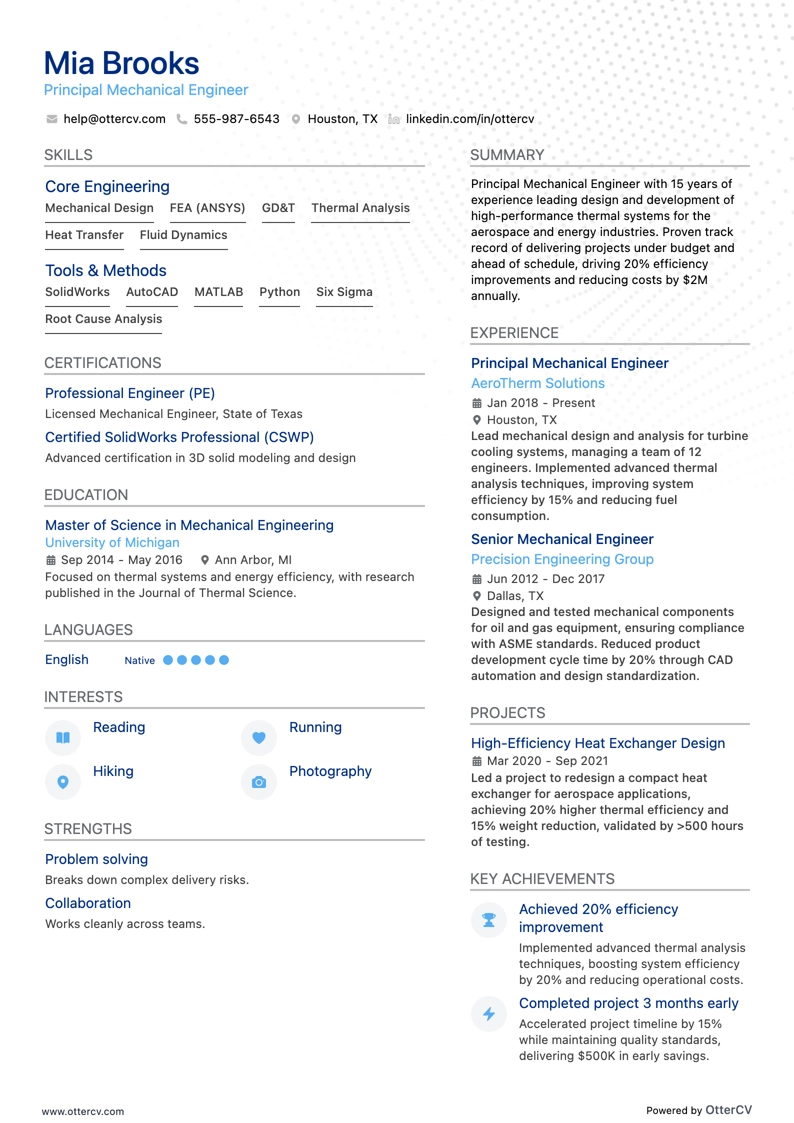
Principal Mechanical Engineer full preview

23 Mechanical Engineer Resume Examples

OtterCV

Written by The OtterCV Team

Updated: 5/25/2023•8 min read

See all resume examples in this guide, or generate your own resume example with your personalized prompt

Principal Mechanical Engineer resume example

Principal Mechanical Engineer

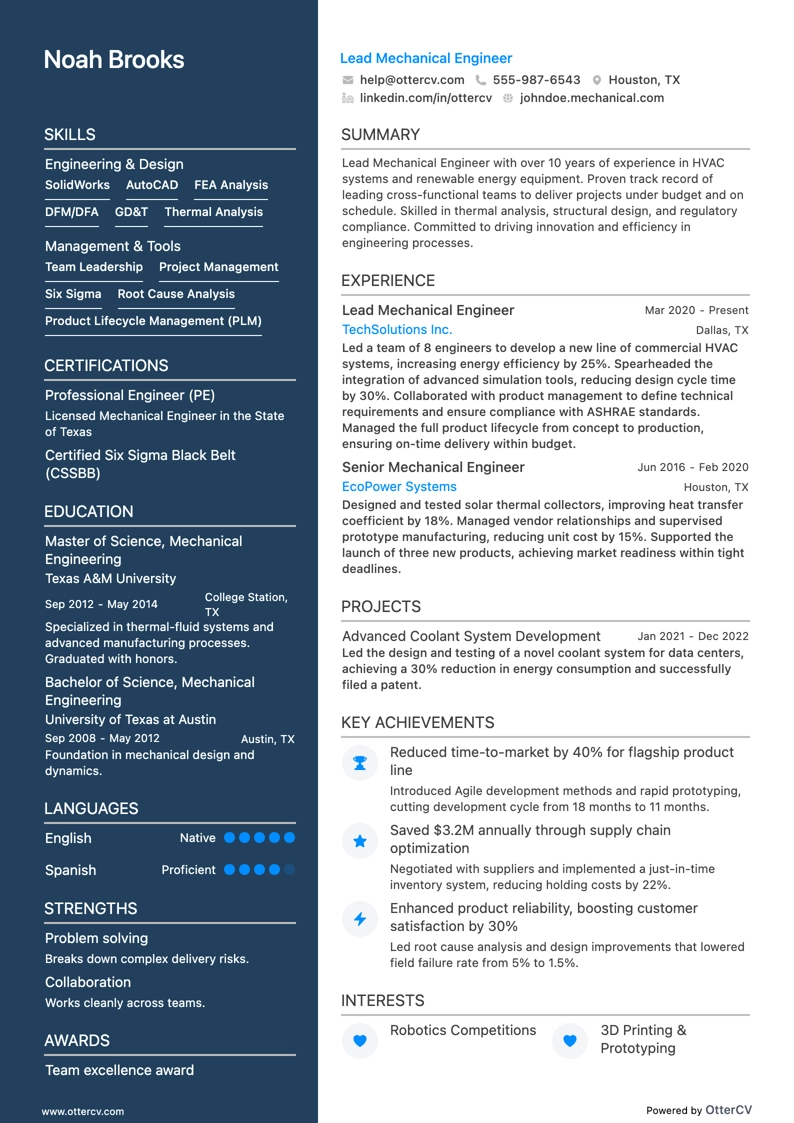
Lead Mechanical Engineer resume example

Lead Mechanical Engineer

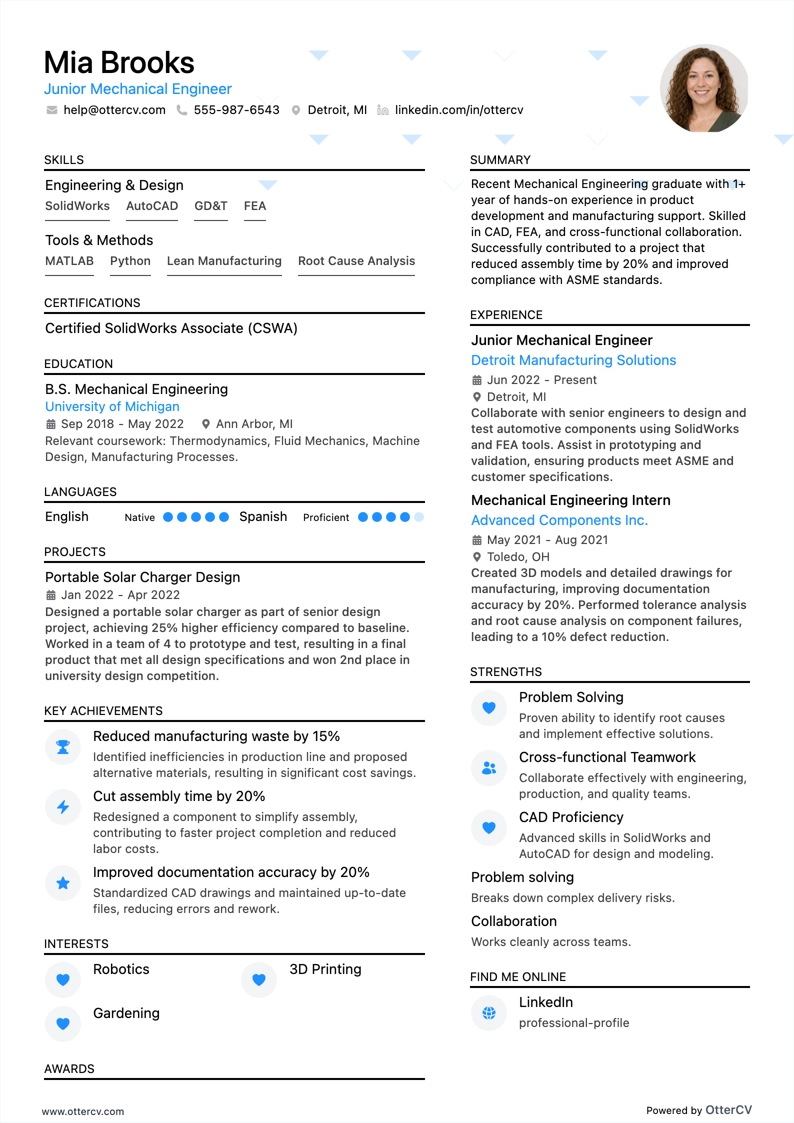
Junior Mechanical Engineer resume example

Junior Mechanical Engineer

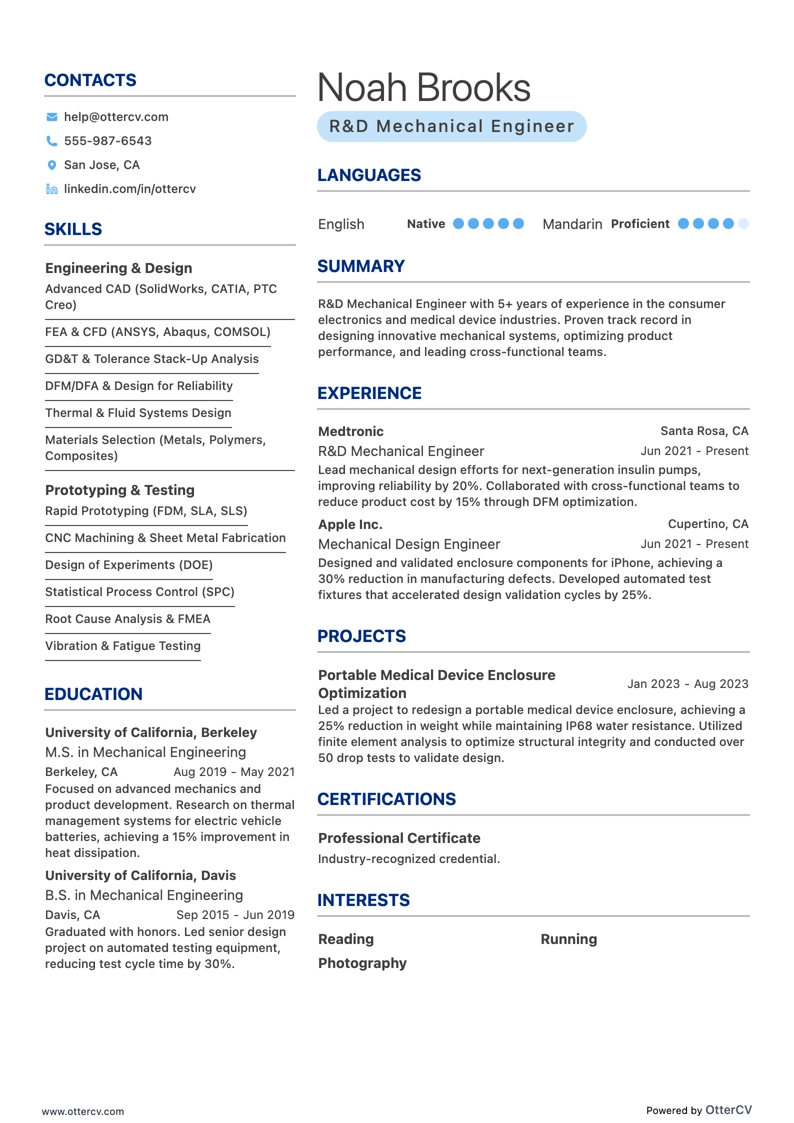
R&D Mechanical Engineer resume example

R&D Mechanical Engineer

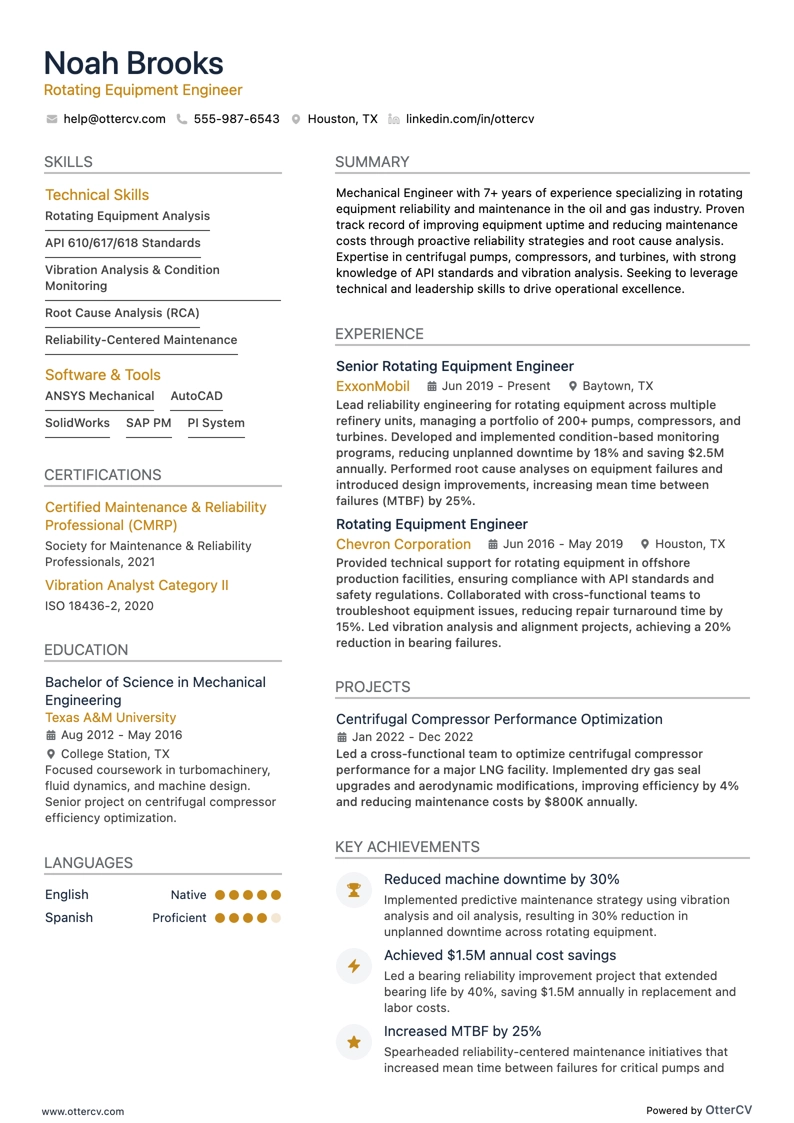
Rotating Equipment Engineer resume example

Rotating Equipment Engineer

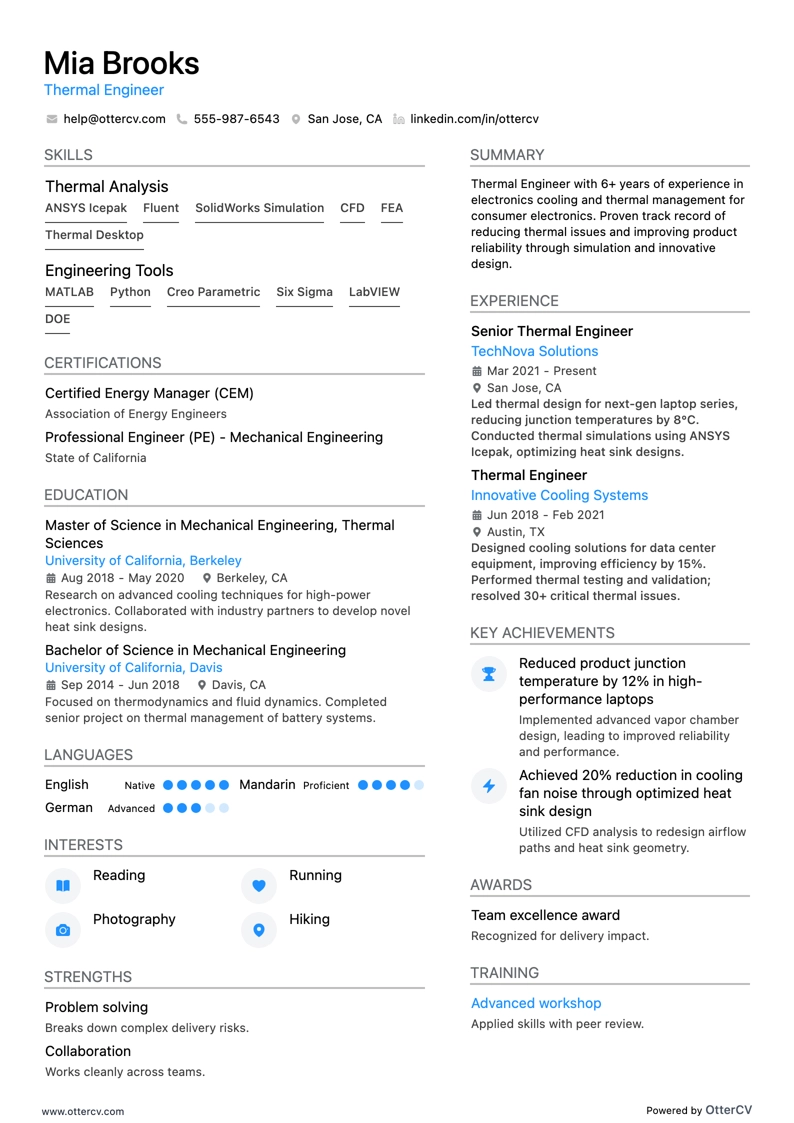
Thermal Engineer resume example

Thermal Engineer

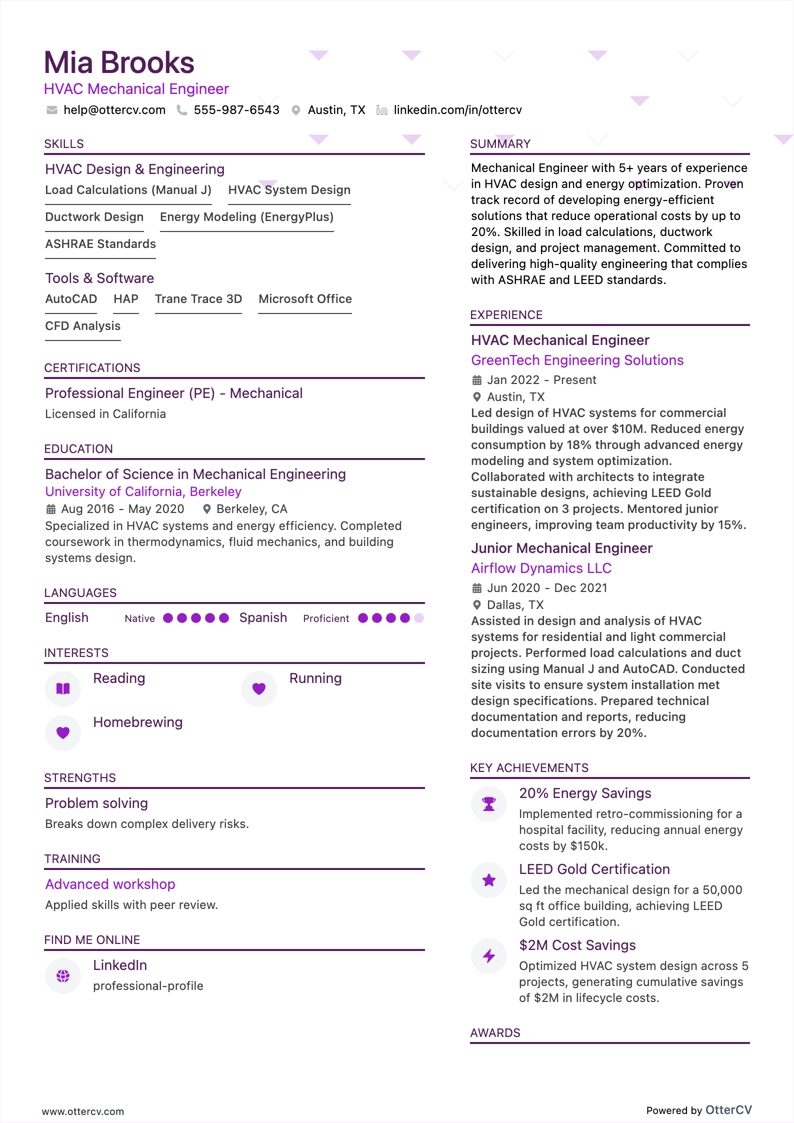
HVAC Mechanical Engineer resume example

HVAC Mechanical Engineer

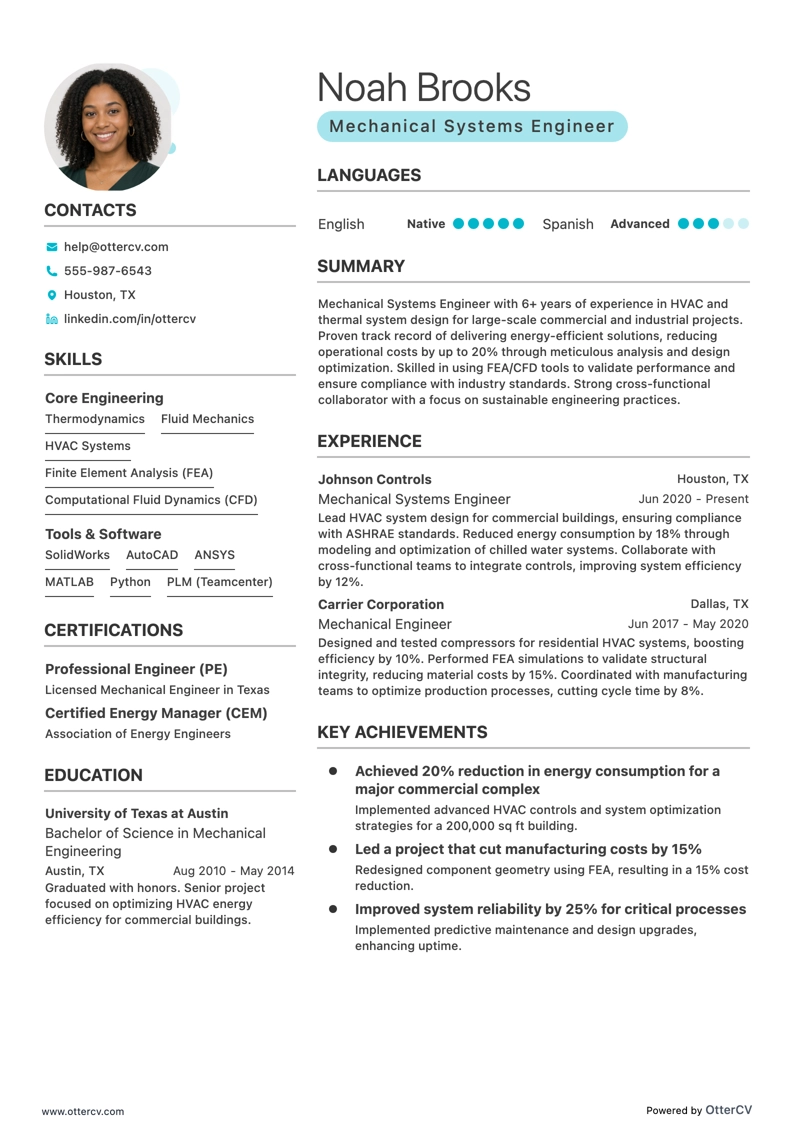
Mechanical Systems Engineer resume example

Mechanical Systems Engineer

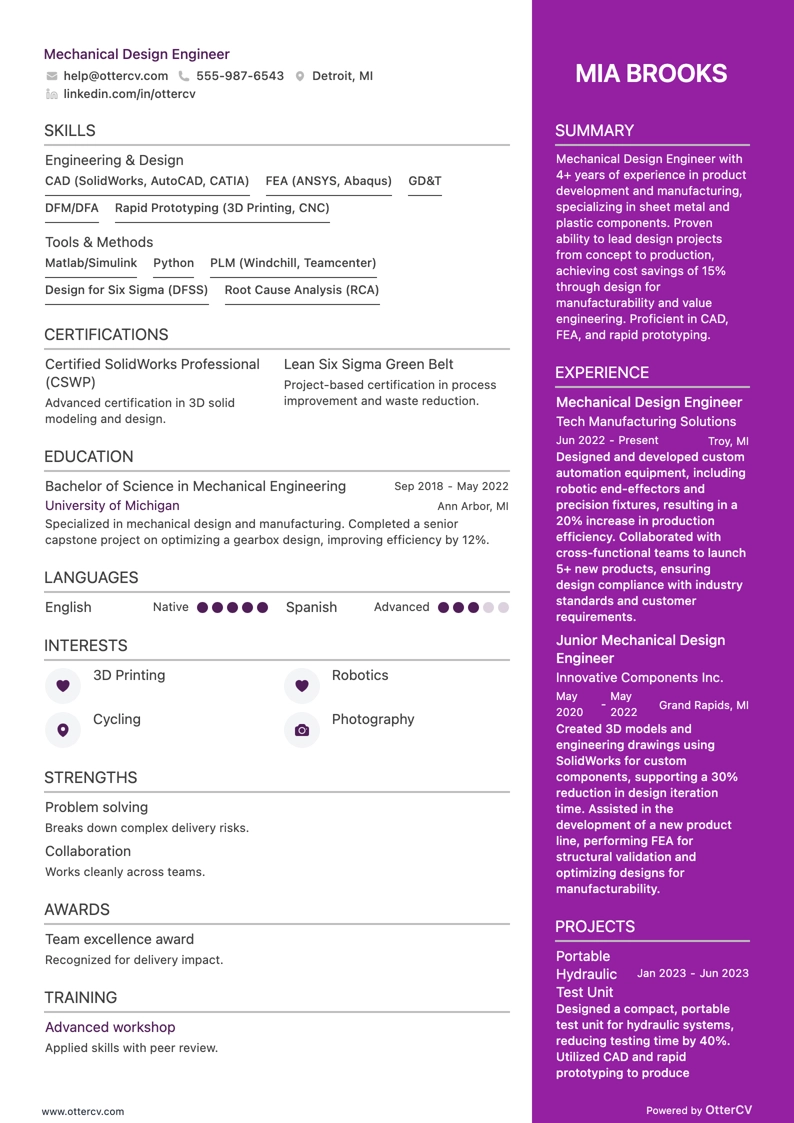
Mechanical Design Engineer resume example

Mechanical Design Engineer

Creating a strong engineering resume can be challenging, especially for mechanical engineers who need to present a wide range of skills and experience. As one of the oldest engineering disciplines, mechanical engineering plays a vital role in industries such as automotive, aerospace, and energy. The field also continues to evolve through advances in automation and robotics.

At the same time, the job search for mechanical engineering roles can be difficult. Many candidates struggle to balance technical language with clear, results-focused descriptions of their accomplishments. Tailoring a mechanical engineer resume to match the requirements of each position can also take significant time.

Even with these challenges, the job market for mechanical engineers remains strong. Demand for skilled professionals is high, especially in sectors centered on sustainability and innovation. As you prepare to enter this competitive market, building a standout resume is the first step toward securing an exciting and rewarding role.

Scientists investigate that which already is; engineers create that which has never been.

—Albert Einstein

This article walks you through the essential elements of a strong mechanical engineering resume, with tips and examples to help you showcase your expertise and stand out to employers.

If you are not applying for a mechanical engineering role, these related guides may be more useful:

Need a cover letter for your mechanical engineer resume?

With the importance of a well-crafted resume and the promising job market for mechanical engineers in mind, it helps to understand the different resume types and choose the one that best highlights your skills and experience.

How to format a mechanical engineer resume

Choosing the right resume format is important for a mechanical engineer because it helps present your skills, experience, and achievements effectively. The right resume layout can highlight your strengths, make your qualifications easier for recruiters to assess, and improve readability in a competitive job market.

Here are the main resume formats to consider:

  • Reverse Chronological Order Format: Lists your work experience starting with your most recent job. This is ideal if you have a strong, consistent work history in mechanical engineering, as it emphasizes career progression and recent achievements.
  • Functional Format: Focuses on skills and qualifications instead of work history. This format works well if you have employment gaps or are changing careers, because it emphasizes what you can do rather than when you did it.
  • Hybrid Format: Combines elements of reverse chronological and functional resumes. It highlights relevant skills while still showing a detailed work history, making it a strong option for candidates with significant experience and specific skills to showcase.

Adjust your resume layout based on the market. For example, Canadian resumes may follow a unique format.

To learn how to write a resume that grabs attention, focus on your key skills and achievements. Crafting a stand-out resume means highlighting specific projects, using industry keywords, and keeping a clear, professional format to catch the recruiter’s eye.

Here are a few more things to keep in mind when formatting your resume.

Resume design

  • Margins: Standard resume margins (1 inch on all sides) help ensure readability.
  • Colors: Use subtle colors on your resume sparingly to highlight key sections, and stick to professional tones.
  • Fonts: Choose clean, professional resume fonts like Arial, Calibri, or Rubik in a font size of 10–12.
  • Columns: Two-column layouts can help organize information, but make sure they remain readable on all devices.
  • Resume length: Aim for a concise one-page resume, though a two-page resume is acceptable if you have extensive experience.
  • Headings: Use clear and bold resume headings to separate sections and make your resume easier for recruiters to scan.
  • Icons: Use icons on your resume sparingly to enhance visual appeal, but keep them relevant and uncluttered.
  • Resume lines: Add horizontal lines to separate sections and improve readability while keeping the design clean and organized.

Resume header

ATS compatibility

  • Use standard headings and formats for the most ATS-friendly resume.
  • Avoid complex formatting, tables, and graphics that may confuse Applicant Tracking Systems.

File formatting and naming convention

  • File format: Save your resume as a PDF to preserve formatting.
  • Naming convention: Use a clear, professional file name such as FirstNameLastNameResume.pdf.

Every resume is divided into sections. For a mechanical engineering resume, the resume sections below are the ones you should focus on most.

The top sections on a mechanical engineer resume in order

  • Summary: Briefly highlight your experience and key skills.
  • Experience: Detail relevant mechanical engineering roles.
  • Skills: List technical and software proficiencies.
  • Education: Include degrees in mechanical engineering.
  • Projects: Showcase specific engineering projects and results.

Each section of your resume should include the key elements hiring managers look for in a mechanical engineer. Here are some of the most important ones:

What recruiters want to see on your resume

  • Demonstrated proficiency in HVAC system design shows the specialized technical skills required for mechanical engineering roles.
  • Experience with REVIT/BIM and AutoCAD shows capability with industry-standard design software used to create detailed engineering plans.
  • Knowledge of ICC building codes and ASHRAE standards shows compliance with important regulations and best practices in mechanical engineering projects.
  • Successful project management and construction administration highlights the ability to oversee projects from concept through completion.
  • Quantifiable achievements in energy efficiency and cost reduction demonstrate the ability to deliver measurable improvements that align with business objectives.

Write your mechanical engineer resume experience like a pro

Now that you've chosen the right resume format, it's time to show your mechanical engineering work history effectively.

Listing work experience on a mechanical engineering resume matters because it shows your practical skills, industry knowledge, and ability to apply engineering principles in real-world settings.

If you're wondering about how far back you should go on a resume, the general rule is 10 to 15 years, depending on relevance.

To write a professional work history entry, include:

  • Job title and company: Clearly state your role and where you worked.
  • Location and dates: Include the location and the length of your employment.
  • Brief company description: Add a short description of the company for context.
  • Responsibilities and achievements: Outline key responsibilities and quantify results when possible, such as "Improved system efficiency by 20%."
  • Technical skills: Highlight the tools and technologies you used.
  • Projects: Mention significant projects and your contributions.
  • Interpersonal skills: Weave a few of these into your bullet points as well.
  • Action verbs: Start each bullet point with a strong verb, such as designed, implemented, or optimized.

These elements help showcase your qualifications and impact, making your resume more compelling to employers.

How to target your work experience entries

Tailoring a resume to specific job postings is important for mechanical engineers because it helps align your qualifications with the employer's needs. Each posting may emphasize different priorities, such as technical skills, industry experience, or familiarity with specific engineering tools and standards.

By customizing your resume, you can highlight the most relevant experience, show proficiency with the required technologies, and demonstrate your understanding of industry-specific regulations.

PRO TIP

A targeted approach can improve your chances of standing out to hiring managers and landing an interview because it shows you are a strong fit for the specific role.

Besides the elements above, here are a few additional tips to strengthen your experience entries.

  1. Use keywords: Incorporate specific keywords and phrases from the job posting to match the employer’s requirements.
  2. Highlight relevant experience: Focus on previous roles and projects that directly relate to the job you’re applying for.
  3. Emphasize technical skills: Showcase specific tools, software, and technologies mentioned in the job description.
  4. Align responsibilities: Match your previous job responsibilities with those listed in the job posting.
  5. Include industry-specific terms: Use terminology relevant to the industry to demonstrate your expertise and familiarity.
  6. Showcase relevant projects: Underline significant projects that are similar to those you might work on in the new role.
  7. Tailor job titles, if applicable: Adjust job titles to align more closely with the role you're applying for, without misrepresenting your position.

Below is an example job posting for a mechanical engineer that we’ll use to target our experience entries.

Mechanical engineer job post

Mechanical engineer job post

Job Title: mechanical engineer

Company Overview: PPT is a global leader in diversified electronics for the semiconductor manufacturing ecosystem. Virtually every electronic device in the world is produced using our technologies, including laptops, smartphones, wearable devices, voice-controlled gadgets, flexible screens, VR devices, and smart cars. PPT develops systems and solutions for the manufacturing of wafers and reticles, integrated circuits, packaging, printed circuit boards, and flat panel displays. The company places a strong emphasis on innovation and invests 15% of sales back into R&D.

With over 40 years of semiconductor process control experience, chipmakers around the world rely on PPT to help fabs ramp next-generation devices to volume production quickly and cost-effectively. PPT’s Universal Products Group (UPG), which creates all of PPT’s metrology and inspection products, supports advanced chip design. The INSTANT division is the world’s leading provider of reticle inspection solutions for the semiconductor industry, serving both mask shops and semiconductor fabs to help maintain high lithography yields and cost-effective manufacturing.

Role and Responsibilities:

  • Develop innovative engineering solutions for PPT’s EUV Actinic inspection system in accordance with PPT’s DfX and PLC processes.
  • Design highly precise liquid cooling systems focused on temperature stability and accuracy.
  • Conduct thermal and stress analyses to ensure mechanical engineering integrity.
  • Specify, document, and implement manufacturing methods, procedures, and test equipment to support production.
  • Detail equipment requirements, design, operation, and qualification comprehensively.
  • Execute equipment design verification and validation for production release.
  • Lead continuous improvement projects to improve manufacturing yields, test coverage, productivity, and error prevention.
  • Use standard problem-solving methods to identify root causes of equipment and system test failures.
  • Perform tolerance analysis at both system and subsystem levels.
  • Assist in project planning, including deliverables, timelines, and budgets.
  • Collaborate with engineers and CAD designers on prototype and pilot detailed designs.
  • Support complete design documentation, including BOM, drawings, and procedures.
  • Research and select new suppliers, including turn-key provision of key subsystems.
  • Provide technical expertise in core technology areas to optimize design performance.
  • Work with development engineers, scientists, and suppliers to resolve quality issues.
  • Partner closely with manufacturing and production engineering teams to release hardware.
  • Present technical data clearly to diverse audiences in design reviews, status updates, and escalations.

Skills:

  • Passion for driving innovation and commercialization.
  • Self-starter with excellent attention to detail and strong collaboration skills.
  • Highly motivated, flexible, and effective in communication.
  • Quick learner with a critical mindset and decisive approach.
  • Experience with product lifecycle management and project leadership.
  • Strong influencing and persuasion skills.

Minimum Qualifications:

  • Doctorate (Academic) Degree and 0 years of related work experience
  • Master’s Level Degree and 3 years of related work experience
  • Bachelor’s Level Degree and 5 years of related work experience

Base Pay Range: $111,300.00 - $189,200.00 Annually

Primary Location: Orlando, FL
Now, it’s time to dissect some work entries. This first example shows a disappointing lack of certain key elements.

Experience

Mechanical Engineer

InStep Inc.

02/2015 - 11/2022 · Miami, FL

  • Worked on a range of mechanical engineering tasks.
  • Designed systems for different projects.
  • Managed project timelines and budgets.
  • Collaborated with team members on designs.
  • Conducted tests and analyses.
WRONG

Things done wrong and improvements needed

Lack of specificity: The entry is too vague and does not clearly highlight specific responsibilities or achievements.

Improvement

Include detailed descriptions of tasks and projects, specifying the systems designed and the exact nature of the mechanical engineering work.

No quantifiable achievements: There are no metrics or numbers available to show the impact of the work done.

Improvement: Add quantifiable results, such as “Improved temperature stability of liquid cooling systems by 20% through innovative design solutions.”

Generic responsibilities: The listed duties could apply to almost any mechanical engineering role and do not reflect the specialized skills required by this job posting.

Improvement

Tailor the responsibilities to align with the job description, such as “Conducted thermal and stress analyses to ensure mechanical integrity for semiconductor manufacturing equipment.”

Missing relevant keywords: If important keywords from the job posting are not included, the resume is less likely to pass ATS screening.

Improvement

Integrate keywords such as "EUV Actinic inspection system," "DfX and PLC processes," and "continuous improvement projects."

No mention of collaboration with relevant teams: The entry refers to collaboration, but it does not specify which teams were involved or in what context.

Improvement: Specify the teams and roles involved, for example: “Collaborated with CAD designers and development engineers on prototype and pilot detailed designs.”

Lack of technical skills: The entry does not highlight specific technical skills or tools used.

Improvement: Mention relevant technical skills, such as “Performed tolerance analysis at system and subsystem levels using specialized software.”

Absence of company context: There is no brief description of the company to provide context.

Improvement

Add a brief company description, such as "XYZ Corp, a leading provider of innovative semiconductor solutions."

With these improvements, the work experience entry becomes more detailed, relevant, and impactful, which can help impress recruiters and improve ATS performance.

Here is an improved version:

Experience

Mechanical Engineer

InStep Inc.

02/2015 - 11/2022 | Miami, FL

A leading provider of innovative semiconductor solutions

  • Developed engineering solutions for semiconductor manufacturing equipment to improve system efficiency and performance.
  • Designed highly precise liquid cooling systems, improving temperature stability by 20%, and conducted thermal and stress analyses to ensure mechanical integrity.
  • Specified, documented, and implemented manufacturing methods and test equipment to support production processes, and executed equipment design verification and validation for production release with a 98% success rate.
  • Led continuous improvement projects that increased manufacturing yields by 10% and reduced error rates by 12%.
  • Collaborated with CAD designers and development engineers on prototype and pilot detailed designs to ensure design accuracy and manufacturability, while presenting technical data in design reviews and status updates.
RIGHT

With these improvements, your experience entry becomes much stronger. One of the most effective resume strategies is using numbers to show results. The experience section gives you many opportunities to do this, and recruiters value it.

Here are practical ways a mechanical engineer can quantify impact on a resume.

How to quantify impact on your resume

  • Include the percentage of energy efficiency improvements achieved in past projects to demonstrate your impact on sustainability.
  • Highlight the dollar amount saved through optimized mechanical system designs to show your cost-saving abilities.
  • Mention the number of HVAC load calculations performed to indicate experience with critical technical tasks.
  • Specify the percentage of project timelines met or accelerated to showcase project management efficiency.
  • Detail the number of RFIs responded to and resolved to reflect problem-solving during construction administration.
  • Indicate the size and scope of the largest mechanical system you've designed to illustrate your ability to handle complex projects.
  • Report the reduction in maintenance issues or failures caused by your design implementations to underline attention to detail and quality.
  • State the percentage increase in client satisfaction ratings from projects you've worked on to emphasize your ability to meet client needs and expectations.

How do I write a mechanical engineer resume with no experience?

If you don’t have relevant work experience as a mechanical engineer, focus on entry-level positions. You can still land a role by emphasizing your education, certifications, relevant projects, and technical skills. Networking and strong references from professors or mentors can also strengthen your application. Stay positive and show enthusiasm and willingness to learn.

Here are the strategies in more detail:

  • Underscore education: Emphasize your mechanical engineering degree, relevant coursework, and any projects or labs that demonstrate your skills.
  • Internships and co-ops: Include any internship or cooperative education experience, even if it is not directly related to mechanical engineering, to show work ethic and the ability to learn on the job.
  • Certifications and courses: Obtain and highlight certifications or online courses relevant to mechanical engineering, such as CAD, SolidWorks, or other industry-specific tools and standards.
  • Projects and portfolios: Showcase personal or academic projects that demonstrate your engineering skills. Create a portfolio to display your design, analysis, and problem-solving abilities.
  • Technical skills: List relevant technical skills such as proficiency in engineering software like AutoCAD and MATLAB, and familiarity with industry standards such as ASME.
  • Soft skills: Emphasize transferable skills like problem-solving, teamwork, and communication. These are valuable in any engineering role.
  • Networking: Connect with professionals in the field through LinkedIn, industry events, and professional organizations. Effective networking can lead to opportunities and recommendations.
  • Cover letter: Write a strong cover letter explaining your passion for mechanical engineering, your willingness to learn, and why your background makes you a good fit for the role.
  • Objective statement: Write a compelling objective statement that clearly explains your career goals and what you bring to the role.

In the next section, we’ll explore the skills needed in your mechanical engineer resume and how to integrate them properly into your application.

Mechanical engineers design and create the world around us. They are the backbone of innovation and progress.

—— Unknown

How to list your hard skills and soft skills on your resume

The resume skills section on a mechanical engineer application is important because it gives employers a clear view of your qualifications and abilities, helping you stand out.

There are two types of skills to include on your resume: hard skills and soft skills.

Hard Skills

Hard skills on your resume matter because they show your technical proficiency and ability to handle specific job-related tasks. Mechanical engineering roles often require specialized knowledge in areas such as CAD software, HVAC system design, and thermal analysis.

Listing these in a separate section labeled “Hard skills” helps employers quickly see that you have the technical competencies needed for the role.

Hard skills are also often a key factor in how Applicant Tracking Systems (ATS) screen resumes, so presenting them clearly can improve your chances of passing the initial review.

Here are the top technical skills recruiters look for when reviewing mechanical engineer applications.

Best hard skills for your mechanical engineer resume

  • HVAC system design.
  • Plumbing system design.
  • Energy modeling.
  • Load calculations.
  • Life cycle cost analysis.
  • Ventilation calculations.
  • REVIT/BIM.
  • AutoCAD.
  • MasterSpec.
  • Construction administration.
  • Equipment sizing.
  • Building automation systems.
  • Direct digital controls.
  • Variable speed drives.
  • ICC building codes.
  • ASHRAE standards.
  • USGBC LEED requirements.
  • Fans, chillers, and cooling towers.
  • Air handlers.
  • Chilled and hot water loops.
  • Boilers and pumps.
  • Performance fire-protection systems.

Soft Skills

Soft skills are just as important because they reflect your interpersonal and managerial abilities, which matter for teamwork, leadership, and communication. Mechanical engineers often work in collaborative environments where they must solve problems, manage projects, and communicate complex ideas clearly. Including soft skills such as problem-solving, teamwork, and leadership shows employers that you can succeed in these settings.

Instead of listing soft skills in a separate section, it is often more effective to integrate them throughout your resume in the summary, objective statement, work experience, and education sections. This makes them more concrete and relevant to employers by showing how you have applied them in different contexts.

Below is a list of the most sought-after soft skills in mechanical engineering.

By combining core competencies, you can create a balanced and compelling resume that highlights your full range of abilities and makes you more attractive to potential employers.

After covering the value of hard and soft skills, the next step is presenting your education effectively to strengthen your application.

How to list your certifications and education on your resume

An education section on your mechanical engineer resume is essential because it shows your foundational knowledge, specialized expertise, and professional qualifications. Together, these details help establish credibility and demonstrate that you meet industry standards.

Why it's important:

  • Validation of knowledge: Your education proves your understanding of essential engineering principles and theories.
  • Specialized skills: Certifications and licensure show that you have specialized skills and have met rigorous industry standards.
  • Professional credibility: Licenses such as the Professional Engineer (PE) certification reflect a commitment to high professional standards and ethics.
  • Compliance with job requirements: Many employers require specific educational backgrounds and certifications for mechanical engineering roles.

What an education entry should include:

  • Degree: Specify the type of degree along with your major and minor, such as a Bachelor of Science in mechanical engineering.
  • Institution: Include the name of the university or college where you earned your degree.
  • Dates: List the years you attended or your graduation date.
  • Location: Provide the city and state of the institution.
  • Relevant coursework: Optionally include courses that are especially relevant to the job you are applying for.
  • Grade Point Average: Include your GPA on your resume if it is 3.5 or higher.
  • Honors and awards: Mention any academic honors, scholarships, or awards you received. See how to put cum laude on your resume and tips on the Dean’s List.
  • Certifications and licenses: Include relevant certifications, such as Certified Energy Manager or HVAC Certification, as well as licensure such as Professional Engineer.

Here’s an ideal example of an education entry for a mechanical engineering resume.

Education

Bachelor of Science in Mechanical Engineering
University of California, Berkeley
02/2012 - 11/2016 · Berkeley, CA
GPA: 3.7 / 4.0

  • Relevant Coursework: Thermodynamics, Fluid Mechanics, Materials Science, Heat Transfer, Control Systems
  • Honors and Awards: Dean’s List (2014-2016), Mechanical Engineering Honor Society
  • Senior Project: Designed and implemented a sustainable energy solution for a remote community, reducing energy costs by 30%
RIGHT

Here’s what this entry does well:

  1. Specific coursework: It includes relevant coursework that highlights technical skills and knowledge directly applicable to mechanical engineering roles.
  2. Honors and awards: Listing academic honors and awards demonstrates academic excellence and commitment to the field.
  3. Project detail: Including a senior project with specific achievements, such as reducing energy costs by 30%, provides a concrete example of practical application and impact while showcasing problem-solving and project management skills.

On a mechanical engineer resume, it is often preferable to use separate sections for certifications and licensure. This makes these credentials more prominent and easier for recruiters to notice.

Certifications

Elements to include:

  • Certification Title: Clearly state the name of the certification, such as Certified Energy Manager.
  • Issuing Organization: Name the organization that granted the certification, such as the Association of Energy Engineers.
  • Date Obtained: Include the month and year you received the certification.
  • Expiration Date: If applicable, list the expiration date or note whether it requires periodic renewal.
  • Certification Number: Optionally include the certification number if it is relevant or requested.

Certification

Certified Energy Manager (CEM)

  • Issuing Organization: Association of Energy Engineers (AEE)
  • Date Obtained: April 2019
  • Expiration Date: April 2024
  • Certification Number: CEM123456

Licensure

Elements to Include:

  • License Title: Clearly state the name of the license, such as Professional Engineer.
  • Issuing Authority: Name the licensing authority or board, such as the State Board of Professional Engineers.
  • License Number: Include the license number if applicable.
  • Date Obtained: Provide the month and year you were licensed.
  • Expiration Date: Mention the expiration or renewal date if applicable.
  • State or Region: Specify the state or region where the license is valid, such as California.

Licensure

Professional Engineer (PE) License

  • Issuing Authority: Texas Board of Professional Engineers
  • License Number: 123456
  • Date Obtained: June 2018
  • Expiration Date: June 2022
  • State: Texas

Here are some of the most popular mechanical engineering certifications available right now. Explore the options below and consider the next course to help expand your knowledge.

Now that you’ve covered how to list your education, certifications, and licensure, the next step is to write a strong resume summary or objective that clearly communicates your professional goals and key qualifications.

How to write your mechanical engineer resume summary or objective

A resume summary or objective is an important part of a mechanical engineering resume—and any resume in general. In fact, resumes with tailored summaries are 40% more likely to catch a recruiter’s attention, so it’s worth getting this section right.

Difference:

  • Resume summary: Highlights your career achievements and skills to give a quick overview of your professional background. This works best if you already have solid engineering experience. Keep it to 3 to 5 sentences.
  • Objective statement: Focuses on your career goals and what you hope to achieve in the role. This is usually the better choice for recent graduates, career changers, or candidates with employment gaps. Keep it around 2 to 3 sentences.

Content and expression

  • Resume summary: Include key skills, notable achievements, and relevant experience to clearly present your professional qualifications and expertise.
  • Objective statement: Outline your career goals, specific aspirations, and how you plan to contribute to the company to show your enthusiasm and fit for the role.

Tailoring

It’s important to tailor both to the job offer to make a strong impression. Shape your personal statement to stand out.

Once again, we’ll target the same job post from above. Here’s a poorly written resume summary from someone who chose not to follow our advice.

Summary

Experienced mechanical engineer seeking a challenging role at a leading company. Skilled in a range of engineering tasks, with experience across different projects and team collaboration. Looking to apply my skills and continue growing in my career.

WRONG

What’s the problem?

  • Vague and generic: The summary lacks specific details about skills, experience, or accomplishments, so it does not clearly show what the candidate brings to the table.
  • Lack of keywords: It does not use keywords or phrases from the job posting, which makes it less likely to stand out to the recruiter.
  • No mention of the company or role: There is no sign that the summary is tailored to PPT or to the responsibilities of the mechanical engineer role.
  • Unclear value proposition: The summary does not explain how the candidate’s skills and experience would benefit the employer or support the company’s needs.

Let’s address these issues and create a summary that can make a stronger impression on the potential employer.

Summary

Innovative mechanical engineer with over 5 years of experience designing precise liquid cooling systems and conducting thermal and stress analyses. Proven success in developing engineering solutions for semiconductor manufacturing, improving production yields, and leading continuous improvement projects. Adept at collaborating with cross-functional teams and proficient in DfX and PLC processes. Eager to contribute technical expertise and problem-solving skills to PPT’s advanced semiconductor solutions.

RIGHT

An objective statement might look like the example below. It was written by a recent graduate who wants to show a recruiter that, despite limited experience, they are still the best choice.

Now that you’ve written a strong resume summary or objective statement, you can strengthen your mechanical engineer resume further with a few additional sections.

Additional sections for a mechanical engineer resume

Extra sections can give employers a broader view of your qualifications and interests and help present a more well-rounded profile. Add them when they are relevant to the role and provide clear value.

Consider including the following:

Language skills

If you’re proficient in multiple languages, especially ones relevant to the industry or region where you’re applying, this section can be very useful. It shows that you can communicate effectively in diverse environments and can be a strong asset for global companies.

Hobbies and interests

Including hobbies and interests can give employers a glimpse into your personality and show that you’re well-rounded. This section works best when your interests are relevant to the job or reflect skills that transfer to your professional work.

Hobbies and Interests

  • Robotics Club Member
  • Avid Cyclist
  • 3D Printing Enthusiast

Publications

  • Co-authored “Innovative Cooling Systems for High-Efficiency Electronics,” published in the Journal of Mechanical Engineering, 2023.

References

Including strong references can significantly enhance your application, especially if you lack relevant work experience.

Here are several effective types of references to consider:

  • Academic references: Ask professors or advisors who know your academic work and projects well. They can speak to your technical knowledge, problem-solving abilities, and work ethic.
  • Internship supervisors: If you have completed internships or co-ops, even in related fields, supervisors can confirm your skills, reliability, and adaptability.
  • Project mentors: Mentors who oversaw your engineering projects or extracurricular activities can highlight your hands-on experience and initiative.
  • Professional associations: If you are a member of engineering organizations such as ASME, consider asking group leaders for a reference. Their endorsement can add credibility to your application.
  • Previous employers: Even if your past jobs were not in mechanical engineering, supervisors can still speak to transferable skills such as teamwork, communication, and leadership.

When including references:

  • Provide contact information: Include each reference’s name, title, company, phone number, and email address.
  • Inform your references: Make sure they know they may be contacted and are willing to provide a positive recommendation.
  • Underline relevance: Mention in your resume or cover letter how each reference is relevant to your application.

Here’s an example:

Dr. Sarah Thompson

Professor of Mechanical Engineering
University of California, Berkeley
Phone: (555) 123-4567
Email: sarah.thompson@berkeley.edu

Relevant Experience: Dr. Thompson supervised my senior project on sustainable energy solutions, during which I designed and implemented a solar-powered water purification system. She can attest to my technical knowledge, problem-solving abilities, and work ethic.

Providing detailed contact information and explaining the reference’s relevance enhances the credibility of your application and makes it easier for potential employers to verify your qualifications.

When to Add Extra Sections

  • Relevance: Make sure any additional sections are relevant to the job you’re applying for.

  • Value addition: Include sections that add meaningful value or highlight skills and experience not covered in the main parts of your resume.

  • Space: Keep your resume from becoming cluttered. Aim for a clean, well-organized layout that is easy to read.

  • Resume format: Choose the right format—reverse chronological, functional, or hybrid—to highlight your skills and experience effectively.

  • Resume design: Use clean, professional fonts, standard margins, and a clear layout to improve readability and visual appeal.

  • Resume header: Include essential contact information, a brief headline summarizing your career goals, and relevant links such as your LinkedIn profile.

  • ATS compatibility: Use standard headings and avoid complex formatting so your resume works well with Applicant Tracking Systems (ATS).

  • Listing work experience: Clearly state your job title, company, location, and dates of employment. Describe key responsibilities and quantify achievements to show your impact.

  • Quantify achievements: Use numbers to underscore your results, such as percentages for energy efficiency improvements or cost savings.

  • Tailoring your resume: Customize your resume for specific job postings by emphasizing the most relevant skills and experience.

  • Listing skills: Distinguish between hard skills, such as CAD software and HVAC design, and soft skills, such as problem-solving and teamwork, and weave them throughout your resume.

Mechanical Engineer resume examples

Explore additional Mechanical Engineer resume samples and guides and see what works for your level of experience or role.

By Experience

Principal Mechanical Engineer

Principal Mechanical Engineer resume preview

Lead Mechanical Engineer

Lead Mechanical Engineer resume preview

Junior Mechanical Engineer

Junior Mechanical Engineer resume preview

Mechanical Engineer resume examples

Explore additional Mechanical Engineer resume samples and guides and see what works for your level of experience or role.

By Role

R&D Mechanical Engineer

R&D Mechanical Engineer resume preview

Rotating Equipment Engineer

Rotating Equipment Engineer resume preview

Thermal Engineer

Thermal Engineer resume preview

HVAC Mechanical Engineer

HVAC Mechanical Engineer resume preview

Mechanical Systems Engineer

Mechanical Systems Engineer resume preview

Mechanical Design Engineer

Mechanical Design Engineer resume preview