Entry-Level Cost Accountant full preview

10 Management Accounting Resume Examples

OtterCV

Written by The OtterCV Team

Updated: 3/5/2023•8 min read

See all resume examples in this guide, or generate your own resume example with your personalized prompt

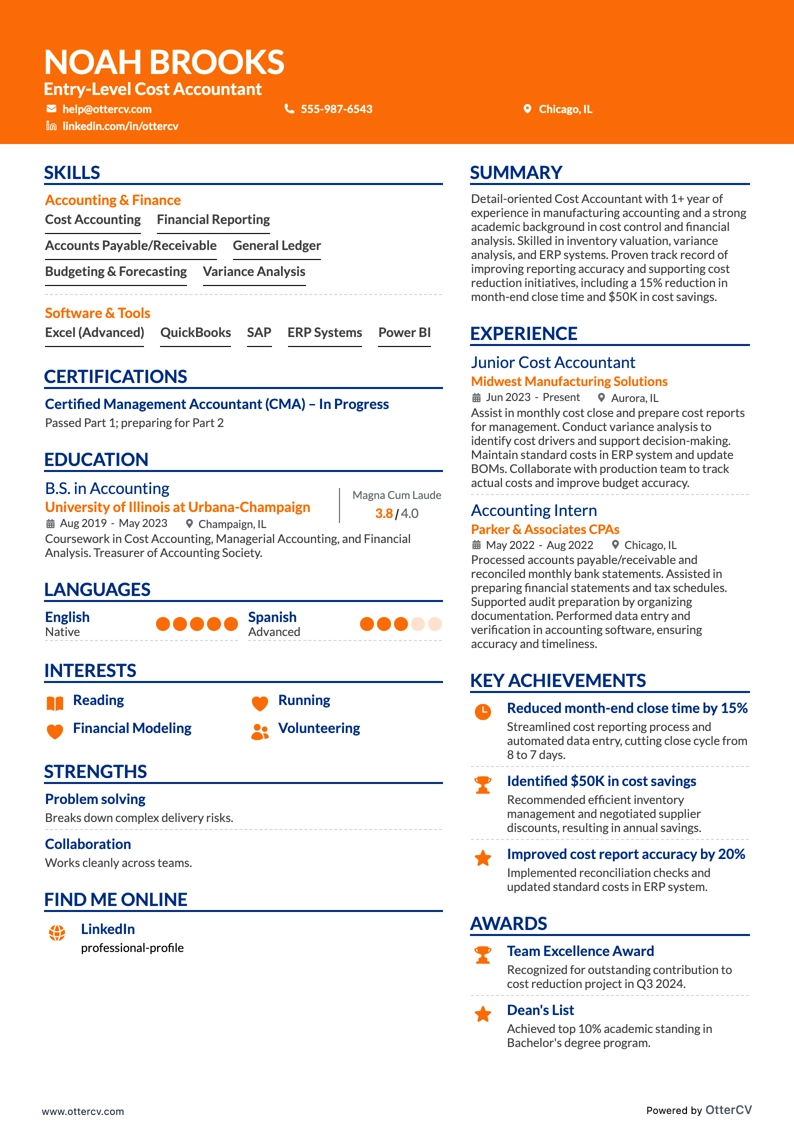
Entry-Level Cost Accountant resume example

Entry-Level Cost Accountant

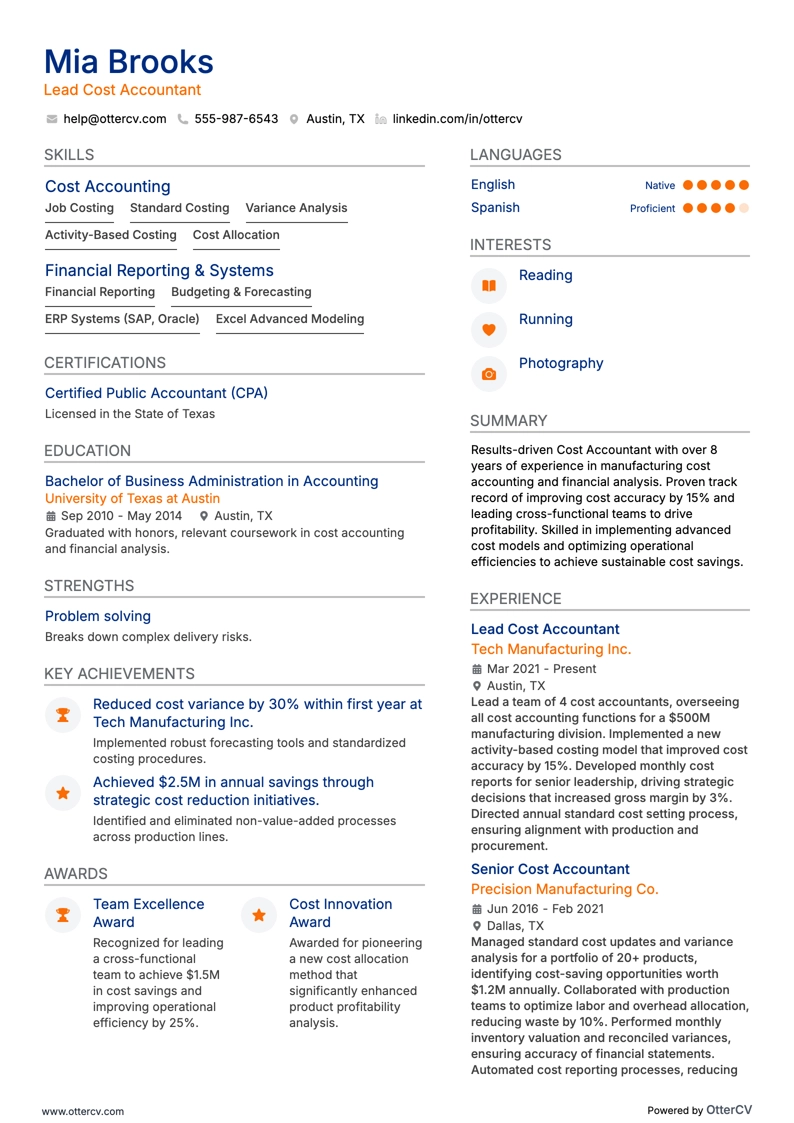
Lead Cost Accountant resume example

Lead Cost Accountant

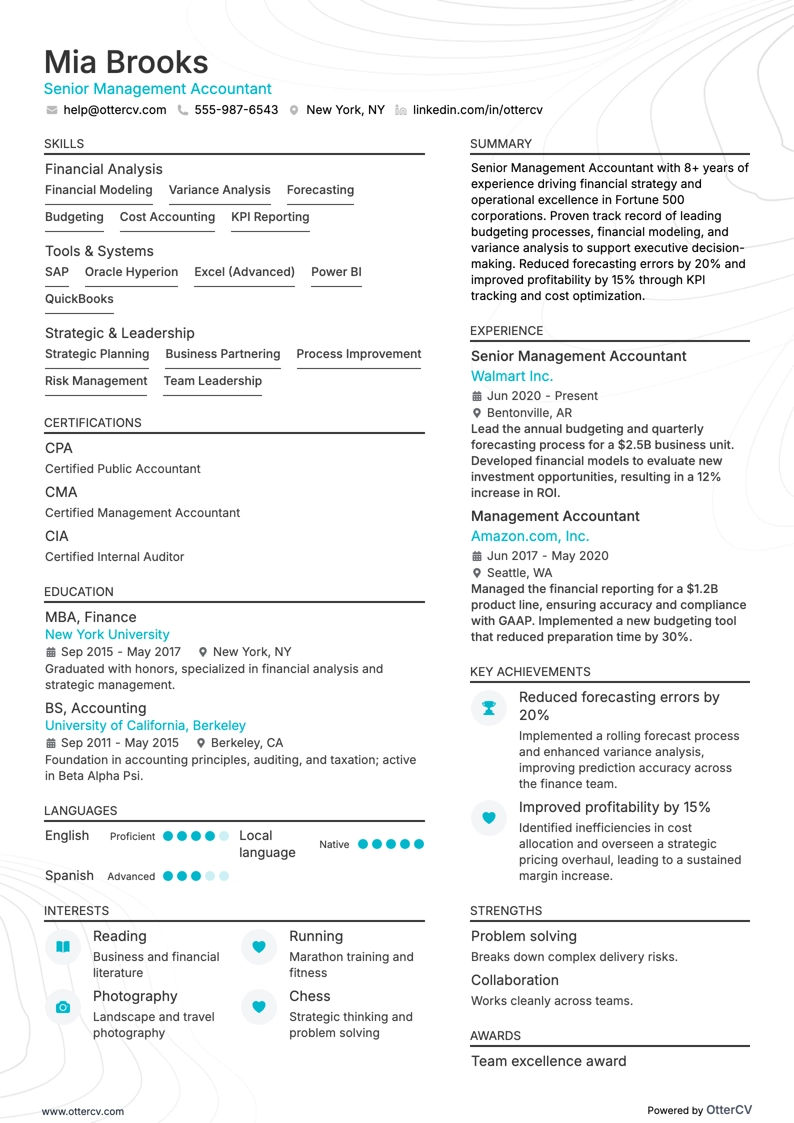
Senior Management Accountant resume example

Senior Management Accountant

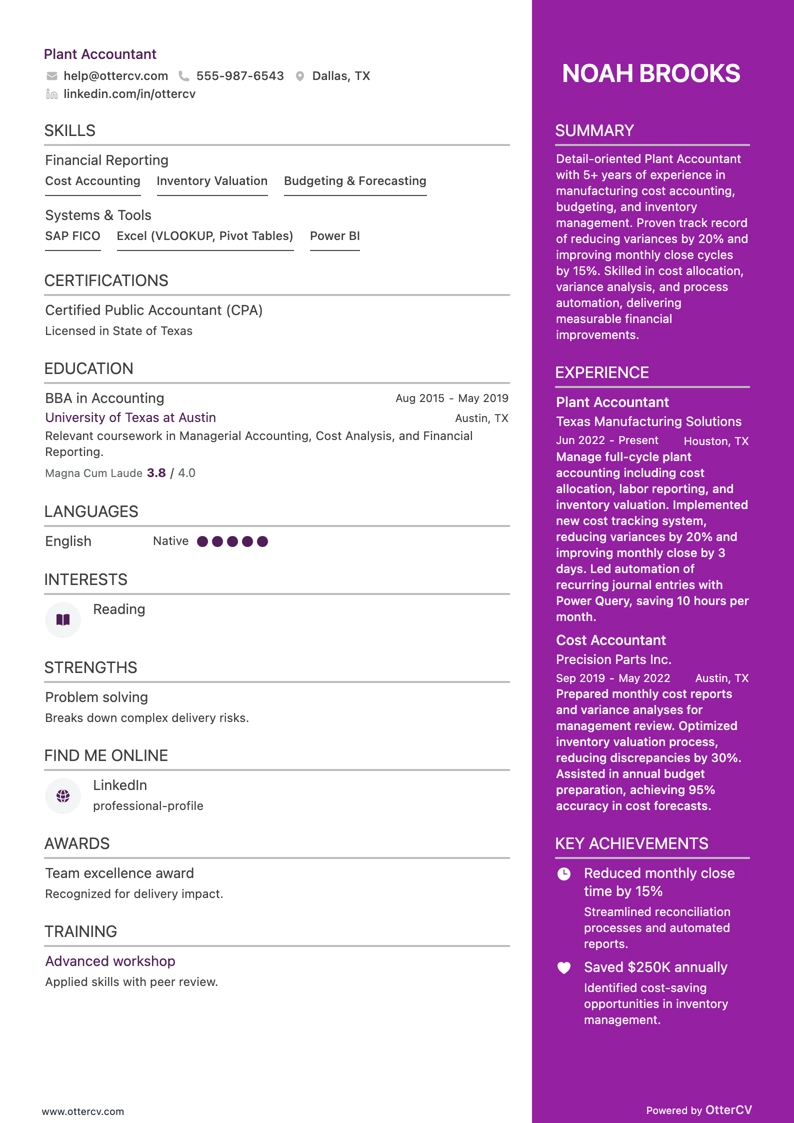
Plant Accountant resume example

Plant Accountant

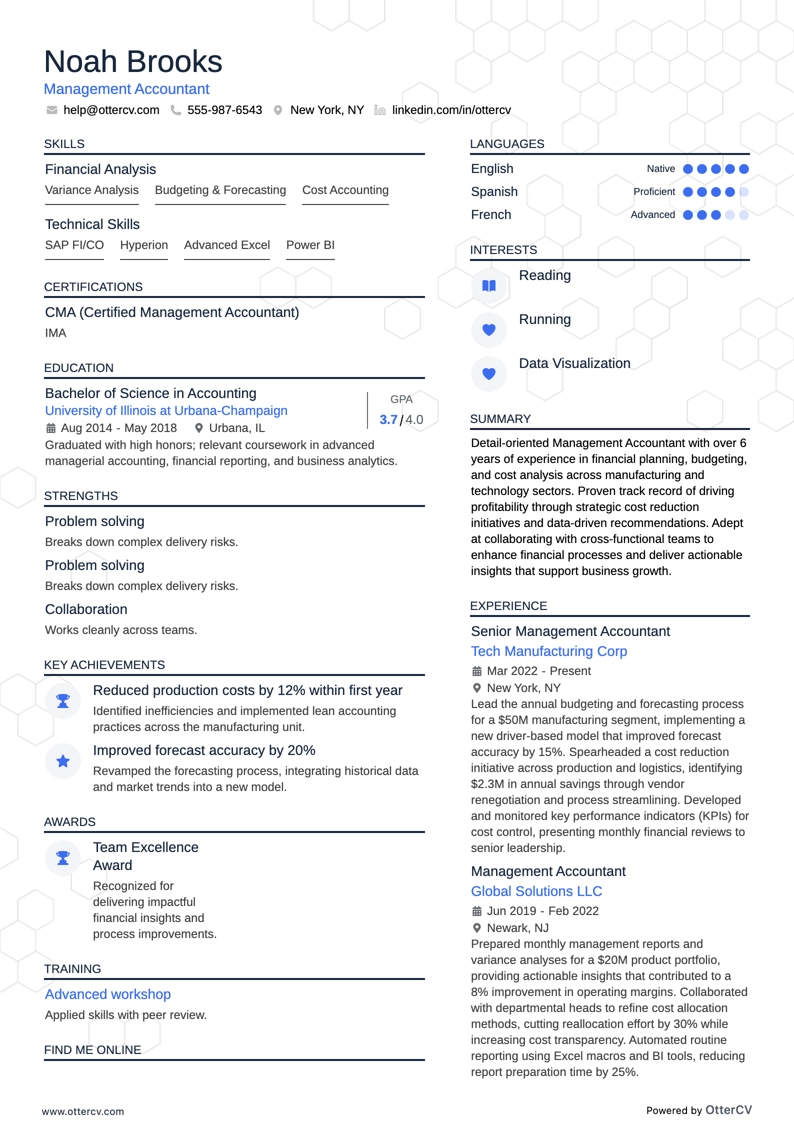
Management Accountant resume example

Management Accountant

Many management accounting resumes fail because they read like task logs rather than decision support. If you are looking for management accounting resume guidance, you need a document that can pass ATS filters and still earn attention in a ten-second recruiter scan.

A strong resume shows how you improved performance, not just which systems you used. Learning how to make your resume stand out starts with highlighting cost savings, gains in forecast accuracy, budget scope, faster close cycles, variance reductions, and how your insights influenced pricing, staffing, or capital decisions.

Key takeaways

  • Quantify every achievement with cost savings, forecast accuracy, or close-cycle improvements.

  • Use a reverse-chronological format to show increasing financial responsibility and leadership scope.

  • Match each job posting’s exact tools, terminology, and KPIs in your experience bullets.

  • Tie every listed skill to a specific outcome in your summary or experience section.

  • Place certifications such as the CMA or CPA near your education to strengthen credibility quickly.

  • Avoid functional or hybrid formats if you have five or more years of experience.

  • Use Echocv to turn routine accounting duties into measurable, recruiter-ready resume bullets.

Job market snapshot for management accountings

We analyzed 389 recent management accounting job ads across major US job boards. These figures provide a quick view of career growth patterns, in-demand skills, and employment type trends.

What level of experience employers are looking for management accountings

Years of ExperiencePercentage found in job ads
1–2 years4.1% (16)
3–4 years6.7% (26)
5–6 years23.4% (91)
7–8 years11.1% (43)
9–10 years2.8% (11)
10+ years6.2% (24)
Not specified48.6% (189)

Management accounting ads by area of specialization (industry)

Industry (Area)Percentage found in job ads
Finance & Banking82.0% (319)
Healthcare10.5% (41)
Education3.3% (13)

Top companies hiring management accountings

CompanyPercentage found in job ads
Wipfli LLP13.1% (51)
FedEx4.1% (16)
CVS Health3.1% (12)
KPMG3.1% (12)

Role overview stats

These tables outline the most common responsibilities and employment types for management accounting roles. Use them to align your resume with employer expectations and understand how the role is structured across the market.

Day-to-day activities and top responsibilities for a management accounting

ResponsibilityPercentage found in job ads
Financial reporting24.2% (94)
Accounting20.1% (78)
Excel19.0% (74)
Netsuite17.2% (67)
Financial analysis15.4% (60)
Project management15.2% (59)
Bill.com13.4% (52)
Quickbooks online13.1% (51)
Accounting software11.3% (44)
Budgeting10.5% (41)
Microsoft office suite10.5% (41)
Gaap10.3% (40)

Type of employment (remote vs on-site vs hybrid)

Employment typePercentage found in job ads
On-site45.0% (175)
Hybrid35.2% (137)
Remote19.8% (77)

How to format a management accounting resume

Recruiters reviewing management accounting resumes look for clear evidence of financial planning leadership, budget oversight, large-scale cost analysis, and the ability to turn accounting data into strategic business decisions. A reverse-chronological format highlights these strengths right away by putting your most senior responsibilities and measurable results first, which matches how hiring managers typically assess fit.

I have significant experience in this role—which format should I use?

I have significant experience in this role—which format should I use?

Use a reverse-chronological format. It is the strongest choice for experienced management accountants because it emphasizes your progression through increasing financial responsibility and decision-making authority.

  • Lead with your most recent role and clearly define the scope of your oversight, including budget size, team leadership, and reporting relationships to senior executives.
  • Highlight domain-specific expertise such as variance analysis, cost allocation modeling, ERP systems (SAP, Oracle), management reporting frameworks, and regulatory compliance oversight.
  • Quantify business impact in every role by tying your work directly to cost reductions, margin improvements, forecast accuracy, or strategic financial outcomes.

Example bullet: “Redesigned the company's cost allocation methodology across four business units, reducing monthly close cycle time by 35% and identifying $2.1M in annual cost savings adopted by the CFO in the FY2024 operating plan.”

Why hybrid and functional resumes don't work for senior roles

Why hybrid and functional resumes don't work for senior roles

Hybrid and functional formats fragment your career timeline and hide your progression from individual contributor to strategic leader, making it harder for recruiters to evaluate how your accountability, decision ownership, and leadership scope evolved over time. Functional formats are especially damaging because they separate quantified achievements from the roles where they happened, weakening the impact of budget oversight, cross-functional leadership, and executive-level financial advisory work that defines senior management accounting positions. Choosing the right resume layout helps keep your career progression clear and compelling.

If you have five or more years of progressive management accounting experience, avoid hybrid and functional formats entirely. These structures are more likely to weaken your candidacy than strengthen it.

  • A functional resume may be acceptable only if you're transitioning into management accounting from a related senior finance role, such as FP&A or controllership, have a significant employment gap, or are re-entering the workforce. Even then, every listed skill should be tied to a specific project, dollar figure, or business outcome to maintain credibility with hiring managers and applicant tracking systems.
Once your layout and formatting are set, the next step is choosing resume sections that reinforce your qualifications.

What sections should go on a management accounting resume

Recruiters expect a management accounting resume to clearly show how you support financial performance through reporting, forecasting, and decision support. Understanding what to put on a resume helps you prioritize the right content for this role.

Use this structure for maximum clarity:

  • Header
  • Summary
  • Experience
  • Skills
  • Projects (include only if appropriate for this role or seniority)
  • Education
  • Certifications (only if relevant to the role)
  • Optional sections: Awards, Leadership, Languages

Strong experience bullets should emphasize measurable impact, business outcomes, scope of responsibility, and results tied to budgeting, forecasting, variance analysis, and stakeholder decisions.

Now that your resume’s structure and key components are in place, the next step is to write your management accounting experience section so each role supports the rest of the document.

How to write your management accounting resume experience

Your experience section should show that you deliver results in management accounting, not just complete tasks. Hiring managers look for clear impact, including the financial systems you managed, the analytical methods you applied, and the measurable outcomes you achieved for the business.

Each entry should include:

  • Job title
  • Company and location, or remote
  • Dates of employment, including month and year

Add three to five concise bullet points that explain what you owned, how you worked, and what results you delivered:

  • Ownership scope: the budgets, forecasts, cost centers, internal reporting structures, or financial planning processes you were directly responsible for.
  • Execution approach: the accounting frameworks, ERP systems, financial modeling techniques, variance analysis methods, or reporting tools you used to support strategic decisions and produce accurate management reports.
  • Value improved: the gains you made in forecasting accuracy, cost efficiency, budget adherence, internal controls, financial visibility, or risk mitigation.
  • Collaboration context: how you worked with department heads, senior leadership, operations teams, external auditors, or other cross-functional stakeholders to align financial insights with business strategy.
  • Impact delivered: the business outcomes your work produced, such as better profitability, stronger resource allocation, faster decision-making, or improved financial health, rather than a list of routine duties.

Experience bullet formula

Experience bullet formula

Action verb + technology + what you built or fixed + measurable result

A management accounting experience example

Senior Management Accountant

NorthPeak Medical Devices | Minneapolis, MN

2022–Present

Mid-market manufacturer scaling a multi-site supply chain for regulated medical devices.

  • Led monthly close for five plants using Oracle NetSuite and BlackLine, reducing close time from eight to five business days and improving forecast readiness by 40%.
  • Built driver-based budgeting and rolling forecasts in Adaptive Planning, improving forecast accuracy from 88% to 95% and enabling quarterly reallocation of $3.2M to the highest-margin product lines.
  • Standardized product costing in NetSuite across standard cost, variance analysis, and activity-based costing, reducing unfavorable material and labor variances by 18% and supporting a 2.1-point gross margin lift.
  • Partnered with operations, procurement, and engineering to launch a Power BI cost-to-serve dashboard, identifying $1.4M in annualized savings through freight mode optimization and supplier term renegotiations.
  • Implemented SOX-lite controls for inventory and capitalization with internal audit and plant controllers, reducing audit adjustments by 60% and lowering cycle count shrinkage from 1.6% to 1.0%.

Now that you've seen what a strong experience section looks like, the next step is adjusting yours to fit a specific job posting.

How to tailor your management accounting resume experience

Recruiters review management accounting resumes through both applicant tracking systems and manual screening, looking for clear alignment between your experience and the job description. Tailoring your resume to the job description by reflecting the language, tools, and priorities in the listing can improve your chances of passing both.

Ways to tailor your management accounting experience:

  • Mirror the exact ERP or financial software named in the posting.
  • Match the budgeting or forecasting methodology the employer specifies.
  • Use the same terminology for cost allocation or variance analysis processes.
  • Reflect the KPIs or financial metrics the role uses to measure success.
  • Highlight industry experience when the posting refers to a specific sector.
  • Emphasize regulatory compliance or internal controls if the role requires them.
  • Align your reporting cadence with the workflows described in the listing.
  • Reference the cross-functional collaboration models the job description prioritizes.

Tailoring means aligning your real accomplishments with the language and priorities of each job posting, not forcing in keywords where they do not belong.

Resume tailoring examples for management accounting

Job description excerptUntailoredTailored
Prepare monthly variance analysis reports comparing actual results to budgets and forecasts using SAP and Excel, and present findings to senior leadership.Assisted with financial reporting and analysis tasks.Prepared monthly variance analysis reports in SAP and Excel, identified cost deviations against budget, and presented actionable findings to senior leadership that drove a 12% reduction in controllable expenses.
Lead the annual budgeting process across three business units, coordinating with department heads to develop operating budgets aligned with strategic goals.Helped with budgeting and worked with different teams.Led the annual budgeting process across three business units, coordinating with 15 department heads to build operating budgets totaling $48M and aligning them with the company's three-year strategic plan.
Develop and maintain cost allocation models to support product-line profitability analysis, ensuring accuracy of standard costs and investigating material cost variances.Performed cost accounting duties and maintained financial records.Built and maintained activity-based cost allocation models across four product lines, improved standard cost accuracy by 8%, and investigated material cost variances that recovered $320K in misallocated overhead annually.

Once you’ve aligned your experience with the role’s priorities, the next step is to quantify your management accounting achievements so employers can see the impact behind those responsibilities.

How to quantify your management accounting achievements

Quantifying your achievements shows business impact beyond reporting. Management accounting can be measured through close speed, forecast accuracy, cost savings, control compliance, and decision-support outcomes across budgets, variance analysis, and performance dashboards.

Quantifying examples for management accounting

MetricExample
Close cycle timeCut monthly close from eight to five business days by standardizing accruals and building Power BI close trackers for twelve cost centers.
Forecast accuracyImproved quarterly operating expense forecast accuracy from 86% to 94% using driver-based models in Excel and SAP data extracts.
Cost savingsDelivered $1.2M in annual savings by identifying spend leakage in indirect procurement and renegotiating three vendor contracts with finance and operations.
Control complianceReduced audit findings from six to one by tightening expense approval controls and documenting SOX (Sarbanes-Oxley Act) narratives for five key processes.
Reporting throughputAutomated variance reporting for 30 departments, cutting prep time from ten hours to two per month using Power Query and standardized templates.

Once you’ve written strong bullet points for your experience section, use that same precision to present your hard and soft skills clearly.

How to list your hard and soft skills on a management accounting resume

Your skills section should show that you can turn financial data into decisions. Recruiters and an ATS (applicant tracking system) scan this section quickly to confirm fit, so prioritize a hard skills-heavy mix supported by role-specific collaboration and communication soft skills.

Management accounting roles require a blend of:

  • Product strategy and discovery skills
  • Data, analytics, and experimentation skills
  • Delivery, execution, and go-to-market discipline
  • Soft skills

Your skills section should be:

  • Scannable with bullet-style grouping
  • Relevant to the job post
  • Backed by proof in your experience bullets
  • Updated with current tools

Place your skills section:

  • Above your experience if you’re junior or switching careers
  • Below your experience if you’re mid- or senior-level with strong achievements

Hard skills

  • Budgeting and forecasting.
  • Variance analysis.
  • Cost accounting and allocation.
  • Standard costing.
  • Activity-based costing.
  • Management reporting and dashboards.
  • Financial modeling.
  • Profitability and margin analysis.
  • KPI design and tracking.
  • SQL, Excel, and Power BI.
  • ERP systems, including SAP and Oracle NetSuite.
  • Internal controls and SOX compliance.

Soft skills

  • Partner with business leaders.
  • Translate data into decisions.
  • Challenge assumptions with evidence.
  • Present insights to executives.
  • Align stakeholders on targets.
  • Drive close and forecast cadence.
  • Prioritize high-impact analyses.
  • Own deadlines and follow-through.
  • Clarify requirements and scope.
  • Resolve data and metric disputes.
  • Influence without authority.
  • Document decisions and rationale.

How to show your management accounting skills in context

Skills should not appear only in a bulleted list on your resume. Explore common resume skills to make sure you are highlighting the most relevant competencies for your target role.

Show these skills in:

  • Your summary, which presents your high-level professional identity
  • Your experience, which proves your abilities through outcomes

Here is what that looks like in practice.

Summary example

Senior management accountant with 12 years of experience in manufacturing, with expertise in budgeting, variance analysis, and SAP. Led cross-functional cost optimization efforts that reduced operating expenses by 17%, turning financial insights into strategic decisions for executive leadership.

  • Immediately signals senior-level expertise.
  • References industry-relevant tools such as SAP.
  • Quantifies impact with a clear metric.
  • Highlights strategic communication skills.

Experience example

Senior Management Accountant

Veridian Manufacturing Group | Charlotte, NC

June 2018–Present

  • Redesigned the monthly variance analysis process using Power BI dashboards, reducing reporting cycle time by 30% and improving forecast accuracy across four business units.
  • Partnered with operations and procurement teams to build zero-based budgets, identifying $2.1M in annual cost savings within the first fiscal year.
  • Developed rolling cash flow forecasts in SAP, enabling leadership to reallocate $850K toward high-margin product lines each quarter.
  • Every bullet contains measurable proof.
  • Skills surface naturally through achievements.

Once you’ve shown your management accounting strengths with specific, results-focused examples, the next step is turning that approach into a resume when you have no experience.

How do I write a management accounting resume with no experience

Even without full-time experience, you can show readiness through:

  • Cost accounting class projects
  • Budgeting and forecasting case studies
  • Variance analysis in coursework
  • ERP system simulation labs
  • Student consulting for local nonprofits
  • Finance club treasurer responsibilities
  • Accounting internship or externship

If you're building a resume without work experience, focus on:

  • Management accounting tools used
  • Quantified outcomes and accuracy
  • Industry-relevant cost drivers analyzed
  • Clean, audit-ready reporting samples

Resume format tip for entry-level management accounting

Resume format tip for entry-level management accounting

Use a hybrid resume format to put projects and skills first while still presenting education, internships, and leadership experience in reverse chronological order.

Do:

  • Lead with a "Projects" section.
  • Quantify results with dollars, percentages, and time saved.
  • Name tools such as Excel, Power BI, and SAP.
  • Mirror job descriptions with management accounting keywords.
  • Add relevant coursework under education.

Example project bullet:

  • Built a three-statement budget model in Excel for a case study, analyzed cost drivers and variances, and improved forecast accuracy by 12% versus baseline assumptions.

Even without hands-on experience, your academic background can show relevant knowledge and skills, which makes the way you present your education especially important.

How to list your education on a management accounting resume

Your education section helps hiring teams quickly confirm that you have the foundational knowledge needed for management accounting roles. It also reinforces your analytical training and financial expertise.

Include:

  • Degree name
  • Institution
  • Location
  • Graduation year
  • Relevant coursework, for juniors or entry-level candidates
  • Honors and GPA, if 3.5 or higher

Skip the month and day—list the graduation year only.

Here’s a strong education entry tailored to management accounting:

Example education entry

Bachelor of Science in Accounting

Indiana University, Kelley School of Business, Bloomington, IN

Graduated 2021

GPA: 3.7/4.0

  • Relevant coursework: Cost Accounting, Managerial Finance, Corporate Budgeting, Financial Statement Analysis, Strategic Cost Management
  • Honors: Dean's List (six semesters), Beta Alpha Psi Honor Society

How to list your certifications on a management accounting resume

Certifications on your resume show your commitment to learning, your proficiency with management accounting tools, and your relevance to current industry standards.

Include:

  • Certificate name
  • Issuing organization
  • Year
  • Optional: credential ID or URL
  • List certifications below education when your degree is recent and your certifications are older or less relevant to management accounting.
  • List certifications above education when they are recent, highly relevant to management accounting, or required for your target role.

Best certifications for your management accounting resume

  • Certified Management Accountant (CMA) is a strong credential for management accounting roles.
  • Certified Public Accountant (CPA) is a widely recognized accounting certification.
  • Chartered Global Management Accountant (CGMA) highlights expertise in management accounting and business strategy.
  • Certified Internal Auditor (CIA) is valuable for roles involving internal controls and audit.
  • Certified Financial Analyst (CFA) can strengthen your resume for finance-focused accounting positions.
  • Certified Fraud Examiner (CFE) is relevant for fraud detection and risk-related responsibilities.
  • SAP Certified Application Associate—Financial Accounting (SAP FI) shows proficiency with SAP financial accounting systems.

Once your credentials are visible to recruiters, use your management accounting resume summary to reinforce their relevance and set the tone for the rest of your resume.

How to write your management accounting resume summary

Your resume summary is often the first thing a recruiter reads, so a strong summary should quickly show that you’re qualified for a management accounting role.

Keep it to three to four lines and include:

  • Your title and total years of relevant accounting experience.
  • Domain expertise, such as corporate finance, manufacturing, or SaaS.
  • Core tools like SAP, Oracle, Excel modeling, or ERP platforms.
  • One or two quantified achievements tied to cost savings or reporting improvements.
  • Soft skills linked to real outcomes, such as cross-functional collaboration that streamlined budgeting cycles.

PRO TIP

At this level, focus on clarity, relevant technical skills, and early measurable impact.

Highlight the specific tools you’ve used and the contributions you’ve made to real projects.

Avoid vague descriptors like “hard-working” or “passionate.” Instead of motivational language, show what you’ve actually accomplished with numbers.

Example summary for a management accounting

Management accountant with three years of experience in manufacturing cost analysis, with strong skills in SAP and advanced Excel modeling. Reduced monthly close time by 20% through streamlined variance reporting processes.

Now that your summary captures the value you bring, make sure your header includes the essential contact and professional details recruiters need to reach you.

What to include in a management accounting resume header

Your resume header is the top section with your key identifiers. It improves visibility, credibility, and recruiter screening for management accounting roles.

Essential resume header elements

  • Full name
  • Tailored job title and headline
  • Location
  • Phone number
  • Professional email
  • GitHub link
  • Portfolio link
  • LinkedIn

A LinkedIn link helps recruiters quickly confirm titles, dates, and employers, which supports faster screening decisions.

Do not include a photo on a management accounting resume unless the role is explicitly front-facing or appearance-dependent.

Match your header job title to the posting, and keep the formatting consistent so recruiters can scan and log your details quickly.

Once your header clearly shows who you are and how to contact you, add targeted optional sections to strengthen your qualifications and increase your resume’s overall impact.

Additional sections for management accounting resumes

These extra sections can help you stand out when your core qualifications are similar to other candidates by giving hiring managers specific reasons to choose you.

  • Languages
  • Certifications (CMA, CPA, CIMA)
  • Professional affiliations
  • Publications and industry presentations
  • Technical proficiencies (ERP systems, BI tools)
  • Continuing education and professional development
  • Volunteer leadership and board experience

Once you’ve strengthened your resume with the right supporting sections, it’s worth turning to the cover letter—a separate document that can reinforce and add context to what your resume shows.

Do management accounting resumes need a cover letter

A cover letter is not required for most management accounting roles, but it can help in competitive job searches or when hiring managers expect one. If you’re unsure what a cover letter is or when to use one, it can make a difference when your resume needs more context or when you want to show fit beyond keywords.

Use a cover letter to add details your resume cannot:

  • Explain your fit for the role or team by connecting your experience to the job’s planning cycles, reporting cadence, and decision-support needs.
  • Highlight one or two relevant projects or outcomes, such as improving forecast accuracy, reducing close time, or building a driver-based model.
  • Show understanding of the product, users, or business context by naming key metrics, cost drivers, and stakeholders you’ve supported.
  • Address career transitions or less obvious experience by mapping transferable work to management accounting tasks, tools, and cross-functional partners.

Once you’ve decided whether to include a cover letter based on the role and employer’s expectations, the next step is using AI to improve your management accounting resume so it matches those requirements more precisely.

Using AI to improve your management accounting resume

AI can improve your resume’s clarity, structure, and impact. It can also help turn day-to-day responsibilities into stronger, results-focused language. But overusing it can quickly make your resume feel less authentic. Once your content is clear and aligned with the role, stop relying on AI. If you’re wondering which AI is best for writing resumes, choose tools that support your voice rather than replace it.

Here are 10 practical prompts to improve specific sections of your management accounting resume:

  1. Sharpen your summary: “Rewrite my resume summary to highlight my management accounting expertise, including budgeting, forecasting, and cost analysis, in three concise sentences.”
  2. Quantify experience bullets: “Add measurable results to these management accounting experience bullets, focusing on cost savings, budget accuracy, or variance reduction percentages.”
  3. Strengthen action verbs: “Replace weak verbs in my management accounting experience section with strong, specific action verbs tied to financial analysis and reporting.”
  4. Tailor skills section: “Reorganize my skills section to prioritize the most in-demand management accounting competencies for this specific job description.”
  5. Clarify project contributions: “Rewrite this project description to clearly show my management accounting role, deliverables, and the financial outcome achieved.”
  6. Align with job posting: “Compare my management accounting resume bullets against this job posting and flag any gaps in terminology or required qualifications.”
  7. Tighten education details: “Condense my education section to emphasize coursework and achievements most relevant to a management accounting career path.”
  8. Highlight certifications strategically: “Reorder and reword my certifications section so my management accounting credentials appear most prominently and include completion dates.”
  9. Remove redundant phrasing: “Identify and eliminate any repetitive or filler language across my management accounting resume without losing key details.”
  10. Improve readability overall: “Simplify overly complex sentences throughout my management accounting resume so each bullet is clear, direct, and under 20 words.”

Stop using AI once your resume sounds accurate, specific, and grounded in real experience. AI should never invent experience or exaggerate claims—if it didn’t happen, it doesn’t belong on your resume.

Conclusion

A strong management accounting resume shows impact through measurable results, role-specific skills, and a clear structure. Lead with outcomes such as cost savings, variance reductions, forecast accuracy, and cycle-time improvements. Support those results with experience in budgeting, forecasting, variance analysis, and financial modeling.

Keep your resume easy to scan and consistent from top to bottom. Use focused bullets, clear headings, and metrics that align with the role. This approach demonstrates readiness for today’s hiring market and the next hiring cycle.

Management Accounting resume examples

Explore additional Management Accounting resume samples and guides and see what works for your level of experience or role.

By Experience

Entry-Level Cost Accountant

Entry-Level Cost Accountant resume preview

Lead Cost Accountant

Lead Cost Accountant resume preview

Senior Management Accountant

Senior Management Accountant resume preview

Management Accounting resume examples

Explore additional Management Accounting resume samples and guides and see what works for your level of experience or role.

By Role

Plant Accountant

Plant Accountant resume preview

Management Accountant

Management Accountant resume preview