Lead Machinist full preview

15 Machinist Resume Examples

OtterCV

Written by The OtterCV Team

Updated: 4/14/2023•8 min read

See all resume examples in this guide, or generate your own resume example with your personalized prompt

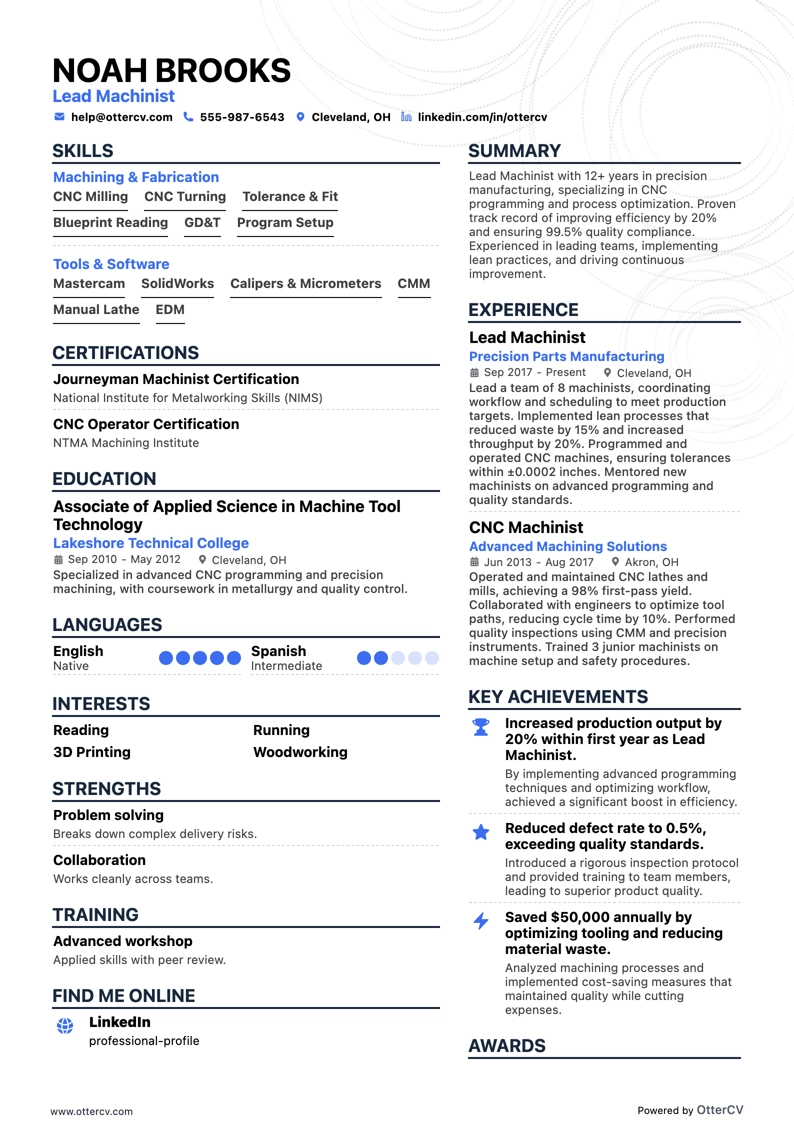
Lead Machinist resume example

Lead Machinist

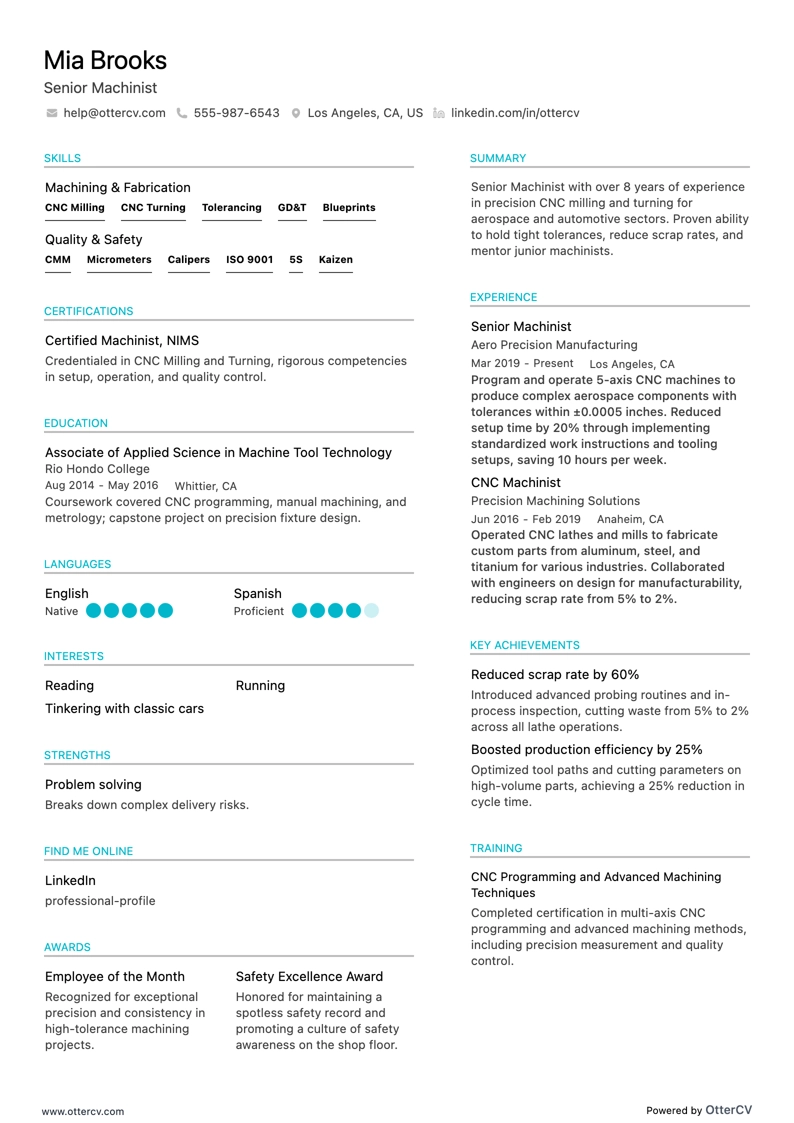
Senior Machinist resume example

Senior Machinist

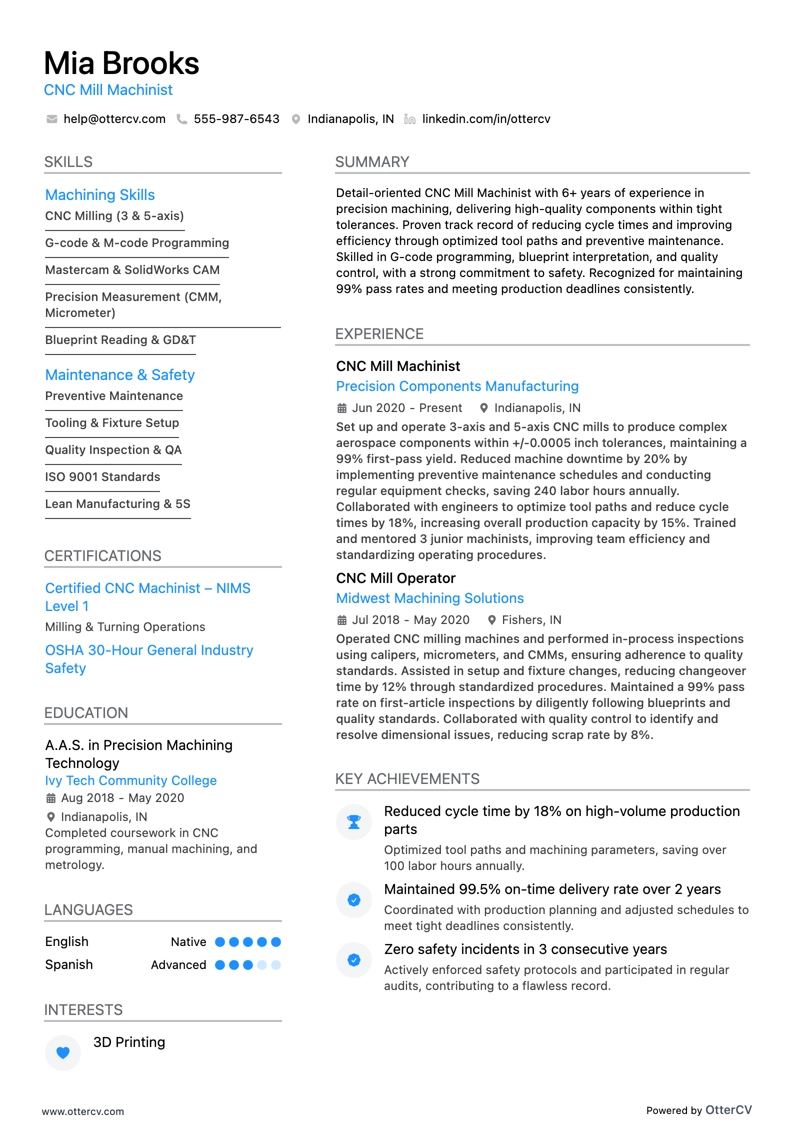
CNC Mill Machinist resume example

CNC Mill Machinist

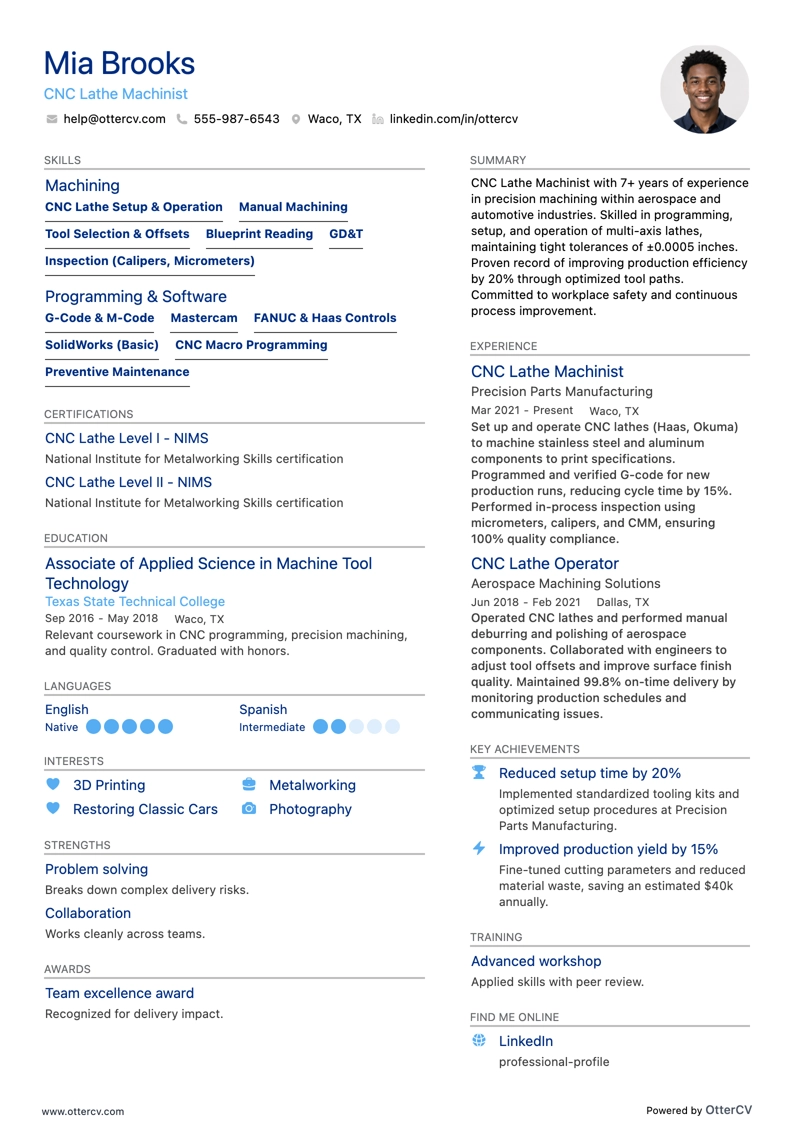
CNC Lathe Machinist resume example

CNC Lathe Machinist

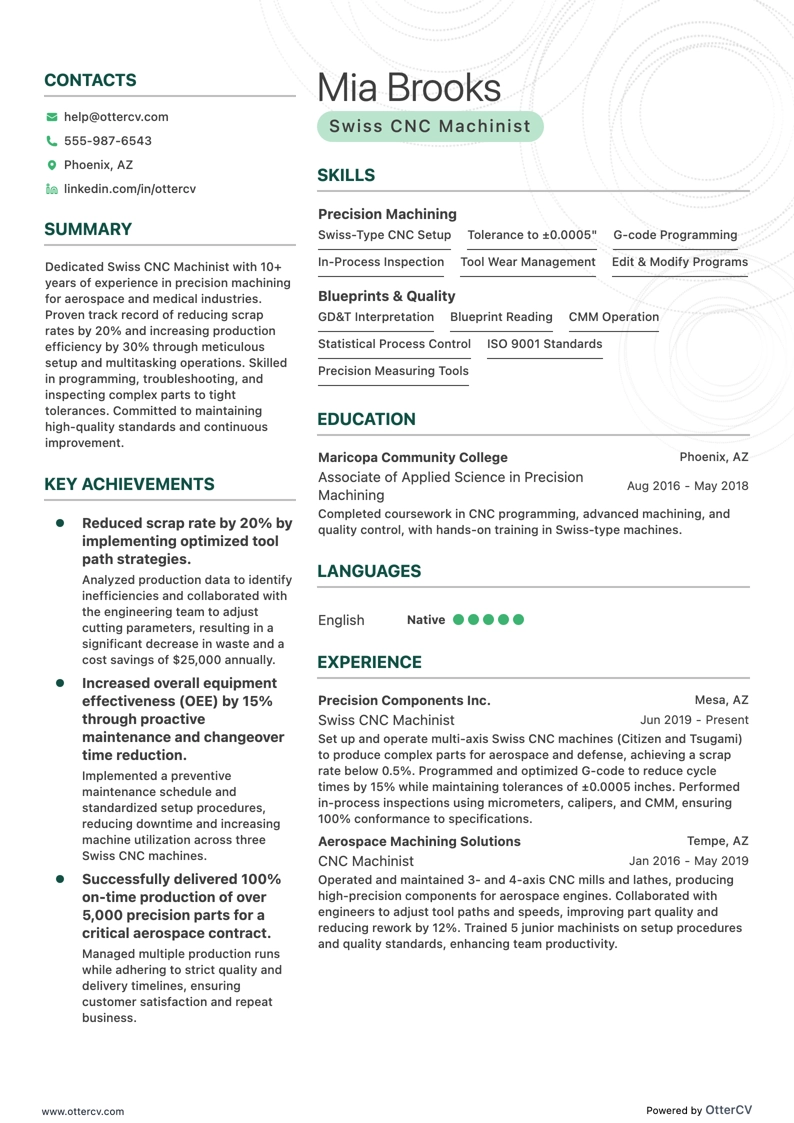
Swiss CNC Machinist resume example

Swiss CNC Machinist

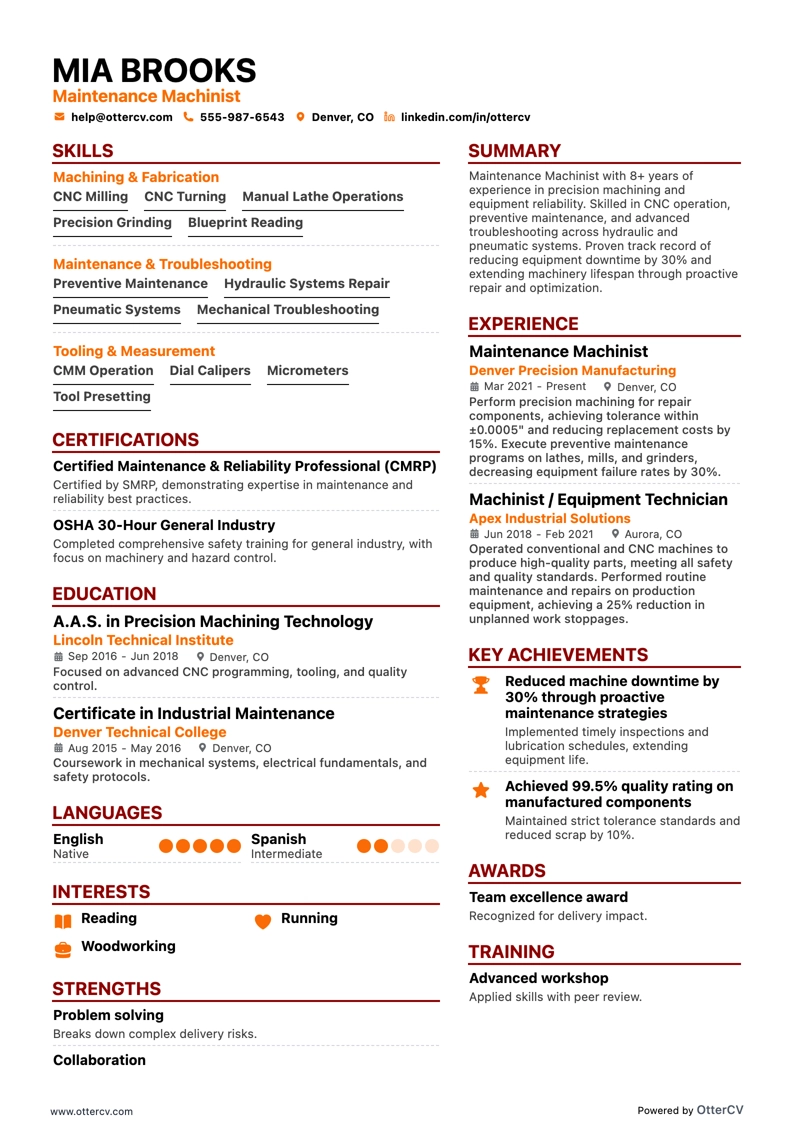
Maintenance Machinist resume example

Maintenance Machinist

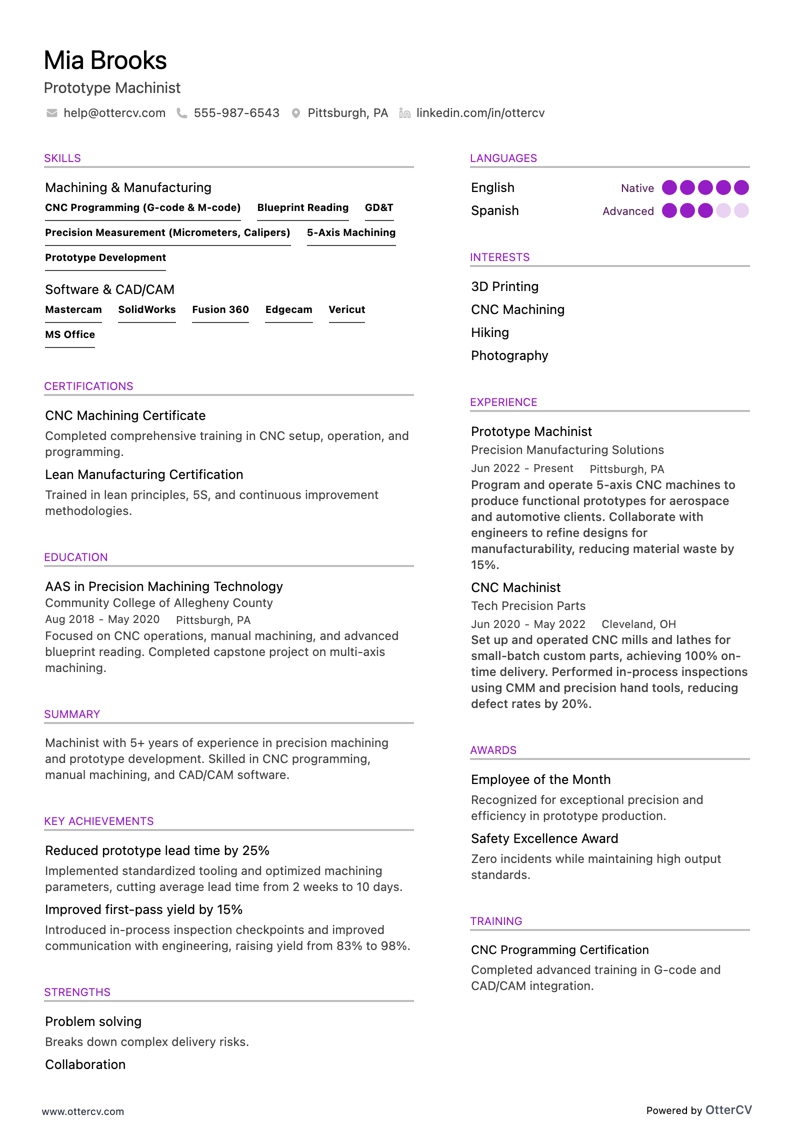
Prototype Machinist resume example

Prototype Machinist

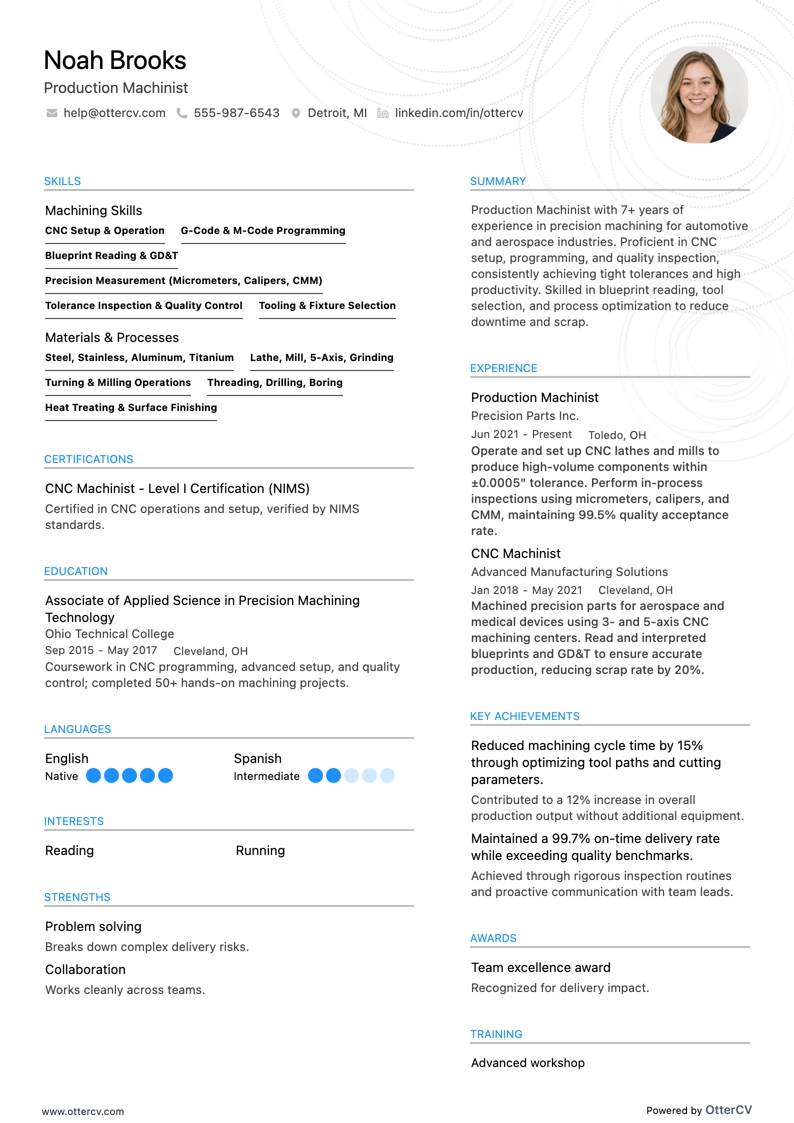
Production Machinist resume example

Production Machinist

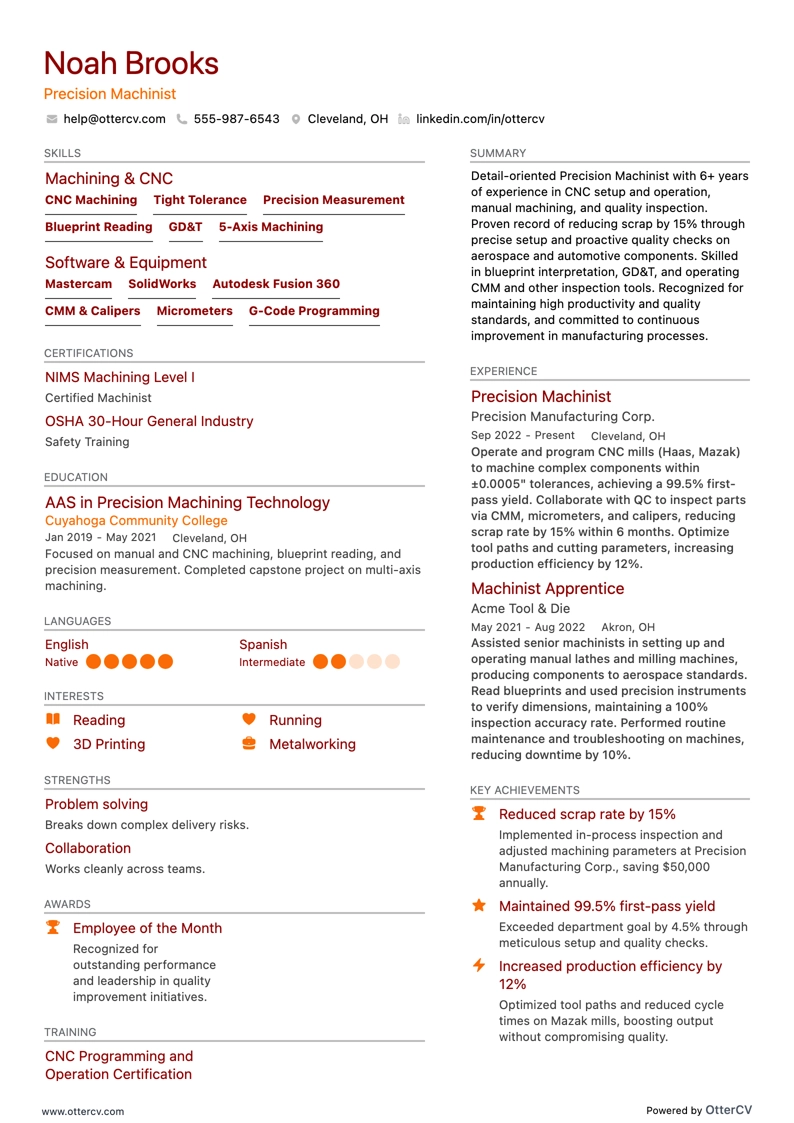
Precision Machinist resume example

Precision Machinist

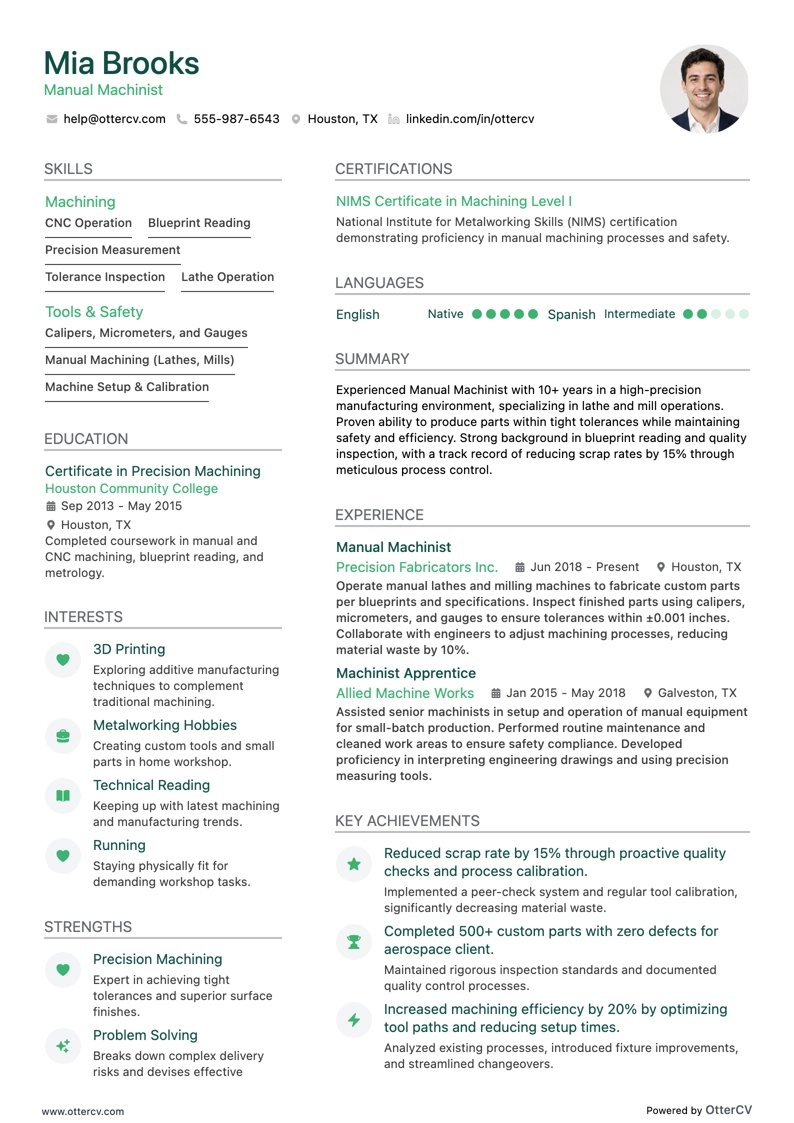
Manual Machinist resume example

Manual Machinist

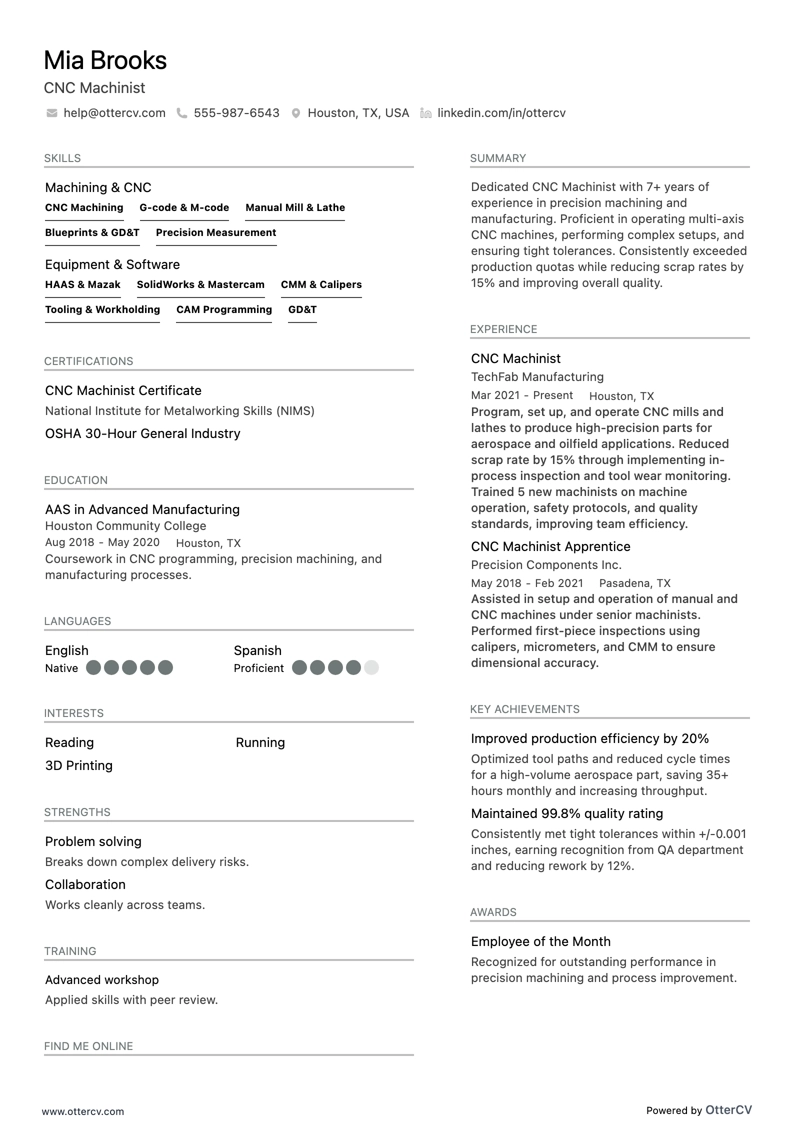
CNC Machinist resume example

CNC Machinist

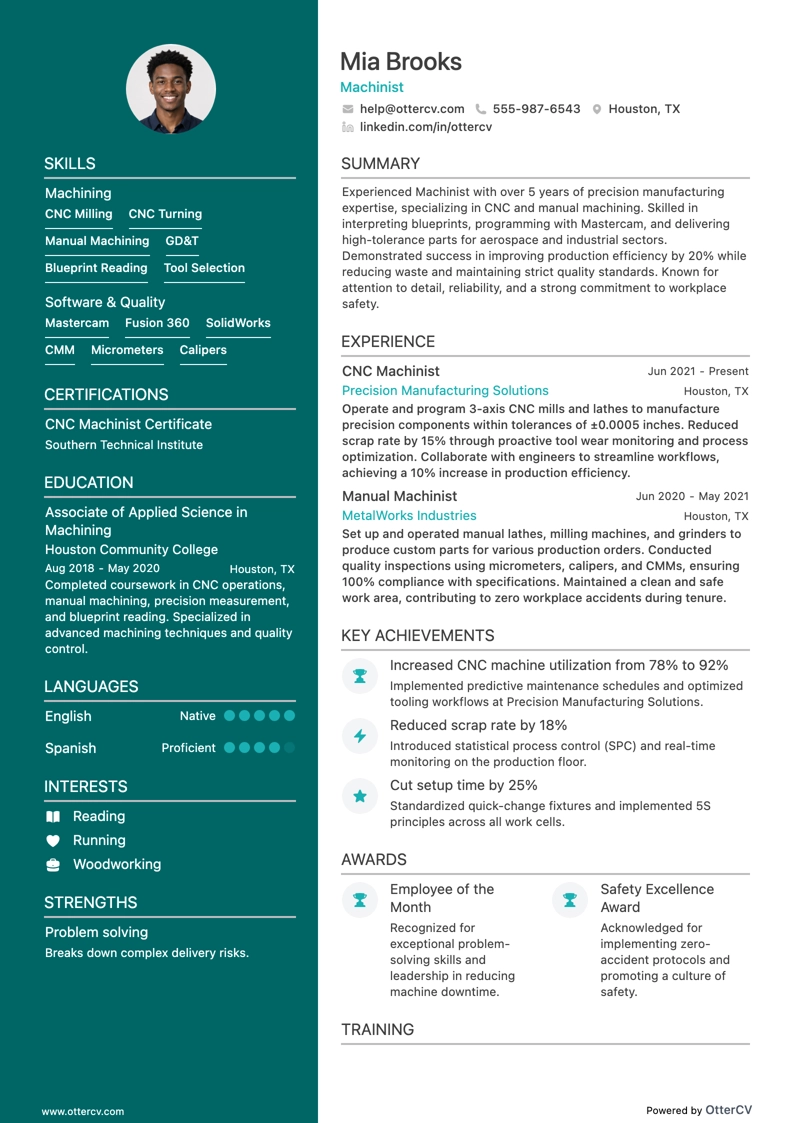
Machinist resume example

Machinist

Many machinist resumes fall short because they list machines and duties without showing tolerances, throughput, or defect reduction. That kind of vagueness is often filtered out by ATS screening and overlooked during fast recruiter reviews in a crowded market.

A strong resume shows what you delivered, not just what you used. Knowing how to make your resume stand out means emphasizing cycle time reductions, scrap rate decreases, tight tolerance holds, on-time job completion, setup time improvements, and cost savings across high-mix work orders.

Key takeaways

  • Quantify tolerances, cycle times, and scrap reduction instead of only listing machines and duties.

  • Use a reverse-chronological resume format if you have machinist experience, and a hybrid format if you are changing careers.

  • Tailor each resume to match the exact machines, software, and standards named in the job posting.

  • Put hard skills above experience when you do not have full-time machinist work history.

  • List NIMS or OSHA certifications near your education to quickly show hands-on competency.

  • Write a three- to four-line summary that highlights your top machines, industry, and one measurable result.

  • Use AI tools like Echocv to tighten language and match keywords, but never fabricate experience.

Job market snapshot for machinists

We analyzed 1,403 recent machinist job ads across major US job boards to highlight employer expectations, regional hotspots, and career growth patterns at a glance.

What level of experience employers are looking for machinists

Years of experiencePercentage found in job ads
1–2 years17.3% (243)
3–4 years12.2% (171)
5–6 years7.6% (106)
7–8 years1.4% (19)
9–10 years1.4% (20)
10+ years3.1% (43)
Not specified57.4% (806)

Machinist ads by area of specialization (industry)

Industry (Area)Percentage found in job ads
Finance & Banking50.5% (708)
Healthcare17.5% (246)
Manufacturing14.8% (207)
Retail & E-commerce11.9% (167)
Energy2.7% (38)
Education1.2% (17)
Government1.1% (15)

Top companies hiring machinists

CompanyPercentage found in job ads
General Dynamics3.2% (45)
Parker-Hannifin, Corporation3.0% (42)
Caterpillar2.6% (37)
Precision Castparts Corporation2.1% (29)
Army National Guard1.8% (25)
Fastenal1.6% (23)
Viant Medical1.3% (18)
Woodward Inc.1.3% (18)
Blue Origin1.2% (17)
Regal Rexnord Corp.1.1% (16)

Role overview stats

These tables outline the most common responsibilities and employment types for machinist roles. Use them to align your resume with employer expectations and better understand how the role is structured across the market.

Day-to-day activities and top responsibilities for a machinist

ResponsibilityPercentage found in job ads
Cnc37.1% (520)
Blueprints32.1% (450)
Micrometers28.2% (396)
Calipers22.4% (314)
Machining19.1% (268)
Blueprint reading16.7% (234)
Gd&t15.4% (216)
Lathes14.8% (207)
Cnc machining11.1% (156)
Lathe10.8% (151)
Cnc programming9.8% (137)
Grinders9.6% (135)

How to format a machinist resume

Recruiters reviewing machinist resumes look first for hands-on technical skills, machine proficiency such as CNC, manual lathes, and mills, and measurable production results like tolerance accuracy and cycle time improvements. Choosing the right resume format helps these signals stand out quickly for both human reviewers and applicant tracking system (ATS) scans. A clean resume layout also makes it easier for recruiters to find key information without friction.

I have significant experience in this role—which format should I use?

I have significant experience in this role—which format should I use?

Use a reverse-chronological format to show how your machinist expertise and shop floor responsibilities have grown over time.

  • Start with your most recent role and emphasize your expanding scope, such as supervising operators, overseeing a machine shop, or coordinating across departments.
  • List the specific machines, programming languages (G-code, M-code), CAD/CAM software, and materials you worked with in each position.
  • Quantify your production impact, quality improvements, or cost savings whenever possible.

Example bullet: “Reduced scrap rate by 18% across a 12-machine CNC department by implementing a standardized tool wear monitoring process, saving $74,000 annually in material costs.”

I'm junior or switching into this role—what format works best?

I'm junior or switching into this role—what format works best?

A hybrid format works best: put a focused skills section at the top, then show your work or project history in reverse-chronological order.

  • Place your strongest technical skills—machine types, measurement tools like calipers, micrometers, and CMMs, and blueprint reading—above your experience section so they are visible right away.
  • Include apprenticeships, vocational training projects, or personal shop work that shows real machining ability, even if it was not formal employment.
  • Connect each skill or project to a concrete action and a measurable or observable result.

Example scaffold: CNC lathe operation → programmed and ran a 50-piece prototype batch from engineering blueprints → held ±0.002" tolerances with zero rejected parts.

Why not use a functional resume?

Why not use a functional resume?

A functional resume removes the timeline and context recruiters use to verify your machining experience. Without that structure, it is harder for them to confirm which machines you have operated, how long you have run them, and whether those skills were used in a production environment.

This format may be acceptable if you are transitioning from a related trade, such as tool and die making or metal fabrication, or returning to work after a gap. Even then, each skill should be tied to a specific project, machine, or measurable outcome instead of being listed as a standalone claim.

What sections should go on a machinist resume

With your format set, the next step is filling it with the right resume sections. Recruiters expect machinists to present machining skills, shop-floor experience, and measurable results in a clean, easy-to-scan format. Knowing which resume sections to include and how to organize them is essential for machinist roles.

Use this structure for clarity:

  • Header
  • Summary
  • Experience
  • Skills
  • Projects
  • Education
  • Certifications
  • Optional sections: Awards, Leadership, Languages

Strong experience bullets should highlight measurable impact, part quality outcomes, production scope, and results such as cycle time reduction, scrap reduction, and safety improvements.

How to write your machinist resume experience

Once you’ve organized your resume with the right structure and key details, the next step is writing your machinist resume experience so employers can quickly see your impact.

The work experience section is where you prove you can deliver finished work—parts machined to spec, tight tolerances held, and production targets met using the equipment and methods the shop actually runs. Hiring managers prioritize demonstrated impact over descriptive task lists, so each line should connect a tool or technique you used to a measurable outcome you produced.

Each entry should include:

  • Job title
  • Company and location (or remote)
  • Dates of employment (month and year)

Add three to five concise bullet points that show what you owned, how you executed the work, and the outcomes you delivered:

  • Ownership scope: the machines, production lines, part families, or shop floor operations you were directly accountable for as a machinist.
  • Execution approach: the CNC programs, manual equipment, CAD/CAM software, inspection instruments, or setup methods you used to plan and complete work.
  • Value improved: changes to dimensional accuracy, cycle time, scrap rate, surface finish quality, machine uptime, or workplace safety tied to your machinist responsibilities.
  • Collaboration context: how you coordinated with quality engineers, programmers, maintenance technicians, tooling vendors, or production supervisors to resolve issues and keep jobs on schedule.
  • Impact delivered: outcomes framed as tangible results—reductions in rework, improvements in throughput, tighter process capability, or consistent on-time delivery—rather than routine duties you performed.

Experience bullet formula

Experience bullet formula

Action verb + technology + what you built or fixed + measurable result

A machinist experience example

CNC Machinist

Apex Precision Components | Dayton, OH

2021–Present

High-mix, low-volume aerospace and medical job shop producing tight-tolerance aluminum, stainless, and titanium components.

  • Programmed and set up three-axis and five-axis Haas and Mazak CNC mills using Mastercam, cutting average cycle time by 18% while holding ±0.0005-inch tolerances.
  • Implemented in-process inspection with Mitutoyo calipers, micrometers, and a Zeiss coordinate measuring machine, reducing scrap by 32% and improving first-pass yield from 92% to 97%.
  • Optimized tooling, feeds, and speeds with Sandvik and Kennametal carbide, extending tool life by 22% and lowering monthly tooling spend by $4,800.
  • Partnered with manufacturing engineers and quality teams to launch eight new part numbers, completing first article inspection packages in 10 days on average and cutting customer turnaround time by 15%.
  • Standardized setup sheets and fixture libraries in the shop’s enterprise resource planning system (ERP), reducing changeover time by 25% across two cells and improving on-time delivery from 89% to 95%.

Now that you’ve seen what a strong experience section looks like, the next step is adjusting those details to fit the specific job you’re targeting.

How to tailor your machinist resume experience

Recruiters review your machinist resume through both human screening and applicant tracking systems. Tailoring your resume to the job description helps your qualifications stand out in both.

Ways to tailor your machinist experience:

  • Mirror the exact CNC machines and equipment listed in the job posting.
  • Match the CAD/CAM software names the employer specifies.
  • Use the same terminology for machining processes and techniques mentioned in the posting.
  • Reflect the GD&T or ISO standards the job description calls for.
  • Include the specific material types you have machined that the role requires.
  • Highlight the tolerance levels and precision metrics the employer prioritizes.
  • Reference the quality control methods or inspection tools named in the posting.
  • Emphasize industry experience that matches the employer’s manufacturing sector.

Tailoring your resume means aligning your real accomplishments with the employer’s needs, not forcing in keywords that do not belong.

Resume tailoring examples for machinist

Job description excerptUntailoredTailored
Set up and operate CNC lathes and milling machines to produce precision parts per engineering drawings with tolerances of ±0.001"Operated various machines in a manufacturing environment to produce parts.Set up and operated CNC lathes and 3-axis milling machines to manufacture precision aerospace components, consistently holding tolerances of ±0.001" across production runs of 500+ parts per week.
Perform first-article inspections using micrometers, calipers, and CMM equipment; document results per AS9100 quality standardsInspected parts and recorded measurements as needed.Conducted first-article and in-process inspections using micrometers, bore gauges, and Zeiss CMM equipment, documenting all results in compliance with AS9100 Rev D quality standards.
Program and edit G-code and M-code for Fanuc-controlled machines; troubleshoot tooling issues to minimize downtimeHelped with machine programming and fixed problems when they came up.Wrote and edited G-code and M-code programs for Fanuc 0i-TD controlled turning centers, reducing unplanned downtime by 18% through proactive tooling adjustments and wear compensation.

Once you’ve aligned your experience with the role’s machining requirements, quantify your machinist achievements to show the measurable impact of your work.

How to quantify your machinist achievements

Quantifying your achievements shows that you improved output, quality, and safety rather than simply stayed busy. Track metrics such as cycle time, scrap rate, first-pass yield, on-time delivery, and cost savings from setup reductions, tool life gains, and fewer rework hours.

Quantifying examples for machinist

MetricExample
Cycle timeReduced CNC cycle time from 14.2 to 11.6 minutes per part by optimizing feeds and speeds in Mastercam, increasing daily output by 18%.
Scrap rateCut scrap from 3.1% to 1.2% by tightening in-process gauging with micrometers and bore gauges and updating offset checks each hour.
Setup timeReduced average setup time by 28% (45 to 32 minutes) using standardized fixture plates and a documented first-article checklist for Haas VF2 jobs.
Tooling costLowered insert spend by $1,900 per month by switching to a coated carbide grade and extending tool life from 120 to 185 parts per edge.
On-time deliveryImproved on-time delivery from 92% to 98% by balancing queue priorities and running two-machine tend cycles during peak orders.

Once you’ve written strong bullet points for your experience section, the next step is to make sure your skills section shows the right mix of hard and soft skills.

How to list your hard and soft skills on a machinist resume

Your skills section should show that you can set up, machine, and inspect parts safely and accurately. Recruiters and ATS (applicant tracking systems) also scan this section for job-match keywords, so focus mostly on hard skills and include a smaller set of role-specific soft skills.

Machinist roles require a blend of:

  • Product strategy and discovery skills.
  • Data, analytics, and experimentation skills.
  • Delivery, execution, and go-to-market discipline.
  • Soft skills.

Your skills section should be:

  • Scannable, using bullet-style grouping.
  • Relevant to the job post.
  • Backed by proof in your experience bullets.
  • Updated with current tools.

Place your skills section:

  • Above your experience section if you’re junior or switching careers.
  • Below your experience section if you’re mid- or senior-level with strong achievements.

Hard skills

  • Experienced in CNC milling and turning.
  • Skilled with manual mills and lathes.
  • Proficient in G-code programming.
  • Familiar with Fanuc and Haas controls.
  • Uses Mastercam and Fusion 360.
  • Reads blueprints and applies GD&T.
  • Performs precision metrology and CMM inspection with Zeiss and Mitutoyo systems.
  • Handles tooling selection and offsets.
  • Prepares setup sheets and conducts first-article inspection.
  • Works with workholding and fixturing.
  • Applies SPC and process capability methods.
  • Performs preventive maintenance and lubrication.

Soft skills

  • Communicate setup changes clearly.
  • Flag out-of-tolerance trends quickly.
  • Follow lockout procedures and safety rules.
  • Coordinate with engineers and quality teams.
  • Prioritize jobs to meet schedules.
  • Document setups for repeatability.
  • Verify assumptions before cutting.
  • Take ownership of scrap reduction actions.
  • Ask targeted clarifying questions.
  • Train operators on standard work.
  • Manage handoffs across shifts.
  • Stay calm during machine downtime.

How to show your machinist skills in context

Skills should not appear only in a list. Present your resume skills in ways that strengthen your qualifications throughout the document.

They should be demonstrated in:

  • Your summary, which shows your high-level professional identity
  • Your experience, which proves your skills through outcomes

Here’s how that looks in practice.

Senior CNC machinist with 12 years of experience in aerospace manufacturing. Skilled in G-code programming, GD&T interpretation, and five-axis mill operation. Reduced scrap rates by 18% through proactive process optimization and cross-functional collaboration with quality engineering teams.

  • Clearly reflects senior-level experience.
  • Names specific tools and methods.
  • Includes a measurable scrap-rate outcome.
  • Highlights collaboration as a soft skill.

Senior CNC Machinist

Vanguard Precision Manufacturing | Wichita, KS

March 2018–Present

  • Programmed and operated five-axis Haas mills, maintaining tolerances within ±0.0005" and reducing cycle times by 14% across 30+ part families.
  • Worked with quality engineers to implement SPC monitoring, reducing non-conformance reports by 22% in one fiscal year.
  • Trained four junior machinists in G-code editing and Mastercam toolpath verification, improving first-pass yield by 11%.
  • Every bullet contains measurable proof.
  • Skills appear naturally within achievements.

Once you’ve shown your machining ability with specific examples and results, the next step is applying that same approach to a machinist resume when you don’t have formal experience.

How do I write a machinist resume with no experience

Even without full-time experience, you can show employers that you’re ready by building a resume without work experience that highlights your training, projects, and hands-on practice.

  • CNC coursework with graded parts
  • Manual mill and lathe labs
  • Shop internship or job shadowing
  • Personal machining projects with drawings
  • Tooling setup and offsets practice
  • Quality inspection logs using calipers
  • Safety training and shop certifications
  • Volunteer work in a machine shop

Focus on:

  • Machining processes you’ve practiced
  • Measured results and tolerances
  • Tools, machines, and materials used
  • Safety and quality documentation

Resume format tip for entry-level machinist

Resume format tip for entry-level machinist

Use a functional resume format if you do not yet have full-time machinist experience. This format helps emphasize your machining skills, projects, and training.

  • Start with a skills summary that lists machines, tooling, and inspection tools.
  • Add a projects section that includes parts, tolerances, and measured outcomes.
  • List machining coursework with the specific machines and processes you used.
  • Include safety training and any shop certifications.
  • Use numbers for tolerances, scrap rate, and cycle time.

Example project bullet:

  • Machined a 6061 aluminum spacer on a manual lathe, held ±0.002 in tolerance across five parts, and verified dimensions with calipers and a micrometer.

Even without hands-on experience, your education section can show employers the technical foundation they need to see.

How to list your education on a machinist resume

Your education section helps hiring teams confirm that you have the foundational technical knowledge machinist roles require. It shows your training in manufacturing principles, mathematics, and precision measurement.

Include:

  • Degree name
  • Institution
  • Location
  • Graduation year
  • Relevant coursework (for juniors or entry-level candidates)
  • Honors and GPA (if 3.5 or higher)

Skip the month and day details and list the graduation year only.

Here’s a strong machinist education entry you can adapt for your own resume:

Example education entry

Associate of Applied Science in Machine Tool Technology

Milwaukee Area Technical College, Milwaukee, WI

Graduated 2021

GPA: 3.7/4.0

  • Relevant coursework: CNC Programming, Blueprint Reading, Geometric Dimensioning & Tolerancing, Metallurgy, and Industrial Mathematics
  • Honors: Dean's List, 2020–2021

How to list your certifications on a machinist resume

Certifications on your resume show a machinist’s commitment to learning, confidence with tools and processes, and alignment with current industry standards. They also help employers verify skills beyond job titles.

Include:

  • Certificate name
  • Issuing organization
  • Year
  • Optional: credential ID or URL
  • List certifications below education when your schooling is recent and directly supports the machinist role you want.
  • List certifications above education when they are recent, highly relevant, or required for the machinist jobs you target.

Best certifications for your machinist resume

  • NIMS CNC Milling: Level I.
  • NIMS CNC Turning: Level I.
  • NIMS Measurement, Materials, and Safety.
  • Haas CNC Certification Program.
  • OSHA 10-Hour General Industry.
  • ASQ Certified Calibration Technician (CCT).
  • SME Lean Certification (Lean Bronze).

Once your certifications are easy for hiring managers to verify, write a machinist resume summary that puts those qualifications front and center.

How to write your machinist resume summary

Your resume summary is often the first thing a recruiter reads. A strong summary quickly shows that you have the skills and hands-on experience needed on the shop floor.

Keep it to three to four lines and include:

  • Your job title and total years of machining experience.
  • The industry or production environment you know best.
  • The main machines, tools, or software you use every day.
  • One or two measurable results, such as scrap reduction or throughput gains.
  • Practical soft skills tied to real outcomes, such as training junior operators or improving workflow communication.

PRO TIP

At the entry or mid level, lead with your strongest technical skills and the specific machines you’ve operated.

Highlight early wins, such as meeting tight tolerances or reducing setup times.

Avoid vague phrases like “hard worker” or “passionate about manufacturing.” Recruiters want proof, not personality slogans.

Example summary for a machinist

CNC machinist with three years of experience operating Haas and Mazak lathes in aerospace production. Reduced average setup time by 18% through standardized tooling procedures. Skilled in GD&T interpretation and first-article inspection.

Now that your summary highlights your strongest qualifications, make sure your header presents your contact details clearly so recruiters can easily reach you.

What to include in a machinist resume header

Your resume header includes your key contact and identity details, helping you stand out in searches, build credibility, and move through recruiter screening more quickly.

Essential resume header elements

  • Full name
  • Tailored job title and headline
  • Location
  • Phone number
  • Professional email
  • GitHub link
  • Portfolio link
  • LinkedIn

A LinkedIn link helps recruiters verify your work history quickly and supports faster screening decisions.

Do not include a photo on a machinist resume unless the role is explicitly front-facing or appearance-dependent.

Match your header job title to the posting, and keep every link and contact detail current and easy to scan.

Once your contact details and role-specific identifiers are in place, add extra sections to showcase relevant information that does not belong in the header.

Additional sections for machinist resumes

When your core qualifications are similar to those of other candidates, these sections can help you stand out by showing role-specific credibility and broader expertise. For example, listing language skills on your resume can be especially useful for shops that serve international clients or work with multilingual teams.

  • Languages
  • Certifications and licenses
  • Hobbies and interests
  • Professional affiliations
  • Publications
  • Continuing education and training
  • Awards and recognitions

Once you’ve strengthened your resume with relevant additional sections, the next step is pairing it with a cover letter to give hiring managers a fuller picture of your qualifications.

Do machinist resumes need a cover letter

A cover letter isn’t required for a machinist, but it can help in competitive roles or at shops with strict hiring expectations. If you’re unsure where to start, understanding what a cover letter is and when it adds value can help you decide. It can make a difference when your resume doesn’t clearly show fit, context, or recent results.

Use a cover letter when it adds details your resume can’t:

  • Explain role and team fit: Match your strengths to the shop’s mix, such as CNC, manual machining, setup, inspection, or lean workflows.
  • Highlight one or two outcomes: Point to a project with measurable results, such as reduced scrap, faster cycle times, tighter tolerances, or smoother changeovers.
  • Show business context: Mention the product types you’ve supported, quality standards you follow, and how your work impacts customers, uptime, or delivery.
  • Address transitions or non-obvious experience: Connect related work to machinist duties, such as maintenance, fabrication, tooling, or programming experience.

Using AI to improve your machinist resume

Once you’ve decided whether to include a cover letter based on the role and employer expectations, you can use AI to improve your machinist resume by sharpening your content and tailoring it more quickly.

AI can improve clarity, structure, and impact. It can tighten language and highlight relevant machinist skills, but overusing it can make your resume feel less authentic. Once your resume reads clearly and fits the role, step away from AI. If you want a starting point, explore ChatGPT resume writing prompts for practical resume improvements.

Here are 10 practical prompts to strengthen specific sections of your machinist resume:

  1. Strengthen your summary. “Rewrite my machinist resume summary to emphasize CNC programming expertise and years of precision manufacturing experience in under four lines.”
  2. Quantify experience bullets. “Add measurable results like tolerances, production volumes, or error reductions to these machinist experience bullet points.”
  3. Tighten skills formatting. “Organize my machinist skills section into clear categories: technical skills, software proficiency, and equipment operation.”
  4. Align with job postings. “Compare my machinist resume experience bullets against this job description and flag missing keywords or qualifications.”
  5. Improve action verbs. “Replace weak or repetitive verbs in my machinist experience section with strong, specific alternatives tied to manufacturing.”
  6. Clarify certifications. “Reformat my machinist certifications section to include issuing bodies, dates earned, and relevant credential numbers.”
  7. Refine project descriptions. “Rewrite this machinist project description to highlight the problem solved, tools used, and measurable outcome achieved.”
  8. Trim redundant content. “Identify and remove duplicate or overlapping information across my machinist resume's experience and skills sections.”
  9. Enhance education details. “Improve my machinist education section by connecting relevant coursework and training directly to CNC or precision machining roles.”
  10. Fix inconsistent formatting. “Standardize tense, punctuation, and bullet structure across all sections of my machinist resume for a polished, consistent look.”

Stop using AI once your resume sounds accurate, specific, and aligned with your real experience. AI should never invent experience or inflate claims—if it didn’t happen, it doesn’t belong on your resume.

Conclusion

A strong machinist resume highlights measurable results, role-specific skills, and a clear structure. It uses numbers to show machining performance, safety, quality, and efficiency, while keeping the language direct and the sections easy to scan.

This approach shows that you can perform on today’s shop floor and adapt as equipment and processes change. A focused machinist resume helps hiring teams quickly match your skills to the role and positions you to contribute from day one.

Machinist resume examples

Explore additional Machinist resume samples and guides and see what works for your level of experience or role.

By Experience

Lead Machinist

Lead Machinist resume preview

Senior Machinist

Senior Machinist resume preview

Machinist resume examples

Explore additional Machinist resume samples and guides and see what works for your level of experience or role.

By Role

CNC Mill Machinist

CNC Mill Machinist resume preview

CNC Lathe Machinist

CNC Lathe Machinist resume preview

Swiss CNC Machinist

Swiss CNC Machinist resume preview

Maintenance Machinist

Maintenance Machinist resume preview

Prototype Machinist

Prototype Machinist resume preview

Production Machinist

Production Machinist resume preview

Precision Machinist

Precision Machinist resume preview

Manual Machinist

Manual Machinist resume preview

CNC Machinist

CNC Machinist resume preview

Machinist

Machinist resume preview