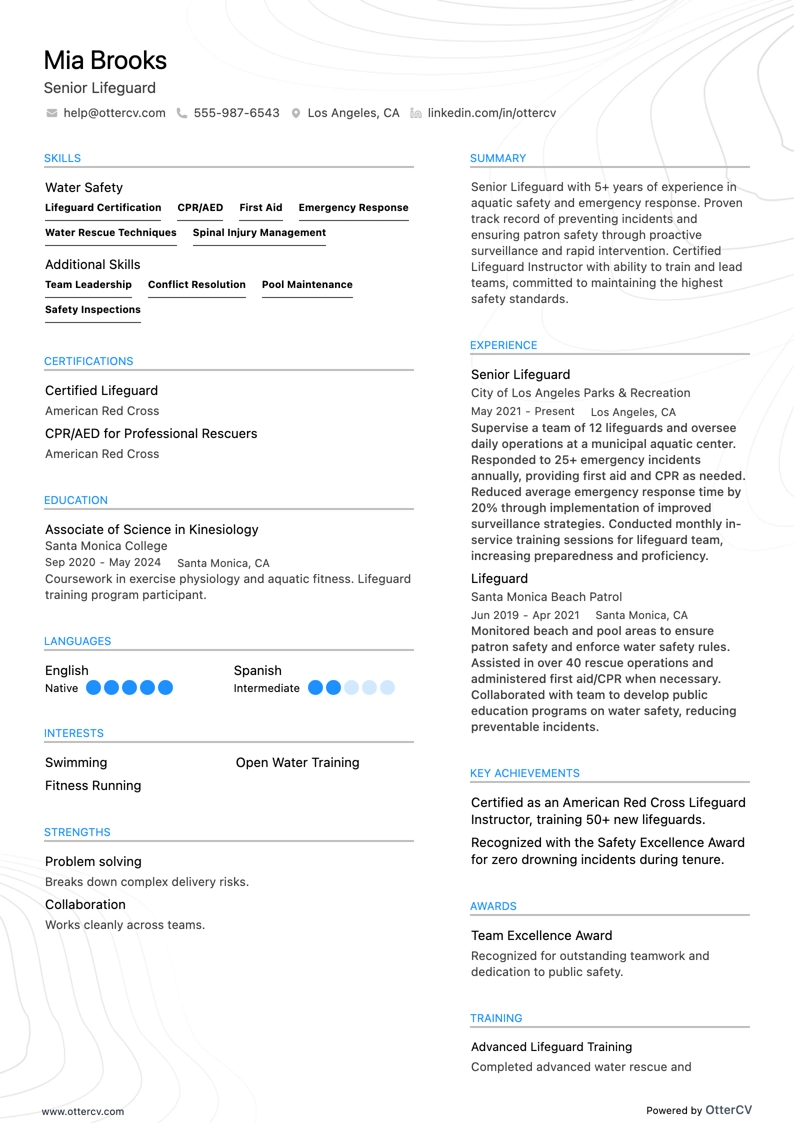
Senior Lifeguard full preview

15 Lifeguard Resume Examples

OtterCV

Written by The OtterCV Team

Updated: 1/9/2024•8 min read

See all resume examples in this guide, or generate your own resume example with your personalized prompt

Senior Lifeguard resume example

Senior Lifeguard

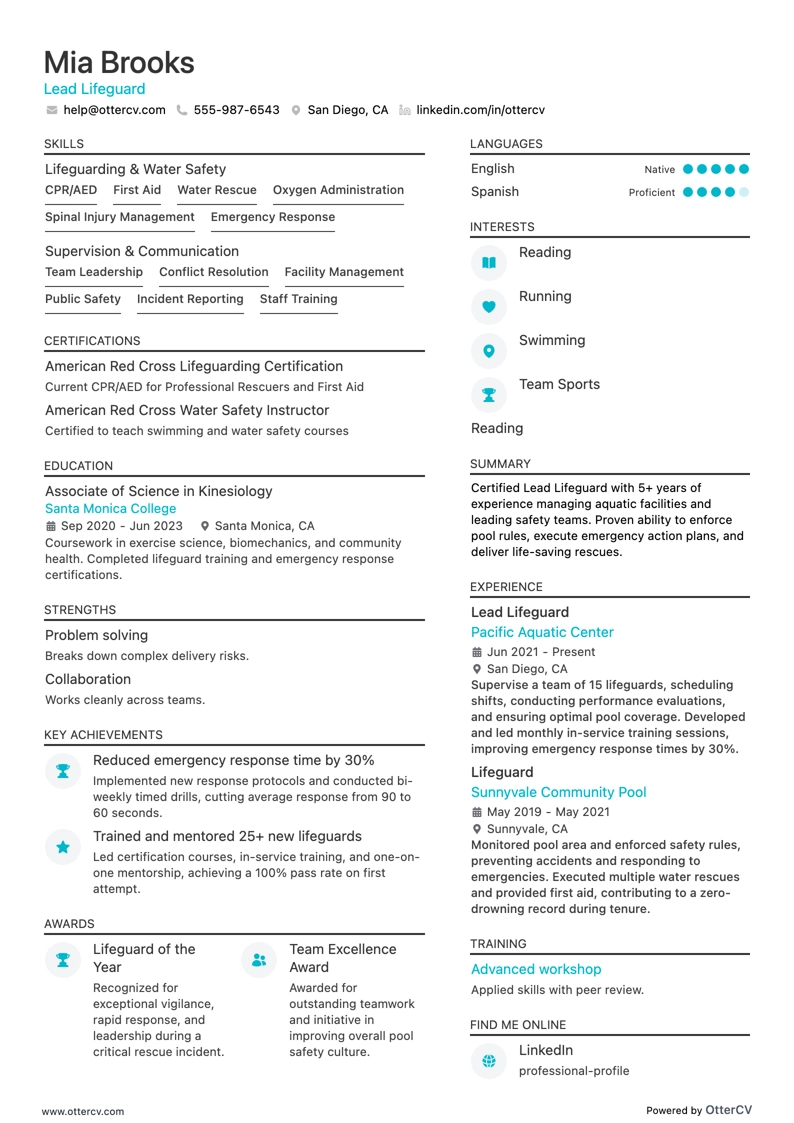
Lead Lifeguard resume example

Lead Lifeguard

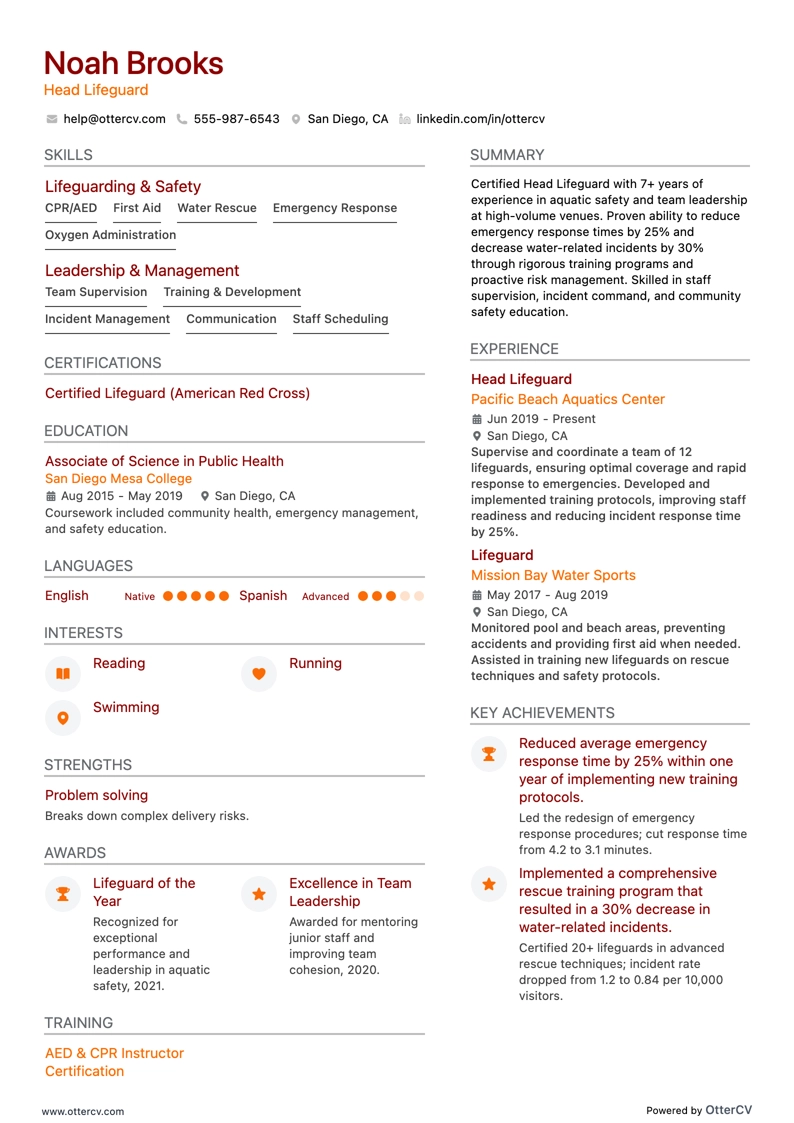
Head Lifeguard resume example

Head Lifeguard

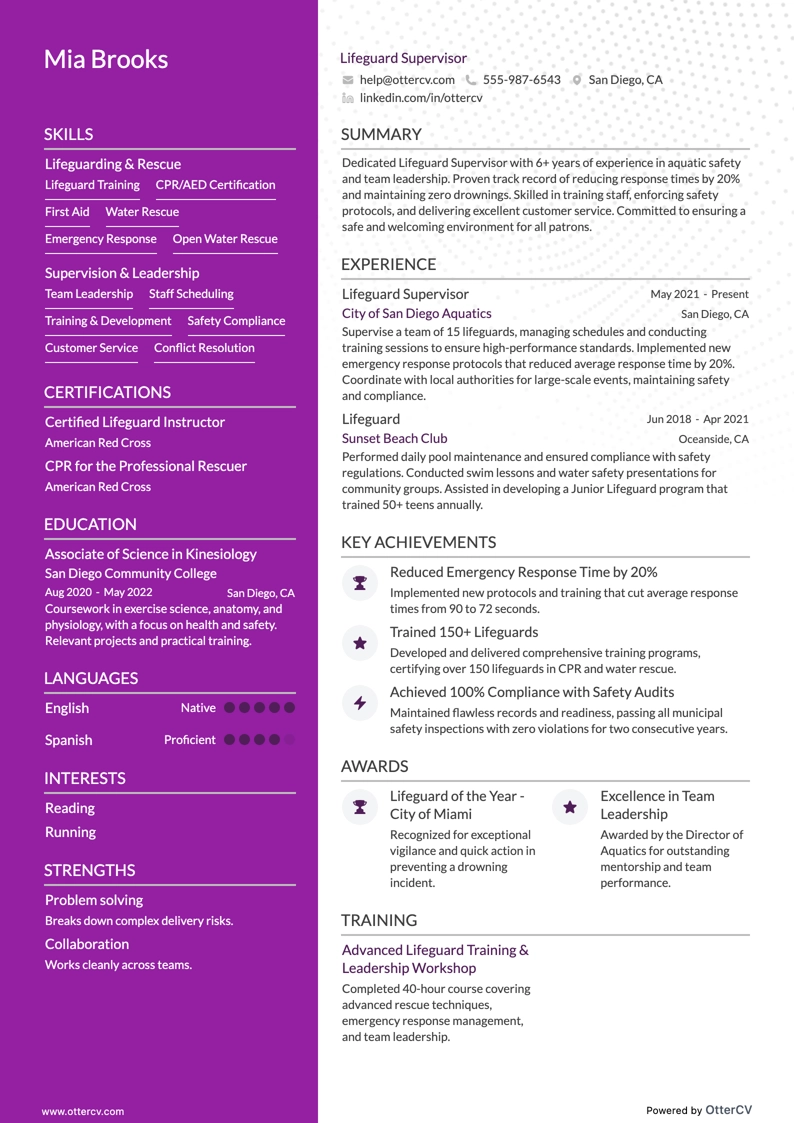
Lifeguard Supervisor resume example

Lifeguard Supervisor

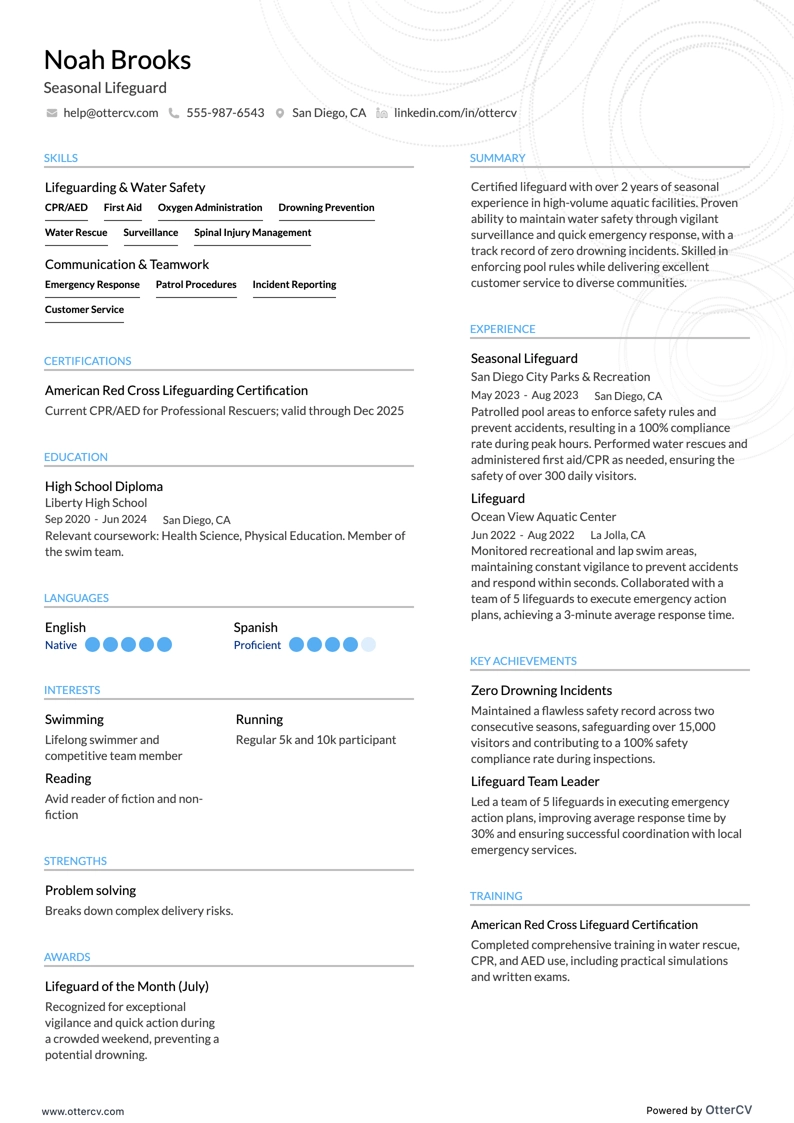
Seasonal Lifeguard resume example

Seasonal Lifeguard

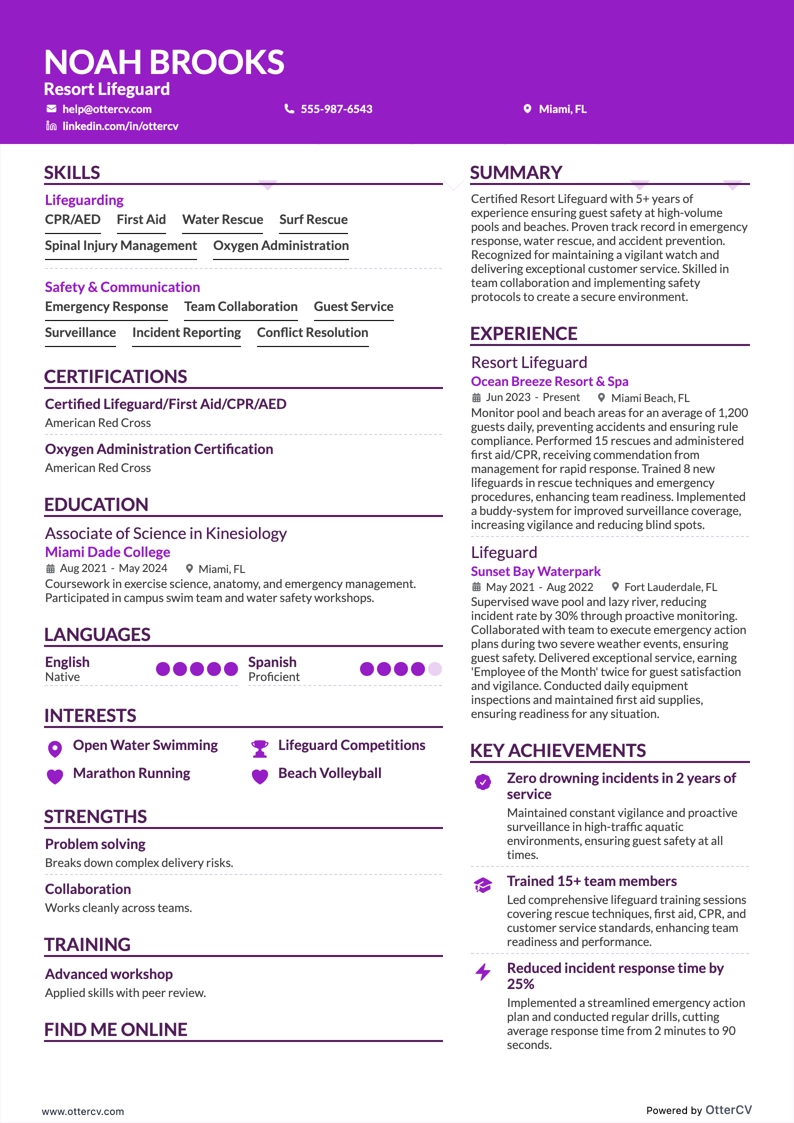
Resort Lifeguard resume example

Resort Lifeguard

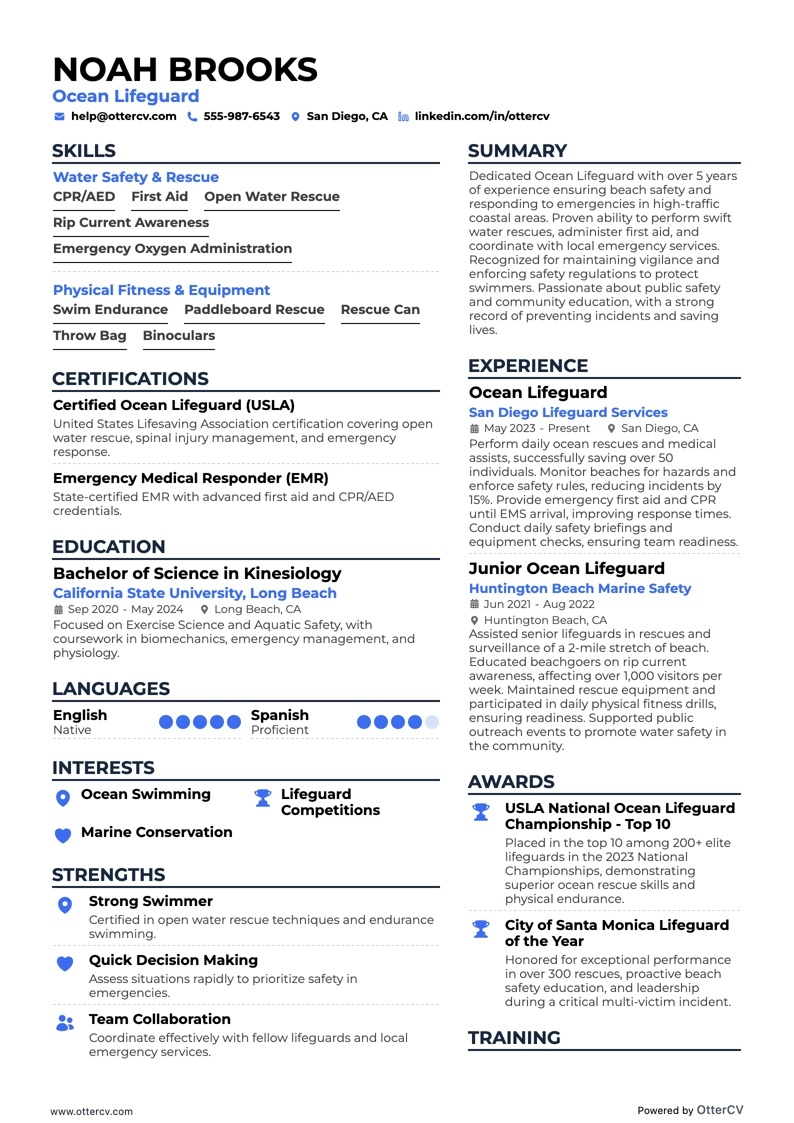
Ocean Lifeguard resume example

Ocean Lifeguard

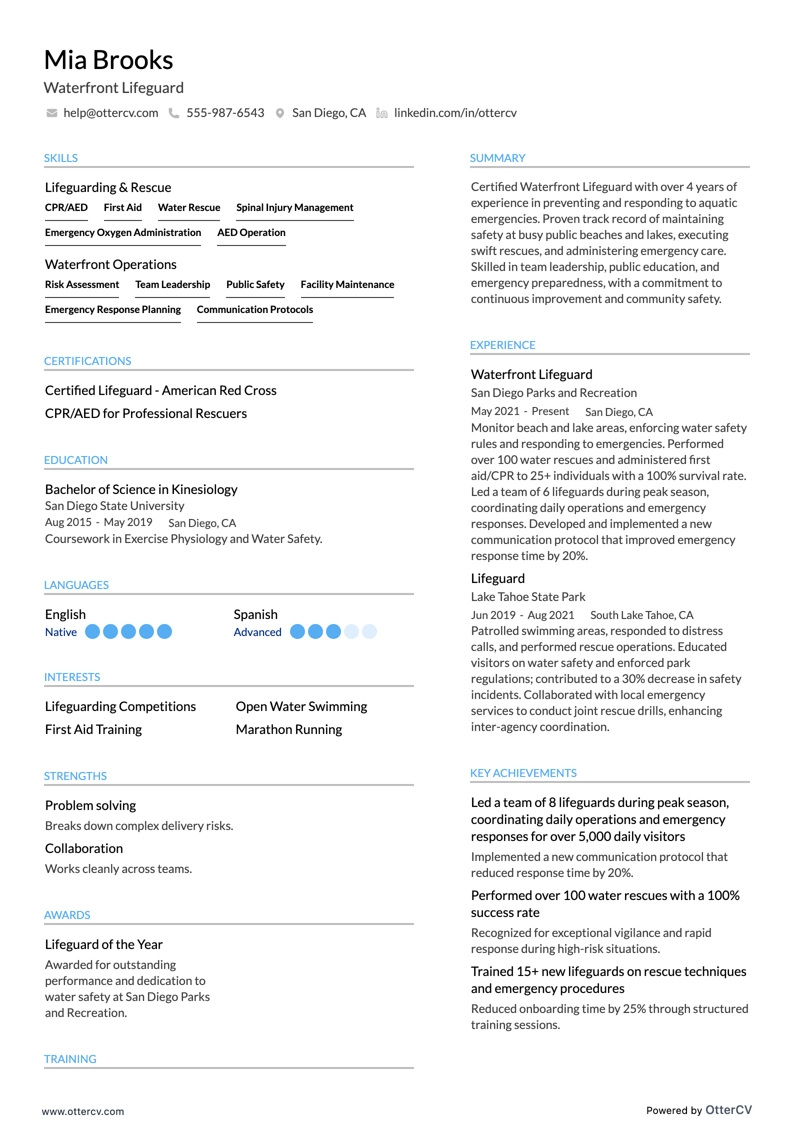
Waterfront Lifeguard resume example

Waterfront Lifeguard

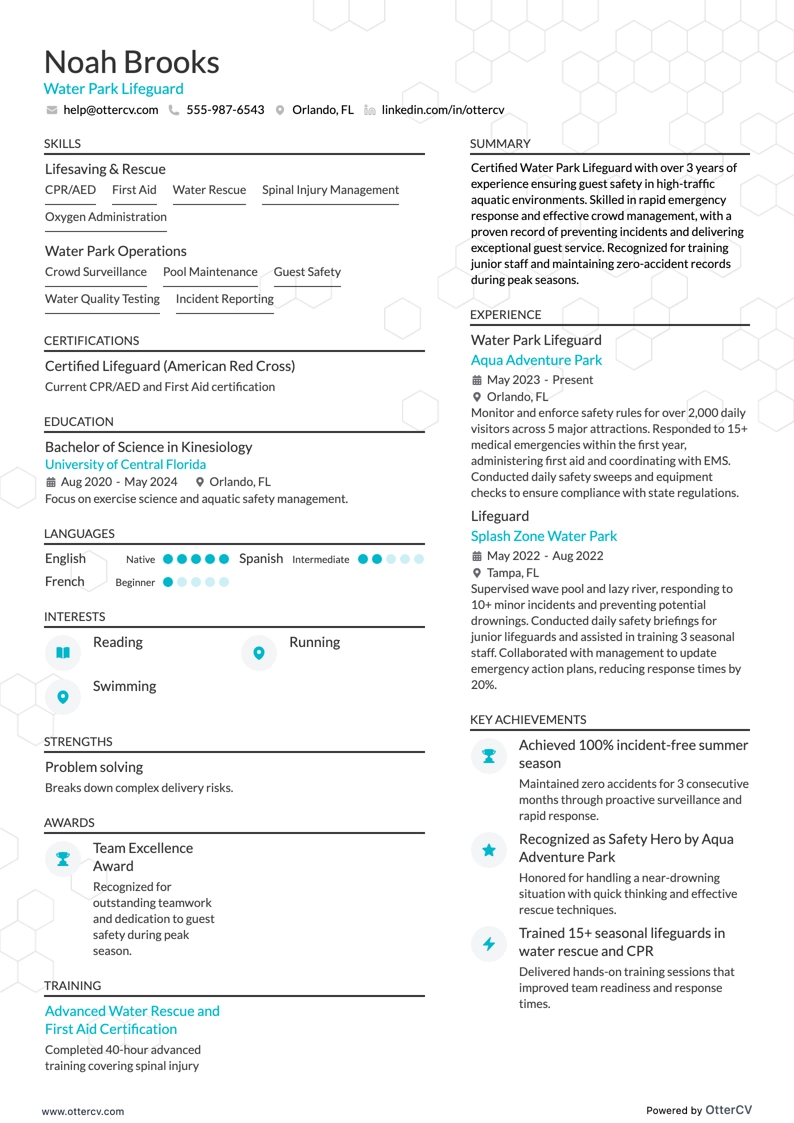
Water Park Lifeguard resume example

Water Park Lifeguard

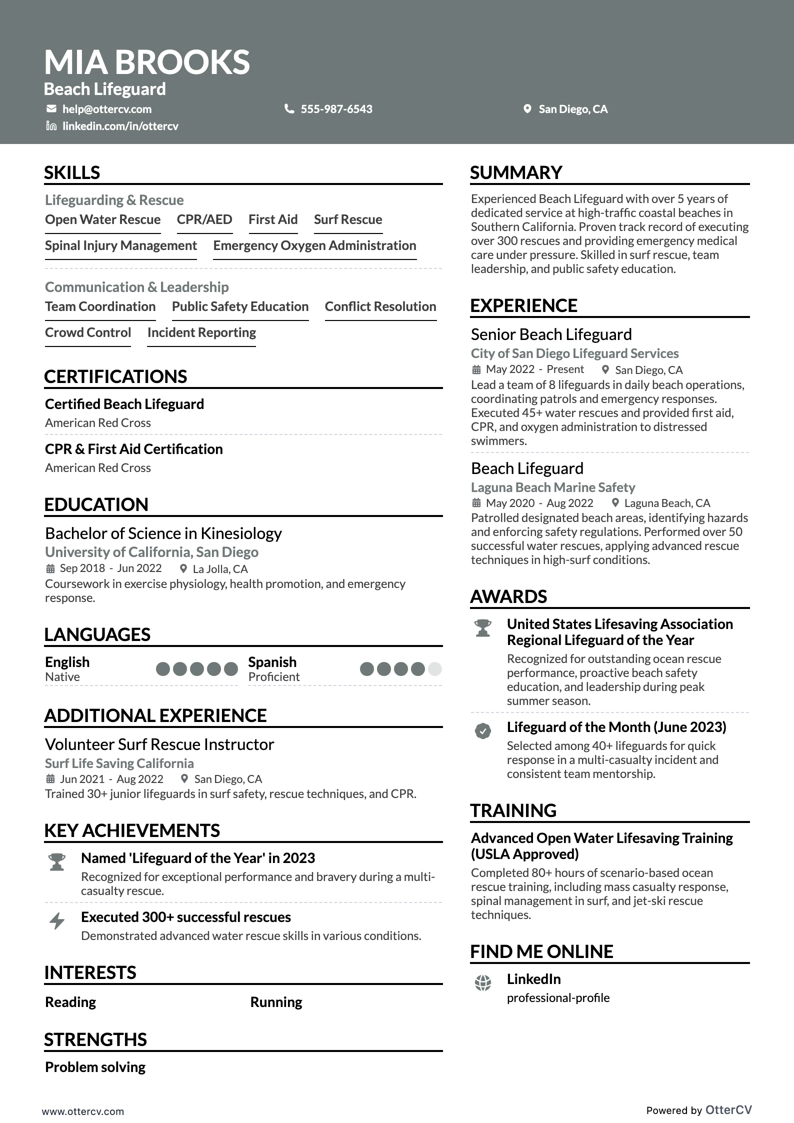
Beach Lifeguard resume example

Beach Lifeguard

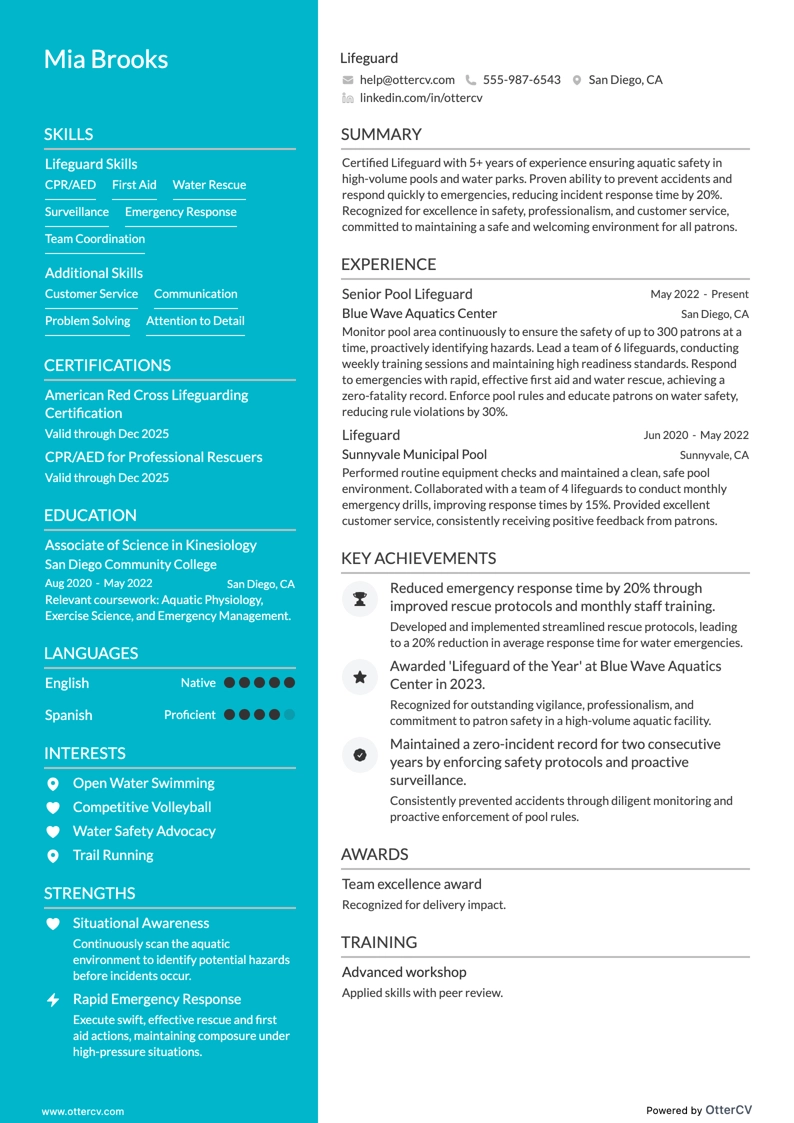
Pool Lifeguard resume example

Pool Lifeguard

Most lifeguard resumes fail because they list certifications and duties without showing that you can perform under pressure. That can cost you interviews when ATS tools screen quickly and recruiters spend only seconds reviewing applications in a crowded pool.

A strong resume emphasizes the results you delivered, not just the equipment or certifications you used. If you want to understand how to make your resume stand out, highlight rescues performed, incidents prevented, swimmers supervised per shift, response times, compliance scores, and how you reduced patron complaints.

Key takeaways

  • Quantify rescues, response times, and patron volumes instead of listing generic lifeguard duties.

  • Use a reverse-chronological format if you have experience, or a hybrid format if you are entering the field.

  • Tailor each experience bullet to match the job posting’s certifications, facility type, and terminology.

  • Place certifications above education when they are recent, required, or more relevant than your degree.

  • Show skills through measurable results in your summary and experience, not just in a skills list.

  • Write a cover letter when the role is competitive or your background needs extra context.

  • Use Echocv’s tools to improve bullet points, then stop editing once your resume reflects your real experience.

Job market snapshot for lifeguards

We analyzed 942 recent lifeguard job ads across major US job boards to show employer expectations, in-demand skills, and regional hotspots at a glance.

What level of experience employers are looking for lifeguards

Years of ExperiencePercentage found in job ads
1–2 years2.7% (25)
3–4 years1.1% (10)
5–6 years0.1% (1)
10+ years26.0% (245)
Not specified70.2% (661)

Lifeguard ads by area of specialization (industry)

Industry (Area)Percentage found in job ads
Healthcare31.8% (300)
Education25.1% (236)
Finance & Banking17.6% (166)
Government10.3% (97)
Manufacturing4.9% (46)
Other3.5% (33)
Retail & E-commerce2.9% (27)

Top companies hiring lifeguards

CompanyPercentage found in job ads
Life Time Fitness8.1% (76)
Department of the Air Force3.2% (30)
Six Flags, Corp.2.9% (27)
Morgan Properties2.8% (26)
City of Aurora, CO2.1% (20)
Salvation Army USA2.1% (20)
State of California1.9% (18)
Great Wolf Resorts, Inc.1.7% (16)
Troon Golf, L.L.C.1.5% (14)
YMCA Metro Atlanta1.5% (14)

Role overview stats

These tables highlight the most common responsibilities and employment types for lifeguard roles. Use them to align your resume with employer expectations and understand how the role is structured across the market.

Day-to-day activities and top responsibilities for a lifeguard

ResponsibilityPercentage found in job ads
First aid64.4% (607)
CPR53.8% (507)
AED28.9% (272)
Swimming20.1% (189)
Lifeguard certification18.0% (170)
Lifeguarding10.3% (97)
Lifeguard9.1% (86)
Lifeguard training8.5% (80)
Customer service6.6% (62)
American Red Cross lifeguard certification5.6% (53)
Pool maintenance4.7% (44)
CPR/AED4.6% (43)

How to format a lifeguard resume

Recruiters hiring lifeguards look first for current certifications, water rescue skills, and hands-on experience in aquatic safety settings. A clean, well-structured resume format helps these qualifications stand out right away and move through an ATS (applicant tracking system) without friction.

I have significant experience in this role—which format should I use?

I have significant experience in this role—which format should I use?

Use a reverse-chronological format to lead with your most recent and most relevant lifeguarding positions.

  • Highlight the scope and ownership of each role, including the facility type, pool or waterfront size, and any team coordination responsibilities.
  • Feature role-specific certifications and skills, such as CPR/AED, lifeguard training (for example, American Red Cross or Ellis & Associates), first aid, oxygen administration, and emergency action plan execution.
  • Quantify outcomes and impact whenever possible, such as response times, incident rates, or patron volumes supervised.

Example bullet: “Maintained a zero-drowning record across three consecutive summer seasons while supervising an outdoor aquatic facility averaging 400+ daily visitors.”

I'm junior or switching into this role—what format works best?

I'm junior or switching into this role—what format works best?

A hybrid resume format works best because it lets you lead with relevant certifications and transferable skills while still showing any work or volunteer history.

  • Place a dedicated skills or certifications section near the top so recruiters immediately see credentials like lifeguard certification, CPR/AED, and first aid.
  • Include relevant projects or transitional experience, such as swim team participation, volunteer water safety instruction, camp counselor duties, or community pool volunteering.
  • Connect every action to a clear result, even in non-lifeguarding roles, to show reliability and responsibility.

Example scaffold: Strong swimming proficiency → completed a 550-yard timed swim and rescue drill during American Red Cross certification → qualified to guard a 50-meter competition pool serving 200+ daily patrons.

Why not use a functional resume?

Why not use a functional resume?

A functional resume removes the timeline and context recruiters need to verify where, when, and how you used your lifeguarding skills, making it harder for them to trust your qualifications.

This format may be acceptable if you are changing careers into lifeguarding, have a gap in your work history, or hold certifications but do not yet have formal paid experience—provided that you connect every listed skill to a specific project, training scenario, or measurable outcome.

Now that you’ve established a clean, readable layout, it’s time to fill each part of your resume with the right content.

What sections should go on a lifeguard resume

Recruiters want to quickly find your certifications, safety training, and proof that you can prevent incidents and respond fast in emergencies. Understanding what to put on a resume is essential, so use this structure for maximum clarity:

  • Header
  • Summary
  • Experience
  • Skills
  • Projects
  • Education
  • Certifications
  • Optional sections: Volunteering, Leadership, Languages

Strong experience bullets should highlight safety outcomes, incident response results, patron volume covered, and measurable improvements in compliance and readiness.

Once you’ve organized the key parts of your resume, the next step is to write your lifeguard resume experience with clear, relevant details that support the rest of your application.

How to write your lifeguard resume experience

Your work experience section should show that you kept swimmers safe, enforced pool or beach protocols, and responded to emergencies quickly and confidently. Hiring managers care more about demonstrated impact, such as rescue outcomes, prevention records, and patron safety, than generic lists of duties.

Each entry should include:

  • Job title
  • Company and location (or remote)
  • Dates of employment (month and year)

Add three to five concise bullet points that explain what you were responsible for, how you carried out the work, and the results you delivered:

  • Ownership scope: the zones, facilities, aquatic programs, or patron groups you were directly responsible for during each shift or season.
  • Execution approach: the surveillance techniques, rescue equipment, first aid certifications, emergency action plans, or communication protocols you used to prevent incidents and respond quickly.
  • Value improved: changes in swimmer safety, incident response times, rule compliance, facility readiness, or risk reduction that resulted from your vigilance and preparation.
  • Collaboration context: how you worked with fellow lifeguards, facility managers, EMS personnel, swim instructors, or local authorities to maintain a safe aquatic environment.
  • Impact delivered: outcomes such as rescue effectiveness, safety record improvements, training contributions, or patron capacity managed, rather than a simple list of daily tasks.

Experience bullet formula

Experience bullet formula

Action verb + technology + what you built or fixed + measurable result

A lifeguard experience example

Head Lifeguard

City Aquatics Center | Austin, TX

2022–Present

High-traffic municipal indoor pool serving 1,200+ swimmers weekly across lap swim, lessons, and open recreation.

  • Led daily zone coverage using the Lifeguard Pro rotation timer and a standardized scan pattern, reducing missed-coverage incidents by 35% and improving average response time by twelve seconds.
  • Administered first aid, oxygen therapy, and automated external defibrillator (AED) care under American Red Cross protocols, supporting 60+ incidents with zero preventable escalations.
  • Conducted weekly in-service drills with aquatics managers and swim instructors, increasing rescue proficiency test pass rates from 82% to 97% and reducing drill completion time by 18%.
  • Implemented a digital incident reporting workflow in Google Forms and Sheets, improving documentation accuracy by 25% and shortening report turnaround from two days to same-day submission.
  • Partnered with facilities and maintenance teams to track chemical readings and water clarity in PoolSync logs, reducing out-of-range closures by 40% and maintaining 98% compliance on health inspections.

Now that you’ve seen what a strong experience section looks like in practice, here’s how to tailor each part to the specific lifeguard role you’re applying for.

How to tailor your lifeguard resume experience

Recruiters review your lifeguard resume through both human screening and applicant tracking systems (ATS). Tailoring your resume to the job description helps your qualifications stand out in both.

Ways to tailor your lifeguard experience:

  • Match the exact certifications and rescue equipment listed in the job posting.
  • Reflect the facility type, such as pool, beach, or waterpark.
  • Use the same terminology for surveillance and scanning techniques mentioned in the listing.
  • Highlight the patron safety and emergency response standards the employer names.
  • Include the specific water rescue methods or first aid protocols they require.
  • Emphasize experience with chemical testing or water quality compliance if it is mentioned.
  • Reference team coordination or shift leadership models described in the posting.
  • Align your enforcement of facility rules with their stated safety policies.

Tailoring means aligning your real accomplishments with what the employer is asking for, not forcing in keywords where they do not belong.

Resume tailoring examples for lifeguard

Job description excerptUntailoredTailored
"Perform water rescues using American Red Cross techniques; maintain constant surveillance of a 50-meter competition pool with up to 200 patrons."Helped keep swimmers safe and responded to emergencies at the pool.Executed water rescues using American Red Cross protocols while maintaining constant surveillance of a 50-meter competition pool, monitoring up to 200 patrons per shift with zero incident escalations over two seasons.
"Enforce facility rules, complete daily chemical testing of chlorine and pH levels, and document results using the StarGuard reporting system."Followed pool rules and helped with maintenance tasks as needed.Enforced facility safety rules for 150+ daily visitors, performed hourly chlorine and pH testing, and documented results in the StarGuard reporting system with 100% compliance during quarterly audits.
"Administer first aid, CPR, and AED procedures; coordinate with EMS during emergencies; hold a valid Ellis & Associates International Lifeguard Training certificate."Certified in lifeguarding and trained to handle medical situations.Administered first aid, CPR, and AED care in three on-duty emergencies, coordinating directly with EMS for rapid patient handoff while maintaining current Ellis & Associates International Lifeguard Training certification.

Once you’ve aligned your experience with the role’s requirements, quantify your lifeguard achievements to show the measurable impact of your work.

How to quantify your lifeguard achievements

Numbers help prove that you kept guests safe, improved readiness, and maintained smooth operations. Focus on risk reduction, response time, compliance, monitored volume, and training outcomes, along with incident prevention and customer satisfaction when those metrics are tracked. Learning how to use numbers on your resume effectively can turn vague duties into clear evidence of impact.

Quantifying examples for lifeguard

MetricExample
Response timeResponded to emergencies in under 60 seconds on average during peak hours, supporting over 300 swimmers per day across three pool zones.
Risk reductionPrevented 25 potential incidents in one summer by enforcing rules, scanning continuously, and documenting interventions in daily safety logs.
ComplianceMaintained 100% compliance across eight unannounced health and safety audits by completing hourly chemical checks and keeping records in a digital log.
Volume handledMonitored an average of 250–400 patrons per shift and rotated stands every 30 minutes to maintain vigilance and reduce fatigue-related errors.
Training impactTrained 12 new lifeguards on rescue protocols and spinal management, raising in-service drill pass rates from 78% to 96% in six weeks.

Once you’ve written strong bullet points for your experience section, the next step is to highlight the hard and soft skills that show you’re qualified to work as a lifeguard.

How to list your hard and soft skills on a lifeguard resume

Your skills section shows that you can prevent incidents and respond quickly. Recruiters scan it to verify certifications and fit for the role, while an ATS (applicant tracking system) checks for relevant keywords. Focus mostly on hard skills, supported by a smaller set of role-specific soft skills.

Lifeguard roles require a blend of:

  • Product strategy and discovery skills.
  • Data, analytics, and experimentation skills.
  • Delivery, execution, and go-to-market discipline.
  • Soft skills.

Your skills section should be:

  • Scannable with bullet-style grouping.
  • Relevant to the job post.
  • Backed by proof in your experience bullets.
  • Updated with current tools.

Place your skills section:

  • Above your experience section if you’re junior or switching careers.
  • Below your experience section if you’re mid- or senior-level with strong achievements.

Hard skills

  • American Red Cross lifeguarding.
  • Cardiopulmonary resuscitation (CPR) and automated external defibrillator (AED) use.
  • First aid and emergency oxygen administration.
  • Water rescue techniques.
  • Spinal injury management.
  • Patron surveillance and scanning.
  • Pool chemical testing and water balance.
  • Incident reporting and documentation.
  • Emergency action plan execution.
  • Radio communication protocols.
  • Facility safety inspections.
  • Swim instruction fundamentals.

Soft skills

  • Enforce rules consistently.
  • Give clear safety warnings.
  • De-escalate patron conflicts.
  • Make rapid risk decisions.
  • Stay alert during long shifts.
  • Coordinate rescues with a team.
  • Lead emergency response calmly.
  • Communicate clearly with parents and staff.
  • Coach patrons on safe behavior.
  • Take ownership of zone coverage.
  • Document incidents objectively.
  • Adapt to changing crowd conditions.

How to show your lifeguard skills in context

Skills should not appear only in a bulleted list on your resume. Browse examples of resume skills to see how other professionals present their abilities effectively.

Your skills should be demonstrated in:

  • Your summary (high-level professional identity)
  • Your experience (proof through outcomes)

Here’s how that looks in practice.

Senior lifeguard with eight years of waterfront and pool experience. Skilled in emergency response, EAP coordination, and staff training. Reduced incident response times by 30% through revised surveillance rotations and proactive hazard assessments.

  • Clearly reflects senior-level expertise
  • Mentions role-specific tools and methods
  • Includes a measurable performance outcome
  • Highlights leadership as a soft skill

Senior Lifeguard

Coral Bay Aquatic Center | Tampa, FL

June 2019–August 2024

  • Supervised a team of 12 guards using zone coverage strategies, reducing response times by 25% across three pool areas.
  • Led more than 200 rescue drills and CPR recertification sessions, maintaining a 100% team compliance rate throughout the year.
  • Worked with facility management to implement a digital incident-reporting system, cutting paperwork errors by 40%.
  • Every bullet contains measurable proof.
  • Skills appear naturally through real outcomes.

Once you’ve shown your lifeguard strengths with specific, real-world examples, the next step is using that same strategy to build a lifeguard resume when you don’t have formal experience.

How do I write a lifeguard resume with no experience

Even without full-time experience, you can still show readiness through:

  • American Red Cross lifeguard certification
  • Swim team or coaching volunteer work
  • Pool deck attendant shifts
  • Water safety course completion
  • First aid and CPR training
  • Community pool event staffing
  • Emergency action plan drills

If you're building a resume without work experience, focus on:

  • Certifications with expiration dates
  • Safety procedures and documented drills
  • Customer-facing roles with metrics
  • Schedule reliability and shift coverage

Resume format tip for entry-level lifeguard

Resume format tip for entry-level lifeguard

Use a skills-based resume format because it highlights certifications, training, and safety procedures before limited work history.

Do:

  • Put certifications at the top.
  • List training hours and completion dates.
  • Add safety projects with measurable results.
  • Include availability and shift types.
  • Use action verbs and numbers.

Example project bullet:

  • Led three emergency action plan drills using rescue tube and whistle protocols, cutting average response time by 20 seconds, verified by instructor timing logs.

Once you’ve structured your resume around transferable skills and relevant training, make sure your education section also reinforces your qualifications.

How to list your education on a lifeguard resume

Your education section helps hiring teams confirm you have foundational knowledge in areas such as safety, health, and physical fitness that support a lifeguard role.

Include:

  • Degree name
  • Institution
  • Location
  • Graduation year
  • Relevant coursework, for juniors or entry-level candidates
  • Honors and GPA, if 3.5 or higher

Skip the month and day, and list the graduation year only.

Here’s a strong education entry tailored for a lifeguard resume.

Example education entry

Bachelor of Science in Kinesiology

University of Central Florida, Orlando, FL

Graduated 2023

GPA: 3.7

  • Relevant coursework: Exercise Physiology, Emergency Health Services, Aquatic Safety Management, Human Anatomy
  • Honors: Dean's List (six consecutive semesters), Magna Cum Laude

How to list your certifications on a lifeguard resume

Certifications on your resume show your commitment to learning, your proficiency with safety tools, and your up-to-date relevance in the lifeguard field. They also help employers confirm that you meet facility, insurer, and local requirements.

Include the following details:

  • Certificate name
  • Issuing organization
  • Year
  • Optional: credential ID or URL
  • Place certifications below education when your degree is recent and directly relevant, and your certifications are older or expected for entry-level lifeguard roles.
  • Place certifications above education when they are recent, job-critical, or required in the lifeguard job posting, especially if your education is older or unrelated.

Best certifications for your lifeguard resume

  • American Red Cross Lifeguarding certification.
  • American Red Cross CPR/AED for Professional Rescuers certification.
  • American Red Cross First Aid certification.
  • American Red Cross Waterfront Skills certification.
  • YMCA Lifeguard Certification.
  • National Swimming Pool Foundation Certified Pool Operator certification.

Once your safety credentials are easy for hiring managers to verify, focus on your lifeguard resume summary so those qualifications stand out right away.

How to write your lifeguard resume summary

Your resume summary is often the first part a recruiter reads. A strong opening should quickly match your skills and experience to what the hiring manager needs.

Keep it to three to four lines and include:

  • Your title and total years of lifeguarding experience.
  • The setting where you have worked, such as pools, beaches, or water parks.
  • Core certifications and skills, including CPR, AED, first aid, and water rescue.
  • One or two measurable achievements that show your impact.
  • Soft skills connected to real results, such as communication that improved emergency response.

PRO TIP

At the entry level, emphasize certifications, relevant training, and any early wins from your first roles. Highlight specific skills such as surveillance techniques or rescue proficiency.

Avoid vague phrases like "passionate team player" or "hardworking individual." Instead, use concrete details that show what you actually did.

Example summary for a lifeguard

Certified lifeguard with two years of experience at high-traffic municipal pools. Skilled in CPR, AED, and water rescue. Maintained a zero-incident record across three summer seasons while supervising up to 200 swimmers per day.

Once your summary explains the value you bring as a lifeguard, make sure the header above it clearly shows your contact details so hiring managers can reach you.

What to include in a lifeguard resume header

A resume header includes your key contact details and role, helping your lifeguard application stand out with clear visibility, credibility, and faster recruiter screening.

Essential resume header elements

  • Full name
  • Tailored job title and headline
  • Location
  • Phone number
  • Professional email
  • GitHub link
  • Portfolio link
  • LinkedIn

A LinkedIn link helps recruiters verify experience quickly and supports screening.

Don't include a photo on a lifeguard resume unless the role is explicitly front-facing or appearance-dependent.

Keep your header to one or two lines, use a lifeguard-specific title, and make sure your contact details match across every platform.

Example

Jordan Rivera

Lifeguard | American Red Cross Certified | Pool and Waterfront Safety

San Diego, CA

(619) 555-01XX | your.name@echocv.com | github.com/yourname | yourwebsite.com | linkedin.com/in/yourname

Once your contact details and role-specific identifiers are clear at the top, you can strengthen your application with additional sections that provide relevant context and support your qualifications.

Additional sections for lifeguard resumes

Extra sections can help you stand out when other candidates have similar certifications and experience. They highlight strengths that matter in aquatic safety. For example, listing language skills on your resume can be especially useful at facilities that serve diverse communities.

  • Languages
  • Hobbies and interests
  • Volunteer experience
  • Awards and achievements
  • Professional affiliations
  • Continuing education

Once you’ve strengthened your resume with relevant additional sections, pairing it with a cover letter can give hiring managers more context about your qualifications.

Do lifeguard resumes need a cover letter

A cover letter is not required for a lifeguard role, but it can help when positions are competitive or employers expect one. If you are unsure where to begin, learn what a cover letter is and how it can help when your resume needs more context or when you want to stand out in a crowded hiring pool.

Use a cover letter to add details your resume cannot:

  • Explain why you are a good fit for the lifeguard team, including your shift availability, experience with different facility types, and your approach to enforcing rules with empathy and consistency.
  • Highlight one or two outcomes, such as reducing incident response time, improving patron compliance, or supporting a successful safety audit or in-service training.
  • Show that you understand the facility’s users and priorities, such as families, lap swimmers, camps, or events, and how that affects prevention and communication.
  • Address transitions or less obvious experience, such as moving from swim instruction, coaching, or EMS, and connect that background to lifeguard readiness.

Using AI to improve your lifeguard resume

Even if you skip a cover letter and let your resume carry the application, AI can help you sharpen the details and align your lifeguard resume with what employers expect.

AI can improve your resume's clarity, structure, and impact. It can refine bullet points, tighten language, and highlight relevant lifeguard skills. But overusing it can make your resume feel less authentic. Once your content is clear and aligned with the role, step away from AI. If you need a place to start, explore ChatGPT resume writing prompts for practical ideas.

Here are 10 practical prompts you can copy and paste to strengthen specific sections of your lifeguard resume:

  1. Sharpen your summary: "Rewrite my lifeguard resume summary to emphasize water safety expertise and emergency response skills in under three sentences."
  2. Quantify rescue experience: "Add measurable outcomes to my lifeguard experience bullets, such as patron counts, response times, or incident reductions."
  3. Improve skills relevance: "Review my lifeguard skills section and remove generic entries. Replace them with role-specific abilities like surveillance or CPR."
  4. Strengthen action verbs: "Replace weak verbs in my lifeguard experience bullets with strong, specific action verbs tied to safety and rescue duties."
  5. Tailor to the posting: "Align my lifeguard resume experience section with this job description. Prioritize matching responsibilities and required qualifications."
  6. Clarify certifications: "Format my lifeguard certifications section clearly, listing each credential's full name, issuing organization, and expiration date."
  7. Refine education details: "Edit my education section to highlight coursework or training directly relevant to my lifeguard role, like aquatic science."
  8. Tighten bullet structure: "Rewrite my lifeguard experience bullets using a consistent structure: action verb, task, and result."
  9. Highlight leadership projects: "Reframe my lifeguard projects or volunteer work to show leadership, initiative, and team coordination at aquatic facilities."
  10. Cut filler language: "Remove vague or redundant phrasing from my lifeguard resume. Keep every sentence specific, concise, and duty-focused."

Stop using AI once your resume sounds accurate, specific, and aligned with your real experience. AI should never invent experience or inflate claims—if it didn't happen, it doesn't belong here.

Conclusion

A strong lifeguard resume should be clear, specific, and easy to scan. It should highlight measurable outcomes, role-specific skills, and key certifications while showing that you can prevent incidents, respond quickly, and support a safe, well-run facility.

Use a clean structure that hiring teams can review quickly. Lead with results, then support them with skills such as surveillance, rescues, first aid, and customer service. This approach shows that you are prepared for today’s hiring market and near-future expectations.

Lifeguard resume examples

Explore additional Lifeguard resume samples and guides and see what works for your level of experience or role.

By Experience

Senior Lifeguard

Senior Lifeguard resume preview

Lead Lifeguard

Lead Lifeguard resume preview

Head Lifeguard

Head Lifeguard resume preview

Lifeguard resume examples

Explore additional Lifeguard resume samples and guides and see what works for your level of experience or role.

By Role

Lifeguard Supervisor

Lifeguard Supervisor resume preview

Seasonal Lifeguard

Seasonal Lifeguard resume preview

Resort Lifeguard

Resort Lifeguard resume preview

Ocean Lifeguard

Ocean Lifeguard resume preview

Waterfront Lifeguard

Waterfront Lifeguard resume preview

Water Park Lifeguard

Water Park Lifeguard resume preview

Beach Lifeguard

Beach Lifeguard resume preview

Pool Lifeguard

Pool Lifeguard resume preview