Senior Lecturer full preview

10 Lecturer Resume Examples

OtterCV

Written by The OtterCV Team

Updated: 7/2/2024•8 min read

See all resume examples in this guide, or generate your own resume example with your personalized prompt

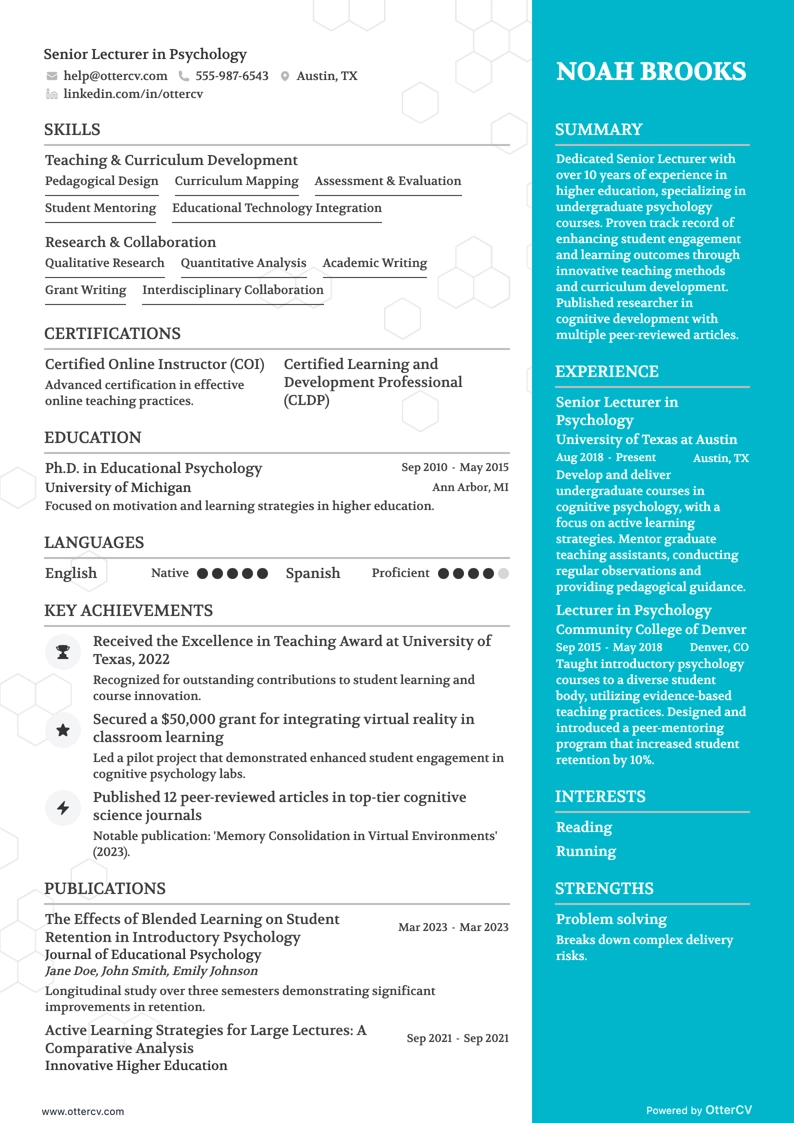
Senior Lecturer resume example

Senior Lecturer

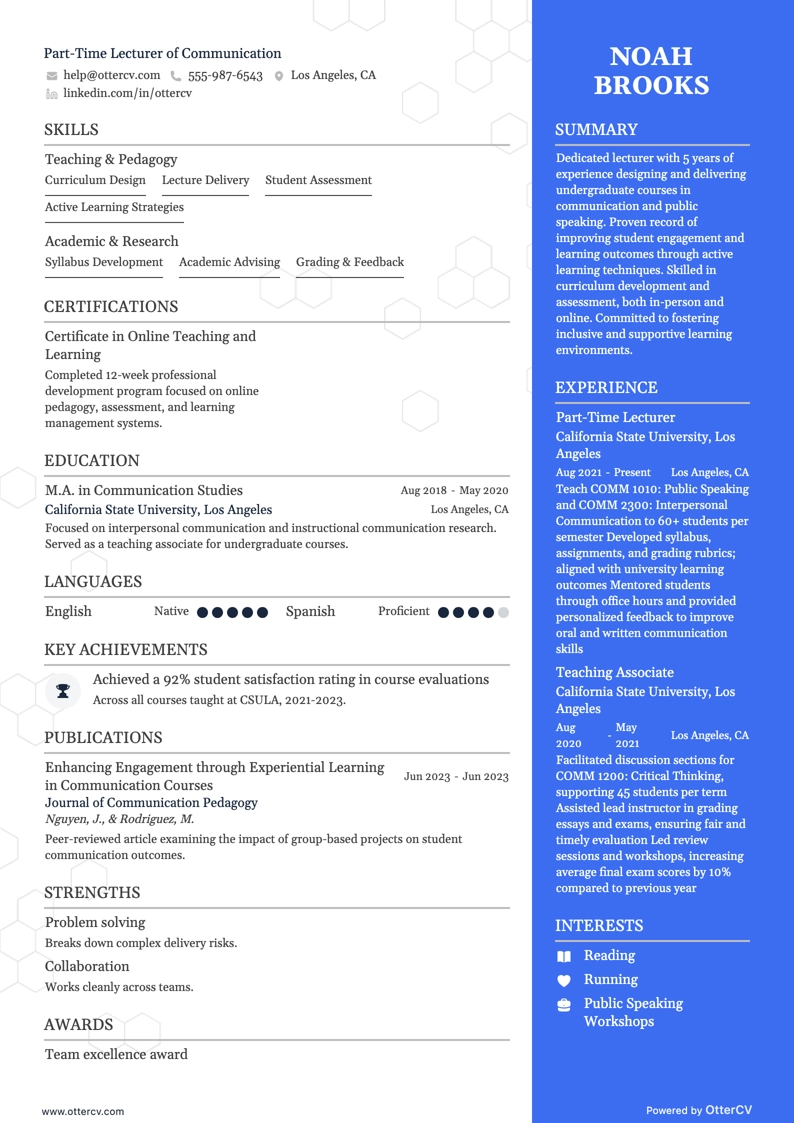
Part-Time Lecturer resume example

Part-Time Lecturer

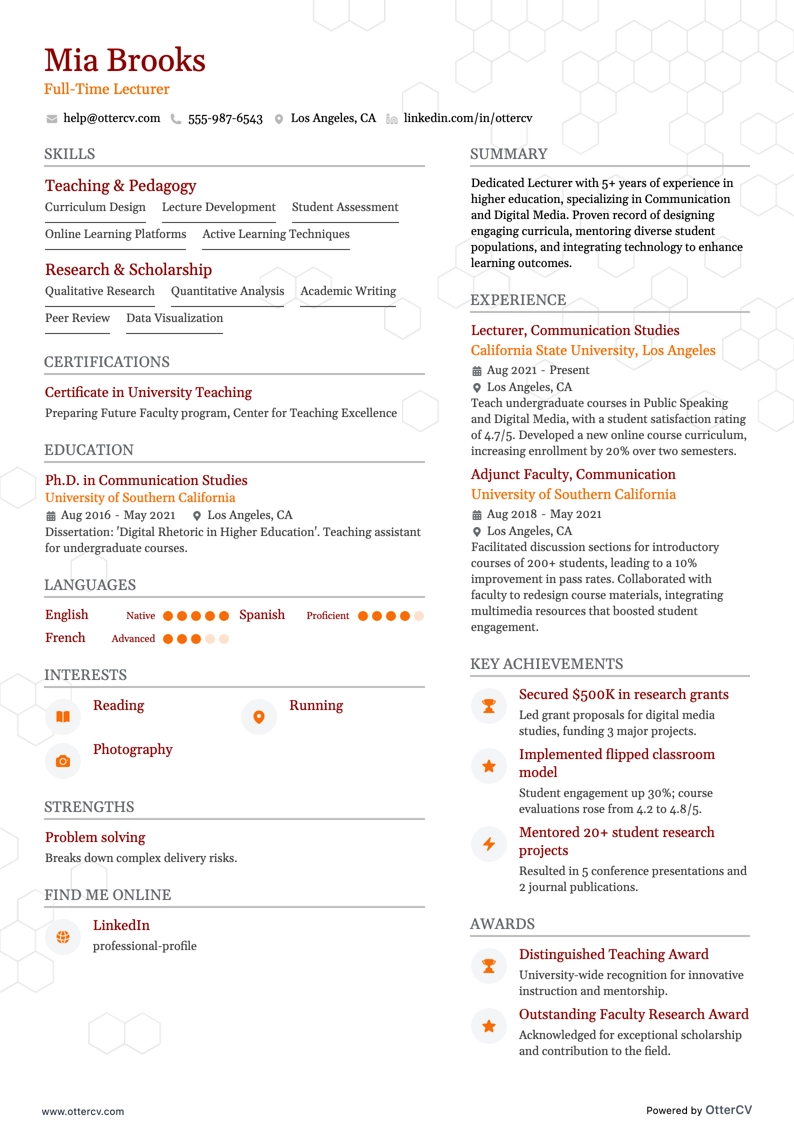
Full-Time Lecturer resume example

Full-Time Lecturer

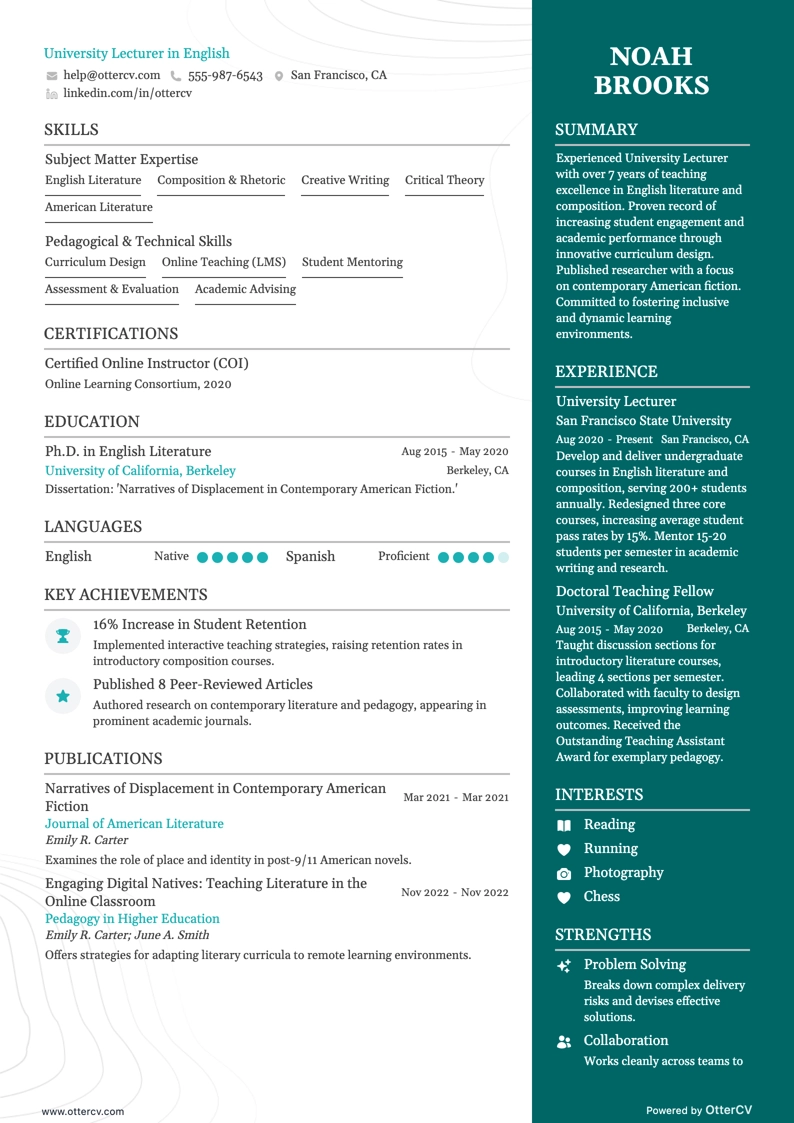
University Lecturer resume example

University Lecturer

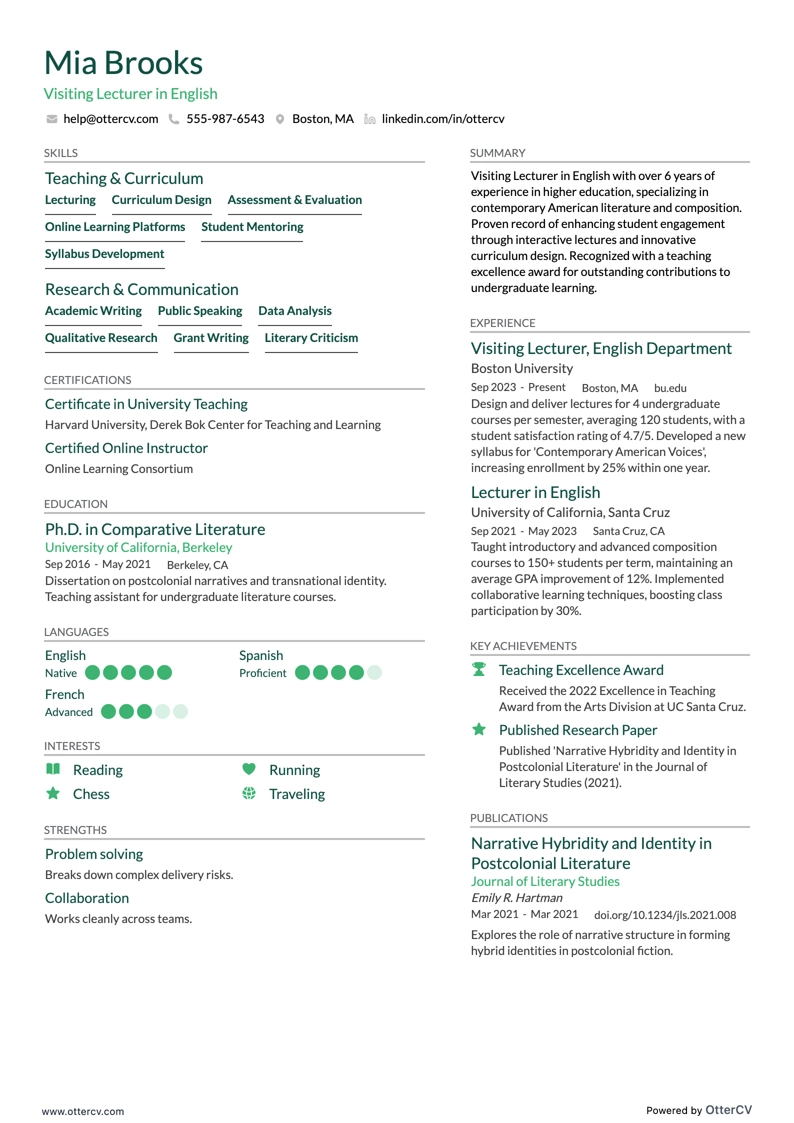
Visiting Lecturer resume example

Visiting Lecturer

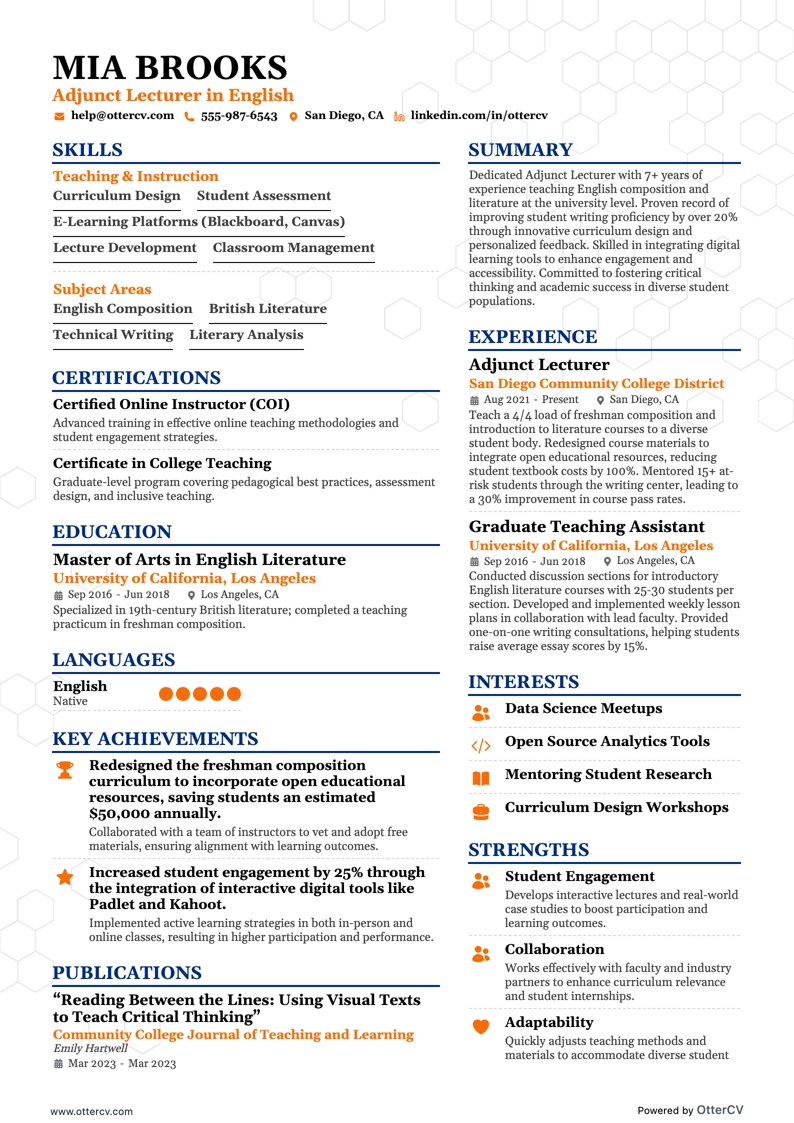
Adjunct Lecturer resume example

Adjunct Lecturer

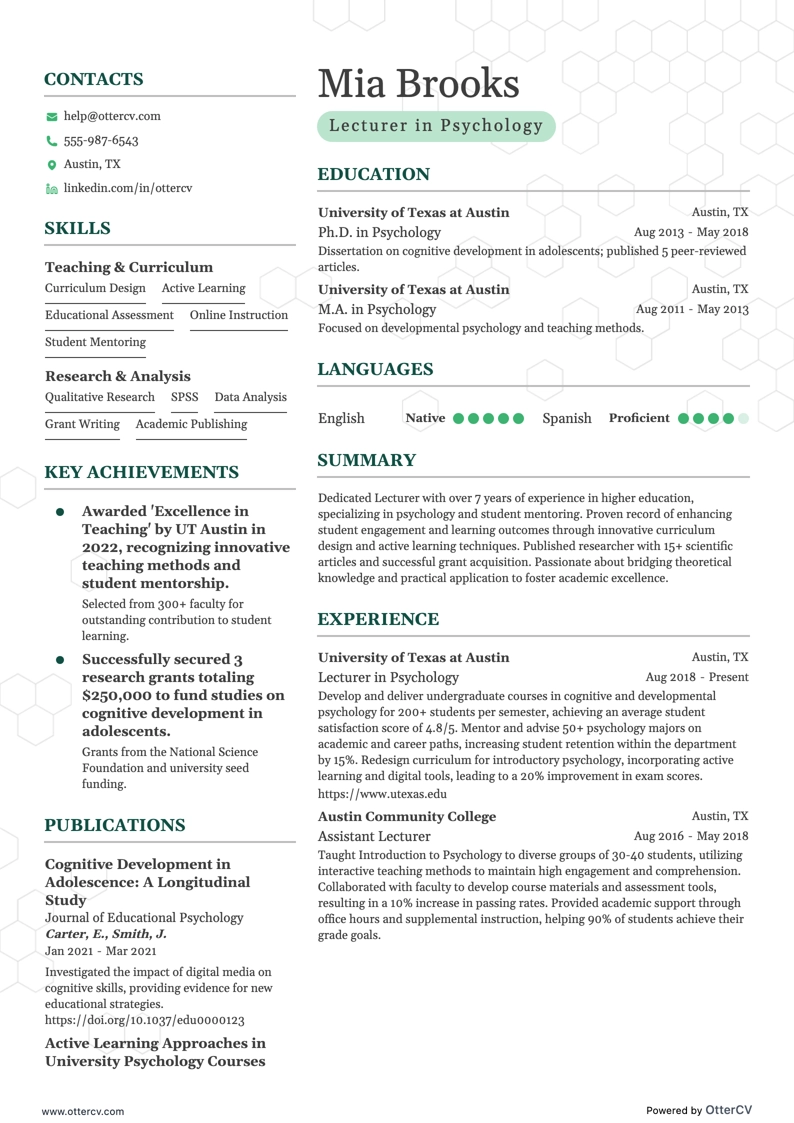
Lecturer resume example

Lecturer

Many lecturer resumes fall short because they read like job descriptions, burying teaching impact beneath long course lists and generic responsibilities. In competitive faculty searches, that kind of format can be filtered out by ATS software or overlooked in a quick recruiter scan.

A strong resume emphasizes outcomes and academic value. To understand how to make your resume stand out, focus on student success gains, course redesign results, evaluation scores, retention improvements, published or funded work, cohort size, and teaching impact across delivery modalities. Support your strengths with assessment results, peer reviews, and program contributions.

Key takeaways

  • Quantify teaching impact with pass rates, retention gains, and evaluation scores in every bullet.

  • Use a reverse-chronological format for experienced lecturers and a hybrid format for career switchers.

  • Mirror the job posting’s exact terminology for tools, methods, and accreditation standards.

  • Tie every listed skill to a measurable outcome in your experience or summary.

  • Lead your summary with subject expertise, years of experience, and one concrete achievement.

  • Echocv can help turn vague teaching duties into specific, recruiter-ready resume bullets.

  • Add a cover letter when the posting requires teaching-philosophy alignment or your fit needs context.

Job market snapshot for lecturers

We analyzed 765 recent lecturer job ads across major US job boards to give you a quick view of experience requirements, salary trends, and overall industry demand.

What level of experience employers are looking for lecturers

Years of ExperiencePercentage found in job ads
1–2 years1.3% (10)
3–4 years1.2% (9)
5–6 years2.2% (17)
7–8 years0.4% (3)
9–10 years0.1% (1)
10+ years0.3% (2)
Not specified94.5% (723)

Lecturer ads by area of specialization (industry)

Industry (Area)Percentage found in job ads
Education91.8% (702)
Healthcare3.3% (25)
Finance & Banking3.0% (23)
Government1.8% (14)

Top companies hiring lecturers

CompanyPercentage found in job ads
Union County College13.3% (102)
University of Houston6.3% (48)
California State University System4.7% (36)
University of Hawaii System4.2% (32)
Princeton University2.7% (21)
Cuyahoga Community College (Tri-C)2.6% (20)
Indiana University2.5% (19)
University of Texas Rio Grande Valley2.1% (16)
Northeastern University2.0% (15)
University of Toronto1.8% (14)

Role overview stats

These tables outline the most common responsibilities and employment types for lecturer roles. Use them to align your resume with employer expectations and understand how the role is structured across the market.

Day-to-day activities and top responsibilities for a lecturer

ResponsibilityPercentage found in job ads
Information technology13.7% (105)
Competency-based education12.4% (95)
Teaching10.7% (82)
Canvas4.1% (31)
Chemistry3.5% (27)
Curriculum development3.5% (27)
Online teaching3.4% (26)
Organic chemistry2.6% (20)
Microsoft suite2.4% (18)
Biology2.1% (16)
Learning management systems2.1% (16)
Computing2.0% (15)

Type of employment (remote vs on-site vs hybrid)

Employment typePercentage found in job ads
On-site78.2% (598)
Hybrid16.3% (125)
Remote5.5% (42)

How to format a lecturer resume

Recruiters hiring for lecturer positions prioritize teaching experience, subject-matter expertise, and evidence of student engagement or curriculum development. A clear, well-structured resume format helps make these strengths immediately visible instead of hiding them beneath generic skill lists or inconsistent formatting.

I have significant experience in this role—which format should I use?

I have significant experience in this role—which format should I use?

Use a reverse-chronological format to emphasize your most recent and most relevant teaching appointments, so your classroom experience is clear right away.

  • Highlight the scope and ownership of your teaching responsibilities, including course loads, class sizes, and departmental committee roles.
  • Feature subject-specific expertise, learning management systems such as Blackboard, Canvas, or Moodle, and pedagogical methods relevant to your discipline.
  • Quantify outcomes tied to student success, curriculum improvements, or program-level contributions.

Example bullet: “Redesigned the introductory biology curriculum for a 400-student lecture series, increasing average student pass rates by 18% over two academic years.”

I'm junior or switching into this role—what format works best?

I'm junior or switching into this role—what format works best?

A hybrid format works well if you have limited formal lecturing experience but bring relevant skills in instruction, research, or academic support.

  • Place a focused skills section near the top to highlight teaching competencies, subject expertise, and educational technology proficiency.
  • Include adjunct teaching, guest lectures, tutoring, graduate teaching assistantships, or relevant training roles as transitional experience.
  • Connect each action to a clear outcome so reviewers can see your readiness for classroom responsibilities.

Example scaffold: Curriculum design (skill) → developed and delivered a five-week supplemental workshop series for undergraduate statistics students (action) → improved cohort exam scores by 12% compared to the previous semester (result).

Why not use a functional resume?

Why not use a functional resume?

A functional resume removes the timeline and institutional context that hiring committees use to assess your teaching progression and subject credibility.

It may be considered only in limited situations:

  • You're transitioning from industry into academia and need to present professional expertise as teaching-relevant competencies.
  • You have significant gaps between academic appointments but continued developing curricula, publishing, or delivering professional training during that time.

Even in these cases, a functional format can raise concerns about continuity and commitment, so avoid it if you have any consistent teaching or academic record to show. Any skills listed should still be tied to specific projects, courses, or measurable student outcomes to maintain credibility with reviewers.

Once your resume has a clean, readable format, the next step is adding the right sections to present your qualifications effectively.

What sections should go on a lecturer resume

Recruiters expect a lecturer resume to show teaching impact, academic credibility, and student outcomes at a glance. Knowing which resume sections to include helps keep it clear and easy to scan.

Use this structure for maximum clarity:

  • Header
  • Summary
  • Experience
  • Skills
  • Projects
  • Education
  • Certifications
  • Optional sections: Publications, Research, Awards

Strong experience bullet points should highlight measurable teaching results, course scope, curriculum improvements, and student success outcomes.

Once you’ve organized the key parts of your resume, the next step is to write your lecturer experience section so it supports the rest of your application.

How to write your lecturer resume experience

Your experience section should show the meaningful work you’ve done as a lecturer through the teaching methods you’ve used, the curricula you’ve developed, and the measurable results achieved by your students and institution. Hiring managers and academic committees care more about demonstrated impact than task lists, so each line should connect your work to a result that mattered. Building a targeted resume helps ensure every entry matches what the hiring committee wants to see.

Each entry should include:

  • Job title
  • Company and location, or remote
  • Dates of employment, including month and year

Add three to five concise bullet points that explain what you owned, how you executed the work, and the outcomes you delivered.

  • Ownership scope: the courses, academic programs, research initiatives, student cohorts, or departmental functions you were directly responsible for as a lecturer.
  • Execution approach: the pedagogical frameworks, learning management systems, assessment strategies, or instructional technologies you used to design and deliver instruction.
  • Value improved: changes in student learning outcomes, course completion rates, curriculum quality, program accreditation standing, or institutional research output tied to your teaching and scholarly work.
  • Collaboration context: how you worked with faculty colleagues, academic advisors, administrative leadership, industry partners, or accreditation bodies to support departmental and institutional goals.
  • Impact delivered: outcomes shown through student achievement, program growth, grant acquisition, publication contributions, or institutional recognition rather than routine teaching duties.

Experience bullet formula

Experience bullet formula

Action verb + technology + what you built or fixed + measurable result

A lecturer experience example

Lecturer, Computer Science

Riverview University | Austin, TX

2021–Present

Public research university serving twenty-five thousand students with a focus on industry-aligned computing programs.

  • Designed and delivered eight courses per year in data structures, databases, and software engineering using Canvas learning management system, active learning, and backward design; increased average course pass rates from 84 percent to 92 percent across six sections.
  • Built an automated grading pipeline with Gradescope and Python; cut turnaround time from seven days to forty-eight hours and reduced regrade requests by 31 percent.
  • Implemented project-based assessments with GitHub, GitHub Actions, and Docker; improved assignment completion rates by 18 percent and decreased environment-related support tickets by 40 percent in coordination with information technology staff.
  • Led a curriculum refresh with faculty, industry advisory board members, and career services; aligned learning outcomes to Association for Computing Machinery guidelines and increased internship placement for enrolled students from 52 percent to 67 percent year over year.
  • Launched an early-alert retention workflow using Tableau dashboards and weekly outreach; raised average attendance by 12 percent and reduced withdrawals by 15 percent across first-year cohorts.

With a strong experience section in place, the next step is to adjust those details for the specific lecturer role you are applying for.

How to tailor your lecturer resume experience

Recruiters review lecturer resumes through both human screening and applicant tracking systems, so tailoring your resume to the job description is essential. This helps ensure the skills, methods, and qualifications the hiring committee wants are clearly reflected in your work history.

Ways to tailor your lecturer experience:

  • Mirror the teaching methodologies or pedagogical approaches named in the posting.
  • Match the learning management systems or educational technologies they specify.
  • Use the exact terminology for curriculum standards or accreditation frameworks referenced.
  • Reflect the student outcome metrics or assessment criteria the department prioritizes.
  • Include discipline or subject area expertise that aligns with their program needs.
  • Highlight course design or delivery formats such as hybrid or online instruction.
  • Emphasize research interests or scholarly activities relevant to the department focus.
  • Reference committee service or faculty governance roles when the posting mentions them.

Tailoring means aligning your real teaching achievements and qualifications with the job requirements, not adding keywords where they do not belong.

Resume tailoring examples for lecturer

Job description excerptUntailoredTailored
"Deliver undergraduate courses in sociology using active learning strategies and Blackboard LMS, with a focus on improving student retention rates."Taught various courses to undergraduate students.Delivered four undergraduate sociology courses per semester using active learning strategies, including think-pair-share and case-based discussion, in Blackboard LMS, contributing to a 12% increase in first-year student retention over two academic years.
"Develop and assess curriculum for introductory biology labs aligned with ABET accreditation standards, incorporating inquiry-based pedagogy."Helped with curriculum development and lab instruction.Designed and assessed curriculum for three introductory biology lab sections, aligned all course learning outcomes with ABET accreditation standards, and integrated inquiry-based experiments that raised average student lab proficiency scores by 15%.
"Supervise senior capstone projects in mechanical engineering and mentor students through industry-partnered research using SolidWorks and MATLAB."Supervised student projects and provided mentorship.Supervised 18 senior capstone projects in mechanical engineering over three years, mentoring students through industry-partnered research with firms like Bosch and Siemens while guiding technical deliverables built in SolidWorks and MATLAB.

Once you’ve aligned your experience with the role’s teaching, research, and service priorities, quantify those results to show the scope and impact of your contributions.

How to quantify your lecturer achievements

Quantifying your achievements shows that you improved learning outcomes, not just delivered lectures. Focus on student success rates, course evaluation scores, assessment quality, turnaround time, and enrollment or retention changes linked to your teaching.

Quantifying examples for lecturer

MetricExample
Learning outcomesRaised pass rate from 78% to 90% across two sections (120 students) by adding weekly retrieval quizzes in Canvas and targeted review sessions.
Student satisfactionImproved end-of-term evaluation score from 4.1 to 4.6 out of 5 by redesigning lectures with active learning and clearer rubrics.
Assessment qualityCut regrade requests by 35% by standardizing rubrics and running double-blind moderation on twenty percent of assignments with two teaching assistants.
Turnaround timeReduced grading turnaround from ten days to four by using Gradescope templates and a checklist, returning feedback within one week for 95% of submissions.
Retention and enrollmentIncreased course retention from 88% to 95% and added one extra section by introducing early alerts and weekly office hours for at-risk students.

Once you’ve refined your bullet points to highlight measurable achievements, the next step is to make sure your skills section clearly presents the hard and soft skills that support those results.

How to list your hard and soft skills on a lecturer resume

Your skills section shows hiring committees that you can design and deliver instruction. It is also one of the first places recruiters and an ATS (applicant tracking system) scan for role-specific keywords, so aim for a balanced mix of discipline-specific hard skills and teaching, communication, and execution-focused soft skills.

Lecturer roles require a blend of:

  • Product strategy and discovery skills.
  • Data, analytics, and experimentation skills.
  • Delivery, execution, and go-to-market discipline.
  • Soft skills.

Your skills section should be:

  • Scannable with bullet-style grouping.
  • Relevant to the job post.
  • Backed by proof in your experience bullets.
  • Updated with current tools.

Place your skills section:

  • Above experience if you’re junior or switching careers.
  • Below experience if you’re mid or senior with strong achievements.

Hard skills

  • Curriculum design and backward design.
  • Syllabus development and learning outcomes.
  • Learning management systems, including Canvas, Blackboard, and Moodle.
  • Assessment design and rubric development.
  • Bloom's taxonomy and constructive alignment.
  • Active learning and flipped classroom methods.
  • Instructional technology, including Zoom, Microsoft Teams, and Panopto.
  • Academic research methods.
  • Quantitative analysis using R, SPSS, and Excel.
  • Qualitative analysis using NVivo and Atlas.ti.
  • Accessibility standards, including Universal Design for Learning.
  • Academic writing and citation styles.

Soft skills

  • Translate complex concepts clearly.
  • Facilitate inclusive discussions.
  • Give actionable student feedback.
  • Adapt instruction in real time.
  • Set expectations and accountability.
  • Resolve classroom conflicts.
  • Collaborate with faculty committees.
  • Mentor and advise students.
  • Manage grading timelines.
  • Align stakeholders on course goals.
  • Communicate effectively with diverse learners.
  • Improve courses based on feedback.

How to show your lecturer skills in context

Skills should not appear only in a bulleted list on your resume. Explore examples of resume skills to see how other professionals present their competencies effectively.

Your skills should also be demonstrated in:

  • Your summary, where you define your high-level professional identity
  • Your experience, where you prove those skills through outcomes

Here’s how that looks in practice.

Senior lecturer with 12 years of experience in molecular biology, with expertise in curriculum design, LMS administration, and active learning pedagogy. Improved undergraduate retention rates by 18% through redesigned lab courses and mentorship programs.

  • Clearly specifies senior-level experience.
  • Names tools and methods relevant to the role.
  • Includes a concrete, measurable outcome.
  • Highlights mentorship as a soft skill.

Experience example

Senior Lecturer

Ridgemont University | Portland, OR

June 2017–Present

  • Redesigned four undergraduate biology courses using backward design, improving average student pass rates by 22% over three semesters.
  • Worked with instructional designers to migrate 12 courses to Canvas LMS, reducing administrative workload by 15 hours per semester.
  • Mentored eight junior faculty on active learning strategies, contributing to a 30% increase in department-wide student satisfaction scores.
  • Every bullet includes measurable proof.
  • Skills are shown naturally through outcomes.

Once you’ve connected your teaching strengths to real classroom outcomes, the next step is learning how to write a lecturer resume with no experience so you can present those strengths without depending on a formal job history.

How do I write a lecturer resume with no experience

Even without full-time experience, you can still show that you’re ready through:

  • Teaching assistant or lab assistant roles
  • Guest lectures or workshop sessions
  • Course syllabus and lesson plans
  • Curriculum design for student clubs
  • Tutoring with documented outcomes
  • Learning management system course builds
  • Academic research presentations

If you're in this situation, our guide on writing a resume without work experience offers strategies that apply directly to early-career lecturers.

Focus on:

  • Course materials and learning outcomes
  • Evidence-based teaching methods
  • Subject expertise with credentials
  • Instructional tools and assessments

Resume format tip for entry-level lecturer

Resume format tip for entry-level lecturer

Use a combination resume format to highlight teaching projects and subject expertise before limited work history.

Do:

  • Lead with a teaching projects section.
  • Quantify outcomes with scores, attendance, or completion.
  • Name lecturer tools used, such as Canvas.
  • Add a selected courses section.
  • Include a short teaching philosophy line.

Example project bullet:

  • Built a Canvas course shell with weekly modules, quizzes, and rubrics for Intro Sociology; improved assignment completion from 72% to 89% in four weeks.

Even without traditional teaching experience, your academic background can show the subject-matter expertise hiring committees want, which makes the education section an important part of a lecturer resume.

How to list your education on a lecturer resume

Your education section helps hiring teams confirm that you meet the academic requirements for a lecturer role. It also highlights your subject expertise and foundational knowledge at a glance.

Include:

  • Degree name
  • Institution
  • Location
  • Graduation year
  • Relevant coursework (for juniors or entry-level candidates)
  • Honors and GPA (if 3.5 or higher)

Skip the month and day. List the graduation year only.

Here’s a strong education entry tailored to a lecturer resume:

Example education entry

Master of Arts in English Literature

University of Michigan, Ann Arbor, MI

Graduated 2019

GPA: 3.8/4.0

  • Relevant Coursework: Composition Pedagogy, Rhetoric and Writing Studies, Contemporary Literary Theory
  • Honors: Graduated summa cum laude; recipient of the Hopwood Graduate Award for Teaching Excellence

How to list your certifications on a lecturer resume

Certifications on your resume show a lecturer's commitment to continuous learning, hands-on tool proficiency, and current industry relevance, especially when your teaching connects to applied practice.

Include the following details:

  • Certificate name
  • Issuing organization
  • Year
  • Optional: credential ID or URL
  • List certifications below education when they are older, less relevant to your courses, or secondary to your academic credentials.
  • List certifications above education when they are recent, highly relevant to your teaching area, or required for your discipline.

Best certifications for your lecturer resume

  • Certified Professional in Learning and Performance (CPLP).
  • Certified Professional in Training Management (CPTM).
  • Google Certified Educator Level 1.
  • Google Certified Educator Level 2.
  • Canvas Certified Educator.
  • Microsoft Certified Educator (MCE).
  • Project Management Professional (PMP).

Once you’ve positioned your credentials to support your teaching qualifications, use your lecturer resume summary to bring those strengths to the forefront.

How to write your lecturer resume summary

Your resume summary is often the first part a recruiter reads. A strong opening helps present you as a qualified lecturer worth interviewing.

Keep it to three to four lines and include:

  • Your title and total years of teaching experience.
  • Your subject area, academic discipline, or institution type.
  • Core skills such as curriculum design, student assessment, or learning management systems.
  • One or two measurable achievements, such as improved pass rates or course enrollment growth.
  • Soft skills linked to outcomes, such as mentoring that boosted student retention.

PRO TIP

As a lecturer, emphasize your subject expertise, teaching effectiveness, and measurable student outcomes.

Highlight the specific courses you taught and the concrete results you achieved. Avoid vague phrases such as “passionate educator” or “dedicated professional,” and replace them with clear evidence of your impact.

Example summary for a lecturer

Lecturer with four years of experience teaching undergraduate biology. Redesigned lab curriculum, increasing student pass rates by 18%. Skilled in Blackboard, active learning strategies, and academic advising.

Now that your summary highlights your teaching expertise and research strengths, make sure your resume header includes the essential contact and professional details hiring committees need to reach you.

What to include in a lecturer resume header

A resume header is the top section of your resume that shows your key identifiers. For a lecturer role, it supports visibility, credibility, and faster recruiter screening.

Essential resume header elements:

  • Full name
  • Tailored job title and headline
  • Location
  • Phone number
  • Professional email
  • GitHub link
  • Portfolio link
  • LinkedIn

A LinkedIn link helps recruiters verify your experience quickly and supports screening.

Don't include a photo on a lecturer resume unless the role is explicitly front-facing or appearance-dependent.

Keep your header to two lines, match your lecturer title to the posting, and use consistent formatting so the key details stand out.

Example

Jordan Taylor

Lecturer in Computer Science | Data Structures, Python, and Student-Centered Teaching

Boston, MA | (617) 555-01XX | your.name@echocv.com | github.com/yourname | yourwebsite.com | linkedin.com/in/yourname

Once your contact details and academic credentials are clearly presented at the top, you can strengthen your application with additional sections that highlight relevant achievements and activities.

Additional sections for lecturer resumes

When your core qualifications are similar to those of other candidates, well-chosen additional sections can help your lecturer resume stand out and reinforce your credibility.

  • Publications and research
  • Conference presentations
  • Languages
  • Professional affiliations and memberships
  • Grants and funded projects
  • Hobbies and interests
  • Awards and honors

Once you’ve strengthened your resume with relevant additional sections, pairing it with a well-crafted cover letter can further distinguish your application.

Do lecturer resumes need a cover letter

A cover letter is not always required for a lecturer role, but it often helps in competitive searches or in departments that expect one. If you are unsure where to begin, understanding what a cover letter is and how it complements your resume can help you decide when it adds real value. It can be especially useful when your resume needs more context, your fit is not immediately obvious, or the posting asks for specific alignment in teaching and service.

Use a cover letter to add value in these situations:

  • Explain your fit for the role and team by connecting your teaching approach to the department’s curriculum, student population, and near-term course needs.
  • Highlight one or two relevant projects or outcomes, such as improved pass rates, redesigned assessments, or measurable gains in student engagement.
  • Show understanding of the institution’s context by referencing program goals, accreditation needs, student support practices, or community and industry partnerships.
  • Address career transitions or less obvious experience by mapping prior roles to lecturer responsibilities, including teaching, advising, curriculum work, and service.

Using AI to improve your lecturer resume

Whether you include a cover letter or let your resume stand on its own, AI can help you refine and tailor your lecturer resume faster and more consistently.

Used well, AI can improve clarity, structure, and impact. It can tighten language and bring measurable results into focus. But overusing it can make your resume feel less authentic. Once your content is clear and aligned with the role, stop relying on AI. For more section-by-section help, explore ChatGPT resume writing prompts.

Here are 10 practical prompts you can copy and paste to strengthen specific parts of your lecturer resume:

  1. Strengthen summary focus: "Rewrite my lecturer resume summary to emphasize teaching philosophy, subject expertise, and measurable student outcomes in under four sentences."
  2. Quantify teaching impact: "Add specific metrics to my lecturer experience bullets, such as class sizes taught, pass rate improvements, or student evaluation scores."
  3. Tighten experience bullets: "Edit my lecturer experience section so each bullet starts with a strong action verb and stays under 20 words."
  4. Align skills strategically: "Compare my lecturer skills section against this job posting and recommend which skills to add, remove, or reorder."
  5. Refine course descriptions: "Rewrite my lecturer resume's course list to highlight curriculum design, delivery methods, and learning outcomes clearly."
  6. Clarify research contributions: "Summarize my lecturer research projects in concise resume bullets that stress methodology, findings, and academic impact."
  7. Improve education details: "Restructure my lecturer education section to feature relevant coursework, thesis topics, and academic honors prominently."
  8. Highlight certifications: "Rewrite my lecturer certifications section to emphasize teaching credentials, pedagogical training, and professional development relevance."
  9. Remove filler language: "Identify and remove vague or redundant phrases from my lecturer resume without changing the original meaning."
  10. Tailor for specific roles: "Adjust my lecturer resume content to match this specific job description, prioritizing the most relevant qualifications and experiences."

Stop using AI once your resume sounds accurate, specific, and grounded in your real experience. AI should never invent experience or inflate claims. If it didn’t happen, it doesn’t belong on your resume.

Conclusion

A strong lecturer resume shows measurable outcomes, role-specific skills, and a clear structure. It highlights teaching impact, student results, curriculum development, and service with numbers and concrete scope.

It should stay easy to scan, consistent in formatting, and focused on relevance. This approach signals readiness for today’s hiring market and near-future expectations, presents your strengths clearly, supports them with evidence, and makes your fit obvious.

With a focused lecturer resume, you help committees evaluate you quickly and confidently.

Lecturer resume examples

Explore additional Lecturer resume samples and guides and see what works for your level of experience or role.

By Experience

Senior Lecturer

Senior Lecturer resume preview

Lecturer resume examples

Explore additional Lecturer resume samples and guides and see what works for your level of experience or role.

By Role

Part-Time Lecturer

Part-Time Lecturer resume preview

Full-Time Lecturer

Full-Time Lecturer resume preview

University Lecturer

University Lecturer resume preview

Visiting Lecturer

Visiting Lecturer resume preview

Adjunct Lecturer

Adjunct Lecturer resume preview

Lecturer

Lecturer resume preview