Legal Research Assistant full preview

19 Law School Resume Examples

OtterCV

Written by The OtterCV Team

Updated: 6/26/2025•8 min read

See all resume examples in this guide, or generate your own resume example with your personalized prompt

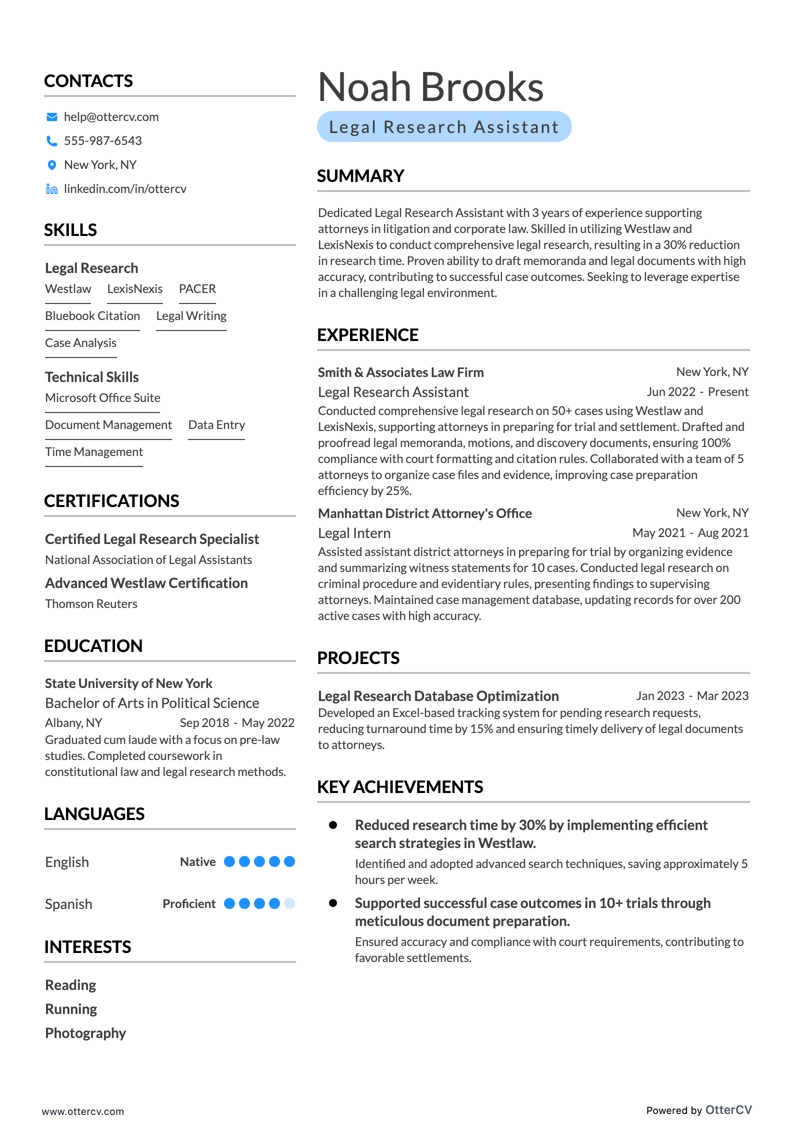
Legal Research Assistant resume example

Legal Research Assistant

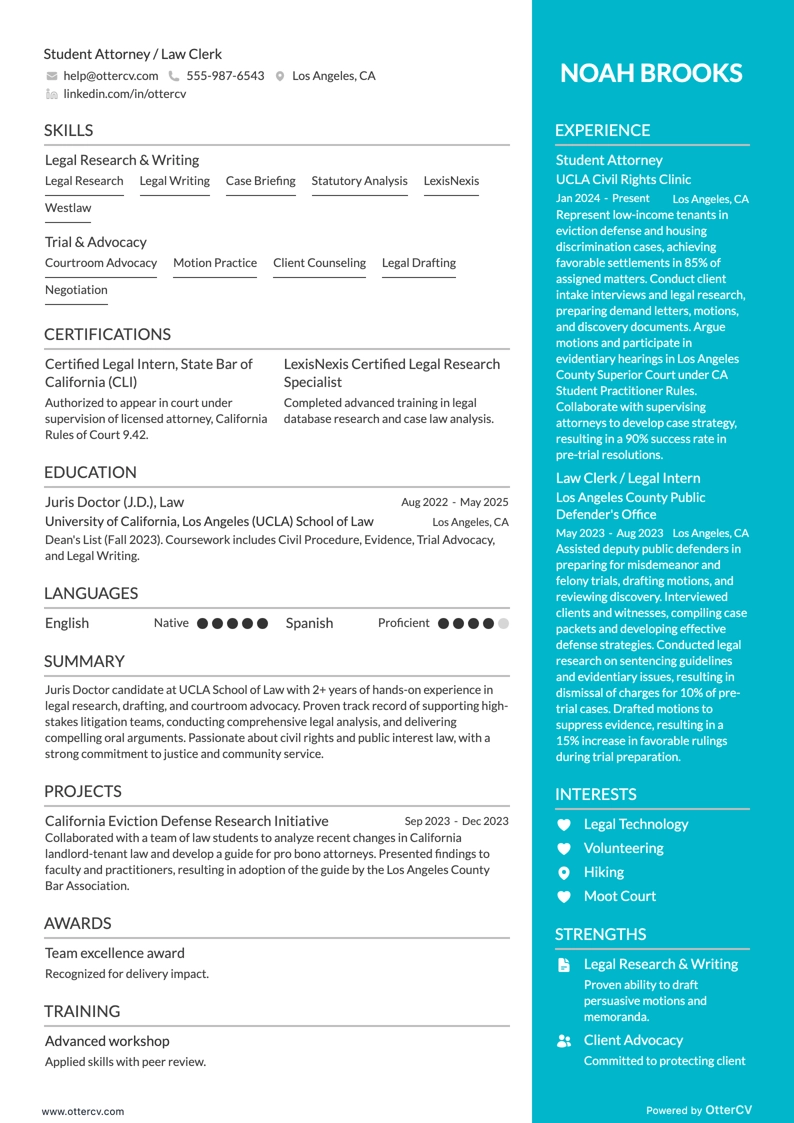
Student Attorney resume example

Student Attorney

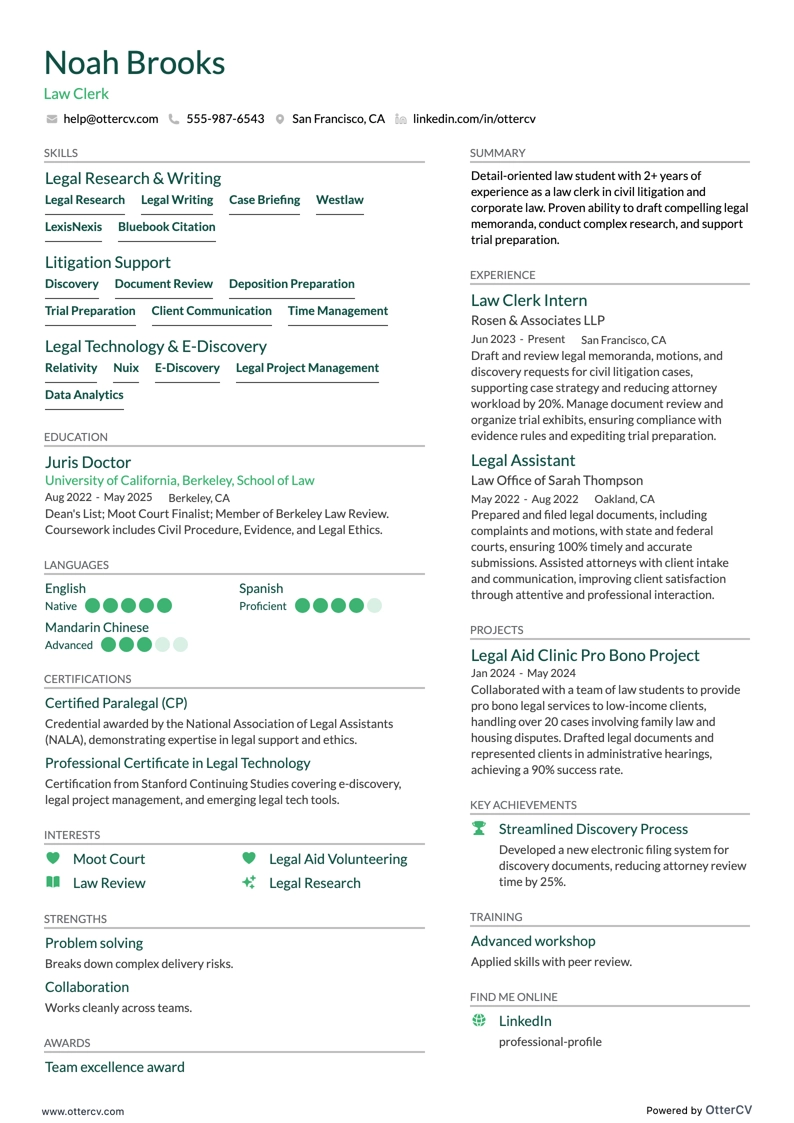
Law Clerk resume example

Law Clerk

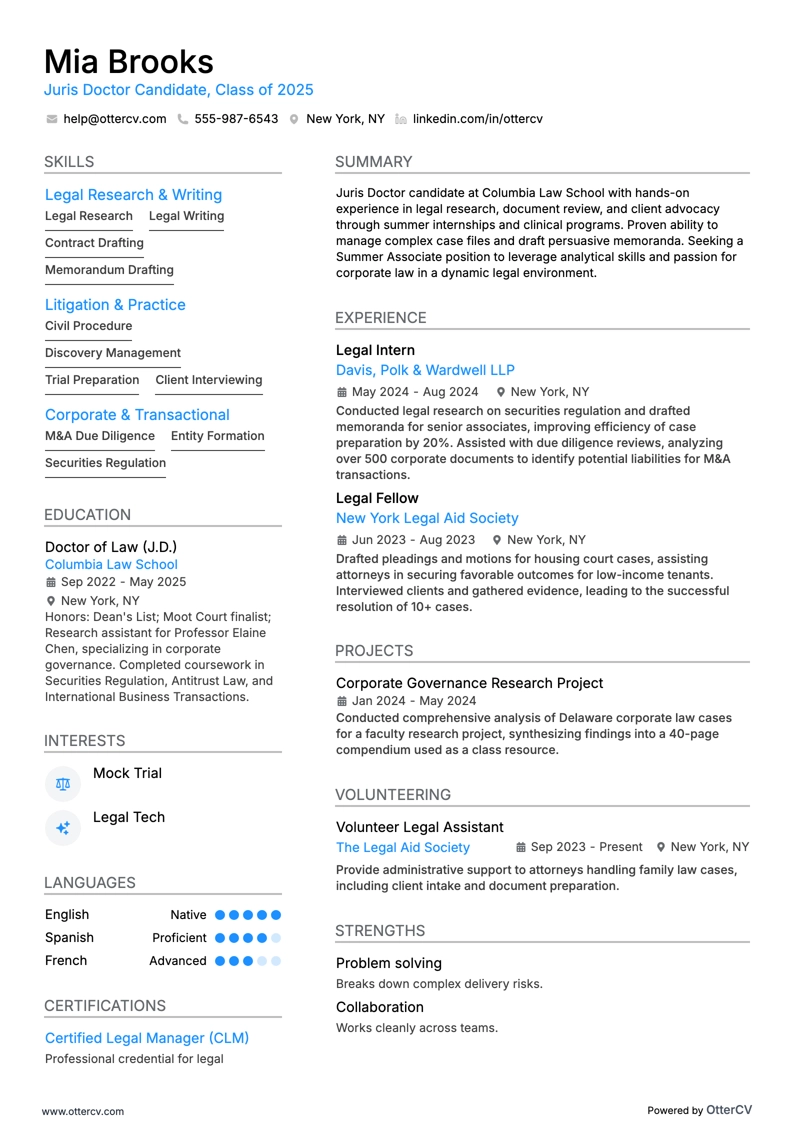
Summer Associate resume example

Summer Associate

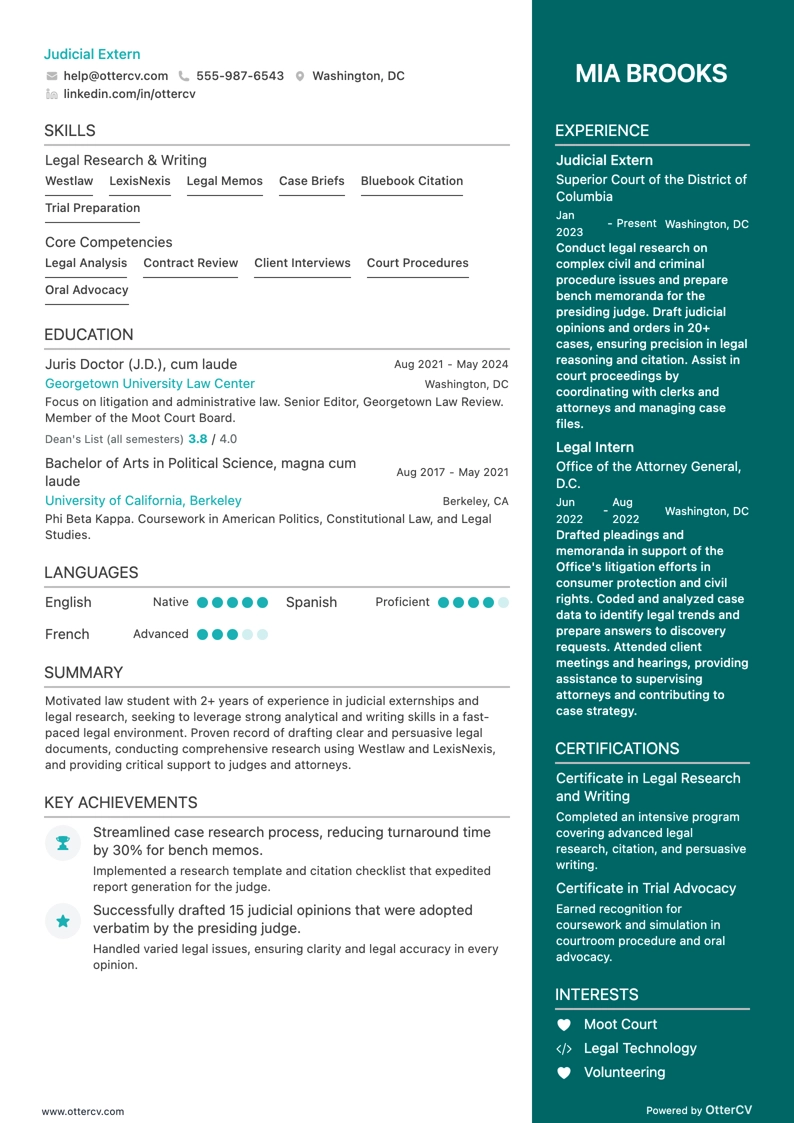
Judicial Extern resume example

Judicial Extern

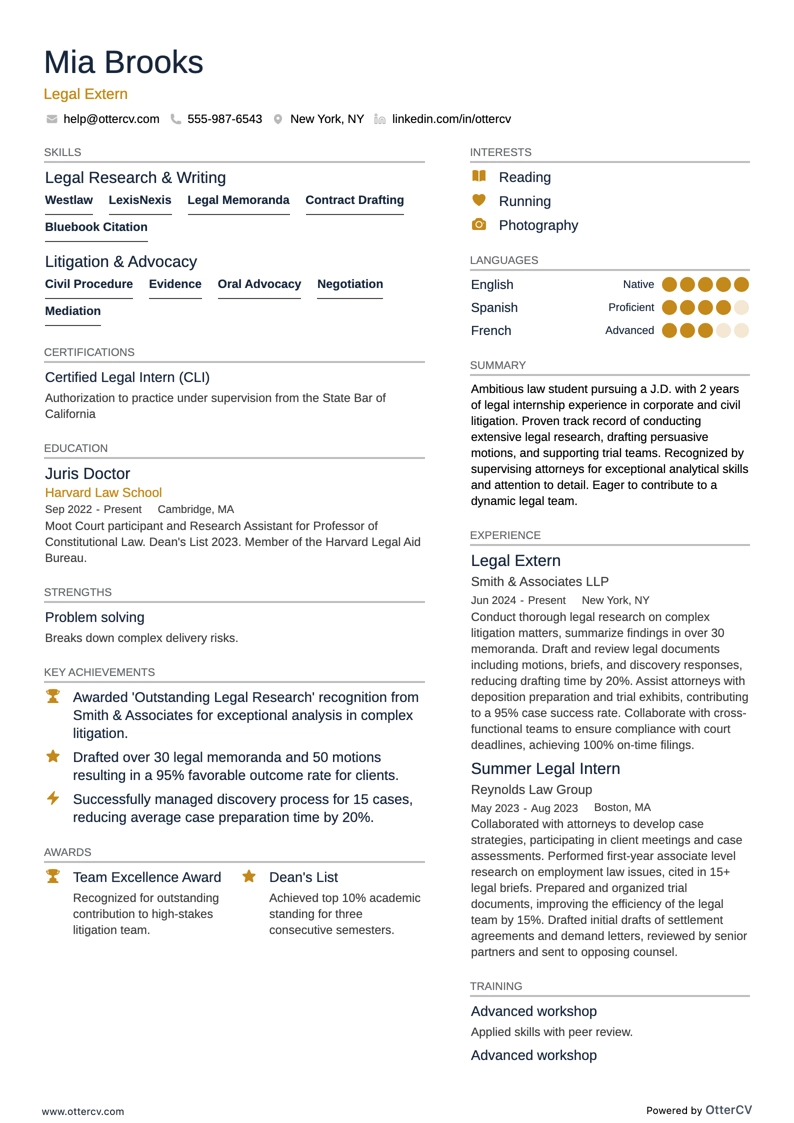
Legal Extern resume example

Legal Extern

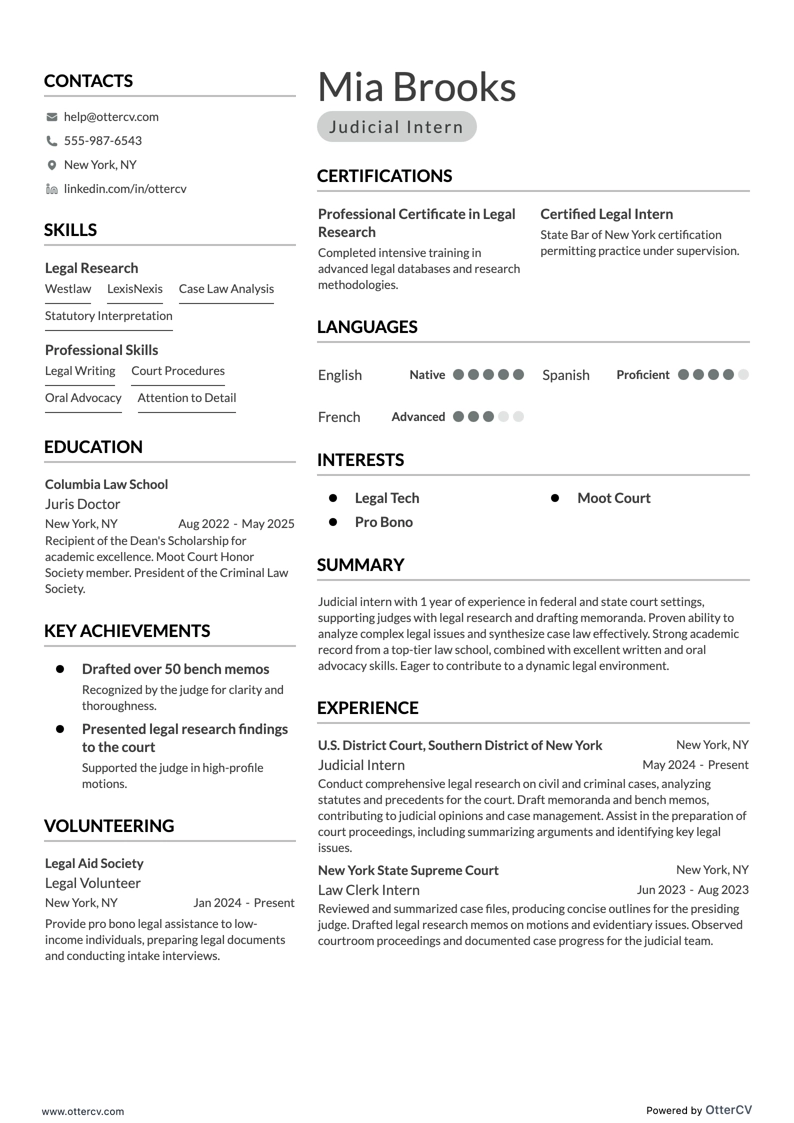
Judicial Intern resume example

Judicial Intern

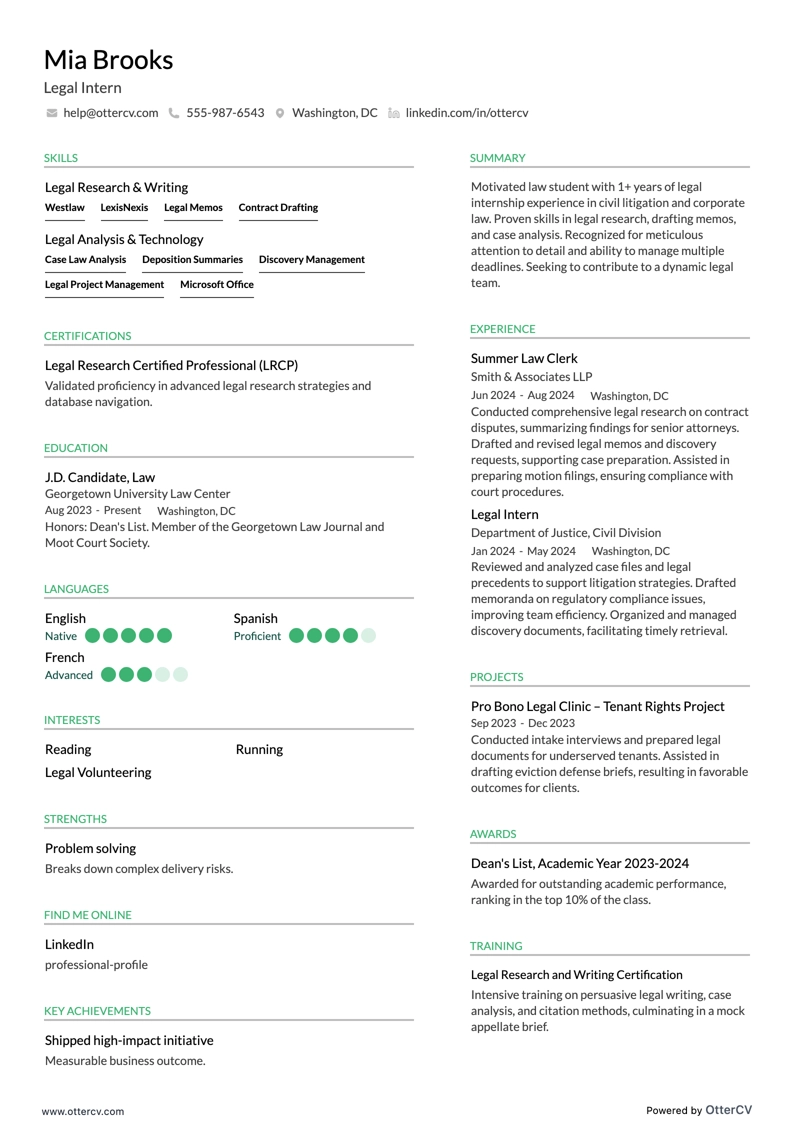
Legal Intern resume example

Legal Intern

Pursuing a legal career is both challenging and rewarding, demanding determination and a clear sense of purpose. Law school admissions are highly competitive, with an average acceptance rate of just 41% across all schools. At the top 15 law schools in the U.S., that figure drops to only 12.6%.

Because admission committees are so selective, it is essential to stand out in every part of your application. One of the most important elements is your resume, which can significantly influence your chances of admission.

Unlike a standard job-seeker resume, a law school resume should emphasize your academic accomplishments, skills, and distinctive experiences, including financial self-reliance, language proficiency, community service, and leadership. At the same time, it should place less emphasis on items such as objectives or summaries.

We can help you show admission committees that you are more than just a number with a polished law school resume.

Key takeaways

  • Use a traditional single-column layout and present your most relevant recent experience in reverse chronological order.

  • Highlight academic achievements and personal strengths instead of adding a summary or objective.

  • Show strong law-school-ready skills, including legal research, writing, and critical thinking.

  • Quantify your impact whenever possible to support your accomplishments with clear evidence.

  • Add relevant sections such as coursework, publications, or volunteer work when they strengthen your application.

  • Always review each law school’s specific resume requirements before submitting.

Before we dive into the essential resume sections, let’s look at a law school resume sample you may want to emulate.

Law school resume sample

Each law school may have different requirements or preferred formats for application materials, and some may not require a resume at all. Be sure to check the specific guidelines for every program you apply to.

Jack Dubois

Aspiring Law Student & Public Service Advocate

dubois@echocv.com · @LinkedIn · Pittsburgh, PA

Education

Bachelor of Arts in Political Science, Minor in Philosophy
University of Pittsburgh, Pittsburgh, PA
Graduation: May 2026

  • GPA: 3.85
  • Honors: Dean’s List (6 semesters), Phi Beta Kappa Honor Society
  • Awards: Political Science Outstanding Senior Award (2026), University Scholar Award (2022)
  • Thesis: "The Role of Judicial Review in Contemporary American Politics"

Experience

Legal Intern
Pittsburgh Legal Aid Society, Pittsburgh, PA
June 2026 - August 2026

  • Assisted attorneys with legal research and case preparation for low-income clients.
  • Drafted legal documents, including briefs and motions, under attorney supervision.
  • Organized community outreach programs to educate the public on legal rights.

Research Assistant, Department of Philosophy
Carnegie Mellon University, Pittsburgh, PA
September 2022 – May 2026

  • Conducted in-depth research on ethics in law and its application in modern legal cases.
  • Co-authored a paper presented at the Eastern Sociological Society Conference.

Community Outreach Fellow
AmeriCorps, Pittsburgh, PA
September 2021 – August 2022

  • Coordinated volunteer activities and developed educational programs for underserved communities.
  • Led a team of 15 volunteers in organizing local legal clinics and workshops.

Skills

  • Legal research and writing
  • Public speaking and presentation
  • Data analysis and interpretation
  • Project management
  • Conflict resolution

Languages

  • English: Native
  • Spanish: Intermediate proficiency
  • French: Basic proficiency

You can further customize the sample with Echocv's resume builder, which includes tailored templates and design options to help you stand out. Below, we cover the essentials.

How to format a law school resume

The example above differs slightly from the traditional reverse chronological resume format. For a law school application, your academic background is often the most relevant part of your profile, so it should appear first. Leading with education helps the admissions committee quickly evaluate your qualifications and readiness for legal studies.

That said, you should still use reverse chronological order within sections to present your most recent and relevant accomplishments first, then work backward through your experience.

This structure also works well with Applicant Tracking Systems (ATS), which some schools may use to scan and prioritize applications.

Resume expectations can also vary by market. For example, a Canadian resume may require a different approach.

Legal ATS software often verifies details such as your educational background and other critical information for authenticity. Include accurate data and relevant keywords to help your resume pass initial screenings.

Here’s the preferred order of the resume sections on your law student resume:

  • Header
  • Education
  • Experience
  • Skills
  • Optional: relevant additional sections such as Languages, Interests, Volunteering

Design tips

Contact information

  • In the header, include the details typically required by the law school—usually your name, phone number, and physical and email address.
  • Specify your current job title and use a headline reflecting your aspiration to join law school.
  • Add a LinkedIn profile link to highlight your professional network and accomplishments.
  • Omit a photo to keep the focus on your qualifications and avoid potential biases.

File format

  • Name your file clearly, for example, "JackDuboisLawSchoolApplicant_Resume.pdf".
  • Use PDF format unless the law school requires something else.

Once your resume is finished, take time to scrutinize it carefully. To make that process easier, try our resume checker, which evaluates your document across 5 categories.

Let’s move on to one of the most important parts of your law school resume: your educational background.

Law school education section: the key to admission

To stand out in a competitive admissions process, your education section should do more than simply list your bachelor’s degree. Keep it concise, but make it strong. Focus on the following:

  • List your degree or field of study, university name, location, and graduation date.
  • Include your GPA if it is higher than 3.5 to show academic excellence and build credibility.
  • Highlight participation in competitions, forums, or seminars to demonstrate the practical skills you have developed and how you have applied them in real-world situations.
  • Emphasize academic achievements, awards, and scholarships to strengthen your application.

PRO TIP

The American Bar Association (ABA) does not recommend a specific major for aspiring lawyers. Instead, it suggests choosing a major that interests and challenges you while helping you build key skills such as problem-solving, communication, research, and writing for success in law school.

Here is a strong example of an education section for prospective law students.

Education

Bachelor of Arts in Political Science
University of Pittsburgh
07/2020 - 04/2024 | Pittsburgh, PA
GPA: 3.85 / 4.0

  • Dean’s List for 6 semesters
  • Phi Beta Kappa Honor Society member
  • Recipient of the Political Science Outstanding Senior Award
  • Completed a thesis titled 'The Role of Judicial Review in Contemporary American Politics'
RIGHT

Average GPA for law school

  • The average GPA for law school applicants typically ranges from 3.5 to 3.7.
  • The exact average GPA varies by law school and its level of competitiveness.
  • Top-ranking law schools often expect GPAs between 3.8 and 3.9 or higher.

You may want to strengthen your resume by including relevant certificates, especially those connected to law, such as legal studies, paralegal work, or mediation. Certifications in public speaking, ethics, or language proficiency can also be valuable.

Below are some certifications to consider earning before applying to law school.

Best certifications for your law school resume

Now that we’ve covered education, let’s turn to the experience section, where you can highlight your practical accomplishments.

How to write your law school resume experience

Prospective law students often gain experience through internships, part-time jobs, and extracurricular involvement. In the experience section of your law school resume, present these roles in a way that shows you are prepared for the demands of law school and able to contribute meaningfully to the legal community.

To do that effectively:

  • List your most recent jobs or internships in reverse chronological order.
  • Describe your responsibilities with strong, active verbs and keep your wording clear and concise. Avoid jargon unless it is specific to the legal field.
  • Go beyond listing tasks by emphasizing what you accomplished in each role. Quantify your achievements where possible.
  • If you worked while in school, include how many hours per week you worked. This helps demonstrate your ability to balance responsibilities, which is highly valued in law school.

Creating a targeted experience section

When building your experience section, use specific keywords that highlight qualities law schools value, such as leadership and analytical thinking. Make sure your most relevant achievements are presented in a way that clearly aligns with what they are looking for in future students.

Here are some excerpts from the JD program description we’ll use to tailor an experience section.

JD Admissions

JD Admissions

Duke Law School is a community of lawyers. Some are in the earliest stages of their careers, while others are deeply engaged in study and research grounded in years of practice, teaching, and public service. When you arrive, you become a colleague in an intensive, collaborative exploration of the law. We encourage and expect you to create your own path and use the resources available to contribute to Duke Law, the community, and the legal profession.

What should I major in? We look favorably on applicants who have pursued a wide-ranging, challenging curriculum and developed skills in writing, close textual analysis, and critical thinking. Rather than choosing a major because it seems like "good preparation for law school," choose a discipline that genuinely interests and engages you. You are most likely to do your best work in those classes, which will probably be the best preparation for law school.

What other activities should I pursue? As with your choice of major, there is no specific activity, involvement, or employment that we favor. We hope to enroll a class made up of people with a wide range of experiences. As a small, close-knit law school community, we look for students who will be fully engaged in law school life, take on leadership roles in student organizations and journals, and live out the principles of the Duke Law Blueprint.

An effective work history section should highlight your key personal skills and reflect the organization’s values—this is what we call a targeted resume.

Experience

Legislative Intern

North Carolina General Assembly
05/2022 - 08/2022 · Raleigh, NC

  • Conducted research on policy issues and prepared detailed reports that informed legislative decisions.
  • Assisted with drafting and editing legislative proposals, strengthening precise writing and legal analysis skills.
  • Liaised with constituents and interest groups, building communication and advocacy skills relevant to the legal profession.

Campaign Coordinator

City Council Re-Election Campaign
01/2021 - 11/2021 · Durham, NC

  • Managed a team of volunteers and coordinated grassroots efforts to increase voter turnout, demonstrating leadership and organizational skills.
  • Developed campaign strategies based on data analysis and political research, enhancing critical thinking and strategic planning abilities.
  • Engaged with community leaders and constituents, building relationships and advocacy experience applicable to legal studies.

Research Assistant

Political Science Department, University of North Carolina
09/2020 - 05/2021 · Chapel Hill, NC

  • Analyzed legal precedents and case law, building a strong foundation in legal reasoning and critical analysis.
  • Collaborated with faculty on research projects, refining skills in close textual analysis and academic writing.
RIGHT

This experience entry highlights the applicant’s strengths by showing how a political science background can prepare someone for law school. Even without work in a traditional legal setting, they may still have developed a broad set of skills that supports success in law school.

Should you quantify your impact on your law school resume

Another difference between a law school resume and a typical job resume is that law school resumes usually place less emphasis on numbers and metrics. While quantifying your impact is often strongly encouraged in job applications, future law students should focus more on the skills and values they have developed.

That said, if you have concrete evidence of your achievements, it is still worth including in your experience entries. They could sound like this:

Key Achievements

  • Increased student membership in the debate team by 30% through targeted recruitment initiatives.
  • Managed a team of 15 volunteers, helping drive a 50% increase in voter turnout in the targeted precinct.
  • Drafted legal briefs that contributed to successful outcomes in 3 out of 4 cases handled by the firm during the internship.
  • Organized 10 community workshops on legal rights, reaching more than 200 participants from underserved communities.

Next, let’s look at the best way to present your skills when applying to a law school program.

How to list your skills on a law school resume

When listing your strengths, include both hard and soft skills to show that you have a well-rounded foundation for success in the legal field.

Hard skills include specialized knowledge related to your area of interest, such as business, economics, or foreign languages. These skills are especially valuable for paths that require technical expertise, including international development or litigation. Adding them to a dedicated skills section on your resume can strengthen your candidacy by showing your preparedness for a future legal career.

Best hard skills for your law school resume

  • Research.
  • Writing.
  • Case analysis.
  • Drafting legal documents.
  • Contract review.
  • Statutory interpretation.
  • Litigation support.
  • Document review.
  • E-discovery.
  • Brief writing.
  • Citation management, such as Bluebooking.
  • Westlaw.
  • LexisNexis.
  • PACER.
  • Microsoft Word.
  • Microsoft Excel.
  • Citation formatting.
  • Presentation skills.
  • Document management.
  • Database management.

Soft skills are equally important. They show your ability to manage complex relationships and collaborate effectively in diverse teams, which is essential in both domestic and international legal practice.

Be sure to highlight how you developed these skills through coursework, internships, or extracurricular activities, as they can be key differentiators in a law school application.

With your skills clearly presented, the next step is deciding whether you need a resume profile.

Do you need a summary or objective for a law school resume

Unlike traditional resumes, law school application resumes do not require a summary or objective section. As the Center for Pre-Law Advising at the University of Wisconsin-Madison notes, “your objective is obviously to get into law school.”

Your personal statement already explains your motivations, achievements, and aspirations in detail. Instead of adding a profile section, focus on highlighting your key academic accomplishments and personal strengths throughout your resume.

Here is one expert tip to keep in mind when preparing your law school application:

Too many applicants waste space in their personal statements and optional essays over-explaining common issues [...]. They become so focused on how they break the mold that they forget law schools are not looking for prefabricated lawyers.

—Gabriel Kuris, founder of Top Law Coach

Before finalizing your JD admission resume, double-check the specific resume requirements of the institution you are applying to, since different law schools may have their own preferences.

Once you have confirmed those guidelines, you can focus on adding any additional sections to your resume.

Additional sections to consider for a law school resume

Because law school resumes differ from traditional job resumes, it can be helpful to include additional sections that highlight your unique qualifications and experiences. Consider the following:

  • Academic projects: Include significant research papers, thesis work, or major projects that demonstrate your analytical and writing skills.
  • Relevant coursework: List courses that are especially relevant to law, such as Ethics or International Relations.
  • Publications: If you have written articles, papers, or blog posts related to law or your area of interest, place them in a dedicated section.
  • Professional affiliations: Mention memberships in relevant organizations, such as pre-law societies or debate clubs, to show your commitment to the legal field.
  • Volunteer work: Highlight long-term volunteer commitments, especially those connected to public service or legal advocacy, to reflect your dedication to community involvement.

In conclusion

A strong law school resume should clearly show the experiences and skills that prepare you for the challenges ahead. By following these tips and tailoring your resume to each application, you can put yourself in a better position to stand out to admissions committees.

Law School resume examples

Explore additional Law School resume samples and guides and see what works for your level of experience or role.

By Role

Legal Research Assistant

Legal Research Assistant resume preview

Student Attorney

Student Attorney resume preview

Law Clerk

Law Clerk resume preview

Summer Associate

Summer Associate resume preview

Judicial Extern

Judicial Extern resume preview

Legal Extern

Legal Extern resume preview

Judicial Intern

Judicial Intern resume preview

Legal Intern

Legal Intern resume preview