Lead Landscaper full preview

21 Landscaping Resume Examples, Templates

OtterCV

Written by The OtterCV Team

Updated: 11/1/2025•8 min read

See all resume examples in this guide, or generate your own resume example with your personalized prompt

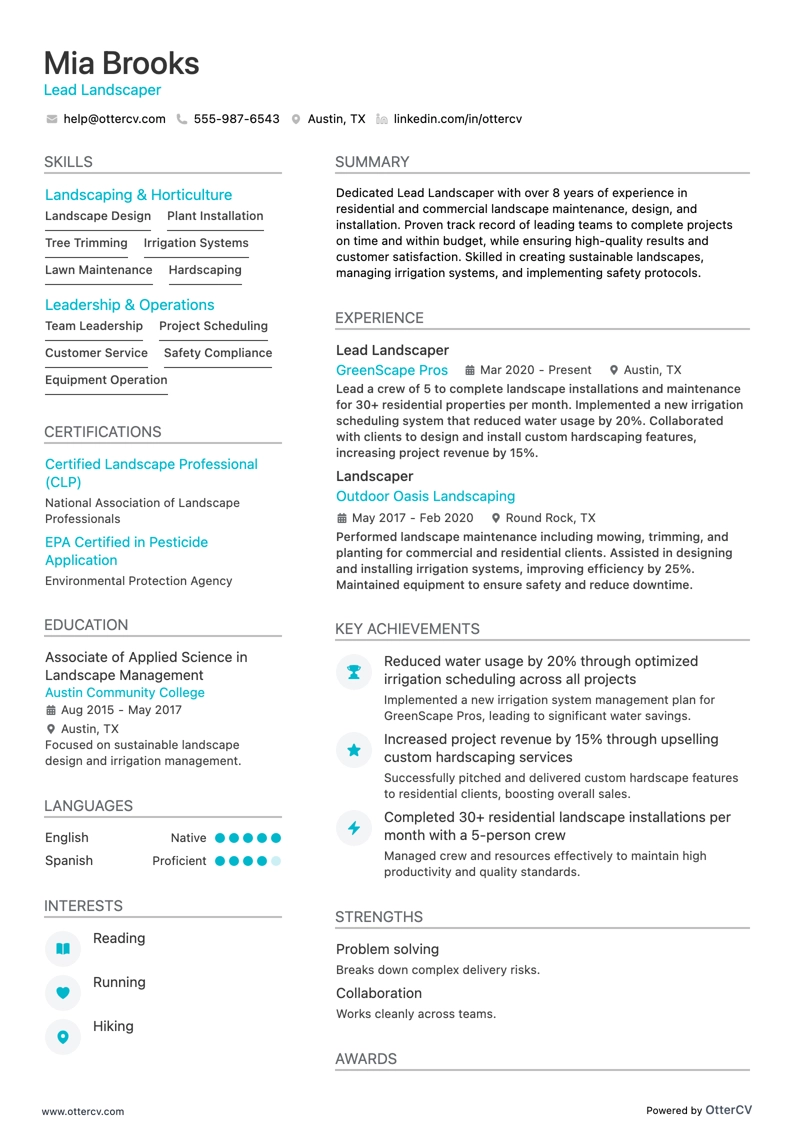
Lead Landscaper resume example

Lead Landscaper

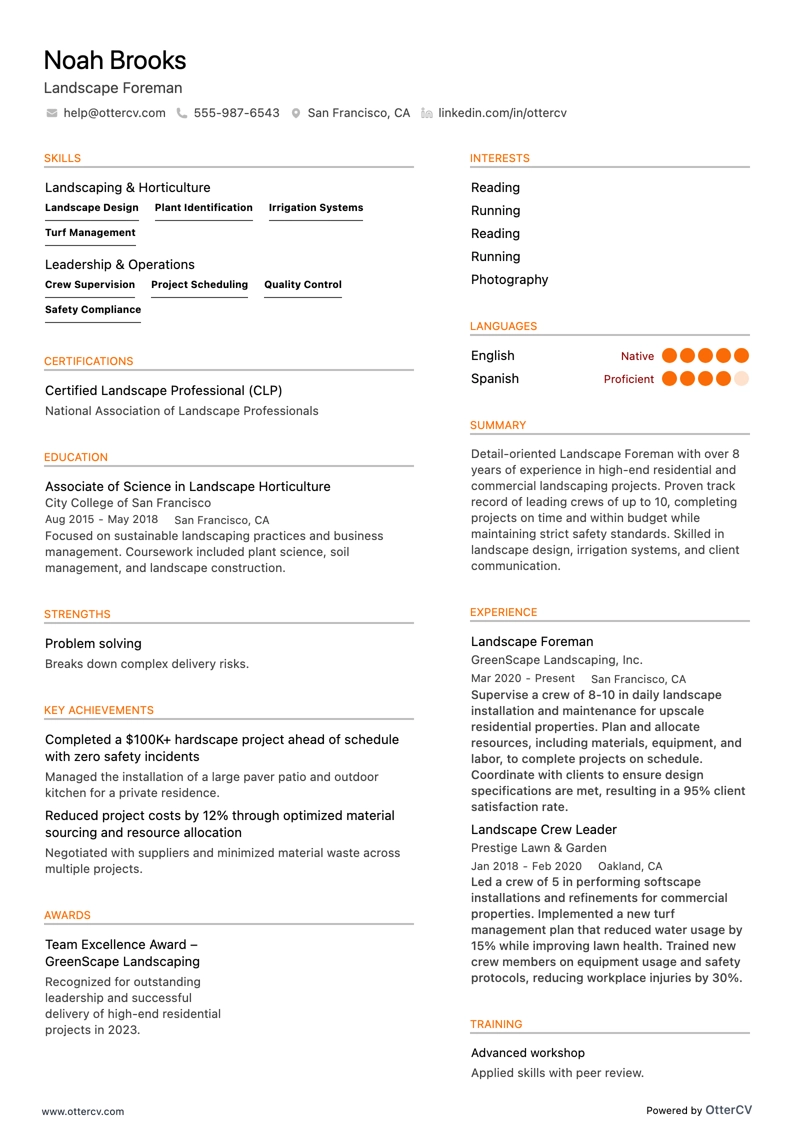
Landscape Foreman resume example

Landscape Foreman

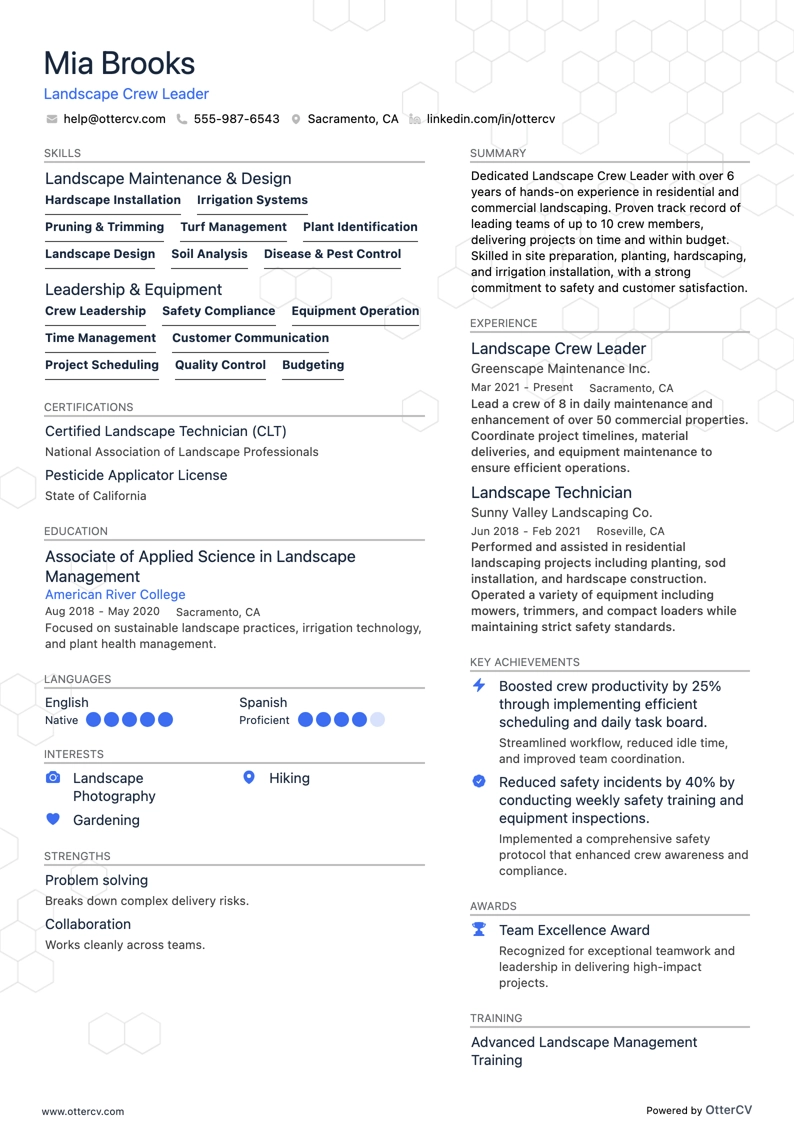
Landscape Crew Leader resume example

Landscape Crew Leader

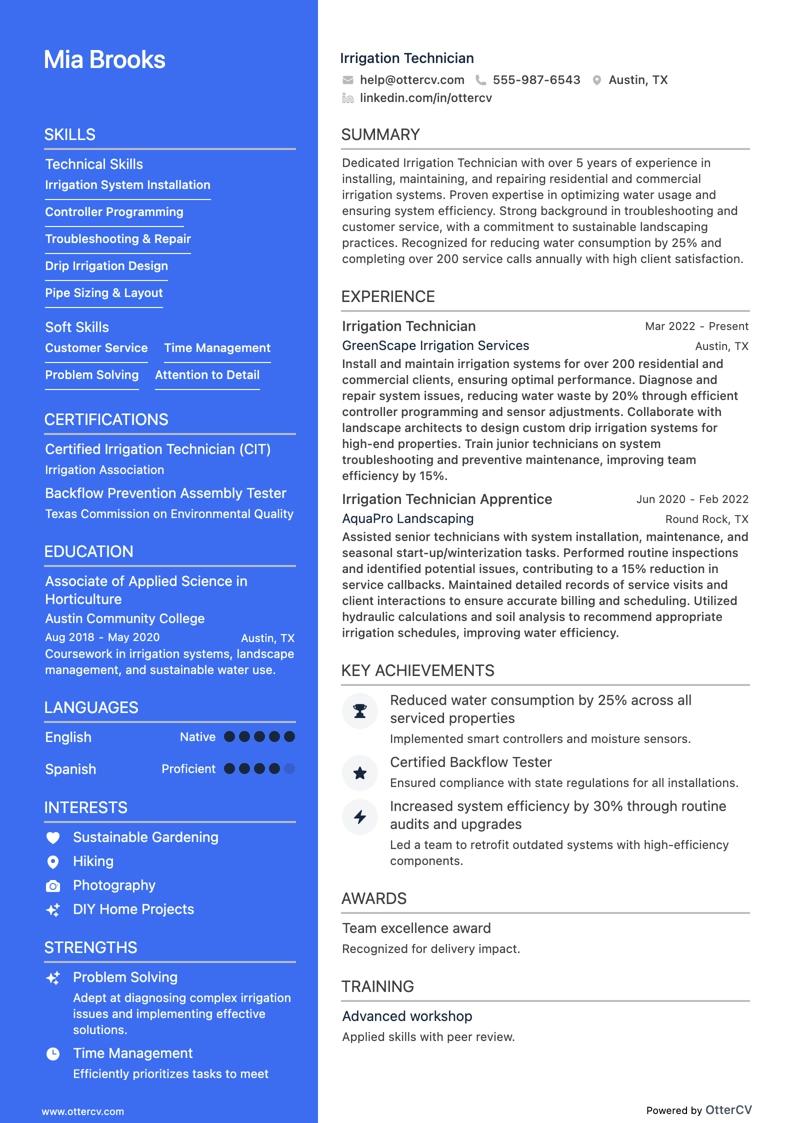
Irrigation Technician resume example

Irrigation Technician

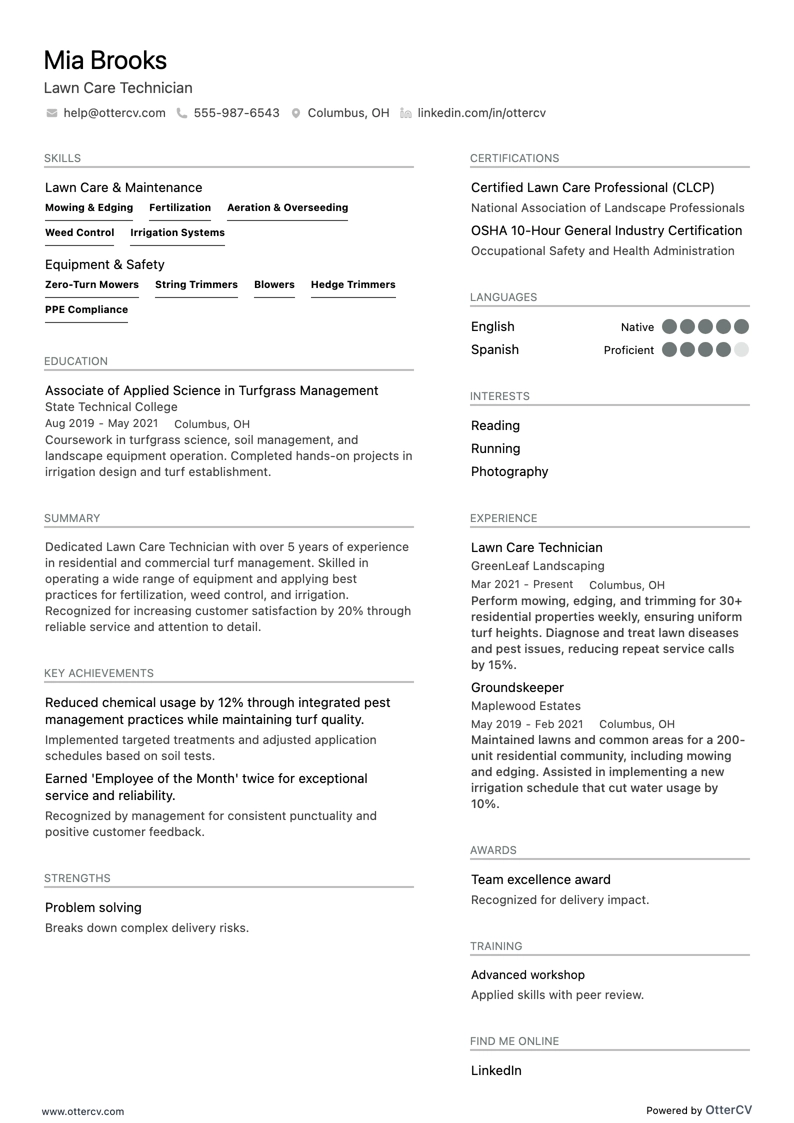
Lawn Care Technician resume example

Lawn Care Technician

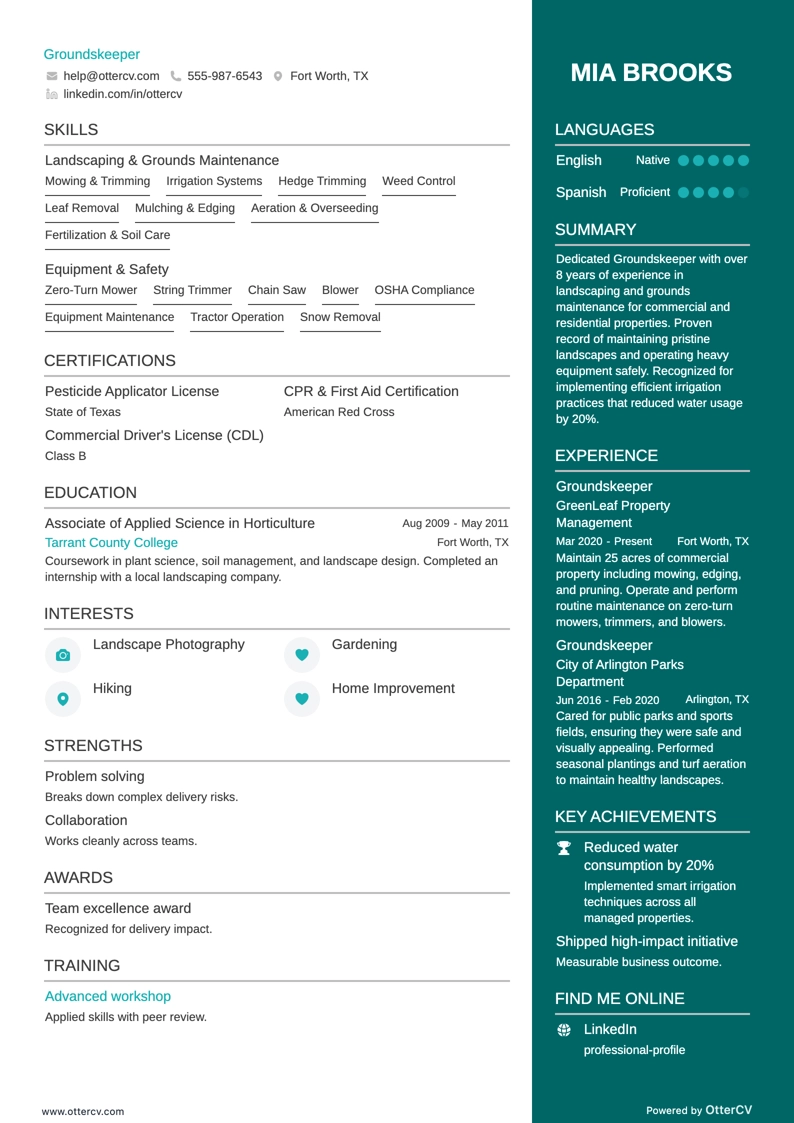
Groundskeeper resume example

Groundskeeper

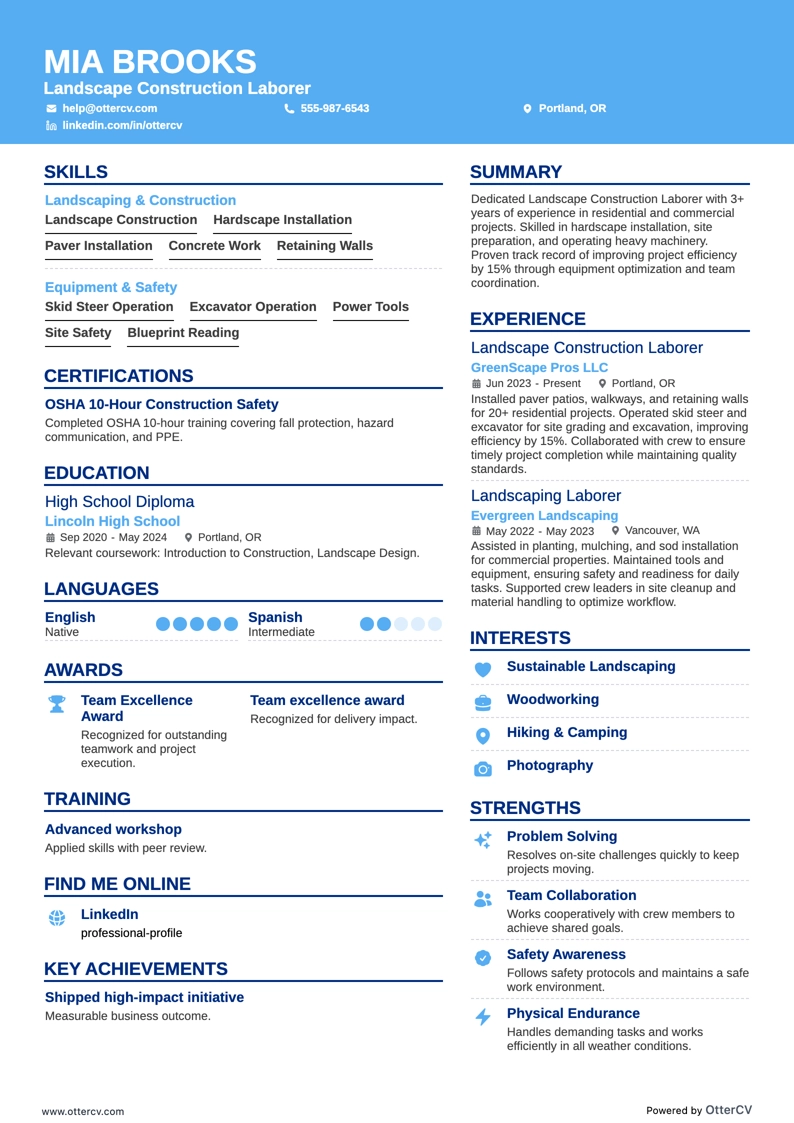
Landscape Construction Laborer resume example

Landscape Construction Laborer

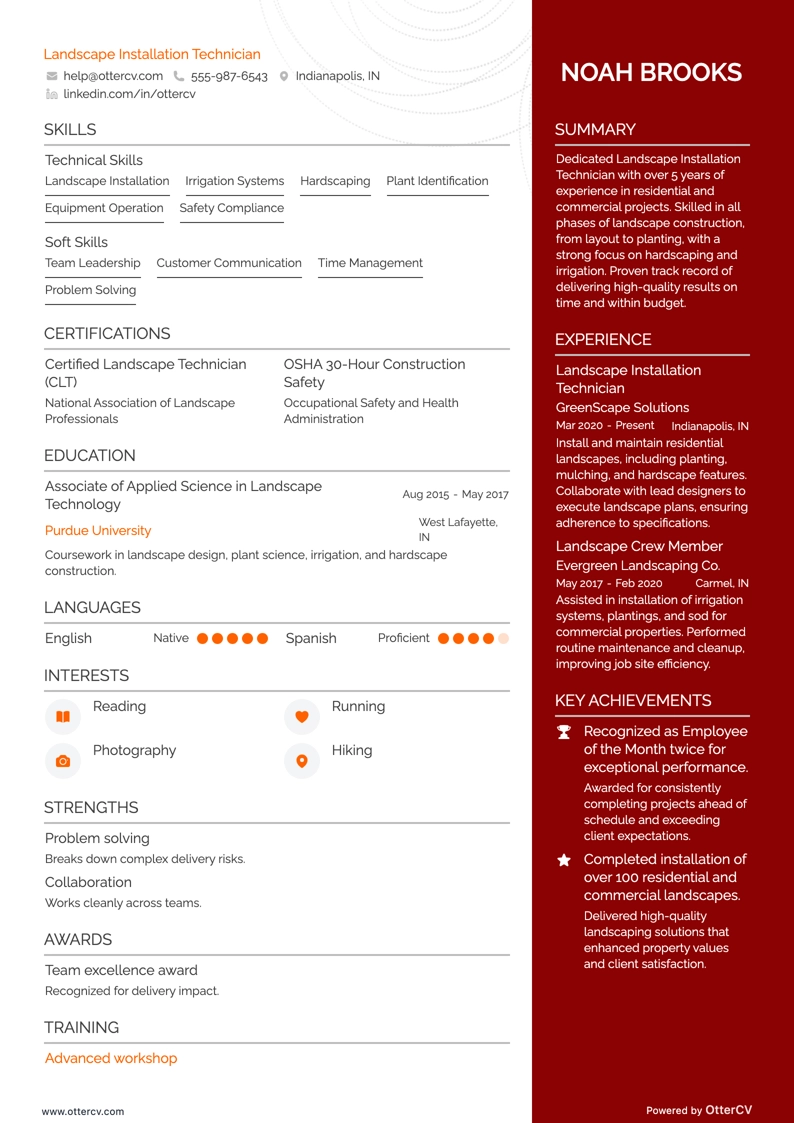
Landscape Installation Technician resume example

Landscape Installation Technician

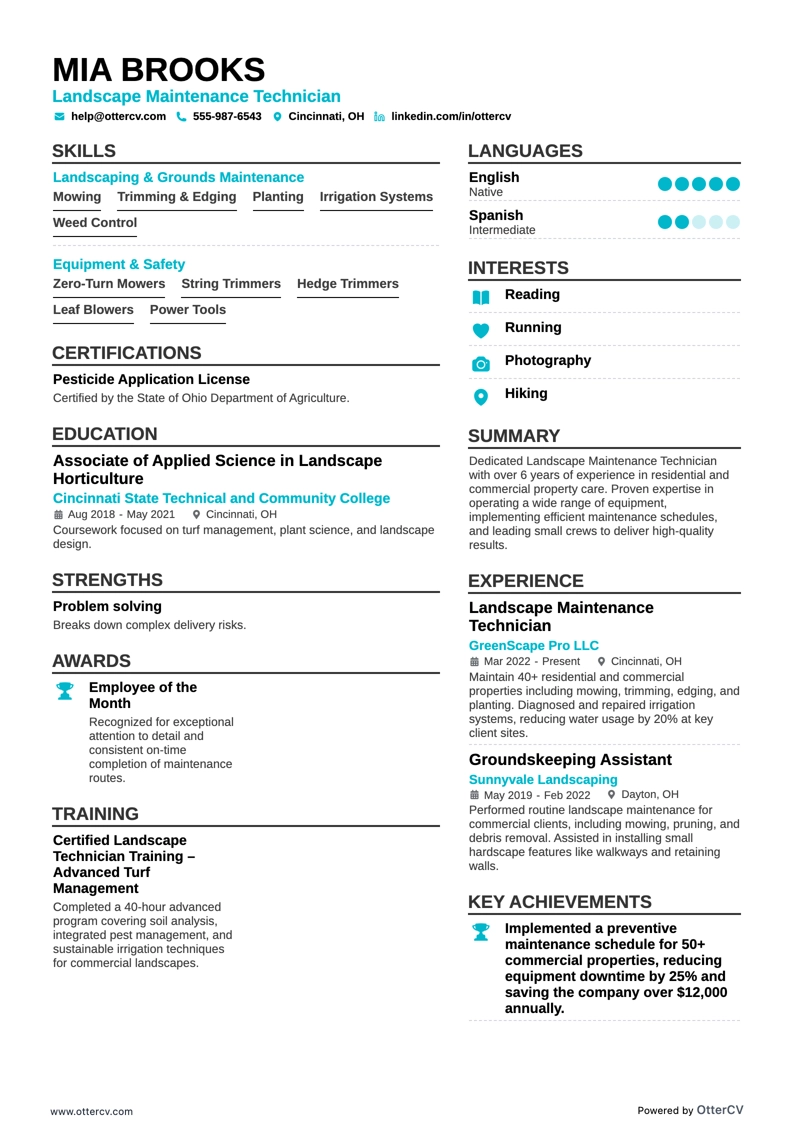
Landscape Maintenance Technician resume example

Landscape Maintenance Technician

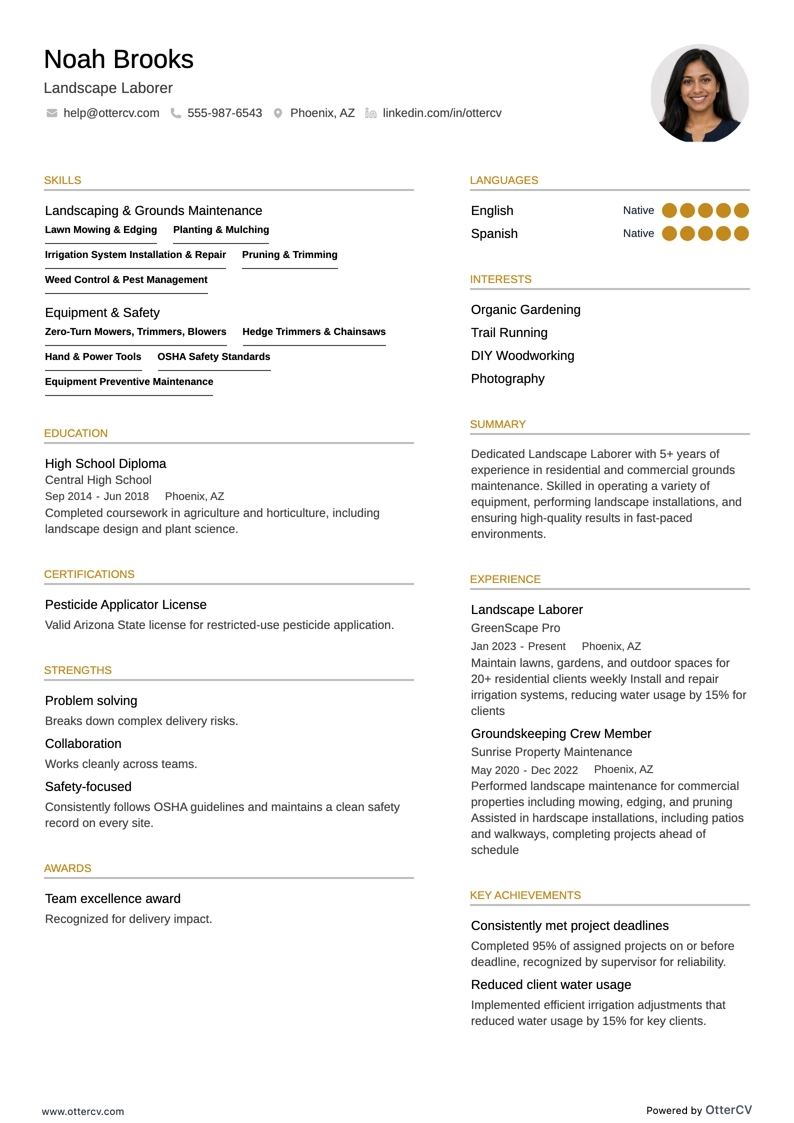
Landscape Laborer resume example

Landscape Laborer

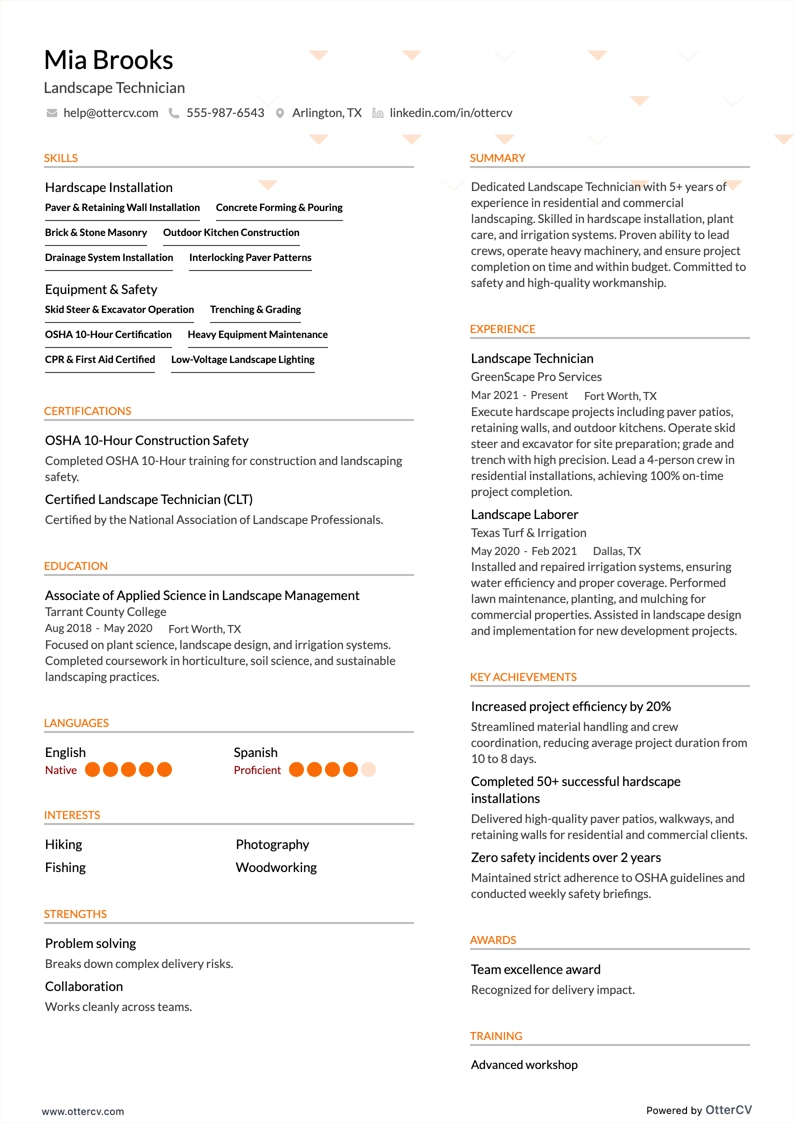
Landscape Technician resume example

Landscape Technician

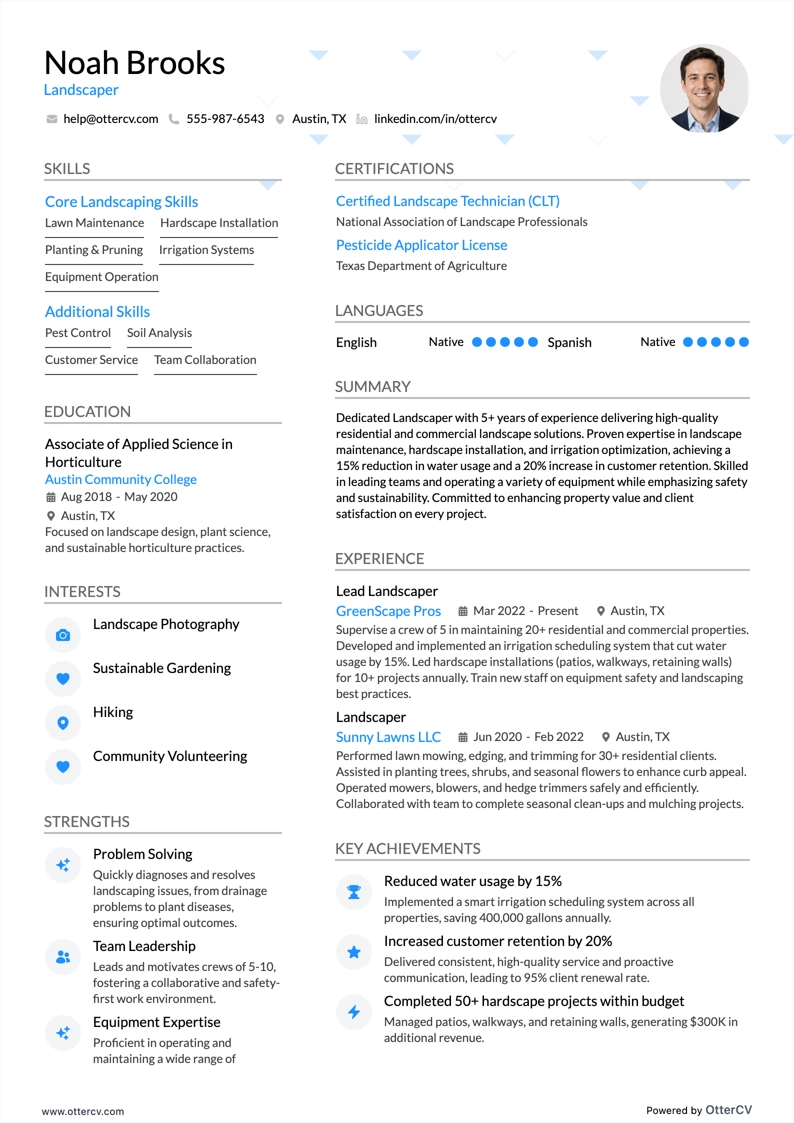
Landscaper resume example

Landscaper

Many landscaping resumes fall short because they focus on tasks and equipment but leave out measurable results and the scope of the sites handled. As a result, they can be filtered out by ATS software and missed in quick recruiter scans, especially when competition is high.

A strong resume shows what you improved, not just what tools or equipment you used. If you are not sure where to start, learning how to write a resume from scratch can help you build that foundation. You can highlight acres maintained, crews led, on-time project completion, water savings, safety record, client retention, and reduced rework from higher-quality installs.

Key takeaways

  • Quantify landscaping results such as properties maintained, water savings, and crew size instead of listing generic duties.

  • Use a reverse-chronological resume format if you have landscaping experience, or a hybrid format if you are changing careers or just starting out.

  • Tailor each resume to the job posting by reflecting the specific equipment, methods, and certifications it mentions.

  • Place certifications such as pesticide applicator licenses and OSHA training near your education section, where recruiters expect to find them.

  • Connect each skill to a measurable result in your experience bullets rather than listing skills on their own.

  • Use Echocv to turn vague task descriptions into specific, recruiter-ready resume bullets more quickly.

  • Write a three- to four-line summary that highlights your specialty, tools, and one quantified achievement upfront.

Job market snapshot for landscapings

We analyzed 968 recent landscaping job ads across major US job boards to provide a quick view of employment type trends, experience requirements, and industry demand.

What level of experience employers are looking for in landscaping

Years of ExperiencePercentage found in job ads
1–2 years14.4% (139)
3–4 years4.9% (47)
5–6 years1.9% (18)
7–8 years1.0% (10)
9–10 years0.4% (4)
10+ years27.8% (269)
Not specified49.3% (477)

Landscaping ads by area of specialization (industry)

Industry (Area)Percentage found in job ads
Finance & Banking68.5% (663)
Education10.5% (102)
Healthcare9.2% (89)
Manufacturing3.3% (32)
Government3.1% (30)
Retail & E-commerce2.4% (23)

Top companies hiring landscapings

CompanyPercentage found in job ads
BrightView Landscapes, LLC41.2% (399)
PBS Engineering and Environmental Inc.5.5% (53)
Davey Tree5.0% (48)
DJ's Landscape Management2.3% (22)
Kimley-Horn and Associates, Inc.2.2% (21)
Actalent1.9% (18)
CW Resources, Inc.1.1% (11)

Role overview stats

These tables outline the most common responsibilities and employment types for landscaping roles. Use them to align your resume with employer expectations and understand how the role is typically structured across the market.

Day-to-day activities and top responsibilities for a landscaping

ResponsibilityPercentage found in job ads
Landscaping14.2% (137)
Landscape maintenance12.4% (120)
Pruning12.1% (117)
Mulching10.8% (105)
Equipment operation10.6% (103)
Autocad10.2% (99)
Weeding9.2% (89)
Equipment maintenance8.3% (80)
Sketchup8.1% (78)
Mowing8.0% (77)
Planting7.1% (69)
Power mowers6.8% (66)

How to format a landscaping resume

Recruiters reviewing landscaping resumes look first for hands-on skills, relevant certifications, and clear evidence that you can manage outdoor projects from start to finish. Choosing the right resume format helps present these qualifications early and clearly, improving both recruiter engagement and applicant tracking system (ATS) readability.

I have significant experience in this role—which format should I use?

I have significant experience in this role—which format should I use?

Use a reverse-chronological format to put your strongest and most recent landscaping experience front and center.

  • Lead with your most recent positions and highlight the scope of the projects you managed, including crew size, property types, and client volume.
  • Feature role-specific skills and tools such as irrigation system installation, hardscape design, pesticide application licensing, and landscape CAD software.
  • Quantify outcomes and business impact whenever possible, including cost savings, client retention rates, and project completion metrics.

Example bullet: “Managed seasonal maintenance for 85+ residential and commercial properties, reducing client churn by 18% year over year through proactive service scheduling and quality audits.”

I'm junior or switching into this role—what format works best?

I'm junior or switching into this role—what format works best?

A hybrid resume format works best because it lets you highlight relevant landscaping skills first while still showing a clear work timeline.

  • Place a dedicated skills section near the top of your resume, listing technical abilities such as mowing equipment operation, plant identification, soil grading, and irrigation repair.
  • Include hands-on projects, volunteer work, or transitional experience—such as personal landscaping projects, agricultural coursework, or grounds maintenance internships—to show applied knowledge.
  • Connect every action to a result, even at a small scale, so recruiters can see your ability to deliver measurable outcomes.

Example scaffold: Irrigation troubleshooting (skill) → diagnosed and repaired sprinkler system malfunctions across a 12-unit apartment complex (action) → cut monthly water waste by 25% and eliminated recurring drainage complaints (result).

Why not use a functional resume?

Why not use a functional resume?

A functional resume removes the work timeline recruiters use to evaluate your hands-on landscaping experience, making it harder for them to confirm where and how you built your skills.

  • A functional resume may be acceptable in limited cases, such as when you’re transitioning from a related trade like agriculture, construction, or groundskeeping, have limited formal work history, or need to address significant resume gaps. Even then, every skill listed should be tied to specific projects, certifications, or measurable outcomes.

What sections should go on a landscaping resume

Once you’ve chosen a resume format that highlights your strengths, the next step is adding the right sections so hiring managers can quickly understand your qualifications.

Recruiters expect a clean, easy-to-scan resume that showcases your landscaping experience, core skills, and safety credentials. Knowing which resume sections to include helps ensure you do not leave out anything important.

Use this structure for maximum clarity:

  • Header
  • Summary
  • Experience
  • Skills
  • Projects
  • Education
  • Certifications
  • Optional sections: Awards, Volunteering, Languages

Your experience bullets should highlight measurable results, job scope, equipment and crew responsibility, safety compliance, and outcomes delivered on time and on budget.

Once you’ve organized your resume with the right structure and key details, the next step is to write your landscaping experience section so it fits that format and clearly supports your application.

How to write your landscaping resume experience

Your experience section should show the landscaping projects you’ve completed, the tools and techniques you used, and the measurable results you achieved. Hiring managers in landscaping care more about proven impact—healthier lawns maintained, properties transformed, clients retained—than generic task lists that only describe daily duties. Building a targeted resume tailored to each employer’s needs makes this section much more effective.

Each entry should include:

  • Job title
  • Company and location (or remote)
  • Dates of employment (month and year)

Include three to five concise bullet points that explain what you owned, how you executed the work, and what outcomes you delivered:

  • Ownership scope: the specific properties, grounds, client accounts, crew teams, or project portfolios you were directly responsible for managing and maintaining.
  • Execution approach: the equipment, irrigation systems, hardscaping techniques, horticultural methods, or seasonal maintenance plans you used to complete landscaping work on time and to standard.
  • Value improved: the changes you drove in property appearance, plant health, water efficiency, soil quality, safety compliance, or operational turnaround time across your landscaping projects.
  • Collaboration context: how you coordinated with property managers, homeowners, nursery suppliers, subcontractors, or municipal agencies to align on project scope, timelines, and design expectations.
  • Impact delivered: the outcomes your work produced—expressed through client retention, service area growth, cost reductions, crew productivity gains, or expanded contract volume—rather than a simple list of tasks performed.

Experience bullet formula

Experience bullet formula

Use this structure for experience bullets: action verb + technology + what you built or fixed + measurable result.

A landscaping experience example

Landscape Crew Lead

Greenway Landscape Co. | Austin, TX

2022–Present

Full-service residential and commercial landscaping provider serving 120+ active properties across Central Texas.

  • Led a four-person crew using Aspire scheduling, ArcGIS site maps, and GPS route planning to complete 1,100+ service visits per season, improving on-time completion from 88% to 96%.
  • Installed drip irrigation and smart controllers (Hunter Hydrawise, Rain Bird) using pressure testing and zone audits, reducing water use by 18% across twenty-five properties while cutting repeat leak callbacks by 30%.
  • Built landscape designs and estimates in AutoCAD and Aspire with material takeoffs and unit-cost templates, reducing bid turnaround time from three days to one day and increasing close rate by 12%.
  • Implemented a weekly preventive maintenance program for mowers, trimmers, and skid steers using a digital checklist in ServiceTitan, reducing equipment downtime by 22% and overtime labor by six hours per week.
  • Coordinated with clients, property managers, and irrigation subcontractors to sequence hardscape installs (pavers, edging, drainage) and plantings, generating $410K in annual project revenue with a 4.8 out of 5 client satisfaction average.

Now that you've seen what a strong experience section looks like, the next step is tailoring each detail to the specific landscaping job you're applying for.

How to tailor your landscaping resume experience

Recruiters review landscaping resumes through both human screening and applicant tracking systems (ATS), so your experience section should speak directly to the job posting. Tailoring your resume to the job description can improve your chances of getting through both screening stages.

Ways to tailor your landscaping experience:

  • Match the specific equipment and tools named in the job description.
  • Use the exact plant species or turf varieties the posting references.
  • Mirror the irrigation systems or hardscape methods the employer specifies.
  • Include any pesticide licensing or safety certifications the role requires.
  • Reflect crew size or project scope that aligns with the employer's operations.
  • Highlight the seasonal maintenance workflows the posting emphasizes.
  • Reference any landscape design software the employer lists as preferred.
  • Emphasize water conservation or sustainable practices when they are mentioned.

Tailoring means aligning your real accomplishments with the job's stated requirements, not forcing in keywords that don't fit.

Resume tailoring examples for landscaping

Job description excerptUntailoredTailored
"Operate and maintain commercial mowing equipment, including zero-turn mowers and string trimmers, across residential and HOA properties."Performed various landscaping tasks using different tools and equipment.Operated zero-turn mowers and string trimmers to maintain 45+ residential lawns and three HOA common areas on a weekly rotation schedule.
"Install hardscape features such as retaining walls, paver patios, and drainage systems according to project blueprints."Helped with outdoor construction and installation projects as needed.Built segmental retaining walls and installed 1,200+ sq. ft. of paver patios per project, following engineered blueprints and integrating French drain systems to meet grading specifications.
"Apply fertilizers, herbicides, and pest control treatments in compliance with state pesticide regulations and IPM principles."Applied chemicals and treatments to lawns and garden areas.Applied granular fertilizers and selective herbicides across 60+ client properties per season, holding a state-certified pesticide applicator license and following integrated pest management (IPM) protocols to reduce chemical use by 20%.

Once you’ve aligned your experience with the role’s priorities, quantify your landscaping achievements to show the measurable impact of your work.

How to quantify your landscaping achievements

Quantifying your achievements shows that you deliver results, not just effort. Track cycle time, quality scores, safety outcomes, costs, and revenue impact across properties, crews, and seasons.

Quantifying examples for landscaping

MetricExample
Cycle timeReduced weekly mow-and-edge time from 6.5 to 5 hours per 12-acre site by standardizing routes and using a 60-inch zero-turn mower.
Quality scoreImproved client inspection scores from 3.8 to 4.6 out of 5 across 18 properties by tightening trim lines and using a checklist in Jobber.
Cost savingsCut seasonal mulch spend by 12% ($4,200) for three commercial sites by right-sizing orders and negotiating bulk delivery with the supplier.
Safety riskAchieved 180 days with zero recordable incidents for a four-person crew by enforcing PPE checks and documenting hazards in weekly tailgate talks.
Revenue growthWon $28,000 in new annual maintenance contracts by upselling aeration and overseeding packages to eight existing HOA clients.

Once you’ve written strong experience bullets, apply that same precision to how you present hard and soft skills throughout your landscaping resume.

How to list your hard and soft skills on a landscaping resume

Your skills section shows that you can maintain properties safely and efficiently. Recruiters and an ATS (applicant tracking system) also scan this section to match your resume to the job posting, so aim for a mix weighted toward hard skills, equipment, and safety skills, supported by role-specific soft skills.

Landscaping roles require a blend of:

  • Product strategy and discovery skills.
  • Data, analytics, and experimentation skills.
  • Delivery, execution, and go-to-market discipline.
  • Soft skills.

Your skills section should be:

  • Scannable, using bullet-style grouping.
  • Relevant to the job post.
  • Backed by proof in your experience bullets.
  • Updated with current tools.

Place your skills section:

  • Above your experience section if you're junior or switching careers.
  • Below your experience section if you're mid- or senior-level with strong achievements.

Hard skills

  • Lawn mowing and striping pattern work.
  • String trimmer and edger operation.
  • Zero-turn mower operation.
  • Chainsaw operation.
  • Hedge trimmer and pruning saw use.
  • Pruning and plant health care.
  • Irrigation system repair, including drip lines.
  • Sprinkler controller programming.
  • Mulching and bed edging.
  • Soil amendment and fertilization rate application.
  • Herbicide and pesticide application in compliance with EPA labels.
  • Hardscape installation, including pavers and retaining walls.

Soft skills

  • Prioritize routes and daily tasks.
  • Follow work orders accurately.
  • Communicate with homeowners on-site.
  • Coordinate with crew leads.
  • Flag hazards and stop unsafe work.
  • Document issues with photos and notes.
  • Manage time across multiple properties.
  • Adjust plans for weather changes.
  • Handle client feedback professionally.
  • Maintain equipment checklists consistently.
  • Keep job sites clean and organized.
  • Escalate scope changes quickly.

How to show your landscaping skills in context

Skills should not appear only in a bulleted list on your resume. Explore common resume skills to see how professionals across industries present their abilities effectively.

Your skills should be demonstrated in:

  • Your summary, which shows your high-level professional identity
  • Your experience, which proves your abilities through outcomes

Here’s how that looks in practice.

Senior landscape professional with 12 years of experience in sustainable site design, irrigation management, and crew leadership. Skilled in AutoCAD and xeriscaping methods, with a record of reducing client water usage by 35% across 60+ residential and commercial projects.

  • Shows senior-level expertise right away
  • Mentions industry-relevant tools and methods
  • Includes a specific, measurable outcome
  • Signals strong client-facing communication skills

Experience example

Senior Landscape Designer

Greenstone Landscapes | Denver, CO

March 2018–Present

  • Designed 80+ drought-resistant landscapes using AutoCAD and native planting strategies, reducing average irrigation costs by 30%.
  • Worked with architects and property managers to deliver phased commercial installations, with 95% of projects completed on schedule.
  • Trained and supervised a crew of six technicians in sustainable grading techniques, reducing soil erosion complaints by 40%.
  • Every bullet includes measurable proof.
  • Skills appear naturally through real outcomes.

Once you’ve connected your landscaping skills to real responsibilities and results, the next step is applying that same approach to a landscaping resume with no experience so you can show what you’ve done without depending on past job titles.

How do I write a landscaping resume with no experience

Even without full-time experience, you can still show that you’re ready for landscaping work through:

  • Yard work for neighbors
  • Community garden volunteer maintenance
  • School grounds cleanup projects
  • Personal lawn care routine
  • Seasonal snow removal services
  • Home irrigation setup practice
  • Tool handling safety training
  • Nursery or garden center shifts

If you're just getting started, our guide on writing a resume without work experience walks you through strategies that apply directly to landscaping.

Focus on:

  • Tools used and maintained
  • Quantified results per project
  • Safety practices and compliance
  • Reliable schedule and availability

Resume format tip for entry-level landscaping

Resume format tip for entry-level landscaping

Use a combination resume format because it puts your skills and projects first while still showing your work history, even if that experience is unrelated.

  • Lead with a skills section: mowing, edging, pruning.
  • Add a projects section with metrics.
  • List the tools you used: string trimmer, blower.
  • Include safety training and equipment care.
  • Tailor keywords to each job post.

Example project bullet:

  • Completed weekly yard work for three neighbors using string trimmer, rake, and blower, reducing leaf buildup by 80 percent across four properties in six weeks.

Even without formal work history, your education section can show relevant knowledge and training that strengthens your candidacy.

How to list your education on a landscaping resume

Your education section helps hiring managers confirm you have foundational knowledge in horticulture, plant science, or landscape design. It also validates your technical training for landscaping roles.

Include:

  • Degree name
  • Institution
  • Location
  • Graduation year
  • Relevant coursework for junior or entry-level candidates
  • Honors and GPA if 3.5 or higher

Skip the month and day, and list only the graduation year.

Here’s a strong education entry tailored for a landscaping resume.

Example education entry

Bachelor of Science in Horticulture

Oregon State University, Corvallis, OR

2021 | GPA: 3.7

  • Relevant Coursework: Landscape Design, Soil Science, Irrigation Systems, Plant Pathology, and Sustainable Land Management
  • Honors: Dean's List, 2019–2021

How to list your certifications on a landscaping resume

Certifications show that you keep learning, handle landscaping tools safely, and stay current with industry standards. They can also help employers trust your skills when your experience level varies.

Include the following details:

  • Certificate name
  • Issuing organization
  • Year
  • Optional: credential ID or URL
  • List certifications below education when your most recent or most relevant proof is your degree or diploma, and your certifications are older or secondary.
  • List certifications above education when they are recent, required for the role, or more relevant to landscaping work than your schooling.

Best certifications for your landscaping resume

  • Pesticide Applicator License.
  • Irrigation Association Certified Irrigation Technician (CIT).
  • OSHA 10-Hour Construction Safety.
  • National Association of Landscape Professionals Landscape Industry Certified.
  • International Society of Arboriculture Certified Arborist.
  • Certified Playground Safety Inspector (CPSI).
  • Commercial Driver's License (CDL).

Once your key qualifications are easy for hiring managers to spot, use your landscaping resume summary to reinforce them right away and set the tone for the rest of your resume.

How to write your landscaping resume summary

Your resume summary is often the first thing a recruiter reads, so it should show your value quickly. A strong landscaping-focused opening makes it clear that you understand the work and can deliver results.

Keep your summary to three to four lines and include:

  • Your job title and total years of hands-on landscaping experience.
  • The type of work you specialize in, such as residential maintenance, commercial grounds, or landscape installation.
  • Core skills and tools, such as irrigation systems, hardscaping, mowing equipment, or pesticide application.
  • One or two measurable results, such as properties maintained, client retention rates, or cost savings.
  • Practical soft skills demonstrated through outcomes, such as crew coordination or client communication that improved satisfaction.

PRO TIP

At the entry or junior level, focus on relevant skills, certifications, and early contributions that demonstrate initiative.

Highlight the specific tools you have operated and the tangible results from any work experience.

Avoid vague phrases like "hard worker" or "passionate about the outdoors." Every word should show what you can do on a job site.

Example summary for a landscaping

Detail-oriented landscaper with two years of experience in residential lawn care and irrigation repair. Maintained over 40 properties each week while reducing supply costs by 15% through efficient route planning.

Now that your summary highlights your strongest qualifications, make sure the header above it presents your contact details clearly so hiring managers can reach you.

What to include in a landscaping resume header

A resume header includes your key contact details and role focus, helping landscaping recruiters identify you quickly, trust your profile, and screen you accurately.

Essential resume header elements

  • Full name
  • Tailored job title and headline
  • Location
  • Phone number
  • Professional email
  • GitHub link
  • Portfolio link
  • LinkedIn

A LinkedIn link helps recruiters verify titles, dates, and references quickly, which can support faster screening.

Do not include a photo on a landscaping resume unless the role is explicitly front-facing or appearance-dependent.

Match your headline to the exact landscaping job posting, and keep your contact details consistent across every platform.

Example

Once your contact details and role focus are clearly established at the top, you can strengthen your application by adding resume sections that highlight relevant qualifications and experience.

Additional sections for landscaping resumes

These extra sections can help you stand out when your core qualifications are similar to other candidates by showcasing strengths that are especially relevant to landscaping.

  • Certifications and licenses
  • Languages
  • Volunteer work
  • Hobbies and interests
  • Awards and achievements
  • Professional affiliations

Once you’ve strengthened your resume with relevant extra sections, the next step is pairing it with a cover letter to make an even stronger impression on hiring managers.

Do landscaping resumes need a cover letter

A cover letter isn’t required for landscaping roles, but it can help when the job is competitive or the employer expects one. If you’re unfamiliar with the format, start by understanding what a cover letter is and how it complements your resume. It can make a difference when your resume alone doesn’t fully explain your fit, context, or a career transition.

Use a cover letter to add value in these situations:

  • Explain your fit for the role and team by matching your experience to the crew structure, pace, schedule, and safety expectations.
  • Highlight one or two landscaping projects with outcomes, such as reduced callbacks, improved curb appeal scores, or faster job completion.
  • Show that you understand the property type, users, and business context, including maintenance standards, seasonal needs, and client communication.
  • Address career transitions or less obvious experience by connecting transferable skills to landscaping tasks, tools, and on-site reliability.

Using AI to improve your landscaping resume

Even if you decide a cover letter adds value for the role, using AI to improve your landscaping resume can help you present your qualifications more clearly and consistently.

AI can improve your resume’s clarity, structure, and impact. It can reword awkward bullet points and bring more relevant skills to the surface. But overusing it can make your resume feel less authentic. Once your content is clear and aligned with the role, step away from AI. For more prompt ideas, see our guide on ChatGPT resume writing prompts.

Here are 10 practical prompts to strengthen specific sections of your landscaping resume:

  1. Strengthen your summary. “Rewrite my landscaping resume summary to highlight hands-on experience, key specialties, and measurable results in under four sentences.”
  2. Quantify experience bullets. “Add specific metrics like square footage, crew size, or project timelines to these landscaping experience bullet points.”
  3. Trim wordy descriptions. “Shorten each of these landscaping job descriptions to one concise, action-driven sentence without losing key details.”
  4. Tailor skills relevance. “Review my landscaping skills section and remove entries that don't align with this specific job posting.”
  5. Improve action verbs. “Replace weak or repeated verbs in my landscaping experience bullets with stronger, more specific alternatives.”
  6. Clarify project details. “Rewrite this landscaping project description to clearly state scope, my role, tools used, and the final outcome.”
  7. Align with job posting. “Compare my landscaping resume to this job description and flag missing keywords or qualifications I should address.”
  8. Refine certifications section. “Reorganize my landscaping certifications section by relevance to the posted role, listing the most critical ones first.”
  9. Upgrade education entries. “Rewrite my education section to emphasize coursework, training, or honors directly related to landscaping.”
  10. Cut filler content. “Identify and remove any vague, redundant, or generic phrases across my entire landscaping resume.”

Stop using AI once your resume sounds accurate, specific, and aligned with real experience. AI should never invent experience or inflate claims—if it didn't happen, it doesn't belong here.

Conclusion

A strong landscaping resume shows results with numbers, highlights role-specific skills, and stays easy to scan. Include measurable outcomes such as properties maintained, crew size, safety record, on-time completion, and customer retention.

Keep the structure clear so hiring teams can find your experience quickly. When your resume demonstrates reliable performance and job-ready skills, you appear prepared for today’s hiring market and the next season’s demand.

Landscaping resume examples

Explore additional Landscaping resume samples and guides and see what works for your level of experience or role.

By Experience

Lead Landscaper

Lead Landscaper resume preview

Landscaping resume examples

Explore additional Landscaping resume samples and guides and see what works for your level of experience or role.

By Role

Landscape Foreman

Landscape Foreman resume preview

Landscape Crew Leader

Landscape Crew Leader resume preview

Irrigation Technician

Irrigation Technician resume preview

Lawn Care Technician

Lawn Care Technician resume preview

Groundskeeper

Groundskeeper resume preview

Landscape Construction Laborer

Landscape Construction Laborer resume preview

Landscape Installation Technician

Landscape Installation Technician resume preview

Landscape Maintenance Technician

Landscape Maintenance Technician resume preview

Landscape Laborer

Landscape Laborer resume preview

Landscape Technician

Landscape Technician resume preview

Landscaper

Landscaper resume preview