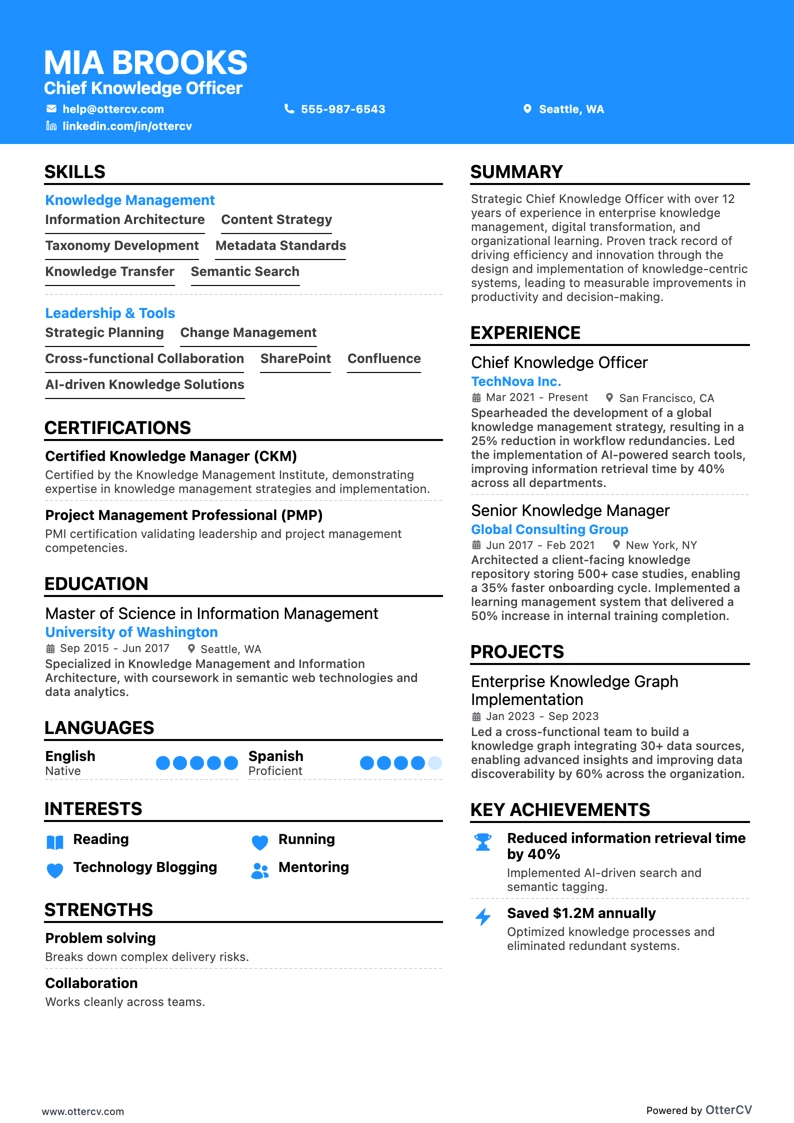
Chief Knowledge Officer full preview

10 Knowledge Manager Resume Examples

OtterCV

Written by The OtterCV Team

Updated: 8/22/2023•8 min read

See all resume examples in this guide, or generate your own resume example with your personalized prompt

Chief Knowledge Officer resume example

Chief Knowledge Officer

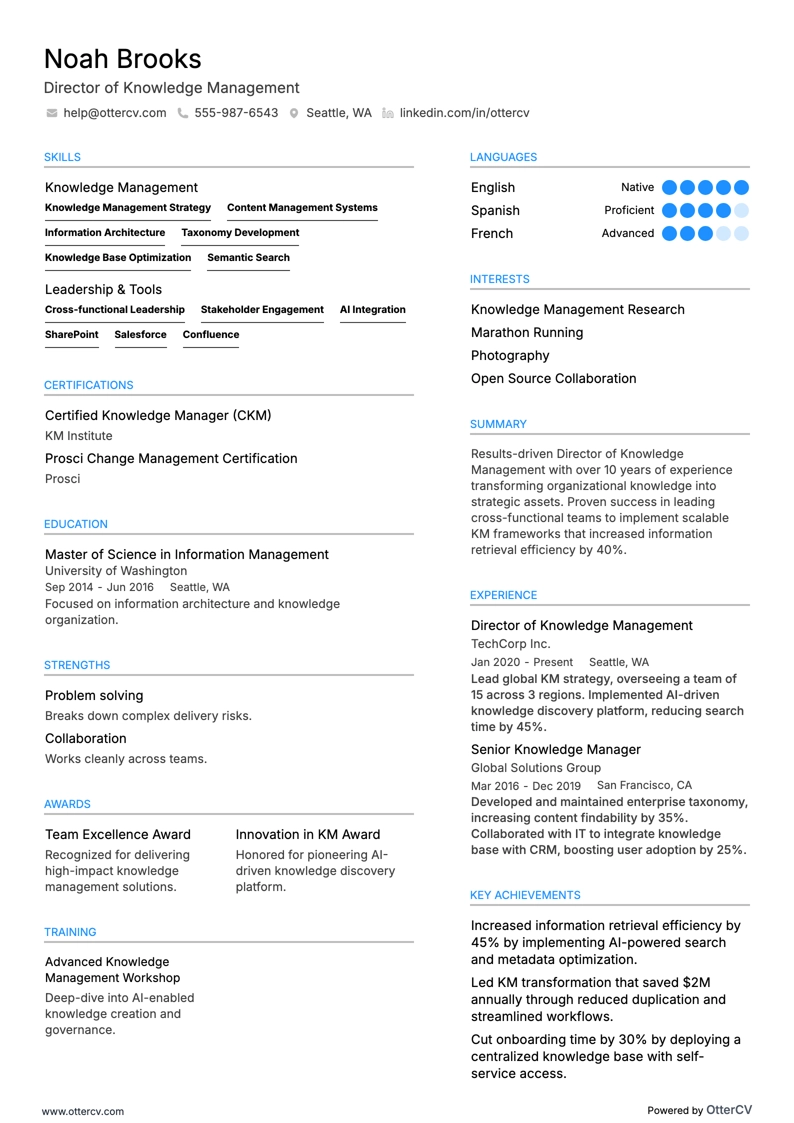
Director of Knowledge Management resume example

Director of Knowledge Management

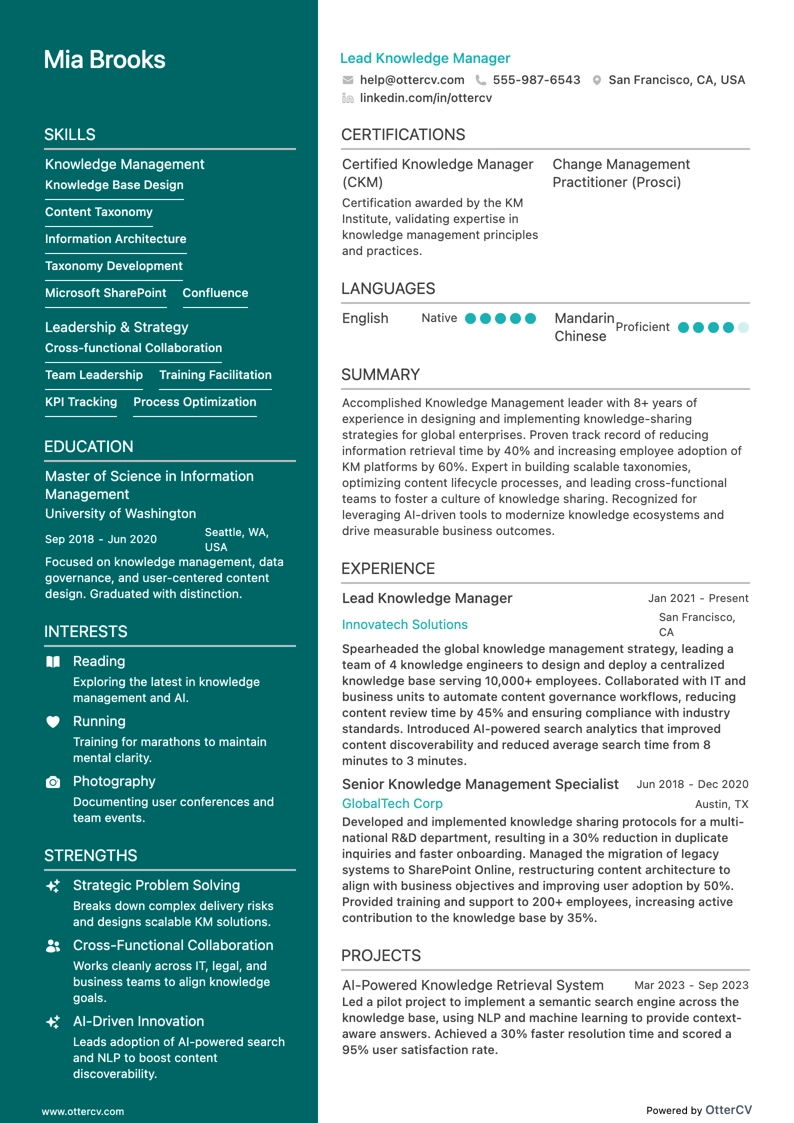
Lead Knowledge Manager resume example

Lead Knowledge Manager

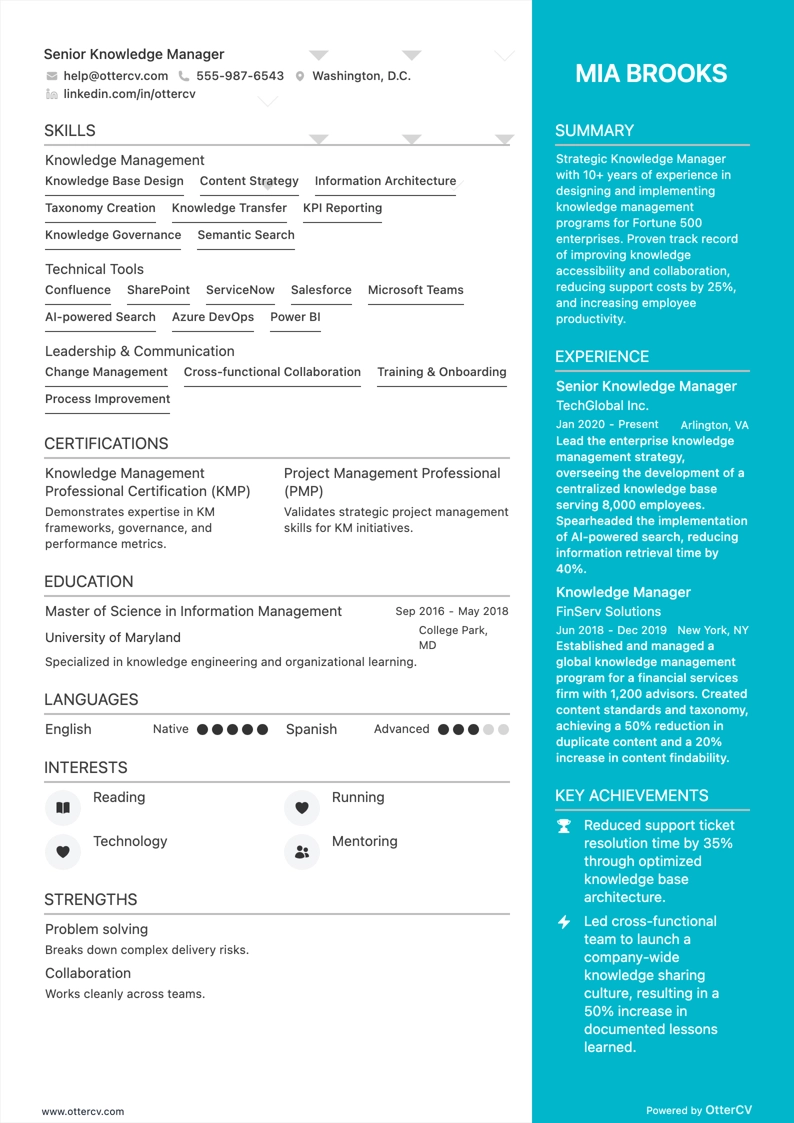
Senior Knowledge Manager resume example

Senior Knowledge Manager

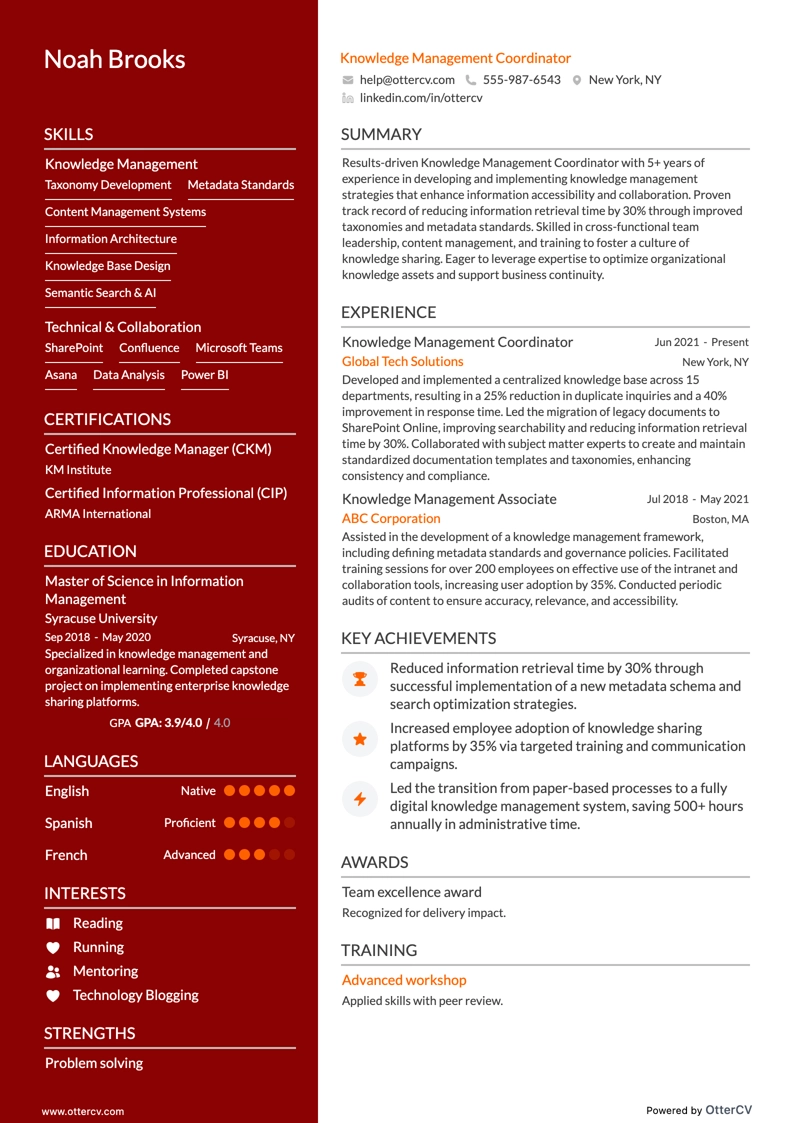
Knowledge Management Coordinator resume example

Knowledge Management Coordinator

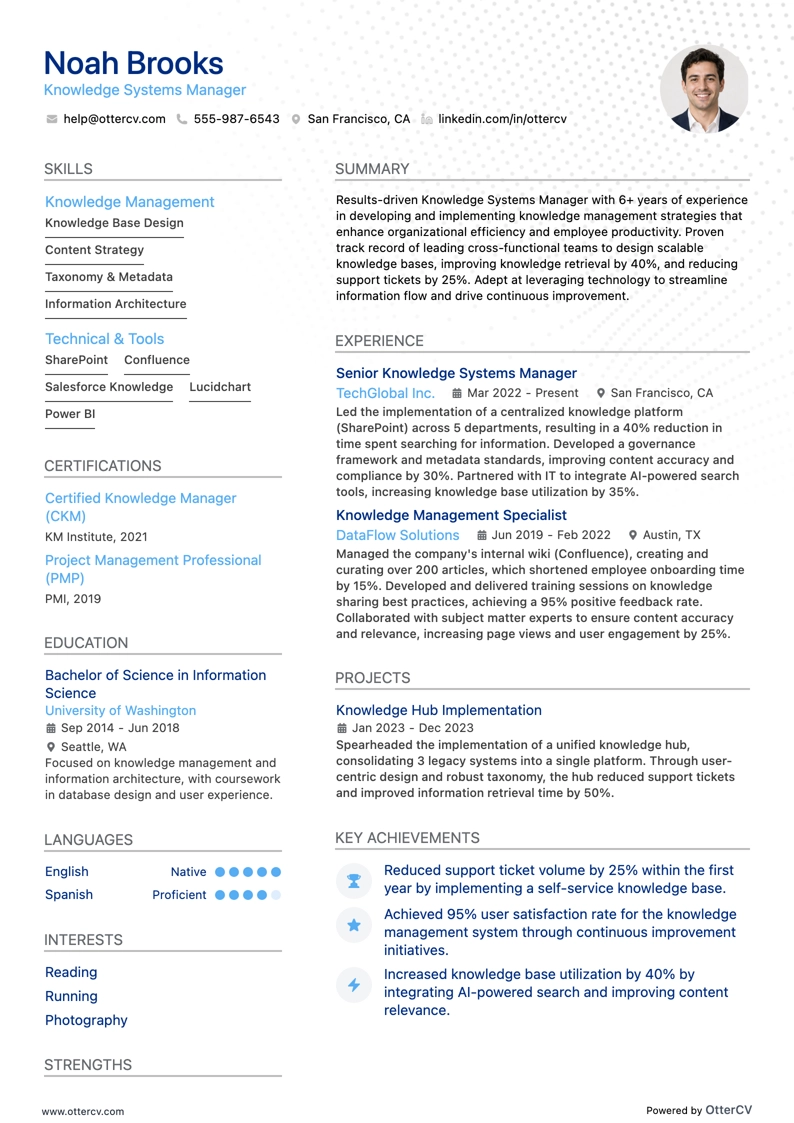
Knowledge Systems Manager resume example

Knowledge Systems Manager

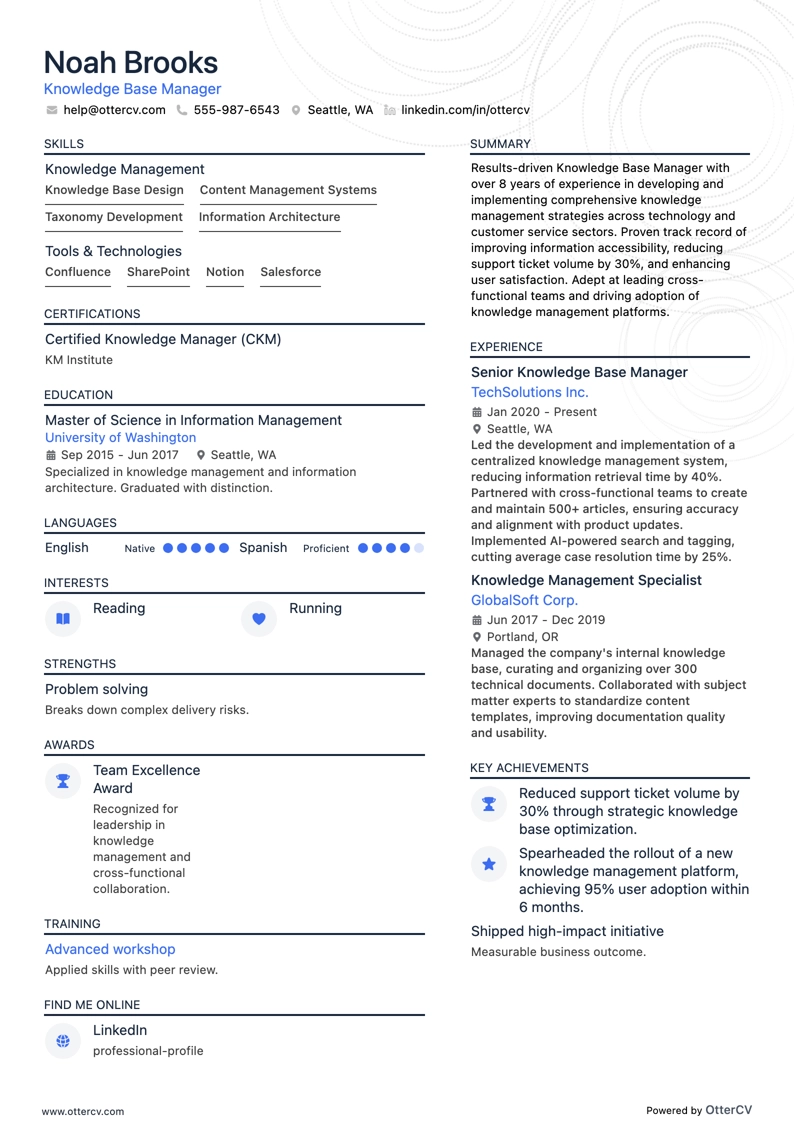
Knowledge Base Manager resume example

Knowledge Base Manager

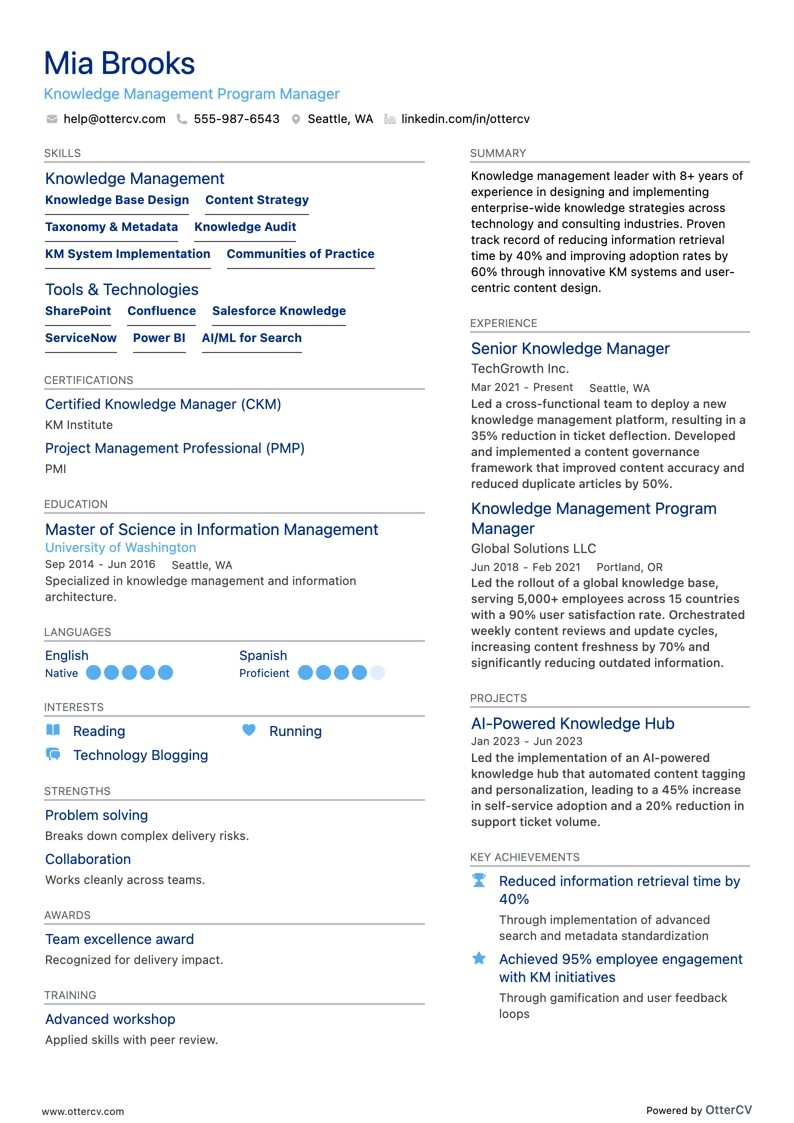
Knowledge Management Program Manager resume example

Knowledge Management Program Manager

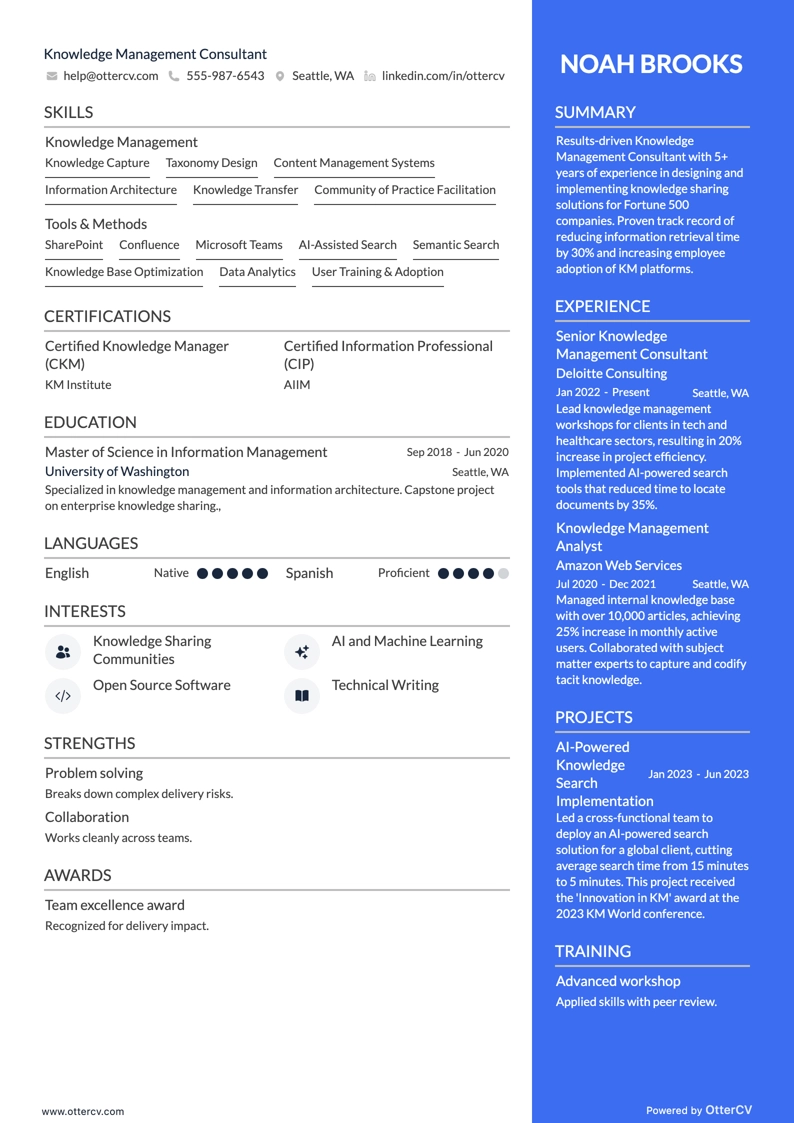
Knowledge Management Consultant resume example

Knowledge Management Consultant

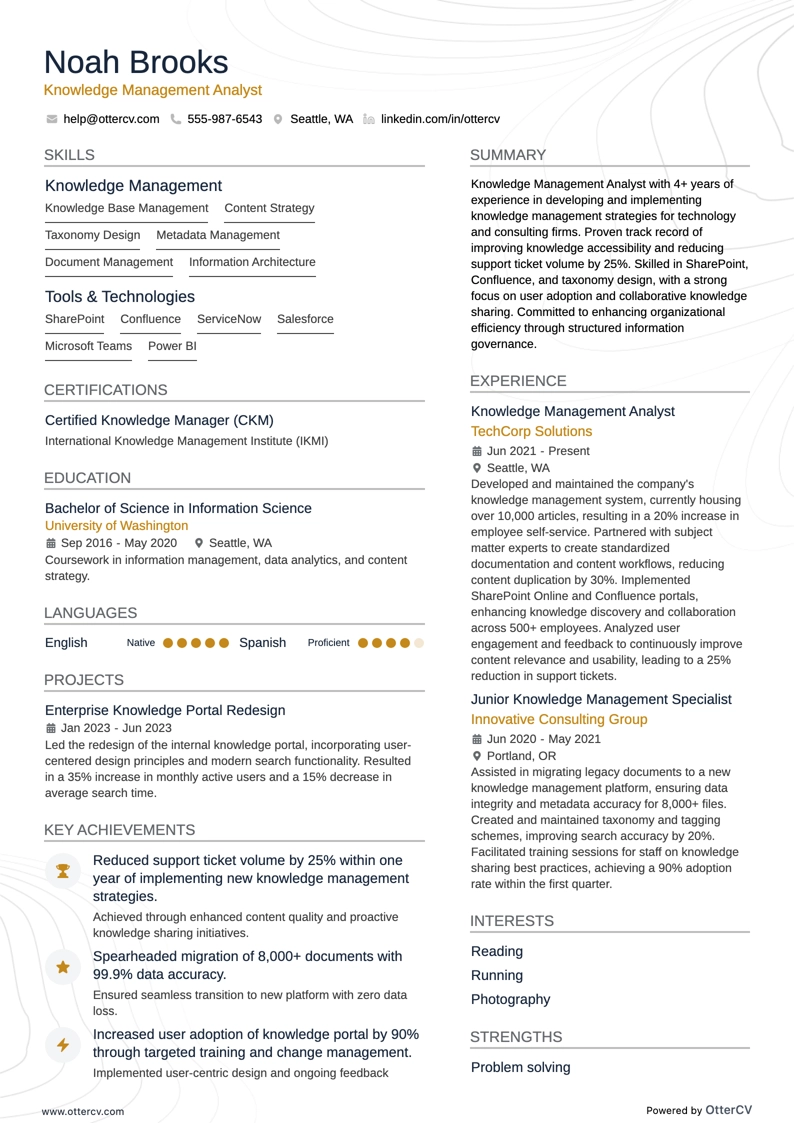
Knowledge Management Analyst resume example

Knowledge Management Analyst

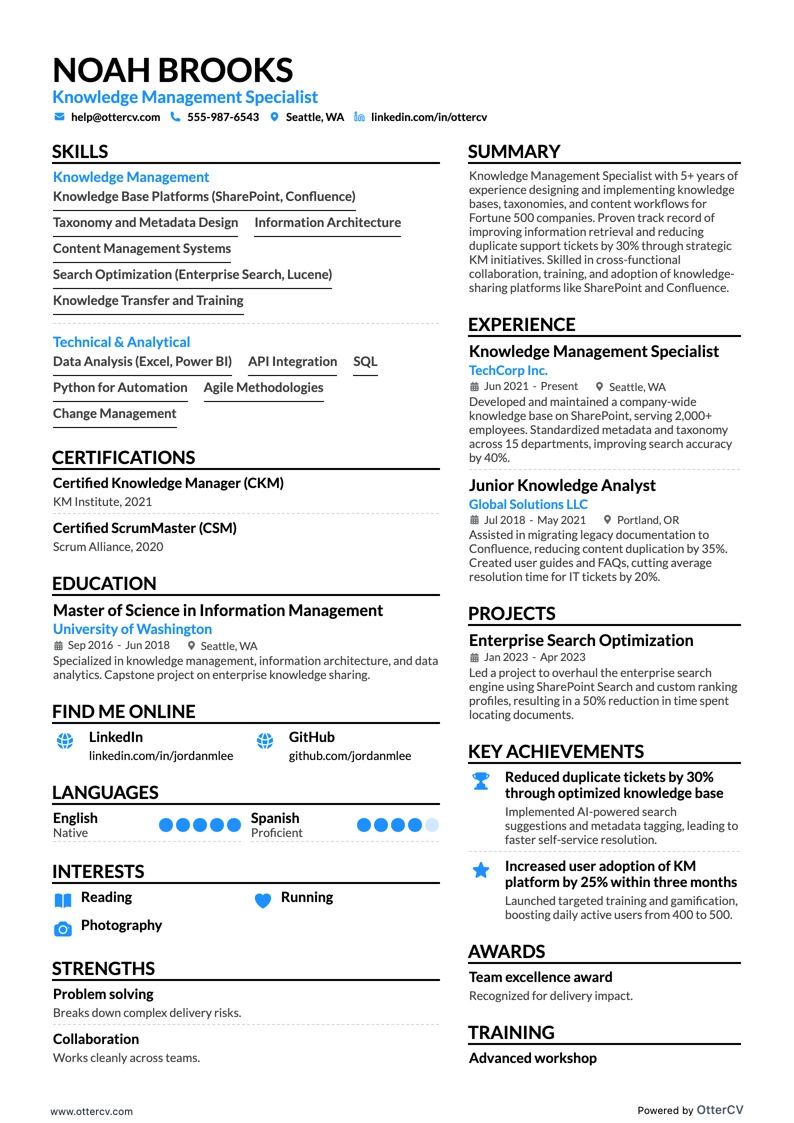
Knowledge Management Specialist resume example

Knowledge Management Specialist

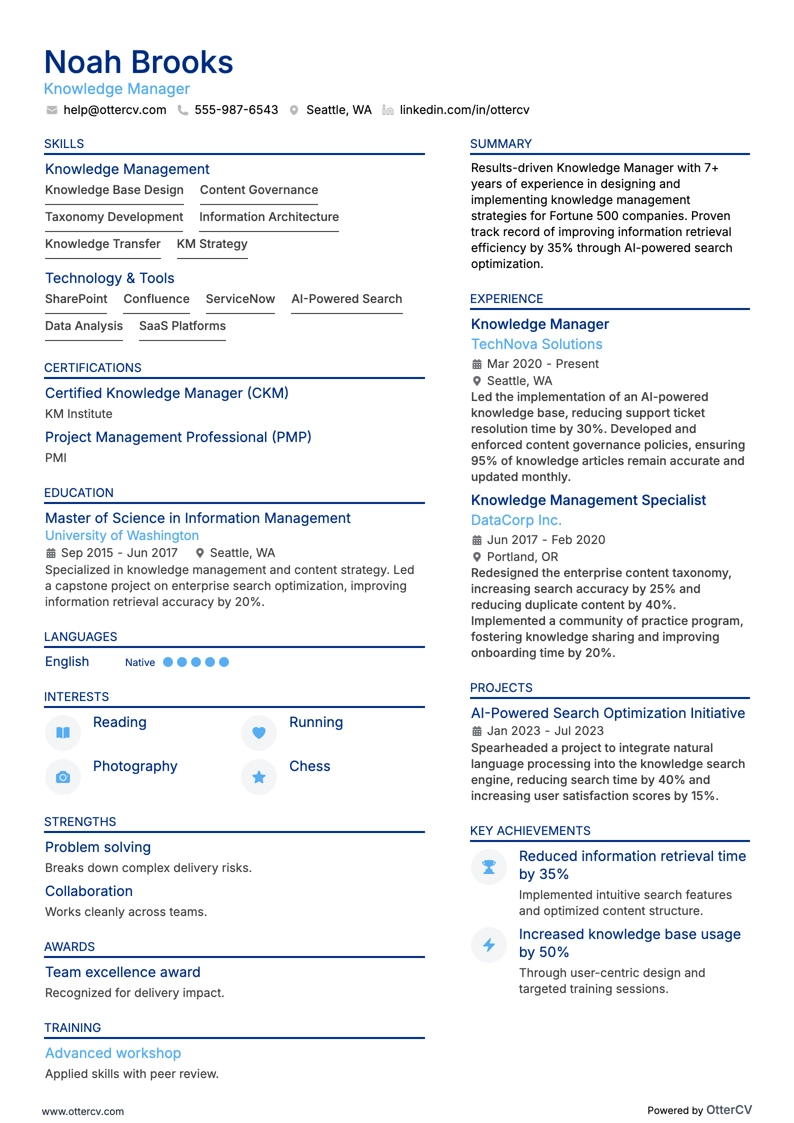
Knowledge Manager resume example

Knowledge Manager

Many knowledge manager resume drafts fall short because they describe repositories and tools without showing how knowledge improved decisions, speed, or quality. That gap can hurt during ATS filtering and quick recruiter scans, where proof and relevance often determine who moves forward. Understanding how to make your resume stand out starts with moving from task lists to clear evidence of impact.

A strong resume emphasizes outcomes and scale rather than duties alone. Highlight results such as faster time to resolution, higher self-service adoption, reduced duplicate work, improved search success, shorter onboarding time, better compliance, and measurable savings across teams.

Key takeaways

  • Quantify knowledge management outcomes on every resume, including search success, deflection rates, and time savings.

  • Use a reverse-chronological format if you have experience, and a hybrid format if you are changing careers.

  • Match the exact tools, platforms, and terminology from each job posting in your experience bullets.

  • Start each bullet with an action verb, a specific task, and a measurable result.

  • Place skills above experience if you are junior, and below experience if you are mid-level or senior.

  • List certifications such as KCS v6 or CKM with education to quickly validate specialized expertise.

  • Use Echocv to turn everyday knowledge management work into quantified, recruiter-ready resume bullets.

Job market snapshot for knowledge managers

We analyzed 183 recent knowledge manager job ads across major US job boards to highlight top hiring companies, experience requirements, and industry demand at a glance.

What level of experience employers are looking for knowledge managers

Years of ExperiencePercentage found in job ads
1–2 years1.6% (3)
3–4 years10.4% (19)
5–6 years11.5% (21)
7–8 years4.4% (8)
9–10 years1.6% (3)
10+ years7.7% (14)
Not specified64.5% (118)

Knowledge manager ads by area of specialization (industry)

Industry (Area)Percentage found in job ads
Finance & Banking69.4% (127)
Healthcare10.4% (19)
Education9.3% (17)
Manufacturing6.6% (12)

Top companies hiring knowledge managers

CompanyPercentage found in job ads
McDermott Will & Emery30.6% (56)
DLA Piper12.0% (22)

Role overview stats

These tables outline the most common responsibilities and employment types for knowledge manager roles. Use them to align your resume with employer expectations and better understand how the role is structured across the market.

Day-to-day activities and top responsibilities for a knowledge manager

ResponsibilityPercentage found in job ads
Knowledge management26.2% (48)
Microsoft Office suite24.0% (44)
Excel20.8% (38)
PowerPoint19.1% (35)
SharePoint19.1% (35)
Outlook18.0% (33)
Word18.0% (33)
AI17.5% (32)
Project management16.9% (31)
Artificial intelligence14.8% (27)
Data analytics13.1% (24)
Power BI13.1% (24)

Type of employment (remote vs on-site vs hybrid)

Employment typePercentage found in job ads
On-site63.9% (117)
Hybrid27.3% (50)
Remote8.7% (16)

How to format a knowledge manager resume

Recruiters reviewing knowledge manager resumes look for clear evidence of structured information governance, cross-functional collaboration, and measurable improvements in knowledge accessibility and organizational efficiency. A clean, well-organized resume format helps these signals stand out quickly in both automated screening and manual review.

I have significant experience in this role—which format should I use?

I have significant experience in this role—which format should I use?

Use a reverse-chronological format to present your knowledge management career in a clear, progression-driven narrative.

Do:

  • Lead with your most recent role and emphasize scope of ownership, such as the number of teams supported, the size of knowledge bases managed, and the governance frameworks you designed or maintained.
  • Highlight role-specific tools and domains such as Confluence, SharePoint, taxonomy development, content lifecycle management, and enterprise search optimization.
  • Quantify outcomes tied to business impact, including reductions in knowledge retrieval time, improvements in onboarding efficiency, or decreases in duplicate content across repositories.

Example bullet: “Redesigned the enterprise knowledge taxonomy across 12 departments, reducing average content retrieval time by 34% and cutting onboarding documentation searches from 15 minutes to under four minutes per query.”

I'm junior or switching into this role—what format works best?

I'm junior or switching into this role—what format works best?

A hybrid format works best. Lead with a focused skills section, then present relevant work history in chronological order.

  • Put a skills summary at the top highlighting core competencies such as information architecture, content curation, metadata tagging, and knowledge base administration.
  • Include academic projects, freelance work, or transitional experience—such as building internal wikis, managing FAQ systems, or organizing shared drives—to show practical knowledge management ability.
  • Connect each action to a clear outcome so hiring managers can see the value you delivered, even without a long tenure in the field.

Example scaffold: Taxonomy design (skill) → restructured a 500-page internal wiki into a topic-based navigation system (action) → reduced support ticket volume related to documentation findability by 22% (result).

Why not use a functional resume?

Why not use a functional resume?

A functional resume removes the timeline and context hiring managers need to understand how you applied knowledge management practices in real organizational settings, which makes it harder for them to judge your readiness for the role.

  • A functional resume may be acceptable if you are transitioning from a related field such as library science, technical writing, or information architecture and do not have direct knowledge management job titles, but only if every listed skill is tied to a specific project, deliverable, or measurable outcome.
  • Avoid the functional format entirely if you have any relevant work history, since most applicant tracking systems and recruiters expect chronological context.

What sections should go on a knowledge manager resume

Now that your resume’s structure and layout are set, the next step is filling each section with the right content.

Recruiters want to see how you capture, organize, govern, and scale knowledge so teams can find answers quickly and work consistently. Knowing what to put on a resume for this role means focusing on impact rather than generic responsibilities.

Use this structure for clarity:

  • Header
  • Summary
  • Experience
  • Skills
  • Projects
  • Education
  • Certifications
  • Optional sections: Publications, Awards, Languages

Strong experience bullets should highlight measurable impact, adoption, and outcomes, such as faster time-to-answer, higher self-serve resolution, improved search performance, reduced rework, and clearer governance across teams.

Once you’ve organized your resume with the right components, the next step is writing a knowledge manager experience section that shows clear, relevant impact in every role.

How to write your knowledge manager resume experience

Your experience section should show that you’ve built, maintained, and improved knowledge systems people actually use. Hiring managers care more about measurable impact—such as taxonomies you designed, repositories you migrated, and adoption rates you increased—than generic lists of day-to-day responsibilities. A targeted resume helps ensure each bullet aligns with the role’s priorities.

Each entry should include:

  • Job title
  • Company and location, or remote
  • Dates of employment, including month and year

Add three to five concise bullet points that show what you owned, how you executed the work, and the outcomes you delivered:

  • Ownership scope: the knowledge bases, content repositories, taxonomy structures, internal wikis, or documentation programs you were directly responsible for managing and improving.
  • Execution approach: the knowledge management platforms, content governance frameworks, information architecture methods, or AI-assisted search tools you used to organize, curate, and distribute knowledge.
  • Value improved: the gains you drove in knowledge accessibility, search accuracy, content freshness, self-service resolution rates, onboarding speed, or reduction of duplicate or outdated information.
  • Collaboration context: how you worked with subject matter experts, product teams, IT, customer support, or leadership to capture tacit knowledge, align documentation standards, and strengthen knowledge-sharing practices across the organization.
  • Impact delivered: the results your work produced—such as adoption growth, time savings, fewer support escalations, improved compliance, or faster employee ramp-up—rather than simply listing tasks.

Experience bullet formula

Experience bullet formula

Action verb + technology + what you built or fixed + measurable result

A knowledge manager experience example

Knowledge Manager

NorthBridge Health | Austin, TX (Hybrid)

2021–Present

Scaled an enterprise health technology platform supporting 4,000+ internal users across customer support, implementation, and product teams.

  • Led a taxonomy and information architecture redesign in Confluence and Jira Service Management, reducing article search time by 38% and increasing self-serve resolution by 22% across support and implementation teams.
  • Implemented a knowledge-centered service methodology and governance workflow with subject matter experts and team leads, raising content freshness from 54% to 91% and reducing repeat tickets by 17%.
  • Built a content quality program using style guides, templates, and peer review in Google Workspace and Confluence, improving article helpfulness ratings from 3.8 to 4.5 out of five and lowering escalations by 12%.
  • Launched a Zendesk Guide and Salesforce Service Cloud knowledge integration with single-source publishing, reducing duplicate content by 28% and saving 160+ hours per quarter for support and product operations.
  • Partnered with product managers, designers, and engineers to operationalize release documentation and change communications, cutting time-to-publish from five days to two days and reducing post-release defects tied to misconfiguration by 14%.

Now that you've seen what makes a strong experience section, the next step is adapting yours to fit a specific job posting.

How to tailor your knowledge manager resume experience

Recruiters review a knowledge manager resume through both applicant tracking systems and human screening, so tailoring your resume to the job description is essential. It helps make the tools, methodologies, and competencies the employer values most clear in your work history.

Ways to tailor your knowledge manager experience:

  • Mirror the knowledge management platforms and tools listed in the posting.
  • Match the taxonomy or classification terminology the employer uses.
  • Reflect any content governance standards or frameworks they reference.
  • Highlight experience in the industry or domain the role requires.
  • Emphasize information security or compliance protocols when the posting mentions them.
  • Use the same language for collaboration workflows or cross-functional models they describe.
  • Align your KPIs with the success metrics outlined in the job description.
  • Feature change management or adoption strategies if the role prioritizes them.

The goal is to present your real accomplishments in language that reflects what the employer is asking for, not to force in keywords that do not belong.

Resume tailoring examples for knowledge manager

Job description excerptUntailoredTailored
“Develop and maintain enterprise knowledge bases using Confluence and SharePoint, ensuring content accuracy and accessibility across global teams.”Managed knowledge base content and kept information up to date.Built and maintained 12 enterprise knowledge bases in Confluence and SharePoint, serving 3,500+ employees across eight global offices with a 97% content accuracy rate during quarterly audits.
“Design and implement taxonomy and metadata frameworks to improve search relevance and knowledge discoverability within ServiceNow.”Helped organize information so employees could find what they needed.Designed a taxonomy and metadata tagging framework within ServiceNow that improved internal search relevance by 40%, reducing average knowledge article retrieval time from 4.2 minutes to 1.5 minutes.
“Lead knowledge management governance, including content lifecycle policies, stakeholder training, and KM adoption metrics tracking using KPIs such as article reuse rate and time-to-resolution.”Worked with stakeholders to promote knowledge sharing and best practices.Led KM governance for a 200-person support organization, enforcing content lifecycle policies that increased article reuse rate by 35% and cut average time-to-resolution by 22% over two quarters through structured stakeholder training and monthly KPI reporting.

Once you’ve aligned your experience with the role’s priorities, quantify your achievements to show the impact of that work with clear, measurable results.

How to quantify your knowledge manager achievements

Quantifying your achievements shows that your knowledge base supports faster answers, better decisions, and lower risk. Track results such as search success, time to publish, deflection, accuracy, adoption, and compliance outcomes across key teams and tools.

Quantifying examples for knowledge manager

MetricExample
Search success rateRaised search success from 62% to 81% by redesigning taxonomy and synonyms in Confluence and Elasticsearch, reducing 'no results' queries by 38%.
Publish cycle timeCut article publish turnaround from eight days to three by adding SME templates, a review queue in Jira, and weekly editorial triage.
Case deflectionIncreased self-serve deflection by 19% by launching troubleshooting guides in Zendesk Guide, reducing monthly ticket volume by 420.
Content accuracyReduced outdated or incorrect articles from 14% to 5% through quarterly audits, version control, and a two-step SME approval workflow.
Compliance riskAchieved 100% completion of annual policy updates across fifty-two documents and passed two audits with zero findings by standardizing governance and retention rules.

Once you’ve written strong bullet points for your experience section, it’s just as important to highlight the hard and soft skills that support your qualifications as a knowledge manager.

How to list your hard and soft skills on a knowledge manager resume

Your skills section shows how you capture, govern, and scale organizational knowledge. Recruiters and ATS (applicant tracking systems) scan this section for role-specific keywords, so aim for a balanced mix of hard skills and job-specific soft skills.

Knowledge manager roles typically require a blend of:

  • Product strategy and discovery skills.
  • Data, analytics, and experimentation skills.
  • Delivery, execution, and go-to-market discipline.
  • Soft skills.

Your skills section should be:

  • Scannable, using bullet-style grouping.
  • Relevant to the job posting.
  • Supported by proof in your experience bullets.
  • Updated with current tools.

Place your skills section:

  • Above your experience section if you’re junior or changing careers.
  • Below your experience section if you’re mid-level or senior with strong achievements.

Hard skills

  • Knowledge base architecture.
  • Information taxonomy and ontology.
  • Metadata standards and tagging.
  • Content lifecycle management.
  • Knowledge governance and policies.
  • Confluence, SharePoint, and Notion.
  • ServiceNow Knowledge Management.
  • Zendesk Guide and Salesforce Service Cloud.
  • Search optimization and relevance tuning.
  • Google Analytics and Looker.
  • SQL reporting and dashboards.
  • SOP and playbook development.

Soft skills

  • Stakeholder alignment and buy-in.
  • Cross-functional facilitation.
  • Clear technical writing.
  • Interviewing subject matter experts.
  • Translating needs into workflows.
  • Prioritization and backlog management.
  • Decision-making with constraints.
  • Ownership of quality standards.
  • Change management communication.
  • Conflict resolution in reviews.
  • Attention to compliance details.
  • Continuous improvement mindset.

How to show your knowledge manager skills in context

Skills should not live only in a bulleted list on your resume. Explore examples of resume skills shown in context to see how top candidates connect competencies to real achievements.

They should be demonstrated in:

  • Your summary (high-level professional identity)
  • Your experience (proof through outcomes)

Here’s what that looks like in practice.

Summary example

Senior knowledge manager with 10 years in healthcare IT, with expertise in Confluence administration, taxonomy design, and cross-functional training. Built an enterprise knowledge base that reduced employee onboarding time by 35% and cut redundant support tickets.

  • Signals senior-level expertise immediately
  • Names specific platforms and methods
  • Leads with a measurable outcome
  • Highlights collaboration and leadership

Senior Knowledge Manager

Vantage Health Systems | Remote

March 2019–Present

  • Redesigned the internal knowledge base in Confluence, reducing average ticket resolution time by 28% across three support teams.
  • Partnered with product and engineering leads to build a structured taxonomy, improving content discoverability scores by 40%.
  • Launched a company-wide knowledge-sharing program using SharePoint and Slack integrations, increasing active contributor participation by 55%.
  • Every bullet includes measurable proof.
  • Skills surface naturally through real outcomes.

Once you’ve shown how your knowledge management strengths lead to real work outcomes, the next step is turning those strengths into a resume, even without direct experience.

How do I write a knowledge manager resume with no experience

Even without full-time experience, you can show readiness through transferable projects and hands-on work. Our guide on writing a resume without work experience includes strategies that apply directly to knowledge manager candidates:

  • Knowledge base build for a student organization.
  • Customer support ticket tagging audits.
  • Internal wiki cleanup and governance.
  • Documentation for process standardization.
  • SharePoint site migration assistance.
  • Confluence space setup and templates.
  • Taxonomy and metadata mapping project.
  • Search analytics report and improvements.

Focus on:

  • Knowledge manager tools used.
  • Governance, taxonomy, and metadata.
  • Measurable documentation and search gains.
  • Cross-team knowledge workflow examples.

Resume format tip for entry-level knowledge manager

Resume format tip for entry-level knowledge manager

Use a combination resume format that leads with skills and projects, then lists experience. This helps highlight knowledge manager work samples when your job history is limited.

Do:

  • Add a Projects section above Experience.
  • List tools such as Confluence, SharePoint, and Zendesk.
  • Show metrics like views, deflection, and time saved.
  • Describe governance, including taxonomy, owners, and review cycles.
  • Link to a sanitized writing sample.

Example project bullet:

  • Built a Confluence knowledge base for a student org, created taxonomy and templates, and cut repeat questions by 30% over eight weeks using search analytics.

Even without direct experience, your education section can show the foundational knowledge and relevant coursework that qualify you for a knowledge manager role.

How to list your education on a knowledge manager resume

Your education section helps hiring teams quickly confirm that you have the academic background needed to manage organizational information systems.

Include:

  • Degree name
  • Institution
  • Location
  • Graduation year
  • Relevant coursework, especially for juniors or entry-level candidates
  • Honors and GPA, if your GPA is 3.5 or higher

Skip the month and day, and list only the graduation year.

Here’s a strong education entry tailored to the knowledge manager role.

Example education entry

Bachelor of Science in Information Science

University of Michigan, Ann Arbor, MI

Graduated 2021

GPA: 3.7/4.0

  • Relevant Coursework: Knowledge Management Systems, Information Architecture, Database Design, Organizational Learning
  • Honors: Magna Cum Laude, Dean's List (six semesters)

How to list your certifications on a knowledge manager resume

Certifications on a resume show a knowledge manager’s commitment to continuous learning, proficiency with key tools, and alignment with industry standards and practices.

Include the following details:

  • Certificate name
  • Issuing organization
  • Year
  • Optional: credential ID or URL
  • Place certifications below education when they’re older, less relevant, or secondary to your degree and core experience.
  • Place certifications above education when they’re recent, highly relevant, or required for the knowledge manager role you want.

Best certifications for your knowledge manager resume

  • Certified Knowledge Manager (CKM).
  • Knowledge-Centered Service (KCS) v6 Practices.
  • ITIL 4 Foundation.
  • Certified Information Professional (CIP).
  • Certified Records Manager (CRM).
  • Certified Information Systems Auditor (CISA).
  • Prosci Certified Change Practitioner.

How to write your knowledge manager resume summary

Once you’ve placed your credentials where they create the most value, write a knowledge manager resume summary that puts those strengths front and center.

Your resume summary is often the first thing a recruiter reads, so it needs to capture attention quickly. A strong opening shows why you’re a good fit for a knowledge manager role before they review the rest of your resume.

Keep it to three to four lines and include:

  • Your job title and total years of experience in knowledge management or related fields.
  • The domain or industry where you’ve built expertise, such as IT, healthcare, or SaaS.
  • Core tools and skills, such as SharePoint, Confluence, taxonomy design, or content governance.
  • One or two measurable achievements that demonstrate your impact.
  • Soft skills connected to outcomes, such as cross-functional collaboration that improved adoption rates.

PRO TIP

For a mid-level knowledge manager role, emphasize the specific tools you have mastered and the processes you have improved.

Quantify your contributions whenever possible, even if the results are modest.

Avoid generic phrases like “passionate team player” or “results-driven professional.” Instead, use concrete details that show what you have actually done.

Example summary for a knowledge manager

Knowledge manager with four years of experience building Confluence-based knowledge bases for SaaS teams. Designed a taxonomy framework that reduced average search time by 35%. Skilled in content governance and cross-departmental collaboration.

Now that your summary highlights your expertise and value, make sure your header presents your contact details and professional identity just as clearly.

What to include in a knowledge manager resume header

A resume header includes your key contact and identity details, helping improve visibility, reinforce credibility, and speed up recruiter screening for a knowledge manager role.

Essential resume header elements:

  • Full name
  • Tailored job title and headline
  • Location
  • Phone number
  • Professional email
  • GitHub link
  • Portfolio link
  • LinkedIn

A LinkedIn link helps recruiters verify your experience quickly and supports screening.

Do not include photos on a knowledge manager resume unless the role is explicitly front-facing or appearance-dependent.

Keep your header consistent with your application profiles, and align your headline with the target posting's core knowledge manager requirements.

Example

Once the top of your resume clearly shows who you are and how to contact you, add relevant sections that further strengthen your knowledge manager resume.

Additional sections for knowledge manager resumes

These extra sections can help you stand out when your core qualifications are similar to those of other candidates. They give hiring managers more concrete evidence of your role-specific expertise. For example, listing language skills can be especially useful if the role involves managing multilingual knowledge bases or supporting global teams.

  • Languages
  • Publications
  • Certifications
  • Professional affiliations
  • Conference presentations
  • Volunteer experience
  • Hobbies and interests

Once you've strengthened your resume with relevant additional sections, pairing it with a well-crafted cover letter can help maximize your application's impact.

Do knowledge manager resumes need a cover letter

A cover letter isn't required for a knowledge manager role, but it often helps. If you're unsure what a cover letter is or when to use one, it matters most for competitive roles or teams that expect strong writing. It can also make a difference when your resume needs more context or your fit isn't immediately obvious.

Use a cover letter to add details your resume can't fully show:

  • Explain role and team fit: Connect your experience to how the knowledge manager will support support, success, sales, or engineering workflows.
  • Highlight one or two outcomes: Share a project, your approach, and a result like faster time to resolution, higher self-serve success, or fewer repeat tickets.
  • Show product and user understanding: Reference key user groups, content gaps, and how you'd measure knowledge health in that business context.
  • Address transitions or non-obvious experience: Clarify why you're moving into a knowledge manager role and how past work maps to the job's core needs.

If you decide a cover letter will not add meaningful value to your application, the next step is using AI to improve your knowledge manager resume so it communicates your qualifications clearly and efficiently.

Using AI to improve your knowledge manager resume

AI can improve your resume's clarity, structure, and impact. It can help you find stronger phrasing and highlight relevant results. But overusing it can strip away authenticity. Once your content feels clear and aligned with the role, step away from AI. If you're exploring tools, this guide on which AI is best for writing resumes can help you choose the right one.

Here are 10 practical prompts you can copy and paste to strengthen specific sections of your knowledge manager resume:

  1. Strengthen summary focus: “Rewrite my knowledge manager resume summary to emphasize expertise in taxonomy design, content governance, and organizational learning outcomes.”
  2. Quantify experience bullets: “Add measurable results to these knowledge manager experience bullets, focusing on efficiency gains, adoption rates, or time saved.”
  3. Align skills with job posting: “Compare my knowledge manager skills section against this job description and suggest missing keywords that match my experience.”
  4. Sharpen project descriptions: “Rewrite this knowledge manager project section to clearly state the problem, my role, the tools used, and the outcome.”
  5. Improve action verbs: “Replace weak or repeated verbs in my knowledge manager experience bullets with specific, high-impact action verbs.”
  6. Tailor education relevance: “Highlight coursework and academic projects in my education section that directly support a knowledge manager role.”
  7. Clarify certification value: “Rewrite my certifications section to briefly explain how each credential supports my work as a knowledge manager.”
  8. Remove filler language: “Identify and remove vague or redundant phrases across my entire knowledge manager resume without changing the core meaning.”
  9. Tighten bullet structure: “Restructure my knowledge manager experience bullets into consistent action-verb-task-result format, each under 20 words.”
  10. Refine for ATS readability: “Adjust formatting and keyword placement across my knowledge manager resume to improve applicant tracking system compatibility.”

Stop using AI once your resume sounds accurate, specific, and aligned with your real experience. AI should never invent experience or inflate claims—if it didn't happen, it does not belong here.

Conclusion

A strong knowledge manager resume demonstrates impact with measurable outcomes, highlights role-specific skills, and uses a clear, easy-to-scan structure. It should connect your work to faster search, greater reuse, fewer repeats, and stronger compliance.

Keep every section focused and consistent so hiring teams can assess you quickly. A results-led knowledge manager resume can position you well for today’s hiring market and the next wave of roles.

Knowledge Manager resume examples

Explore additional Knowledge Manager resume samples and guides and see what works for your level of experience or role.

By Experience

Chief Knowledge Officer

Chief Knowledge Officer resume preview

Director of Knowledge Management

Director of Knowledge Management resume preview

Lead Knowledge Manager

Lead Knowledge Manager resume preview

Senior Knowledge Manager

Senior Knowledge Manager resume preview

Knowledge Manager resume examples

Explore additional Knowledge Manager resume samples and guides and see what works for your level of experience or role.

By Role

Knowledge Management Coordinator

Knowledge Management Coordinator resume preview

Knowledge Systems Manager

Knowledge Systems Manager resume preview

Knowledge Base Manager

Knowledge Base Manager resume preview

Knowledge Management Program Manager

Knowledge Management Program Manager resume preview

Knowledge Management Consultant

Knowledge Management Consultant resume preview

Knowledge Management Analyst

Knowledge Management Analyst resume preview

Knowledge Management Specialist

Knowledge Management Specialist resume preview

Knowledge Manager

Knowledge Manager resume preview