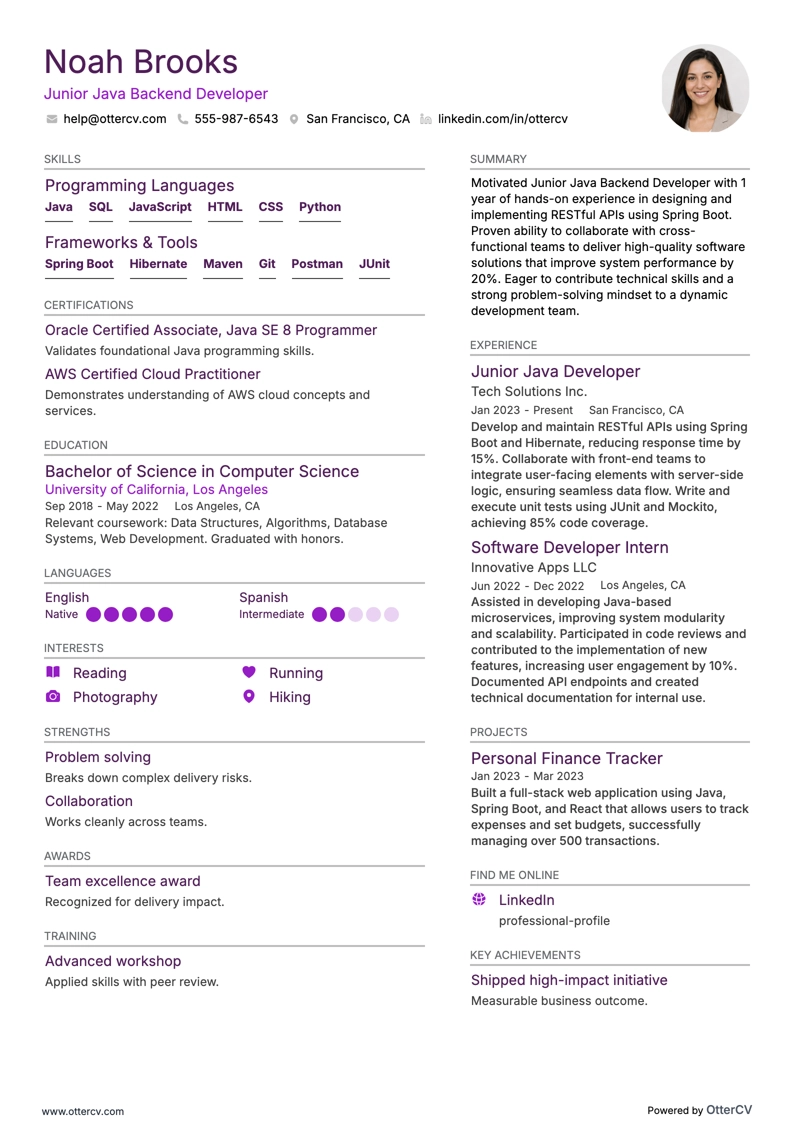
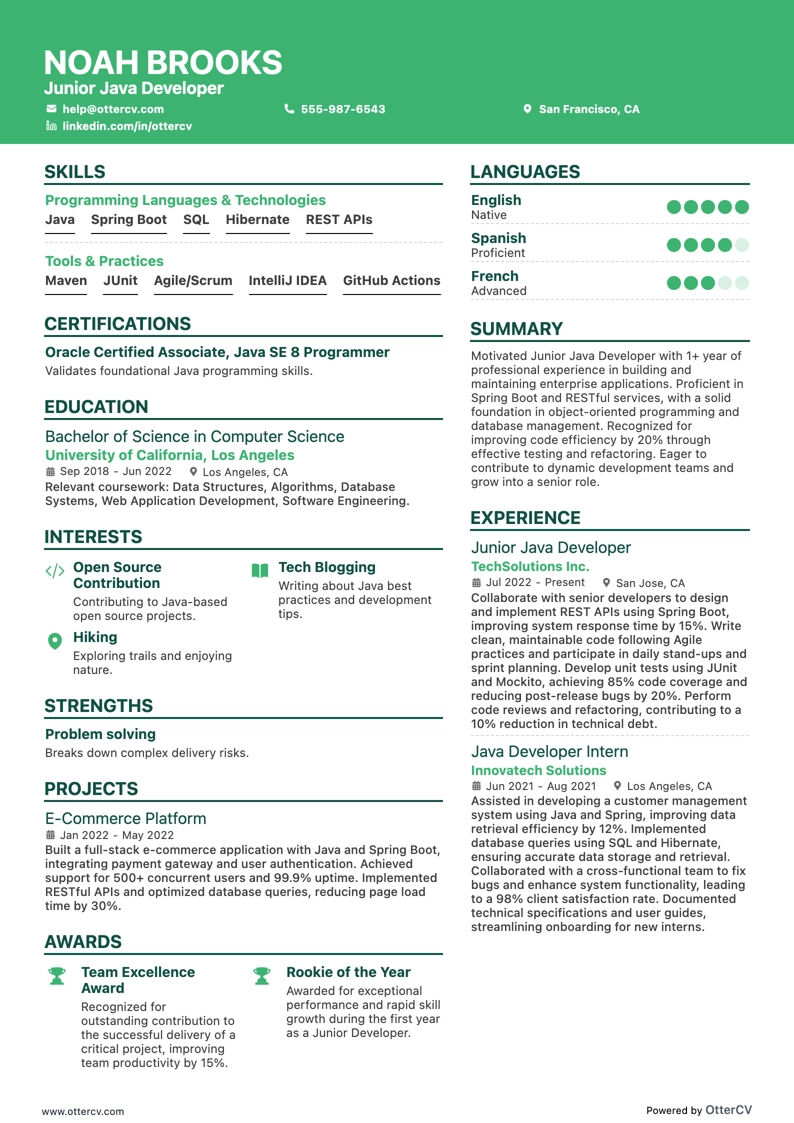
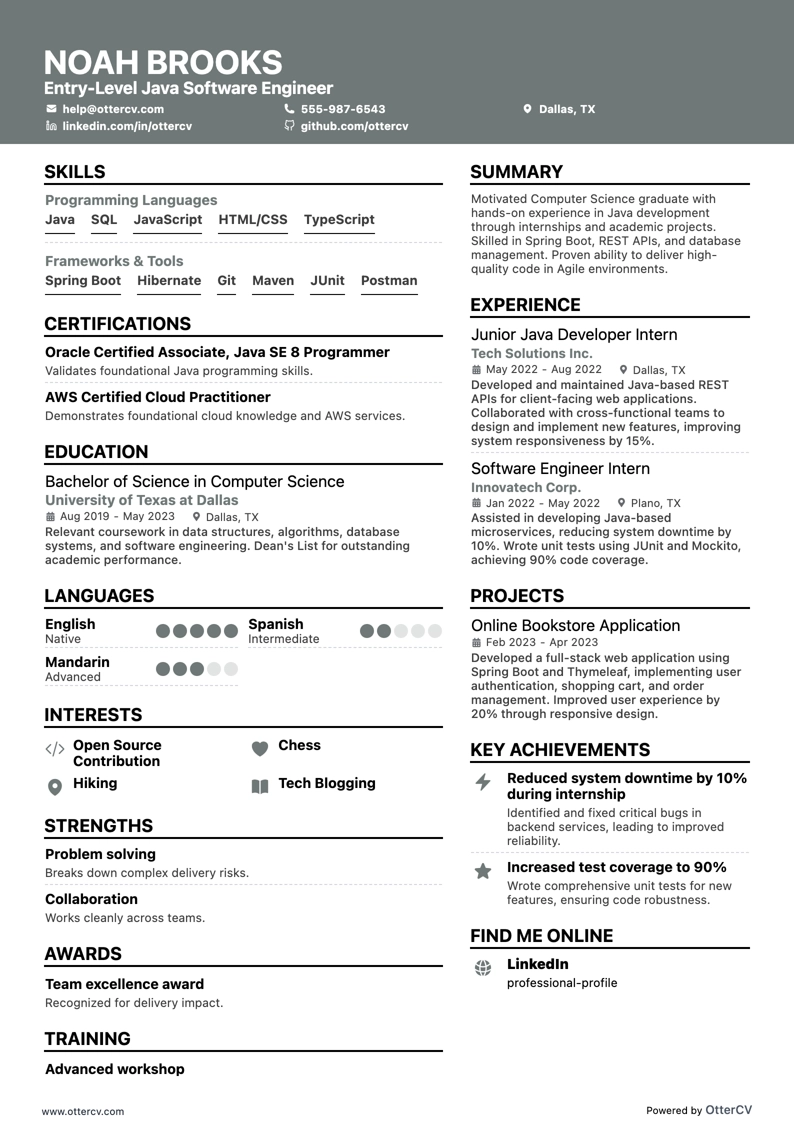
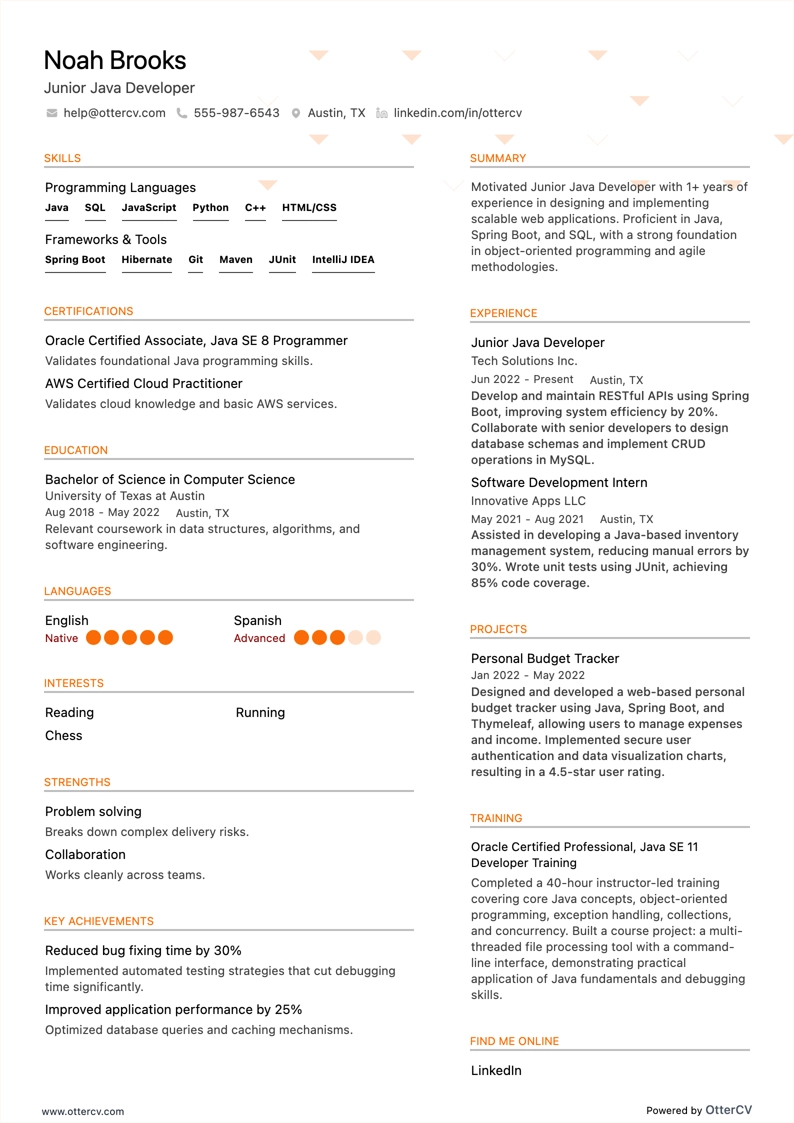
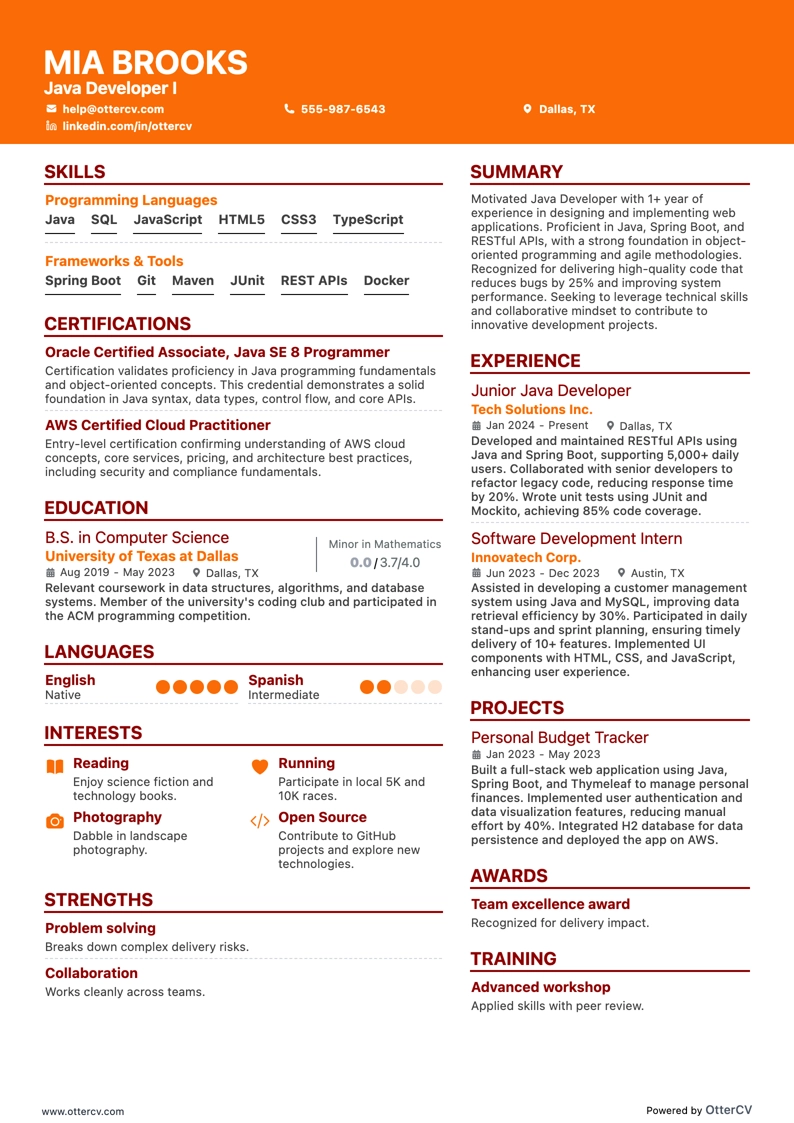
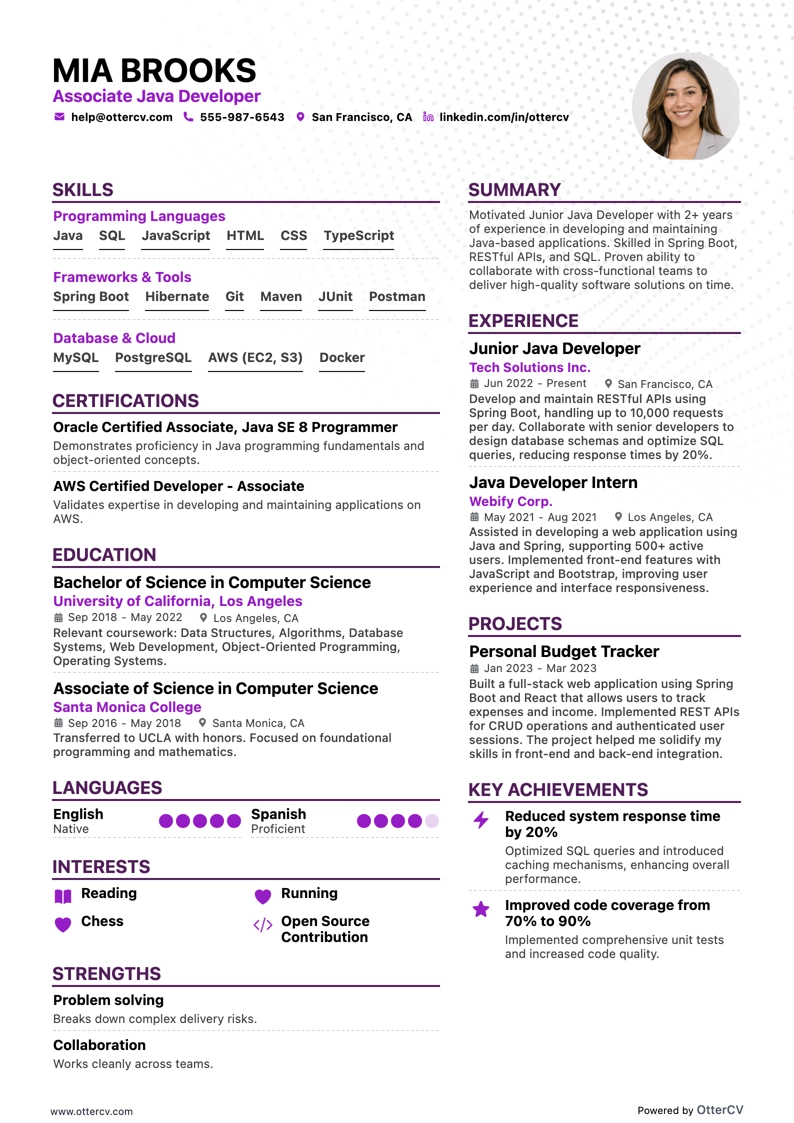
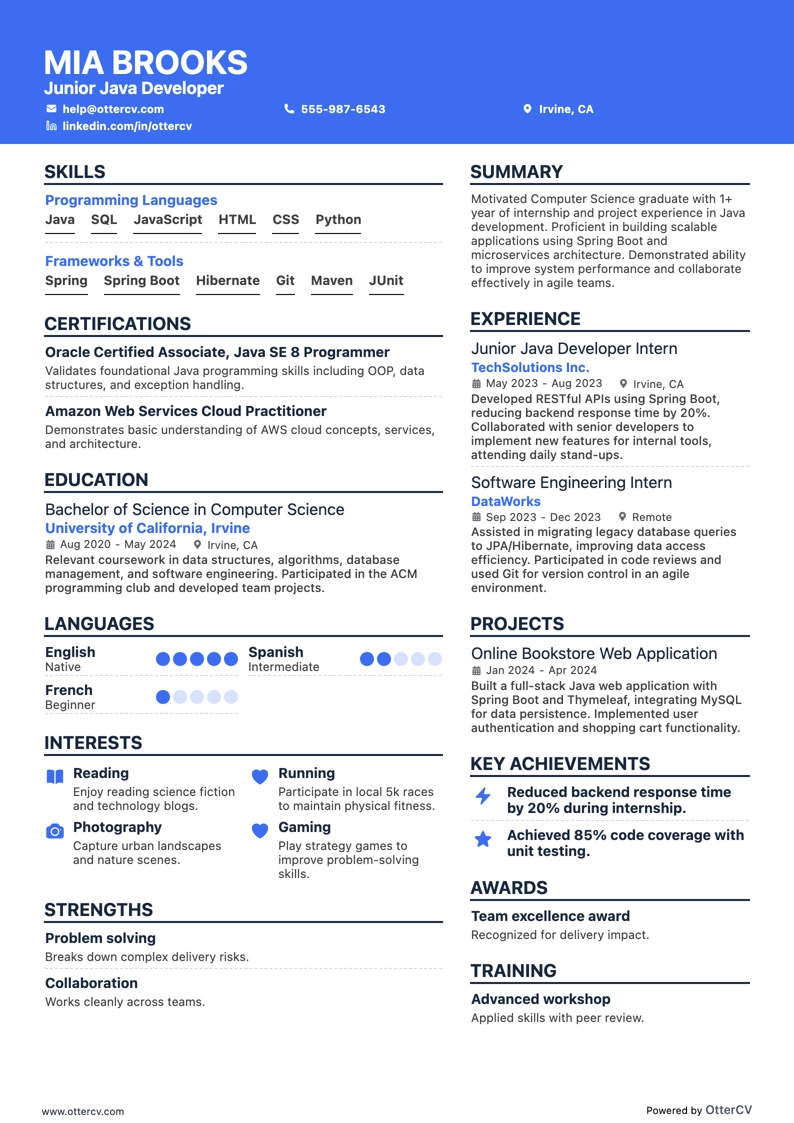
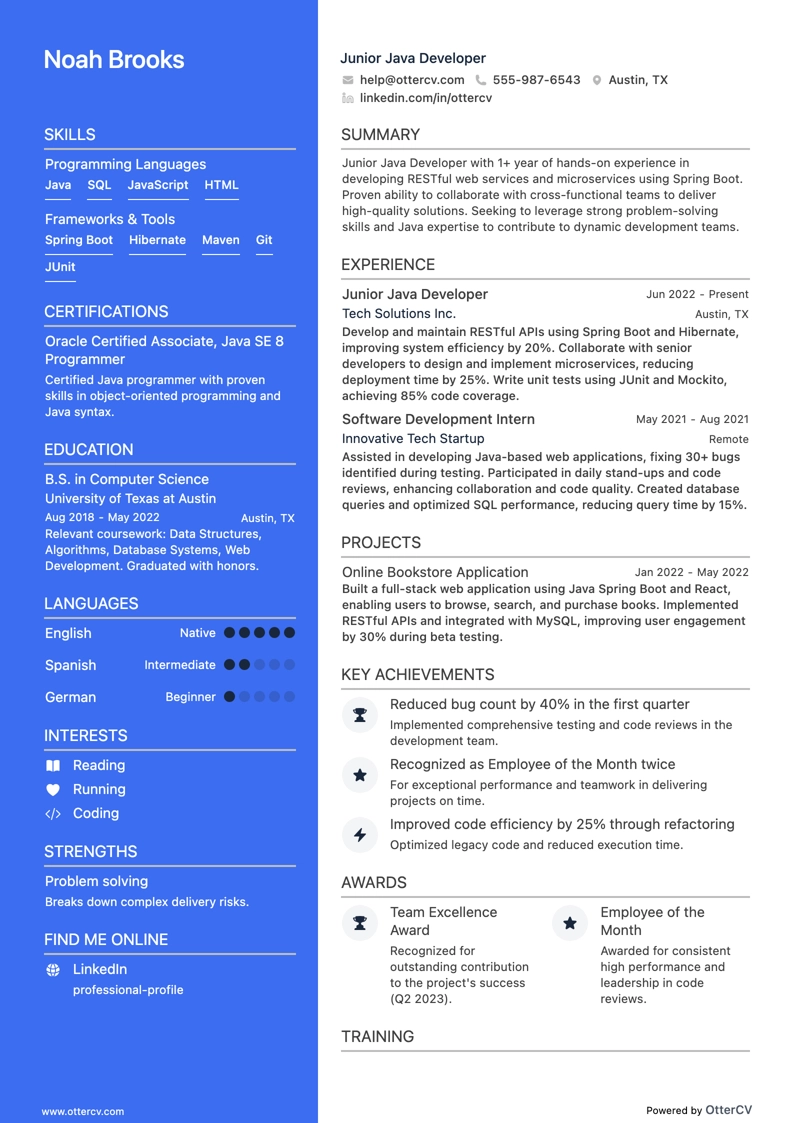
Junior Java Web Developer full preview

5 Junior Java Developer Resume Examples

OtterCV

Written by The OtterCV Team

Updated: 10/18/2023•8 min read

See all resume examples in this guide, or generate your own resume example with your personalized prompt

Junior Java Web Developer resume example

Junior Java Web Developer

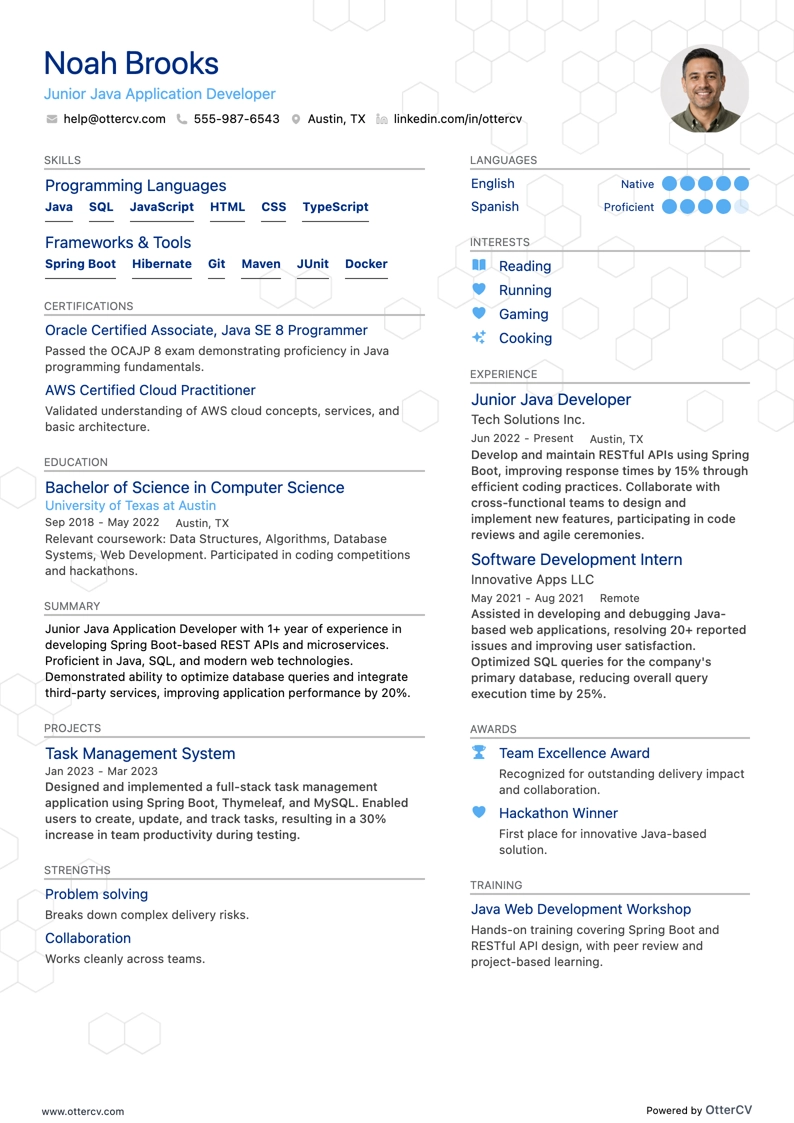
Junior Java Application Developer resume example

Junior Java Application Developer

Junior Java Backend Developer resume example

Junior Java Backend Developer

Associate Java Software Engineer resume example

Associate Java Software Engineer

Entry-Level Java Software Engineer resume example

Entry-Level Java Software Engineer

Junior Java Software Engineer resume example

Junior Java Software Engineer

Java Developer I resume example

Java Developer I

Associate Java Developer resume example

Associate Java Developer

Entry-Level Java Developer resume example

Entry-Level Java Developer

Junior Java Developer resume example

Junior Java Developer

Java is a versatile programming language used in web applications, cloud computing, and mobile development, and it is likely to remain in demand on the job market for years to come.

That said, starting out as a Java developer in 2026 is harder than ever. As tech becomes a more desirable career path and more people learn Java, junior Java developers are competing with thousands of other candidates.

AI is also becoming a strong substitute for entry-level developers, which makes standing out even more important. A strong resume can help you do that.

In this article, you’ll learn how to craft your resume and see real Java resume samples to use as a reference.

We’ll cover:

  • how to format your resume
  • how to tailor it to what recruiters want to see in a junior Java developer
  • what sections to include
  • how to write each section so it makes an impact
  • which skills and achievements are best to add
  • how to write a junior developer resume without previous experience

For related guides, see:

Junior Java developer resume example

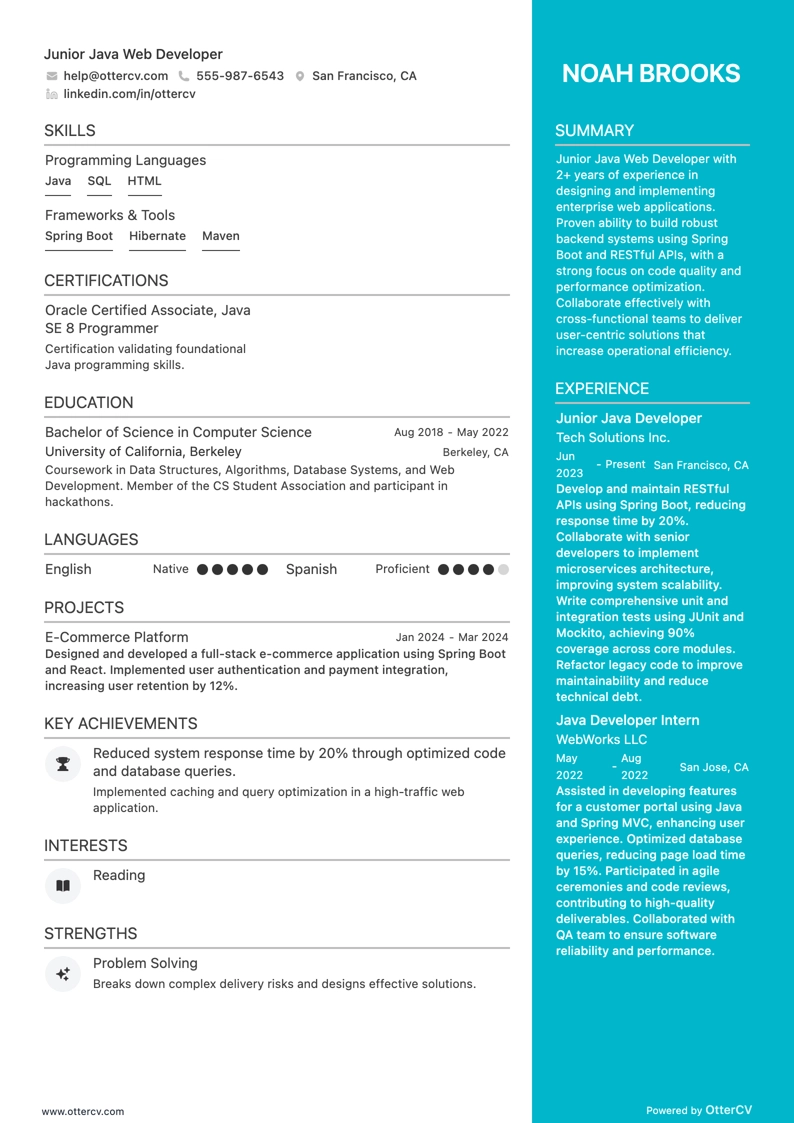
Junior Java Web Developer resume preview
  • Tailored experience to the role: The resume includes relevant positions such as Java Developer and Java Developer Intern, showing direct experience for a junior Java developer role.
  • Quantifiable achievements: The work experience section uses measurable results, including "30% improvement in efficiency" and "25% increase in customer satisfaction," to show the impact of the applicant’s work.
  • Relevant skills and courses: The Skills section highlights both broad and role-specific abilities such as "Java," "Software Development," and "System Optimization." The Courses section also features relevant certifications, including "Advanced Java Programming" and "Data Analysis with Python."
  • Unique sections reflecting personality and values: Sections like "Most Proud Of," "Strengths," and "Passions" add personality and present the applicant as a well-rounded candidate.

How to format a junior Java developer resume

The right resume format helps you make a strong first impression.

Hiring managers want to see technical ability, but they also look for professionalism and attention to detail.

As a junior Java developer, use these formatting tips to make your resume more effective:

  • Use the reverse chronological format: List your most recent job first, followed by earlier roles in reverse chronological order. This format clearly shows your career progression, even if your experience is still limited.
  • Add a header: Place your name, contact information, and photo at the top of the resume. A strong header should be clear, easy to read, and immediately noticeable.
  • Keep it one page long: A shorter resume is often better, since recruiters usually spend only a few seconds scanning it. If you have extra space, include relevant professional projects while still keeping the resume to one page.
  • Save your resume as a PDF file: Unless instructed otherwise, use PDF format. It preserves your layout, is easy to read across devices and software, and is easily scannable by applicant tracking software (ATS).

Be mindful of regional differences in resume formats. For example, a Canadian layout might vary.

The top sections on a junior Java developer resume

  • Technical Skills: Shows proficiency in Java and related technologies.
  • Education and Certifications: Highlights relevant degrees and Java certifications.
  • Work Experience: Demonstrates practical Java development experience.
  • Projects and Portfolio: Displays hands-on Java projects and contributions.
  • Professional Summary: Offers a brief overview of Java development skills and goals.

What recruiters want to see on your resume:

  • Proficiency in Java and related frameworks for building and maintaining Java-based applications.
  • A strong understanding of object-oriented programming for effective Java development and code organization.
  • Experience with databases and SQL to integrate Java applications with database systems.
  • Familiarity with version control systems like Git for collaborative development and code management.
  • Problem-solving skills and logical thinking for debugging and developing efficient Java solutions.

How to write your junior Java developer resume experience

Writing your job experience resume section can feel stressful.

As a junior Java developer in a competitive field, it’s normal to wonder whether your experience is enough.

Even if you do not have much experience yet, you can still make this section meaningful and effective.

Here’s how:

  1. List your jobs one by one in reverse chronological order.
  2. Junior Java developers usually have up to three years of experience, so begin with your most recent relevant role.
  3. Include everything that is part of your professional Java developer journey so far, including short-term junior Java developer roles, internships, and freelance work.
  4. For each entry, add your job title, employer name, and the time you spent there.
  5. Under each role, include four to five bullet points that describe your experience.

As an example, here’s what your junior Java developer experience section shouldn’t look like:

Experience

Junior Java Developer

Tech Solutions Ltd.

02/2022 - 11/2023 · San Francisco, CA

  • Wrote, maintained, and tested Java code.
  • Mainly worked on an e-commerce project.
  • Participated in code reviews.
  • Participated in the debugging process using AI.
WRONG

What’s wrong here

  • The descriptions are too short and vague.
  • The candidate lists general job responsibilities instead of highlighting what they excelled at.
  • There are no examples or evidence of impact made at the company.
  • The technologies they used most are not mentioned.

Here’s how your Experience section should look:

Experience

Junior Java Developer

Tech Solutions Ltd.

02/2022 - 11/2023 | San Francisco, CA

  • Worked exclusively on high-impact Java desktop and web applications using Java EE 8, Spring Boot, and self-written unit tests.
  • Developed a custom e-commerce payment method, increasing customer satisfaction by 52%.
  • Supported team members in code reviews, cutting new code commit timeframes in half.
  • Implemented changes to a bug-finding AI algorithm, raising deliverable code quality by 23%.
RIGHT

What’s right here:

  • The candidate clearly explains what their work focused on.
  • They name the technologies they used most.
  • Each task or project includes context and impact, such as “increasing customer satisfaction by 52%”, “cutting new code commit timeframes in half”, and “raising deliverable code quality by 23%”.
  • The example makes the difference clear:
  • “Wrote Java code” (wrong) vs. “worked on high-impact Java applications, using Java EE 8 and Spring Boot” (right).
  • “Worked on e-commerce project” (wrong) vs. “developed custom e-commerce payment method, increasing customer satisfaction by 52%” (right).
  • “Participated in the debugging process, using AI” (wrong) vs. “implemented changes to bug-finding AI algorithm, raising deliverable code quality by 23%” (right).

How to quantify impact on your resume

A common mistake is listing only job responsibilities. Hiring managers and even non-technical recruiters already know what a Java developer does, so focus on your accomplishments instead.

Before writing a bullet point under a job entry, ask yourself two questions:

  1. What did I contribute?
  2. What special acknowledgments was I given?

Did you add key new features to an app? Were you trusted with database integrations because of your Big Data and SQL skills? Were you promoted to junior Java developer after only two months as an intern instead of the usual six? Did you stand out in cloud microservices and APIs?

List the details that set you apart from other candidates with the same job title. For example:

  • Highlight coding projects: Mention coding projects or tasks, including the number of lines of code written or the percentage improvement in efficiency.
  • Quantify problem-solving skills: Include specific examples of how you used Java to solve problems, noting the scale of the problem and the effectiveness of the solution.
  • Mention collaborative work: Specify the number of team members involved in projects to show teamwork and adaptability.
  • Detail your educational background: List relevant Java courses or certifications, including hours spent or notable achievements.
  • Include performance metrics: Mention metrics or KPIs you helped improve in past roles or projects.
  • Showcase your testing experience: Include the number of tests written or bugs found and fixed.
  • Specify tools and technologies: List Java frameworks and tools you know, and quantify your experience level or duration of use.
  • Discuss continuous learning: Mention ongoing Java learning, including the number of courses taken or hours spent.

Whenever possible, add quantifiable data to support your accomplishments.

Use phrasing like “Raised X by X%.”, “Completed Y in half the expected timeframe.”, and “Implemented new code debugging feature, raising team productivity by X%, and cutting project costs by X%.”

How do I write a junior Java developer resume with no experience

Want to start your Java developer career without previous dev experience? You can still build a strong resume tailored to a junior Java developer role.

Here’s how:

  1. Focus on your transferable skills

    List your work experience, even if it was not in Java development. Frame it around the skills and achievements that will help you as a Java developer. Highlight projects or tasks that involved code, collaboration with developers, complex software, or anything related to software engineering. For example, tech recruiting can still demonstrate relevant technical knowledge gained from working closely with developers.

  2. Emphasize classes, courses, bootcamps, internships

    Include Java bootcamps, software engineering courses, computer science classes, and internships. Focus on the skills you gained, the projects you completed, and any standout achievements.

  3. Showcase your certificates

    If you have certificates in tech, computer science, programming, or Java, list them in a separate Certificates section so they stand out.

  4. Focus on your Java projects

    Create a dedicated Projects section and include every Java project you have completed, whether from school, university, online courses, bootcamps, internships, or personal practice. List each by name, link to it if possible, and briefly explain what it involved. Be clear about the technologies used, such as “Java SE 9”, “Spring”, or “Azure”.

  5. Highlight your skills

    In a separate Skills section, list the Java-related skills you already have, such as Java SE 11, Java SE 17, Azure, Oracle, Git, Jira, Spring, Python, Agile Methodologies, and REST APIs.

How to list your hard and soft skills on your resume

Here’s what to know about your junior Java developer skills resume section.

There are two types of skills:

  • Hard skills: specific, tangible, evidence-based skills, usually tied to software proficiency or knowledge in a particular field.
  • Soft skills: broader people skills, such as leadership and time management.

The best way to list your skills on a junior Java resume is to:

  1. Create a separate Skills section.
  2. List your hard and soft skills one by one.
  3. Phrase them as nouns rather than verbs, such as “time management” instead of “managing my time”.
  4. Focus more on hard skills, since they are more relevant for junior Java developer roles.
  5. Only list skills you actually have and can back up in an interview or on the job.
  6. Prioritize skills most relevant to Java development, including other OOP languages and tools or environments where Java is used.
  7. Tailor your Skills section to the junior Java job ad. If the posting asks for Spring or RESTful APIs, use those exact terms if they are genuinely part of your skill set.

It’s also important to keep your resume ATS-friendly. Many companies use ATS software to scan resumes and compare them to the ideal candidate profile.

That means your resume should match the keywords in the junior Java developer job ad as closely as possible. If the requirement says “project management”, use “project management” rather than a variation like “managing projects”.

Now here are the best hard and soft skills you can add to your resume as a junior Java developer:
Best hard skills for your junior Java developer resume

  • Java.
  • Spring Framework.
  • Hibernate.
  • Java Server Pages (JSP).
  • Servlets.
  • Java Database Connectivity (JDBC).
  • RESTful Web Services.
  • SOAP Web Services.
  • SQL and database design.
  • Git and version control.
  • Maven or Gradle.
  • JUnit and unit testing.
  • JavaScript.
  • HTML/CSS.
  • Angular or React (basic knowledge).
  • JSON and XML.
  • Apache Tomcat.
  • Eclipse or IntelliJ IDEA.
  • Linux/Unix basics.
  • Docker (basic knowledge).

Best soft skills for your junior Java developer resume

  • Problem-solving.
  • Critical thinking.
  • Teamwork and collaboration.
  • Effective communication.
  • Adaptability.
  • Time management.
  • Attention to detail.
  • Creativity.
  • Empathy.
  • Continuous learning.
  • Resilience.
  • Organization skills.
  • Patience.
  • Emotional intelligence.
  • Conflict resolution.
  • Leadership potential.
  • Client focus.
  • Decision making.
  • Self-motivation.
  • Active listening.

How to list your certifications and education on your resume

Hiring managers for junior Java developers usually look for some form of technical education or accredited training and certification. Here’s how to present both clearly on your resume.

Education

  1. Create an Education resume section.
  2. Start with the highest level of formal education you’ve completed or are currently completing, then list the rest in order.
  3. Include the name of the degree.
  4. Add the name of the school or university.
  5. List the location.
  6. Include the dates you studied there.
  7. Mention major projects completed during that time, including your capstone project and any work that involved writing Java code.
  8. List the technologies you learned and used while studying.
  9. Add awards or notable achievements, including your GPA if it is above 3.5 on a 4.0 scale.

If you do not have formal education to include, list any Java development bootcamp or intensive computer science course you have completed. The same steps above still apply.

Certifications

  1. Create a separate Certificates resume section.
  2. Start with your most recently earned certificate, then list the rest from there.
  3. Write the full name of the certificate.
  4. Include both the full name and abbreviation so non-technical recruiters can recognize it more easily and so your resume is more ATS-friendly.
  5. Name the issuing organization.
  6. Add the date you received it and the expiration date, if applicable.
  7. If any certifications have expired, renew them if possible before adding them to your resume. Recruiters want to see that you stay current in a fast-changing tech field.
  8. Only include certificates relevant to Java or software engineering in general.

Here are the top few certifications you can have as a junior Java developer:

How to write your junior Java developer resume summary or objective

Your resume Summary or Objective is the short paragraph at the top of your resume, usually placed right below your professional title.

It briefly explains who you are as a professional.

A resume Summary focuses on your career path so far and usually highlights one or two key skills and achievements.

A resume Objective focuses on your future career goals.

If you already have experience as a junior Java developer or intern, use a Summary.

If you do not have prior Java experience, use an Objective.

Here’s what to avoid in your junior Java developer resume Summary section:

Summary

Junior Java developer with experience in Java, Spring, Git, and Jira. Moderately skilled in Python and JavaScript. Has worked on backend and frontend software development, as well as databases, across projects in cloud, analytics software, and mobile apps.

WRONG

The wrong Summary example

  • It doesn’t specify years of experience.
  • It lists every skill the candidate has instead of focusing on their strongest ones.
  • It is too general, covering everything the candidate has worked on rather than what they excel at.
  • It doesn’t include any achievements or specific contributions the candidate has made.

In contrast…

Summary

Junior backend Java developer with 1.5 years of work experience and 4+ years of building RESTful APIs and microservices in cloud and on-prem environments. Highly skilled in the latest Java SE and Spring Boot versions. One of my greatest achievements so far includes developing key analytics software that increased the company’s local office profit by 32%.

RIGHT

The Right Summary Example

  • Clearly states how much work experience the candidate has.
  • Mentions an additional 4 years of practical experience, likely gained through personal projects, freelance work, university, or similar activities.
  • Emphasizes the candidate’s strongest areas in Java development, including cloud and on-prem environments, RESTful APIs and microservices, and the latest Java SE and Spring Boot versions.
  • Highlights only the technologies the candidate is actually proficient in.
  • Includes a specific professional achievement, such as increasing the company’s local office profit by 32%.

Now let’s look at the dos and don’ts of the junior Java developer resume objective.

Objective

Skilled Senior Tech Recruiter with 8+ years of experience headhunting and hiring senior software developers, now looking to transition into Java development.

WRONG

The Wrong Objective Example

  • It is too vague and nonspecific, giving almost no useful information about the candidate. It could just as easily describe a tech recruiter applying to every job they find online, whether in Java development or even pet grooming.
  • It includes irrelevant information, such as “8+ years of experience in recruitment,” without connecting that background to the goal of becoming a junior Java developer.
  • It does not explain the reason or basis for the career shift.

In contrast…

Objective

Senior Tech Recruiter seeking to launch a career in Java development. Highly knowledgeable about best coding practices, modern backend Java technologies, and the complexities of cloud computing. Aiming to apply technical knowledge, along with practical skills gained through bootcamp and certification courses, in a new role as a junior Java developer.

RIGHT

The right Objective example

  • Provides a clear objective: the candidate has extensive experience working closely with developers, has taken the time to learn Java development basics, and wants to transfer those skills into a Java developer career.
  • Highlights relevant skills and technical knowledge, including “best coding practices”, “cutting-edge backend Java technologies”, and “Cloud computing”.
  • Emphasizes the candidate’s beginner-level Java education, showing they can hit the ground running as a new junior Java developer.

Additional sections for a junior Java developer resume

  • Strengths: List your strengths one by one and add a short explanation for each. Examples for a junior Java developer include “Problem-Solving,” “Logical Thinking,” “Adaptability,” “Analytical Skills,” “Fast Self Learner,” and “Time & Task Management.” Connect these strengths to your coding experience with examples such as “self-taught Java developer,” “exceeded KPIs and never missed Sprint deadlines,” or “adapted to new software three times faster than expected.”

  • Volunteer Work: Include relevant volunteer experience, such as mentoring young software developers or building websites and apps for a charity. Present it similarly to work experience by listing the position, organization, and project description.

  • Passions: Add a passions section to reinforce your interest in software development. You might include interests such as “Solving daily coding puzzle tasks,” “Listening to tech podcasts,” or “Listening in on Java lectures at the local university.”

  • Format your resume in reverse chronological order, place your contact information at the top, keep it under two pages, and save it as a PDF.

  • Include these core sections: Summary/Objective, Experience, Education, Certifications, and Skills.

  • If you need more relevant content, add extra sections such as Strengths, Volunteer Work, and Passions.

  • Use a Summary if you already have Java development experience. Otherwise, use an Objective.

  • Focus on your top achievements and strongest skills.

  • Support your accomplishments with specific examples.

  • If you have no previous Java development experience, highlight transferable skills from your other jobs.

  • Tailor your junior Java resume to the job ad by matching its wording for tech terminology, skills, requirements, and certifications.

Junior Java Developer resume examples

Explore additional Junior Java Developer resume samples and guides and see what works for your level of experience or role.

By Experience

Associate Java Software Engineer

Associate Java Software Engineer resume preview

Entry-Level Java Software Engineer

Entry-Level Java Software Engineer resume preview

Junior Java Software Engineer

Junior Java Software Engineer resume preview

Java Developer I

Java Developer I resume preview

Associate Java Developer

Associate Java Developer resume preview

Entry-Level Java Developer

Entry-Level Java Developer resume preview

Junior Java Developer

Junior Java Developer resume preview

Junior Java Developer resume examples

Explore additional Junior Java Developer resume samples and guides and see what works for your level of experience or role.

By Role

Junior Java Web Developer

Junior Java Web Developer resume preview

Junior Java Application Developer

Junior Java Application Developer resume preview

Junior Java Backend Developer

Junior Java Backend Developer resume preview