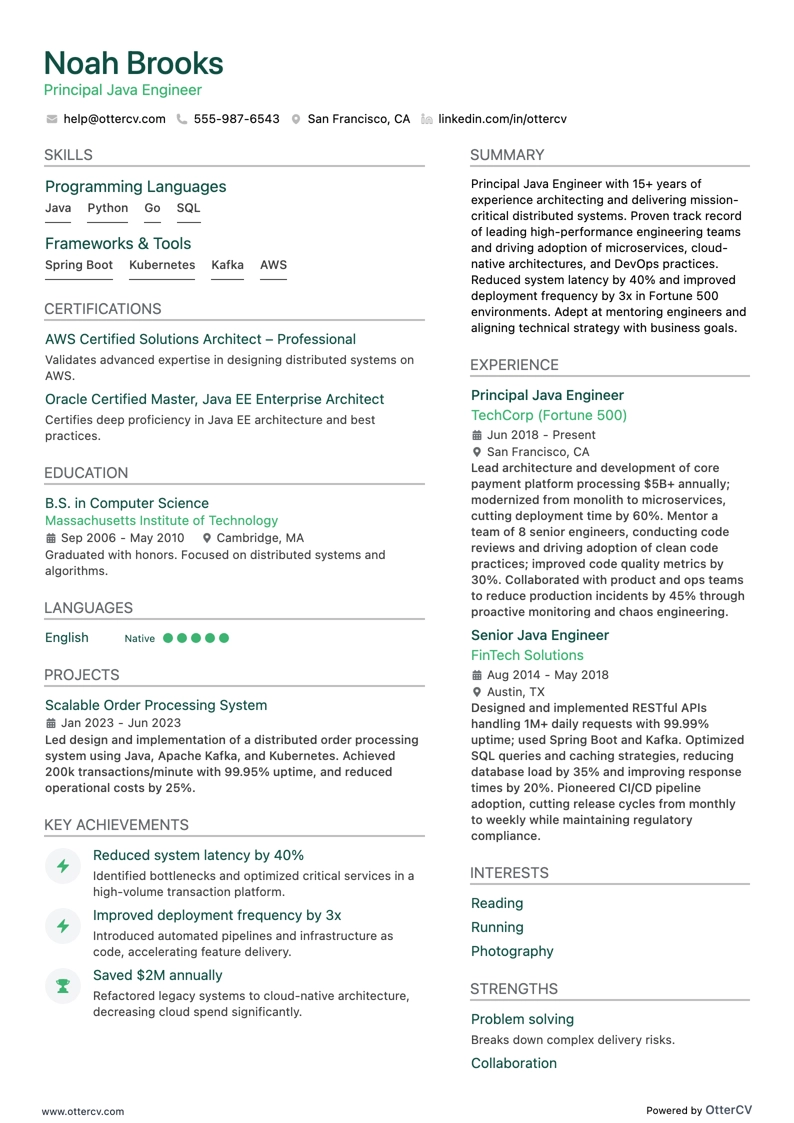
Principal Java Engineer full preview

8 Java Developer Resume Examples

OtterCV

Written by The OtterCV Team

Updated: 5/13/2023•8 min read

See all resume examples in this guide, or generate your own resume example with your personalized prompt

Principal Java Engineer resume example

Principal Java Engineer

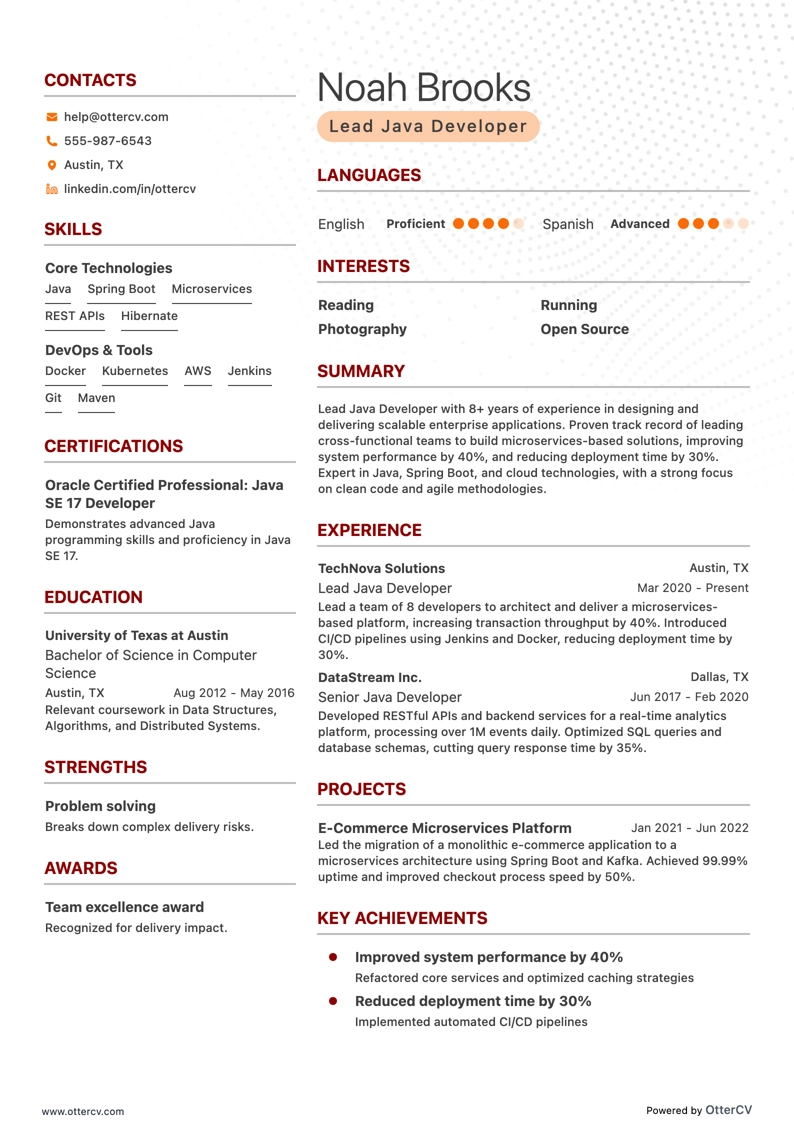
Lead Java Developer resume example

Lead Java Developer

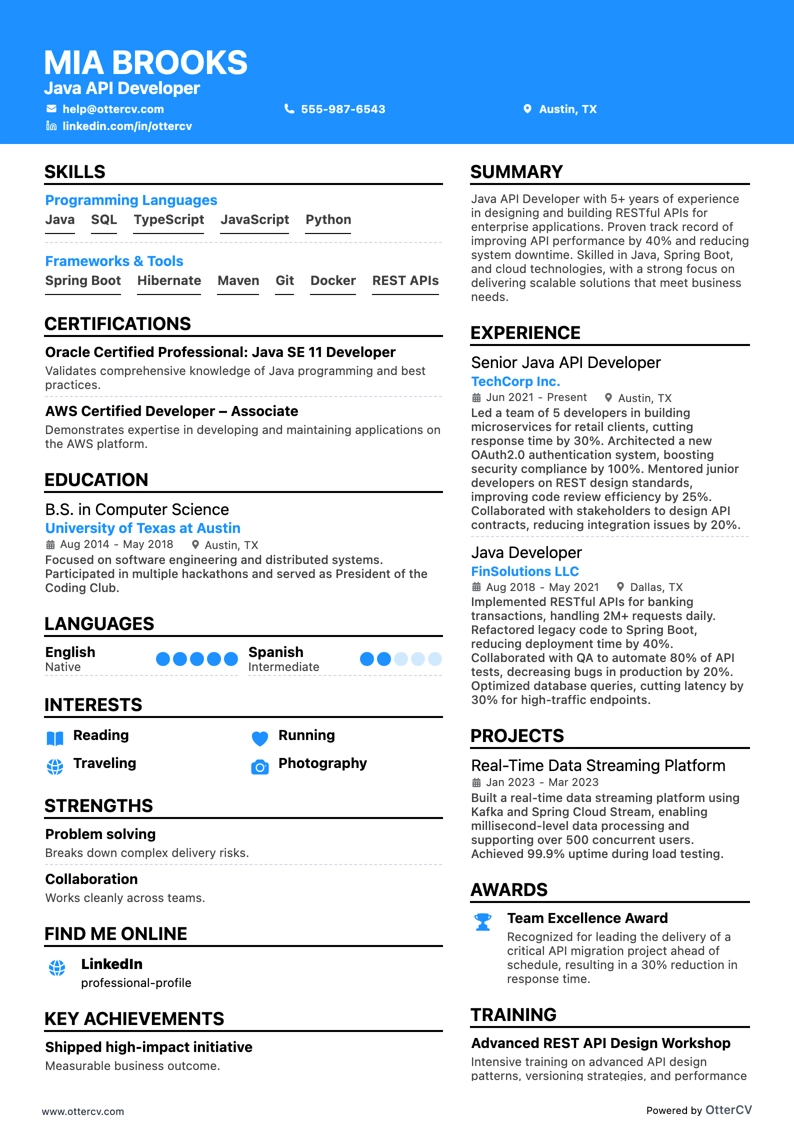
Java API Developer resume example

Java API Developer

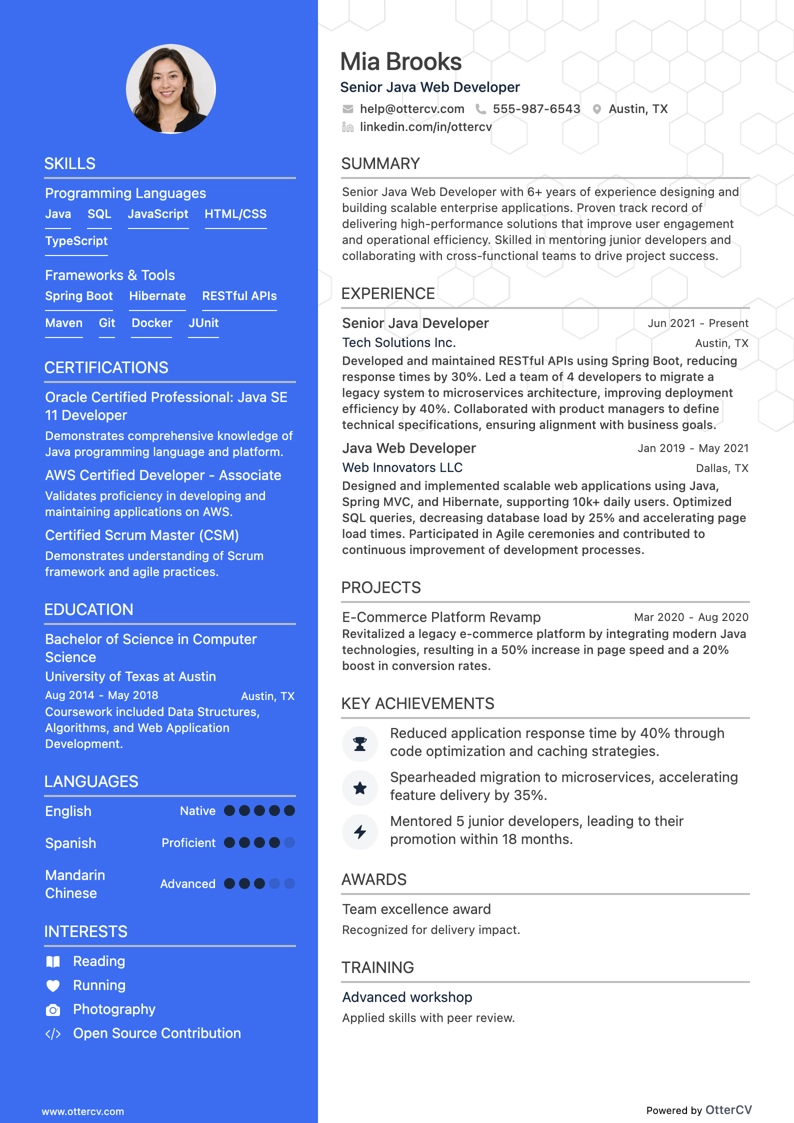
Java Web Developer resume example

Java Web Developer

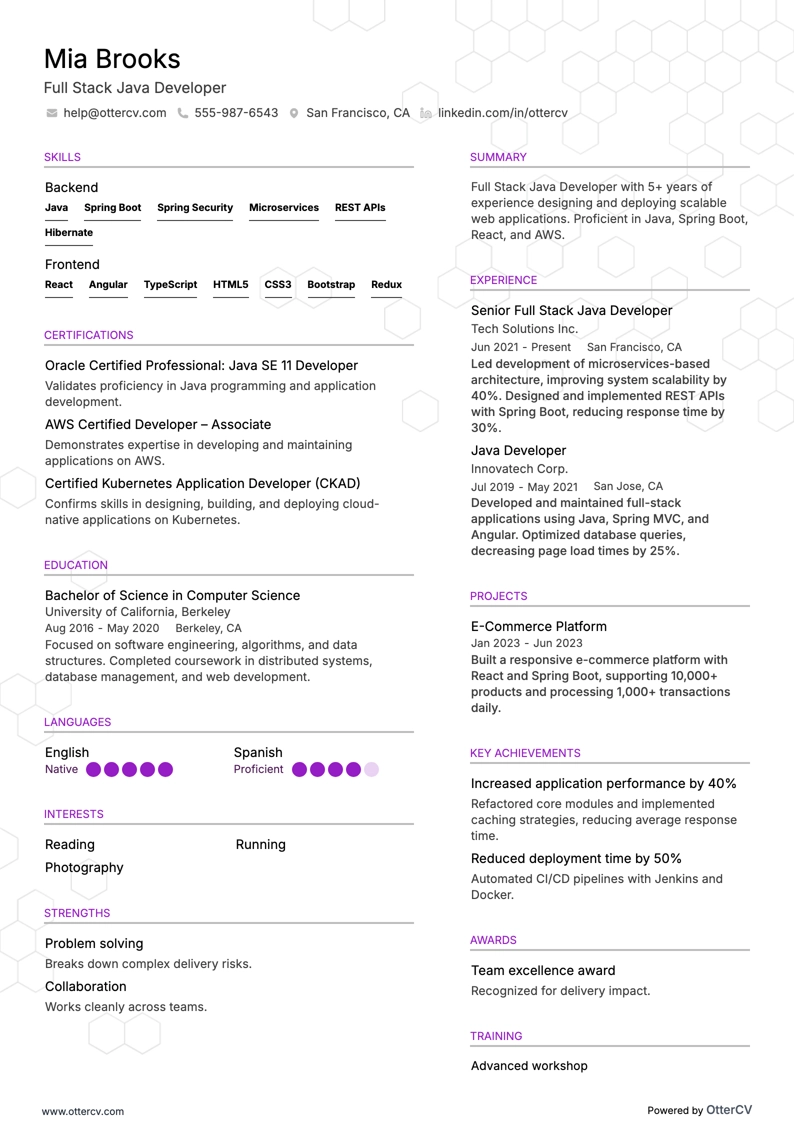
Full Stack Java Developer resume example

Full Stack Java Developer

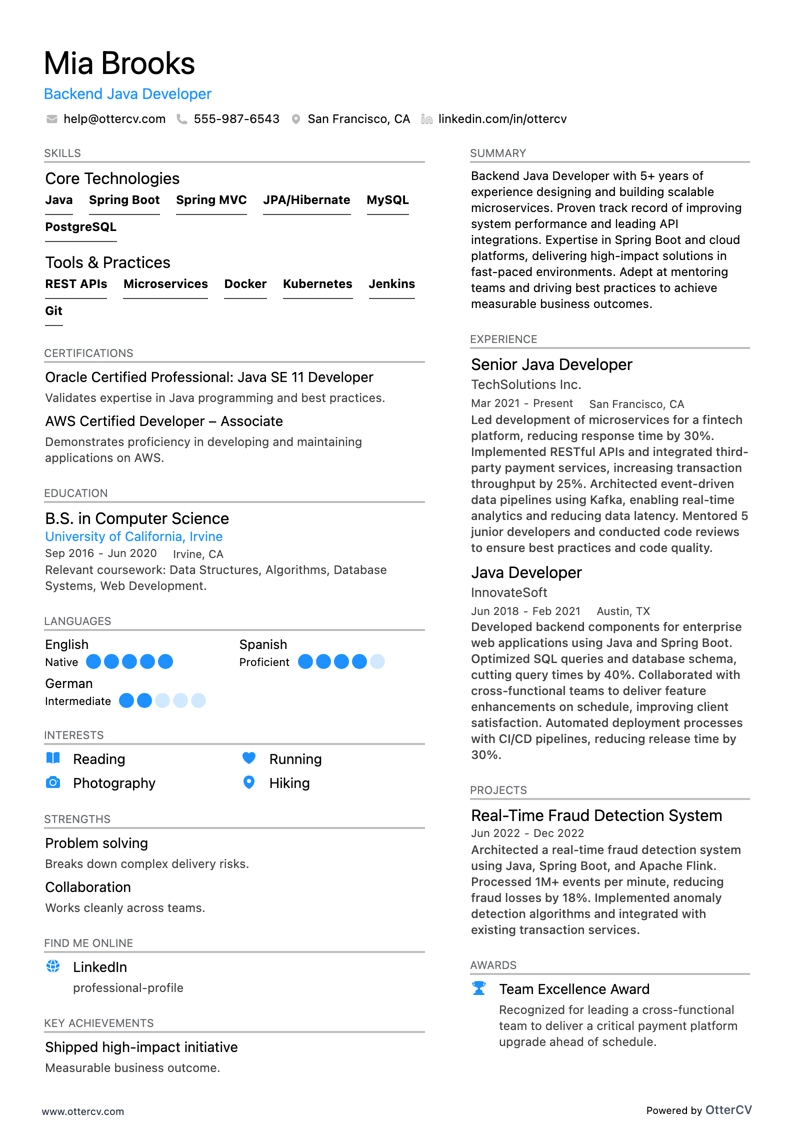
Backend Java Developer resume example

Backend Java Developer

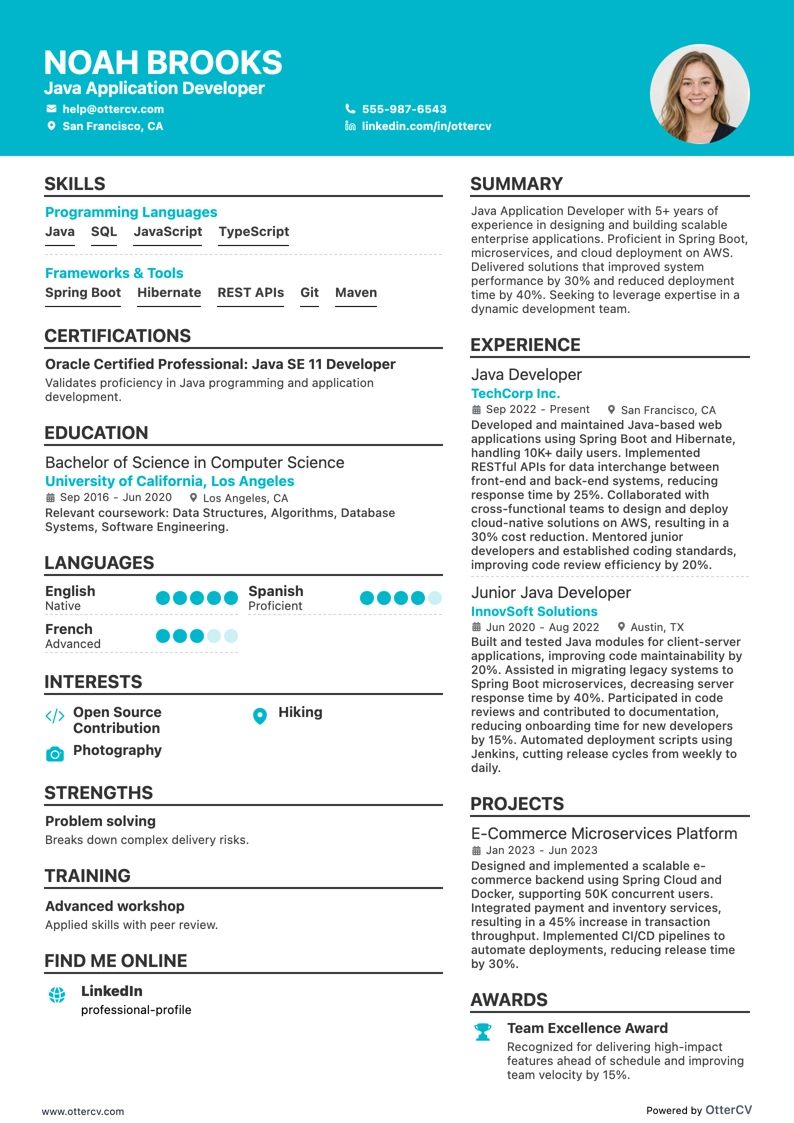
Java Application Developer resume example

Java Application Developer

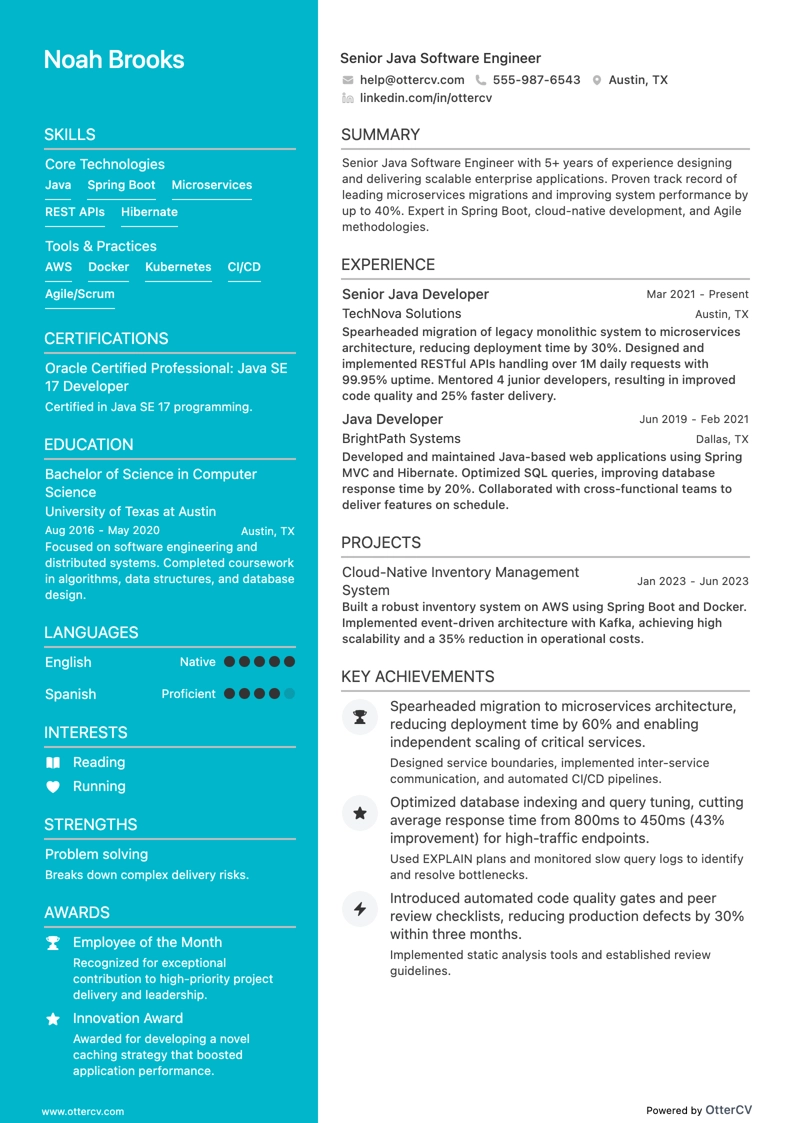
Java Software Engineer resume example

Java Software Engineer

Writing a compelling Java developer resume can be tricky. Because Java is one of the software industry’s most widely used programming languages, Java developers are in demand, but landing the right position can still be difficult. In many cases, an unfocused or overly long resume is what gets in the way.

Java’s broad use also means developers come from many backgrounds and bring a wide range of specialized skills. A common mistake is adding too much unrelated information or too many examples that do not strengthen the application.

Choosing which skills and experience to highlight requires research and a clear understanding of how employers review developer resumes. This guide, with pro tips and resume examples, will help you learn how to:

  • Format your resume for better ATS optimization.
  • Select, organize, and present your most relevant hard and soft skills.
  • Include quantifiable evidence to support your skills.
  • Write a summary or objective section that gives efficient context to the information on your resume.
  • Use keyword strategies to help your resume get reviewed by hiring companies.
  • Create a projects section that shares high-quality examples of your work.

There are many specialized roles within Java development. Explore these resume examples for specific Java developer positions:

Java developer resume example

Principal Java Engineer resume preview

Here’s what this applicant does well in their resume:

  • Clear career progression: The experience section shows a steady path from an internship to junior roles and then to a mid-level Java developer position. This demonstrates growing expertise and commitment to the field.
  • Relevant technical skills: The resume includes a broad set of skills, including Java, Node.js, SQL, MongoDB, and various development tools, which are highly relevant for a Java developer role.
  • Achievement-focused experience: In each role, the applicant highlights measurable contributions, such as reducing data loading time, managing large-scale projects, and improving processes. This emphasizes impact rather than only listing responsibilities.
  • Certifications and continuous learning: Certifications such as Professional Scrum Master and Sun Certified Java Programmer, along with ongoing education in iOS App Development and Server-side Development, show a commitment to staying current.

How to format a Java developer resume

Many employers now use Applicant Tracking Systems (ATS) to analyze developer resumes. ATS scans resume text for keywords related to desired skills and qualifications, then sorts and prioritizes candidates based on how well their resumes match the role.

Formatting is important because it helps ATS recognize and extract key skills and experience correctly. Understanding the impact of formatting on ATS analyses can improve your chances of getting your resume seen by an employer.

Consider these best practices when formatting your Java developer resume:

  • Creative elements: Include creative elements, such as colors, decorative patterns, or a header photo, to make your resume distinctive. Avoid creative text features like emojis and non-standard date formats, as they can make ATS recognition harder.
  • Font selection: Choose ATS-friendly fonts that fit the overall style of your resume. Examples include Serif, Sans-serif, Aria, and Times New Roman. If you want more creative options in the Echocv Resume Builder, consider Rubik, Lato, Montserrat, Raleway, Exo 2, and Volkhov.
  • Header content: A prominent header with your name, desired job title, and contact information helps employers see key details at a glance.
  • Section headings and subheadings: Make sure each section is logically organized and clearly labeled. Standard section titles help ATS identify content more accurately.
  • Ordering: List achievements in reverse chronological order so your most recent and relevant experience appears first.
  • Document type: Doc or PDF files are standard resume formats and are usually the easiest for ATS to analyze.

To support accurate recognition of your information, use the most recommended sections for Java developer resumes.

Targeting Canada? Keep in mind their resume layout may differ from others.

The top sections on a Java developer resume

  • Technical Skills: Demonstrates proficiency in Java and related technologies.
  • Professional Experience: Highlights relevant Java development projects and roles.
  • Education and Certifications: Showcases formal training and Java certifications.
  • Java-specific Achievements: Displays notable accomplishments in Java development.
  • Open Source Contributions: Reflects involvement in Java community projects.

What recruiters want to see on your resume:

  • Demonstrated proficiency in Java and related frameworks such as Spring and Hibernate is important for effective software development.
  • Experience with the software development lifecycle, from requirement analysis through deployment, is essential for a Java developer.
  • Strong problem-solving abilities are highly valued, as Java developers are expected to handle complex challenges.
  • Familiarity with database technologies, including SQL and NoSQL, is important because Java developers often work with databases.
  • Collaboration and communication skills matter because development projects typically require teamwork and clear idea-sharing.

How to write your Java developer resume experience

The experience section explains your relevant work history. For Java developers, relevance matters because Java is used so widely that you may have many experiences that show your skills without directly matching a specific role.

Employers use this section to judge how closely your background fits an open position and to understand your career progression. Because of that, including your entire work history is a mistake. A long list forces employers to sort through each role and decide what is relevant on their own, which can lead them to assume incorrectly that your experience is not a strong fit.

Create a targeted experience section by listing only past jobs that demonstrate the knowledge and abilities described in the job posting, so employers can quickly identify your most relevant experience.

PRO TIP

To tailor your Java developer resume for each new application quickly and easily:

  • Create a resume template that includes all your experience and skills.
  • Make a copy of the template each time you apply for a position.
  • In the new document, delete any irrelevant experience examples.
  • Edit the remaining examples to include keywords from the job description.

When assessing relevance, remember that Java development depends on current industry knowledge. As a result, employers may view outdated experience examples as less relevant.

To better understand how to target an experience section, compare the value of these example experiences for a role requiring expertise in implementing APIs.

Experience

Senior Java Developer

RightClick

02/2021 - 11/2023 | Greenwich, CT

  • Used Java and related frameworks to create GUIs.
  • Designed and implemented functional, aesthetically pleasing user interfaces.
  • Worked with business analysts to understand user requirements and translate them into technical specifications.
  • Developed and tested GUIs to ensure they met user requirements and worked as expected.
WRONG

Although this is a senior developer role, the job description emphasizes GUI specialization rather than API expertise, which makes this resume example less relevant than one that shows experience working with APIs.

Experience

Java Developer

Insight Global

02/2021 - 11/2023 · Berkeley Heights, NJ

  • Designed and developed microservices for highly efficient protocol translation and enrichment using reactive design patterns.
  • Delivered end-to-end solutions for Payment APIs and developed high-throughput, high-volume transaction APIs for omnichannel platforms.
  • Enhanced API solutions to provide simple, easy-to-consume APIs for payment customers.
  • Contributed to the roadmap and strategies for documenting and presenting API specifications in an easy-to-consume format.
RIGHT

This example is especially useful for a Java developer resume targeted at roles that require API expertise because it highlights specific API-related work, such as improving efficiency and developing documentation strategies.

How to quantify the impact on your resume

You can strengthen your Java developer resume by adding quantifiable evidence to your experience descriptions. This means including tangible, measurable, or verifiable details that support your claims about your skills and knowledge.

For example, saying you have Java experience in cloud computing is less effective than describing a project where you used Java to reduce a cloud server’s workload by 20%.

Numbers and statistics are excellent ways to quantify your skills. Here are some effective ways to use measurable evidence on your resume:

  • State how many years of experience you have as a Java developer.
  • Share the size of the development teams you have worked with to show collaboration skills.
  • Include the number of projects you have completed to highlight productivity and follow-through.
  • Use percentages to show improvements in application performance resulting from your work.
  • Describe the size or complexity of the databases you have worked with to demonstrate your ability to handle large or complex data sets.
  • Show the impact of your work by noting how many users accessed your deployed applications.
  • Include how many lines of code you contributed to open-source Java projects to verify technical skill and community involvement.
  • Mention reductions in bug count or system downtime resulting from your solutions to emphasize problem-solving ability and efficiency.

Examples like these help your resume demonstrate your skills with evidence, giving employers clearer proof of your qualifications and abilities.

How do I write a Java developer resume with no experience

Writing a Java developer resume with no prior developer experience can feel intimidating. However, you can still show your abilities and potential through alternative examples of Java-related experience.

Follow these steps to write your experience section without previous Java developer employment:

  • Compile a list of keywords from the job description.
  • Brainstorm past experiences from a non-developer career, education, or personal life that demonstrate the same skills and knowledge.
  • Include non-development experiences that show transferable skills.
  • Add tangible evidence in other resume sections, such as certifications and projects, to build credibility.

Remember, not having formal Java development employment does not mean you lack the skills or knowledge to succeed. Some employers even value candidates from alternative backgrounds for their unique strengths and fresh perspectives.

PRO TIP

For those without Java development work experience, your Java developer cover letter is an excellent opportunity to add detail and explain how skills and knowledge gained outside the field can transfer to Java development.

How to list your hard skills and soft skills on your resume

The skills section of your Java developer resume should include separate subsections for hard skills and soft skills. Because many developers focus heavily on hard skills, soft skills are often overlooked. Still, soft skills can help set you apart from other applicants.

Hard skills are the abilities needed to perform a specific job. They usually require study, training, and practice, and often relate to technical abilities involving frameworks, servers, tools, and other Java development technologies.

Best hard skills for your Java developer resume

  • Java development expertise.
  • Spring Framework experience.
  • Hibernate knowledge.
  • J2EE proficiency.
  • RESTful API development skills.
  • Maven build tool experience.
  • Git version control skills.
  • Jenkins automation knowledge.
  • JUnit testing experience.
  • SQL database skills.
  • NoSQL database knowledge.
  • Docker containerization experience.
  • Microservices architecture knowledge.
  • JavaScript proficiency.
  • HTML/CSS skills.
  • Angular development experience.
  • Kafka experience.
  • AWS knowledge.
  • JIRA proficiency.
  • Eclipse IDE experience.

Soft skills are personal, work-related strengths that come from your personality or identity. Because they are intrinsic, they can transfer from one role to another. For example, some Java developers have a strong eye for detail, while others naturally see the big picture.

Best soft skills for your Java developer resume

  • Problem-solving.
  • Teamwork.
  • Communication.
  • Adaptability.
  • Attention to detail.
  • Time management.
  • Critical thinking.
  • Creativity.
  • Leadership.
  • Analytical thinking.
  • Self-motivation.
  • Initiative.
  • Collaboration.
  • Conflict resolution.
  • Decision making.
  • Organizational skills.
  • Prioritization.
  • Flexibility.
  • Integrity.
  • Client-focused mindset.

Follow these steps to write your Java developer skills section:

  • Format your skills section as a simple list without elaboration or examples.
  • Separate hard skills and soft skills into different subsections.
  • Organize long skill lists into subsections such as “Frameworks” or “Web Development.”
  • Tailor your list for each position by using keyword skills from the job description.
  • Write skills exactly as they appear in the job description to improve ATS optimization.
  • Never lie about or exaggerate your skills.
  • Keep your experience and skills sections consistent.
  • List skills mentioned in your experience section in the skills section, and reference those skills in your experience descriptions.

An employer may be looking for a Java developer with expertise in “Security and Performance Optimization” and receive numerous resumes from qualified applicants. However, a candidate who also mentions being an analytical thinker with a knack for problem-solving may stand out as the best fit.

Including relevant soft skills alongside hard skills gives employers a more complete picture of who you are and what you can contribute to their business.

How to list your certifications and education on your resume

Degrees and certifications are excellent ways to support your hard skills. They can also demonstrate soft skills such as “dedication to continued learning” and “adaptability to new technologies.” Format them as separate sections titled “Certifications” and “Education.”

To write your Java developer education section, follow these steps:

  • List degrees in reverse chronological order so your most recent and relevant degree appears first.
  • For each degree, include the name of the university, its location, the dates you attended, and the title of your degree.
  • Including your GPA is optional unless the job description specifies a minimum GPA requirement.
  • Only include your major and minor if they are relevant to the position or add useful background information. For example, a minor in Cybersecurity may be appropriate, while a minor in Art History may not be.

Education

Bachelor of Science in Software Engineering
Arizona State University
07/2018 - 06/2022
Online

RIGHT

How to Write a Java Developer Certifications Section

To write your Java developer certifications section, follow these steps:

  • List only current, unexpired credentials.
  • Include the certification name, the certifying institution, and the year you earned it. For tech certifications, the year matters because technologies can change significantly over time.
  • Only include certifications that are mentioned in or closely related to the job description. For example, if a Java developer role requires AWS experience, a Microsoft Certified: Azure Developer Associate certificate would not be the best fit.

If you want to add a Java developer certification to your resume, consider one of the certifications commonly sought by employers hiring Java developers.

How to write your Java developer resume summary or objective

A summary or objective section, sometimes called a Resume Profile or Personal Statement, helps put the information on your resume into context. Because a resume is mostly a list of facts and data, this section gives you a chance to show how those details connect to your broader career path or goals. No matter which format you choose, the goal is to explain your fit for a specific developer role as clearly and briefly as possible.

The main difference between a summary and an objective is whether the focus is on your past or your future. A summary highlights past experience, while an objective explains future career goals.

For Java developers with extensive experience, a summary is usually the better option because it shows how your background supports your fit and potential for success.

To write a strong Java developer resume summary, follow these best practices:

  • Highlight the skill or experience that most closely matches the new role.
  • Use an impactful description with keywords taken directly from the job description.
  • Keep it brief. A summary should be 3 to 5 sentences long.

The following example shows how to improve a Java developer summary by adding relevant keywords.

Summary

Skilled Java developer with experience developing and maintaining a range of systems. Strong foundation in software and related technologies, with successful contributions to innovative applications in the finance industry. Adept at collaborating with cross-functional teams and experienced in full-stack development. Seeking to bring technical excellence to a dynamic development team.

WRONG

This summary lacks specific keywords that would help clarify how the candidate’s skills align with a particular role. For example, it mentions a “foundation in software and technologies” without identifying which ones. It also misses the chance to name a specific industry they have worked in.

Summary

Results-driven and highly skilled Java developer with six years of experience developing and maintaining robust front-office systems. Strong foundation in Core Java, Spring Framework, and web development, with successful contributions to innovative applications in the finance industry. Adept at collaborating with cross-functional SDLC teams to deliver high-quality applications. Proven full-stack development expertise with a focus on Micro Service Architecture, along with strong problem-solving skills, attention to detail, and a commitment to writing clean, efficient code.

RIGHT

This summary uses keywords and phrases drawn from a job description to highlight skills from the candidate’s background that align with the position.

Examples of hard-skill keywords and phrases include:

  • Java developer
  • Developing and maintaining front-office systems
  • Core Java
  • Spring Framework
  • Web development
  • Finance industry
  • SDLC teams
  • High-quality applications
  • Full-stack development
  • Micro Service Architecture
  • Clean and efficient code

Examples of soft-skill keywords and phrases include:

  • Results-driven
  • Six years experience
  • Innovative
  • Collaborating
  • Strong problem-solving abilities
  • Keen eye for detail

PRO TIP

Rephrasing specific requirements from the “Qualifications” or “Ideal Candidate” sections of a job description is a great way to make sure you mention the skills and qualifications the employer values most.

If you have little or no experience as a Java developer, an objective section can help you emphasize what you want to achieve and how your skills and background support your success.

When writing your Java developer resume objective, follow these best practices:

  • Describe the position you are seeking.
  • Include relevant, transferable, or soft skills you will use as a Java developer.
  • Show your motivation to learn and gain experience.
  • Use keywords directly from the job description.
  • Keep it brief, ideally 3-5 sentences.

The examples below show how a shift in focus can improve a Java developer's resume objective.

Objective

New Java developer with a Bachelor's degree in Computer Science seeking a first opportunity to contribute to a company that builds high-quality applications. Eager to apply knowledge of Java, frameworks, and backend development while learning new skills in developing and maintaining cutting-edge applications. Committed to understanding industry best practices, continuously improving skills, and contributing as part of a dynamic, collaborative team.

WRONG

This objective includes relevant keyword skills and experience, but it draws unnecessary attention to the candidate’s limited background. For example, phrases like "new Java developer" and "first experience" would read more confidently if "new" and "first" were removed. It also focuses more on what the candidate hopes to gain from the role than on what they can contribute.

Objective

Driven and hard-working Java developer with a Bachelor's degree in Computer Science and demonstrable experience building high-quality applications. Seeking a challenging role to apply skills in Java, Spring Framework, Spring Boot, backend development, and the finance industry to help develop and maintain cutting-edge applications. Committed to staying current with industry best practices and continuous improvement, and eager to contribute to a dynamic team by solving complex problems and mastering emerging technologies in a collaborative environment.

RIGHT

This Java developer objective is a strong example of emphasizing skills and experience that support a target role without drawing attention to a lack of employment history. The applicant highlights relevant keyword skills that demonstrate expertise, including:

  • Bachelor's degree in Computer Science
  • Developing and maintaining cutting-edge applications
  • Java
  • Spring Framework
  • Spring Boot
  • Backend development
  • Finance

The objective also includes soft skills that can support both job performance and the broader work environment, such as:

  • Staying current on industry best practices
  • Continuous improvement
  • Contributing to a dynamic team
  • Tackling complex problems
  • Mastering emerging technologies

Although personal statements are brief, they should be specific and detailed enough to show employers how your background and future goals align with their company and the Java developer role.

Additional sections for a Java developer resume

If you have relevant information or work samples that do not fit within the top resume sections of your Java developer resume, consider adding one of these optional resume sections.

  • Languages: Tech is an increasingly global industry and often involves international communication. The ability to speak multiple languages can be a valuable asset for employers. Including a language section is a strong way to set yourself apart from other applicants.
  • Programming Languages: Fluency in programming languages beyond Java, such as Python or C++, is another skill many employers value. If you include both spoken and programming languages, list them in separate sections to clearly distinguish them.

Languages

Spoken Languages
English, Spanish, Brazilian Portuguese
Programming Languages
Java, Python, SQL, R
RIGHT
  • Awards and Achievements: Notable awards and achievements help demonstrate the quality of your skills. Including accomplishments such as a Java Community Process Program Award or Oracle Certified Programmer certification can help distinguish you from other applicants. Make sure anything you list is relevant, recognizable, and verifiable.
  • Publications: Sharing noteworthy publications shows employers that you are not just knowledgeable, but an expert in your field. Publications may include work written by others that references your contributions, as well as your own writing on Java development topics published in a reputable journal or website. Examples include research papers, case studies, articles on respected online platforms, and contributions to development books. Focus only on the most recognizable, noteworthy, and relevant publications.
  • Professional Associations: Including professional associations highlights your commitment to continued improvement and staying current as a Java developer. If you want to add a professional association to your resume but are not yet a member, consider joining one of the leading associations for Java developers listed below.

Make sure your resume highlights your strongest qualifications by tailoring sections to help you stand out from other applicants. If you add sections beyond the standard ones, use catchy, ATS-friendly headings.

How to write a Java developer projects section

A projects section highlights significant projects or strong code samples on your resume and helps demonstrate your hard skills as a Java developer. List each project with a brief description and a link to its repository.

Including projects can be especially helpful if you have limited work experience, since school or personal projects may not fit naturally into other resume sections.

Projects

Brooke's Books: Online Bookstore Platform

06/2020 - 11/2021 · https://github.com/Brookesbooksbookstoreplatform

Freelance development project completed for a local business. Developed a comprehensive online bookstore platform using Java, Spring Boot, and MySQL, with a user-friendly interface for customers to browse, search, and purchase books.

RIGHT

Key takeaways

  • Create a "Projects" section heading .

  • Select only projects that showcase skills needed for the position described in the job posting.

  • List projects in order of relevance or significance, with the strongest examples first. In many cases, your most recent work will also be the most relevant.

  • Give each project a short, simple title.

  • Include a URL or repository link, such as GitHub or Bitbucket.

  • Add a brief 1-2 sentence description for each project, using keywords from the job description where appropriate.

  • Use ATS-optimized formatting to improve the chances that employers will see your resume.

  • Tailor your Java developer resume skills and experience with examples that match the specific position.

  • Provide clear evidence of skills and achievements to show your impact in previous roles.

  • Include soft skills alongside hard skills, and use precise wording to support ATS optimization.

  • List relevant education and certifications starting with the most recent to show current knowledge.

  • Add context to your resume with either a summary or an objective section.

  • Use additional sections to highlight relevant skills that do not fit elsewhere on the resume.

Java Developer resume examples

Explore additional Java Developer resume samples and guides and see what works for your level of experience or role.

By Experience

Principal Java Engineer

Principal Java Engineer resume preview

Lead Java Developer

Lead Java Developer resume preview

Java Developer resume examples

Explore additional Java Developer resume samples and guides and see what works for your level of experience or role.

By Role

Java API Developer

Java API Developer resume preview

Java Web Developer

Java Web Developer resume preview

Full Stack Java Developer

Full Stack Java Developer resume preview

Backend Java Developer

Backend Java Developer resume preview

Java Application Developer

Java Application Developer resume preview

Java Software Engineer

Java Software Engineer resume preview