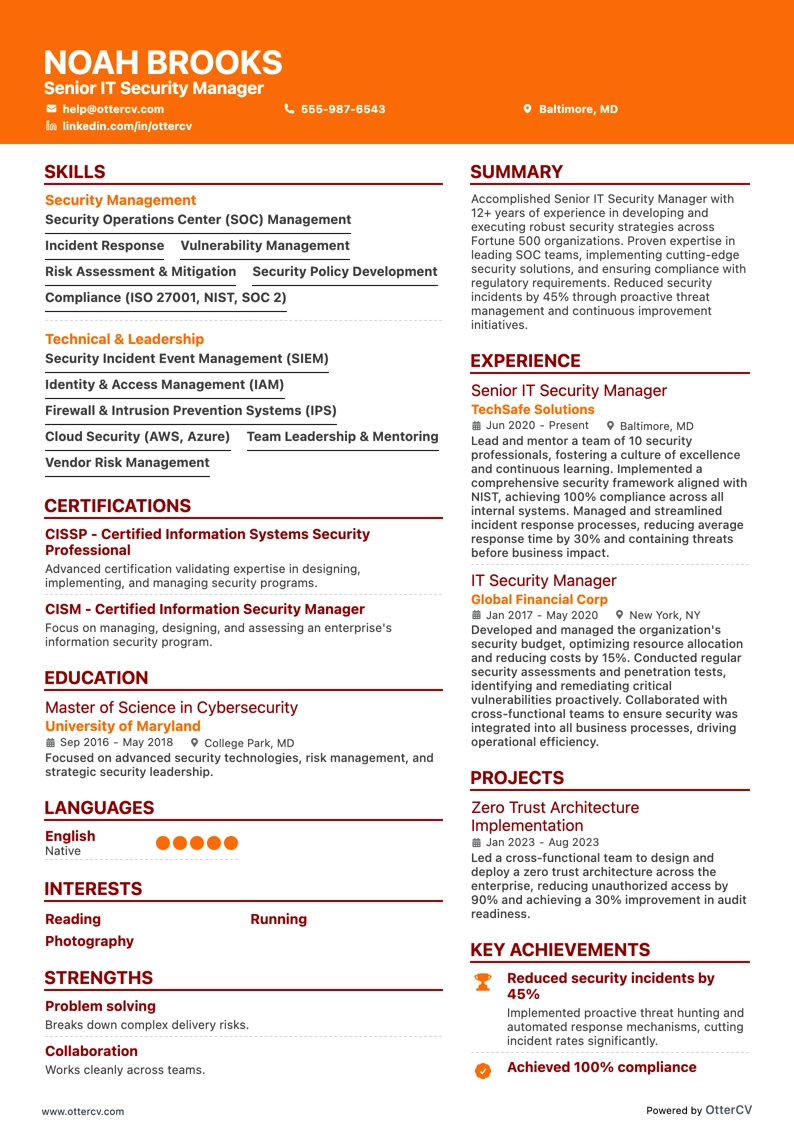
Senior IT Security Manager full preview

10 IT Security Manager Resume Examples

OtterCV

Written by The OtterCV Team

Updated: 10/31/2024•8 min read

See all resume examples in this guide, or generate your own resume example with your personalized prompt

Senior IT Security Manager resume example

Senior IT Security Manager

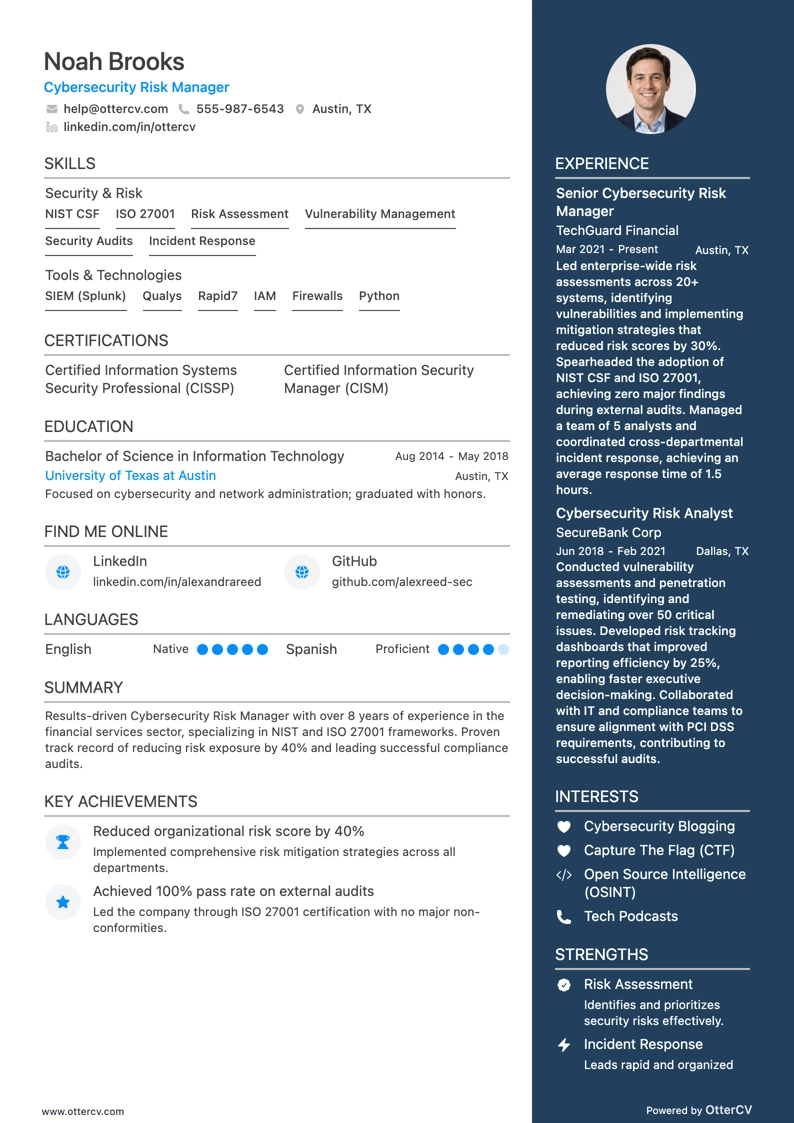
Cybersecurity Risk Manager resume example

Cybersecurity Risk Manager

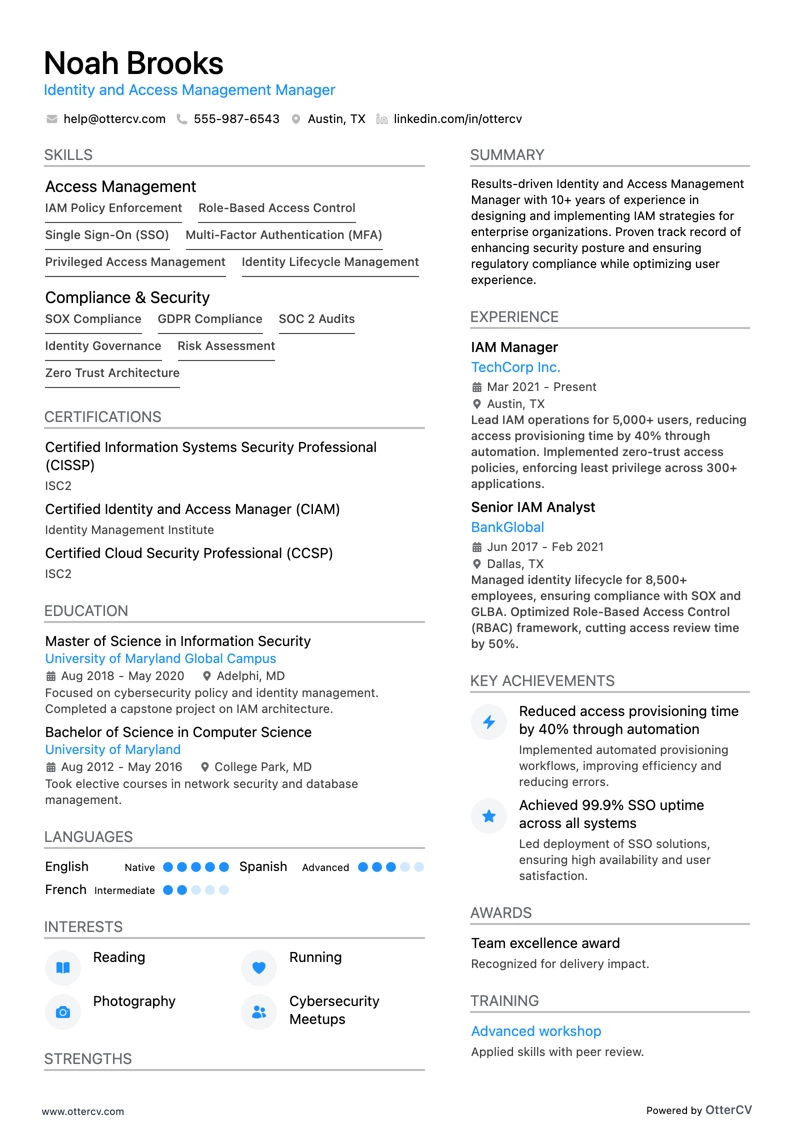
Identity and Access Management Manager resume example

Identity and Access Management Manager

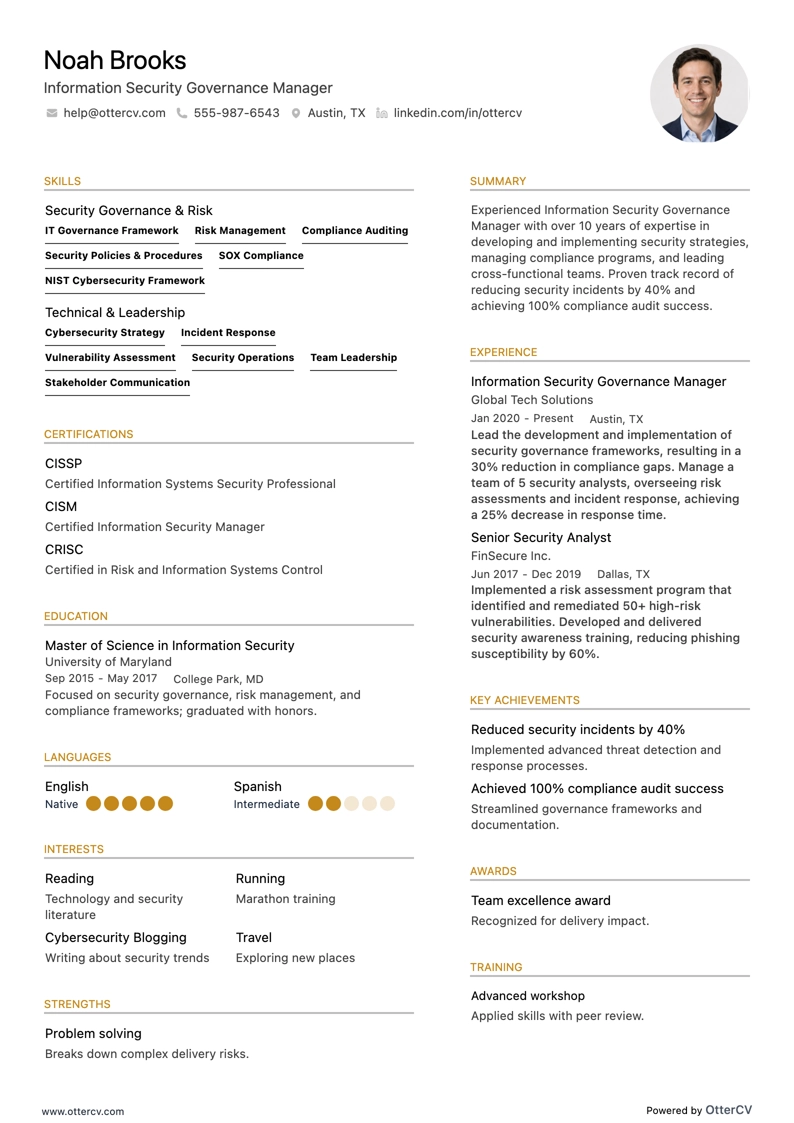
Information Security Governance Manager resume example

Information Security Governance Manager

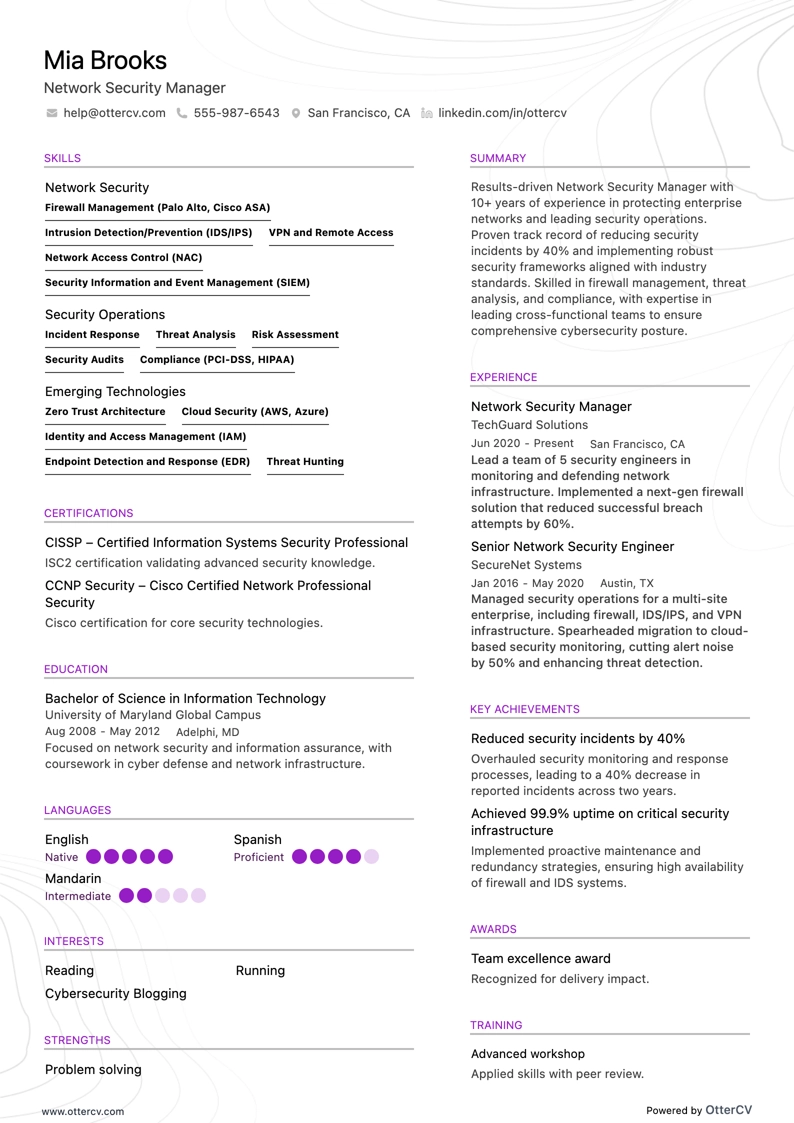
Network Security Manager resume example

Network Security Manager

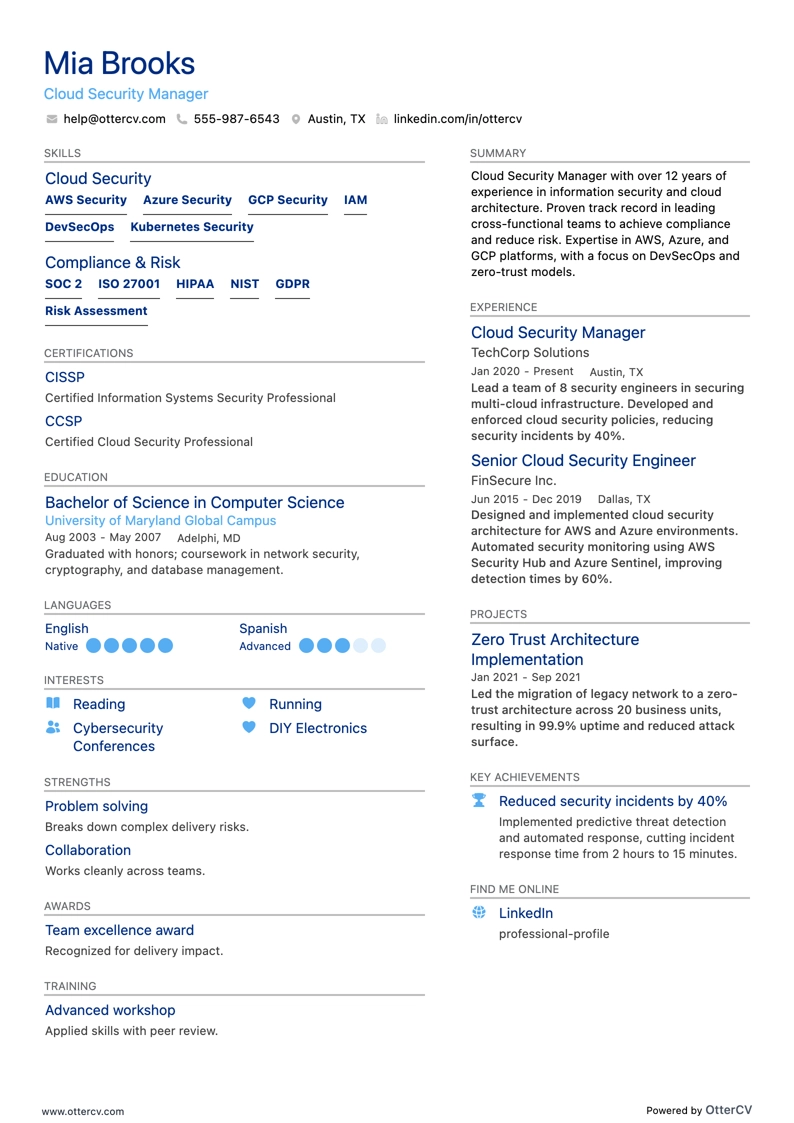
Cloud Security Manager resume example

Cloud Security Manager

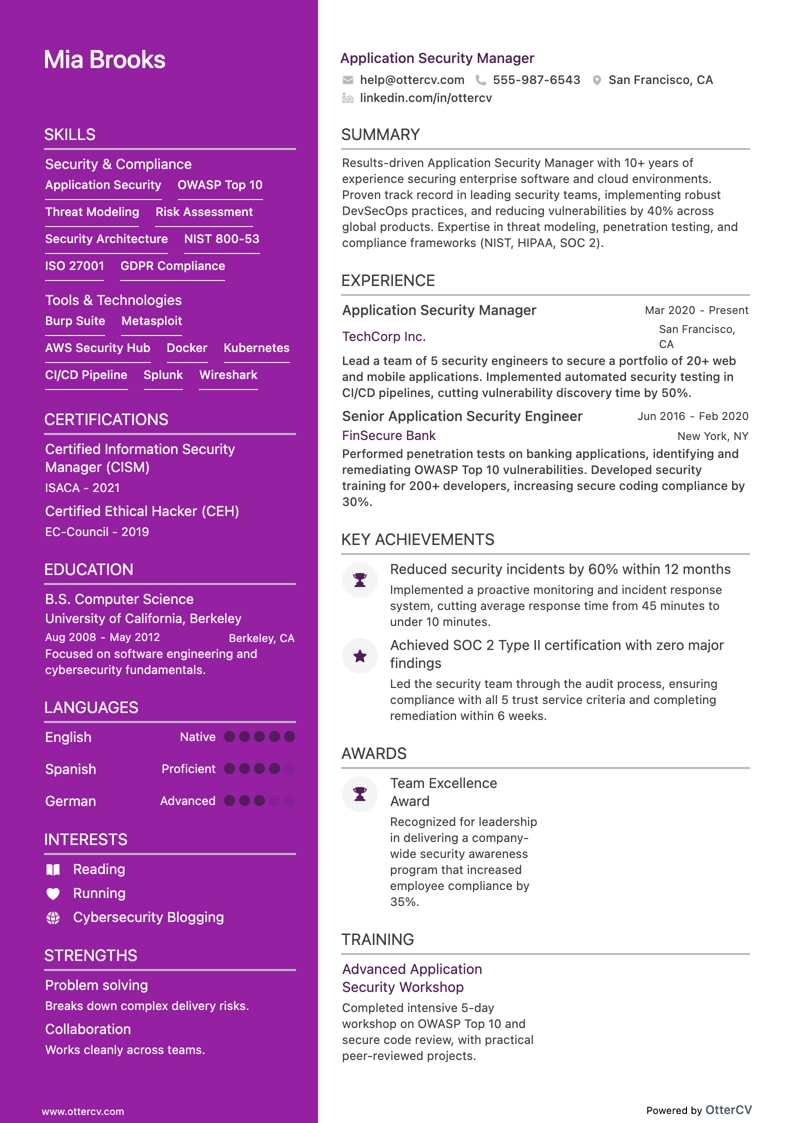
Application Security Manager resume example

Application Security Manager

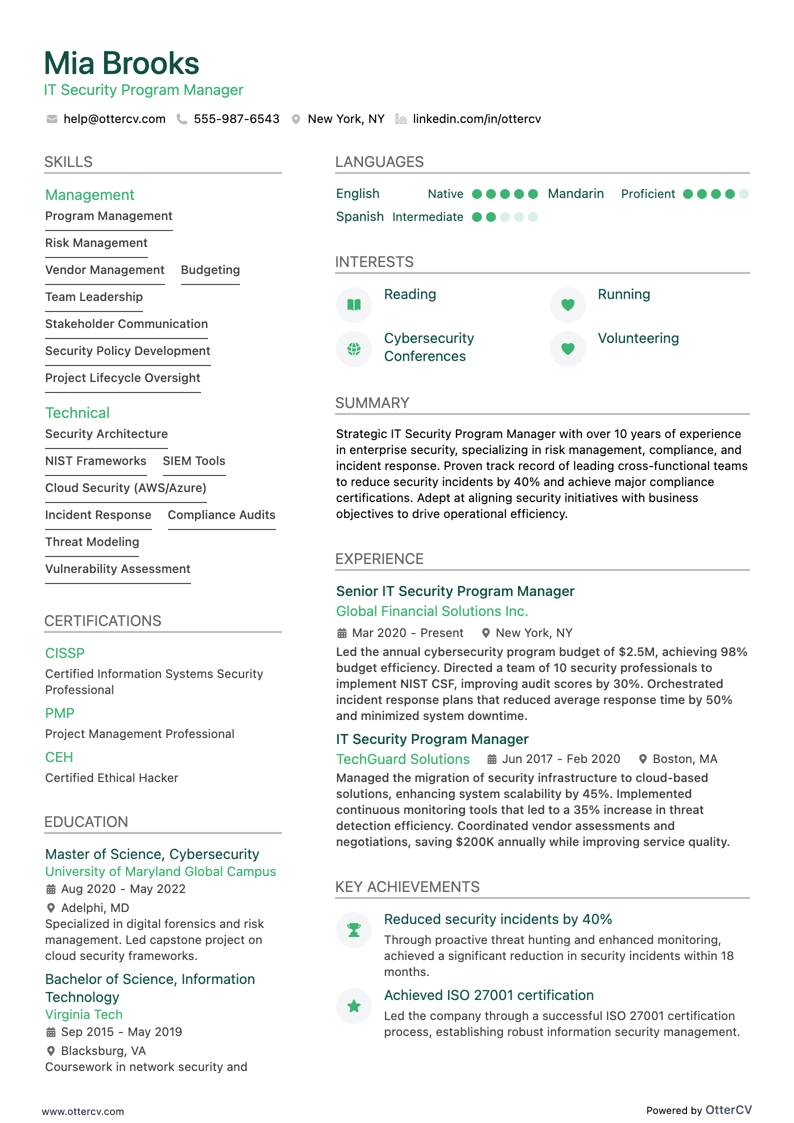
IT Security Program Manager resume example

IT Security Program Manager

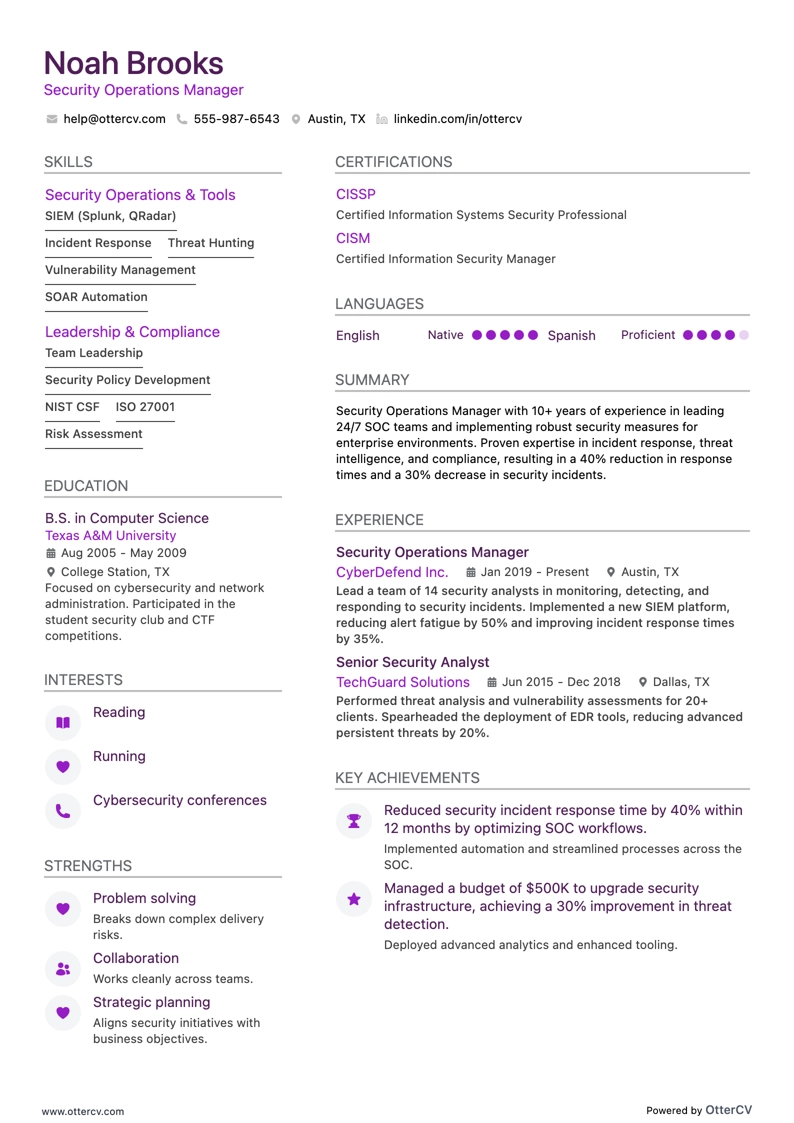
Security Operations Manager resume example

Security Operations Manager

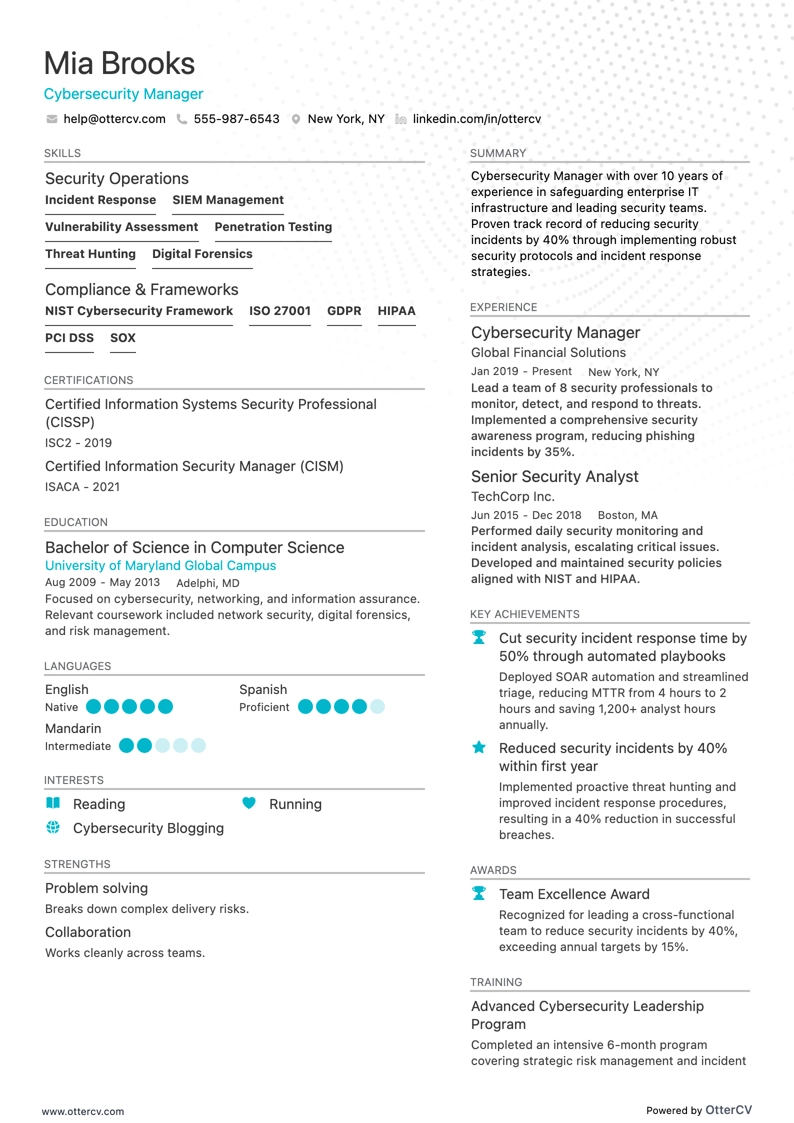
Cybersecurity Manager resume example

Cybersecurity Manager

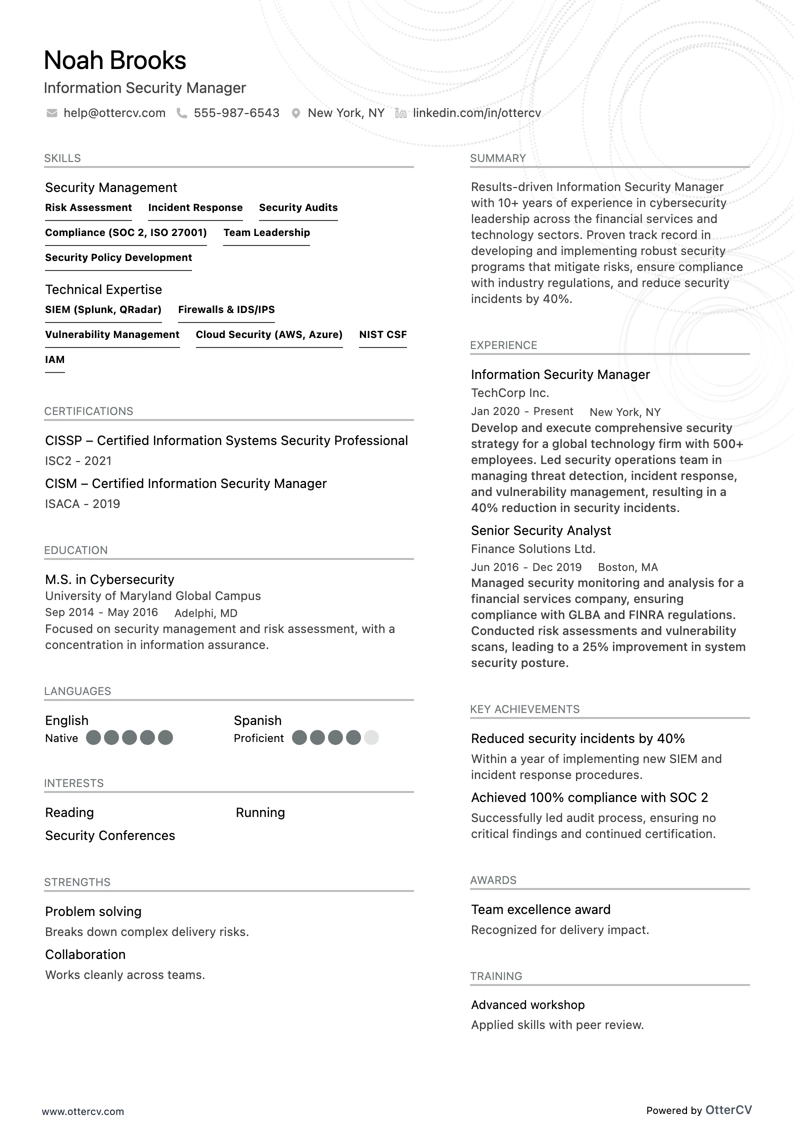
Information Security Manager resume example

Information Security Manager

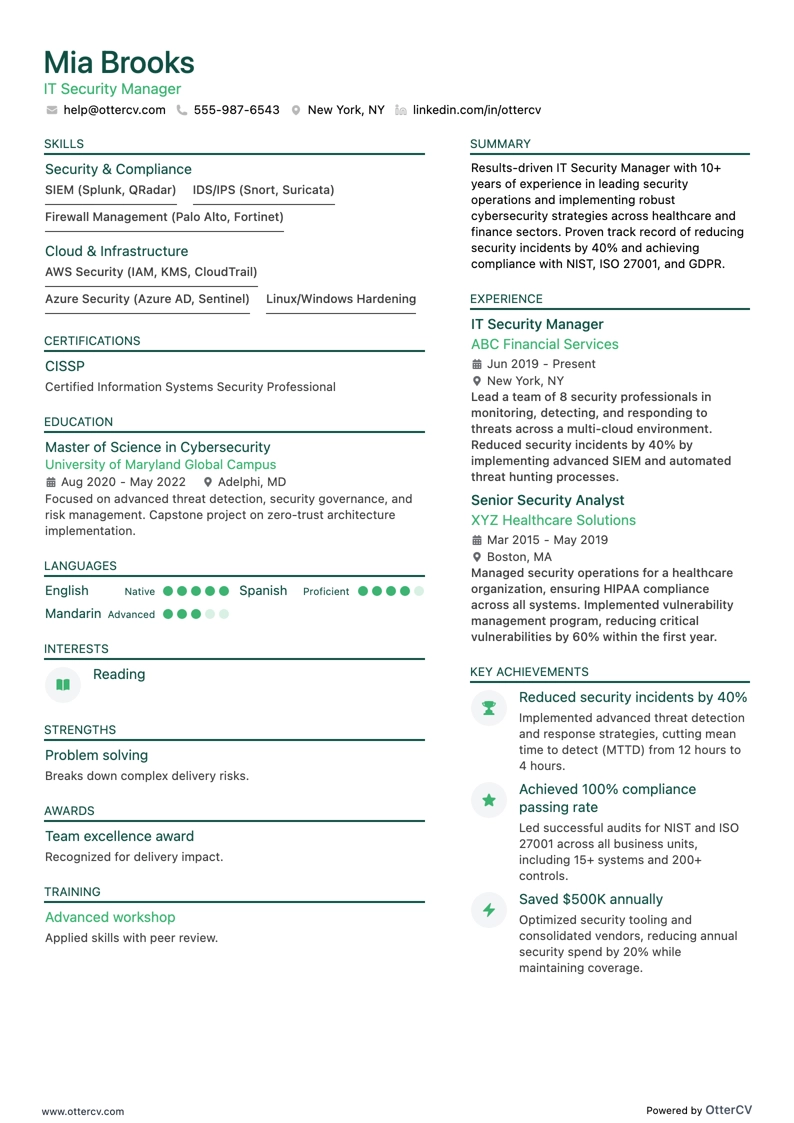
IT Security Manager resume example

IT Security Manager

Many IT security manager resumes fail because they read like lists of tools and generic responsibilities. In today’s hiring process, that kind of resume is often filtered by ATS keyword screening and overlooked during fast recruiter scans in a highly competitive market. If you’re not sure where to start, learning how to write a resume that clearly communicates value is the essential first step.

A strong resume shows how you reduce risk and help move the business forward. Highlight measurable outcomes such as percentage drops in incidents, audit pass rates, mean time to detect, budget savings, and enterprise rollout scope. Emphasize delivery impact through fewer critical vulnerabilities and improved uptime.

Key takeaways

  • Quantify achievements with metrics such as incident reduction, audit results, and cost savings.

  • Use a reverse-chronological format to show leadership progression and increasing accountability.

  • Tailor experience bullets to match each job posting’s tools and frameworks.

  • Link every listed skill to a measurable outcome in your experience section.

  • Place certifications above education when they are recent and directly relevant to the role.

  • Write a three- to four-line summary that highlights team scope, domains, and one key result.

  • Use Echocv’s Bullet Point Generator to turn vague duties into recruiter-ready, metrics-driven bullets.

Job market snapshot for IT security managers

We analyzed 379 recent IT security manager job ads across major US job boards to give you a quick view of employer expectations, industry demand, and experience requirements.

What level of experience employers are looking for IT security managers

Years of ExperiencePercentage found in job ads
1–2 years4.0% (15)
3–4 years6.3% (24)
5–6 years36.7% (139)
7–8 years7.1% (27)
9–10 years6.9% (26)
10+ years11.3% (43)
Not specified34.6% (131)

IT security manager ads by area of specialization (industry)

Industry (Area)Percentage found in job ads
Finance & Banking45.9% (174)
Healthcare30.3% (115)
Education11.9% (45)
Manufacturing4.0% (15)

Top companies hiring IT security managers

CompanyPercentage found in job ads
Accenture21.1% (80)
Boeing4.7% (18)
RTX Corporation3.4% (13)

Role overview stats

These tables outline the most common responsibilities and employment types for IT security manager roles. Use them to align your resume with employer expectations and understand how the role is structured across the market.

Day-to-day activities and top responsibilities for an IT security manager

ResponsibilityPercentage found in job ads
CISSP28.2% (107)
CISM17.7% (67)
CISA16.1% (61)
Cybersecurity13.5% (51)
Incident response13.5% (51)
RMF11.1% (42)
Security analytics10.3% (39)
Nextlabs9.8% (37)
Onapsis9.8% (37)
Pathlock9.8% (37)
SAP GRC9.8% (37)
Automated external application scanning9.5% (36)

Type of employment (remote vs on-site vs hybrid)

Employment typePercentage found in job ads
On-site86.5% (328)
Hybrid10.3% (39)
Remote3.2% (12)

How to format a IT security manager resume

Recruiters evaluating IT security manager candidates look for clear evidence of hands-on security program ownership, cross-functional leadership, and measurable risk reduction across enterprise environments. Your resume format should highlight these signals immediately, with career progression, increasing scope of accountability, and quantified business impact visible at a glance.

I have significant experience in this role—which format should I use?

I have significant experience in this role—which format should I use?

Use a reverse-chronological format. It is the strongest choice for experienced IT security managers because it emphasizes leadership progression and increasing accountability across security programs.

Do:

  • Start each role with your scope of ownership, including team size, budget authority, number of assets or endpoints under management, and reporting structure.
  • Highlight role-specific domains and tools, such as vulnerability management, SIEM platforms (Splunk, QRadar), incident response frameworks, compliance standards (ISO 27001, NIST, SOC 2), and vendor oversight.
  • Quantify outcomes tied to business impact, such as breach reduction rates, audit results, cost savings from security automation, or improvements in mean time to detect and respond.

Example bullet: “Led a 12-person security operations team through SOC 2 Type II certification, reducing critical vulnerability remediation time by 47% and saving $320K annually by consolidating three legacy SIEM tools into a single platform.”

Why hybrid and functional resumes don't work for senior roles

Why hybrid and functional resumes don't work for senior roles

Hybrid and functional resume formats fragment your career timeline, making it harder for recruiters to see your progression from technical contributor to security leader. They also make it more difficult to evaluate how your decision-making authority and accountability expanded over time.

These formats can dilute leadership impact by separating accomplishments from the roles where they happened, removing the context that shows you delivered results at scale. If you have five or more years of progressive security management experience, avoid hybrid and functional resumes entirely. They tend to raise more questions than they answer and can misrepresent your seniority to both recruiters and applicant tracking systems.

  • Edge-case exception: A functional resume may be acceptable only if you're transitioning into IT security management from an adjacent field, such as network engineering or compliance, and have a significant employment gap. Even then, every listed skill should be tied to a specific project, initiative, or measurable outcome rather than presented in isolation.

What sections should go on a IT security manager resume

With your format established, the next step is choosing the right sections to present your qualifications effectively.

Recruiters want clear evidence that you can lead security programs, reduce risk, and improve security outcomes across people, processes, and technology. Knowing what to put on a resume for this role helps you avoid wasting space on irrelevant details.

Use this structure for maximum clarity:

  • Header
  • Summary
  • Experience
  • Skills
  • Projects
  • Education
  • Certifications
  • Optional sections: Awards, Publications, Open-source work

Strong experience bullets should highlight measurable risk reduction, incident and vulnerability outcomes, program scope, cross-functional leadership, and business impact.

How to write your IT security manager resume experience

Once you’ve organized your resume with the right structure and supporting details, focus on your IT security manager experience section to show the results you delivered.

Your experience section should highlight the security initiatives you led, the frameworks and tools you used, and the measurable outcomes you achieved in protecting organizational assets. Hiring managers care more about proven impact—such as reduced vulnerabilities, stronger compliance, and faster incident response—than generic task lists.

Each entry should include:

  • Job title
  • Company and location (or remote)
  • Dates of employment (month and year)

Add three to five concise bullet points that explain what you owned, how you executed, and the outcomes you delivered:

  • Ownership scope: the security programs, infrastructure environments, compliance domains, or teams you were directly responsible for as an IT security manager.
  • Execution approach: the security frameworks, threat detection platforms, risk assessment methods, or governance standards you used to identify vulnerabilities and enforce protections.
  • Value improved: changes to the organization’s security posture, incident response readiness, regulatory compliance standing, system uptime, or overall risk exposure resulting from your leadership.
  • Collaboration context: how you worked with IT operations, engineering, legal, executive leadership, auditors, or third-party vendors to align security strategy with business objectives.
  • Impact delivered: outcomes shown through breach prevention results, audit findings, policy adoption scale, or business continuity improvements rather than routine responsibilities.

Experience bullet formula

Experience bullet formula

Action verb + technology + what you built or fixed + measurable result

A IT security manager experience example

IT Security Manager

Northbridge Health | Remote

2021–Present

Private healthcare software company supporting 2,500 employees and a HIPAA-regulated SaaS platform used by 1.2M patients.

  • Led a Zero Trust rollout using Microsoft Entra ID, Conditional Access, and Okta MFA, reducing account takeover incidents by 62% year over year.
  • Built and operationalized a SIEM program in Microsoft Sentinel with KQL detections and SOAR playbooks, reducing mean time to detect from 14 hours to 45 minutes.
  • Directed quarterly vulnerability management with Tenable and Qualys, partnering with engineering to increase patch compliance from 71% to 96% and reduce critical findings by 58%.
  • Ran incident response for ransomware, business email compromise, and data exposure events using NIST 800-61 playbooks and CrowdStrike Falcon, cutting mean time to contain by 41% and preventing an estimated $1.3M in downtime.
  • Partnered with product, HR, and legal to pass SOC 2 Type II and strengthen HIPAA controls, closing 100% of audit findings on schedule and reducing third-party risk review cycle time by 35%.

Now that you’ve seen how a strong experience section comes together, let’s look at how to customize yours for a specific job posting.

How to tailor your IT security manager resume experience

Recruiters review your IT security manager resume through applicant tracking systems and manual screening, looking for specific skills and qualifications. Tailoring your resume to the job description by reflecting the posting’s language and priorities can improve your chances of passing both reviews.

Ways to tailor your IT security manager experience:

  • Match the specific SIEM platforms or firewall technologies named in the posting.
  • Mirror the exact compliance frameworks listed, such as NIST or ISO 27001.
  • Align your incident response methodology language with the job description.
  • Reflect the risk assessment or vulnerability management processes they mention.
  • Highlight experience in the specific industry or regulatory domain referenced.
  • Emphasize team leadership scope that matches the stated reporting structure.
  • Include the security audit types or penetration testing approaches you led if they are referenced.
  • Use the employer’s terminology for threat detection or security operations workflows.

Tailoring means aligning your real accomplishments with the employer’s stated priorities, not artificially adding keywords where they do not belong.

Resume tailoring examples for IT security manager

Job description excerptUntailoredTailored
Lead vulnerability management program using Qualys and Tenable, ensuring timely remediation across cloud and on-premises environmentsManaged security tools and helped fix vulnerabilities across the organization.Led enterprise vulnerability management using Qualys and Tenable, driving 94% on-time remediation across AWS cloud infrastructure and 3,000+ on-premises endpoints.
Develop and enforce security policies aligned with NIST CSF and ISO 27001, conducting regular risk assessments and compliance auditsCreated security policies and performed audits to keep the company compliant.Developed and enforced security policies aligned with NIST CSF and ISO 27001, conducted quarterly risk assessments, and led 12 compliance audits with zero critical findings over two years.
Manage a team of six security analysts, oversee SIEM operations in Splunk, and coordinate incident response for a 24/7 SOCSupervised security team members and handled incident response activities.Managed a team of six security analysts in a 24/7 SOC, oversaw Splunk SIEM operations, and coordinated incident response that reduced mean time to containment from 4.2 hours to 47 minutes.

Once you’ve aligned your experience with the role’s security priorities, the next step is to quantify your IT security manager achievements so hiring teams can clearly see the impact behind those choices.

How to quantify your IT security manager achievements

Quantifying your achievements shows that you reduced risk and improved security operations. Use numbers tied to incident response speed, vulnerability reduction, compliance results, uptime, and cost savings from smarter controls.

Quantifying examples for IT security manager

MetricExample
Incident responseCut mean time to contain from 6 hours to 75 minutes by tuning Microsoft Sentinel alerts and standardizing the on-call playbook.
Vulnerability riskReduced critical vulnerabilities older than 30 days by 62% across 1,200 endpoints using Tenable scanning and weekly remediation sprints.
Compliance auditPassed ISO 27001 surveillance audit with zero major findings by closing 18 control gaps and automating evidence collection in ServiceNow.
AvailabilityImproved VPN service uptime from 99.2% to 99.95% for 3,500 users by upgrading AnyConnect gateways and adding active-active failover.
Security costLowered endpoint security spend by $180,000 annually by consolidating three tools into CrowdStrike and renegotiating licensing for 4,000 devices.

How to list your hard and soft skills on a IT security manager resume

With strong bullet points in place, the next step is making sure your IT security manager resume shows the right balance of hard and soft skills employers want to see.

Your skills section matters because it shows how you reduce risk and run security programs. Recruiters and ATS also scan this section for role-specific keywords, so aim for a balanced mix of hard skills and execution-focused soft skills.

IT security manager roles require a blend of:

  • Product strategy and discovery skills.
  • Data, analytics, and experimentation skills.
  • Delivery, execution, and go-to-market discipline.
  • Soft skills.

Your skills section should be:

  • Scannable with bullet-style grouping.
  • Relevant to the job post.
  • Backed by proof in your experience bullets.
  • Updated with current tools.

Place your skills section:

  • Above your experience if you're junior or switching careers.
  • Below your experience if you're mid- or senior-level with strong achievements.

Hard skills

  • Knowledge of the NIST Cybersecurity Framework.
  • Experience with ISO 27001 and ISO 27002.
  • Ability to conduct risk assessments and threat modeling.
  • Development of security policies and standards.
  • Incident response and forensics expertise.
  • SIEM experience with Splunk and Microsoft Sentinel.
  • EDR experience with CrowdStrike Falcon and Microsoft Defender.
  • Vulnerability management using Tenable and Qualys.
  • Identity and access management, including single sign-on.
  • Cloud security across AWS, Azure, and Google Cloud Platform.
  • Understanding of Zero Trust architecture.
  • Security audits and SOC 2 readiness.

Soft skills

  • Lead incident command decisions.
  • Translate risk for executives.
  • Partner with IT and engineering teams.
  • Negotiate security trade-offs.
  • Prioritize remediation by impact.
  • Write clear security requirements.
  • Run security governance cadences.
  • Drive alignment across vendors and stakeholders.
  • Coach analysts and engineers.
  • Escalate issues with context.
  • Manage security program roadmaps.
  • Hold teams accountable to controls.

How to show your IT security manager skills in context

Skills should not appear only in a dedicated skills section. Browse resume skills examples to see how strong candidates weave their competencies throughout the resume.

Show your skills in:

  • Your summary, where you define your professional identity at a high level
  • Your experience, where you prove your abilities through outcomes

Here is what strong, skills-rich writing looks like in practice.

Summary example

IT security manager with 12 years of experience defending enterprise cloud environments. Skilled in SIEM platforms, zero-trust architecture, and cross-functional incident response. Led a threat detection overhaul that reduced mean response time by 48% across global operations.

  • Clearly reflects senior-level experience
  • Names specific tools and frameworks
  • Leads with a measurable outcome
  • Signals leadership and collaboration

Experience example

IT Security Manager

Vanteon Systems | Remote

March 2019–Present

  • Deployed CrowdStrike and Splunk SIEM across 14 offices, reducing threat detection time from 36 hours to under four.
  • Partnered with DevOps and compliance teams to implement zero-trust policies, cutting unauthorized access incidents by 62%.
  • Led quarterly red-team exercises and trained 120 staff on phishing protocols, lowering social engineering success rates by 55%.
  • Every bullet includes measurable proof.
  • Skills surface naturally through real outcomes.

How do I write a IT security manager resume with no experience

Once you’ve shown your IT security manager abilities with specific, results-driven examples, the next step is using that same approach to build an IT security manager resume when you have no experience.

Even without full-time experience, you can still demonstrate readiness through:

  • Capstone security program management project
  • Home lab SIEM detection tuning
  • Internship leading vulnerability remediation
  • SOC volunteer shift incident triage
  • Open-source security tool contributions
  • Compliance audit support for ISO 27001
  • University security club leadership role
  • Bug bounty reports with write-ups

If you're starting out, our guide on building a resume without work experience explains how to position these projects effectively.

Focus on:

  • Incident response leadership with metrics
  • Risk assessments tied to controls
  • Compliance mapping and audit evidence
  • Security tooling: SIEM, EDR, IAM

Resume format tip for entry-level IT security manager

Resume format tip for entry-level IT security manager

Use a hybrid resume format to put security projects and tools first while still showing steady education and relevant roles.

Do:

  • Lead with a "Security Projects" section.
  • Quantify outcomes, such as time saved or risks reduced.
  • List the tools and frameworks you used.
  • Translate coursework into deliverables and artifacts.
  • Add links to reports and repositories.

Example project bullet:

  • Led a capstone IT security manager project using Splunk and NIST Cybersecurity Framework, cutting alert triage time 30% by tuning correlation rules.

Once you’ve structured your resume to emphasize transferable skills over direct experience, your education section becomes another way to strengthen your candidacy.

How to list your education on a IT security manager resume

Your education section helps hiring teams quickly confirm that you have the foundational knowledge an IT security manager needs. It reinforces your technical training, analytical skills, and academic background.

Include:

  • Degree name
  • Institution
  • Location
  • Graduation year
  • Relevant coursework, for juniors or entry-level candidates
  • Honors and GPA, if 3.5 or higher

Skip the month and day details. Listing only the graduation year creates a cleaner, more professional presentation.

Here’s a strong education entry tailored to the IT security manager role:

Example education entry

Bachelor of Science in Cybersecurity

George Mason University, Fairfax, VA

Graduated: 2018

GPA: 3.7/4.0

  • Relevant Coursework: Network Defense, Risk Management, Digital Forensics, Cryptography, Security Architecture
  • Honors: Magna Cum Laude, Dean's List (six semesters)

How to list your certifications on a IT security manager resume

Certifications on your resume show your commitment to continuous learning, demonstrate tool proficiency, and confirm your industry relevance for an IT security manager role, especially in fast-changing security environments.

Include the following details:

  • Certificate name
  • Issuing organization
  • Year
  • Optional: credential ID or URL

Place certifications below education when your degree is recent and your certifications are older or less relevant to IT security manager work.

Place certifications above education when they are recent, highly relevant, or required for the IT security manager roles you target.

Best certifications for your IT security manager resume

  • CISSP (Certified Information Systems Security Professional)
  • CISM (Certified Information Security Manager)
  • CCSP (Certified Cloud Security Professional)
  • CompTIA Security+
  • GIAC Security Essentials (GSEC)
  • ISO/IEC 27001 Lead Implementer
  • Certified Ethical Hacker (CEH)

How to write your IT security manager resume summary

Once your credentials are easy for hiring teams to find, use your IT security manager resume summary to quickly show how those qualifications translate into business impact.

Your resume summary is often the first part a recruiter reads, so a strong one should immediately show that you are qualified for the IT security manager role.

Keep it to three to four lines and include:

  • Your title and total years of experience in IT security or related fields.
  • The domains or industries you have worked in, such as finance, healthcare, or SaaS.
  • Core tools and frameworks, such as SIEM platforms, NIST, ISO 27001, or zero-trust architecture.
  • One or two measurable achievements, such as reducing incidents or improving compliance rates.
  • Soft skills connected to real outcomes, such as cross-functional collaboration that accelerated audit readiness.

PRO TIP

At the manager level, focus more on team leadership, risk strategy, and business outcomes than on individual technical tasks.

Show ownership of security programs, budgets, or compliance initiatives. Avoid vague phrases like “passionate about cybersecurity” or “results-driven professional.” Instead, let your numbers and scope speak for themselves.

Example summary for a IT security manager

IT security manager with eight years of experience leading enterprise security programs in financial services. Directed a 12-person team, reduced security incidents by 40%, and achieved SOC 2 compliance across three business units.

Now that your summary highlights your security expertise and leadership value, make sure the header above it presents your contact details and professional brand clearly.

What to include in a IT security manager resume header

A resume header lists your key identity and contact details so recruiters can find you quickly, trust your profile, and screen you accurately as a IT security manager.

Essential resume header elements

  • Full name
  • Tailored job title and headline
  • Location
  • Phone number
  • Professional email
  • GitHub link
  • Portfolio link
  • LinkedIn

A LinkedIn link helps recruiters verify your experience quickly and supports screening.

Do not include a photo on a IT security manager resume unless the role is explicitly front-facing or appearance-dependent.

Match your header title and links to the job posting, and keep formatting consistent so applicant tracking systems can parse your details correctly.

Example

Once your contact details and role-specific identifiers are in place at the top of your resume, strengthen the rest of your application with additional sections that add relevant context and support your candidacy.

Additional sections for IT security manager resumes

When your core qualifications are similar to those of other candidates, these extra resume sections can help you stand out by adding role-specific credibility and depth.

  • Security clearances
  • Industry publications and research
  • Conference presentations and speaking engagements
  • Professional memberships (ISACA, ISSA, (ISC)²)
  • Languages
  • Volunteer work in cybersecurity education
  • Hobbies and interests related to technology

Once you’ve strengthened your resume with relevant supplementary sections, the next step is pairing it with a well-crafted cover letter to maximize your application’s impact.

Do IT security manager resumes need a cover letter

An IT security manager cover letter isn’t required for most roles, but it can help in competitive searches or when hiring teams expect one. If you’re unsure what a cover letter is and when it adds value, it can make a difference when your resume needs added context or when you’re targeting a specific environment.

Use a cover letter to add details your resume can’t:

  • Explain role and team fit: Match your leadership style to the team’s maturity, operating model, and key stakeholders.
  • Highlight one or two outcomes: Tie a security program, incident response improvement, or risk reduction to measurable results.
  • Show business context: Reference the product, users, and threat landscape, and connect security priorities to uptime, trust, and compliance needs.
  • Address transitions or non-obvious experience: Clarify a move from engineering, audit, or consulting, and map your skills to IT security manager responsibilities.

Even if you choose not to include a cover letter, you can still strengthen your application by using AI to improve your IT security manager resume.

Using AI to improve your IT security manager resume

AI can improve your resume’s clarity, structure, and overall impact. It can tighten language and highlight relevant achievements. If you’re wondering which AI is best for writing resumes, the key is to choose tools that enhance your content without fabricating details. Overusing AI can strip away authenticity, so once your resume feels clear and aligned with the role, step away from it.

Here are 10 practical prompts to strengthen specific sections of your IT security manager resume:

  1. Strengthen your summary. “Rewrite my resume summary to highlight my most relevant qualifications as an IT security manager in three concise sentences.”
  2. Quantify experience bullets. “Add measurable outcomes to each of my IT security manager experience bullets using metrics like incident reduction or cost savings.”
  3. Align skills to job posts. “Compare my skills section against this IT security manager job description and suggest missing technical or leadership skills.”
  4. Sharpen action verbs. “Replace weak or repetitive verbs in my IT security manager experience section with strong, specific action verbs.”
  5. Refine project descriptions. “Rewrite my project entries to clearly show scope, tools used, and results achieved as an IT security manager.”
  6. Trim redundant phrasing. “Remove filler words and redundant phrases from my IT security manager resume without changing the meaning.”
  7. Tailor certification entries. “Reorganize my certifications section to prioritize credentials most relevant to an IT security manager role.”
  8. Improve education relevance. “Rewrite my education section to emphasize coursework and achievements directly applicable to an IT security manager position.”
  9. Clarify compliance experience. “Highlight my experience with regulatory frameworks like NIST, ISO 27001, or GDPR in my IT security manager resume.”
  10. Tighten formatting consistency. “Review my IT security manager resume for inconsistent tense, punctuation, or formatting across all sections and fix them.”

Stop using AI once your resume sounds accurate, specific, and aligned with your real experience. AI should never invent experience or inflate claims—if it didn’t happen, it doesn’t belong on your resume.

Conclusion

A strong IT security manager resume should show measurable outcomes, role-specific skills, and a clear structure. Highlight risk reduction, incident response improvements, audit results, and compliance wins using metrics hiring teams can verify.

Keep each section focused and easy to scan, with consistent titles and action-led bullets. This shows you can lead security programs now and adapt to near-future demands.

IT Security Manager resume examples

Explore additional IT Security Manager resume samples and guides and see what works for your level of experience or role.

By Experience

Senior IT Security Manager

Senior IT Security Manager resume preview

IT Security Manager resume examples

Explore additional IT Security Manager resume samples and guides and see what works for your level of experience or role.

By Role

Cybersecurity Risk Manager

Cybersecurity Risk Manager resume preview

Identity and Access Management Manager

Identity and Access Management Manager resume preview

Information Security Governance Manager

Information Security Governance Manager resume preview

Network Security Manager

Network Security Manager resume preview

Cloud Security Manager

Cloud Security Manager resume preview

Application Security Manager

Application Security Manager resume preview

IT Security Program Manager

IT Security Program Manager resume preview

Security Operations Manager

Security Operations Manager resume preview

Cybersecurity Manager

Cybersecurity Manager resume preview

Information Security Manager

Information Security Manager resume preview

IT Security Manager

IT Security Manager resume preview