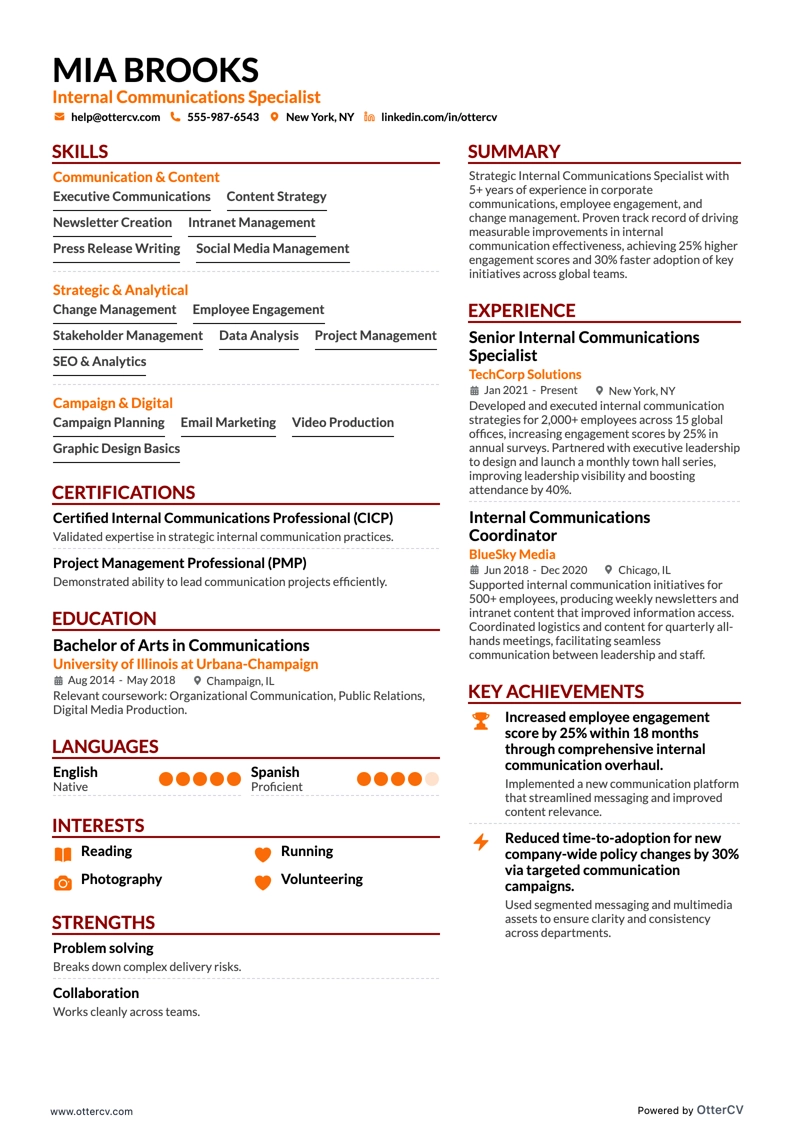
Head of Internal Communications full preview

20 Internal Communications Resume Examples

OtterCV

Written by The OtterCV Team

Updated: 1/30/2025•8 min read

See all resume examples in this guide, or generate your own resume example with your personalized prompt

Head of Internal Communications resume example

Head of Internal Communications

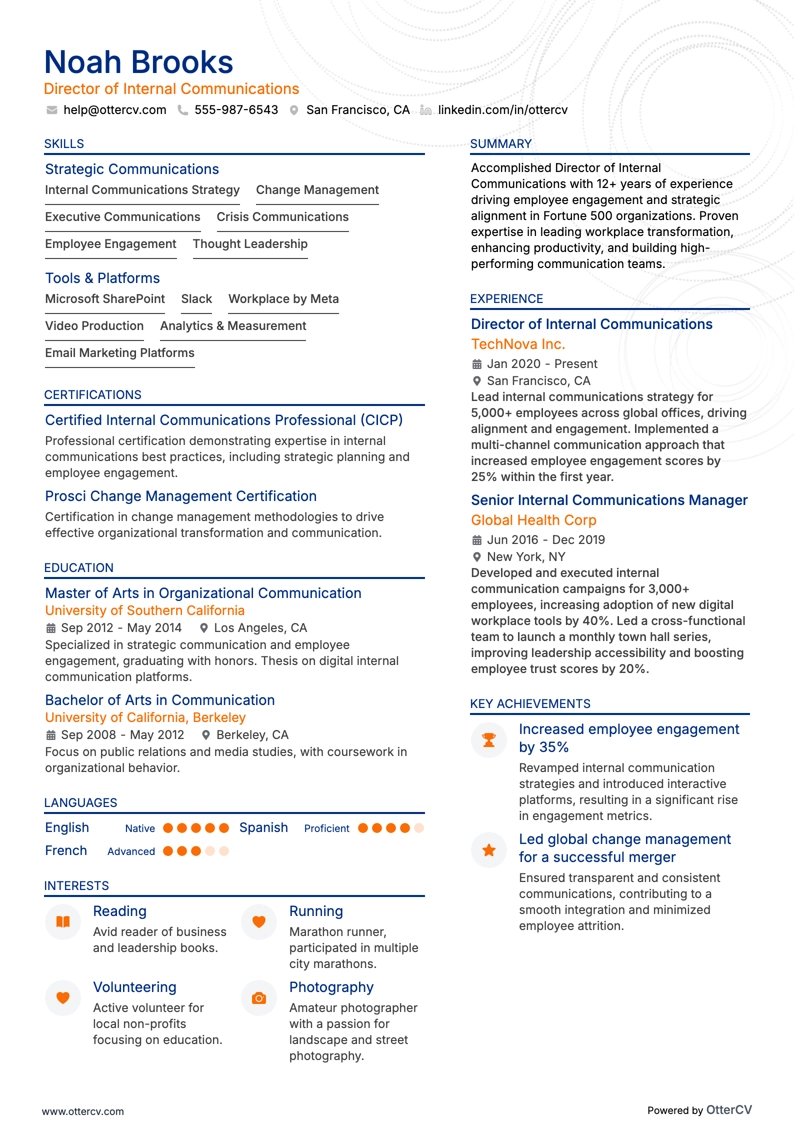
Director of Internal Communications resume example

Director of Internal Communications

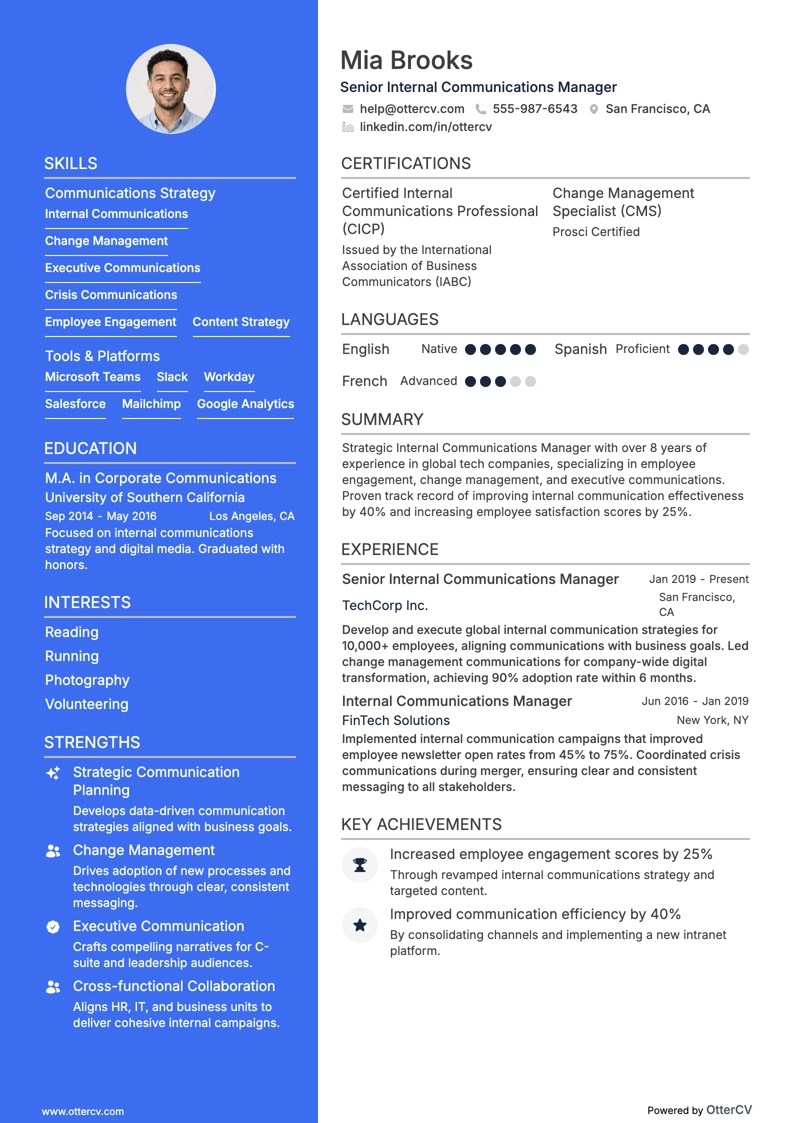
Senior Internal Communications Manager resume example

Senior Internal Communications Manager

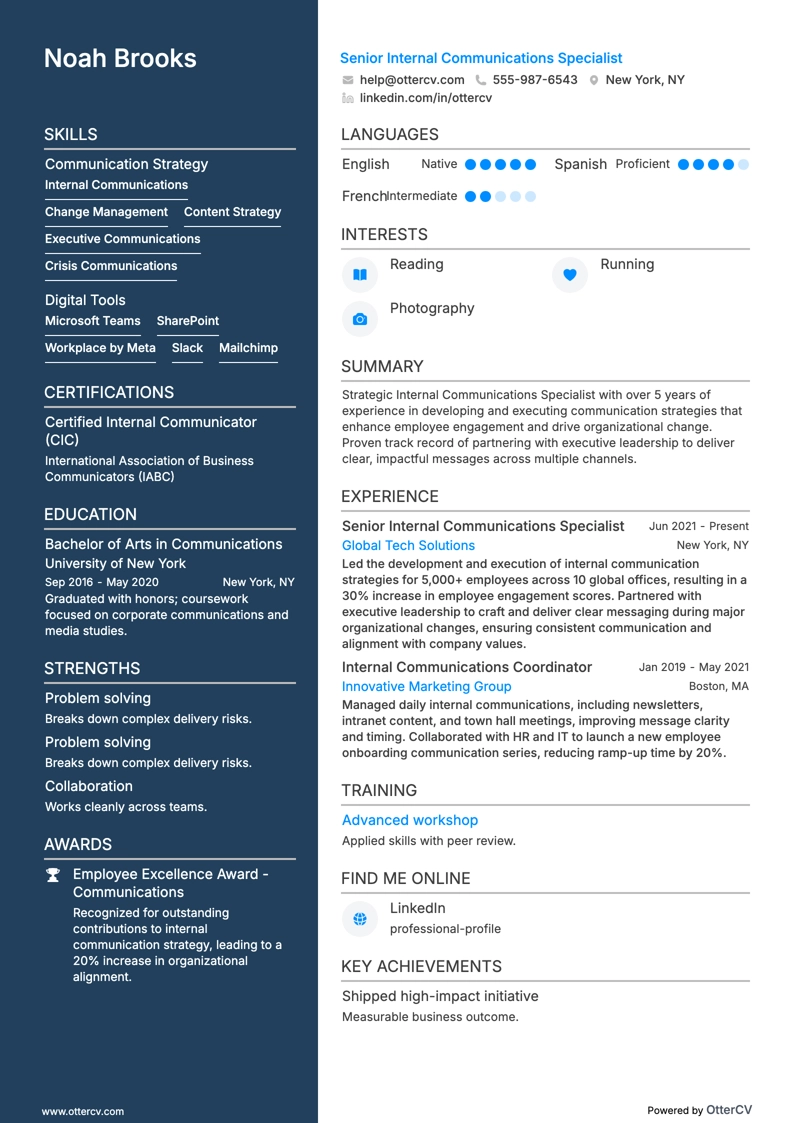
Senior Internal Communications Specialist resume example

Senior Internal Communications Specialist

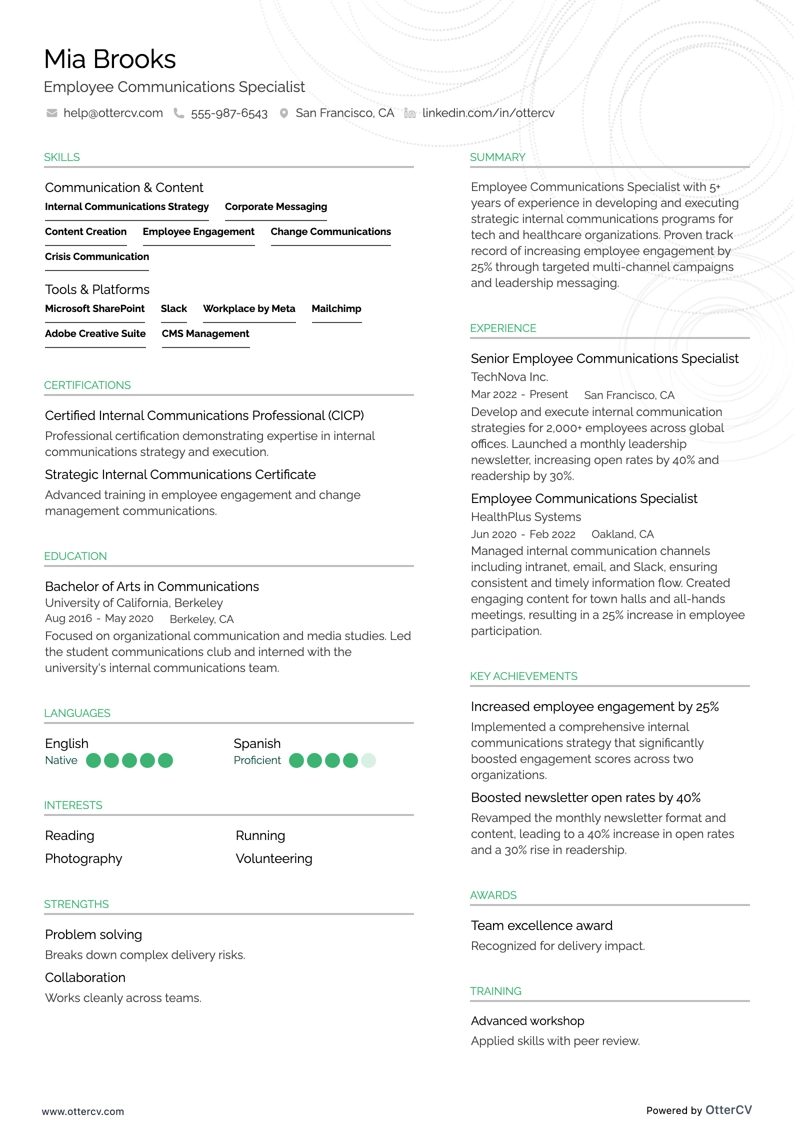
Employee Communications Specialist resume example

Employee Communications Specialist

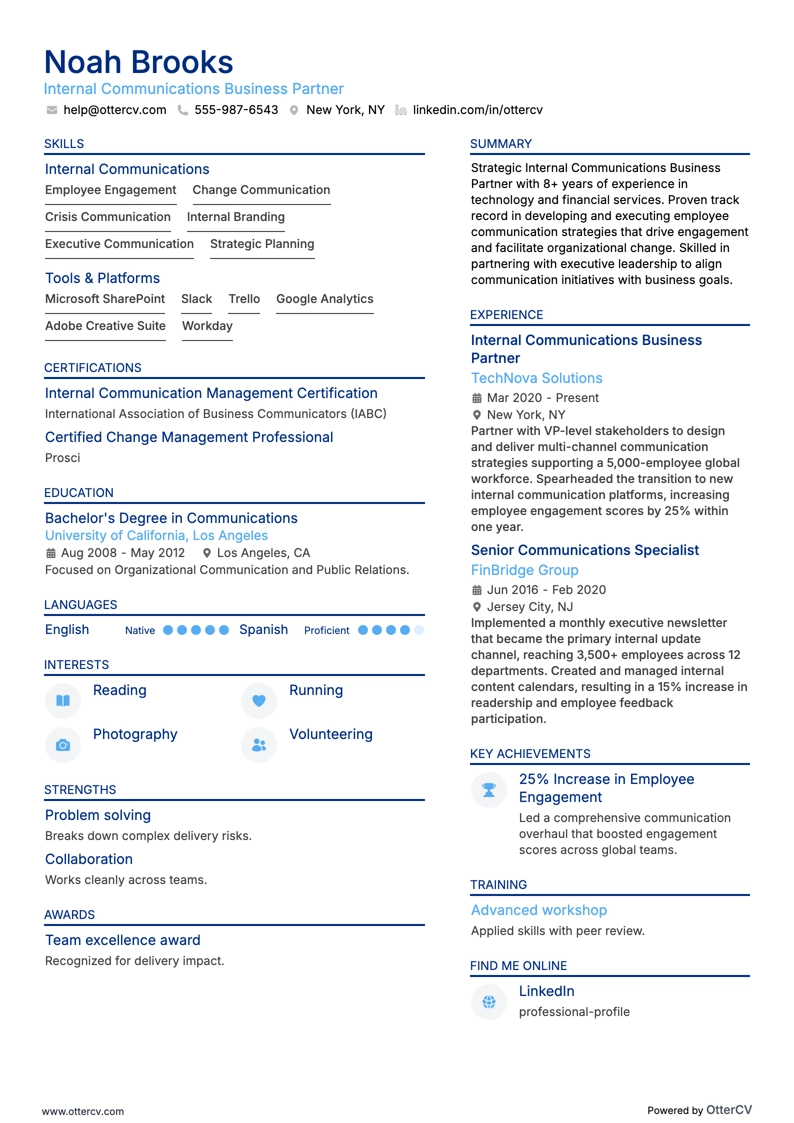
Internal Communications Business Partner resume example

Internal Communications Business Partner

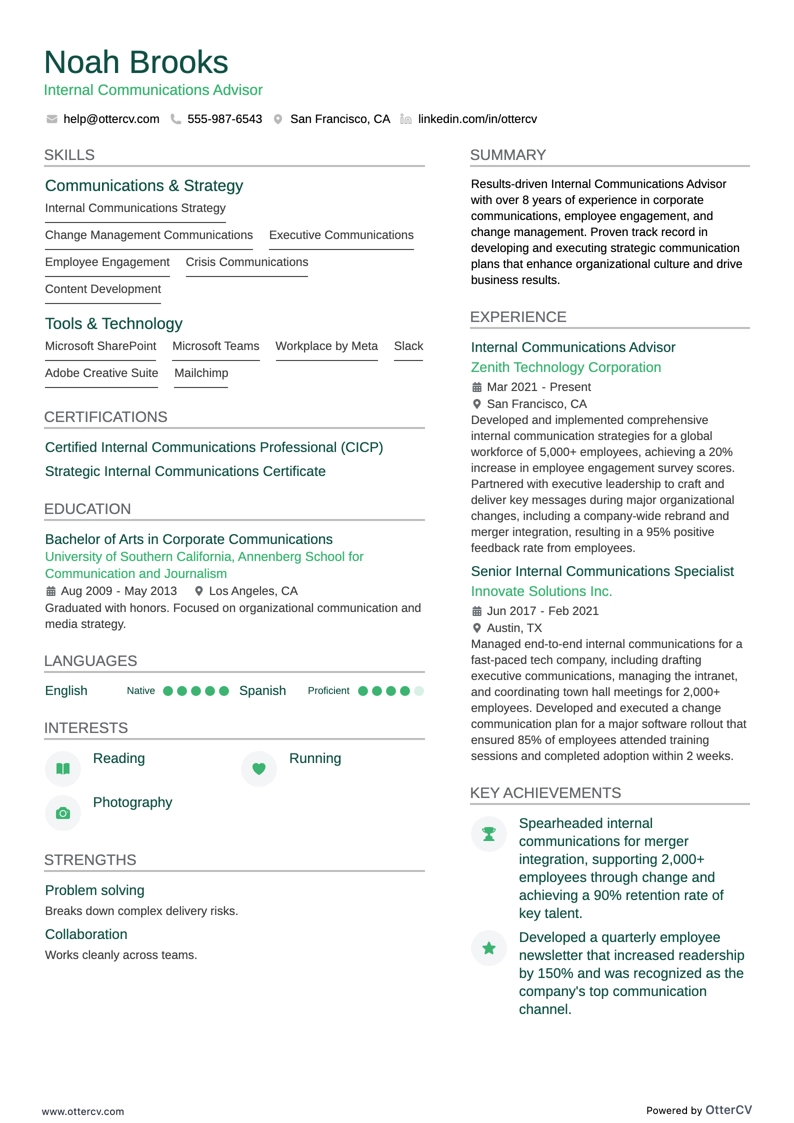
Internal Communications Advisor resume example

Internal Communications Advisor

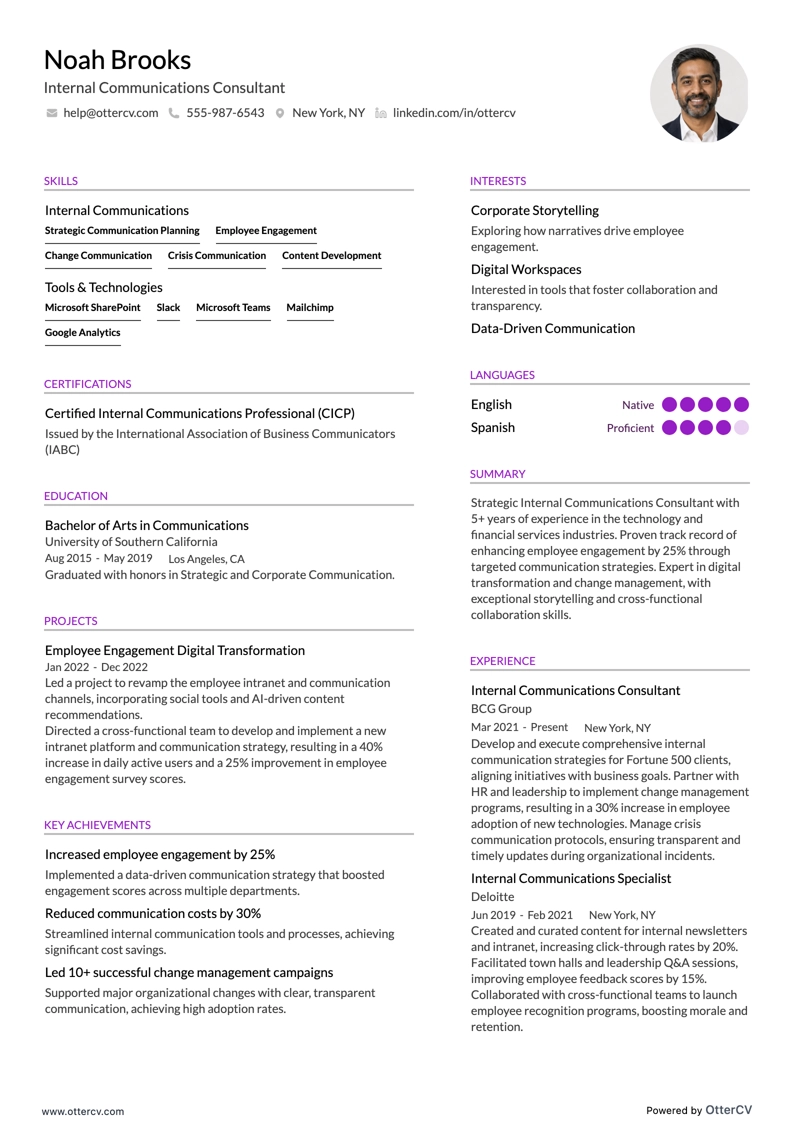
Internal Communications Consultant resume example

Internal Communications Consultant

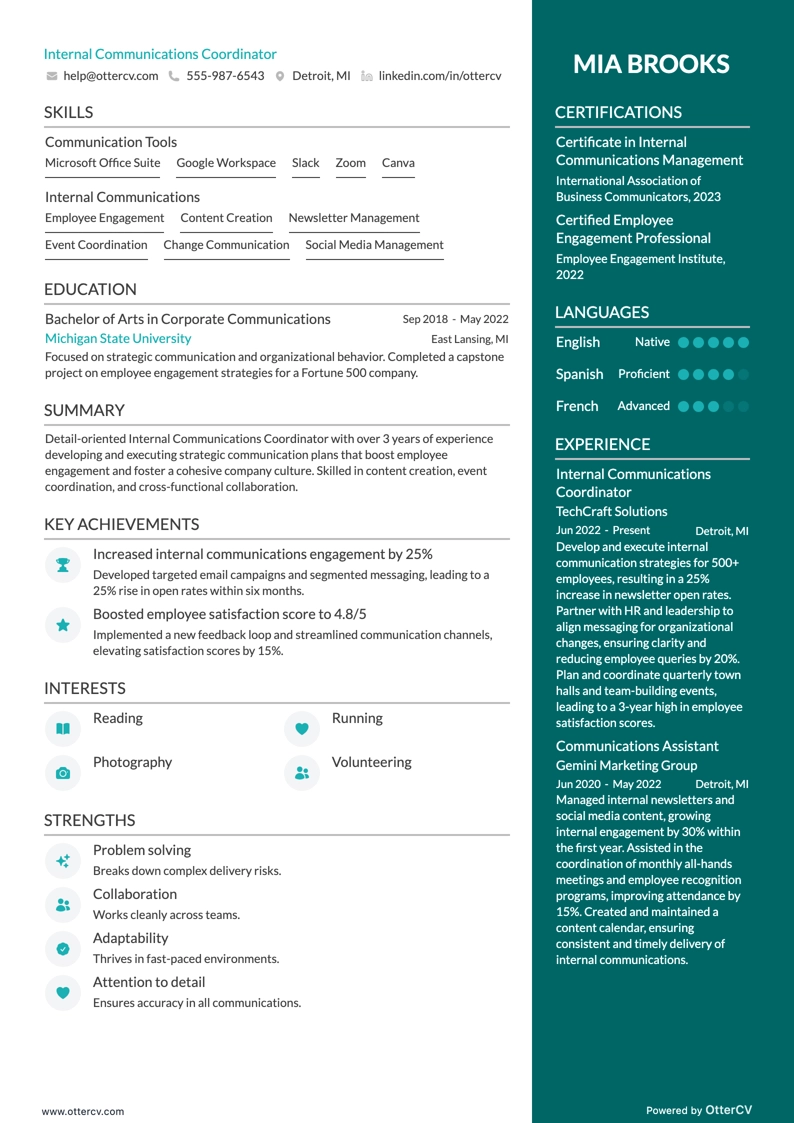
Internal Communications Coordinator resume example

Internal Communications Coordinator

Internal Communications Specialist resume example

Internal Communications Specialist

Organizations are living systems with one big heart: the internal communications specialist or manager.

They carry the voice of the organization and help it reach every team.

Internal communications professionals:

  • Protect and shape company-wide values.
  • Educate and inspire teams as they build culture.
  • Promote inclusivity throughout the organizational journey.

A few years ago, this was not how the role was viewed. Internal communications were often seen as "copy-paste managers" who filled inboxes with announcements.

Today, the role is crucial for:

  • Achieving more business goals.
  • Maintaining values.
  • Supporting the growth of the organization.

All of this becomes possible when employee experience and engagement improve.

Internal communications is about connecting a business with its staff and guiding them in the direction the business wants to go.

—James Delves, head of public relations and engagement at the Chartered Institute of Marketing (CIM)

Improving organizational culture is often the result of strong communication strategies designed, led, and updated by internal communications specialists.

Doesn't that sound like an exciting opportunity?

Your internal communications resume is your gateway to this evolving industry.

Our 2026 resume guide brings together your best creative, communication, and other relevant skills to help you find the right opportunity today.

What you’ll learn here

  • How to present your experience as a digital-age narrator and brand gatekeeper to leave a lasting impression on recruiters
  • The Echocv step-by-step challenge for starting your internal communications resume
  • Tips for the seven key resume sections that add more depth to your internal communications career
  • How to break into internal communications without the usual five+ years of experience
  • 50+ hard and soft skills you do not want to miss

Looking for related resumes?

From where should you start writing your internal communications resume?

Success in internal communications depends on understanding everything from company-wide goals to how departments function.

That includes even the often mysterious HR department.

In this section, we challenge you to test both your internal communications skills and your resume. The goal is simple: book your next interview in the blink of an eye.

To complete this exercise, prepare the following:

  • as many internal communications roles as you want to apply for
  • your current resume or a draft version
  • time, patience, and problem-solving

Next, review the job requirements and align them with your experience.

This shows your ability to listen, understand, and respond to the needs of people, the organization, and HR.

Adding relevant job keywords can also help, since your resume may be scanned by ATS (Applicant Tracking Systems) that sort candidates as suitable or unsuitable.

Internal communications professionals are expected to be both corporate affairs gatekeepers and gifted storytellers.

Think of yourself as a modern-day Scheherazade, Brothers Grimm, or Aesop.

With that in mind, there are five critical elements in your resume that can hint at your abilities.

Panel: When assessing internal communications resumes, recruiters want to see:

When assessing internal communications resumes, recruiters want to see:

  • Your ability to draft and execute strategic communication plans that support organizational culture with tangible results.
  • Your ability to work effectively with different team members in cross-functional environments.
  • Strong copywriting skills and the ability to adapt content for different communication channels.
  • Experience incorporating internal events into your broader communication strategy.
  • Evidence that you offer something beyond the basic checklist, backed by measurable results from your experience.

Now that you’ve answered these five key questions, here comes the fun part.

It’s time to show how you’ve aligned past companies’ messages with their vision, goals, and people.

Highlight how you’ve adapted communication strategies for different levels of understanding, trends, and communities.

You can use various resume sections to showcase these capabilities, including:

Top internal communications resume sections

  • Include a header and summary.
  • Add your experience.
  • List your skills.
  • Highlight your strengths and achievements.
  • Include your certification and education.

What’s in an internal communications resume header?

Like a strong press release title, your resume header should be clear, concise, and compelling. Think of it as the top one-third of your resume and one of the first hurdles in the recruitment process.

It gives recruiters an immediate sense of whether you’re a good fit for the role.

To strengthen your resume, make sure your header includes these three essential elements:

Your headline is a single chance to make a strong impression in less than a sentence.

You can use it to:

  • Use keywords from the job ad that connect to your experience
  • Show how your values align with the company’s
  • Highlight something that makes you unique
  • Focus on your biggest professional achievement

Whatever you choose, tailor it to each position you apply for.

2 internal communications resume header examples

Costa Luna

The role you are applying for?

+1-480-677-0261 · Email · LinkedIn/Portfolio · Superstition, AZ

WRONG

In the first example, the candidate includes only a name, location, and telephone number, missing an opportunity to add vital keywords.

The second example meets all the requirements of a strong resume header and even includes keywords and achievements in the title.

Writing your internal communications resume summary; keywords, achievements, and more

Adapting your resume for each job is one of the best ways to showcase your copywriting skills.

As with most written content, recruiters tend to skim resumes and focus closely on the summary.

Your internal communications resume summary is another place to align your experience and achievements with the job requirements.

You can also use it to highlight the skills you want to bring into your next role.

Here are some areas you can quantify:

  • your years of experience in the communications industry;
  • project management skills, including standout communication plans and campaigns with outcomes;
  • people management, including how you have built relationships with key stakeholders;
  • content writing for different channels, including Intranet, media packages, and social media.

The list of internal communications skills and achievements can be extensive.

Remember, this section should do more than summarize your experience or list bullets. It should shine a light on what you do best.

2 internal communications resume summary examples

Summary

I have worked in internal communications since 1999. I began at a small domestic company, where I sent 10 weekly emails to more than 50 staff members. I later joined an international startup and took charge of all internal communications and events.

WRONG

Why This Example Doesn’t Work

  • It confuses a start date with the actual amount of experience.
  • It lists roles in chronological order without showing any achievements.
  • It uses “I,” which makes the tone too personal.

Summary

Internal communications manager with 20+ years of experience translating company vision, messaging, and goals into clear, valuable communications for teams. Currently responsible for all internal communications, ensuring staff receive the latest corporate updates through the channels most suitable to them, resulting in 97% positive feedback for innovation and flexibility in digital channels.

As Head of Internal Communications at XYZ, responsible for sharing key stakeholder messages and delivering 10 weekly emails related to vision, values, and change management. This helped keep staff turnover below 10% and contributed to having 30+ employees with 20+ years at the company.

RIGHT

Within the example above, you’ll notice that the candidate:

  • included years and the biggest outcome of their role;
  • used feedback as a measurable result of their efforts;
  • showed how their communication affected the bigger picture, including low staff turnover rates and increased loyalty.

The alpha and omega to your internal communications resume experience

The top one-third of your resume may have helped you stand out with keywords and creativity.

Now it’s time for the essence of your resume or experience: showing more depth as a professional.

The best way to present your experience is through tangible results tied to the bigger picture of the organization.

Recruiters hiring internal communications professionals often assess performance through four key skills.

1. Strategy

This includes developing and executing monthly, quarterly, and annual plans to:

  • bring key messages, such as change management and new product development, closer to employees;
  • make sure everyone is informed and stays on board;
  • help reach organizational goals and support the bigger picture.

Anyone who has designed communication plans knows they must be adapted based on engagement, needs, and individuals’ understanding.

PRO TIP

In your experience section, quantify the goals you achieved through a dynamic communication strategy.

2. Collaboration

Your role is to understand what matters to different departments and communicate across teams in line with company-wide priorities.

This also requires influence and negotiation.

PRO TIP

Use your resume to show how your collaborations contributed to department growth and improved performance.

Writing

On a day-to-day basis, internal communications experts create a range of internal and executive content based on organizational needs.

In your experience section, quantify and describe your ability to write and edit:

  • presentations and announcements
  • blog posts and newsletters
  • brand stories, interviews, and values content
  • press releases

Events

Some internal communications professionals are also responsible for organizing internal events.

Consider how your event management experience has contributed to employee engagement.

PRO TIP

Remember that your experience section is a numbers game. For each bullet point, include a percentage, number, or achievement when possible.

Internal communications resume experience examples

Experience

Internal Comms Influencer

Atlas Architectural Designs

02/2018 - 11/2021 | Minneota, MN

Leading company in reimagining and designing bespoke spaces across Minnesota.

  • Listened to key stakeholders and managers to write emails for 50+ staff.
  • Successfully communicated promotions across.
  • Organized annual team building.
  • Managed 3 junior communications experts.
WRONG

Here are a few ways to improve the experience section above:

  • Write out your full role instead of using abbreviations to better show its importance.
  • Focus less on duties alone and more on the outcomes your work delivered for the organization.
  • Include more soft skills keywords so each experience point stands out.

If you want to see what an excellent internal communications experience section looks like, check out the example below.

Experience

Internal Communications Manager and Influencer

Atlas Architectural Designs

02/2018 - 11/2021 · Minneota, MN

Leading company in reimagining and designing bespoke spaces across Minnesota

  • Attended biweekly meetings with key stakeholders and managers to understand priorities for employee-wide communication, producing 50+ emails, newsletters, and other content.
  • Developed a communication plan to announce internal promotions, giving employees the spotlight through interviews and achieving 45% more positive feedback across the board.
  • Organized 4 annual team-building events based on individuals' needs and interests, increasing attendance and engagement with 250+ employees joining each year.
  • Oversaw 3 junior communication experts, helping them develop copywriting and negotiation skills and ensuring the team met all 120+ annual goals.
RIGHT

In the example above, each bullet point emphasizes skills and measurable outcomes for company culture, departments, and individuals.

If your resume is missing that kind of impact, this section can help. If you want to break into internal communications with less experience, focus your resume on the areas below.

Entry-level internal communications resume tips

Most internal communications manager roles require over five years of experience. Even so, there are still entry-level opportunities that can help you start building your career in this field.

Prepare your resume for an entry-level role by emphasizing these sections:

Education and certifications

Internal communications relies on both strong writing and speaking skills. That makes your higher education especially important. You should also consider adding relevant certificates for the role.

We’ll cover both of these resume sections in more detail later in this guide.

Internships

You may think your communications internship was only there to check a box, but internships often teach the basics of corporate culture, writing, and communication with senior staff.

Include that experience on your resume, no matter how long the internship lasted, to show your commitment to learning.

Functional Skills-Based Resume Format

This format highlights what you bring as a professional, including your skills and what makes you unique.

Use it to present both relevant experience and your values.

Internal communications top resume skills

You may underestimate this section and wonder what a skills box can really do to help your resume stand out. In practice, it can be one of the most effective ways to showcase your strengths and what sets you apart.

The skills you include may range from hard and technical skills to soft skills.

Hard skills are tied more closely to the technology you use in the role. Examples include scheduling content across platforms, uploading blog posts to a CRM, and managing Slack or Teams channels.

Recruiters’ favorite 20+ internal communications technical skills can be found below.
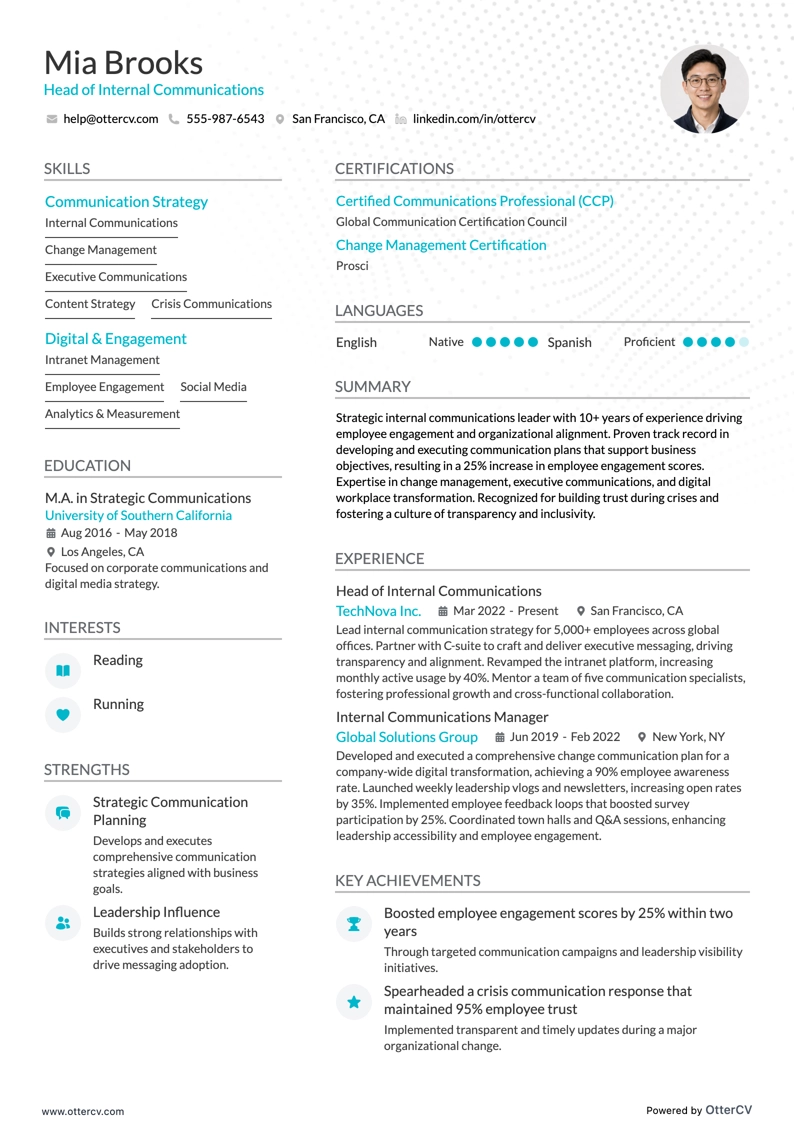
Technical skills list for your resume

  • Internal branding and project management.
  • Developing and implementing communication plans.
  • Designing and writing presentations.
  • Creating digital and print content.
  • Writing announcements, newsletters, and reports.
  • Writing blog posts, stories, and values content.
  • Writing press releases.
  • Managing intranet, social media channels, and communication channels.
  • Editing and proofreading.
  • Interviewing and directing videos.
  • Conceptualizing photoshoots and organizing events.
  • Managing editorial calendars.
  • Integrating data-led solutions.
  • Working knowledge of MSO and CRM.
  • Managing various social media channels and communication platforms.
  • Writing emails.

How to describe soft skills on your resume

Soft skills are at the heart of internal communication. Strong professionals are not just effective communicators; they are also guided by solid values.

They stand up for what they believe is right and do not back down.

Your resume is a great opportunity to show recruiters that you offer more than technical proficiency and experience.

Be selective when choosing 30+ of the following soft skills to include on your resume.

Soft skills list for your resume

  • Communication and cultural strategy.
  • Collaboration.
  • Interpersonal communication.
  • Consistency.
  • Engagement.
  • Change management.
  • Clear and cohesive narrating.
  • Operational delivery.
  • Leadership.
  • People management.
  • Overseeing third-party vendors.
  • Relationship management.
  • Negotiation.
  • Influencing.
  • Networking.
  • Moral responsibility and a good moral compass.
  • Listening.
  • Comprehension.
  • Simplifying complex ideas.
  • Fearlessness.
  • A yearning for knowledge.
  • Creativity.
  • Organization.
  • Adaptability to shifting priorities.
  • Working in a fast-paced environment.
  • Meeting deadlines.
  • Speaking and presentation.
  • Multitasking.
  • Commercial awareness.
  • Technology knowledge.
  • Social media understanding.
  • Transformation.
  • Open-mindedness.
  • Problem-solving.
  • Empathy.
  • Confidence.

You could further highlight your soft skills in other resume sections.

Internal communications strengths/ achievements for the win

These two resume sections give you extra space to expand on your soft skills by tying them to real results.

To get the most from a strengths or achievements section:

  • Select up to three soft skills that are relevant to the job.
  • Use your biggest achievements to demonstrate your aptitude.
  • Keep it simple by focusing on one skill and one achievement per sentence.

The ideal strengths section would be like this:

Strengths

  • Influence: A 2022 company-wide communication plan improved employee engagement with the brand, leading to 5K+ new users starting to use Teams daily.
  • Time Management: Ability to prioritize and multitask in a dynamic environment to consistently reach 85% of business-critical goals while meeting deadlines, including next-day turnarounds.
  • Handshake: Grew and sustained relationships with 20+ key internal stakeholders so internal communications always reflected their messages and agenda.
RIGHT

What about internal communications certificates…

Certificates are another strategic way to show recruiters that you can apply both technical and soft skills in different situations.

Your past certifications may relate to content creation and distribution, budget management and allocation, people skills, and more.

There is no strict limit on which ones you should include, but they should always be relevant to the role you are applying for.

Top #15 certificates for your resume

  • The Charted Institute of Public Relations Specialist Certificate in Internal Communication.
  • Udemy Brand Communications Strategy Masterclass.
  • Udemy Effective Corporate Communications.
  • Global Communication Certification Council Strategic Communication Management Professional.
  • Global Communication Certification Council Communication Management Professional.
  • Certiport Communication Skills for Business Professional Communication.
  • American Institute for Business Management and Communication Certified Public Relations Manager.
  • American Institute for Business Management and Communication Certified Business Communication Professional.
  • Sales and Marketing Certification Institute Certified Marketing Communications Manager.
  • Successful Negotiation: Essential Strategies and Skills from the University of Michigan.
  • High Performance Collaboration: Leadership, Teamwork and Negotiation from Northwestern University.
  • Accelerated Program for Six-Figure Copywriting by American Writers & Artists Inc.
  • Content Marketing Training from Reliablesoft.
  • Content Marketing Course from DMI.
  • Role of Content Course with Eric Enge from SEMRush.

Internal communications higher education: on recruiters’ radar

  • Public Relations, Journalism, or Media

  • English or History

  • Business or Strategic Management

  • Marketing or Communications

  • Your internal communications resume is a chance to showcase your copywriting experience and your ability to adapt to different voices. Use the space to present your most relevant experience.

  • Write each section with a targeted approach to the specific job so you can stand out during the assessment process.

  • Whether you focus on skills, key achievements, or experience, always include outcomes or end results, preferably supported by a number or percentage.

  • Show your strengths by highlighting both technical and soft skills, such as CRM and relationship management.

  • Do not overlook your education and certification sections, as they show your willingness to learn and grow in the field.

Internal Communications resume examples

Explore additional Internal Communications resume samples and guides and see what works for your level of experience or role.

By Experience

Head of Internal Communications

Head of Internal Communications resume preview

Director of Internal Communications

Director of Internal Communications resume preview

Senior Internal Communications Manager

Senior Internal Communications Manager resume preview

Senior Internal Communications Specialist

Senior Internal Communications Specialist resume preview

Internal Communications resume examples

Explore additional Internal Communications resume samples and guides and see what works for your level of experience or role.

By Role

Employee Communications Specialist

Employee Communications Specialist resume preview

Internal Communications Business Partner

Internal Communications Business Partner resume preview

Internal Communications Advisor

Internal Communications Advisor resume preview

Internal Communications Consultant

Internal Communications Consultant resume preview

Internal Communications Coordinator

Internal Communications Coordinator resume preview

Internal Communications Specialist

Internal Communications Specialist resume preview