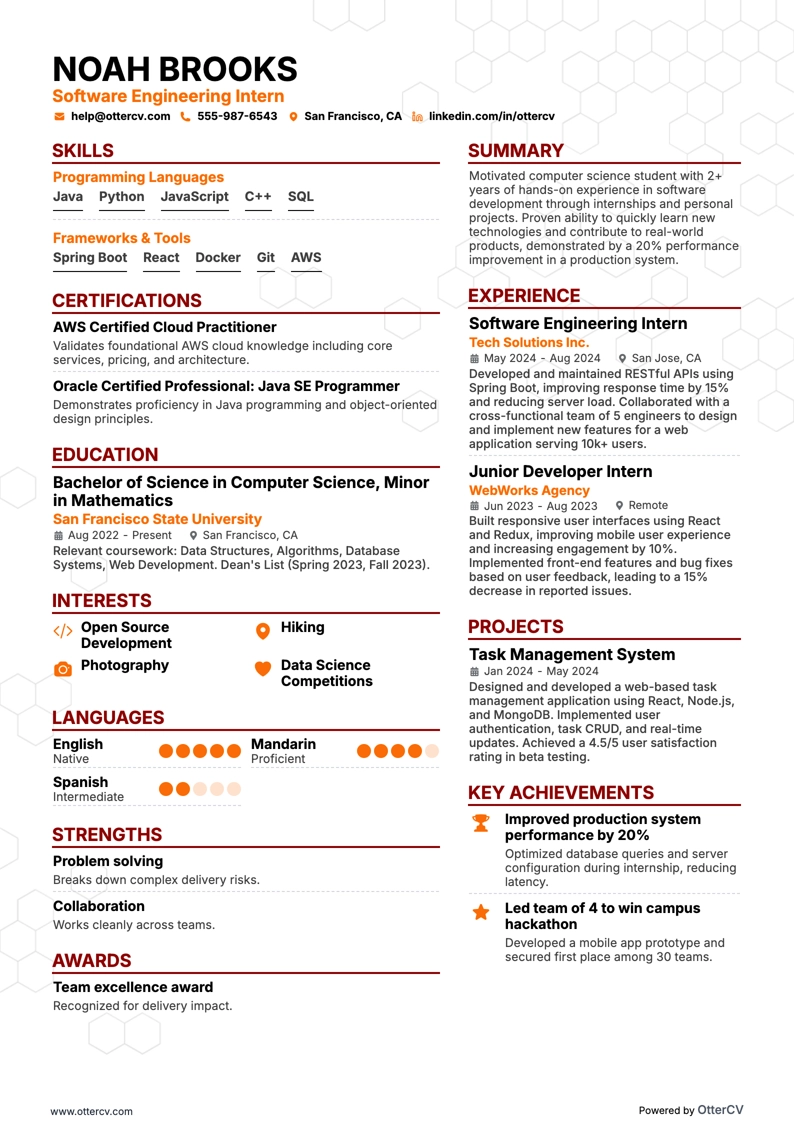
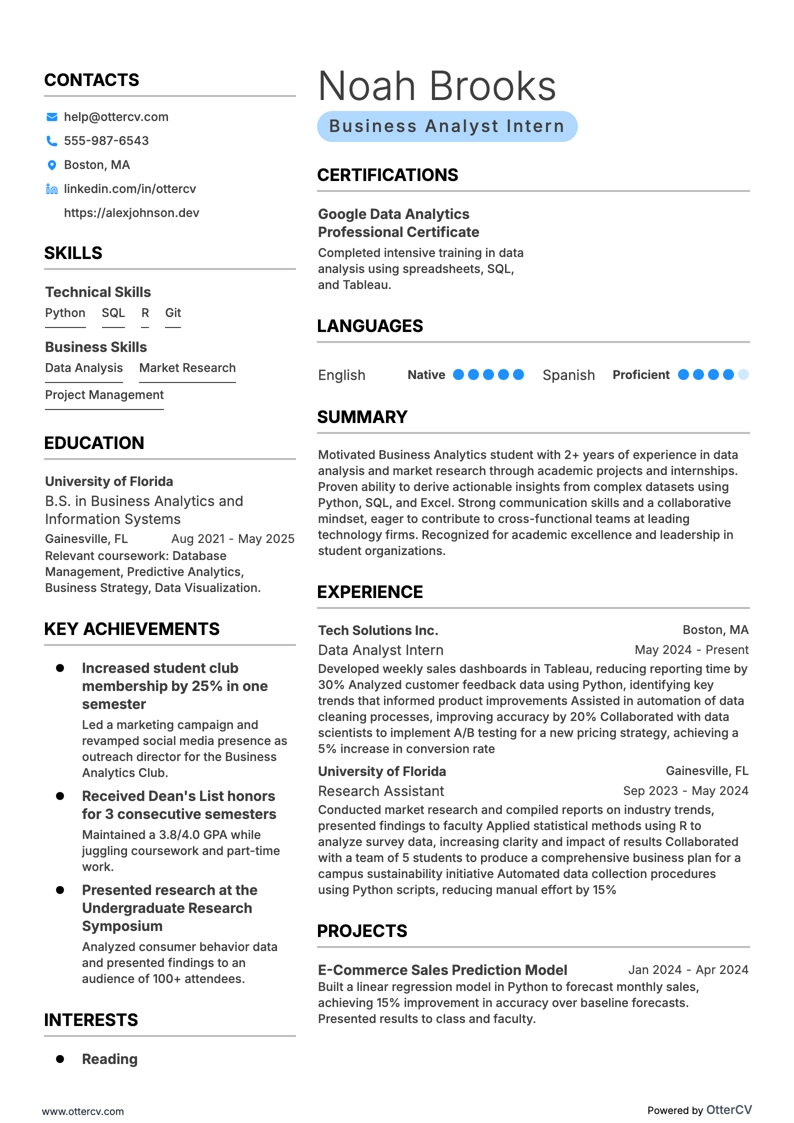
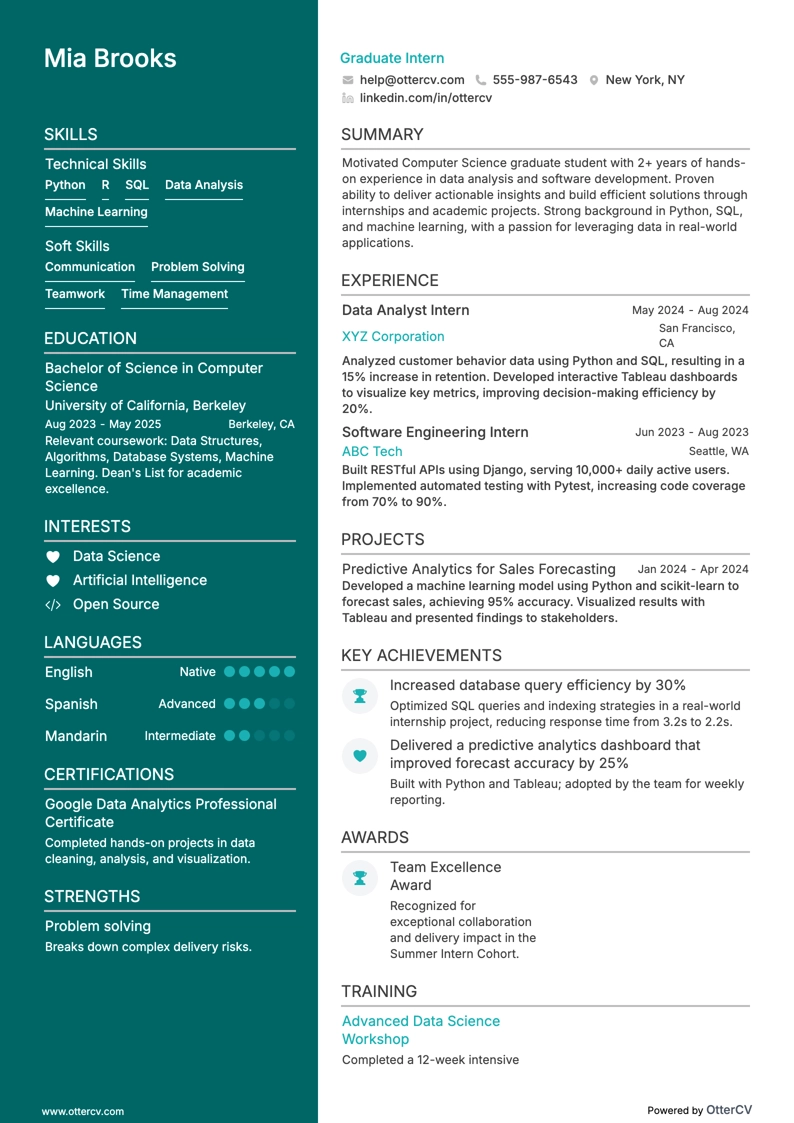
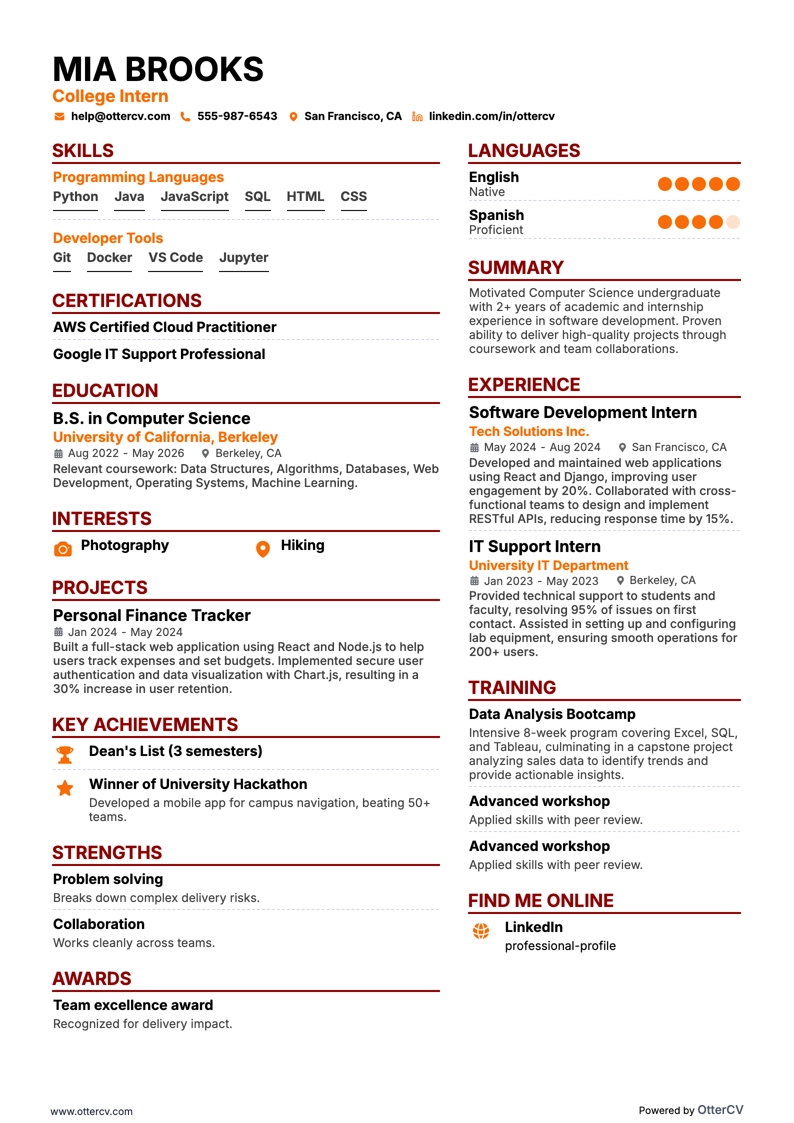
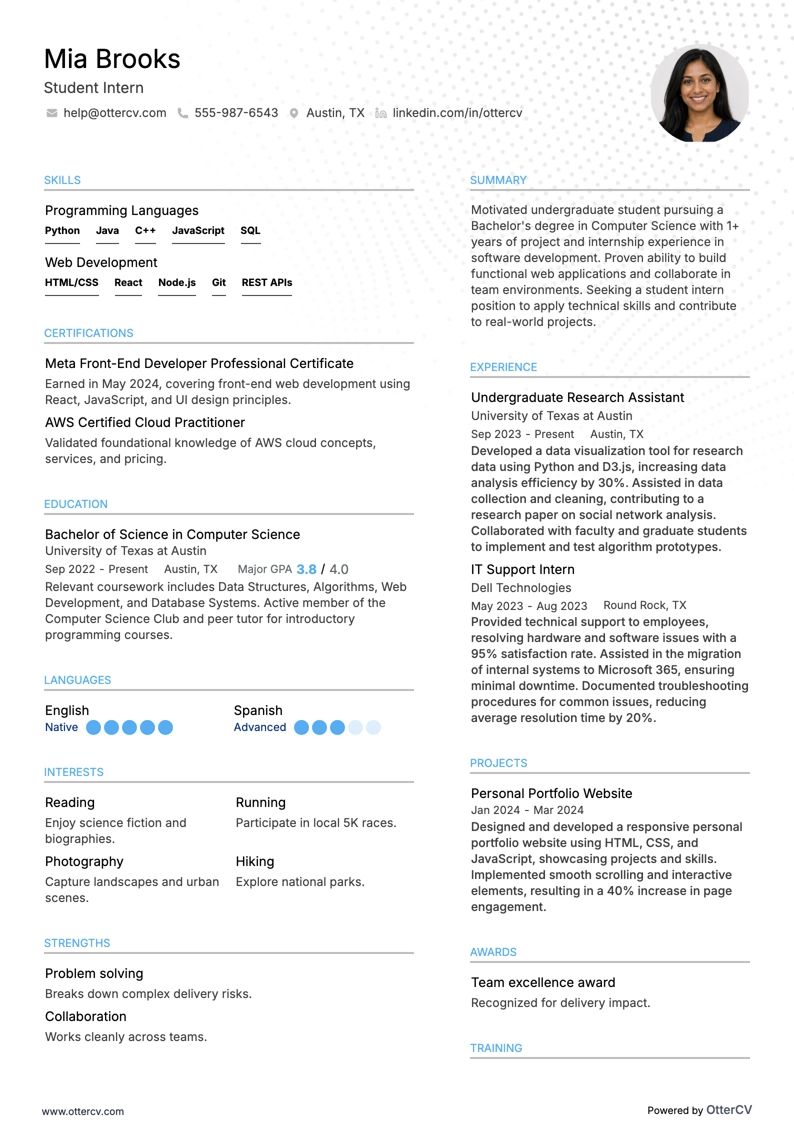
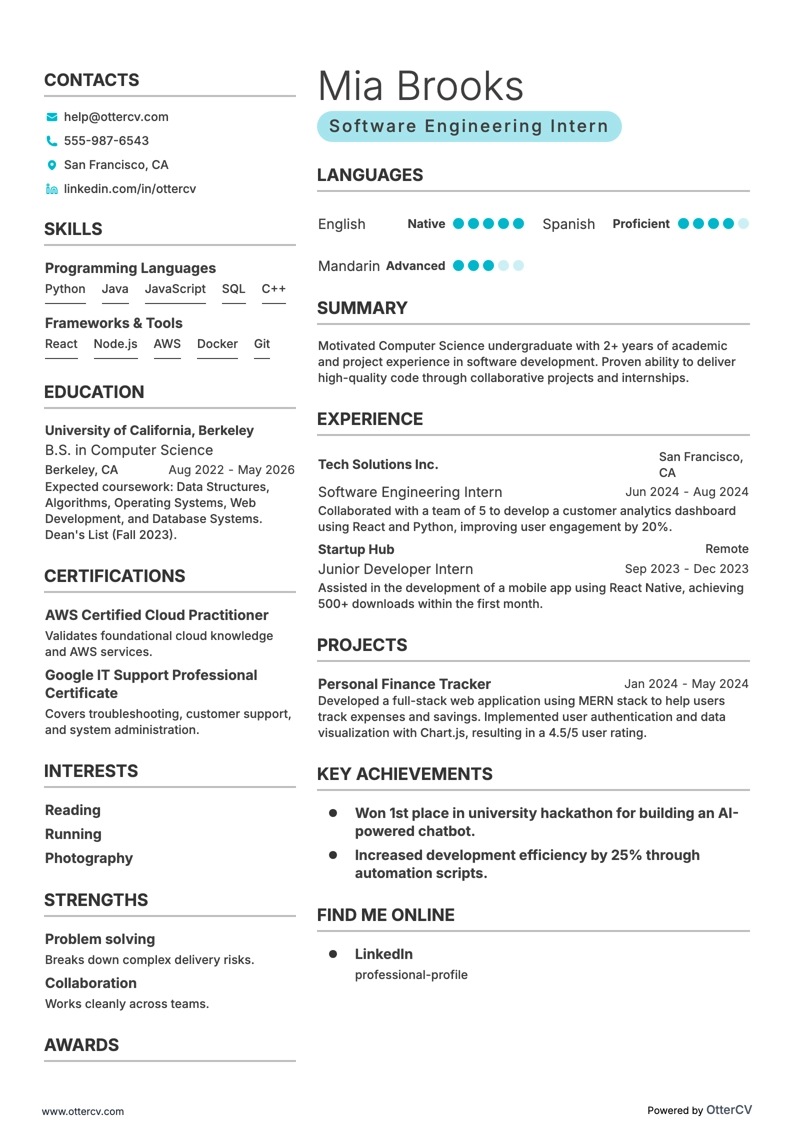
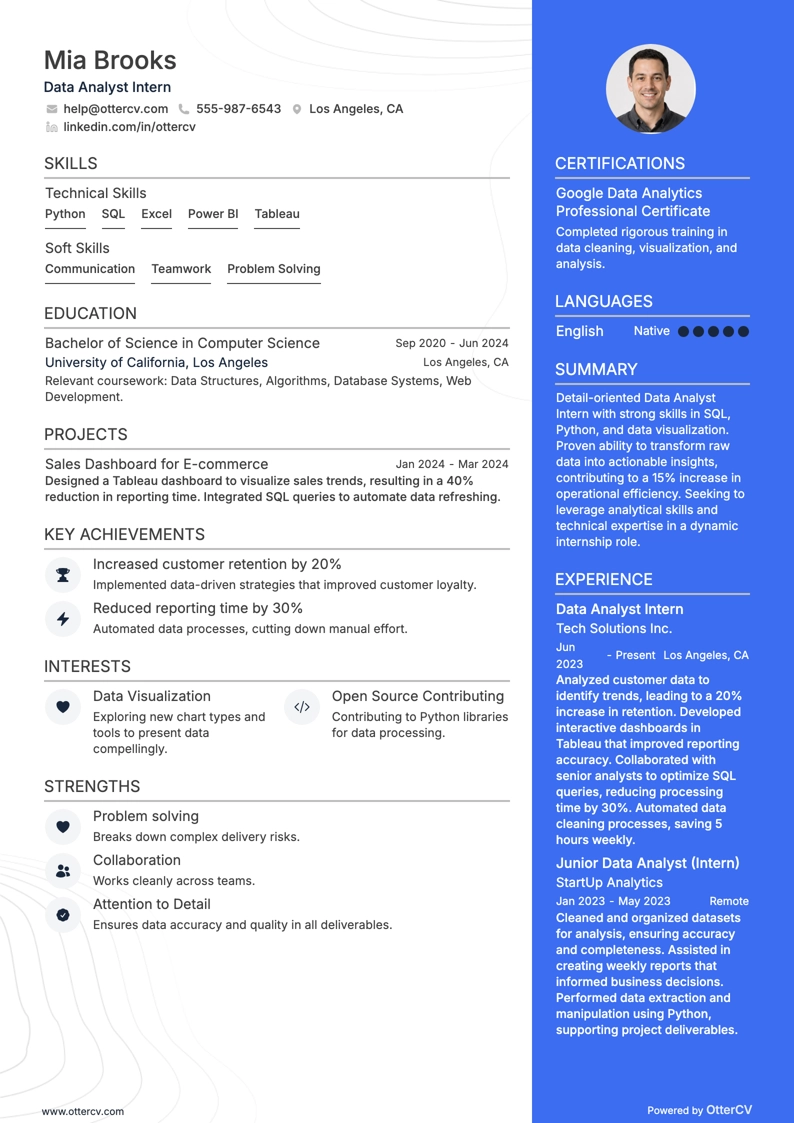
Fall Intern full preview

15 Intern Resume Examples

OtterCV

Written by The OtterCV Team

Updated: 8/30/2025•8 min read

See all resume examples in this guide, or generate your own resume example with your personalized prompt

Fall Intern resume example

Fall Intern

Spring Intern resume example

Spring Intern

Graduate Intern resume example

Graduate Intern

College Intern resume example

College Intern

Student Intern resume example

Student Intern

Summer Intern resume example

Summer Intern

Intern resume example

Intern

“Internships help you build your resume and gain valuable on-the-job skills,” says a Glassdoor article. That may be obvious, but landing an internship still requires a resume that looks polished and professional.

Unlike a standard student resume, which may include all kinds of jobs, an intern resume has a more focused purpose. It should highlight the skills and experiences that match the internship you want. Every section should support your career goals and show employers why you are a strong fit.

The key to a standout intern resume is customization. In this guide, we’ll show you how to tailor your resume to reflect who you are and who you want to become professionally. You’ll also learn:

  • What resume format to use to draw recruiters’ attention to your top skills and achievements.
  • How to describe your previous experience and support it with concrete examples of success.
  • What transferable skills are and why they matter on an intern resume.
  • How to create an effective education section that shows HR you’re serious about your career path.
  • How to personalize your resume further with additional sections and an intern cover letter for maximum impact.

Before we dive in, check out these resume guides for specific internship roles:

Resume format for interns

Remember, resume layouts can vary by country—for example, a Canadian resume format could look different.

According to NACE, paid interns are nearly twice as likely to secure employment after graduation as non-interns. In addition, 68% of these students receive job offers from the same organizations where they interned. That makes it especially important to make a strong impression from the start.

A well-crafted resume can jump-start your career in your chosen field and may even help you get into your preferred company. To do that, you need to show both HR staff and applicant tracking systems (ATS) that you are motivated and hard-working.

Almost 90% of organizations use ATS to scan your resume for keywords. This helps them quickly assess whether you understood the job requirements by counting how often keywords from the job posting appear on your resume.

That is why your intern resume should be tailored to each specific role you apply for. The first thing to focus on is the resume format.

The very first thing I tell every intern on the first day is that their internship exists solely on their resume…

—Jay Samit, Serial Entrepreneur

Resume design tips

There are three common resume formats:

  • Reverse-chronological resume: the most common format, listing your work experience from most recent to oldest. It works well if you have relevant experience, internships, part-time jobs, or volunteer work related to your field of study. If you are just starting out, though, this format can draw attention to your limited experience.
  • Functional resume: focuses on your skills and experience instead of presenting your work history in reverse chronological order. It is a strong option for interns who do not have much work experience but do have relevant skills. You can organize it by skills or projects and highlight contributions or achievements under each one.
  • Combination (hybrid) resume: combines elements of both reverse-chronological and functional resumes. It lets you place relevant skills near the top of the resume and follow them with your work history.

For most interns, the hybrid or functional resume often works best, especially if you do not yet have solid previous experience. These formats help you emphasize skills, academic projects, and volunteer work that are relevant to the job you want.

  • Font: Use professional fonts such as Rubik, Lato, or Volkhov in size 10–12 p. Anything smaller can be hard to read. In some industries, traditional fonts like Arial and Times New Roman may be preferred. They also will not affect ATS scanning the way some decorative custom fonts can.
  • Margins: Good readability also depends on your resume margins. Keep them between 0.5 and 1 inch on each side.
  • Length: The recommended resume length for interns is one page.
  • Header: Include your name, phone number, a professional email address with your real name, and a link to your LinkedIn profile. If you are applying for a creative role, consider adding a link to your portfolio to show your skills. However, think carefully before adding a photo to your resume, as it is frowned upon in some US states and even illegal.
  • Resume template: Choose a clean, traditional template. Single-column resumes are flexible across industries, especially law, accounting, finance, and engineering. They can also fit more text without looking cluttered.
  • File formatting: Save your resume as a PDF to preserve formatting unless the job listing says otherwise. Use a professional file name, such as FirstNameLastNameintern_Resume.pdf.
  • Proofread: If you are not confident in your spelling or grammar, use our AI-powered resume checker to make sure your resume is error-free.

Next, it’s time to decide which resume sections you’ll need on your internship resume.

The top sections on an internship resume

  • An education section that outlines your academic background and relevant coursework.
  • A strong skills section that shows your job-relevant abilities.
  • Previous experience that highlights practical industry exposure or interest.
  • An objective statement at the top of your resume that serves as a professional pitch.
  • Projects and achievements that showcase your applied knowledge and results.

Include the following information in these sections to create a resume that is both easy to read and engaging.

What recruiters want to see on a resume for an internship

  • Relevant educational background that matches the job requirements.
  • Internship or part-time experience that demonstrates practical skills.
  • Extracurricular activities that show teamwork and leadership.
  • Technical skills that fit the industry or role.
  • Academic projects related to the job that show real-world application.

Think of this as the basic framework of your resume: a well-planned document with keywords placed strategically. The next step is to optimize the content so it has a better chance of passing the ATS.

How to write an intern resume experience section

Many interns feel overwhelmed at this stage. How do you build an experience section when you have so little directly relevant experience? You may have spent a summer scanning items at Target, but can that really help if you want an internship in Google’s BOLD program?

Yes, it can.

Recruiters know interns usually have little to no experience. They do not expect a list of every table you have waited on over the past few years. What they do want is a clear overview of the transferable skills you can bring to their organization. They want to understand how you made an impact in previous roles, whether paid or volunteer, and how that experience can support your next career move.

Now, let’s return to the Target cashier aiming for a Google internship and look at this intern’s experience section.

Professional Experience

Cashier

Target

06/2023 - 08/2023 | San Francisco, CA

  • Handled daily financial transactions at the checkout.
  • Provided customer service and resolved inquiries.
  • Promoted store loyalty programs to customers.
  • Organized the front-end area to streamline the checkout process.
WRONG

This experience entry misses the mark.

  • It lacks specificity: The bullet points are too general and do not highlight clear skills or achievements that could translate into value for a role at Google. They also do not include quantified outcomes that show the applicant’s impact or effectiveness.
  • It is not clearly relevant to the role: The tasks described are typical for a cashier position, but they are not connected to the skills and experience expected in a tech-focused internship like Google’s BOLD program. Skills such as technology awareness, innovation, project management, and analytical thinking would be more relevant.
  • There is no description section: That space could be used to frame routine responsibilities in a way that emphasizes transferable skills, such as learning quickly, handling complex transactions, or working well under pressure.
  • The presentation is too generic: Overall, the entry is straightforward but lacks a strategic angle that aligns it with the goals and values of a tech company like Google. It does not make a compelling case for why this experience matters or how it prepares the candidate for an internship in a fast-moving, innovative environment.

The goal is not to lie about your skills or responsibilities, but to present them in a thoughtful way that better matches the requirements of the target role. See how this can be done below.

Professional Experience

Cashier

Target

06/2023 - 08/2023 | San Francisco, CA

Managed financial transactions and customer service in a high-traffic retail store.

  • Processed over 1,000 transactions per week with a 99.5% accuracy rate, ensuring reliable financial handling.
  • Assisted approximately 150 customers daily by providing information and resolving issues to improve customer satisfaction.
  • Contributed to a 10% increase in in-store loyalty card sign-ups by clearly promoting customer benefits.
  • Implemented a new organization system for the front-end area, reducing clutter and improving checkout efficiency.
RIGHT

This revised version checks the following boxes:

  • Quantified achievements: The bullets include specific metrics such as "processed over 1,000 transactions per week with a 99.5% accuracy rate." These results show the applicant's direct impact on business operations and reflect strong work ethic and precision.
  • Demonstrated skills: Assisting approximately 150 customers daily shows the cashier's ability to handle a high volume of customer interactions while demonstrating communication and problem-solving skills, both of which are important in roles at Google where user experience matters.
  • Operational improvements: Mentioning the implementation of a new organization system that improved the checkout process shows initiative and an ability to make changes that increase efficiency. This aligns with Google's culture of innovation and optimization.
  • Relevance to teamwork and adaptability: Managing financial transactions and customer service in a high-traffic retail environment demonstrates the ability to work effectively in fast-paced, dynamic settings. That experience translates well to the often high-pressure environments at Google.
  • Professional presentation: Starting with a clear description shows the candidate can present information professionally. The effective use of detail and the strategic placement of quantified data make the section more compelling, which is important for capturing recruiters' attention.

Way more impressive, right? These qualities make the experience section more relevant and show that even non-tech experience can be valuable when it highlights transferable skills and individual impact.

How to quantify impact on your resume

The right numbers and results depend on the job you’re applying for. Here are a few ideas to help you measure your successes from past academic and work experience.

  • Highlight the percentage increase in efficiency from a process improvement you implemented to show effectiveness and innovation.
  • Document the exact number of users who benefited from a software tool or application you developed to demonstrate your impact on user engagement.
  • Quantify the reduction in expenses from cost-cutting measures you introduced to emphasize your contribution to financial health.
  • Mention the increase in follow-up rates from your communication strategies to show your ability to improve customer or client retention.
  • Describe the growth in audience size from digital marketing campaigns you managed to reflect your skill in expanding market reach.
  • Specify the volume of data you analyzed or managed to underscore your analytical and detail-oriented abilities.
  • Report the number of events or projects you coordinated to showcase your organizational skills and ability to multitask effectively.
  • Detail the increase in positive feedback or ratings on projects or services you worked on to highlight your commitment to quality and customer satisfaction.

These are only examples. Use them to brainstorm your own contributions, and be specific when describing them.

According to an article on smallbizgenious.net, just over half of students who complete internships take part in more than one. Among them, 27% complete two internships, 13% complete three, and 2% undertake six or more. Imagine those resumes!

How do I write an internship resume with no work experience

The simplest answer is to build a targeted resume. That means tailoring your resume to the internship you want, with careful attention to keywords, language, and a professional profile. Even if you lack formal work experience, your educational background and coursework can still support your application.

You also have the advantage of applying without pre-existing expectations, especially if you are still studying at high-school. The usual age for American students starting an internship is 17.

If you want to strengthen your intern resume, consider adding these sections:

  • Projects and coursework achievements: Include academic or personal projects that relate to the role. Explain what the project involved, your role, the skills you used, and the outcome or what you learned.
  • Extracurricular activities: Add involvement in clubs, sports, student government, or volunteer work, especially if you held a leadership position or the activity is relevant to the internship.
  • Awards and honors: Mention any academic or extracurricular awards and why you received them.
  • Professional affiliations: List any clubs or organizations related to your field to show dedication and industry involvement.
  • Certifications: Include any relevant certifications that show commitment to the field or proficiency in specific areas.

The key is to provide evidence for every claim you make on your resume. Don’t write “edited the college newspaper.” Instead, write “Managed the editorial process for the college newspaper, enhancing content quality and increasing readership by 20%.” That is how you help recruiters look past your lack of experience.

The skills section can also help compensate for limited work history.

How to list your relevant intern skills

You have likely built many skills through your education. On your internship resume, highlight both technical skills and soft skills you have developed along the way.

Hard skills are the technical abilities that can help you stand out. You may have gained them through coursework or certifications, such as coding languages, cybersecurity knowledge, or customer relationship management software.

Here are some general tips for listing hard skills on your resume:

  • List all job-relevant skills in a dedicated section.
  • If you mention them elsewhere, quantify them when possible, for example: “Increased sales by 15% using a new CRM software,”.
  • Don’t exaggerate your abilities.
  • Use the job description to decide which skills to emphasize.

This last point is especially important for ATS scanners, which look for specific keywords, including skills.

Here are some tech skills you may have learned during your studies that can be useful when applying for an internship.

The best hard skills for an internship resume

  • Data analysis is a valuable hard skill for an internship resume.
  • Statistical software, such as SPSS and SAS, can strengthen your application.
  • Programming skills, including Python and Java, are strong additions.
  • Database management with SQL is a useful technical skill to include.
  • Web development skills, including HTML, CSS, and JavaScript, are relevant for many internships.
  • Project management software, such as Jira and Trello, can show practical workflow experience.
  • Graphic design tools like Adobe Photoshop and Illustrator are useful hard skills.
  • CAD software, including AutoCAD and SolidWorks, is important for technical and engineering roles.
  • Financial modeling is a strong skill for finance-related internships.
  • Cloud computing platforms such as AWS and Azure can add technical depth.
  • Machine learning tools, including TensorFlow and PyTorch, are valuable for data and AI roles.
  • Cybersecurity fundamentals can demonstrate core technical knowledge.
  • Mobile app development with Swift or Android Studio is worth highlighting.
  • Network configuration is a practical technical skill to list.
  • Blockchain technology can be relevant for specialized internship roles.
  • Robotics is a strong hard skill for engineering and automation fields.
  • Biotechnology can be relevant for science and research internships.
  • Electronic circuit design is useful for hardware and engineering positions.
  • Video editing software, such as Final Cut Pro and Adobe Premiere, can support creative roles.
  • Spreadsheet proficiency in Excel and Google Sheets is useful across many internships.

Soft skills are people skills, and they can be harder to measure than hard skills. Even so, they are just as important for applicants.

Here are some tips for including soft skills on a resume:

  • Avoid generic wording such as “Good communication skills.”
  • Tailor your soft skills to the job you are applying for.
  • Use action verbs when describing your soft skills. For example, instead of simply listing “critical thinking,” support it with a measurable result: “Applied critical thinking to solve complex problems and make informed decisions, reducing project costs by 15%.”
  • Use language and phrases that align with the company’s values.
  • Use your cover letter to highlight your soft skills with concrete examples, and be ready to elaborate on each one in an interview.

If a company emphasizes an inclusive culture, that is something you can reflect on your resume. For example, if you led a university club and created initiatives to make sure no one felt out of place, mention that experience.

Here’s a pool of interpersonal skills you can consider including in your intern resume.

The best soft skills for an internship resume

  • Communication helps you express ideas clearly.
  • Teamwork shows you can work well with others.
  • Adaptability helps you adjust to new tasks and environments.
  • Problem-solving shows you can find practical solutions.
  • Leadership reflects your ability to guide and support others.
  • Creativity helps you bring fresh ideas to your work.
  • Time management shows you can handle deadlines effectively.
  • Conflict resolution demonstrates that you can handle disagreements professionally.
  • Critical thinking shows you can evaluate information carefully.
  • Emotional intelligence helps you understand and respond to others well.
  • Attention to detail shows that you work accurately and carefully.
  • Initiative reflects your willingness to take action without being asked.
  • Stress management shows you can stay productive under pressure.
  • Interpersonal skills help you build strong working relationships.
  • Organizational skills show you can keep tasks and priorities in order.
  • Persuasion helps you influence others effectively.
  • Negotiation shows you can reach balanced agreements.
  • Patience helps you stay calm and consistent.
  • Empathy shows that you can understand other people’s perspectives.
  • Active listening helps you understand instructions and feedback clearly.

Now, let’s focus on the most impactful part of an intern’s resume: the education section.

How to list education and certifications on your resume

Because you’re new to your field, much of your experience likely comes from educational settings. Highlight that by including projects you’ve worked on, theses you’ve written, and other relevant academic experience on your resume.

Here’s what to include in your education section:

  • Degree title
  • University, college, or other institution
  • Location (optional)
  • Years attended
  • Your GPA (if above 3.5)
  • Honors, Dean’s list, and awards (if applicable)
  • Student accomplishments

Education

Bachelor of Science in Marketing
University of California, Berkeley
08/2020 - Expected graduation May 2024
Berkeley, CA
GPA: 3.8 / 4.0

  • Recipient of the Dean's List for four consecutive semesters.
  • Completed key courses: Consumer Behavior, Digital Marketing Analytics, Strategic Brand Management, Market Research Techniques
RIGHT

This person has a strong chance of securing a paid internship across many organizations and industries, including advertising, media networks, retail chains, tech companies, and financial services.

Next, consider strengthening your resume with relevant certifications. Employers value them across professions, often even more than formal education, because they demonstrate your career interests. Even if you have just graduated from college—or are still enrolled—there are many free certification courses available to explore.

The next section of this guide explains how to craft your resume objective to show relevance and motivation.

How to write your intern resume objective

Another essential part of an intern resume is the objective statement at the top of the page, just below the header. While resume summaries provide an overview of a candidate’s career, objectives focus on your unique value proposition. You’ll need a summary once you have more than 3 years of work experience.

The other key difference is length. Objective statements should be no longer than 3 sentences, which helps entry-level candidates and interns stay concise and clear. Here are the simple steps to write an effective objective:

What to Include

  • Start with a sentence that presents your strongest quality or professional goal.
  • Follow with a sentence highlighting the skills and qualifications most relevant to the position.
  • End with a strong closing sentence that shows you and the employer share the same values.

Objective

Dedicated law student eager to apply analytical and research skills in the U.S. Department of State Student Internship Program. Committed to supporting U.S. foreign policy by drafting diplomatic communications and facilitating international meetings. Aiming to strengthen U.S. diplomatic efforts globally through detail-oriented contributions and effective communication.

RIGHT

Why This Objective Works Well for an Intern

  • Direct and specific: The objective clearly explains what the intern wants to do and which skills they plan to use, showing they understand the role and how they can contribute.
  • Highlights relevant skills: It emphasizes analytical and research skills, which are important in a foreign affairs environment.
  • Professional tone: The wording is professional yet approachable, which suits a high-level internship where effective communication matters.

Additional sections for an intern’s resume

If your resume is still a work in progress and you have extra space, adding other resume sections can make it more engaging. Echocv’s resume builder lets you rearrange existing sections and add new ones with the click of a button.

Consider including these sections if they are relevant to the job you’re applying for:

  • Volunteer experience: If you’ve done volunteer work related to your field or that demonstrates leadership and initiative, include it. It’s a strong way to show dedication and values.
  • Hobbies or interests: For internships especially, involvement outside academics can highlight teamwork, leadership, and time management skills.

How to put a projects section on a resume

Academic or personal projects are a great way to show how you apply your knowledge and skills in real-world situations. More experienced candidates often place projects under education, but if your work experience is limited, creating a separate projects section can help shift the focus. Here’s how:

  • Mention the project title
  • Add your role
  • Include project duration dates and, optionally, location
  • Write up to 3 bullet points describing your contributions

Academic Projects

Sustainable and Green Finance Project

02/2021 - 11/2021 | University of California, Berkeley

Developed a comprehensive project assessing the financial viability and impact of investments in sustainable and green technologies, with a focus on how ESG criteria influence investment decisions and how green finance supports environmental sustainability.

  • Analyzed the impact of environmental, social, and governance (ESG) criteria on investment decisions.
  • Conducted case studies on the financial viability of sustainable business practices within the technology sector.
  • Developed a framework to evaluate green bonds and sustainable investment funds.
RIGHT

Key takeaways

  • Tailor your resume: Adapt it to each internship by using keywords from the job description and emphasizing the most relevant experience and skills.

  • Choose the right format: Depending on your background, use a reverse chronological, functional, or hybrid format to present your skills and relevant work or academic projects effectively.

  • Highlight key skills and achievements: Use specific examples to show your strengths, and quantify your contributions whenever possible.

  • Optimize for ATS: Make your resume ATS-friendly by including job-listing keywords and using a simple, professional format.

  • List education and certifications: Clearly include your educational background, relevant coursework, and any certifications that strengthen your qualifications for the internship.

  • Add an objective statement: A strong objective at the top of your resume can summarize your goals and show enthusiasm for the position.

Intern resume examples

Explore additional Intern resume samples and guides and see what works for your level of experience or role.

By Role

Fall Intern

Fall Intern resume preview

Spring Intern

Spring Intern resume preview

Graduate Intern

Graduate Intern resume preview

College Intern

College Intern resume preview

Student Intern

Student Intern resume preview

Summer Intern

Summer Intern resume preview

Intern

Intern resume preview