Lead Industrial Engineer full preview

21 Industrial Engineer Resume Examples

OtterCV

Written by The OtterCV Team

Updated: 8/16/2024•8 min read

See all resume examples in this guide, or generate your own resume example with your personalized prompt

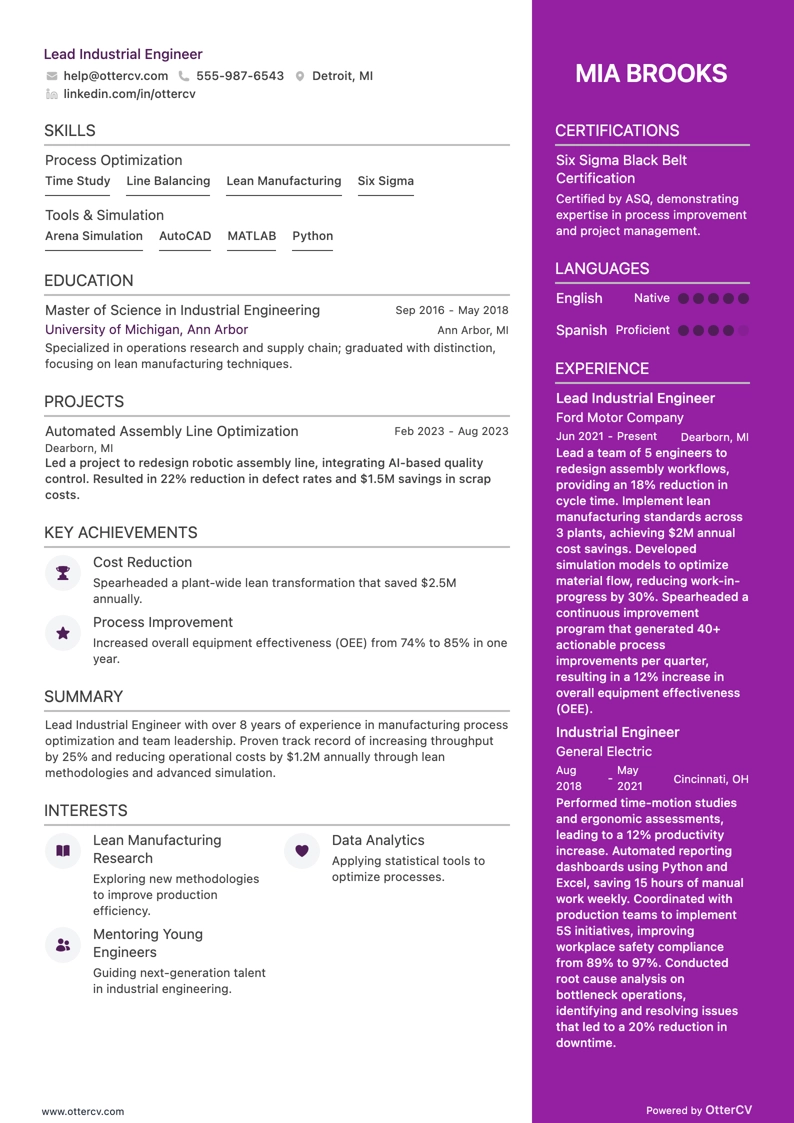
Lead Industrial Engineer resume example

Lead Industrial Engineer

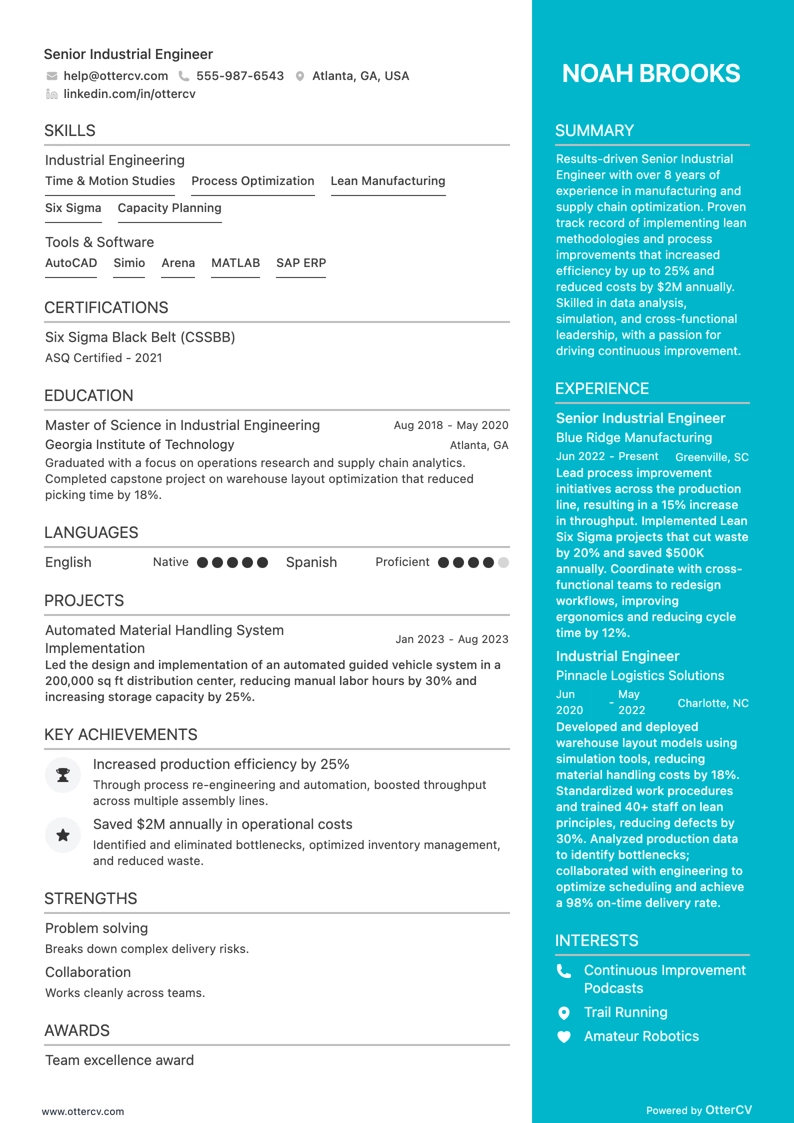
Senior Industrial Engineer resume example

Senior Industrial Engineer

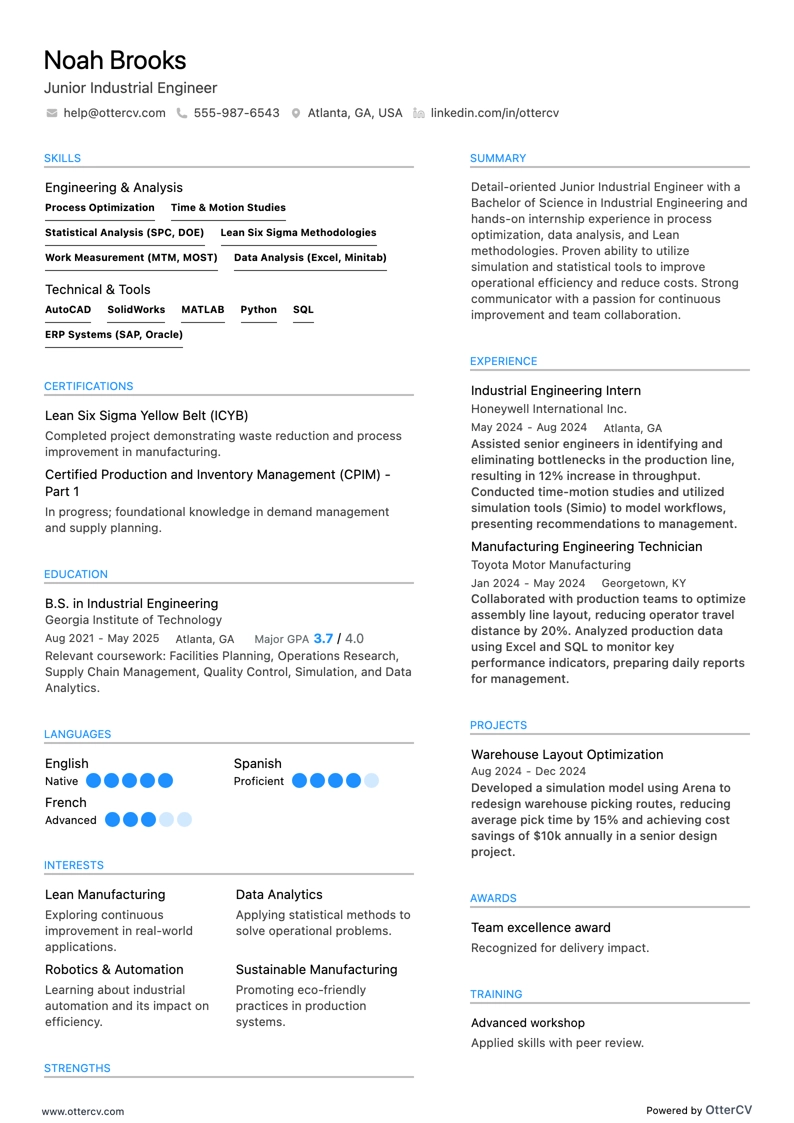
Junior Industrial Engineer resume example

Junior Industrial Engineer

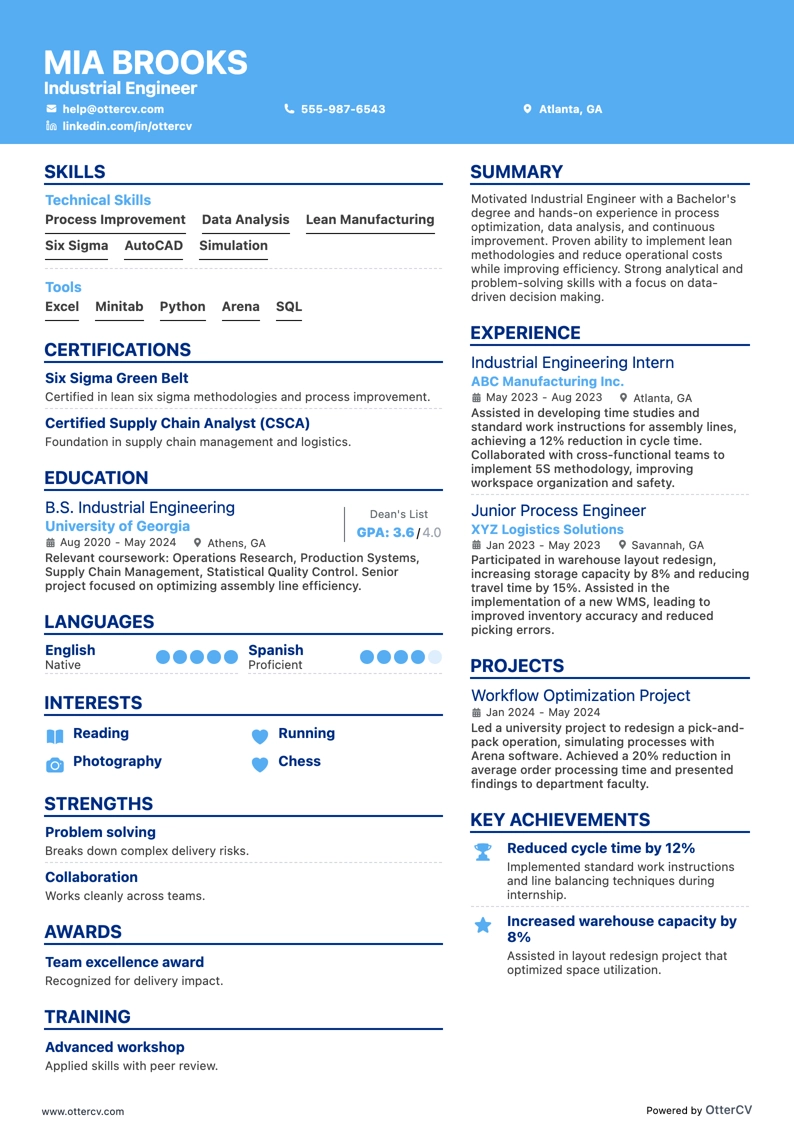
Entry-Level Industrial Engineer resume example

Entry-Level Industrial Engineer

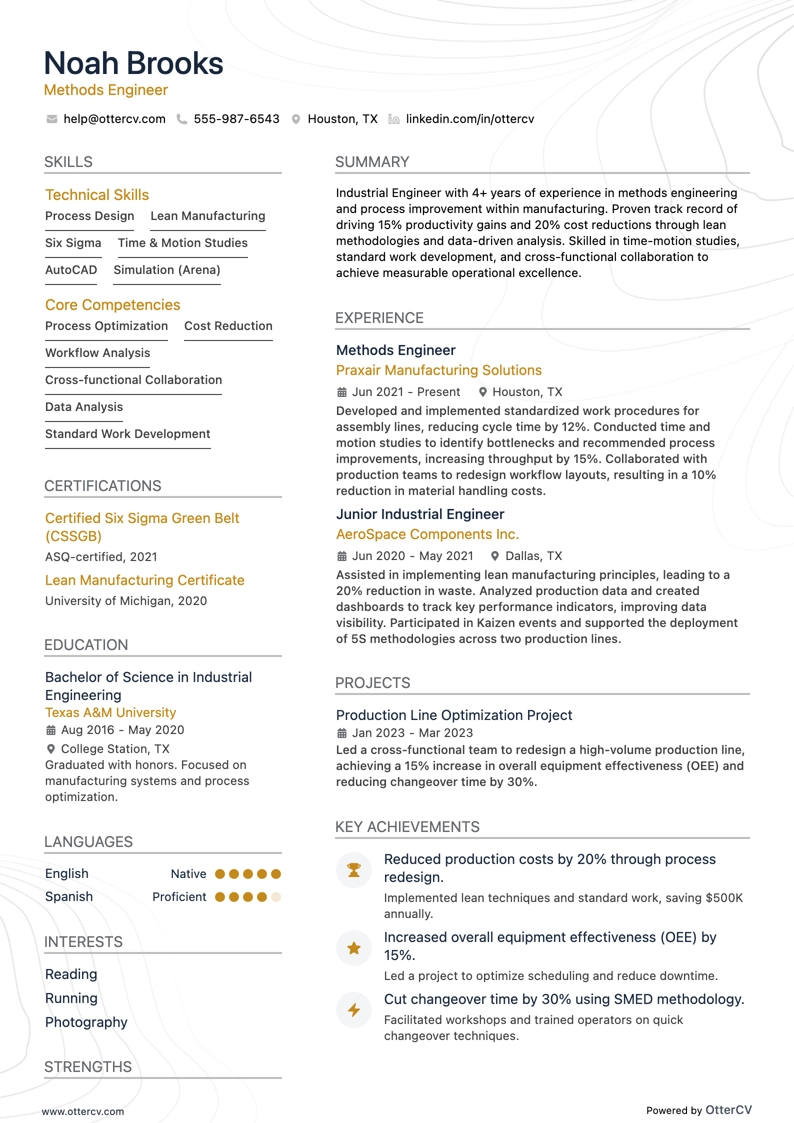
Methods Engineer resume example

Methods Engineer

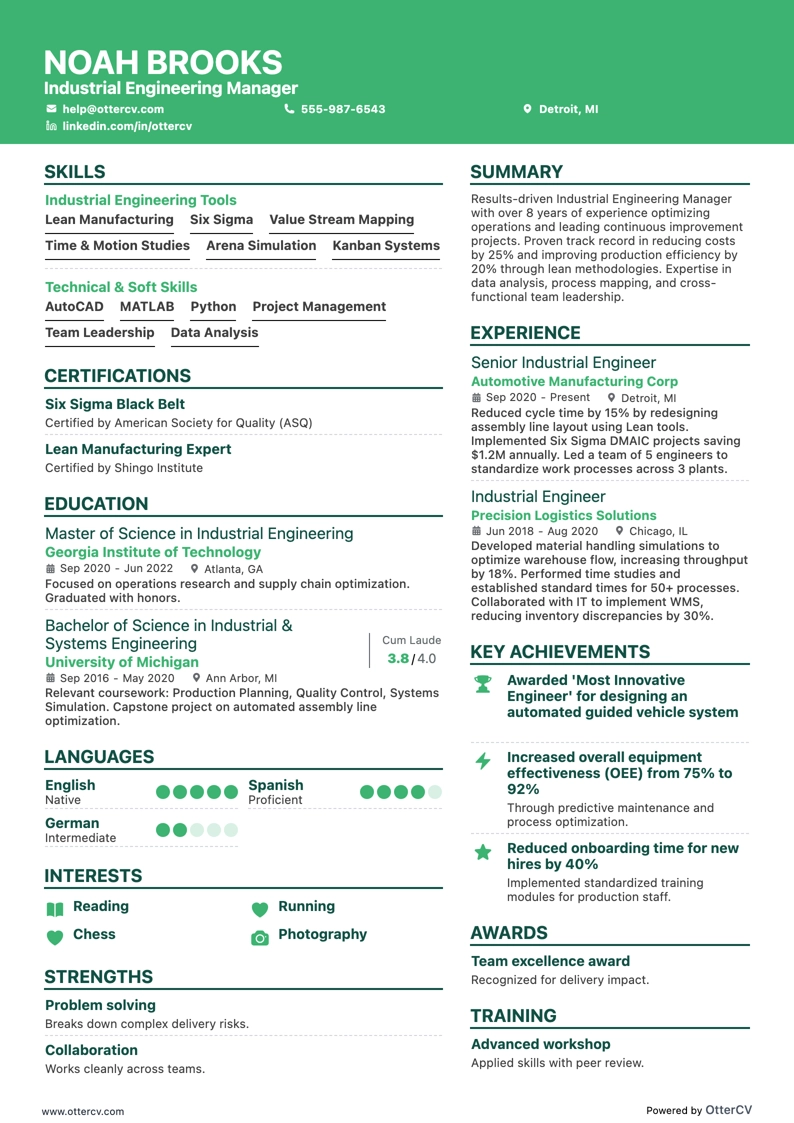
Industrial Engineering Manager resume example

Industrial Engineering Manager

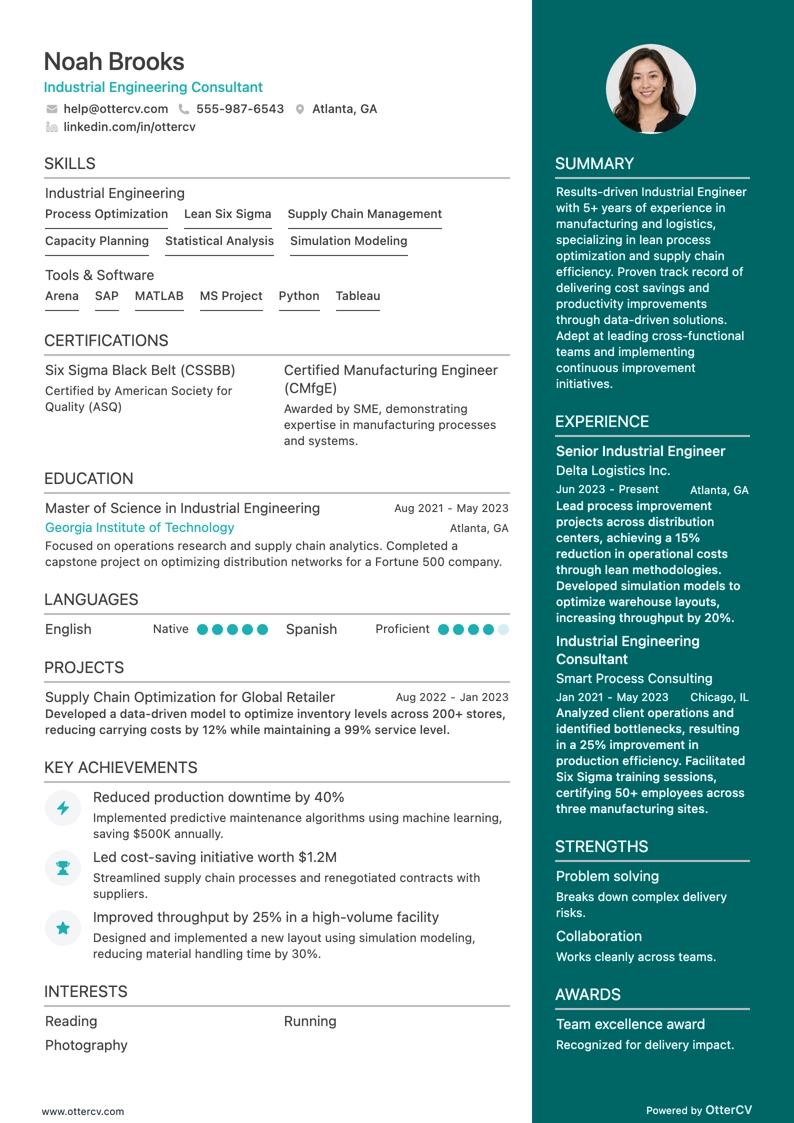
Industrial Engineering Consultant resume example

Industrial Engineering Consultant

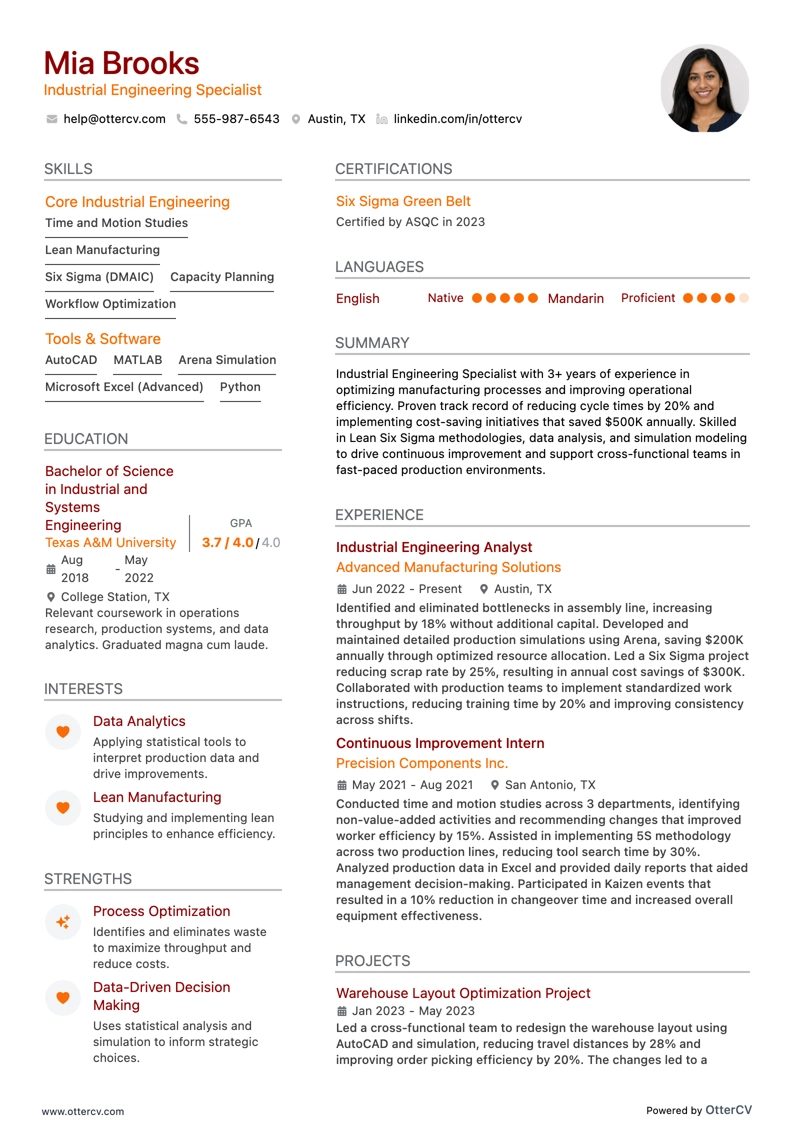
Industrial Engineering Specialist resume example

Industrial Engineering Specialist

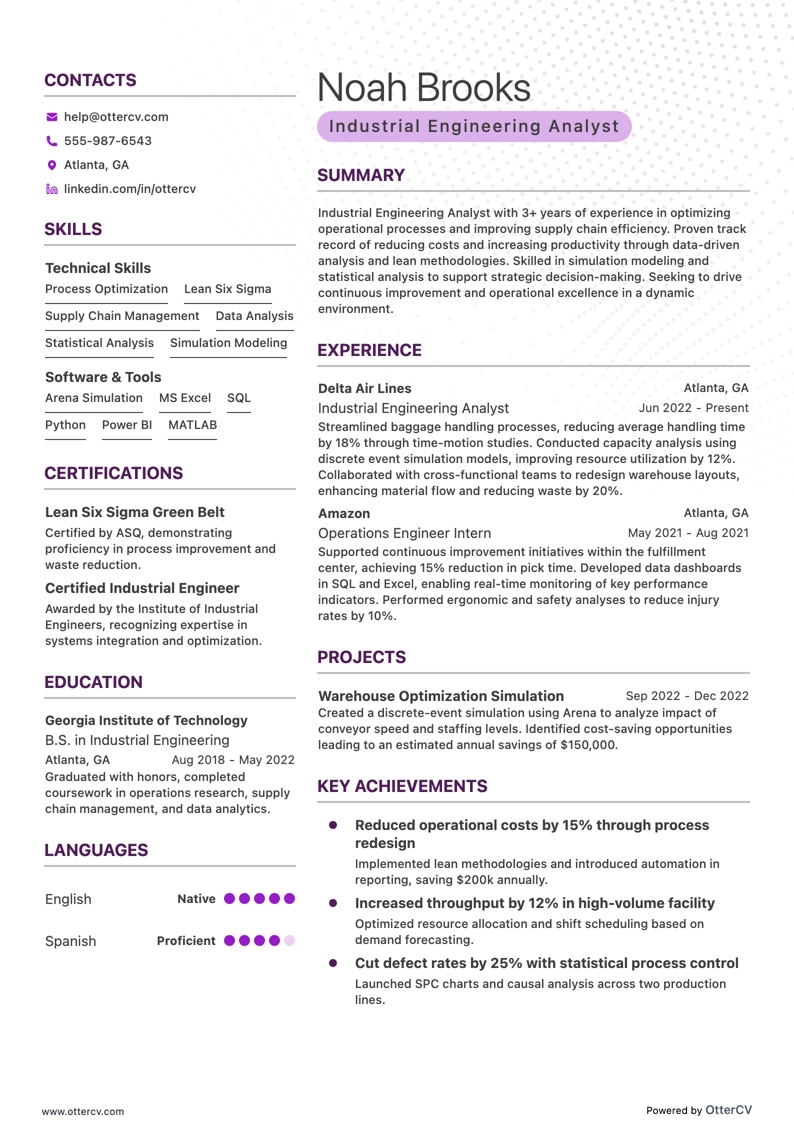
Industrial Engineering Analyst resume example

Industrial Engineering Analyst

Mechanical and electrical engineers may joke about industrial engineering, but when the production floor falls into chaos, industrial engineers are the ones people call.

As an industrial engineer, you solve problems, organize workflows, reduce waste, increase efficiency, and improve outcomes.

Your skills are valuable across many industries, including manufacturing, hospital management, and IT development.

Successful industrial engineers often advance within their organizations and can eventually reach C-level positions.

Here’s one inspiring example: Mike Duke, former Wal-Mart CEO, graduated in industrial engineering from Georgia-Tech.

But building an empire starts with a great industrial engineering resume.

In this article, you will learn how to apply industrial engineering skills and principles to your resume so it becomes more effective and impactful for recruiters.

Learning Notes From Our Industrial Engineer Resume Guide

  • Review 9 industrial engineer resume samples and extract best practices for your own resume.
  • Learn how to fit your resume onto a single page to increase the chances of it being read.
  • Reduce and optimize your wording by removing unnecessary fluff.
  • Write an impactful resume header, summary, and work experience section.
  • Analyze the job description and identify which keywords to include in your industrial engineer resume.
  • Understand which skills, technologies, and management methods hiring managers prefer.
  • Position your education and certificates effectively on your industrial engineer resume.

How to Write an Industrial Engineer Resume

Treat your industrial engineer resume like a work project. To improve the end product, start by analyzing the process and defining the requirements.

Recruiters often review dozens or even hundreds of industrial engineering resumes, and you may have only 3 - 6 seconds to communicate the most important information before your resume is sorted into one pile or another.

You also need to include 100% of the required skills and experience. Automated HR software scans industrial engineering resumes and filters out the ones that do not match the job profile.

Spelling mistakes, vague titles, unnecessary details, poor formatting, and a lack of focus can quickly send your resume to the shredder. Be sure to avoid common resume mistakes.

Finally, your industrial engineer resume should be convincing and compelling so that when the hiring manager reads it, they immediately see that you are the best candidate for the role.

A recruiter will pay attention to the following in your resume:

  • Evidence that you improved production processes and distribution systems.
  • Examples of solutions that made the company more efficient in production, resources, or packaging.
  • Your level of mechanical aptitude and fundamental understanding of physics.
  • Your ability to communicate opportunities and project benefits to higher management.
  • Soft skills such as creative problem solving, critical thinking, communication, negotiation, and project management.

Although industrial engineering is an engineering role, the job relies heavily on soft skills in day-to-day work.

You still need technical expertise that matches the industry. For example, if you are applying to an automotive manufacturing plant, you should understand how cars work and what each subsystem does.

In practice, much of the role involves using soft skills to organize the manufacturing process, improve efficiency, and increase profit.

Your industrial engineering resume should show your problem-solving ability and the value you created for past employers.

Most important sections of an industrial engineer resume

  • Include a well-organized resume header with your name and contact details.
  • Add an impactful resume summary that highlights your experience, skills, and achievements.
  • Use a work experience section to show practical examples of the improvements and solutions you contributed at work.
  • Create a clear, concise skills section covering your technical and soft skills, tools, technologies, and management strategies.
  • Set aside space for your education and certifications, especially if you have completed your FE or PE exams.
  • Depending on your background, an awards and achievements section may also be worth adding.

Depending on your experience and past projects, you may want to organize your resume in a reverse-chronological or hybrid resume layout.

The reverse-chronological format lists your work experience and education in a standard timeline, followed by skills, achievements, and other sections.

The hybrid layout blends skills and work experience so the information most relevant to the job offer appears near the top of the resume.

What Does a Good Industrial Engineer Resume Header Look Like?

Whichever layout you choose, the resume header always comes first.

Recruiters may reject your application if they notice errors in your header or if key details are missing. That suggests a lack of attention to detail, which does not align with this profession.

Keep the header simple, and present your contact information in a clear, readable format.

Review a couple of industrial engineer resume samples below.

2 Industrial Engineer Resume Header Examples

Barbara Ramirez

Industrial Engineer

1-408-406-2436
Santa Clara

WRONG

At first glance, this header looks fine: name, title, and phone number. But where is the email? How will recruiters send you interview details?

It also misses the opportunity to make a stronger impression with relevant links and keywords in the title.

These errors may seem small, but when recruiters review your industrial engineering resume, the header is the first thing they see about you. In this case, it is not very impressive.

Fortunately, it only takes a little effort to fix. Let’s look at another resume header example.

What changed? The resume now includes an email address and a more specific location, making it easy for employers to contact this industrial engineer about an interview.

The title is also more detailed. It shows experience in the automotive industry, which suggests strong familiarity with cars and how they work.

There is also a website listed. It could be a personal portfolio, an engineering practice, or a consulting agency. Either way, having a personal page creates a positive impression and shows extra initiative.

How to Make Sure Your Industrial Engineer Resume Summary Creates an Impact

The header provides a solid introduction, but the resume summary section is what really reinforces your value.

A well-written summary can get recruiters interested and keep them engaged with your resume.

At the same time, it needs to be strategic, highlighting the skills and experience most relevant to the job opening.

That is a lot to accomplish in just a few lines, but it is often enough for recruiters to tell the difference between professionals and amateurs.

This becomes even clearer when you look at a few industrial engineering resume samples.

2 industrial engineer resume summary examples

Summary

I am an industrial engineer with experience in production lines, responsible for improving assembly lines by developing faster action sequences for assembling components.

WRONG

This summary conveys some information about the engineer, but it is still too vague.

  • What production lines did they work on?
  • Which industry were they in?
  • How did they improve the process?

Your industrial engineering resume should answer these questions, not leave them open.

Be specific and use only words that add value. Remove anything unnecessary.

Review the job posting and incorporate the skills and technologies that appear most prominently.

Summary

Senior industrial engineer with 5+ years of experience developing SOPs and conducting time studies for vehicle assembly lines to optimize productivity, quality, and cost. Worked directly with the Head of Production to define KPIs for each new production line and develop methods for collecting and analyzing data. Six Sigma certified.

RIGHT

This engineer clearly knows what they are doing. They open the summary by stating how much experience they have and the role they advanced to during their career.

“Worked directly with Head of Production” suggests that this level of contact with senior management was not typical for all colleagues, which indicates their work was trusted and important to the employer.

They also use strong industry keywords to keep the summary concise while still delivering essential information about their work.

  • SOP - Standard Operating Procedure
  • Time Studies - a common process used to analyze worker performance
  • KPI - Key Performance Indicators
  • Six Sigma - a widely successful methodology for improving productivity, quality, and cost in almost every kind of process

In just two sentences, they provide enough information for recruiters to quickly decide whether the applicant is worth investigating further.

Experience

Industrial Engineer

Kebel Shoe Company

04/2009 - 09/2013 | St. Louis, Missouri

  • Monitored worker performance on the assembly line.
  • Tracked production output, quality, and efficiency.
  • Worked with product engineers to improve manufacturing speed.
  • Submitted weekly and monthly reports to upper management.
WRONG

This job description feels generic and lacks substance. The bullet points add little beyond the basic responsibilities of an industrial engineer.

As written, this work experience raises more questions than it answers. Most employers would not pursue vague details like this unless the company were a Fortune 500 employer.

And if you had worked for one, your experience would likely be described with much more specificity. Let’s fix that.

Experience

Industrial Engineer

Kebel Shoe Company
04/2009 - 09/2013
St. Louis, Missouri

  • Conducted time and motion economy studies on production line workers to identify improvement opportunities.
  • Improved rubber stamp output by designing interlocking cutting forms that maximized the number of items on a blank sheet, saving 38 minutes of operator time.
  • Persuaded product engineers to change product design requirements, reducing the total number of moulds used and cutting production time by up to 9%.
  • Reviewed factory plans and layout schematics, then rearranged several workstations to reduce material transportation and improve pipeline flow.
  • Reported weekly to the Plant Manager with KPI analysis and root-cause analysis for ongoing production pipeline issues.
RIGHT

This industrial engineer clearly explains the work completed for the employer. The resume lists several activities that are common in industrial engineering and shows that the applicant has real hands-on experience in the profession.

In addition, the candidate highlights improvements they implemented and the results they achieved:

  • Just under 8% of one operator’s entire work day.
  • Reduced production time by up to 9%.
  • Convinced other engineers to do something they didn’t intent.

That suggests they are a natural problem solver, a strong negotiator, and someone who creates practical value for the company.

That’s exactly what recruiters and hiring managers want to see.

Student Or Entry-level? Here Are Tips for Your Junior Industrial Engineer Resume

An entry-level industrial engineer resume should be built around your university courses and skills.

Start with a header and an industrial engineering student objective that explains your motivation and sets expectations for recruiters.

Then add a detailed education section, relevant experience, and skills.

How to List Continuing Education on Your Resume

If you have little or no work experience, your best option may be to target an industrial engineering internship with the possibility of being hired after the initial trial period.

Extracurricular activities can also help you stand out. If you take part in university clubs such as an Engineering, Science, or Student Racing Club, you can gain meaningful practical experience and technical knowledge.

Leadership experience, volunteering for charity, and organizing school parades or plays can also build the soft skills needed to become an industrial engineer.

It’s important to include the skills mentioned in the job offer without misleading your recruiter. If you are lying on your resume, you will likely be caught and may not make it past the interview.

Don’t make that mistake just to get your foot in the door. Be 100% honest about what you bring to the table.

What’s the Proper Way to Describe Your Skills on Industrial Engineering Resume

Your recruiter may or may not know industrial engineering well, and will often evaluate you against the employer’s requirements. In some cases, that first review may even be done by software scanning resumes for keywords that match a predefined profile.

A well-defined skills section can help you pass that first sift, as long as you have carefully analyzed the job description.

Industrial engineering is one of the few engineering roles where technical skills can seem less visible in daily operations.

Still, to optimize a manufacturing pipeline, you need an in-depth technical understanding of every part, machine, and person involved in the process.

  • What operations are being executed, and why?
  • Is there a faster way to assemble this piece of furniture, and how?
  • Are workers missing productivity targets because of uncomfortable equipment?

There is still plenty of engineering involved in the job. It just is not always obvious to outside observers.

How to list tech skills in your resume

Skills

Manufacturing
Production lines, Processing, Plant layout design, Work cell design
Programming skills
Mathlab, C/C++, Python, R
CAD Software
AutoCAD, Revit, SolidWorks
RIGHT

Most importantly, keep your skills focused on what the job description calls for. Make sure your top skills also appear elsewhere in your resume.

Here is a list of technical skills most commonly associated with industrial engineering.

10 Tech Skills You Can Use in an Industrial Engineer Resume

  • Systems analysis and evaluation are valuable skills for identifying process issues and improving performance.
  • Manufacturing, production lines, and processing experience show practical knowledge of industrial operations.
  • Plant layout design and work cell design support efficient workflow and space utilization.
  • Machine knowledge includes design, principles of operation, and familiarity with parts, tools, repair, and maintenance.
  • Materials science and technology help support production decisions and product development.
  • Programming skills such as Matlab, SQL, C/C++, Java, Python, and R can strengthen technical problem-solving.
  • Math skills including statistics, probabilities, and linear programming are useful for analysis and optimization.
  • Data management covers collection, analysis, visualization, and manipulation of operational information.
  • CAD software skills may include Inventor, Revit, SolidWorks, and SolidEDGE.
  • Technical measurements, product testing, and quality control are important for maintaining standards and performance.

Depending on the industry you work in, your role may require specific knowledge in:

  • Electrical engineering
  • Thermodynamics
  • Fluid mechanics
  • Aeronautics
  • Marine engineering
  • Chemical engineering

How to list soft skills in your industrial engineer resume

Soft skills are especially important for industrial engineers compared with many other engineering roles.

  • You collect information from a variety of sources and from people at all levels of the company.
  • You analyze data, cross-reference timesheets, inspect SOP documents and technical product drawings, and look for patterns that reveal inefficiencies.
  • You then return to those same stakeholders and negotiate solutions that can improve the overall process.

As an industrial engineer, soft skills, along with business and project management skills, support much of your day-to-day work.

Consider the example below:

Strengths

KPI analysis and optimization
Managed a production pipeline with 20 workers across 6 distinct processes. Defined KPIs, established a baseline performance level, and after collecting data for 3 weeks, implemented changes in operation sequencing that improved task handling time by 7%.
Negotiation
After identifying supply chain problems that caused delays and downtime at the manufacturing facilities, negotiated with 3 separate parties to improve delivery schedules. Achieved a constant supply of materials and consumables to maintain uninterrupted production 24/7.
Six Sigma
Implemented Six Sigma methodology in a hospital that could not turn a profit despite operating near full capacity. Identified major efficiency leaks that were syphoning money away and worked with the Financial Director and heads of each ward to optimize spending and maintenance schedules, reducing hospital expenses on equipment and consumables by 11%.
RIGHT

What industrial engineering soft skills recruiters want to see in resumes

  • Creativity is valued.
  • Problem-solving is essential.
  • Analytical thinking is important.
  • A systematic approach stands out.
  • Judgment and decision-making matter.
  • Communication skills are expected.
  • Listening is a key strength.
  • Writing should be clear and effective.
  • Presenting information well is useful.
  • Reporting skills are important.
  • Negotiation can be a valuable asset.
  • Project management experience is relevant.
  • Cost analysis is often expected.
  • Managing time schedules is important.
  • Creating work plans shows organization.
  • Documentation should be accurate.
  • Lean management knowledge is beneficial.
  • Six Sigma management is valued.
  • Root cause analysis is a useful skill.
  • Planning ability is important.
  • Social perceptiveness helps in team settings.
  • Education and training of others is relevant.
  • Resource and personnel management is valuable.

What Are the Rules When Adding Education to Your Resume?

As with any engineering profession, formal education is required to legally practice. Unless you are a student or a fresher industrial engineer, keep your education section limited to the essentials:

  • Title and level of degree
  • Graduation year
  • Institution issuing the degree

An industrial engineering degree from an ABET-approved university is generally preferred by employers.

However, it is also possible to secure an industrial engineering position with a different engineering degree, such as:

  • Mechanical engineering
  • Electrical engineering
  • Chemical engineering

These degrees provide in-depth knowledge of a specific field, which is valuable when managing and improving industrial processes in that area.

At the same time, soft skills can be developed through certification programs and additional training.

Should You Have a Certification Section in Your Industrial Engineer Resume?

Certificates can help bridge the gaps between your education, work experience and the requirements of the job you are applying for.

The most valuable certifications for engineers are the FE and PE exams conducted by each state.

At a minimum, you should obtain your Fundamentals of Engineering (Engineer in Training) certificate.

A PE certificate is widely seen as a mark of excellence and prestige among engineers. Recruiters and employers will always take interest in candidates who have one, whether or not the role strictly requires it.

Below, you will find other valuable certificates that may be even more relevant depending on your position.

Top 6 industrial engineer resume certificates

  • Lean Six Sigma Green Belt.
  • SAP Certification.
  • SAS Certification.
  • APICS Certified Supply Chain Professional Certification.
  • PMP Project Management Professional.
  • American Society of Quality Certification.

Top Tips to Remember When Writing Your Own Industrial Engineering Resume

  • Keep your industrial engineering resume simple. Remove unnecessary information and focus on the core sections.
  • Always ask someone to proofread your resume to catch spelling and grammar mistakes. Errors leave a poor impression and can undermine your hard work.
  • Do not underestimate the value of a strong resume header. It is the first thing a recruiter will read.
  • Your summary section can make or break your resume. It is often the point where reviewers decide whether you are worth spending more time on.
  • Hiring decisions are usually made based on the work experience section. Be specific, and include details and results from your work.
  • A skills section helps fill gaps and improve your chances of getting through automated HR software. Make sure it includes the prominent skills listed in the job description.
  • Leave space on your resume for education and certificates. If you are an industrial engineering student, education will make up most of your resume.

Industrial Engineer resume examples

Explore additional Industrial Engineer resume samples and guides and see what works for your level of experience or role.

By Experience

Lead Industrial Engineer

Lead Industrial Engineer resume preview

Senior Industrial Engineer

Senior Industrial Engineer resume preview

Junior Industrial Engineer

Junior Industrial Engineer resume preview

Entry-Level Industrial Engineer

Entry-Level Industrial Engineer resume preview

Industrial Engineer resume examples

Explore additional Industrial Engineer resume samples and guides and see what works for your level of experience or role.

By Role

Methods Engineer

Methods Engineer resume preview

Industrial Engineering Manager

Industrial Engineering Manager resume preview

Industrial Engineering Consultant

Industrial Engineering Consultant resume preview

Industrial Engineering Specialist

Industrial Engineering Specialist resume preview

Industrial Engineering Analyst

Industrial Engineering Analyst resume preview