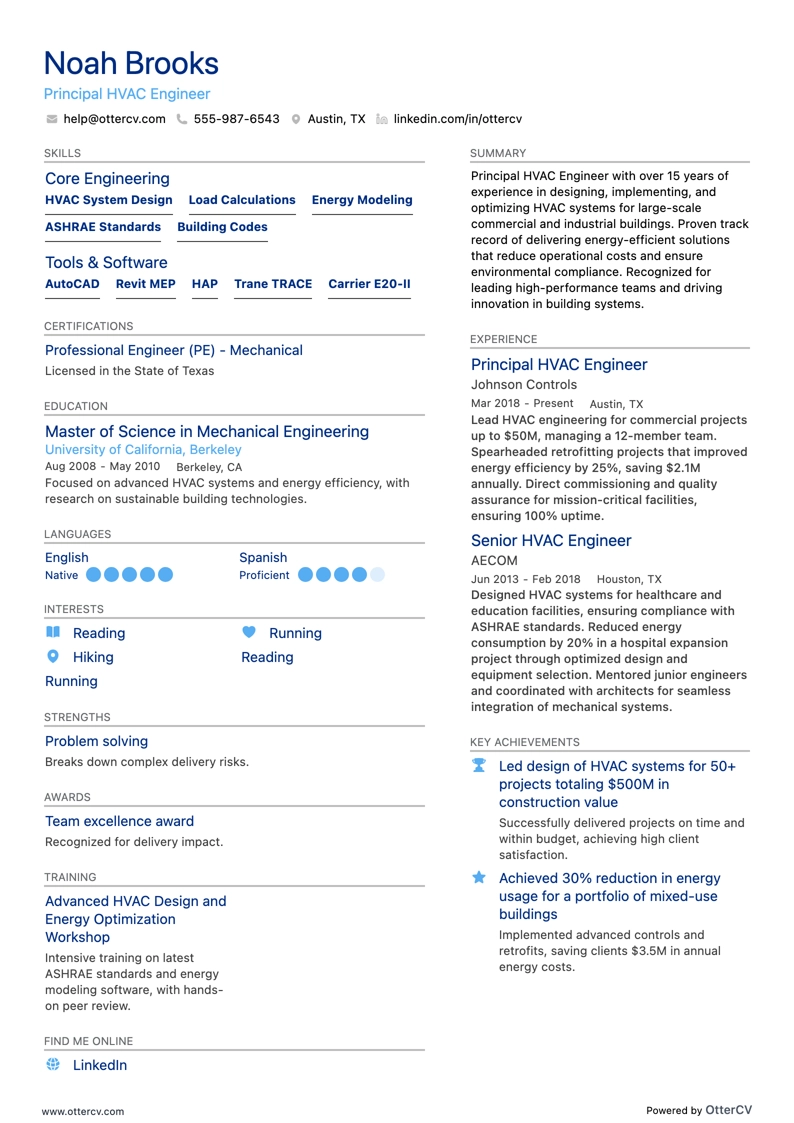
Principal HVAC Engineer full preview

22 HVAC Resume Examples

OtterCV

Written by The OtterCV Team

Updated: 6/5/2025•8 min read

See all resume examples in this guide, or generate your own resume example with your personalized prompt

Principal HVAC Engineer resume example

Principal HVAC Engineer

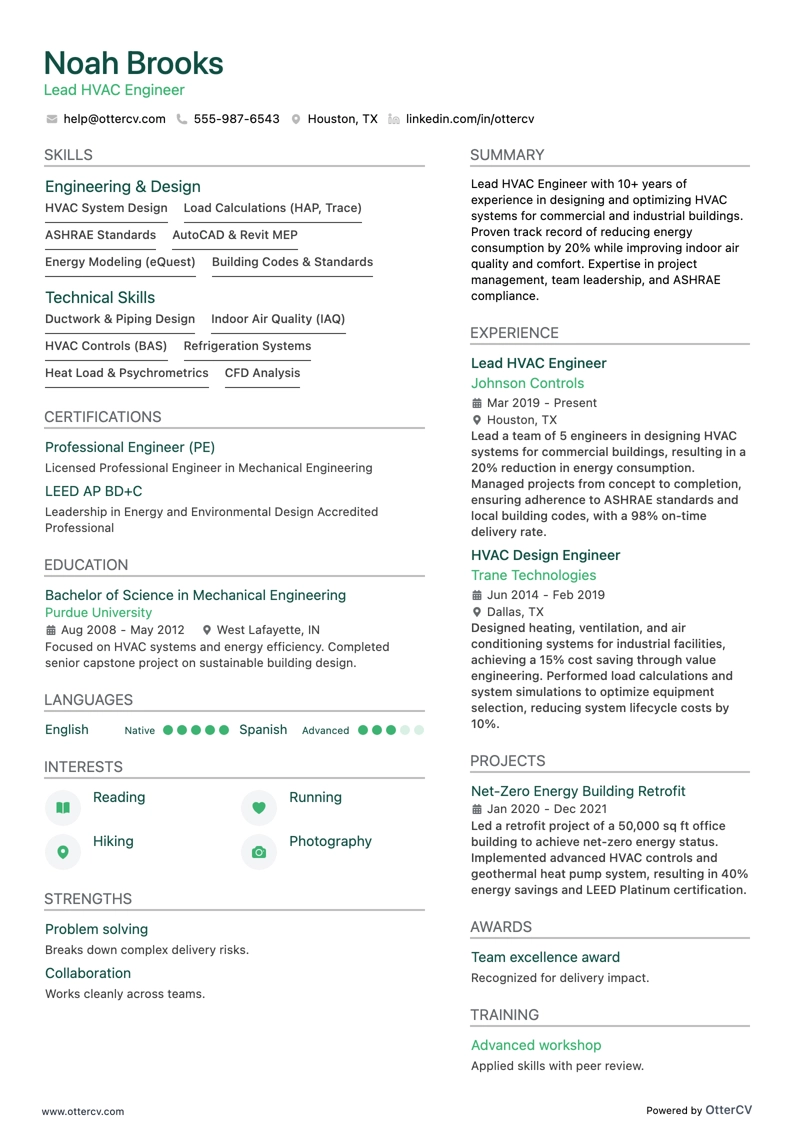
Lead HVAC Engineer resume example

Lead HVAC Engineer

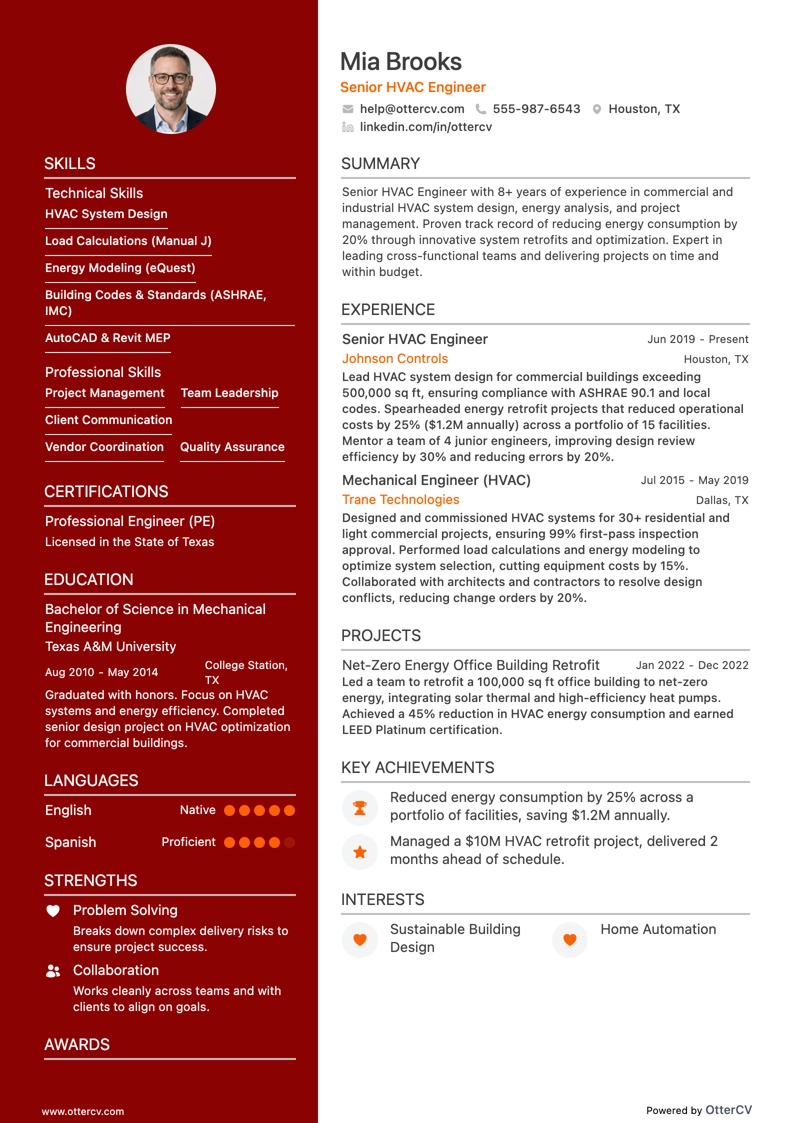
Senior HVAC Engineer resume example

Senior HVAC Engineer

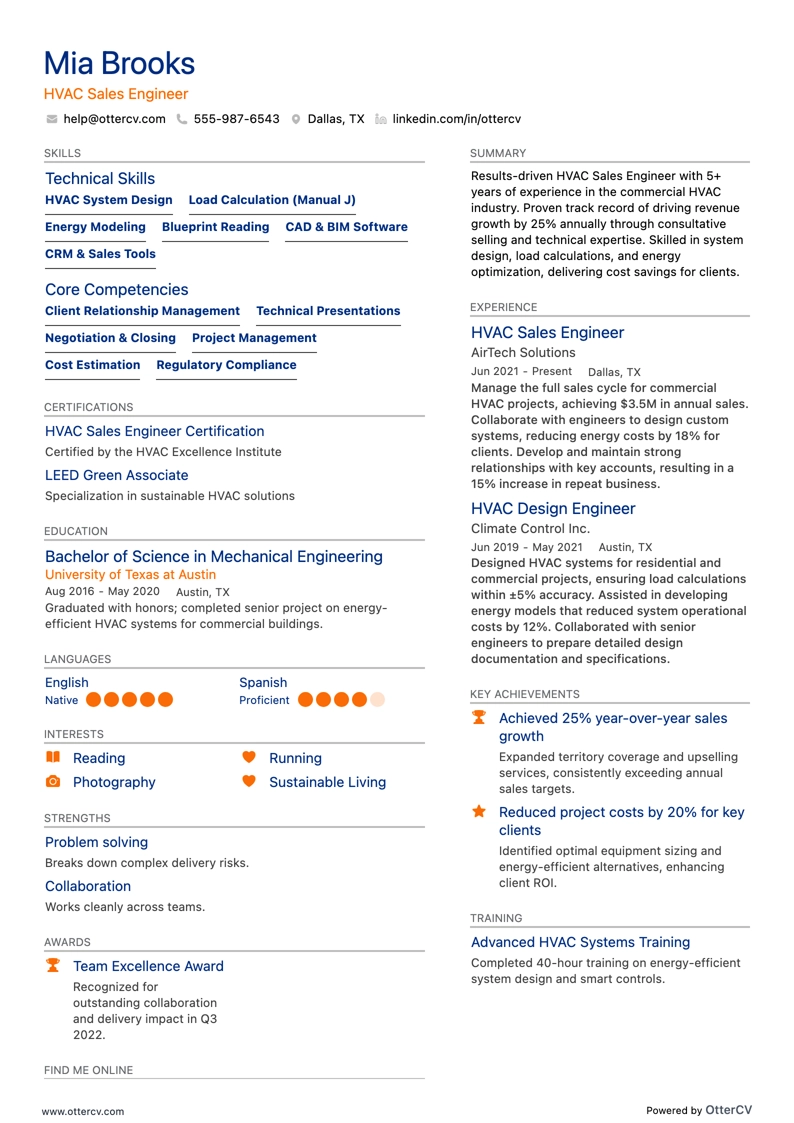
HVAC Sales Engineer resume example

HVAC Sales Engineer

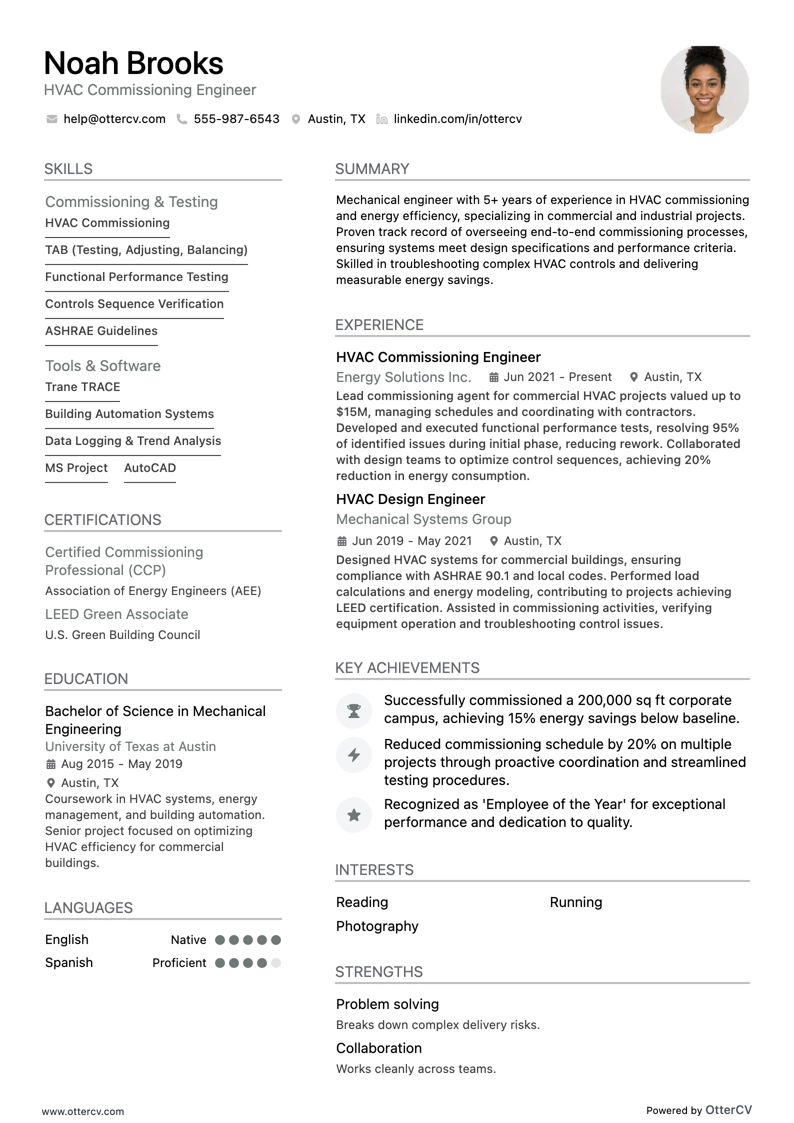
HVAC Commissioning Engineer resume example

HVAC Commissioning Engineer

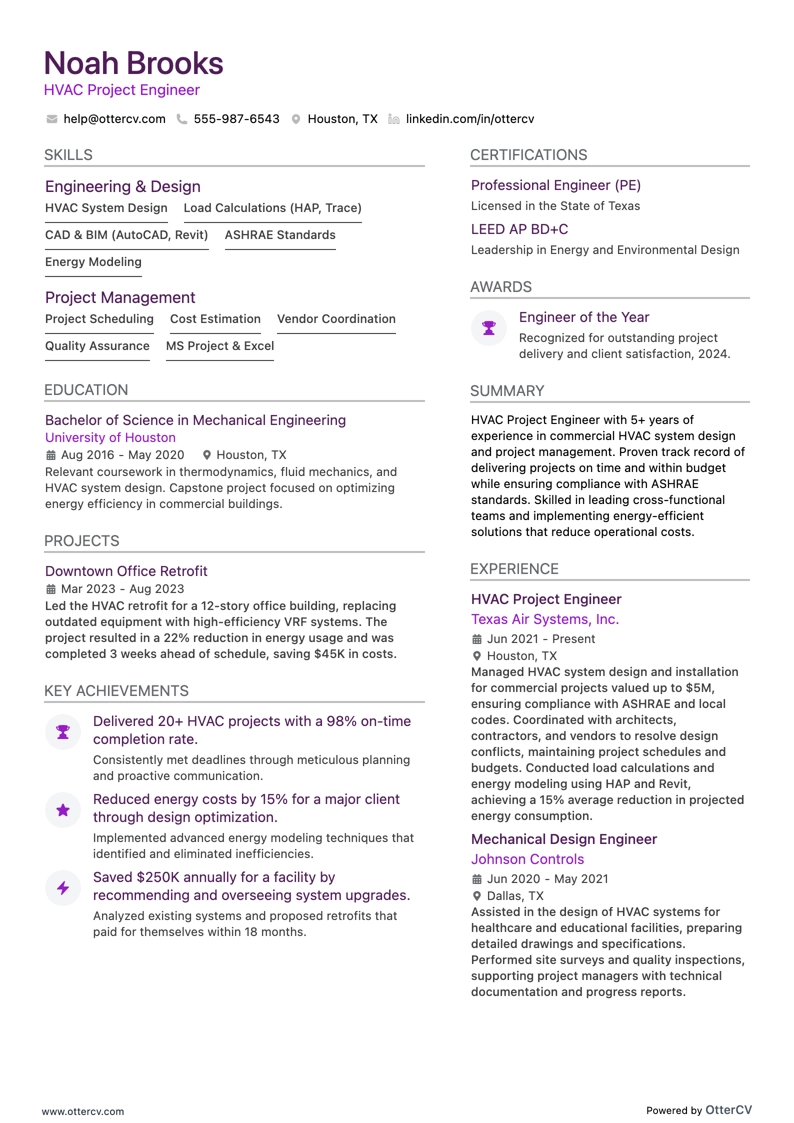
HVAC Project Engineer resume example

HVAC Project Engineer

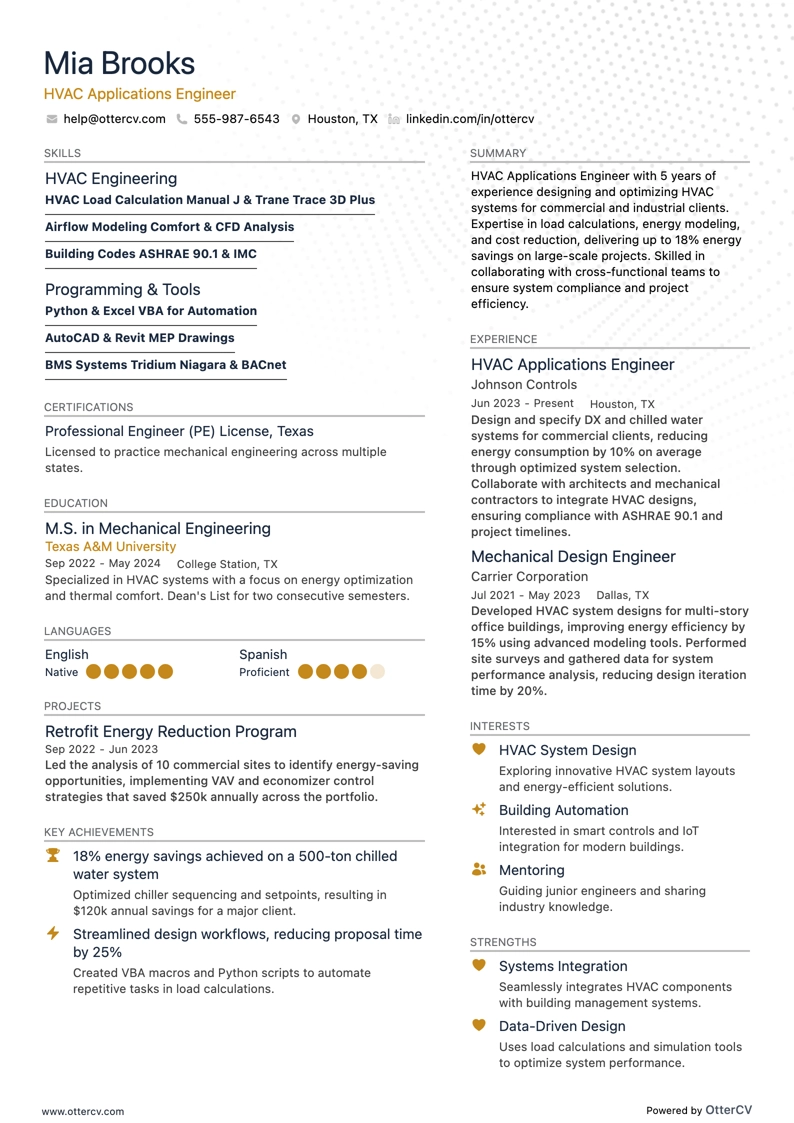
HVAC Applications Engineer resume example

HVAC Applications Engineer

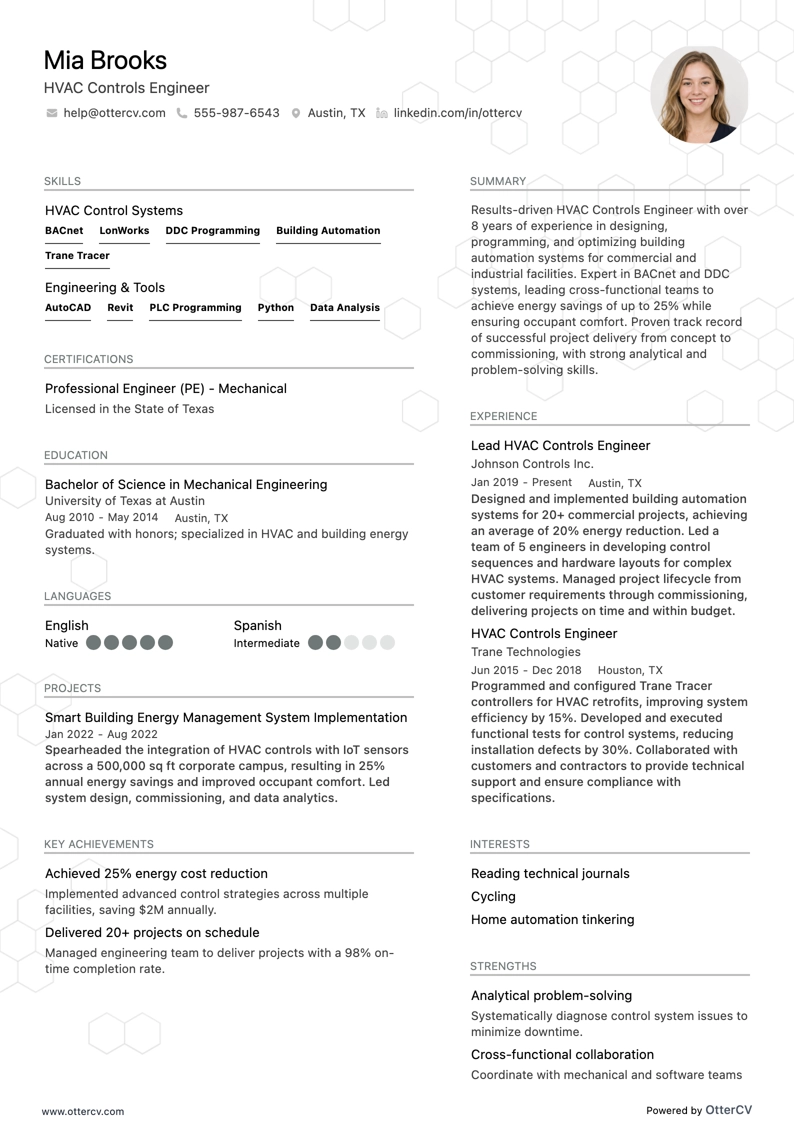
HVAC Controls Engineer resume example

HVAC Controls Engineer

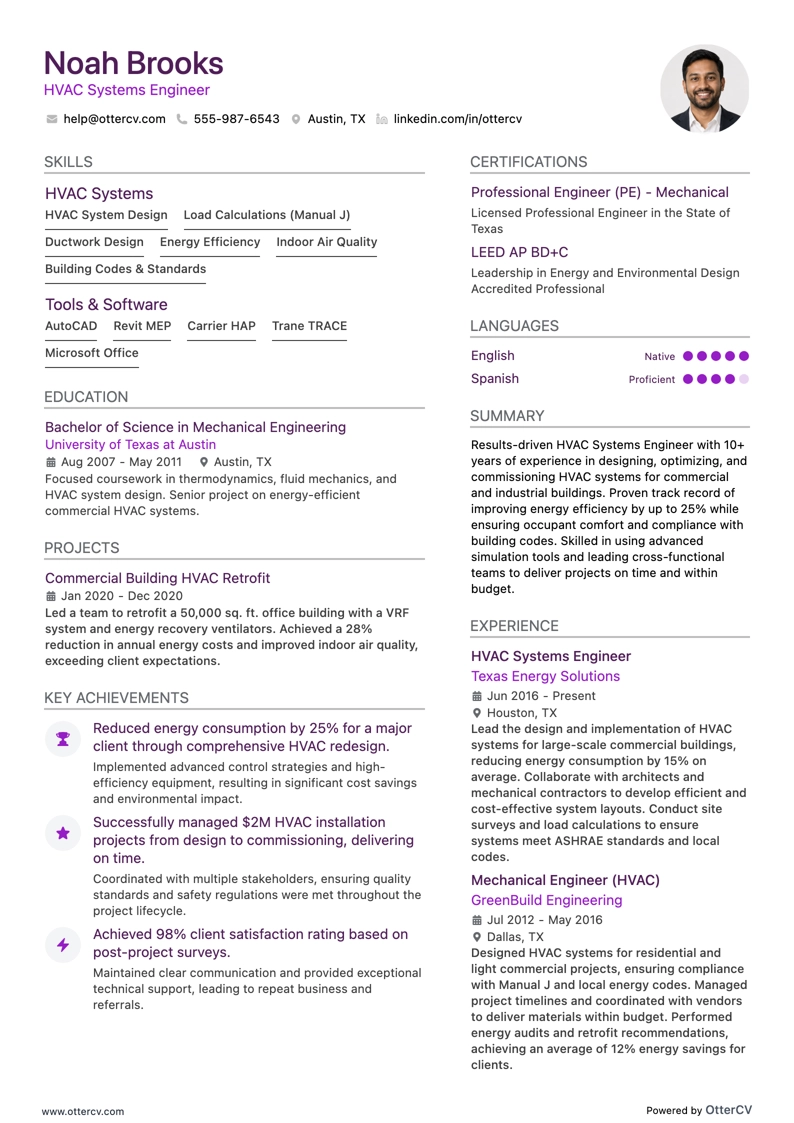
HVAC Systems Engineer resume example

HVAC Systems Engineer

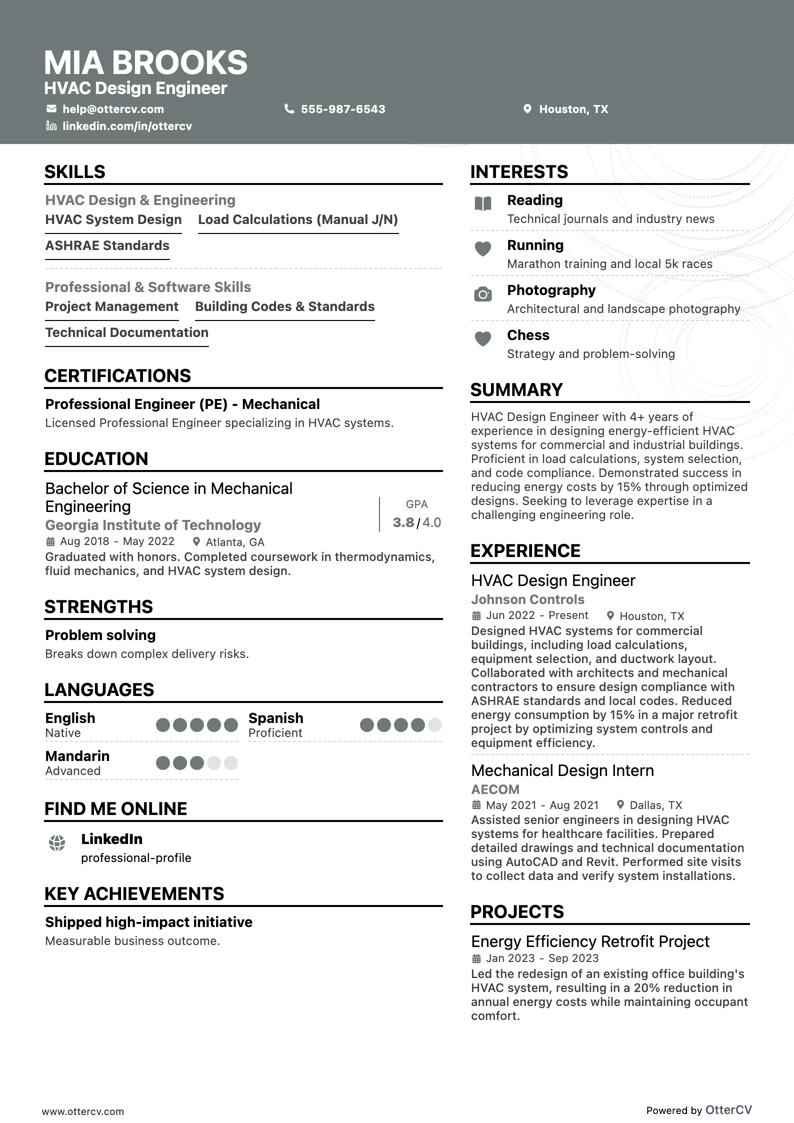
HVAC Design Engineer resume example

HVAC Design Engineer

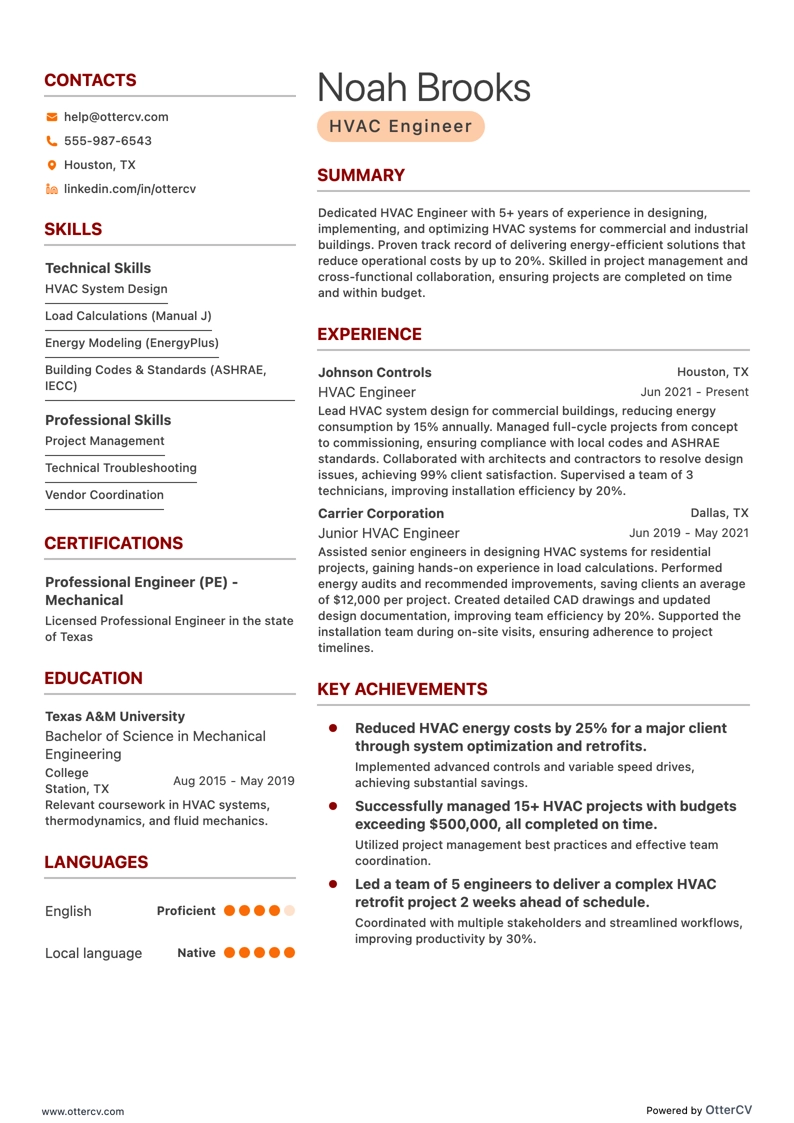
HVAC Engineer resume example

HVAC Engineer

Imagine this: the owner of a busy, family-owned ice cream shop calls in a panic because the air conditioning has failed on a scorching summer day. The ice cream is melting, customers are leaving, and the business is on the verge of chaos.

That is where you come in as the HVAC technician. You quickly diagnose the problem, repair the system, and keep the business running smoothly. You are the behind-the-scenes professional people may not think about until they need help most.

Today, HVAC systems are essential, and the demand for skilled tradesmen remains high. To stand out in this competitive field, you need a strong HVAC resume that showcases your technical expertise and your ability to handle real-world emergencies with confidence.

Key takeaways

  • Use a reverse-chronological format to highlight your most recent HVAC experience and career growth.

  • Keep your document clean and professional with proper margins, a two-column layout, and subtle colors.

  • Tailor your application to the job by aligning keywords and achievements with the job description for better ATS compatibility.

  • Separate hard and soft skills to show both technical expertise and customer service strengths.

  • Highlight certifications such as EPA 608 and NATE, since they are highly valued in HVAC roles.

  • Quantify achievements to show your impact, such as reduced downtime or cost savings.

HVAC resume sample

Here’s a solid HVAC resume example.

Use Joseph’s resume as a template for your own, or create a new one in minutes with the Echocv resume builder.

Joseph White

HVAC Technician

(619) 555-0123 | joseph.white@echocv.com | @LinkedIn | San Diego, California

Summary

Detail-oriented HVAC Technician with over six years of experience installing, repairing, and maintaining air quality systems. Skilled in diagnosing maintenance issues, performing emergency repairs efficiently, and managing multiple warranty service projects. Recognized for strong service delivery and for improving system efficiency and client satisfaction through proactive maintenance.

Experience

Senior HVAC Technician
Heating and Cooling, LTD., San Diego, California
June 2018 – Present

  • Diagnose and repair complex residential and commercial HVAC systems, improving system efficiency by 20%.
  • Serve as lead technician for emergency services, reducing average repair time by 30%.
  • Train junior technicians in system diagnostics, repair techniques, and customer service skills.

HVAC Technician
CoolTech HVAC Services, San Diego, California
May 2016 – May 2018

  • Performed installations and preventive maintenance for HVAC systems in commercial and residential buildings.
  • Conducted regular system checks and replaced parts, leading to a 25% decrease in customer complaints due to system failures.
  • Managed inventory of repair supplies and equipment, ensuring necessary tools were always available.

Education

Associate of Science in HVAC Technology
San Diego Technical College, San Diego, California
Graduated: 2016

Certifications

  • EPA Section 608 Technician Certification
  • NATE Certified HVAC Technician
  • OSHA 30-Hour Construction Safety and Health Training

Skills

  • HVAC System Installation
  • Troubleshooting and Diagnostics
  • Preventive Maintenance
  • Emergency Repair
  • Customer Service
  • Team Leadership

Transitioning from a sample resume blueprint to the actual resume format helps refine and define your application’s structure.

How to format an HVAC resume

Choosing the right resume format for an HVAC technician is like setting a thermostat: when it’s right, everything works smoothly; when it’s not, the problem is obvious. Use a resume template that clearly highlights your top skills and experience.

Top sections on a resume

When outlining your resume, think carefully about which resume sections to include. Recommended sections are:

  • Summary Profile
  • Core Competencies
  • Work History
  • Certifications and Training
  • References

We’ll discuss these in more detail below.

Resume format

The reverse-chronological format works especially well for technical roles like HVAC. It lists your work experience starting with your most recent job, so hiring managers see your latest achievements first. This structure also highlights career growth and shows how your skills have developed over time.

Resume designs

Less is more for job applications, especially for technicians. Keep your resume to one page unless you have enough experience to justify a second page.

Additional design tips:

  • Keep your margins between 0.5” and 1”. Smaller margins can hurt readability, while larger ones can make the page look sparse.
  • Consider a two-column layout to use space efficiently and make the resume easier to scan.
  • A subtle touch of color can help important sections stand out, but keep the overall look professional.
  • Use clean fonts such as Arial, Calibri, or Lato so your HVAC achievements are easy to read.

Contact information

Your resume header is one of the first things hiring managers will notice, so make sure it is accurate and easy to read. Include your name, job title, such as HVAC Technician, and contact details. Skip the photo unless the job description specifically asks for one.

You can also add a resume headline to describe your services, such as Certified HVAC Technician | Expert in Installation, Repair, and Maintenance of Heating, Ventilation & Cooling Systems. Besides being engaging, this headline includes keywords that can help improve your resume’s ATS score.

Keep in mind that expectations can vary by location. Canadian resumes, for example, may follow a different format.

PRO TIP

Contrary to popular belief, our tests showed that fonts, colors, columns, and resume length don’t affect ATS (Applicant Tracking Systems) parsing.

Instead, focus on matching the language in the job description and on formatting details such as dates and bullet symbols, since those may affect your application.

File formatting and naming

Always send your resume as a PDF to keep the formatting intact, unless the job ad requires something else. For clarity and professionalism, name your document using this common convention: James_Smith_HVACTechnician.pdf.

After polishing your resume, don’t let a typo undermine it. Make sure your document is flawless with our free resume checker.

Now, let’s focus on showcasing your HVAC expertise.

How to write your HVAC resume experience

Including your HVAC technician experience in your professional history section is essential to show a well-rounded skill set.

Your ability to troubleshoot complex mechanical issues and work with a range of tools and technologies demonstrates technical expertise. At the same time, showing how you handle customer service demands alongside technical work highlights your communication and interpersonal skills.

Experience working in challenging environments while following industry regulations also reflects resilience and professionalism. Together, these details create a clear picture of your capabilities and can help you stand out to potential employers or clients.

Here are some practical tips for writing your HVAC experience section:

  • Start with your most recent position and include your job title, company name, and employment dates.
  • List your core responsibilities using action verbs and quantifiable results where possible.
  • Highlight specific accomplishments or challenges you overcame, such as reducing energy costs or handling high volumes of work.
  • Mention any specialized tools, software, or equipment you have used, such as refrigerant recovery tools or diagnostic equipment.

Next, let’s look at a real HVAC job posting. The highlighted parts are the ones we’ll target in the following sample experience entry.

HVAC Technician

HVAC Technician

At Marriott Vacations Worldwide (MVW), Maintenance Technician III team members help create memorable vacation experiences in a supportive, friendly, and beautiful work environment.

Typical responsibilities include:

  • Responding to guest repair requests and resolving maintenance issues with guests and owners.
  • Performing assigned preventive maintenance tasks.
  • Using above-average engineering operations skills and strong general mechanical ability.
  • Handling general engineering-related inventory duties.
  • Performing advanced troubleshooting of building systems.
  • Reading, logging, tracking, and interpreting data from meters, gauges, and other measuring devices.
  • Participating in regular training related to safety, technical knowledge, and career development.

Guest experience and company standards include:

  • Welcoming guests and anticipating and addressing their needs.
  • Interacting professionally and promptly with colleagues and guests.
  • Contributing to team goals.
  • Following company policies and safety procedures at all times.

To become a Maintenance Technician III at MVW, candidates must be available to work various shifts, holidays, and weekends; be able to reach overhead and below the knees, bend, twist, pull, stoop, and stand, sit, or walk for extended periods; and lift, carry, push, or pull items weighing up to 50 lbs without assistance. The position may also require background and drug screening in accordance with company policy and applicable legal requirements.

Tailoring your HVAC technician resume

Tailoring your resume to the job description can be the difference between getting noticed by a recruiter and being overlooked.

Here’s why it matters:

  • Customizing your experience to match the job description shows that you’re a strong fit for the role.
  • Tailoring your resume highlights attention to detail, an important skill in HVAC work where precision matters.
  • Using the same language and keywords from the job description can improve your chances of getting through applicant tracking systems.
  • It helps you emphasize the skills the employer cares about most, which can increase your chances of landing an interview.

Here’s an experience section targeting the job posting above:

Experience

Maintenance Technician III

Hilton Grand Vacations

03/2019 - 09/2023 | Orlando, FL

  • Completed 95% of guest repair requests within 24 hours, increasing guest satisfaction scores by 15%.
  • Performed preventive maintenance on HVAC systems, reducing equipment downtime by 30%.
  • Communicated with over 300 guests and owners annually to resolve maintenance issues, maintaining a 4.8/5 satisfaction rating.
  • Led a team in implementing a new inventory tracking system, reducing inventory discrepancies by 25%.
  • Troubleshot and repaired complex building systems, decreasing external contractor costs by 20%.
  • Completed 100+ hours of technical and safety training, contributing to zero safety incidents over a 3-year period.
RIGHT

Here’s what makes it effective:

  • Highlights a reduction in equipment downtime, aligning with the job requirement for performing preventive maintenance tasks.
  • Shows a strong track record in communicating with guests and owners, directly linking to resolving maintenance issues.
  • Demonstrates troubleshooting of complex building systems, reflecting the advanced skills required by the position.
  • Emphasizes participation in training and safety practices, matching the job’s focus on regular safety and technical training.

Knowing the tools is one thing; measuring their impact is another. Let’s quantify your experience to make a stronger impression.

How to quantify your experience on a resume

Quantifiable achievements on an HVAC resume matter because they show proven impact and add credibility through measurable results.

Using concrete numbers also helps you stand out from candidates who only list responsibilities. It makes it easier for hiring managers to quickly assess your capabilities and picture the value you can bring.

Here are some ideas on how to approach this:

Use Measurable HVAC Achievements

  • Include the number of successful HVAC installations you have completed to provide measurable proof of your effectiveness and proficiency.
  • Highlight the percentage reduction in repair callbacks achieved in previous roles to show your attention to detail and the quality of your work.
  • Specify the number of preventive maintenance tasks completed to reflect your commitment to system efficiency and longevity.
  • Detail the volume of emergency repair situations handled to underline your ability to respond quickly and effectively to urgent service requests.
  • Mention measurable energy-efficiency results, such as the percentage reduction in power usage after system upgrades or tune-ups, to emphasize your value in delivering cost-effective solutions.

Even without much experience, you can present your skills in a way that supports your HVAC resume effectively.

How do I write an HVAC resume with no experience?

Having no experience can make it harder to find an HVAC job because the field requires specific technical knowledge. The key is to show recruiters that you are eager to learn and can quickly become an asset.

A great way to build expertise is through an apprenticeship, where you can gain hands-on training and grow from there.

To make your application stand out, focus on the following:

  • State your goals and enthusiasm for gaining hands-on HVAC experience, and emphasize your willingness to learn and grow.
  • Highlight your physical ability to lift heavy equipment and work in different weather conditions, if applicable.
  • Show that you learn quickly, especially when troubleshooting systems or using HVAC tools and software.
  • Mention any basic knowledge of refrigeration, heating systems, or mechanical skills to show a solid foundation.
  • Include transferable skills such as problem-solving, attention to detail, and experience using tools.
  • Emphasize customer service skills, including clear communication and handling inquiries.
  • Note any teamwork experience, since HVAC work often involves collaborating on projects.
  • Use a functional or hybrid resume format to focus more on skills and training than work history.

Finally, pair your application with a strong resume objective. This short statement, up to three sentences at the top of your document, explains your career goals and why you can achieve them at that specific company.

Here’s a good example:

Objective

Motivated HVAC graduate with strong technical skills and EPA 608 certification, eager to apply hands-on training in system diagnostics and maintenance. Seeking an entry-level role with [Company Name] to contribute to energy-efficient solutions and further develop expertise in heating and cooling systems.

RIGHT

Moving from the drafting table to the field, let’s focus on the hard and soft skills you need for the job market.

HVAC skills on your resume

Your HVAC skills section helps employers quickly assess whether you have the technical expertise and interpersonal abilities required for the role. In HVAC work, you need to show both the ability to handle technical job demands and the professionalism to work with clients and team members.

Hard skills are the specific, practical abilities essential to HVAC work. They are gained through training, certifications, or hands-on experience and are directly tied to the job. It’s best to list them in a separate section so they are easy to spot.

Here are some examples:

Best hard skills for your HVAC resume

  • Air conditioning units.
  • Furnaces.
  • Heat pumps.
  • Central heating systems.
  • Ductless mini-split systems.
  • Packaged heating and air systems.
  • Boilers.
  • Chimneys.
  • Programmable thermostats.
  • Energy management systems.
  • Indoor air quality equipment.
  • HVAC control systems.
  • Ventilation equipment.
  • Air handlers.
  • Radiant heating systems.
  • Geothermal heating and cooling systems.
  • Variable refrigerant flow (VRF) systems.
  • Evaporative coolers.
  • Solar air conditioning systems.
  • Ductwork and venting systems.

Soft skills are personal and interpersonal attributes that complement your technical knowledge. They help you work well with clients, respond to customer service inquiries, and collaborate efficiently with coworkers. These skills are usually easiest to understand when shown through specific examples in your experience section.

Take a look at our list:

Best soft skills for your HVAC resume

PRO TIP

For hands-on positions, another effective strategy is to add a Core Competencies section.

This gives you a clear, organized way to showcase your key skills, abilities, and knowledge. It is typically placed just below the header for easy visibility and can include both hard and soft skills.

After building your skills, strengthen your resume by clearly presenting your education and certifications.

How to list your certifications and education on your resume

The education section of your resume can strengthen your application, especially if you do not yet have enough direct experience. Use it to highlight your formal training, relevant certifications, and additional learning that supports your fit for the role.

HVAC trade school

An HVAC diploma is typically earned through a trade school program lasting 6 months to 2 years. These programs combine classroom instruction with hands-on training in system installation, maintenance, and electrical work, helping prepare graduates for entry-level roles.

Certifications for an HVAC resume

For HVAC and maintenance technician roles, certifications and specialized training may matter more than a traditional degree, even if your major is relevant, such as “Construction Management.” Showing current certifications can demonstrate that you stay aligned with industry standards and meet employers’ demand for practical skills.

Here are a few ways to present your certifications or additional training:

  • Create a “Certifications” section if you have multiple certifications.
  • Mention key certifications in your resume summary for better visibility.
  • Add certifications under “Education” if they were earned through academic programs.
  • Include certifications in progress and note the expected completion date.

Here is an example of a well-written education section that combines an HVAC diploma with relevant certifications.

Education & Certifications

HVAC Diploma

Southern Technical College
08/2018 - 05/2020
Orlando, FL

  • Completed coursework in HVAC system installation, maintenance, and electrical work.
  • Received hands-on training in preventive maintenance, system troubleshooting, and safety protocols.

EPA 608 Certification

Environmental Protection Agency (EPA)
06/2020

  • Certified for the safe handling and disposal of refrigerants in HVAC systems.

OSHA 10-Hour Construction Safety and Health Certification

Occupational Safety and Health Administration (OSHA)
03/2021

  • Trained in essential workplace safety and health practices for construction environments.
RIGHT

It works because it:

  • Includes key certifications that directly align with job requirements.
  • Highlights hands-on experience in system installation, troubleshooting, and preventive maintenance.
  • Combines real institutions with formal education and certifications to show continuous professional development.

It’s time to finish your resume with a summary that gives a clear view of your potential.

How to write your HVAC resume summary

An resume summary for an HVAC role should quickly communicate your experience, key skills, and achievements. Use three to five sentences to explain what you bring to the role. Since the summary may be the only part of your resume that gets read closely, take the time to polish it.

Summary

Detail-oriented and highly skilled HVAC Maintenance Technician with over five years of experience in troubleshooting, preventive maintenance, and guest communication in luxury vacation resorts. Proven ability to complete 95% of guest repair requests within 24 hours, reduce equipment downtime by 30%, and lead inventory management efforts to streamline operations. Adept at collaborating with teams, exceeding guest expectations, and maintaining safety and technical standards. Seeking to contribute to Marriott Vacations Worldwide by delivering exceptional maintenance services and creating memorable guest experiences.

RIGHT

This summary is effective because it highlights key skills and achievements, including troubleshooting, preventive maintenance, and guest communication, while quantifying results such as repair request completion and reduced equipment downtime.

As a final touch, strengthen your resume with additional sections that reflect your unique professional background.

Additional sections for an HVAC resume

Optional sections can add personality to your resume and help you stand out from other candidates. For an HVAC role, these details can highlight your interests outside work and how you contribute to your community.

Here are some ideas:

  • Highlight specific projects, such as HVAC installations or major repairs, where you improved system efficiency or reduced operating costs.
  • Mention any advanced technical or safety training courses to show your commitment to staying current with industry standards.
  • List any additional languages you speak, especially if you are applying for roles that serve a diverse customer base.
  • Include any volunteer work where you used your HVAC skills or supported your community, as this can demonstrate initiative, leadership, and a willingness to help others.
  • References can be a separate part of your resume and provided on request. This can help show future employers that your clients are satisfied with your service.

Possible reference section:

References

  • David Thompson - Lead HVAC Engineer

    d.thompson@echocv.com | (314) 555-98xx

  • Lisa Martin - Building Operations Manager

    lisa.martin@echocv.com | (626) 555-22xx

  • Mark Allen - Senior HVAC Technician

    mark.allen@echocv.com | (773) 555-34xx

RIGHT

In conclusion

An effective HVAC resume should work like a well-maintained unit: precise, efficient, and tailored to the job. Highlight your skills, certifications, and measurable results to help your career stay cool under pressure.

HVAC resume examples

Explore additional HVAC resume samples and guides and see what works for your level of experience or role.

By Experience

Principal HVAC Engineer

Principal HVAC Engineer resume preview

Lead HVAC Engineer

Lead HVAC Engineer resume preview

Senior HVAC Engineer

Senior HVAC Engineer resume preview

HVAC resume examples

Explore additional HVAC resume samples and guides and see what works for your level of experience or role.

By Role

HVAC Sales Engineer

HVAC Sales Engineer resume preview

HVAC Commissioning Engineer

HVAC Commissioning Engineer resume preview

HVAC Project Engineer

HVAC Project Engineer resume preview

HVAC Applications Engineer

HVAC Applications Engineer resume preview

HVAC Controls Engineer

HVAC Controls Engineer resume preview

HVAC Systems Engineer

HVAC Systems Engineer resume preview

HVAC Design Engineer

HVAC Design Engineer resume preview

HVAC Engineer

HVAC Engineer resume preview