Household Manager full preview

10 Homemaker Resume Examples

OtterCV

Written by The OtterCV Team

Updated: 11/24/2023•8 min read

See all resume examples in this guide, or generate your own resume example with your personalized prompt

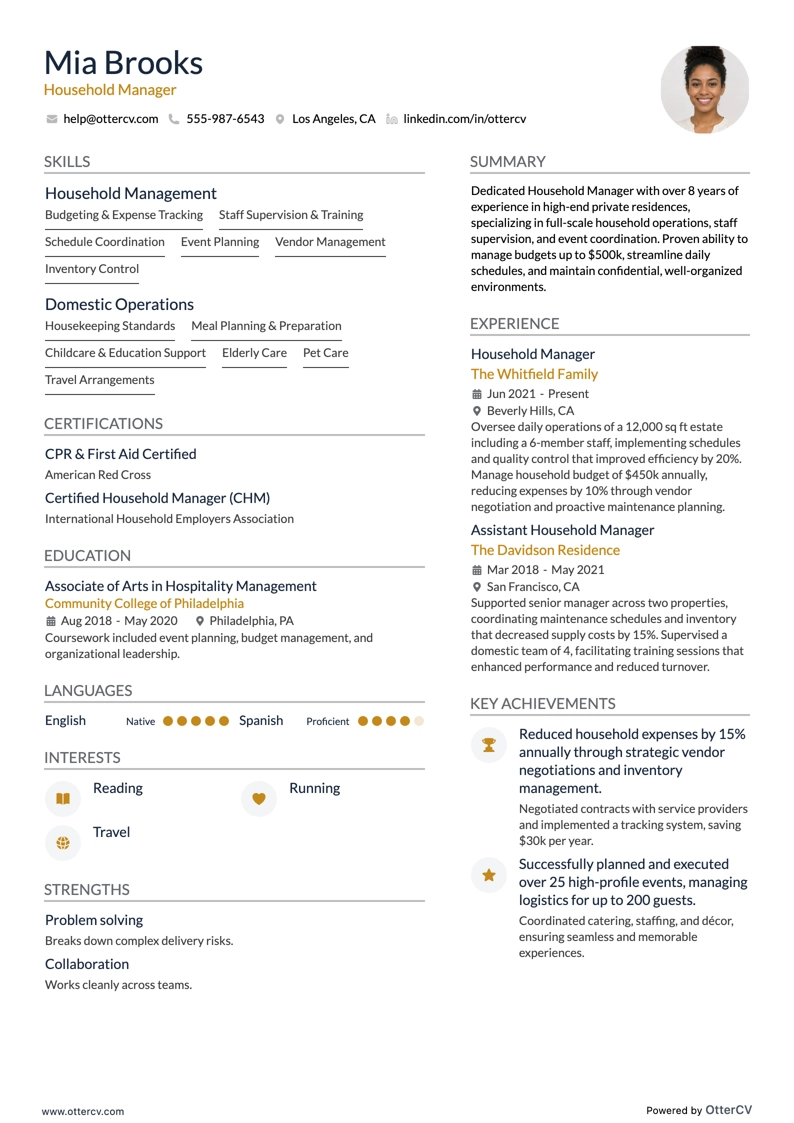
Household Manager resume example

Household Manager

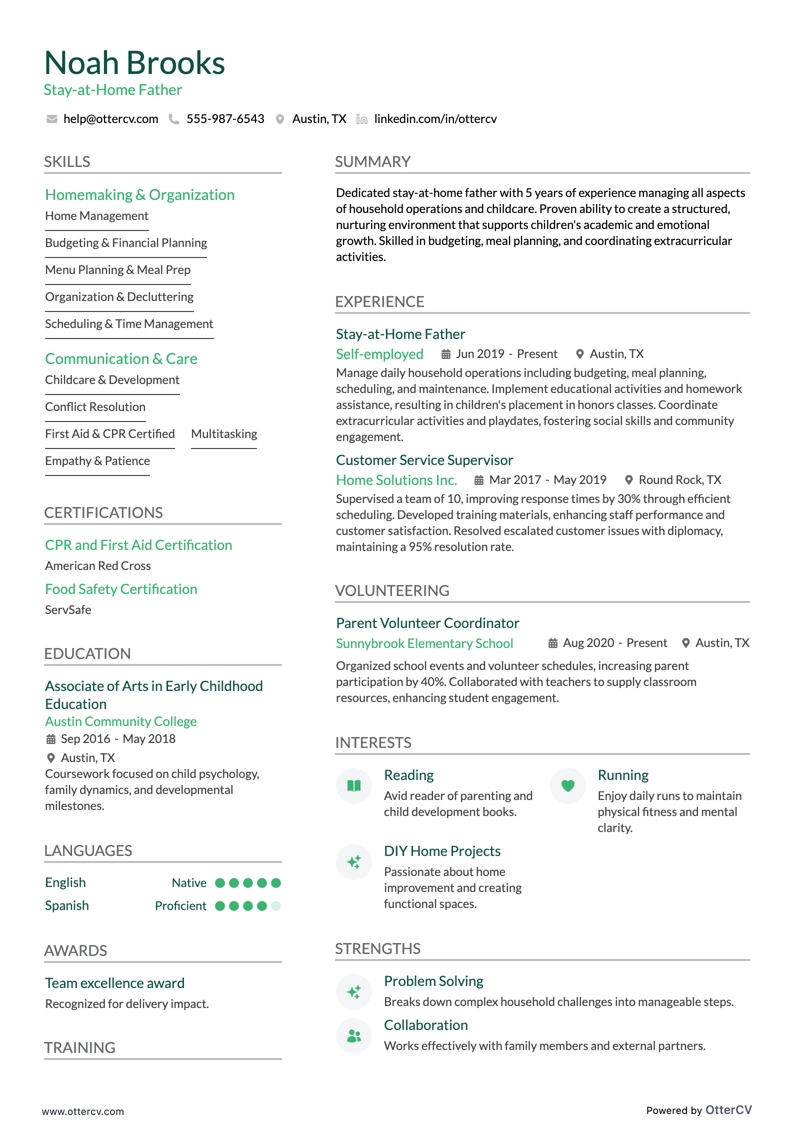
Stay-at-Home Father resume example

Stay-at-Home Father

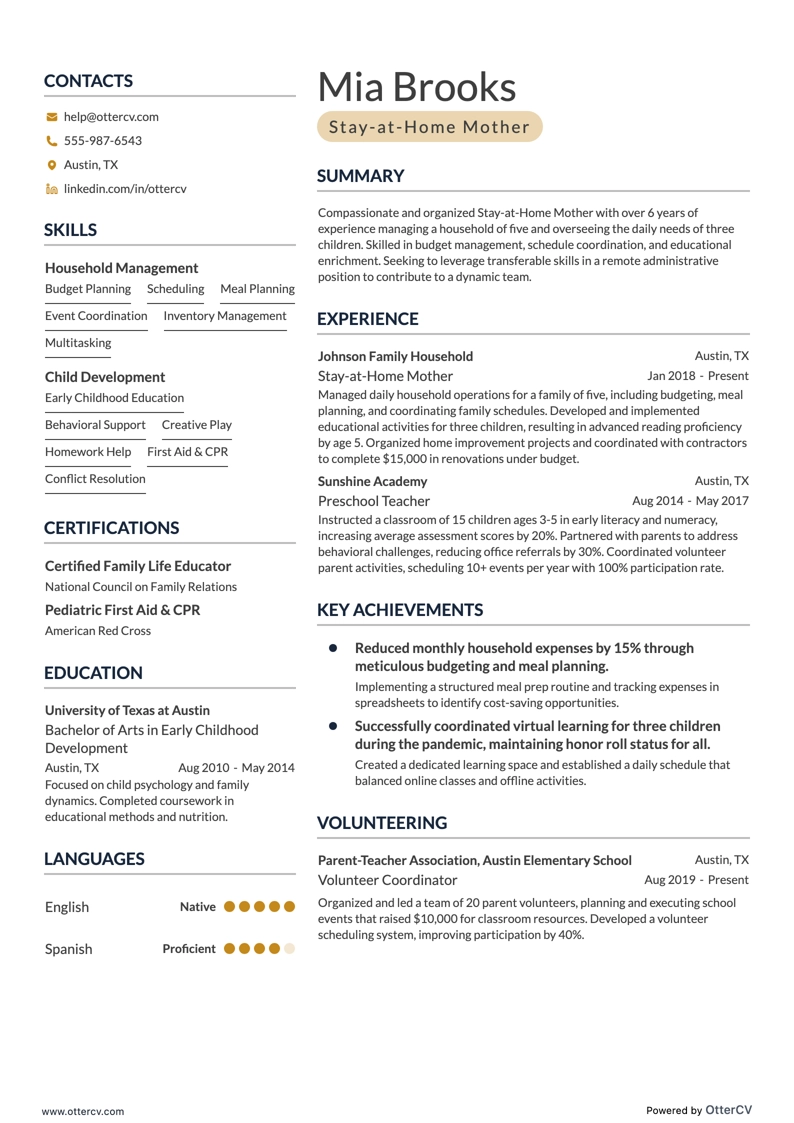
Stay-at-Home Mother resume example

Stay-at-Home Mother

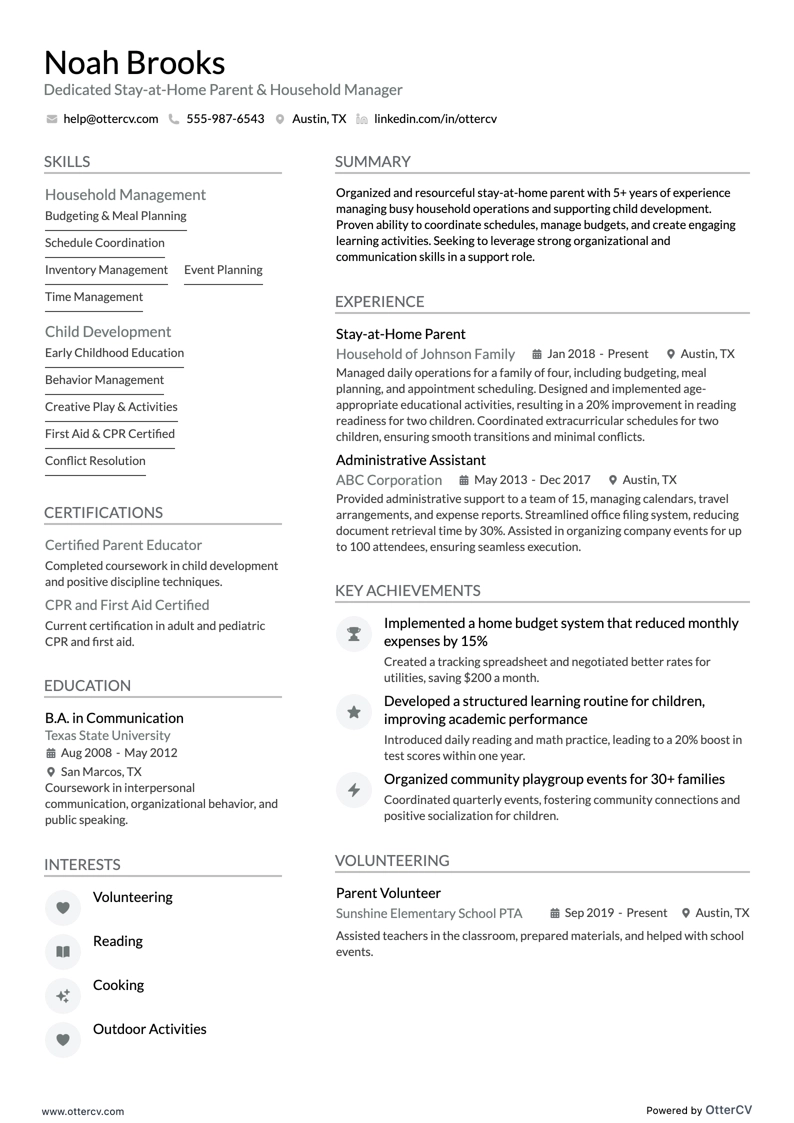
Stay-at-Home Parent resume example

Stay-at-Home Parent

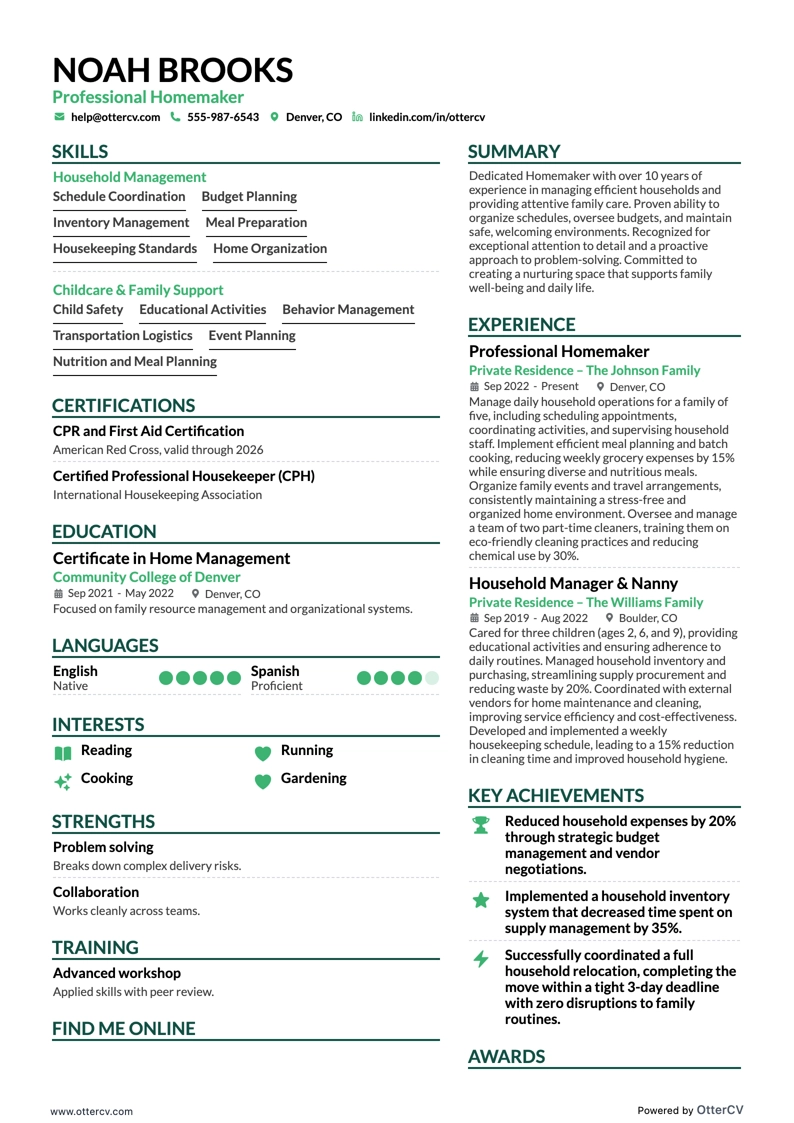
Homemaker resume example

Homemaker

Many homemaker resumes fall short because they list household duties without measurable results or transferable skills. That kind of format is more likely to be filtered out by ATS screening and missed in quick recruiter scans, especially in a competitive job market.

A strong resume focuses on what you delivered and improved. Knowing how to make your resume stand out means highlighting budgets managed, schedules coordinated across multiple needs, cost savings achieved, conflicts resolved, deadlines met, and quality standards maintained. Quantify the scope of your work, show consistency, and connect outcomes to reliability.

Key takeaways

  • Quantify household achievements with dollars saved, time reduced, or error rates to show impact.

  • Use a hybrid resume format to highlight transferable skills while keeping a clear timeline.

  • Tailor each experience bullet to reflect the job posting’s language and priorities.

  • Translate daily homemaker tasks into professional terms such as budget management and vendor coordination.

  • Place certifications above education when they are more recent or more relevant to the target role.

  • Write a three- to four-line summary that includes measurable results instead of vague personality traits.

  • Use Echocv’s tools to turn routine household duties into clear, recruiter-ready resume bullets.

Job market snapshot for homemakers

We analyzed 71 recent homemaker job ads across major US job boards. These figures provide a quick view of employment type trends, leading employers, and the salary landscape.

What level of experience employers are looking for homemakers

Years of ExperiencePercentage found in job ads
10+ years38.0% (27)
Not specified62.0% (44)

Homemaker ads by area of specialization (industry)

Industry (Area)Percentage found in job ads
Healthcare67.6% (48)
Finance & Banking32.4% (23)

Top companies hiring homemakers

CompanyPercentage found in job ads
Addus HomeCare Corporation62.0% (44)
Interim Healthcare15.5% (11)

Role overview stats

These tables outline the most common responsibilities and employment types for homemaker roles. Use them to align your resume with employer expectations and understand how the role is typically structured across the market.

Day-to-day activities and top responsibilities for a homemaker

ResponsibilityPercentage found in job ads
Basic life support14.1% (10)
CPR14.1% (10)
Criminal history check9.9% (7)
Drug screening8.5% (6)
NJ CHHA certification8.5% (6)
Dementia care5.6% (4)
Meal preparation5.6% (4)
Post-stroke care5.6% (4)
Transportation5.6% (4)
Laundry4.2% (3)
Light housekeeping4.2% (3)
NJ CHHA4.2% (3)

How to format a homemaker resume

Recruiters reviewing homemaker resumes look for transferable skills, any volunteer or freelance experience, and clear evidence that you can return to the workforce and deliver results. Choosing the right resume format directly affects how visible those strengths are. The right structure helps keep employment gaps from overshadowing your capabilities while ensuring the document remains ATS-readable.

I have significant experience managing a household and related responsibilities—which format should I use?

I have significant experience managing a household and related responsibilities—which format should I use?

Use a hybrid (combination) resume format. It lets you lead with a strong skills section while still showing a timeline of any formal or informal work history.

  • Organize transferable skills into clear categories such as budget management, scheduling, event coordination, and vendor negotiation to demonstrate scope and ownership.
  • Highlight relevant tools and domains, including project management apps, bookkeeping software, volunteer coordination platforms, or community organizing efforts.
  • Quantify outcomes whenever possible by tying household or volunteer responsibilities to measurable results.

Example bullet: “Managed a $65,000 annual household budget across 12 expense categories, reducing discretionary spending by 18% over two years through vendor comparison and bulk purchasing strategies.”

I'm re-entering the workforce or switching into a new role—what format works best?

I'm re-entering the workforce or switching into a new role—what format works best?

A hybrid resume format works best because it puts your transferable skills first while still showing a timeline of volunteer work, freelance projects, or community involvement.

  • Place a dedicated skills section near the top of your resume, grouping abilities such as organization, financial planning, conflict resolution, and time management under clear headings.
  • Include volunteer roles, PTA leadership, freelance projects, caregiving certifications, or relevant coursework as transitional experience entries with dates and descriptions.
  • Connect each listed skill to a specific action and outcome so recruiters see real-world application rather than just a list of traits.

Example scaffold: Budget management → tracked and allocated monthly household finances using spreadsheet tools → maintained consistent savings rate of 15% across a three-year period.

When does a functional resume make sense?

When does a functional resume make sense?

A functional resume can make sense in specific situations where a traditional timeline would raise more questions than it answers:

  • You have an extended employment gap of five or more years and no volunteer, freelance, or formal caregiving credentials to include in a chronological section.
  • You're pivoting into an entirely new field and need to present household management skills under industry-relevant categories.
  • You completed recent training, certifications, or coursework that better reflects your current qualifications than your past employment history.

Functional resumes have a major limitation: many recruiters and applicant tracking systems view them as an attempt to hide gaps or limited experience, which can reduce your chances of getting an interview. If you're unsure, reviewing tips on resume layout can help you choose the structure that presents your qualifications most effectively. Avoid this format if you have any volunteer work, freelance projects, or part-time roles that can support a timeline.

  • A functional resume is acceptable when you have no work history to reference at all, but even then, connect each listed skill to a specific project, volunteer effort, or measurable outcome to show real application rather than self-assessment.
Once you’ve chosen a resume format that highlights your strengths, the next step is adding the right sections so employers can quickly understand the value you offer.

What sections should go on a homemaker resume

Recruiters expect a clear, job-targeted resume that translates your household and community responsibilities into relevant, measurable qualifications. Understanding what to put on a resume helps ensure each section includes the information employers need.

Use this structure for maximum clarity:

  • Header
  • Summary
  • Experience
  • Skills
  • Projects
  • Education
  • Certifications
  • Optional sections: Volunteering, Leadership, Languages

Your experience bullets should emphasize impact, outcomes, scope, and results that align with the role you’re targeting.

With your resume structure in place, the next step is to describe your homemaker experience so it fits those sections and supports your target role.

How to write your homemaker resume experience

The work experience section of your homemaker resume should show what you delivered, whether that included managing a household budget, coordinating schedules, or overseeing home improvement projects. Use role-relevant tools and methods, and emphasize measurable outcomes. Hiring managers care more about demonstrated impact than task lists, so focus on what changed because of your work instead of listing daily responsibilities.

Each entry should include:

  • Job title
  • Company and location, or remote
  • Dates of employment, with month and year

Add three to five concise bullet points that explain what you owned, how you executed it, and what outcomes you delivered:

  • Ownership scope: the household operations, financial accounts, caregiving responsibilities, vendor relationships, or family programs you were fully accountable for as a homemaker.
  • Execution approach: the budgeting tools, scheduling systems, meal-planning frameworks, educational methods, or organizational techniques you used to make decisions and deliver consistent results across your homemaker responsibilities.
  • Value improved: changes to household efficiency, cost savings, nutritional quality, children's developmental progress, home safety, or resource allocation that resulted directly from your homemaker work.
  • Collaboration context: how you coordinated with educators, healthcare providers, contractors, community organizations, or extended family members to achieve shared goals within your homemaker role.
  • Impact delivered: outcomes shown through the scale of responsibilities managed, improvements sustained over time, or long-term family outcomes rather than routine activity descriptions tied to your homemaker experience.

Experience bullet formula

Experience bullet formula

Action verb + technology + what you built or fixed + measurable result

A homemaker experience example

Household Operations Manager

Private Household | Austin, TX
2019–Present

Managed end-to-end operations for a four-person household, including budgeting, scheduling, procurement, and vendor management.

  • Implemented a zero-based budgeting system in Google Sheets and Monarch Money, reducing monthly discretionary spending by 18% and increasing savings by $6,200 year over year.
  • Built a recurring maintenance and appointment workflow in Google Calendar and Notion, reducing missed deadlines to zero and saving an average of three hours per week.
  • Negotiated and managed eight vendor contracts using standardized scopes of work and service-level checklists, lowering annual service costs by 12% and improving on-time completion from 80% to 96%.
  • Streamlined grocery and household procurement with Instacart, Amazon Subscribe & Save, and a par-level inventory tracker, cutting emergency runs by 60% and reducing food waste by 25%.
  • Coordinated schedules and priorities with a spouse, teachers, and healthcare providers through shared calendars and weekly planning meetings, improving on-time school and activity attendance to 98%.

Now that you’ve seen how to structure a homemaker experience entry, the next step is tailoring that content to the specific job you’re applying for.

How to tailor your homemaker resume experience

Recruiters review your homemaker resume through both human screening and applicant tracking systems, so close alignment with the job posting is essential. Tailoring your resume to the job description by reflecting the language and priorities in each listing can improve your chances of passing both reviews.

Ways to tailor your homemaker experience:

  • Match the household management tools or software named in the job description.
  • Use the same terminology for organizational or scheduling processes that the posting lists.
  • Reflect the productivity or efficiency outcomes the employer emphasizes.
  • Include relevant volunteer or community leadership experience connected to the role.
  • Emphasize budgeting or financial oversight skills when fiscal responsibility is mentioned.
  • Highlight coordination workflows that align with the teamwork models described.
  • Reference compliance with safety or quality standards if the posting includes them.
  • Align caregiving or mentoring accomplishments with the stated people management needs.

Tailoring means connecting your real household and community achievements to specific job requirements, not forcing in keywords that do not fit.

Resume tailoring examples for homemaker

Job description excerptUntailoredTailored
"Seeking a family assistant to manage household budgets, track expenses in Excel, and reduce monthly spending by identifying cost-saving opportunities."Handled money and paid bills for the family.Managed a $5,000 monthly household budget using Excel spreadsheets, tracked expenses by category, and identified cost-saving switches that reduced grocery and utility spending by 18% over one year.
"Looking for a household manager to coordinate schedules for a family of five, arrange medical appointments, and communicate with school administrators and extracurricular program directors."Kept the family organized and on schedule.Coordinated daily schedules for five family members across three schools and four extracurricular programs, managed all medical appointments, and served as the primary liaison with teachers, coaches, and pediatric staff.
"Need someone experienced in meal planning for dietary restrictions, grocery procurement within a set budget, and preparing nutritious meals aligned with a registered dietitian's recommendations."Cooked meals for the family every day.Planned and prepared 21 weekly meals following a registered dietitian's guidelines for gluten-free and low-sodium diets, sourcing ingredients within a $150 weekly grocery budget through strategic meal prepping and seasonal purchasing.

Once you’ve aligned your homemaker responsibilities with the role’s requirements, quantify the results to show clear impact and make your experience easier to evaluate.

How to quantify your homemaker achievements

Quantifying your homemaker work demonstrates real impact, not just effort. Using numbers on your resume to show time saved, costs reduced, schedules met, errors avoided, and risks prevented across budgeting, meal planning, household logistics, and family care makes your experience more concrete and credible.

Quantifying examples for homemaker

MetricExample
Cost savingsCut monthly grocery spending by 18% ($220) through meal planning in Google Sheets, using store apps, and buying pantry staples in bulk.
Cycle timeReduced weeknight dinner prep from 60 minutes to 35 by batching ingredients on Sundays and using a slow cooker three nights a week.
AccuracyMaintained a zero late-fee record for twelve months by automating bill reminders in Google Calendar and reconciling receipts weekly.
Risk reductionImproved home safety by installing two smoke alarms, one carbon monoxide detector, and a medication lockbox, with monthly checks completed for a year.
Volume handledCoordinated an average of twenty appointments per month for a four-person household using a shared calendar and weekly planning checklists.

Once you've crafted strong bullet points for your experience section, apply the same level of precision to presenting your hard and soft skills.

How to list your hard and soft skills on a homemaker resume

Your skills section shows how you run a household like an operation, and recruiters and ATS scan it for job-matching keywords. Aim for a balanced mix of role-specific hard skills and execution-focused soft skills.

Homemaker roles require a blend of:

  • Product strategy and discovery skills.
  • Data, analytics, and experimentation skills.
  • Delivery, execution, and go-to-market discipline.
  • Soft skills.

Your skills section should be:

  • Scannable with bullet-style grouping.
  • Relevant to the job post.
  • Backed by proof in your experience bullets.
  • Updated with current tools.

Place your skills section:

  • Above experience if you're junior or switching careers.
  • Below experience if you're mid/senior with strong achievements.

Hard skills

  • Household budgeting and forecasting.
  • Expense tracking and receipt management.
  • Meal planning and nutrition basics.
  • Grocery procurement and price comparison.
  • Calendar management and scheduling.
  • Vendor sourcing and bid comparison.
  • Inventory management and restocking.
  • Cleaning and sanitation protocols.
  • Laundry care and fabric handling.
  • Childcare routines and safety procedures.
  • Basic home maintenance coordination.
  • Microsoft Excel and Google Sheets.

Soft skills

  • Prioritize competing needs.
  • Make time-bound decisions.
  • Communicate schedules and changes clearly.
  • Coordinate across family stakeholders.
  • Set boundaries and expectations.
  • Resolve conflicts calmly.
  • Follow through on commitments.
  • Adapt plans under pressure.
  • Anticipate risks and contingencies.
  • Document routines and instructions.
  • Delegate tasks and check quality.
  • Manage sensitive information discreetly.

How to show your homemaker skills in context

Skills should not appear only in a bulleted list on your resume. Explore examples of resume skills to see how other candidates present their abilities effectively.

Show your skills in:

  • Your summary (high-level professional identity)
  • Your experience (proof through outcomes)

Here’s what that looks like in practice.

Summary example

Resourceful household manager with 12 years of experience coordinating family logistics, budgets, and vendor relationships. Skilled in scheduling software, meal planning systems, and crisis problem-solving. Reduced annual household expenses by 22% through strategic sourcing and negotiation.

  • Clearly reflects senior-level experience
  • Names specific tools and methods
  • Leads with a measurable financial outcome
  • Highlights adaptability as a soft skill

Experience Example

Household Manager

Self-Employed | Portland, Oregon

January 2012–August 2024

  • Managed a $68,000 annual household budget using Excel and Mint, reducing discretionary spending by 18% over three years.
  • Coordinated schedules and logistics for a five-person family, working with contractors, teachers, and healthcare providers through Google Calendar.
  • Planned and completed a full home renovation project with three vendors, finishing two weeks ahead of schedule and 9% under budget.
  • Every bullet includes a measurable outcome.
  • Skills appear naturally within real achievements.

How do I write a homemaker resume with no experience

Once you’ve connected your household responsibilities to relevant workplace strengths, the next step is to structure your resume so those strengths come through clearly, even without formal job experience.

Even without full-time experience, you can show readiness through:

  • Household budget tracking and reporting
  • Vendor quotes, scheduling, and follow-up
  • Meal planning and grocery procurement
  • Childcare routines and activity planning
  • Home inventory management and replenishment
  • Event planning with timelines and budgets
  • Volunteer coordination for school projects
  • Basic home maintenance scheduling and logs

If you're building your application from scratch, our guide on creating a resume without work experience walks you through the process step by step.

Focus on:

  • Quantified results from home projects
  • Tools used: spreadsheets, apps, calendars
  • Process: plan, execute, document outcomes
  • Transferable tasks matching job postings

Resume format tip for entry-level homemaker

Resume format tip for entry-level homemaker

Use a combination resume format because it puts skills and projects first while still showing a clear timeline for your homemaker experience.

  • Add a Projects section with metrics.
  • List the tools used for each project.
  • Translate homemaker tasks into job-focused terms.
  • Match keywords to the job description.
  • Include relevant training and certificates.

Example project bullet:

  • Tracked household budget in Google Sheets, reduced monthly grocery spend by 12% in three months through price comparisons and planned shopping lists.

Now that you’ve outlined your resume’s core structure, it’s time to highlight your education. This section can strengthen your candidacy even if you don’t have traditional work experience.

How to list your education on a homemaker resume

Your education section helps hiring teams confirm your foundational knowledge. It can also reinforce skills relevant to a homemaker role, such as organization, communication, and household management.

Include the following:

  • Degree name
  • Institution
  • Location
  • Graduation year
  • Relevant coursework (for juniors or entry-level candidates)
  • Honors and GPA (if 3.5 or higher)

List only the graduation year, and do not include specific months or days.

Here’s a strong education entry tailored for a homemaker resume:

Example education entry

Bachelor of Science in Family and Consumer Sciences

University of Georgia, Athens, GA

Graduated 2016

GPA: 3.7/4.0

  • Relevant coursework: Nutrition and Meal Planning, Home Economics, Child Development, Personal Finance Management
  • Honors: Dean's List, Magna Cum Laude

How to list your certifications on a homemaker resume

Certifications show a homemaker's commitment to learning, comfort with tools, and readiness for today's workplace. They help turn home management skills into credible, job-relevant qualifications.

Include:

  • Certificate name
  • Issuing organization
  • Year
  • Optional: credential ID or URL
  • Place certifications below education when your degree is recent, closely matches the role, and your certifications support rather than lead.
  • Place certifications above education when they are more recent than your schooling or more relevant to the target role than your education.

Best certifications for your homemaker resume

  • Google Project Management: Professional Certificate
  • Google Data Analytics Professional Certificate
  • Microsoft Office Specialist (MOS)
  • CompTIA IT Fundamentals (ITF+)
  • Certified Associate in Project Management (CAPM)
  • QuickBooks Certified User
  • ServSafe Food Handler

How to write your homemaker resume summary

Once you’ve placed your credentials where employers will see them, use your homemaker resume summary to put them in context and show how they support the role you’re targeting.

Your resume summary is often the first thing a recruiter reads. A strong opening highlights your skills and value before they review the rest of your resume.

Keep your summary to three to four lines and include:

  • Your professional title and total years of relevant experience.
  • The domain or context of your work, such as household management or caregiving.
  • Core skills like budgeting, scheduling, event coordination, or time management.
  • One or two measurable achievements that show real results.
  • Soft skills tied to outcomes, such as problem-solving that reduced household costs.

PRO TIP

At this level, prioritize clarity and relevance above all else. Highlight transferable skills and any early, measurable impact you can quantify.

Avoid vague traits like “hard worker” or “passionate self-starter.” Instead, use specific actions and results that demonstrate your capabilities.

Example summary for a homemaker

Organized homemaker with five years of experience managing household operations, budgets, and schedules. Reduced monthly expenses by 20% through strategic meal planning and vendor negotiations while coordinating care for three children.

Now that your summary highlights the value you bring, make sure the header above it includes accurate contact details so recruiters can reach you easily.

What to include in a homemaker resume header

A resume header is the top section of your resume that shows your identity and contact details. For a homemaker resume, it can improve visibility, credibility, and recruiter screening.

Essential resume header elements:

  • Full name
  • Tailored job title and headline
  • Location
  • Phone number
  • Professional email
  • GitHub link
  • Portfolio link
  • LinkedIn

Including a LinkedIn link helps recruiters verify your experience quickly and can speed up screening.

Do not include photos on a homemaker resume unless the role is explicitly front-facing or appearance-dependent.

Match your header to the keywords in the job posting so recruiter searches can surface your homemaker resume faster.

Example

Once your contact details and professional branding are in place at the top of your resume, add targeted sections that reinforce your qualifications and give hiring managers helpful context.

Additional sections for homemaker resumes

These extra sections can help you stand out by highlighting skills and experiences that do not fit neatly into standard resume categories. For example, including language skills can show your ability to communicate across diverse communities and workplaces.

  • Languages
  • Volunteer experience
  • Certifications and training
  • Hobbies and interests
  • Professional affiliations
  • Continuing education

Once you’ve strengthened your resume with these supplementary sections, pairing it with a well-crafted cover letter can further bridge the gap between your homemaking experience and your target role.

Do homemaker resumes need a cover letter

A cover letter isn’t required for a homemaker, but it can help in competitive roles or when employers expect one. If you’re unsure where to start, learning what a cover letter is and how it works can help you decide whether to include one. It can make a difference when your resume needs more context or when you want to show a clear fit.

Use a cover letter when you need to add context quickly:

  • Explain role and team fit: Connect your homemaker responsibilities to the job’s priorities, tools, and pace.
  • Highlight one or two outcomes: Choose projects with measurable results, such as budgets managed, schedules built, or volunteer work delivered on time.
  • Show product and user understanding: Reference the company’s customers, workflow, or service model, and note how you’d support it.
  • Address transitions and gaps: Clarify your return-to-work plan, availability, and any training or recent experience that isn’t obvious on your resume.

If you choose to include a cover letter to add context to your return to work, the next step is using AI to improve your homemaker resume so it reflects that same context in clear, job-aligned language.

Using AI to improve your homemaker resume

AI can improve your resume’s clarity, structure, and impact by translating homemaker experience into professional language. But overusing it can make your resume sound less authentic. Once your content feels clear and aligned with the role, step away from AI. If you’re wondering which AI is best for writing resumes, start with tools that give you control over the output and let you edit freely.

Here are 10 practical prompts you can copy and paste to strengthen specific sections of your resume:

  1. Strengthen your summary: “Rewrite my homemaker resume summary to highlight transferable skills like organization, budgeting, and time management in three concise sentences.”
  2. Quantify experience bullets: “Add measurable results to these homemaker experience bullets, such as budgets managed, schedules coordinated, or people supervised.”
  3. Tailor skills to a role: “Compare my homemaker skills list against this job description and suggest which skills to prioritize for relevance.”
  4. Clarify project descriptions: “Rewrite this homemaker volunteer project description to emphasize leadership, outcomes, and scope in two bullet points.”
  5. Improve action verbs: “Replace weak verbs in my homemaker experience section with strong, specific action verbs that show initiative and ownership.”
  6. Refine education entries: “Reformat my homemaker resume education section to highlight relevant coursework, certifications, and completion dates clearly.”
  7. Translate daily tasks: “Turn these daily homemaker responsibilities into professional experience bullets suitable for an administrative assistant resume.”
  8. Tighten certification descriptions: “Shorten my homemaker resume certification descriptions to one line each while keeping the credential name, issuer, and date.”
  9. Remove filler language: “Identify and remove vague or filler words from my homemaker resume so every sentence adds specific value.”
  10. Align with job postings: “Adjust my homemaker resume experience bullets to mirror the exact language and priorities found in this job posting.”

Stop using AI once your resume sounds accurate, specific, and aligned with your real experience. AI should never invent experience or inflate claims—if it didn’t happen, it doesn’t belong here.

Conclusion

A strong homemaker resume connects your work to measurable results, role-specific skills, and a clear structure. It emphasizes outcomes, uses simple headings, and makes dates, skills, and achievements easy to scan.

This approach shows you are prepared for today’s hiring market and the changes ahead. It presents reliability, organization, communication, budgeting, scheduling, and problem-solving in a format employers can quickly trust.

Homemaker resume examples

Explore additional Homemaker resume samples and guides and see what works for your level of experience or role.

By Role

Household Manager

Household Manager resume preview

Stay-at-Home Father

Stay-at-Home Father resume preview

Stay-at-Home Mother

Stay-at-Home Mother resume preview

Stay-at-Home Parent

Stay-at-Home Parent resume preview

Homemaker

Homemaker resume preview