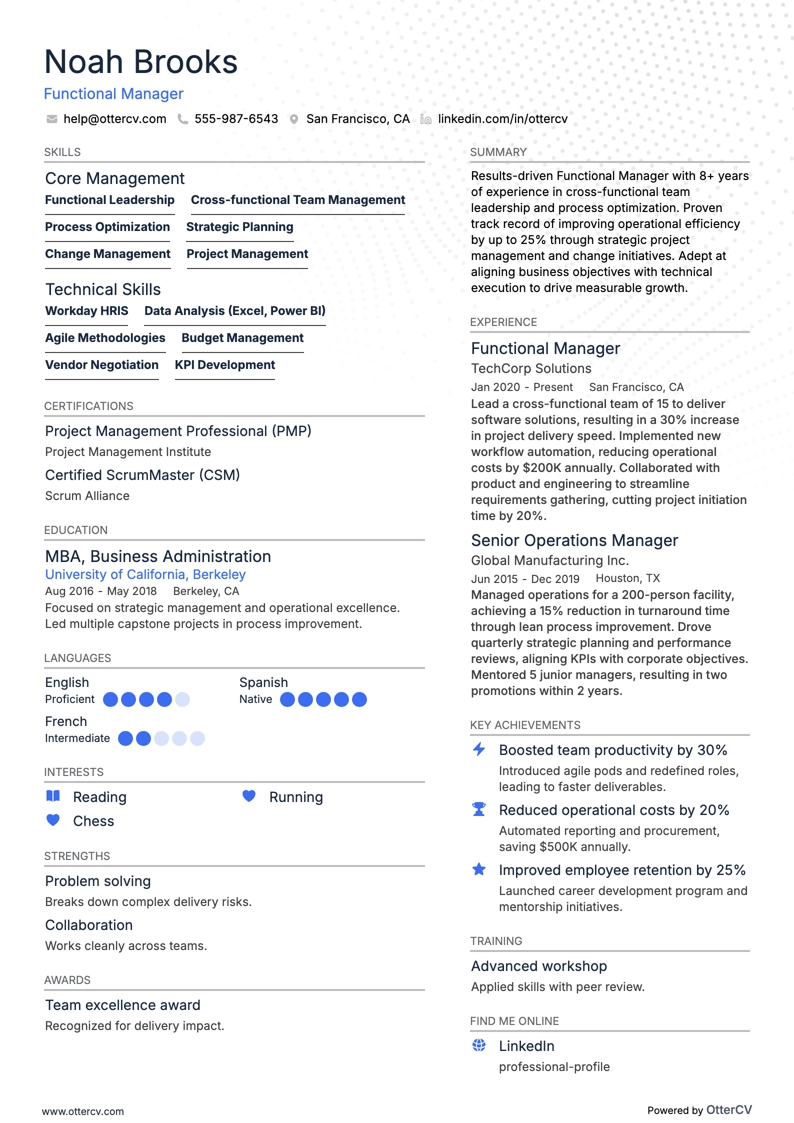
Lead Functional Manager full preview

10 Functional Manager Resume Examples

OtterCV

Written by The OtterCV Team

Updated: 12/6/2025•8 min read

See all resume examples in this guide, or generate your own resume example with your personalized prompt

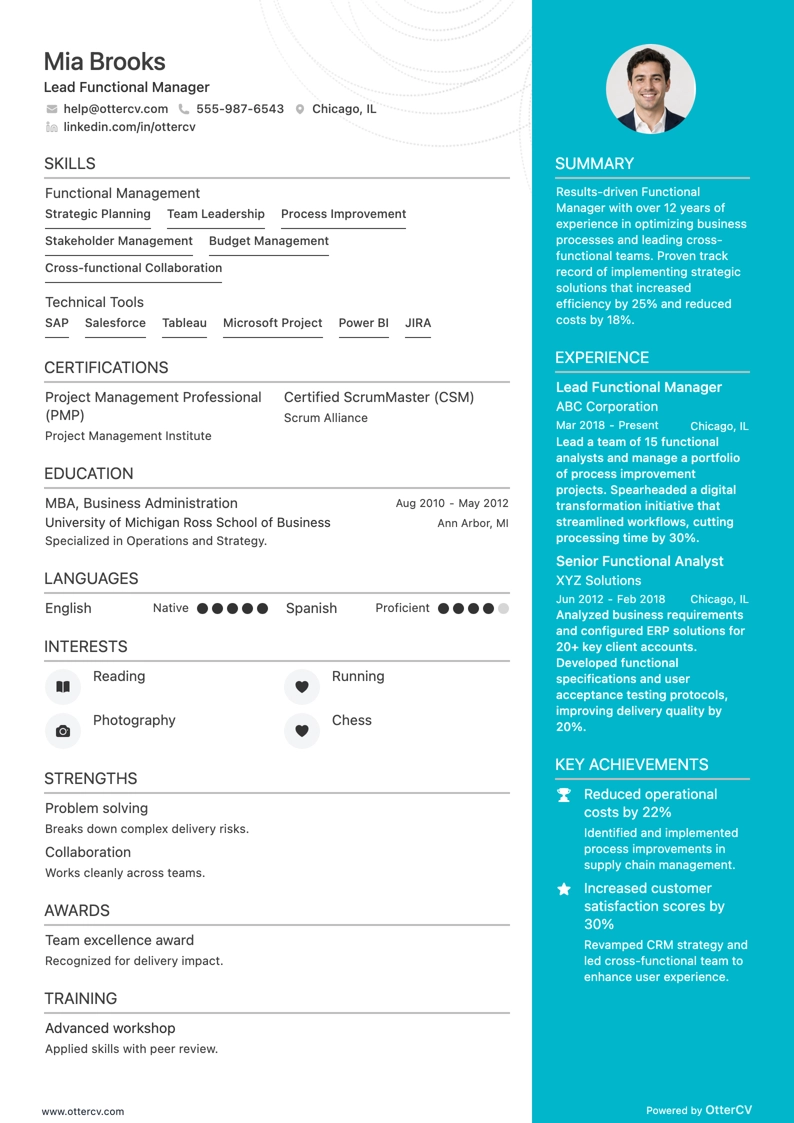
Lead Functional Manager resume example

Lead Functional Manager

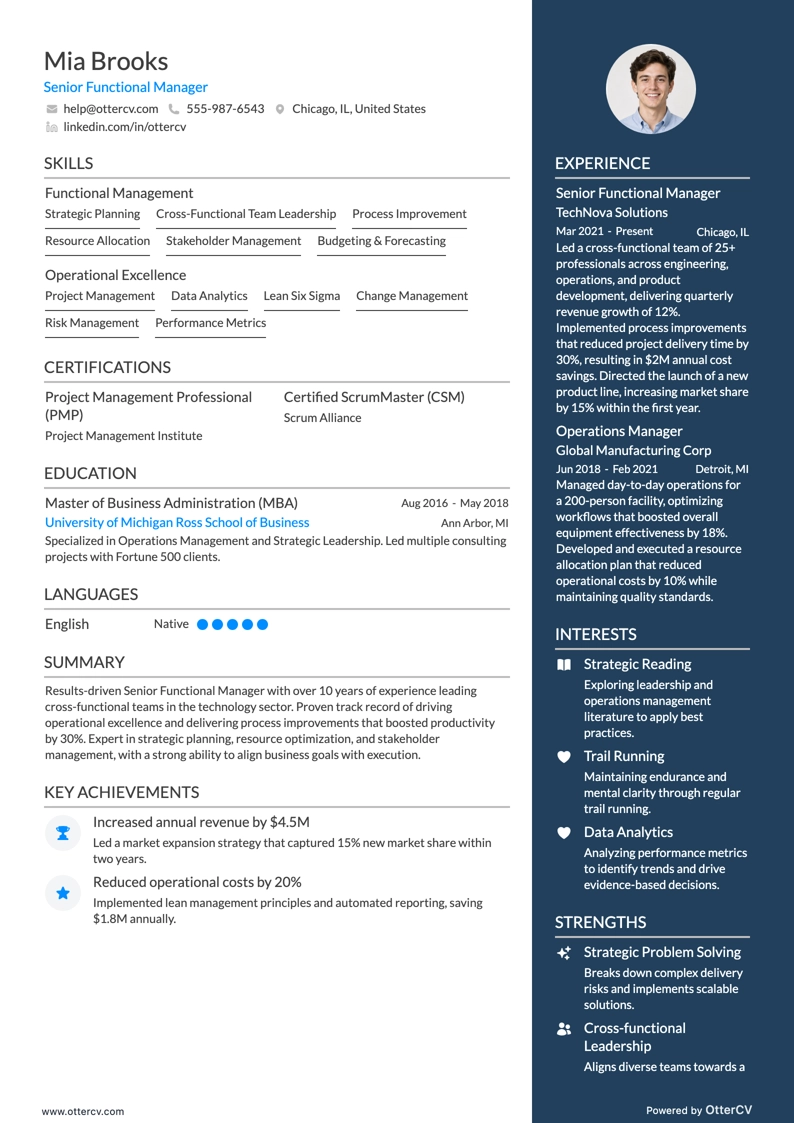
Senior Functional Manager resume example

Senior Functional Manager

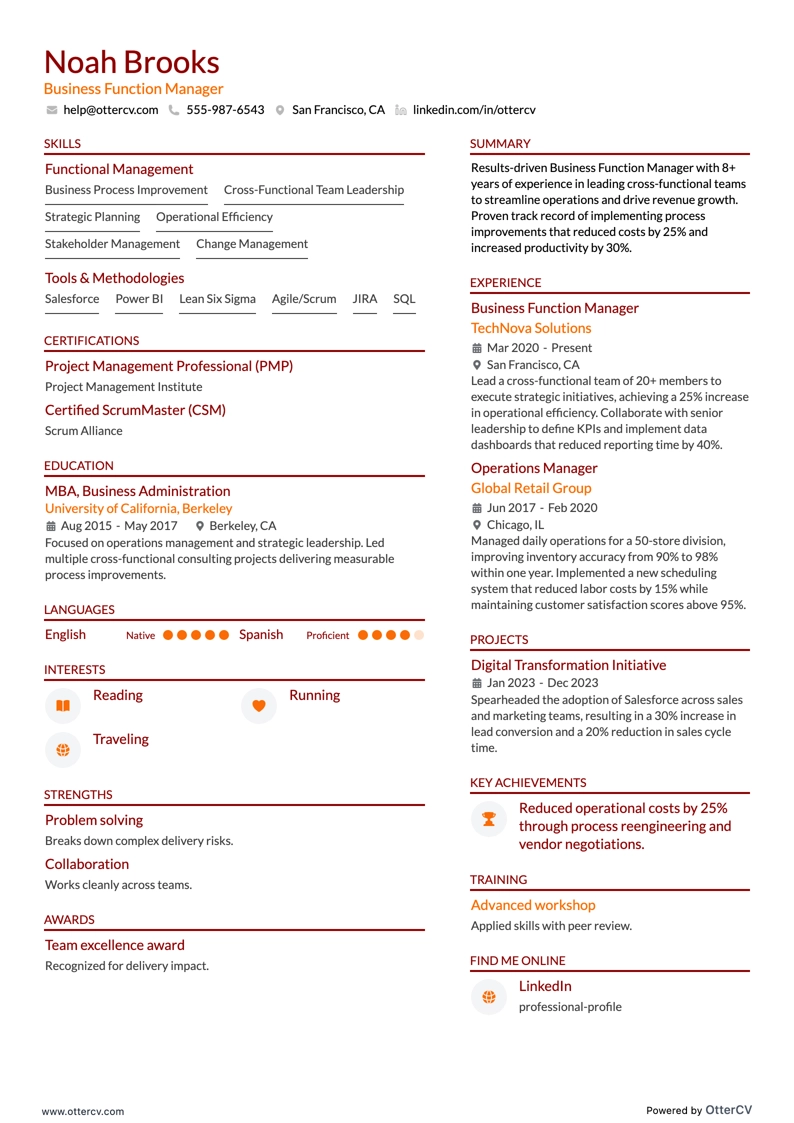
Business Function Manager resume example

Business Function Manager

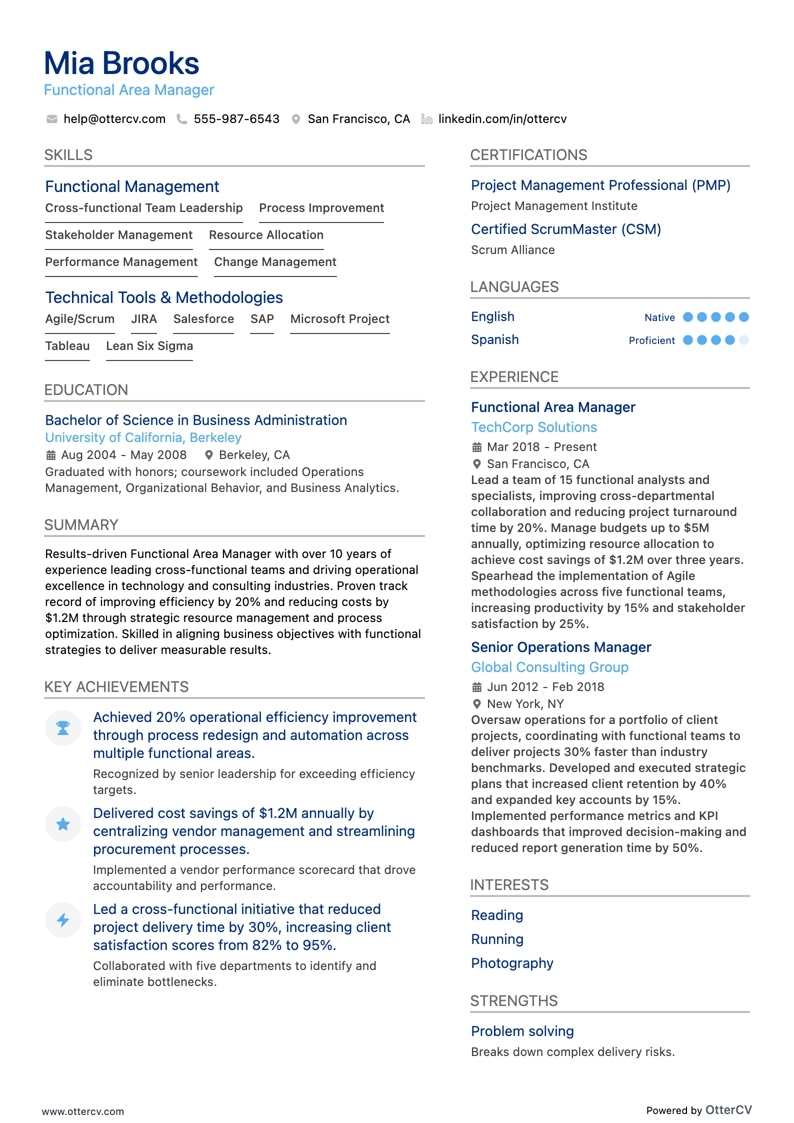
Functional Area Manager resume example

Functional Area Manager

Functional Manager resume example

Functional Manager

Functional manager resumes often fail when they read like job descriptions, causing your leadership impact to get lost in ATS screening and quick recruiter reviews. In a crowded market, that gap can eliminate you before you reach the interview stage.

A strong resume shows what you changed, improved, and delivered. Knowing how to make your resume stand out starts with highlighting measurable results such as cost reductions, cycle-time gains, on-time delivery rates, quality improvements, team size and budget scope, and customer or revenue impact.

Key takeaways

  • Use a reverse-chronological format to highlight your leadership progression and expanding scope.

  • Support every skill claim with a specific action and a measurable result.

  • Quantify achievements with cycle time, cost, quality, risk, and delivery metrics.

  • Tailor experience bullets to match the job posting’s language and priorities.

  • Keep your skills section balanced with roughly two-thirds hard skills and one-third soft skills.

  • Stop using AI once your resume accurately reflects your real experience, and never inflate claims.

  • Build your resume faster with Echocv to align structure, keywords, and impact for recruiter screening.

How to format a functional manager resume

Recruiters reviewing functional manager candidates look for clear evidence of cross-functional leadership, process ownership, and the ability to drive operational results across departments. Your resume format plays a direct role in how quickly a hiring manager can spot these strengths. If you choose the wrong structure, you can bury the progression and scope that matter most.

I have significant experience in this role—which format should I use?

I have significant experience in this role—which format should I use?

Use a reverse-chronological format to give recruiters a clear, immediate view of your leadership trajectory and expanding functional ownership.

Do:

  • Lead each role entry with your scope of responsibility, including team size, budget authority, and the number of functions or business units managed.
  • Highlight domain-specific expertise such as resource planning, cross-departmental coordination, P&L management, and enterprise tools like SAP, Jira, or Workday.
  • Quantify business impact with metrics tied to efficiency gains, cost reductions, revenue influence, or delivery timelines.

Example: “Led a 28-person cross-functional operations team across three business units, reducing project delivery cycle time by 34% and cutting annual operating costs by $1.2M through process standardization and vendor renegotiation.”

I'm junior or switching into this role—what format works best?

I'm junior or switching into this role—what format works best?

A hybrid resume format works best because it highlights transferable skills and relevant competencies while still providing enough work history to show professional credibility.

Do:

  • Place a focused skills section near the top of your resume, grouping competencies by category, such as team coordination, process improvement, and stakeholder communication.
  • Include project-based experience, cross-functional task force participation, or interim leadership roles that demonstrate management readiness.
  • Connect every skill claim to a specific action and a measurable or observable result.

Example scaffold: Process optimization (skill) → redesigned the client onboarding workflow across two departments (action) → reduced average onboarding time from 14 days to six days (result).

Why not use a functional resume?

Why not use a functional resume?

A functional resume removes the timeline and context that show you can manage people, processes, and outcomes consistently—the exact evidence hiring managers use to trust you with functional authority.

A functional format may be worth considering only in limited situations:

  • You're moving into functional management from a specialist or individual contributor path and need to highlight leadership-adjacent skills.
  • You have a gap of one year or more in your work history but can point to relevant volunteer, consulting, or project-based management experience.

Functional resumes often trigger skepticism from both recruiters and applicant tracking systems, so avoid this format if you have any continuous management or supervisory experience to show. Even in edge cases, every skill should be tied to a specific project, initiative, or outcome—standalone skill lists without context can weaken your candidacy.

Now that you’ve established a clean, readable layout, it’s time to fill each part of your resume with the right content.

What sections should go on a functional manager resume

Recruiters expect a functional manager resume to show clear leadership impact, operational scope, and measurable results. Including the right resume sections helps present that information clearly:

  • Header
  • Summary
  • Experience
  • Skills
  • Projects
  • Education
  • Certifications
  • Optional sections: Awards, Leadership, Languages

Your experience bullets should emphasize the outcomes you delivered, the scope you managed, and the impact you drove across people, process, and performance.

Once you’ve organized the key elements of your resume, the next step is to write your functional manager resume experience in a way that supports that structure and clearly highlights your impact.

How to write your functional manager resume experience

Your experience section should show that you can move work from strategy to execution across a functional area. Hiring managers care more about demonstrated impact—initiatives you shipped, tools and methods you used, and measurable outcomes—than task lists that only describe day-to-day responsibilities.

Each entry should include:

  • Job title
  • Company and location (or remote)
  • Dates of employment (month and year)

Add three to five concise bullet points that explain what you owned, how you executed, and what outcomes you delivered:

  • Ownership scope: the functional processes, teams, budgets, or operational areas you were directly accountable for as a functional manager.
  • Execution approach: the frameworks, planning methodologies, reporting tools, or governance structures you used to prioritize work, allocate resources, and drive decisions within your function.
  • Value improved: the specific changes in quality, efficiency, compliance, turnaround time, or risk posture your leadership produced for the function and the broader organization.
  • Collaboration context: how you partnered with leaders in other departments, senior executives, vendors, or external stakeholders to align your function’s output with company-wide objectives.
  • Impact delivered: the business outcomes your functional leadership created, expressed through results, scale, or strategic contribution rather than a summary of activities performed.

Experience bullet formula

Experience bullet formula

Action verb + technology + what you built or fixed + measurable result

A functional manager experience example

Functional Manager, Customer Operations

Northbridge Health | Austin, TX

2021–Present

Digital health provider supporting two million members with a multi-channel support and claims resolution operation.

  • Led a 32-person customer operations team across chat, email, and phone using Zendesk, Talkdesk, and Jira, improving first-contact resolution by 18% and reducing average handle time by 12% in two quarters.
  • Implemented workforce management in NICE CXone and rebuilt scheduling and forecasting models, increasing schedule adherence from 84% to 93% and cutting overtime spend by 22%.
  • Partnered with product managers, designers, and engineers to launch self-serve workflows and knowledge base governance in Confluence and Zendesk Guide, deflecting 14% of inbound tickets and saving 1,100 agent hours per quarter.
  • Built KPI dashboards in Looker and Salesforce Service Cloud, standardizing weekly business reviews and coaching plans, lifting customer satisfaction from 4.2 to 4.6 and reducing reopen rate by 9%.
  • Strengthened quality and compliance by deploying scorecards, call calibration, and HIPAA-aligned audit trails, reducing critical errors by 31% and passing two external audits with zero major findings.

Now that you’ve seen how to structure your experience entries, the next step is adjusting them for the specific functional manager role you’re targeting.

How to tailor your functional manager resume experience

Recruiters assess your functional manager resume through both human review and applicant tracking systems (ATS). Tailoring your experience section to match the job posting can improve your chances of getting through both screening steps.

Ways to tailor your functional manager experience:

  • Match the resource planning tools or systems named in the posting.
  • Use the same terminology for cross-functional workflows.
  • Reflect the KPIs or performance benchmarks the role emphasizes.
  • Highlight experience with the staffing models or team structures described.
  • Include domain expertise when the posting specifies an industry.
  • Align your process improvement language with the methodologies mentioned.
  • Emphasize compliance or quality assurance responsibilities when they are referenced.
  • Showcase collaboration frameworks that match the reporting structure described.

Tailoring means aligning your real accomplishments with the language and priorities of the job posting, not forcing in keywords where they do not belong.

Resume tailoring examples for functional manager

Job description excerptUntailoredTailored
"Lead cross-functional teams to deliver product launches on time and within budget using Agile methodology and Jira for project tracking."Managed teams and helped complete projects on schedule.Led cross-functional teams of 14 across engineering, marketing, and supply chain to deliver six product launches within budget, using Agile sprints tracked in Jira to cut time-to-market by 18%.
"Oversee departmental P&L, drive cost optimization initiatives, and report performance metrics to senior leadership using SAP and Tableau dashboards."Responsible for budgeting and reporting financial results to leadership.Managed a $4.2M departmental P&L, identifying cost optimization opportunities that reduced operating expenses by 12% year over year while building Tableau dashboards connected to SAP data for monthly executive performance reviews.
"Develop and execute workforce planning strategies, reduce attrition, and partner with HR to build succession pipelines for critical roles."Helped with hiring and worked to keep employees from leaving.Partnered with HR to design a succession pipeline covering 11 critical roles, implementing quarterly talent reviews and individualized development plans that lowered attrition from 22% to 13% within 18 months.

Once you’ve aligned your experience with the role’s priorities, quantify your functional manager achievements to show the measurable impact behind those responsibilities.

How to quantify your functional manager achievements

Quantifying your impact shows how your team improved outcomes, not just activity. Track cycle time, quality, cost, risk, and delivery reliability, then tie each result to scope, tools, and the business goal.

Quantifying examples for functional manager

MetricExample
Cycle timeCut approval cycle time from 12 days to seven by redesigning intake in Jira and adding service-level agreements across eight stakeholders.
Quality accuracyReduced rework rate from 18% to 9% by introducing checklists, peer reviews, and weekly audits across a 22-person operations team.
Cost efficiencyLowered vendor spend by $180K annually by consolidating three contracts and renegotiating rates using quarterly performance scorecards.
Risk complianceImproved audit pass rate from 84% to 98% by standardizing evidence collection in SharePoint and closing 31 control gaps in one quarter.
Delivery reliabilityRaised on-time delivery from 76% to 92% by implementing capacity planning in Smartsheet and weekly burn-down reviews for 15 concurrent projects.

Once you've written strong experience bullets, apply the same precision to how you present your hard and soft skills on a functional manager resume.

How to list your hard and soft skills on a functional manager resume

Your skills section shows how you lead a function. Recruiters and an ATS (applicant tracking system) scan it quickly to confirm fit, so aim for a balance of roughly two-thirds hard skills and one-third soft skills.

Functional manager roles require a blend of:

  • Product strategy and discovery skills.
  • Data, analytics, and experimentation skills.
  • Delivery, execution, and go-to-market discipline.
  • Soft skills.

Your skills section should be:

  • Scannable, using bullet-style grouping.
  • Relevant to the job post.
  • Backed by proof in your experience bullets.
  • Updated with current tools.

Place your skills section:

  • Above experience if you're junior or switching careers.
  • Below experience if you're mid/senior with strong achievements.

Hard skills

  • Roadmap development and prioritization.
  • OKR and KPI design.
  • Agile delivery using Scrum and Kanban.
  • Stakeholder requirements management.
  • Business case development.
  • Budgeting and forecasting.
  • Resource and capacity planning.
  • Cross-functional operating cadence.
  • Process mapping and SOP development.
  • Risk management and mitigation.
  • SQL, Excel, Tableau, and Power BI.
  • Jira, Confluence, and Asana.

Soft skills

  • Align stakeholders on priorities.
  • Lead through influence.
  • Make trade-off decisions quickly.
  • Set clear expectations.
  • Communicate executive-ready updates.
  • Run effective cross-functional meetings.
  • Resolve conflict and unblock teams.
  • Coach and develop direct reports.
  • Delegate effectively and follow through.
  • Hold teams accountable for outcomes.
  • Negotiate scope and timelines.
  • Drive continuous improvement routines.

How to show your functional manager skills in context

Skills should not appear only in a bulleted list on your resume. For inspiration, review how other professionals present their resume skills.

Your skills should be demonstrated in:

  • Your summary, which shows your high-level professional identity
  • Your experience, which proves your skills through outcomes

Here is what strong functional manager examples look like in practice.

Summary example

Functional manager with 12 years of experience in supply chain operations, with strengths in cross-departmental coordination, SAP ERP, and Lean Six Sigma. Reduced fulfillment cycle times by 31% while leading a 45-person team through two major process overhauls.

  • Clearly reflects senior-level experience
  • Names tools and methods relevant to the role
  • Includes a concrete, measurable outcome
  • Signals leadership and collaboration strengths

Experience example

Senior Functional Manager

Bridgewell Logistics | Charlotte, NC

March 2019–Present

  • Restructured inventory workflows using SAP ERP, reducing order processing errors by 24% across three distribution centers.
  • Partnered with engineering and procurement teams to implement Lean Six Sigma initiatives, generating $1.2M in annual savings.
  • Coached and developed 38 direct reports through quarterly performance reviews, improving team retention by 19%.
  • Every bullet includes measurable proof.
  • Skills surface naturally through real outcomes.

Once you’ve connected your management strengths to real responsibilities and results, use the same approach to build a functional manager resume even if you don’t have direct experience.

How do I write a functional manager resume with no experience

Even without full-time experience, you can show that you’re ready through:

  • Capstone operations improvement project
  • Internship leading cross-functional deliverables
  • Volunteer program budget and reporting
  • Student organization process redesign
  • Case competition strategy and metrics
  • Freelance client workflow implementation
  • Certification project with dashboards
  • Part-time lead scheduling and KPIs

If you're building a resume without work experience, focus on:

  • Quantified outcomes and business impact
  • Tools, systems, and reporting cadence
  • Process improvements with clear baselines
  • Ownership scope and stakeholder alignment

Resume format tip for entry-level functional manager

Resume format tip for entry-level functional manager

Use a combination resume format. It emphasizes transferable skills and measurable projects while keeping limited work history clear and credible.

Do:

  • Lead with a summary of functional manager skills.
  • Add a Projects section above Experience.
  • Use action verbs and measurable results.
  • Name tools such as Excel, SQL, Tableau, and Asana.
  • Match keywords to the job posting.

Example project bullet:

  • Led a capstone operations improvement project, built a Tableau dashboard and KPI cadence, and cut order cycle time by 18% over eight weeks.

Even without direct experience, your education section can show the foundational knowledge and leadership training that support your fit for a functional manager role.

How to list your education on a functional manager resume

Your education section helps hiring teams confirm that you have the core knowledge required. It validates your qualifications and signals readiness for functional manager responsibilities.

Include:

  • Degree name
  • Institution
  • Location
  • Graduation year
  • Relevant coursework (for juniors or entry-level candidates)
  • Honors and GPA (if 3.5 or higher)

For a cleaner format, avoid listing specific months or days. Use the graduation year only.

Here’s a strong education entry tailored for a functional manager resume:

Example education entry

Bachelor of Science in Business Administration

University of Michigan, Ann Arbor, MI

Graduated: 2018

GPA: 3.7/4.0

  • Relevant Coursework: Operations Management, Organizational Behavior, Strategic Planning, Cross-Functional Leadership
  • Honors: Magna Cum Laude, Dean's List (six consecutive semesters)

How to list your certifications on a functional manager resume

Certifications show a functional manager's commitment to learning, proficiency with tools, and alignment with industry standards, especially when your work history appears later on the page.

Include:

  • Certificate name
  • Issuing organization
  • Year
  • Optional: credential ID or URL
  • Place certifications below education when they're older, less relevant, or you already have strong, recent education credentials.
  • Place certifications above education when they're recent, highly relevant to the target role, or they support the skills featured in your summary.

Best certifications for your functional manager resume

  • Project Management Professional (PMP)
  • Certified ScrumMaster (CSM)
  • Lean Six Sigma Green Belt
  • ITIL 4 Foundation
  • Prosci Certified Change Practitioner
  • SHRM Certified Professional (SHRM-CP)
  • Google Project Management Professional Certificate

How to write your functional manager resume summary

Once your certifications are easy to verify, use your functional manager resume summary to highlight those qualifications upfront and connect them to the role.

Your resume summary is often the first thing a recruiter reads. A strong summary quickly shows that you can lead cross-functional teams and deliver results.

Keep it to three to four lines and include:

  • Your title and total years of experience in functional or cross-functional management.
  • The domain, industry, or product type you have worked in most recently.
  • Core tools, methodologies, or skills such as Agile, Lean, or workforce planning.
  • One or two quantified achievements that show measurable business impact.
  • Soft skills tied to real outcomes, such as stakeholder alignment that reduced project delays.

PRO TIP

For a mid-level role, emphasize specific skills, tools, and measurable contributions to team or department goals.

Show how you improved processes or increased efficiency using numbers whenever possible.

Avoid vague phrases like “passionate leader” or “results-driven professional.” Recruiters want proof, not personality descriptors.

Example summary for a functional manager

Functional manager with six years of experience leading operations teams in SaaS. Skilled in Agile and workforce planning. Reduced departmental costs by 18% through streamlined resource allocation and cross-team coordination.

Now that your summary highlights your leadership strengths and cross-functional expertise, make sure your resume header includes the contact details hiring managers need to reach you.

What to include in a functional manager resume header

A resume header presents your core identity and contact information. For a functional manager, it can improve search visibility, reinforce credibility, and help you pass recruiter screening more quickly.

Essential resume header elements

  • Full name
  • Tailored job title and headline
  • Location
  • Phone number
  • Professional email
  • GitHub link
  • Portfolio link
  • LinkedIn

A LinkedIn link helps recruiters quickly confirm your roles, dates, and recommendations, which can support faster screening decisions.

Do not include a photo on a functional manager resume unless the role is explicitly front-facing or appearance-dependent.

Match your header job title to the posting, and keep the formatting consistent so recruiters can scan and save your details without errors.

Once your header clearly establishes your identity and key contact details, you can strengthen the rest of your application by adding relevant optional sections.

Additional sections for functional manager resumes

Extra resume sections can help a functional manager stand out when core qualifications are similar across candidates. They add role-specific credibility and show well-rounded expertise.

  • Languages
  • Certifications and professional development
  • Cross-functional project leadership
  • Industry publications or presentations
  • Professional affiliations and board memberships
  • Volunteer leadership experience
  • Technical tools and platforms proficiency

Once you've rounded out your resume with the right supplementary sections, the next step is pairing it with a strong cover letter to complete your application.

Do functional manager resumes need a cover letter

A cover letter isn't required for a functional manager, but it can help in competitive searches or when hiring teams expect one. If you're unsure what a cover letter is and how it complements your resume, it can make a difference when your resume needs more context or when you want to show clear role fit quickly.

Use a cover letter to add context your resume can't:

  • Explain role and team fit by naming the function, scope, stakeholders, and how you'll support the manager's goals.
  • Highlight one or two relevant projects or outcomes, and connect them to the role's priorities and success metrics.
  • Show you understand the product, users, or business context by referencing a specific challenge and how you'd approach it.
  • Address career transitions or non-obvious experience by linking past work to the functional manager role's core responsibilities.

Using AI to improve your functional manager resume

Even if you skip a cover letter and let your resume carry the narrative, AI can help sharpen that message and align it with what hiring teams scan for.

AI can improve your resume's clarity, structure, and impact. It can tighten language and highlight results, but overusing it can strip away authenticity. Once your content feels clear and aligned with the role, step away from AI. For practical guidance, explore these ChatGPT resume writing prompts to get started.

Here are 10 practical prompts to strengthen specific sections of your functional manager resume:

  1. Strengthen your summary. “Rewrite my functional manager resume summary to emphasize cross-departmental leadership and measurable operational outcomes in under four sentences.”
  2. Quantify experience bullets. “Add specific metrics and results to each experience bullet on my functional manager resume without inventing data I haven't provided.”
  3. Tighten skills phrasing. “Refine the skills section of my functional manager resume so each entry reflects hands-on expertise rather than generic competencies.”
  4. Align with job postings. “Compare my functional manager resume experience section against this job description and flag gaps in keyword alignment.”
  5. Improve action verbs. “Replace weak or repetitive action verbs in my functional manager resume bullets with stronger, more precise alternatives.”
  6. Clarify project contributions. “Rewrite the projects section of my functional manager resume to clearly define my role, scope, and measurable deliverables.”
  7. Sharpen education relevance. “Edit my functional manager resume education section to highlight coursework and achievements directly relevant to operational leadership.”
  8. Spotlight certifications impact. “Rewrite my functional manager resume certifications section to briefly connect each credential to real workplace application.”
  9. Remove filler language. “Identify and remove vague or unnecessary words throughout my functional manager resume while preserving original meaning.”
  10. Improve overall readability. “Restructure long or complex sentences across my functional manager resume so every bullet is concise and scannable.”

Stop using AI once your resume sounds accurate, specific, and aligned with your real experience. AI should never invent experience or inflate claims—if it didn't happen, it doesn't belong here.

Conclusion

A strong functional manager resume shows measurable results, role-specific skills, and a clear structure. It connects your achievements to business goals with numbers, scope, and timelines while staying focused, easy to scan, and consistent from summary through experience.

Hiring teams want proof that you can lead teams, manage priorities, and deliver results. When your functional manager resume highlights impact and core skills in a clean format, it shows you are ready for today’s market and able to adapt as expectations change.

Functional Manager resume examples

Explore additional Functional Manager resume samples and guides and see what works for your level of experience or role.

By Experience

Lead Functional Manager

Lead Functional Manager resume preview

Senior Functional Manager

Senior Functional Manager resume preview

Functional Manager resume examples

Explore additional Functional Manager resume samples and guides and see what works for your level of experience or role.

By Role

Business Function Manager

Business Function Manager resume preview

Functional Area Manager

Functional Area Manager resume preview

Functional Manager

Functional Manager resume preview