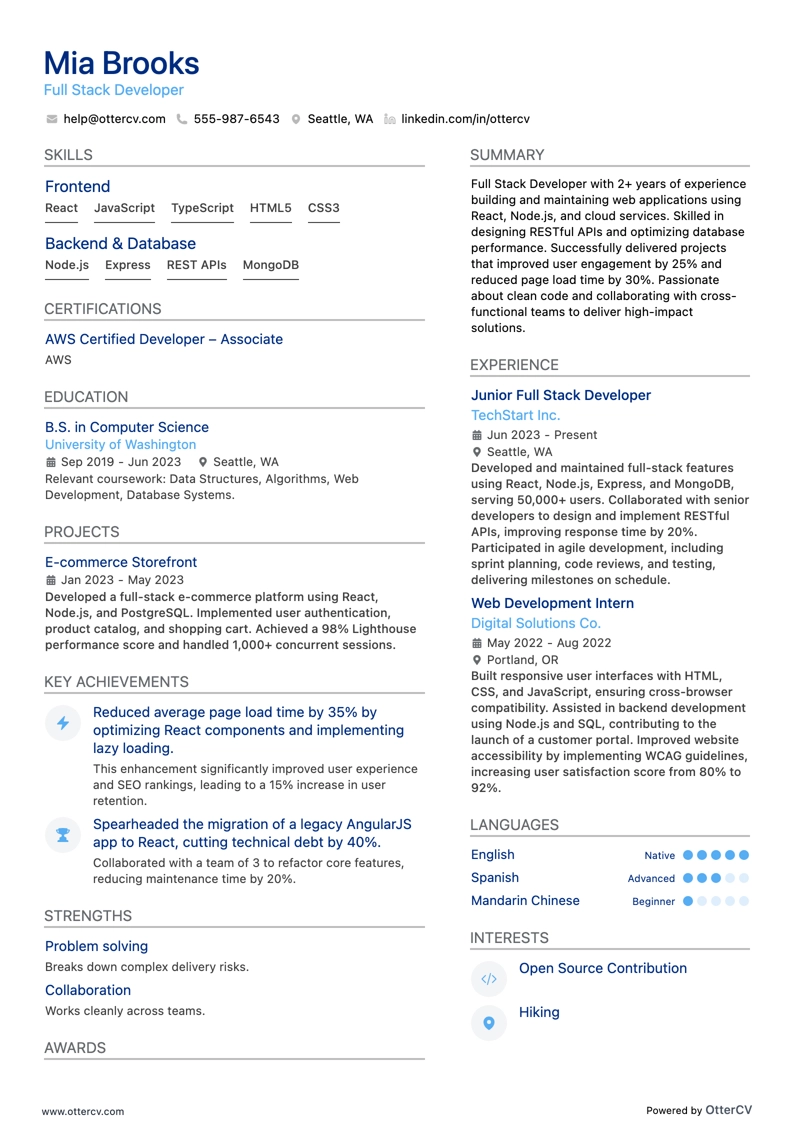
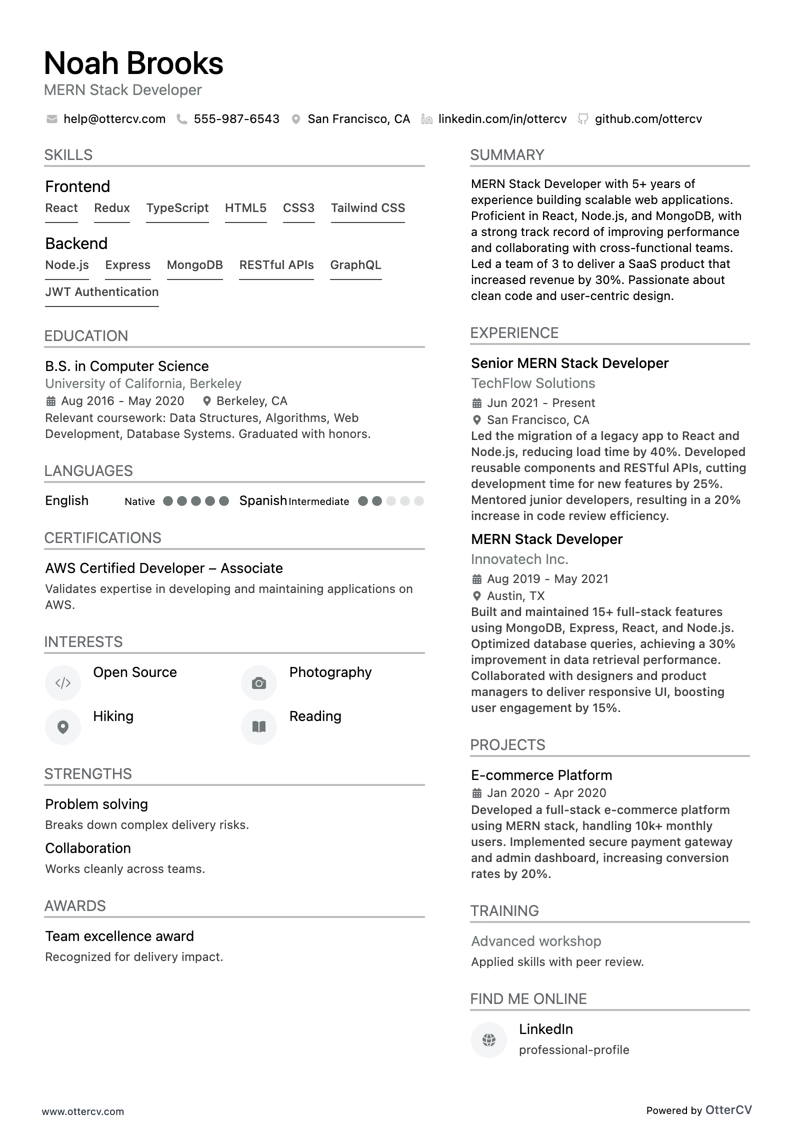
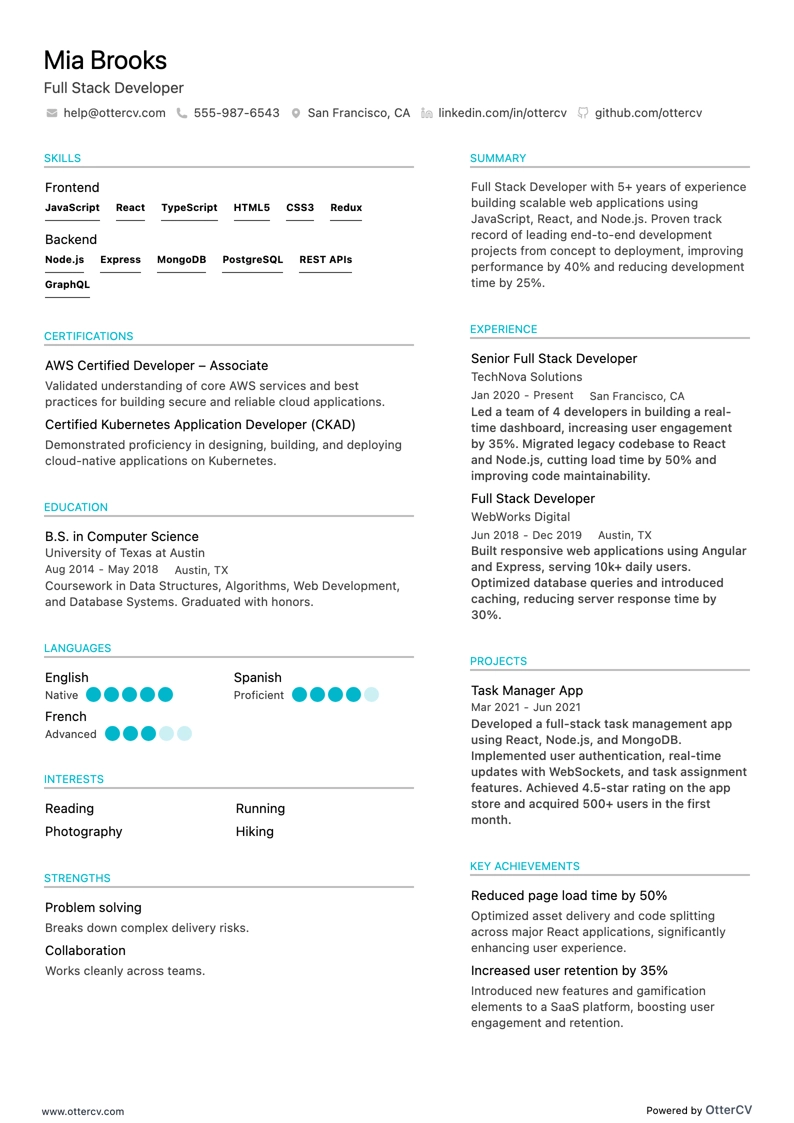
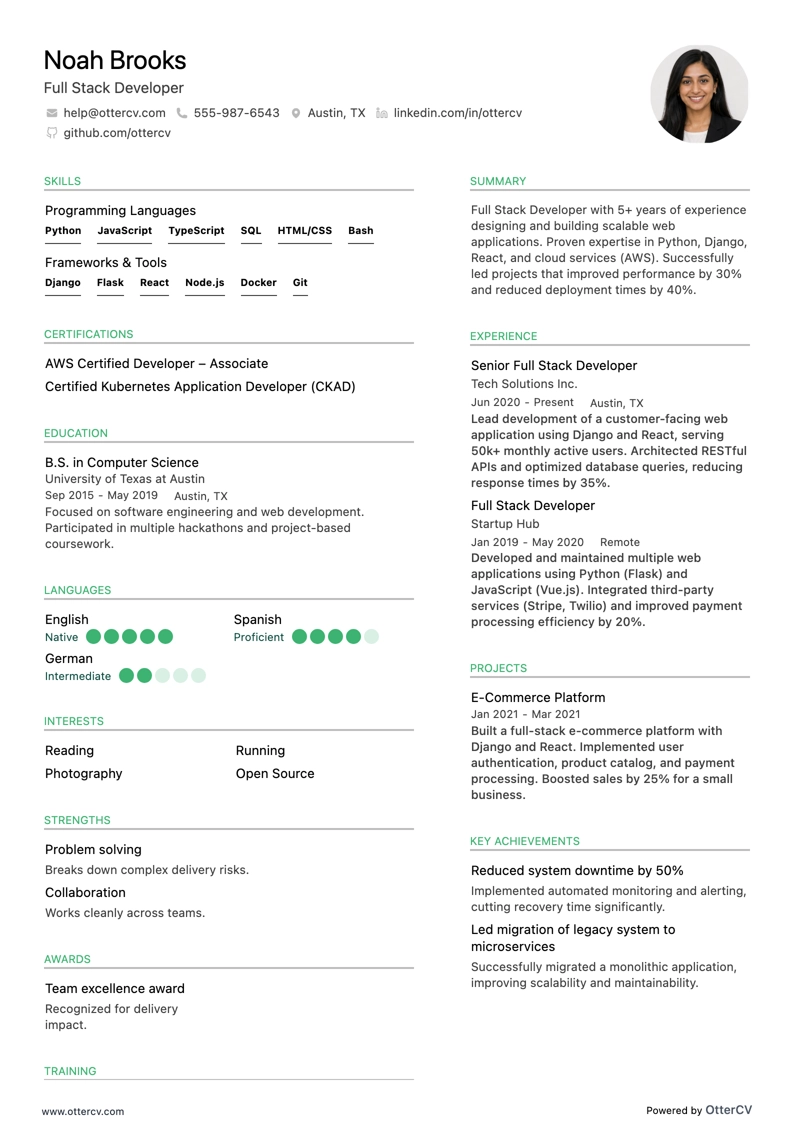
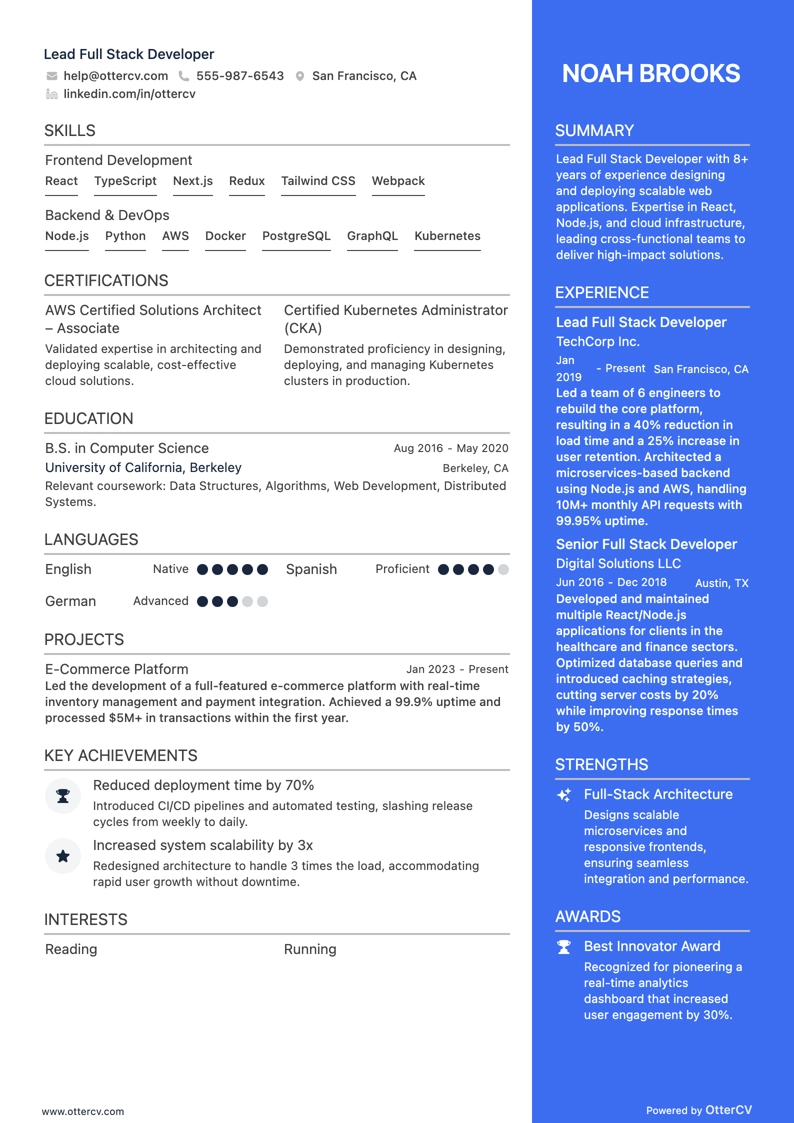
Lead Full Stack Developer full preview

13 Full-Stack Developer Resume Examples

OtterCV

Written by The OtterCV Team

Updated: 8/21/2023•8 min read

See all resume examples in this guide, or generate your own resume example with your personalized prompt

Lead Full Stack Developer resume example

Lead Full Stack Developer

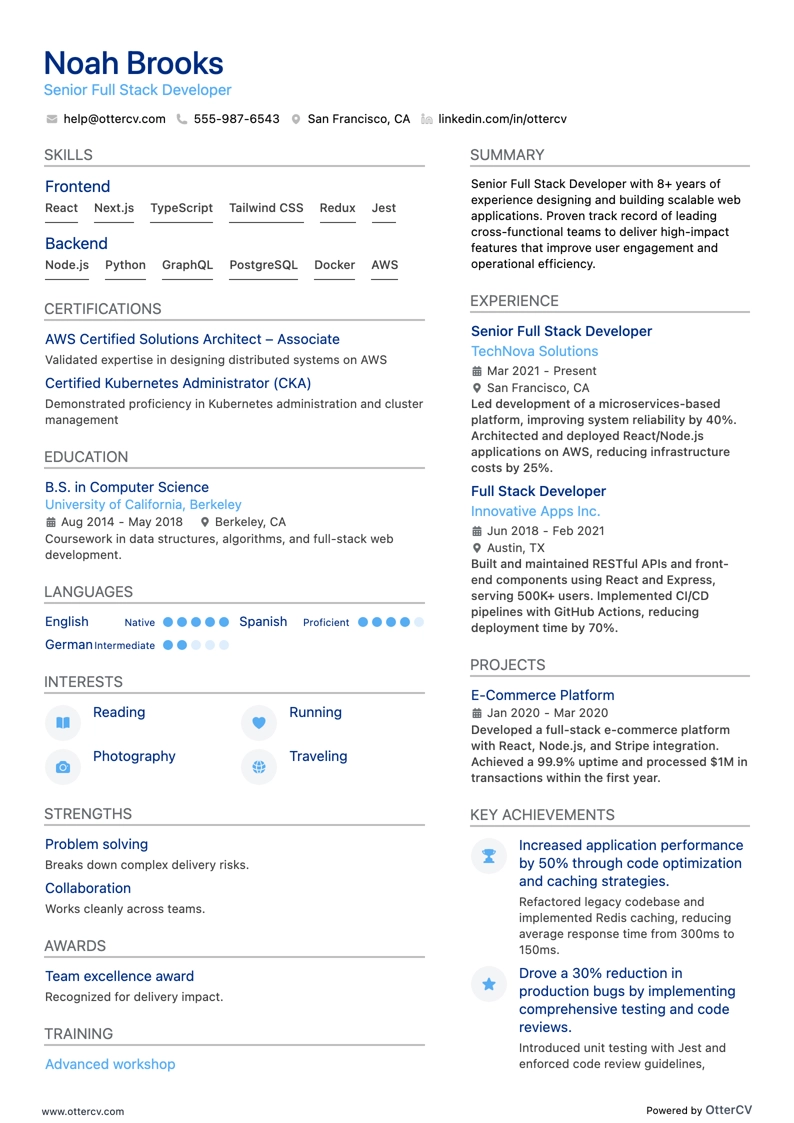
Senior Full Stack Developer resume example

Senior Full Stack Developer

Junior Full Stack Developer resume example

Junior Full Stack Developer

MERN Stack Developer resume example

MERN Stack Developer

JavaScript Full Stack Developer resume example

JavaScript Full Stack Developer

Python Full Stack Developer resume example

Python Full Stack Developer

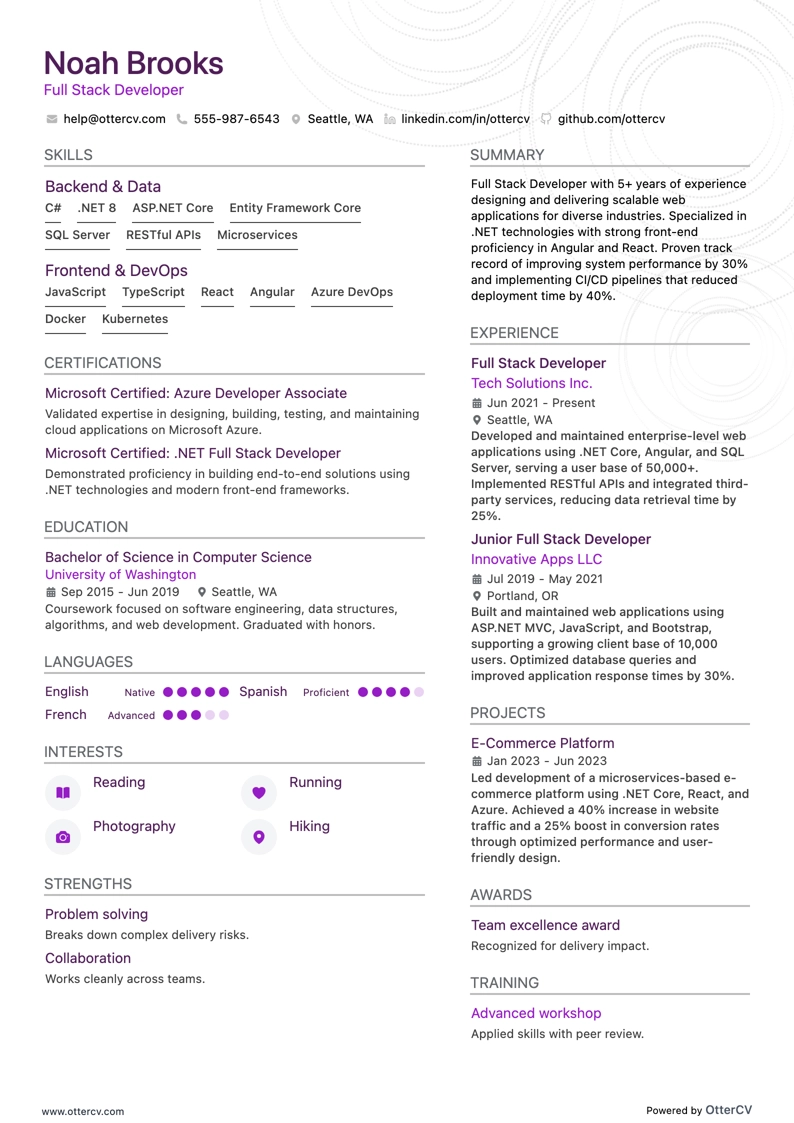
.NET Full Stack Developer resume example

.NET Full Stack Developer

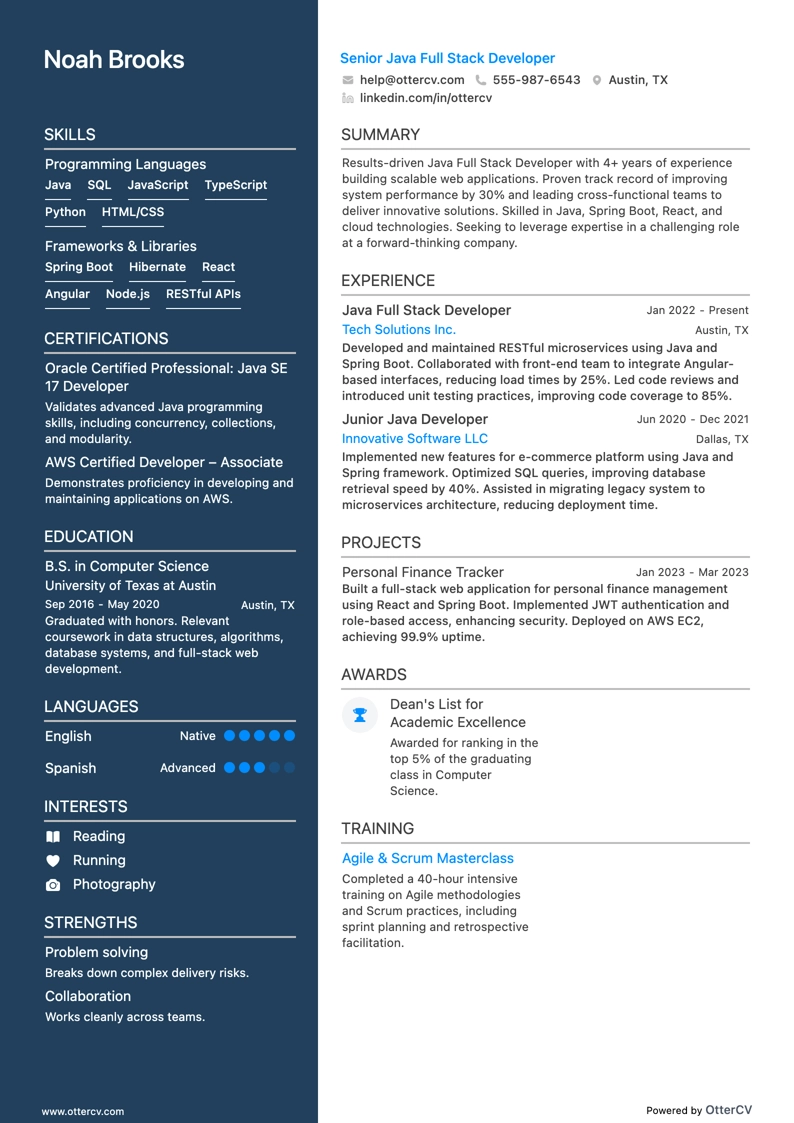
Java Full Stack Developer resume example

Java Full Stack Developer

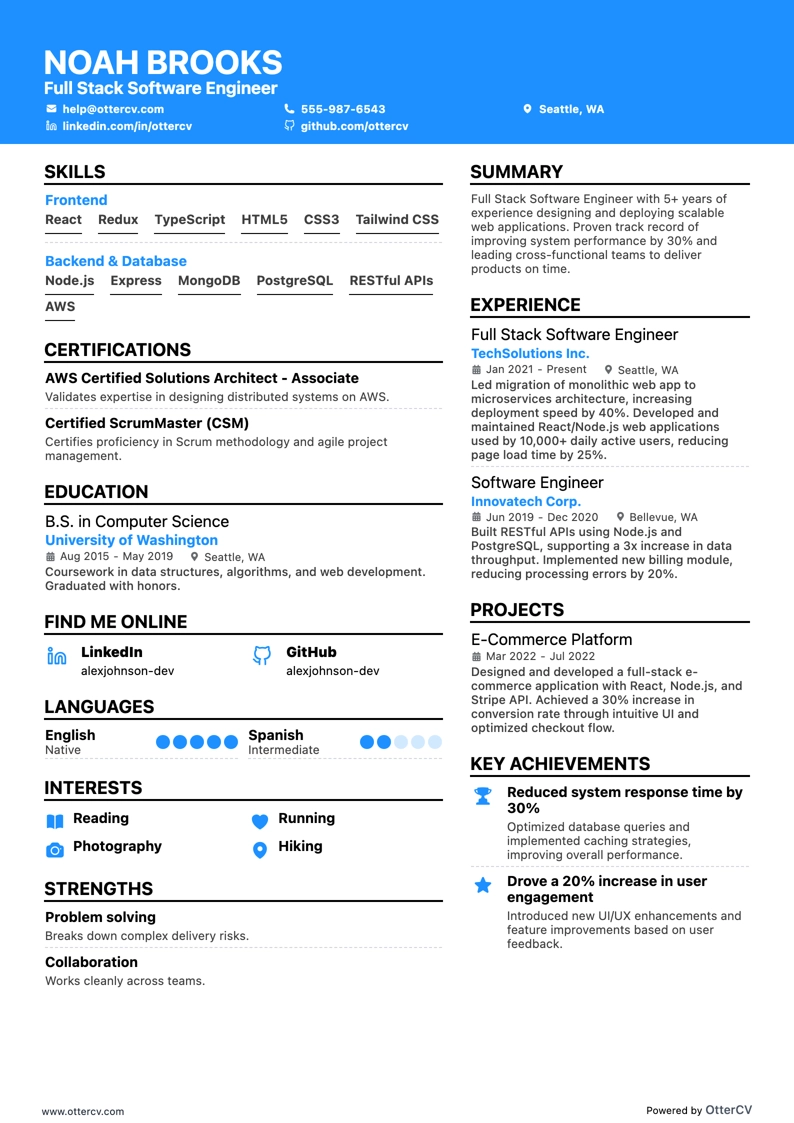
Full Stack Software Engineer resume example

Full Stack Software Engineer

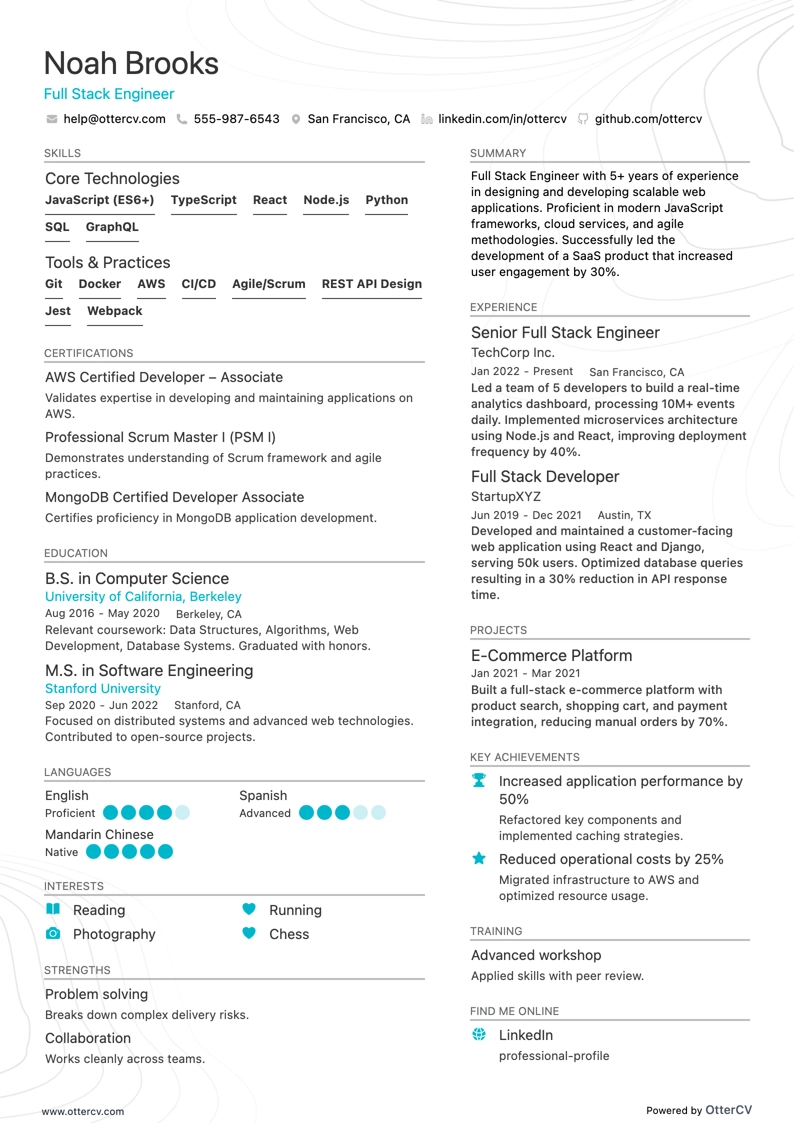
Full Stack Engineer resume example

Full Stack Engineer

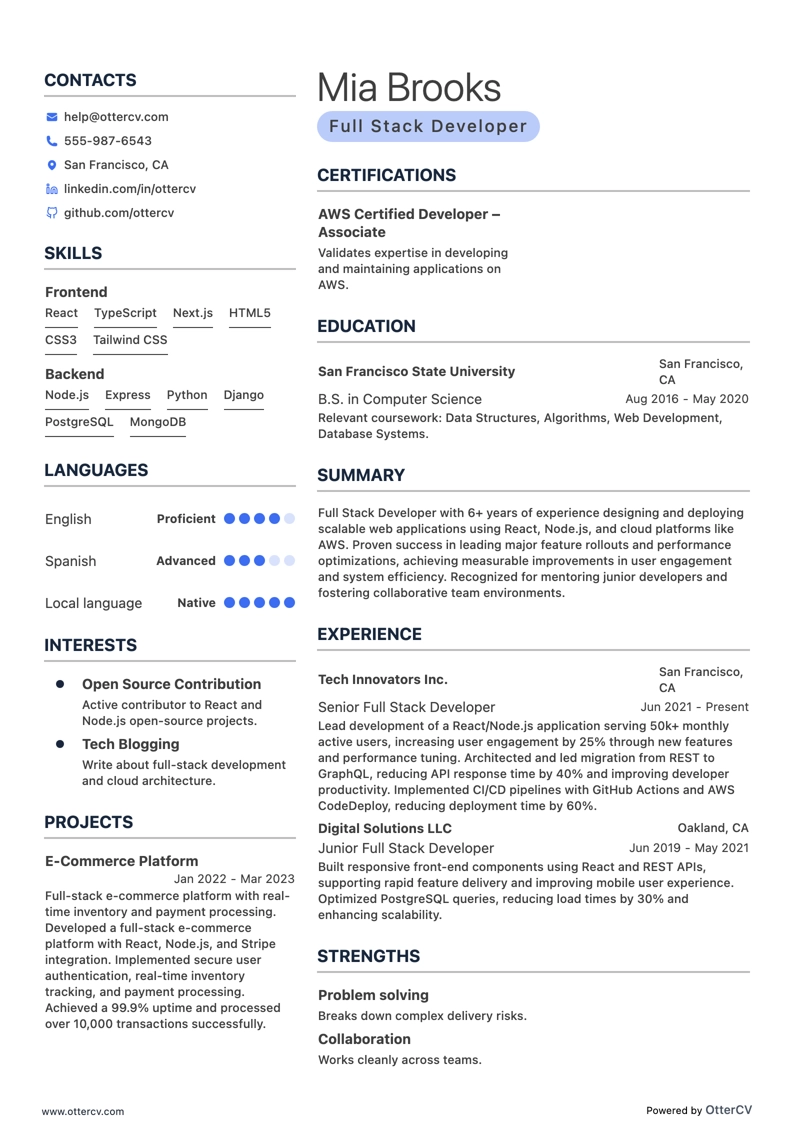
Full Stack Developer resume example

Full Stack Developer

Full-stack developers work at the intersection of design and infrastructure, building products that run smoothly from concept to launch. You may move easily between front-end polish and back-end logic, but showing that full range on a resume can be difficult.

Recruiters want more than a list of frameworks and tools. They need to understand how your skills lead to results. Too often, resumes get buried in technical detail and overlook the bigger picture: apps launched, performance improved, and teams aligned.

This guide shows you how to present the full stack of your impact so hiring managers can see it clearly.

Key takeaways

  • Use a hybrid resume format to highlight both your skills and career progression; choose a functional format if you are just starting out.

  • Arrange sections logically so skills, projects, and achievements are easy to scan alongside your work history.

  • Quantify your impact with results such as uptime, load time, or user growth instead of only listing duties.

  • Work soft skills into your summary or experience bullet points.

  • Use Echocv tools such as the Resume Checker and Tailoring Tool to improve structure and tailor your resume to each job ad.

Ready to deploy your own career story? Explore these full-stack developer resume examples built for different roles and goals.

How to choose the best full-stack developer resume format

The best tech resumes do more than list what you know—they show how you’ve applied it. For full-stack developers, that means choosing a format that makes your technical range and the results of your work easy to see.

Recruiters should be able to follow the full story: the projects you’ve owned, the value you’ve delivered, and how your skills match the role. The right format should make your capabilities clear at a glance, even for non-technical recruiters.

Which resume format should a full-stack developer use?

The combination (hybrid) format is the best choice for full-stack developers. It puts your technical skills front and center while still giving you space to highlight projects, results, and career growth. This balance helps recruiters quickly scan your core competencies without missing the bigger picture.

99% of the time, you should choose the combination resume. This format works for almost any candidate applying for almost any IT job.

—— Baron Fendler, author of How to Write an Amazing IT Resume

If you’re just starting out as a full-stack developer, the functional format can be a smart alternative. Instead of emphasizing limited work history, it brings your skills, projects, and training to the forefront.

For someone fresh out of a bootcamp or with strong personal projects but no professional titles yet, this format helps show that you can code, collaborate, and deliver, even if you haven’t officially held the title before.

What sections should go on a resume for full-stack developers?

In a hybrid resume, a full-stack developer with more than two years of experience may want to organize their sections like this:

  • Resume header (name, title, contact info): Keep it clean and professional so recruiters know exactly who you are and how to reach you.
  • Summary: A short snapshot that highlights your technical range and the business value you’ve delivered.
  • Skills section: Split into front-end and back-end tools so your technical breadth is obvious at a glance.
  • Work experience: Focus on achievements tied to projects, collaboration, and measurable results—not just coding tasks.
  • Education: List your degree or bootcamp training, keeping it brief and to the point.
  • Certifications: Extra proof of expertise—cloud platforms, security, or framework-specific credentials can add weight.

Not sure if your resume structure works? Run it through Echocv’s free Resume Checker and get instant feedback.

How to write your full-stack developer resume experience

Let’s break down this section so you know exactly what to include and what to leave out.

Your experience section should show that you can build, launch, and optimize products that make a difference. Recruiters want evidence of scale, tools, and measurable results.

Keep the structure clear and support it with data. Include:

  • Job title and company: Be specific about your level, such as Junior, Mid, or Senior, and give context on the company, whether it’s a startup, agency, or large enterprise.
  • Dates of employment: Use a consistent date formatting style.
  • Location: Add it if it helps highlight your remote setup or willingness to relocate.
  • Up to five bullets: Highlight scope, tools and frameworks, collaboration, and measurable successes in three to five bullet points.

Look at a well-structured example:

Good example of a full-stack developer experience section

Full-Stack Developer

Stripe Inc. | San Francisco, CA

Jan 2023 – June 2025

  • Architected and deployed a microservices-based payments API using Node.js and Express, handling 2M+ transactions monthly with 99.98% uptime.
  • Introduced serverless functions with AWS Lambda to offload batch jobs, reducing processing time from 4h to 30m (≈87% faster).
  • Built front-end dashboards in React and Redux, improving load times by 45%.
  • Implemented a CI/CD pipeline with Docker and GitHub Actions, slashing deployment windows from 60 min to 6 min.
  • Mentored 4 junior engineers through code reviews and architecture decisions, reducing the team bug rate by 30%.

What makes this entry strong is how it connects each responsibility to a clear metric, showing both technical depth and business impact.

Now, let’s look at how to tailor your work history so it speaks directly to the job description in front of you.

How to tailor your full-stack developer resume experience

Tailoring your resume is about proving you’re the right developer for this role, not just any role. Tech stacks vary widely between companies, so showing that you’ve already worked with the same frameworks, deployment methods, or product scale helps you stand out immediately.

Here’s how to do it:

  • Match the stack: If the posting calls for React, Node.js, and PostgreSQL, make sure those tools appear in your bullets if you’ve actually used them.
  • Mirror the product type: Highlight e-commerce builds, SaaS platforms, or payment systems if that’s what the company is hiring for.
  • Show scale: Emphasize metrics related to keywords like user growth, response times, or system uptime. This shows you’ve handled challenges at the right level.
  • Weave in soft skills: If the ad stresses communication or mentorship, show it in context, such as “partnered with designers to cut feature delivery time by 20%” or “mentored 3 junior developers through code reviews.”
  • Reflect collaboration style: If they mention Agile, pair programming, or cross-functional squads, call out your experience in the same setup.

Now, let’s see how a generic bullet can be reshaped into one tailored for a full-stack role.

Resume tailoring examples for full-stack developers

Job description excerptUntailored bulletTailored bullet
Lead the development and implementation of enterprise-class websites and information systems.Worked on company website projects.Led the end-to-end development of an enterprise e-commerce platform using React and Node.js, scaling to 500K+ monthly users with 99.9% uptime.
Build software using agile methodologies with iterative development cycles informed by user feedback.Participated in a few agile projects.Built and shipped new features in 2-week sprints, collaborating with designers and PMs and integrating user feedback that boosted adoption by 18%.
Proven ability to multitask and prioritize in a fast-paced environment with changing priorities; adaptable to change and a quick learner.Handled multiple tasks on different projects.Juggled 4 concurrent microservice deployments across AWS, quickly adapting to shifting priorities and cutting release delays by 30%.

With Echocv’s Tailoring Tool, you can customize your resume in seconds: paste in the job ad, and it will suggest matching experience entries that you can refine with your own numbers.

How to quantify your experience on a full-stack developer resume

Numbers make your resume more credible. Strong bullet points follow the STAR method (situation–task–action–result), and recruiters pay closest attention to the results. Highlight the scale of what you built, the performance improvements you delivered, and the user impact of your work.

For full-stack and DevOps-heavy roles, quantification might look like this:

Examples of how to quantify project manager achievements on your resume

How to quantifyExample bullet point
Show performance improvements in the applications you built.“Optimized React components and database queries, reducing average page load time by 42% across the platform.”
Highlight uptime or reliability gains from your work.“Redesigned API architecture, boosting system uptime from 97% to 99.95% and cutting error rates by 28%.”
Demonstrate scale by referencing user growth or traffic handled.“Developed microservices in Node.js to support a SaaS product scaling from 50K to 250K active users within one year.”
Quantify deployment speed or development cycle improvements.“Automated CI/CD pipeline with Docker and GitHub Actions, reducing deployment time from 45 minutes to under 5 minutes”
Show measurable impact from collaboration or user feedback.“Partnered with designers to rework checkout flow, improving conversion rates by 19% and reducing cart abandonment.”

For equally sharp, deployment-ready experience entries, try our Bullet Point Generator.

How to list skills on a full-stack developer resume

A full-stack developer’s skill set tells the story of how you turn ideas into working products.

Hard skills show that you can code, deploy, and maintain systems, while soft skills show that you can collaborate, troubleshoot, and adapt when priorities shift. Both should appear on your resume, but in different ways: a dedicated skills section makes them easy to scan, while your experience bullets bring them to life in context.

Best hard skills for full-stack developers

  • HTML5 & CSS3 for building and styling web interfaces.
  • JavaScript (ES6+) for interactive front-end and back-end development.
  • TypeScript for safer, more scalable JavaScript applications.
  • React.js for building modern user interfaces.
  • Angular for structured front-end application development.
  • Node.js for server-side JavaScript development.
  • Express.js for creating web servers and APIs with Node.js.
  • Python as a versatile back-end programming language.
  • Java for enterprise and server-side development.
  • SQL and NoSQL databases, including PostgreSQL, MongoDB, and MySQL.
  • RESTful APIs and GraphQL for data exchange between systems.
  • Git and GitHub for version control.
  • Docker and Kubernetes for containerization and orchestration.
  • AWS, Azure, and Google Cloud for cloud infrastructure.
  • CI/CD pipelines, including Jenkins, GitHub Actions, and GitLab CI.

Technical chops alone are not enough. Soft skills are what make a full-stack developer effective on real teams.

Here are the ones recruiters value most:

Simply listing soft skills won’t get you far. They carry more weight when integrated into your summary or experience sections and supported by real examples of how you work with others.

Here’s an experience entry that shows collaboration in action:

Experience

Coordinated with DevOps to implement a CI/CD pipeline, cutting deployment time from 30 minutes to under 5.

Next, let’s look at how to position your formal training on your resume.

How to list your certifications and education on your full-stack developer resume

For full-stack developers, both education and certifications can matter, but their value depends on your career stage.

If you’re early in your career, your degree or bootcamp training may do most of the work in showing that you’re qualified.

For mid-level and senior developers, certifications often carry more weight because they demonstrate current expertise in specific technologies, frameworks, or cloud platforms.

Education vs. Certifications

As a rule of thumb:

  • Place education first if you have less than three years of experience.
  • Lead with certifications if you’re established in the field and have credentials that directly match the role, such as AWS, Azure, or Kubernetes.

Bachelor of Science in Computer Science

University of Washington | Seattle, WA

Graduated: 2019

  • Focused coursework in Software Engineering, Database Systems, and Web Development.
  • Senior capstone: built a full-stack e-commerce platform using React, Node.js, and MongoDB that was used by 200+ students.

Certifications

  • List each certification with its name, issuing body, and year. Add a link to the credential if it can be verified online.
  • Only include certifications that are current and relevant to full-stack development.

Certification section sample

  • AWS Certified Developer – Associate
    Amazon Web Services | 2023
  • Certified Kubernetes Application Developer (CKAD)
    Cloud Native Computing Foundation | 2022

Certifications can demonstrate your expertise in ways a resume bullet point cannot. Recruiters often look for one or more of these.

Best certifications for your full-stack developer resume

Now that the main sections are in place, bring them together with a professional summary that makes your resume clear and compelling at a glance.

How to write your full-stack developer resume summary

Your summary is the headline of your career—the part recruiters scan first to decide whether to keep reading.

For full-stack developers with more than three years of experience, it should show both your technical range and the real-world impact you bring to a team.

A strong summary should:

  • State your current level, such as Senior Full-Stack Developer, and your years of experience building end-to-end solutions.
  • Highlight the scale and type of systems you’ve worked on, such as high-traffic SaaS, e-commerce platforms, or enterprise-grade applications.
  • Call out the core stack you specialize in, such as React, Node.js, Python, AWS, or PostgreSQL, to match the role’s requirements.
  • Quantify achievements that matter in tech, including user growth supported, latency reduced, uptime maintained, or deployments accelerated.
  • Show how you’ve collaborated with designers, DevOps, or product managers to ship features faster or improve user experience.

Look at a good example:

Example summary

Senior Full Stack Developer with 7+ years of experience building and scaling SaaS platforms and e-commerce systems. Skilled in React, Node.js, and AWS, with a track record of reducing API latency by 35% and supporting applications used by 1M+ monthly users. Adept at collaborating across product, design, and DevOps teams to deliver features faster and improve customer experience.

This professional statement balances technical depth with measurable results. In just a few lines, it shows the stack, the scale, and the impact.

Want a summary that strikes the same balance? Try Echocv’s Summary Generator to create one that highlights your strengths in seconds.

Not every full-stack developer starts with years of experience, and that’s okay. If you’re just getting started, your resume can still show that you have the skills and mindset to succeed.

How do I write a full-stack developer resume with no experience?

Even without professional titles on your resume, you can still show that you’re ready to contribute. The key is to focus less on formal work history and more on projects, training, and transferable experience.

Here’s what to include:

  • Projects: Highlight personal, bootcamp, or open-source work that shows you can build and ship full applications.
  • Training: List your degree or bootcamp training, and include relevant coursework if it strengthens your expertise.
  • Certifications: Place any cloud or framework-specific credentials prominently to establish credibility early on.
  • Volunteer work or internships: Emphasize teamwork, problem-solving, or client interaction.
  • Professional statement: Write a short 2–3 sentence introduction that explains who you are, what you do well, and how your career goals align with the company. For a more modern feel, label it "Profile" or "Summary" instead of "Objective".

Resume format tip for junior full-stack developers

Resume format tip for junior full-stack developers

Use a functional resume to put your skills front and center. Start with a strong skills section that highlights your stack, including languages, frameworks, databases, and cloud tools, then support it with your projects and any experience you have.

PRO TIP

If you’re light on experience, stick to a single-column template. It distributes your content evenly across the page, helping your resume look more substantial without drawing attention to what’s missing.

Frequently asked questions about full-stack developer resumes and job applications

Here are some common questions full-stack developers have when writing their resumes and how to approach them.

What’s the best resume layout for developers with project-heavy backgrounds?

A two-column layout is a smart choice. It lets you keep projects and work experience together in the main column, while using the second column for skills, certifications, and extras. This gives your projects the visibility they deserve without making the page feel uneven or sparse.

Should I include a cover letter if the job ad doesn’t ask for one?

If the posting explicitly says “resume only,” respect it. If nothing is mentioned and you’re emailing your application, you can use a short e-note in the body of the email to highlight one or two key points without attaching a full cover letter.

How can I show salary readiness without listing numbers?

You can signal your market value by highlighting certifications, quantified achievements, and experience with high-demand stacks such as React, Node.js, and AWS. Recruiters already understand what those skills are worth.

Do full-stack developers need certifications to land a role?

Not always, but relevant certifications in AWS, Kubernetes, or Node.js can help you stand out, especially if you are early in your career or moving into cloud-heavy environments.

How can I show career progression as a developer?

Even if your job titles have stayed similar, show growth through broader project scope, new frameworks you have mastered, or added leadership responsibilities such as mentoring junior developers.

Is it okay to list GitHub or portfolio projects as experience?

Absolutely. If you have limited professional experience, projects can serve as proof of skill. Make sure they are polished, well documented, and relevant to the company’s stack.

Should I include freelance work on my resume?

Yes, if it is relevant. A freelance project that shows end-to-end development, collaboration, or deployment at scale can be just as valuable as a formal role.

How do I show remote collaboration skills?

Highlight both the tools you use, such as Slack, Jira, GitHub, and Zoom, and the results you achieved, like delivering features across distributed teams or coordinating sprints across time zones. Recruiters want evidence that you can thrive on a modern team.

In conclusion

Your resume is not just a list of frameworks and job titles. It is proof that you can take an idea and ship it into the world. Show the stack, show the impact, and do not let your results disappear behind jargon. Whether you are new to the field or growing into senior roles, the goal is the same: make it impossible for a recruiter to miss what you bring to the table.
Full-Stack Developer resume examples

Explore additional Full-Stack Developer resume samples and guides and see what works for your level of experience or role.

By Experience

Lead Full Stack Developer

Lead Full Stack Developer resume preview

Senior Full Stack Developer

Senior Full Stack Developer resume preview

Junior Full Stack Developer

Junior Full Stack Developer resume preview

Full-Stack Developer resume examples

Explore additional Full-Stack Developer resume samples and guides and see what works for your level of experience or role.

By Role

MERN Stack Developer

MERN Stack Developer resume preview

JavaScript Full Stack Developer

JavaScript Full Stack Developer resume preview

Python Full Stack Developer

Python Full Stack Developer resume preview

.NET Full Stack Developer

.NET Full Stack Developer resume preview

Java Full Stack Developer

Java Full Stack Developer resume preview

Full Stack Software Engineer

Full Stack Software Engineer resume preview

Full Stack Engineer

Full Stack Engineer resume preview

Full Stack Developer

Full Stack Developer resume preview