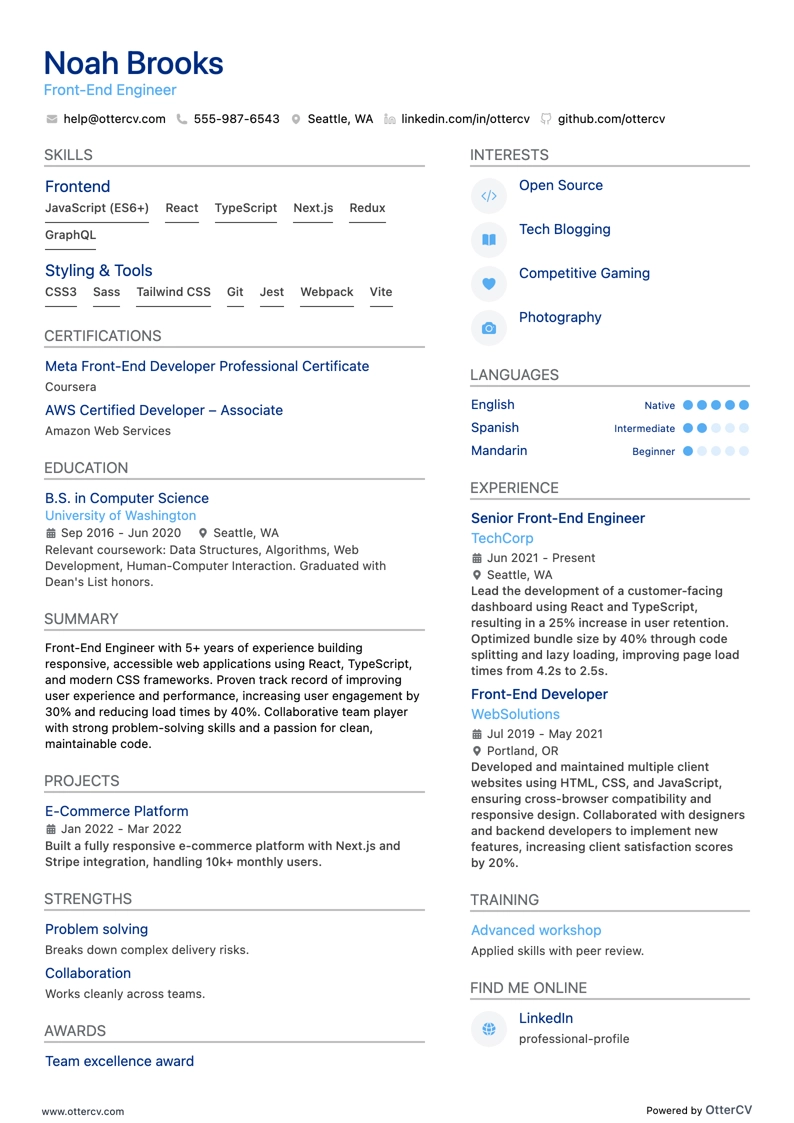
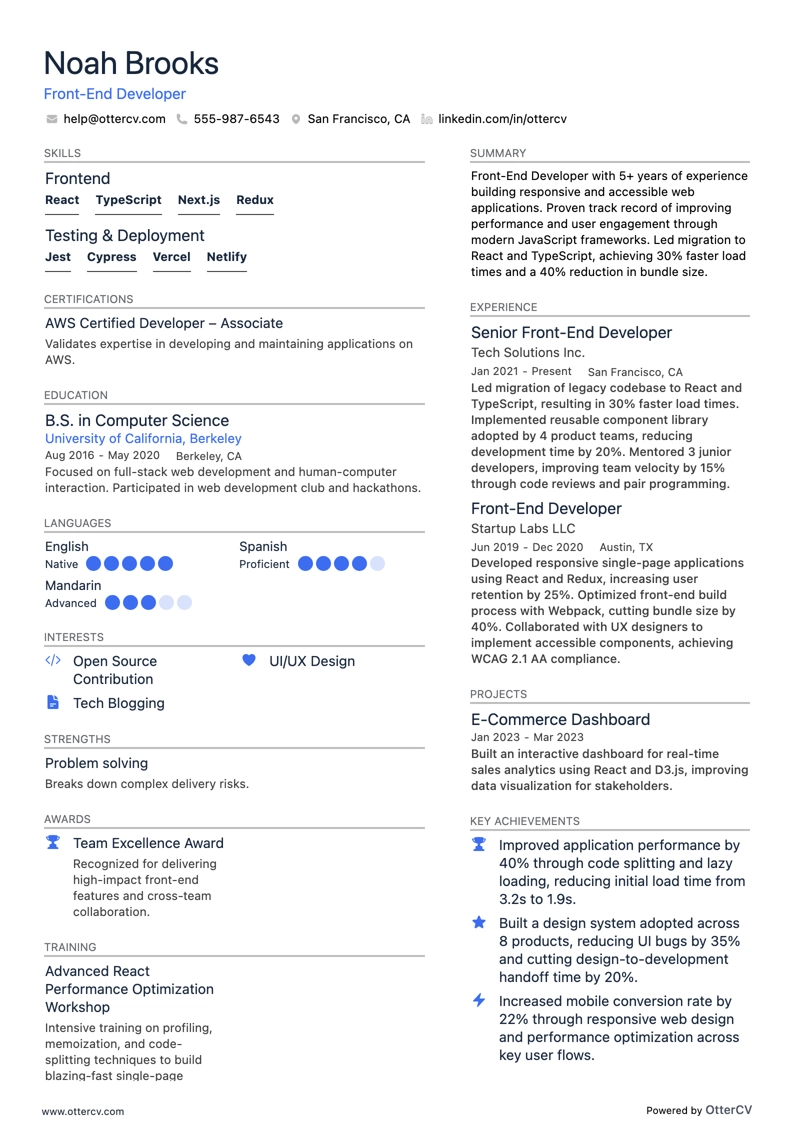
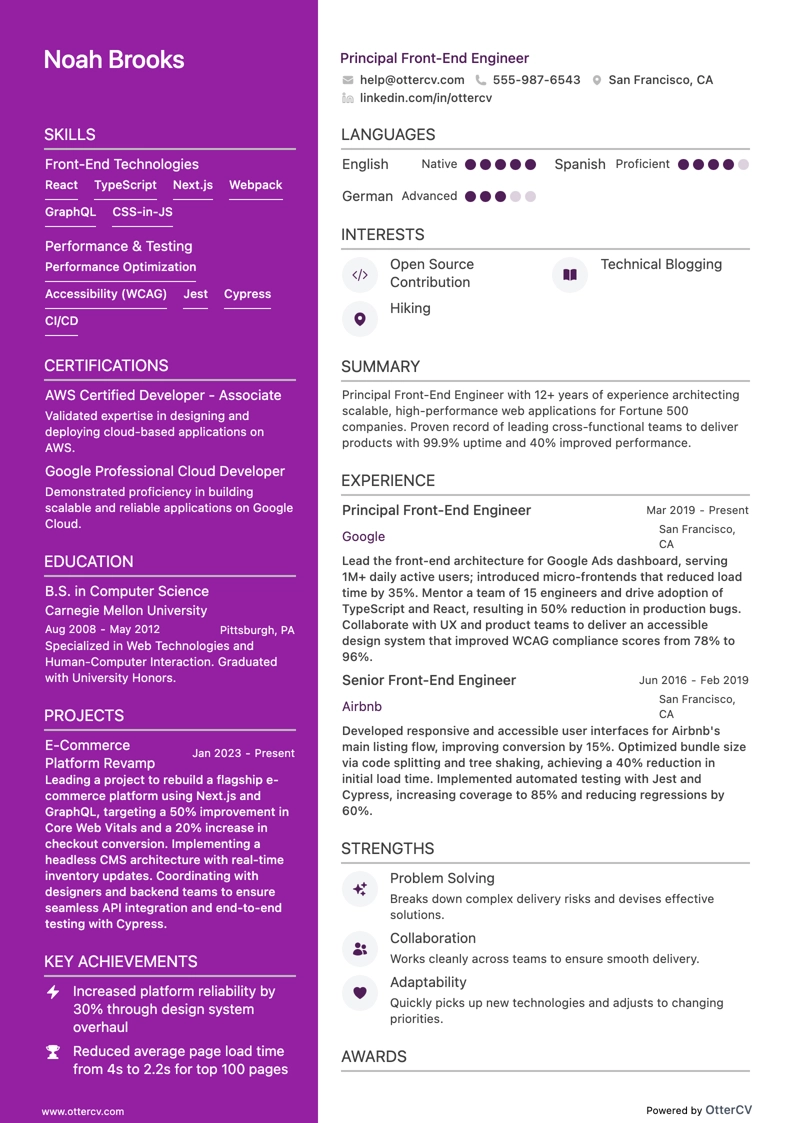
Principal Front-End Engineer full preview

26 Front-End Developer Resume Examples

OtterCV

Written by The OtterCV Team

Updated: 7/10/2024•8 min read

See all resume examples in this guide, or generate your own resume example with your personalized prompt

Principal Front-End Engineer resume example

Principal Front-End Engineer

Senior Front-End Engineer resume example

Senior Front-End Engineer

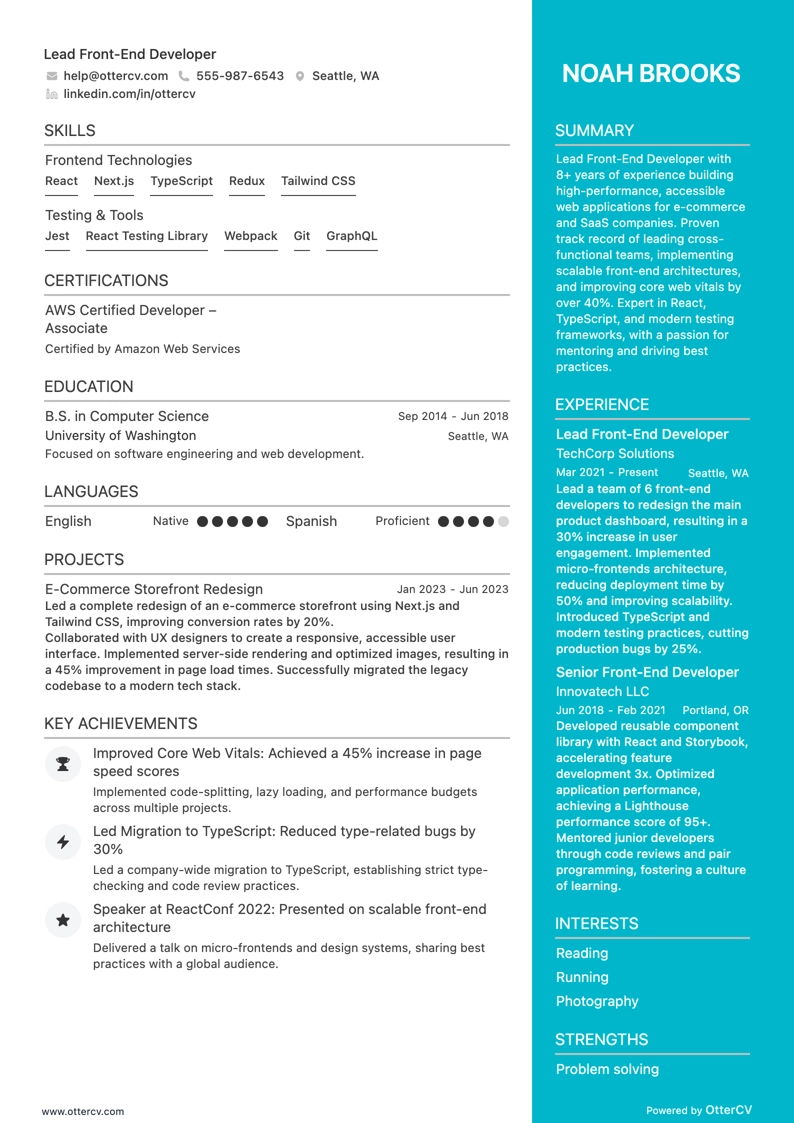
Lead Front-End Developer resume example

Lead Front-End Developer

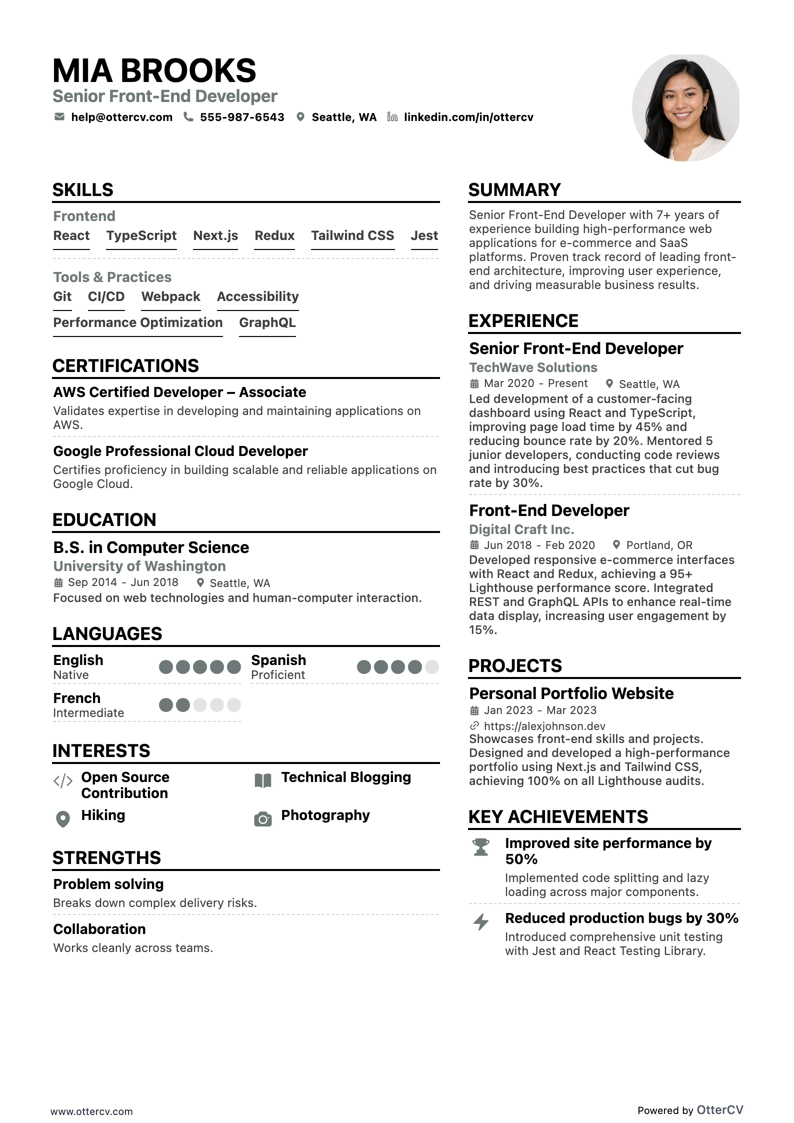
Senior Front-End Developer resume example

Senior Front-End Developer

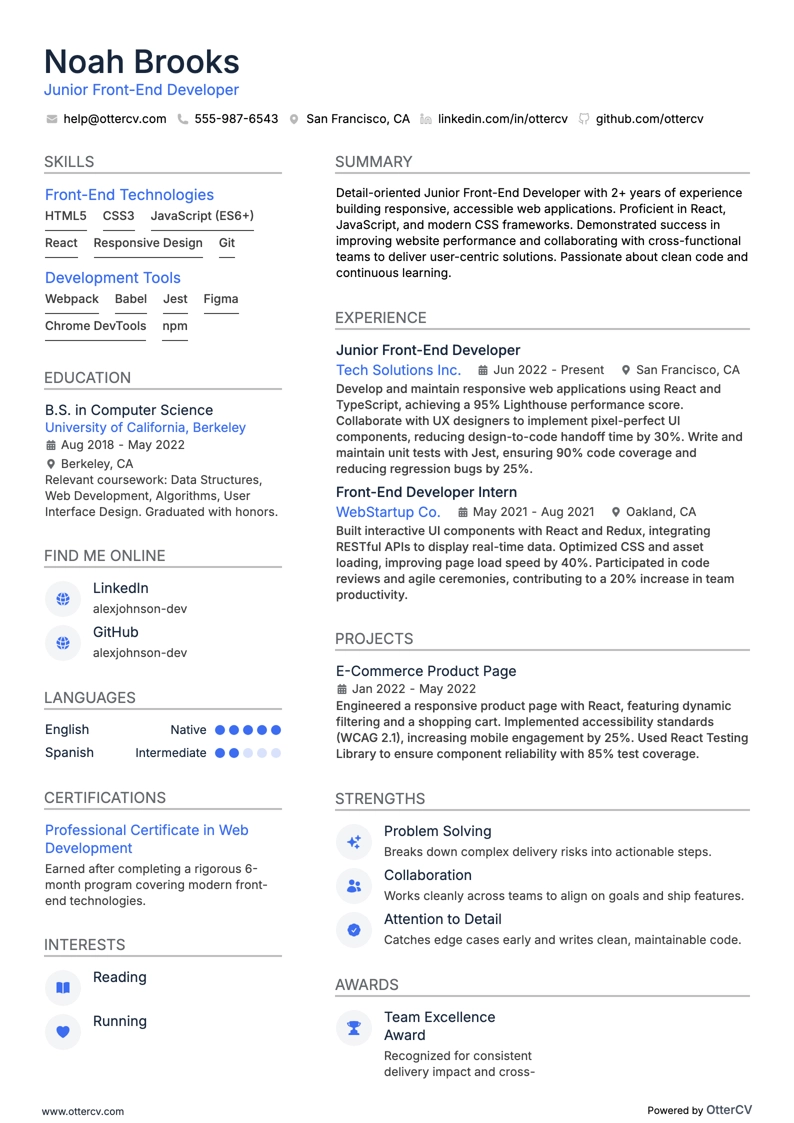
Junior Front-End Developer resume example

Junior Front-End Developer

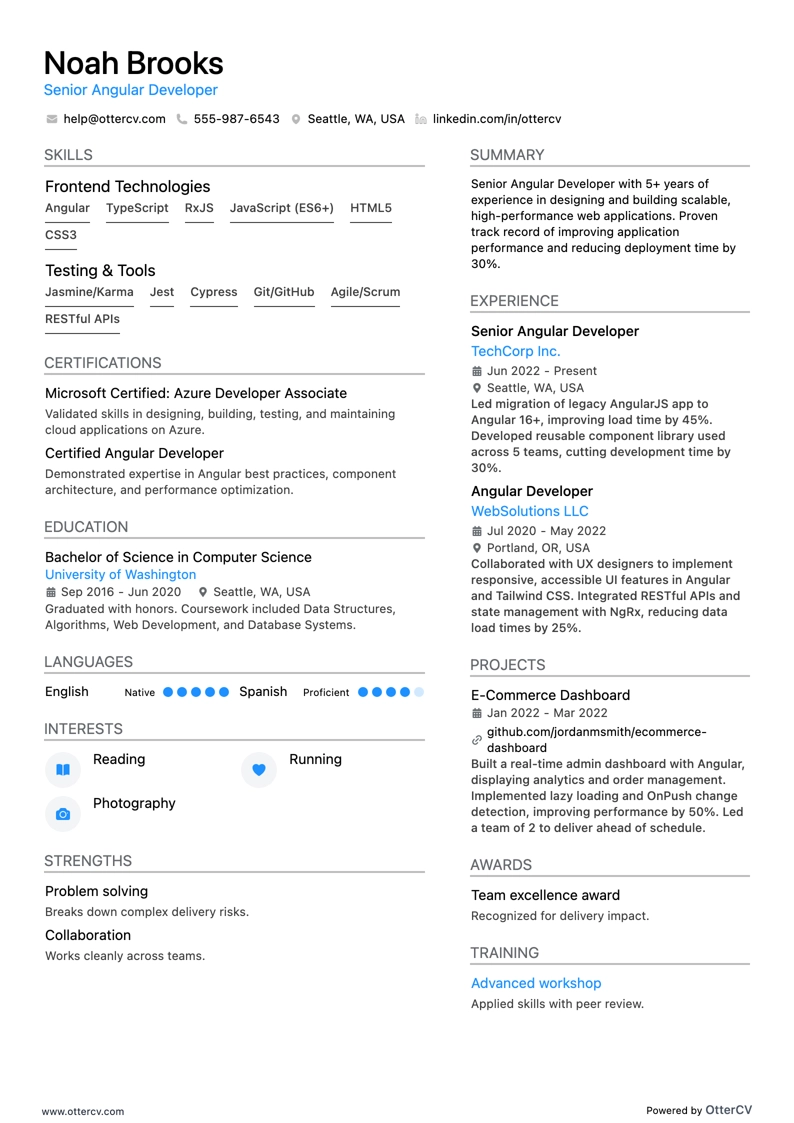
Angular Developer resume example

Angular Developer

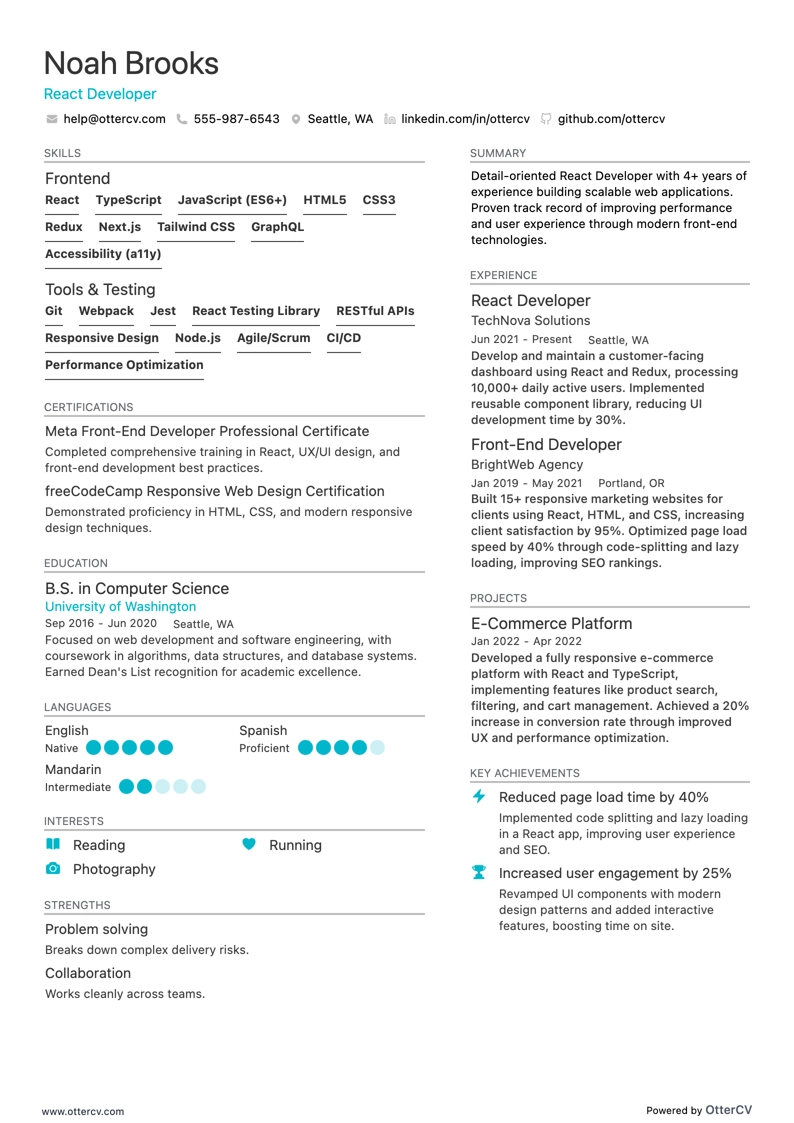
React Developer resume example

React Developer

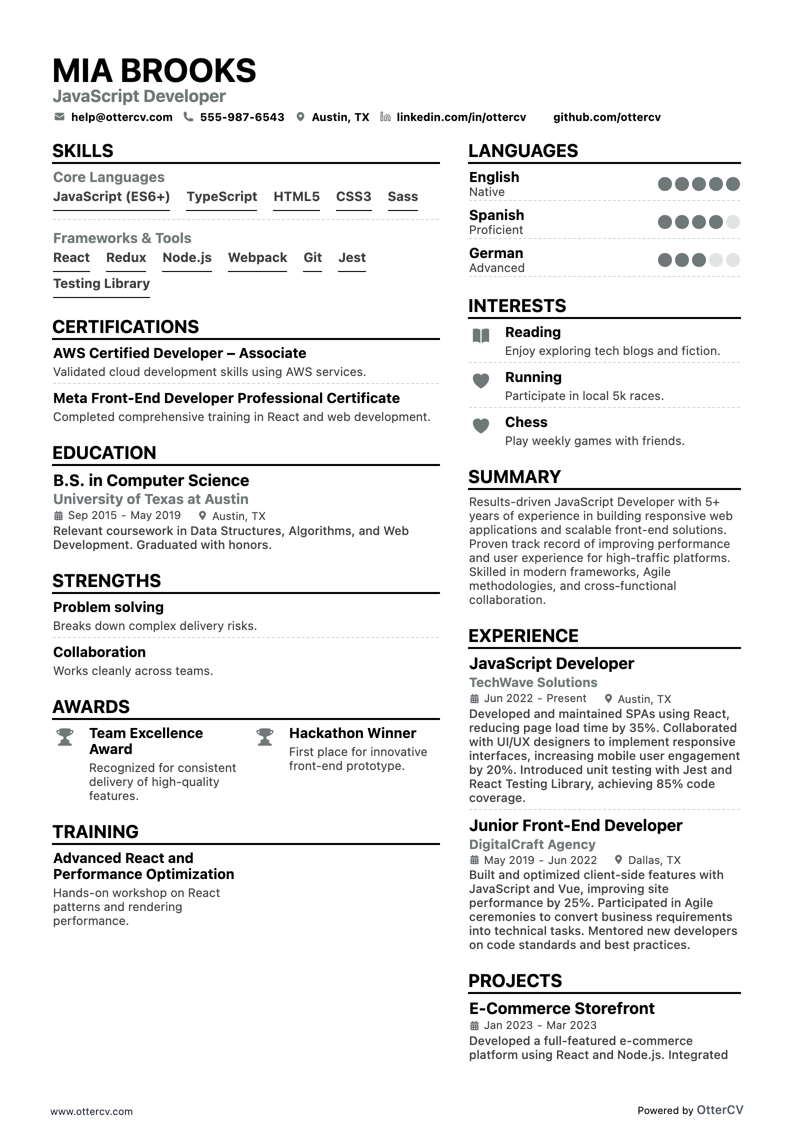
JavaScript Developer resume example

JavaScript Developer

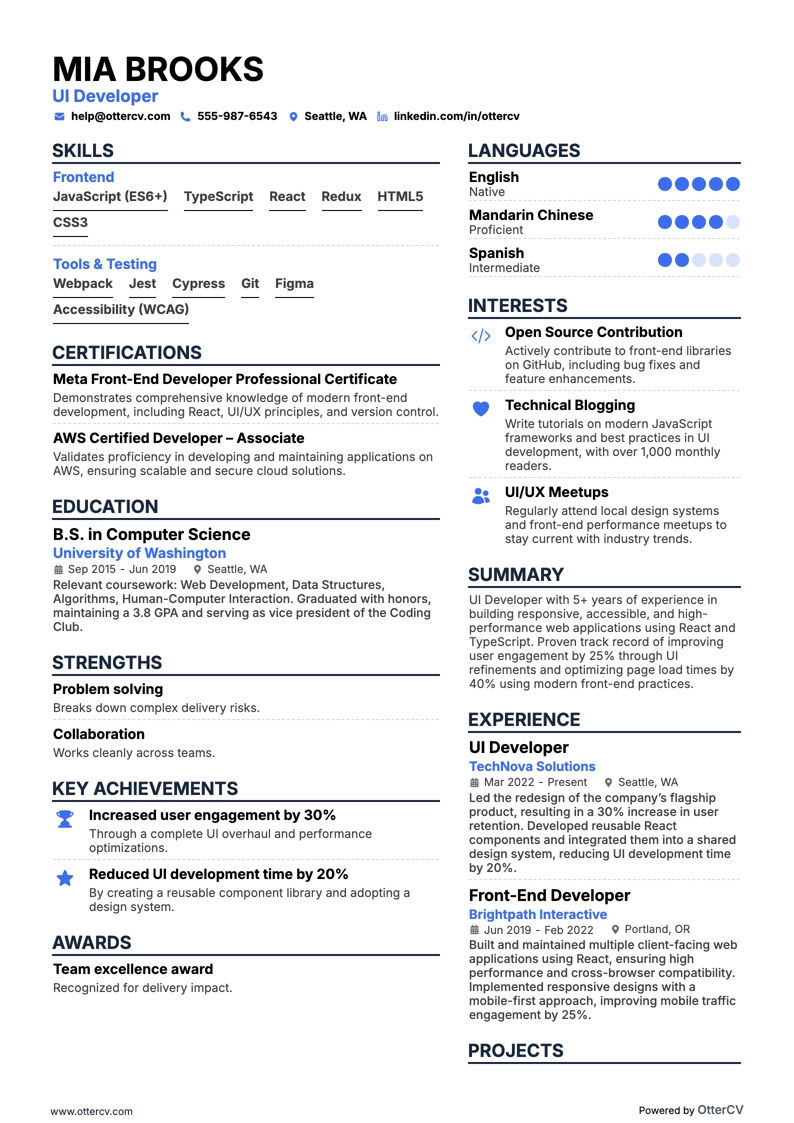
UI Developer resume example

UI Developer

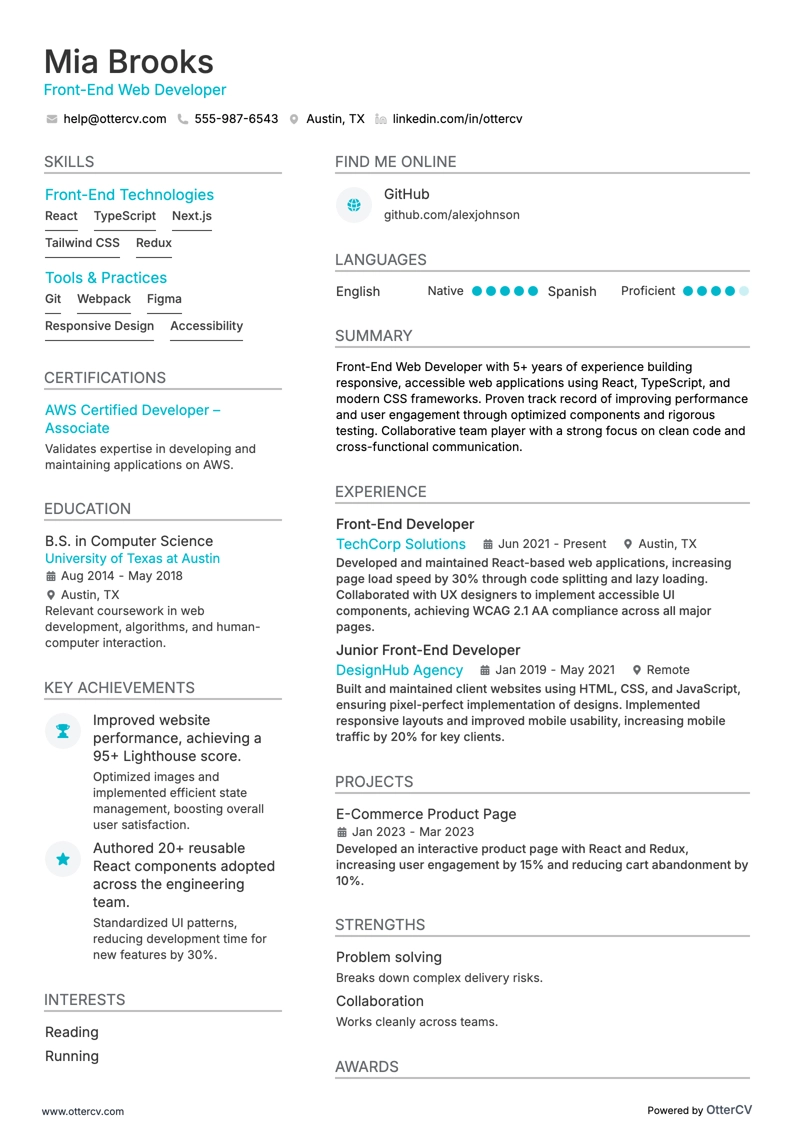
Front-End Web Developer resume example

Front-End Web Developer

Front-End Engineer resume example

Front-End Engineer

Front-End Developer resume example

Front-End Developer

Front-end developer resumes often fall short for one simple reason: they list tools instead of results. In a market where companies screen thousands of candidates through applicant tracking systems (ATS) and quick recruiter reviews, simply writing “React, JavaScript, HTML/CSS” is not enough.

A strong front-end resume highlights measurable impact, such as faster load times, cleaner UI, accessible components, scalable architecture, and features shipped to real users across real environments.

Key takeaways

  • Use a clean reverse-chronological or hybrid resume format.

  • Show measurable impact in each experience bullet, such as speed, stability, or accessibility.

  • Tailor your resume to the job’s tools, methods, and metrics.

  • Include a GitHub link and, if possible, a separate portfolio or live project link in the header.

  • Highlight modern frameworks such as React, Next.js, and TypeScript.

  • Add a projects section, especially if you’re junior or changing careers.

  • Use Echocv to tailor, test, and polish your resume into an ATS-friendly PDF.

If you want to see how other developers present their skills and achievements, browse the additional resume examples below. They can help you compare formats and choose the approach that best fits your background.

Before you write a single bullet point, choose a structure that highlights your technical depth and results right away.

How to choose the best front-end developer resume format

Recruiters reviewing front-end developer resumes usually look for three things first: technical scope, tools, and impact. Your resume format determines how quickly they can find them.

I have 2+ years of experience. Which format should I use?

I have 2+ years of experience. Which format should I use?

Use reverse-chronological.

Do:

  • Lead with your most recent role.
  • Show scope, tech stack, and measurable outcomes.
  • Include performance, accessibility, and testing metrics.

Example bullet:

  • “Reduced bundle size by 38% using code-splitting and tree-shaking in Webpack.”

I’m a junior or switching to front-end. What format works best?

I’m a junior or switching to front-end. What format works best?

Use a hybrid format.

Do:

  • Put a focused Skills section above Experience.
  • Add a Projects section for code samples, GitHub links, and shipped interfaces.
  • Tie every skill to one outcome.

Example scaffold:

“React (hooks + state mgmt) → built UI component library → reduced dev time by 22%.”

Why not use a functional resume?

Why not use a functional resume?

Functional formats hide timeline context, which is important for engineering accountability, version control knowledge, and showing how your codebase contributions evolved over time.

What sections should go on a front-end developer resume?

Use this structure of different resume sections for maximum clarity:

  • Header (name, title, GitHub, portfolio, LinkedIn)
  • Summary
  • Experience
  • Skills (front-end, UI, dev tools, testing)
  • Projects
  • Education
  • Certifications
  • Optional add-ons
    • Achievements
    • Open-source contributions
    • Publications/speaking
    • Hackathons
    • Tools category within the “Skills” section

With your resume layout in place, the next step is writing experience bullets that highlight shipped features, performance gains, and real impact—not just task lists.

How to write your front-end developer resume experience

Your experience section should show what you shipped, the tech you used, and—most importantly—the results you delivered. Front-end hiring managers often scan for ownership, impact, and scalability in less than ten seconds.

Each entry should clearly include:

  • Job title (Front-End Developer, UI Developer, React Developer, etc.)
  • Company + location (or remote)
  • Dates (month + year)
  • Three to five concise bullet points that show:
  • Scope (users, products, features)
  • Tools and stack (React, Next.js, TypeScript, Tailwind, Jest, Vite, etc.)
  • Performance and accessibility improvements
  • Collaboration with designers, PMs, and back-end engineers
  • Measurable impact (KPIs, percentages, time saved, errors reduced)

Your bullets should follow this formula:

Action verb + technical skill/tool + what you built/fixed + measurable outcome

A front-end developer experience example

Right example - modern, quantified, specific.

Senior Front-End Developer

IXF | Orlando, FL

2020–Present

Global freight and logistics platform serving 4.2M+ monthly users.

  • Rebuilt the order management UI with React and TypeScript, reducing form errors by 38% and increasing task completion speed by 23%.
  • Implemented a Storybook-based component library that cut design-to-development handoff time by 30% and reduced UI inconsistencies by 41%.
  • Optimized bundle size through code-splitting and tree-shaking, lowering initial load time from 3.8s to 1.9s on 4G connections.
  • Led accessibility upgrades to WCAG 2.2 AA, achieving full keyboard navigation and improving screen reader accuracy by 27%.
  • Collaborated with backend and QA teams to ship monthly releases through GitHub Actions CI/CD workflows.

Once your bullets show clear impact, the next step is tailoring your experience to match the job description—this is where most candidates gain or lose interviews.

How to tailor your front-end developer resume experience

Recruiters compare your resume against the job posting through both human review and ATS keyword matching.

Ways to tailor your front-end experience:

  • Match the frameworks and libraries listed, such as React, Vue, Next.js, Tailwind, and Zustand.
  • Use the same testing terminology, including unit, integration, and E2E.
  • Mirror the performance metrics mentioned in the job description.
  • Include domain-specific experience, such as e-commerce, SaaS, or fintech.
  • Emphasize accessibility if the posting mentions WCAG or ARIA.
  • Highlight API integration patterns like REST and GraphQL.
  • Show agile or scrum collaboration if it appears in the posting.

Tailoring isn’t stuffing keywords—it’s aligning your achievements with real requirements.

Resume tailoring examples for front-end developers

Job description excerptUntailored bulletTailored bullet
“Experience with React + TypeScript and component-driven architecture.”“Worked with React components.”“Built a React + TypeScript component system—reduced re-renders by 22% and improved dev velocity with reusable patterns.”
“Focus on Core Web Vitals and performance optimization.”“Improved website speed.”“Cut LCP from 3.1s to 1.8s by implementing code-splitting, image optimization, and preloading critical assets.”
“Must deliver accessible interfaces (WCAG 2.2 AA).”“Implemented accessibility improvements.”“Achieved WCAG 2.2 AA compliance—fixed contrast issues, added ARIA labels, and improved keyboard coverage by 100%.”
“Experience working with designers via Figma.”“Collaborated with designers.”“Partnered with designers in Figma—translated prototypes into production UI with 98% design fidelity.”
“Testing experience with Jest and React Testing Library.”“Wrote tests for components.”“Implemented a Jest + RTL suite—raised component coverage from 38% to 82% and prevented 15+ regressions.”

Once your bullets match the job description, your next advantage is to quantify your work by turning abstract tasks into concrete results.

How to quantify your experience on a front-end developer resume

Quantifying your work shows impact through clear metrics. In front-end roles, the numbers often relate to speed, accessibility, stability, and user behavior.

Examples of How to Quantify Front-End Developer Achievements on Your Resume

How to quantifyExample bullet point
Load time improvements“Reduced page load time by 43% using lazy loading, tree-shaking, and asset compression.”
Core Web Vitals“Improved LCP from 3.5s → 1.7s, CLS from 0.21 → 0.03 through layout stabilization.”
Error reduction“Cut production errors by 61% after implementing stricter TypeScript types and integration tests.”
Accessibility“Achieved WCAG 2.2 AA compliance across 14 pages—improved keyboard nav and ARIA implementation.”
Build pipeline speed“Reduced build time by 32% by migrating from Webpack to Vite.”
User activity“Increased checkout completion rate by 18% after redesigning UI flow.”
Developer velocity“Delivered 20+ reusable UI components—reduced new feature build time by 40%.”

Your next step is to highlight the skills that match modern front-end roles, both technical and collaborative, so recruiters can quickly assess your capabilities.

How to list your hard and soft skills on a front-end developer resume

Skills help recruiters and ATS quickly verify whether your technical foundation matches the role.

Front-end roles require a blend of:

  • Technical skills and/or hard skills (JavaScript frameworks, UI libraries, DevTools)
  • Testing and quality skills
  • Performance and accessibility discipline
  • Soft skills (communication, collaboration, problem-solving)

YOUR TOOLSET

A skills section shows what you can do, while tools are the technologies you use to do it.

For front-end developers, it’s usually best to include tools as a category within your skills section rather than as a separate section, so recruiters can see your abilities and tech stack in one place.

Your skills section should be:

  • Scannable with bullet-style grouping
  • Relevant to the job post
  • Backed by proof in your experience bullets
  • Updated with current tools (React & TypeScript > jQuery)

Place your skills section:

  • Above experience if you’re junior or switching careers.
  • Below experience if you’re mid/senior with strong achievements.

Best hard skills for your front-end developer resume

  • React skills include hooks, context, and state management.
  • Next.js experience should cover SSR and SSG.
  • TypeScript is a valuable front-end development skill.
  • JavaScript skills should include ES6+ and DOM manipulation.
  • HTML5/CSS3 knowledge should include Flexbox and Grid.
  • Styling skills can include Tailwind CSS and Styled Components.
  • API integration experience can include REST and GraphQL.
  • Testing skills should include Jest, React Testing Library, and Cypress.
  • Build tool knowledge can include Vite, Webpack, Babel, and Turborepo.
  • Version control and delivery skills can include Git, GitHub Actions, and CI/CD.
  • Accessibility knowledge should include WCAG 2.2 AA and ARIA.
  • Performance optimization should cover Core Web Vitals.
  • Responsive design is an essential hard skill.
  • UX collaboration can include turning Figma designs into code.

How to showcase your skills in context

Your skills should not appear only in lists. They should also be demonstrated in:

  • Your summary (high-level technical identity)
  • Your experience (proof through outcomes)

Below are examples of both.

Summary

Front-End Developer with 5+ years of experience building scalable React and Next.js applications. Improved Core Web Vitals across multiple products, reducing LCP by up to 45%. Strong communicator with expertise in translating Figma designs into pixel-perfect, accessible interfaces using TypeScript, Tailwind, and modern testing frameworks.

Why it works

  • Shows experience level
  • Lists high-impact tools
  • Includes metrics
  • Demonstrates soft skills naturally

Front-End Developer

BrightCart (Remote)

June 2021–October 2024

  • Rebuilt the dashboard UI with React and TypeScript, reducing bugs by 42% and improving developer onboarding time by 30%.
  • Strengthened the testing suite with Cypress and Jest, increasing automated test coverage from 38% to 81%.
  • Partnered with UX designers to refine user flows in Figma before development, cutting rework by 22% across three sprints.

Why it works:

  • Technical skills are proven with measurable results.
  • Testing, performance, and collaboration appear naturally.

Next, reinforce your foundation by listing your education clearly and concisely, especially if you're early in your career.

How to list your education on a front-end developer resume

Your education section helps hiring teams validate your grounding in computer science, UI, or related fields. Keep it clean, factual, and easy to scan.

Include:

Avoid month and day details; the year alone is enough.

B.S. in Computer Science

Arizona State University | Tempe, AZ | 2020

GPA: 3.8/4.0

  • Relevant coursework: Web Development, Algorithms, Human-Computer Interaction, Database Systems
  • Honors: Dean’s List (4 semesters), Cum Laude

After education, certifications can help you stand out, especially when they are recent and directly related to front-end frameworks or accessibility.

How to list your certifications on a front-end developer resume

Certifications show a commitment to learning, familiarity with modern tools, and industry relevance.

On many front-end developer resumes, certifications can appear above education when they are more current or more directly applicable to the technologies used in the role.

Include:

  • Certificate name
  • Issuing organization
  • Year
  • Optional: credential ID or URL

PRO TIP

  • Place certifications below education if you’re a recent graduate.
  • Place them above education if you earned them recently and they’re more relevant.

With your education and certifications in place, you’re ready to write a summary that reflects your identity as an engineer: your stack, strengths, and outcomes.

How to write your front-end developer resume summary

Your summary is the first impression recruiters get.

Keep it to three to four lines and include:

  • Your title and years of experience
  • Your domain or product type, such as SaaS, e-commerce, or enterprise
  • Your core technologies, such as React, Next.js, and TypeScript
  • One or two quantified achievements
  • Soft skills tied to real outcomes

PRO TIP

Avoid generic statements like “hard-working and passionate.” Instead, focus on what you deliver.

Resume summary example

Front-End Developer with 6+ years of experience building performant, accessible interfaces with React, Next.js, and TypeScript. Improved Core Web Vitals by up to 45% across multiple products and reduced UI defects by 27% through stronger testing and a component-driven architecture. Strong collaborator with experience working closely with design, product, and backend teams.

Why it works:

  • Senior-level clarity
  • Tech stack named upfront
  • Metrics included
  • Demonstrates collaboration

How do I write a front-end developer resume with no experience?

Even without full-time experience, you can still show that you are ready for front-end work through:

  • Front-end projects: React apps, portfolio websites, dashboards, and landing pages
  • Bootcamp or certificate projects: Meta, W3C, freeCodeCamp
  • Open-source contributions: Even small PRs count
  • Hackathons or coding challenges
  • Internships, apprenticeships, or freelance tasks
  • Relevant coursework: Web dev, HCI, UX, algorithms
  • Technical strengths: Testing, accessibility, reusable UI patterns

Focus on:

  • What you built
  • The tech stack you used
  • The problems you solved
  • Measurable results, such as “reduced bundle size by 28%”

Resume format tip for entry-level front-end developers

Resume format tip for entry-level front-end developers

A hybrid resume works best.

Do:

  • Lead with Skills.
  • Place Projects above Experience.
  • Include GitHub and portfolio links in the header.
  • Add one to three strong technical bullets for each project.

Example project bullet:

  • “Built a Next.js e-commerce product page—reduced image load time by 42% using optimized static exports.”

Front-end candidates often ask similar questions about formatting, tools, design choices, and how to present projects. These answers will help you avoid common mistakes.

Frequently asked questions about front-end developer resumes

If you’re unsure about formatting, skills, or what to include, these FAQs cover the essentials for a front-end developer resume.

What should your front-end developer resume header include?

Include the following in your header:

A 2024 LinkedIn report found that candidates with a LinkedIn link are 71% more likely to get interviews, so always include one.

Do front-end developers need a cover letter?

A cover letter is not always required, but it can help you stand out, especially for competitive engineering roles. Use it to explain why you are a strong fit, highlight one or two relevant projects, and show genuine interest in the product.

Should front-end developers use colored or creative resume templates?

Yes, but in moderation.

Echocv templates are ATS-friendly, clean, and modern. Avoid heavy graphics, photos, or non-standard fonts. Use one accent color and keep the layout easy to scan.

Treat your resume like a UI: focus on spacing, hierarchy, and readability.

How technical should a front-end developer resume be?

You should name the core technologies you use:

  • Languages (JavaScript, TypeScript)
  • Frameworks (React, Next.js, Vue)
  • Tools (Vite, Webpack, CI/CD, Git)
  • Tests (Jest, RTL, Cypress)
  • Accessibility standards (WCAG, ARIA)
  • APIs (REST, GraphQL)

But avoid overwhelming keyword lists. Show proof through experience bullets.

Should you include a portfolio?

Yes—for front-end roles, portfolios are expected.

Link to:

  • Code samples
  • UI components
  • Projects with real users
  • Deployed apps (Vercel, Netlify)

Place the portfolio link in your header.

How long should a front-end developer resume be?

  • One page for under ten years of experience
  • Two pages only if you have extensive shipped features, leadership, or multiple product lines

Keep it concise and impact-driven.

Should front-end developers include soft skills?

Yes, but only in context.

Wrong: “Teamwork, leadership, communication.”

Right: “Partnered with designers in Figma to reduce UI rework by 22%.”

Soft skills should appear through actions, not labels.

Should a front-end developer include a photo?

No. Photos can cause ATS parsing issues and bias concerns.

How should you save and name your front-end resume file?

Save your resume as a PDF—it preserves your spacing and design.

Use a clear, professional naming convention so recruiters can identify your file at a glance. Include your name, your target role, and the word “resume,” and avoid spaces, special characters, or vague filenames like “final_version.pdf.”
FirstName_LastName_FrontEnd_Developer_Resume.pdf

What additional sections work well for front-end resumes?

  • Tools & Tech Stack
  • Open-source contributions
  • Speaking/mentorship
  • Hackathons
  • Publications
  • Achievements
  • UI systems or design system contributions

These sections can help show community involvement and technical depth.

How do salaries tie to my resume?

Front-end developer salaries often increase with:

  • Demonstrated impact, such as performance gains, stability, and accessibility improvements
  • Testing maturity
  • Architecture ownership
  • Modern frameworks, including Next.js and TS
  • Cross-team collaboration

Your resume should highlight these areas with metrics.

Now that every section is covered, here’s a quick list you can use to double-check that your resume is ready to send.

Resume Checklist

  • Use a reverse-chronological or hybrid format.

  • Include three to five quantified bullets for each role.

  • Match your skills to the job description.

  • Highlight a modern stack such as React, Next.js, and TypeScript.

  • Add your GitHub and portfolio links in the header.

  • Show strong examples of testing and performance work.

  • Use an ATS-friendly Echocv template.

Conclusion

Front-end development is rooted in clarity, structure, and performance, and your resume should reflect those same qualities. By emphasizing measurable improvements, modern frameworks, and clean architectural decisions, you can stand out in the competitive 2026 job market.

Echocv’s AI Resume Builder helps turn your experience into concise, impactful bullet points and create an ATS-friendly layout that recruiters can scan in seconds.

Your next interview starts with the right resume—and you have everything you need to build it.

Front-End Developer resume examples

Explore additional Front-End Developer resume samples and guides and see what works for your level of experience or role.

By Experience

Principal Front-End Engineer

Principal Front-End Engineer resume preview

Senior Front-End Engineer

Senior Front-End Engineer resume preview

Lead Front-End Developer

Lead Front-End Developer resume preview

Senior Front-End Developer

Senior Front-End Developer resume preview

Junior Front-End Developer

Junior Front-End Developer resume preview

Front-End Developer resume examples

Explore additional Front-End Developer resume samples and guides and see what works for your level of experience or role.

By Role

Angular Developer

Angular Developer resume preview

React Developer

React Developer resume preview

JavaScript Developer

JavaScript Developer resume preview

UI Developer

UI Developer resume preview

Front-End Web Developer

Front-End Web Developer resume preview

Front-End Engineer

Front-End Engineer resume preview

Front-End Developer

Front-End Developer resume preview