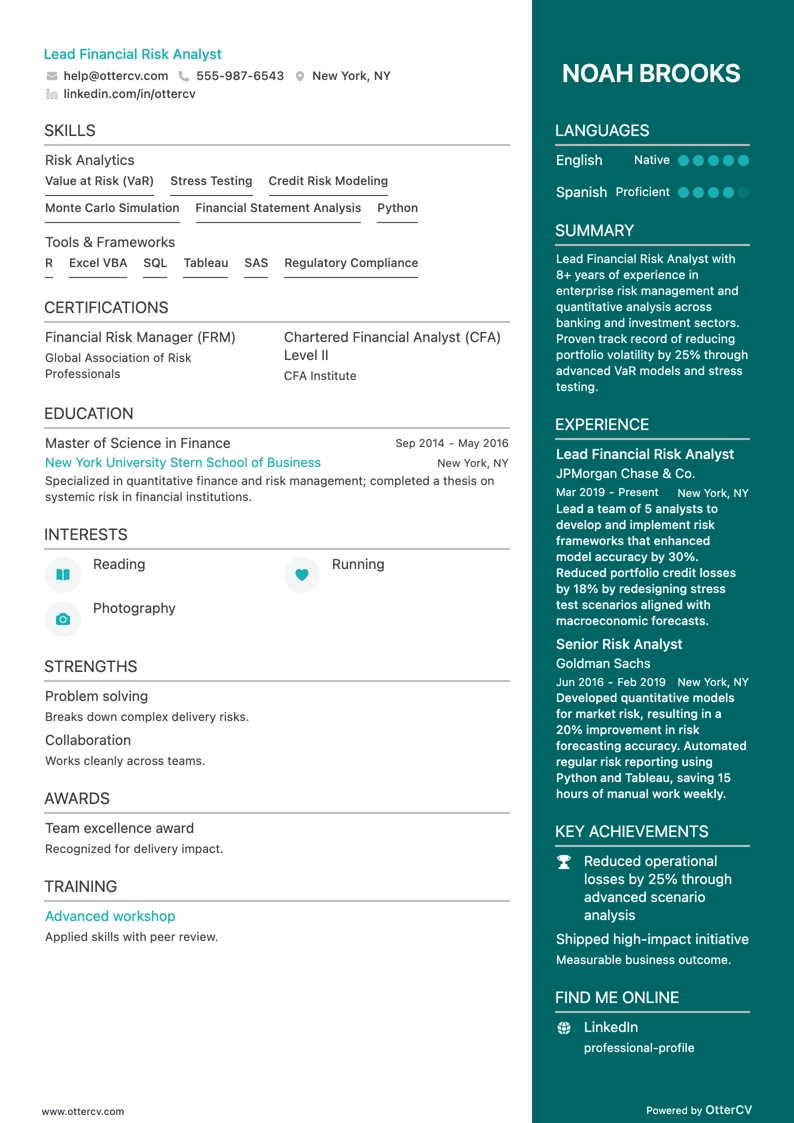
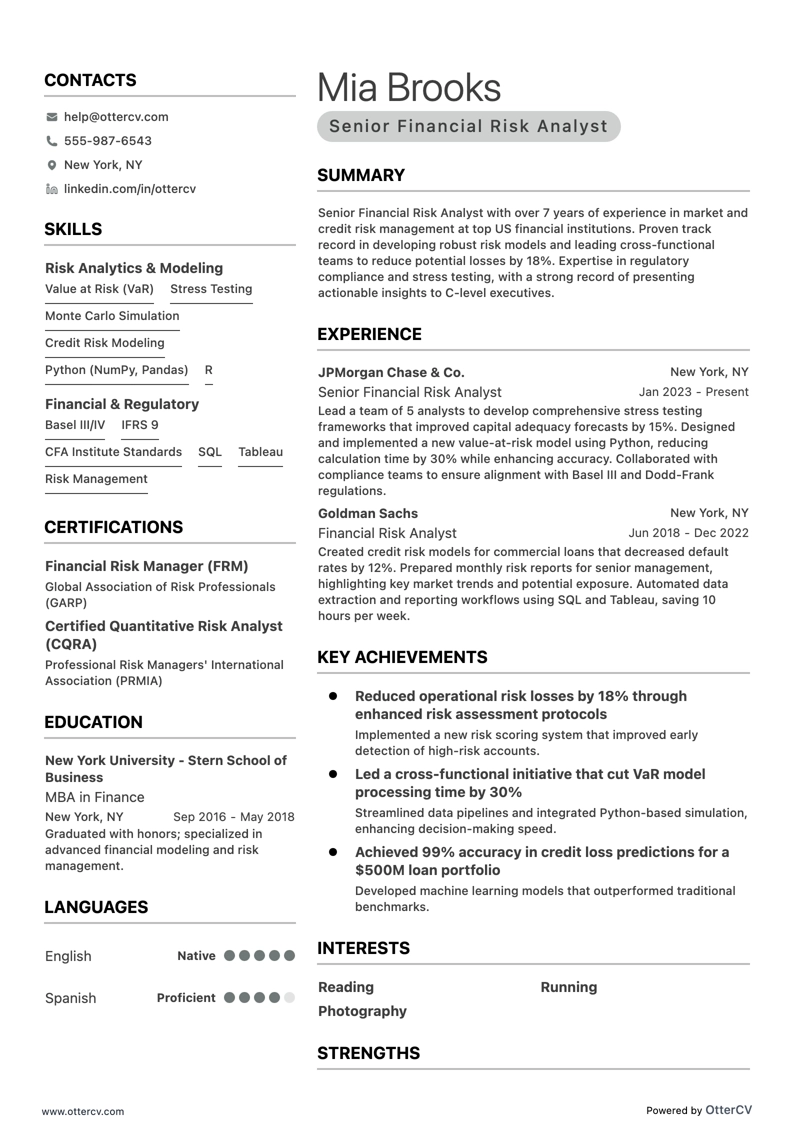
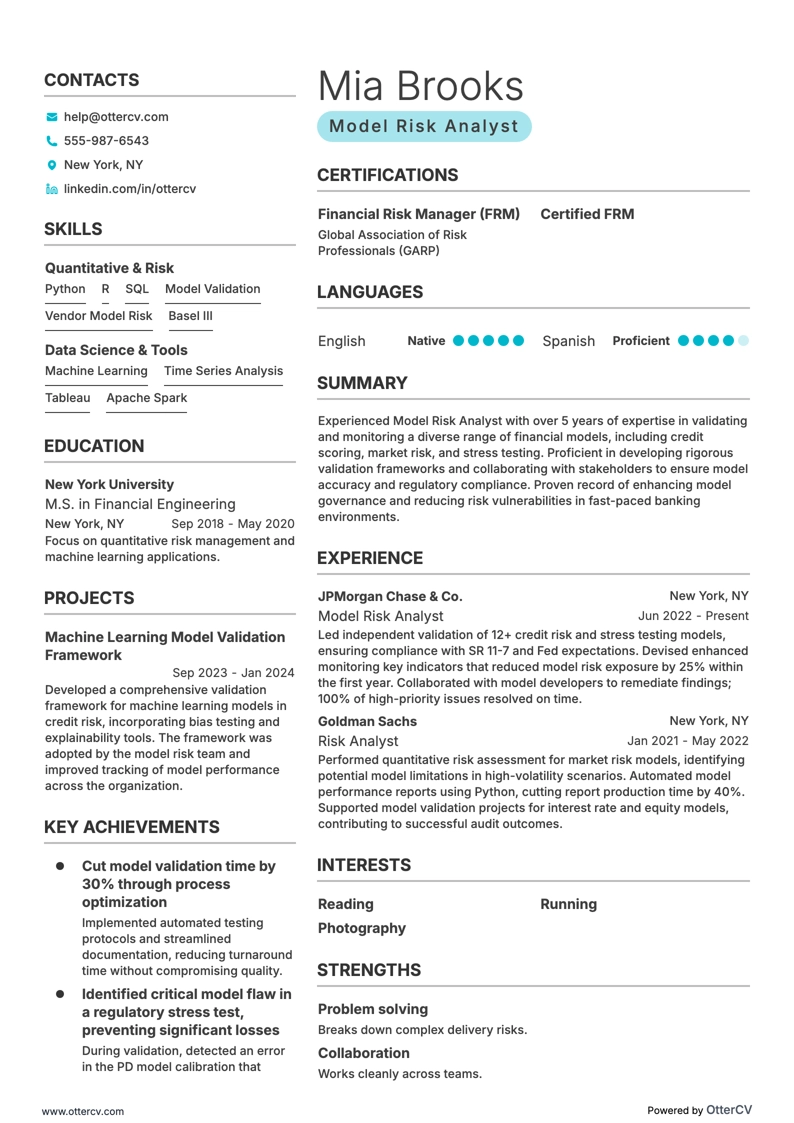
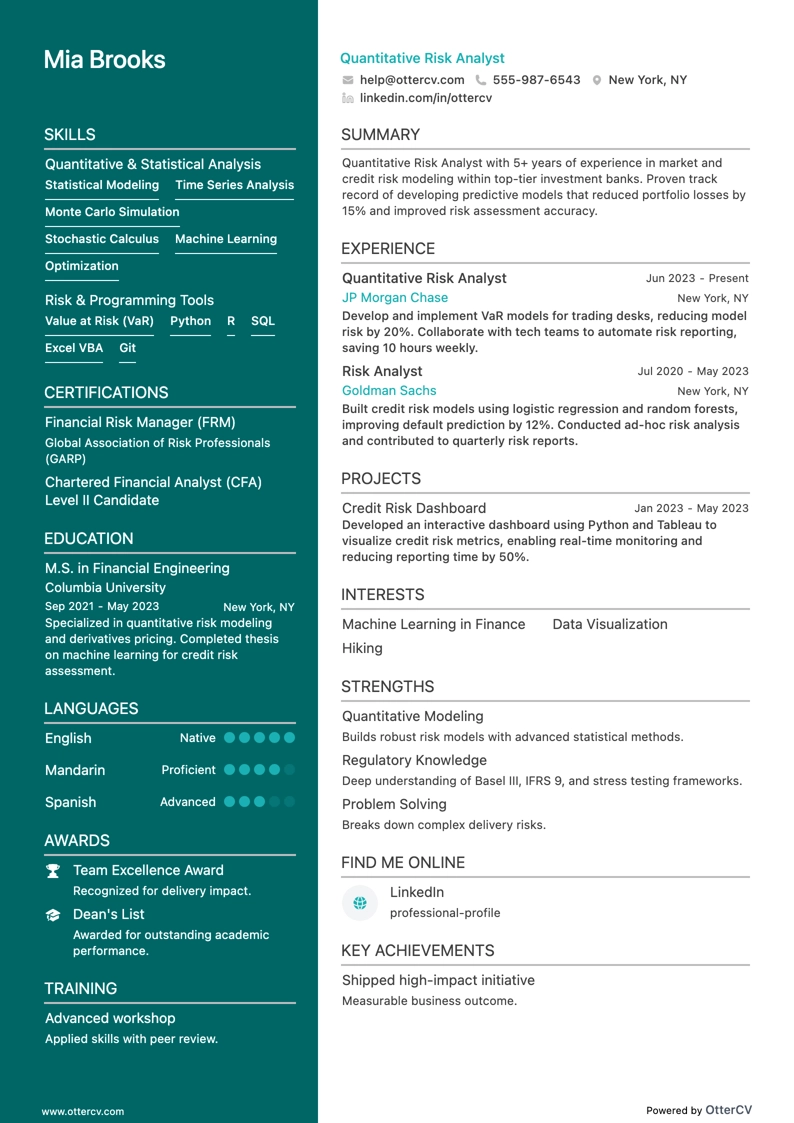
Lead Financial Risk Analyst full preview

10 Financial Risk Analyst Resume Examples

OtterCV

Written by The OtterCV Team

Updated: 4/6/2024•8 min read

See all resume examples in this guide, or generate your own resume example with your personalized prompt

Lead Financial Risk Analyst resume example

Lead Financial Risk Analyst

Senior Financial Risk Analyst resume example

Senior Financial Risk Analyst

Model Risk Analyst resume example

Model Risk Analyst

Quantitative Risk Analyst resume example

Quantitative Risk Analyst

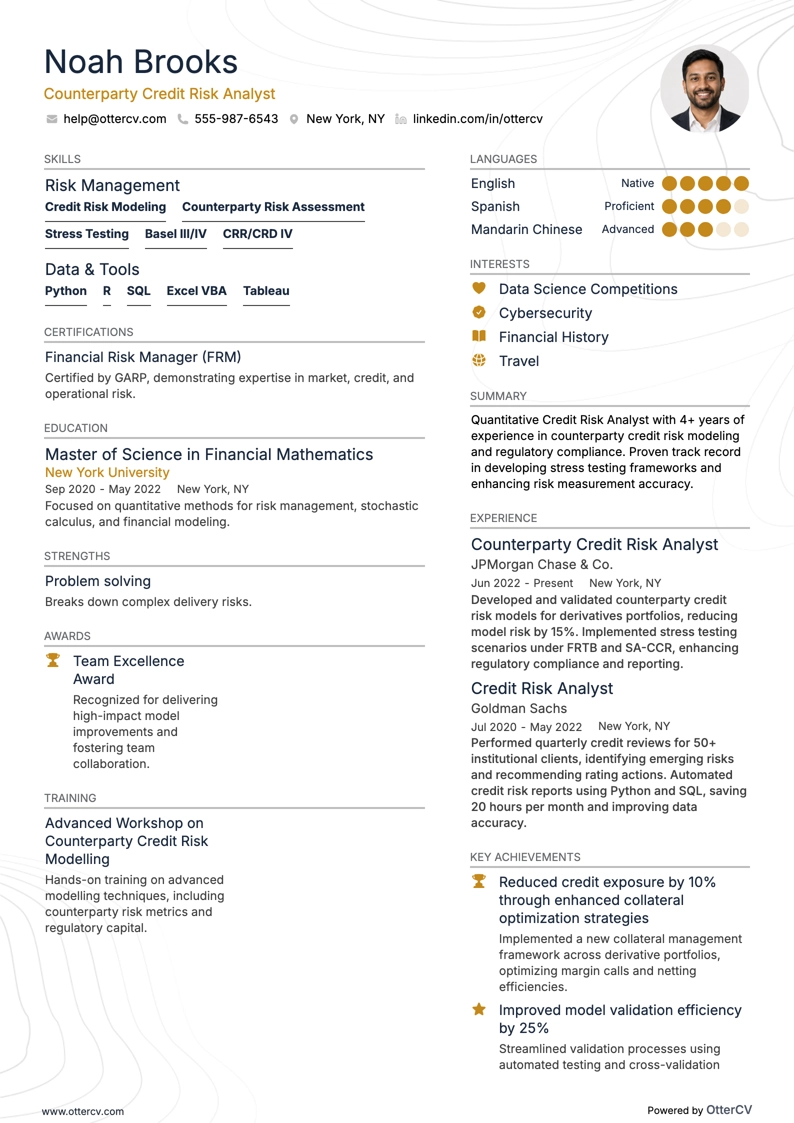
Counterparty Credit Risk Analyst resume example

Counterparty Credit Risk Analyst

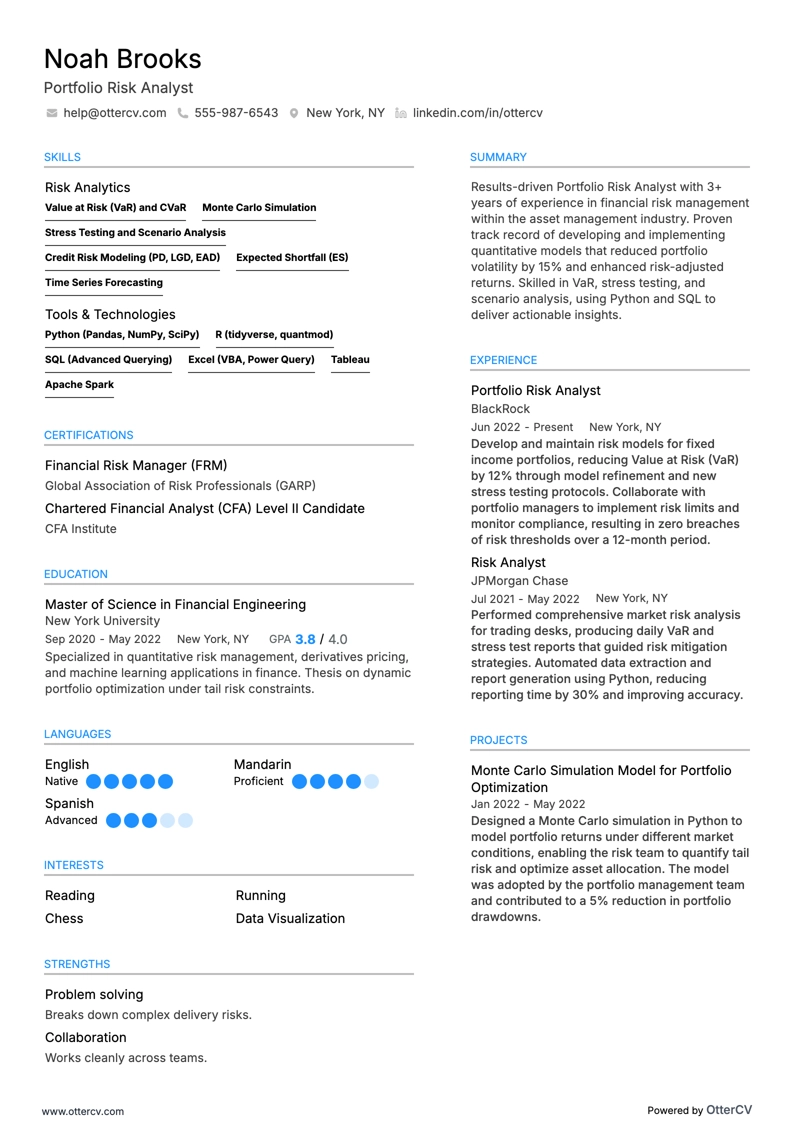
Portfolio Risk Analyst resume example

Portfolio Risk Analyst

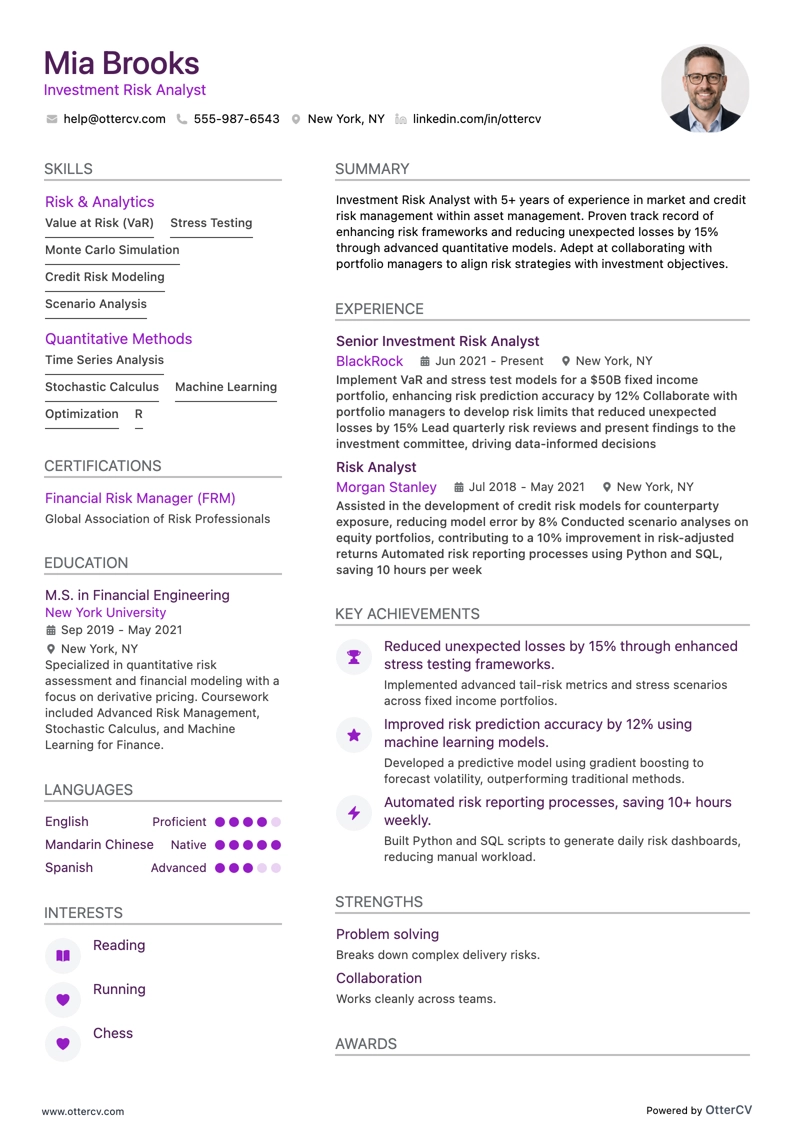
Investment Risk Analyst resume example

Investment Risk Analyst

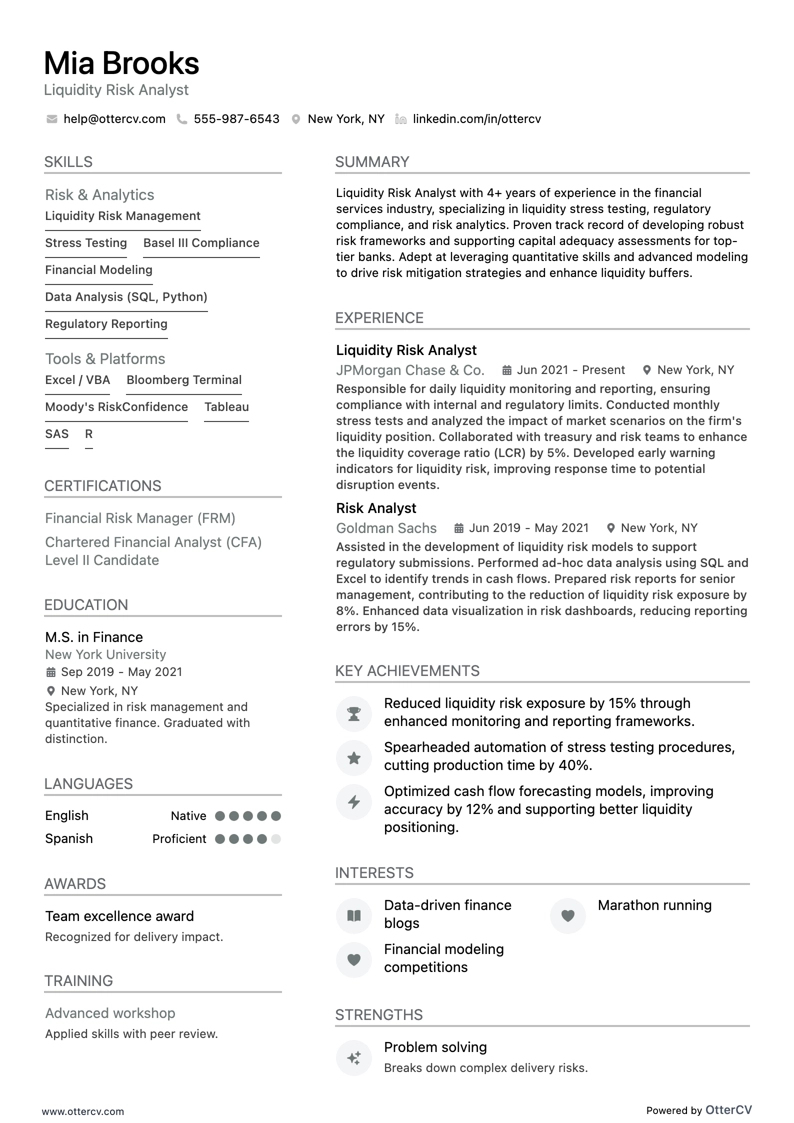
Liquidity Risk Analyst resume example

Liquidity Risk Analyst

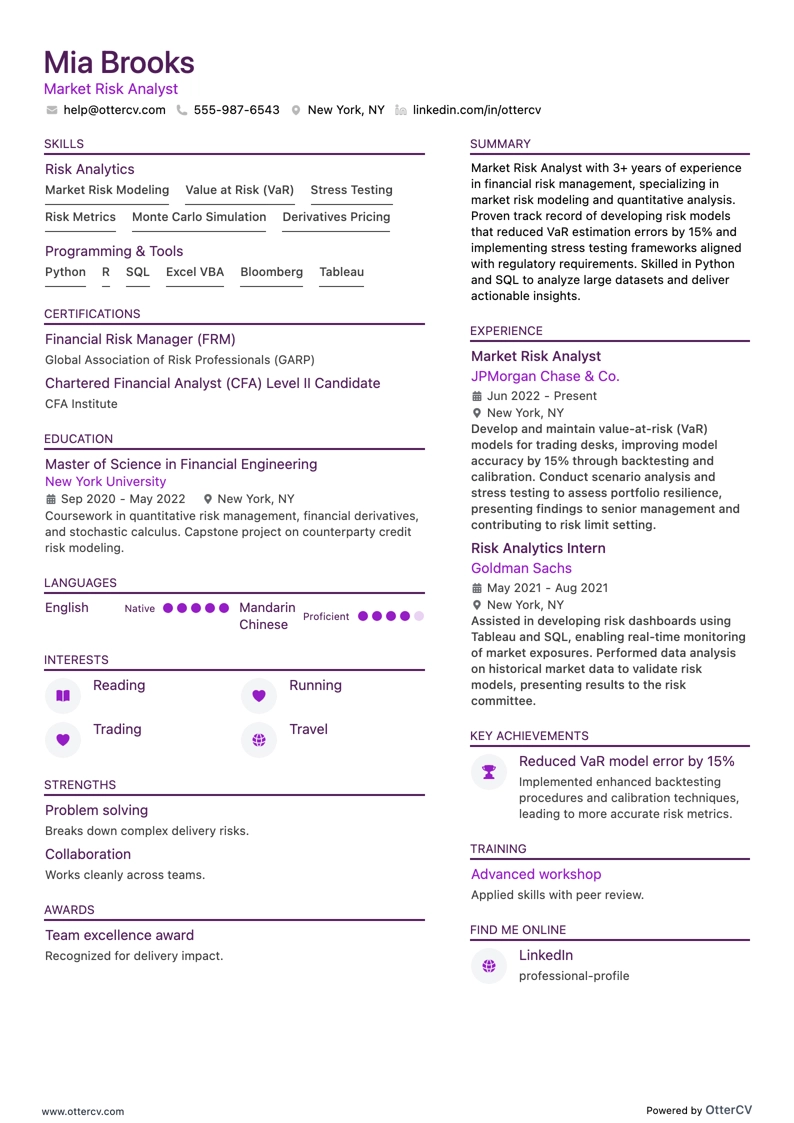
Market Risk Analyst resume example

Market Risk Analyst

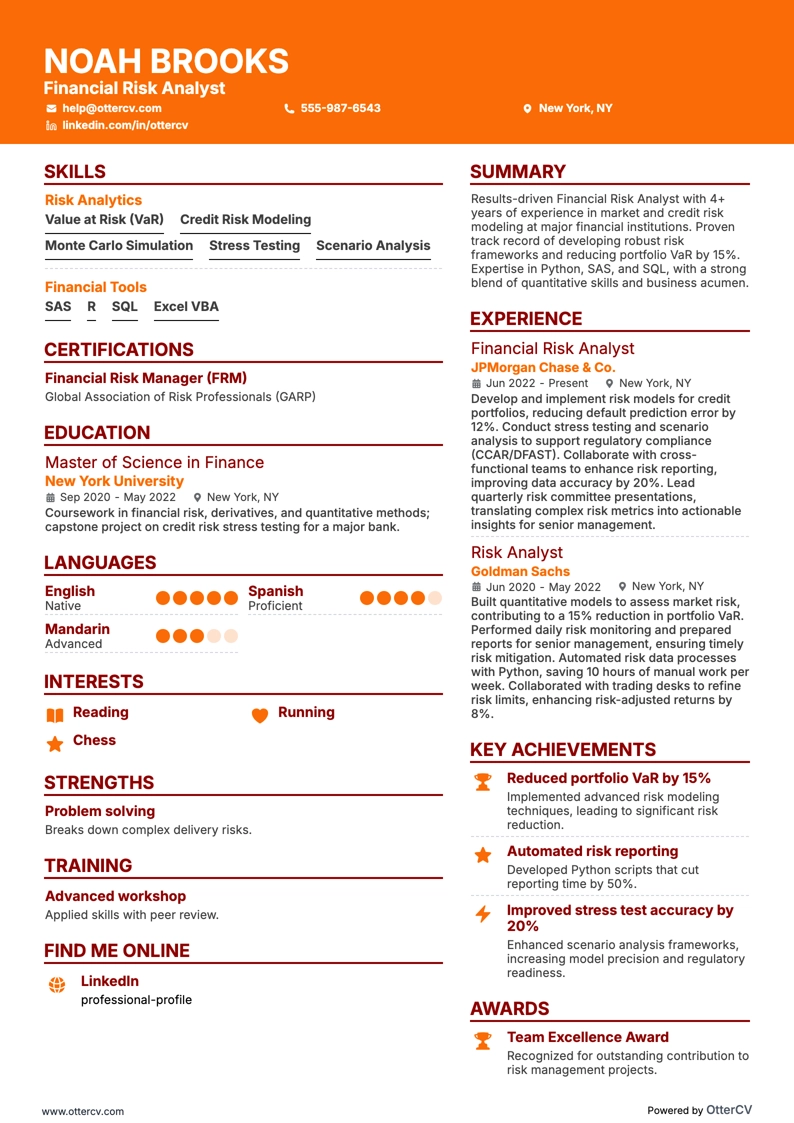
Financial Risk Analyst resume example

Financial Risk Analyst

Many financial risk analyst resumes fall short because they list models and systems without showing the decisions supported, the exposure reduced, or the impact on controls. As a result, they are often filtered out by applicant tracking systems and overlooked in quick recruiter reviews. In a competitive market, evidence matters more than task lists.

A strong resume explains what changed because of your work. Quantify risk reduction, capital impact, stress test coverage, portfolio size, audit findings closed, and reporting cycle time. Emphasize the decisions enabled, losses avoided, and governance improvements delivered. If you are not sure where to start, learning how to write a resume that leads with impact instead of duties is the essential first step.

Key takeaways

  • Quantify risk reduction, model accuracy, and reporting speed instead of listing daily responsibilities.

  • Use a reverse-chronological format for senior roles and a hybrid format for career changers.

  • Match the job posting’s exact tools, frameworks, and regulatory terms in your bullet points.

  • Tie every listed skill to a specific project, outcome, or measurable result.

  • Place certifications such as the FRM or CFA near your education to highlight specialized expertise.

  • Write a three- to four-line summary that shows your domain focus and one quantified achievement.

  • Use Echocv to turn vague duties into metrics-driven bullets that can pass ATS screening.

How to format a financial risk analyst resume

Recruiters reviewing financial risk analyst resumes look for quantitative modeling expertise, regulatory knowledge, and the ability to turn complex risk data into actionable business decisions. A clean, well-structured resume helps these strengths stand out quickly in both automated screening and the initial human review. Choosing the right resume format is essential to making a strong first impression.

I have significant experience in this role—which format should I use?

I have significant experience in this role—which format should I use?

Use a reverse-chronological format so your deepest and most relevant risk analysis experience appears first.

  • Start with your most senior role and clearly define the scope, including portfolio size, team oversight, risk categories managed, and reporting lines.
  • Highlight domain-specific tools and frameworks such as VaR modeling, Monte Carlo simulations, Basel III/IV compliance, SAS, Python, or Bloomberg Terminal proficiency.
  • Quantify outcomes tied to business impact, including loss reduction, capital optimization, or regulatory audit results.

Example bullet: “Developed and implemented a credit risk scoring model across a $2.4B commercial lending portfolio, reducing default exposure by 18% and saving the firm an estimated $12M annually in projected losses.”

I'm junior or switching into this role—what format works best?

I'm junior or switching into this role—what format works best?

A hybrid format works best because it highlights relevant skills and education while still showing a clear timeline of professional experience.

Do:

  • Place a dedicated skills section near the top, emphasizing quantitative methods, risk frameworks such as COSO and Basel standards, and technical tools like SQL, R, or Python.
  • Include academic projects, internships, or certifications such as FRM or PRM that show applied risk analysis, even if your formal work history is limited.
  • Connect every listed skill or project to a clear action and measurable result so recruiters can evaluate practical capability.

Example scaffold: “Statistical modeling (skill) → built a logistic regression model to assess counterparty default probability for a graduate capstone project (action) → achieved 91% classification accuracy on a 10,000-record dataset, earning distinction from faculty reviewers (result).”

Why not use a functional resume?

Why not use a functional resume?

A functional resume removes the timeline and context hiring managers need to understand how your risk analysis skills developed and how you applied them in real work settings.

A functional format may be acceptable in limited cases:

  • If you are moving from an adjacent quantitative field, such as actuarial science or data analytics, and do not have direct risk analyst job titles, a functional resume can help organize transferable skills—but only when each skill is tied to a specific project, dataset, or measurable outcome instead of being listed on its own.

Once you have a clean, readable layout, the next step is choosing the right resume sections and organizing them for maximum impact.

What sections should go on a financial risk analyst resume

Recruiters want clear evidence that you can identify, quantify, and communicate financial risk while supporting sound decision-making. Understanding what to put on a resume for this role helps you prioritize the most relevant content from the start.

Use this structure for maximum clarity:

  • Header
  • Summary
  • Experience
  • Skills
  • Projects
  • Education
  • Certifications
  • Optional sections: Awards, Publications, Languages

Strong experience bullets should highlight measurable impact, reduced risk exposure, model or process improvements, and the scope of the portfolios, products, and stakeholders you supported.

Now that you’ve organized the key resume components, the next step is to write your financial risk analyst resume experience section so your qualifications come through clearly and consistently.

How to write your financial risk analyst resume experience

Your experience section should show measurable results, not just completed tasks. Hiring managers reviewing financial risk analyst resumes look for clear impact: the risk frameworks you applied, the models you built or improved, and the quantifiable outcomes your work produced. A targeted resume that aligns each bullet with the role’s requirements is often what leads to callbacks.

Each entry should include:

  • Job title
  • Company and location, or remote
  • Dates of employment, including month and year

Add three to five concise bullet points that explain what you owned, how you executed the work, and what outcomes you delivered:

  • Ownership scope: the risk portfolios, asset classes, credit programs, market segments, or regulatory reporting processes you were directly responsible for as a financial risk analyst.
  • Execution approach: the quantitative models, stress-testing frameworks, risk management platforms, statistical tools, or analytical methods you used to assess exposure, forecast losses, and support strategic decisions.
  • Value improved: the measurable gains you drove in risk mitigation effectiveness, model accuracy, portfolio performance, capital adequacy, compliance reliability, or early-warning detection.
  • Collaboration context: how you worked with trading desks, portfolio managers, compliance teams, senior leadership, auditors, or external regulators to align risk assessments with business and regulatory objectives.
  • Impact delivered: the concrete outcomes your work produced, such as reduced exposure, stronger controls, improved forecasting precision, faster reporting cycles, or direct contributions to organizational resilience, rather than a summary of routine activities.

Experience bullet formula

Experience bullet formula

Use this structure for experience bullets: action verb + technology + what you built or fixed + measurable result.

A financial risk analyst experience example

Financial Risk Analyst

Crestline Bank | Charlotte, NC

2022–Present

Regional commercial bank supporting $18B in assets across middle-market lending, treasury, and consumer credit.

  • Built and productionized probability of default and loss given default models in Python (pandas, scikit-learn) and SQL, improving delinquency forecasting accuracy by 18% and reducing quarterly model run time by 35%.
  • Automated Basel III risk-weighted assets and capital reporting in SAS and Tableau, cutting month-end close by six days and reducing manual reconciliation errors by 40% in partnership with Finance and Data Engineering.
  • Implemented CCAR-style stress testing scenarios and sensitivity analysis across CRE and C&I portfolios, identifying $120M in elevated exposure and driving a 9% reduction in concentration risk through revised underwriting limits.
  • Designed a Power BI dashboard for key risk indicators and early-warning signals using Snowflake data, increasing stakeholder adoption to 60+ weekly users and shortening risk review preparation time by 50%.
  • Led model governance and validation documentation aligned to SR 11-7, resolving nine audit findings and improving model monitoring coverage from 70% to 95% with Risk, Compliance, and Internal Audit.

Now that you've seen what a strong experience section looks like in practice, here’s how to tailor yours to the specific financial risk analyst role you want.

How to tailor your financial risk analyst resume experience

Recruiters review your financial risk analyst resume through both applicant tracking systems and human screening. Tailoring your resume to the job description helps show that your qualifications match what hiring managers prioritize.

Ways to tailor your financial risk analyst experience:

  • Match the risk modeling tools and platforms named in the job description.
  • Mirror the exact regulatory frameworks listed, such as Basel III or SOX.
  • Use the same terminology for stress testing or scenario analysis methods.
  • Reflect specific KPIs such as loss reduction or portfolio exposure metrics.
  • Highlight experience in the industry sector the role targets.
  • Emphasize compliance and audit processes when the posting references them.
  • Include cross-functional collaboration with credit or treasury teams if it is mentioned.
  • Align your quantitative methods with the statistical approaches they specify.

Tailoring means aligning your real accomplishments with the role’s stated requirements, not forcing keywords where they do not belong.

Resume tailoring examples for financial risk analyst

Job description excerptUntailoredTailored
Develop and maintain credit risk models using SAS and Python to assess portfolio exposure across commercial lending products.Built models to help the company understand risk better.Developed and maintained credit risk models in SAS and Python to quantify portfolio exposure across $2.1B in commercial lending products, reducing unexpected loss estimates by 14%.
Conduct stress testing and scenario analysis in compliance with Basel III and CCAR regulatory frameworks.Performed analysis and reporting for leadership on a regular basis.Conducted quarterly stress testing and scenario analysis aligned with Basel III and CCAR requirements, delivering risk reports that passed Federal Reserve review with zero remediation items.
Collaborate with front-office trading desks to monitor market risk exposures and recommend VaR limit adjustments.Worked with different teams to identify and communicate potential risks.Partnered with three front-office trading desks to monitor daily market risk exposures, recommending VaR limit adjustments that reduced threshold breaches by 32% over six months.

Once you’ve aligned your experience with the role’s requirements, the next step is to quantify your financial risk analyst achievements so hiring teams can quickly understand your impact.

How to quantify your financial risk analyst achievements

Quantifying your achievements shows that you reduced risk, improved accuracy, and accelerated decision-making. Focus on loss avoidance, changes in exposure, model performance, compliance findings, and cycle time across portfolios, products, and reporting periods.

Quantifying examples for financial risk analyst

MetricExample
Risk reductionReduced Value at Risk (VaR) exceptions by 28% in two quarters by recalibrating a Monte Carlo model in Python and tightening data quality checks.
Model accuracyImproved probability of default model area under the curve from 0.71 to 0.79 by adding macro factors and validating with five-fold cross-validation in SAS.
Reporting cycle timeCut daily risk report turnaround from four hours to ninety minutes by automating data pulls in SQL and scheduling workflows in Airflow.
Compliance qualityLowered audit findings from nine to two by aligning stress testing documentation with SR 11-7 and standardizing model change logs.
Exposure coverageExpanded counterparty limit monitoring from 120 to 310 counterparties by building a Tableau dashboard and adding automated breach alerts.

Once you’ve written strong experience bullets, apply the same precision to how you present your hard and soft skills.

How to list your hard and soft skills on a financial risk analyst resume

Your skills section should show that you can quantify, monitor, and mitigate financial risk. Recruiters and ATS (applicant tracking system) software scan this section quickly for keyword matches, so prioritize hard skills and support them with role-specific soft skills.

Financial risk analyst roles require a blend of:

  • Product strategy and discovery skills
  • Data, analytics, and experimentation skills
  • Delivery, execution, and go-to-market discipline
  • Soft skills

Your skills section should be:

  • Scannable with bullet-style grouping
  • Relevant to the job post
  • Backed by proof in your experience bullets
  • Updated with current tools

Place your skills section:

  • Above your experience section if you’re junior or changing careers
  • Below your experience section if you’re mid-level or senior with strong achievements

Hard skills

  • Credit risk modeling.
  • Market risk and VaR.
  • Stress testing and scenario analysis.
  • IFRS 9 and CECL.
  • Basel III capital rules.
  • SQL, Python, and R.
  • Tableau and Power BI.
  • Excel and VBA.
  • Bloomberg Terminal and Refinitiv Eikon.
  • SAS and MATLAB.
  • Data validation and reconciliation.
  • Model risk management.

Soft skills

  • Translate risk into business impact.
  • Challenge assumptions with data.
  • Present findings to executives.
  • Write clear risk memos.
  • Partner with finance and treasury.
  • Align with compliance and audit.
  • Prioritize issues by materiality.
  • Escalate risks early.
  • Drive decisions under deadlines.
  • Own controls and follow-through.
  • Ask precise, testable questions.
  • Maintain confidentiality and judgment.

How to show your financial risk analyst skills in context

Skills should not live only in a bulleted list on your resume. Review examples of resume skills shown in context to see how strong candidates weave key competencies into their narratives.

They should be demonstrated in:

  • Your summary (high-level professional identity)
  • Your experience (proof through outcomes)

Here is what strong, context-driven examples look like in practice.

Senior financial risk analyst with 10 years of banking experience, specializing in credit risk modeling using SAS and Monte Carlo simulations. Reduced portfolio loss exposure by 18% through enterprise-wide stress testing frameworks and cross-functional stakeholder collaboration.

  • Clearly reflects senior-level expertise
  • Names specific tools and methods
  • Leads with a measurable outcome
  • Shows cross-functional collaboration skills

Experience example

Senior Financial Risk Analyst

Meridian Capital Group | New York, NY

March 2019–Present

  • Built Value-at-Risk models in Python and SAS, reducing unexpected trading losses by 22% across three portfolios.
  • Partnered with compliance and treasury teams to redesign stress testing protocols, improving regulatory audit pass rates by 15%.
  • Developed automated credit exposure dashboards in Tableau, cutting monthly reporting time by 30% for senior leadership.
  • Every bullet includes measurable proof.
  • Skills surface naturally through real outcomes.

Once you’ve grounded your abilities in real examples and outcomes, apply that same approach to a financial risk analyst resume, even if you do not have direct experience.

How do I write a financial risk analyst resume with no experience

Even without full-time experience, you can show readiness through:

  • Risk modeling class projects
  • Case competitions on credit risk
  • Internship in finance operations
  • Student-managed investment fund analysis
  • Personal portfolio risk dashboards
  • Research assistantship in econometrics
  • Financial risk analyst certification coursework
  • Volunteer budgeting and variance analysis

If you’re building your application from scratch, this guide on writing a resume without work experience explains how to structure transferable projects and coursework effectively.

Focus on:

  • Quantified risk metrics and results
  • Clear models, assumptions, limitations
  • Tools: Excel, SQL, Python
  • Credit, market, liquidity risk exposure

Resume format tip for entry-level financial risk analyst

Resume format tip for entry-level financial risk analyst

Use a combination resume format to highlight projects and skills first while still keeping a clear timeline for internships and coursework.

Do:

  • Start with a skills section that lists Excel, SQL, Python, and the risk methods you used.
  • Turn coursework into projects by showing the dataset, method, and numeric outcome.
  • Add a tools line for each project that includes the data source, model, and validation approach.
  • Quantify impact with error rates, sensitivity, or scenario results.
  • Use financial risk analyst keywords that match the job posting.

Example project bullet:

  • Built a Python and SQL credit risk model on 50,000 loan records, improving default prediction AUC from 0.68 to 0.76 using logistic regression and cross-validation.

Once you’ve structured your resume around transferable skills and relevant projects, the next step is to present your education clearly to reinforce your qualifications.

How to list your education on a financial risk analyst resume

Your education section helps hiring teams quickly confirm that you have the foundational quantitative and analytical training needed for a financial risk analyst role.

Include:

  • Degree name
  • Institution
  • Location
  • Graduation year
  • Relevant coursework (for juniors or entry-level candidates)
  • Honors and GPA (if 3.5 or higher)

Skip the month and day, and list only the graduation year.

Here’s a strong education entry tailored for a financial risk analyst resume.

Example education entry

Bachelor of Science in Finance

Georgetown University, Washington, D.C.

Graduated 2021

GPA: 3.7/4.0

  • Relevant coursework: Derivatives & Risk Management, Econometrics, Stochastic Modeling, Fixed Income Analysis, Financial Statement Analysis
  • Honors: Magna Cum Laude, Dean's List (six semesters)

How to list your certifications on a financial risk analyst resume

Certifications on a resume show a financial risk analyst's commitment to learning, proficiency with risk tools, and alignment with industry standards and regulations.

Include:

  • Certificate name
  • Issuing organization
  • Year
  • Optional: credential ID or URL
  • Place certifications below education when your degree is recent and directly relevant, and your certifications are older or secondary.
  • Place certifications above education when they are recent, highly relevant, or required, especially if your education is older or less aligned.

Best certifications for your financial risk analyst resume

  • Chartered Financial Analyst (CFA).
  • Financial Risk Manager (FRM).
  • Professional Risk Manager (PRM).
  • Chartered Alternative Investment Analyst (CAIA).
  • Certified Treasury Professional (CTP).
  • Certified Anti-Money Laundering Specialist (CAMS).
  • SAS Certified Specialist: Base Programming Using SAS 9.4.

Once you’ve positioned your credentials to support your expertise, apply that same focus to your financial risk analyst resume summary so recruiters can recognize your value right away.

How to write your financial risk analyst resume summary

Your resume summary is often the first thing a recruiter reads, so a strong summary should quickly show that you’re qualified for a financial risk analyst role.

Keep it to three to four lines and include:

  • Your title and relevant years of experience in risk analysis.
  • Your domain focus, such as credit risk, market risk, or operational risk.
  • Core tools and skills, including VaR modeling, Monte Carlo simulations, SAS, Python, or SQL.
  • One or two quantified achievements that show your analytical impact.
  • Soft skills connected to real outcomes, such as cross-functional communication or stakeholder reporting.

PRO TIP

At this level, emphasize technical proficiency, relevant coursework or certifications, and any early wins with data.

Avoid vague phrases like "passionate problem-solver" or "eager to learn." Instead, show what you've already done with specific tools and measurable contributions.

Example summary for a financial risk analyst

Financial risk analyst with two years of experience in credit risk modeling using Python and SQL. Built automated reporting dashboards that reduced portfolio review time by 30% across three business units.

Now that your summary highlights your risk expertise, make sure the header above it clearly presents your contact details so recruiters can reach you.

What to include in a financial risk analyst resume header

Your resume header should list your main contact details and role focus so recruiters can quickly identify you, trust your profile, and screen you accurately.

Essential resume header elements

  • Full name
  • Tailored job title and headline
  • Location
  • Phone number
  • Professional email
  • GitHub link
  • Portfolio link
  • LinkedIn

A LinkedIn link helps recruiters confirm your experience quickly and supports faster screening.

Do not include a photo on a financial risk analyst resume unless the role is explicitly front-facing or appearance-dependent.

Keep the header to two lines, match your financial risk analyst title to the job posting, and use links that open directly to your profiles.

Example

Jordan Lee

Financial risk analyst | Credit risk, market risk, Python, and stress testing

Chicago, IL

(312) 555-01XX

your.name@echocv.com | github.com/yourname | yourwebsite.com | linkedin.com/in/yourname

Once your contact details and role identifiers are clearly presented at the top, add additional sections that highlight supporting qualifications and strengthen your financial risk analyst candidacy.

Additional sections for financial risk analyst resumes

When your core qualifications are similar to those of other candidates, extra resume sections can help you stand out by showing unique, role-relevant credibility. For example, listing language skills on your resume can be a strong differentiator if the role involves global counterparties or cross-border risk reporting.

  • Languages
  • Publications
  • Industry certifications
  • Professional affiliations
  • Awards and honors
  • Conferences and speaking engagements
  • Volunteer experience in financial literacy

Once you’ve strengthened your resume with the right supporting sections, pairing it with a cover letter can give hiring managers more context about your qualifications.

Do financial risk analyst resumes need a cover letter

A cover letter is not required for a financial risk analyst role, but it can help in competitive job searches or when a hiring manager expects one. It is especially useful when your resume needs added context or when you are targeting a specific team. If you are not sure where to begin, learning what a cover letter is and how it complements your resume can help you decide when it adds value.

Use your cover letter to add context your resume cannot fully show:

  • Explain your fit for the role and team by connecting your experience to the team’s risk scope, models, and stakeholders.
  • Highlight one or two projects with clear outcomes, such as improved loss forecasting accuracy or faster risk reporting cycles.
  • Show that you understand the product, users, and business context, including revenue drivers, risk appetite, and key controls.
  • Address career transitions or less obvious experience by linking prior work to credit, market, liquidity, or operational risk.

Using AI to improve your financial risk analyst resume

After deciding whether a cover letter adds value to your application, the next step is improving your financial risk analyst resume, since it is usually the first document employers review.

AI can improve your resume’s clarity, structure, and overall impact. It can help refine bullet points, align keywords, and quantify achievements. But overusing it can make your resume feel less authentic. Once your content is clear and tailored to the role, step away from AI.

For practical starting points, explore these ChatGPT resume writing prompts tailored to common resume challenges.

Here are 10 prompts you can copy and paste to strengthen specific sections of your financial risk analyst resume:

Strengthen summary focus

Strengthen summary focus

Rewrite my financial risk analyst resume summary to emphasize relevant risk modeling skills and measurable career achievements in under four sentences.

Quantify experience bullets

Quantify experience bullets

Add specific metrics and outcomes to each bullet in my financial risk analyst resume, without inventing any new accomplishments.

Align skills section

Align skills section

Compare my financial risk analyst resume skills section against this job description and identify any missing technical or regulatory keywords.

Tighten action verbs

Tighten action verbs

Replace weak or passive verbs in my financial risk analyst experience section with stronger, industry-specific action verbs.

Refine project descriptions

Refine project descriptions

Edit the projects section of my financial risk analyst resume so each entry clearly explains the problem, method, and result.

Improve certification placement

Improve certification placement

Reorganize the certifications section on my financial risk analyst resume so the credentials most relevant to this specific posting appear first.

Clarify education details

Clarify education details

Rewrite the education section of my financial risk analyst resume to highlight coursework, honors, or research related to risk analysis.

Remove redundant phrasing

Remove redundant phrasing

Identify and remove repetitive or filler language across all sections of my financial risk analyst resume.

Tailor for ATS

Tailor for ATS

Optimize my financial risk analyst resume with keywords from this job posting while keeping the language natural and readable.

Check overall consistency

Check overall consistency

Review my financial risk analyst resume for inconsistent formatting, tense shifts, or misaligned date ranges across all sections.

Conclusion

A strong financial risk analyst resume demonstrates measurable results, such as reduced exposure, improved models, and faster reporting. It should also highlight role-specific skills, including scenario analysis, stress testing, credit risk, market risk, and clear stakeholder communication.

Keep the structure clean and easy to scan, with a focused summary, metrics-led bullet points, and relevant tools. This signals that you can deliver results now while adapting to changing regulations, data demands, and hiring expectations.

Financial Risk Analyst resume examples

Explore additional Financial Risk Analyst resume samples and guides and see what works for your level of experience or role.

By Experience

Lead Financial Risk Analyst

Lead Financial Risk Analyst resume preview

Senior Financial Risk Analyst

Senior Financial Risk Analyst resume preview

Financial Risk Analyst resume examples

Explore additional Financial Risk Analyst resume samples and guides and see what works for your level of experience or role.

By Role

Model Risk Analyst

Model Risk Analyst resume preview

Quantitative Risk Analyst

Quantitative Risk Analyst resume preview

Counterparty Credit Risk Analyst

Counterparty Credit Risk Analyst resume preview

Portfolio Risk Analyst

Portfolio Risk Analyst resume preview

Investment Risk Analyst

Investment Risk Analyst resume preview

Liquidity Risk Analyst

Liquidity Risk Analyst resume preview

Market Risk Analyst

Market Risk Analyst resume preview

Financial Risk Analyst

Financial Risk Analyst resume preview