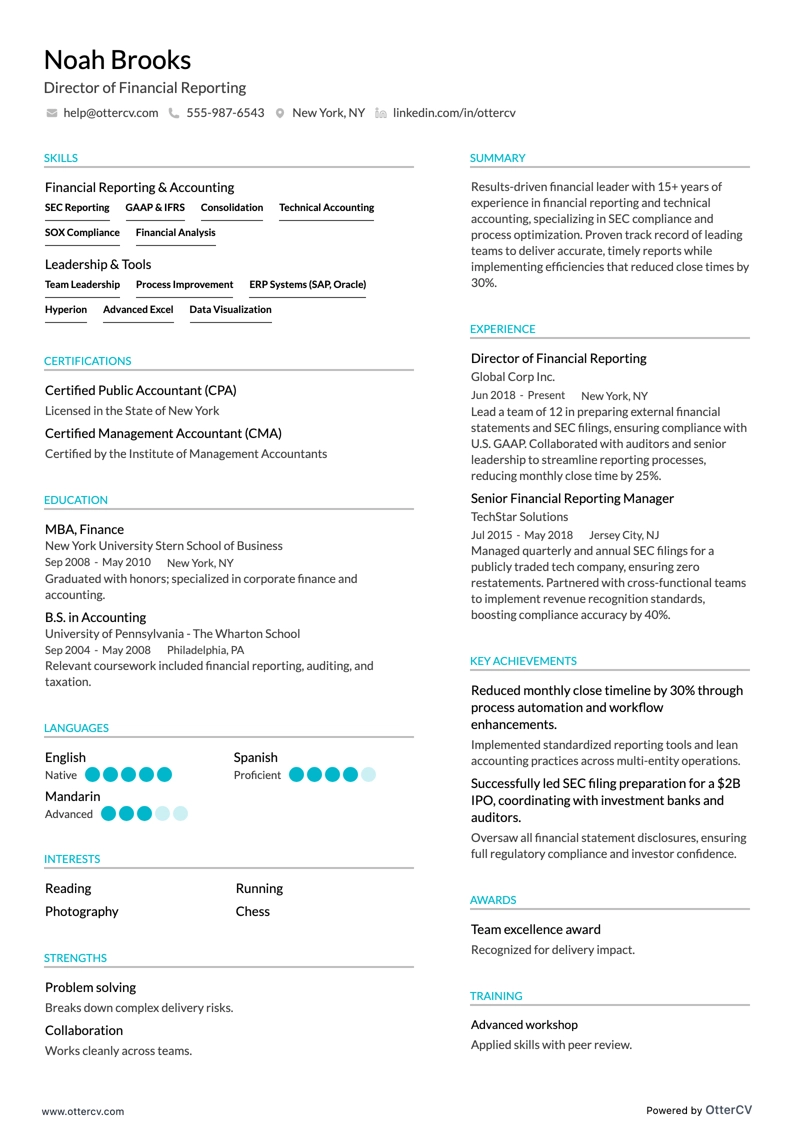
Director of Financial Reporting full preview

10 Financial Reporting Manager Resume Examples

OtterCV

Written by The OtterCV Team

Updated: 4/21/2025•8 min read

See all resume examples in this guide, or generate your own resume example with your personalized prompt

Director of Financial Reporting resume example

Director of Financial Reporting

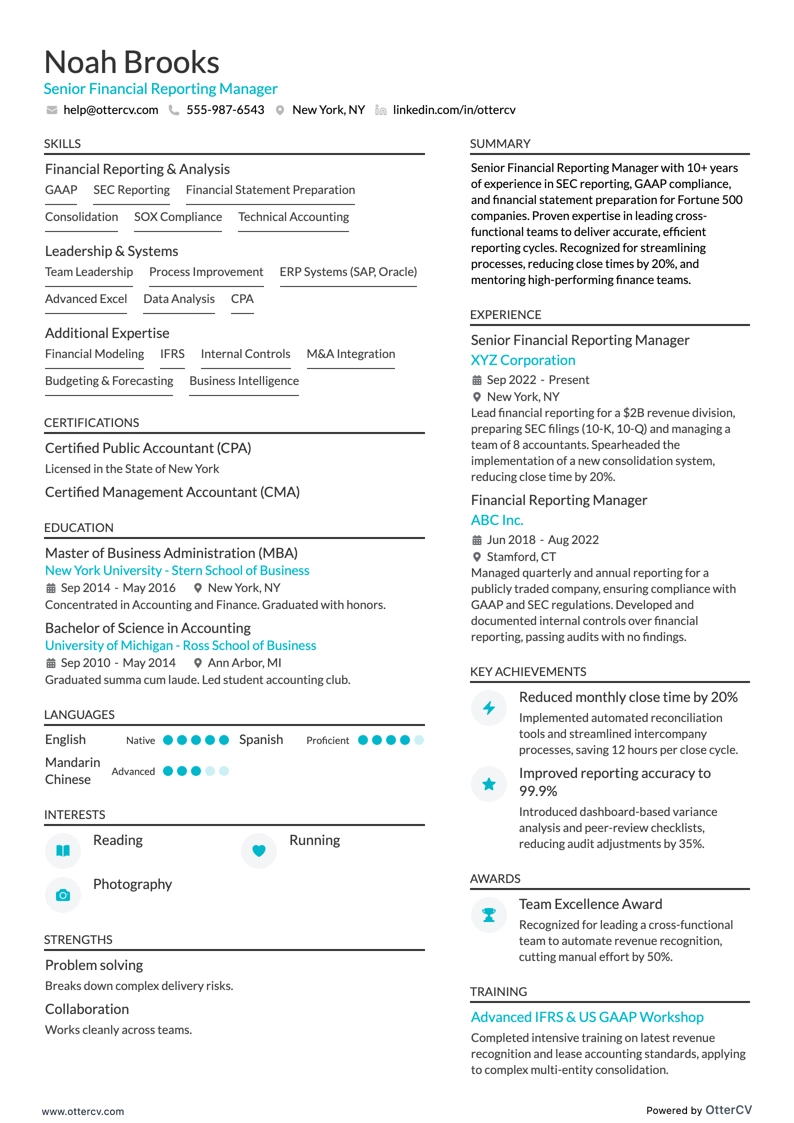
Senior Financial Reporting Manager resume example

Senior Financial Reporting Manager

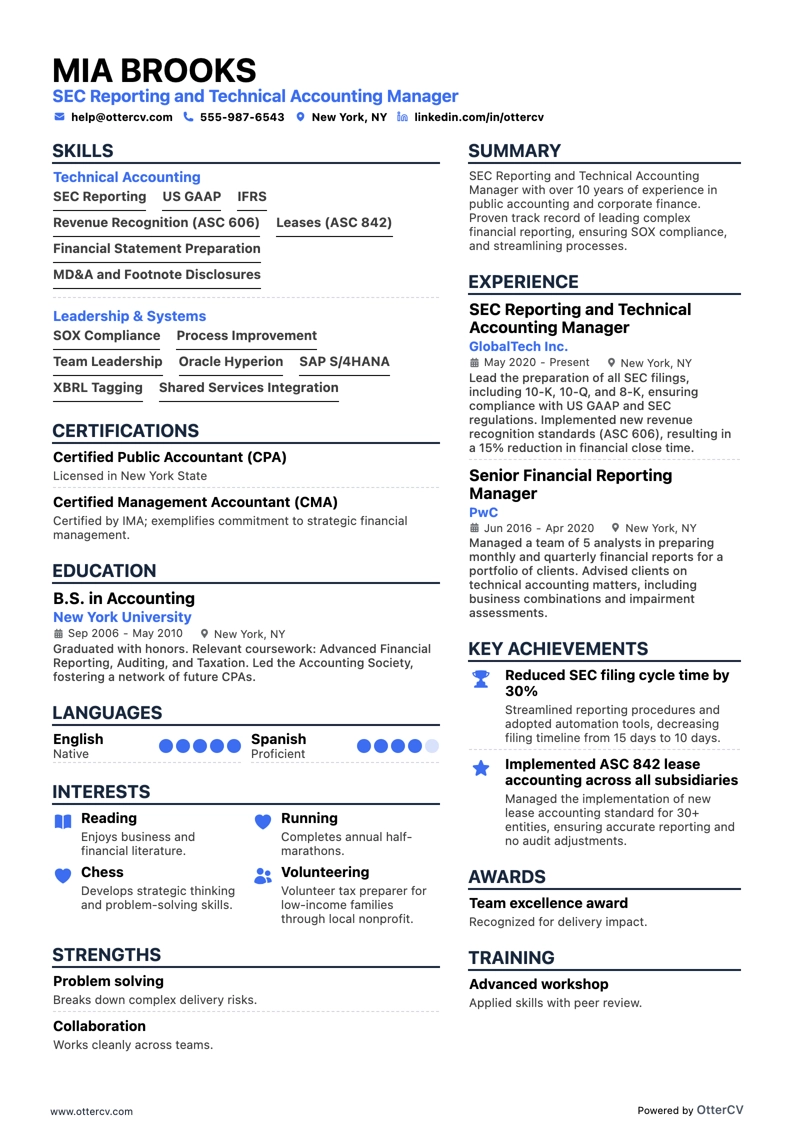
SEC Reporting and Technical Accounting Manager resume example

SEC Reporting and Technical Accounting Manager

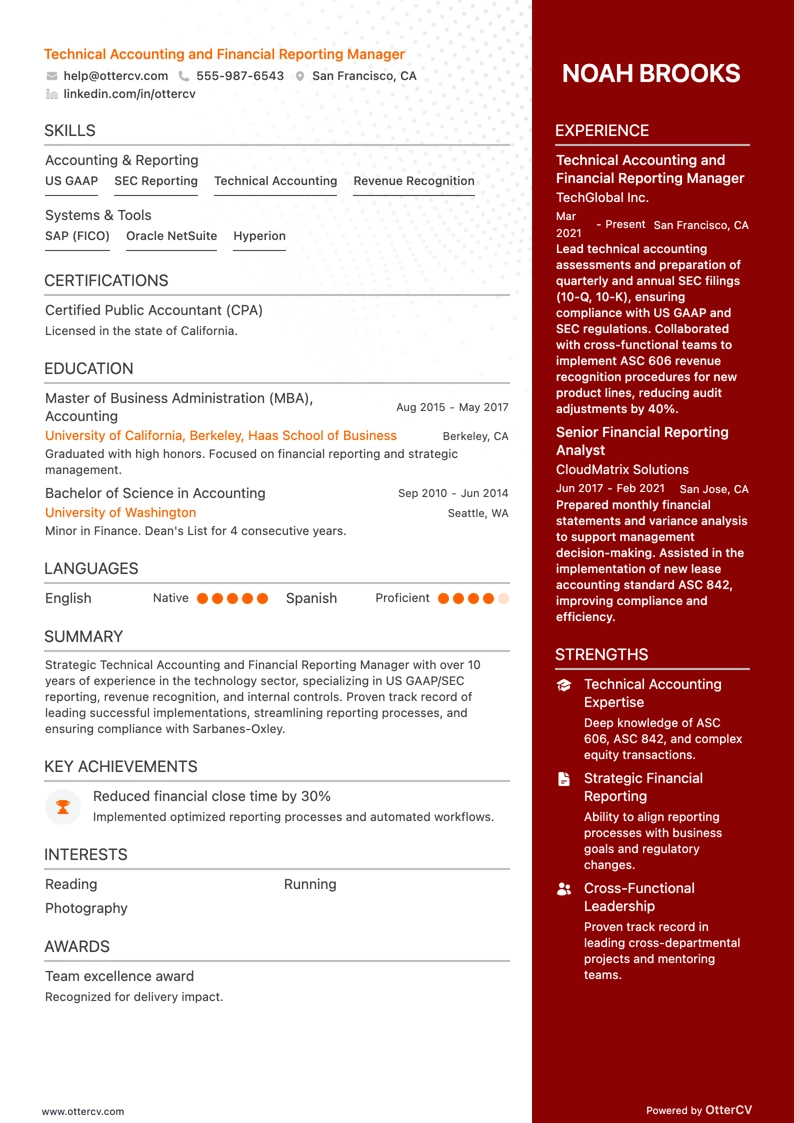
Technical Accounting and Financial Reporting Manager resume example

Technical Accounting and Financial Reporting Manager

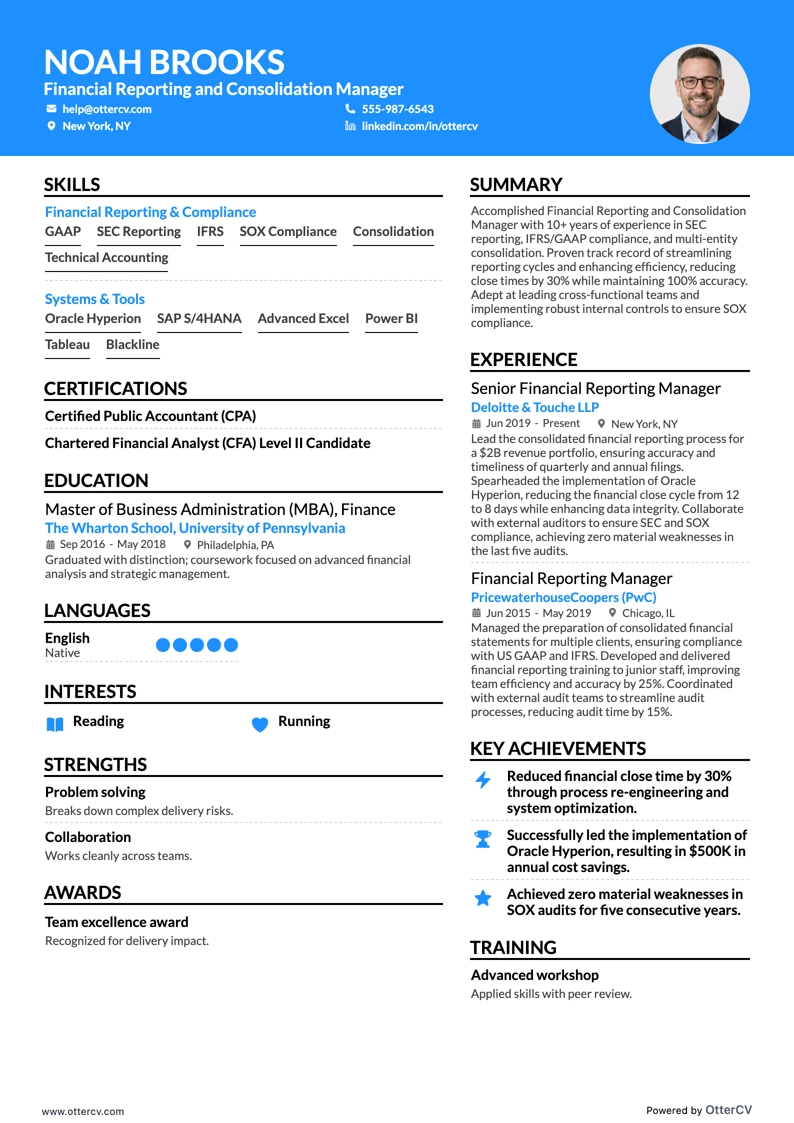
Financial Reporting and Consolidation Manager resume example

Financial Reporting and Consolidation Manager

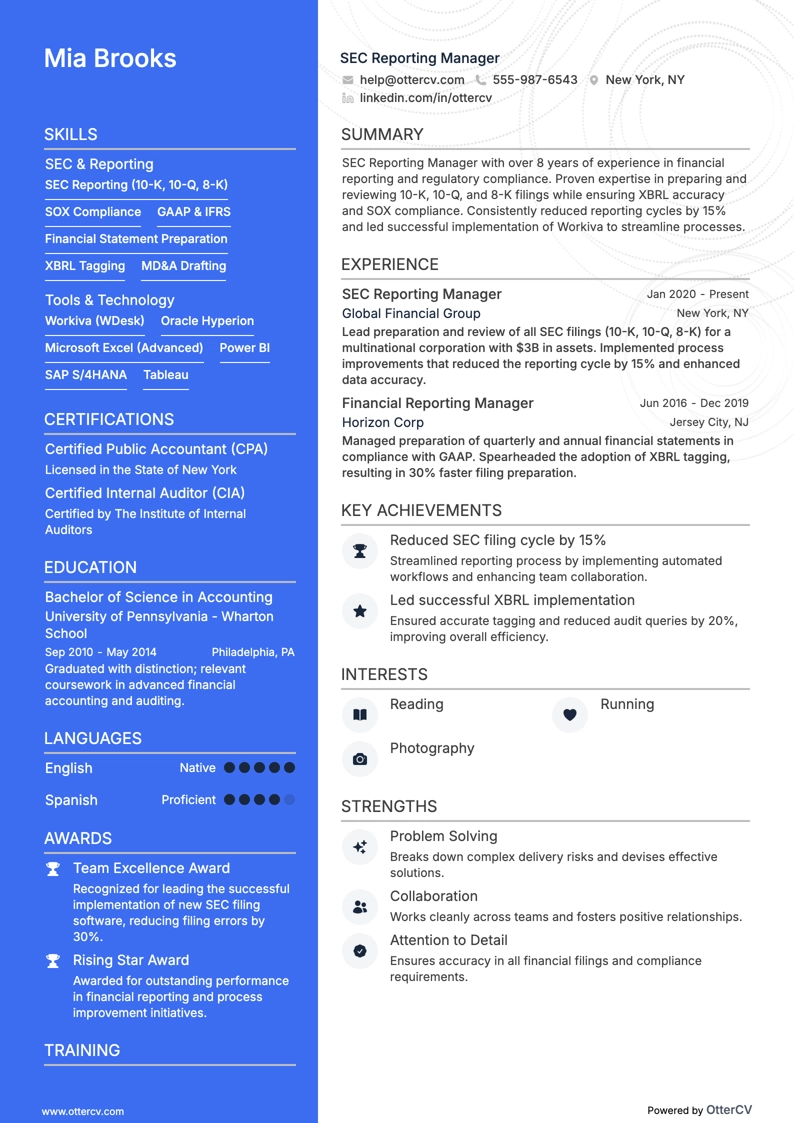
SEC Reporting Manager resume example

SEC Reporting Manager

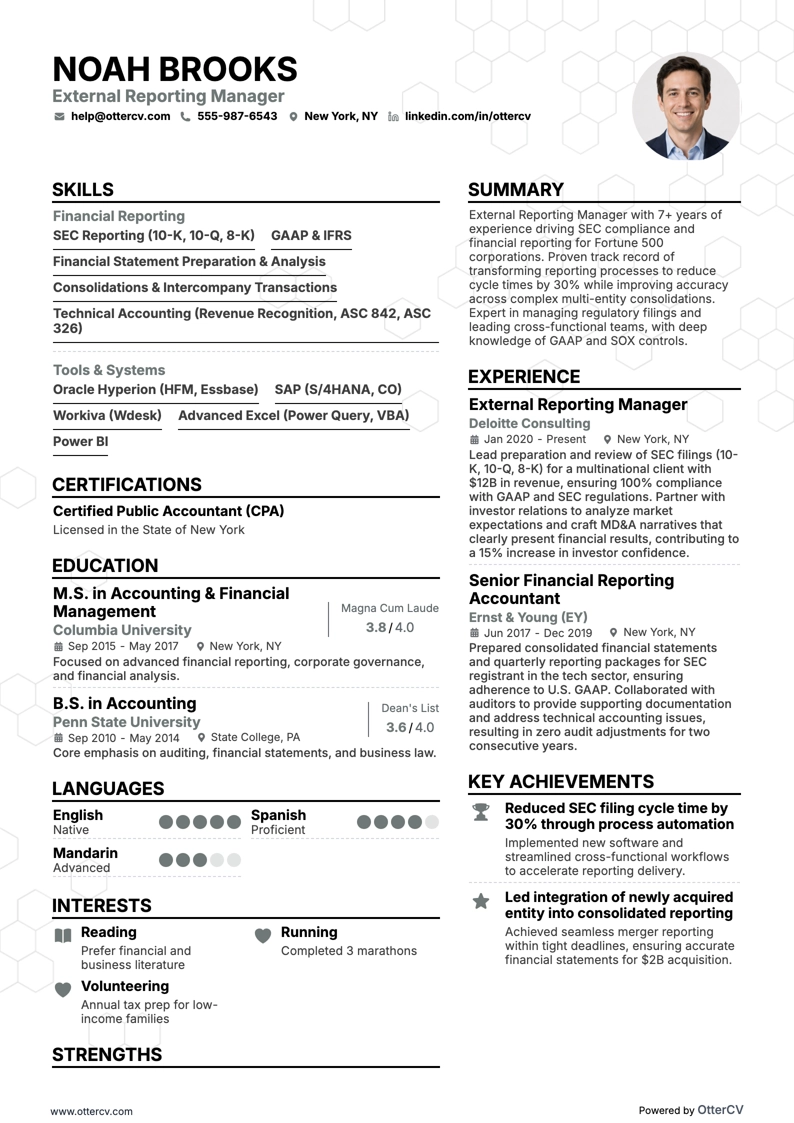
External Reporting Manager resume example

External Reporting Manager

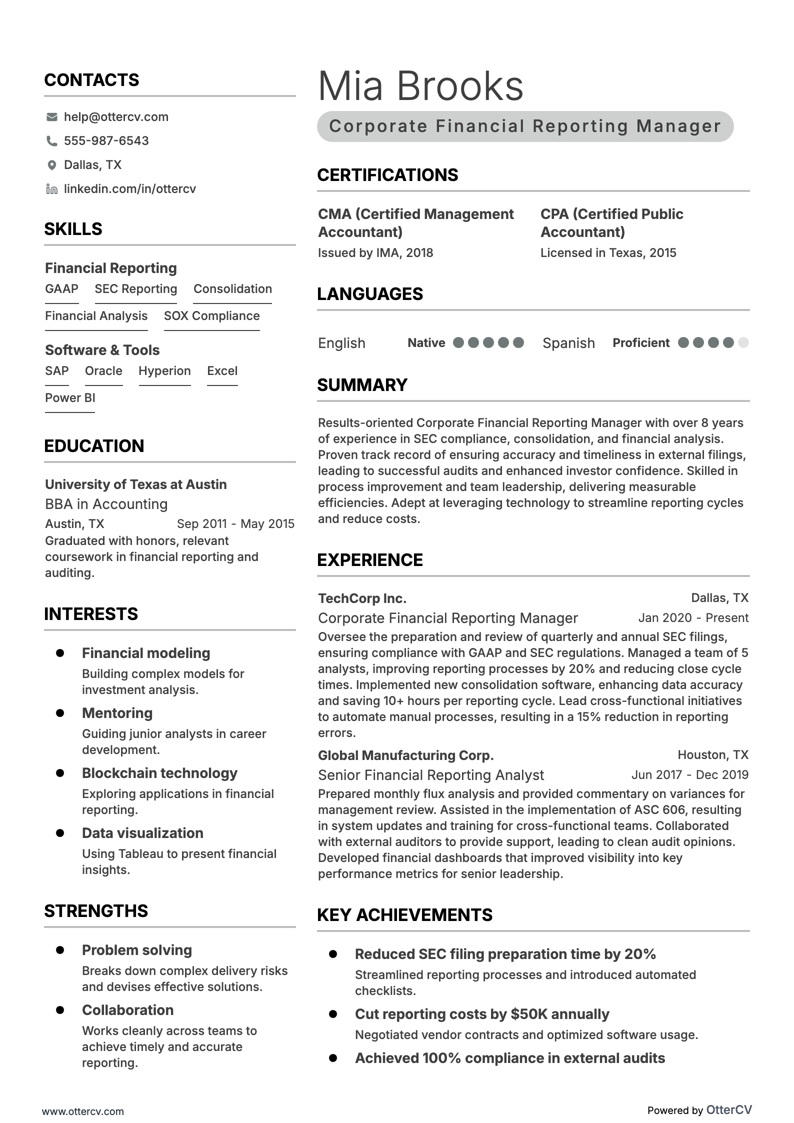
Corporate Financial Reporting Manager resume example

Corporate Financial Reporting Manager

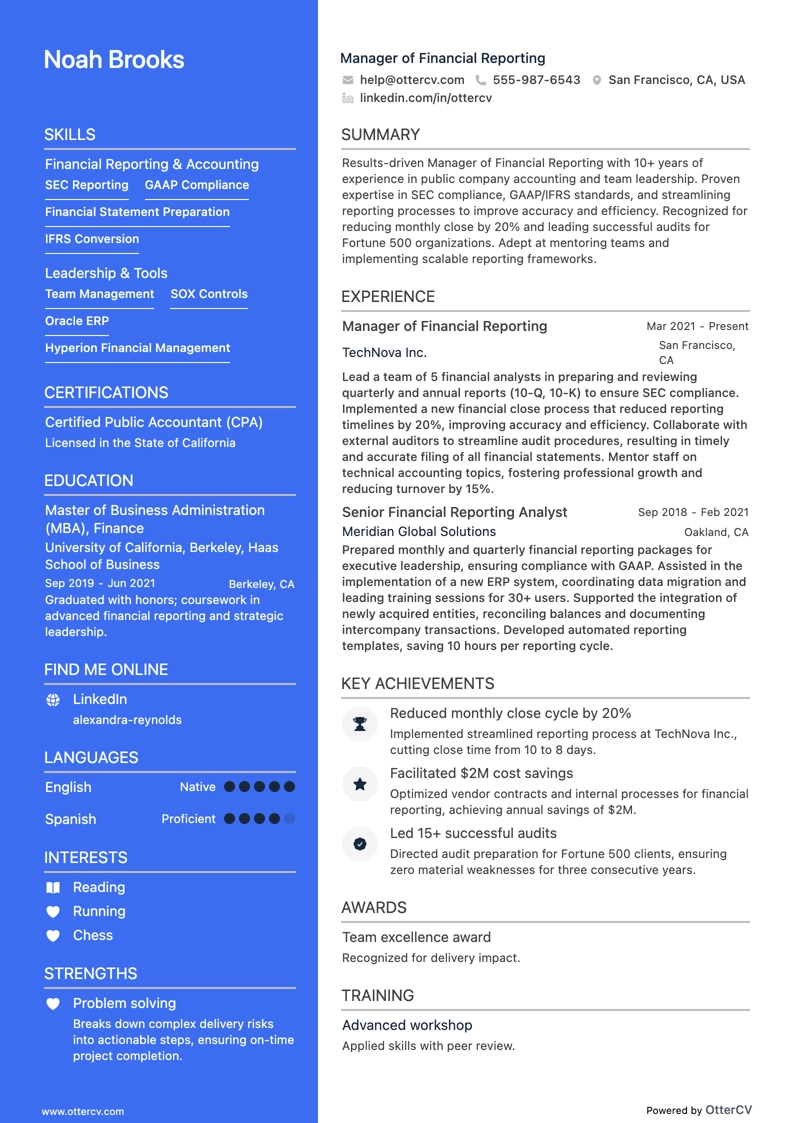
Manager of Financial Reporting resume example

Manager of Financial Reporting

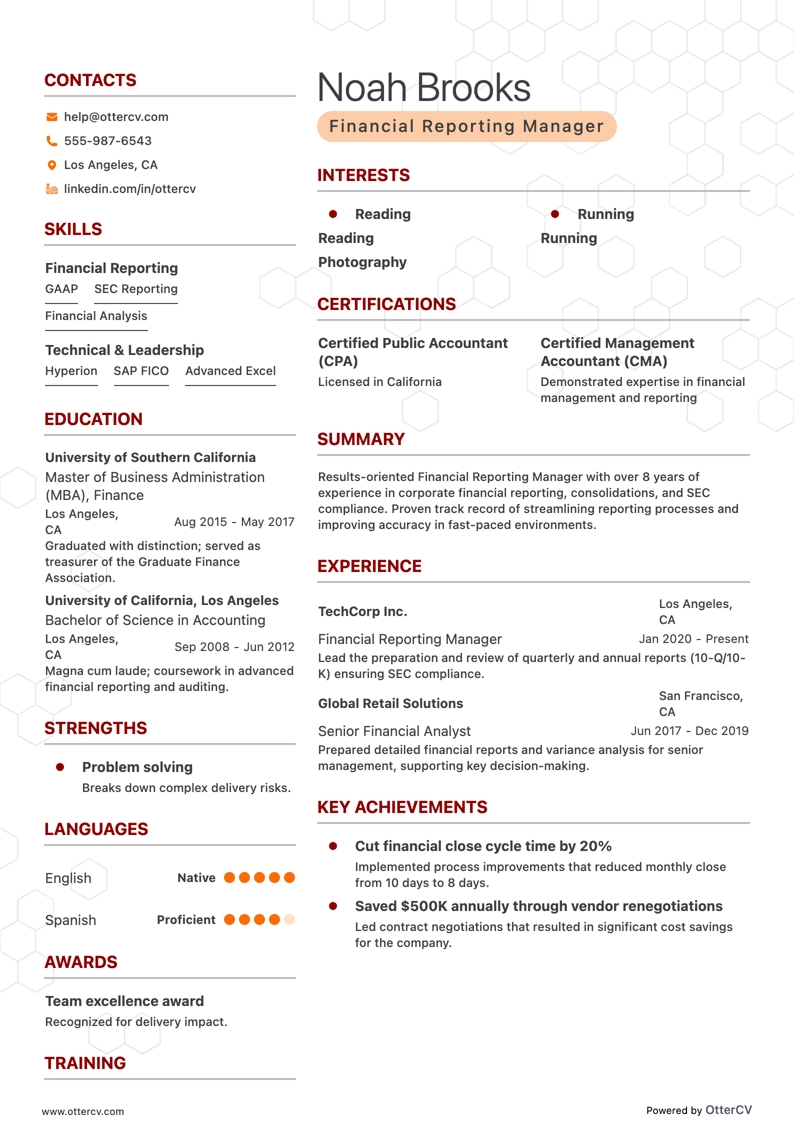
Financial Reporting Manager resume example

Financial Reporting Manager

Many financial reporting manager resumes fail because they read like task lists and hide audit-ready results behind dense accounting jargon. That weakens performance in ATS screening and quick recruiter scans, where clarity and impact matter in a highly competitive field. Understanding how to make your resume stand out is essential when many candidates share similar credentials.

A strong resume proves outcomes, not just tools. Show faster close cycles, fewer post-close adjustments, clean audit results, timely SEC filings, stronger controls, and scalable processes. Quantify your scope with the number of entities, revenue, deadlines met, and reductions in error rates.

Key takeaways

  • Quantify close-cycle improvements, audit outcomes, and error reductions instead of listing routine duties.

  • Use reverse-chronological format to show increasing reporting leadership and scope.

  • Tailor each bullet to reflect the job posting's tools, standards, and compliance language.

  • Show skills through measurable results rather than a standalone skills list.

  • Start each role with ownership scope, including team size, entity count, and reporting jurisdictions.

  • Place certifications such as CPA or CMA near education to strengthen credibility with hiring managers.

  • Use Echocv to turn vague responsibilities into specific, recruiter-ready bullets with measurable impact.

How to format a financial reporting manager resume

Recruiters reviewing financial reporting manager candidates look for clear evidence of progressive leadership in close processes, SEC/GAAP compliance, and cross-functional oversight of reporting cycles. A well-chosen resume format makes these signals—scope of accountability, team leadership, and measurable improvements in reporting accuracy or efficiency—easy to see instead of hiding career progression behind distracting formatting choices.

I have significant experience in this role—which format should I use?

I have significant experience in this role—which format should I use?

Use a reverse-chronological format—it is the right choice for experienced financial reporting managers.

Do:

  • Start each role entry with your scope of ownership, including team size, number of entities consolidated, and reporting jurisdictions such as domestic, international, SEC, and statutory.
  • Highlight proficiency in role-critical systems and domains such as Oracle HFM, SAP BPC, Workiva, BlackLine, SOX compliance, and technical accounting under ASC 842 or ASC 606.
  • Quantify outcomes related to reporting quality, audit readiness, and process efficiency instead of listing routine duties.

Example bullet: “Led monthly and quarterly SEC reporting for a $2.4B organization across 14 subsidiaries, reducing close cycle time from 12 to 7 business days while eliminating two consecutive quarters of material audit adjustments.”

Why hybrid and functional resumes don't work for senior roles

Why hybrid and functional resumes don't work for senior roles

Hybrid resumes fragment your leadership narrative by pulling key accomplishments out of their organizational context. That makes it harder for reviewers to evaluate how your accountability has grown across reporting cycles, team expansion, and compliance mandates. Functional resumes go even further by removing timeline and role-level detail, which weakens evidence of decision ownership, stakeholder management, and the increasing complexity that defines a strong financial reporting career.

If your background shows a clear progression of increasing scope in financial reporting, consolidation, or close management, avoid hybrid and functional formats entirely.

  • Edge-case exception: A functional format may be acceptable only if you're moving into financial reporting management from an adjacent discipline, such as external audit or technical accounting advisory, and have limited direct reporting titles. Even then, every skill claim should be tied to specific projects, deliverables, and quantified outcomes to remain credible with hiring managers and applicant tracking systems.

Once your resume format is clean and easy to scan, the next step is choosing sections that each serve a clear purpose.

What sections should go on a financial reporting manager resume

Recruiters want to see how you lead accurate, compliant reporting and support timely closes with clear ownership and measurable results. Knowing what to put on a resume helps you prioritize the sections that matter most for this role.

Use this structure for maximum clarity:

  • Header
  • Summary
  • Experience
  • Skills
  • Projects
  • Education
  • Certifications
  • Optional sections: Awards, Leadership, Languages

Strong experience bullets should highlight reporting accuracy, close-cycle improvements, audit readiness, stakeholder impact, and the scope of entities, systems, and standards you owned.

How to write your financial reporting manager resume experience

Once you’ve organized your resume with the right sections, the next step is to present your financial reporting manager experience in a way that fits that structure and clearly shows impact.

Your work experience section should show the financial reporting work you’ve delivered, the tools and methodologies you’ve used, and the measurable outcomes you’ve achieved. Hiring managers value demonstrated impact—such as improved accuracy, streamlined close processes, and successful audit outcomes—more than generic task lists.

Each entry should include:

  • Job title
  • Company and location (or remote)
  • Dates of employment (month and year)

Add three to five concise bullet points that explain what you owned, how you executed, and the outcomes you delivered:

  • Ownership scope: The reporting functions, financial statements, consolidation processes, entity structures, or teams you were directly accountable for as a financial reporting manager.
  • Execution approach: The ERP systems, reporting platforms, accounting standards, internal controls, or analytical frameworks you used to produce accurate and timely financial reports.
  • Value improved: The changes you drove in reporting accuracy, close-cycle efficiency, compliance posture, data reliability, or risk reduction across the financial reporting function.
  • Collaboration context: How you partnered with auditors, tax teams, FP&A, treasury, legal counsel, or executive leadership to align reporting outputs with organizational and regulatory requirements.
  • Impact delivered: The outcomes your work produced, expressed through business results, regulatory milestones, process improvements, or operational scale rather than routine activity descriptions.

Experience bullet formula

Experience bullet formula

Action verb + technology + what you built or fixed + measurable result

A financial reporting manager experience example

Financial Reporting Manager

Arcstone Energy | Houston, TX

2021–Present

Publicly traded energy company with $6B+ revenue, operating across upstream and midstream assets.

  • Led SEC reporting for 10-Q and 10-K filings using Workiva and Oracle Financials, reducing the close-to-file cycle by 20% from 40 to 32 days while maintaining zero late filings.
  • Streamlined the monthly close by redesigning account reconciliations in BlackLine and automating journal entry workflows in Oracle, reducing rework by 30% and saving 120+ hours per quarter.
  • Implemented ASC 842 lease accounting in LeaseQuery and coordinated adoption with FP&A, tax, and external auditors, improving completeness testing and reducing audit adjustments by 35%.
  • Built a GAAP-to-management reporting bridge in Power BI with SQL-based data validation, improving forecast-to-actual variance analysis accuracy by 15% and accelerating leadership reporting by two days.
  • Partnered with internal audit and IT to strengthen SOX controls over revenue recognition and consolidation in Hyperion Financial Management, lowering control exceptions by 40% and improving PBC turnaround time by 25%.

Now that you’ve seen what a strong experience section looks like, the next step is tailoring yours to the specific role you want.

How to tailor your financial reporting manager resume experience

Recruiters assess your financial reporting manager resume through both applicant tracking systems and manual review, measuring how closely your experience matches the job posting. Tailoring your resume to the job description by revising each bullet to reflect the posting’s language and priorities can improve your chances of passing both filters.

Ways to tailor your financial reporting manager experience:

  • Mirror the exact ERP or consolidation tools listed in the posting.
  • Match the terminology for GAAP or IFRS standards required in the role.
  • Align your reporting KPIs with the metrics the employer tracks.
  • Highlight SEC filing experience when the job description mentions it.
  • Reference the specific close cycle timelines emphasized in the posting.
  • Include industry experience that matches the company’s sector focus.
  • Reflect the cross-functional collaboration models described in the role listing.
  • Emphasize SOX compliance or internal controls when the posting calls for them.

Tailoring means aligning your real accomplishments with the employer’s stated requirements, not forcing unrelated keywords into your experience section.

Resume tailoring examples for financial reporting manager

Job description excerptUntailoredTailored
"Oversee preparation of consolidated financial statements in accordance with US GAAP for a multi-entity organization using Oracle HFM."Prepared financial statements and reports for the company on a regular basis.Led monthly and quarterly preparation of consolidated financial statements across 12 entities in full compliance with US GAAP, using Oracle HFM to streamline intercompany eliminations and reduce close cycle time by three days.
"Manage SEC reporting requirements including 10-K, 10-Q, and 8-K filings, ensuring accuracy and timely submission through collaboration with external auditors."Helped with regulatory filings and worked with auditors when needed.Managed end-to-end SEC reporting for 10-K, 10-Q, and 8-K filings, coordinating directly with external auditors to ensure zero restatements and consistent on-time submission over eight consecutive quarters.
"Drive process improvements in the monthly close cycle, leveraging BlackLine for account reconciliations and journal entry automation to achieve a 5-day close target."Improved financial processes and helped the team meet deadlines more efficiently.Redesigned the monthly close workflow by implementing BlackLine for automated account reconciliations and journal entries, cutting the close cycle from nine days to five and eliminating 40% of manual reconciliation tasks.

Once you’ve aligned your experience with the role’s requirements, the next step is to quantify your financial reporting manager achievements so hiring teams can quickly understand the impact behind those responsibilities.

How to quantify your financial reporting manager achievements

Quantifying your achievements shows that you improved close speed, reporting accuracy, and compliance outcomes. Focus on close cycle time, material adjustments, audit findings, control effectiveness, and the reporting volume you delivered across entities and standards.

Quantifying examples for financial reporting manager

MetricExample
Close cycle timeCut month-end close from eight to five business days by automating reconciliations in BlackLine and standardizing journal entry workflows across six entities.
Reporting accuracyReduced post-close adjustments by 35% by tightening flux analysis thresholds and adding a two-step review in Workiva for all SEC reporting schedules.
Audit outcomesDelivered a clean audit with zero significant deficiencies and one minor comment by improving PBC tracking and control evidence retention in SharePoint.
Compliance riskLowered SOX control exceptions from twelve to three per quarter by redesigning key controls and retraining twenty process owners on documentation standards.
Volume deliveredProduced ten-K and three ten-Q filings on time while managing 120+ footnotes and schedules, coordinating inputs from tax, treasury, and FP&A.

How to list your hard and soft skills on a financial reporting manager resume

Once your experience bullet points are strong, make sure your skills section shows the mix of hard and soft skills hiring managers expect in a financial reporting manager.

Skills matter because financial reporting managers must deliver accurate, compliant reporting on tight timelines. Recruiters and ATS often scan the skills section first to quickly confirm fit, so include a balanced mix of technical reporting skills and execution-focused soft skills.

Financial reporting manager roles require a blend of:

  • Product strategy and discovery skills.
  • Data, analytics, and experimentation skills.
  • Delivery, execution, and go-to-market discipline.
  • Soft skills.

Your skills section should be:

  • Scannable, with bullet-style grouping.
  • Relevant to the job post.
  • Backed by proof in your experience bullets.
  • Updated with current tools.

Place your skills section:

  • Above your experience if you're junior or switching careers.
  • Below your experience if you're mid-level or senior with strong achievements.

Hard skills

  • Demonstrates proficiency in US GAAP and IFRS reporting.
  • Covers SEC reporting, including 10-K and 10-Q filings.
  • Includes financial statement consolidation.
  • Supports month-end close and flux analysis.
  • Reflects experience with technical accounting memos.
  • Includes revenue recognition under ASC 606.
  • Covers lease accounting under ASC 842.
  • Demonstrates knowledge of internal controls and SOX compliance.
  • Includes audit coordination and PBC management.
  • Shows familiarity with Workiva and EDGAR filing.
  • Includes experience with NetSuite, Oracle, and SAP.
  • Demonstrates advanced Excel and Power Query skills.

Soft skills

  • Strong soft skills show you can lead teams and collaborate across departments under pressure.
  • Own reporting calendars and deadlines.
  • Translate guidance into clear actions.
  • Partner with FP&A and controllership.
  • Align legal, tax, and treasury inputs.
  • Lead audit discussions and follow-ups.
  • Write crisp, defensible disclosures.
  • Escalate risks early with options.
  • Drive close process improvements.
  • Review work with high standards.
  • Communicate changes to stakeholders.
  • Prioritize tasks under time pressure.
  • Coach and develop analysts.

How to show your financial reporting manager skills in context

Your skills should not appear only in a bulleted list on your resume. Reviewing resume skills examples can help you see how strong candidates integrate their competencies throughout the document.

Show these skills in:

  • Your summary, where you define your professional identity at a high level
  • Your experience, where you prove your abilities through outcomes

Here’s what that looks like in practice.

Senior financial reporting manager with 12 years in healthcare finance. Skilled in SEC filings, HFM consolidations, and cross-functional leadership. Reduced the close cycle by 30% while maintaining full GAAP compliance across three subsidiaries.

  • Clearly reflects senior-level experience
  • Names specific tools and frameworks
  • Leads with a measurable outcome
  • Signals cross-functional leadership ability

Experience example

Financial Reporting Manager

Brevian Health Partners | Chicago, IL

June 2019–Present

  • Streamlined monthly consolidation in Oracle HFM, reducing the close cycle from 12 days to eight across four entities.
  • Worked with FP&A and external auditors to close 15 disclosure gaps, resulting in zero material findings in two consecutive audits.
  • Created automated variance analysis dashboards in Power BI, cutting manual reporting effort by 40% for a six-person team.
  • Every bullet includes measurable proof.
  • Skills surface naturally through real outcomes.

Once you’ve connected your abilities to clear outcomes and examples, apply that same approach when building a financial reporting manager resume with no experience. This helps you present relevant strengths even without holding the formal title.

How do I write a financial reporting manager resume with no experience

Even without full-time experience, you can show readiness through:

  • Audit internship supporting close process
  • Public accounting busy-season internship
  • Monthly close for student org
  • Financial statement prep coursework project
  • ERP simulation in accounting lab
  • SEC reporting case competition
  • Volunteer nonprofit financial reporting
  • CPA exam sections passed

If you're building a resume without work experience, focus on:

  • GAAP financial statement accuracy
  • Close process ownership and timelines
  • Variance analysis with reconciliations
  • ERP reporting and controls exposure

Resume format tip for entry-level financial reporting manager

Resume format tip for entry-level financial reporting manager

Use a hybrid resume format to highlight reporting projects and technical skills while keeping education and internships easy to scan.

  • Lead with education, exams, and certifications.
  • Add a Projects section above experience.
  • Quantify results with time, volume, or error rates.
  • List tools such as Excel, Power BI, and NetSuite.
  • Mirror keywords from the job posting.

Example project bullet:

  • Built a three-statement reporting pack in Excel and Power BI from ERP simulation data, cutting month-end reporting time by 25% for a four-person team.

Even without direct experience, your academic background can provide a strong foundation on your resume. Here’s how to present your education effectively.

How to list your education on a financial reporting manager resume

Your education section helps hiring teams confirm you have the academic foundation for a financial reporting manager role. It also reinforces core competencies in accounting, finance, and regulatory standards.

Include the following:

  • Degree name
  • Institution
  • Location
  • Graduation year
  • Relevant coursework, for juniors or entry-level candidates
  • Honors and GPA, if 3.5 or higher

Skip the month and day, and list the graduation year only.

Here’s a strong education entry tailored to a financial reporting manager resume:

Example education entry

Bachelor of Science in Accounting

University of Illinois at Urbana-Champaign, Champaign, IL

Graduated 2016

GPA: 3.7/4.0

  • Relevant Coursework: Advanced Financial Reporting, SEC Regulatory Compliance, Corporate Consolidations, and Auditing Standards
  • Honors: Magna Cum Laude, Beta Alpha Psi Honor Society

How to list your certifications on a financial reporting manager resume

Certifications on your resume show a financial reporting manager’s commitment to ongoing learning, proficiency with reporting tools, and alignment with current accounting and compliance standards.

Include the following details:

  • Certificate name
  • Issuing organization
  • Year
  • Optional: credential ID or URL
  • Place certifications below education when they are older, less relevant, or mainly reflect general professional development.
  • Place certifications above education when they are recent, in progress, or directly related to financial reporting manager responsibilities.

Best certifications for your financial reporting manager resume

  • Certified Public Accountant (CPA).
  • Chartered Financial Analyst (CFA).
  • Certified Management Accountant (CMA).
  • Chartered Global Management Accountant (CGMA).
  • Certified Internal Auditor (CIA).
  • Certified Information Systems Auditor (CISA).
  • IFRS Certificate (ACCA).

How to write your financial reporting manager resume summary

Once your credentials are easy to find, use your financial reporting manager resume summary to reinforce those qualifications right away.

Your resume summary is often the first thing a recruiter reads. A strong summary immediately shows that you’re qualified for a financial reporting manager role.

Keep it to three to four lines and include:

  • Your title and total years of experience in financial reporting or accounting.
  • Your domain focus, such as SEC reporting, GAAP compliance, or consolidations.
  • Core tools like Oracle, SAP, HFM, or advanced Excel modeling.
  • One or two quantified achievements tied to accuracy, efficiency, or cost savings.
  • Soft skills shown through real results, such as cross-functional collaboration or mentoring analysts.

PRO TIP

At the manager level, emphasize your ownership of reporting cycles, team leadership, and process improvements backed by measurable results.

Highlight your ability to improve accuracy and meet tight deadlines across departments.

Avoid vague phrases like “detail-oriented professional” or “passionate about finance.” Focus on showing impact instead.

Example summary for a financial reporting manager

Financial reporting manager with eight years of experience leading SEC and GAAP reporting. Managed a team of five analysts and reduced close cycle time by 30% using HFM and Oracle.

Now that your summary clearly communicates your value, make sure recruiters can easily reach you with a polished, complete resume header.

What to include in a financial reporting manager resume header

A resume header includes your key identifiers and contact details, helping a financial reporting manager stand out during recruiter screening through clear visibility and credibility.

Essential resume header elements

  • Full name
  • Tailored job title and headline
  • Location
  • Phone number
  • Professional email
  • GitHub link
  • Portfolio link
  • LinkedIn

Including a LinkedIn link helps recruiters verify your experience quickly and supports screening.

Do not include photos on a financial reporting manager resume unless the role is explicitly front-facing or appearance-dependent.

Keep your header to one or two lines, match the job title to the posting, and use consistent formatting across all contact links.

Example

Once your contact details and role identifier are in place at the top of the resume, add optional sections to strengthen your fit and round out the document.

Additional sections for financial reporting manager resumes

When your core qualifications are similar to those of other candidates, additional sections can help you stand out by highlighting relevant expertise and credibility. For example, listing language skills can be especially useful if the role involves international reporting or multi-jurisdiction consolidations.

Consider adding these sections for a financial reporting manager resume:

  • Languages
  • Professional affiliations (e.g., IMA, AICPA, FEI)
  • Publications and thought leadership
  • Continuing education and CPE credits
  • Speaking engagements and conference presentations
  • Volunteer leadership in finance or nonprofit boards
  • Awards and industry recognition

Once you’ve strengthened your resume with relevant additional sections, pairing it with a well-written cover letter can increase your impact.

Do financial reporting manager resumes need a cover letter

A cover letter is not required for a financial reporting manager role, but it can help in competitive searches and at companies that expect one. If you’re unsure what a cover letter is or how it complements your resume, it’s worth learning before deciding to skip it. It can make a difference when your resume needs added context or when hiring teams are comparing several similar candidates.

Use a cover letter to provide context your resume cannot fully show:

  • Explain your fit for the role or team by linking your reporting experience to the company’s close process, controls, and stakeholder needs.
  • Highlight one or two outcomes, such as shortening the close cycle, improving audit readiness, or reducing recurring adjustments.
  • Show that you understand the business context by referencing the product, revenue model, key users of reports, and how decisions depend on financial reporting.
  • Address career transitions or less obvious experience by connecting past roles to financial reporting manager responsibilities and tools.

Even if you decide a cover letter will not add value for this role, using AI to improve your financial reporting manager resume can strengthen the document hiring teams will review first.

Using AI to improve your financial reporting manager resume

AI can improve your resume’s clarity, structure, and overall impact. It can refine bullet points, tighten language, and highlight measurable results. But overusing it can make your resume feel less authentic. Once the content is clear and aligned with the role, step away from AI assistance. If you are still comparing tools, learn which AI is best for writing resumes before choosing a platform.

Here are 10 practical prompts you can copy and paste to strengthen specific parts of your resume:

  1. Sharpen your summary: “Rewrite my resume summary to highlight my core strengths as a financial reporting manager in under four sentences.”
  2. Quantify your impact: “Add measurable results to these experience bullets for a financial reporting manager, focusing on accuracy, deadlines, and cost savings.”
  3. Tighten bullet points: “Condense each experience bullet to one line while preserving key achievements relevant to a financial reporting manager role.”
  4. Align with job posts: “Compare my financial reporting manager resume bullets against this job description and flag any gaps in required qualifications.”
  5. Strengthen action verbs: “Replace weak or repeated verbs in my financial reporting manager experience section with stronger, more specific alternatives.”
  6. Refine skills section: “Reorganize my skills section to prioritize the most relevant technical and soft skills for a financial reporting manager.”
  7. Improve project descriptions: “Rewrite my project descriptions to clearly show scope, tools used, and outcomes for a financial reporting manager resume.”
  8. Enhance certifications section: “Reformat my certifications section to emphasize credentials most valued for a financial reporting manager position.”
  9. Clarify education details: “Edit my education section to highlight coursework and honors directly applicable to a financial reporting manager career path.”
  10. Remove filler language: “Identify and remove vague or redundant phrasing throughout my financial reporting manager resume without losing important details.”

Stop using AI once your resume sounds accurate, specific, and aligned with your real experience. AI should never invent experience or inflate claims—if it did not happen, it does not belong on your resume.

Conclusion

A strong financial reporting manager resume shows impact through measurable outcomes, role-specific skills, and a clear structure. Use metrics that demonstrate faster closes, fewer audit findings, and stronger controls. Highlight expertise in financial statements, consolidations, disclosures, and compliance.

Keep each section direct and easy to scan so hiring teams can confirm fit quickly. Show consistent results, clean formatting, and precise language. This helps position you as a financial reporting manager ready for today’s hiring market and near-future expectations.

Financial Reporting Manager resume examples

Explore additional Financial Reporting Manager resume samples and guides and see what works for your level of experience or role.

By Experience

Director of Financial Reporting

Director of Financial Reporting resume preview

Senior Financial Reporting Manager

Senior Financial Reporting Manager resume preview

Financial Reporting Manager resume examples

Explore additional Financial Reporting Manager resume samples and guides and see what works for your level of experience or role.

By Role

SEC Reporting and Technical Accounting Manager

SEC Reporting and Technical Accounting Manager resume preview

Technical Accounting and Financial Reporting Manager

Technical Accounting and Financial Reporting Manager resume preview

Financial Reporting and Consolidation Manager

Financial Reporting and Consolidation Manager resume preview

SEC Reporting Manager

SEC Reporting Manager resume preview

External Reporting Manager

External Reporting Manager resume preview

Corporate Financial Reporting Manager

Corporate Financial Reporting Manager resume preview

Manager of Financial Reporting

Manager of Financial Reporting resume preview

Financial Reporting Manager

Financial Reporting Manager resume preview