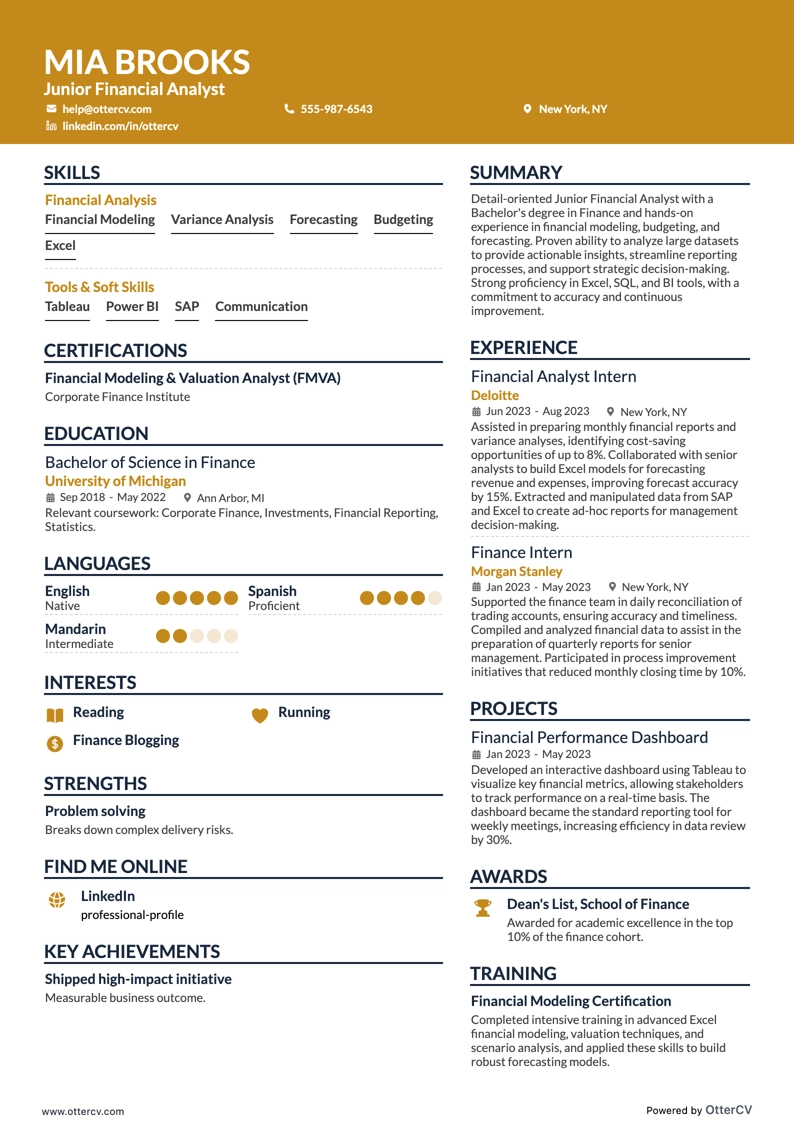
Junior Financial Analyst full preview

24 Financial Analyst Resume Examples

OtterCV

Written by The OtterCV Team

Updated: 9/21/2023•8 min read

See all resume examples in this guide, or generate your own resume example with your personalized prompt

Junior Financial Analyst resume example

Junior Financial Analyst

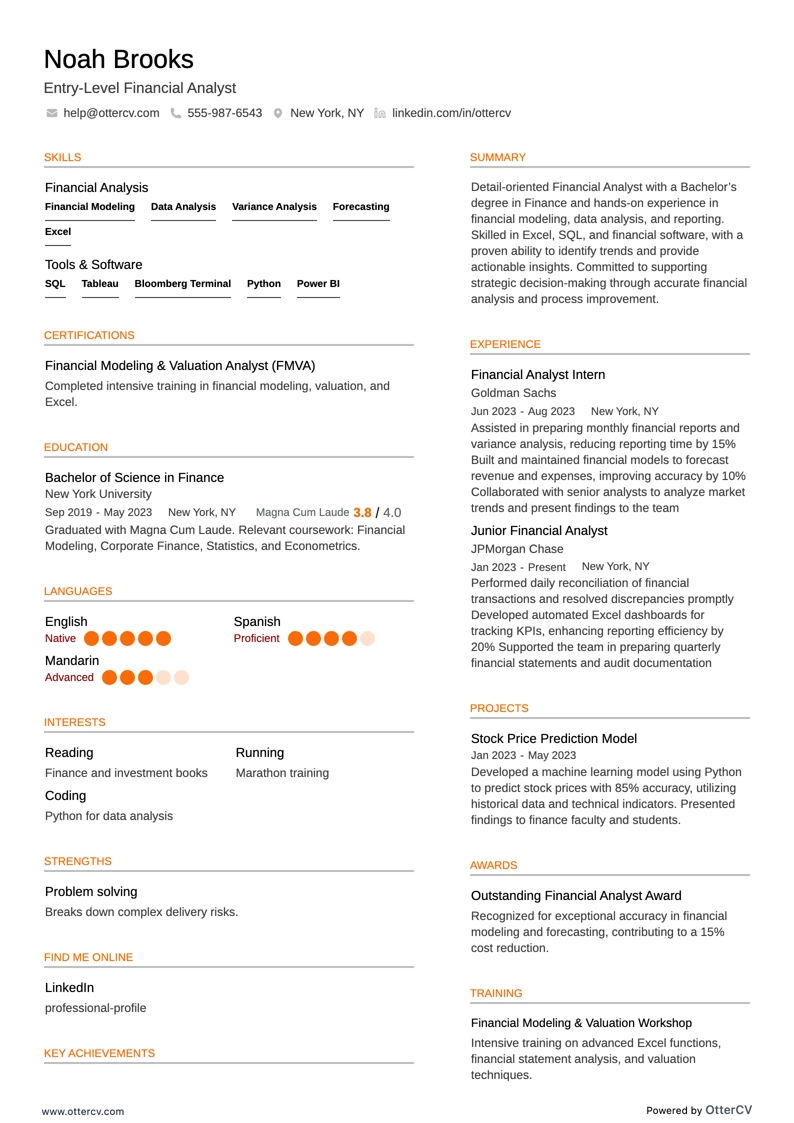
Entry-Level Financial Analyst resume example

Entry-Level Financial Analyst

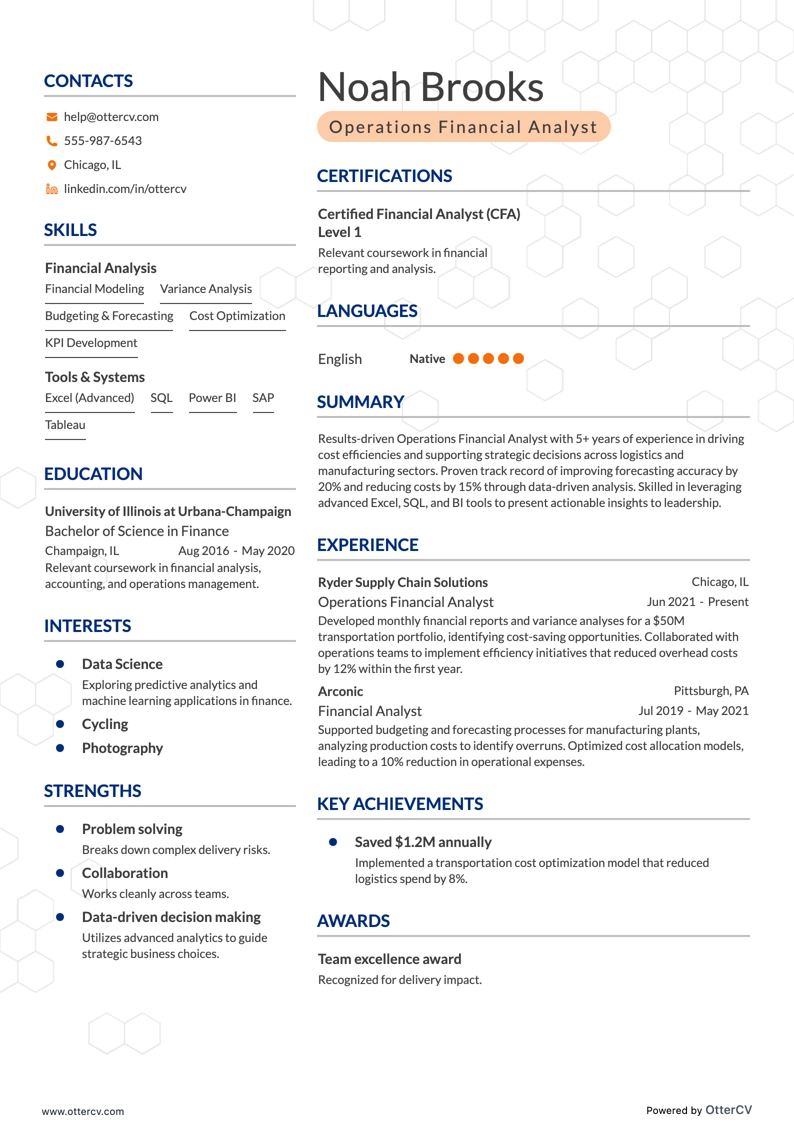
Operations Financial Analyst resume example

Operations Financial Analyst

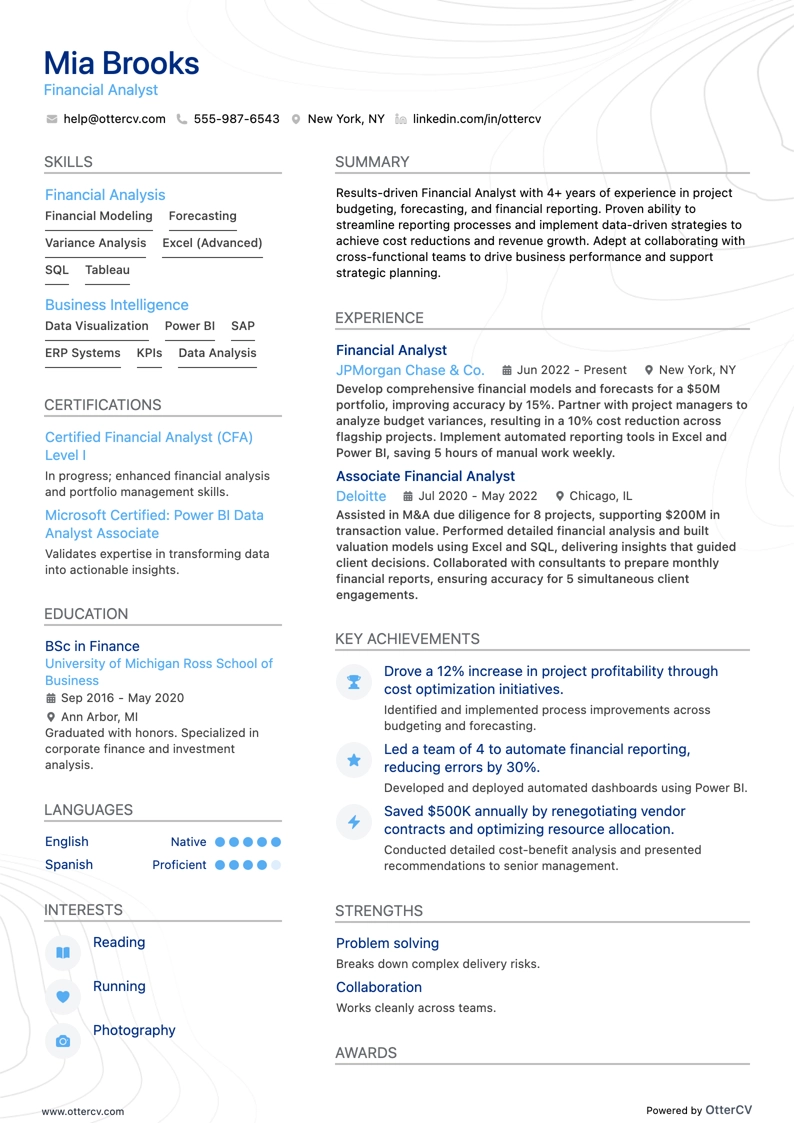
Project Financial Analyst resume example

Project Financial Analyst

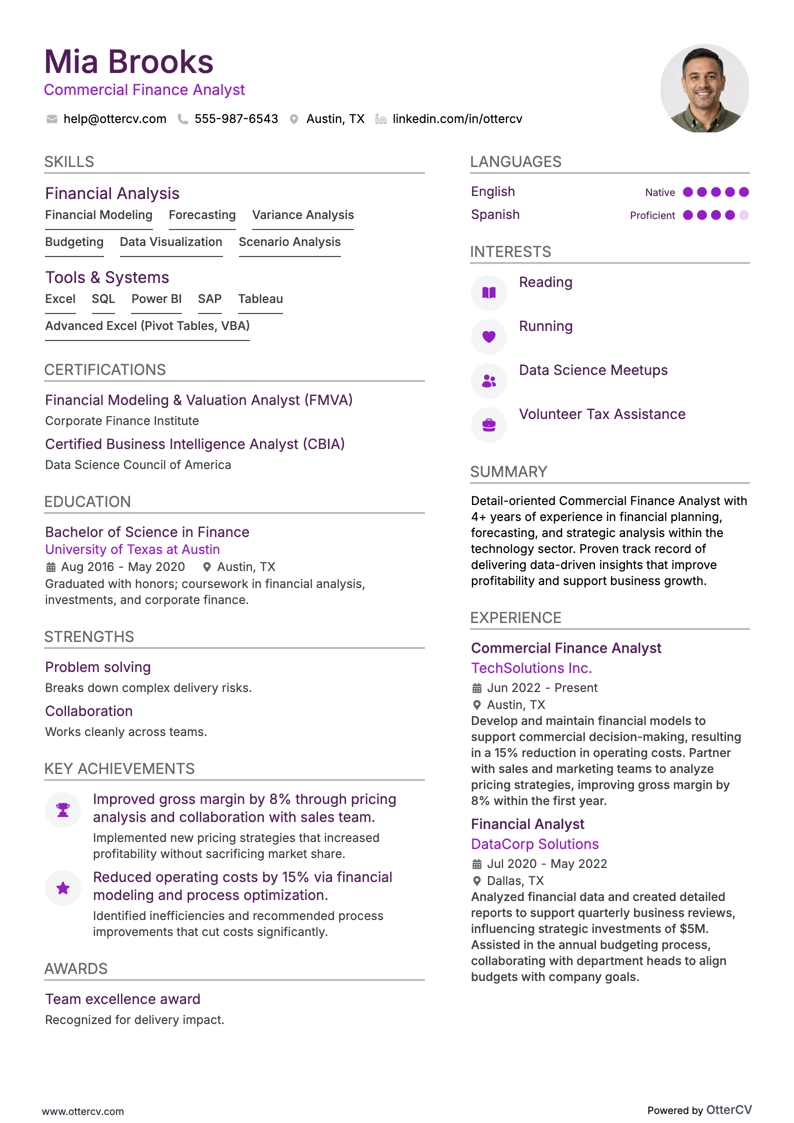
Commercial Finance Analyst resume example

Commercial Finance Analyst

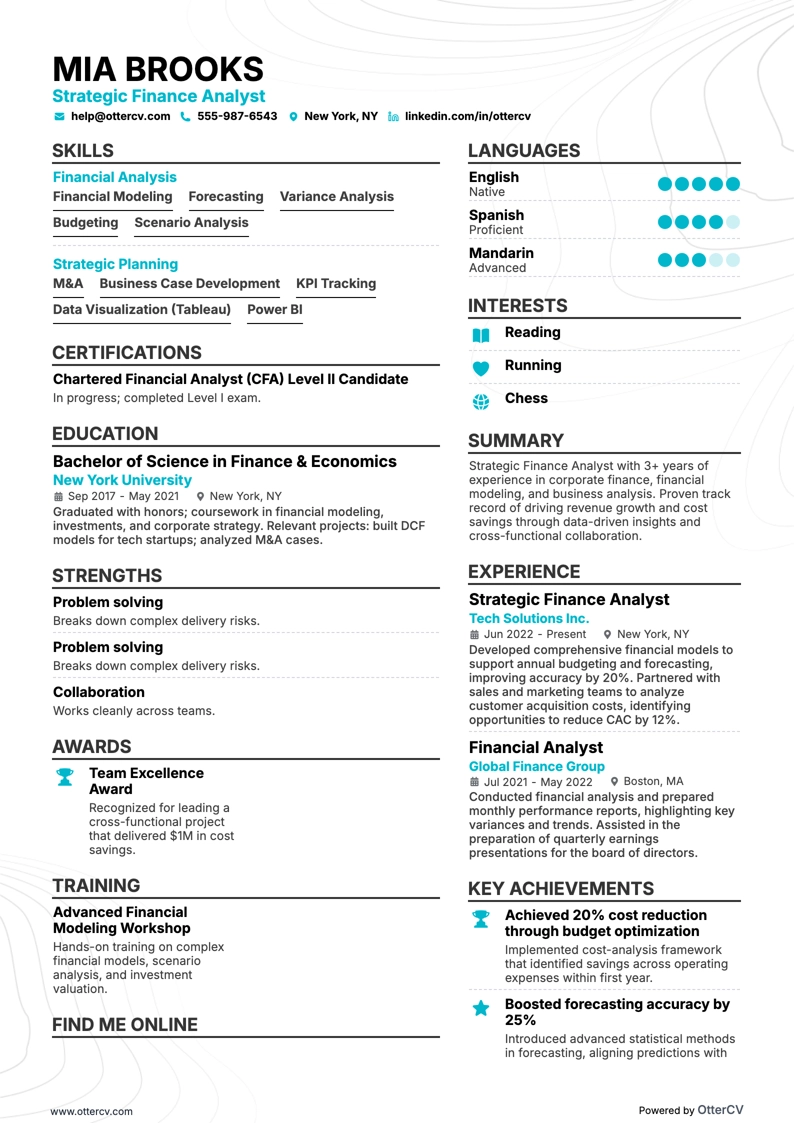
Strategic Finance Analyst resume example

Strategic Finance Analyst

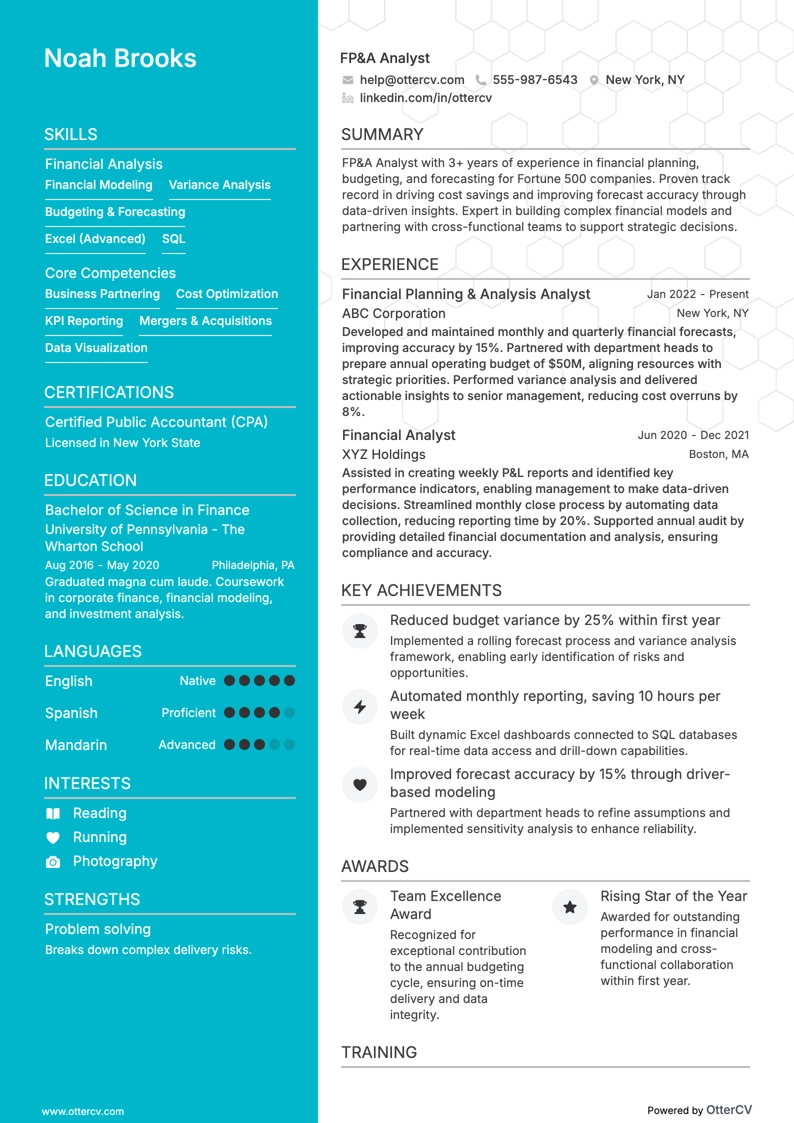
FP&A Analyst resume example

FP&A Analyst

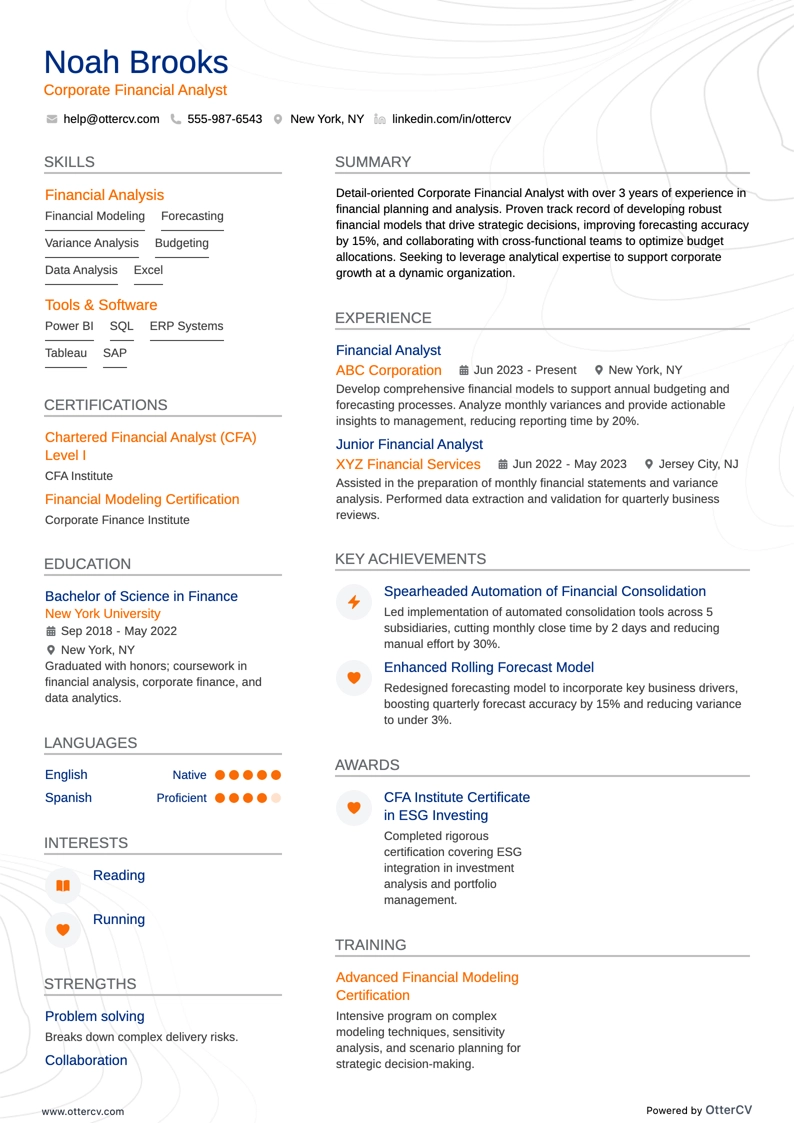
Corporate Financial Analyst resume example

Corporate Financial Analyst

As a financial analyst, you manage financial models, prepare reports, control budgets, and provide insights to management. These responsibilities make you a reliable, skilled analyst who turns data into actionable insights.

While some parts of the job can feel repetitive, that is where focus and attention to detail matter most. With that in mind, this guide will help you craft a resume that highlights your achievements and shows how effective you are in the role.

Key takeaways

  • List your financial analyst experience in reverse chronological order to show your career progression clearly.

  • Write a strong resume summary that highlights your qualifications, analytical mindset, and key achievements.

  • Show your technical skills in financial modeling, data analysis, and financial software, along with your communication and problem-solving strengths.

  • Use specific metrics to demonstrate your impact, such as improved forecasting accuracy or cost reductions.

  • Tailor your resume for each role by matching your skills and experience to the job requirements.

  • Include your education and relevant certifications to reinforce your expertise.

  • If you have limited experience, emphasize internships, academic projects, and volunteer work that demonstrate your financial analysis skills.

A strong financial analyst resume is essential. Below is a resume sample that highlights the best format to showcase your skills and experience.

Financial analyst resume sample

Review this financial analyst resume example for guidance.

Ethan Miller

Financial Analyst

help@echocv.com | @linkedin.com | Austin, Texas

Summary

Dedicated financial analyst with over 7 years of experience in fast-paced financial environments. Skilled in financial modeling, data analysis, and budget management, with a detail-oriented approach and strong analytical abilities. Proven success in delivering actionable insights and working effectively with cross-functional teams and senior management.

Professional Experience

Financial Analyst

Shockwave Medical (Johnson & Johnson MedTech), New Brunswick, NJ

June 2022 - Present

  • Develop and maintain complex financial models to support strategic decision-making.
  • Manage budgeting and forecasting processes, improving accuracy by 15%.
  • Analyze financial data to identify trends and opportunities, resulting in a 10% reduction in costs.
  • Prepare detailed financial reports for senior management to support stronger decision-making.
  • Collaborate with cross-functional teams to align financial goals and strategies.

Junior Financial Analyst

BBVA Compass, Birmingham, AL

November 2017 – May 2022

  • Assisted in preparing financial reports and analysis, contributing to a 20% improvement in forecast accuracy.
  • Managed budget tracking and variance analysis, helping reduce discrepancies by 12%.
  • Supported senior analysts with in-depth financial research, improving report quality.
  • Played a key role in the monthly closing process, ensuring timely and accurate financial reporting.

Education

Bachelor of Business Administration (Finance)

University of Alabama

Graduated: 2017

Relevant Coursework

  • Financial Analysis: Focused on advanced financial modeling and data-driven decision-making.

Certifications

  • Chartered Financial Analyst (CFA) Level 1, CFA Institute, 2019
  • Microsoft Excel Expert, Microsoft, 2018

Skills

  • Financial Modeling
  • Budget Management
  • Data Analysis
  • Forecasting
  • Financial Reporting
  • Advanced Excel

Languages

  • English (Fluent)
  • Spanish (Intermediate)

After reviewing the example, let’s look at how to structure your financial analyst resume.

How to format a financial analyst resume

For financial analysts, the reverse-chronological resume format is usually the most effective choice. It emphasizes your most recent and relevant experience, helping recruiters quickly understand your career progression and the impact you’ve made.

This format also showcases key strengths such as specific skills and quantifiable results, which are especially important in financial analysis. It’s also easy for both Applicant tracking systems (ATS) and hiring managers to scan.

Keep in mind that resume standards can vary by market—for example, a Canadian resume layout may differ.

ATS Parsing: What Matters Most

Our tests confirm that fonts, colors, and resume length typically do not cause problems with ATS parsing. What matters most are details such as date formatting and bullet point usage, since they can affect how the software reads your resume.

A well-structured resume helps both ATS software and hiring managers with limited time quickly understand your experience.

Let’s dive into the specifics of resume design.

Resume order

When building a reverse-chronological resume, organize the sections in a clear, easy-to-follow order:

  1. Header
  2. Summary/Objective
  3. Professional experience
  4. Education & Certifications
  5. Skills
  6. Languages

Design tips for financial analyst resumes

Contact information

File format

  • Choose a simple resume file name, such as “EthanMillerFinancialAnalystResume.pdf.”
  • Save your resume as a PDF unless the job posting specifies a different format.

Take advantage of our free AI resume checker to see how your existing resume will be parsed by ATS.

Now, let’s take a closer look at the work experience section of your financial analyst resume.

How to write your financial analyst resume experience

Your professional experience is a critical part of a financial analyst resume because it highlights your practical skills, strengthens your credibility, and shows your expertise in finance.

It also helps employers understand your ability to handle real-world financial responsibilities. Focus on your strongest accomplishments, using measurable results such as improving the accuracy of financial forecasts, optimizing budget processes, or delivering significant cost savings.

Organize your resume clearly by using bullet points. Most importantly, tailor your resume to the job description so recruiters can quickly see why you are a strong fit for the role.

The right way to tailor your financial analyst resume to the job description

Customizing your resume to align with the job description helps your most relevant qualifications stand out and improves your chances of impressing the hiring manager. By emphasizing the skills and experience the employer values most, you show that you are well suited for the position. This approach is known as creating a targeted resume.

Here’s how to tailor an experience section to fit a real financial analyst job offer:

Financial analyst

Financial analyst

Job description: Abbott is a global healthcare leader that helps people live more fully at all stages of life. In this financial analyst role, you will manage day-to-day accounting and month-end close activities within the finance department, with a focus on fixed asset accounting. The position also supports journal entries, reconciliations, process improvement, and reporting.

What you'll do:

  • Perform day-to-day accounting duties, including account reconciliations, accruals, general ledger maintenance, and other assigned tasks.
  • Complete month-end close activities, including fixed asset additions, account reconciliations, journal entry preparation, general ledger account reconciliation, and maintenance of supporting schedules.
  • Maintain detailed, supported, and documented reconciliations for all assigned general ledger accounts.
  • Support account inquiries and fluctuations during month-end accounting review.
  • Handle all aspects of Fixed Assets and Construction in Process, including maintaining the fixed asset database, tracking additions and disposals, reporting, and performing physical verification of Fixed Assets.
  • Monitor bank accounts daily and post all incoming and outgoing transactions.

Core competencies:

  • Action-oriented
  • Collaborative
  • Communicates effectively
  • Financial acumen
  • Optimizes work processes
  • Resourcefulness
  • Dealing with ambiguity

Required qualifications:

  • Bachelor’s Degree (B.A) in Accounting, Finance, and/or other related technical field, or an equivalent combination of education and experience
  • 3+ years accounting experience required
  • Advanced experience in Excel and proficiency with Microsoft Office Suite (Outlook, Access, Word, PowerPoint)
  • Excellent attention to detail, well-organized, and highly accountable
  • Solid analytical insight, prioritization, and problem-solving skills
  • Strong oral, written, and interpersonal skills
  • Comfortable working in a fast-paced environment with limited guidance
  • Self-motivated, action-oriented individual with the perseverance to meet deadlines
  • Developed time management and priority setting skills required to work in an often ambiguous and constantly changing business environment

Here’s the customized experience section:

Experience

Financial Analyst

Abbott

03/2019 - 02/2024 · New York, NY

  • Handled daily accounting tasks, improving reconciliation accuracy by 15%.
  • Completed month-end close activities, reducing close time by 10%.
  • Maintained detailed reconciliations for 100+ general ledger accounts.
  • Supported month-end reviews, decreasing discrepancies by 12%.
  • Managed fixed assets, ensuring 100% accuracy in database and physical verifications.
  • Monitored and posted daily bank transactions, maintaining 99% accuracy.
RIGHT

Why This Resume Matches the Job Requirements

This resume aligns well with the job ad's requirements by:

  • Highlighting key financial responsibilities, including daily accounting tasks and month-end close activities, which demonstrate essential financial management skills.
  • Showing measurable impact through results such as improving reconciliation accuracy by 15% and reducing month-end close time by 10%.
  • Emphasizing critical skills such as fixed asset management, detailed ledger reconciliations, and accurate bank transaction monitoring.
  • Demonstrating the ability to support month-end reviews and reduce discrepancies by 12%, which is important for accurate financial reporting.
  • Reinforcing the importance of detailed record-keeping and accuracy, both of which are essential for financial integrity and compliance.

How to quantify your experience on a resume

In the upcoming section, we’ll show you how to quantify your achievements.

Understanding the story behind the numbers is what sets great financial analysts apart.

—Warren Buffett

Just as metrics and KPIs are essential for evaluating financial performance, using numbers and results on your resume helps show your impact as a financial analyst. It demonstrates how you improved financial forecasting, reduced costs, or increased budget accuracy, making your achievements clear and measurable.

Here are some ideas:

Key Financial Achievements

  • Reduced forecasting errors by 15% through improved data analysis techniques.
  • Managed a $10 million budget and optimized resource allocation to achieve a 12% cost reduction.
  • Increased financial reporting accuracy by 20% through automated processes.
  • Analyzed financial trends and delivered insights that contributed to a 25% increase in revenue.
  • Implemented a new financial model that boosted profitability by 18% over six months.

Even without financial analyst experience, you can still build a strong resume. Here’s how.

How do i write a financial analyst resume with no experience

Starting a financial analyst career can feel exciting and challenging when you’re new to the field. Even so, you can create a resume that shows your potential and helps you stand out.

Use these tips to get started:

  • Use a functional resume format to highlight your analytical skills and academic achievements.
  • Choose a simple template to keep your resume professional, even with limited experience.
  • Include coursework and academic projects that show your understanding of financial analysis and problem-solving.
  • Emphasize your technical skills and familiarity with financial software, such as Excel or the Microsoft Office Suite, by listing relevant training or courses.
  • Focus on transferable skills. Summer jobs or relevant internships, even if they are not directly related to finance, can help you develop skills like data analysis or report generation, so include them.
  • Highlight any hands-on experience with financial documents, such as forecasting or budget analysis.
  • Mention volunteer work or extracurricular activities that involve financial responsibilities or collaboration.

Resume objective for entry-level financial analyst

When writing a resume for a financial analyst role without work experience, an objective statement can help show your career goals and your interest in entering the finance field.

To write a strong resume objective:

  • Summarize your career goals in 2-3 sentences and tailor them to the financial analyst position you want.
  • Customize it for the job and company by using relevant keywords from the job posting to show your fit for the role.
  • Highlight key skills or qualifications that make you a strong candidate.
  • Explain how your expertise can support the company and contribute to its financial success.

Now, let’s review an example of an effective objective statement:

Objective

Detail-oriented and highly organized individual seeking a Financial Analyst position at Abbott. Eager to leverage strong analytical skills, advanced proficiency in Excel and Microsoft Office Suite, and a solid understanding of fixed asset accounting. Committed to supporting the finance team and contributing to the company’s financial accuracy and operational success.

RIGHT

Financial analyst hard and soft skills on your resume

Financial analysts should highlight a well-rounded skill set that includes both soft skills and hard skills. This matters because the finance industry requires professionals to keep up with changing tools and financial regulations.

To improve your chances of moving forward in the hiring process, present your core competencies in a dedicated section. This helps employers quickly see whether you are a strong fit for the role.

Here’s a list of the top hard skills featured on financial analyst resumes:

Best hard skills for your financial analyst resume

  • Microsoft Excel is a core financial analysis skill.
  • SAP is commonly used in financial operations and reporting.
  • Oracle Financials is a valuable tool for financial management.
  • SQL helps analysts query and manage financial data.
  • Bloomberg Terminal supports market research and data analysis.
  • Hyperion is useful for financial planning and reporting.
  • QuickBooks is widely used for accounting and bookkeeping tasks.
  • Tableau helps turn financial data into clear visual reports.
  • Power BI is useful for dashboarding and business intelligence.
  • Microsoft Access supports database management and reporting.
  • SAS is used for statistical analysis and data modeling.
  • MATLAB can support quantitative and financial analysis.
  • R is useful for statistical computing and data analysis.
  • Python is widely used for financial modeling and automation.
  • Essbase supports multidimensional financial analysis.
  • JD Edwards is used in enterprise financial systems.
  • Xero is a helpful platform for accounting tasks.
  • Microsoft PowerPoint is useful for presenting financial findings.
  • Workday is relevant for finance and enterprise resource planning.

Soft Skills for Financial Analyst Resumes

Recruiters also look for soft skills when assessing financial analyst candidates.

Integrate people skills into other sections of your resume, such as the summary or experience section, where you can demonstrate them with examples. For instance, you might describe your data analysis skills with a statement like: “Improved financial forecasting accuracy by 20% through advanced data analysis techniques.”

We’ve covered the essential skills for a financial analyst, so now let’s turn to certifications and education. This section can reinforce your commitment and show your industry knowledge.

How to list your education and certifications on your resume

When listing education on your financial analyst resume, highlight the analytical and technical skills you’ve gained. Tailor this section to the job description just as you would your work history. Employers use it to confirm that your educational background supports the skills you’ve presented elsewhere on your resume.

Important details to include in your education section:

Here’s an example tailored to the financial analyst role you’re applying for:

Education

Bachelor of Science in Finance, Minor in Data Analytics
Northeastern University
04/2018 · Boston, MA
GPA: 3.8 / 4.0

  • Honors: Summa Cum Laude, Dean's List (2014-2028)
  • Corporate Finance: Conducted in-depth analyses of capital structure and financing decisions, aligning with the responsibilities of a financial analyst.
  • Advanced Excel Techniques: Mastered financial functions, pivot tables, and data visualization, essential for managing and analyzing financial data.
RIGHT

Why this financial analyst education example works

This financial analyst education example is effective because it:

  • Presents a Bachelor's Degree in Finance with a Minor in Data Analytics, which aligns well with the financial analyst role.
  • Includes all key details, such as the degree, institution, location, GPA, and graduation dates, giving a complete overview.
  • Highlights relevant coursework, including Financial Modeling and Advanced Data Analytics, that directly supports the skills needed for a financial analyst position.
  • Shows honors such as Summa Cum Laude and Dean's List, demonstrating academic excellence and dedication.
  • Includes advanced skills, such as strong Excel techniques, which are essential for analyzing and managing financial data.

This example could be even stronger with a certifications section, since relevant financial certifications can strengthen your resume and make you more appealing to potential employers.

Now that your education section is finalized, focus on highlighting your strongest financial analyst skills in the summary.

How to write your financial analyst resume summary

The summary section of your financial analyst resume gives employers a quick view of your expertise and achievements.

To make it effective:

  • Start with your professional title and years of experience in financial analysis.
  • Highlight your most relevant skills and achievements, supported by specific examples.
  • Mention your proficiency with financial tools and technologies such as Excel, SQL, and financial modeling software.
  • Keep it concise in 3–5 strong sentences, and use compelling adjectives to describe your accomplishments.
  • Avoid using the first-person perspective.

Here’s an example summary tailored to the financial analyst role discussed earlier in the article:

Summary

Experienced Financial Analyst with over 5 years in financial management, specializing in financial modeling, data analysis, and budgeting. Proven success in improving forecasting accuracy and optimizing budgets to deliver significant cost savings. Skilled in leading cross-functional financial projects and managing large datasets, resulting in a 20% increase in financial reporting efficiency. Strong communicator with expertise in Excel and financial software, seeking a Financial Analyst position at Abbott to support the company’s financial strategy and success.

RIGHT

This summary highlights the candidate’s relevant skills in financial modeling, data analysis, and budgeting. It includes measurable results, such as a 20% increase in financial reporting efficiency, and connects the candidate’s expertise to Abbott’s needs, showing their potential to support the company’s financial success.

Additional sections for a financial analyst resume

Optional resume sections can give employers a more complete view of your skills and experience. They also help highlight added strengths and qualifications. Consider including:

  • Professional memberships: Highlight memberships in organizations such as the CFA Institute or Financial Planning Association to show your commitment to professional development and involvement in the finance field.
  • Passions: Including hobbies such as hiking, cooking, or reading can offer insight into your interests outside of work and show enthusiasm that extends beyond your day-to-day role.
  • Language skills: Mention any additional languages you speak to emphasize your ability to work with international clients or in global markets, which can be especially valuable for companies with a global presence.
  • Projects: Describe specific projects where you improved financial processes, increased forecasting accuracy, or supported digital transformation initiatives, showing your impact on efficiency and innovation.

In conclusion

Your resume is ready to showcase your financial analysis skills, but remember to keep it updated as your career progresses. Whether you’re pursuing a new role or aiming for a promotion, a strong resume remains essential in finance.

Financial Analyst resume examples

Explore additional Financial Analyst resume samples and guides and see what works for your level of experience or role.

By Experience

Junior Financial Analyst

Junior Financial Analyst resume preview

Entry-Level Financial Analyst

Entry-Level Financial Analyst resume preview

Financial Analyst resume examples

Explore additional Financial Analyst resume samples and guides and see what works for your level of experience or role.

By Role

Operations Financial Analyst

Operations Financial Analyst resume preview

Project Financial Analyst

Project Financial Analyst resume preview

Commercial Finance Analyst

Commercial Finance Analyst resume preview

Strategic Finance Analyst

Strategic Finance Analyst resume preview

FP&A Analyst

FP&A Analyst resume preview

Corporate Financial Analyst

Corporate Financial Analyst resume preview