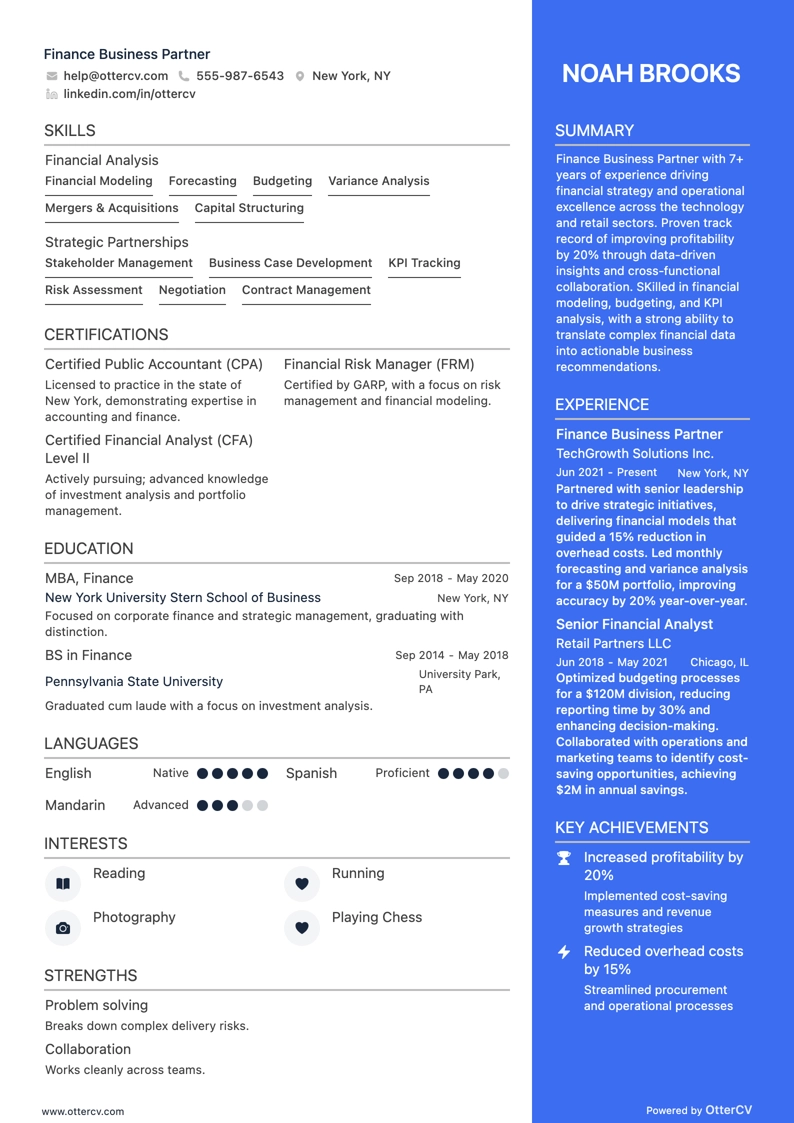
Finance Business Partner full preview

12 Finance Resume Examples, Templates

OtterCV

Written by The OtterCV Team

Updated: 5/22/2024•8 min read

See all resume examples in this guide, or generate your own resume example with your personalized prompt

Finance Business Partner resume example

Finance Business Partner

Frustrated by consistently low ATS scores on your finance resume? You’re not alone. Employers use applicant tracking systems differently, but they all expect candidates to complete the application carefully.

What makes a finance resume stand out isn’t just strong grades. It’s clear, relevant, hands-on work experience. Hiring managers want proof that you can use numbers to drive influence. For example: “I mapped out the data flows and data lineage, which improved data quality by X%”. That’s more than a bullet point—it shows how you use data to create change and support new ideas.

If that sounds familiar, this guide will help you strengthen your finance resume. You’ll learn:

  • Which resume sections can help you stand out
  • How to make a strong first impression with your finance resume summary
  • How to prove your financial credibility in the work experience section
  • Which skills finance recruiters are looking for
  • How to format your education and certifications

If the broad scope of finance feels overwhelming, explore this related example:

How to format a finance resume

If you’re an experienced finance professional, the reverse-chronological resume layout is usually the best choice. It highlights your progression and achievements across finance roles and companies.

If you’re new to finance or working as a freelancer, a hybrid layout or a functional resume format may be a better fit. These formats emphasize your skills and present them as part of your career development.

Choosing the right resume template also matters for finance professionals who want to showcase their analytical strengths. Our professional resume examples offer a sleek, modern look that helps capture attention.

When tailoring your finance resume, keep these tips in mind:

  • Convert your finance resume to PDF to preserve formatting across platforms.
  • Include precise contact information, such as a professional email, a current phone number, and your location.
  • Use 1-inch margins to maintain a clean, professional layout and make your resume easy to scan.
  • Choose professional fonts like Rubik, Lato, Volkhov or Montserrat. A font size between 10-12 points helps balance ATS compatibility and readability.
  • Select resume colors that fit the finance sector. Blue is a broadly appealing choice for many finance resume styles.

Also consider local expectations—Canadian resumes, for example, may follow a different format.

In the United States, it’s less common to include a photo on your resume. It’s not required, and in some cases, your application may be better without one.

Even top finance professionals can find it difficult to market themselves effectively, especially when describing their expertise on a resume. Improve your resume with our AI checker and get customized suggestions to highlight your financial skills and increase your chances of landing interviews.

Already have a finance resume? Upload it here to discover ways to improve it further.

Shape your finance resume effectively with formatting strategies that emphasize key sections and showcase your competencies.

The top sections on a finance resume

  • Professional summary: It quickly shows your key financial accomplishments and expertise.
  • Education and certifications: Degrees and certifications such as CPA, CFA, or MBA can strengthen your credibility in finance and are often required for specialized roles.
  • Work experience within finance: Recruiters place high value on past experience in similar roles, including your responsibilities and achievements.
  • Skills relevant to the sector: This section highlights your ability with finance-specific software, data analysis, or portfolio management and shows your readiness for the role.
  • Achievements section: It draws attention to high-stakes projects, deals, or financial strategies you have managed.

When tailoring your finance resume, highlight the strengths that make you stand out. Recruiters want clear evidence that you would be a valuable asset to their finance team.

What recruiters want to see on your resume:

  • Financial certifications that demonstrate your expertise and deep knowledge of the finance field.
  • A strong background in financial analysis, with the ability to evaluate data and support strategic business decisions.
  • Expertise in financial software used for modern financial analysis and reporting.
  • Exceptional communication skills for explaining complex financial concepts to different audiences.
  • A track record of making strategic financial decisions that help increase profitability.

Now that you have a strong starting point, focus on how to present your finance work experience effectively.

How to write your finance resume experience

The experience section is one of the most important parts of a finance resume. It is where recruiters evaluate whether your past roles align with the requirements of the job you want now. They look for clear achievements and the impact you made in previous positions, so it is essential to include quantifiable results and key metrics.

You need to show that you are a strong fit for the role by backing up your claims with real outcomes. For each position, aim to include three to four meaningful achievements, and give more attention to results than to routine responsibilities.

Compare the following two descriptions of the same finance role. The first gives a general summary, while the second focuses on specific, measurable accomplishments.

Experience

Financial Analyst

Global Finance Group

05/2019 - 10/2023 · New York, NY

Company Description

  • Boosted ROI through meticulous financial analysis and market trend evaluation.
  • Negotiated cost-saving contracts, effectively reducing operational expenses.
  • Designed and implemented strategic investment plans, markedly enhancing portfolio performance.
WRONG

Several aspects of this example could be improved:

  • No specific metrics are included, such as growth percentages or cost savings.
  • The duties and resulting impact do not clearly explain support for financial goals.
  • It does not show collaboration with key departments.

With focused revisions, this section of the resume could be much more effective and do a better job of highlighting the candidate’s strengths and industry achievements.

Experience

Financial Analyst

Global Finance Group

05/2019 - 10/2023 | New York, NY

Company Description

  • Increased ROI by 30% through in-depth financial analysis and adaptation to market trends.
  • Secured contracts that resulted in a 20% reduction in operational costs.
  • Formulated and executed investment strategies that improved portfolio performance by 25%.
RIGHT

Why This Finance Resume Example Works

The second example stands out because it uses specific results and detailed role descriptions, making it a strong model for a finance resume. Here’s why it works:

  • It presents precise achievements, such as improved ROI and reduced operational costs with clear percentages.
  • It explains how the candidate used financial analysis and market trends to make informed decisions.
  • It highlights the applicant’s ability to drive growth and profitability by developing and applying effective investment strategies to improve portfolio performance.

For finance professionals, demonstrating hands-on experience is essential for making a strong impression. It’s also important to ensure your resume is compatible with Applicant Tracking Systems (ATS), since these systems screen applications for specific finance-related keywords and qualifications.

If resume writing feels daunting, Echocv offers ATS-friendly templates designed to streamline the process and showcase your financial expertise effectively.

After choosing a professionally designed template, the next step is deciding the ideal length for your finance resume. Whether you choose a one-page resume or a two-page version depends on which format best highlights your skills and achievements. Focus on the experience and strengths that best reflect your financial expertise.

Next, let’s look at how to quantify your financial wins with numbers that speak volumes.

How to quantify the impact on a finance-related resume

Finance professionals should show how their work improves financial performance and supports growth. Use clear, measurable results such as:

  • Specific financial metrics you improved.
  • Cost efficiencies you identified and implemented.
  • Mitigated financial risks that demonstrate your risk management skills.
  • Business growth figures achieved through your financial strategies.
  • Examples of reducing debt or improving cash flow.
  • Improvements in audit scores or compliance rates.

For first-time job seekers, quantifiable achievements can be harder to show. If you’re dealing with a lack of experience, the strategies below can help you stand out and improve your chances of landing an interview.

How do I write a finance resume with no experience

If you’re entering the finance field, highlight your initiative and involvement in finance-related activities. Volunteering for budget analysis at local nonprofits or participating in university finance clubs can help strengthen your profile.

  • Objective section: Write a short statement that shows your interest in finance, mentions your past involvement, and explains your professional goals. Make it easy for recruiters to see how your ambitions align with their firm.
  • Skills: List relevant finance skills, including technical skills such as financial analysis, portfolio management, and tools like Bloomberg and Excel, as well as soft skills like problem-solving and communication. Show how these skills were built through academics, projects, or self-study.
  • Education section: Include your degree, major, and any finance-specific certifications, such as CFA or CPA, to show your commitment to the field.
  • Projects: Add freelance projects or personal investments that demonstrate your finance skills and the results you achieved.
  • Internships: Include any finance-related internships to show practical application of financial knowledge and hands-on industry exposure.
  • Work experience section: Mention past roles that demonstrate transferable skills relevant to finance, such as analytical thinking, market research, report writing, or technical expertise.

Include your graduation date to emphasize your academic background and its relevance to the role. If it is above average, listing your GPA on your resume can further strengthen your application. Your recent finance education and fresh perspective are advantages. Also remember that in finance, soft skills matter just as much as hard skills.

How to list your hard skills and soft skills on your resume

Skills are essential on a finance resume. Hiring managers want to understand what you can do and why you’re a strong fit for the role.

Be sure to include the finance tools and software you know, along with your interpersonal strengths.

Best hard skills for your finance resume

  • Working with SAP.
  • Knowledge of SQL.
  • Proficiency in Excel.
  • Statistical and financial analysis.
  • Forecasting.
  • Accounting.
  • Tax preparation.
  • Risk management.
  • Portfolio management.
  • Investment analysis.
  • Budgeting.
  • Experience with Oracle ERP.

Choose finance resume skills that match the job description. Review the job posting closely, then tailor your skills to reflect the employer's needs.

PRO TIP

Most US employers prefer resumes tailored to the specific job rather than a one-size-fits-all version. Customizing your application can significantly improve your chances of landing the role.

How to list your education and certifications on your resume

To qualify for a finance role, you’ll typically need a Bachelor’s degree in finance, economics, accounting, or a related discipline. Here’s how to structure your education section.

What to include:

  • Degree name: Indicate the degree you obtained.
  • Institution name: The school where you earned your degree.
  • Graduation date: Include your graduation date or expected graduation date.
  • Major/Concentration: Mention your major and any minors related to finance.
  • Relevant courses: Highlight courses that are specifically related to finance or economics.
  • GPA: Include your GPA if it’s notable and you recently finished your studies.

Here’s an example:

Education

Master of Science in Finance

The University of Texas at Dallas

09/2022 - 11/2023

  • Specialized Coursework: Investment analysis, corporate finance strategies, and financial risk management

Bachelor of Science in Economics

Hardin-Simmons University

05/2017 - 03/2021

  • Core Modules: Economic theory, quantitative analysis, and financial markets
RIGHT

In finance, a strong commitment to continual learning and professional development is highly valued. Including certifications on your resume, whether in financial analysis, investment management, or compliance, shows that you are prepared to handle the field’s complexity.

These credentials signal to hiring managers that you are ready for the challenges of the finance industry and can strengthen your candidacy for finance roles.

Here are the top five certifications finance recruiters look for, each offering a path to specialized expertise in the field:

How to write your finance resume summary or objective

A strong summary is the cornerstone of a finance resume.

For finance professionals with extensive portfolios, choosing a summary is a strategic move. This concise paragraph highlights the skills and achievements most relevant to the role, helping recruiters quickly understand your qualifications for the finance position.

Next, let’s look at a strong finance resume summary and a weaker one to see what works and what doesn’t.

Summary

Financial specialist with excellent analytical skills and experience in financial modeling, business valuation, and financial reporting.

WRONG

Obviously, the first example is weak for a few clear reasons:

  • It fails to show quantifiable successes or examples of skill application.
  • It uses broad language without specifying areas of finance specialization.
  • It does not tailor the summary to the candidate's experience or the job.

Now let's see how a few simple adjustments can greatly improve the message.

Summary

Experienced Financial Analyst with 8+ years in tech, with expertise in financial modelling, valuation, and reporting. Streamlined processes to improve efficiency and reduce reporting times by 20%. Holds a CFA and is proficient in Excel and Tableau, with strong teamwork skills and a talent for strategic financial planning.

RIGHT

Why this improved example is better

  • It mentions 8+ years, which shows deeper industry experience.
  • It highlights a specific improvement, such as cutting reporting times by 20%.
  • Referencing a CFA and skills in Excel and Tableau demonstrates specialized knowledge and technical ability.
  • Mentions of teamwork and planning skills show well-rounded capabilities in both individual and group settings.

Additional sections for a finance resume

In finance, it is important to highlight your strengths and notable achievements. Consider adding these sections to your resume:

  • Publications on your resume: Include any finance-related articles, research papers, or analyses you have authored for journals, websites, or books. This can strengthen your credibility and show your expertise in the field.
  • Interests and hobbies: Share a selection of hobbies, such as chess, hiking, or reading economic literature, to present a well-rounded personality with interests beyond finance.
  • Language skills: Show your ability to communicate effectively in the international finance arena.

To showcase your accomplishments more clearly, consider creating a separate achievements section on your resume.

How to put an achievements section on a resume

Here is how to present your most important contributions and successes in the finance industry.

Achievements

  • Optimized Portfolio Performance: Innovated investment plans, delivering a 30% improvement in portfolio efficiency over two years.

  • Financial Forecasting Accuracy: Developed a predictive analytics model that improved financial forecasting accuracy by 25%, significantly reducing risk.

  • Cost Reduction Initiative: Led a cost reduction initiative that cut operational expenses by 20%, boosting overall profitability.

RIGHT

Key takeaways

  • Tailor your finance resume to the specific role and use a format that highlights your experience and skills to improve your chances of landing an interview.

  • Include accurate contact information and choose a professional layout and font so your resume is easy to read and ATS-friendly.

  • List relevant finance certifications, such as CFA or CPA, to highlight your expertise and commitment to professional development.

  • Add sections for publications, interests, and hobbies to present a more complete, well-rounded profile.

  • Use a separate achievements section to showcase meaningful results, such as optimized portfolio performance or cost reduction initiatives, so your application stands out.

Finance resume examples

Explore additional Finance resume samples and guides and see what works for your level of experience or role.

By Role

Finance Business Partner

Finance Business Partner resume preview