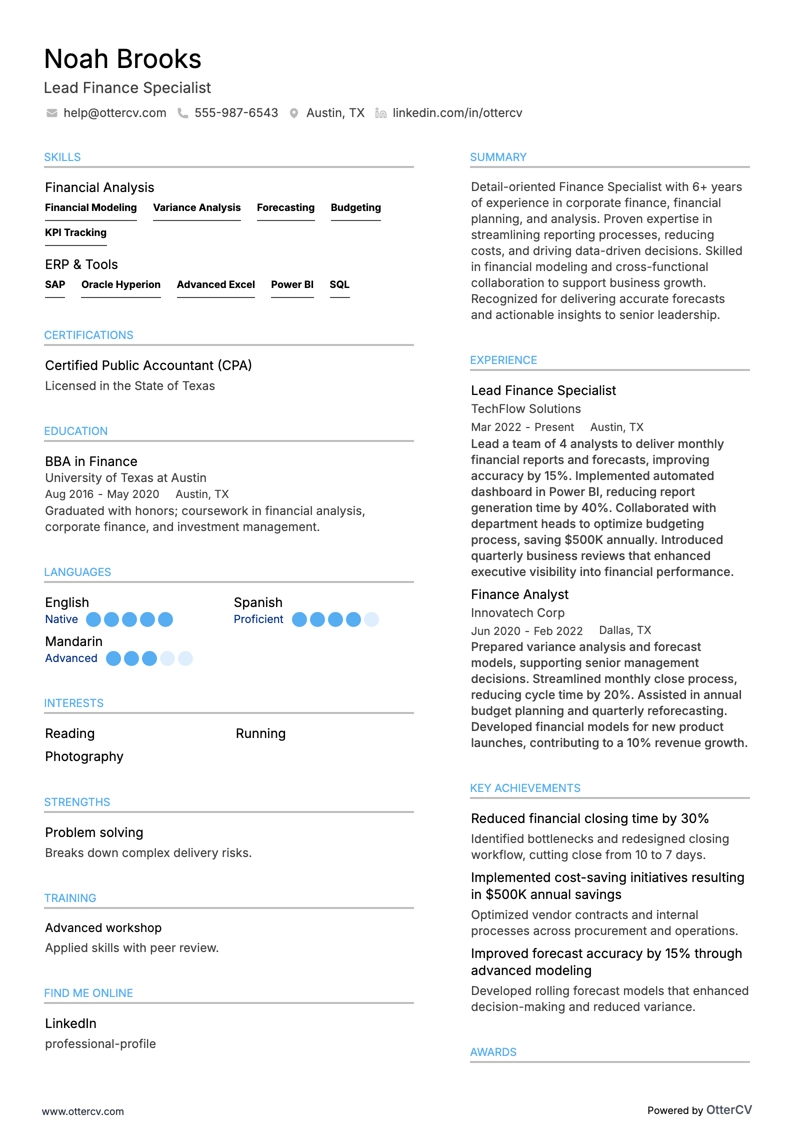
Lead Finance Specialist full preview

28 Finance Specialist Resume Examples

OtterCV

Written by The OtterCV Team

Updated: 4/3/2024•8 min read

See all resume examples in this guide, or generate your own resume example with your personalized prompt

Lead Finance Specialist resume example

Lead Finance Specialist

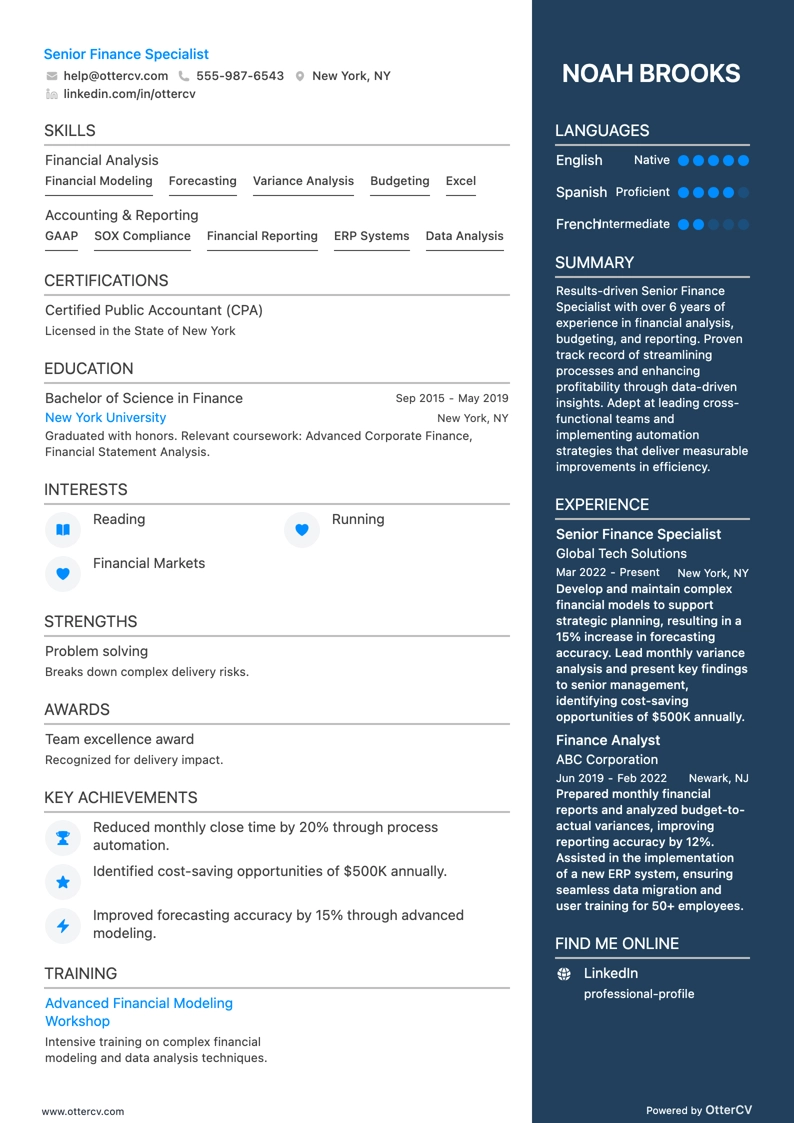
Senior Finance Specialist resume example

Senior Finance Specialist

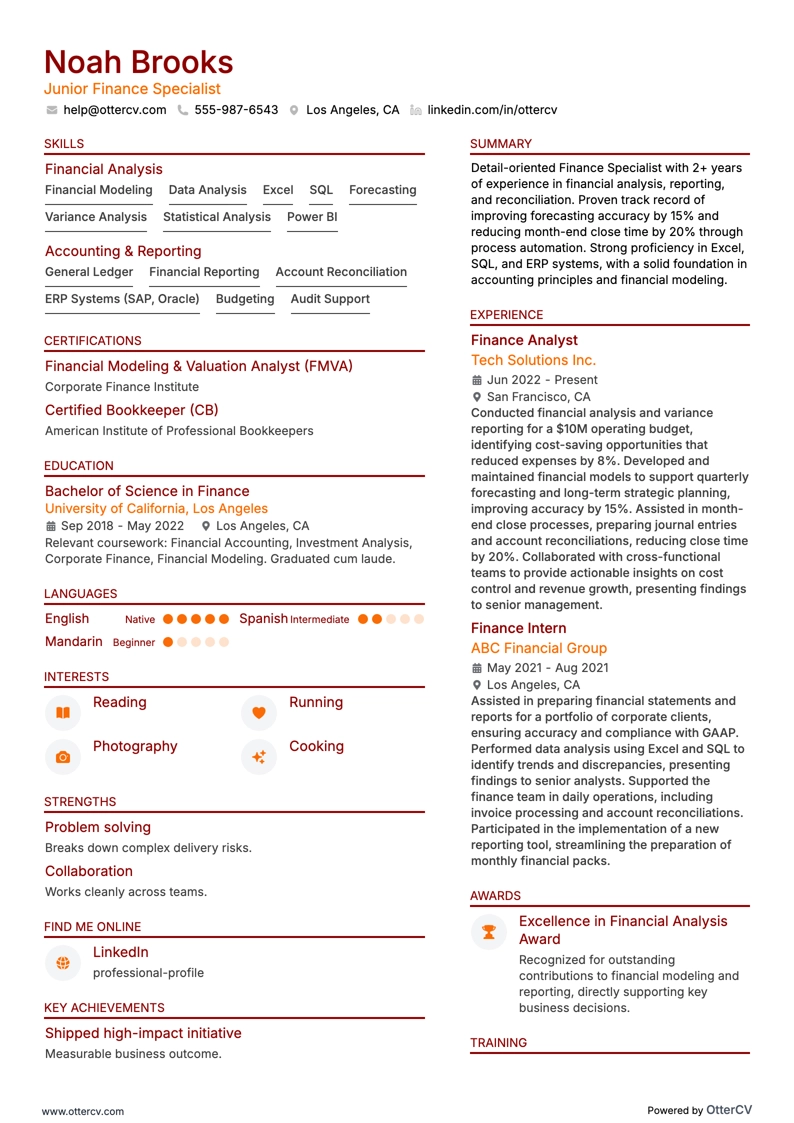
Junior Finance Specialist resume example

Junior Finance Specialist

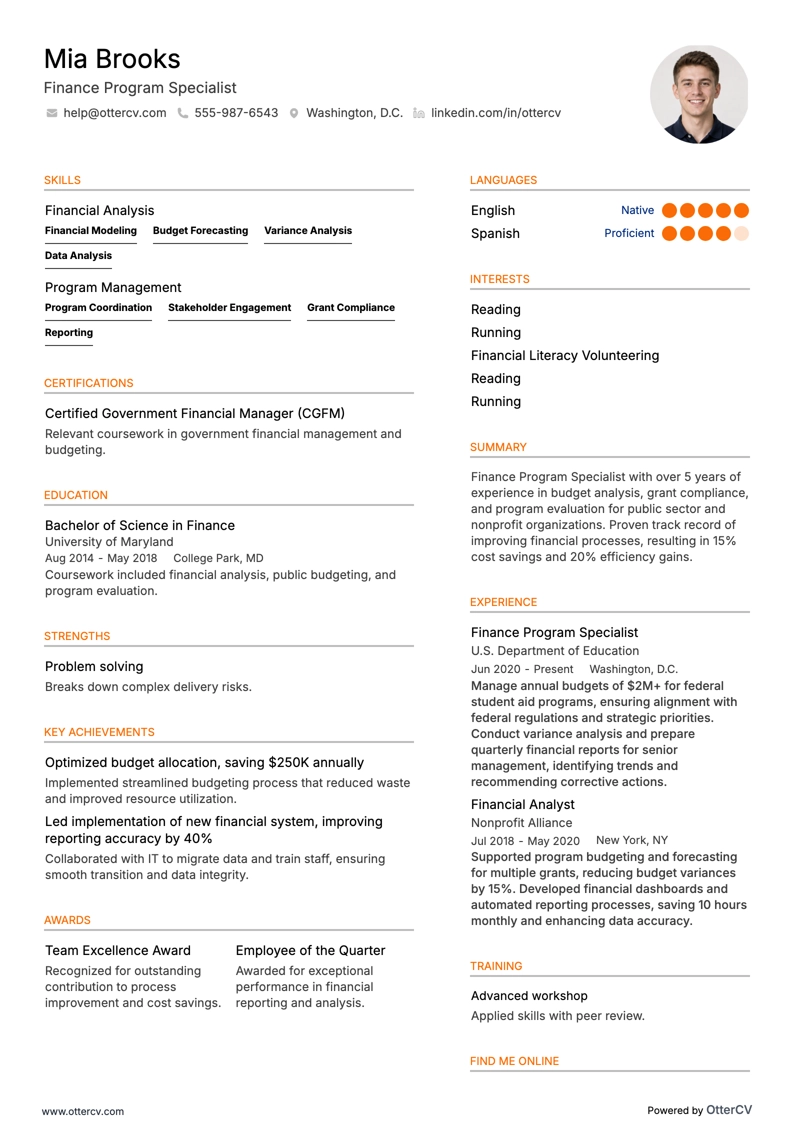
Finance Program Specialist resume example

Finance Program Specialist

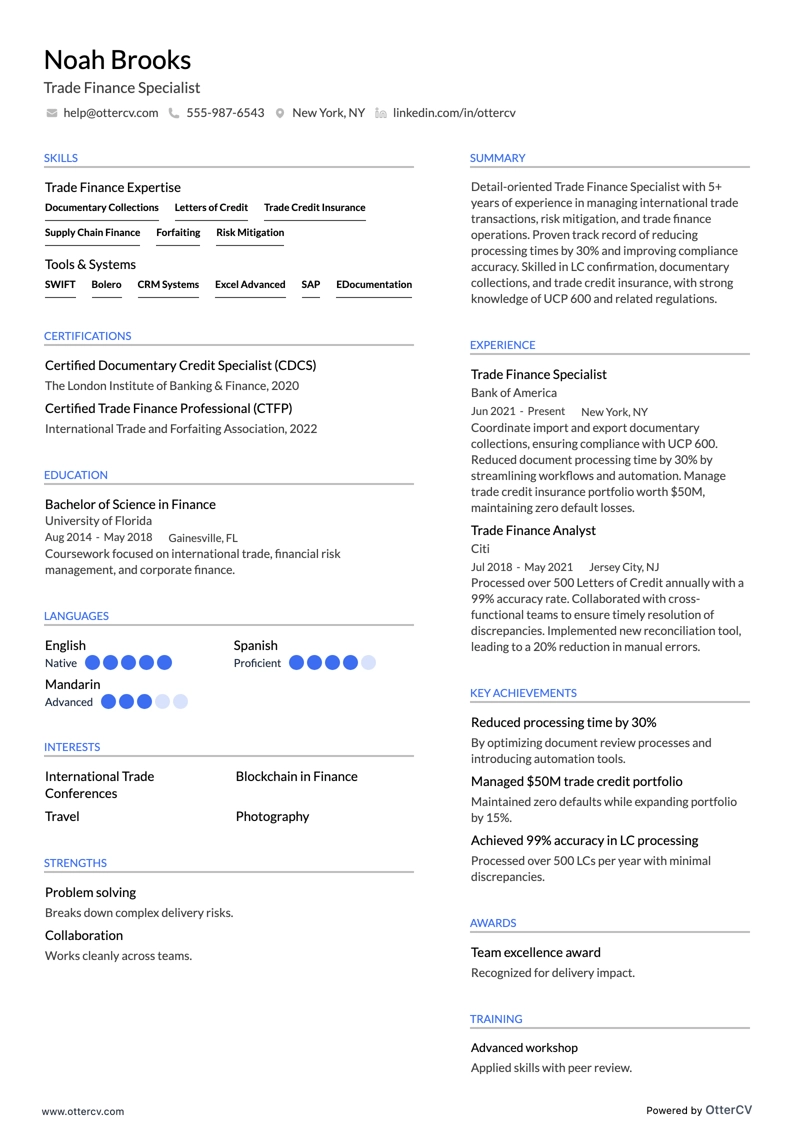
Trade Finance Specialist resume example

Trade Finance Specialist

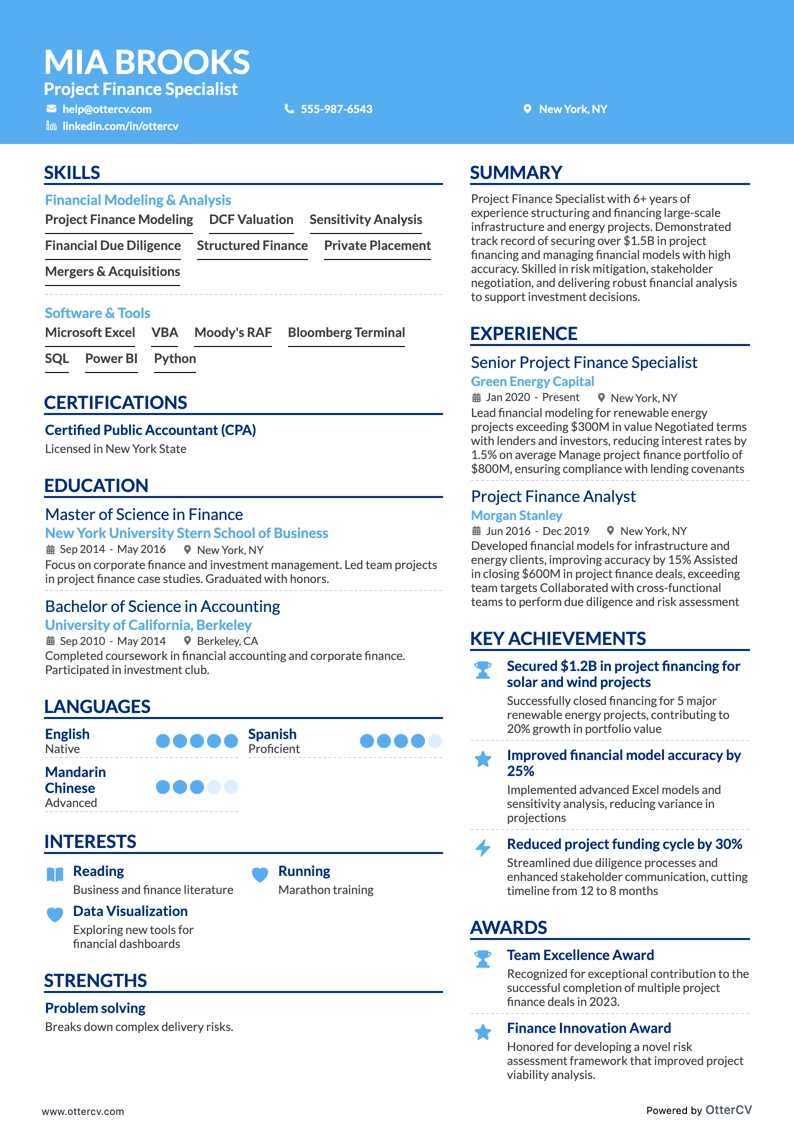
Project Finance Specialist resume example

Project Finance Specialist

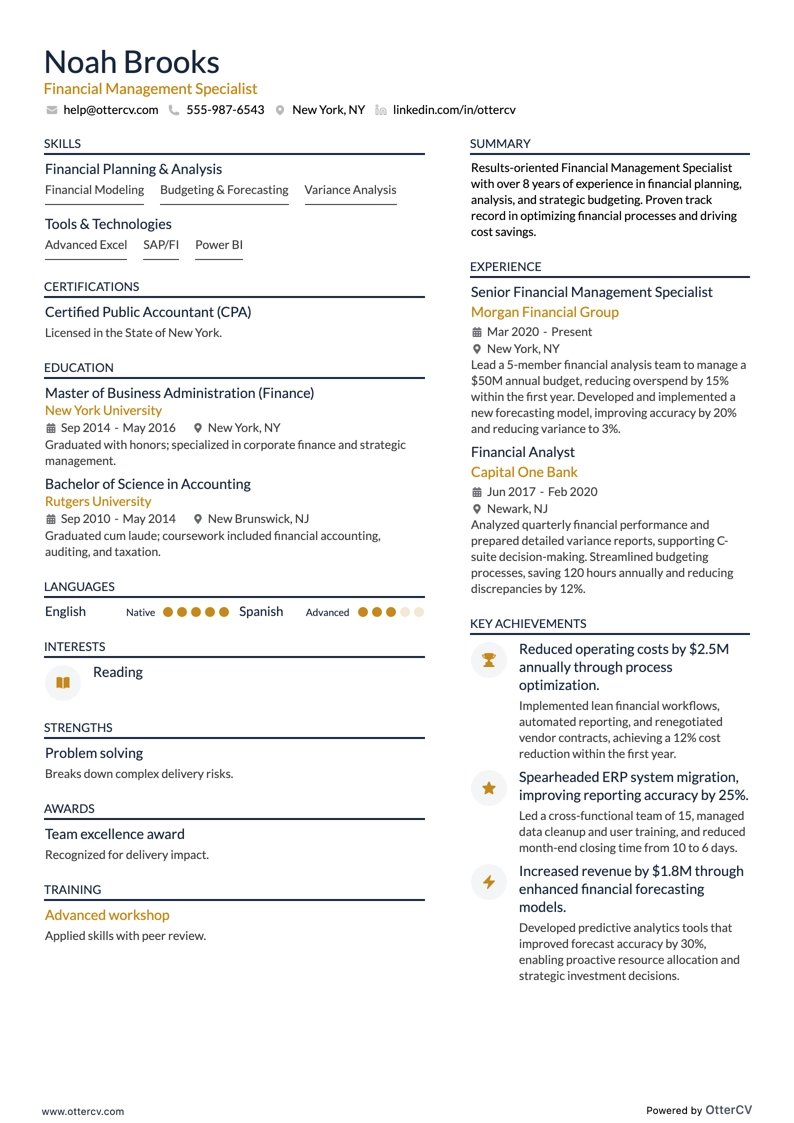
Financial Management Specialist resume example

Financial Management Specialist

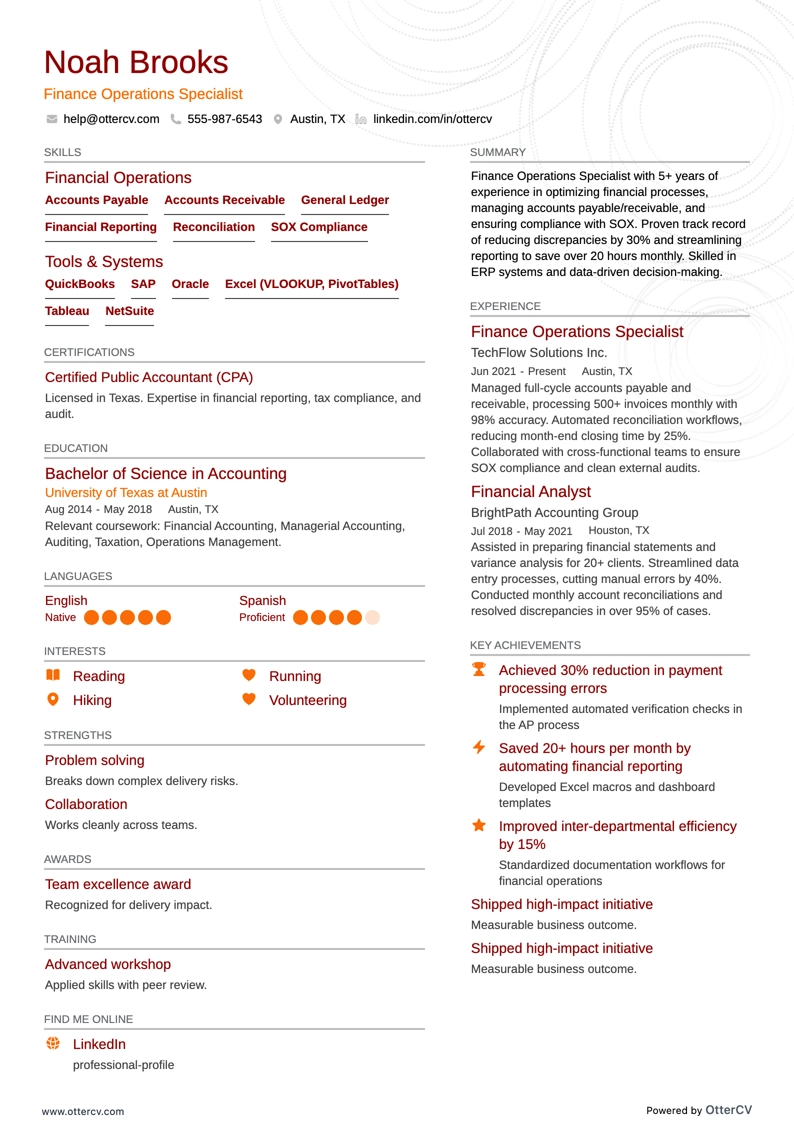
Finance Operations Specialist resume example

Finance Operations Specialist

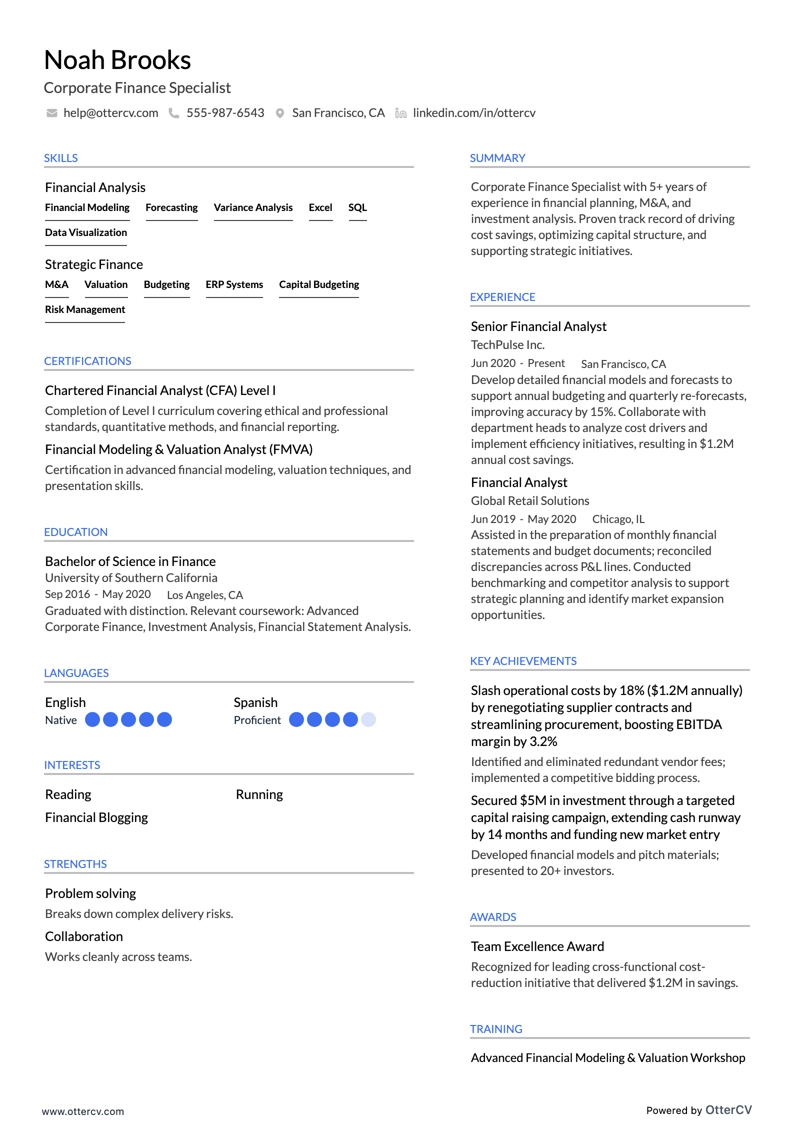
Corporate Finance Specialist resume example

Corporate Finance Specialist

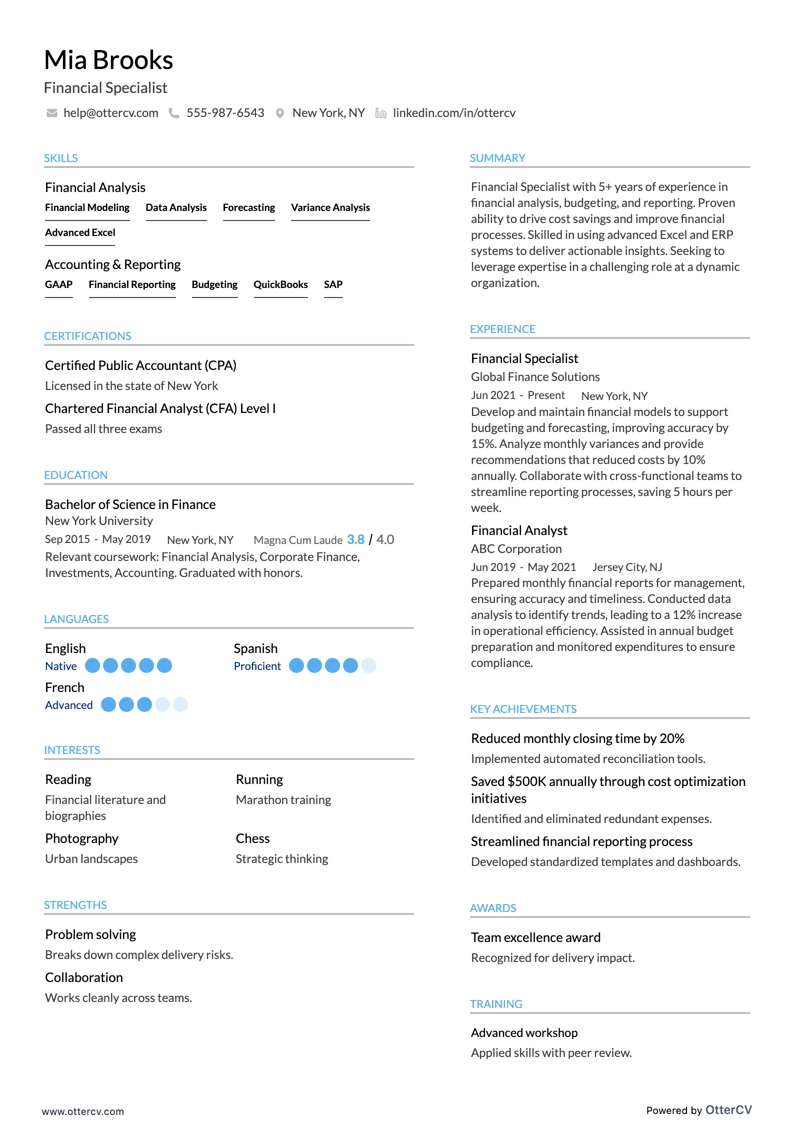
Financial Specialist resume example

Financial Specialist

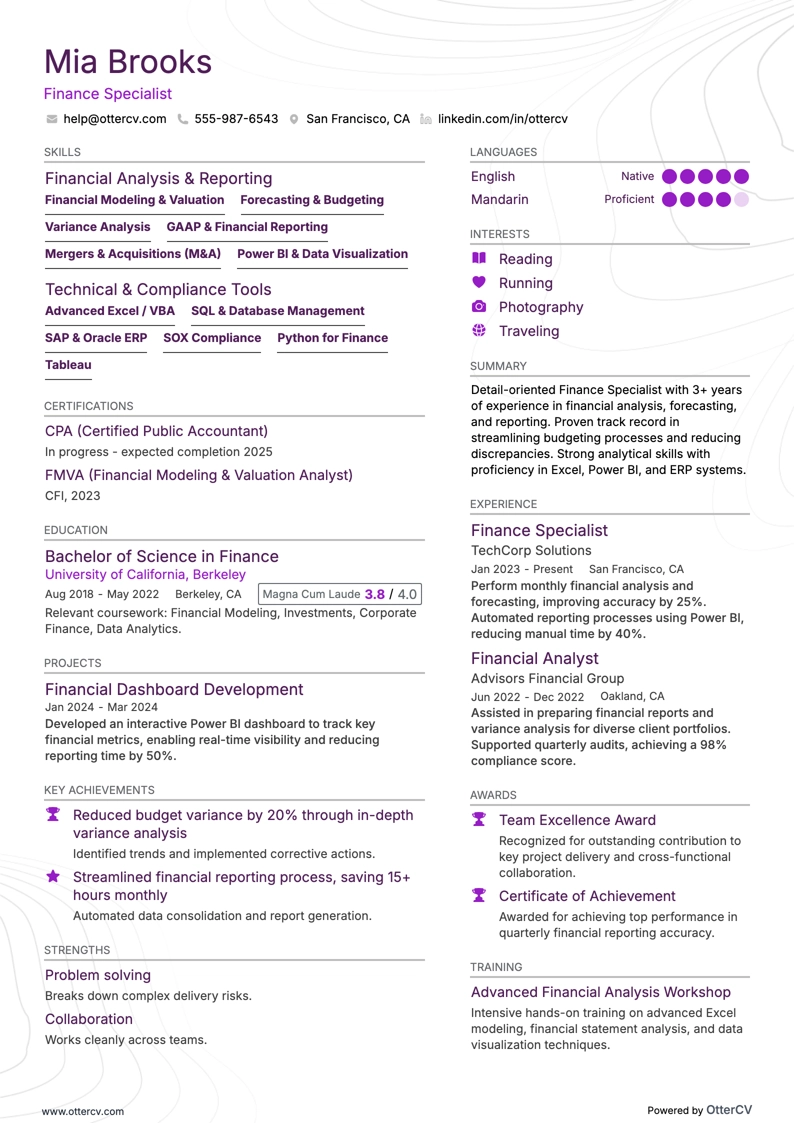
Finance Specialist resume example

Finance Specialist

Many finance specialist resumes fall short because they list systems and duties without connecting them to business results. In a crowded market, that makes them easier to miss in finance specialist resume searches, ATS filters, and quick recruiter scans.

A strong resume explains what you changed and why it mattered. Learning how to make your resume stand out starts with highlighting revenue protected, costs reduced, close cycles shortened, forecast accuracy improved, audit findings resolved, and reporting delivered for leaders. Quantify your scope with dollars, entities, volume, and deadlines.

Key takeaways

  • Connect each finance skill to a measurable business result, such as cost savings or faster close cycles.

  • Use a reverse-chronological resume format if you have experience, and a hybrid format if you are changing careers.

  • Match your resume language to the specific tools, standards, and KPIs listed in each job posting.

  • Quantify achievements with dollars, percentages, timelines, and error-rate reductions whenever possible.

  • Show skills in context within your summary and experience bullets, not only in a standalone skills section.

  • Use AI to improve clarity and alignment, but do not let it exaggerate or invent experience.

  • Echocv can help turn routine finance tasks into strong, quantified resume bullets quickly.

Job market snapshot for finance specialists

We analyzed 102 recent finance specialist job ads across major US job boards. These figures provide a quick view of the companies hiring, the skills in demand, and what employers expect.

What level of experience employers are looking for finance specialists

Years of ExperiencePercentage found in job ads
1–2 years6.9% (7)
3–4 years4.9% (5)
5–6 years7.8% (8)
10+ years1.0% (1)
Not specified79.4% (81)

Finance specialist ads by area of specialization (industry)

Industry (Area)Percentage found in job ads
Finance & Banking70.6% (72)
Healthcare12.7% (13)
Education11.8% (12)

Top companies hiring finance specialists

CompanyPercentage found in job ads
Deloitte27.5% (28)
Jackson Health System9.8% (10)

Role overview stats

These tables outline the most common responsibilities and employment types for finance specialist roles. Use them to align your resume with employer expectations and better understand how the role is structured across the market.

Day-to-day activities and top responsibilities for a finance specialist

ResponsibilityPercentage found in job ads
Finance33.3% (34)
Oracle30.4% (31)
Cloud27.5% (28)
Business process design22.5% (23)
Configuration22.5% (23)
Requirements gathering22.5% (23)
Testing22.5% (23)
Training22.5% (23)
ERP14.7% (15)
Microsoft Office14.7% (15)
Portfolio management12.7% (13)
Procurement12.7% (13)

Type of employment (remote vs on-site vs hybrid)

Employment typePercentage found in job ads
On-site81.4% (83)
Hybrid9.8% (10)
Remote8.8% (9)

How to format a finance specialist resume

Recruiters reviewing finance specialist resumes look for analytical proficiency, familiarity with financial reporting frameworks, and clear evidence of accuracy in data-driven environments. Choosing the right resume format helps these strengths stand out quickly for both human reviewers and applicant tracking system (ATS) parsing.

I have significant experience in this role—which format should I use?

I have significant experience in this role—which format should I use?

Use a reverse-chronological format to present your finance experience in a clear, progression-oriented timeline that highlights increasing responsibility and domain expertise.

Do the following:

  • Lead each role entry with scope indicators such as portfolio size, number of accounts managed, or departmental budget oversight.
  • Highlight role-specific tools and domains, including financial modeling, ERP platforms (SAP, Oracle), variance analysis, GAAP compliance, or forecasting methodologies.
  • Quantify outcomes tied to cost savings, reporting accuracy improvements, or process efficiencies you directly influenced.

Example bullet: “Reduced month-end close cycle from 12 days to seven by redesigning the reconciliation workflow across three business units, improving reporting accuracy by 18%.”

I'm junior or switching into this role—what format works best?

I'm junior or switching into this role—what format works best?

A hybrid resume format works best. It lets you lead with a targeted skills section while still including a concise work history that provides context and shows your trajectory.

  • Place a skills section near the top that highlights core finance competencies such as financial analysis, budgeting, Excel modeling, or ERP proficiency, aligned to the job posting.
  • Include academic projects, internships, or cross-functional experience that shows applied finance knowledge, even if it came from a non-finance role.
  • Connect every listed skill or project to a specific action and a measurable or observable result.

Example scaffold: Financial modeling (skill) → built a three-year revenue projection model for a capstone client engagement (action) → delivered a forecast within 4% of actual Q1 results, earning faculty distinction (result).

Why not use a functional resume?

Why not use a functional resume?

A functional resume removes the timeline and context hiring managers use to verify where, when, and how you applied your finance skills, which can make your candidacy harder to assess.

  • Career changers entering finance with no direct work history but relevant certifications, such as CFA Level I or CPA progress, or finance-adjacent project experience.
  • Recent graduates whose internship or academic project experience is stronger than their formal employment record.
  • Candidates with resume gaps who completed relevant coursework, freelance financial analysis, or volunteer treasurer roles during time away from full-time work.

Even in these cases, each listed skill should be tied to a specific project, deliverable, or outcome rather than presented in isolation. If you have more than one year of relevant finance experience, avoid a functional resume entirely, because it can raise questions about progression and accountability that a chronological or hybrid format answers more clearly.

With your layout and formatting set, the next step is filling your resume with the right content, starting with the sections you include.

What sections should go on a finance specialist resume

Recruiters expect a clean, numbers-driven resume that shows how you improved financial performance, reporting accuracy, and decision-making. Knowing what to put on a resume for a finance specialist role is essential to making a strong impression.

Use this structure for maximum clarity:

  • Header
  • Summary
  • Experience
  • Skills
  • Projects
  • Education
  • Certifications
  • Optional sections: Awards, Leadership, Languages

Strong experience bullets should highlight measurable impact, business outcomes, scope of responsibility, and results tied to revenue, cost, risk, or reporting speed and accuracy.

Once you’ve organized your resume with the right components, the next step is to write your finance specialist experience section with relevant, results-focused details that strengthen the rest of your application.

How to write your finance specialist resume experience

Your experience section should prove that you delivered measurable results, not just completed tasks. Hiring managers reviewing finance specialist resumes look for clear impact, role-relevant tools and methodologies, and concrete outcomes instead of generic descriptions of day-to-day responsibilities. Building a targeted resume for the specific role you want makes this section much more effective.

Each entry should include:

  • Job title
  • Company and location (or remote)
  • Dates of employment (month and year)

Include three to five concise bullet points that show what you owned, how you executed the work, and what results you delivered:

  • Ownership scope: the financial processes, reporting systems, portfolios, budgets, or compliance areas you were directly responsible for as a finance specialist.
  • Execution approach: the analytical tools, financial models, forecasting frameworks, ERP platforms, or regulatory standards you used to support decisions and complete the work.
  • Value improved: the measurable gains you created in accuracy, cost efficiency, risk mitigation, audit readiness, cash flow performance, or reporting timeliness.
  • Collaboration context: how you worked with stakeholders across accounting, operations, leadership, external auditors, or regulatory bodies to align financial strategy with business objectives.
  • Impact delivered: the tangible business outcomes your work produced, expressed through results, scale, or organizational impact rather than a list of activities.

Experience bullet formula

Experience bullet formula

Action verb + technology + what you built or fixed + measurable result

A finance specialist experience example

Finance Specialist

Northbridge Health Systems | Chicago, IL

2022–Present

Multi-state healthcare provider supporting 30+ clinics and a centralized revenue cycle team.

  • Streamlined month-end close from eight to five business days by redesigning accrual workflows, building Excel Power Query templates, and standardizing journal entries in Oracle NetSuite.
  • Built a rolling 13-week cash flow forecast in Adaptive Planning and Excel, improving forecast accuracy from 85% to 95% and enabling treasury to reduce idle cash by $2.1M.
  • Automated vendor spend variance reporting using SQL and Power BI, cutting manual analysis time by 12 hours per week and identifying $410K in contract leakage for procurement to renegotiate.
  • Partnered with FP&A, operations leaders, and clinic managers to implement cost center governance and KPI dashboards, reducing unbudgeted spend by 9% across 18 departments.
  • Strengthened internal controls by updating SOX (Sarbanes-Oxley) narratives, reconciling key accounts, and implementing segregation-of-duties checks, reducing audit adjustments by 30%.

Now that you've seen how a strong experience section comes together, here's how to adjust those details for the specific finance specialist role you're targeting.

How to tailor your finance specialist resume experience

Recruiters review your finance specialist resume through both human screening and applicant tracking systems, so tailoring your resume to the job description is essential. It helps ensure the skills, tools, and responsibilities you highlight match what the employer is seeking.

Ways to tailor your finance specialist experience:

  • Mirror the exact financial software and ERP systems listed in the job posting.
  • Match the terminology used for accounting standards such as GAAP or IFRS.
  • Reflect the specific KPIs or financial metrics the role prioritizes.
  • Highlight regulatory compliance experience when the posting emphasizes audit readiness.
  • Include industry-specific finance experience that aligns with the employer's sector.
  • Use the same language for budgeting, forecasting, or variance analysis processes.
  • Emphasize cross-functional collaboration if the role involves partnering with other departments.
  • Reference reconciliation or reporting workflows described in the job description.

Tailoring means aligning your real accomplishments with the role's stated requirements, not forcing keywords where they don't belong.

Resume tailoring examples for finance specialist

Job description excerptUntailoredTailored
Perform monthly variance analysis and prepare financial reports for senior leadership using Oracle ERP and Excel-based modelsAssisted with financial reporting and data analysis tasks for management.Conducted monthly variance analysis across 12 cost centers using Oracle ERP and built Excel-based forecasting models that reduced reporting turnaround time by 30% for senior leadership.
Manage accounts payable and receivable processes, ensuring compliance with GAAP and SOX controlsHandled day-to-day accounting functions and maintained financial records.Managed full-cycle accounts payable and receivable for a $15M portfolio, enforced GAAP standards, and maintained 100% compliance across quarterly SOX control audits.
Support annual budgeting and rolling forecasts in collaboration with department heads using Adaptive InsightsHelped prepare budgets and worked with different teams on financial planning.Partnered with six department heads to build annual budgets and quarterly rolling forecasts in Adaptive Insights, improving forecast accuracy by 18% year over year.

Once you’ve aligned your experience with the role’s needs, the next step is to quantify your finance specialist achievements so employers can clearly see the impact behind those responsibilities.

How to quantify your finance specialist achievements

Quantifying your achievements helps show how your work improves accuracy, speed, compliance, and risk control. Focus on close timelines, forecast variance, reconciliation error rates, audit findings, cash flow impact, and cost savings.

Quantifying examples for finance specialist

MetricExample
Close cycle timeCut month-end close from eight to five business days by standardizing accrual checklists and automating journal uploads in NetSuite.
Forecast accuracyImproved quarterly revenue forecast variance from 7.5% to 3.2% by rebuilding driver-based models in Excel and Power BI.
Reconciliation qualityReduced bank reconciliation exceptions by 42% by tightening matching rules and resolving aged items over 60 days in SAP.
Compliance riskPassed two external audits with zero material findings by strengthening SOX controls and maintaining 100% on-time evidence in AuditBoard.
Cost savingsSaved $180K annually by renegotiating payment terms and capturing 96% of early-pay discounts across 120 key vendors.

Once you've written strong, results-driven bullet points, the next step is making sure your resume shows the mix of hard and soft skills finance employers want to see.

How to list your hard and soft skills on a finance specialist resume

Your skills section should show that you can handle reporting, forecasting, and controls. Recruiters and ATS (applicant tracking systems) scan this section quickly to confirm fit, so prioritize a hard skills-heavy mix supported by targeted soft skills that help you execute effectively.

Finance specialist roles require a blend of:

  • Product strategy and discovery skills
  • Data, analytics, and experimentation skills
  • Delivery, execution, and go-to-market discipline
  • Soft skills

Your skills section should be:

  • Scannable, using bullet-style grouping
  • Relevant to the job posting
  • Supported by proof in your experience bullets
  • Updated with current tools

Place your skills section:

  • Above your experience section if you're junior or changing careers
  • Below your experience section if you're mid-level or senior with strong achievements

Hard skills

  • Financial modeling in Excel.
  • Budgeting and forecasting.
  • Variance analysis.
  • Month-end close support.
  • General ledger reconciliations.
  • Financial statement analysis.
  • Cash flow forecasting.
  • Accounts payable and accounts receivable.
  • Enterprise resource planning systems.
  • Power BI and Tableau dashboards.
  • SQL reporting queries.
  • GAAP compliance.

Soft skills

  • Translate numbers into decisions.
  • Partner with budget owners.
  • Challenge assumptions with data.
  • Present concise financial updates.
  • Prioritize deadlines during close.
  • Own issues through resolution.
  • Align stakeholders on tradeoffs.
  • Document processes and controls.
  • Communicate risks early.
  • Manage competing requests.
  • Ask focused clarifying questions.
  • Maintain confidentiality with discretion.

How to show your finance specialist skills in context

Skills should not appear only as a neat list on your resume. Reviewing examples of resume skills used effectively can show how strong candidates connect competencies to real accomplishments.

Your skills should be demonstrated in:

  • Your summary, where you present your high-level professional identity
  • Your experience, where you prove your abilities through outcomes

Here is what strong, contextual skill placement looks like in practice.

Summary example

Finance specialist with 10+ years in corporate FP&A, with expertise in financial modeling, SAP, and cross-departmental forecasting. Reduced annual budget variances by 18% through streamlined variance analysis and proactive stakeholder collaboration.

  • Clearly reflects senior-level experience
  • Names specific tools and methods
  • Leads with a measurable outcome
  • Signals collaboration as a soft skill

Experience example

Senior Finance Specialist

Alderman & Cole Partners | Chicago, IL

March 2019–Present

  • Built rolling 12-month forecast models in SAP, improving projection accuracy by 22% across three business units.
  • Partnered with operations and procurement teams to redesign cost allocation workflows, saving $340K annually.
  • Automated monthly close reconciliations with Power BI dashboards, reducing reporting cycle time by four days.
  • Every bullet includes measurable proof.
  • Skills surface naturally through real outcomes.

Once you’ve shown your finance specialist strengths with relevant examples, use the same strategy when writing a finance specialist resume with no experience.

How do I write a finance specialist resume with no experience

Even without full-time experience, you can still demonstrate readiness through:

  • Budgeting for student organizations
  • Finance internship or job shadowing
  • Accounting coursework with a final project
  • Personal portfolio tracking investments
  • Volunteer bookkeeping for nonprofits
  • Case competitions in corporate finance
  • Financial modeling course capstone
  • Freelance invoice and expense tracking

If you're building a resume without work experience, focus on:

  • Quantified results from finance projects
  • Reconciliations, variance, and accuracy metrics
  • Tools: Excel, SQL, QuickBooks
  • Financial reporting and documentation samples

Resume format tip for entry-level finance specialist

Resume format tip for entry-level finance specialist

Use a combination resume format to highlight skills and projects first, then list education and limited work history to support them.

Do:

  • Add a projects section above experience.
  • Quantify outcomes with dollars, percentages, or time saved.
  • List finance specialist tools in context.
  • Include relevant coursework with deliverables.
  • Tailor keywords to each job post.

Example project bullet:

  • Built an Excel budget tracker for a student organization, reconciled one year of expenses, and cut month-end close time by 30%.

Even without traditional work history, your education section can carry significant weight on a finance specialist resume, so it should be presented strategically.

How to list your education on a finance specialist resume

Your education section helps hiring teams quickly confirm that you have the foundational knowledge needed for a finance specialist role. It also validates your academic background in accounting, economics, or related fields.

Include:

  • Degree name
  • Institution
  • Location
  • Graduation year
  • Relevant coursework for juniors or entry-level candidates
  • Honors and GPA if 3.5 or higher

Skip the month and day, and list the graduation year only.

Here’s a strong education entry tailored for a finance specialist resume:

Example education entry

Bachelor of Science in Finance

University of Illinois at Urbana-Champaign, Champaign, IL

Graduated 2021

GPA: 3.7/4.0

  • Relevant coursework: Financial Analysis, Corporate Finance, Econometrics, Risk Management, and Financial Modeling
  • Honors: Dean's List (six consecutive semesters), Beta Gamma Sigma Honor Society

How to list your certifications on a finance specialist resume

Certifications on your resume show your commitment to learning, your proficiency with finance tools, and your relevance in the finance industry as a finance specialist.

Include the following details:

  • Certificate name
  • Issuing organization
  • Year
  • Optional: credential ID or URL
  • Place certifications below education when your degree is recent and more relevant than older or general credentials.
  • Place certifications above education when they are recent, role-specific, or required, and you want recruiters to notice them first.

Best certifications for your finance specialist resume

  • Chartered Financial Analyst (CFA)
  • Certified Public Accountant (CPA)
  • Certified Management Accountant (CMA)
  • Financial Risk Manager (FRM)
  • Certified Treasury Professional (CTP)
  • Chartered Alternative Investment Analyst (CAIA)
  • Bloomberg Market Concepts (BMC)

How to write your finance specialist resume summary

Once your key credentials are positioned where hiring managers will notice them, focus on your finance specialist resume summary to reinforce those strengths right away.

Your resume summary is often the first thing a recruiter reads, so it should quickly show that you are qualified for the role.

Keep it to three to four lines and include:

  • Your title and total years of relevant finance experience.
  • Your domain, such as corporate finance, FP&A, or banking.
  • Core tools and skills, such as Excel, SAP, SQL, or financial modeling.
  • One or two quantified achievements that demonstrate measurable impact.
  • Soft skills connected to real results, such as collaboration that improved reporting cycles.

PRO TIP

At this level, emphasize technical skills, relevant tools, and early wins that show you can deliver results. Focus on specific contributions instead of listing job duties.

Avoid vague phrases like "passionate team player" or "motivated self-starter." Recruiters want evidence, not enthusiasm.

Example summary for a finance specialist

Detail-oriented finance specialist with three years of experience in budgeting and variance analysis. Reduced monthly close time by 20% using SAP and advanced Excel. Skilled in cross-functional reporting and data-driven forecasting.

Now that your summary highlights your financial expertise, make sure your header includes the contact details recruiters need to reach you.

What to include in a finance specialist resume header

Your resume header contains your main contact and professional details. For a finance specialist, it helps improve visibility, strengthen credibility, and support recruiter screening.

Essential resume header elements:

  • Full name
  • Tailored job title and headline
  • Location
  • Phone number
  • Professional email
  • GitHub link
  • Portfolio link
  • LinkedIn

A LinkedIn link helps recruiters quickly verify your experience and supports screening.

Do not include a photo on a finance specialist resume unless the role is explicitly front-facing or appearance-dependent.

Use a clear job title, keep formatting consistent, and align your headline with the finance specialist role and the job posting.

Example

Once your header clearly presents you and your finance credentials, you can strengthen the rest of your resume with additional sections that add relevant supporting details.

Additional sections for finance specialist resumes

When your core qualifications are similar to those of other candidates, carefully chosen extra sections can help your finance specialist resume stand out. For example, listing language skills can be a strong advantage for roles involving multi-regional financial reporting or international stakeholders.

  • Languages
  • Certifications and licenses
  • Publications and research
  • Professional affiliations and memberships
  • Volunteer experience in financial literacy
  • Awards and honors
  • Conferences and speaking engagements

Once you’ve rounded out your resume with the right supplementary sections, the next step is pairing it with a strong cover letter to complete your application.

Do finance specialist resumes need a cover letter

A cover letter is not required for a finance specialist role, but it can help in competitive hiring processes or when employers expect one. If you are unsure, learning what a cover letter is and when it adds value can help you decide. It is especially useful when your resume needs added context or when you want to show a clear fit for the role.

Use a cover letter to add value in these situations:

  • Explain your fit for the role and team by matching your strengths to finance specialist responsibilities and team priorities.
  • Highlight one or two relevant projects with outcomes, such as improved forecasting accuracy, faster close cycles, or tighter budget variance control.
  • Show your understanding of the product, users, and business context by connecting your analysis to decisions that affect revenue, cost, or risk.
  • Address career changes or less obvious experience by linking your prior work to finance specialist skills, tools, and stakeholder management.

Using AI to improve your finance specialist resume

Even if you decide a cover letter adds value for your finance specialist application, improving your finance specialist resume with AI can strengthen the document employers review first.

AI can improve your resume’s clarity, structure, and impact. It can refine bullet points, tighten language, and highlight measurable results. But overusing it can quickly strip away authenticity. Once your content is clear and aligned with the role, step away from AI entirely. If you’re wondering which AI is best for writing resumes, the answer depends on your specific needs, but the principles below apply regardless of the tool you choose.

Here are 10 practical prompts to strengthen specific sections of your finance specialist resume:

  1. Sharpen your summary: “Rewrite my finance specialist resume summary to highlight core competencies and measurable achievements in under four sentences.”
  2. Quantify experience bullets: “Add specific metrics and financial outcomes to each experience bullet on my finance specialist resume.”
  3. Align skills section: “Review my finance specialist skills section and remove any skills not directly relevant to financial analysis or reporting roles.”
  4. Strengthen action verbs: “Replace weak or passive verbs in my finance specialist experience section with strong, finance-specific action verbs.”
  5. Tighten project descriptions: “Condense each project entry on my finance specialist resume to two lines while preserving scope, tools, and results.”
  6. Improve certification relevance: “Reorder and rewrite my certifications section to emphasize credentials most valued for a finance specialist position.”
  7. Clarify education details: “Refine my education section to highlight coursework, honors, or concentrations directly applicable to a finance specialist role.”
  8. Remove redundant content: “Identify and remove any repeated or overlapping information across all sections of my finance specialist resume.”
  9. Tailor to job posting: “Compare my finance specialist resume against this job description and suggest targeted edits for stronger alignment.”
  10. Audit overall consistency: “Check my finance specialist resume for inconsistent formatting, tense shifts, and mismatched date ranges across all sections.”

Stop using AI once your resume sounds accurate, specific, and aligned with your real experience. AI should never invent experience or inflate claims—if it didn’t happen, it doesn’t belong here.

Conclusion

A strong finance specialist resume shows measurable outcomes, role-specific skills, and a clear structure. It highlights results such as cost savings, variance reductions, and faster close cycles while keeping sections scannable with consistent formatting and focused bullet points.

This approach aligns with today’s hiring market and supports near-future expectations. It shows that you can deliver accurate reporting, strong controls, and reliable forecasting. With clear impact and relevant skills, your finance specialist resume can position you for interviews.

Finance Specialist resume examples

Explore additional Finance Specialist resume samples and guides and see what works for your level of experience or role.

By Experience

Lead Finance Specialist

Lead Finance Specialist resume preview

Senior Finance Specialist

Senior Finance Specialist resume preview

Junior Finance Specialist

Junior Finance Specialist resume preview

Finance Specialist resume examples

Explore additional Finance Specialist resume samples and guides and see what works for your level of experience or role.

By Role

Finance Program Specialist

Finance Program Specialist resume preview

Trade Finance Specialist

Trade Finance Specialist resume preview

Project Finance Specialist

Project Finance Specialist resume preview

Financial Management Specialist

Financial Management Specialist resume preview

Finance Operations Specialist

Finance Operations Specialist resume preview

Corporate Finance Specialist

Corporate Finance Specialist resume preview

Financial Specialist

Financial Specialist resume preview

Finance Specialist

Finance Specialist resume preview