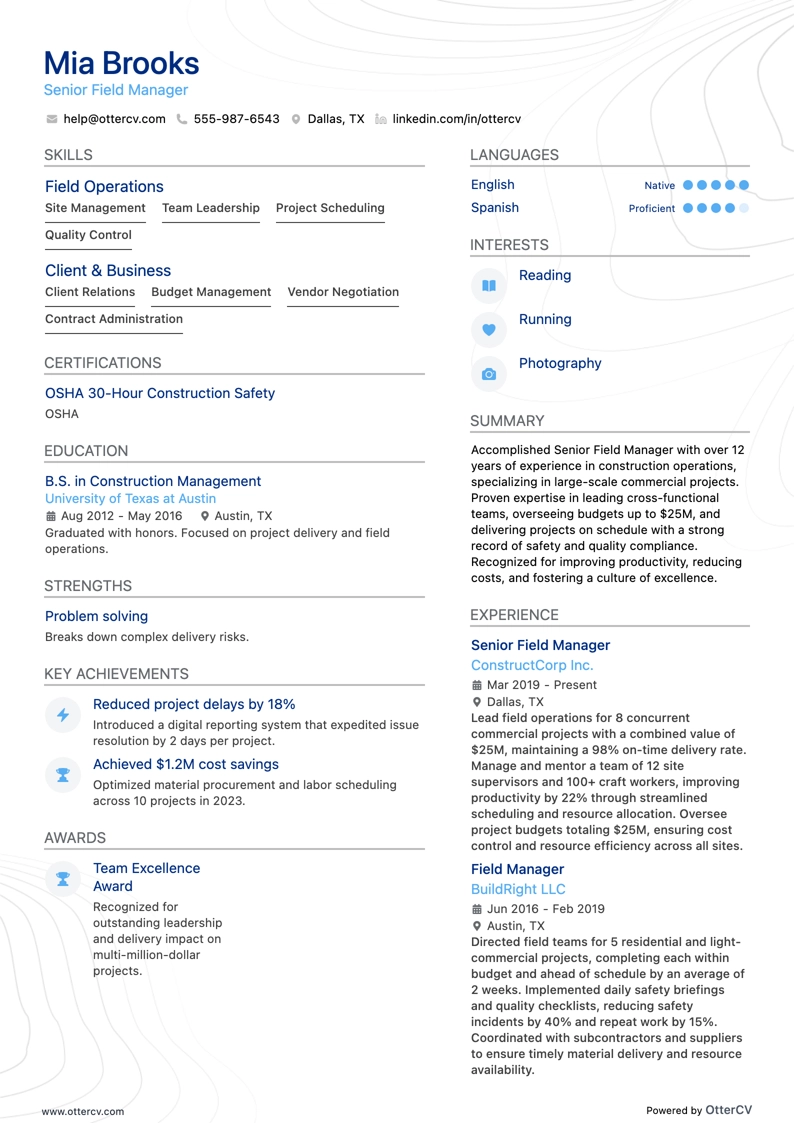
Senior Field Manager full preview

10 Field Manager Resume Examples

OtterCV

Written by The OtterCV Team

Updated: 11/23/2023•8 min read

See all resume examples in this guide, or generate your own resume example with your personalized prompt

Senior Field Manager resume example

Senior Field Manager

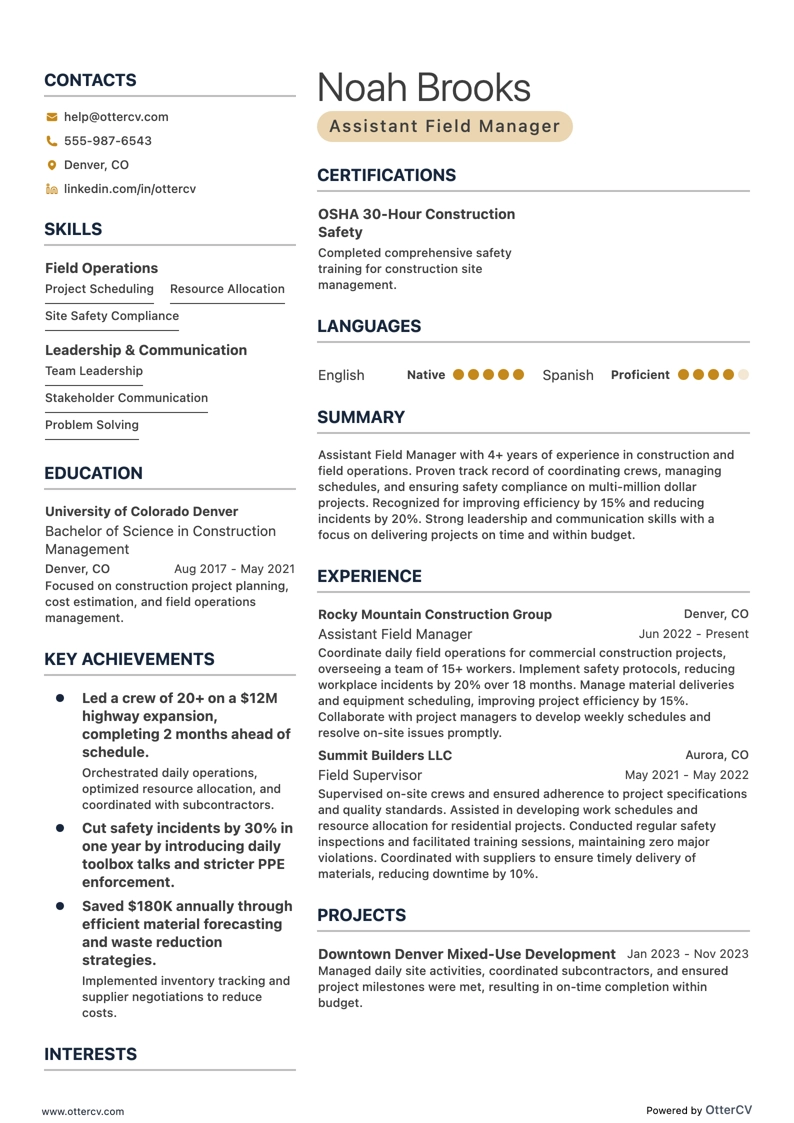
Assistant Field Manager resume example

Assistant Field Manager

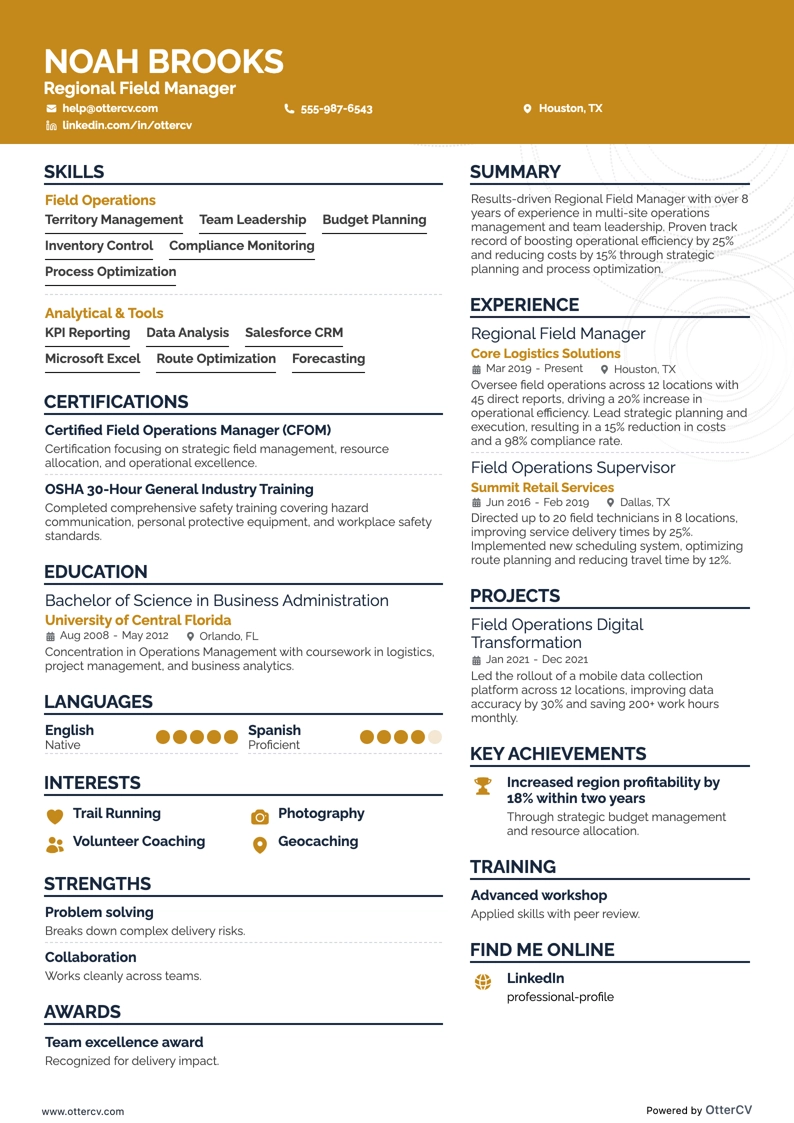
Regional Field Manager resume example

Regional Field Manager

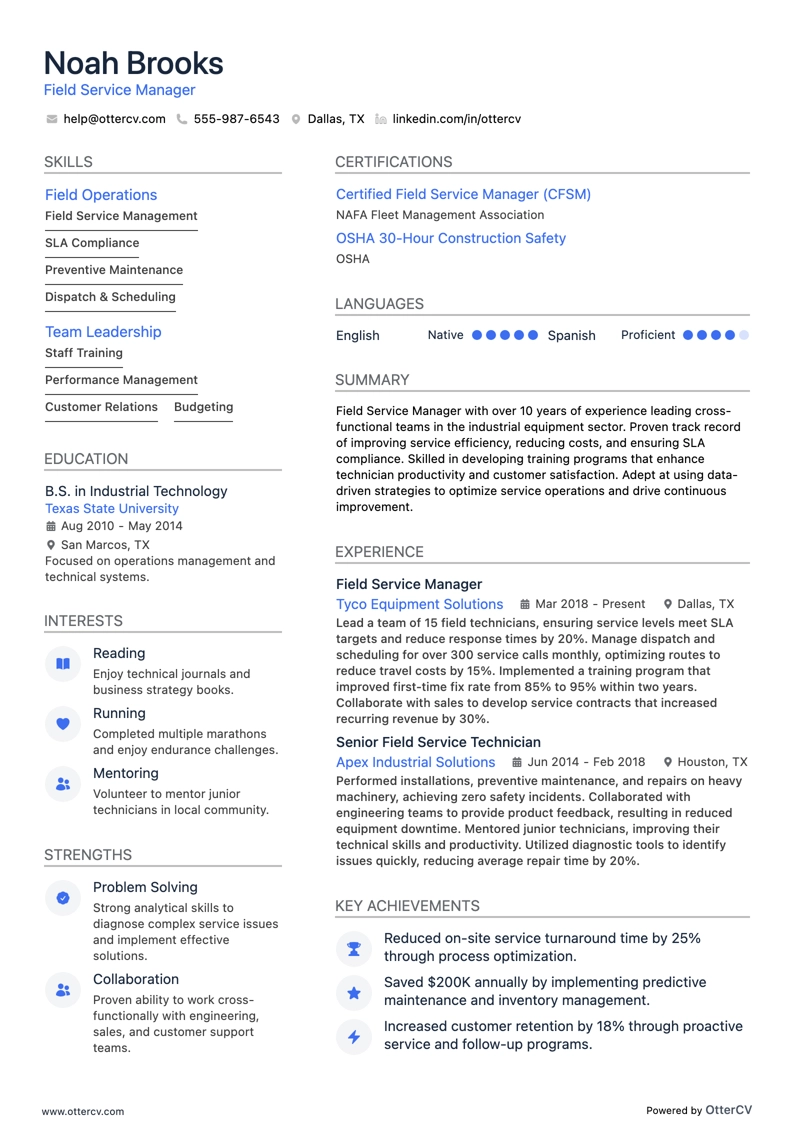
Field Service Manager resume example

Field Service Manager

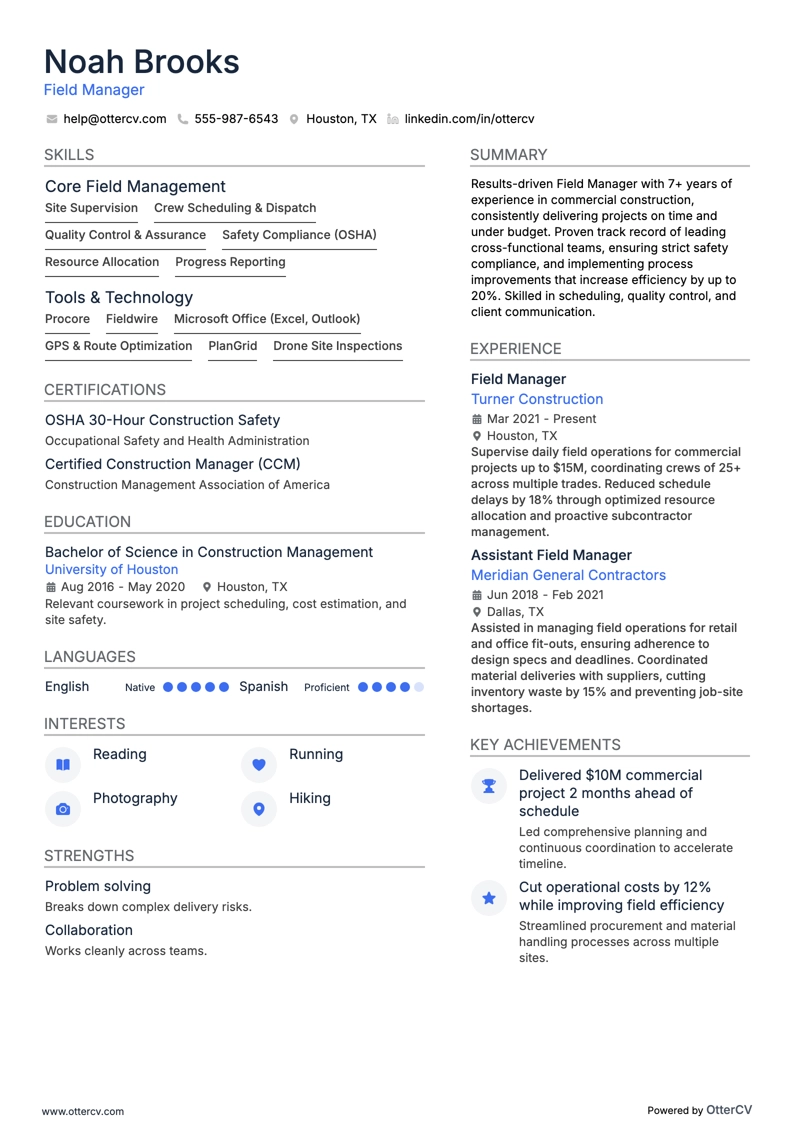
Field Manager resume example

Field Manager

Most field manager resume drafts fail because they read like task lists, burying results under tools, routes, and daily oversight. That approach does not work in today’s field manager resume screening, where ATS tools filter for keywords and recruiters scan quickly in a highly competitive market.

A strong resume shows what you improved and what changed because of your leadership. If you’re unsure where to begin, learning how to write a resume that emphasizes results is a critical first step. Highlight territory growth, on-time delivery rates, reduced safety incidents, service-level compliance, audit scores, budget variance, headcount managed, and customer satisfaction gains across sites.

Key takeaways

  • Focus each experience bullet on measurable results instead of task lists.

  • Use a reverse-chronological format if you have consistent field management experience.

  • Match the terminology and tools used in each job posting.

  • Show both hard skills, such as scheduling and OSHA compliance, and leadership soft skills.

  • Quantify safety improvements, cost savings, and on-time performance to demonstrate impact.

  • Put certifications above education when they are recent or required for the role.

  • Use Echocv to turn daily field work into clear, metric-driven resume bullets.

Job market snapshot for field managers

We analyzed 114 recent field manager job ads across major US job boards to highlight top hiring companies, career growth patterns, and employer expectations at a glance.

What level of experience employers are looking for field managers

Years of ExperiencePercentage found in job ads
1–2 years8.8% (10)
3–4 years11.4% (13)
5–6 years7.0% (8)
7–8 years0.9% (1)
9–10 years4.4% (5)
10+ years19.3% (22)
Not specified52.6% (60)

Field manager ads by area of specialization (industry)

Industry (Area)Percentage found in job ads
Finance & Banking75.4% (86)

Top companies hiring field managers

CompanyPercentage found in job ads
U-Haul19.3% (22)
Stier Supply Company12.3% (14)
Allan Myers9.6% (11)
Frontdoor, inc.9.6% (11)

Role overview stats

These tables outline the most common responsibilities and employment types for field manager roles. Use them to align your resume with employer expectations and understand how the role is structured across the market.

Day-to-day activities and top responsibilities for a field manager

ResponsibilityPercentage found in job ads
Project management21.9% (25)
Outlook21.1% (24)
Microsoft office14.9% (17)
Organizational skills13.2% (15)
Sales13.2% (15)
Excel12.3% (14)
Negotiation12.3% (14)
Decision-making11.4% (13)
Powerpoint11.4% (13)
Problem solving11.4% (13)
Word11.4% (13)
Analytical skills10.5% (12)

Type of employment (remote vs on-site vs hybrid)

Employment typePercentage found in job ads
On-site85.1% (97)
Hybrid8.8% (10)
Remote6.1% (7)

How to format a field manager resume

Recruiters hiring for field manager roles look for hands-on operational oversight, coordination across multiple sites, and the ability to deliver measurable results in fast-moving environments. A clean, well-structured resume format helps make key signals—territory coverage, crew leadership, and performance metrics—easy to spot during both automated screening and manual review.

I have significant experience in this role—which format should I use?

I have significant experience in this role—which format should I use?

Use a reverse-chronological format to show your field management career in a clear, progression-driven timeline.

  • Lead with your scope of ownership, including the number of sites managed, team size, geographic territory, and budget responsibility.
  • Highlight domain-specific expertise such as field operations software, including Salesforce Field Service and ServiceTitan, along with safety compliance frameworks and vendor management.
  • Quantify business impact with metrics such as cost reductions, productivity gains, contract retention rates, or improvements in safety incidents.

Example: “Directed daily field operations across 14 commercial sites and a team of 45 technicians, reducing average project turnaround time by 22% and cutting operational costs by $310K annually through route optimization and vendor renegotiation.”

I'm junior or switching into this role—what format works best?

I'm junior or switching into this role—what format works best?

A hybrid resume format works best. It lets you lead with relevant skills while still including a concise work history that gives recruiters context.

  • Place a skills section near the top with field-relevant strengths such as site coordination, crew scheduling, quality inspections, and safety protocol enforcement.
  • Include project-based experience, internships, or supervisory roles from adjacent fields such as construction, logistics, or facilities to show transferable field leadership.
  • Connect each action to a result so recruiters can see cause and effect, not just task descriptions.

Example scaffold: Skill: crew coordination → Action: scheduled and supervised a rotating team of 12 laborers across three concurrent renovation sites → Result: maintained 100% on-time milestone delivery over a six-month project cycle.

Why not use a functional resume?

Why not use a functional resume?

A functional resume removes the timeline and context recruiters use to understand where, when, and how you applied your field management skills, which makes it harder for them to judge your readiness for the role.

  • A functional resume may be acceptable if you are moving from a related hands-on role, such as site supervisor or logistics coordinator, with limited direct field manager titles, or if you are returning to the workforce after a gap. In either case, every skill listed should be tied to a specific project, outcome, or measurable contribution.
  • Avoid a functional format if you have any continuous field operations experience, because it is likely to raise more questions than it answers during screening.

With your format established, the next step is to fill your resume with the right sections so recruiters get a complete picture of your qualifications.

What sections should go on a field manager resume

Recruiters expect a clean, easy-to-scan resume that shows you can lead field operations, meet service and safety targets, and manage teams across multiple sites. Knowing what to put on a resume for a field manager role helps you focus on the details that matter most.

Use this structure for clarity:

  • Header
  • Summary
  • Experience
  • Skills
  • Projects
  • Education
  • Certifications
  • Optional sections: Awards, Leadership, Languages

Your experience bullets should emphasize measurable results, the size of the territories and teams you managed, and the operational impact you made across safety, quality, cost, and timelines.

With your resume structure in place, the next step is to write a field manager experience section that reinforces the information included elsewhere on your resume.

How to write your field manager resume experience

The experience section of your field manager resume should highlight the work you’ve delivered, including projects completed, teams led, and operations improved across job sites or territories. Hiring managers care more about proven impact than generic task lists, so each entry should focus on relevant tools, methods, and measurable results.

Each entry should include:

  • Job title
  • Company and location (or remote)
  • Dates of employment (month and year)

Add three to five concise bullet points that show what you owned, how you executed, and what outcomes you delivered:

  • Ownership scope: the sites, territories, crews, vendor relationships, or operational programs you were directly responsible for as a field manager.
  • Execution approach: the scheduling platforms, inspection protocols, safety frameworks, reporting tools, or resource-allocation methods you used to plan work and make field decisions.
  • Value improved: the changes you drove in site quality, crew productivity, compliance rates, turnaround times, equipment reliability, or operational risk.
  • Collaboration context: how you worked with project managers, corporate leadership, subcontractors, regulatory agencies, or clients to align field execution with broader organizational goals.
  • Impact delivered: the outcomes your field management produced, expressed through project scale, service-level improvements, cost reductions, or safety record gains rather than a list of activities.

Experience bullet formula

Experience bullet formula

Action verb + technology + what you built or fixed + measurable result

A field manager experience example

Field Operations Manager

SunGrid Energy Services | Phoenix, AZ

2021–Present

Led a forty-person field team delivering commercial solar and battery installations across Arizona and New Mexico in a safety-critical, fast-schedule environment.

  • Directed daily dispatch and capacity planning in Salesforce Field Service and ServiceNow, cutting average job cycle time from twelve to nine days (25%) while maintaining on-time completion above 95%.
  • Implemented standardized quality inspections using iAuditor and a photo-based punch list workflow, reducing rework from 8.5% to 5.6% and improving first-pass acceptance by 18%.
  • Partnered with project managers, engineers, and client stakeholders to resolve scope changes and permitting blockers, preventing $420,000 in change-order leakage and improving gross margin by 2.1 points.
  • Launched a safety program with toolbox talks, near-miss tracking, and OSHA-aligned audits, decreasing recordable incidents by 33% and lowering lost-time days by 40%.
  • Built KPI dashboards in Power BI from Smartsheet and telematics data, increasing crew utilization by 12% and saving 180 labor hours per month through faster issue escalation and routing adjustments.

Now that you’ve seen how to structure a strong experience entry, focus on adapting it to the specific field manager role you’re targeting.

How to tailor your field manager resume experience

Recruiters review field manager resumes through applicant tracking systems and manual screening, so tailoring your resume to the job description is essential. It helps ensure the skills, tools, and results you highlight match what the employer is actively looking for.

Ways to tailor your field manager experience:

  • Use the same field operations terminology that appears in the job posting.
  • Reference the CRM or workforce management platforms they list.
  • Match your leadership scope to the team size they describe.
  • Highlight the compliance or safety standards named in the posting.
  • Align your KPIs with the performance metrics they prioritize.
  • Include relevant industry experience when the role calls for domain knowledge.
  • Emphasize the coordination workflows or reporting structures they mention.
  • Reflect their quality assurance or inspection methodologies in your bullet points.

Tailoring means connecting your real accomplishments to what the employer values, not forcing unrelated keywords into your experience.

Resume tailoring examples for field manager

Job description excerptUntailoredTailored
“Oversee daily field operations across multiple job sites, ensuring compliance with OSHA safety standards and project timelines.”Managed operations and made sure things ran smoothly.Directed daily field operations across six concurrent job sites, enforcing OSHA safety standards and maintaining a 97% on-time project completion rate over 18 months.
“Coordinate with subcontractors, suppliers, and project managers using Procore to track progress, budgets, and change orders.”Worked with different teams and helped keep projects on budget.Coordinated with 12+ subcontractors and suppliers while using Procore to track budgets, change orders, and milestones—reducing cost overruns by 15% across a $4.2M portfolio.
“Conduct regular site inspections, document deficiencies, and implement corrective actions to meet municipal code requirements.”Performed inspections and handled issues as they came up.Conducted weekly site inspections, documented deficiencies against municipal code requirements, and implemented corrective actions that cut violation citations by 40% within the first quarter.

Once you’ve aligned your experience with the role’s priorities, quantify your field manager achievements to show the impact of your work with measurable results.

How to quantify your field manager achievements

Quantifying your achievements shows how your field leadership improved results, not just activity. Focus on on-time completion, safety and compliance, customer satisfaction, cost control, and productivity across sites, crews, and service routes.

Quantifying examples for field manager

MetricExample
On-time deliveryRaised on-time job completion from 86% to 95% in six months by rebalancing routes in Salesforce and tightening daily dispatch huddles.
Safety complianceCut recordable incidents by 32% year over year across four crews by enforcing weekly tailgate talks and closing audit findings within five business days.
Cost efficiencyReduced overtime spend by $48K per quarter by aligning staffing to forecasted work orders and standardizing shift handoffs in a shared schedule.
Quality accuracyLowered rework rate from 9% to 4% by adding a two-step checklist and photo verification in the field service mobile app.
Customer satisfactionImproved customer satisfaction score from 4.1 to 4.6 out of five by setting two-hour arrival windows and resolving escalations within twenty-four hours.

How to list your hard and soft skills on a field manager resume

Once your bullet points are strong, the next step is making sure your skills section shows the right mix of hard and soft skills for a field manager role.

Your skills section should show how you run field operations, lead crews, and meet service targets. Recruiters and ATS often scan this section quickly to confirm fit, so aim for a balanced mix of hard skills such as tools and processes, and soft skills such as execution and leadership.

Field manager roles require a blend of:

  • Product strategy and discovery skills.
  • Data, analytics, and experimentation skills.
  • Delivery, execution, and go-to-market discipline.
  • Soft skills.

Your skills section should be:

  • Scannable, with bullet-style grouping.
  • Relevant to the job post.
  • Backed by proof in your experience bullets.
  • Updated with current tools.

Place your skills section:

  • Above your experience section if you're junior or changing careers.
  • Below your experience section if you're mid- or senior-level with strong achievements.

Hard skills

  • Field operations management.
  • Workforce scheduling and dispatch.
  • Route optimization and GPS tracking.
  • Service level agreement tracking.
  • Preventive maintenance programs.
  • Safety compliance and OSHA standards.
  • Inventory control and cycle counts.
  • Work order systems and CMMS.
  • Quality audits and corrective actions.
  • Budgeting and cost control.
  • Vendor and subcontractor management.
  • Microsoft Excel and Power BI.

Soft skills

  • Lead daily standups and huddles.
  • Prioritize work under constraints.
  • Escalate risks early and clearly.
  • Coach technicians in the field.
  • Set clear expectations and follow through.
  • Negotiate timelines with stakeholders.
  • De-escalate customer issues on-site.
  • Make fast, data-backed decisions.
  • Coordinate across teams and regions.
  • Hold teams accountable to standards.
  • Communicate status in plain language.
  • Own outcomes end-to-end.

How to show your field manager skills in context

Skills should not appear only in a bulleted list on your resume. Browse examples of resume skills to see how other professionals weave competencies into their resumes effectively.

Your skills should be demonstrated in:

  • Your summary (high-level professional identity)
  • Your experience (proof through outcomes)

Here is what strong, skill-rich entries look like in practice.

Summary example

Field manager with 12 years of experience in commercial construction, with expertise in workforce scheduling, safety compliance, and Procore project tracking. Led cross-functional crews across 30+ sites and reduced project delays by 18% through proactive resource allocation.

  • Clearly reflects senior-level experience.
  • Names role-relevant tools such as Procore.
  • Quantifies impact with concrete metrics.
  • Highlights leadership as a key soft skill.

Experience example

Senior Field Manager

Bridgepoint Infrastructure Group | Denver, CO

March 2018–January 2024

  • Supervised 45-person field crews using daily scheduling in Buildertrend, completing 94% of projects on or ahead of deadline.
  • Worked with project engineers and safety officers to implement new site protocols, reducing recordable incidents by 27% year over year.
  • Streamlined material procurement workflows with regional vendors, cutting supply delays by 22% and saving $140K annually.
  • Every bullet includes measurable proof.
  • Skills appear naturally within achievements.

Once you’ve connected your abilities to real outcomes and responsibilities, the next step is to use that same approach on a field manager resume, even if you don’t have direct experience.

How do I write a field manager resume with no experience

Even without full-time experience, you can still show that you’re ready for the role through experience such as:

  • Retail shift lead coverage
  • Volunteer event operations coordination
  • Campus club logistics leadership
  • Internship with site visit reporting
  • Inventory counts and replenishment audits
  • Route planning for deliveries
  • Safety training and compliance checklists
  • Customer site issue resolution tracking

If you’re building your first field manager resume, our guide on writing a resume without work experience can help you present transferable skills effectively.

Focus on:

  • Multi-site scheduling and dispatch logs
  • Inventory control with audit results
  • Safety compliance documentation and metrics
  • Reporting accuracy using field tools

Resume format tip for entry-level field manager

Resume format tip for entry-level field manager

Use a combination resume format to put relevant projects and transferable experience ahead of a limited work history.

Do:

  • Add a Relevant Projects section.
  • Quantify outcomes with counts and percentages.
  • Name tools like Excel and Google Sheets.
  • Mirror field manager keywords from job postings.
  • Include licenses, training, and certifications.

Example project bullet:

  • Planned a five-stop delivery route in Google Maps and tracked status in Google Sheets, cutting total drive time by 12% across three trial runs.

Even without direct experience, your education section can show the foundational knowledge and relevant training that qualify you for a field manager role.

How to list your education on a field manager resume

Your education section helps hiring teams confirm you have the background needed for the role. It also validates your training in management, operations, or related disciplines.

Include:

  • Degree name
  • Institution
  • Location
  • Graduation year
  • Relevant coursework for juniors or entry-level candidates
  • Honors and GPA if 3.5 or higher

Avoid listing specific months or days. For a cleaner look, use the graduation year only.

Here’s a strong education entry tailored to a field manager resume.

Example education entry

Bachelor of Science in Construction Management

University of Florida, Gainesville, FL

Graduated 2019

GPA: 3.7/4.0

  • Relevant Coursework: Project Scheduling, Site Safety Management, Operations Leadership, Contract Administration
  • Honors: Magna Cum Laude, Dean's List (six semesters)

How to list your certifications on a field manager resume

Certifications on a resume show a field manager’s commitment to learning, proficiency with tools and processes, and alignment with industry standards and safety expectations.

Include the following details:

  • Certificate name
  • Issuing organization
  • Year
  • Optional: credential ID or URL
  • Place certifications below education when they are older, less role-specific, or secondary to a recent degree.
  • Place certifications above education when they are recent, required for the role, or directly tied to field manager responsibilities.

Best certifications for your field manager resume

  • Project Management Professional (PMP)
  • Certified Associate in Project Management (CAPM)
  • OSHA 30-Hour Construction Safety and Health
  • Lean Six Sigma Green Belt
  • Certified Construction Manager (CCM)
  • First Aid/CPR/AED Certification
  • Forklift Operator Certification

Once you’ve placed your certifications where recruiters will notice them, focus on your field manager resume summary to reinforce those qualifications in a clear, high-level snapshot.

How to write your field manager resume summary

Your resume summary is often the first part a recruiter reads, so it needs to capture attention quickly. A strong opening helps position you as a solid fit for a field manager role before they review the rest of your resume.

Keep it to three to four lines and include:

  • Your job title and total years of field management experience.
  • The industry or domain you’ve worked in, such as construction, retail, or utilities.
  • Core skills such as team coordination, scheduling, safety compliance, or budget oversight.
  • One or two measurable results, such as efficiency improvements or cost reductions.
  • Soft skills connected to outcomes, such as cross-functional communication that reduced project delays.

PRO TIP

At this level, prioritize clarity and relevance over impressive-sounding language. Lead with the scope of your experience, your industry, and your strongest measurable results.

Avoid vague descriptors like “passionate” or “hardworking.” Replace them with specific contributions. Skip objective statements, and make sure every word earns its place.

Example summary for a field manager

Field manager with six years of experience in commercial construction, leading crews of up to 25. Reduced project completion times by 18% through improved scheduling and vendor coordination.

Now that your summary highlights your strongest qualifications, make sure your header includes the essential contact and professional details recruiters need to reach you.

What to include in a field manager resume header

A resume header includes your key identifying and contact details, helping field manager candidates improve visibility, build credibility, and pass recruiter screening quickly.

Essential resume header elements

  • Full name
  • Tailored job title and headline
  • Location
  • Phone number
  • Professional email
  • GitHub link
  • Portfolio link
  • LinkedIn

A LinkedIn link helps recruiters verify experience quickly and supports screening.

Don't include a photo on a field manager resume unless the role is explicitly front-facing or appearance-dependent.

Put your job title and location on the first line so recruiters can confirm fit in seconds.

Jordan Ramirez

Field Manager | Field operations leadership and site execution

Austin, TX | (512) 555-01XX | your.name@echocv.com | github.com/yourname | yourwebsite.com | linkedin.com/in/yourname

Once your contact details and role identifiers are in place at the top, add targeted sections that reinforce the qualifications highlighted in your header.

Additional sections for field manager resumes

When your core qualifications are similar to those of other candidates, these extra sections can help you stand out by showing role-specific credibility and broader expertise. For example, listing language skills on your resume can be a strong differentiator if you manage multilingual crews or work across diverse regions.

  • Languages
  • Certifications and licenses
  • Professional affiliations
  • Volunteer experience
  • Awards and recognition
  • Technical proficiencies
  • Hobbies and interests

Once your resume clearly reflects your full range of qualifications, the next step is pairing it with a cover letter that helps tie everything together for hiring managers.

Do field manager resumes need a cover letter?

A cover letter is not required for a field manager role, but it can help in competitive searches or when hiring teams expect one. It is especially useful when your resume needs added context or when you want to connect specific outcomes to the role. If you are unfamiliar with the format, start by learning what a cover letter is and how it complements your resume.

Use a cover letter to provide context your resume cannot:

  • Explain role and team fit: Match your field manager experience to the territory model, coaching cadence, and cross-functional partners.
  • Highlight one or two outcomes: Choose a project that improved quota attainment, reduced churn, or increased adoption, and state the measurable result.
  • Show business understanding: Reference the product, key users, and sales cycle, and explain how you support execution in the field.
  • Address transitions: Clarify a move between industries, a step into a field manager role, or non-obvious experience that maps to leading reps.

Using AI to improve your field manager resume

Once you’ve decided whether to include a cover letter, you can use AI to improve your field manager resume by tailoring your content and sharpening your wording more quickly.

AI can improve your resume’s clarity, structure, and overall impact. It can help you find stronger phrasing and cleaner formatting, but overusing it can strip away authenticity. Once your resume reads clearly and aligns with the role, step away from AI. For a deeper look at effective prompts and techniques, explore our guide on ChatGPT resume writing.

Here are 10 practical prompts you can copy and paste to strengthen specific sections of your field manager resume:

  1. Strengthen your summary: “Rewrite my field manager resume summary to highlight leadership scope, team size, and measurable operational results in three sentences or fewer.”
  2. Quantify experience bullets: “Add specific metrics like percentages, dollar amounts, or team counts to each field manager experience bullet on my resume.”
  3. Tighten action verbs: “Replace weak or passive verbs in my field manager experience section with strong, industry-relevant action verbs.”
  4. Align skills to the job: “Compare my field manager skills section against this job posting and flag missing keywords I should add.”
  5. Clarify project contributions: “Rewrite my field manager project descriptions to clearly state my role, the challenge, the action I took, and the result.”
  6. Improve certification relevance: “Reorganize my certifications section to prioritize credentials most relevant to a field manager position.”
  7. Refine education details: “Simplify my education section to emphasize coursework and achievements directly applicable to field manager responsibilities.”
  8. Remove filler language: “Identify and remove vague or redundant phrases throughout my field manager resume without losing meaning.”
  9. Focus scope of responsibility: “Rewrite each field manager experience entry to clearly define my territory size, reporting structure, and daily oversight duties.”
  10. Tailor for a specific posting: “Adjust my entire field manager resume to mirror the language, priorities, and qualifications listed in this job description.”

Stop using AI once your resume sounds accurate, specific, and aligned with your real experience. AI should never invent experience or inflate claims—if it didn’t happen, it doesn’t belong here.
Conclusion

A strong field manager resume shows impact through measurable outcomes, such as faster completion times, lower costs, and safer sites. It also highlights role-specific skills, including scheduling, coaching crews, quality control, and customer communication.

Keep your resume focused, consistent, and easy to review. A clear structure, clean layout, relevant keywords, and precise metrics make responsibilities and results easy to scan while showing you are prepared for today’s hiring standards and near-future expectations. This helps hiring teams trust your judgment and execution.

Field Manager resume examples

Explore additional Field Manager resume samples and guides and see what works for your level of experience or role.

By Experience

Senior Field Manager

Senior Field Manager resume preview

Assistant Field Manager

Assistant Field Manager resume preview

Field Manager resume examples

Explore additional Field Manager resume samples and guides and see what works for your level of experience or role.

By Role

Regional Field Manager

Regional Field Manager resume preview

Field Service Manager

Field Service Manager resume preview

Field Manager

Field Manager resume preview