Lead Fashion Designer full preview

14 Fashion Designer Resume Examples, Templates

OtterCV

Written by The OtterCV Team

Updated: 10/16/2025•8 min read

See all resume examples in this guide, or generate your own resume example with your personalized prompt

Lead Fashion Designer resume example

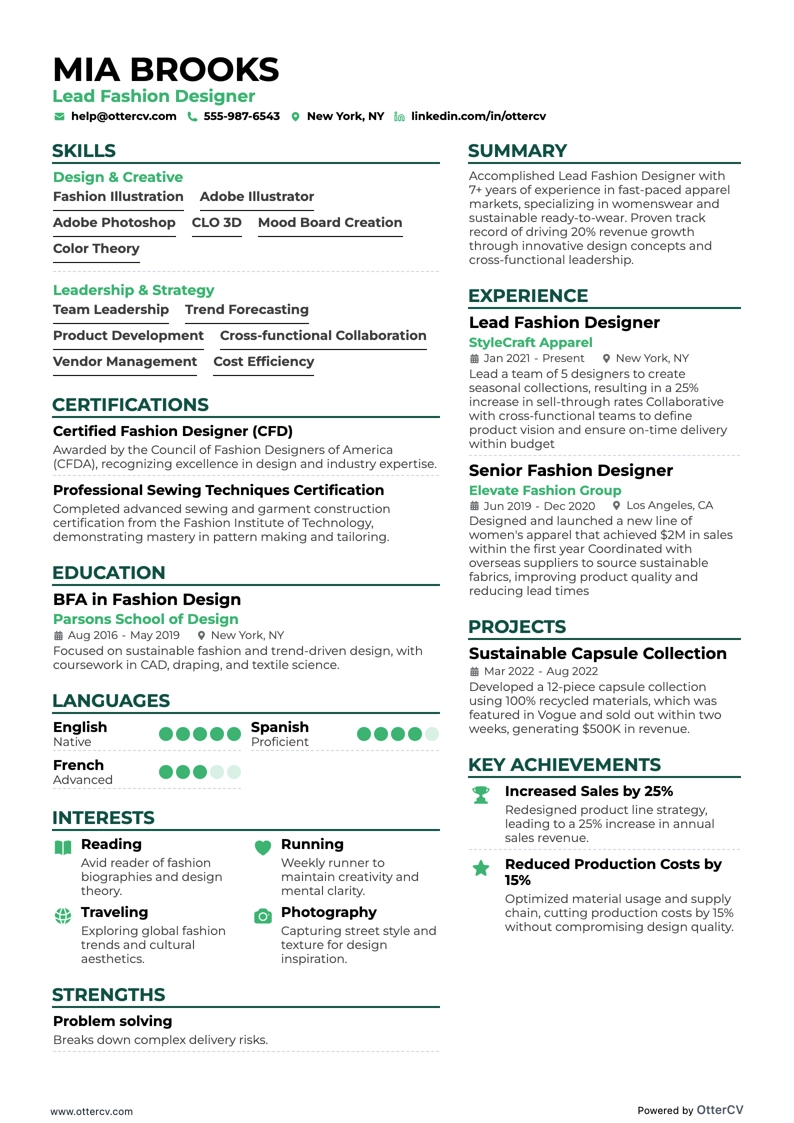
Lead Fashion Designer

Senior Fashion Designer resume example

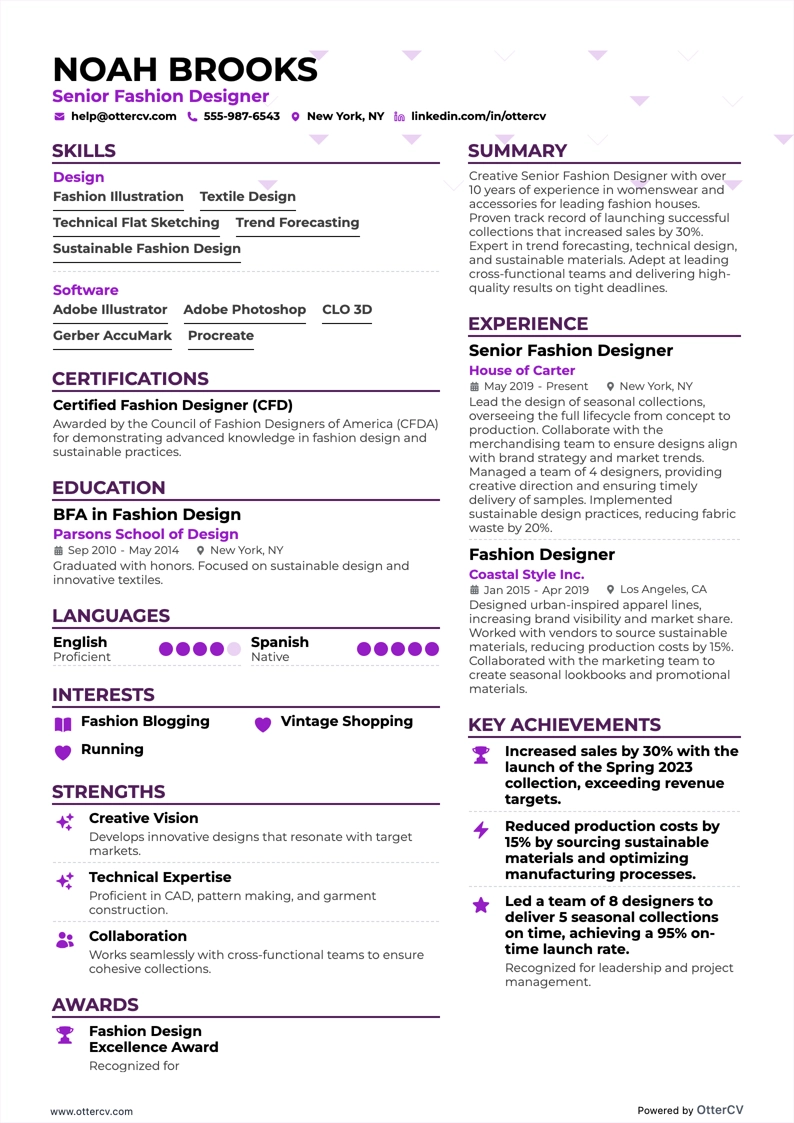
Senior Fashion Designer

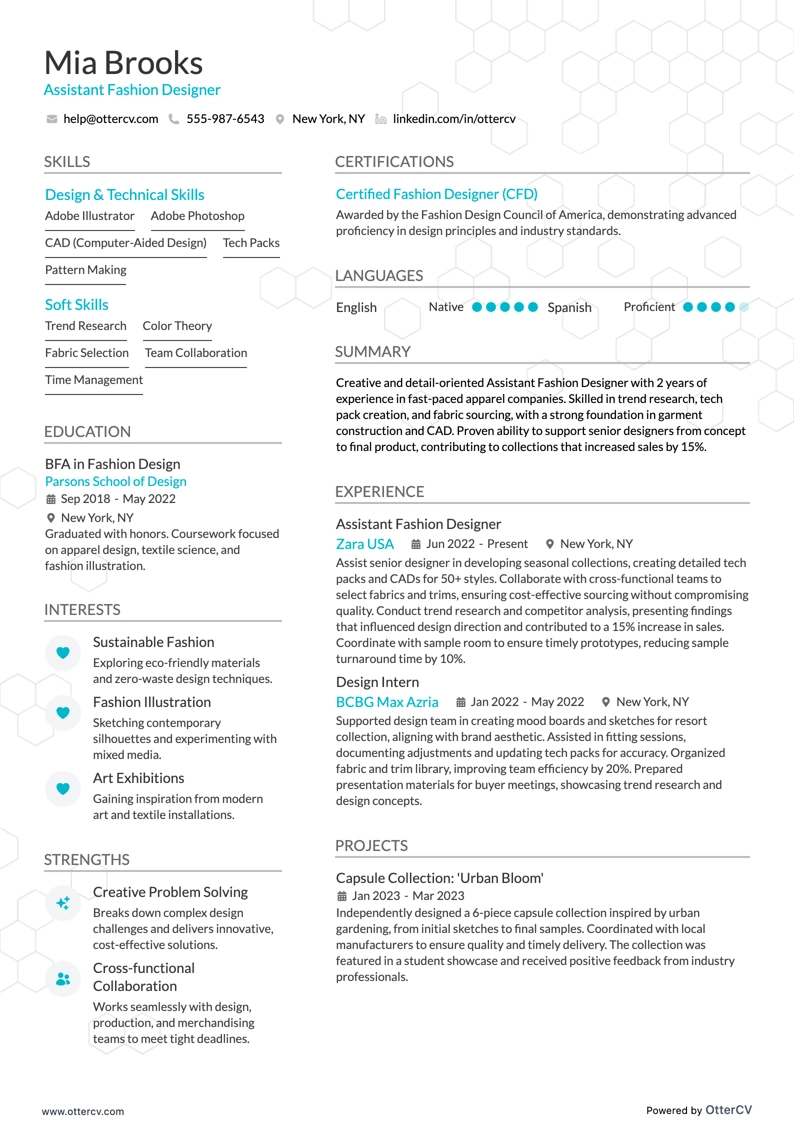
Assistant Fashion Designer resume example

Assistant Fashion Designer

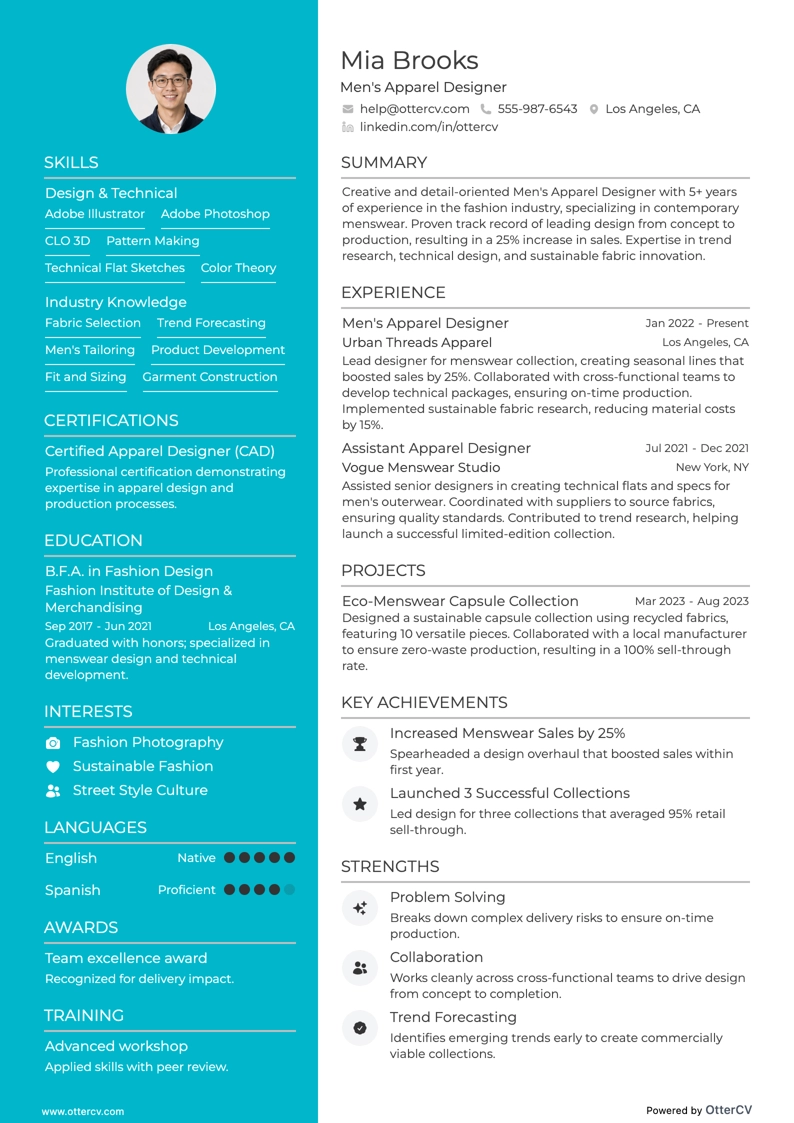
Men's Apparel Designer resume example

Men's Apparel Designer

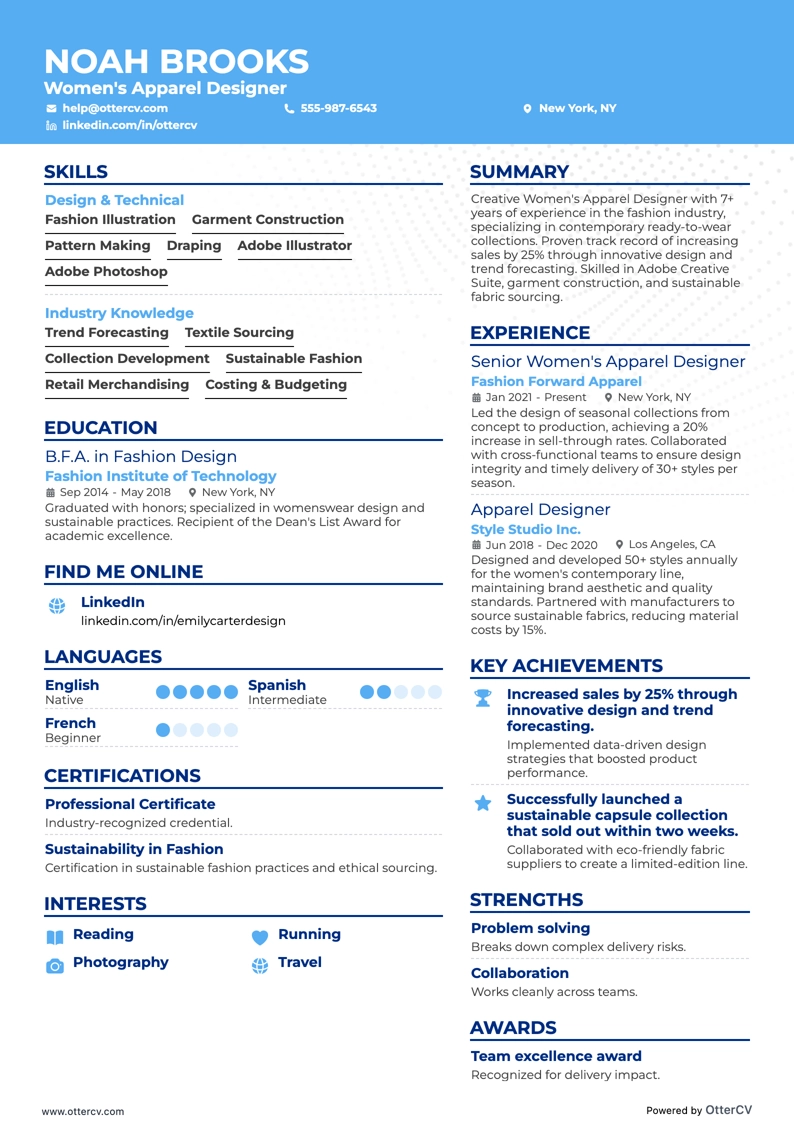
Women's Apparel Designer resume example

Women's Apparel Designer

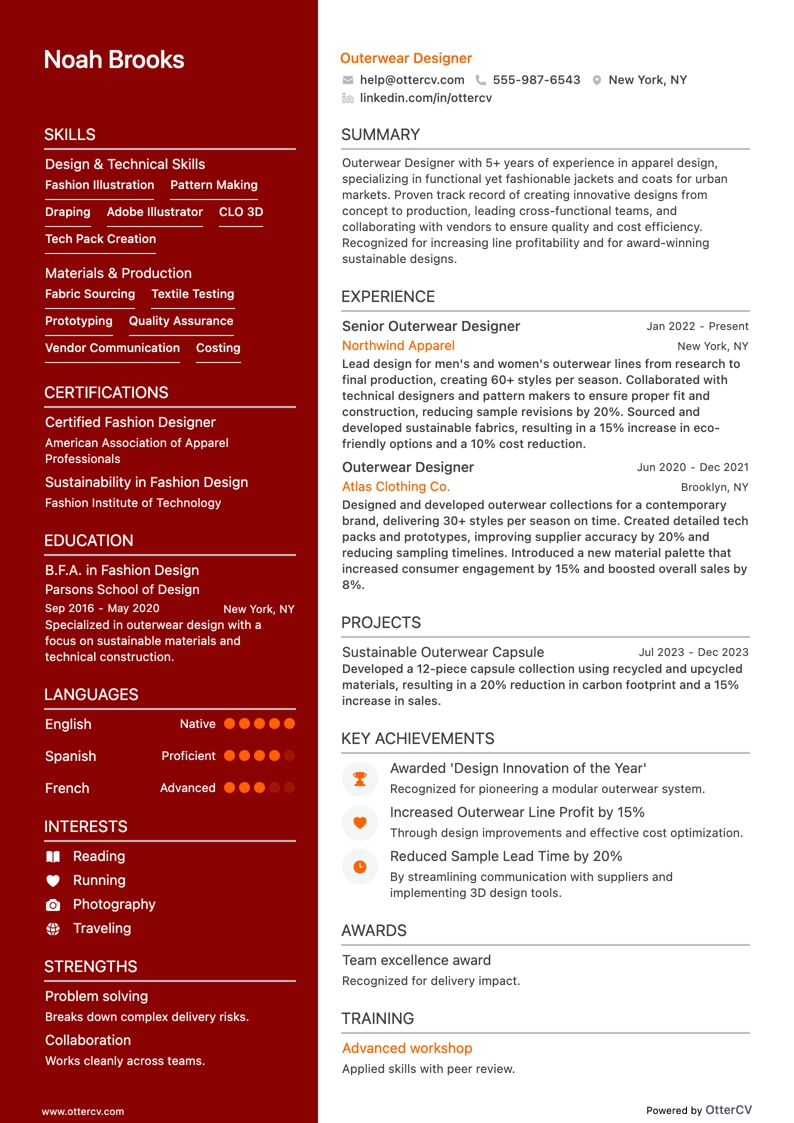
Outerwear Designer resume example

Outerwear Designer

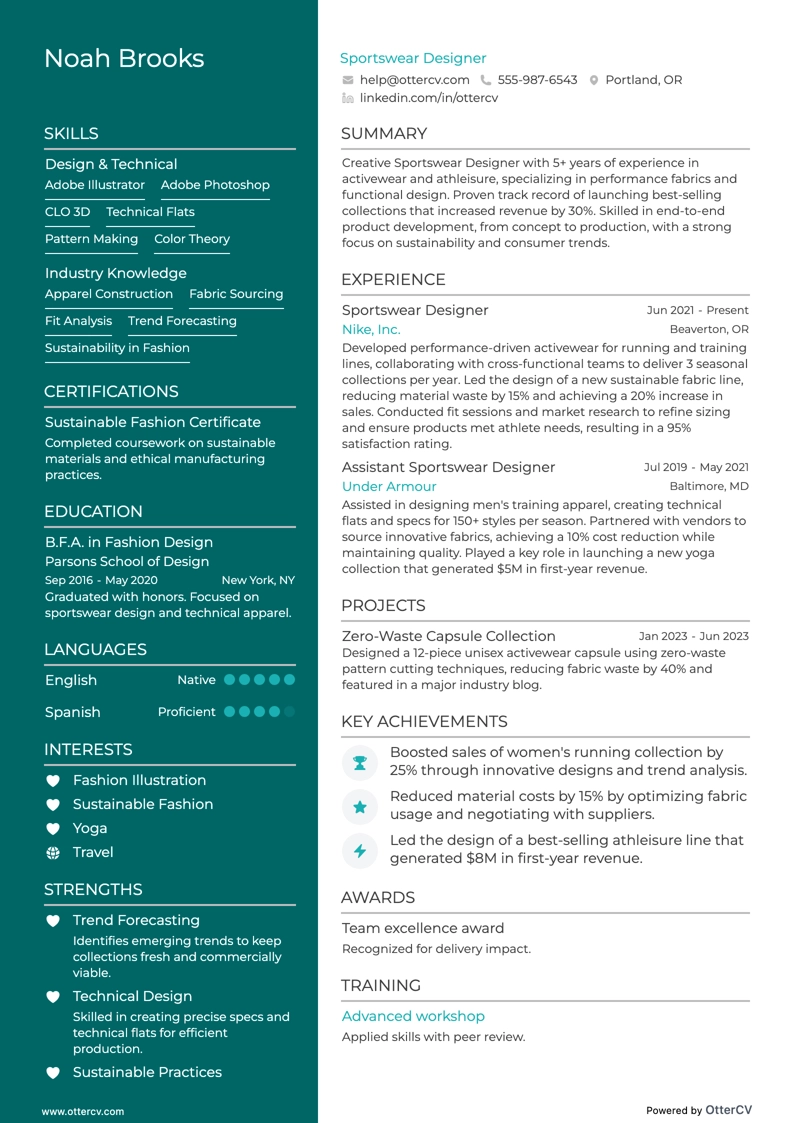
Sportswear Designer resume example

Sportswear Designer

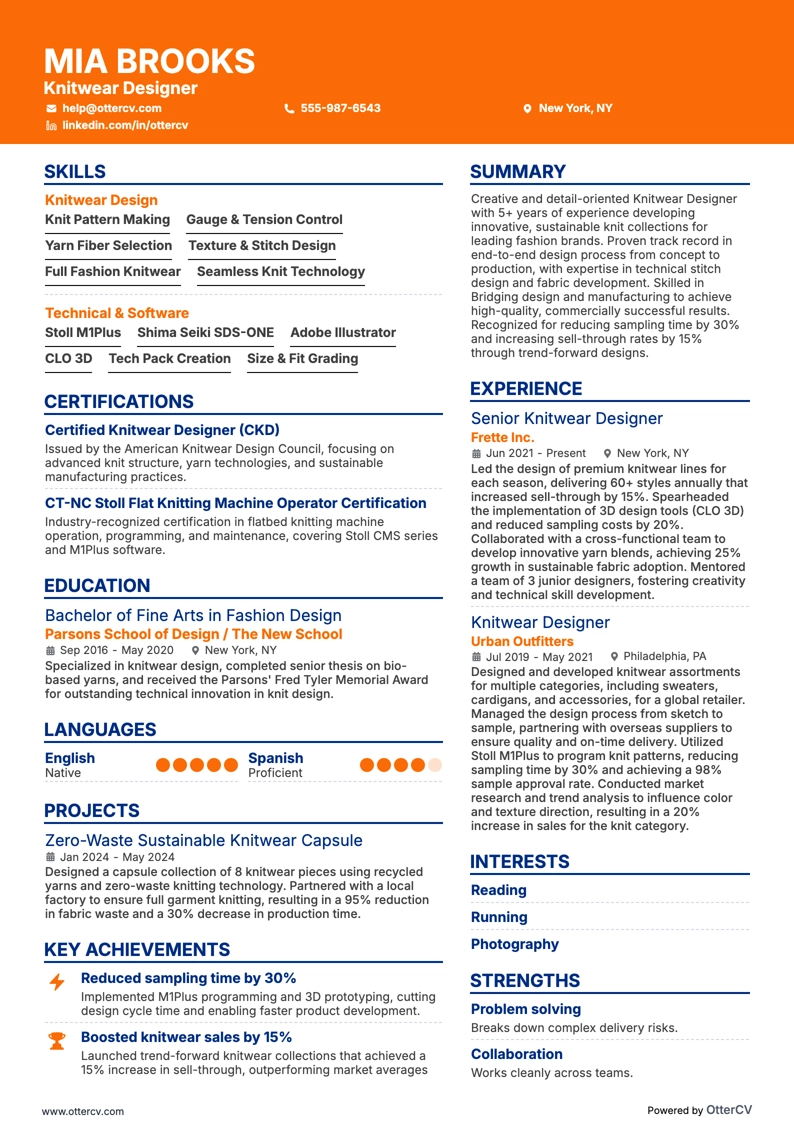
Knitwear Designer resume example

Knitwear Designer

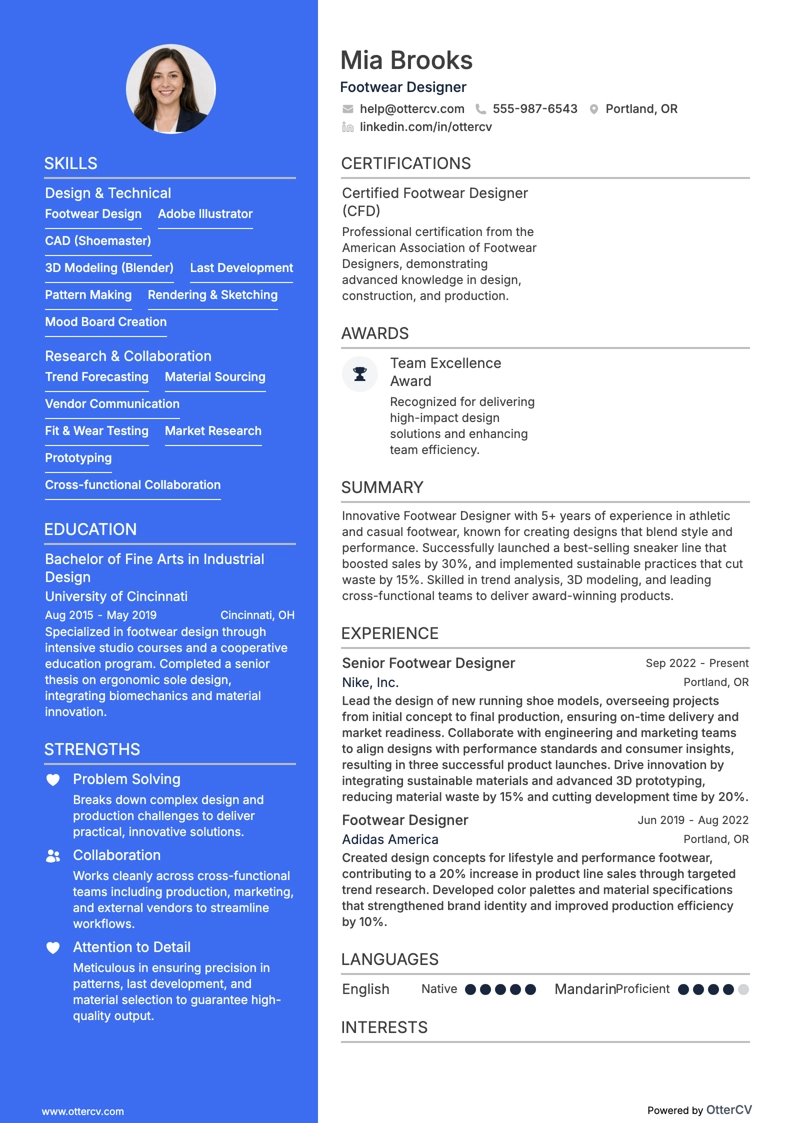
Footwear Designer resume example

Footwear Designer

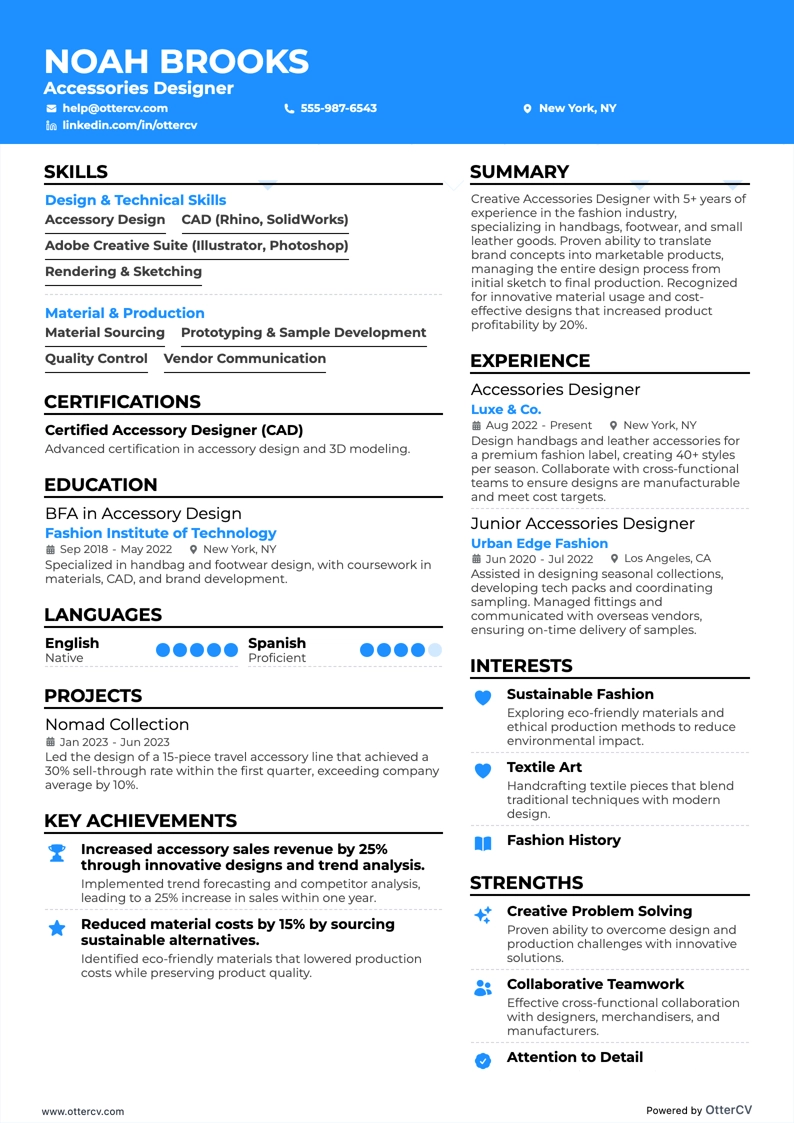
Accessories Designer resume example

Accessories Designer

Apparel Designer resume example

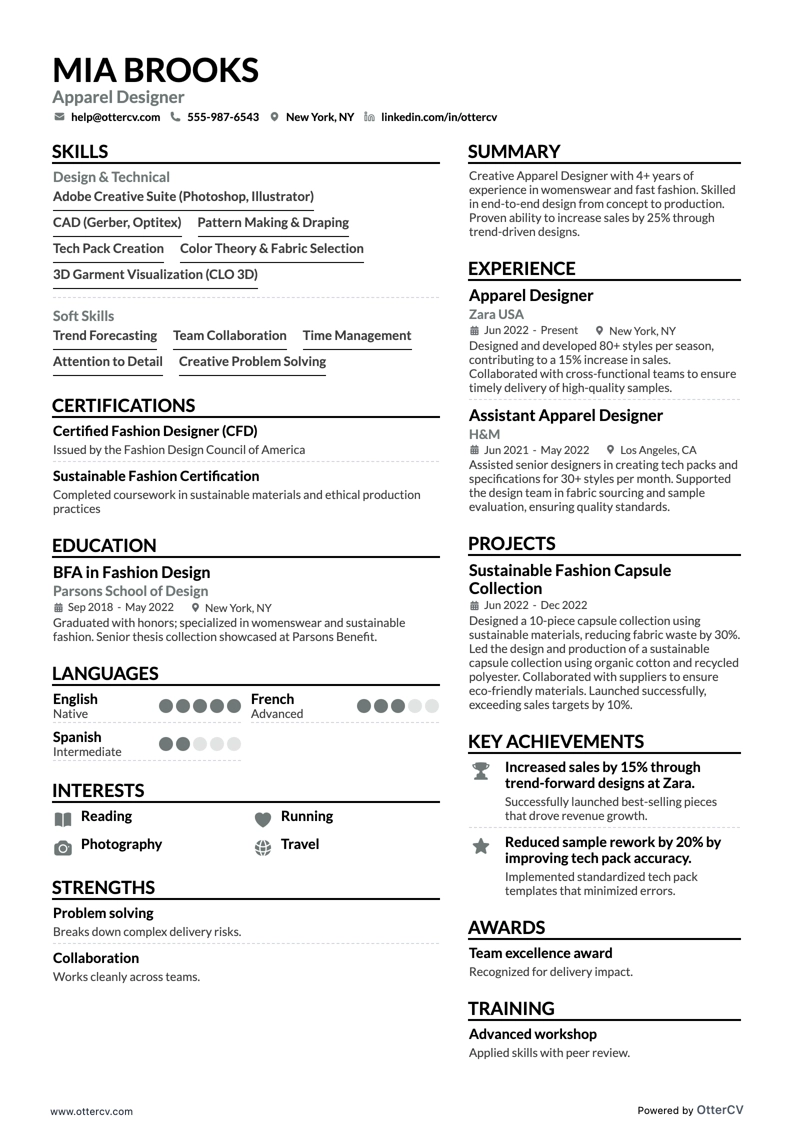
Apparel Designer

Fashion Designer resume example

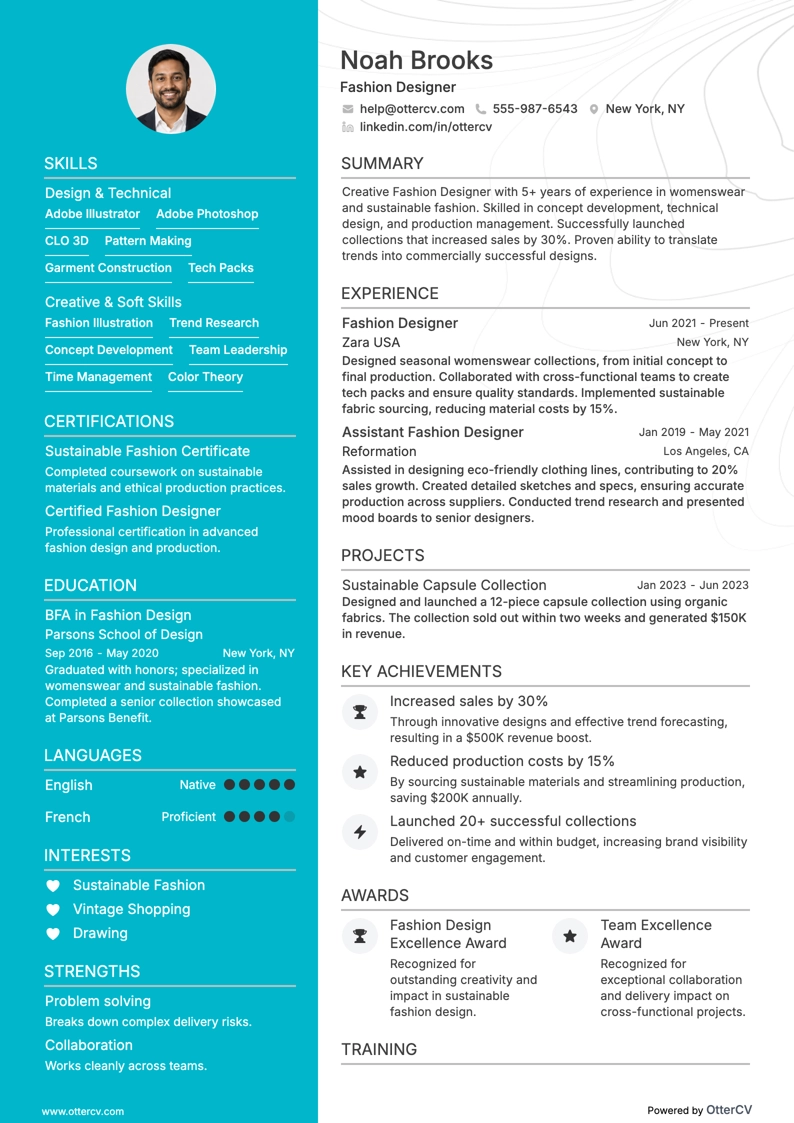
Fashion Designer

A fashion designer’s portfolio might help you get noticed, but your resume is what convinces employers to hire you. Don’t rely on your designs alone—show the practical skills hiring managers value.

Your resume should demonstrate that you can manage deadlines, work with suppliers, and take collections from sketch to showroom smoothly. Pair that substance with a sleek layout, and you’ll stand out to recruiters.

At Echocv, we’ve helped thousands of fashion designers create resumes that do more than look creative—they show real impact that leads to interviews.

This guide includes 14 fashion designer resume examples and templates, along with a breakdown of the essential sections, what works, and what to avoid. All advice is provided by Certified Professional Résumé Writers.

Key takeaways

  • Highlight both creativity and professional reliability on your fashion designer resume.

  • Use a hybrid resume format to balance design skills and work experience.

  • Include a portfolio link, since it’s essential for a fashion designer role.

  • Tailor bullet points with specific tools, collections, and outcomes that match the job description.

  • Quantify your work with results such as sales growth, press features, or production efficiency.

  • If you’re entry-level, emphasize coursework, projects, and certifications.

  • Use our AI Resume Builder to create an ATS-friendly resume and get thoughtful suggestions at each step.

How to choose the best resume format for a fashion designer

Fashion designers often rely on portfolios and recommendations, but a resume is still essential for showing the skills that go beyond creativity. This includes meeting deadlines, collaborating with teams, and managing the full design-to-production cycle.

The right format helps present your achievements in a clear and meaningful way.

Which resume format should a fashion designer use?

We usually recommend the reverse-chronological format because it works well for all types of roles.

If you want to place more emphasis on your skills, use the hybrid resume format. It gives equal weight to your creative abilities and your professional experience.

Exception:

Exception:

If you’re just starting out and don’t have substantial work history, the functional format can prioritize your skills instead.

What sections should go on a fashion designer resume?

Recruiters want to quickly identify the creative and professional strengths that make you a reliable hire. Most fashion designer resumes should include these sections:

  • Header (contact info)
  • Resume summary
  • Work experience
  • Education and Certifications
  • Skills

For a reverse-chronological resume, use the order above.

For a hybrid resume, organize your experience section by skills, then provide examples showing how you used those skills in a work context.

For example:

Creative Direction & Design

Gucci | Assistant Designer | 2021–Present

  • Assisted in developing seasonal collections, contributing design concepts featured in the Fall/Winter 2022 runway show.
  • Researched emerging fashion trends and fabrics to support the Creative Director’s vision.
  • Collaborated with patternmakers and seamstresses to move prototypes from sketch to sample.

Trend Analysis & Product Development

Zara (Inditex) | Junior Designer | 2018–2021

  • Designed capsule collections aligned with fast-fashion trends, increasing sell-through rates by 15%.
  • Partnered with sourcing teams to ensure cost-effective material choices without sacrificing quality.
  • Created technical sketches and spec sheets for production teams across Europe and Asia.

Brand Identity & Visual Storytelling

H&M | Design Intern | 2017–2018

  • Supported senior designers in developing sustainable fashion pieces for the “Conscious Collection.”
  • Assisted with mood board creation and design presentations for cross-functional teams.
  • Contributed design ideas selected for the Summer 2018 global campaign.

Additional sections to strengthen your resume

You can also add a projects or achievements section to highlight concrete examples of your work. Another useful option is a languages section, especially if you work for global brands.

Our AI Resume Builder is versatile enough to support many different work situations and scenarios.

For entry-level designers or professionals transitioning into fashion from another field, placing Skills or Certifications higher on your resume can better highlight your technical abilities and knowledge of industry tools, drawing less attention to limited experience.

Use the F-Shape Scanning Pattern

Structure your resume around the F-shape scanning pattern. Recruiters usually look across the top of the page first to find your name, title, and contact information, then scan down the left side for section headings, company names, and dates.

If you use a two-column layout, put shorter sections such as Skills, Education, or your Portfolio link in the narrower column, while keeping the overall reading order clear from left to right. Echocv’s resume templates offer creative options that balance readability with a personal touch.

Want to get your resume score? Run it through Echocv’s Resume Checker. It analyzes formatting, keywords, and section order, then shows you exactly what to improve.

How to write your fashion designer resume experience

Your work experience shows hiring managers how you move a design from concept to runway or retail. They want to see the collections you worked on, the impact of your designs, and how you contributed to a brand’s success.

Here’s what to include in your experience section:

  • Job title and company name: Be clear about whether you were an Assistant Designer, Fashion Designer, or Creative Director, since each reflects a different level of responsibility.
  • Dates of employment: Keep formatting consistent so your career timeline is easy to follow.
  • Location: Include the city and state/country. If you worked remotely, you can simply write “Remote.”

Each entry should include three to six bullet points covering:

  • Project scope: Seasonal collections, product categories, and market segment.
  • Tools and skills: Mention the most important ones, such as Adobe Illustrator, Photoshop, CAD software, draping, pattern-making, and textiles. You can place the rest in your skills section.
  • Collaboration: Work with merchandisers, suppliers, pattern makers, photographers, and marketing teams.
  • Results: Collections featured at shows, boosted sales, reduced costs, faster production, or better fabric use.

Here’s an example:

Good example of a fashion designer experience section

Senior Fashion Designer
GlobalTech Solutions — Boston, MA
Jan 2021 – Jun 2024

  • Directed a $25M digital transformation program across 5 business units, delivering it 10% under budget while meeting all compliance standards.
  • Led a cross-functional team of 22 through Agile sprints, achieving a 97% sprint completion rate and reducing release cycle time from 8 weeks to 5.
  • Negotiated vendor contracts worth $12M, reducing annual operational costs by 15% while improving service quality through tighter SLAs.
  • Designed and launched four seasonal womenswear collections, totaling 150+ pieces, which drove a 20% year-over-year increase in retail sales.
  • Introduced sustainable sourcing practices that cut fabric waste by 18% while meeting eco-certification standards.
  • Worked with marketing to align collection launches with brand campaigns, resulting in coverage in Vogue and Elle.

How to tailor your fashion designer resume experience

As a designer, you understand the value of a perfect fit. The same principle applies to your resume: the more precisely it is tailored to the company’s needs, the stronger the impression you will make.

Here are several ways to tailor your fashion designer experience section:

  • Highlight the type of design work the role emphasizes, such as ready-to-wear, couture, accessories, kidswear, or sustainable lines.
  • Reference the keywords mentioned in the job posting, including creative tools or software like Adobe Illustrator, Photoshop, CLO3D, and CAD programs.
  • Point to experience with similar collection sizes, product ranges, or market segments.
  • Emphasize collaboration that reflects the company’s setup, such as working with sourcing teams, manufacturers, or marketing departments.
  • Back up your work with numbers the brand values most, such as sales growth, production speed, cost savings, or press coverage.

Customizing your resume this way is one of the most reliable ways to stand out. It turns a generic list of duties into proof that you already speak the company’s language and can deliver what they need.

Resume tailoring examples for fashion designers

Job Description ExcerptUntailored BulletTailored BulletWhy This Works
Experience creating seasonal collections using Adobe Illustrator and CLO3D, with focus on sustainable fabrics.Designed women’s clothing for seasonal lines.Created 3 seasonal womenswear collections (40+ pieces each) using Adobe Illustrator and CLO3D, incorporating 60% sustainable fabrics.Uses the JD tools (“Illustrator” and “CLO3D”), aligns with the sustainability focus, and quantifies scope.
Proven ability to collaborate with suppliers and manufacturers to meet production deadlines.Worked with suppliers to develop samples.Partnered with 5 international suppliers to deliver samples 2 weeks ahead of schedule, ensuring an on-time launch for the Spring/Summer line.Shows collaboration, quantifies the number of suppliers, and highlights success against deadlines.
Strong background in trend research, fabric sourcing, and ensuring commercial viability of designs.Researched trends and fabrics for new designs.Researched market trends and sourced 12 new fabrics that cut material costs by 18% while aligning with the brand's commercial direction.Directly reflects the JD focus on trends and fabrics, quantifies results, and shows business impact.

When you tailor your resume, you’re not just optimizing it for ATS software. Even after machine screening, a recruiter will still review your document.

PRO TIP: THE SIMPLE TRUTH ABOUT ATS

We’ve done the research—and no, ATS doesn’t automatically reject your resume. What matters most is clarity.

Use simple fonts, consistent dates, standard section titles, and the right keywords from the job description. Keep the design sleek but easy to scan, and you’ll pass both the software and the recruiter’s eye test.

You don’t need to rewrite your resume for every role. Instead, use Echocv’s One-Click Tailoring Tool: paste in the job description, and it generates bullet points, skills, achievements, and even a summary tailored to the posting.

How to quantify your experience on a fashion designer resume

Creative roles still benefit from measuring your impact. Numbers help clarify the scope of your work. Include details such as how many pieces you designed in a collection, the percentage of sustainable fabrics you introduced, or the sales increase tied to a best-selling item.

Most artistic achievements have measurable value. Use that to show that you’re not only creative, but also capable of driving results.

Examples of How to Quantify Fashion Designer Achievements on Your Resume

How to quantifyExample bullet point
Show the revenue or savings your designs generated.Designed a capsule collection that increased seasonal sales by 22% and generated $1.2M in revenue.
Highlight the percentage of collections or pieces delivered on schedule.Completed 95% of design projects ahead of sampling deadlines, enabling on-time collection launches.
Point to cost reductions from smarter sourcing or design decisions.Sourced alternative fabrics that reduced production costs by 18% without sacrificing quality.
Mention the recognition or visibility your work received.Showcased designs at Paris Fashion Week, gaining coverage in Elle and Vogue.
State how your process improvements sped up production.Streamlined pattern revisions, cutting sample turnaround time from 4 weeks to 2.

How to list your hard and soft skills on your fashion designer resume

Hiring managers want to see that you have both the technical design expertise to create collections and the interpersonal skills needed to collaborate across teams. Your skills section should be prominently featured on your fashion designer resume.

In general, place your hard skills in a separate section, and add context to your soft skills through your summary and the bullet points in your work experience.

Best hard skills for your fashion designer resume

  • Adobe Illustrator and Photoshop proficiency.
  • Experience with CAD software, including CLO3D, Gerber, and Lectra.
  • Draping and pattern-making skills.
  • Fabric knowledge and textile selection expertise.
  • Trend forecasting and market research ability.
  • Garment construction techniques.
  • Sustainable design practices.
  • Technical drawing and spec sheet preparation.

Best soft skills for your fashion designer resume

  • Creativity and innovation.
  • Collaboration with cross-functional teams.
  • Time management under tight deadlines.
  • Attention to detail.
  • Clear communication with suppliers and manufacturers.
  • Adaptability to shifting trends.
  • Problem-solving during production challenges.
  • Client and stakeholder presentation skills.

Example of weaving soft skills into your experience or summary

  • Summary: Innovative fashion designer with 5+ years of experience creating womenswear collections. Known for combining a strong creative vision with cross-team collaboration, delivering designs that boosted seasonal sales by 20%.

  • Experience bullet: Led a team of 3 assistant designers and coordinated with suppliers across 4 countries to launch a 30-piece collection on schedule, demonstrating leadership and communication skills.

How to list your certifications and education on your fashion designer resume

Your education and certifications give recruiters a quick snapshot of the foundation behind your creativity. It’s not about bragging or name-dropping. Formal training, stronger technical expertise, and staying aligned with industry trends show discipline and adaptability.

In a fast-moving industry like fashion, keeping your knowledge current through new certifications and training is just as important as your degree.

What to include in an education resume entry:

  • Degree and major
  • Name of the university or design school
  • Location
  • Graduation year, without the month
  • Relevant coursework, awards, or honors, especially if you’re early in your career or switching fields

In your certification resume section, include:

  • The exact title of the certification
  • The organization that issued it
  • Year earned, plus the expiry date if it’s coming up soon

Example of an education or certifications section for a fashion designer

Education

Bachelor of Fine Arts in Fashion Design, 2019

Parsons School of Design — New York, NY

Certifications

  • Adobe Certified Professional in Illustrator, 2022
  • CLO 3D Fashion Design Certification, 2021

Best certifications for your fashion designer resume

  • If you’re just starting out or changing careers, Adobe Certified Professional (Illustrator, Photoshop) demonstrates digital design fluency.
  • If you’re just starting out or changing careers, CLO 3D Fashion Design Certification highlights 3D and CAD skills in demand today.
  • If you’re just starting out or changing careers, a Textile Design Certificate (offered by FIT, Coursera, or Udemy) provides solid grounding in fabrics and materials.
  • If you’re just starting out or changing careers, a Fashion Marketing or Merchandising Certificate shows awareness of the business side of fashion.
  • For designers with mid-level experience, Advanced Draping or Patternmaking Certification (FIT, London College of Fashion) can strengthen technical credibility.
  • For designers with mid-level experience, Sustainable Fashion Certification (Parsons, UAL) can support relevant industry knowledge.
  • For designers with mid-level experience, CAD/PLM Software Certifications (Gerber, Lectra) can demonstrate software proficiency.
  • For designers with mid-level experience, Apparel Product Development & Sourcing Certification can show product lifecycle knowledge.
  • For specialized roles, Luxury Brand Management Certification is ideal for those designing in premium markets.
  • For specialized roles, Sustainable Textiles & Materials Certification is valuable for eco-conscious brands.
  • For specialized roles, Fashion Styling or Visual Merchandising Certification bridges design and presentation skills.
  • For specialized roles, Digital/Virtual Fashion Certification covers AR, VR, or metaverse garments.

How to write your fashion designer resume summary

For mid- or senior-level fashion designers, the resume summary is your first chance to show that you can balance creativity with commercial impact. Since this may be the only section HR reads, it needs to count.

A strong summary should:

  • State your current role and years of experience.
  • Highlight the types of collections, markets, or brands you’ve worked with.
  • Mention key design tools or areas of expertise.
  • Include a couple of measurable achievements.
  • Emphasize what you bring to the employer and how you respond to their needs.

Example summary

Fashion designer with 8+ years of experience in womenswear and accessories for luxury and ready-to-wear brands. Skilled in Adobe Illustrator, CLO3D, and textile research, with a strong ability to bring collections from concept to market with precision. A collaborative partner to production, marketing, and suppliers, delivering modern, sustainable designs that strengthen brand identity and connect with audiences.

This sample follows a simple formula: it shows who you are, what you’ve done, how you did it, and what it achieved—exactly what hiring managers need in just a few lines.

How do I write a fashion designer resume with no experience?

Fashion is one of the few fields where being entry-level can be an advantage. Many employers value fresh perspectives, bold ideas, and the energy new designers bring. Even without formal work experience, you can create a resume that shows your creativity, transferable skills, and academic or personal projects.

Instead of focusing on work history, include:

  • Relevant coursework or academic design projects, such as capsule collections, textile research, and portfolio work
  • Internships or part-time fashion-related roles, including assistant designer, retail, styling, or merchandising work
  • Volunteer or extracurricular involvement, such as fashion shows, competitions, student clubs, or event organization
  • Certifications such as Adobe Illustrator, CLO3D, or sustainable fashion training
  • Additional sections like Projects or Achievements to highlight outcomes instead of job titles

Resume format tip for entry-level fashion designers:

Resume format tip for entry-level fashion designers:

A well-crafted cover letter can help offset limited experience by showing your passion for fashion and your unique design perspective. Use it to highlight academic projects, internships, or portfolio pieces that best reflect your skills. Most importantly, connect your creativity and values to the company’s brand identity so the hiring manager can see why you’re a natural fit.

Frequently asked questions about fashion designer resumes and job applications

Here are a few more questions to help with common resume and job application concerns.

What should your fashion designer resume header include?

Your header should give recruiters everything they need to contact you quickly. Include your full name, phone number, professional email address, city and state, and a link to your online portfolio, GitHub, or LinkedIn.

What does a good fashion designer resume look like?

A strong resume balances style with substance. It should be clean, professional, and easy to scan, with simple fonts, well-spaced sections, and color only when it improves readability. For most designers, one page is enough. Those with 10+ years of experience or leadership roles may need two. Your resume is just as important as your designer portfolio.

How should I name and format my resume file?

Always save your resume as a PDF unless the job posting requests another format. Use a clear, professional file name such as Firstname-Lastname-Fashion-Designer-Resume.pdf.

Avoid vague names like resume-final.pdf, which can look sloppy and get lost in a recruiter’s folder.

How do I show career progression on a fashion designer resume?

Employers want to see growth over time. Make promotions or title changes clear in your work history, such as Assistant Designer to Designer. Show how your responsibilities expanded, whether that meant moving from supporting one line to leading full collections, taking on sourcing, or managing junior designers. Even small steps can show you are ready for bigger opportunities.

Do I need industry-specific experience to land a fashion design role?

Not always. Experience at a fashion house helps, but transferable skills from related fields such as retail, merchandising, or costume design can also help you get in the door. What matters most is tailoring your resume to show that you understand the industry’s pace and that your portfolio fits the brand’s aesthetic.

What should I include in a fashion designer cover letter?

Your cover letter gives you space to add context to your achievements. Instead of repeating your resume, explain why you are drawn to the company’s aesthetic and share one example from your portfolio, an internship, or a project that shows you can contribute in a similar style.

Keep it personal, focused, and under one page.

How much do fashion designers earn?

Fashion designer salaries vary by location and industry. In the U.S., the median annual pay is around $80,690 (BLS, 2024). Designers in major fashion hubs and in luxury or entertainment sectors often earn more.
Median salary for project managers in the U.S. by state

StateMean Annual Salary
New Hampshire$107,140
Vermont$102,300
Massachusetts$92,500
New Jersey$90,820
Washington$90,350

In conclusion

Fashion design is rooted in vision, but your resume is about connection. It should show recruiters not only what you can create, but also how you can deliver for their brand. With the right format, tailored achievements, and a strong portfolio link, your resume can fit the role as perfectly as a bespoke garment.

Fashion Designer resume examples

Explore additional Fashion Designer resume samples and guides and see what works for your level of experience or role.

By Experience

Lead Fashion Designer

Lead Fashion Designer resume preview

Senior Fashion Designer

Senior Fashion Designer resume preview

Assistant Fashion Designer

Assistant Fashion Designer resume preview

Fashion Designer resume examples

Explore additional Fashion Designer resume samples and guides and see what works for your level of experience or role.

By Role

Men's Apparel Designer

Men's Apparel Designer resume preview

Women's Apparel Designer

Women's Apparel Designer resume preview

Outerwear Designer

Outerwear Designer resume preview

Sportswear Designer

Sportswear Designer resume preview

Knitwear Designer

Knitwear Designer resume preview

Footwear Designer

Footwear Designer resume preview

Accessories Designer

Accessories Designer resume preview

Apparel Designer

Apparel Designer resume preview

Fashion Designer

Fashion Designer resume preview