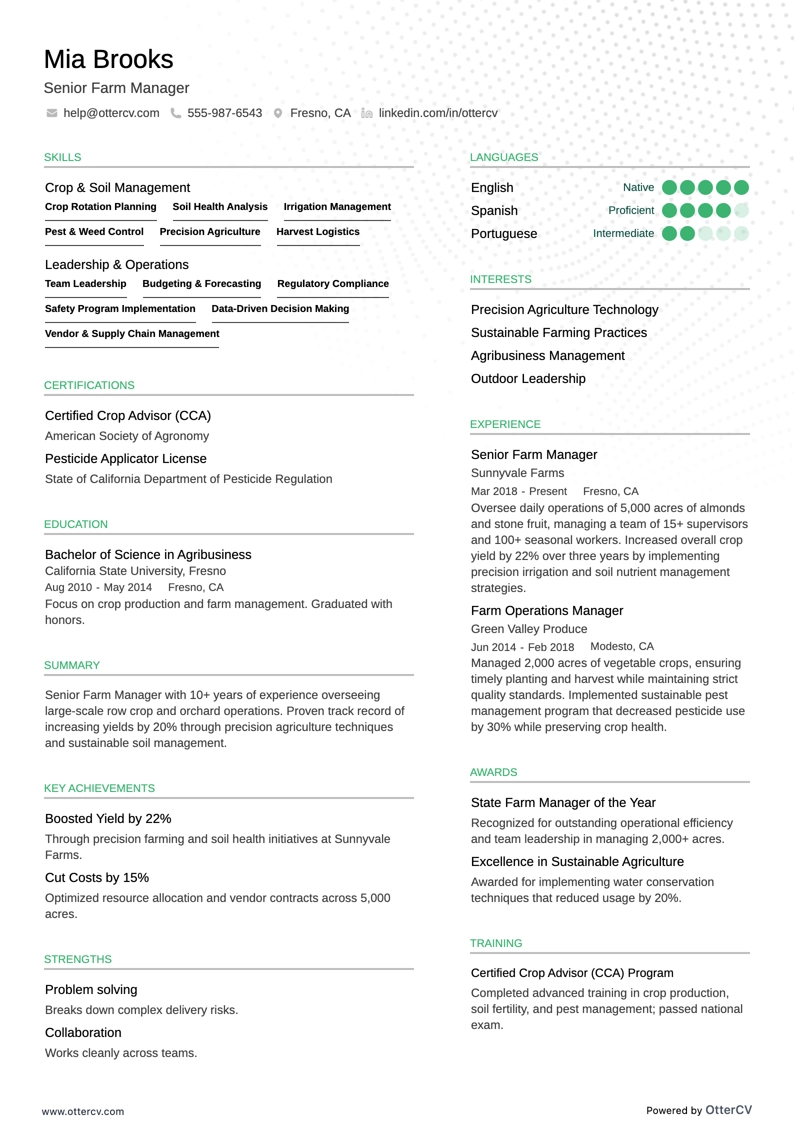
Senior Farm Manager full preview

10 Farm Manager Resume Examples

OtterCV

Written by The OtterCV Team

Updated: 8/30/2025•8 min read

See all resume examples in this guide, or generate your own resume example with your personalized prompt

Senior Farm Manager resume example

Senior Farm Manager

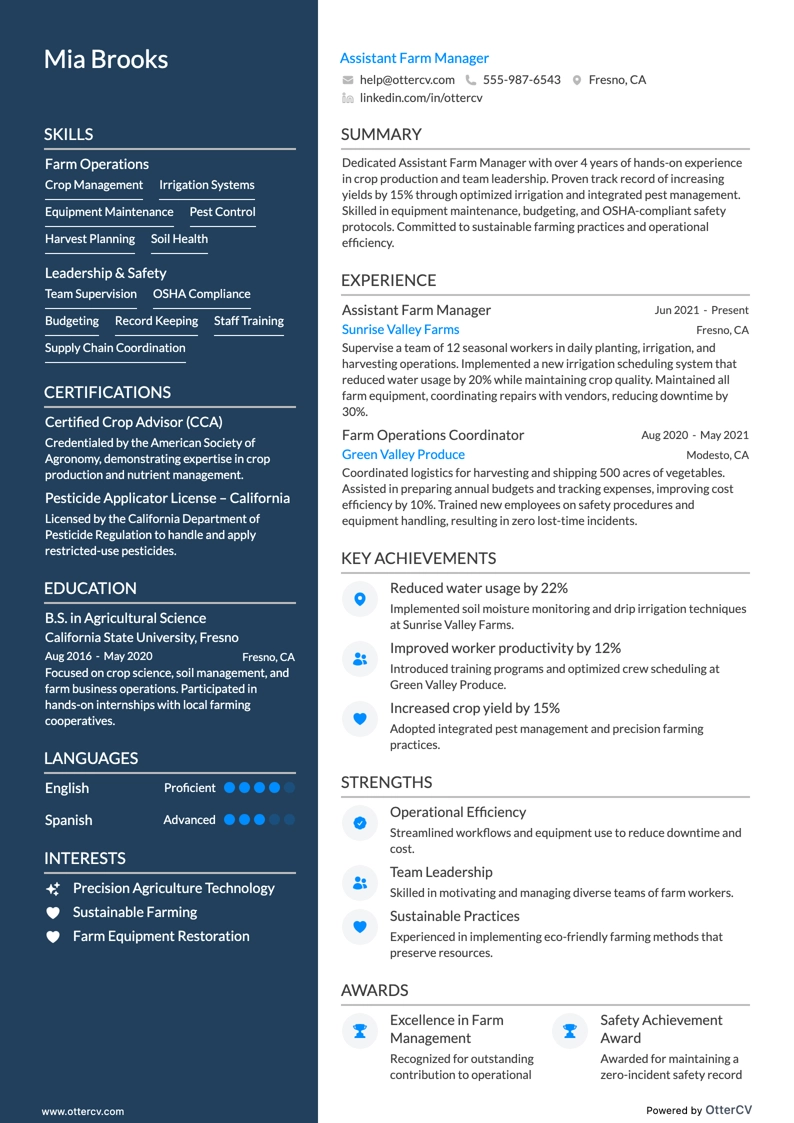
Assistant Farm Manager resume example

Assistant Farm Manager

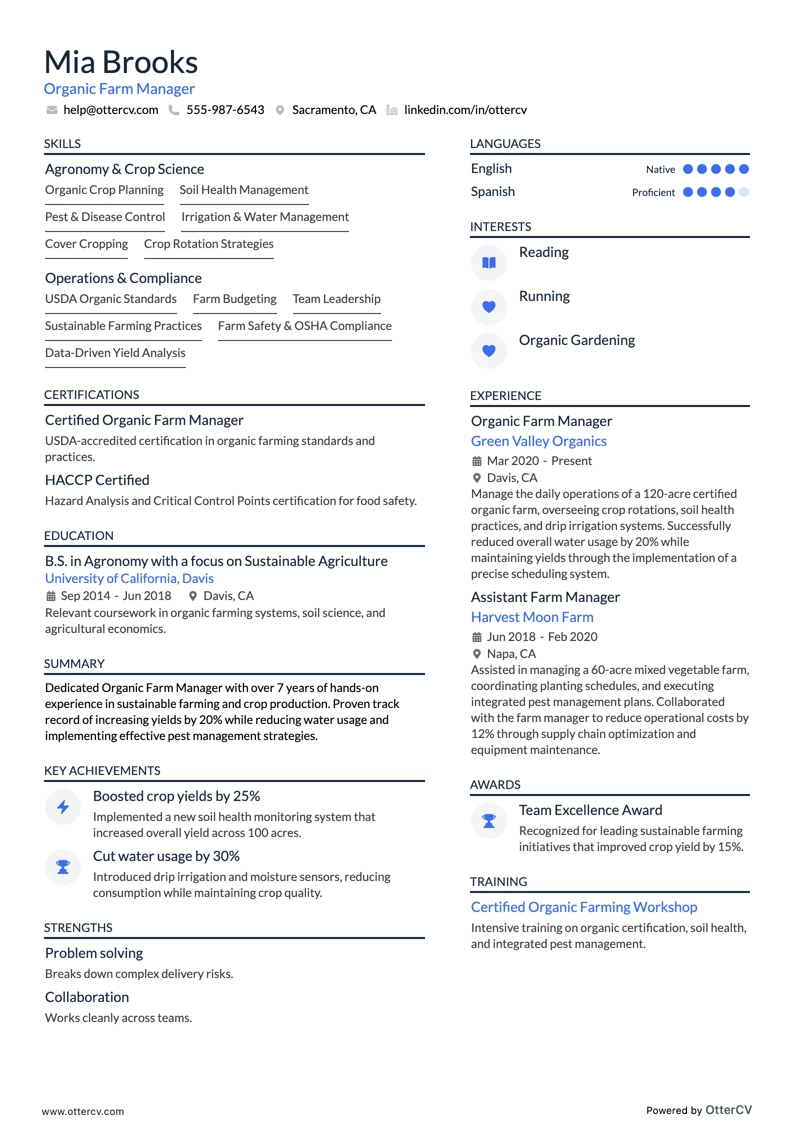
Organic Farm Manager resume example

Organic Farm Manager

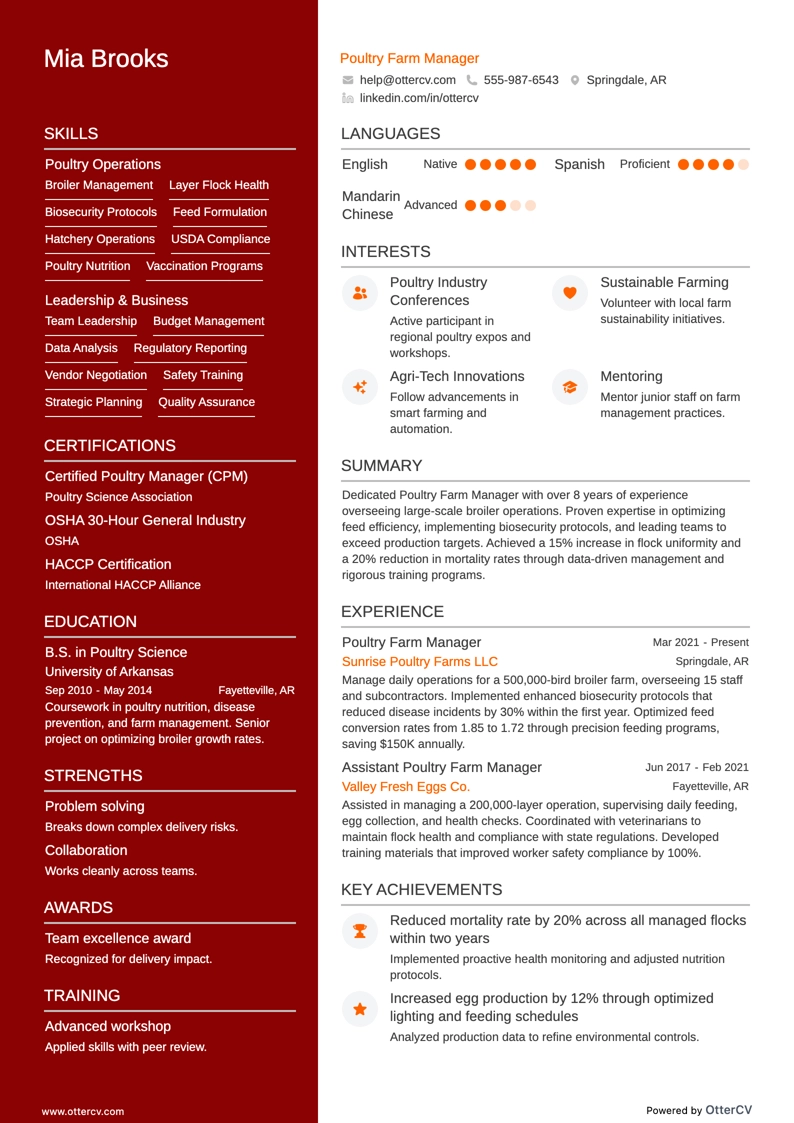
Poultry Farm Manager resume example

Poultry Farm Manager

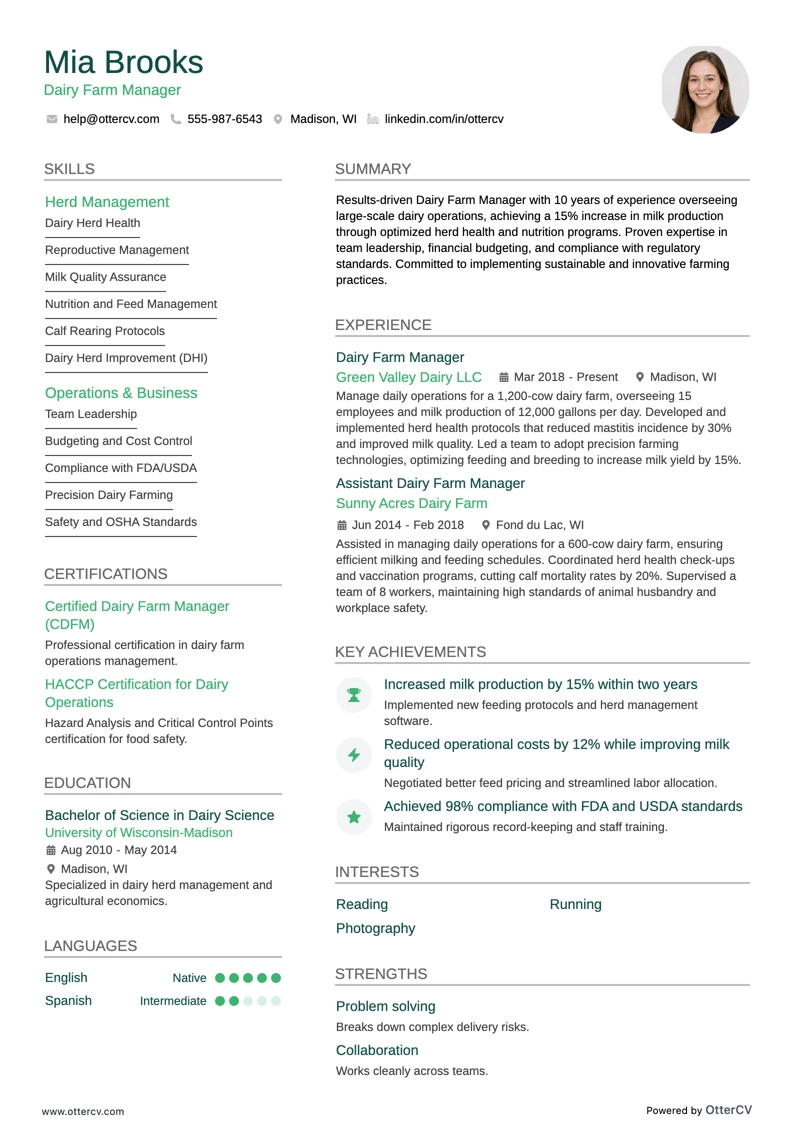
Dairy Farm Manager resume example

Dairy Farm Manager

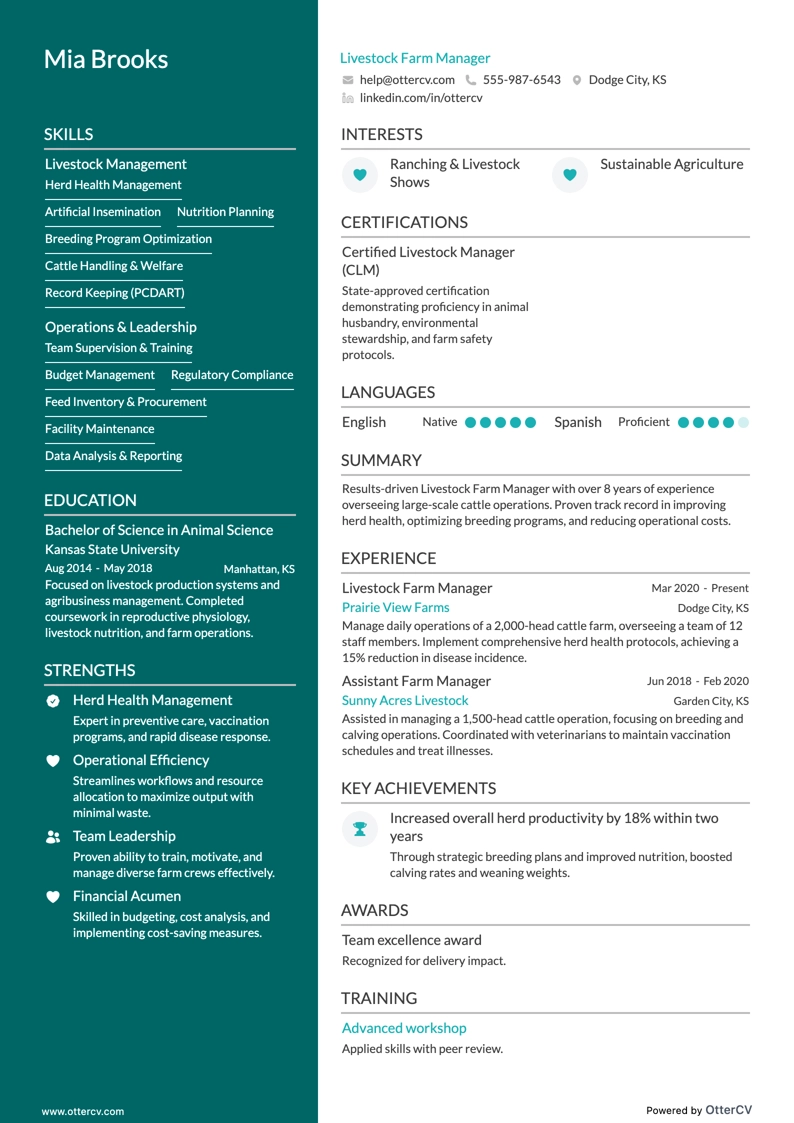
Livestock Farm Manager resume example

Livestock Farm Manager

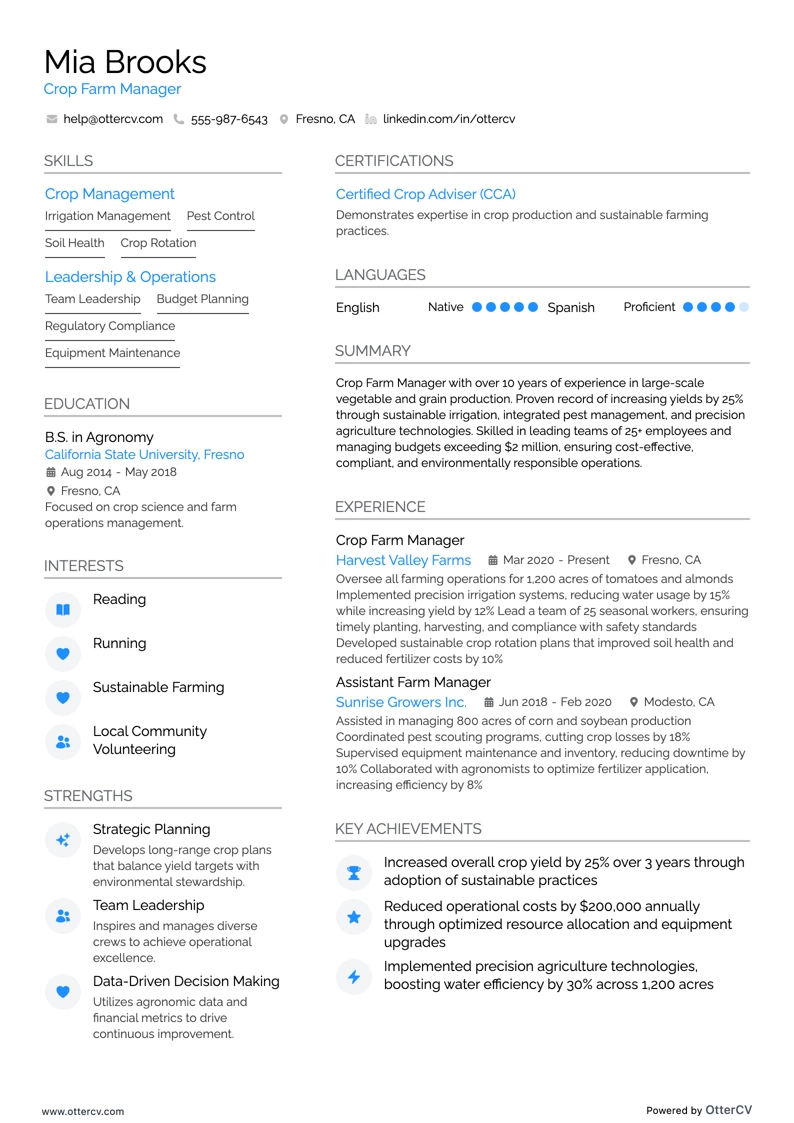
Crop Farm Manager resume example

Crop Farm Manager

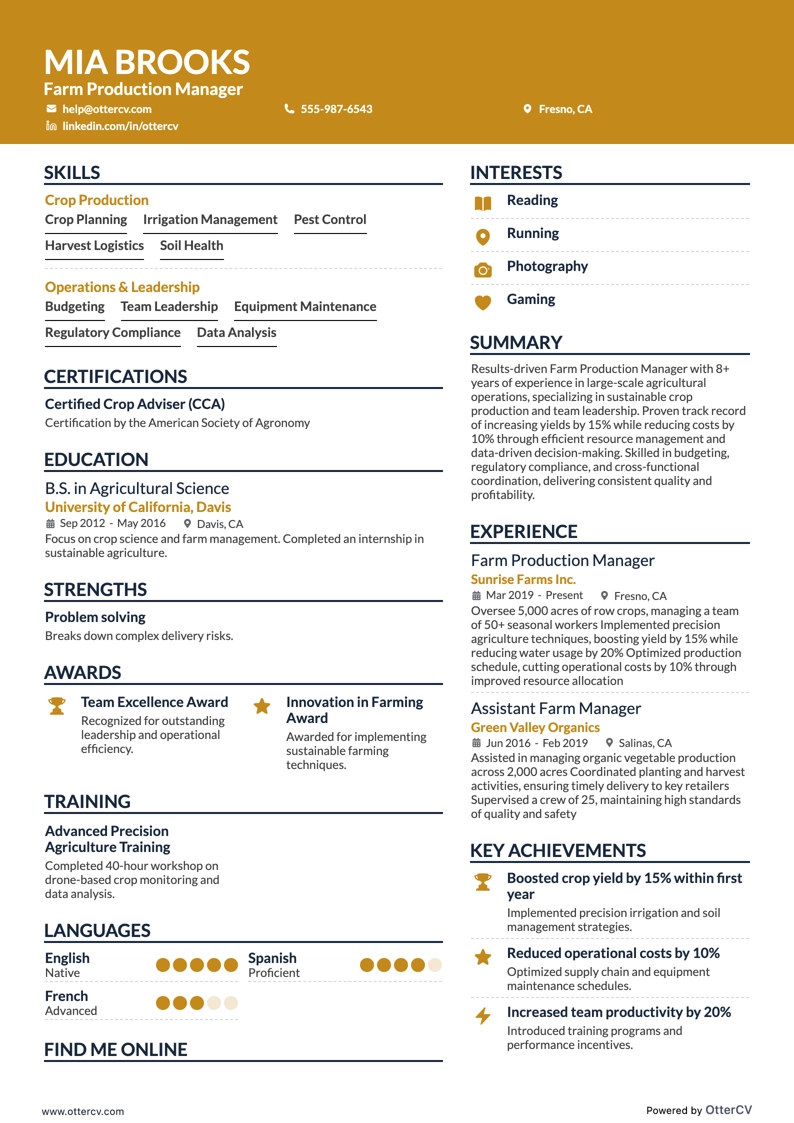
Farm Production Manager resume example

Farm Production Manager

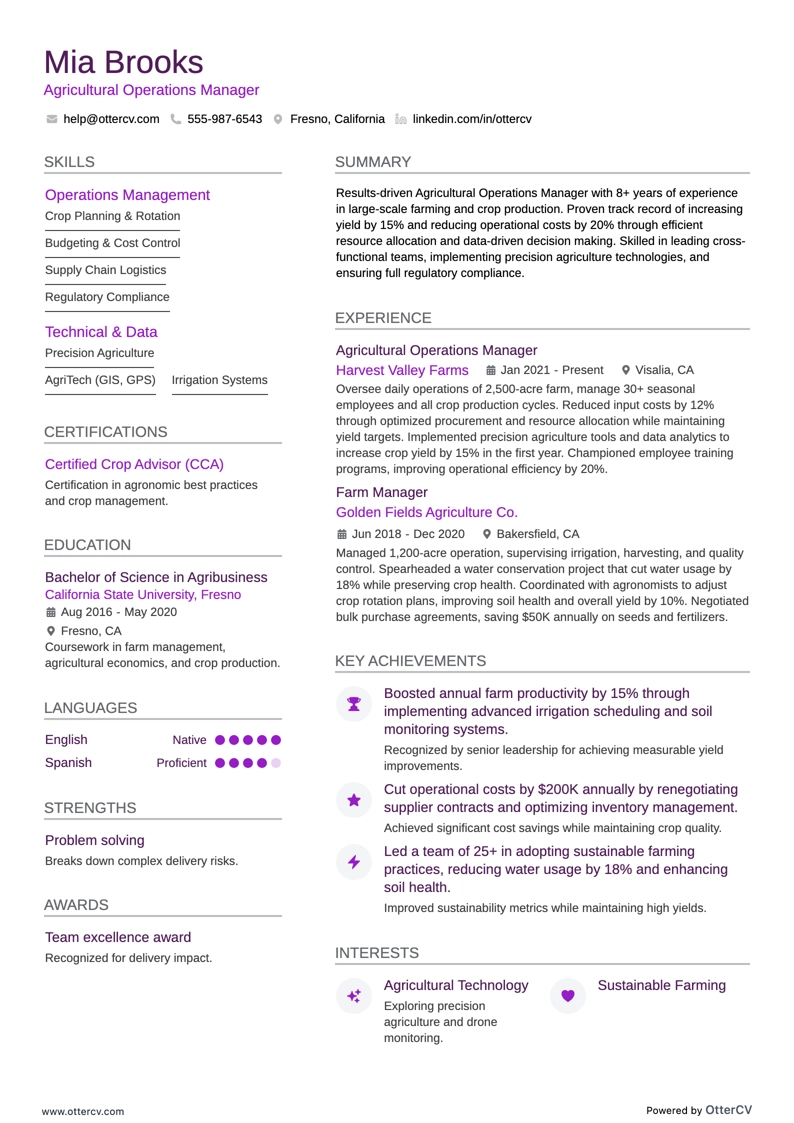
Agricultural Operations Manager resume example

Agricultural Operations Manager

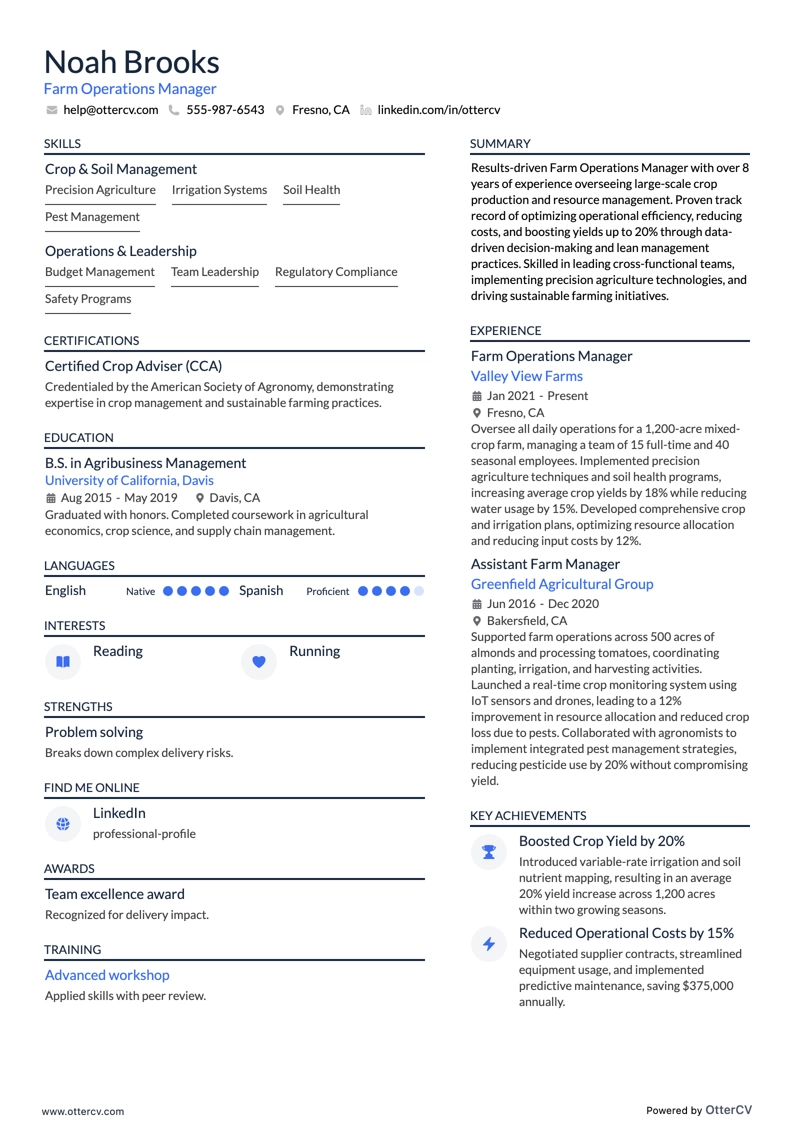
Farm Operations Manager resume example

Farm Operations Manager

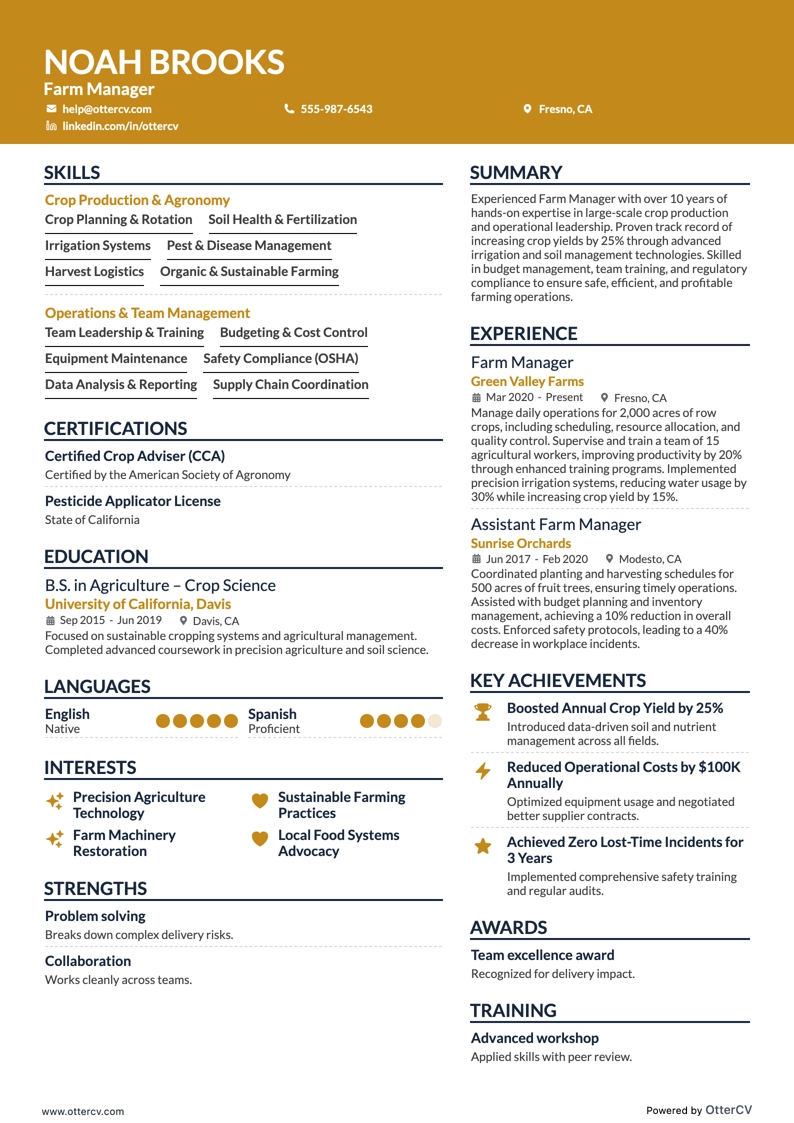
Farm Manager resume example

Farm Manager

Most farm manager resumes fail because they read like task logs, burying results under equipment lists and generic duties. That becomes a problem when ATS filters quickly and recruiters scan applications in seconds.

A strong resume shows what you improved and how you ran the operation. Knowing how to make your resume stand out starts with highlighting yield gains, acres managed, labor costs reduced, safety incident rates, irrigation efficiency, audit pass rates, and on-time harvest delivery. Quantify budgets, headcount, and quality outcomes.

Key takeaways

  • Quantify yield gains, cost savings, and crew size in every experience bullet.

  • Use a reverse-chronological format for seasoned managers and a hybrid format for career switchers.

  • Tailor each resume to the job posting’s equipment, crops, and KPIs.

  • Place skills above experience when you’re junior and below it when you’re senior.

  • Anchor your summary in measurable wins, not personality statements or vague descriptors.

  • Pair hard skills with proof in your experience bullets to give recruiters context.

  • Build and refine your farm manager resume with Echocv to align content with ATS requirements.

How to format a farm manager resume

Recruiters reviewing farm manager candidates look first for operational scope, hands-on agricultural expertise, and measurable results such as yield improvements, cost reductions, and labor management. A clean, well-structured resume format helps these signals stand out quickly for both human reviewers and applicant tracking system (ATS) screening.

I have significant experience in this role—which format should I use?

I have significant experience in this role—which format should I use?

Use a reverse-chronological format to show your progression through increasingly complex agricultural operations.

  • Lead with your most recent role and clearly define the scope of each operation you managed, such as acreage, headcount, livestock volume, or annual budget.
  • Highlight domain-specific expertise, including crop rotation planning, integrated pest management, irrigation systems, USDA compliance, and farm management software like AgriWebb or Granular.
  • Quantify outcomes tied directly to operational performance, including yield per acre, cost-per-unit reductions, revenue growth, or efficiency gains.

Example bullet: “Managed a 2,400-acre row crop operation with 18 seasonal employees, implementing precision agriculture techniques that increased soybean yield by 14% and reduced input costs by $87,000 annually.”

I'm junior or switching into this role—what format works best?

I'm junior or switching into this role—what format works best?

A hybrid resume format works well if you have relevant agricultural skills but limited direct farm management experience.

  • Place a dedicated skills section near the top of your resume that highlights core competencies such as soil health management, equipment operation, livestock care, or agricultural certifications.
  • Include project-based experience, internships, or transitional roles—such as assistant farm manager, agricultural technician, or FFA leadership—to show applied knowledge.
  • Connect each action to a clear result, even on a small scale, to show you understand how decisions affect outcomes.

Example scaffold: Irrigation scheduling (skill) → redesigned watering intervals for a 200-acre vegetable plot during a summer internship (action) → reduced water usage by 18% while maintaining crop quality benchmarks (result).

Why not use a functional resume?

Why not use a functional resume?

A functional resume removes the operational context recruiters need to assess your readiness for farm management, including what you managed, where you worked, and the scale of your responsibilities.

It may be acceptable if you are transitioning from a related field, such as agricultural science, landscaping, or supply chain logistics, and do not yet have direct farm management titles. Even then, each skill should be tied to a specific project, outcome, or hands-on experience.

With your format set, the next step is filling each section with content that highlights your qualifications as a farm manager.

What sections should go on a farm manager resume

Recruiters expect a farm manager resume to clearly show your operational leadership, production results, and compliance track record. Understanding what to put on a resume helps you prioritize the right content for this role.

Use this structure for maximum clarity:

  • Header
  • Summary
  • Experience
  • Skills
  • Projects
  • Education
  • Certifications
  • Optional sections: Awards, Leadership, Languages

Strong experience bullets should emphasize measurable outcomes, acreage and headcount scope, yield and cost improvements, safety and regulatory compliance results, and on-time delivery performance.

How to write your farm manager resume experience

Once your resume has the right sections in place, the next step is describing your farm manager experience in a way that shows the impact behind each role.

The work experience section should prove you can run agricultural operations, not just list responsibilities. Hiring managers reviewing farm manager resumes look for demonstrated results over generic task lists, so each bullet should show what you delivered, which tools or methods you used, and the measurable outcomes tied to production, profitability, or sustainability.

Each entry should include:

  • Job title
  • Company and location (or remote)
  • Dates of employment (month and year)

Add three to five concise bullet points that explain what you owned, how you executed, and what results you delivered:

  • Ownership scope: the operations, crop programs, livestock herds, land parcels, equipment fleets, budgets, or crews you were directly responsible for as a farm manager.
  • Execution approach: the agronomic practices, precision agriculture technologies, irrigation systems, pest management frameworks, or financial planning tools you used to make decisions and produce results.
  • Value improved: changes to yield quality, soil health, harvest efficiency, input cost control, regulatory compliance, animal welfare standards, or environmental sustainability tied to your management.
  • Collaboration context: how you worked with agronomists, veterinarians, equipment vendors, commodity buyers, regulatory agencies, seasonal labor teams, or landowners to achieve shared operational goals.
  • Impact delivered: outcomes shown through production gains, cost reductions, acreage expansion, waste minimization, safety improvements, or market positioning rather than routine activity.

Experience bullet formula

Experience bullet formula

Action verb + technology + what you built or fixed + measurable result

A farm manager experience example

Farm Manager

Red River Produce Farm | Fresno, CA

2021–Present

Managed a 200-acre diversified vegetable operation supplying regional grocers and foodservice accounts.

  • Led crop planning and weekly field execution using Agworld and John Deere Operations Center, improving yield per acre by 12% and reducing input waste by 9% across five crop cycles.
  • Implemented integrated pest management with drone scouting (DJI) and digital trap logs, reducing pesticide applications by 18% while maintaining a 94% Grade A pack-out rate.
  • Standardized irrigation scheduling with soil-moisture sensors (Irrometer) and ET-based set points, lowering water use by 15% and preventing three heat-stress events during peak season.
  • Managed a 22-person seasonal crew with bilingual SOPs, ADP time tracking, and safety training, reducing recordable incidents by 40% and increasing harvest throughput by 17%.
  • Worked with buyers, a food safety auditor, and the packing shed lead to maintain PrimusGFS compliance, passing audits with zero major findings and decreasing customer rejections by 30%.

Now that you’ve seen what a strong experience section looks like, the next step is adjusting your resume to fit a specific farm manager job posting.

How to tailor your farm manager resume experience

Recruiters review farm manager resumes through both human screening and applicant tracking systems, so your experience section should align closely with the job posting. Tailoring your resume to the job description helps ensure the skills, tools, and responsibilities you highlight match what the employer is looking for.

Ways to tailor your farm manager experience:

  • Match the specific equipment or irrigation systems named in the posting.
  • Use the same crop or livestock terminology the employer uses.
  • Reflect the yield or production KPIs mentioned in the job description.
  • Include relevant certifications such as GAP or organic compliance standards.
  • Highlight labor management experience that fits their workforce size.
  • Emphasize sustainability or soil health practices when those are listed as priorities.
  • Reference budget oversight or cost reduction work tied to stated goals.
  • Include precision agriculture technologies the operation currently uses.

Tailoring your resume means aligning your real accomplishments with each job’s stated requirements, not forcing in keywords that do not fit.

Resume tailoring examples for farm manager

Job description excerptUntailoredTailored
"Manage daily operations of a 2,000-acre row crop operation, including corn and soybean rotations, with oversight of irrigation scheduling using Valley pivot systems."Responsible for overseeing farm operations and ensuring daily activities ran smoothly.Directed daily operations across a 1,800-acre corn and soybean rotation, managing irrigation scheduling and maintenance of Valley center-pivot systems to reduce water usage by 15%.
"Supervise a seasonal crew of 15–20 workers, enforce workplace safety protocols, and ensure compliance with OSHA and EPA pesticide application standards."Managed a team of workers and made sure safety rules were followed during the season.Supervised crews of up to 18 seasonal laborers, conducted weekly OSHA safety briefings, and maintained full EPA compliance across all pesticide applications with zero violations over three growing seasons.
"Develop and manage annual operating budgets exceeding $1.5M, track input costs for seed, fertilizer, and fuel, and report financial performance to ownership using AgriEdge Excelsior."Helped with budgeting and tracked expenses for farm supplies throughout the year.Built and managed a $1.6M annual operating budget, monitored input costs for seed, fertilizer, and fuel, and delivered monthly financial performance reports to ownership through AgriEdge Excelsior, identifying $120K in cost savings over two fiscal years.

Once you’ve aligned your experience with the role’s priorities, the next step is to quantify your farm manager achievements so employers can see the measurable results of that fit.

How to quantify your farm manager achievements

Quantifying your achievements shows how you improved yield, costs, and risk. Track production volume, input efficiency, labor productivity, quality grades, safety, compliance, and on-time deliveries across fields, herds, equipment, and seasonal cycles.

Quantifying examples for farm manager

MetricExample
Yield performanceIncreased corn yield from 168 to 186 bushels per acre across 520 acres by tightening soil sampling, variable-rate fertilization, and irrigation scheduling.
Cost efficiencyCut fertilizer spend 12% ($48,000) by switching to variable-rate application and renegotiating supplier pricing across three farms and two growing seasons.
Quality gradeRaised produce pack-out rate from 82% to 91% by implementing wash-line checks and harvest handling training for a 26-person crew.
Safety riskReduced recordable incidents from five to one in twelve months by enforcing equipment lockout procedures and weekly safety tailgates.
Delivery reliabilityImproved on-time deliveries from 88% to 97% for 14 weekly wholesale loads by standardizing harvest cutoffs and adding a dispatch checklist.

Once you’ve written strong bullet points to showcase your experience, present your hard and soft skills strategically throughout your farm manager resume.

How to list your hard and soft skills on a farm manager resume

Your skills section should show that you can run safe, profitable farm operations. Recruiters and ATS (applicant tracking systems) also scan this section for job-match keywords, so aim for a hard-skill-heavy mix supported by a focused set of leadership and execution soft skills.

Farm manager roles require a blend of:

  • Product strategy and discovery skills.
  • Data, analytics, and experimentation skills.
  • Delivery, execution, and go-to-market discipline.
  • Soft skills.

Your skills section should be:

  • Scannable, using bullet-style grouping.
  • Relevant to the job post.
  • Backed by proof in your experience bullets.
  • Updated with current tools.

Place your skills section:

  • Above your experience section if you’re junior or switching careers.
  • Below your experience section if you’re mid-level or senior with strong achievements.

Hard skills

  • Crop planning and rotation.
  • Soil sampling and nutrient management.
  • Integrated pest management.
  • Irrigation scheduling and maintenance.
  • Equipment operation and maintenance.
  • Preventive maintenance programs.
  • Farm budgets and cost control.
  • Inventory, procurement, and vendor management.
  • Food safety and HACCP compliance.
  • Worker safety and OSHA compliance.
  • Precision agriculture and GPS guidance.
  • Farm management software and Excel.

Soft skills

  • Set daily priorities and targets.
  • Lead crews through peak seasons.
  • Give clear task briefings.
  • Hold vendors accountable to agreed terms.
  • Make fast decisions under pressure.
  • Resolve conflicts on the floor.
  • Train and coach new hires.
  • Coordinate across the field and packhouse.
  • Communicate risks early and clearly.
  • Enforce safety standards consistently.
  • Track follow-through on commitments.
  • Adapt plans to weather changes.

How to show your farm manager skills in context

Skills should not appear only in a bulleted list on your resume. Review resume skills examples to see how strong candidates weave their abilities throughout the document.

Your skills should be demonstrated in:

  • Your summary, which presents your high-level professional identity
  • Your experience, which proves your abilities through outcomes

Here’s how that looks in practice.

Summary example

Farm manager with 12 years of experience overseeing 2,000+ acre row-crop operations. Skilled in precision agriculture, irrigation scheduling, and crew leadership. Implemented variable-rate seeding that increased corn yields by 18% while reducing input costs through GPS-guided soil mapping.

Key strengths highlighted

  • Immediately signals senior-level expertise
  • Mentions specific tools and methods
  • Leads with a measurable yield outcome
  • Emphasizes team leadership as a soft skill

Experience example

Senior Farm Manager

Heartland Prairie Farms | Champaign, IL

June 2017–Present

  • Directed a 15-person crew across 2,400 acres, increasing overall harvest efficiency by 22% through precision planting technology.
  • Worked with agronomists and equipment vendors to implement drone-based crop scouting, reducing pesticide spending by $38,000 annually.
  • Created a rotational grazing plan with the livestock team that improved pasture recovery rates by 30% over two seasons.
  • Every bullet contains measurable proof.
  • Skills appear naturally through real outcomes.

Once you’ve connected your relevant abilities to real tasks and outcomes, the next step is applying that same approach to a farm manager resume when you don’t have formal experience.

How do I write a farm manager resume with no experience

Even without full-time experience, you can still show that you’re ready. Writing a resume without work experience is possible when you emphasize transferable projects and measurable contributions.

  • Student farm leadership role
  • Community garden plot management
  • Internship on produce farm
  • Livestock care volunteer shifts
  • Farmers market operations support
  • Equipment maintenance workshop training
  • Food safety certification projects
  • Yield tracking spreadsheet assignments

Focus on these areas:

  • Production results with measured outputs
  • Safety, compliance, and documentation
  • Equipment, irrigation, and maintenance basics
  • Data tracking for yield and costs

Resume format tip for entry-level farm manager

Resume format tip for entry-level farm manager

Use a combination resume format to emphasize projects, certifications, and farm work exposure before limited paid experience.

  • Add a Projects section with metrics.
  • List the farm manager tools you used.
  • Include certifications with dates and hours.
  • Quantify outputs, costs, or time saved.
  • Tailor keywords to each job post.

Example project bullet:

  • Managed a community garden plot using a crop plan, drip irrigation schedule, and yield log, increasing weekly harvest weight by 18% over eight weeks.

Even without direct experience, your educational background can show relevant agricultural knowledge when presented clearly.

How to list your education on a farm manager resume

Your education section helps hiring teams confirm that you have foundational knowledge in agriculture, business, or related fields. It also supports your readiness for farm manager responsibilities.

Include:

  • Degree name
  • Institution
  • Location
  • Graduation year
  • Relevant coursework for juniors or entry-level candidates
  • Honors and GPA if 3.5 or higher

List the graduation year only, and leave out the month and day.

Here’s a strong education entry tailored to the farm manager role.

Example education entry

Bachelor of Science in Agricultural Science

Iowa State University, Ames, IA

Graduated 2019

GPA: 3.7/4.0

  • Relevant coursework: Crop Production Systems, Soil Science, Farm Business Management, Livestock Operations
  • Honors: Magna Cum Laude, Dean's List (six semesters)

How to list your certifications on a farm manager resume

Certifications on a resume show a farm manager’s commitment to continuous learning, hands-on tool proficiency, and current industry knowledge. They also signal readiness to meet safety, compliance, and production goals.

Include the following details:

  • Certificate name
  • Issuing organization
  • Year
  • Optional: credential ID or URL
  • List certifications below education when they are older, less relevant, or mainly support your baseline training as a farm manager.
  • List certifications above education when they are recent, role-critical, or required for the farm manager job you are targeting.

Best certifications for your farm manager resume

  • Certified Crop Adviser (CCA).
  • Certified Professional Agronomist (CPAg).
  • OSHA 30-Hour General Industry.
  • ServSafe Food Protection Manager Certification.
  • Pesticide Applicator License (State Certification).
  • GlobalG.A.P. Integrated Farm Assurance (IFA).
  • NRCS Conservation Planning Certification.

Once you’ve placed your credentials where recruiters can see them, use your farm manager resume summary to reinforce your value and show why you fit the role.

How to write your farm manager resume summary

Your resume summary is often the first thing a recruiter reads. A strong summary quickly shows that you’re qualified to manage daily farm operations and deliver results.

Keep it to three to four lines and include:

  • Your title and total years of hands-on farm management experience.
  • The type of operation you’ve managed, such as row crop, livestock, or mixed agriculture.
  • Core skills like irrigation planning, crop rotation, budgeting, or equipment maintenance.
  • One or two measurable wins, such as yield increases or cost reductions.
  • Practical soft skills demonstrated through real outcomes, like team coordination or vendor negotiation.

PRO TIP

At this level, focus on specific skills, relevant agricultural knowledge, and early contributions that show you’re ready for the role.

Highlight the tools you’ve used and the results you’ve helped achieve.

Avoid vague statements like “passionate about farming” or “hard worker.” Recruiters want proof, not personality pitches.

Example summary for a farm manager

Detail-oriented farm manager with three years of experience overseeing 600-acre row crop operations. Improved seasonal yield by 18% through optimized irrigation scheduling and soil management. Skilled in equipment maintenance, crew supervision, and budget tracking.

Now that your summary highlights your qualifications at a glance, make sure your header includes the essential contact and professional details recruiters need to reach you.

What to include in a farm manager resume header

A resume header is the top section of your resume that contains your key contact details. For a farm manager, it can improve visibility, credibility, and recruiter screening.

Essential resume header elements

  • Full name
  • Tailored job title and headline
  • Location
  • Phone number
  • Professional email
  • GitHub link
  • Portfolio link
  • LinkedIn

Including a LinkedIn link helps recruiters verify your experience quickly and supports faster screening.

Do not include photos on a farm manager resume unless the role is explicitly front-facing or appearance-dependent.

Use a clear job title, a specific location, and consistent contact details so recruiters can confirm fit in seconds.

Example

Once your contact details and role information are clearly presented at the top, add the following sections to strengthen your farm manager resume and reinforce the first impression created by your header.

Additional sections for farm manager resumes

When your core qualifications are similar to other candidates, well-chosen extra sections can help your farm manager resume stand out with role-specific credibility. For example, listing language skills on your resume can be especially useful when managing bilingual crews or working with international buyers.

  • Languages
  • Certifications and licenses
  • Professional affiliations and memberships
  • Publications and research
  • Volunteer experience in agriculture
  • Awards and recognitions

Once you've strengthened your resume with the right supporting sections, pairing it with a cover letter can make your application stronger.

Do farm manager resumes need a cover letter

A cover letter is not required for a farm manager role, but it often helps. If you're unsure what a cover letter is or when it adds value, it matters most in competitive hiring situations or when an employer expects one. It can also help when your resume needs more context or your fit for the role is not immediately obvious.

Use a cover letter to add value quickly:

  • Explain role and team fit: Connect your leadership style to the farm's crew size, shift needs, and operating rhythm.
  • Highlight one or two outcomes: Include a project with clear results, such as reduced feed waste, improved yields, or fewer equipment breakdowns.
  • Show business and user understanding: Reference the farm's crops or livestock, buyers, compliance needs, and how your decisions protect margins and quality.
  • Address transitions or non-obvious experience: Translate related work into farm manager responsibilities, and explain any gaps or location changes in one sentence.

Even if you decide a cover letter adds value to your application, using AI to improve your farm manager resume can help you strengthen the document employers review first and tailor it more efficiently.

Using AI to improve your farm manager resume

AI can improve your resume’s clarity, structure, and impact. It can help refine your language and highlight results. But overusing it can strip away authenticity. Once your resume feels clear and aligned with the role, step away from the tool. If you're wondering which AI is best for writing resumes, start with tools that focus on structure and keyword alignment instead of generating content from scratch.

Here are 10 practical prompts to strengthen specific sections of your farm manager resume:

  1. Strengthen your summary. “Rewrite my farm manager resume summary to highlight leadership experience, crop yield results, and team size in three concise sentences.”
  2. Quantify experience bullets. “Add measurable outcomes—like acreage managed, cost savings, or production increases—to each farm manager experience bullet on my resume.”
  3. Tighten action verbs. “Replace weak or passive verbs in my farm manager experience section with strong, agriculture-specific action verbs.”
  4. Align skills section. “Compare my farm manager skills section against this job description and suggest missing keywords that match my real experience.”
  5. Clarify project descriptions. “Rewrite my farm manager project entries to clearly state the problem, my role, and the outcome in one to two sentences each.”
  6. Improve certification details. “Reformat my farm manager certifications section so each entry includes the credential name, issuing body, and year earned.”
  7. Refine education entries. “Edit my farm manager education section to emphasize relevant coursework, honors, or fieldwork tied to agricultural management.”
  8. Remove redundant phrasing. “Identify and cut filler words or repeated ideas across my entire farm manager resume without losing important details.”
  9. Tailor for ATS. “Adjust my farm manager resume bullets to naturally include keywords from this specific job posting without keyword stuffing.”
  10. Sharpen accomplishment statements. “Rewrite my farm manager accomplishments using a clear result-action-context format with specific numbers where possible.”

Stop using AI once your resume sounds accurate, specific, and aligned with your real experience. AI should never invent experience or inflate claims—if it didn’t happen, it doesn’t belong here.

Conclusion

A strong farm manager resume shows your impact through measurable results, including yield gains, cost control, safety performance, and equipment uptime. It should also reflect role-specific skills such as crop planning, livestock care, irrigation, compliance, and crew leadership.

Use a clear structure that makes your results easy to scan. Keep your resume current and focused for today’s hiring market and the opportunities ahead. Highlight steady performance, sound judgment, and practical problem-solving across seasons so employers can see you’re ready to lead.

Farm Manager resume examples

Explore additional Farm Manager resume samples and guides and see what works for your level of experience or role.

By Experience

Senior Farm Manager

Senior Farm Manager resume preview

Assistant Farm Manager

Assistant Farm Manager resume preview

Farm Manager resume examples

Explore additional Farm Manager resume samples and guides and see what works for your level of experience or role.

By Role

Organic Farm Manager

Organic Farm Manager resume preview

Poultry Farm Manager

Poultry Farm Manager resume preview

Dairy Farm Manager

Dairy Farm Manager resume preview

Livestock Farm Manager

Livestock Farm Manager resume preview

Crop Farm Manager

Crop Farm Manager resume preview

Farm Production Manager

Farm Production Manager resume preview

Agricultural Operations Manager

Agricultural Operations Manager resume preview

Farm Operations Manager

Farm Operations Manager resume preview

Farm Manager

Farm Manager resume preview