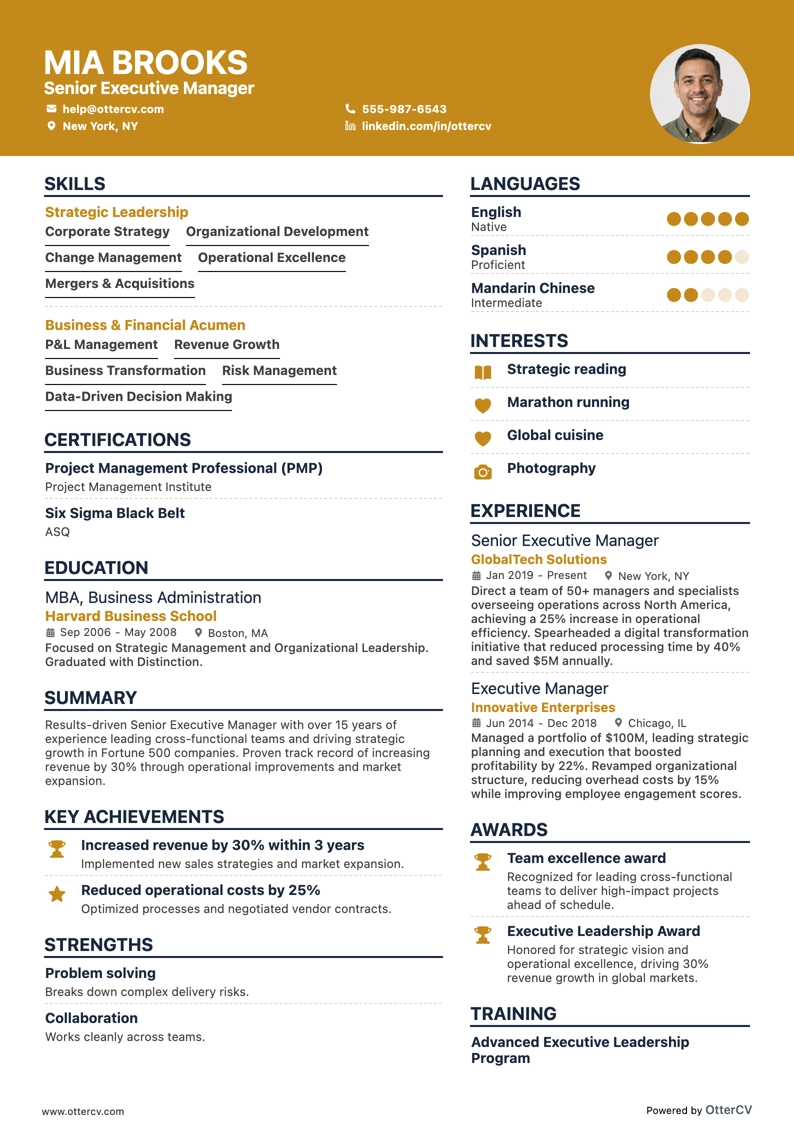
Senior Executive Manager full preview

10 Executive Manager Resume Examples, Templates

OtterCV

Written by The OtterCV Team

Updated: 12/26/2023•8 min read

See all resume examples in this guide, or generate your own resume example with your personalized prompt

Senior Executive Manager resume example

Senior Executive Manager

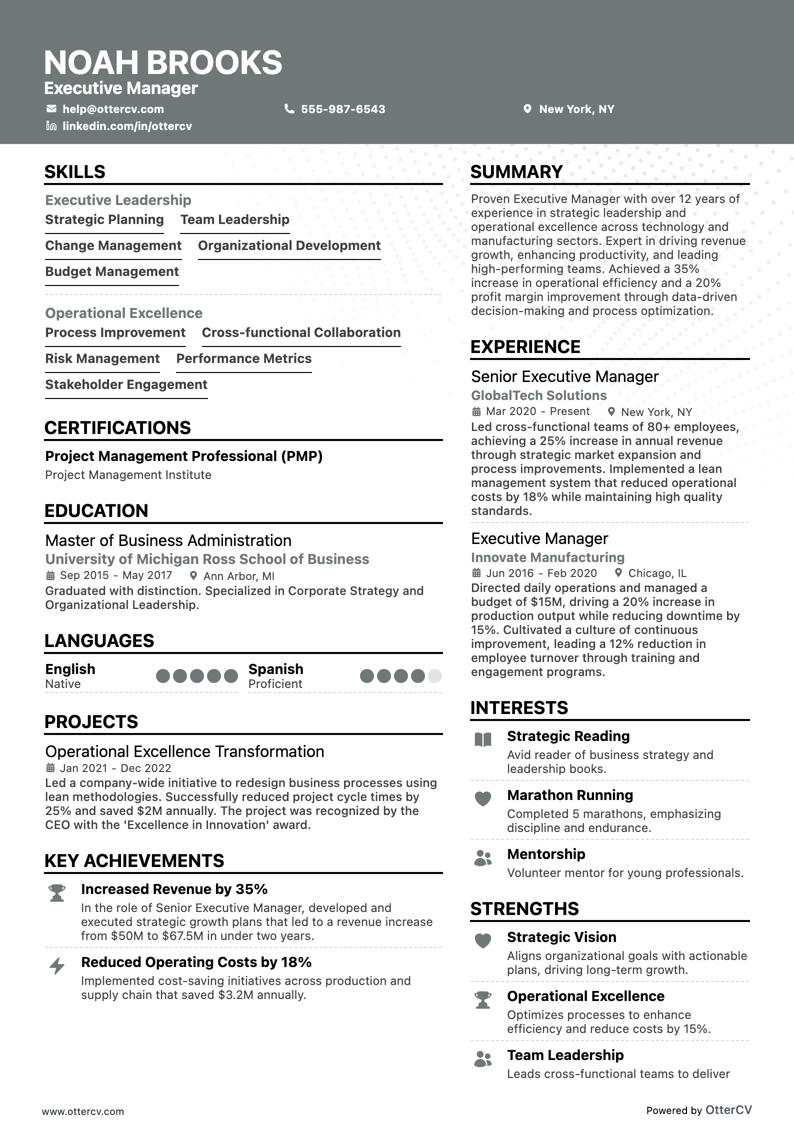
Executive Manager resume example

Executive Manager

Many executive manager resumes fail because they read like job descriptions, burying leadership impact beneath long lists of responsibilities. In today’s hiring process, that hurts: applicant tracking systems and fast recruiter scans favor clear, measurable outcomes.

A strong resume shows what you changed, improved, or delivered. If you’re unsure where to start, learning how to write a resume with a focus on results rather than responsibilities is the essential first step. Highlight revenue growth, cost reduction, risk mitigation, budget and headcount scope, on-time program delivery, service levels, and stakeholder satisfaction. Quantify scale, timelines, and business results.

Key takeaways

  • Start each experience bullet with your ownership scope, execution method, and measurable business outcome.

  • Use a reverse-chronological format, since hybrid and functional layouts can weaken executive credibility.

  • Quantify achievements with metrics tied to revenue, cost, delivery speed, quality, and risk.

  • Tailor your resume to each posting by mirroring its frameworks, KPIs, and terminology.

  • Show skills in context by proving them through your summary and experience bullets.

  • Include a cover letter when role fit or career transitions require narrative explanation.

  • Use Echocv's tools to sharpen language and quantify bullets, but stop before the content sounds generic.

Job market snapshot for executive managers

We analyzed 64 recent executive manager job ads across major US job boards to highlight regional hotspots, in-demand skills, and career growth patterns at a glance.

What level of experience employers are looking for executive managers

Years of ExperiencePercentage found in job ads
1–2 years1.6% (1)
3–4 years3.1% (2)
5–6 years29.7% (19)
7–8 years14.1% (9)
9–10 years1.6% (1)
10+ years4.7% (3)
Not specified46.9% (30)

Executive manager ads by area of specialization (industry)

Industry (Area)Percentage found in job ads
Finance & Banking65.6% (42)
Healthcare15.6% (10)

Role overview stats

These tables outline the most common responsibilities and employment types for executive manager roles. Use them to align your resume with employer expectations and understand how the role is typically structured across the market.

Day-to-day activities and top responsibilities for an executive manager

ResponsibilityPercentage found in job ads
Cybersecurity15.6% (10)
VoIP15.6% (10)
Business continuity12.5% (8)
Customer premise equipment12.5% (8)
Data networking technologies12.5% (8)
Disaster recovery12.5% (8)
Ethernet12.5% (8)
Internet technologies12.5% (8)
LAN12.5% (8)
MAN12.5% (8)
MAN technologies12.5% (8)
Network design12.5% (8)

Type of employment (remote vs on-site vs hybrid)

Employment typePercentage found in job ads
On-site56.3% (36)
Hybrid25.0% (16)
Remote18.8% (12)

How to format a executive manager resume

Recruiters evaluating executive manager candidates look for clear evidence of strategic leadership, organizational impact, and a progression of increasing responsibility. A well-chosen resume format helps make these signals immediately visible to both human reviewers and applicant tracking systems.

I have significant experience in this role—which format should I use?

I have significant experience in this role—which format should I use?

Use a reverse-chronological format—it is the only structure that properly showcases your leadership progression and executive-level accountability.

Do:

  • Lead each role entry with scope indicators such as team size, budget authority, business unit ownership, and reporting structure.
  • Highlight domain expertise in areas such as P&L management, cross-functional strategy, organizational development, stakeholder relations, and enterprise-level decision-making frameworks.
  • Quantify outcomes tied directly to business impact, including revenue growth, cost optimization, market expansion, or operational transformation.

Example bullet: “Directed a $42M operational restructuring across four business units, reducing overhead by 18% while improving employee retention by 12% over two fiscal years.”

Why hybrid and functional resumes don't work for senior roles

Why hybrid and functional resumes don't work for senior roles

Hybrid formats can fragment your career narrative by separating key accomplishments from their organizational context. That makes it harder for executive hiring committees to verify leadership progression and decision ownership. Functional formats are even more damaging at this level because they remove accountability context, making it difficult to connect your strategic impact to specific roles, timelines, and business outcomes.

Avoid both formats when applying to executive manager positions, as they can signal gaps in tenure or an attempt to mask an inconsistent leadership track record.

  • One exception: a functional format may be acceptable if you're transitioning into executive management from an adjacent discipline, such as moving from a senior consulting principal to an in-house executive manager role, provided every listed skill is tied to specific projects, measurable outcomes, and clear organizational context.

Now that you’ve established a clean, readable resume structure, the next step is filling each section with the right content—starting with the essentials every executive manager resume should include.

What sections should go on a executive manager resume

Recruiters expect to see clear leadership scope, measurable business impact, and career progression across executive management roles. Knowing exactly what to put on a resume at this level helps ensure nothing important is missing.

Use this structure for maximum clarity:

  • Header
  • Summary
  • Experience
  • Skills
  • Projects
  • Education
  • Certifications
  • Optional sections: Awards, Publications, Languages

Strong experience bullets should highlight the outcomes you delivered, the scope you owned, and the results you drove across teams, budgets, and strategy.

Once you’ve organized the key resume components employers expect, the next step is to write your executive manager resume experience so it strengthens the rest of the document.

How to write your executive manager resume experience

Your work experience section is the foundation of your executive manager resume. It should highlight the strategic initiatives you’ve led, the operational frameworks you’ve implemented, and the measurable business outcomes you’ve delivered. Hiring managers evaluating executive manager candidates care more about proven impact—such as revenue growth, organizational transformation, and market expansion—than task-based descriptions of day-to-day responsibilities.

Each entry should include:

  • Job title
  • Company and location, or remote
  • Dates of employment, including month and year

Include three to five concise bullet points that show what you owned, how you executed, and what results you delivered:

  • Ownership scope: the business units, P&L portfolios, strategic initiatives, cross-departmental operations, or senior leadership teams you were directly accountable for as an executive manager.
  • Execution approach: the strategic planning frameworks, governance models, enterprise technologies, change management methodologies, or decision-making structures you used to improve organizational performance and align priorities.
  • Value improved: changes to profitability, operational efficiency, organizational scalability, market positioning, risk mitigation, or stakeholder confidence resulting from your executive leadership.
  • Collaboration context: how you worked with board members, C-suite peers, investors, regulatory bodies, or cross-functional department heads to advance enterprise-wide objectives tied to your executive manager role.
  • Impact delivered: outcomes expressed through business growth, competitive advantage, cultural transformation, or long-term strategic positioning rather than a summary of meetings attended or processes maintained.

Experience bullet formula

Experience bullet formula

Action verb + technology + what you built or fixed + measurable result

A executive manager experience example

Executive Manager, Operations & Strategy

NorthBridge Logistics | Chicago, IL

2021–Present

Third-party logistics provider supporting over 600 enterprise customers across North America with time-critical freight and warehousing.

  • Led a cross-functional transformation across operations, finance, and product using OKRs (objectives and key results), Lean Six Sigma, and Tableau dashboards, cutting order-to-delivery cycle time by 18% and improving on-time delivery from 92% to 97% in twelve months.
  • Negotiated and implemented a new transportation management system (Transportation Management System) and NetSuite integration with engineering, vendors, and regional leaders, reducing manual billing errors by 35% and accelerating month-end close by four days.
  • Directed a $28M annual operating budget and restructured capacity planning using SQL-based forecasting and scenario modeling, improving gross margin by 2.6 points and avoiding $1.9M in peak-season overflow costs.
  • Built an executive risk and compliance program with HR, legal, and security using SOC 2 controls, incident runbooks, and quarterly audits, reducing high-severity incidents by 40% and passing two customer compliance reviews with zero critical findings.
  • Scaled leadership cadence across five sites by standardizing KPI reviews, stakeholder updates, and performance coaching, reducing frontline turnover from 24% to 16% and increasing employee engagement scores by 11 points.

Now that you've seen what a strong experience section looks like in practice, here's how to tailor yours for a specific executive manager role.

How to tailor your executive manager resume experience

Recruiters review your executive manager resume through both human screening and applicant tracking systems (ATS), so it needs to align closely with the job posting. Tailoring your resume to the job description helps show that your qualifications match what each employer values most.

Ways to tailor your executive manager experience:

  • Match the leadership frameworks and management methodologies named in the posting.
  • Mirror the specific KPIs and performance metrics the role emphasizes.
  • Reference the strategic planning tools or enterprise systems listed as requirements.
  • Include industry or domain expertise when the posting calls for it.
  • Highlight compliance and governance experience if the role involves regulatory oversight.
  • Use the same terminology for operational processes and organizational standards mentioned in the posting.
  • Emphasize the cross-functional collaboration models or workflows the employer describes.
  • Align your budget authority with the scope outlined in the posting.

Tailoring means connecting your real accomplishments to each job's stated priorities, not forcing in keywords where they don't belong.

Resume tailoring examples for executive manager

Job description excerptUntailoredTailored
Lead enterprise-wide digital transformation initiatives, partnering with C-suite stakeholders to drive operational efficiency across a $2B+ portfolio using Lean Six Sigma methodologies.Led various projects to improve company operations and worked with senior leaders on business goals.Directed a $2.4B enterprise-wide digital transformation program in partnership with the CFO and COO, applying Lean Six Sigma methodologies to reduce operational costs by 18% across four business units.
Build and scale high-performing cross-functional teams (100+ employees) to execute strategic growth plans in emerging APAC markets, with full P&L ownership.Managed large teams and helped the company grow in international markets.Built and scaled a 130-person cross-functional organization across three APAC markets, owning a $340M P&L and delivering 22% year-over-year revenue growth against the board's strategic expansion plan.
Develop and implement risk governance frameworks aligned with SOX and SEC compliance standards, reporting directly to the board of directors on enterprise risk posture.Handled risk management duties and reported findings to leadership on a regular basis.Designed and implemented an enterprise risk governance framework fully aligned with SOX and SEC compliance standards, delivering quarterly risk posture briefings to a 12-member board and closing 100% of critical audit findings within 90 days.

Once you’ve aligned your experience with the role’s priorities, quantify your executive manager achievements to show the measurable impact of your work.

How to quantify your executive manager achievements

Quantifying your achievements demonstrates business impact and leadership effectiveness. Focus on revenue, cost, delivery speed, quality, risk, and customer outcomes, and tie those results to scope such as budget, headcount, and cross-functional programs.

Quantifying examples for executive manager

MetricExample
Revenue growthGrew annual recurring revenue 18% ($4.2M) by launching a three-tier pricing model and tightening sales enablement in Salesforce.
Cost efficiencyReduced operating expenses 12% ($1.1M) by consolidating vendors, renegotiating contracts, and standardizing procurement workflows in Coupa.
Delivery speedCut quarterly initiative cycle time from 14 to nine weeks by implementing a weekly operating cadence and Jira-based dependency tracking across six teams.
Quality outcomesImproved customer satisfaction score from 4.1 to 4.6 by redesigning escalations, adding root-cause reviews, and enforcing service-level agreements.
Risk reductionLowered audit findings 40% by rolling out control testing, updating policies, and training 120 managers on compliance and documentation standards.

With strong, results-driven bullet points in place, the next step is making sure your skills section shows the right mix of hard and soft skills to support your executive manager qualifications.

How to list your hard and soft skills on a executive manager resume

Your skills section shows how you lead teams and deliver outcomes. Recruiters and an ATS (applicant tracking system) scan this section quickly to confirm fit, so aim for a balanced mix of hard skills and role-specific soft skills.

Executive manager roles require a blend of:

  • Product strategy and discovery skills
  • Data, analytics, and experimentation skills
  • Delivery, execution, and go-to-market discipline
  • Soft skills

Your skills section should be:

  • Scannable, with bullet-style grouping
  • Relevant to the job post
  • Backed by proof in your experience bullets
  • Updated with current tools

Place your skills section:

  • Above experience if you're junior or switching careers
  • Below experience if you're mid/senior with strong achievements

Hard skills

  • Strategic planning and roadmapping.
  • Operating model design.
  • Budgeting and financial forecasting.
  • Profit and loss management.
  • OKRs and KPI dashboards.
  • Program and portfolio management.
  • Risk management and controls.
  • Contract negotiation and vendor management.
  • Salesforce, HubSpot, and Microsoft Dynamics.
  • Power BI, Tableau, and Excel.
  • SQL reporting and analysis.
  • Lean Six Sigma process improvement.

Soft skills

  • Set priorities and make trade-offs.
  • Align stakeholders across functions.
  • Lead executive-level communication.
  • Drive accountability and follow-through.
  • Make decisions with incomplete data.
  • Coach leaders and build succession.
  • Resolve conflict and unblock teams.
  • Influence without direct authority.
  • Run effective staff meetings.
  • Escalate risks early and clearly.
  • Translate strategy into execution.
  • Manage change and adoption.

How to show your executive manager skills in context

Skills should not appear only in a dedicated list. Review examples of resume skills used in context to see how strong candidates connect competencies to real accomplishments.

Show these skills in:

  • Your summary, which reflects your high-level professional identity
  • Your experience, which proves your value through outcomes

Here is what strong, skills-driven content looks like in practice.

Summary example

Executive manager with 15 years in healthcare operations, with expertise in Lean Six Sigma, ERP implementation, and cross-functional leadership. Delivered $12M in annual cost savings while scaling teams across four regional facilities.

  • Clearly reflects senior-level experience
  • Names specific tools and methods
  • Leads with a measurable cost outcome
  • Signals collaborative leadership ability

Experience example

Vice President of Operations

Meridian Health Partners | Chicago, IL

March 2018–Present

  • Redesigned supply chain workflows using SAP S/4HANA, reducing procurement costs by 22% across three facilities.
  • Worked with C-suite leaders and department heads to launch a Lean Six Sigma program that reduced patient wait times by 31%.
  • Led a 120-person operations team through a system-wide ERP migration, completing the project two months ahead of schedule.
  • Every bullet includes measurable proof.
  • Skills surface naturally through real outcomes.

Once you’ve shown leadership impact through specific examples, the next step is using that approach to structure an executive manager resume when you don’t have direct experience.

How do I write a executive manager resume with no experience

Even without full-time experience, you can show readiness through transferable accomplishments. Our guide on writing a resume without work experience explains strategies that apply directly to executive manager candidates building their first resume.

  • Student consulting team leadership
  • Campus organization budget ownership
  • Cross-functional capstone project management
  • Internship operational reporting deliverables
  • Volunteer program KPI dashboard building
  • Case competition strategy presentations
  • Small business process improvement project
  • Committee vendor and contract coordination

Focus on:

  • Budget scope and cost impact
  • KPIs, dashboards, and reporting cadence
  • Process improvements with documented results
  • Stakeholder alignment across functions

Resume format tip for entry-level executive manager

Resume format tip for entry-level executive manager

Use a functional resume format to emphasize leadership outcomes, project scope, and business impact when your work history is limited.

Do:

  • Lead with a summary of measurable outcomes.
  • Add a projects section above work history.
  • Quantify scope, including budget, headcount, and timelines.
  • List tools such as Excel, PowerPoint, and Tableau.
  • Tailor keywords to each job posting.

Example project bullet:

  • Led a cross-functional capstone project using Excel dashboards and weekly KPIs, cutting cycle time 18% and improving on-time delivery from 82% to 93%.

Even without direct experience, your education section can show the leadership knowledge and business acumen that support your fit for an executive manager role.

How to list your education on a executive manager resume

Your education section helps hiring teams confirm the foundational knowledge behind your leadership experience. It reinforces the strategic, financial, and organizational expertise expected of an executive manager.

Include:

  • Degree name
  • Institution
  • Location
  • Graduation year
  • Relevant coursework (for juniors or entry-level candidates)
  • Honors and GPA (if 3.5 or higher)

List your graduation year only. Do not include specific months or days.

Here’s a strong education entry tailored for an executive manager resume:

Example education entry

Master of Business Administration

Kellogg School of Management, Northwestern University, Evanston, IL

Graduated: 2012

GPA: 3.8/4.0

  • Relevant Coursework: Corporate Strategy, Organizational Leadership, Financial Decision-Making, Operations Management
  • Honors: Dean's List, Beta Gamma Sigma Honor Society

How to list your certifications on a executive manager resume

Certifications on a resume show an executive manager's commitment to learning, proficiency with modern tools, and alignment with industry standards. They also strengthen your credibility when you lead strategy, operations, and cross-functional teams.

Include the following details:

  • Certificate name
  • Issuing organization
  • Year
  • Optional: credential ID or URL
  • Place certifications below education when your degree is recent and more relevant than the certifications.
  • Place certifications above education when they are recent, role-critical, or demonstrate specialized expertise your education does not cover.

Best certifications for your executive manager resume

  • Project Management Professional (PMP)
  • Certified ScrumMaster (CSM)
  • Lean Six Sigma Black Belt
  • Prosci Change Management Certification
  • Certified in Production and Inventory Management (CPIM)
  • SHRM Certified Professional (SHRM-CP)
  • Certified Professional in Supply Management (CPSM)

Once you’ve placed your certifications where they add the most value, carry that strength into your executive manager resume summary so your strongest qualifications appear upfront.

How to write your executive manager resume summary

Your resume summary is often the first part a recruiter reads. A clear, specific opening helps show that you’re an experienced leader worth considering for an executive manager role.

Keep it to three to four lines and include:

  • Your title and total years of executive management experience.
  • The industry, domain, or type of business you’ve led.
  • Core competencies such as P&L ownership, strategic planning, or organizational development.
  • One or two quantified achievements that show business-wide impact.
  • Soft skills connected to real outcomes, such as cross-functional alignment or stakeholder influence.

PRO TIP

At the executive manager level, lead with your scope, outcomes, and decision-making authority. Emphasize the revenue impact, team size, or operational improvements you drove.

Avoid generic phrases like "results-oriented professional" or "passionate leader." Recruiters want proof, not personality branding.

Example summary for a executive manager

Executive manager with 12+ years of experience leading cross-functional teams of 80+ across manufacturing operations. Delivered $4.2M in annual cost savings through supply chain restructuring and vendor renegotiation.

Now that your summary highlights the leadership value you bring, make sure the header above it presents your contact details and professional identity just as clearly.

What to include in a executive manager resume header

A resume header is the top section of your resume that contains your key details. For a executive manager, it improves visibility, credibility, and recruiter screening.

Essential resume header elements

  • Full name
  • Tailored job title and headline
  • Location
  • Phone number
  • Professional email
  • GitHub link
  • Portfolio link
  • LinkedIn

A LinkedIn link helps recruiters verify experience quickly and supports screening.

Do not include a photo on a executive manager resume unless the role is explicitly front-facing or appearance-dependent.

Keep your header to one or two lines, match the job title to the posting, and use links that open to complete, updated profiles.

Example

Once your contact details and role branding are clear at the top, strengthen the rest of your application with targeted additional sections that reinforce those essentials.

Additional sections for executive manager resumes

Beyond core qualifications, these sections can help an executive manager stand out by highlighting leadership depth and industry credibility.

  • Board memberships and advisory roles
  • Publications and thought leadership
  • Languages
  • Professional affiliations and industry associations
  • Speaking engagements and keynote presentations
  • Executive education and certifications
  • Philanthropic leadership and nonprofit board service

Once you’ve strengthened your resume with the right supporting sections, pairing it with a strong cover letter can help maximize your impact.

Do executive manager resumes need a cover letter?

An executive manager resume does not always need a cover letter, but one can help in competitive searches or when hiring leaders expect more narrative context. If you’re unsure what a cover letter is and when it adds value, it can make a difference when your fit, scope, or impact is not obvious from bullet points alone.

Use a cover letter to add context your executive manager resume cannot show:

  • Explain role or team fit: Connect your leadership style to the team’s needs, operating model, and decision-making cadence.
  • Highlight one or two relevant projects or outcomes: Choose results tied to revenue, cost, risk, or customer impact, and clearly state your role in delivering them.
  • Show understanding of the product, users, or business context: Reference the company’s market, customer segments, and current constraints, then explain how you would prioritize.
  • Address career transitions or non-obvious experience: Clarify industry switches, title changes, or gaps, and translate your experience into the executive manager role.

Even if you decide a cover letter will not add value to your application, using AI to improve your executive manager resume can strengthen the document hiring teams will review first.

Using AI to improve your executive manager resume

AI can improve your resume’s clarity, structure, and overall impact. It can tighten language and help highlight measurable results. However, overusing it can make your resume sound generic or inauthentic. Once your content is clear and aligned with the role, step away from AI. For more targeted help, explore these ChatGPT resume writing prompts for executive-level candidates.

Here are 10 practical prompts to strengthen specific sections of your executive manager resume:

  1. Sharpen your summary. “Rewrite my executive manager resume summary to emphasize leadership scope, business impact, and strategic oversight in under four sentences.”
  2. Quantify experience bullets. “Review my executive manager experience bullets and suggest specific metrics, percentages, or dollar figures to quantify each accomplishment.”
  3. Strengthen action verbs. “Replace weak or passive verbs in my executive manager experience section with strong, leadership-focused action verbs.”
  4. Align skills strategically. “Compare my executive manager skills section against this job description and identify missing high-priority keywords to add.”
  5. Tighten project descriptions. “Condense my executive manager project descriptions into concise bullets that highlight scope, team size, and measurable outcomes.”
  6. Refine education details. “Rewrite my executive manager education section to emphasize leadership-relevant coursework, honors, or executive development programs.”
  7. Improve certification relevance. “Evaluate my executive manager certifications section and suggest how to frame each credential’s relevance to senior leadership roles.”
  8. Eliminate filler language. “Identify and remove vague or redundant phrases across my entire executive manager resume without losing meaningful content.”
  9. Focus on leadership impact. “Rewrite three executive manager experience bullets to clearly show how my decisions influenced revenue, efficiency, or organizational growth.”
  10. Tailor for specific roles. “Adjust my executive manager resume summary and top five experience bullets to align with this specific job posting’s requirements.”

Stop using AI once your resume sounds accurate, specific, and grounded in real experience. AI should never invent experience or inflate claims—if it did not happen, it does not belong on your resume.

Conclusion

A strong executive manager resume demonstrates impact through measurable outcomes, role-specific skills, and a clear structure. Use precise metrics, well-defined responsibilities, and consistent formatting to show how you lead teams and deliver results.

Today’s hiring market rewards clarity, speed, and evidence. When your executive manager resume is easy to scan and supported by outcomes, it shows you’re ready to lead now and adapt next.

Executive Manager resume examples

Explore additional Executive Manager resume samples and guides and see what works for your level of experience or role.

By Experience

Senior Executive Manager

Senior Executive Manager resume preview

Executive Manager resume examples

Explore additional Executive Manager resume samples and guides and see what works for your level of experience or role.

By Role

Executive Manager

Executive Manager resume preview