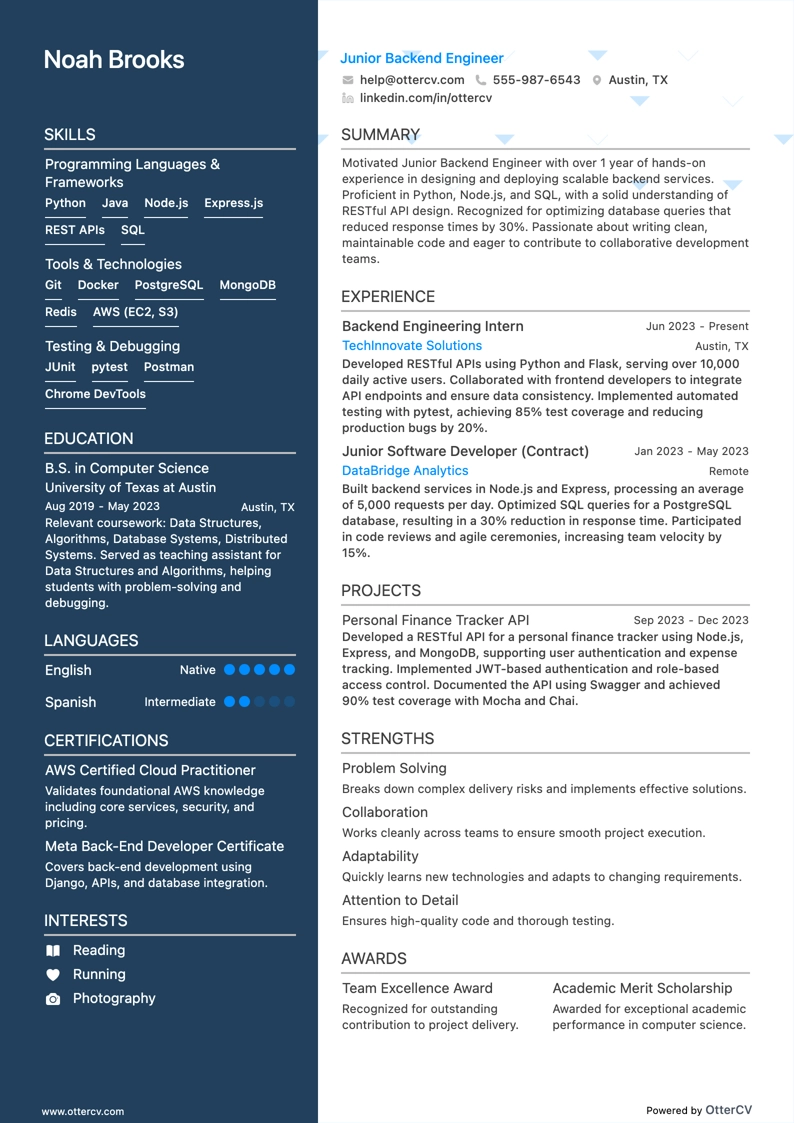
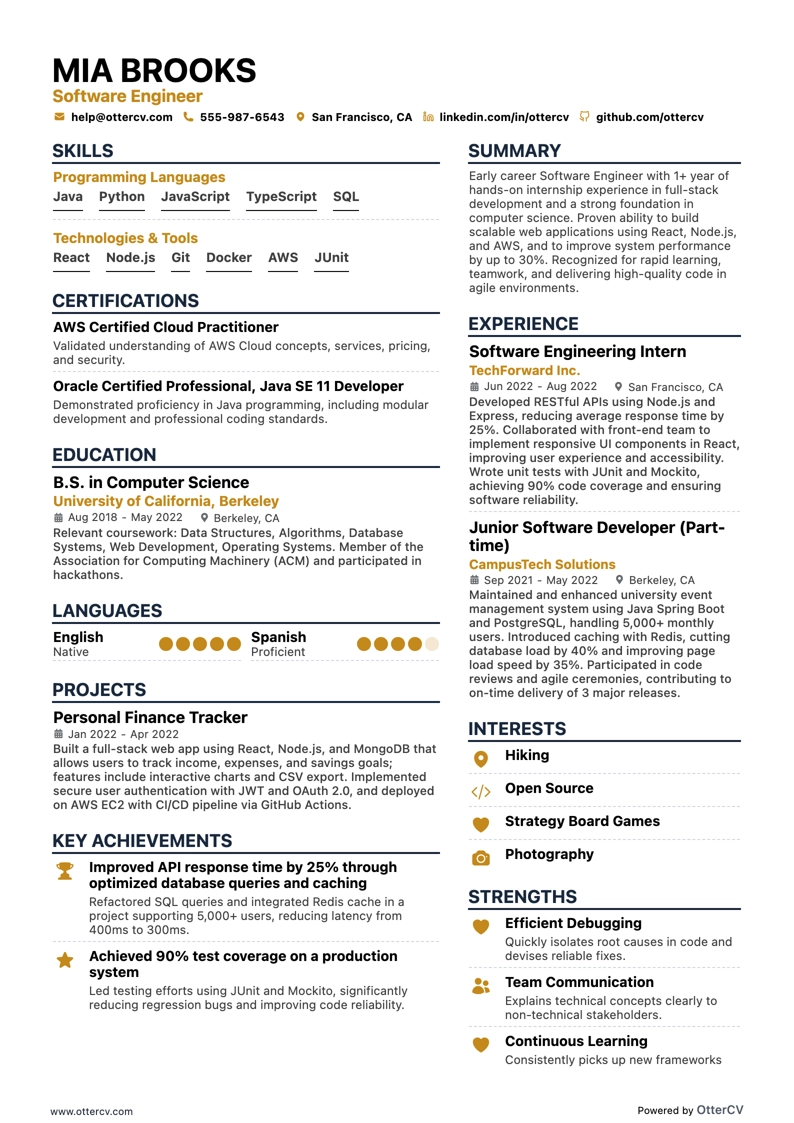
Junior Backend Engineer full preview

18 Entry-Level Software Engineer Resume Examples

OtterCV

Written by The OtterCV Team

Updated: 7/12/2025•8 min read

See all resume examples in this guide, or generate your own resume example with your personalized prompt

Junior Backend Engineer resume example

Junior Backend Engineer

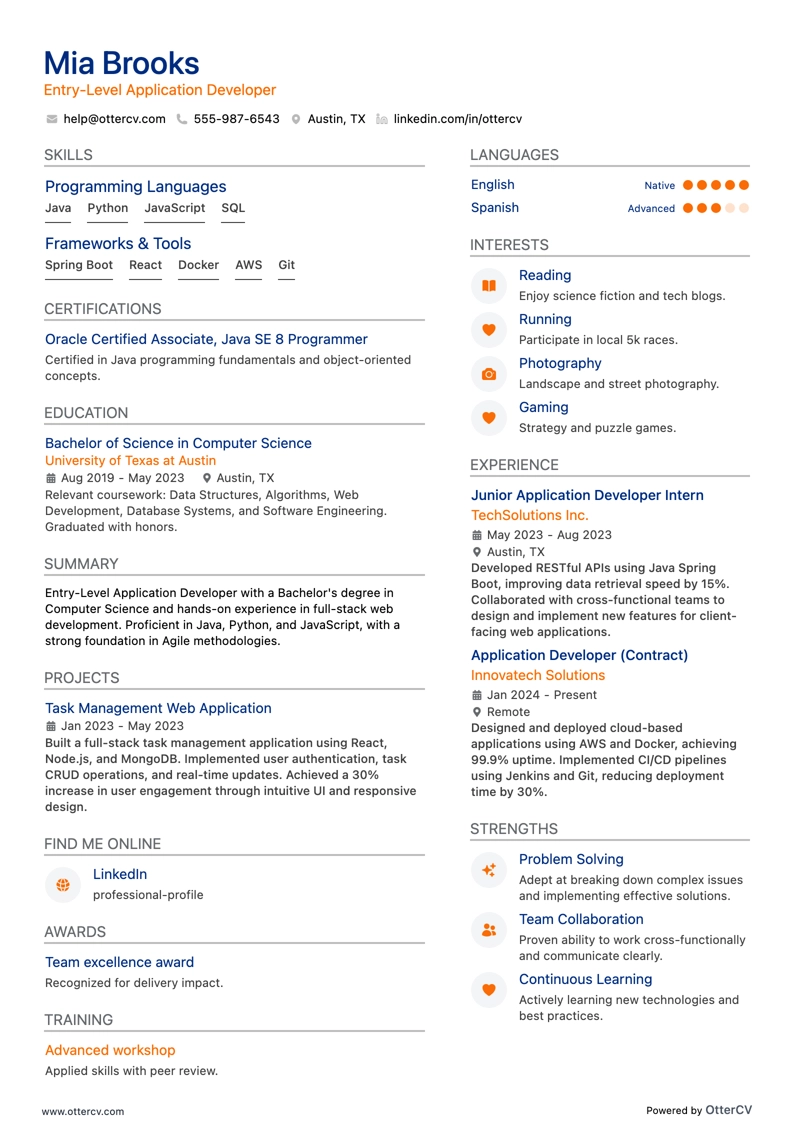
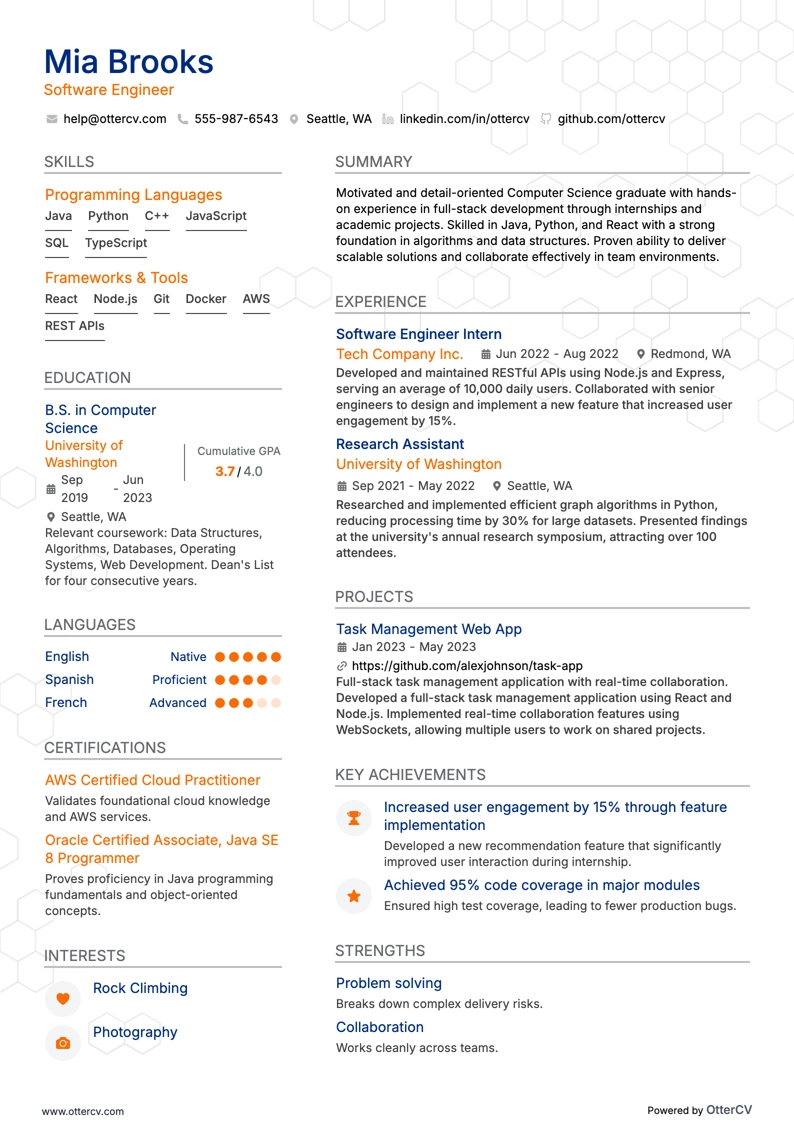
Entry-Level Application Developer resume example

Entry-Level Application Developer

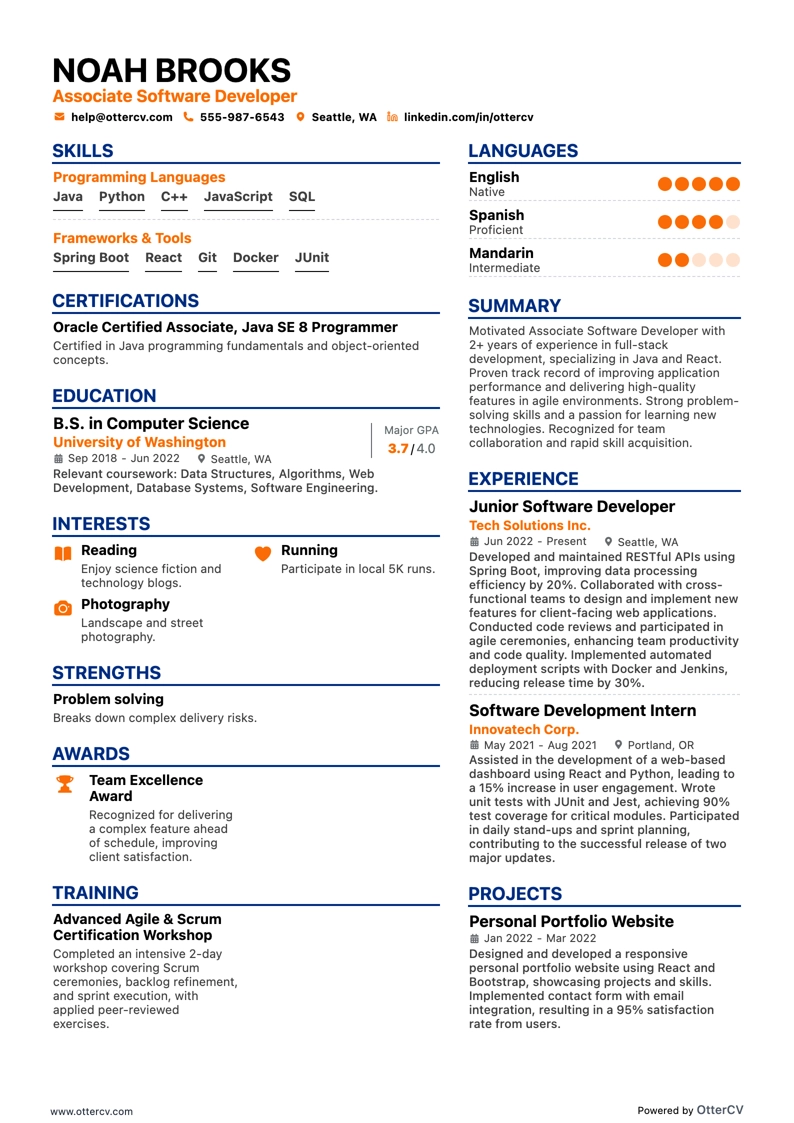
Associate Software Developer resume example

Associate Software Developer

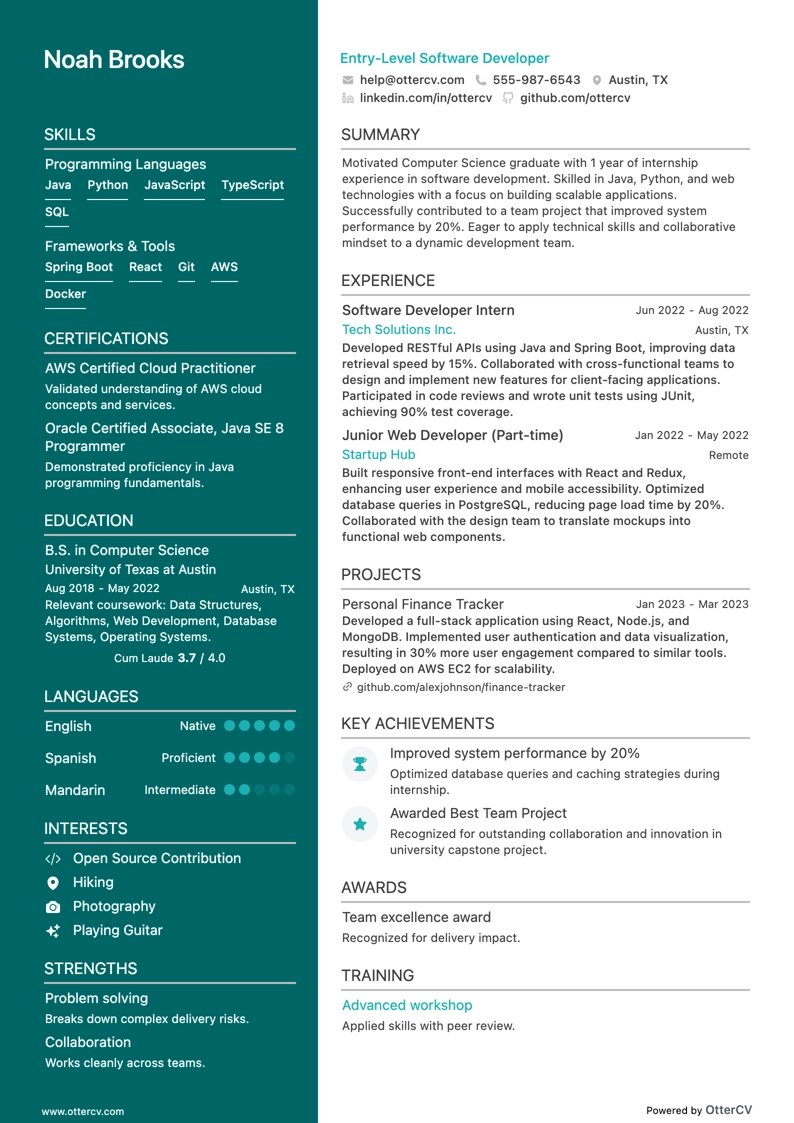
Entry-Level Software Developer resume example

Entry-Level Software Developer

Early Career Software Engineer resume example

Early Career Software Engineer

New Grad Software Engineer resume example

New Grad Software Engineer

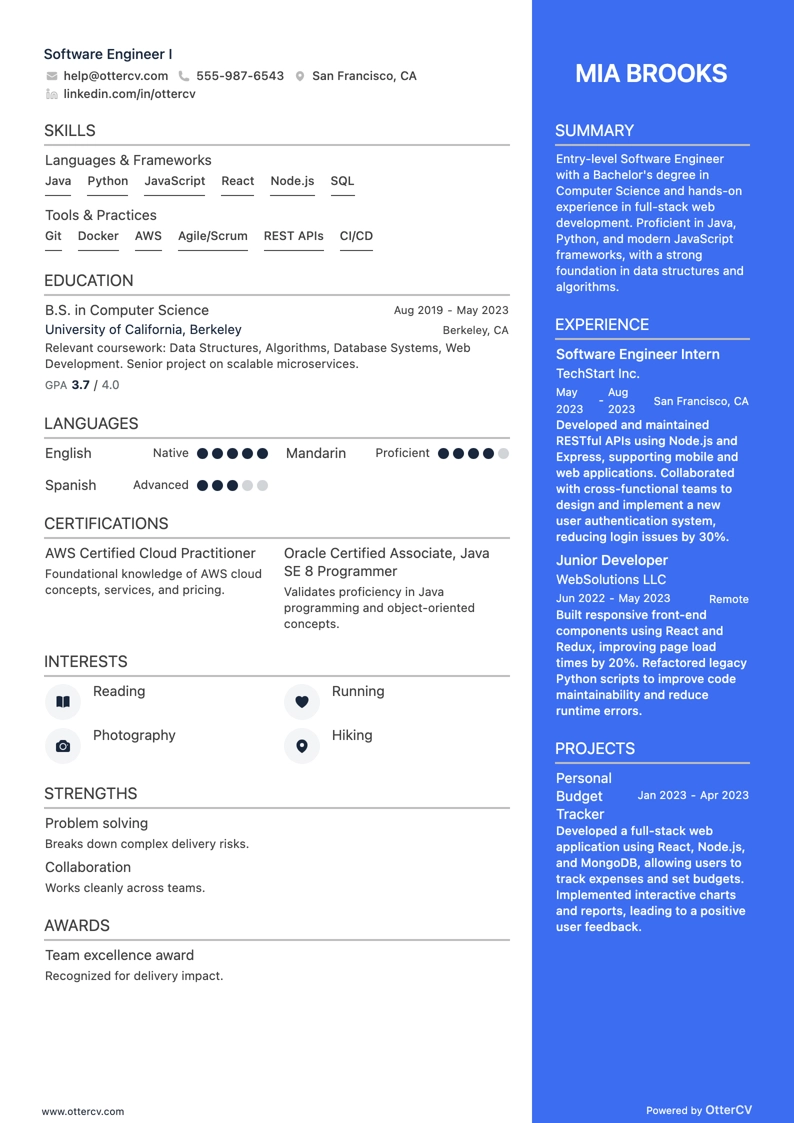
Software Engineer I resume example

Software Engineer I

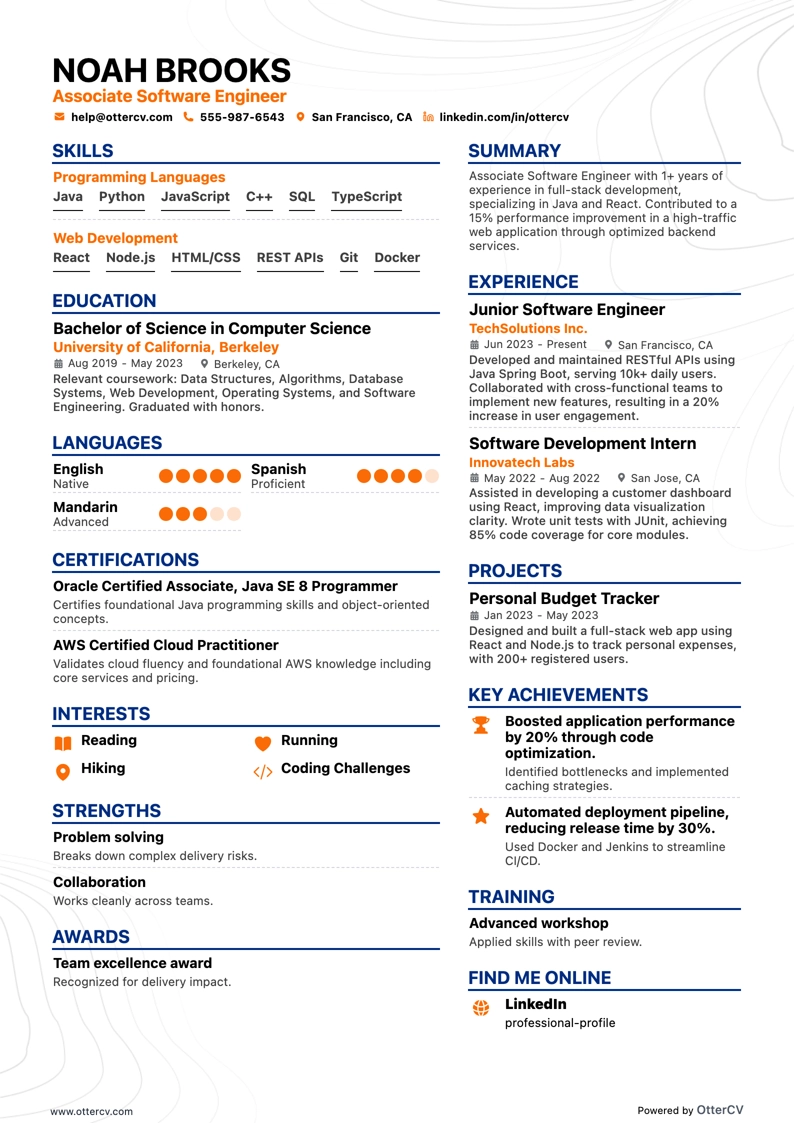
Associate Software Engineer resume example

Associate Software Engineer

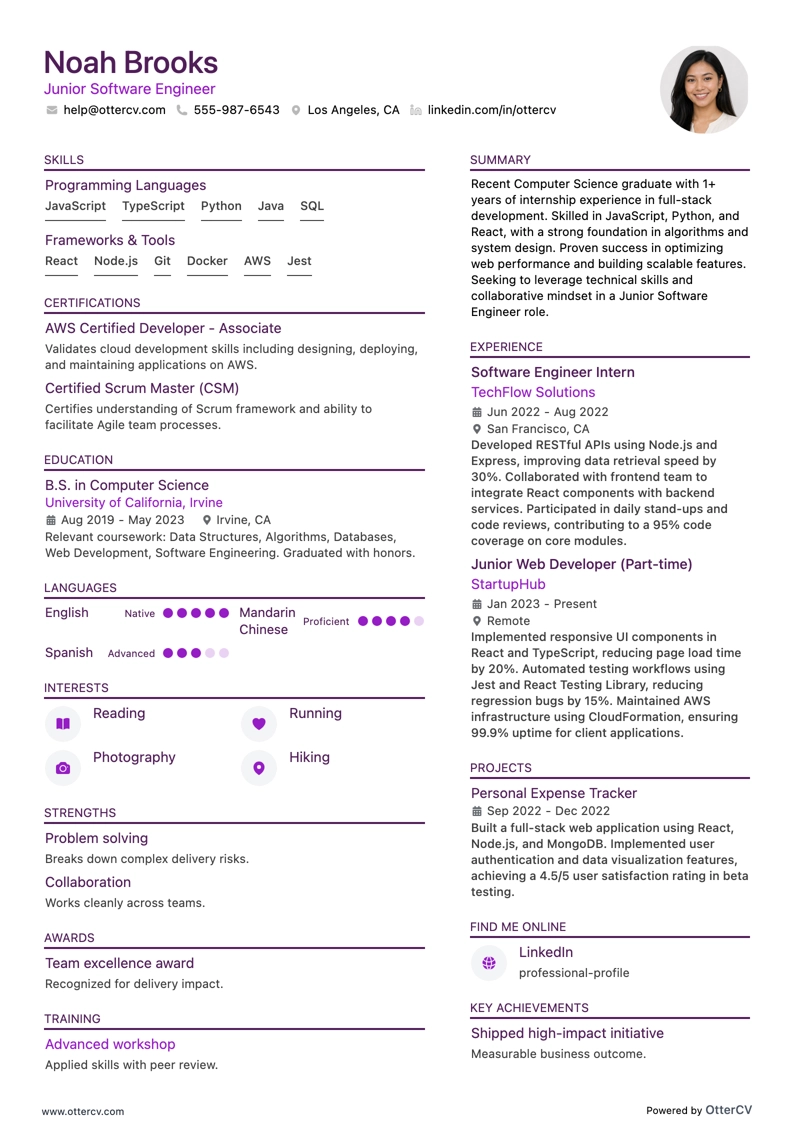
Junior Software Engineer resume example

Junior Software Engineer

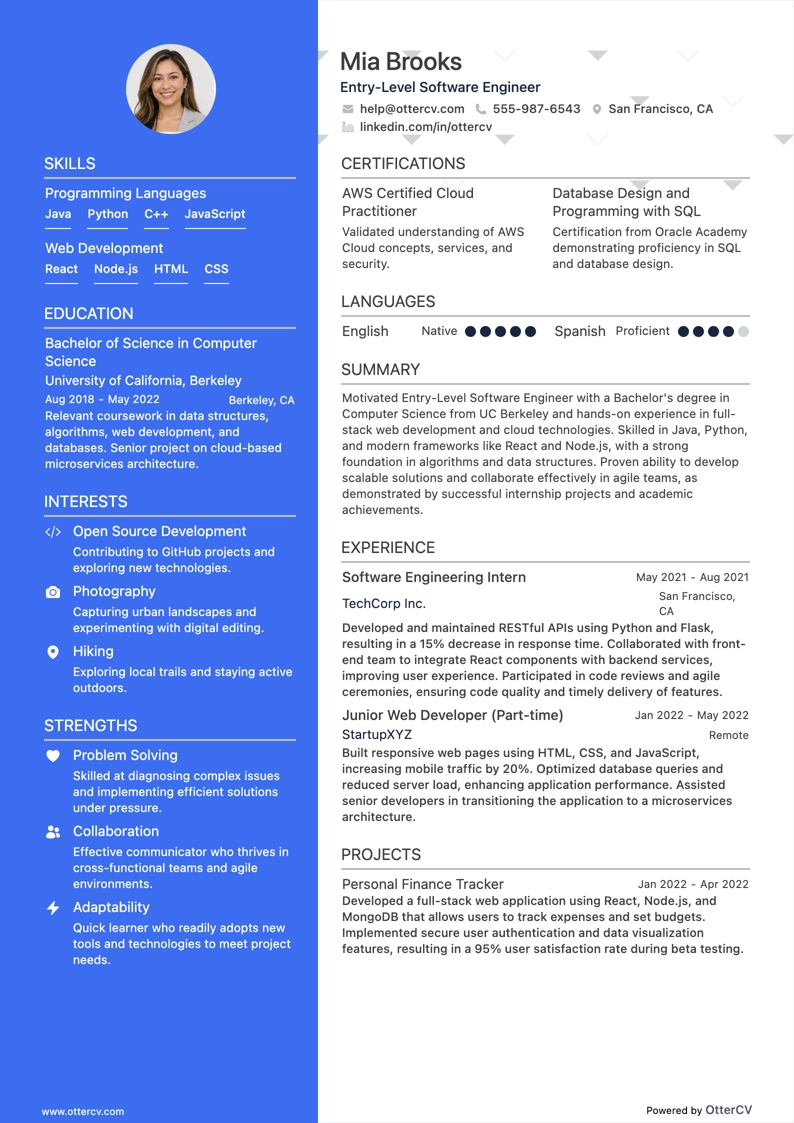
Entry-Level Software Engineer resume example

Entry-Level Software Engineer

Creating an entry-level software engineer resume is often one of the most challenging steps for people just starting out. With limited experience and a competitive tech job market, you can improve your chances by building a resume that highlights your unique strengths and readiness for the role.

To stand out, focus on presenting your technical skills, academic projects, and any relevant experience in a clear, strategic way. This guide will help you create a compelling resume that showcases your potential effectively.

By emphasizing your technical abilities, academic work, and transferable experience, you can show employers that you are ready to succeed in the tech industry.

Key takeaways

  • Include measurable outcomes in your projects and experience to show real-world impact.

  • Tailor your resume to the job description by emphasizing relevant skills, tools, and technologies.

  • Use a hybrid resume format to highlight technical skills and projects while still showcasing your education.

  • Add certifications such as AWS, Azure, or Kubernetes to validate your technical expertise.

  • Include sections for projects, hackathons, and open-source contributions to strengthen your profile.

  • Keep your resume concise, well structured, and focused on skills that match entry-level software engineering roles.

To help you get started, here is a detailed sample resume that shows what a strong result can look like.

Entry-level Software Engineer Resume Sample

This example is tailored for aspiring software engineers and shows how to highlight internships, education, and technical skills to stand out to potential employers, even with limited professional experience.

Christian Torres

Software Engineer | Agile Development | Embedded Systems

(210) 867-53XX | help@echocv.com | @LinkedIn | San Antonio, TX

Summary

Enthusiastic software engineer with a solid foundation in coding, testing, and software development. Experienced in Agile environments and passionate about creating innovative solutions for complex challenges. Career aspirations include contributing to impactful projects in defense technology and advancing skills in embedded systems and software testing.

Experience

Software Engineering Intern

Lockheed Martin, Fort Worth, TX

May 2023 – August 2023

  • Developed automated test scripts for embedded systems, reducing testing time by 35% and improving reliability.
  • Collaborated with cross-functional teams to debug and optimize existing software, resulting in a 20% performance boost.
  • Designed and implemented a tool for monitoring system performance, enhancing data accuracy by 15%.
  • Participated in Agile ceremonies, contributing to sprint planning and backlog refinement for two major projects.
  • Wrote technical documentation for software features, streamlining onboarding for future interns and team members.
  • Created and maintained unit tests, achieving 95% code coverage across critical components of the project.

Software Development Intern

Raytheon Technologies, Dallas, TX

January 2023 – April 2023

  • Contributed to the development of a user interface for mission-critical software, increasing usability by 30%.
  • Enhanced the functionality of existing tools by integrating new APIs, resulting in improved data retrieval speed by 40%.
  • Assisted in testing and debugging a secure communication protocol, ensuring compliance with industry standards.
  • Conducted peer code reviews to maintain quality and consistency, reducing errors in production by 15%.
  • Supported the deployment of a software update across 10 systems, ensuring a smooth transition with zero downtime.

Education

Bachelor of Science in Software Engineering

University of Texas at San Antonio

Graduated: 2023

  • Coursework included software development lifecycle, object-oriented programming, and Agile methodologies.
  • Gained expertise in embedded systems, software testing, and debugging techniques.
  • Worked on a capstone project to develop a real-time data monitoring application, achieving 20% faster performance.
  • Participated in collaborative programming projects to design and implement scalable software solutions.

Certifications

  • Eggplant Functional Test Automation (Keysight Technologies) (2024)
  • Advanced Embedded Systems (Coursera) (2026)

Skills

  • Java
  • Python
  • Agile Development
  • Embedded Systems
  • Eggplant Test Automation
  • Software Testing

Languages

  • English (Native)
  • Spanish (Proficiency: 4)

Now that you've seen a strong entry-level software engineer resume example, here’s how to format your own resume so it looks more professional, clear, and recruiter-friendly.

How to Format an Entry-level Software Engineer Resume

For aspiring software engineers, your resume layout and overall organization play a key role in making a strong first impression.

Use a structure that clearly highlights your technical skills and potential.

Choose the right format

The hybrid resume format is ideal for entry-level software engineers. It emphasizes technical skills, personal or academic projects, and education, which makes it a strong choice for applicants with limited professional experience. By contrast, a chronological resume focuses on work experience, starting with your most recent job, so it is better suited to candidates with a substantial professional background.

A functional resume highlights skills and achievements over job history, making it a strong choice for candidates with little experience. A combination resume blends skills with a stronger focus on education and projects.

Design and layout tips

Use these design and layout tips to make your resume visually polished and easy for both recruiters and ATS (Applicant Tracking Systems) to read.

  • Margins: Use margins between 0.5" and 1" to reduce clutter while making the most of the page.
  • Colors: Keep the text black and use one accent color, such as blue or gray, for headings or dividers to maintain a professional look. Avoid using more than three colors on your resume: primary, secondary, and accent.
  • Fonts: Choose clean fonts such as Arial, Rubik, or Calibri. Use 10-12 pt for body text and 14-16 pt for headings to improve readability.
  • Columns: A two-column layout can work well for listing skills, such as Python, React, and AWS, along with certifications. Do not overload columns with too much detail, since that can hurt readability and ATS parsing.
  • Length: Keep your resume to one page. Entry-level applicants should prioritize the most impactful details.

Contact information

Include your contact information on your resume, such as your name, phone number, email address, GitHub, LinkedIn profile, or a portfolio showcasing relevant projects, such as a React web app or Python automation scripts.

ATS can easily parse these details, so keep them clear and avoid unnecessary items such as your full mailing address or a photo. Usually, photos aren’t required for US resumes, but always check the job ad to confirm.

ATS (Applicant Tracking Systems) often creates unnecessary fear. Our tests show that fonts, colors, columns, and resume length do not affect parsing. Instead, focus on matching the language of the job description and using consistent formatting for details such as dates and bullet points, since these may affect your application. Not all companies use ATS, so avoid keyword stuffing and keep your resume clear and concise.

File formatting and naming

Proper formatting and file naming can make your resume look more professional and easier for recruiters to manage.

Key resume sections for software engineers

These key resume sections help present your qualifications and create a strong impression as an entry-level software engineer:

  1. Contact Information: Make it easy for recruiters to reach you.
  2. Professional Summary or Objective: Highlight your programming skills, project experience, and enthusiasm for solving technical challenges.
  3. Technical Skills: Focus on programming languages such as Python and JavaScript, tools such as Git and Docker, and other relevant technologies.
  4. Projects: Include personal or academic projects that show your ability to build applications, automate processes, or solve problems.
  5. Education: Include your degree, relevant coursework, and honors or GPA on your resume if it is 3.5 or above.
  6. Certifications: List certifications such as AWS, Microsoft Azure, or relevant online courses.

Got a resume already? See how well it performs against our AI resume checker.

Now that you’ve formatted your resume and outlined its key sections, focus on writing an experience section that clearly demonstrates your skills and contributions.

How to List Your Entry-level Software Engineer Resume Experience

When you’re starting out, your experience section should emphasize practical applications of your skills. Even without formal work experience, you can show your abilities through academic and personal projects, as well as internships.

What to include in the experience section

  • Internships or volunteer work: Highlight any internships or volunteer roles where you applied your coding skills, even if the projects were small.
  • Academic projects: Mention coursework that shows your programming skills or understanding of databases, algorithms, or software development.
  • Personal projects: Include independent projects that show initiative, such as building an app, website, or automation tool.
  • Hackathons or competitions: List hackathons or coding competitions that demonstrate teamwork and creative problem-solving under deadlines.
  • Freelance or open-source contributions: Add freelance work, if applicable, or open-source contributions that show your ability to collaborate and deliver results.

Why tailoring your resume matters

Tailoring your resume to the specific job description helps you stand out in a competitive market.

Here’s why it matters:

  • Relevance: It shows recruiters that your skills align with the role.
  • ATS optimization: Tailoring helps your resume include the right keywords to pass ATS screening.
  • Professionalism: It shows that you’ve taken the time to research the position and present yourself as a strong fit.

Let’s look at a real-world job ad and identify the parts we’ll focus on in the sample experience entry below.

Entry-Level Software Engineer

Entry-Level Software Engineer

As an entry-level software engineer, you will design, develop, test, and maintain software applications in an agile environment. The role involves collaborating with cross-functional teams, troubleshooting technical issues, and implementing efficient solutions while helping improve software quality and performance through code reviews, debugging, and optimization.

Responsibilities:

  • Collaborate in an agile environment to design, develop, test, and maintain innovative software applications.
  • Assist in resolving network issues, configuring operating systems, and providing remote desktop support.
  • Troubleshoot complex problems, gather requirements, and implement creative solutions across various industries.
  • Participate in code reviews, debugging, and performance optimization to deliver high-quality software solutions.
  • Contribute to the development of scalable backend services to support secure and efficient operations for millions of users.

Requirements:

  • Bachelor’s degree in Computer Science, Computer Engineering, or a related field.
  • Proficiency in programming languages like Java, Python, or C++.
  • Experience with databases such as SQL and a strong understanding of algorithms and data structures.
  • Strong problem-solving skills and the ability to work collaboratively in team settings.
  • Excellent verbal and written communication skills.
  • Familiarity with software development methodologies like Agile or Scrum.
  • Ability to analyze and improve efficiency, scalability, and stability of various systems.

How to tailor and write a work experience section

A targeted work experience section helps your resume match the specific job description by highlighting the skills, tools, and accomplishments recruiters value most.

Here’s how to structure and present your experience for the job posting above:

Key components of a work experience entry

  • Position title: Clearly state your current role in the resume header, such as “Software Engineer Intern,” or use the role the company is hiring for, in this case, “Entry-Level Software Engineer.”
  • Workplace: Include the organization or project name, such as “TechStart Inc.” or “Open Source Contribution.”
  • Location: If applicable, add the city and state or indicate “Remote”.
  • Date range: Provide accurate dates, including the year, and note whether the position is ongoing.
  • Bullets: Briefly describe your responsibilities, skills used, and quantifiable achievements in each role using action verbs.

Getting the most out of the bullets

  • Emphasize collaborative work in agile environments, including teamwork and iterative development.
  • Include the technical skills and tools you used, such as React, Python, SQL, and Node.js.
  • Quantify results whenever possible, for example, "improved database query efficiency by 15%".
  • Showcase problem-solving skills through examples like debugging or performance optimization.
  • Highlight contributions to code quality, such as participating in code reviews or identifying and fixing bugs.

Here’s what it could look like:

Professional Experience

Software Engineer Intern

TechStart Inc.

06/2023 - 08/2023 | San Francisco, CA

  • Collaborated in an agile environment to design and test a web-based inventory management system using React and Node.js.
  • Optimized SQL database queries, reducing system latency by 15% and improving application responsiveness.
  • Participated in code reviews, identifying and resolving 20+ bugs to improve software performance and maintainability.
RIGHT

Here’s how the experience entry above was tailored to the job description:

  • Aligned with job requirements: It demonstrated teamwork in an agile environment and applied technical skills such as React, Node.js, and SQL to match key responsibilities.
  • Showcased problem-solving and code quality: It improved database efficiency by 15% and resolved 20+ bugs through code reviews and debugging.
  • Quantified contributions: It used measurable outcomes to show impact, including reduced system latency and improved software performance.

Now that you’ve seen how entry-level candidates can align their experience with a job description, let’s look at how to quantify achievements to make a resume even more impactful.

How to quantify your experience on a resume

For entry-level software engineers, quantifying your achievements helps show the value of your work, even without a long job history. Use metrics from internships, class projects, or personal work, such as “improved algorithm efficiency by 20%” or “built a web app used by 50+ peers,” to demonstrate your potential impact.

Here are some ways to add measurable impact to your resume:

  • Add performance metrics from academic or personal projects, such as reducing algorithm runtime by a percentage or improving application load time.
  • Include specific user engagement data for applications you developed, such as the number of users who interacted with your app or feature.
  • Mention the size or complexity of the data sets you analyzed or processed, such as handling millions of rows in a database query.
  • Highlight the impact of your code optimizations by referencing reduced system errors, downtime, or resource consumption.
  • Quantify your contributions to group projects, such as the number of features you implemented or the lines of code you reviewed.

Even without formal experience, you can build a strong entry-level software engineer resume by focusing on the skills, projects, and achievements that show your potential. Learn more about what makes a good resume.

Writing an entry-level resume objective

Resume objectives are ideal for entry-level applicants because they are concise, usually 1–3 sentences, and focus on the skills, goals, and value you bring to the role. Unlike summaries, which are longer and better suited to experienced candidates, objectives emphasize how your background aligns with the company’s needs.

Use these tips to craft a strong objective:

Tips for writing objectives

  • Make it specific: Tailor the objective to the job description, mention the company, and include relevant technologies instead of using generic statements.
  • Demonstrate your value: Show how your skills solve problems or support team success in ways that align with the company’s goals.
  • Keep it concise: Write 1–2 impactful sentences using clear, direct language.
  • Include technical skills: Mention relevant tools and languages such as React, Python, or AWS when they match the job requirements.
  • Show enthusiasm: Express excitement about contributing to the company and a willingness to learn and grow.

Here is a concise example of an entry-level software engineer objective that highlights technical skills, education, and career goals.

Objective

Motivated computer science graduate with a strong foundation in Python, algorithms, and cloud computing. Seeking an entry-level software engineering role at Google to build innovative, scalable solutions and contribute to team success.

RIGHT

With your objective in place, the next step is to present your hard and soft skills to show both your technical expertise and your ability to work collaboratively.

How to List Your Hard and Soft Skills on Your Resume

Skills are a critical part of an entry-level software engineer resume because they show both your technical proficiency (hard skills) and your ability to collaborate and adapt (soft skills). Recruiters review these sections quickly to assess whether you have the qualifications and mindset needed for the role.

Hard vs. soft skills

Hard skills: Measurable, technical abilities directly tied to the job, such as coding languages, tools, and frameworks.

Soft skills: Interpersonal and personal qualities, such as communication and problem-solving, that help you work well with others and handle challenges.

Where to list skills

  • Dedicated skills section: List your technical hard skills in a skills section so recruiters can scan them easily.
  • Work experience and projects: Weave both soft and hard skills into bullet points to show how you have applied them.

These technical skills are essential for entry-level software engineers because they demonstrate your ability to use the programming languages, tools, and frameworks required to build and maintain software systems.

Best hard skills for your entry-level software engineer resume

  • Python is a valuable programming language to include.
  • Java is a strong hard skill for entry-level software engineering roles.
  • JavaScript is commonly expected for modern development work.
  • React shows front-end development experience.
  • Node.js highlights back-end JavaScript skills.
  • SQL demonstrates database query knowledge.
  • Git/GitHub reflects version control and collaboration skills.
  • Docker shows familiarity with containerization.
  • AWS (Amazon Web Services) indicates cloud platform experience.
  • Kubernetes demonstrates knowledge of container orchestration.
  • HTML/CSS shows foundational web development skills.
  • C++ is useful for roles that require systems or performance-focused programming.
  • RESTful APIs demonstrate experience with application integration.
  • Agile/Scrum methodologies show familiarity with common software development workflows.
  • Bash/Shell scripting highlights command-line and automation skills.
  • Data Structures are essential for software engineering fundamentals.
  • Algorithms demonstrate problem-solving and technical depth.
  • MongoDB shows experience with NoSQL databases.
  • Testing tools (e.g., Selenium, JUnit) reflect software testing knowledge.
  • CI/CD pipelines demonstrate understanding of automated development workflows.

Soft skills are equally important because they show your ability to collaborate, communicate, and adapt to dynamic work environments, making you a valuable team player.

Best soft skills for your entry-level software engineer resume

  • Problem-solving helps you identify issues and build effective solutions.
  • Communication shows you can explain ideas clearly.
  • Team collaboration highlights your ability to work well with others.
  • Adaptability shows you can adjust to changing tasks and priorities.
  • Time management reflects your ability to stay organized and meet deadlines.
  • Critical thinking shows you can evaluate options carefully.
  • Creativity highlights your ability to develop new ideas.
  • Initiative shows you can take action without constant direction.
  • Accountability reflects that you take responsibility for your work.
  • Attention to detail shows you can produce accurate work.
  • Openness to feedback shows you are willing to learn and improve.
  • Resilience highlights your ability to recover from setbacks.
  • Emotional intelligence shows you can understand and manage workplace interactions.
  • Leadership potential suggests you can guide and support others.
  • Multitasking shows you can handle multiple responsibilities at once.
  • Conflict resolution reflects your ability to handle disagreements constructively.
  • Empathy shows you can understand other people's perspectives.
  • Decision-making highlights your ability to choose practical solutions.
  • Work ethic shows you are dependable and committed.
  • Organization reflects your ability to keep tasks and priorities in order.

These skills can make your resume more impactful and help you stand out to recruiters as a well-rounded candidate.

How to List Your Certifications and Education on Your Resume

The education section on your resume plays a critical role in an entry-level software engineer resume. It highlights your academic qualifications, technical foundation, and any coursework relevant to the role. Recruiters often use this section to quickly assess whether your background matches the job requirements.

For entry-level resumes, you can place the education section above the experience section, especially if you have little to no practical experience to show.

Best practices for listing education and certifications:

  • Include your degree, major or minor, and relevant coursework such as Data Structures, Algorithms, and Software Development.
  • Add academic achievements, such as a high GPA if it is 3.5 or above.
  • List certifications, such as AWS Certified Developer, or relevant online courses from platforms like Coursera, Udemy, and Codecademy to show initiative.

If your degree is incomplete or you are still working on certifications, you can still present your efforts and technical abilities effectively.

If you’re still working toward certifications or list an incomplete degree on your resume, include completed coursework or personal projects that show your initiative and technical ability.

Here is an example of a well-crafted education entry tailored to the job description discussed above:

Education

Bachelor of Science in Computer Science
University of California, Los Angeles
2021 - 2026 · Los Angeles, CA
GPA: 3.8 / 4.0

  • Relevant coursework: Algorithms, Data Structures, Artificial Intelligence, Software Development
  • Dean’s List (2023, 2024)
RIGHT

Why This Works

  • Clear and relevant details: The degree, university name, location, and GPA (3.8) are presented concisely, making it easy for recruiters to evaluate academic qualifications.
  • Targeted coursework and achievements: Courses such as Algorithms and Artificial Intelligence, along with Dean’s List honors, highlight technical skills and consistent academic success.
  • Concise formatting: The structured layout makes the section easy to read and directly relevant to the role.

Include certifications on your resume that validate your proficiency in key technologies and tools to demonstrate your readiness for entry-level software engineering roles. For example, certifications in AWS or Kubernetes can help validate proficiency in cloud-based infrastructure development.

Add these to your resume to strengthen it further:

Best certifications for your entry-level software engineer resume

Additional Sections for An Entry-Level Software Engineer Resume

Once you’ve nailed the core sections of your resume, optional sections can further showcase your skills and help your application stand out.

Use these sections to tell a more complete story. For example, link to a GitHub repository in your open-source contributions or explain how a volunteer project solved a real-world problem. These achievements can set you apart and make your resume more memorable.

  • Projects: Highlight technical projects you’ve completed, including the tools and technologies used.
  • Awards: Share any awards you’ve received to demonstrate creativity, dedication, and the ability to excel under pressure.
  • Open-source contributions: List contributions to GitHub repositories or other open-source projects to show collaboration and coding experience.
  • Volunteer experience: Emphasize volunteer work where you applied technical skills, such as building a nonprofit website or automating a process.

In Conclusion

This article is a comprehensive guide to crafting an impactful entry-level software engineer resume by tailoring each section to highlight skills, projects, and certifications that resonate with recruiters.

From structuring your education and experience to using additional sections like certifications and projects, this guide helps your resume stand out, even without formal work experience.

Entry-Level Software Engineer resume examples

Explore additional Entry-Level Software Engineer resume samples and guides and see what works for your level of experience or role.

By Experience

Junior Backend Engineer

Junior Backend Engineer resume preview

Entry-Level Application Developer

Entry-Level Application Developer resume preview

Associate Software Developer

Associate Software Developer resume preview

Entry-Level Software Developer

Entry-Level Software Developer resume preview

Early Career Software Engineer

Early Career Software Engineer resume preview

New Grad Software Engineer

New Grad Software Engineer resume preview

Software Engineer I

Software Engineer I resume preview

Associate Software Engineer

Associate Software Engineer resume preview

Junior Software Engineer

Junior Software Engineer resume preview

Entry-Level Software Engineer

Entry-Level Software Engineer resume preview