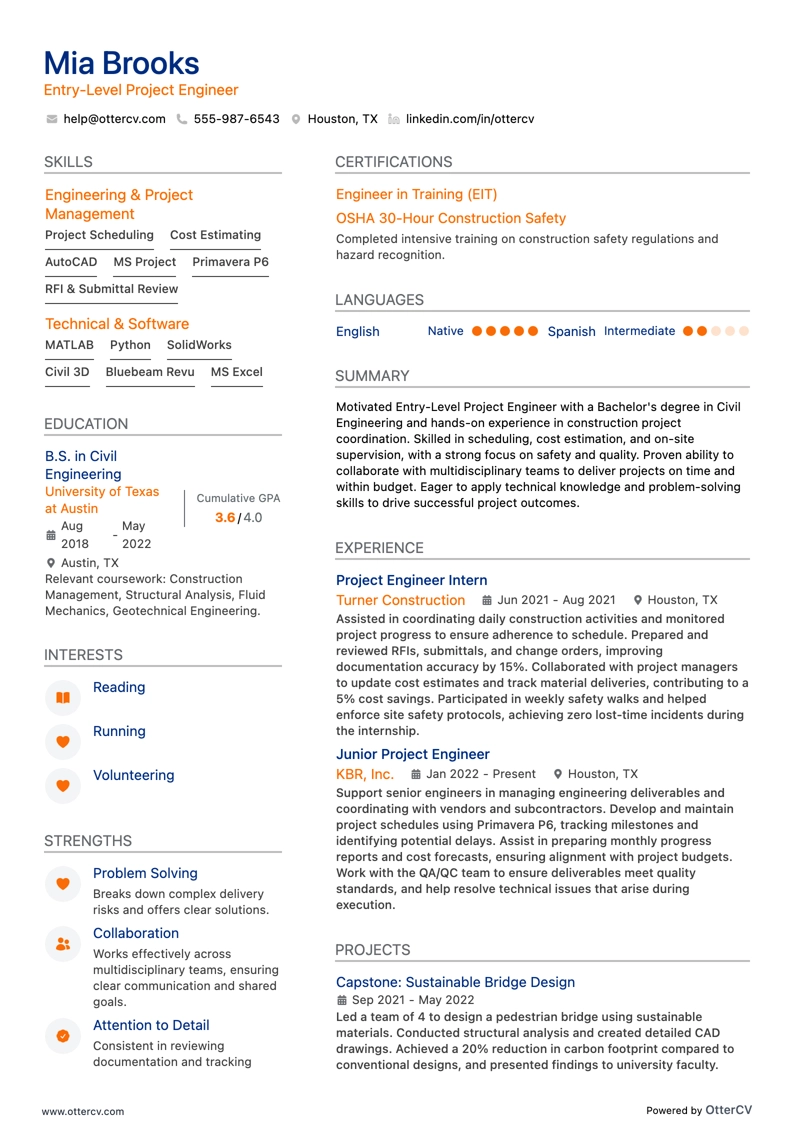
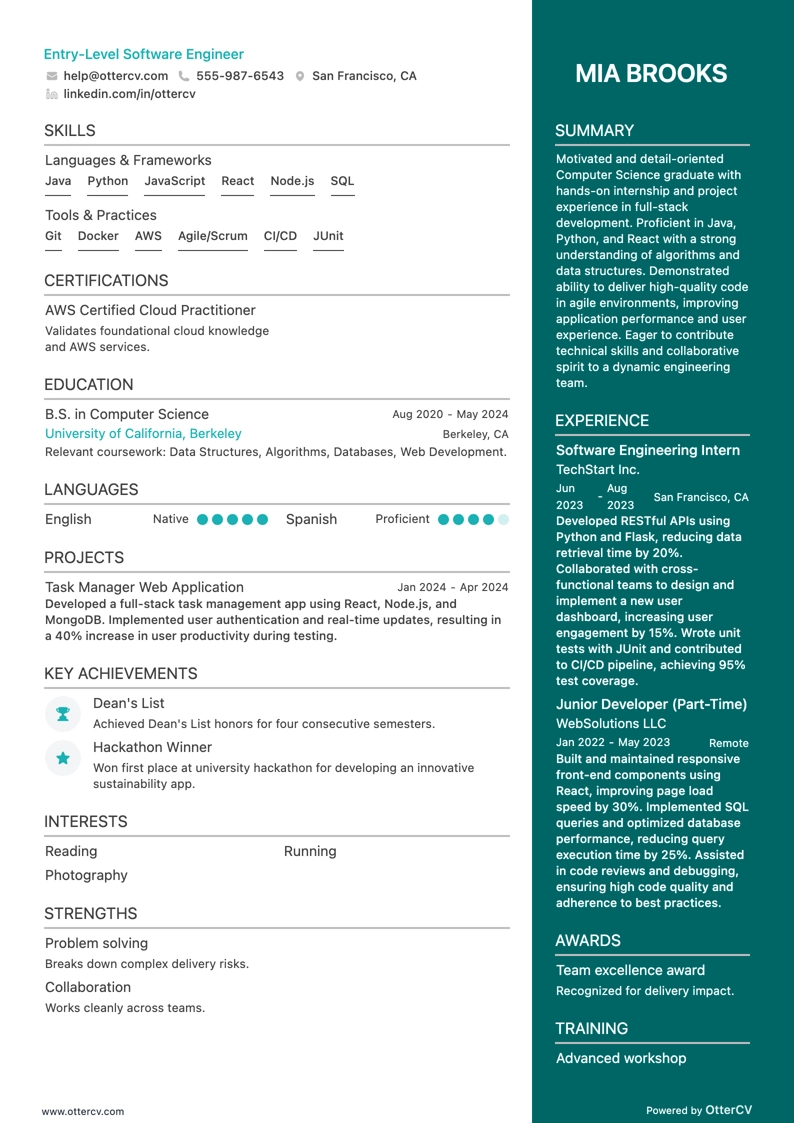
Entry-Level Project Engineer full preview

5 Entry-Level Engineering Resume Examples

OtterCV

Written by The OtterCV Team

Updated: 12/28/2024•8 min read

See all resume examples in this guide, or generate your own resume example with your personalized prompt

Entry-Level Project Engineer resume example

Entry-Level Project Engineer

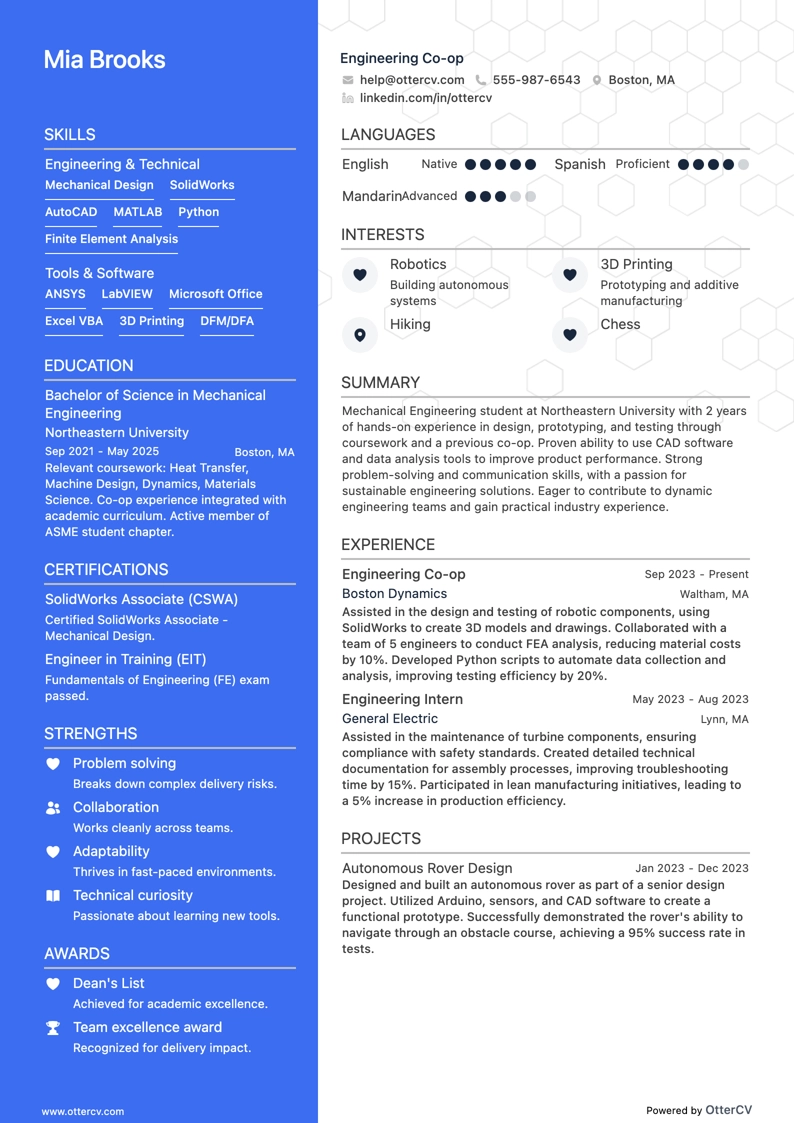
Engineering Co-op resume example

Engineering Co-op

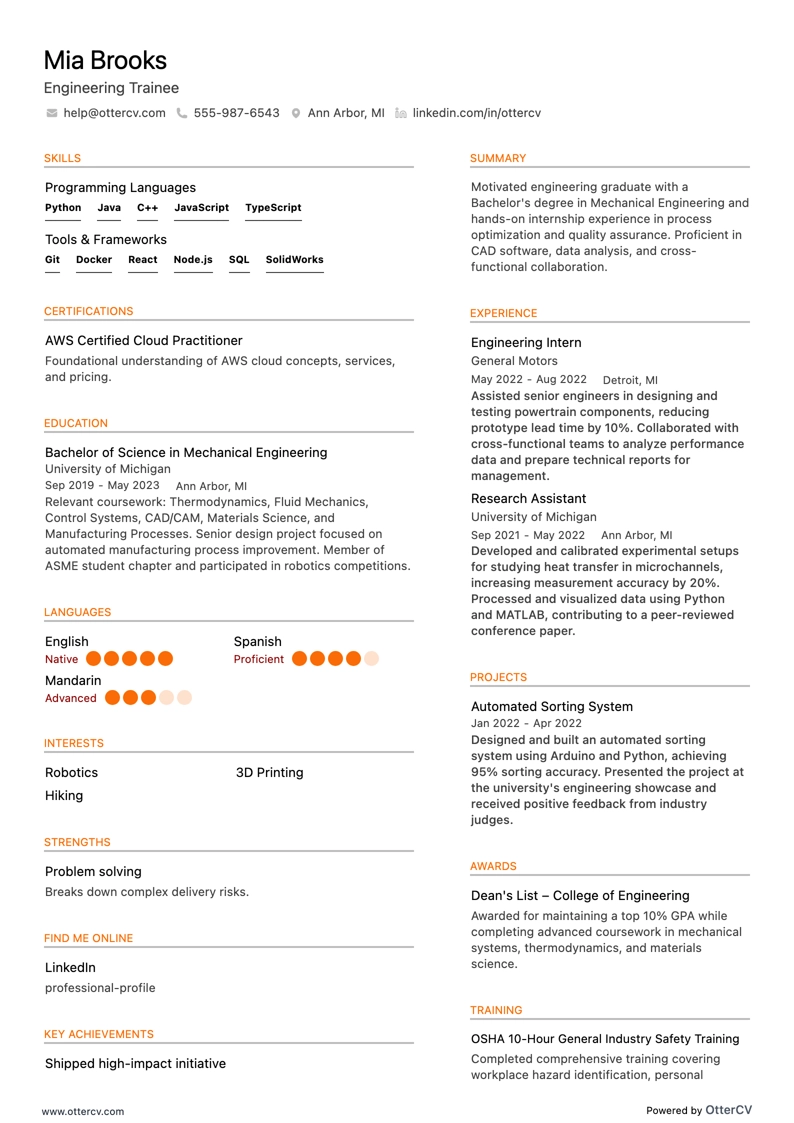
Engineering Trainee resume example

Engineering Trainee

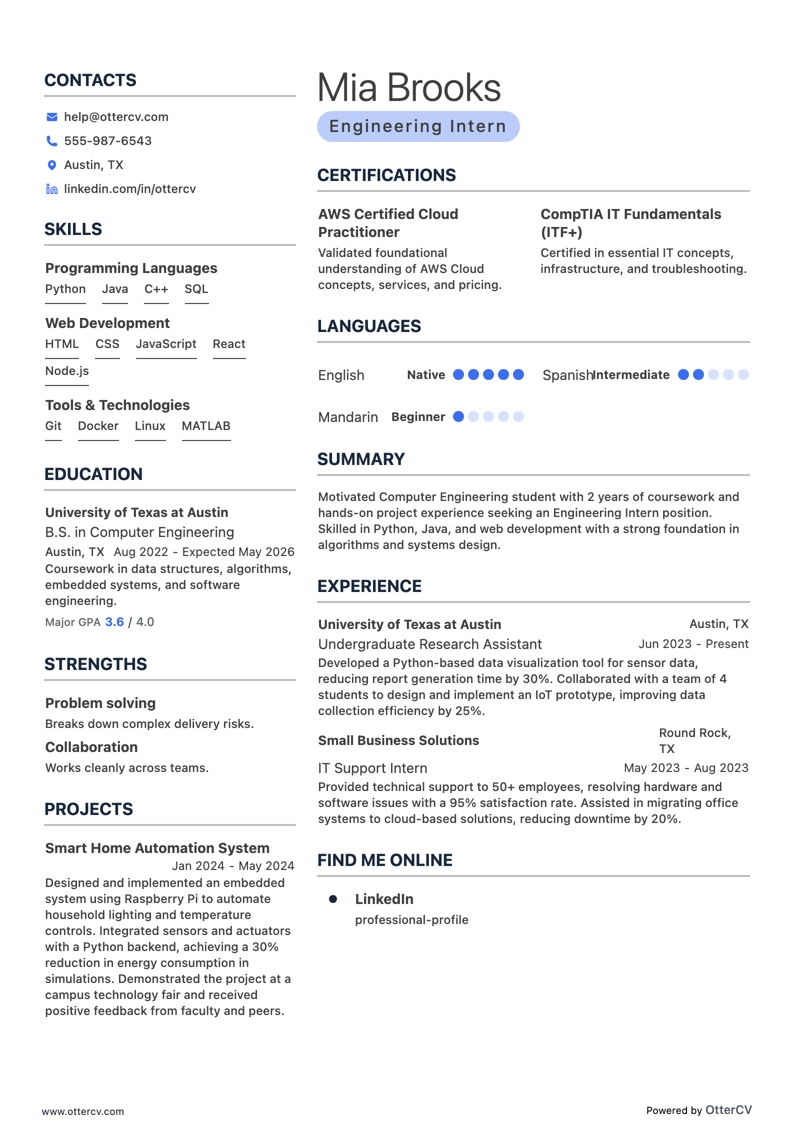
Engineering Intern resume example

Engineering Intern

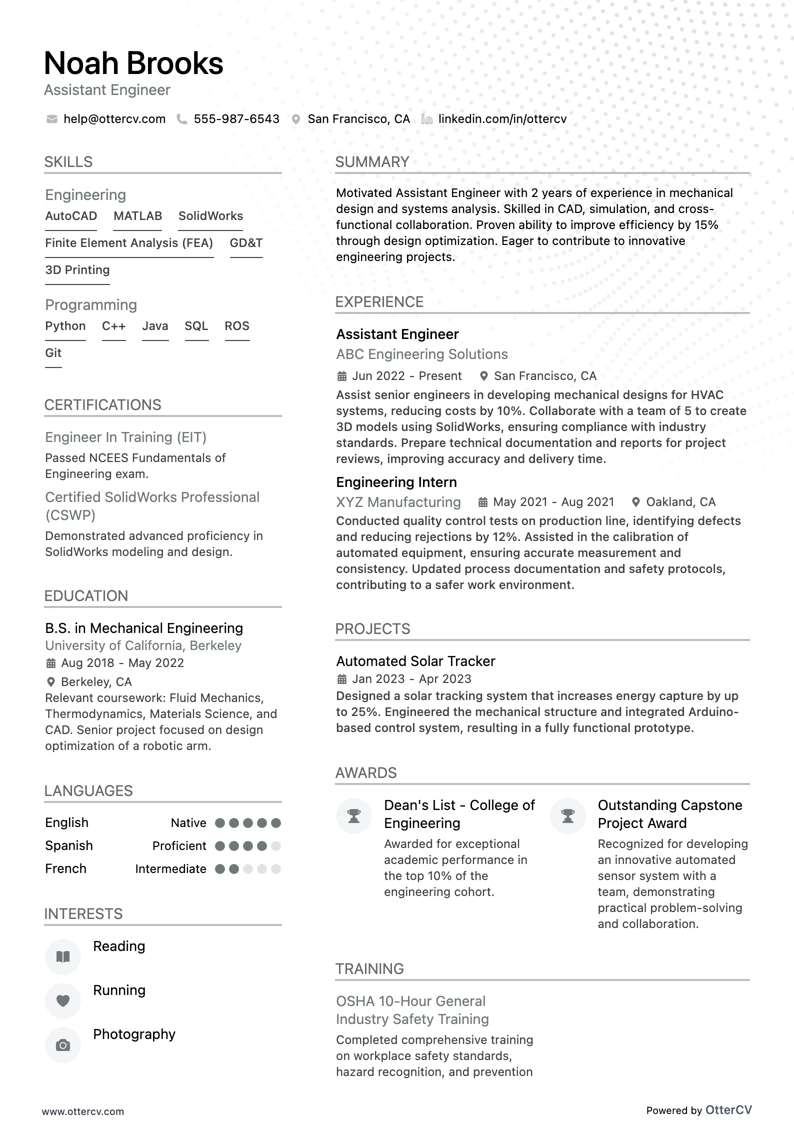
Assistant Engineer resume example

Assistant Engineer

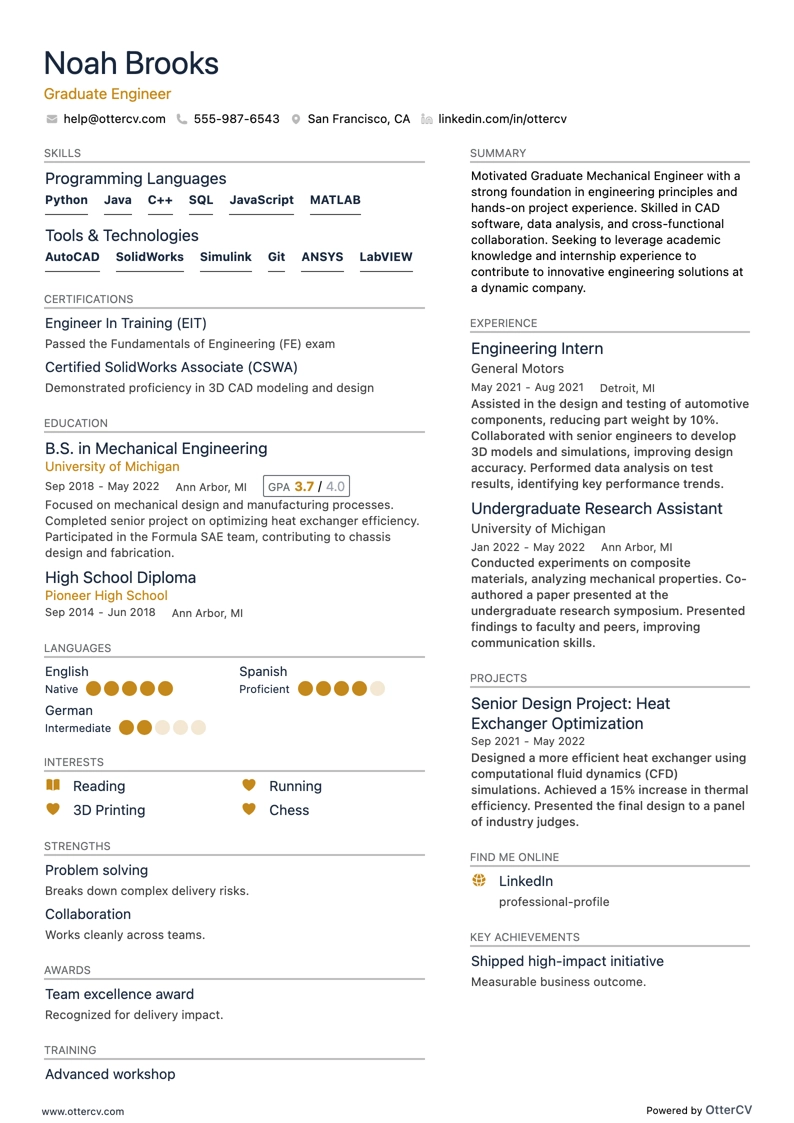
Graduate Engineer resume example

Graduate Engineer

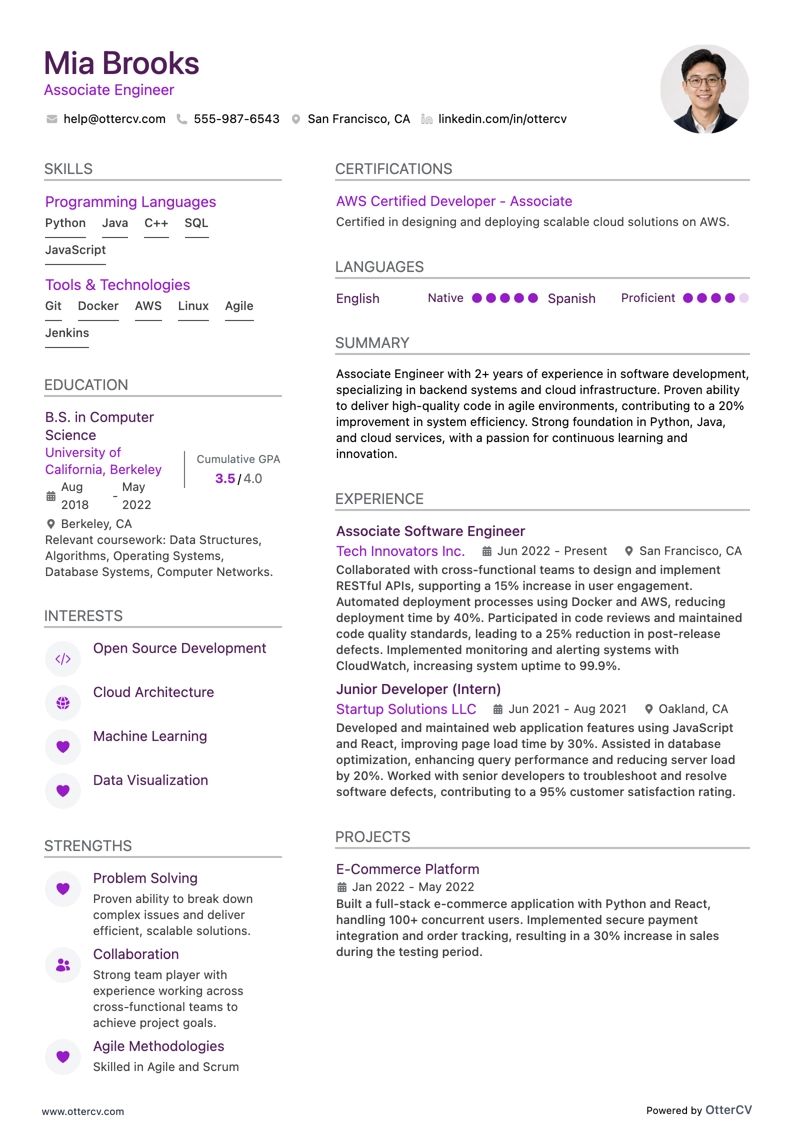
Associate Engineer resume example

Associate Engineer

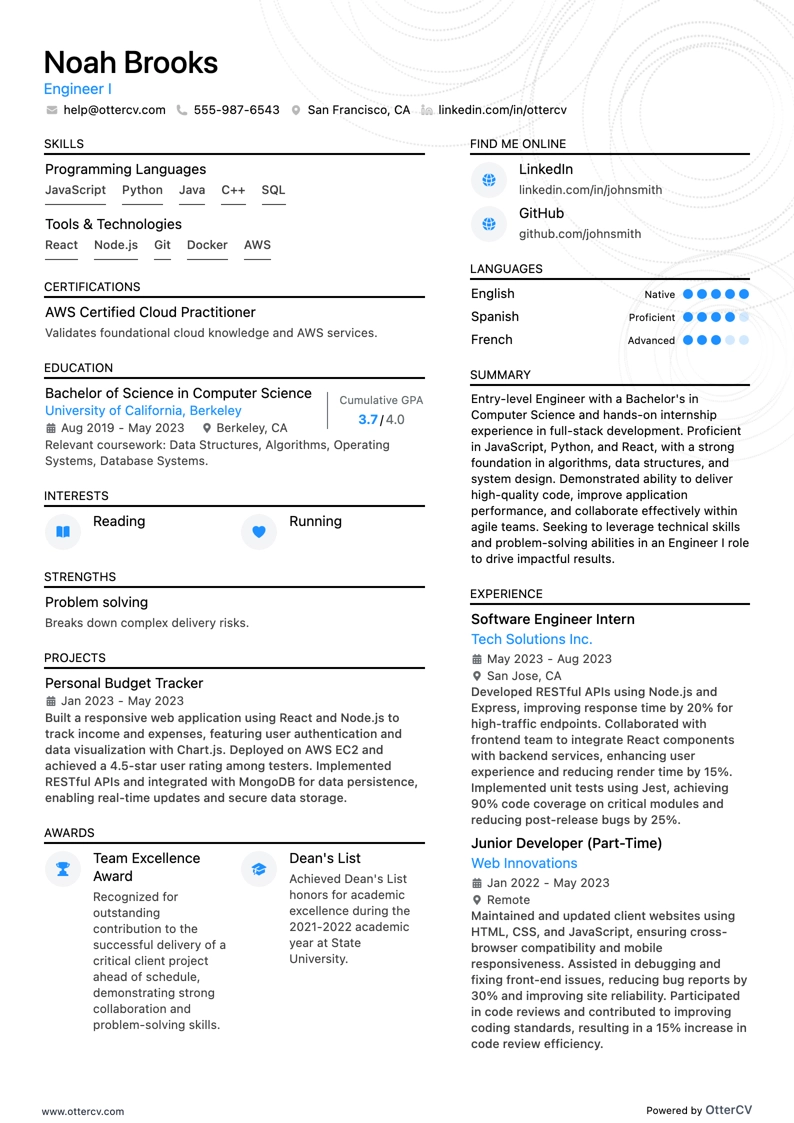
Engineer I resume example

Engineer I

Entry-Level Engineer resume example

Entry-Level Engineer

There’s a story about a graduate looking for a first job in engineering. Over a few years, he applied to 400 job listings with his entry-level engineering resume.

How many interviews did he get? Three. The problem is that, these days, that’s considered a success.

Mechanical engineers, for example, send out an average of 100 resumes before landing an interview, then wait up to 90 days for a job offer—if they get one at all.

Are you ready to send out your first 100 resumes? We didn’t think so.

Let us help you create a highly effective entry-level engineer resume and possibly cut that number in half, or more.

How? You need to know the game. Read on.

This Entry-Level Engineer resume will teach you:

  • How to make use of our 10+ resume examples from real candidates.
  • The biggest myths in entry-level resume applications.
  • Which resume layout works best for entry-level engineer resumes.
  • How to show your soft skills without sounding too vague.
  • How to emphasize your education and certification sections for greater impact.

Looking for related resume guides? We got you covered.

How to write an entry-level engineering resume: getting started

Finding engineering work is tough. But what many candidates do not realize is that most advice on writing an entry-level engineering resume simply does not work.

Myth #1: “Play the numbers game. Send as many applications every day as possible and eventually you’ll land an interview.”

You cannot rely on the numbers game, because the game is rigged.

Recruiters look for very specific things in an entry-level engineering resume. If you miss those, you can keep sending resumes and still get rejected again and again.

Myth #2: “I have a GPA above a 3.0, I’ll have no problems getting this job”

GPA alone does not matter much. At least two things usually matter more to recruiters: internships and relevant experience.

Our HR won’t even pass a resume to me unless it includes the keywords “internship” or “co-op” (cooperative education). Then again, we get over 150 applicants for our entry-level positions.

—— Engineer lead on Reddit.com

Myth #3: “All that matters are my technical skills”

We’ll cover how to handle this in your junior engineering resume in the Summary and Experience sections.

In your Summary, writing “I know AutoCAD, MATLAB, Excel...” is not enough. Recruiters move quickly, and technical skills alone rarely make you stand out.

Yes, technical skills are essential to your profession. Yes, you worked hard to learn them. But so have 20+ of your classmates who are also applying for jobs.

What makes you different?

From an employer’s perspective, many technical skills can be learned on the job. You can often pick up missing technical skills within the first two months anyway.

Soft skills are different. Leadership, communication, and collaboration are not things someone can teach you in two months, yet successful engineers need them.

Your ability to contribute to large projects, build relationships with clients, and help people is what can make your resume stand out, even if you demonstrated those qualities through volunteer summer work.

We’ll talk more about soft skills and how to present them effectively in the Skills section of your entry-level Engineer resume.

Now let’s look at how to structure those sections.

What’s the proper layout for entry-level Engineer resumes

Even for an entry-level Engineering position, your resume should look professional.

It should present your strengths and experience in a clean, structured way.

The sample entry-level Engineering resume example mentioned above is based on the hybrid resume format.

In hybrid resumes, both skills and work experience play a central role in creating a cohesive narrative of your work history.

See our article to learn more about how to create the best hybrid resume.

After that, all you need is a legible, professional font to complete the design.

You’re then ready to move on and fill the layout with the relevant resume sections.

Mike Potts

Entry Level Mechanical Engineer

1-555-321-3124
mikepotts@gmail.com
San Francisco, CA

WRONG

Let’s look at each of them separately.

For more information on the best resume formats, read our guide: The Best Resume Formats You Need to Consider (5+ Examples Included).

Entry-level engineering resume header: how to make it short and sweet

Even though most entry-level jobs include the word “Entry” in the title, you do not necessarily need to include this word in your resume header.

Mike Potts

Entry Level Mechanical Engineer

1-555-321-3124 · mikepotts@gmail.com · San Francisco, CA

RIGHT

Using “entry” in your headline can make your resume sound inexperienced. Even for entry-level roles, many employers still prefer candidates with at least some experience, which is why job descriptions often ask for “0–3 years of experience.” As a result, a header with “entry” may lower your resume’s priority.

To improve your chances, use a title that closely matches the role you are targeting, such as Civil Engineer or Mechanical Engineer.

You also missed a chance to show your social and networking skills. Your LinkedIn profile can help support that by showing your connections, highlighting your soft skills, and demonstrating memberships in major engineering organizations such as ASME or EYE (European Young Engineers).

If you want more ideas for stand-out resume headers, read our guide Perfecting Your Resume Header so You Get Noticed.

Your header signals experience and can even hint at your soft skills. Next, capture the recruiter’s attention with a strong summary.

How to make your student or entry-level engineering objective memorable

Your summary is perhaps the most important section of an entry-level engineering resume. If it misses the mark, recruiters may not read any further.

So how do you write it? To answer that, let’s first look at how not to write it.

Summary

Graduated Ohio University with GPA 2.78...

WRONG

A GPA below 3.0 can cause recruiters to stop reading your resume. Since 3.0 is the national average and many engineering roles target that benchmark, listing a lower GPA may work against you.

If your GPA is below that level, it is not the end of the world. Simply leave it off your resume, and especially do not lead with it.

Instead, the first things to highlight in your resume summary should be internships and co-ops. If you have them, make the most of that experience because it helps set you apart from candidates who do not.

Summary

Recent B.E. graduate with cooperative learning experience at GLW Construction seeking a position in municipal and transportation fields.

RIGHT

If you don’t have internships, focus on relevant work experience instead of only listing your technical skills.

Summary

A recent graduate proficient with AutoCAD, MATLAB, and Civil3D...

WRONG

You’ll have a separate Skills section for that. Here, focus on your most relevant achievements for the position you’re applying for.

These can include volunteer work, extracurricular activities, college projects, and the role you played in them. Keep it brief.

If you have more to say, consider explaining it in a cover letter.

Summary

A recent B.E. graduate of IIT who led a team of undergraduate engineers during a Chicago Waterfront fair project and has extensive volunteer experience in district-scale waste and water consulting is seeking a position in water construction.

RIGHT

Entry-level engineering resume experience section: things to know

How do you write an experience section when you have no experience? Start by changing your perspective.

You do have experience, just not always in the traditional sense. Student projects, volunteer work, internships, and personal projects can all be included if they are relevant to the role you are applying for or to engineering in general.

Tip #1: If you graduated in engineering several years ago and have had only an irregular work history since then, consider removing the dates. If you completed an engineering internship several years ago and are only now applying for an engineering job, you may want to remove those dates as well. The value of the internship should not be diminished by how long ago it happened.

Tip #2: Put the most relevant skills and work-related experience first. If the position asks for CAD tools experience, highlight that. Do the same for experience handling reports to Senior Engineers and developing project documents.

Do not simply copy the job description. Requirements are often vague and generic, so be specific about what you actually did.

Experience

Electrical Engineer Intern

Connexus Energy

11/2017 - 10/2019 | Ramsey, MN

  • Performed routine tasks assigned by engineers.
  • Participated in electrical engineering work for buildings.
  • Developed plan drawings.
WRONG

There are three problems here:

  • The experience is too generic and doesn’t mention any specific tasks. “Performed routine tasks” could mean almost anything, including mopping floors.
  • There is no collaboration experience, so recruiters can’t tell whether you work well with others.
  • No technical skills are mentioned, which is a missed opportunity.

Here is how to do it properly.

Experience

Electrical Engineer Intern

Connexus Energy

11/2017 - 10/2019 | Ramsey, MN

  • Worked in a team environment with engineers and designers to help design power systems (critical, life safety, and emergency), lighting, data communications, and integrated process control systems.
  • Performed power, lighting, and grounding calculations under the direction of mid- and senior-level engineers.
  • Used AutoCAD and Revit to develop schematics and plan drawings.
RIGHT

There are more than 40 engineering degrees, and the experience section will look different for each one.

Still, the core principles stay the same: highlight your soft skills, collaborative experience, and technical abilities, and be specific about what you actually did.

Here is a final example of an entry-level Mechanical Engineering resume experience section. Notice how it mentions technologies and job-specific responsibilities.

Experience

Mechanical Engineering Intern

Oceaneering

08/2015 - 10/2017 · Hanover, MD

  • Worked closely with equipment suppliers and plant staff to support successful plant operations.
  • Participated in creating preventative maintenance routines and bills of materials for new equipment.
  • Used CAD modeling tools to create mechanical models and accompanying drawings.
RIGHT

For more ideas on how to create an actionable resume experience section, see our guide How to Describe Your Resume Work Experience.

What skills to feature on an entry-level engineer resume

Most employers prefer T-shaped applicants. These candidates show technical depth in their area of study along with soft skills and broader interests.

That means your entry-level engineer resume should reflect both technical expertise and soft skills.

Technical skills are the foundation of any engineering role, so they are critical to include on your resume. This matters even more for entry-level engineer resumes, which are often scanned by ATS robots for specific keywords.

Although engineering responsibilities vary widely by job, some technical skills appear in many job descriptions. Entry-level engineers often spend a lot of time documenting projects and performing calculations while learning from senior engineers, so be sure to mention tools such as CAD, MATLAB, and Microsoft Office.

While not required, coding skills can strengthen an entry-level mechanical engineering resume and many other engineering resumes as well. Skills in Python and C++ can help automate many engineering tasks.

The number of embedded robotics and automation jobs that need mechanical engineers with coding skills is also growing every day.

BigData is similar: it is not necessary, but it can give you an edge for certain positions.

Top 7 technical skills for engineering student resumes

  • CAD/CAE/CAM proficiency.
  • MATLAB skills.
  • Microsoft Office proficiency.
  • Python programming skills.
  • C/C++ programming skills.
  • Revit expertise.
  • SolidWorks proficiency.

Now to the soft skills.

Soft skills are extremely valuable for entry-level engineers because they are rarely taught or studied directly. Still, engineers need them to work well in teams, communicate ideas clearly, and lead projects successfully.

Because soft skills matter during resume screening, they should be reflected throughout your resume. But this section is where you address them directly.

Don’t be generic.

It is tempting to list broad traits like “communication,” “leadership,” and “time management,” but everyone does that. Recruiters do not like generic resumes. They can seem as if they were written by someone else, or by someone who is not genuinely enthusiastic about the job.

Instead, show your soft skills through specific examples:

  • Don’t: Organization skills. Do: Organized student and local ASME conferences.
  • Don’t: Communication skills. Do: Was a key speaker at 2018 Boston ME Student Fair.
  • Don’t: Leadership. Do: Led a student engineering project that won 2nd place at U.S.A Young Robotics competition.

Strengths

Communication
Was a key speaker at the 2018 Boston ME Student Fair.
Organization
Helped organize IIE and local ASME conferences in the Automation in General Manufacturing segment.
Leadership
Led a student engineering project that won 2nd place at the U.S.A Young Robotics competition.
RIGHT

If any of your engineering student projects were covered by news outlets or authoritative engineering publications, mention that as well.

If you are still unsure which skills will impress recruiters, see our guide on How to Create A Resume Skills Section To Impress Recruiters (+10 Examples You Need to See).

Entry-level engineering resume education: how to position it

Almost every junior engineering role requires relevant education. The main exception is when a candidate already has relevant field experience.

There are over 40 engineering degrees, and some align much more closely with a job than others. For example, an Aerospace Engineering graduate applying to NASA is a strong match, while a Chemical Engineering graduate applying for a Civil Engineering role may be less relevant.

If you have a relevant degree from a prestigious university, put your education section near the top of your resume. If your education is less relevant or your GPA is low, place it after your skills section instead.

If your GPA is above 3.0, highlight it. If it is below 3.0, consider leaving it off entirely.

For more guidance, read Perfecting the Education Section on Your Resume.

What certificates to add in my entry-level engineer resume

Certifications can be a valuable asset for any engineering graduate.

Three types of certificates may be especially helpful:

  • Engineering certificates (FE)
  • Technical tools certificates (AutoCAD certification, MATLAB)
  • Engineering-related certificates (project-management and statistics Sigma6, ANSYS)

Passing the FE exam is a common requirement for entry-level engineering jobs.

If you have passed the FE and the job description explicitly lists it as a requirement, mention it not only in your certifications section, but also in your summary or experience section.

Top 8 entry-level engineering certificates

  • FE/EIT.
  • AutoCAD certification.
  • MathWorks (MATLAB).
  • SolidWorks.
  • ASME.
  • Sigma 6 (PM & QC).
  • IIT.
  • ANSYS.

Other sections to include on your resume

  • Language skills

  • Hobbies and interests

  • Projects

  • Volunteer work

  • Highlights

  • References

  • LinkedIn on Resume

  • GPA

  • Build a T-shaped resume that combines deep technical knowledge with strong soft skills.

  • Highlight your GPA only if it is above 3.0.

  • You likely have relevant engineering experience even if you think you do not, so focus on what you have done that matches the role.

  • If you have internship or co-op experience, prioritize it above everything else on your entry-level engineering resume.

Entry-Level Engineering resume examples

Explore additional Entry-Level Engineering resume samples and guides and see what works for your level of experience or role.

By Experience

Entry-Level Project Engineer

Entry-Level Project Engineer resume preview

Engineering Co-op

Engineering Co-op resume preview

Engineering Trainee

Engineering Trainee resume preview

Engineering Intern

Engineering Intern resume preview

Assistant Engineer

Assistant Engineer resume preview

Graduate Engineer

Graduate Engineer resume preview

Associate Engineer

Associate Engineer resume preview

Engineer I

Engineer I resume preview

Entry-Level Engineer

Entry-Level Engineer resume preview