Lead Digital Marketing Strategist full preview

26 Digital Marketing Resume Examples

OtterCV

Written by The OtterCV Team

Updated: 1/17/2023•8 min read

See all resume examples in this guide, or generate your own resume example with your personalized prompt

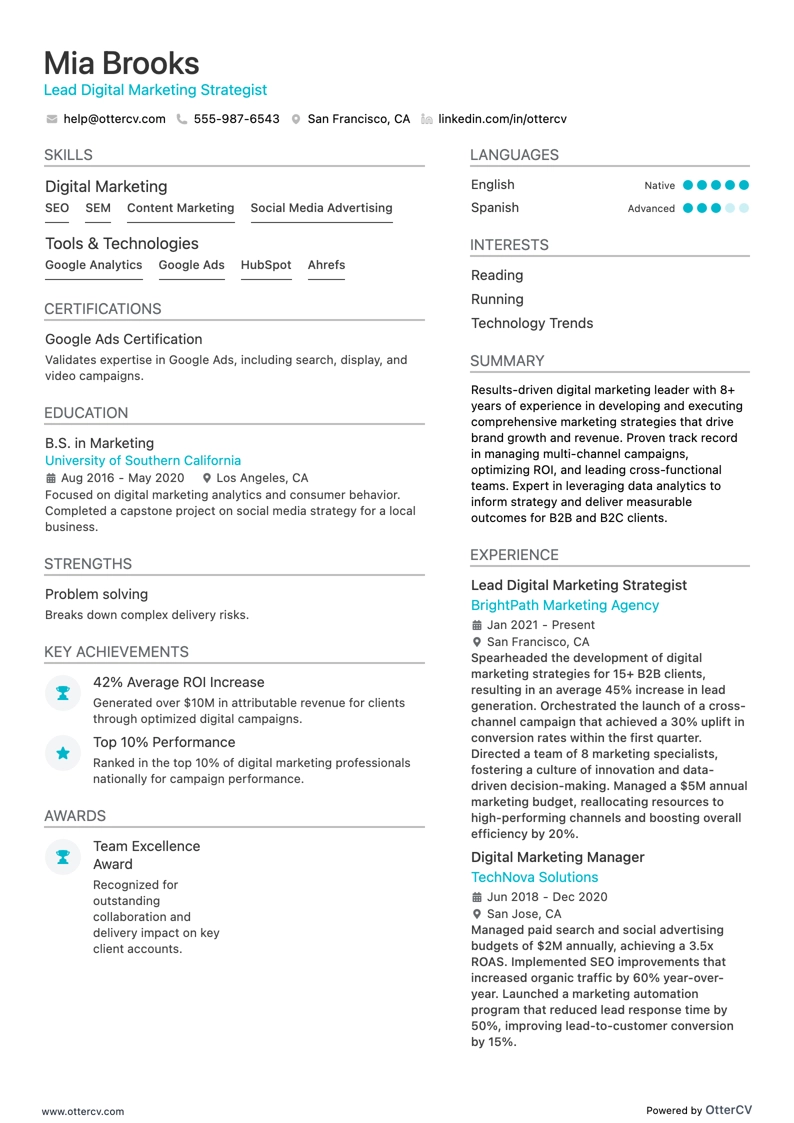
Lead Digital Marketing Strategist resume example

Lead Digital Marketing Strategist

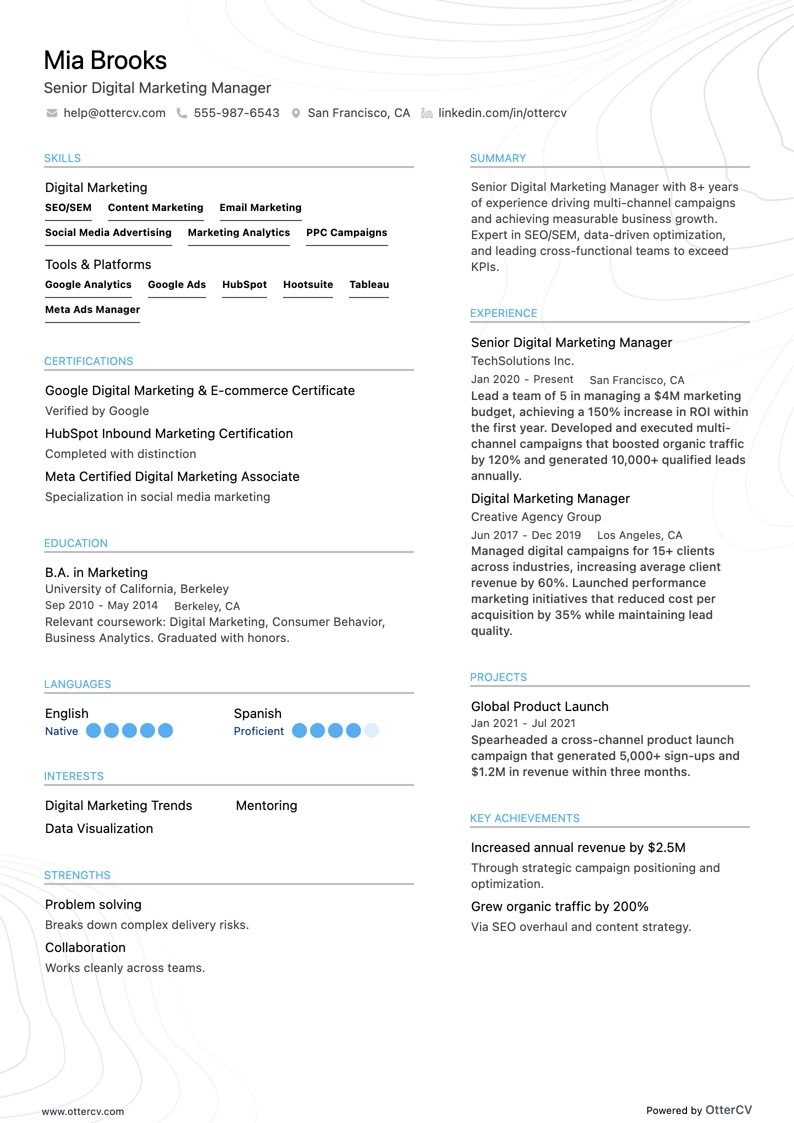
Senior Digital Marketing Manager resume example

Senior Digital Marketing Manager

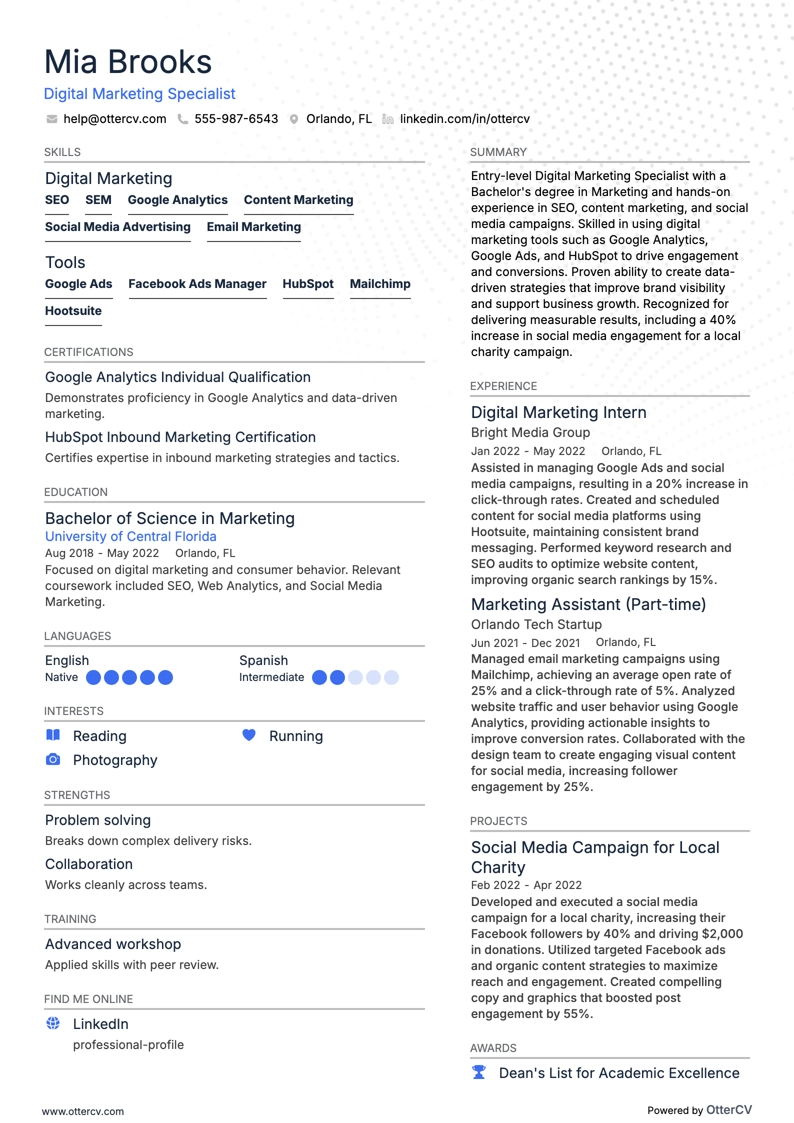
Entry-Level Digital Marketing Specialist resume example

Entry-Level Digital Marketing Specialist

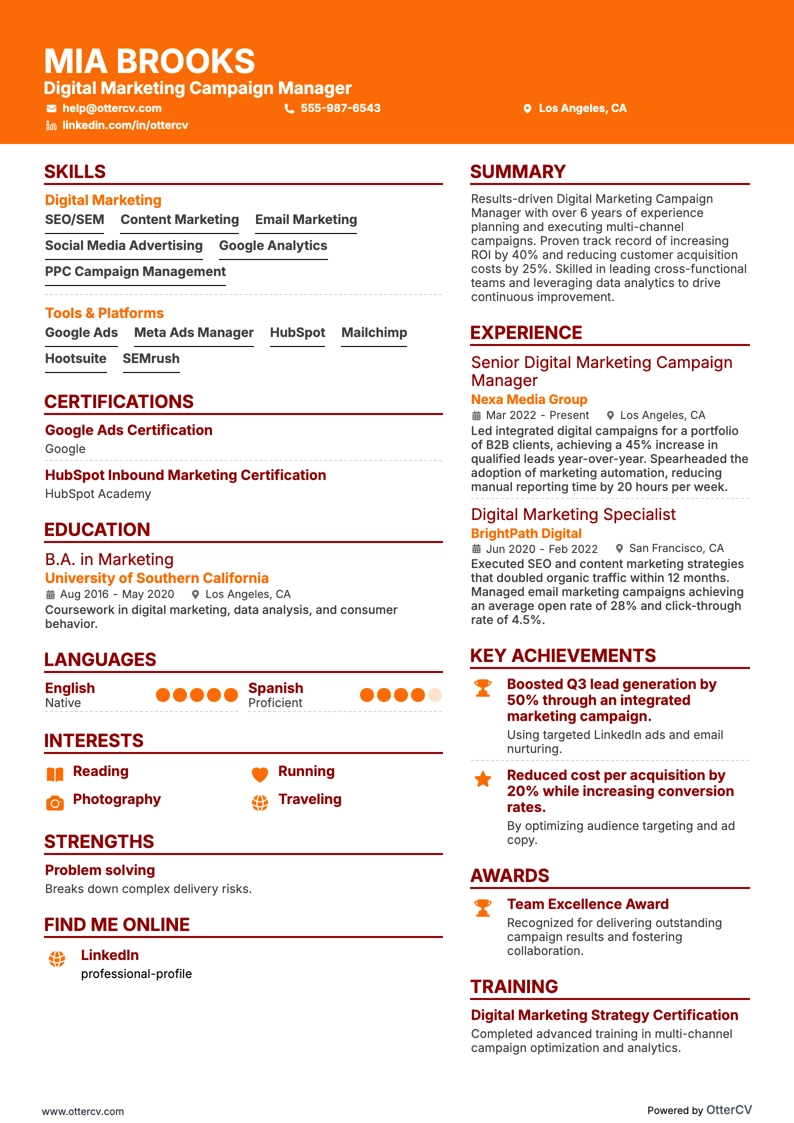
Digital Marketing Campaign Manager resume example

Digital Marketing Campaign Manager

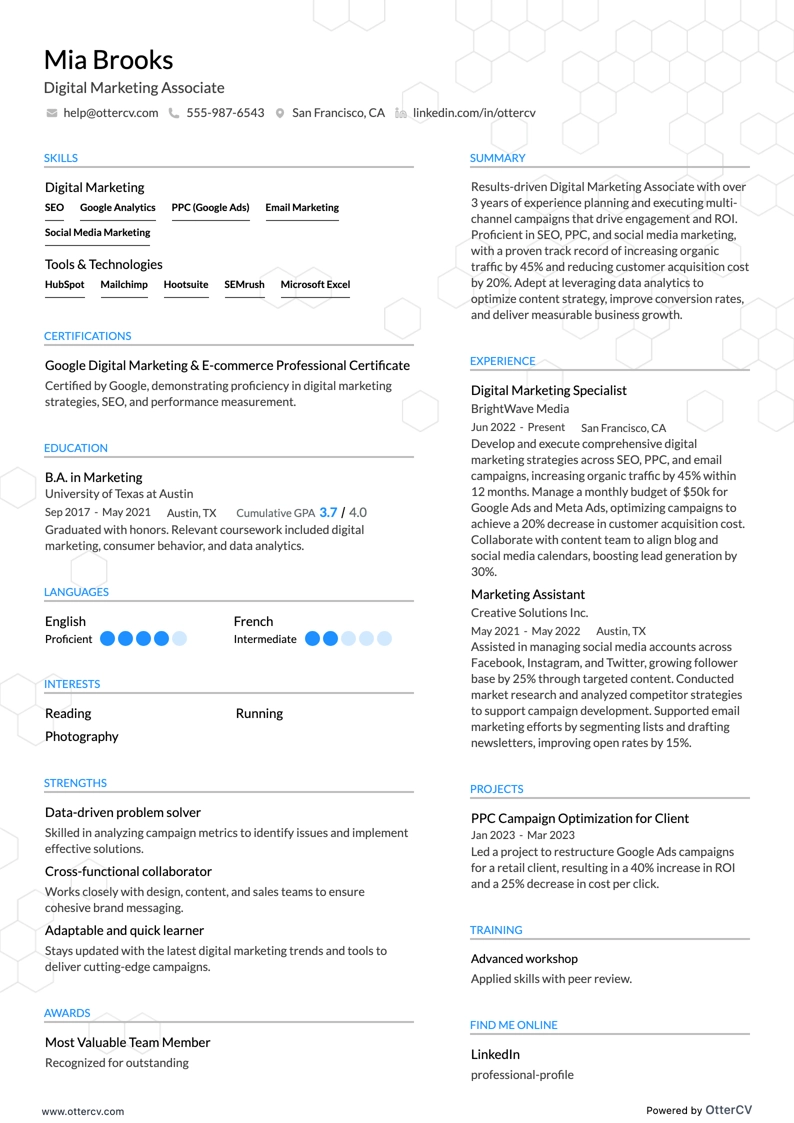
Digital Marketing Associate resume example

Digital Marketing Associate

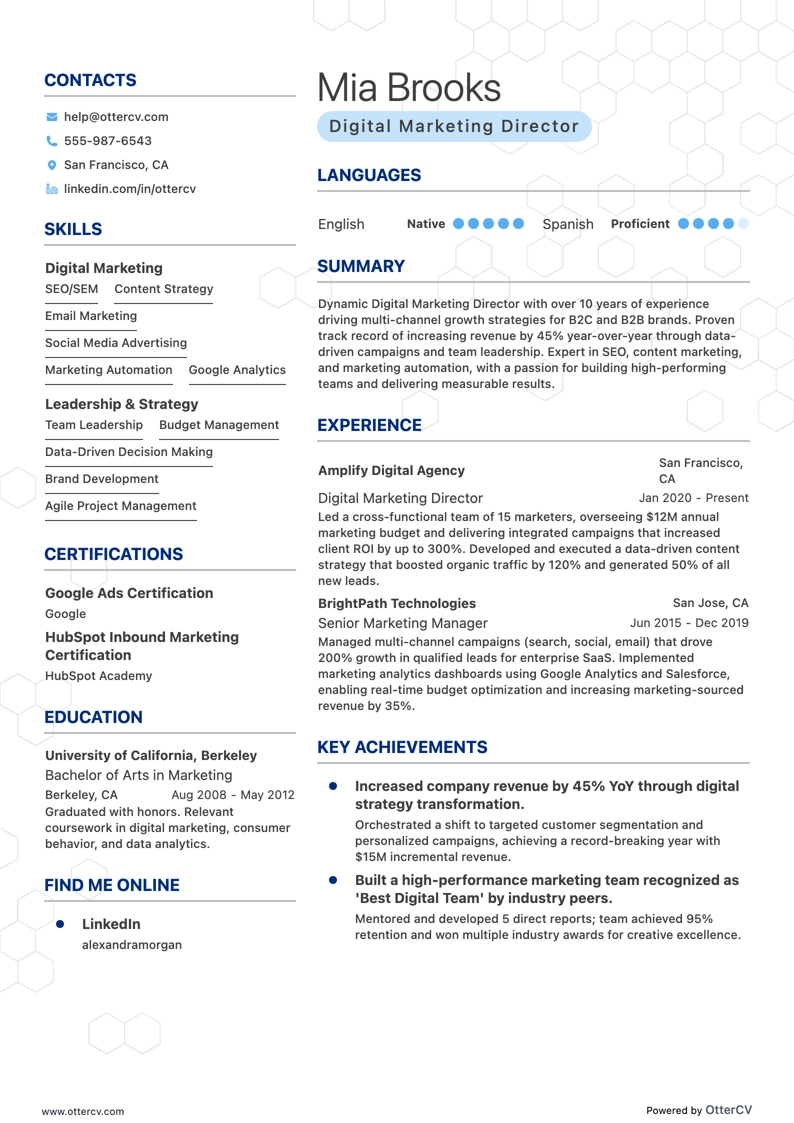
Digital Marketing Director resume example

Digital Marketing Director

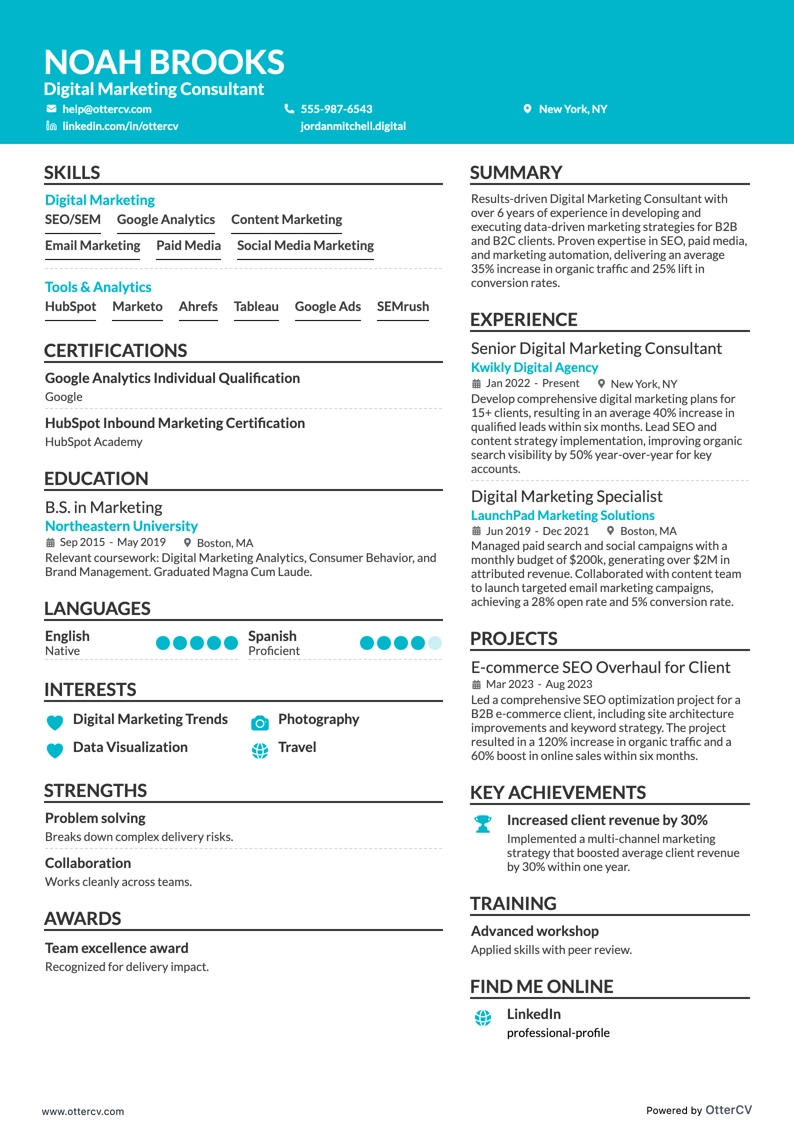
Digital Marketing Consultant resume example

Digital Marketing Consultant

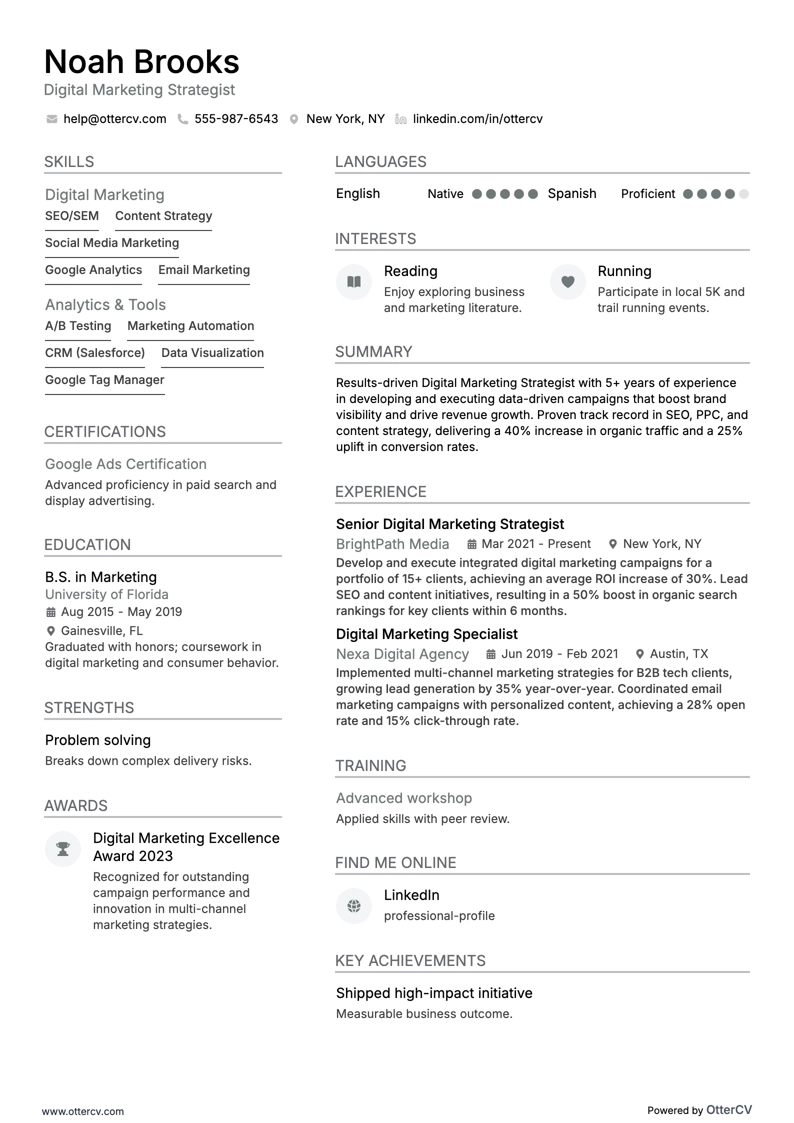
Digital Marketing Strategist resume example

Digital Marketing Strategist

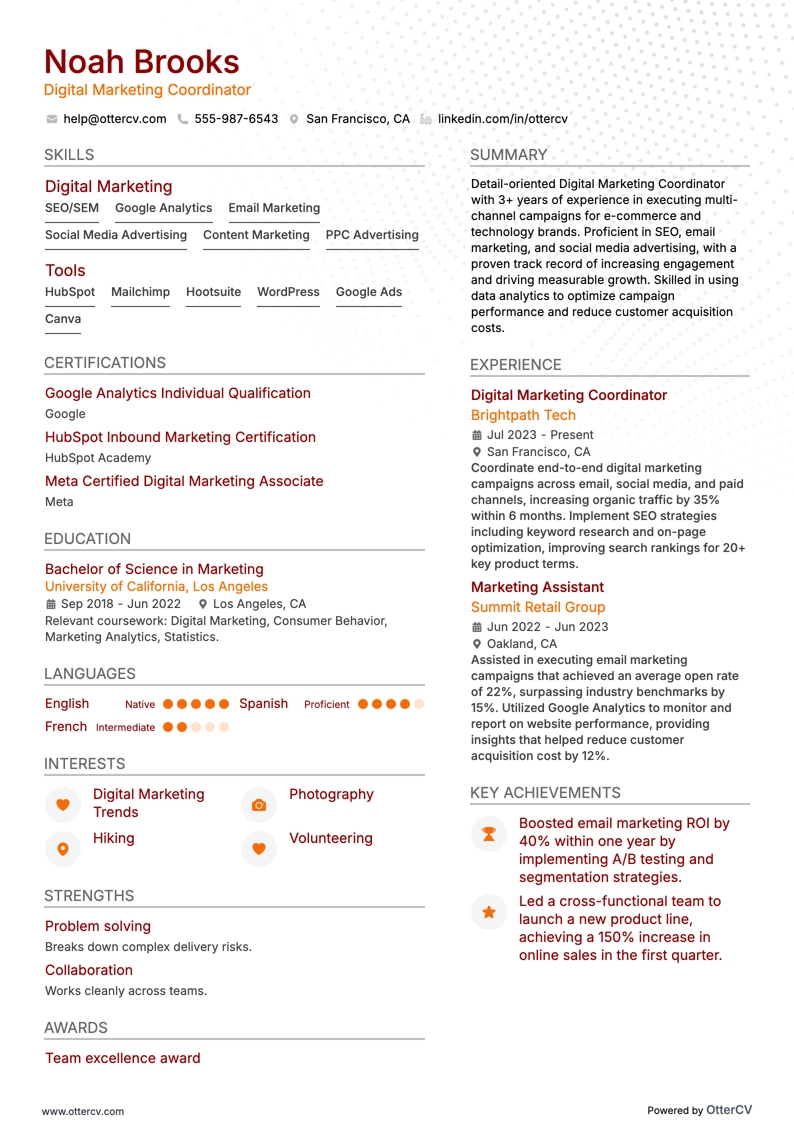
Digital Marketing Coordinator resume example

Digital Marketing Coordinator

The digital marketing industry is highly dynamic, with growing emphasis on content marketing, marketing automation, and AI tools like ChatGPT to automate time-intensive tasks. As a result, writing a digital marketing resume for a modern agency requires you to balance creativity with strong technical skills.

That can quickly become overwhelming without clear guidance. On top of that, the job market in digital marketing is constantly evolving, which means keeping certifications like Google AdWords or Hootsuite Social Marketing up to date to show your credibility. As technology continues to advance, you also need to identify those changes and demonstrate your ability to adapt.

The Bureau of Labor Statistics anticipates a 10% increase in digital marketing job demand by 2026, with digital marketing jobs expected to grow by 6% by 2032, faster than the average job growth rate. This points to strong and rising demand for digital marketing skills, making the field one of the fastest-growing job sectors.

We’ll look at several digital marketing resume examples to show the challenges you may face and help you prove to employers that hiring you is the solution to their problems.

In this section, we’ll cover:

  • Insider tips and tricks for crafting the strongest resume possible.
  • A strong digital marketing resume example and what makes it effective.
  • The formats and sections to include in your digital marketing resume.
  • Good and bad work experience examples, why they work or fall short, and what to include if you do not yet have professional experience.
  • The best way to present your education, skills, and certifications to impress recruiters.
  • The secret weapon of any resume: the summary or objective, plus the steps to write it well.

Already have a resume? See how it compares with our resume checker.

PRO TIP

Digital marketing is a broad discipline, so your resume will be more effective if it shows specialization in a few areas such as social media, SEO, analytics, SEM, UX/web design, content writing, or email marketing.

Also consider whether the role expects you to create strategies or primarily execute them, and make that clear in your resume.

Looking for other related resumes?

Need to get more familiar with the basics of a resume’s purpose first? We got you covered!

What’s the trick to the perfect digital marketing resume?

Here are a few tips to take the guesswork out of building an effective resume. We’ll go into more detail in the sections below.

Be sure your numbers make an impact

Unlike fields where success is easier to measure in dollars, cents, or other tangible results, digital marketing performance can be harder to measure and explain. The impact of SEO strategies, content marketing, or social media campaigns is not always directly visible in immediate sales or profit.

Your resume should include numbers that clearly show your results and position you as a strong performer.

Target your resume to specific company goals

Digital marketing is a broad term that can mean anything from SMM to SEO, but companies are hiring to solve specific needs.

The key word is tailor. Tailor every part of your resume to each job you apply for. Read about the company, study its most active marketing channels, review other job postings, and find out what it currently wants most from digital marketing. In short, do your research.

Digital Marketing Demand Continues to Grow

The digital marketing industry’s expansion is highlighted by LinkedIn data showing 860,000 job openings for “Digital Marketing Specialists.” This demand underscores the importance of skills in social media, content strategy, SEO, and analytics.

It also reflects a broader trend: digital marketing remains one of the most sought-after job categories as businesses continue to digitize their operations and invest in strengthening their online presence.

Resume format and layout make it easy to read

Use headings, bullet points, and custom sections to make your resume easy to scan. It’s also a good idea to highlight your results with bold text. For a digital marketing resume, you’ll generally choose from a few common formats.

  • Hybrid or combination resume format: combines the main elements of a functional resume and a chronological resume to show both your skills and employment history.
  • Functional resume format: focuses on your skills and transferable abilities instead of prioritizing work history and job titles.
  • Reverse chronological resume format: lists your most recent experience first, and the same approach can apply to your education history. This format is best for people with a rich employment history.

Keep these additional tips in mind:

  • Header: Your resume header is the first thing people read. Include contact information, professional social links such as LinkedIn, and possibly a resume photo, although it is not required.
  • Length of a resume: It’s best to keep your resume length between 1 and 2 pages, since most recruiters lose interest after the second page.
  • File format: Unless told otherwise, a PDF resume file is usually better than a Word document. PDFs are easy to share and avoid issues with images shifting around.
  • Choose the right font: Use a standard 12p font. Common choices include Rubik, Lato, Montserrat, Raleway, Exo 2, Volkhov, and standard serif and sans-serif fonts.

Optimize your resume for ATS

Applicant Tracking System (ATS) software automates the hiring process by identifying top candidates based on specific keywords, such as skills and job titles. For job seekers, optimizing a resume for ATS is important for visibility.

Here are a couple of ways to make your ATS-friendly resume stronger:

  • Use relevant resume keywords: ATS tools scan resumes for terms related to the job posting. If your resume lacks those keywords, it may be filtered out, so adding them strategically can improve your chances of being noticed.
  • Apply standard formatting: ATS may not parse resumes correctly if they use non-standard layouts, graphics, or unusual section titles. Standard formatting helps ensure your information is read accurately.

Learn as much as you can about ATS and follow proven tips to improve the chances of your resume passing the system’s filters and reaching a recruiter.

Still feeling a bit out of your element? Take a closer look at these tips on writing resumes.

Digital marketing resume example

Lead Digital Marketing Strategist resume preview

What this applicant does well in their resume

  • Quantifiable achievements: The resume highlights specific results, including increasing user acquisition by 45% and improving ROAS by 30%, which aligns well with the role’s focus on growth and efficiency.
  • Relevant experience and skills: The applicant shows experience with key tools and platforms, including Meta, Google Analytics, and SQL, demonstrating a strong technical foundation for the role.
  • Education and certifications: Certifications in Advanced Google Analytics and Effective Creative Testing show a commitment to continuous learning and skill development in digital marketing.

The right format for your digital marketing resume

When building a digital marketing resume, your first choice is whether to emphasize skills or work experience. The right balance depends on your background and the role you want, but both matter when showing your fit for the position.

Here’s how to approach it:

Early Career Professionals

  • Focus on skills: If you do not yet have extensive work experience, highlight your digital marketing skills. Include competencies such as SEO, content marketing, social media management, PPC advertising, analytics, and any relevant certifications or courses you have completed.
  • Project and internship experience: Add internships, volunteer work, or projects, including class projects, that show your skills in practice. This helps fill the experience gap with real examples of what you can do.

Mid to Senior-Level Professionals

  • Highlight work experience: If you have substantial experience, put more emphasis on your professional history. Describe your roles, responsibilities, and the impact you made at previous organizations. Quantify achievements where possible, such as increasing website traffic by 30% or boosting conversion rates by 20%.
  • Skills as supporting evidence: Do not leave out your skills section. Include both hard skills, such as tools and platforms you know well, and soft skills, such as leadership, teamwork, and communication. Tailor this section to the job description so the most relevant skills stand out.

General Tips

  • Keywords: Use digital marketing keywords throughout your resume. This can help with ATS screening and better align your resume with the job posting.
  • Results-oriented: Frame your contributions around outcomes and results. Employers want to see the value you can bring to their organization.

Targeting Canada? Keep in mind their resume layout may differ from others.

Digital marketing sections to consider

  • Summary or objective statement: Briefly present your qualifications, expertise, and skills relevant to a digital marketing role.
  • Digital marketing work experience: Show your experience and expertise in digital marketing through past roles, but don’t overdo it.
  • Key skills: Highlight hard skills such as SEO, SEM, and content marketing, along with soft skills like creativity and problem-solving.
  • Education, certifications, and training: List relevant degrees, qualifications, or training, such as HubSpot Content Marketing Certification (HubSpot) and Google Digital Garage: Fundamentals of digital marketing.
  • References on a resume: Include previous employers or clients who can confirm your digital marketing skills, work ethic, and achievements.

What recruiters look for on a digital marketing resume

  • Practical SEO and SEM experience: Recruiters prioritize these skills because they directly affect a company’s online visibility and reputation.
  • Content creation skills: Creating compelling, high-quality content is essential for attracting audiences and supporting successful marketing campaigns.
  • Familiarity with social media platforms: This is an important part of a strong digital marketer’s skill set.
  • Analytical skills: Recruiters value candidates who can evaluate campaign performance, understand audience behavior, and improve future efforts.
  • Up-to-date knowledge of marketing trends: Because digital marketing changes constantly, recruiters look for candidates who can adapt to new techniques and help maintain the company’s competitiveness.
  • Usability skills: Digital marketers should show website usability knowledge, including User Experience (UX) and User Interface (UI).

Digital marketing resume experience

Let’s look at both a bad and a good example of how to list your work experience on a resume for a digital marketing role:

Experience

Digital Marketing Position

A Creative Agency

01/2019 - 12/2021 · Gig Harbor, WA

Helped other companies improve through digital marketing support.

  • Performed digital marketing activities.
  • Managed social media.
  • Collaborated with the team on projects.
  • Supported website-related tasks.
WRONG

What’s obviously missing

  • Vague job title: “digital marketing Position” is too broad and does not clarify the role or level of responsibility.
  • Lack of specifics: The duties are described in general terms without explaining what was actually done, so the scope of work and relevant skills are unclear.
  • No results shown: It does not mention outcomes or achievements. Recruiters look for measurable impact.
  • Missing context: There is no description of the company or industry, which makes it harder to judge the scale and relevance of the experience.
  • No skills or tools mentioned: It does not identify any digital marketing tools or techniques used, so the candidate’s competencies are difficult to assess.
  • Generic language: The wording is non-specific and could apply to almost any job, so it does little to stand out or capture interest.

Experience

Digital Marketing Specialist

XYZ Digital Agency

02/2020 - 09/2023 | Apache Junction, AZ

A leading provider of cloud-based solutions to small businesses.

  • Led a digital campaign that increased online sales by 35% in 2021 through targeted social media advertising and email marketing.
  • Implemented an SEO strategy that moved the company’s main product page into Google’s top 3 results for key phrases, driving a 50% increase in organic traffic.
  • Designed and executed a content marketing plan that doubled blog traffic and increased subscriber count by 40%.
  • Managed a $15,000 monthly digital advertising budget and optimized it for a 20% increase in ad conversion rates.
RIGHT

Why this example is so much better:

  • Company context: A brief description of the company helps the reader understand the industry and scale of the business.
  • Specific achievements: It includes concrete results such as sales growth, SEO ranking improvements, and traffic increases, showing clear business impact.
  • Strategy and execution: It demonstrates the ability to develop and carry out digital marketing strategies, highlighting both strategic thinking and execution.
  • Budget management: It shows responsibility for budgets, which signals trustworthiness and financial awareness.
  • Relevance to digital marketing: Each point connects directly to core digital marketing functions, making the experience highly relevant to similar roles.
  • Clear and concise: Straightforward language makes the achievements and responsibilities easy for hiring managers to understand quickly.

How to quantify impact

Quantifying your achievements or impact on a resume matters because it gives employers measurable evidence of your results. It makes your accomplishments easier to understand, shows the value you brought to previous organizations, and helps you stand out from other candidates.

  • Mention the percentage increase in organic traffic driven by your SEO strategies.
  • Include the number of leads generated through your social media campaigns.
  • Show the conversion rate improvements you helped achieve.
  • State the budget amount you managed for pay-per-click campaigns.
  • Report any reduction in cost-per-acquisition under your strategies.
  • Outline the percentage growth in website engagement or dwell time resulting from your content strategy.
  • Document any significant increase in social media followers or likes during your time in the role.
  • Point to quantifiable improvements in email marketing open or click-through rates.

Freelance and Remote Work Are Reshaping Marketing Jobs

The shift toward freelance and remote work is changing the industry's employment landscape. A notable 54% of marketing leaders now hire freelancers, driven by factors such as layoffs and the growing preference for work-from-home arrangements. This trend highlights the flexibility and adaptability digital marketing professionals need in today’s job market.

How to get hired as a digital marketer without experience

If you need to create a resume with no work experience in digital marketing, it’s not the end of the world. Focus on showing relevant skills, projects, and what you’ve learned.

Here’s what to include:

  • Education and certifications: List your degree and any relevant certifications, such as Google Analytics, Google Ads, and HubSpot Inbound Marketing.
  • Relevant skills: Emphasize the digital marketing skills you’ve learned through courses or self-study, including SEO, content creation, social media management, data analysis, and PPC advertising.
  • Personal projects: Show projects where you’ve applied digital marketing skills, such as managing a blog, running a social media campaign, or building and optimizing a website.
  • Internships and volunteer work: Include any internships or volunteer roles that involved digital marketing tasks, even if they were only part of your responsibilities.
  • Online courses and workshops: Mention relevant online courses, webinars, or workshops you’ve completed.
  • Soft skills: Highlight qualities that matter in digital marketing, such as creativity, adaptability, analytical thinking, and communication skills.
  • Tools and platforms: List the tools you know, such as Google Analytics, SEMrush, Mailchimp, WordPress, and Hootsuite.
  • Achievements and results: If you have measurable results from personal projects or related work, such as increased website traffic or improved social media engagement, include them.

No job history? Build your skills on your own. One strong signal is showing that you’ve created a website or blog with a specific focus; simply using Facebook and “being online all the time” isn’t enough.

—Clay Cazier, VP of Search Strategy at PMX Agency

Focusing on these areas shows potential employers that you have a foundational understanding of digital marketing and the eagerness to learn and grow in the role, even without direct job experience.

For more examples, see our Experience Resume Section guide.

Digital marketing skills that make all the difference

Because digital marketing covers such a wide range of disciplines, listing your skills is essential. It highlights your expertise, helps you stand out as a candidate, and shows how your strengths match the job requirements.

Hard skills on a resume refer to technical abilities such as SEO, analytics, PPC, and content management—skills that are measurable and teachable. Soft skills, such as creativity, communication, problem-solving, and adaptability, are personal traits that support strong collaboration, job performance, and effective communication in the fast-changing digital marketing landscape.

Here are some of the most in-demand digital marketing skills:

As mentioned, digital marketers are often expected to specialize in one or more areas. That is why it is important to identify the kind of digital marketer the recruiter is looking for and highlight the skills most relevant to that role.

If you are still unsure which skills will impress recruiters, see our guide on How to Create A Resume Skills Section To Impress Recruiters and our exhaustive list of skills that recruiters look for.

Does a digital marketing resume need an education section?

Yes, in general, it should. For seasoned professionals, the education section may be less important, though it can still complement your certifications and show your foundational knowledge. For recent graduates, however, it is important to include your degree because it reflects your academic background and relevant field skills.

Even without a degree, you can still show that you are qualified. As one digital marketer put it:

“Certifications are the new degree.”

—Justin Emig of the digital marketing agency Web Talent Marketing

The purpose of a degree is to show that you have relevant skills. If you can demonstrate those skills in another way, that can be even better. In digital marketing, which changes quickly, recent certifications and hands-on experience are often more valuable than a marketing degree earned even 5 years ago.

Presenting your education on your resume

If you have degrees, make sure to highlight them in a strong education resume section alongside relevant certificates. Together, they can make a strong impression on recruiters.

For a professional and straightforward presentation, follow these guidelines:

  • List items in reverse chronological order: Start with your most recent qualification or academic achievement and work backward, just as you would with work experience.
  • Use separate sections for certificates and education: To showcase your credentials more clearly, consider creating a section for each.

What to include:

  • Degree name: Specify the degree you earned.
  • Institution name: Include where you earned your degree.
  • Graduation date: State when you graduated or are expected to graduate.
  • Major/Concentration: List your major as well as any related minors.
  • Relevant courses or projects: Include these, especially if they relate directly to digital marketing.
  • Certifications: Add any digital marketing-related certifications.
  • GPA: Include your grade point average if it is impressive and you are a recent graduate.
  • Awards: Include any awards related to your field if they are relevant to the position you are applying for.

Here’s one example:

Education

Bachelor of Science in Marketing (Major)
University of Digital Arts
02/2018 - 05/2022
GPA: 3.8 / 4.0

  • Minor in Graphic Design.
  • Relevant Courses: Digital Marketing Analytics, Social Media Strategy, Content Marketing.
RIGHT

Three reasons why it’s a good example:

  1. Clarity and structure: The section is well organized, making it easy for recruiters to quickly identify the candidate’s education level, institutions attended, and graduation dates.
  2. Relevance: Including courses directly related to digital marketing shows the candidate’s commitment to the field and highlights skills that employers look for.
  3. Achievements highlighted: Listing the GPA and specific courses showcases academic performance and ongoing professional development, signaling a strong work ethic and dedication to the field.

Do you need digital marketing certifications?

If you read advice from experienced digital marketers, certifications come up again and again. They’re one of the easiest ways to stand out from the competition, demonstrate your skills, and grow as a digital marketer without needing formal work experience.

It’s also worth noting that digital marketers often work like project managers in many situations, so if you have project management certifications, you can include them on your digital project manager resume as well.

Any Google certifications you can get will be a huge differentiator, especially the Google Analytics individual qualification.

—Clay Cazier, VP of Search Strategy at PMX Agency

In conclusion, certifications on your resume are extremely important, so it is often worth adding a separate section for them after education.

To present a certificate properly, include:

  • Certification name: the full name of the certification.
  • Issuing organization: the name of the organization that issued it.
  • Date of completion: the month and year you received it. If the certificate has an expiration date, it can also be helpful to include that.
  • Location (optional): the address where you obtained the certification, if applicable.

Below are the certifications our research identified as among the most sought-after by recruiters.

Resume summary

A resume summary is a brief statement, usually 2-4 sentences, placed at the top of your resume to highlight your experience, skills, and achievements in digital marketing. It is best suited to professionals with experience in the field, showing their expertise, the value they bring, and their career accomplishments.

Resume objective

A resume objective, by contrast, focuses on your career goals and how you plan to contribute to a potential employer. It is typically used by those with less experience in digital marketing or those changing careers. The objective emphasizes your aspirations and how your skills, including those gained in other fields, can apply to digital marketing roles.

Why are these sections important?

  • Tailoring your application: Both help tailor your resume to digital marketing roles and make it clear at a glance what you offer or want to achieve.
  • First impression: They give employers a quick view of your professional background or career goals, helping create a strong first impression.
  • Screening tool: Many employers use these sections to quickly screen candidates for keywords or objectives that match the job opening.

Ultimately, these sections help position you as the ideal candidate for the job. Study the employer and write your summary or objective directly to their digital marketing needs.

The example below is something you will want to avoid.

Summary

Digital marketing professional familiar with a range of online platforms, marketing tools, and project-based campaign work. Enjoys working with people and using online channels to promote products or services. Seeking a digital marketing role to apply existing skills and continue learning.

WRONG

This summary fails to impress because it:

  • Lacks specific details about experience, achievements, or skills.
  • Uses vague language (“stuff,” “things”) instead of concrete examples.
  • Does not quantify accomplishments or identify the tools and strategies used.
  • Does not communicate a clear value proposition to the employer.

Here’s an example of a strong resume summary from a digital marketing specialist:

Summary

Dynamic Digital Marketing Specialist with over 5 years of experience leading omnichannel digital marketing campaigns. Proven success in increasing online presence, engagement, and sales for diverse brands through SEO, PPC, social media, and content marketing strategies. Adept at using data analysis and insights to improve campaign performance. In the last year, increased organic traffic by 40% and boosted conversion rates by 15%. Passionate about leveraging analytics and creative content to achieve marketing goals and drive business growth.

RIGHT

Other sections for your digital marketing resume

  • Language skills

  • Hobbies and interests

  • Projects

  • Volunteer work

  • Highlights

  • References

  • LinkedIn on resume

  • GPA

  • Resume awards

  • Publications

  • Industry dynamics and skill requirements: Balance creativity with technical ability, and keep your knowledge and certifications up to date to stay competitive.

  • Adaptability and specialization: Success in digital marketing depends on keeping up with technological changes and adapting quickly.

  • Effective resume strategies: Use the right resume format and layout to highlight relevant skills and experience, optimize for ATS, and include measurable results to show impact.

  • Resume customization: Tailor your resume to emphasize either skills or work experience based on your career stage and the role’s requirements.

  • Keyword optimization: Include relevant digital marketing keywords to improve visibility in Applicant Tracking Systems (ATS) and better match the job description.

  • Use specific metrics to demonstrate success: Percentage increases, dollar amounts, and numerical growth rates give clear proof of your results and capabilities.

  • Relevance of education and certifications: While a bachelor’s degree in marketing, communications, or business administration can be valuable, it is not always necessary to detail your full educational background. Digital marketing often places more value on practical skills and recent certifications.

  • Use of resume summaries or objectives: Both can help tailor your application, create a strong first impression, and support employer screening.

Digital Marketing resume examples

Explore additional Digital Marketing resume samples and guides and see what works for your level of experience or role.

By Experience

Lead Digital Marketing Strategist

Lead Digital Marketing Strategist resume preview

Senior Digital Marketing Manager

Senior Digital Marketing Manager resume preview

Entry-Level Digital Marketing Specialist

Entry-Level Digital Marketing Specialist resume preview

Digital Marketing resume examples

Explore additional Digital Marketing resume samples and guides and see what works for your level of experience or role.

By Role

Digital Marketing Campaign Manager

Digital Marketing Campaign Manager resume preview

Digital Marketing Associate

Digital Marketing Associate resume preview

Digital Marketing Director

Digital Marketing Director resume preview

Digital Marketing Consultant

Digital Marketing Consultant resume preview

Digital Marketing Strategist

Digital Marketing Strategist resume preview

Digital Marketing Coordinator

Digital Marketing Coordinator resume preview