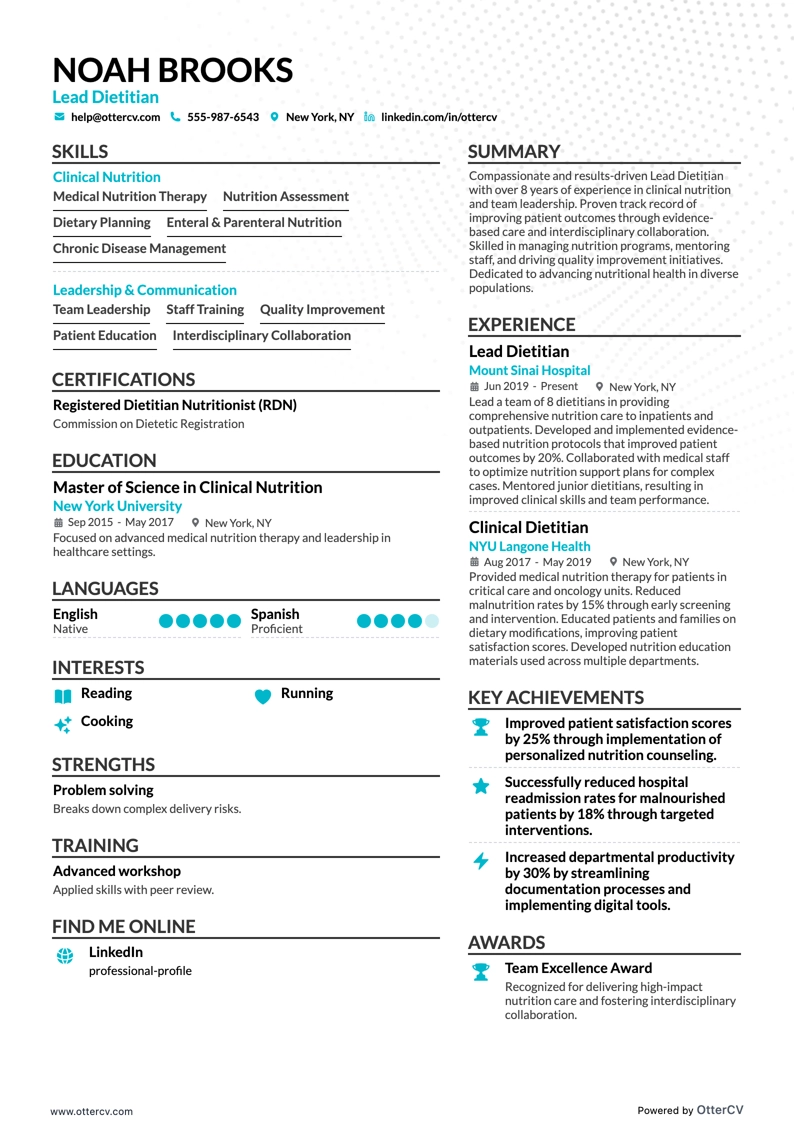
Lead Dietitian full preview

10 Dietician Resume Examples

OtterCV

Written by The OtterCV Team

Updated: 8/31/2023•8 min read

See all resume examples in this guide, or generate your own resume example with your personalized prompt

Lead Dietitian resume example

Lead Dietitian

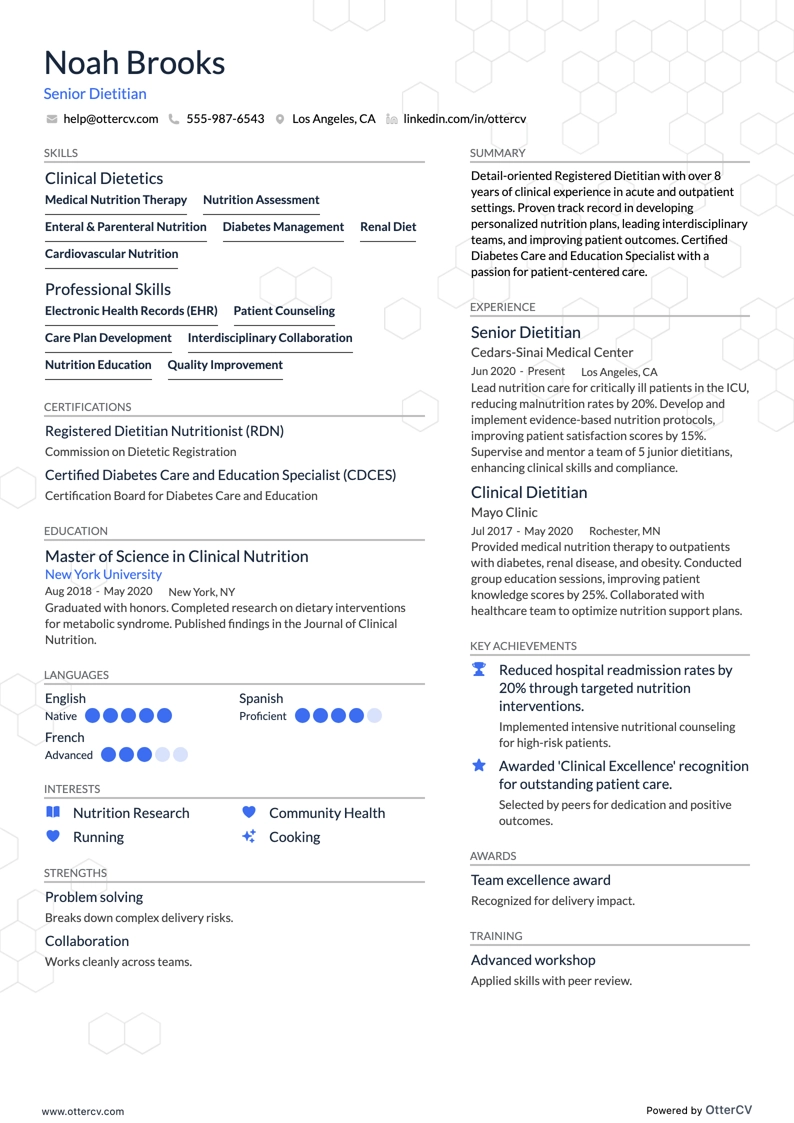
Senior Dietitian resume example

Senior Dietitian

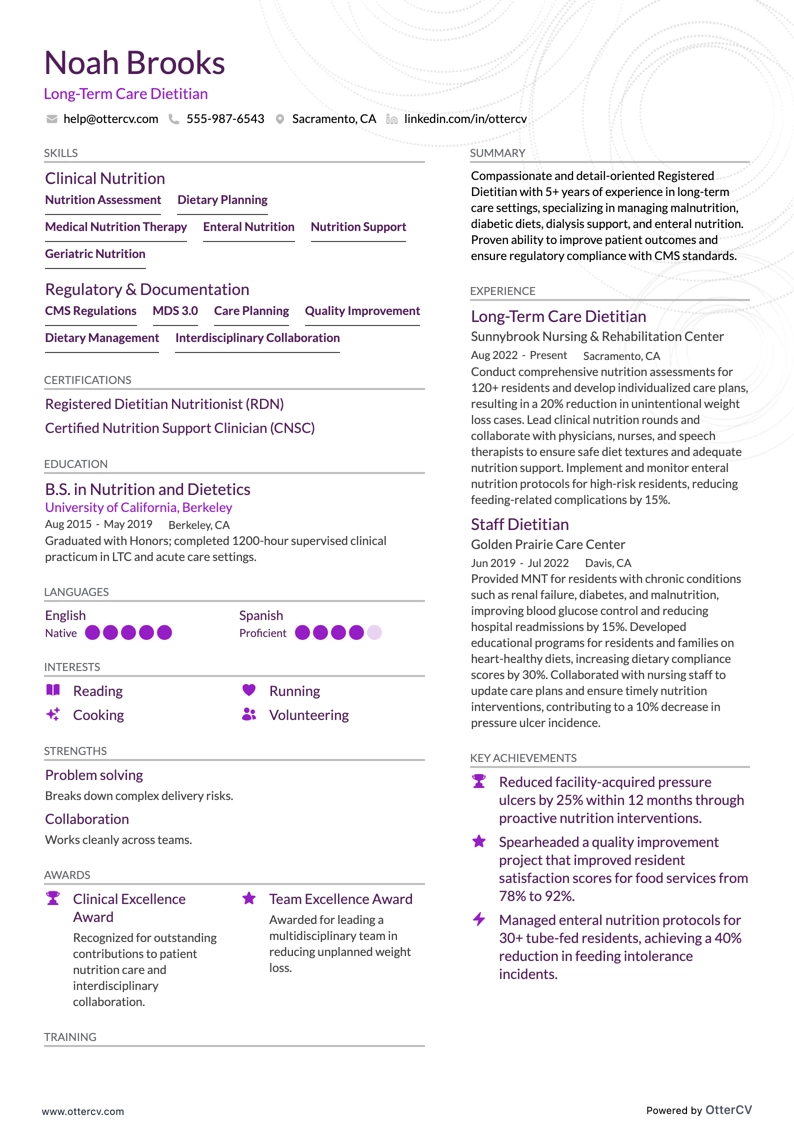
Long-Term Care Dietitian resume example

Long-Term Care Dietitian

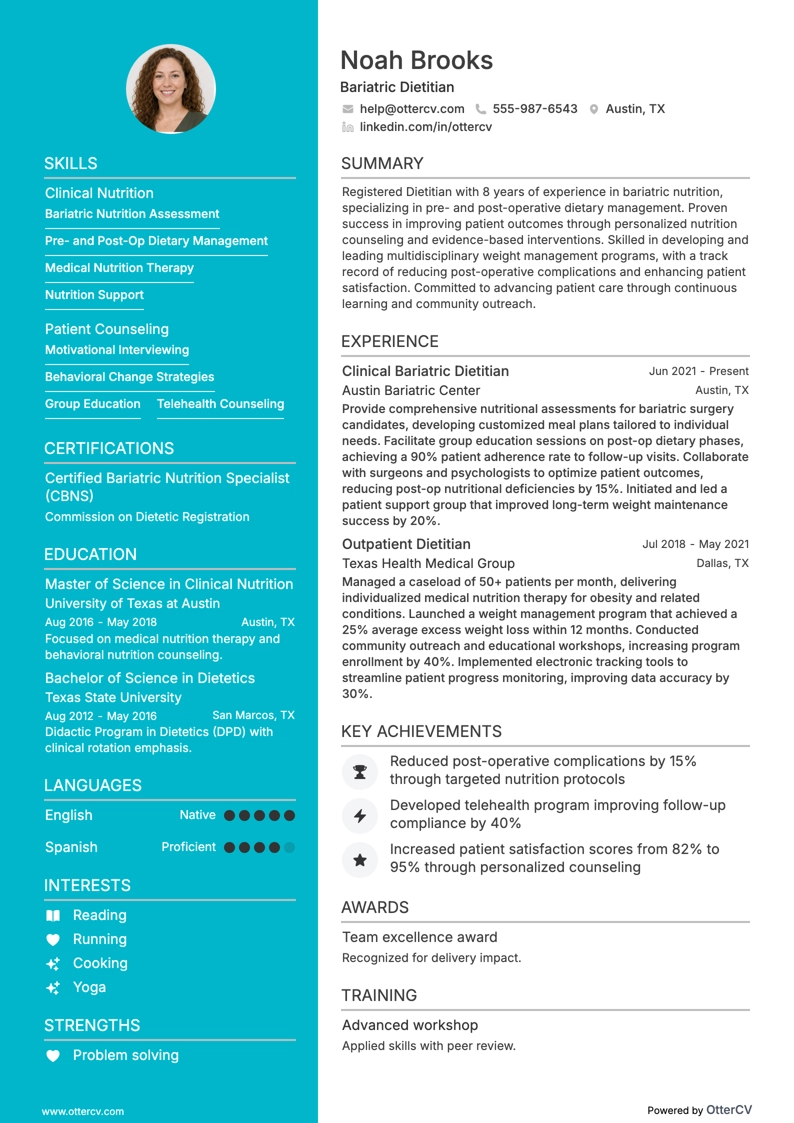
Bariatric Dietitian resume example

Bariatric Dietitian

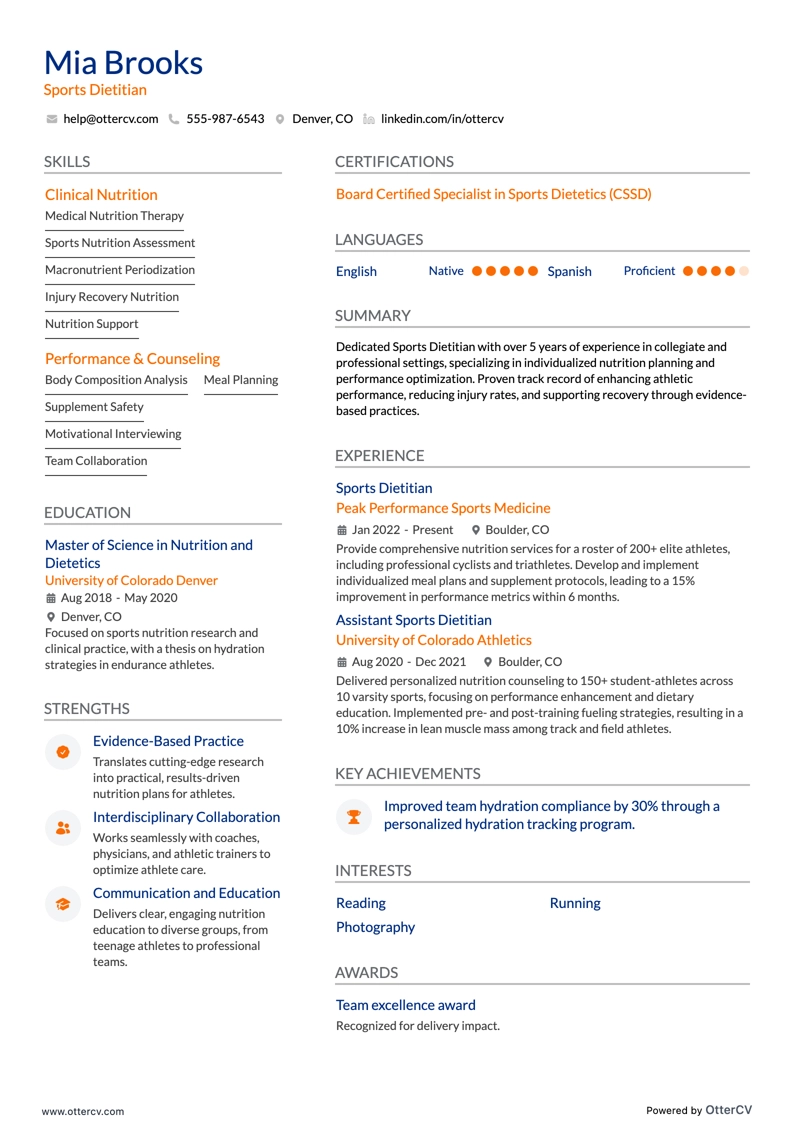
Sports Dietitian resume example

Sports Dietitian

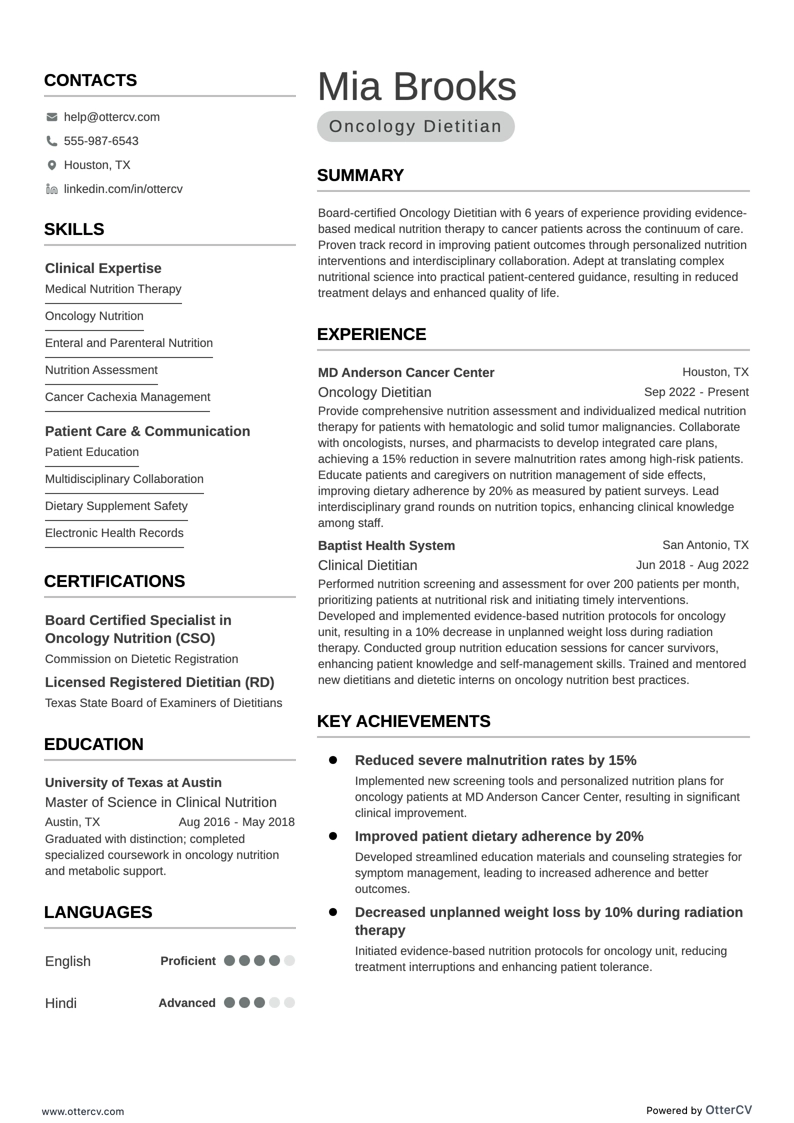
Oncology Dietitian resume example

Oncology Dietitian

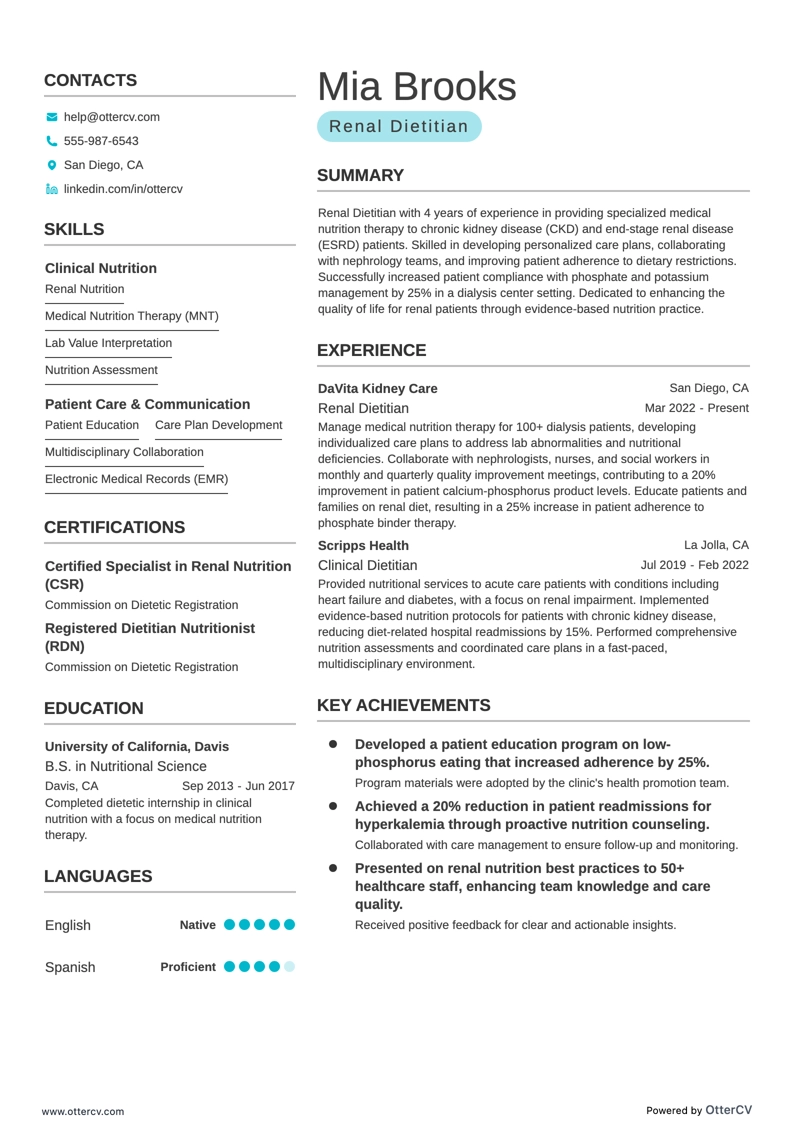
Renal Dietitian resume example

Renal Dietitian

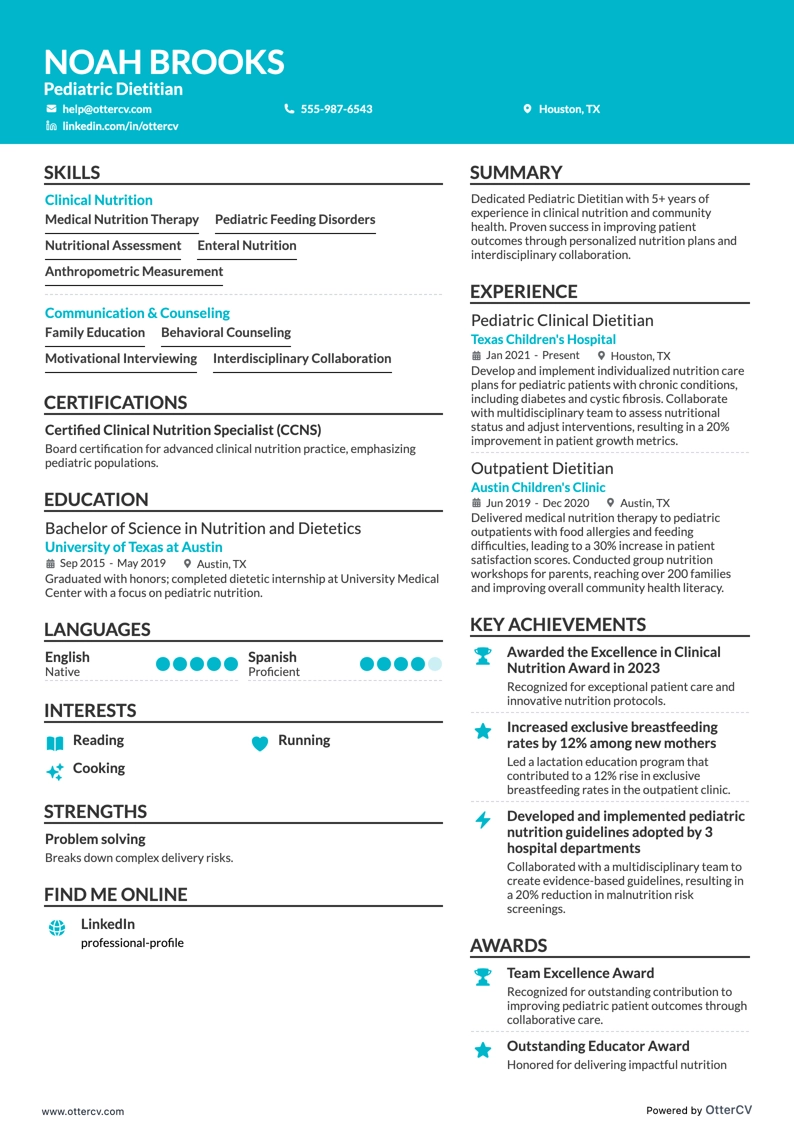
Pediatric Dietitian resume example

Pediatric Dietitian

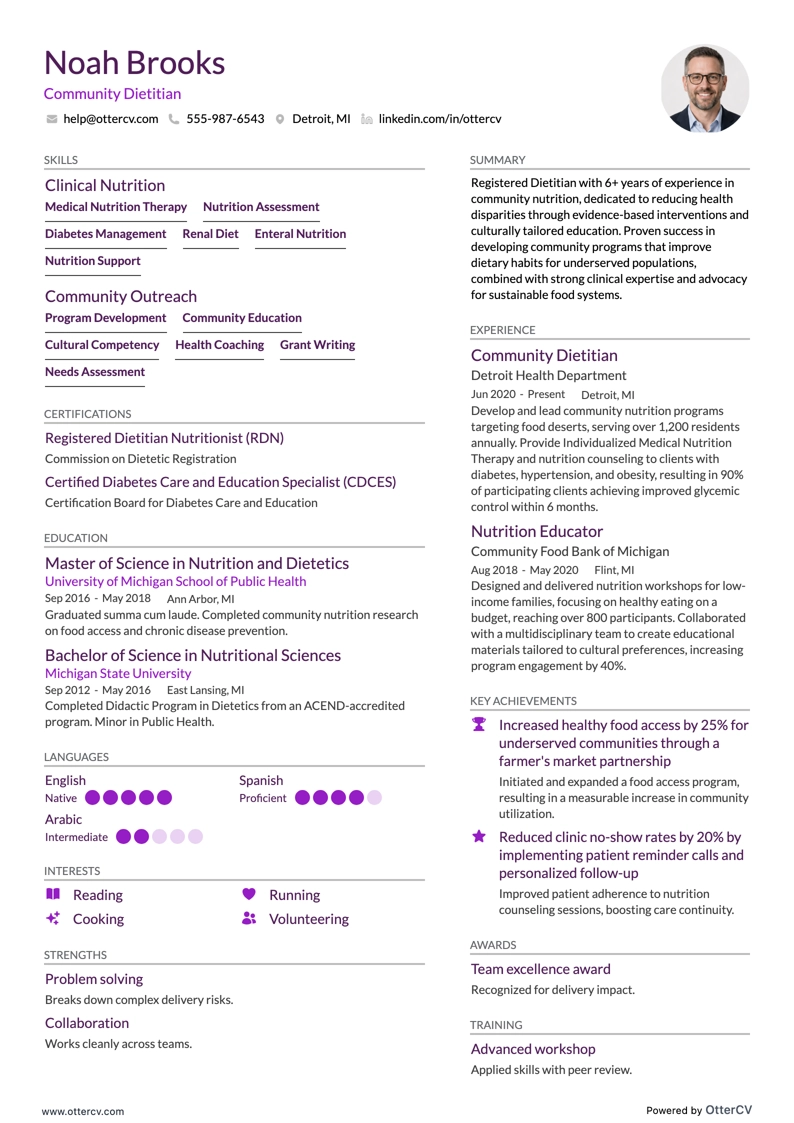
Community Dietitian resume example

Community Dietitian

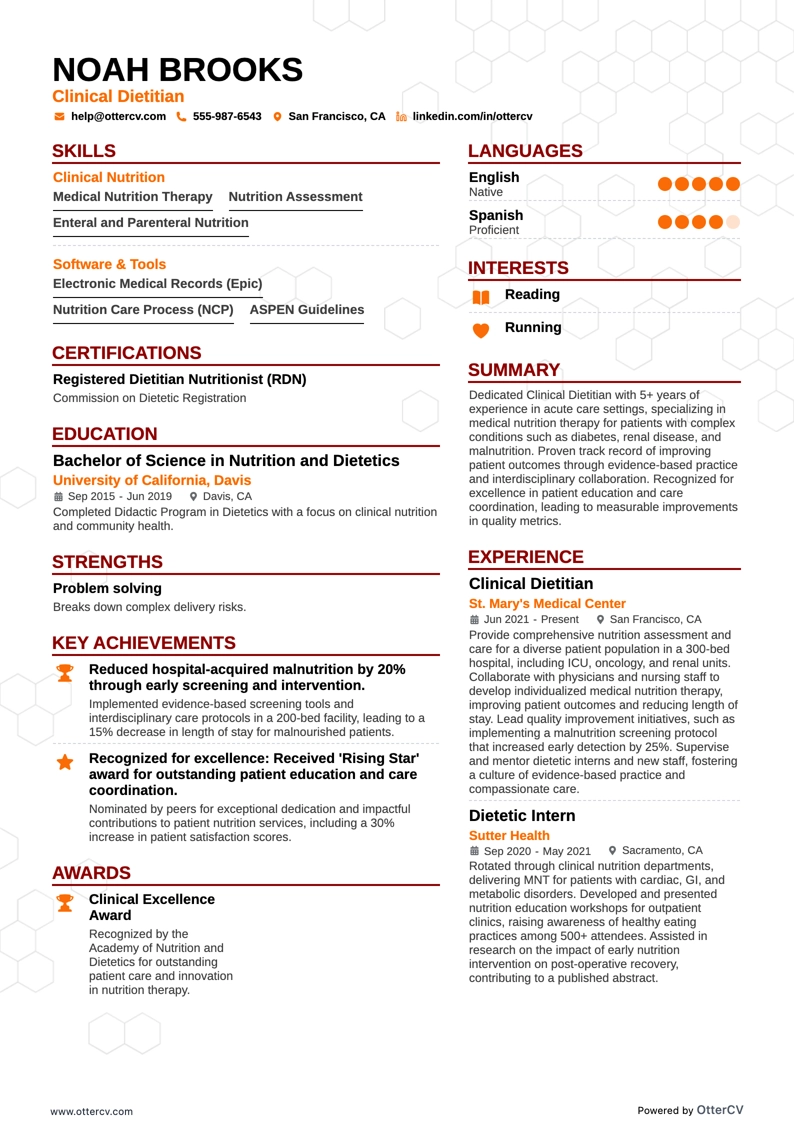
Clinical Dietitian resume example

Clinical Dietitian

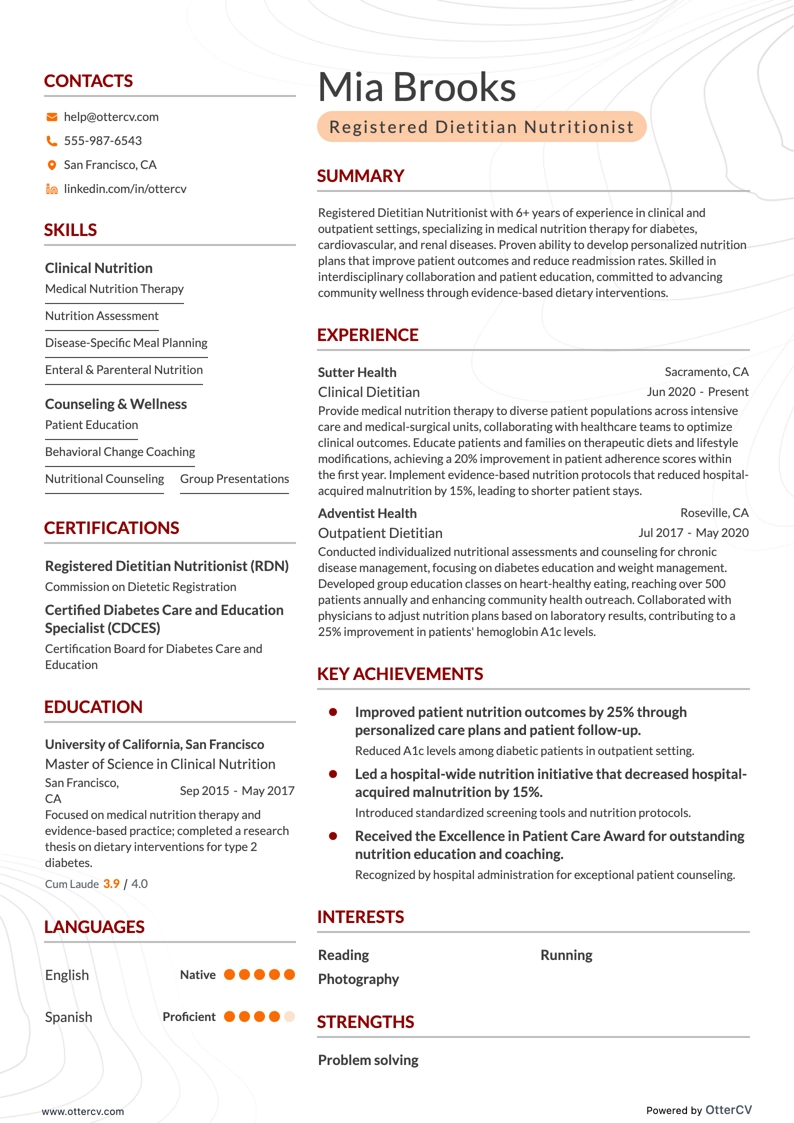
Registered Dietitian Nutritionist resume example

Registered Dietitian Nutritionist

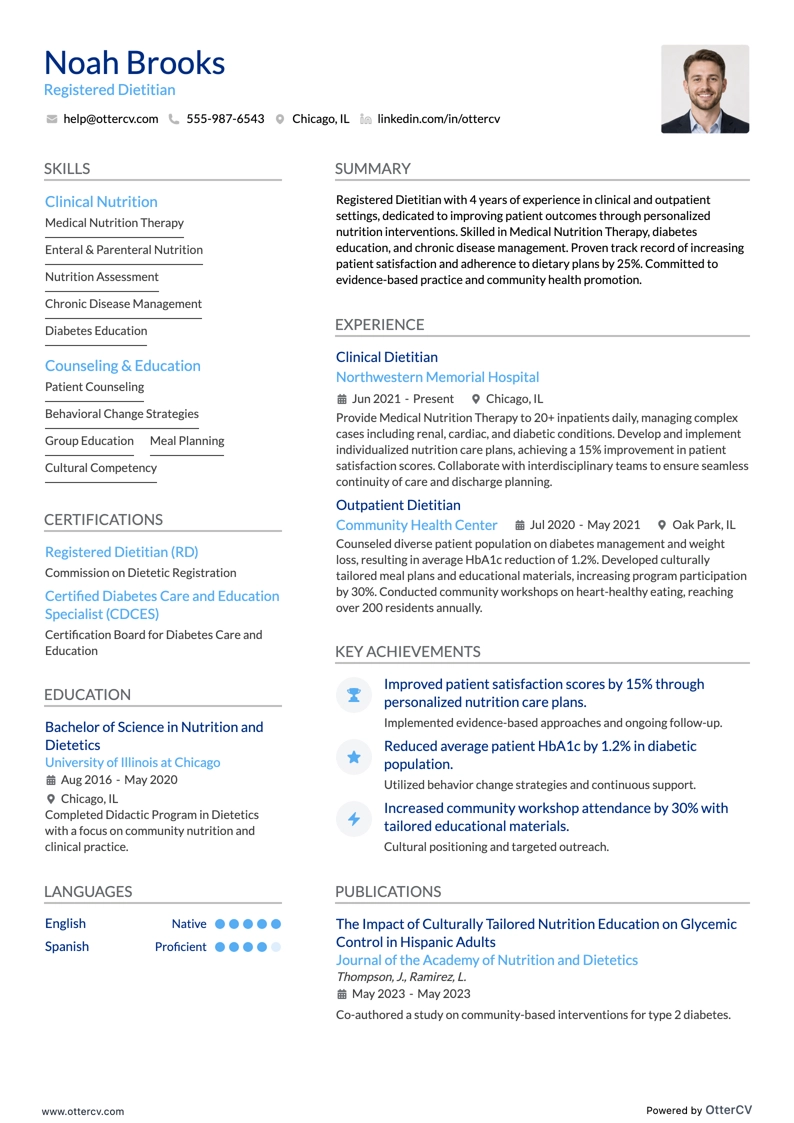
Registered Dietitian resume example

Registered Dietitian

Dieticians exploring a new job will find opportunities across many industries, including healthcare, food services, education, sports, and fitness. Because professionals in this field often come from varied backgrounds, creating a resume that is both compelling and tailored to a specific job post can be challenging.

In this guide to creating a professional dietician resume, we cover common challenges such as:

  • Using professional jargon in a way that HR staff, families, and others can understand.
  • Tailoring your work experience to show versatility while still focusing on the specific requirements of the job post.
  • Clearly presenting your scientific and nutritional knowledge and interpersonal strengths across multiple resume sections.
  • Highlighting your connection to the profession through membership in the Academy of Nutrition and Dietetics or other national associations.
  • Showing your commitment to continued learning through workshops, seminars, and conferences covering advances in nutrition research and dietetics.

We’ll also use real-world dietician resume examples to help you create a targeted resume that reflects specifics from the job post and improves your chances of getting an interview.

If this dietician resume guide does not match your career goals, you may also want to review these guides for similar roles:

Before adding your work experience, education, and hard and soft skills, you should first decide on the design and layout of your resume.

How to format a dietician resume

Formatting your resume is the first step toward helping it pass applicant tracking systems and get noticed by recruiters. Use these document settings:

  • One-inch margins on all sides to improve readability and keep the layout organized.
  • A plain white background with black text for a clear, professional appearance.
  • Single line spacing to keep sentences concise and fit enough information on one page.
  • Font size between 10 and 12 points, which is standard for both print and digital readability.
  • A two-page limit, which is the industry standard and gives you enough room to present your skills and experience.
  • Document type: submit your resume as a PDF so the formatting stays consistent across operating systems.

These settings are already standard in most new Word or Google Docs files, so there is usually not much to adjust.

Your resume design and layout also give you room to personalize your application. Echocv offers a range of resume templates to choose from.

The right resume format depends on your career stage:

  • Functional resume: best for dieticians with little to no experience, with greater emphasis on education and hard and soft skills.
  • Reverse chronological resume: a strong choice if you have a few years of experience, listing your most recent role first and working backward.
  • Chronological resume: useful for senior dieticians who want to lead with their most relevant past experience. Review the job post carefully to decide which experience to highlight.

You may also notice that some dietician resumes use two columns. The best choice depends on your experience level.

Single-column resumes are usually better for entry-level dieticians with little or no professional experience. They offer a simple, clean layout. You can explore Echocv single-column resume templates if that style appeals to you.

A two-column resume is often better for more experienced dieticians. It lets you fit more information on a page and experiment more with layout choices, including a colored background, graphics, and text icons.

Font choice matters as well. Avoid decorative or script fonts because they are harder to read and may not perform well with applicant tracking systems or HR teams. Stick to a serif or sans-serif font such as Volkhov, Rubix, Railway, Montserrat, Lato, or Exo 2.

If you prefer classic options like Arial, Times New Roman, or Courier, those are still acceptable, though they may feel a bit old school.

Echocv also includes a variety of modern fonts in its resume builder.

Be aware that resume conventions can vary by market. For example, a Canadian resume may follow a different structure.

If you already have a resume and want to see how it compares, run it through the resume checker for a free analysis.

After choosing a layout, you’ll need to add these sections:

The top sections on a dietician resume:

  • Contact information: Include your full name and clear ways to reach you, such as your phone number, professional email address, social media account, or personal website.
  • Career statement: Summarize your career experience, area of specialization, and notable accomplishments, including published articles or awards.
  • Education and qualifications: List post-secondary degrees in food science or public health, along with certifications that show specific nutritional training.
  • Work experience: Include up to 3 relevant roles with specific accomplishments and quantifiable dietician metrics.
  • Skills and competencies: Show a range of personal and professional skills, such as dietary planning, patient counseling, and nutritional assessment.

Before you start adding the details of your career, focus on:

What recruiters want to see on your resume:

  • Academic credentials in nutritional science or dietetics: Show relevant educational preparation through bachelor’s, master’s, or doctorate degrees in clinical nutrition, dietetics, or nutrition and dietetics.
  • Professional certifications: Many dietician roles require advanced training through certifications and continuing education in pediatric nutrition, renal nutrition, sports dietetics, or other specialized areas.
  • Experience in patient counseling: Recruiters value experience explaining complex terms in ways patients and their families can understand.
  • Clinical or food service systems management expertise: Large-scale clinical or managerial food service experience is highly sought after and often prioritized by recruiters.
  • Proficiency in dietetic software: Experience with tools such as EatRightPro, DietMaster Pro, Healthie, and other industry-related software shows the technical skills needed for the job.

Now it’s time to add your relevant work experience in a way that makes recruiters want to call you right away.

How to write your dietician resume experience

The resume experience section is where you list any professional experience in which you performed the duties of a dietician. This can include full-time and part-time roles at hospitals, private facilities, public health facilities, and other organizations.

For each job, include the following:

  • Job title
  • Company name
  • Location
  • Industry type
  • Dates of employment
  • 3-5 bullet points describing your work experience

As you write your work experience, include relevant keywords that describe the work you did and how your efforts improved your client's nutritional health or the company’s workflow. Review the job post to identify which skills to highlight.

Doing this will help you create a more targeted resume that attracts interest.

To see how to tailor this section, let’s look at a real-world dietician resume experience example. This first example shows how most dieticians present their past work experience.

Experience

Dietician

Sodexo

05/2010 - Current | Montgomery, AL

  • Designed monthly menu schedules for prisons and university campuses, including locations serving several hundred people daily.
  • Applied quality improvement principles through measurement, assessment, and monitoring.
  • Educated staff on preparation techniques that preserve food's nutritional content.
  • Stayed current with official nutritional guidelines and portion sizes.
WRONG

This example does little to explain the person’s accomplishments or the impact they had on the company. When writing your resume experience, use action verbs to describe your work. For example, write “Designed” instead of “design.”

The goal of this section is not to simply list duties and responsibilities. Recruiters already know what those are and do not need them repeated. Instead, focus on showing your impact by including specific, actionable details.

This example can be improved by adding relevant information about accomplishments and results.

Experience

Dietician

Sodexo

05/2012 - Current Montgomery, AL

Facilities management and food services company providing nutritious meal plans to schools, universities, hospitals, and other public organizations.

  • Designed monthly menu schedules with 3 nutritious meals and 3 snacks per day for prisons and university campuses, including sites serving up to 2,000+ people daily.
  • Improved kitchen efficiency through measurement, assessment, and monitoring, reducing ingredient waste by 23%.
  • Trained staff on proper preparation techniques to preserve nutritional content, improving client meal satisfaction scores by 79%.
  • Stayed current with official nutritional guidelines and presented new findings to CEOs, kitchen managers, and food services staff.
  • Implemented new portion-size monitoring procedures, resulting in $150K in annual cost savings.
  • Received the Outstanding Dietician of the Year Award in 2019 for developing new meal plans that improved the health and well-being of university students.
RIGHT

You now have a clearer picture of this dietician’s abilities and the positive results they delivered for past clients. These are the kinds of measurable outcomes recruiters want to see.

This example works well because it:

  • Quantifies several dietician metrics
  • Demonstrates interpersonal skills
  • Shows the effects of implemented policies
  • Specifies the dietician field
  • Highlights outstanding recognition in the field

If you are not sure which metrics to quantify, the examples below show some of the top dietician metrics to include on your resume.

How to quantify impact on your resume

One of the biggest challenges dieticians face when writing resume experience is showing their impact on the company. Many dietician resumes do not include measurable results such as cost savings, improvements in client satisfaction ratings, or the number of meal plans created.

Using numbers and percentages helps explain the positive effect you had and gives recruiters a clearer sense of the value you bring.

Here are real-world examples of strong dietician metrics:

  • Include the number of individual clients: “Managed a caseload of 20-25 clients and provided individualized nutrition counseling and personalized meal plans.”
  • Percentage increase in patient satisfaction: “Developed new nutritional menus based on patient feedback that led to a 73% increase in patient satisfaction ratings.”
  • Total number of specialized nutrition plans designed: “Developed and implemented 15 nutrition plans that introduced new low-carb meals, vegetarian meals, and Mediterranean-style meals.”
  • Number of interdisciplinary team meetings: “Collaborated with 4 interdisciplinary teams of healthcare professionals to provide nutrition counseling for patients with chronic conditions, resulting in a 30% reduction in hospital readmissions and a 20% improvement in patient satisfaction scores.”
  • Number of food service employees supervised: “Managed a team of 75 food service employees and implemented new training procedures that resulted in a 30% improvement in employee performance.”
  • Percentage reduction or cost savings from reduced food waste: “Implemented stricter monitoring procedures for kitchen prep staff, which led to a 49% reduction in food waste.”
  • Number of continuous education units (CEU) earned: “Currently have 38 CEUs in public health with a focus on pediatric nutrition.”
  • Number of large-scale meal plans developed: “Provided nutrition assessment and education to an average of 780 patients and 1,400 staff in an 800-bed hospital.”

Focus only on the key metrics mentioned in the job post.

How do I write a dietician resume with no experience

If you do not have much relevant work experience, that is okay. You can still build an impressive resume that shows the skills dieticians need.

List your past work experience in reverse chronological order, with your most recent experience first. If you are unsure which jobs to include, focus on positions where you performed duties related to dietetics.

This can include any job where you:

  • Supervised or advised nutritionists, chefs, food service staff, managers, or other professionals
  • Communicated with patients about their dietary needs in a clear way they could understand
  • Demonstrated nutritional knowledge in pediatrics, sports nutrition, renal care, or other dietetic specialties
  • Worked through complex issues and used problem-solving skills to resolve them
  • Adapted successfully to sudden changes in patient nutritional needs

These transferable skills are exactly what recruiters want to see from first-time dieticians.

If you do not have formal work experience, you can also include volunteer work at food banks, community shelters, or meal delivery services to show your commitment to the field. Adding an internship can also strengthen your resume and help demonstrate relevant experience.

How to list your hard and soft skills on your resume

Your resume experience section can also highlight hard and soft skills related to the job you are applying for.

Hard skills are technical and business skills learned through school and on-the-job training. For dieticians, recruiters often look for skills such as meal planning, clinical dietetics, nutritional software, and food service management programs.

Soft skills are personal qualities that help you communicate well, empathize with clients, and show compassion. These include active listening, emotional intelligence, organizational skills, and patience. Strong soft skills help you build closer client relationships and better understand nutritional needs.

Take a look at this list of the top hard skills for dieticians.

Best hard skills for your dietician resume

  • Nutrition assessment.
  • Dietary planning.
  • Clinical dietetics.
  • Food service systems management.
  • Menu planning.
  • Nutritional counseling.
  • Diabetes management.
  • Cardiovascular care nutrition.
  • Renal nutrition.
  • Pediatric nutrition.
  • Geriatric nutrition.
  • Weight management.
  • Allergies and intolerance management.
  • Nutritional analysis software.
  • Metabolic measurement devices.
  • Electronic health record systems.
  • Microsoft Office suite.
  • Food safety procedures.
  • Use of calorimetry for diet plans.
  • Use of body composition devices.

The top soft skills that dieticians need include:

Best soft skills for your dietician resume

  • Active listening helps you understand client needs clearly.
  • Empathy supports compassionate nutrition guidance.
  • Communication helps you explain dietary advice effectively.
  • Patience is essential when supporting long-term behavior change.
  • Leadership shows you can guide others with confidence.
  • Time management helps you stay organized and meet deadlines.
  • Professionalism reflects your reliability and ethical standards.
  • Critical thinking helps you evaluate nutrition needs carefully.
  • Being a passionate learner shows commitment to ongoing growth.
  • Interpersonal skills help you build trust with clients and colleagues.
  • Problem-solving helps you address nutrition challenges effectively.
  • Adaptability shows you can adjust to different clients and settings.
  • Teamwork reflects your ability to collaborate with healthcare professionals.
  • Organizational skills help you manage plans, records, and priorities.
  • Creative thinking supports practical and personalized nutrition solutions.
  • Motivational skills help encourage clients to stay on track.
  • Detail oriented shows accuracy in assessments and planning.
  • Stress management helps you stay effective in busy environments.
  • Cultural sensitivity supports respectful and inclusive dietary care.

Echocv offers a number of different resume sections where you can add these skills.

Next, we’ll look at how to add your education and advanced training in dietetics and nutritional planning.

How to list your certifications and education on your resume

Dieticians need to be highly skilled and show a strong educational foundation. Without this section, your resume may appear unconvincing.

When listing your courses in the education section, include:

  • Degree name
  • School name and location
  • Dates of enrollment or graduation
  • A bullet list of course descriptions

You only need to include course descriptions if you have little to no work experience as a dietician.

If you have a Master’s or doctorate degree, list it with any post-secondary degree, starting with your most recent education.

Education

Master's in Nutrition and Dietetics

Arizona State University

08/2021 - 05/2023

4.0 / 4.0


Bachelor's in Nutrition

California College of the Arts

08/2016 - 04/2020

GPA: 3.98 / 4.0

RIGHT

Certifications

  • Licensed Dietician Nutritionist (LDN)
    University of Massachusetts School of Public Health & Health Sciences

  • 100+ continuing education credits
    Academy of Nutrition and Dietetics

RIGHT

Because this is a highly skilled position, registered dieticians must complete a minimum of 75 hours of approved continuing education credits every five years.

If you want to build your skills and increase your earning potential, consider applying for one of these dietician certifications.

In this section, we’ll cover how to create a personal statement and craft a strong introduction.

How to write your dietician resume summary or objective

If your resume gets your foot in the door, this section serves as your personal greeting, so it should make a strong first impression. The best approach depends on where you are in your career.

A resume summary outlines your career to date and is best suited for experienced dieticians with 5 or more years of experience. It should highlight career achievements and continuing education, ideally with quantified metrics. This is also where you can tailor your resume more closely to the job description.

Next, let’s look at a real-world resume summary from an experienced dietician to see how this section is typically written. This example reflects how most dieticians format it.

Summary

Compassionate Dietician with many years of experience helping people reach their health goals. Adept at delivering presentations, workshops, and seminars on related topics. Proven ability to follow legal and ethical standards in healthcare documentation, including privacy and confidentiality regulations. Current with advances in dietetics and presently hold 220 CEUs.

WRONG

After reading this example, would you hire this person? Probably not. It does a decent job highlighting leadership ability and continuing education credits, but it leaves out essential details such as patient improvement rates and how the candidate’s performance benefited the company.

The most important rule when writing a personal statement is to include specific details. Now let’s look at how adding relevant information can strengthen this weak dietician resume summary.

Summary

Compassionate RND-Certified Dietician with 15+ years of experience helping people reach their health goals by creating nutrition plans for hospitals, clinical settings, private practice, research institutes, school sports, and food service companies. Developed comprehensive nutrition plans for each patient, leading to a 38% increase in patient well-being. Skilled in delivering presentations, workshops, and seminars on chronic ailment prevention, enabling staff to prepare more nutritious meals that reduced chronic symptoms by 18%. Proven ability to follow legal and ethical standards in healthcare documentation, including privacy and confidentiality regulations. Current with advances in dietetics and currently hold 220 CEUs.

RIGHT

This example gives a clearer picture of the candidate’s experience by specifying years in the field and quantifying multiple metrics. Adding detail about the length of their career also makes the final statement of “220 CEUs” more credible.

From this summary, we can gather:

  • They are a Registered Dietitian Nutritionist with over 15 years of experience.
  • It identifies the specific types of organizations where they have worked.
  • They can lead others and interpret complex technical information for both professionals and non-professionals.
  • They have developed new nutrition plans that increased patient satisfaction.
  • It highlights their continuing education journey.

If you only have a few years of experience as a dietician, you should write a resume objective. A shorter career can be harder to summarize, so focus on your career goals and any continuing education courses you are currently taking.

Summary

Meticulous Dietician with 3 years of experience assisting in creating nutritious meal plans that increased client satisfaction by 38%. Delivered effective, personalized diet plans to a diverse clientele in a sports injury rehab facility. Seeking to further develop my skills as a client-focused dietician in the fitness field while continuing my education and earning more CEUs.

RIGHT

As you can see, just a few well-written sentences can create an impressive personal statement, regardless of how many years of experience you have.

Additional sections for a dietician resume

So far, we’ve covered the five main resume sections: header, personal statement, work experience, education, and skills. If your resume still feels a little light, you can add additional resume sections to highlight relevant skills and other information that shows you are a well-rounded dietician.

Here are several sections dieticians should consider including:

  • Professional affiliations: Show recruiters that you are active in the industry, building professional connections, and keeping up with advances in dietetics and nutrition science.
  • Spoken languages: If the job posting requires a foreign language, use this section to describe your proficiency.
  • Speaking engagements: If you have spoken at a conference or training seminar, this can demonstrate advanced subject knowledge.
  • Awards and honors: Use this section to highlight local or national awards and recognition in the field.

How to include publications on a resume

If you enjoy writing and have published blogs, articles, or books about nutrition planning, research, or specific dietary plans, include a publications section on your resume.

When listing publications, include:

  • Article title
  • Publisher
  • Author name(s)
  • Publishing date
  • Link to the article or book

Publications

Omega-3s & Childhood Development

Vol. 26, No. 4, P. 16-18

Alexandria Hardy, RDN, LDN

04/2024 · www.articlelink.com

A comprehensive review of the research and strategies to boost nutritional intake for children.

Sports Nutrition: A Handbook for Professionals

6th Edition

Christine Karpinski, Christine A. Rosenbloom

10/2017 · www.booklink.com

A handbook offering timely research and evidence-based advice for health professionals working with athletes at all levels.

RIGHT

Key takeaways

  • Demonstrates the technical and interpersonal skills essential for dieticians.

  • Includes relevant keywords from the job post to create a tailored resume that improves your chances of getting noticed and performing well with applicant tracking systems.

  • Highlights your commitment to learning and staying current with advances in dietetics and nutritional sciences.

  • Shows your ability to explain complex information in a way that everyone can understand.

Dietician resume examples

Explore additional Dietician resume samples and guides and see what works for your level of experience or role.

By Experience

Lead Dietitian

Lead Dietitian resume preview

Senior Dietitian

Senior Dietitian resume preview

Dietician resume examples

Explore additional Dietician resume samples and guides and see what works for your level of experience or role.

By Role

Long-Term Care Dietitian

Long-Term Care Dietitian resume preview

Bariatric Dietitian

Bariatric Dietitian resume preview

Sports Dietitian

Sports Dietitian resume preview

Oncology Dietitian

Oncology Dietitian resume preview

Renal Dietitian

Renal Dietitian resume preview

Pediatric Dietitian

Pediatric Dietitian resume preview

Community Dietitian

Community Dietitian resume preview

Clinical Dietitian

Clinical Dietitian resume preview

Registered Dietitian Nutritionist

Registered Dietitian Nutritionist resume preview

Registered Dietitian

Registered Dietitian resume preview