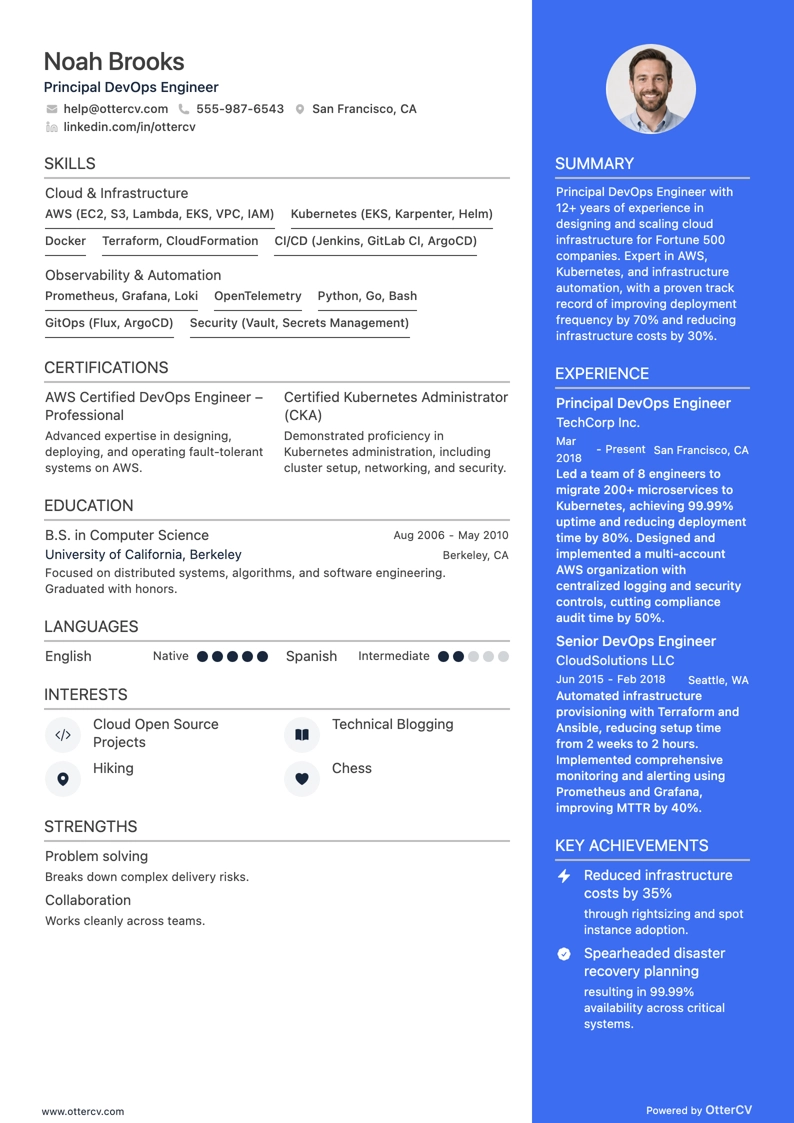
Principal DevOps Engineer full preview

15 DevOps Engineer Resume Examples

OtterCV

Written by The OtterCV Team

Updated: 10/10/2024•8 min read

See all resume examples in this guide, or generate your own resume example with your personalized prompt

Principal DevOps Engineer resume example

Principal DevOps Engineer

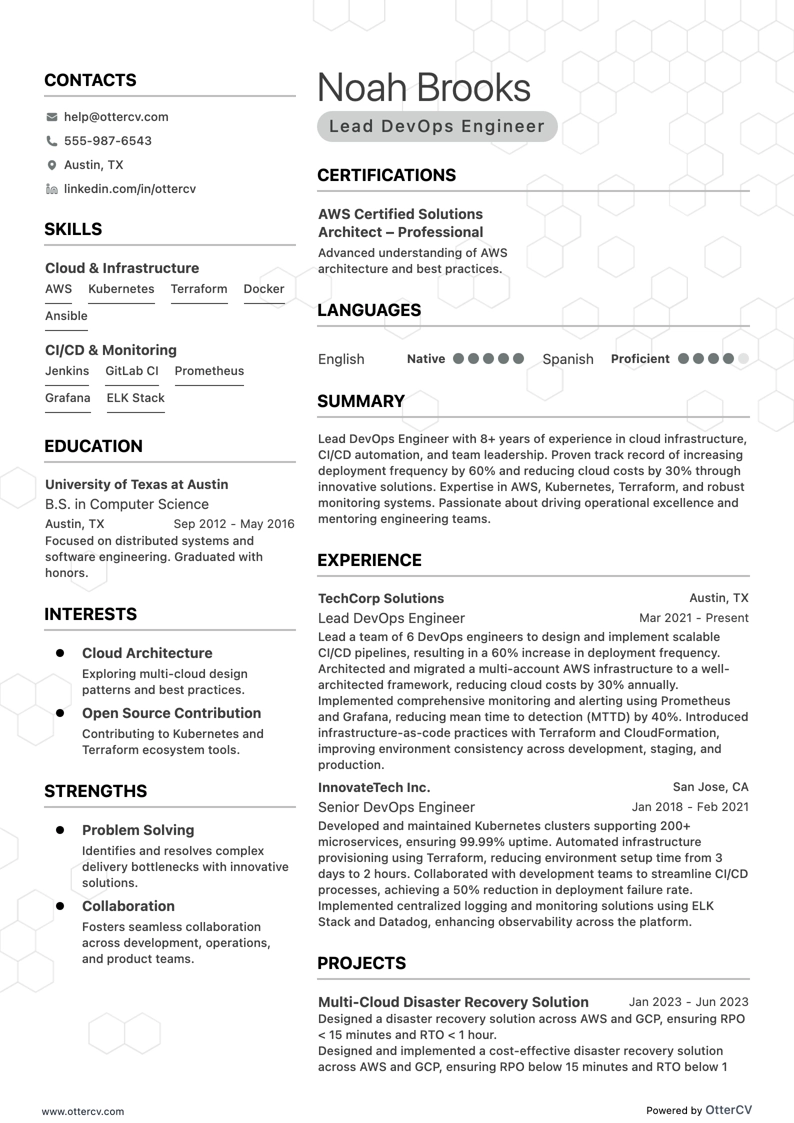
Lead DevOps Engineer resume example

Lead DevOps Engineer

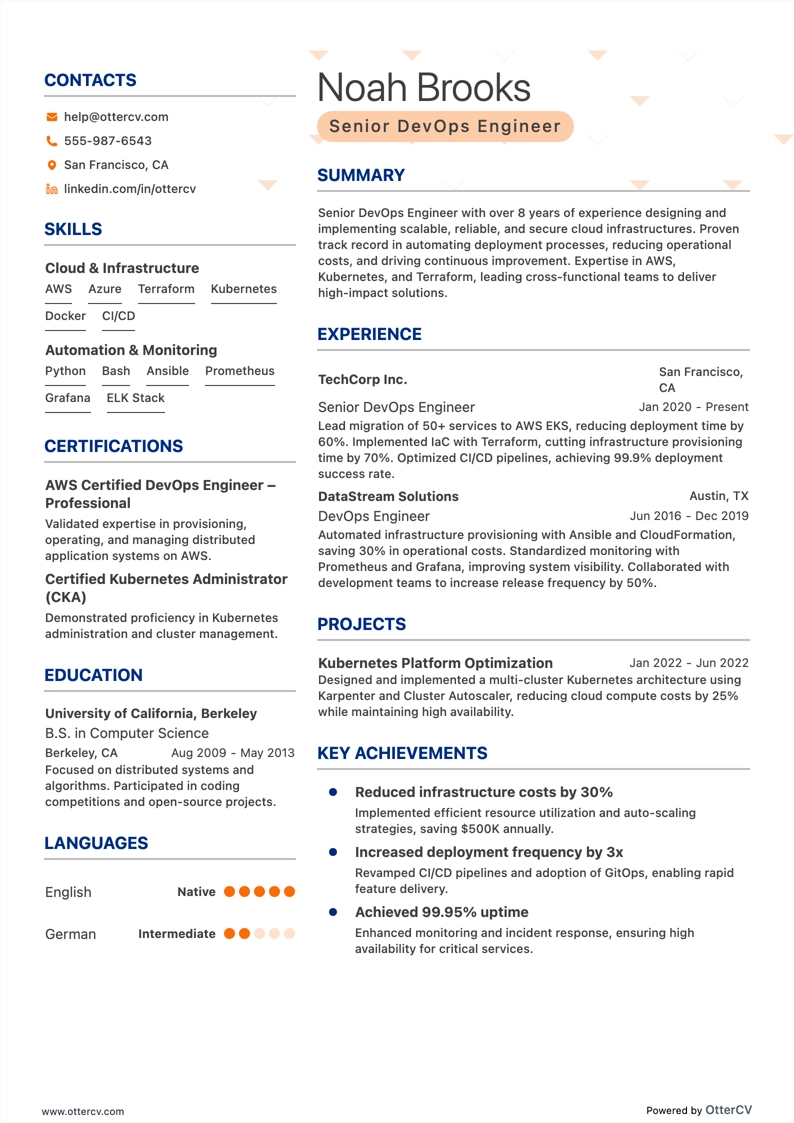
Senior DevOps Engineer resume example

Senior DevOps Engineer

Entry-Level DevOps Engineer resume example

Entry-Level DevOps Engineer

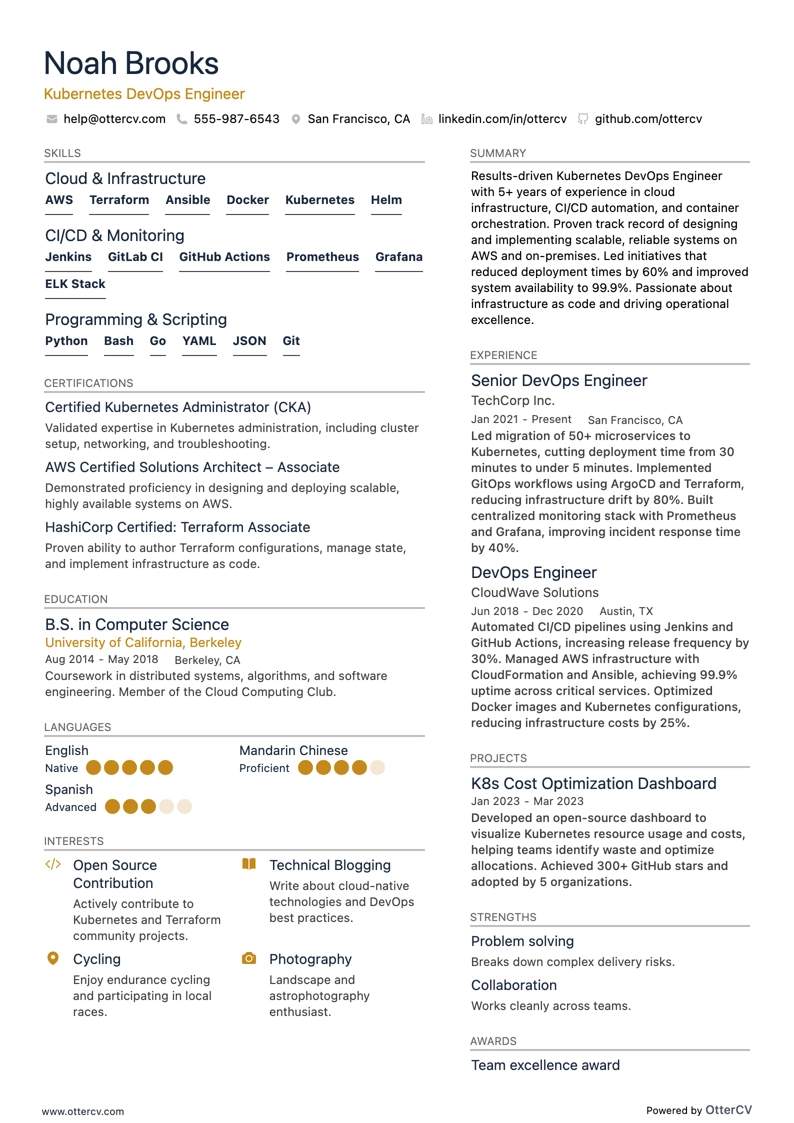
Kubernetes DevOps Engineer resume example

Kubernetes DevOps Engineer

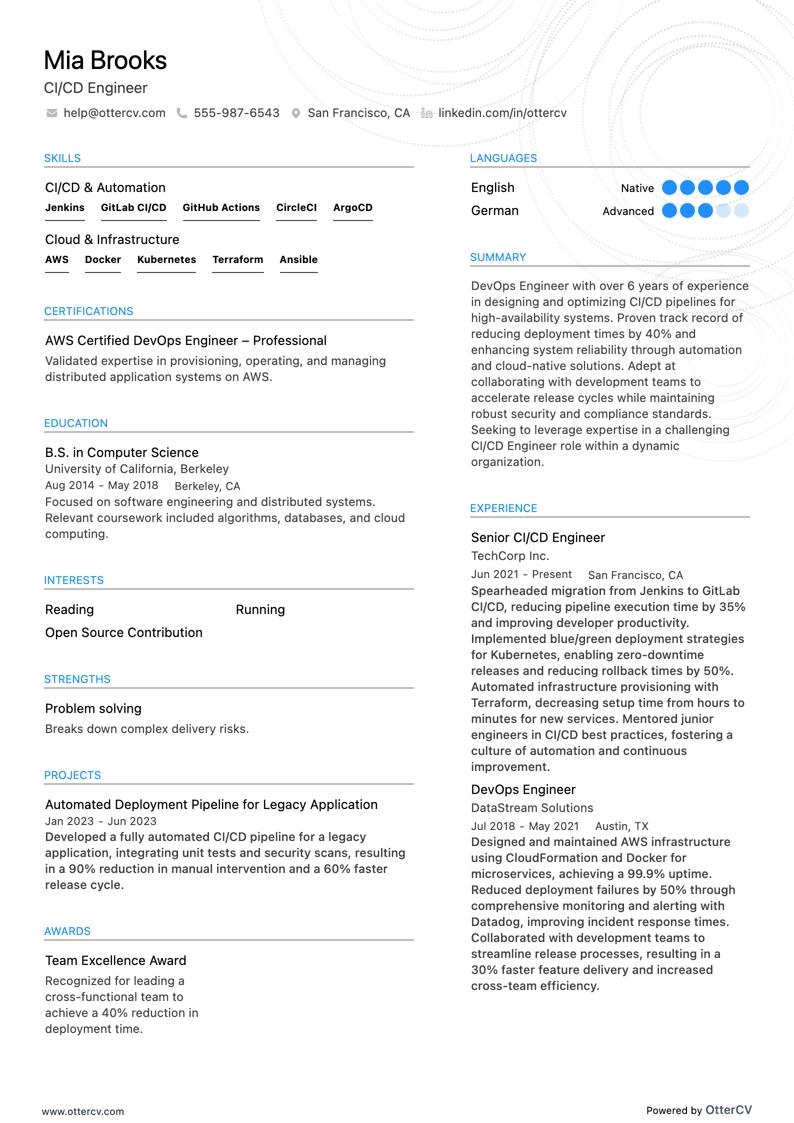
CI/CD Engineer resume example

CI/CD Engineer

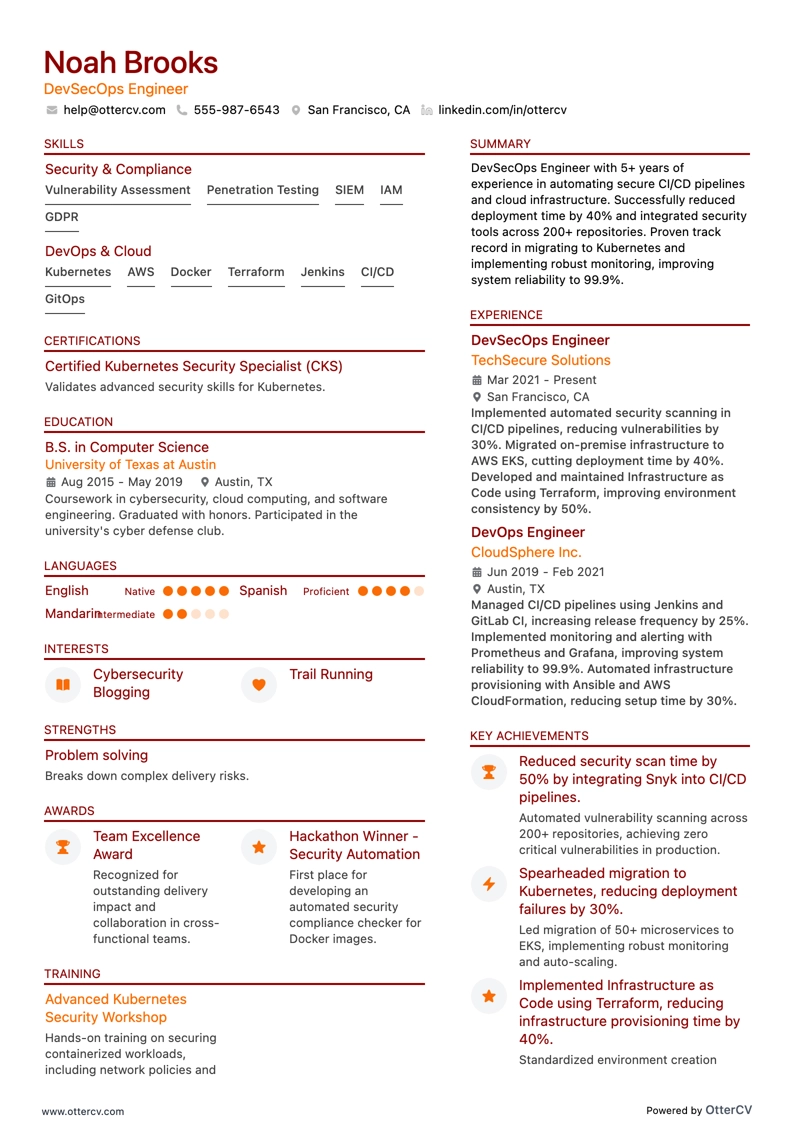
DevSecOps Engineer resume example

DevSecOps Engineer

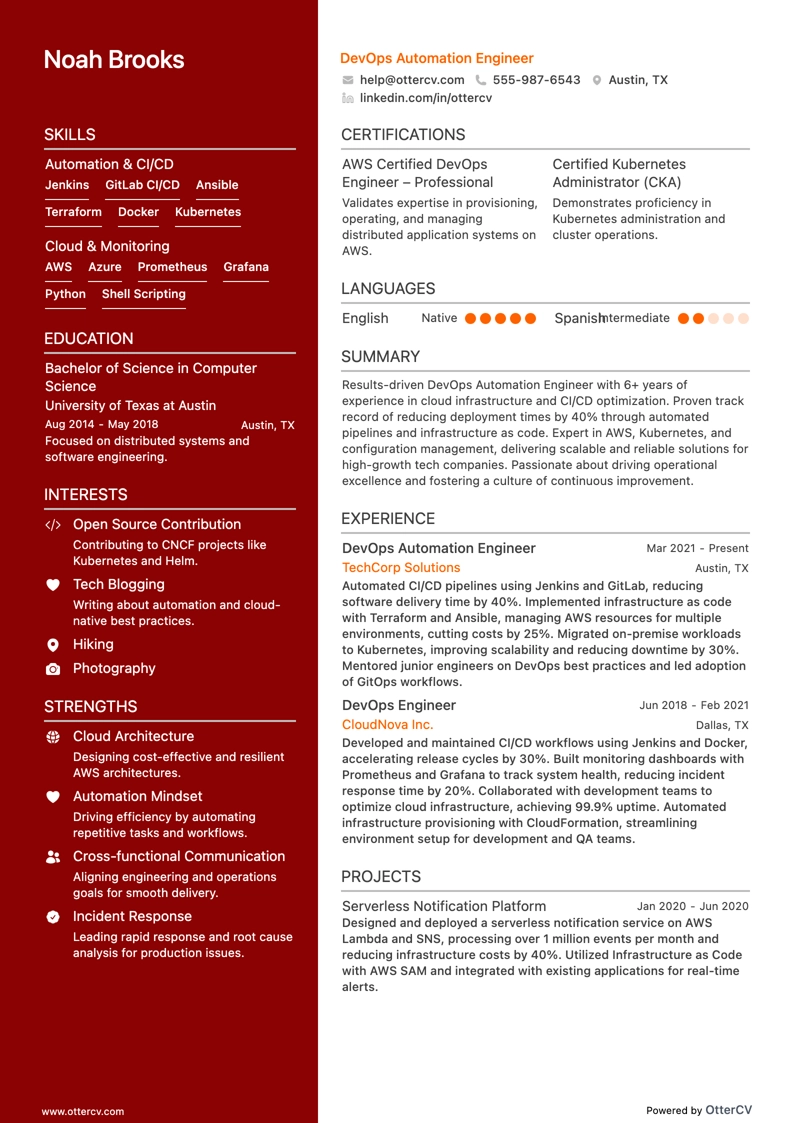
DevOps Automation Engineer resume example

DevOps Automation Engineer

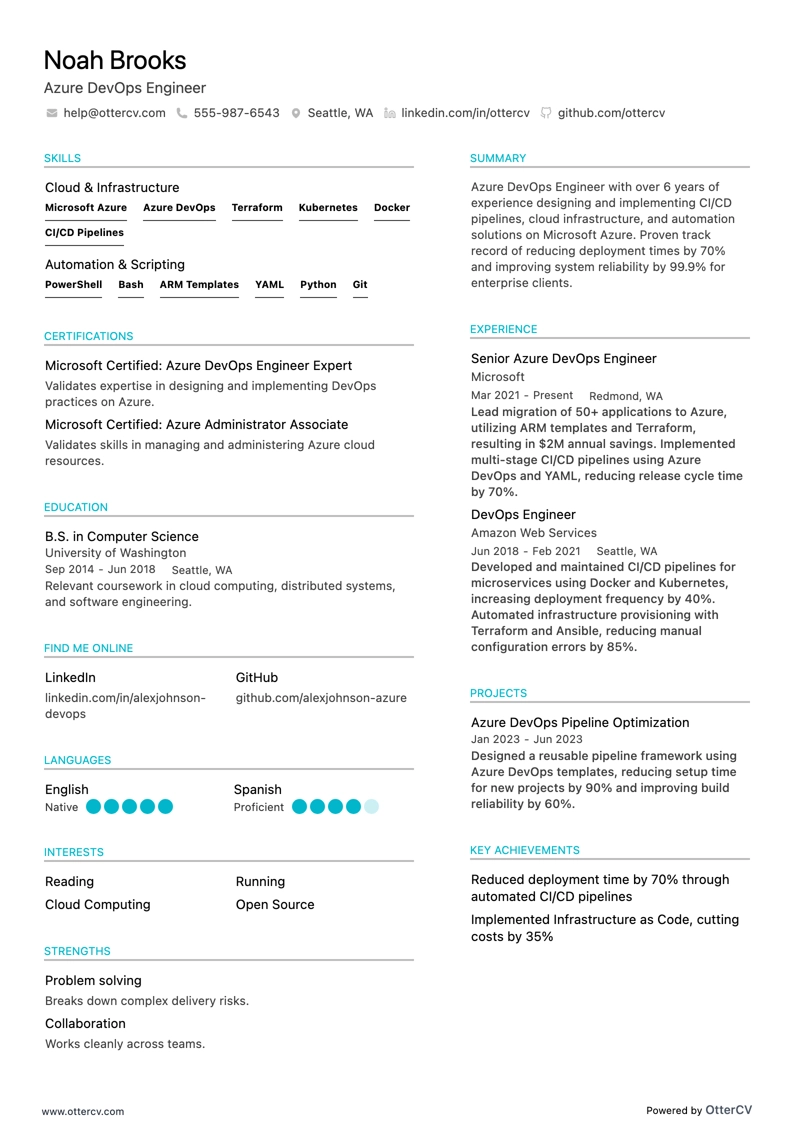
Azure DevOps Engineer resume example

Azure DevOps Engineer

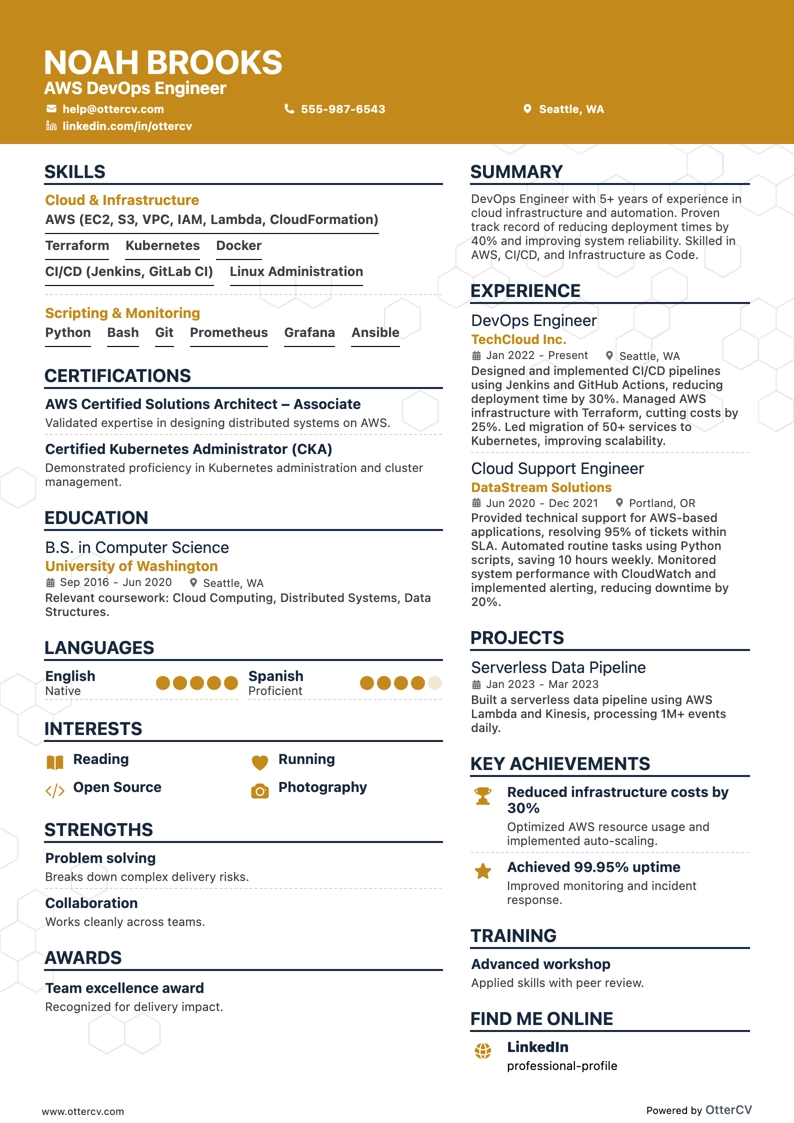
AWS DevOps Engineer resume example

AWS DevOps Engineer

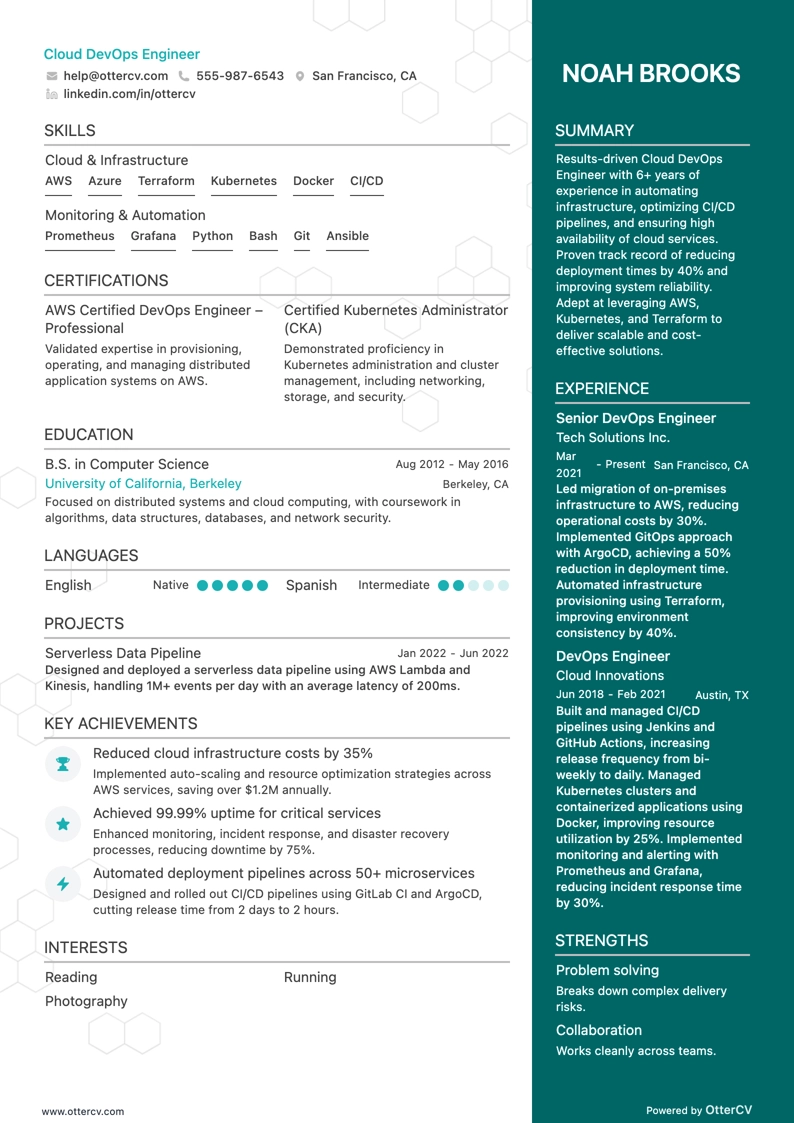
Cloud DevOps Engineer resume example

Cloud DevOps Engineer

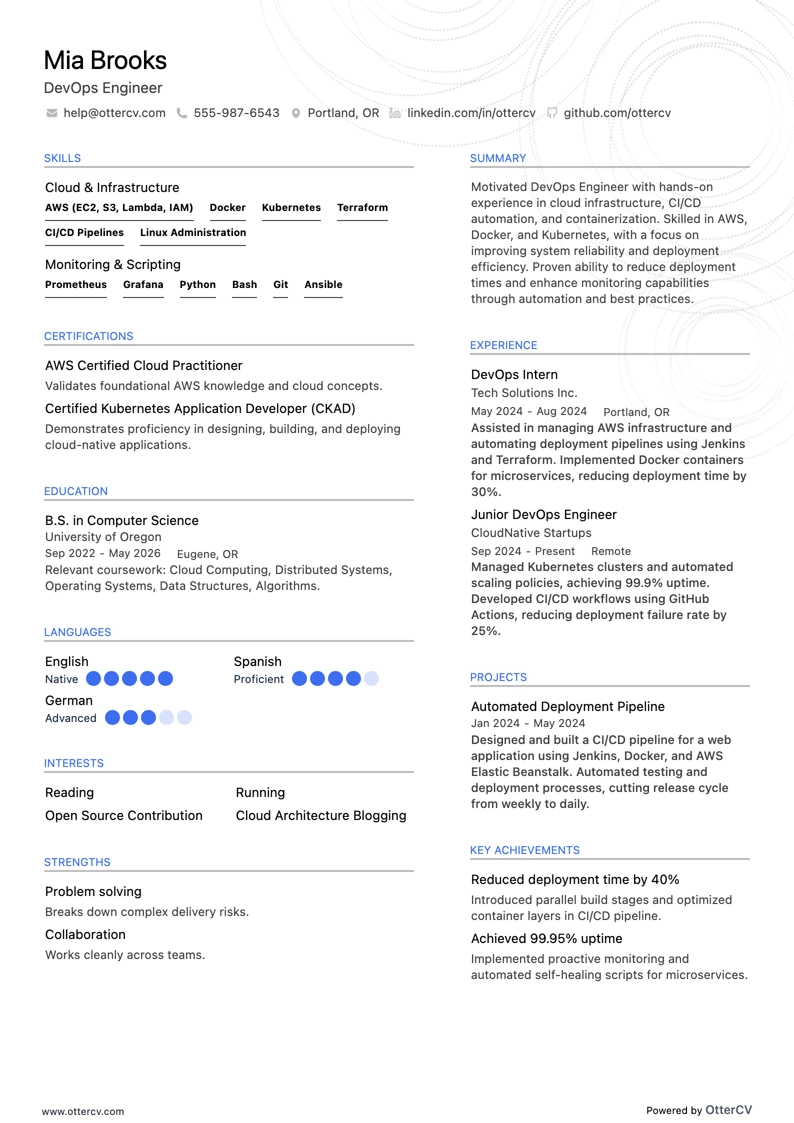
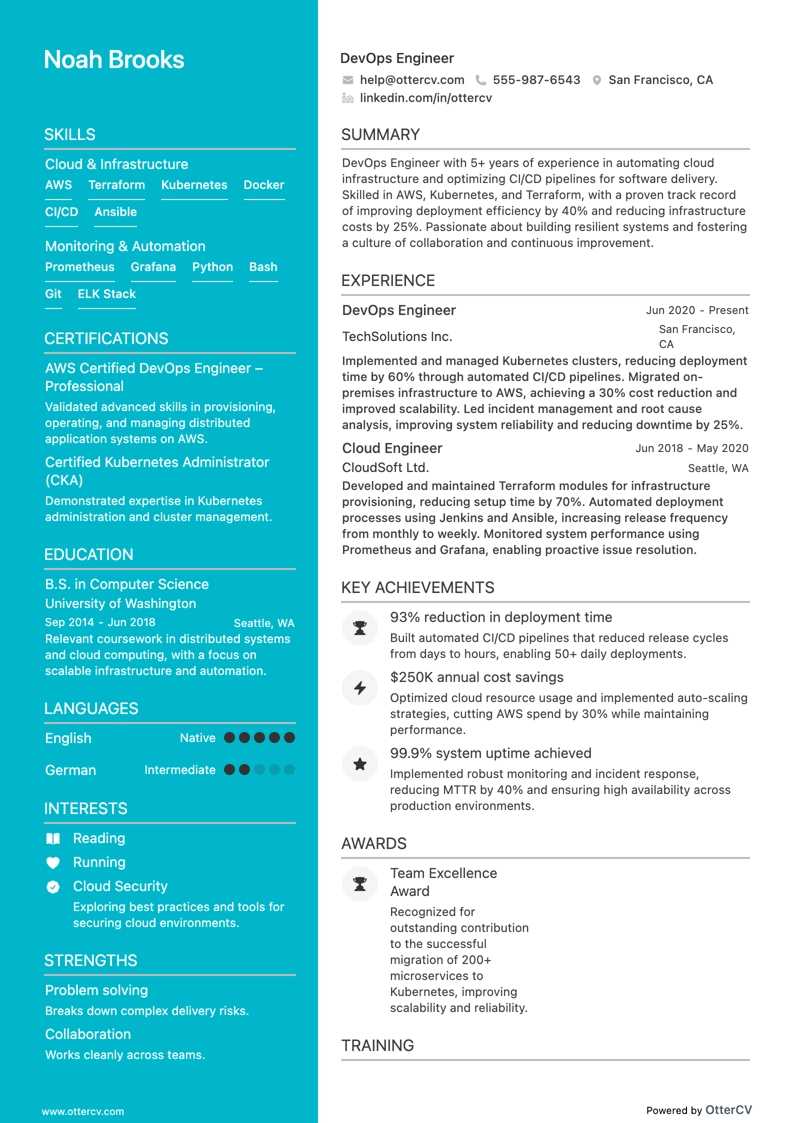
DevOps Engineer resume example

DevOps Engineer

Showcasing your expertise on a DevOps engineer resume can feel like a balancing act. You need to demonstrate technical proficiency across a wide range of tools and technologies while also highlighting your ability to collaborate across teams.

The challenge is communicating deep technical knowledge without overwhelming the reader with jargon or overly technical details.

In this guide, you’ll learn:

  • How to format your DevOps engineer resume so hiring managers immediately recognize your technical expertise and organizational skills
  • How to quantify your impact with measurable results so companies can expect positive outcomes
  • How to present the right combination of skills to show current industry knowledge and increase employability
  • How to write a DevOps engineer resume summary that makes a strong impression and introduces your value in the industry

For examples of resumes in similar roles, explore our selection below.

How to format a DevOps engineer resume

Your DevOps engineer resume should show technical expertise from the start. Since formatting is one of the first things recruiters notice, it is also your first chance to make a strong impression.

Use a professional, well-organized structure. When formatting your DevOps engineer resume, review these key areas:

  • Reverse chronological layout — This format highlights your work history in reverse chronological order. Show how you built expertise in new technologies and completed automation projects throughout your career.
  • Header — Add a brief and clear header with professional contact information and a link to your online profile or portfolio. A LinkedIn profile or portfolio URL can give employers a fuller view of your background and projects.
  • Key achievements — Highlight achievements that show a proven track record and current knowledge in the fast-changing tech industry. Explain how your work reduced downtime, improved system reliability, or accelerated software deployment cycles.
  • Limit to one page — You may have enough experience with cloud platforms and automation tools to fill multiple pages, but recruiters often prefer concise resumes. Include only the strongest and most relevant information, and tailor every section to fit your target job.

To preserve formatting and improve file security, use a PDF file format instead of Doc. Incompatible or corrupted files will not help you land a role that requires strong technical knowledge.

For help getting started, use Echocv’s resume builder to edit an ATS-friendly DevOps engineer resume template and download a PDF that passes through Applicant Tracking Systems.

Different markets have specific resume formats — a Canadian resume could vary in layout.

The top sections on a DevOps engineer resume

  • Technical skills show expertise in DevOps tools and languages and help demonstrate proficiency in key technologies.
  • Work experience highlights past DevOps roles and achievements and reflects hands-on experience with successful project implementations.
  • Education and certifications emphasize formal training and qualifications and show foundational knowledge and commitment to professional growth.
  • The projects section details meaningful contributions to DevOps initiatives and gives concrete examples of skills used in real-world situations.
  • A professional summary introduces the candidate's DevOps background and goals and provides a clear snapshot of experience and aspirations.

What recruiters want to see on your resume:

  • Proficiency in automation tools and scripting languages to support efficient infrastructure management and deployment processes.
  • Experience with cloud platforms and services for modern, scalable, and resilient system architectures.
  • Understanding of CI/CD pipelines and version control to implement continuous integration and delivery practices.
  • Knowledge of containerization and orchestration technologies for developing and managing microservices-based applications.
  • Demonstrated ability in system monitoring and incident management to maintain high availability and service performance.

How to write your DevOps engineer resume experience

Your resume experience section should show your work history and the accomplishments tied to each role. For each position, include 3–4 bullet points that highlight your strongest achievements.

DevOps engineers often find it challenging to present deep technical expertise without overwhelming readers with jargon or overly technical detail.

The key challenge is quantifying your achievements in a way that makes sense to non-technical hiring managers.

Let’s look at a sample DevOps engineer resume experience section.

Experience

DevOps Engineer

Tangerine Tech

02/2019 - 11/2022 | San Diego, CA

  • Developed applications and maintained databases.
  • Designed and implemented database models.
  • Participated in the annual company fundraiser.
WRONG

What doesn’t work in this example

  • Doesn’t quantify achievements: Developing applications and maintaining databases sound valuable, but without results they do not say much. As written here, hiring managers cannot tell whether any of these projects were successful.
  • No industry keywords: A DevOps engineer resume should include specific tools and technologies to show employers that your skills are current. Be sure to include industry keywords that highlight your expertise in specific platforms, services, and languages.
  • Irrelevant information: Participating in a company fundraiser may reflect soft skills, but it is not relevant in this context. Use resume space efficiently by including only information that supports your target job.

Let’s make a few changes and look at an updated version of this experience section.

Experience

DevOps Engineer

Tangerine Tech

02/2019 - 11/2022 · San Diego, CA

  • Developed cloud-based applications using AWS and maintained 14 databases while staying under budget.
  • Designed and implemented an SQL relational database model that increased productivity by 25%.
  • Recognized for outstanding achievement as a Certified Agile Practitioner.
RIGHT

What works in this example:

  • Uses metrics and numbers: “increased productivity by 25%” and “maintained 14 databases while staying under budget” provide measurable results that show hiring managers exactly what you accomplished.
  • Shows industry keywords: Terms like AWS, SQL relational database model, and Certified Agile Practitioner demonstrate industry-specific knowledge and can improve ATS optimization for your target job.
  • Includes specific achievements: Awards and project outcomes help potential employers understand how you can contribute to success at their company.

How to quantify impact on your resume

DevOps engineers need to translate technical achievements into business impact. Employers want to see how your practical experience leads to successful project implementation.

Quantify the impact on your DevOps engineer resume by using real numbers and data. Highlight project outcomes and efficiency improvements.

When quantifying impact on your DevOps engineer resume, consider including:

  • The number of servers managed or automated to demonstrate scalability and management skills.
  • The percentage reduction in deployment time achieved to highlight efficiency improvements.
  • The number of containerized applications developed to show expertise in modern application packaging.
  • The decrease in system downtime achieved to reflect reliability and uptime improvements.
  • The number of automated tests written to indicate a commitment to quality and thoroughness.
  • The percentage increase in system performance to showcase optimization and tuning abilities.
  • The size of the infrastructure budget managed to reflect financial and resource allocation skills.
  • The number of team members led or mentored to demonstrate leadership and team management capabilities.

How do I write a DevOps engineer resume with no experience

Writing a DevOps engineer resume with no DevOps engineer experience can feel intimidating. If you are changing careers or entering the field, focus on transferable skills instead of work history.

Use these steps to write an entry-level DevOps engineer resume:

  • Choose a functional resume layout.
  • Focus on transferable skills.
  • Use additional sections to highlight skill development.
  • Only include information that is relevant to your target job.

A functional resume layout focuses on transferable skills rather than experience. This can help show employers that you learned deployment processes, system architectures, and orchestration technologies in other ways.

Don’t pad your experience section with irrelevant jobs just to fill space. Only include roles that are relevant to your target position and emphasize transferable skills.

Software engineer, development manager, and other IT roles are all strong options for showcasing technical skills.

Customer service and management jobs can also help highlight interpersonal and communication skills.

How to list your hard skills and soft skills on your resume

Showing both interpersonal skills and technical expertise is essential for an effective DevOps engineer resume.

DevOps engineers need technical skills for continuous integration and deployment, along with communication skills to collaborate across development and operations teams.

Skills on your DevOps engineer resume usually fall into two categories: hard skills and soft skills.

Hard skills are the technical knowledge and abilities needed to perform job duties. Soft skills are the interpersonal and communication skills needed to work effectively with others.

The main difference between these two sections on your resume is how they are presented. Hard skills are typically listed, while soft skills are better supported with examples.

Look at an example of hard skills on a DevOps engineer resume.
Skills

  • AWS
  • Azure
  • CI/CD
  • Python
  • Bash
  • SQL
  • API Development and Management
  • Performance Tuning
  • Linux/Unix Administration
  • Storage and Backup Solutions
RIGHT

When listing specific technologies, tools, and languages on your DevOps engineer resume, only include skills you are confident in. Employers will assume that anything on your resume reflects real proficiency.

Keep in mind that many companies use Applicant Tracking Systems (ATS) to scan resumes for specific skills. To improve ATS performance, use relevant industry keywords and phrases on your DevOps engineer resume.

Match each skill 1:1 to the wording used in the job description so it can be recognized by ATS, but work it into your resume naturally. Copy-and-paste phrasing is usually obvious and easy to spot.

Here are a few more hard skills to consider for your DevOps engineer resume.

Best hard skills for your DevOps engineer resume

  • Cloud platforms, such as AWS, Azure, and GCP.
  • Containerization tools, such as Docker and Kubernetes.
  • Infrastructure as Code (IaC) tools, such as Terraform and Ansible.
  • Continuous Integration/Continuous Deployment (CI/CD) tools, such as Jenkins and GitLab CI.
  • Version control systems, such as Git and SVN.
  • Scripting languages, such as Python and Bash.
  • Configuration management tools, such as Puppet and Chef.
  • Monitoring and logging tools, such as Prometheus and the ELK stack.
  • Network security and firewalls.
  • Database management, including SQL and NoSQL.
  • Linux/Unix administration.
  • Virtualization technologies, such as VMware and Hyper-V.
  • API development and management.
  • Load balancing and clustering.
  • Performance tuning.
  • Storage and backup solutions.
  • Serverless technologies.
  • Microservices architecture.
  • DevOps methodologies and practices.
  • Agile project management tools, such as Jira and Trello.

Soft skills can be interpreted in different ways, so they often need a bit more explanation. Choose a few of your strongest soft skills and include an example to help hiring managers understand exactly what you mean.

Unlike some more independent IT roles, DevOps focuses on collaboration between development and operations teams. That makes your soft skills section a strong place to highlight communication and teamwork.

Let’s look at an example of a DevOps engineer soft skills section.

Strengths

Collaboration
Facilitated collaboration between 3 development teams on a project that generated $1.2M in revenue.
Time Management
Completed 8 development projects in Q1 2023, stayed under budget, and increased productivity by 20%.
RIGHT

Support your claims with specific, measurable results and positive outcomes. Show potential employers how your soft skills can contribute to success.

Here are a few additional soft skills to consider adding to your DevOps engineer resume.

Best soft skills for your DevOps engineer resume

  • Problem-solving abilities.
  • Strong communication skills.
  • Collaboration and teamwork.
  • Adaptability in fast-paced environments.
  • Attention to detail.
  • Time management and prioritization.
  • Critical thinking.
  • Creativity and innovation.
  • Leadership and mentorship.
  • Emotional intelligence.
  • Resilience and stress management.
  • Decision-making skills.
  • A customer-oriented approach.
  • Project management abilities.
  • Learning agility and a willingness to update skills.
  • Conflict resolution.
  • Strategic thinking.
  • Analytical skills.
  • Empathy and interpersonal understanding.
  • Patience and perseverance.

How to list your certifications and education on your resume

DevOps engineers typically have a bachelor’s degree in computer science, computer programming, software engineering, or a related field. Higher-level degrees, such as a master’s in a related field, can also be beneficial.

Certifications in specific skills and technologies are a strong way to keep your resume current and improve your employability as industry trends evolve.

A good education section needs only a few details:

  • Name of degree
  • Name of institution
  • Years attended

Here is an example of a DevOps engineer resume education section.

Education

BS in Computer Science
University of Maryland
02/2010 - 11/2014 · Baltimore, MD

RIGHT

Similarly, a certification section only needs the certificate name and issuing institution.

Here’s an example of a DevOps engineer resume certification section.

Certifications

  • Professional Cloud DevOps Engineer
    Google Cloud Platform

  • Certified Agile Practitioner
    PMI

RIGHT

Earning new certifications helps keep your industry skills current and demonstrates commitment to your role and knowledge of the latest practices.

As you continue developing your skills throughout your career, be sure to update your resume to reflect your most current qualifications.

Here are a few additional certifications to consider for your DevOps engineer resume.

How to write your DevOps engineer resume summary or objective

A DevOps engineer resume summary or objective is a strong way to introduce yourself and highlight your top industry accomplishments in 3-4 sentences.

Although the terms are often used interchangeably, there is a slight difference between them.

A summary is a brief introduction that communicates your role and value in the industry. It is usually the better choice for seasoned professionals with years of experience.

An objective looks to the future and explains what you hope to achieve in your next position. It is ideal for entry-level candidates with little or no industry experience.

If you have at least some DevOps engineering experience, a smart approach is to combine both: highlight a key achievement and then share a goal for the future.

End your summary with a goal that aligns with your target company. This shows you have done your research and are ready to provide solutions.

Let’s look at an example of a DevOps engineer resume summary.

Summary

Experienced professional in containerization tools and cloud platforms. Developed successful programs in the e-commerce industry. Seeking an opportunity in database management as a DevOps Engineer.

WRONG

What doesn’t work in this example

  • No measurable outcomes: “developed successful programs” does not tell hiring managers much, because success can mean different things to different people. Use specific results and achievements to make your impact clear.
  • Lacking industry keywords: There is no mention of specific tools, technologies, or languages. This is a missed opportunity to introduce your top skills right away.
  • Unclear goal: It is not enough to say that your goal is to get the position. Potential employers want to understand how your experience aligns with the company’s goals.

Let’s make a few improvements and take another look.

Summary

Google Cloud Platform Certified DevOps Engineer with 6 years of experience in SQL database management. Developed e-commerce software using Python and Bash that generated $2.3M in revenue. Seeking to leverage expertise in Puppet and Chef to increase productivity as a DevOps Engineer at JRR Tech.

RIGHT

What works in this example

  • Strong introduction - “Google Cloud Platform Certified DevOps engineer with 6 years of experience” tells hiring managers immediately that the candidate is experienced and certified in specific technologies.
  • Real results - the candidate highlights an achievement that “earned $2.3M in revenue,” helping employers understand the impact they can make.
  • Uses industry keywords - including terms like Python, Bash, SQL, Puppet, and Chef showcases key technical skills and supports ATS optimization.

Additional sections for a DevOps engineer resume

  • Projects - As a DevOps engineer, some of your biggest accomplishments may come from previous projects. Show the outcomes of successful projects to demonstrate your abilities.

  • Volunteering - Volunteer work often involves collaboration and communication. Include volunteer experience where you developed soft skills that help you as a DevOps engineer.

  • Hobbies - Hobbies and interests can also be a good way to build specialized skills or niche knowledge. Add hobbies that align with the skills needed for your target job.

  • Format your DevOps engineer resume with a reverse chronological layout that highlights your experience and shows your technical expertise.

  • Quantify impact by showing measurable results from previous projects so companies can understand how you will achieve success in the role.

  • Include a combination of soft skills and hard skills so hiring managers can see you have both the technical expertise and interpersonal skills to do the job.

  • Show your commitment to the industry and increase your employability by developing relevant skills and keeping your resume up to date.

DevOps Engineer resume examples

Explore additional DevOps Engineer resume samples and guides and see what works for your level of experience or role.

By Experience

Principal DevOps Engineer

Principal DevOps Engineer resume preview

Lead DevOps Engineer

Lead DevOps Engineer resume preview

Senior DevOps Engineer

Senior DevOps Engineer resume preview

Entry-Level DevOps Engineer

Entry-Level DevOps Engineer resume preview

DevOps Engineer resume examples

Explore additional DevOps Engineer resume samples and guides and see what works for your level of experience or role.

By Role

Kubernetes DevOps Engineer

Kubernetes DevOps Engineer resume preview

CI/CD Engineer

CI/CD Engineer resume preview

DevSecOps Engineer

DevSecOps Engineer resume preview

DevOps Automation Engineer

DevOps Automation Engineer resume preview

Azure DevOps Engineer

Azure DevOps Engineer resume preview

AWS DevOps Engineer

AWS DevOps Engineer resume preview

Cloud DevOps Engineer

Cloud DevOps Engineer resume preview

DevOps Engineer

DevOps Engineer resume preview