Lead Design Manager full preview

10 Design Manager Resume Examples

OtterCV

Written by The OtterCV Team

Updated: 8/11/2024•8 min read

See all resume examples in this guide, or generate your own resume example with your personalized prompt

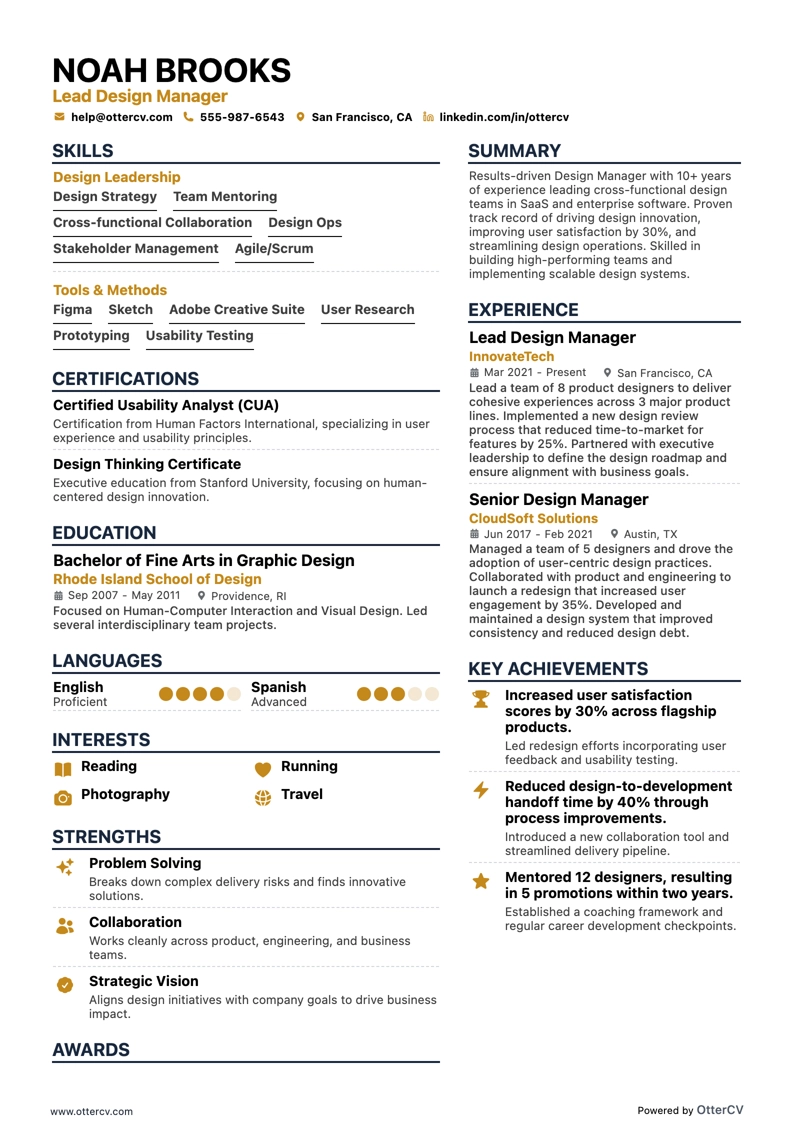
Lead Design Manager resume example

Lead Design Manager

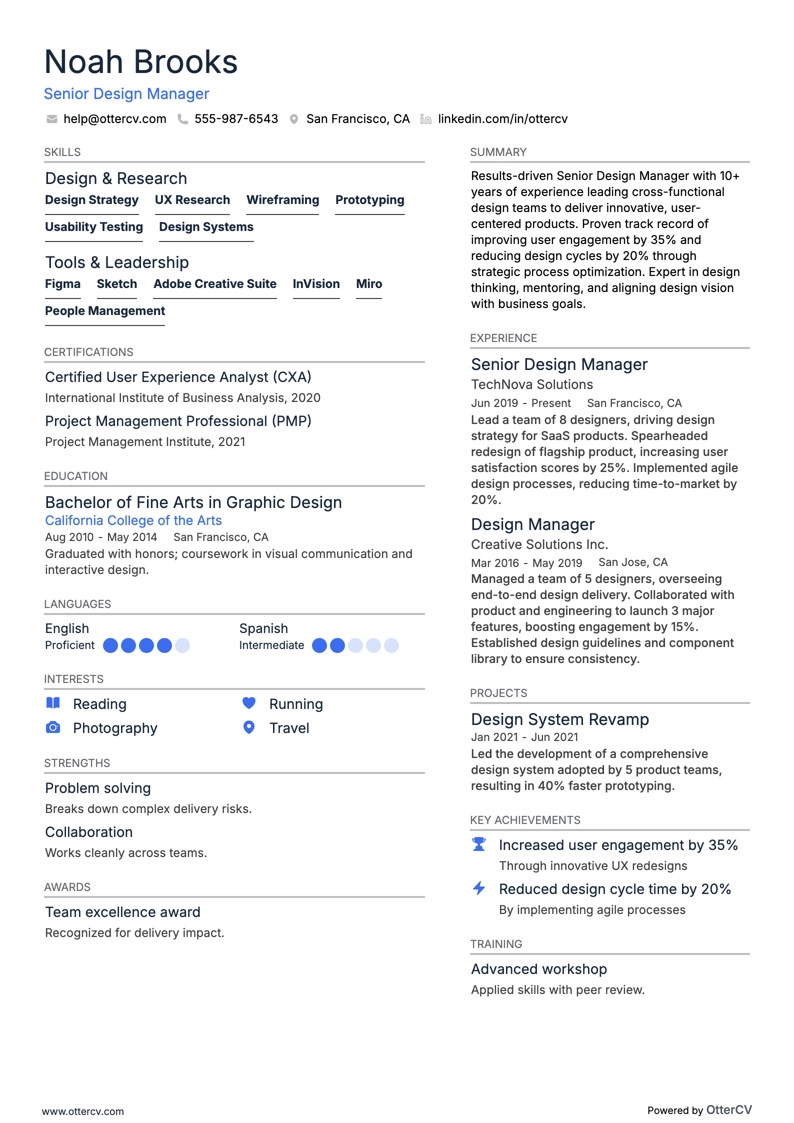
Senior Design Manager resume example

Senior Design Manager

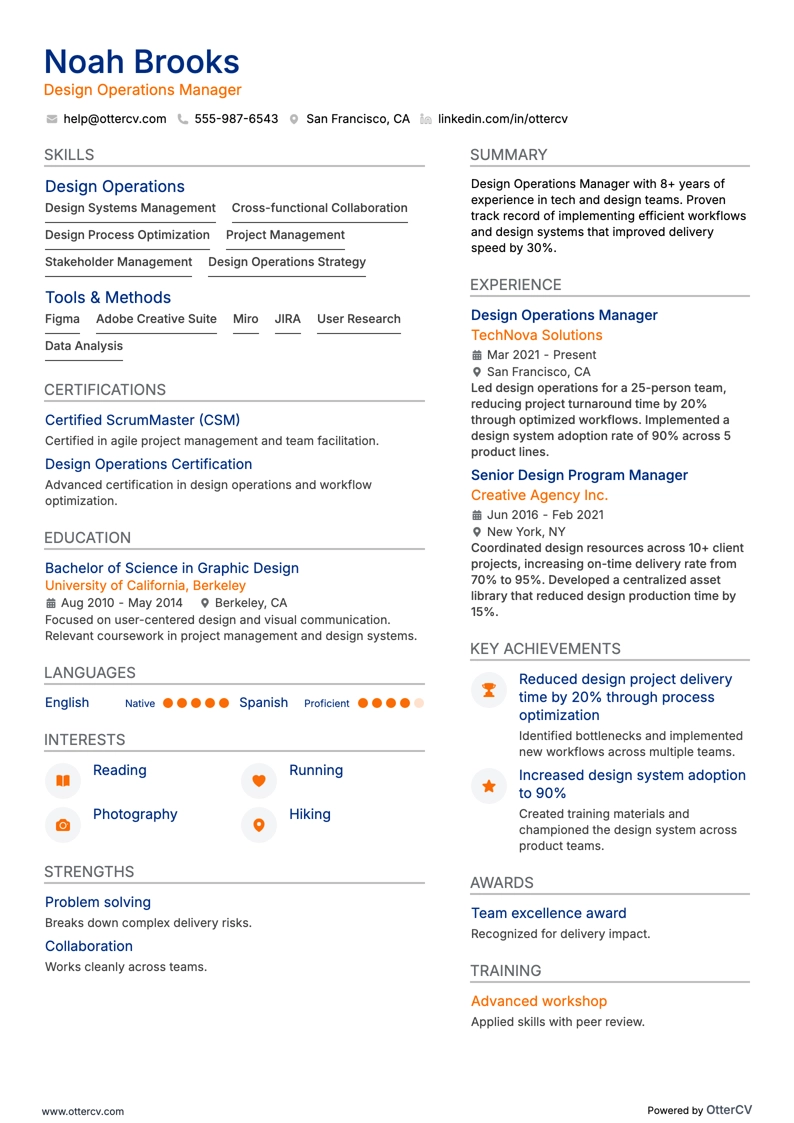
Design Operations Manager resume example

Design Operations Manager

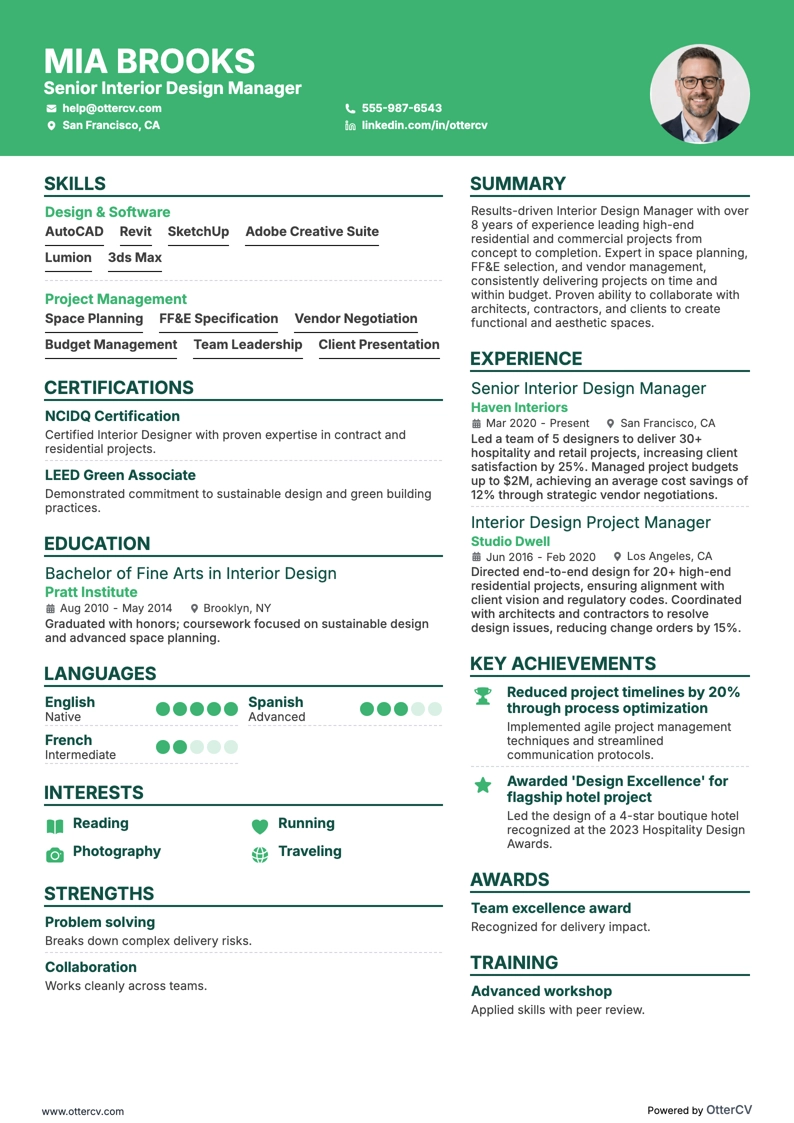
Interior Design Manager resume example

Interior Design Manager

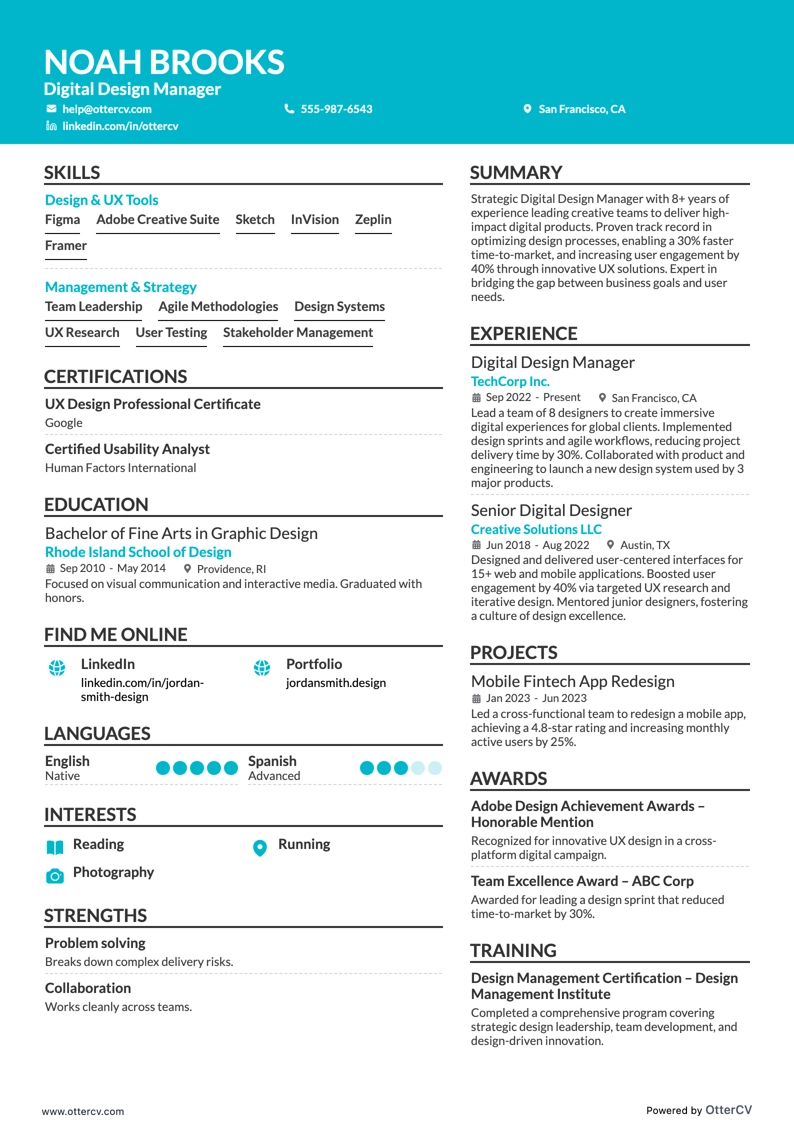
Digital Design Manager resume example

Digital Design Manager

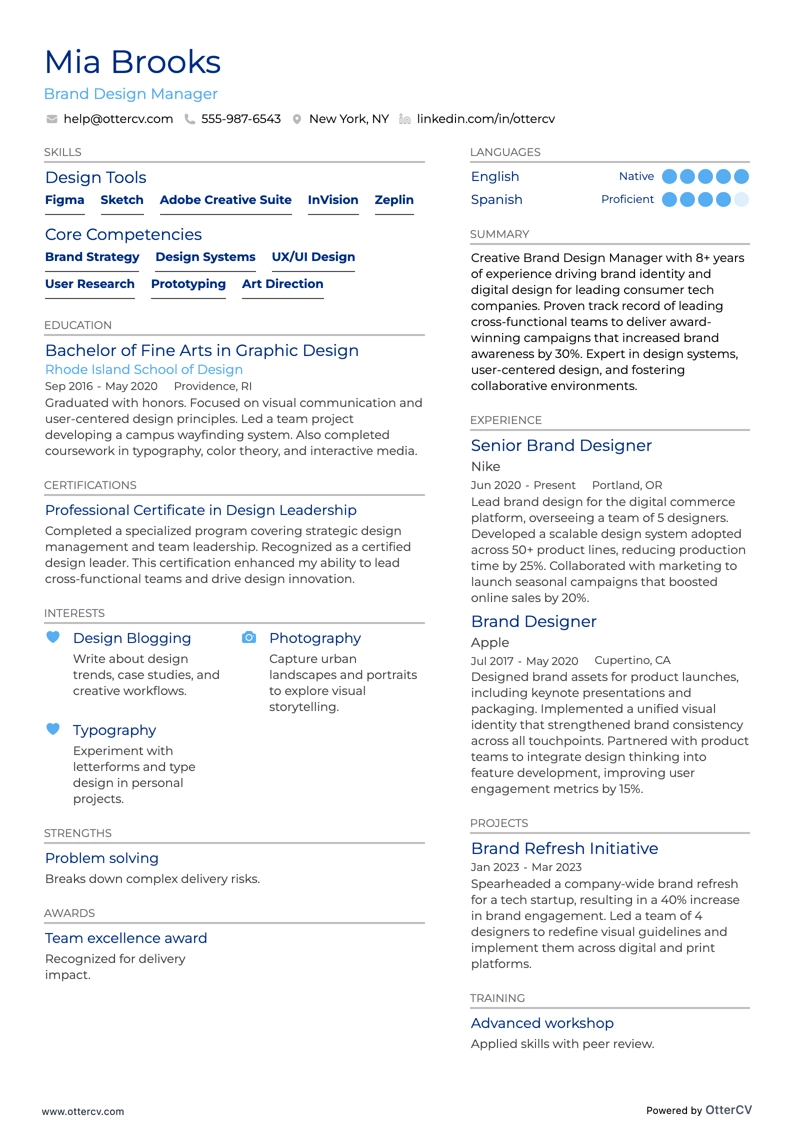
Brand Design Manager resume example

Brand Design Manager

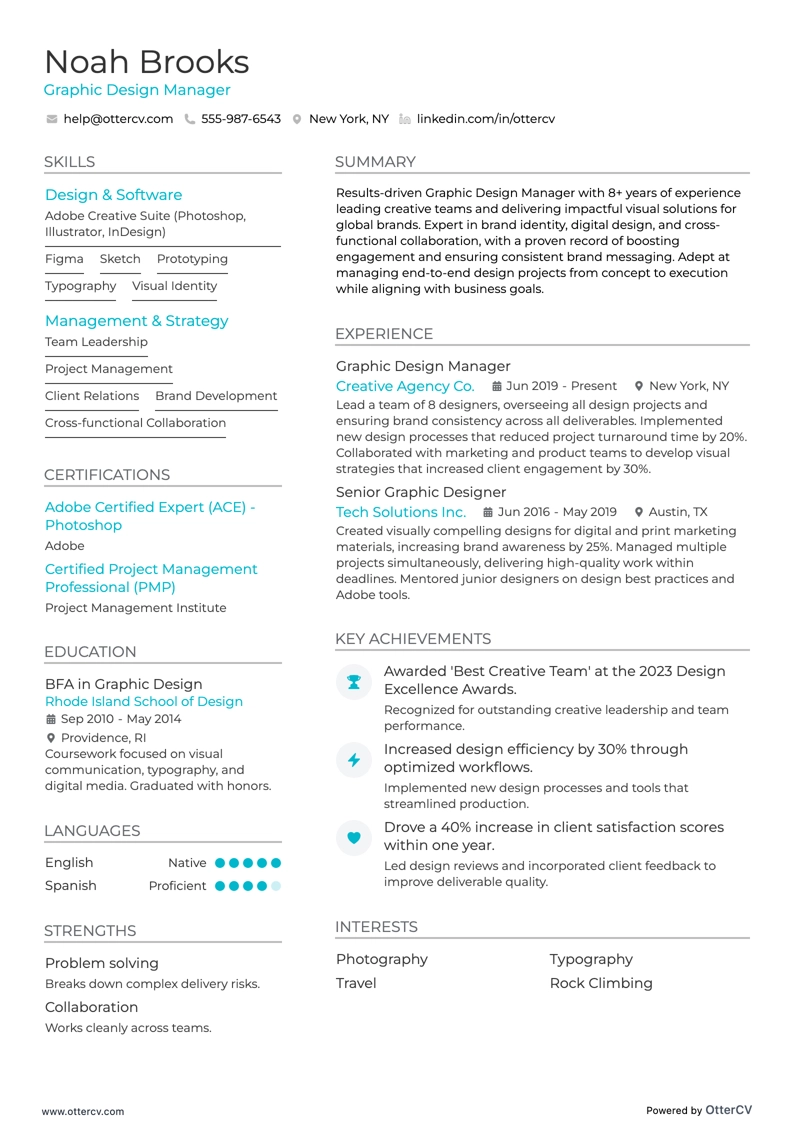
Graphic Design Manager resume example

Graphic Design Manager

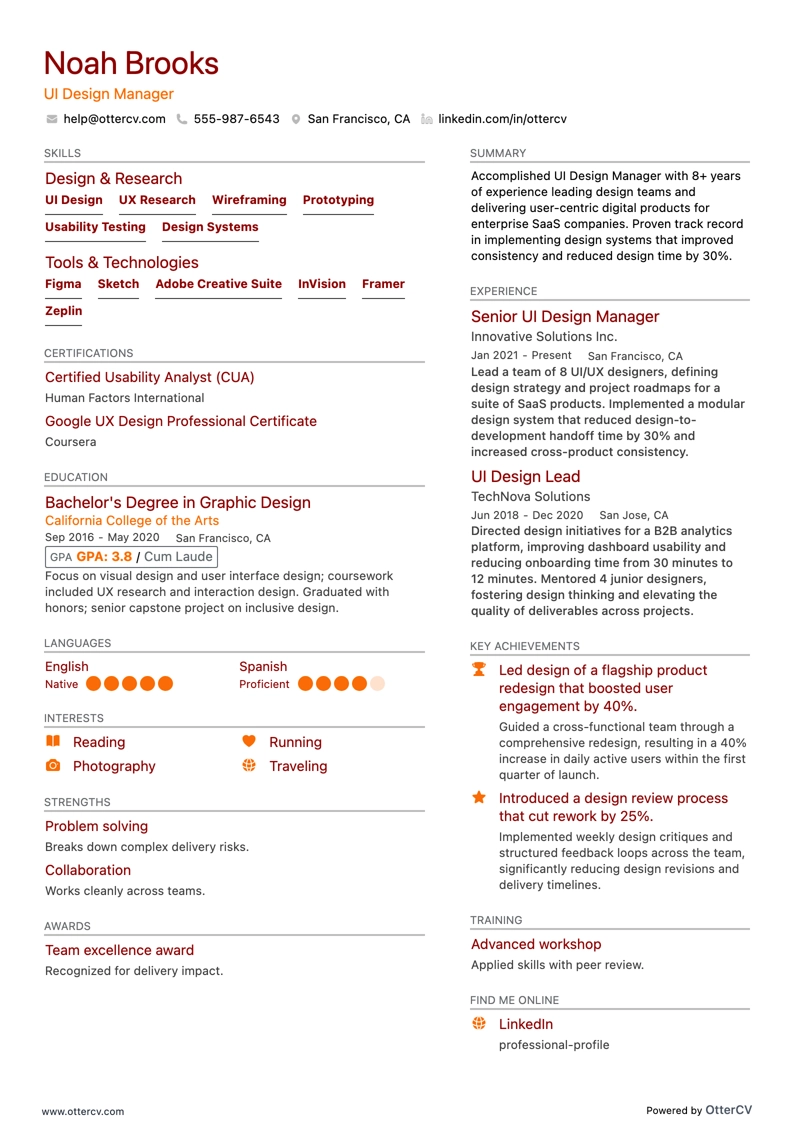
UI Design Manager resume example

UI Design Manager

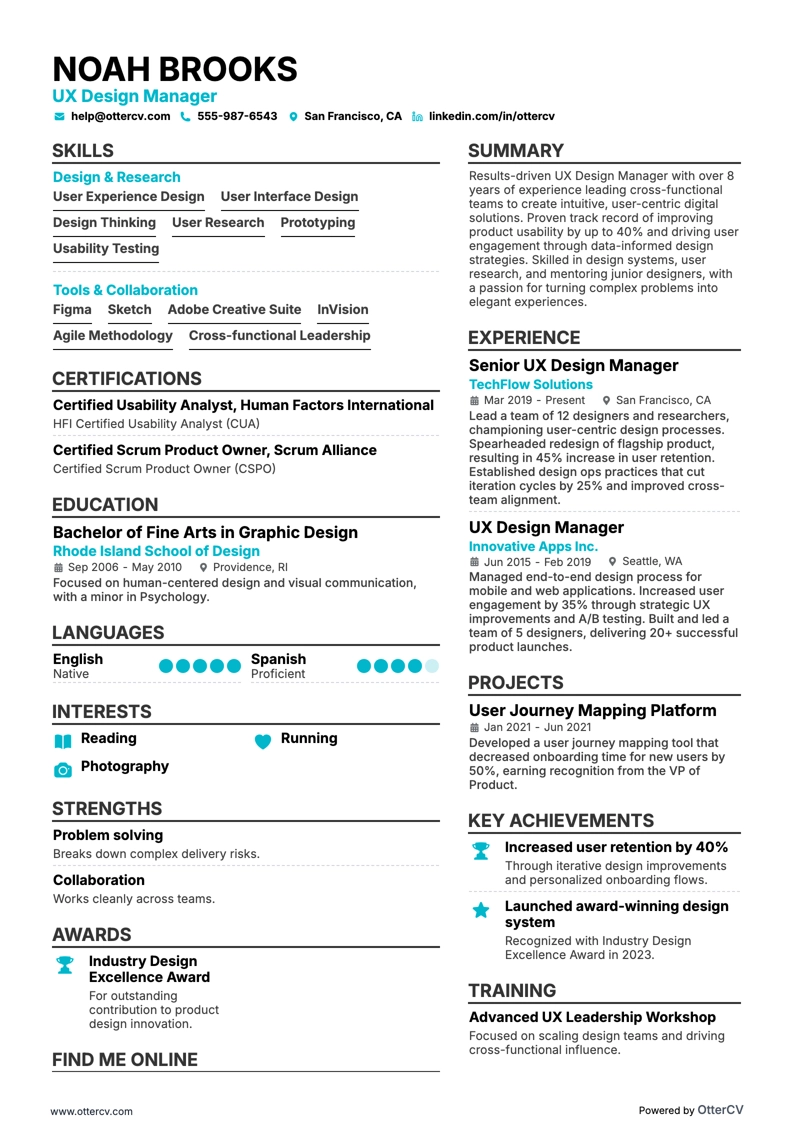
UX Design Manager resume example

UX Design Manager

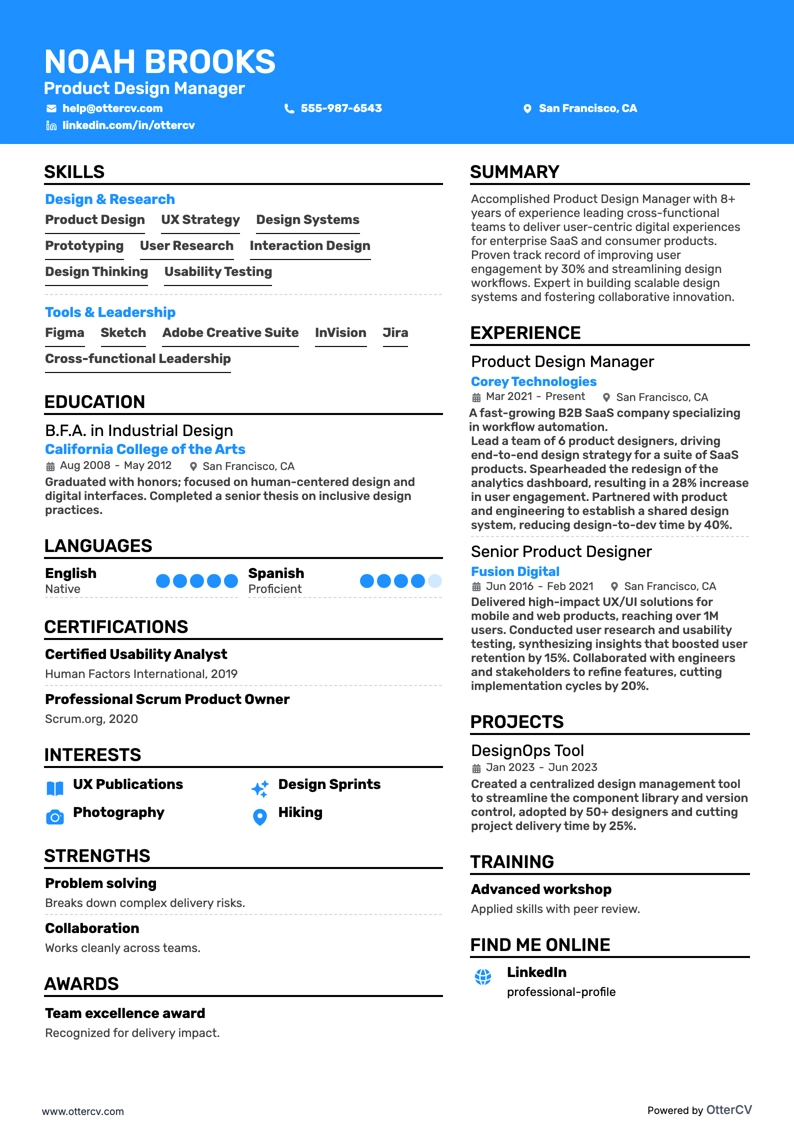
Product Design Manager resume example

Product Design Manager

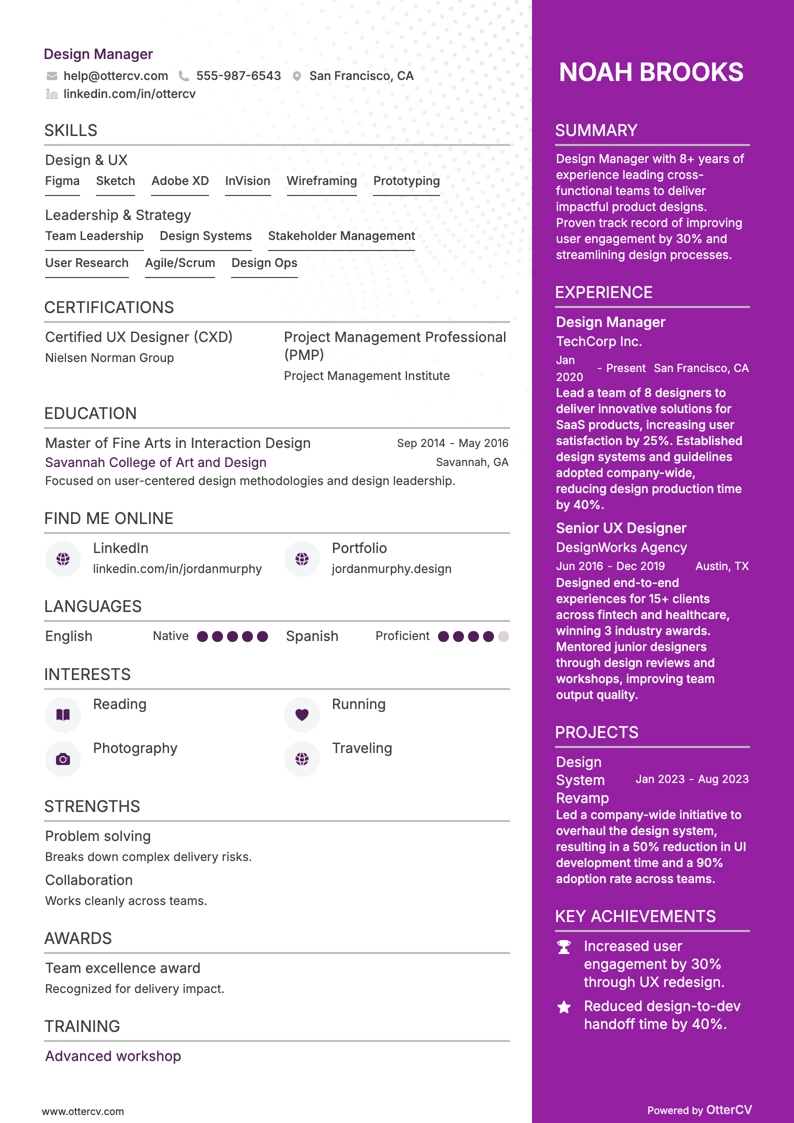
Design Manager resume example

Design Manager

Many design manager resumes fail because they read like job descriptions instead of leadership narratives. In a crowded market, that weakness shows up quickly in ATS filters and in recruiter scans that last only seconds.

A strong resume shows how you lead design to measurable results. Knowing how to make your resume stand out means emphasizing product outcomes, team scale, delivery speed, quality gains, adoption lifts, conversion improvements, retention impact, and cross-functional alignment across multiple launches.

Key takeaways

  • Use a reverse-chronological format to show leadership progression and growing design ownership.

  • Anchor each experience bullet to measurable outcomes such as delivery speed, adoption, or revenue impact.

  • Tailor your resume language to each job posting’s tools, KPIs, and team structure.

  • Show skills in context through your summary and experience bullets.

  • Quantify achievements across speed, quality, adoption, efficiency, and risk reduction.

  • Use Echocv’s Bullet Point Generator to turn vague duties into recruiter-ready statements.

  • Stop using AI once your resume accurately reflects your real experience without inflated claims.

Job market snapshot for design managers

We analyzed 355 recent design manager job ads across major US job boards. These figures highlight regional hotspots, employment type trends, and in-demand skills at a glance.

What level of experience employers are looking for design managers

Years of ExperiencePercentage found in job ads
1–2 years3.1% (11)
3–4 years4.2% (15)
5–6 years20.0% (71)
7–8 years13.0% (46)
9–10 years15.8% (56)
10+ years24.8% (88)
Not specified34.9% (124)

Design manager ads by area of specialization (industry)

Industry (Area)Percentage found in job ads
Finance & Banking53.0% (188)
Healthcare26.2% (93)
Education5.6% (20)
Manufacturing3.9% (14)
Retail & E-commerce3.4% (12)
Professional Services2.8% (10)

Top companies hiring design managers

CompanyPercentage found in job ads
Vantage Data Centers10.1% (36)
Accenture8.5% (30)
Jacobs Solutions Inc.6.2% (22)
AECOM3.9% (14)
Cushman & Wakefield Inc3.9% (14)
Whiting-Turner Contracting Co3.1% (11)
Microsoft Corporation2.8% (10)

Role overview stats

These tables outline the most common responsibilities and employment types for design manager roles. Use them to align your resume with employer expectations and understand how the role is typically structured across the market.

Day-to-day activities and top responsibilities for a design manager

ResponsibilityPercentage found in job ads
Project management28.5% (101)
Revit16.6% (59)
Architecture16.3% (58)
Autocad16.3% (58)
Engineering15.5% (55)
Bim14.6% (52)
Bluebeam11.5% (41)
Microsoft office9.0% (32)
Cad8.7% (31)
Excel8.7% (31)
Adobe creative suite7.9% (28)
Procore7.3% (26)

Type of employment (remote vs on-site vs hybrid)

Employment typePercentage found in job ads
On-site63.1% (224)
Hybrid30.1% (107)
Remote6.8% (24)

How to format a design manager resume

Recruiters assessing design manager candidates look for evidence of leadership scope, team growth, cross-functional collaboration, and measurable business impact driven by design strategy. A reverse-chronological format highlights these signals right away by showing a clear progression from individual contributor to management, making it easier for both hiring managers and applicant tracking systems to follow your decision-making authority over time.

I have significant experience in this role—which format should I use?

I have significant experience in this role—which format should I use?

Use a reverse-chronological format. It is the strongest choice for experienced design managers because it puts your leadership trajectory and expanding scope of ownership front and center. Choosing the right resume format helps present your strengths in the most compelling way.

Do:

  • Lead each role entry with your management scope, including team size, number of direct reports, cross-functional stakeholders, and budget or resource accountability.
  • Highlight the design-specific tools, systems, and domains you have overseen, such as design systems, user research programs, Figma/Abstract workflows, or brand and product design functions.
  • Anchor each accomplishment to measurable outcomes or business impact, including revenue influence, efficiency gains, user engagement metrics, or successful product launches.

Example bullet: “Led a 12-person product design team through a platform redesign that increased user task completion rates by 34% and contributed to a $4.2M lift in annual subscription revenue.”

Why hybrid and functional resumes don't work for senior roles

Why hybrid and functional resumes don't work for senior roles

Hybrid resumes fragment your leadership narrative by separating key skills from the operational context that gives them meaning. That makes it harder for reviewers to connect your decisions to specific teams, timelines, and outcomes. Functional resumes create even bigger problems: they obscure career progression, weaken evidence of accountability, and remove the organizational context that shows you have led at scale.

If you have three or more years of design management experience with clear upward progression, avoid hybrid and functional formats entirely. In these cases, they are more likely to weaken your candidacy than strengthen it.

  • A functional format may be acceptable only if you are transitioning into design management from a senior individual contributor or creative director role with no formal management titles. Even then, every skill claim should be tied to specific projects, team outcomes, and measurable results.

Once your resume format is clean and easy to scan, the next step is choosing sections that truly earn their place on the page.

What sections should go on a design manager resume

Recruiters expect a design manager resume to show leadership, product impact, and design execution in a format that is clear and easy to review. Understanding what to put on a resume is essential for maximum clarity.

Use this structure:

  • Header
  • Summary
  • Experience
  • Skills
  • Projects
  • Education
  • Certifications
  • Optional sections: Awards, Publications, Volunteering

Strong experience bullets should highlight measurable outcomes, team scope, cross-functional influence, and the business impact of your design decisions.

Once you’ve organized your resume with the right components, the next step is to write your design manager experience section so it reinforces that structure with clear, relevant impact.

How to write your design manager resume experience

The experience section is where you prove you’ve shipped real work—not just managed calendars or attended critiques. Hiring managers reviewing design manager resumes care more about demonstrated impact than task lists, so each bullet should connect your ownership of design outcomes to the tools, methods, and measurable results that moved a product or team forward.

Each entry should include:

  • Job title
  • Company and location (or remote)
  • Dates of employment (month and year)

Add three to five concise bullet points that show what you owned, how you executed, and what outcomes you delivered:

  • Ownership scope: the products, platforms, design systems, or teams you were directly accountable for as a design manager, including the size and structure of the group you led.
  • Execution approach: the design frameworks, research methods, critique structures, or workflow tools you used to guide your team’s decisions and deliver cohesive work.
  • Value improved: changes to design quality, user experience performance, team efficiency, accessibility compliance, or design-system reliability that resulted from your leadership.
  • Collaboration context: how you partnered with product managers, engineers, researchers, executives, or external vendors to align design direction with broader organizational goals.
  • Impact delivered: outcomes framed as business results, user-facing improvements, or operational gains—expressed through scale or significance rather than as a list of activities you participated in.

Experience bullet formula

Experience bullet formula

Action verb + technology + what you built or fixed + measurable result

A design manager experience example

Design Manager

LumenPay | Remote

2022–Present

Led product design for a B2B payments platform serving 1,200+ mid-market finance teams across North America.

  • Directed a team of six product designers and two content designers, and implemented a design system in Figma with tokens and component governance that reduced UI defects by 28% and cut design-to-development handoff time by 35%.
  • Partnered with product managers and engineering leads to run quarterly discovery through customer interviews, journey mapping, and Amplitude dashboards, improving activation by 14% and reducing onboarding drop-off by nine percentage points.
  • Established a research operations program in Dovetail and UserTesting, standardizing protocols and an insights repository that increased study throughput by 40% and shortened decision cycles from three weeks to two.
  • Led a cross-functional redesign of the invoice approval flow using service blueprints and usability testing, decreasing task completion time by 22% and lowering support tickets related to approvals by 18%.
  • Implemented accessibility-first design reviews against Web Content Accessibility Guidelines (WCAG) 2.2 and automated checks with Axe, reducing critical accessibility issues by 60% and supporting enterprise procurement requirements.

Now that you've seen what a strong experience section looks like, the next step is adjusting yours to fit the specific role you're targeting.

How to tailor your design manager resume experience

Recruiters review design manager resumes through both human evaluation and applicant tracking systems, so tailoring your resume to the job description can improve your chances of moving forward. In practice, tailoring means mapping your real experience to the language, tools, and priorities each employer emphasizes.

Ways to tailor your design manager experience:

  • Match the design tools and platforms named in the job description.
  • Use the same terminology for design systems or standards.
  • Reflect the leadership models or team structures described in the posting.
  • Include domain experience when the role calls for a specific industry focus.
  • Highlight accessibility or compliance work if the listing requires it.
  • Use the same KPIs or success criteria the employer mentions.
  • Reference cross-functional collaboration frameworks mentioned in the posting.
  • Emphasize the user research or testing methodologies the role prioritizes.

Tailoring is about aligning your real achievements with each job's requirements, not forcing in keywords that don't fit.

Resume tailoring examples for design manager

Job description excerptUntailoredTailored
“Lead a team of 8–12 product designers using Figma to deliver end-to-end UX for our B2B SaaS platform, partnering closely with product management and engineering.”Managed a team of designers and worked on various projects across the organization.Led a cross-functional design team of 10 product designers in Figma, delivering end-to-end UX for a B2B SaaS platform in close partnership with product management and engineering—reducing design-to-dev handoff time by 30%.
“Establish and scale a design system that ensures consistency across our mobile and web applications, driving adoption through documentation and stakeholder training.”Helped improve design processes and created guidelines for the team to follow.Built and scaled a unified design system across mobile and web applications, authored component documentation, and led stakeholder training sessions that drove 95% adoption across four product teams within six months.
“Define and track UX quality metrics, conduct usability testing, and use insights to inform the product roadmap alongside senior leadership.”Conducted user research and shared findings with leadership to improve the product.Defined UX quality metrics—including task success rate and time-on-task—conducted moderated usability tests with 200+ participants, and presented actionable insights to senior leadership that directly shaped three quarterly product roadmap priorities.

Once you’ve aligned your experience with the role’s priorities, quantify your design manager achievements to show the impact behind those choices.

How to quantify your design manager achievements

Quantifying your impact shows how your leadership improved delivery, quality, and outcomes. Track cycle time, usability and accessibility quality, adoption and conversion, risk reduction, and cost or tooling efficiency across teams and releases.

Quantifying examples for design manager

MetricExample
Delivery speedCut design-to-dev handoff time from 10 days to six by standardizing Figma libraries and Jira intake, improving sprint readiness from 70% to 90%.
Quality & accessibilityReduced usability defects by 35% and raised accessibility pass rate from 82% to 97% by adding WCAG checklists and monthly audits in Figma.
Adoption & conversionIncreased feature adoption by 18% and checkout conversion by 2.1 points by leading redesign experiments using Amplitude and A/B testing with product.
Efficiency & costSaved $120,000 annually by consolidating three design tools into one stack and cutting contractor hours by 25% through reusable components.
Risk reductionLowered compliance rework by 40% by introducing privacy reviews and design guardrails, reducing legal review turnaround from five days to two.

Once your experience is clearly expressed in strong bullet points, the next step is making sure your skills section shows the mix of hard and soft skills hiring managers expect from a design manager.

How to list your hard and soft skills on a design manager resume

Your skills section shows how you lead design teams and ship outcomes. Recruiters and ATS (applicant tracking systems) scan it quickly to confirm fit, so aim for a balanced mix of role-specific hard skills and execution-focused soft skills.

Design manager roles require a blend of:

  • Product strategy and discovery skills
  • Data, analytics, and experimentation skills
  • Delivery, execution, and go-to-market discipline
  • Soft skills

Your skills section should be:

  • Scannable, with bullet-style grouping
  • Relevant to the job post
  • Backed by proof in your experience bullets
  • Updated with current tools

Place your skills section:

  • Above experience if you're junior or switching careers
  • Below experience if you're mid- or senior-level with strong achievements

Hard skills

  • Design systems governance.
  • Figma, FigJam, and Tokens Studio.
  • Accessibility standards, including WCAG 2.2.
  • User research planning.
  • Usability testing protocols.
  • Journey mapping and service blueprints.
  • Information architecture.
  • Interaction design patterns.
  • Product analytics with Amplitude and Mixpanel.
  • Experiment design and A/B testing.
  • Agile delivery and sprint planning.
  • Jira and Confluence.

Soft skills

  • Set clear design direction.
  • Align stakeholders around tradeoffs.
  • Lead critiques toward outcomes.
  • Coach designers and help them level up.
  • Delegate work and remove blockers.
  • Influence without formal authority.
  • Communicate decisions clearly.
  • Partner closely with product and engineering.
  • Manage scope and expectations.
  • Handle conflict directly.
  • Drive cross-functional execution.
  • Hold teams accountable for quality.

How to show your design manager skills in context

Skills should not live only in a dedicated skills list. You can explore common resume skills to identify which ones best match your design management experience.

Show those skills in:

  • Your summary, to define your high-level professional identity
  • Your experience, to prove them through outcomes

Here’s what that looks like in practice.

Summary example

Design manager with 10+ years of experience leading product design teams in fintech. Skilled in Figma, design systems, and cross-functional collaboration. Built and scaled a 12-person UX team that improved onboarding conversion by 34%.

What this section should show

  • Clearly reflects senior-level experience
  • Names tools and methods relevant to the role
  • Includes a specific, measurable outcome
  • Highlights leadership as a soft skill

Experience example

Senior Design Manager

Clearpath Financial | Remote

June 2019–March 2024

  • Directed a team of nine designers using Figma and established a unified design system, reducing component inconsistencies by 52%.
  • Partnered with product and engineering leads to redesign the client dashboard, increasing user engagement by 28%.
  • Introduced structured design critiques and mentorship programs, improving team retention rates by 40% over three years.
  • Every bullet includes measurable proof.
  • Skills appear naturally through real outcomes.

Once you’ve connected your leadership and design impact to real outcomes, apply that same approach to a design manager resume, even if you don’t have formal experience.

How do I write a design manager resume with no experience

Even without full-time experience, you can still show that you’re ready for design management. If you’re building a resume without work experience, highlight leadership signals from other settings:

  • Leading capstone product design teams
  • Managing volunteer redesign initiatives
  • Running design sprint facilitation
  • Owning design system documentation
  • Coordinating cross-functional stakeholder reviews
  • Mentoring junior designers in critiques
  • Shipping freelance client design projects
  • Presenting portfolio case studies to panels

Focus on showing:

  • Scope, timeline, and deliverables owned
  • Cross-functional alignment with evidence
  • Design system decisions and governance
  • Metrics tied to shipped outcomes

Resume format tip for entry-level design manager

Resume format tip for entry-level design manager

Use a combination resume format because it highlights leadership skills and shipped work while still showing your education and limited employment history.

  • Add a Selected leadership projects section.
  • Start bullets with action verbs and outcomes.
  • Name the tools you used, such as Figma, Jira, and Confluence.
  • Quantify impact, including time saved, adoption, or conversion.
  • Include your role, team size, and timeline.

Example project bullet:

  • Led a four-week design sprint for a capstone team in Figma and Jira, aligned five stakeholders, and improved task completion by 18% in usability tests.

Even without direct experience, your educational background can strengthen your design manager resume when presented clearly.

How to list your education on a design manager resume

Your education section helps hiring teams confirm you have the foundational knowledge needed for a design manager role. It shows your training in design thinking, leadership, and strategy.

Include:

  • Degree name
  • Institution
  • Location
  • Graduation year
  • Relevant coursework, for juniors or entry-level candidates
  • Honors and GPA, if 3.5 or higher

Skip the month and day. List the graduation year only.

Here’s a strong education entry tailored to a design manager resume:

Example education entry

Master of Fine Arts in Design Management

Savannah College of Art and Design, Savannah, GA

Graduated 2019

GPA: 3.8/4.0

  • Relevant coursework: Design Strategy, User Experience Leadership, Product Design Systems, Creative Team Management
  • Honors: Graduated magna cum laude, Dean's List all semesters

How to list your certifications on a design manager resume

Certifications show a design manager's commitment to learning, proficiency with tools and methods, and alignment with current industry standards.

Include:

  • Certificate name
  • Issuing organization
  • Year
  • Optional: credential ID or URL
  • Place certifications below education when your degrees are recent and more relevant than older, general certifications.
  • Place certifications above education when they are recent, role-specific, or required for the design manager roles you target.

Best certifications for your design manager resume

  • Nielsen Norman Group UX Certification.
  • Certified ScrumMaster (CSM).
  • SAFe Product Owner/Product Manager (POPM).
  • IDEO U Foundations in Design Thinking Certificate.
  • Google UX Design Professional Certificate.
  • Project Management Professional (PMP).
  • Certified Product Manager (CPM).

How to write your design manager resume summary

Once you’ve positioned your credentials where they add the most value, focus on your design manager resume summary to reinforce those qualifications right away.

Your resume summary is often the first thing a recruiter reads. A strong summary quickly shows that you’re qualified to lead design teams and deliver measurable results.

Keep it to three to four lines and include:

  • Your title and total years of experience in design leadership.
  • The domain or industry you’ve worked in, such as SaaS, e-commerce, or fintech.
  • Core skills such as design systems, user research, cross-functional collaboration, or Figma.
  • One or two quantified achievements that show team or business impact.
  • Soft skills tied to real outcomes, such as mentoring that improved retention or stakeholder alignment that shortened cycles.

PRO TIP

At the design manager level, focus more on leadership scope, team growth, and business outcomes than on individual design execution.

Show evidence by highlighting how many designers you’ve managed, which products you’ve shipped, and which metrics improved.

Avoid vague phrases like “passionate leader” or “design enthusiast.” Recruiters want evidence, not enthusiasm.

Example summary for a design manager

Design manager with eight years of experience leading product design teams in B2B SaaS. Built and mentored a team of six designers, improving design-to-development handoff efficiency by 35%.

Now that your summary highlights your leadership strengths and design expertise, make sure your header presents your contact details and professional identity just as clearly.

What to include in a design manager resume header

A resume header is the contact and identity section at the top of your resume. For a design manager, it improves visibility, credibility, and recruiter screening.

Essential resume header elements

  • Full name
  • Tailored job title and headline
  • Location
  • Phone number
  • Professional email
  • GitHub link
  • Portfolio link
  • LinkedIn

A LinkedIn link helps recruiters verify your experience quickly and supports screening.

Do not include a photo on a design manager resume unless the role is explicitly front-facing or appearance-dependent.

Keep the header to two lines, match your job title to the posting, and use links that load quickly and work well on mobile.

Example

Once your contact details and role-specific identifiers are in place, you can strengthen your application by adding supporting sections that reinforce your fit for a design manager role.

Additional sections for design manager resumes

Beyond the core resume sections, these additions can help you stand out by highlighting specialized expertise, leadership depth, and cultural fit. For example, listing language skills can show your ability to collaborate with global teams.

  • Languages
  • Design tools and software proficiencies
  • Speaking engagements and conference presentations
  • Publications and thought leadership
  • Professional affiliations and design organizations
  • Awards and design recognitions
  • Hobbies and interests

Once you’ve rounded out your resume with the right supplementary sections, pairing it with a cover letter can strengthen your overall application.

Do design manager resumes need a cover letter

A cover letter is not required for a design manager role, but it can help in competitive searches or when hiring teams expect one. If you’re unsure what a cover letter is and how it complements your resume, it’s worth understanding before you decide to skip it. It can make a difference when your resume needs more context or when the role calls for clear leadership and cross-functional alignment.

Use a cover letter to add context your resume cannot show:

  • Explain your role and team fit by naming the design manager scope you’ve led and the partners you work with most closely.
  • Highlight one or two outcomes with specifics, such as improved activation, reduced churn, or faster delivery through better design operations.
  • Show product, user, and business understanding by referencing the company’s users, key journeys, and a relevant metric you would prioritize.
  • Address career transitions or less obvious experience by connecting your past work to design manager responsibilities and decision-making.

Even if you decide a cover letter will not add value to your application, using AI to improve your design manager resume can strengthen the document hiring teams review first.

Using AI to improve your design manager resume

AI can improve your resume's clarity, structure, and impact. It is useful for tightening language and aligning content with specific roles. But overusing it can strip away authenticity. Once your resume reads clearly and fits the role, step away from AI. If you are wondering which AI is best for writing resumes, choose tools that help you refine rather than fabricate.

Here are 10 prompts you can copy and paste to strengthen specific sections of your design manager resume:

  1. Strengthen your summary: "Rewrite my design manager resume summary to highlight leadership scope, team size, and measurable design outcomes in three sentences."
  2. Quantify experience bullets: "Add specific metrics like adoption rates, efficiency gains, or revenue impact to these design manager experience bullet points."
  3. Align skills to the role: "Review this skills section and remove entries irrelevant to a design manager position. Suggest replacements based on current industry expectations."
  4. Tighten project descriptions: "Condense these design manager project descriptions into one-line summaries that emphasize my role, the challenge, and the result."
  5. Improve action verbs: "Replace weak or repetitive verbs in my design manager experience section with specific, leadership-oriented alternatives."
  6. Tailor to a job posting: "Compare my design manager resume against this job description. Identify missing keywords and suggest where to add them naturally."
  7. Clarify education relevance: "Rewrite my education section to emphasize coursework and achievements most relevant to a design manager career path."
  8. Refine certification descriptions: "Shorten each certification entry on my design manager resume to one line that states the credential, issuer, and year."
  9. Remove filler language: "Scan my design manager resume for vague phrases, unnecessary adjectives, and filler words. Remove them without changing meaning."
  10. Sharpen leadership impact: "Rewrite these bullet points to clearly show how my design manager decisions influenced cross-functional outcomes and business goals."

Stop using AI once your resume sounds accurate, specific, and aligned with your real experience. AI should never invent experience or inflate claims. If it did not happen, it does not belong here.

Conclusion

A strong design manager resume highlights measurable results, role-specific skills, and a clear structure. Start with impact, then support it with metrics, scope, and the work you led from idea to delivery.

Keep each section easy to scan with consistent headings and focused bullet points. This approach aligns with how teams hire today and helps you enter the next hiring cycle with confidence.

Design Manager resume examples

Explore additional Design Manager resume samples and guides and see what works for your level of experience or role.

By Experience

Lead Design Manager

Lead Design Manager resume preview

Senior Design Manager

Senior Design Manager resume preview

Design Manager resume examples

Explore additional Design Manager resume samples and guides and see what works for your level of experience or role.

By Role

Design Operations Manager

Design Operations Manager resume preview

Interior Design Manager

Interior Design Manager resume preview

Digital Design Manager

Digital Design Manager resume preview

Brand Design Manager

Brand Design Manager resume preview

Graphic Design Manager

Graphic Design Manager resume preview

UI Design Manager

UI Design Manager resume preview

UX Design Manager

UX Design Manager resume preview

Product Design Manager

Product Design Manager resume preview

Design Manager

Design Manager resume preview