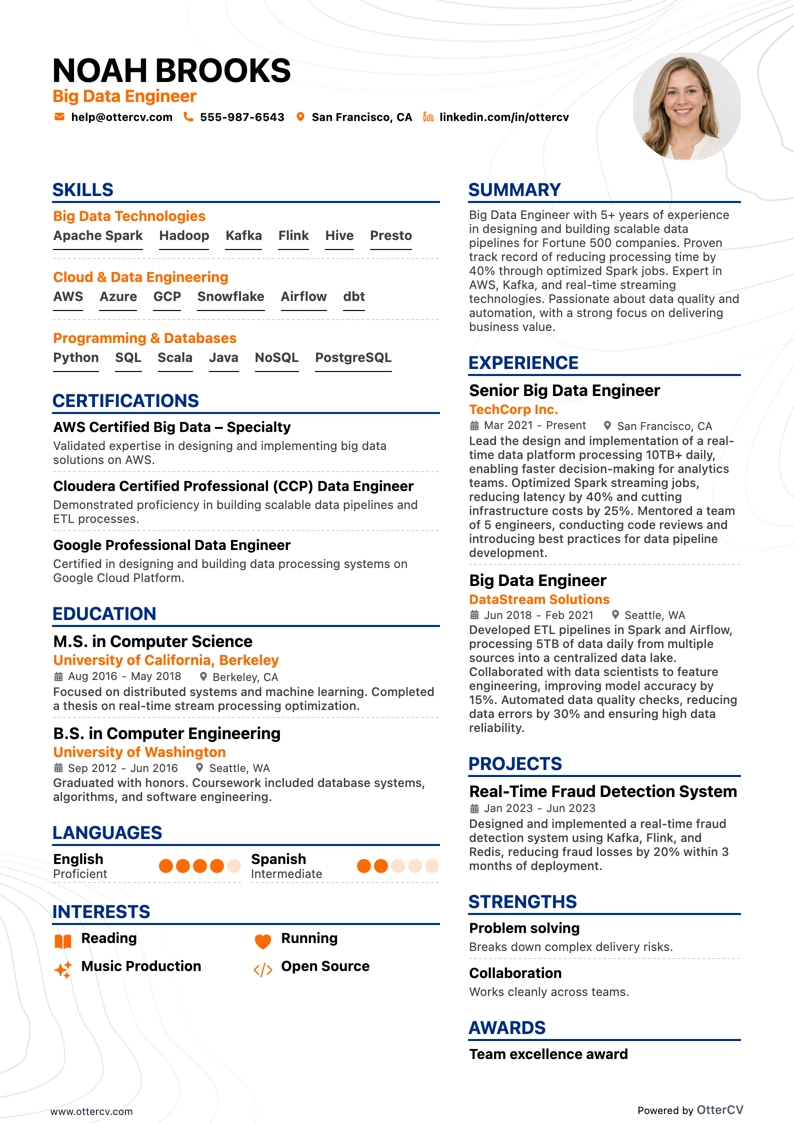
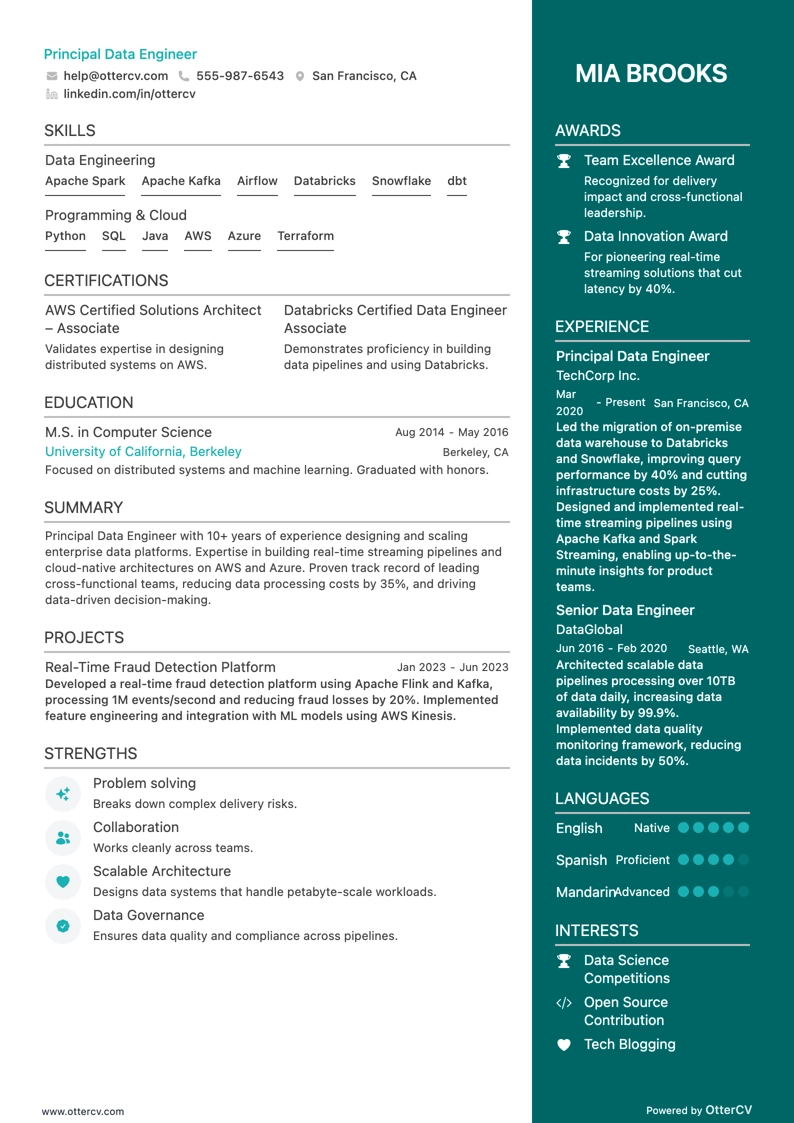
Principal Data Engineer full preview

26 Data Engineer Resume Examples

OtterCV

Written by The OtterCV Team

Updated: 1/21/2024•8 min read

See all resume examples in this guide, or generate your own resume example with your personalized prompt

Principal Data Engineer resume example

Principal Data Engineer

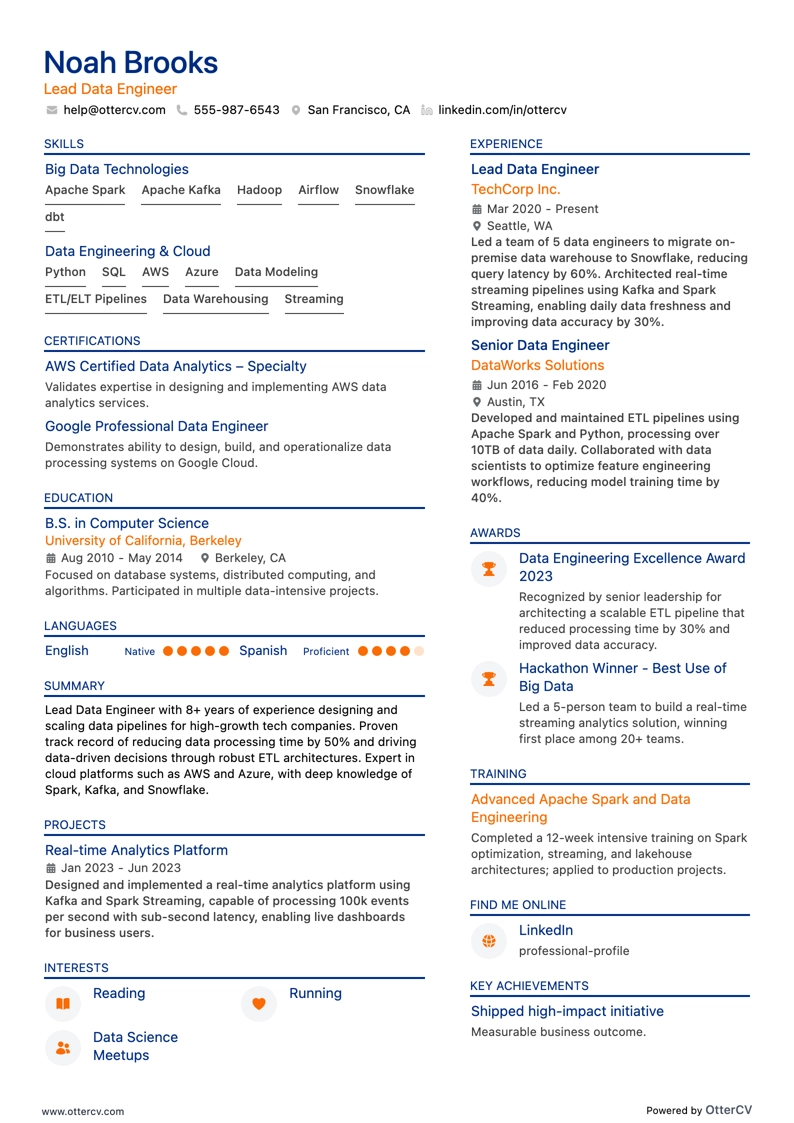
Lead Data Engineer resume example

Lead Data Engineer

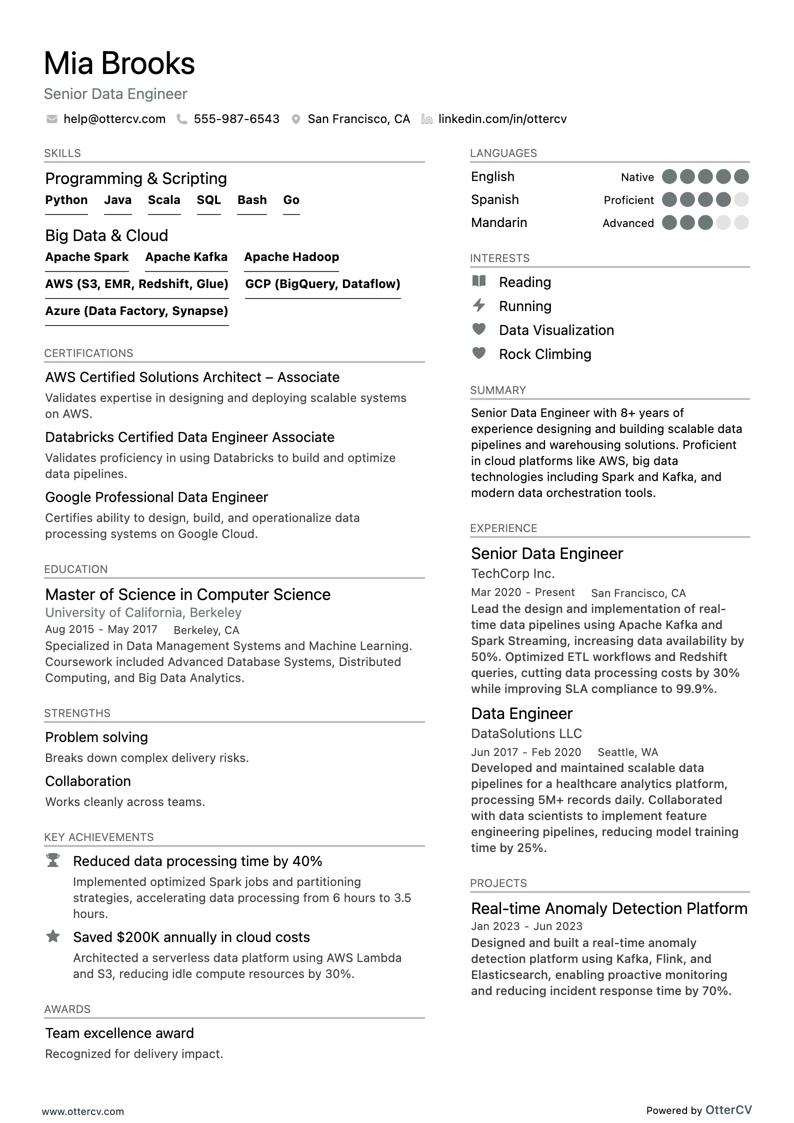
Senior Data Engineer resume example

Senior Data Engineer

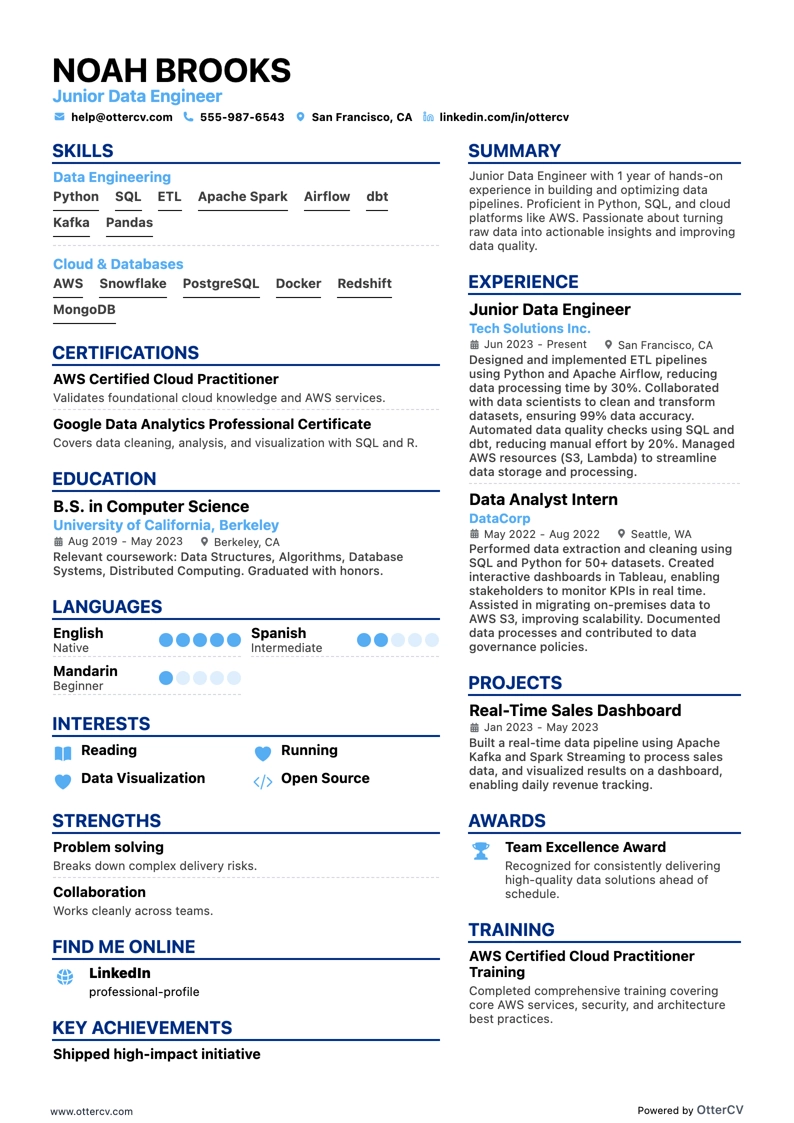
Junior Data Engineer resume example

Junior Data Engineer

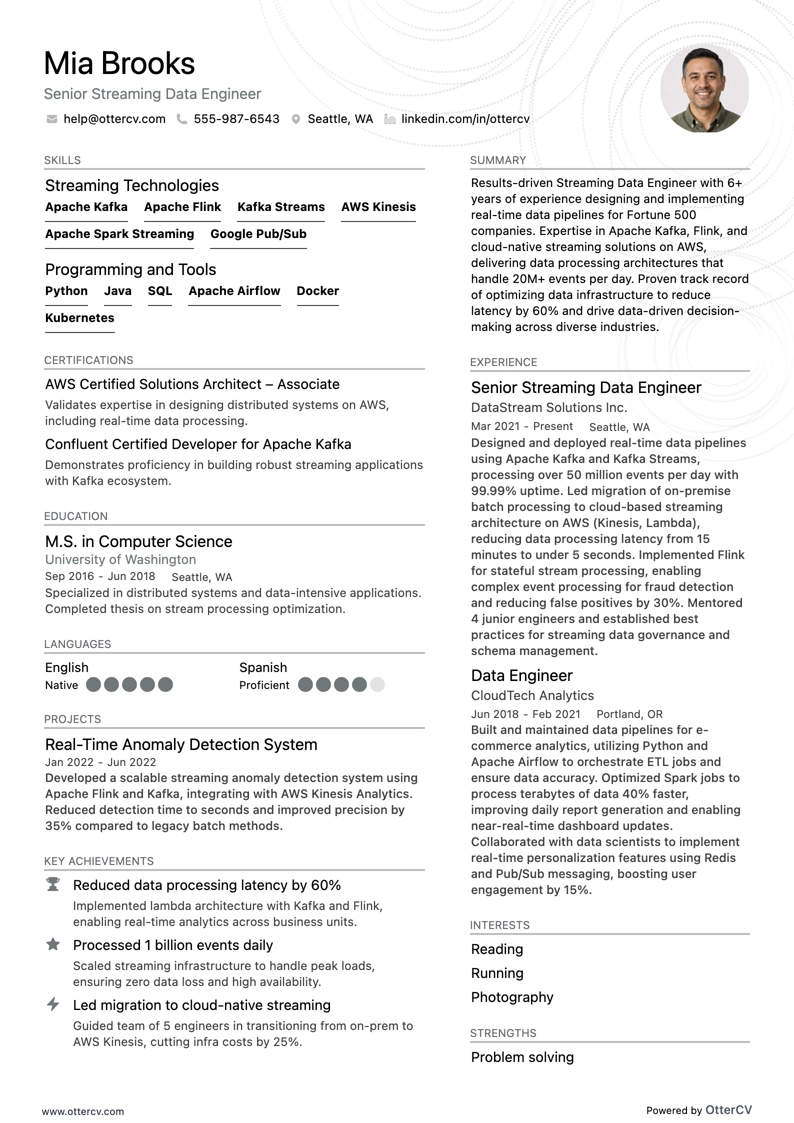
Streaming Data Engineer resume example

Streaming Data Engineer

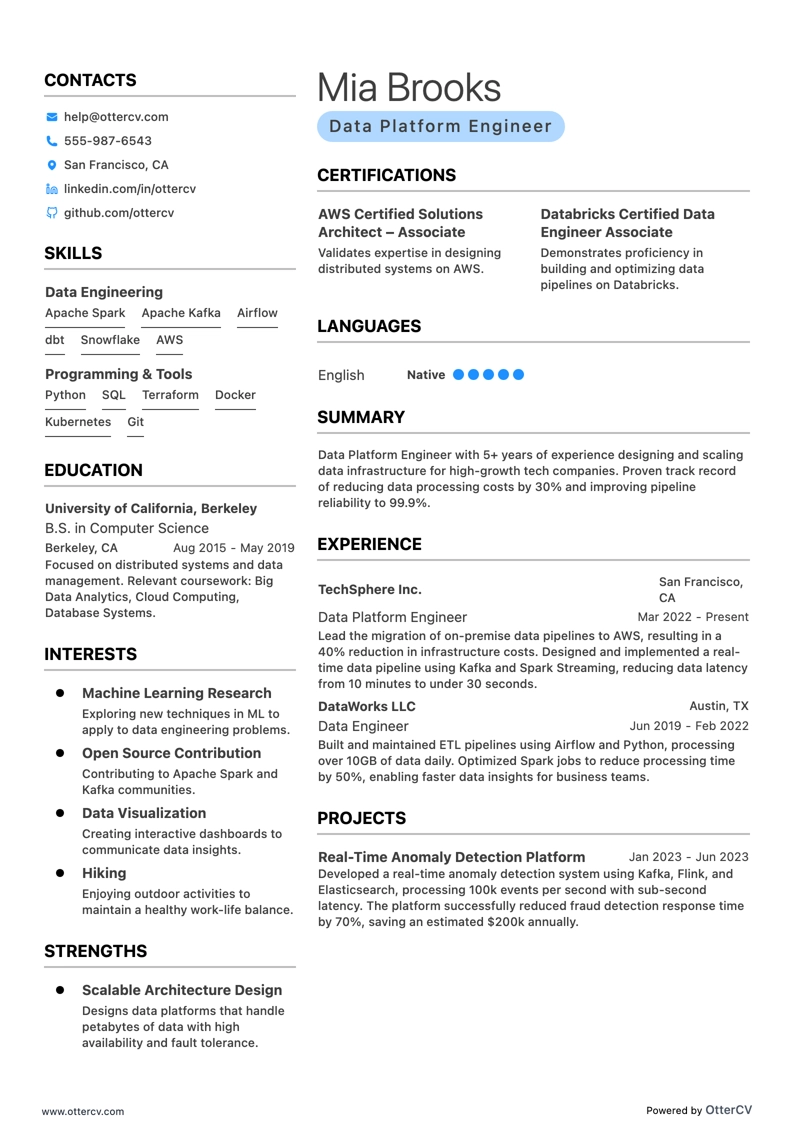
Data Platform Engineer resume example

Data Platform Engineer

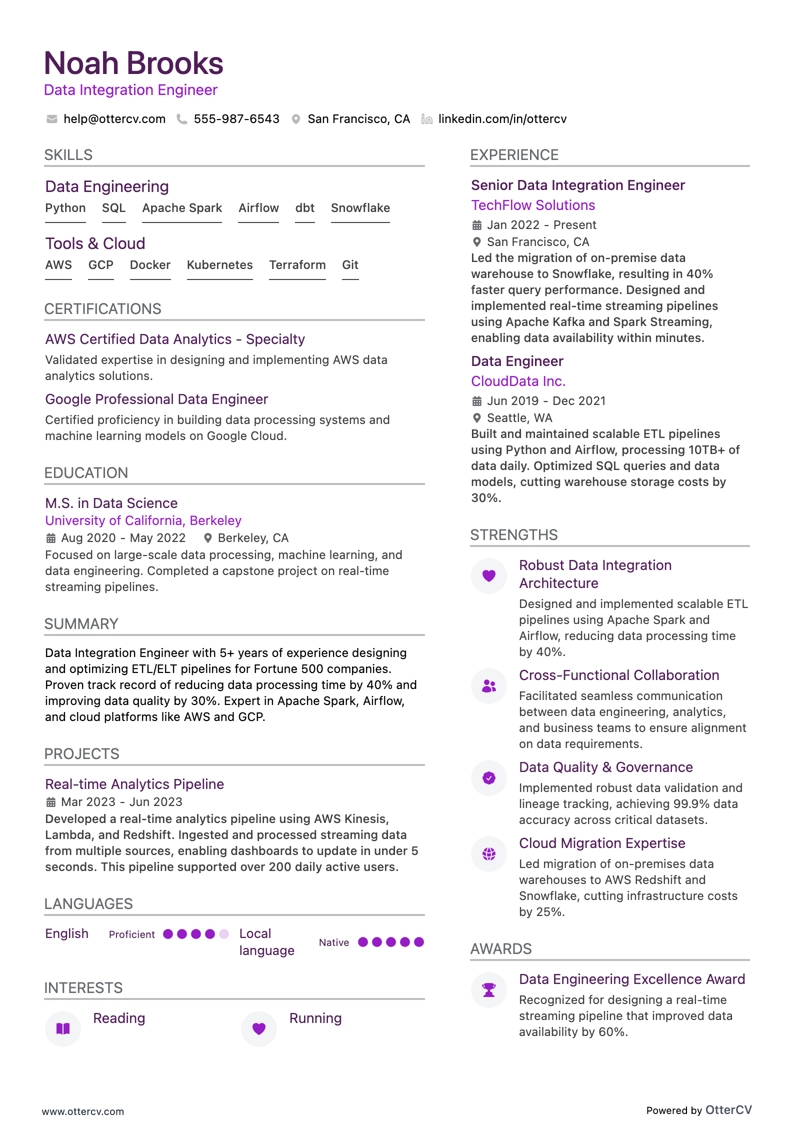
Data Integration Engineer resume example

Data Integration Engineer

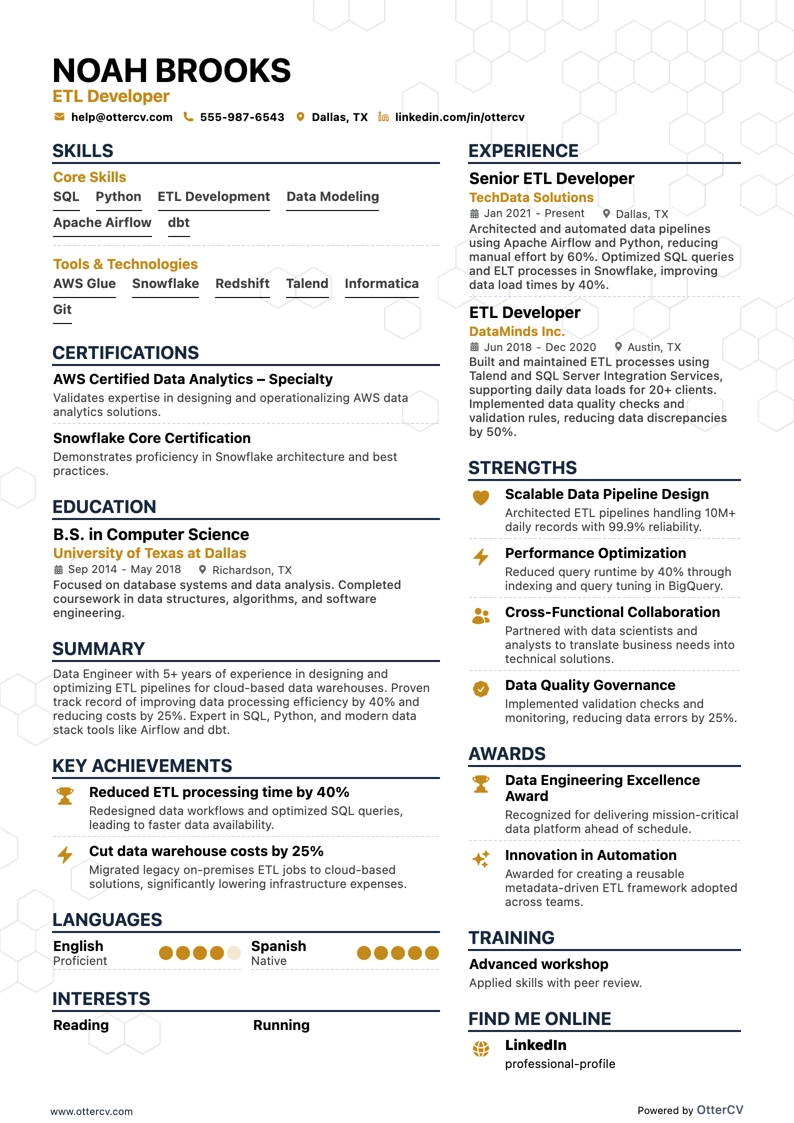
ETL Developer resume example

ETL Developer

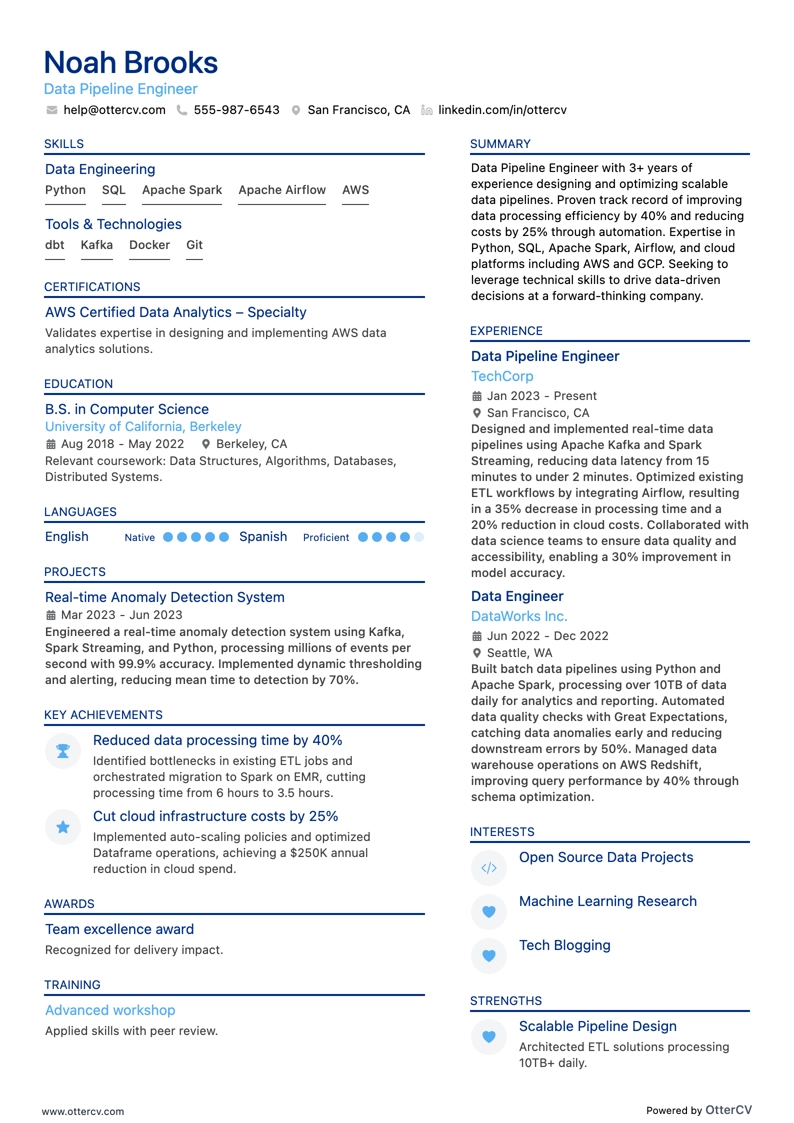
Data Pipeline Engineer resume example

Data Pipeline Engineer

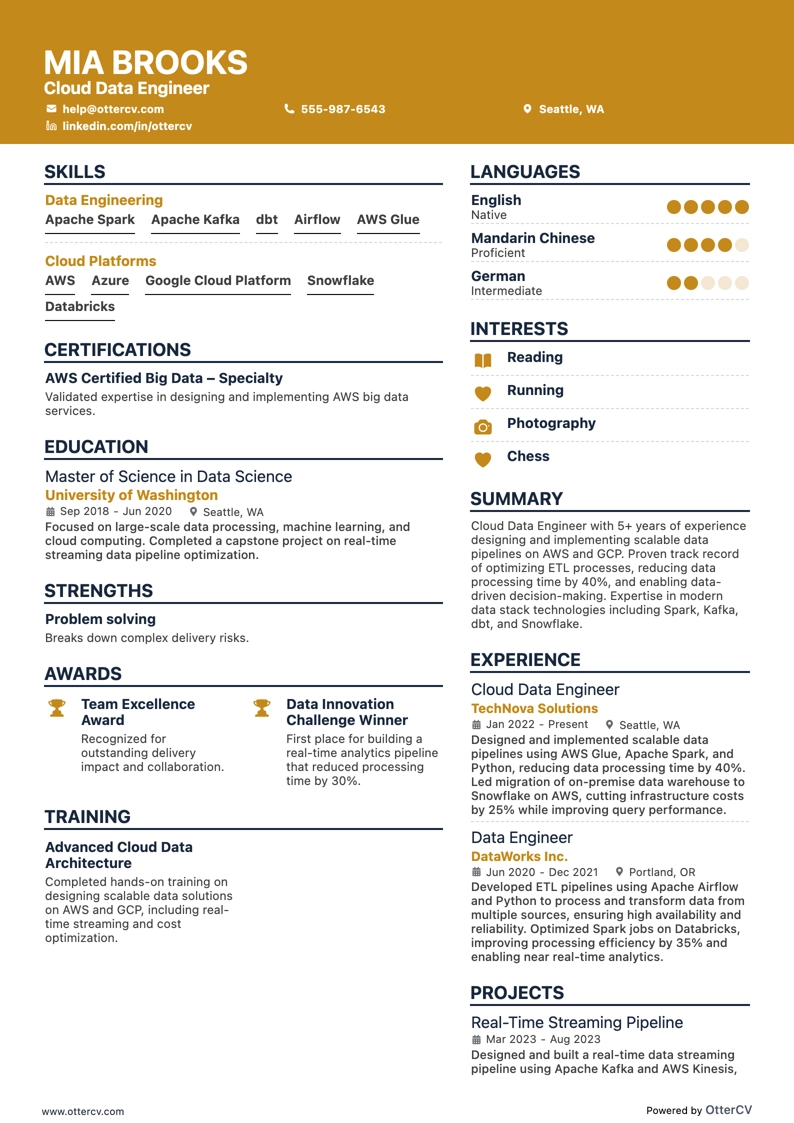
Cloud Data Engineer resume example

Cloud Data Engineer

Big Data Engineer resume example

Big Data Engineer

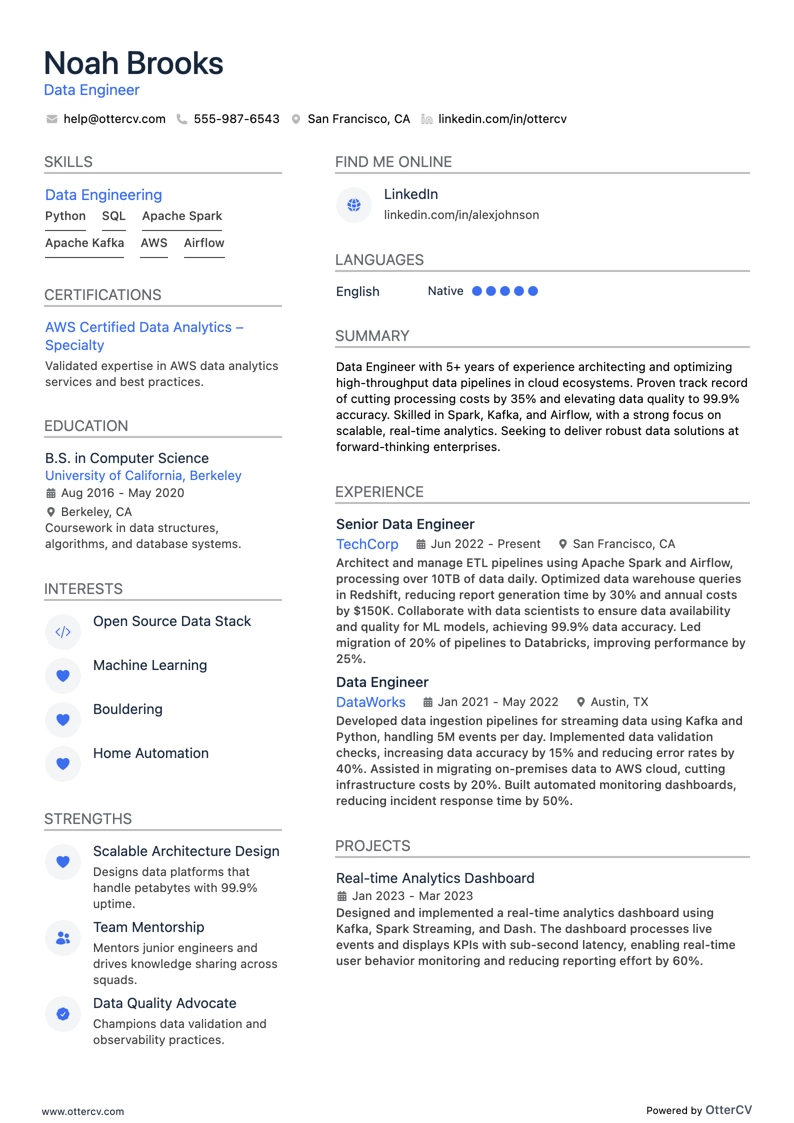
Data Engineer resume example

Data Engineer

Data engineers are the backbone of modern business operations.

You play a pivotal role in turning raw data into actionable insights by designing and maintaining robust data pipelines that keep information accurate, accessible, and ready for decision-making.

However, recognizing your value as a data engineer is only part of the challenge. You also need to communicate that value clearly to recruiters through a resume that highlights your skills and achievements effectively.

That’s why we created this guide. You’ll learn:

  • A step-by-step process for building a data engineer resume from scratch
  • HR-approved tips and practical tricks for writing each section
  • Real-world templates and strong data engineer resume examples to inspire your writing

How to format a data engineer resume

An organized database helps engineers retrieve data efficiently. In the same way, a well-structured resume helps recruiters quickly identify your key qualifications and achievements. Presenting yourself with a modern, polished data engineer resume is a strong way to set yourself apart and stand out.

Here are some essential formatting guidelines for a data engineer resume:

  • Use a reverse chronological format: Start with your most recent role, then list earlier positions in reverse chronological order. This gives recruiters a clear view of your expertise and career progression, especially when presenting data-focused experience.
  • Create an eye-catching resume header: Place your name and job title at the top of the resume, followed by your contact information, including your email address, phone number, and LinkedIn profile.
  • Organize your resume into multiple sections: Divide your resume into clear sections that highlight different parts of your professional background. Include core sections such as "Experience" and "Skills," along with additional sections like "Projects" and "Achievements."
  • Choose an ideal resume length: If you have less than a decade of experience as a data engineer, a one-page resume is ideal for presenting your value concisely. If you have extensive experience, a two-page resume may be more appropriate.

Be mindful of regional differences in resume formats. For example, a Canadian layout may vary.

PRO TIP

A common question data engineers ask when creating their resumes is: “Which file format should I use for my resume—PDF, DOCX, HTML, or JPG?”

In most cases, PDF is the best choice. It helps keep your resume’s layout consistent across devices and platforms, so hiring managers see it as you intended.

The top sections on a data engineer resume

  • Resume header: Introduces you with your name, title, and primary contact details.
  • Resume summary: Summarizes your data engineering expertise and background.
  • Resume experience: Details your past roles, data projects, and their impact.
  • Technical skills: Lists the data tools, platforms, and languages you’ve mastered.
  • Certifications: Highlights the data-related credentials and courses you’ve completed.
  • Achievements: Spotlights the impactful data solutions and projects you’ve spearheaded.

What recruiters want to see on your resume:

  • Experience collaborating closely with data scientists, analysts, and other departments to support company goals.
  • A proven ability to solve complex data challenges and develop effective solutions.
  • Strong command of key tools, cloud databases, and platforms such as Hadoop, Spark, and SQL.
  • Soft skills like teamwork, communication, and adaptability, which are essential in collaborative environments.
  • A bachelor’s or master’s degree, typically in Computer Science, Data Science, or a related field.

For more inspiration, here are more attractive resume templates to accelerate your job search.

How to write your data engineer resume experience

Think of the experience section as a data model of your professional journey and the connections between your career roles.

Use it to show the roles you have held, the responsibilities you managed, and the impact you made at each company.

As a data engineer, you may have many responsibilities and skills to present. Still, hiring managers look most closely for proof of data management expertise, pipeline construction, and cloud platform knowledge.

To create a compelling data engineer resume experience section, focus on the following:

  • List job-specific duties: Include responsibilities that match the data engineering role you are applying for. Your experience should align with both the job description and current market expectations.
  • Demonstrate impact with numbers: Support your achievements with metrics to validate your expertise. Mentioning your tech stack can also help show your hands-on experience more clearly.
  • Use action verbs: Start each bullet point with a strong action verb to make your resume more dynamic and highlight your proactive contribution in past roles.

Let’s review two examples of the experience section on a data engineering resume:

Experience

Data Engineer

Novotel Inc

03/2017 - 05/2019 | Boston, MA

  • Responsible for troubleshooting various computer issues and implementing solutions for Novotel.
  • Monitored and troubleshot issues with Java code.
  • Conducted machine learning program research.
  • Managed configuration changes to various product devices.
  • Installed and managed various Python projects.
WRONG

Unfortunately, this first example falls short in several areas and is unlikely to help you land a job, even at a local small business. It relies too heavily on generic duties, without highlighting results or showing the candidate’s value.

To strengthen it, the applicant should:

  • Incorporate job-specific duties: Tailor your experience to match the specific responsibilities of each data engineering role based on the job description.
  • Integrate quantifiable metrics: Numbers add context and scale, making achievements more concrete and impactful.
  • Utilize strong power words and action verbs: These make the resume more dynamic and help convey a proactive attitude.

With these improvements in place, let’s look at a more refined and effective example.

Experience

Data Engineer

Novotel Inc

03/2017 - 05/2019 · Boston, MA

  • Built streaming services for real-time processing of 100,000 users using Java and Scala.
  • Improved the performance of existing ETL processes and SQL queries for weekly CRM summary data.
  • Led the migration of a legacy data warehouse from on-premise to AWS using Java and Spark.
  • Developed infrastructure to process 15 TB/day, resulting in an 8% increase in online sales for the Ad-tech division.
RIGHT

How to quantify impact on your resume

In data engineering, numbers add depth and credibility to every statement, claim, and conclusion. The same principle applies to your resume. Showing measurable impact is one of the strongest ways to demonstrate your contributions and value to employers.

Here are examples of quantified data engineering responsibilities you can include on your resume:

  • Data processing: Reduced data processing time by 18% by optimizing algorithms.
  • Pipeline construction: Designed and implemented 15+ data pipelines, improving data flow efficiency by 27%.
  • Database management: Managed and maintained a database of over 1.5 million records with 99.9% uptime.
  • Data cleansing: Improved data quality by implementing automated cleansing procedures, reducing errors by 22%.
  • Cloud integration: Migrated 3+ terabytes of data to cloud platforms, resulting in a 33% reduction in infrastructure costs.
  • Query optimization: Improved query response time by 32% through performance tuning.
  • Data modeling: Developed 12+ data models that supported business decision-making and increased revenue by 17%.
  • ETL processes: Automated ETL processes, leading to a 47% reduction in manual data handling tasks.
  • Collaboration: Worked with cross-functional teams on 5 major projects, leading to a 16% increase in project delivery speed.
  • Training: Conducted 7 workshops on best data practices, enhancing team productivity by 25%.

How do I write a data engineer resume with no experience

Demand for data engineers continues to grow as more companies recognize the value of data-driven decision-making. Still, getting into established firms or landing high-paying roles can be difficult without experience.

The good news is that many startups and small businesses are open to entry-level candidates who have the right profile.

If you are applying without experience, focus on the strengths you do have:

  • Use a resume objective instead of a summary to clearly state your career goals and aspirations.
  • Prioritize your education, especially courses and projects related to data engineering concepts and tools.
  • Highlight relevant data engineering certifications to show commitment to the field.
  • Emphasize soft skills and transferable abilities to help offset your lack of hands-on experience.
  • Add sections for workshops and online courses to further strengthen your application.

How to list your hard skills and soft skills on your resume

Resume skills help show how you can add value and support informed business decision-making. They also demonstrate that you have started bridging the gap between academic knowledge and real-world application.

Before going deeper into how to best list skills on your resume, it helps to understand the difference between soft skills and hard skills.

  • Soft skills: These are the interpersonal traits that shape how you work with colleagues and approach challenges. For data engineers, important soft skills include communication, teamwork, and problem-solving.
  • Hard skills: These are the core and technical abilities you gain through education, training, and work experience. For data engineers, this can include programming languages and data analysis tools.
How to list skills on a data-engineer resume in a few steps

  • Categorize your skills: Separate them into hard skills and soft skills.

  • Put the most relevant skills first: Match your list to the job description, such as listing Python programming first if the role asks for it.

  • Use specific keywords: Instead of broad terms like database management, name the databases you know, such as MySQL or MongoDB.

  • Include transferable skills: Skills like effective communication and team collaboration still matter, especially if you are changing industries.

  • Limit the list to 10-15 skills: A focused list of 10 to 15 core and soft skills is more effective than a crowded section.

Before submitting your resume, give it some time so you can review it again with fresh eyes. If you have data engineering colleagues or mentors, ask them to look over your skills section for relevance and clarity.

Best hard skills for your data engineer resume

  • SQL is a foundational skill for querying and managing data.
  • Python is widely used for data engineering tasks and automation.
  • Big data technologies include Hadoop, Spark, and Kafka.
  • Relational databases include PostgreSQL and MySQL.
  • NoSQL databases include MongoDB and Cassandra.
  • ETL processes are essential for moving and transforming data.
  • Cloud platforms include AWS, GCP, and Azure.
  • Cloud databases include Snowflake, Azure SQL, and Databricks.
  • Data warehousing solutions include Redshift and BigQuery.
  • Data modeling and design support scalable data systems.
  • Stream processing includes Kafka Streams and Flink.
  • Workflow orchestration includes Apache Airflow and Prefect.
  • Data storage solutions include AWS S3 and Delta Lake.
  • Data integration tools include Talend and Informatica.
  • Distributed systems and architecture are core data engineering skills.
  • Performance optimization and tuning help improve system efficiency.
  • Data governance and compliance support secure, reliable data practices.
  • Containerization includes Docker and Kubernetes.
  • Machine learning integration and pipelines can strengthen your resume.
  • API development and management are valuable technical skills.

How to list your certifications and education on your resume

In a highly competitive field like data engineering, certifications help validate your expertise and show potential employers that you are committed to the profession.

To make that section effective, only include certifications that are relevant to the job you are applying for.

Educational Degree

What about your educational degree?

Education lays the groundwork for your career. Companies often require specific degrees to confirm that candidates have a foundational understanding of the field and the skills needed to contribute from day one.

Here’s a quick example of how to list education on a data engineer resume:

Education

Bachelor of Science in Computer Science
University of California
07/2017 - 09/2021 · Berkeley, CA

RIGHT

How to write your data engineer resume summary or objective

Many data engineering job seekers place a summary or objective at the top of their resumes. While both provide a brief snapshot of your professional background, they serve different purposes.

A resume summary is a concise overview of your achievements, skills, and experience. It is best for candidates with significant experience as data engineers.

A resume objective is a short statement about your career goals and aspirations. It tells hiring managers what you hope to achieve in your next role and how you plan to do it. Objectives are a good fit for entry-level candidates or applicants changing careers.

Examples of data engineer resume summaries:

Summary

Experienced Data Engineer seeking a new opportunity with your company. Passionate about data and looking for an organization where I can continue to grow and learn. Familiar with many data tools and eager to contribute to your growth.

WRONG

The previous example has a lot of room for improvement. It is vague, generic, and does not emphasize measurable achievements that can impress recruiters.

You can improve it in three simple steps:

  • Always quantify your achievements: Use numbers and data to make your experience and claims more impactful.
  • Highlight your value clearly to the recruiter: Show how your skills and talents benefited past employers to demonstrate your direct contributions and workplace impact.
  • Utilize ATS keywords: Read the job description carefully and identify the keywords the hiring company expects, including achievements, skills such as “Python and SQL,” and degrees such as “Master’s in Data Science.”

Let’s make those changes and see the result:

Summary

Data Engineer with 6+ years of experience delivering end-to-end data solutions. Designed and optimized 50+ data pipelines, improving processing efficiency by 30%. Holds a Master's degree in Data Science. Proficient in Python, SQL, and cloud platforms, with a strong track record of managing large-scale datasets and supporting data-driven decision-making.

RIGHT

Additional sections for a data engineer resume

  • Strengths: Similar to a skills section, this highlights the core competencies and natural talents that make you a strong data engineer.

  • Projects: Use this section to describe meaningful personal, academic, or professional work that demonstrates hands-on data engineering experience.

  • Workshops: Include workshops you attended, led, or presented to show your commitment to continuous learning and staying current with industry trends.

  • Courses: This section can feature any specialized coursework you completed outside your formal education.

  • Awards & Honors: List recognitions you received in data engineering to highlight your contributions and achievements.

  • Emphasize relevance: Prioritize projects that closely match the job description and the company’s expectations.

  • Illustrate complexity: Choose projects that address difficult data challenges or require innovative solutions.

  • Highlight skillset diversity: Include a range of projects that reflect varied skills, such as data wrangling and machine learning implementations.

  • Prioritize modern resume design and formatting to improve readability and quickly capture a recruiter’s attention.

  • Read job descriptions carefully so you can tailor your data engineer resume to company needs.

  • Structure your experience section in reverse-chronological order, and make sure your accomplishments are quantifiable.

  • Emphasize soft skills and core talents to reinforce your expertise and impress recruiters.

  • Spotlight your degree and relevant certifications to strengthen your position for highly demanding roles.

  • Make your resume more impactful by adding sections such as projects, courses, and awards.

Data Engineer resume examples

Explore additional Data Engineer resume samples and guides and see what works for your level of experience or role.

By Experience

Principal Data Engineer

Principal Data Engineer resume preview

Lead Data Engineer

Lead Data Engineer resume preview

Senior Data Engineer

Senior Data Engineer resume preview

Junior Data Engineer

Junior Data Engineer resume preview

Data Engineer resume examples

Explore additional Data Engineer resume samples and guides and see what works for your level of experience or role.

By Role

Streaming Data Engineer

Streaming Data Engineer resume preview

Data Platform Engineer

Data Platform Engineer resume preview

Data Integration Engineer

Data Integration Engineer resume preview

ETL Developer

ETL Developer resume preview

Data Pipeline Engineer

Data Pipeline Engineer resume preview

Cloud Data Engineer

Cloud Data Engineer resume preview

Big Data Engineer

Big Data Engineer resume preview

Data Engineer

Data Engineer resume preview