Lead Cybersecurity Analyst full preview

22 Cybersecurity Analyst Resume Examples

OtterCV

Written by The OtterCV Team

Updated: 11/4/2025•8 min read

See all resume examples in this guide, or generate your own resume example with your personalized prompt

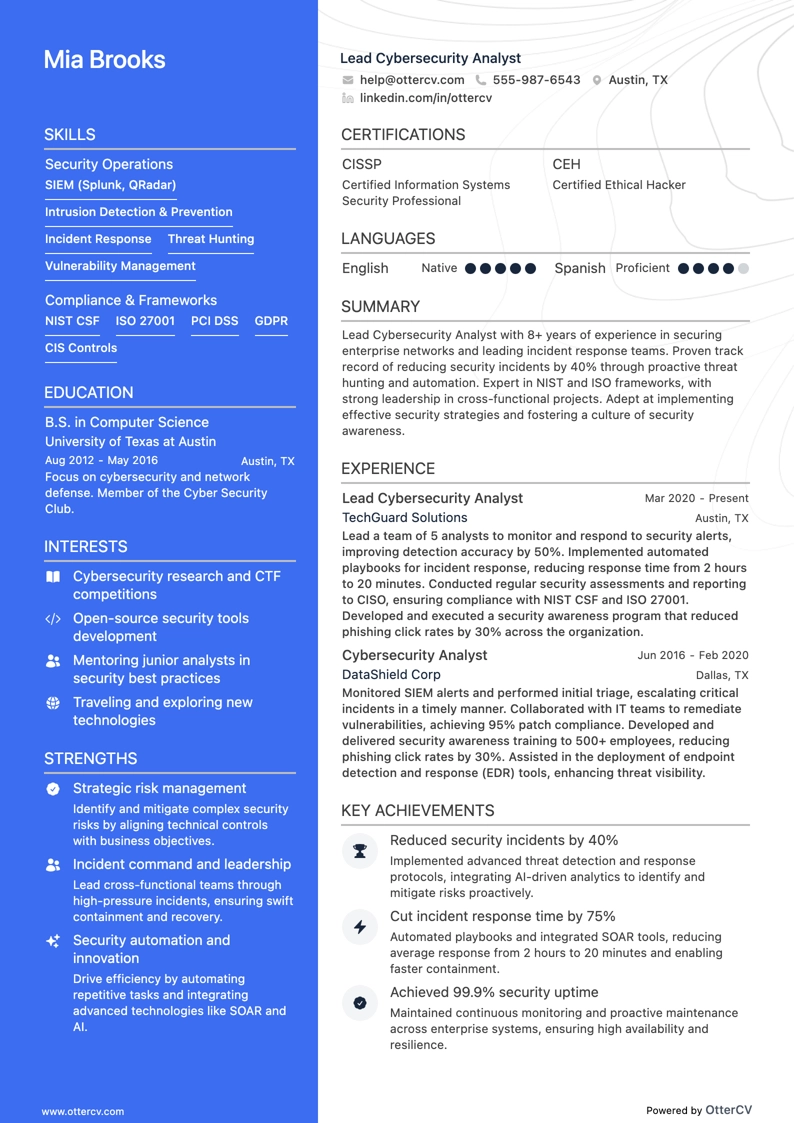
Lead Cybersecurity Analyst resume example

Lead Cybersecurity Analyst

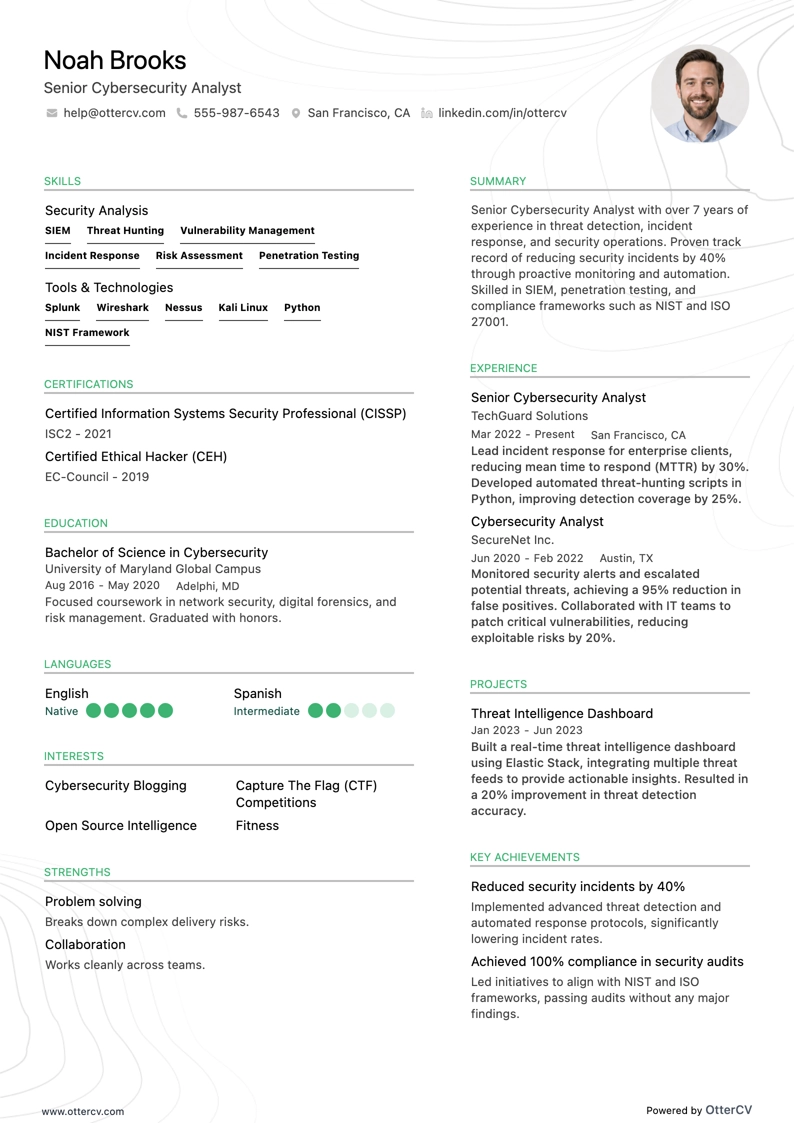
Senior Cybersecurity Analyst resume example

Senior Cybersecurity Analyst

Entry-Level Cybersecurity Analyst resume example

Entry-Level Cybersecurity Analyst

Identity and Access Management Analyst resume example

Identity and Access Management Analyst

Application Security Analyst resume example

Application Security Analyst

Cloud Security Analyst resume example

Cloud Security Analyst

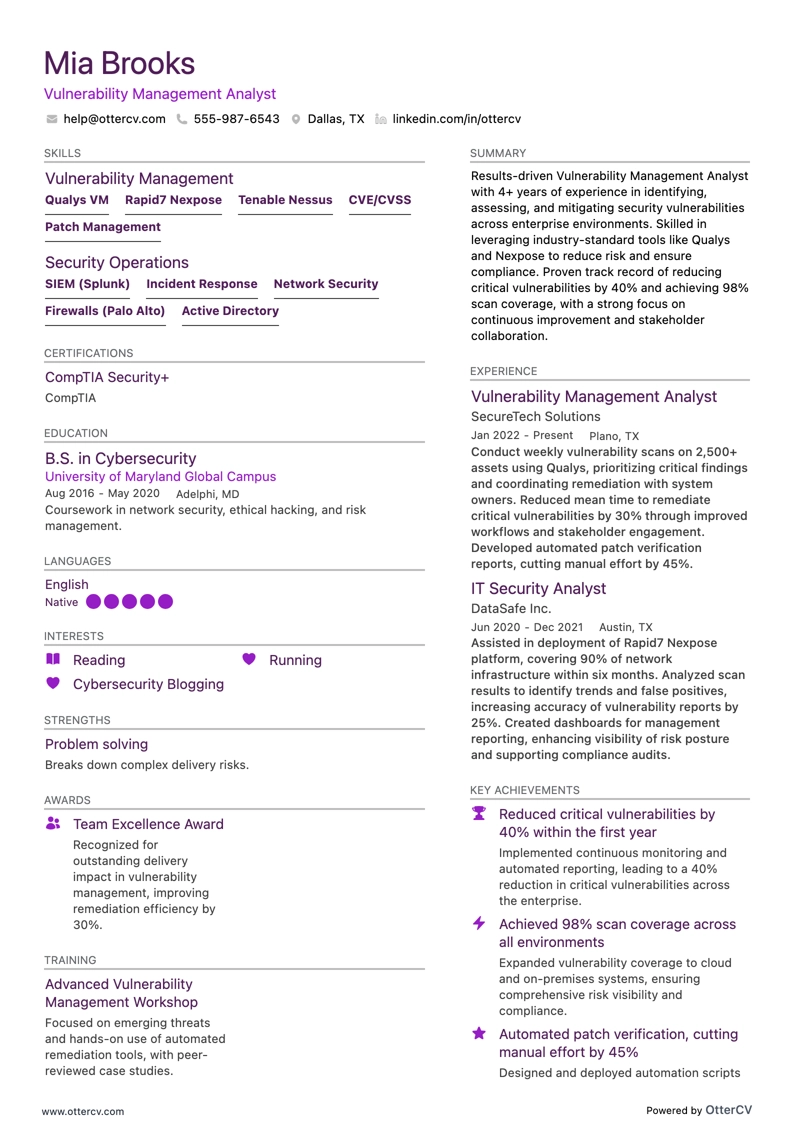
Vulnerability Management Analyst resume example

Vulnerability Management Analyst

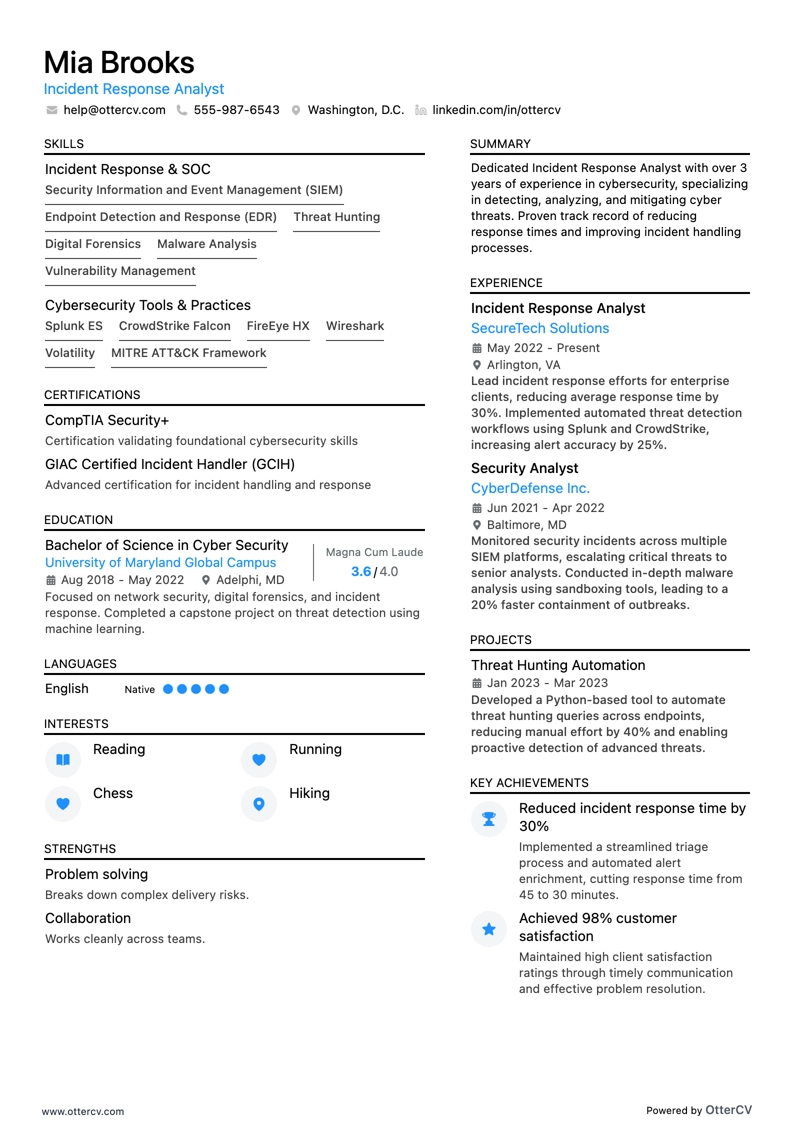
Incident Response Analyst resume example

Incident Response Analyst

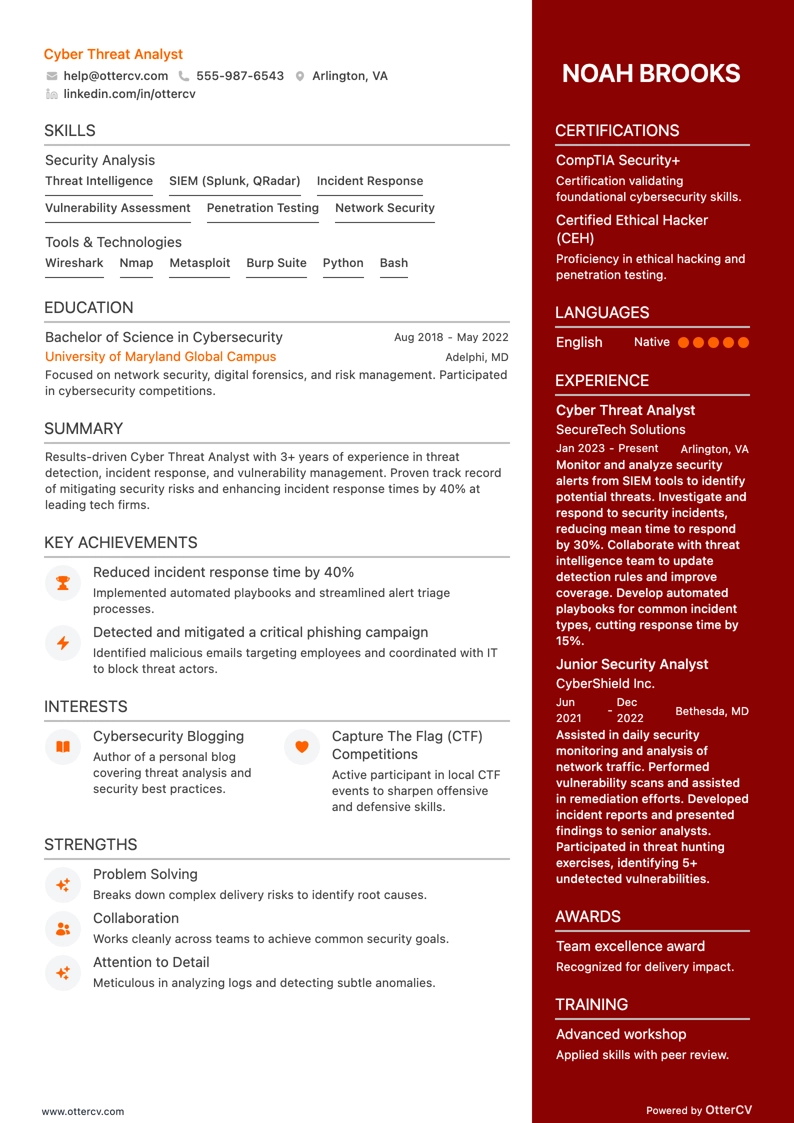
Cyber Threat Analyst resume example

Cyber Threat Analyst

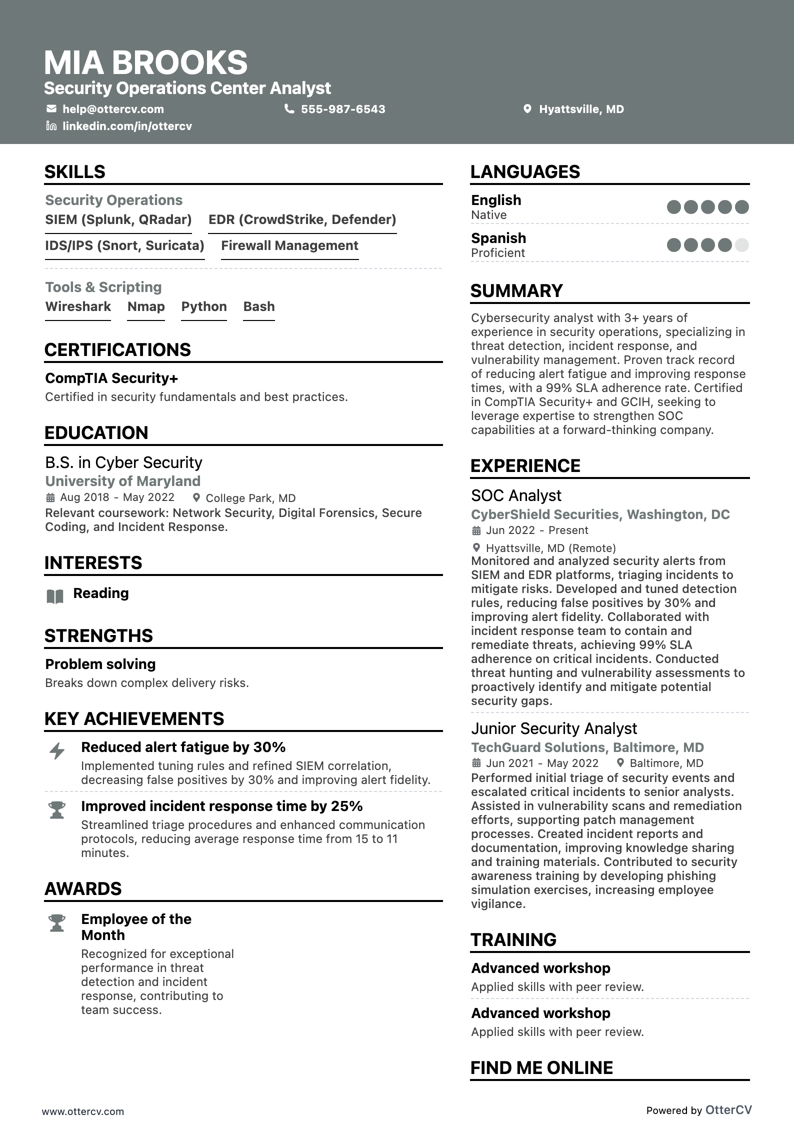
Security Operations Center Analyst resume example

Security Operations Center Analyst

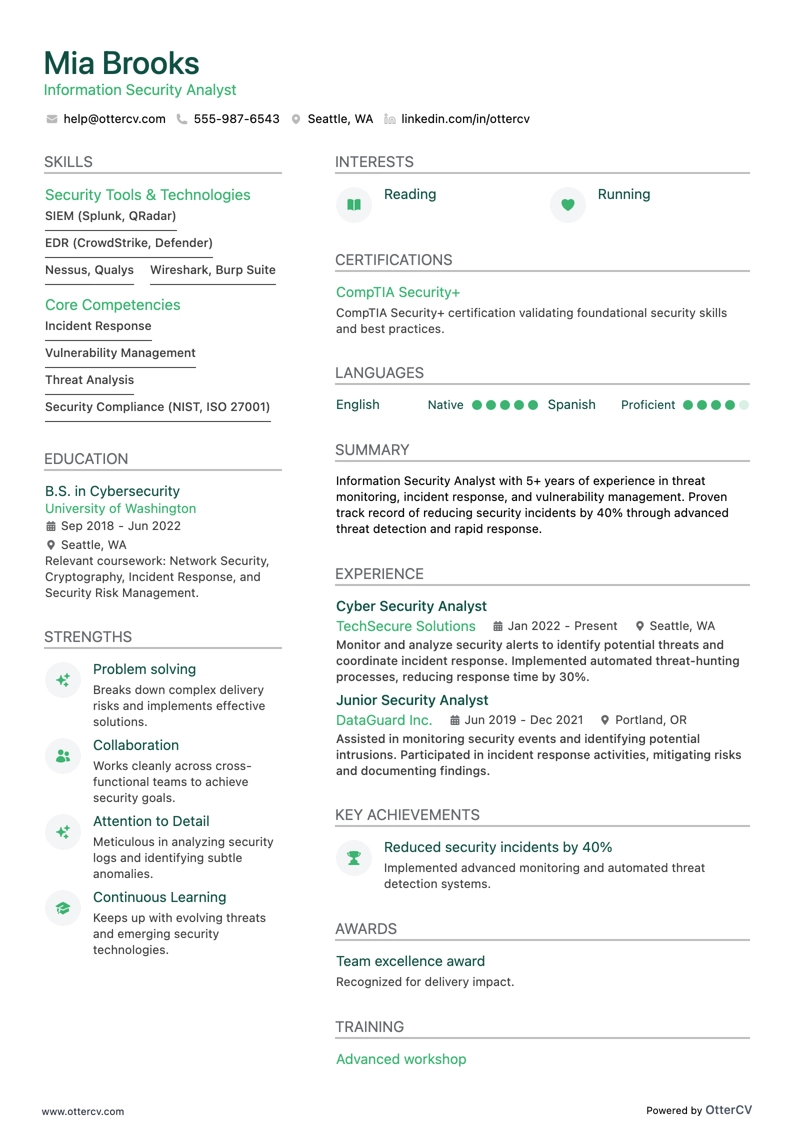
Information Security Analyst resume example

Information Security Analyst

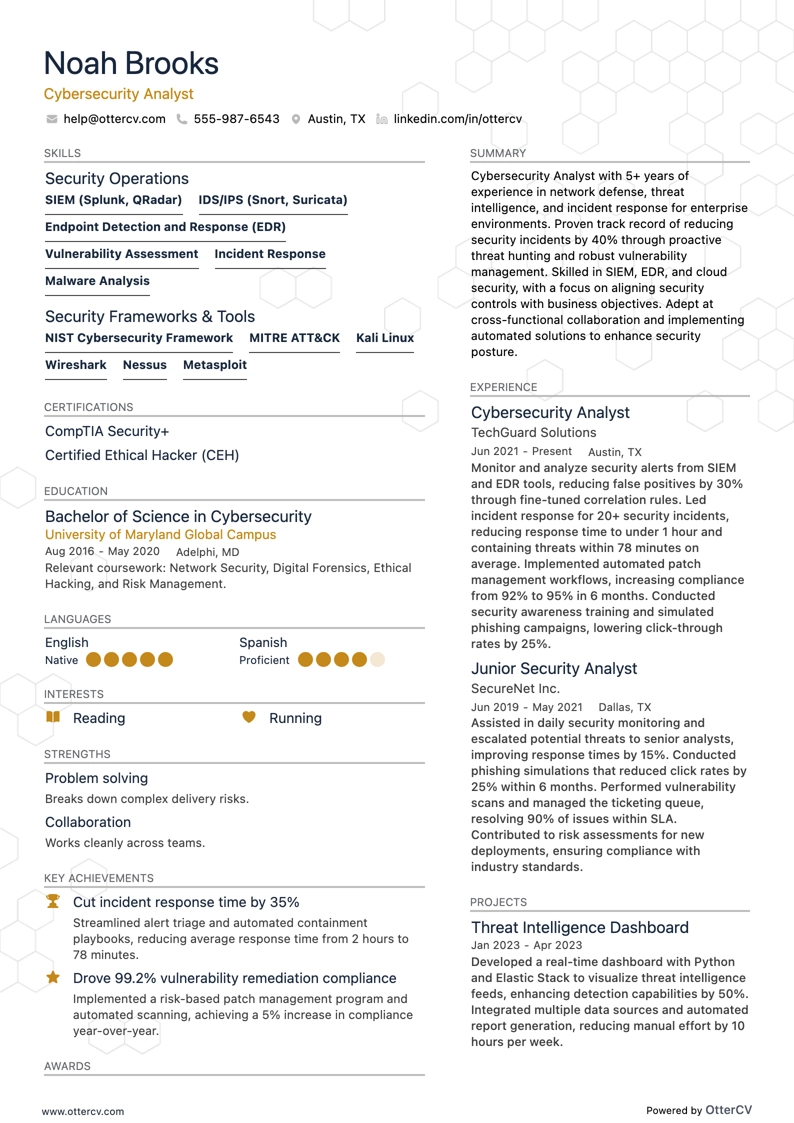
Cybersecurity Analyst resume example

Cybersecurity Analyst

As a cybersecurity analyst, you know how to spot weaknesses in a network. But can you identify the weak points in your resume?

According to a recent ISC2 cybersecurity workforce study, the global shortage of cybersecurity professionals has surpassed four million, yet competition for top roles remains intense.

In this guide, you’ll learn how to refine your cybersecurity analyst resume so it can handle rigorous screening and pass applicant tracking systems (ATS) more easily.

From front-line threat hunting to compliance oversight, this guide will help strengthen your qualifications and capture the attention of hiring managers in a competitive digital field.

Key takeaways

  • Tailor your resume summary and experience with role-specific cybersecurity terms.

  • Rename your skills section to “Technical Expertise” to convey competence.

  • Align your technical abilities to the role and organize them into relevant categories.

  • Show how your breach prevention methods led to cost savings for businesses.

  • Place your certifications before your education to highlight relevant know-how.

We’ll walk through every part of building a strong resume and share inspiring examples along the way. Let’s start with the first one.

Cybersecurity analyst resume sample

Review this example cybersecurity analyst resume, then copy and customize it in Echocv’s AI-powered resume builder.

Adrian Thomas

Cybersecurity Analyst

(555)-173-87XX | adrian.thomas@echocv.com | @LinkedIn | San Francisco, CA

Summary

Proactive and detail-oriented cybersecurity analyst with over four years of experience in threat detection, incident response, and vulnerability management. Skilled in deploying advanced SIEM tools and applying security frameworks such as NIST and ISO 27001. Works effectively with cross-functional teams to implement strong security controls and protect critical infrastructure. Seeking to join ShieldSec Solutions to apply cutting-edge methodologies and stay ahead of emerging cyber threats.

Technical Expertise

  • Threat Analysis & Incident Response
  • Vulnerability Assessments & Penetration Testing
  • SIEM Tools (Splunk, QRadar)
  • Security Frameworks (NIST, ISO 27001)
  • Network Protocols & Firewall Administration
  • Cloud Security (AWS, Azure)
  • Collaboration & Communication

Professional Experience

Cybersecurity Analyst

DataShield Innovations, Seattle, WA

January 2021 – Present

  • Perform comprehensive vulnerability assessments and penetration tests to identify high-risk threats.
  • Monitor real-time network activity using Splunk, isolating and containing suspicious behavior.
  • Coordinate cross-functional incident response efforts, reducing recovery time by 40%.
  • Collaborate with compliance teams to integrate and maintain NIST security controls.
  • Provide mentorship to junior analysts on new threat vectors and best practices.

Certification

  • Certified Ethical Hacker (CEH) | 2024
  • EC-Council

Education

Bachelor of Science in Cybersecurity

University of California | Berkeley, CA | Graduated: May 2021

  • GPA: 3.8
  • Relevant Coursework: Network Security, Ethical Hacking, Incident Response, Cryptography
  • Capstone Project: Designed and implemented a secure network architecture for a simulated corporate environment.

Projects & Research

  • Cloud Threat Monitoring Pilot – Deployed automated scripts to detect anomalous behavior in AWS-based systems, reducing false positives by 30%.
  • Web Application Firewall (WAF) Optimization – Collaborated with DevOps team to optimize WAF rules, improving performance for a major e-commerce client.
This is just a text-only example, but there’s much more you can do with formatting.

How to format a cybersecurity analyst resume

How you format your cyber threat analyst resume can make the difference between getting a call from a hiring manager and being passed over. A clear, strategic structure helps present your expertise in the best possible light.

Best resume format for a cybersecurity analyst

A hybrid resume format is the best choice for a cyber vulnerability analyst because hiring managers often want to see your relevant experience and skills right away.

Resume design tips

In 2026, a one-page resume with a two-column layout is an effective way to showcase your experience and technical skills. It makes your resume visually appealing and easy to scan.

However, if you have an extensive cybersecurity career—around 10 years or more—you can confidently use a two-page resume.

Here’s what else we recommend:

  • Keep resume margins between 0.5"–1" to make your content readable and printer-friendly.
  • Use a neutral color scheme, such as black with subtle accent hues, to maintain a professional look.
  • Choose clean, classic resume fonts like Calibri or Arial in 10–12 pt size for readability.
  • Avoid excessive graphics, as they can take attention away from your experience and technical skills.
  • Try Echocv’s professional resume templates to save time.

Don’t worry about using modern resume templates. Current applicant tracking systems can parse them just fine.

Contact information

File format and naming

It is best to save your resume in PDF format for three reasons:

  • ATS can easily extract text for keyword matching.
  • Hiring managers expect it.
  • It preserves resume formatting across devices.

Also, name the file appropriately, for example: name_surname_cybersecurity_analyst_resume.pdf.

Top sections for a cybersecurity analyst resume

Here is how to organize your resume for maximum clarity and impact:

  • Header with contact information
  • Professional Summary
  • Technical Expertise
  • Professional Experience
  • Certification & Education
  • Projects & Research

We will discuss the rest of these resume sections in detail. But first, try our free ATS resume checker.

Now that we’ve covered the basics of creating a strong IT security analyst resume, let’s look at what to write in each section.

How to write your cybersecurity analyst resume experience

Writing your experience section is one of the most important steps in building a compelling cyber vulnerability analyst resume.

This is where you show your hands-on expertise in threat mitigation and incident response.

Here’s how to approach it:

  • Each work experience entry should include your role, company name, location, and employment period.
  • Start with your most recent role and follow reverse-chronological order.
  • Instead of listing responsibilities, show real examples of how you prevented or mitigated cybersecurity threats.
  • Use action verbs and numbers to make your accomplishments clear and measurable.

You can strengthen this section further by tailoring it to the job description.

Why resume tailoring is important

Think of this step as a way to “hack” the job application system. It can improve your chances of getting an interview call.

Here’s why:

  • It adds relevant keywords from the job description to your resume.
  • It improves your chances of passing ATS screening.
  • It shows hiring managers that you pay attention to detail.

For example, you can address company-specific needs such as experience with hybrid cloud environments and include role-related keywords like “SIEM integration” or “SOC analyst.”

To see how this works in practice, let’s look at a job description example and then apply some resume tailoring.

Cybersecurity Analyst

Cybersecurity Analyst

Company Profile: ShieldSec Solutions is a forward-thinking cybersecurity firm specializing in proactive threat intelligence, incident response, and data protection strategies. Trusted by global enterprises in finance, healthcare, and government, the team applies cutting-edge security methodologies to safeguard critical systems and sensitive data. The company fosters a culture of innovation, continuous learning, and collaboration to stay ahead of evolving cyber threats.

Main Role Responsibilities:

  • Perform in-depth vulnerability assessments and penetration tests to identify potential risks.
  • Monitor networks, systems, and applications for suspicious activity and promptly address threats.
  • Coordinate incident response efforts, including containment, eradication, and recovery measures.
  • Work closely with cross-functional teams to implement security controls and compliance standards.
  • Develop and maintain cybersecurity documentation, including incident reports and standard operating procedures.
  • Provide mentorship and training to junior staff on security best practices and emerging technologies.

Requirements:

  • Bachelor’s degree in Cybersecurity, Computer Science, or a related field.
  • 3+ years of hands-on experience in threat analysis, incident handling, or security operations.
  • Proven expertise in security frameworks and standards, such as NIST and ISO 27001.
  • Solid understanding of network protocols, firewalls, and SIEM tools.
  • Industry certifications such as CompTIA Security+, CEH, or CISSP are strongly preferred.
  • Excellent communication skills and the ability to thrive in a fast-paced environment.

As you’ve noticed, we’ve highlighted the parts of the job description that we’ll target in the experience section example below.

Professional Experience

Cybersecurity Analyst

DataShield Innovations

02/2000 - 11/2004 | Seattle, WA

  • Performed in-depth vulnerability assessments and penetration tests to proactively identify high-risk threats.
  • Monitored real-time network activity and system logs, swiftly containing suspicious behavior.
  • Coordinated cross-functional incident response efforts to ensure seamless eradication and recovery.
  • Collaborated with IT and compliance teams to implement security controls and meet industry frameworks, including NIST and ISO 27001.
  • Mentored and trained junior staff on the latest security methodologies and best practices.
RIGHT

We used the responsibilities outlined in the job description to shape the action verbs and accomplishments, making the entry a strong match.

That said, it can be improved further by adding numbers and metrics.

How to quantify your experience on a resume

Quantifying your cybersecurity experience with concrete numbers and measurable results helps you stand out from candidates who are less specific. It also makes a stronger, more memorable impression.

Here are a few recommendations:

  • Include incident response metrics, such as reduced mean time to detect (MTTD) or mean time to respond (MTTR).
  • Mention the specific types of threats you handled, such as DDoS attacks or ransomware.
  • List any specialized tools and frameworks you implemented.
  • Describe cross-functional collaboration with different teams and departments.
  • Show examples of proactivity and leadership, such as spearheading security awareness training or leading an incident response task force.

Here are some examples of what to include in your experience bullet points:

Key Cybersecurity Impact

  • Reduced incident response times by 45% by implementing automated threat detection workflows.
  • Conducted over 250 vulnerability assessments annually, identifying and mitigating high-risk threats across critical systems.
  • Increased phishing email detection by 60% by refining email filtering rules and deploying advanced AI-based tools.
  • Secured $2 million in potential cost savings by preventing data breaches through enhanced endpoint protection measures.
  • Improved network uptime by 30% by proactively addressing system vulnerabilities and optimizing firewall configurations.

Having notable accomplishments in cyber threat analysis can make you a strong candidate for the role. But what if you do not have direct experience?

How do I write a cybersecurity analyst resume with no experience

Writing a resume without direct experience for a cybersecurity analyst role can be challenging. Still, with the right approach, you can stand out against even some experienced candidates.

If you are a recent graduate, use a functional resume format. Highlight your academic projects, certifications, and any cybersecurity competitions you have participated in.

If you are an IT professional with transferable skills, a hybrid resume can present your qualifications more effectively. Emphasize your relevant experience, technical skills, and how they apply to cybersecurity.

A functional resume emphasizes education and skills, while a hybrid, or combination, resume blends elements of both reverse chronological and functional formats.

Here’s what else you should do:

  • Stick to a one-page resume to present your relevant competencies concisely.
  • Use industry- and job-specific terms to help pass ATS screening.
  • Demonstrate continuous learning by mentioning participation in cybersecurity communities and training platforms, such as TryHackMe and Hack The Box.
  • Show strong motivation to apply your skills and knowledge in this role.

When it comes to motivation, the best place to express it is in a resume objective.

Objective statement writing tips

If you don’t have direct cybersecurity experience, start your resume with an objective instead of a summary.

Here’s how to write it:

  • Tailor the objective to the role and company.
  • Mention certifications and transferable skills.
  • Align your career goal with the hiring company’s priorities.
  • Articulate your enthusiasm for the role.
  • Keep it direct and concise in two to three sentences.

Here’s an example to inspire you:

Objective

Detail-oriented IT professional with a strong foundation in network security and system administration, seeking to apply technical skills and a proactive approach in a Cybersecurity Analyst role at ShieldSec Solutions. Eager to help safeguard critical systems while expanding expertise in threat detection and incident response.

RIGHT

If you're aiming to land a senior role in network security, the next section will be particularly helpful.

How to show career progression on a cybersecurity analyst resume

If you want to move forward in your cybersecurity career, your resume should clearly show your professional growth.

Hiring managers want more than technical ability. They also look for candidates who can lead initiatives, solve complex problems, and make a broader impact.

One of the strongest ways to present yourself as ready for a more senior cybersecurity role is to demonstrate career progression throughout your resume.

Here are effective ways to highlight that growth:

  • Use your experience section to show an upward trajectory by describing promotions and expanded responsibilities.
  • Include examples of stepping into leadership roles, such as leading incident response or guiding a team through containment.
  • Mention cross-functional collaboration with IT, compliance, or DevOps teams to strengthen security.
  • List major projects you owned, such as leading security audits or designing new firewall architectures.
  • Explain how you handled advanced challenges, including implementing zero-trust models or responding to zero-day threats.

Ultimately, success comes down to showing that you have the right mix of skills and qualities for the role.

How to list your hard and soft skills on your resume

Information security evolves quickly, so keeping your skills list current can be difficult. Be careful not to include outdated tools, as that can signal you are not staying up to date.

For applications in 2026, we recommend using a dedicated, carefully structured hard skills section.

Hard skills and soft skills are common resume-writing terms. “Hard” refers to measurable, technical abilities, while “soft” describes interpersonal and behavioral traits.

Technical Expertise

Here’s what we recommend for strengthening your skills section:

  • Use a heading such as Technical Expertise or Tools & Technologies to better match the language commonly used in the field.
  • Group your technical skills into categories, such as Network Security and Cloud Security, to present your qualifications more clearly and include relevant keywords.
  • Prioritize the tools named in the job description to tailor your resume more effectively.
  • Include compliance standards when they are relevant to the role.

Here are the technologies hiring managers expect to see in your skills section during 2026:

Best hard skills for your cybersecurity analyst resume

  • Splunk is a valuable hard skill for a cybersecurity analyst resume.
  • Wireshark is a valuable hard skill for a cybersecurity analyst resume.
  • Nessus is a valuable hard skill for a cybersecurity analyst resume.
  • Qualys is a valuable hard skill for a cybersecurity analyst resume.
  • Metasploit is a valuable hard skill for a cybersecurity analyst resume.
  • Burp Suite is a valuable hard skill for a cybersecurity analyst resume.
  • Palo Alto Networks is a valuable hard skill for a cybersecurity analyst resume.
  • Cisco ASA is a valuable hard skill for a cybersecurity analyst resume.
  • Microsoft Defender ATP is a valuable hard skill for a cybersecurity analyst resume.
  • AWS Security Hub is a valuable hard skill for a cybersecurity analyst resume.
  • Azure Sentinel is a valuable hard skill for a cybersecurity analyst resume.
  • CrowdStrike Falcon is a valuable hard skill for a cybersecurity analyst resume.
  • Fortinet is a valuable hard skill for a cybersecurity analyst resume.
  • QRadar is a valuable hard skill for a cybersecurity analyst resume.
  • Kali Linux is a valuable hard skill for a cybersecurity analyst resume.
  • OpenVAS is a valuable hard skill for a cybersecurity analyst resume.
  • ZAP Proxy is a valuable hard skill for a cybersecurity analyst resume.
  • Snort is a valuable hard skill for a cybersecurity analyst resume.
  • OSSEC is a valuable hard skill for a cybersecurity analyst resume.
  • Darktrace is a valuable hard skill for a cybersecurity analyst resume.

We don’t recommend creating a separate soft skills section, as it can draw attention away from your technical expertise.

Instead, mention relevant soft skills in other parts of your resume, such as your summary or work experience.

That said, hiring managers still value personal qualities, especially when you connect them to how you solved specific problems in the past.

Here are the traits you can tie to your technical know-how:

Best soft skills for your cybersecurity analyst resume

  • Analytical thinking helps you evaluate threats and patterns clearly.
  • Problem-solving shows you can respond effectively to security challenges.
  • Communication helps you explain risks, findings, and recommendations clearly.
  • Attention to detail is essential for spotting anomalies and vulnerabilities.
  • Team collaboration shows you can work well with IT, security, and business teams.
  • Time management helps you prioritize incidents and ongoing tasks.
  • Adaptability shows you can adjust to changing threats and technologies.
  • Decision-making reflects your ability to act confidently under pressure.
  • Risk assessment shows you can evaluate potential threats and their impact.
  • Conflict resolution helps you navigate disagreements and keep teams aligned.
  • Creativity supports finding practical solutions to complex security issues.
  • Organizational skills help you manage processes, documentation, and priorities.
  • Multitasking shows you can handle several responsibilities at once.
  • Active listening helps you understand concerns, requirements, and feedback.
  • Strategic planning shows you can think beyond immediate incidents.
  • Emotional intelligence supports effective collaboration and professional judgment.
  • Leadership potential shows readiness to guide initiatives and support others.

When listing skills on your resume, it’s best to support them with credentials.

How to list your certifications and education on your resume

On a cybersecurity analyst resume, the certifications section usually takes priority over education.

Certifications show hiring managers that you have current, job-specific knowledge and skills, which are often valued more than a formal degree.

When listing certificates, include the name of each one, the year you earned it, and the issuer.

Certifications

Certified Information Systems Security Professional (CISSP) | 2024

ISC²

RIGHT

Here are some of the certificates that hiring managers look for on threat intelligence analyst resumes in 2026:

Still, your education should be listed properly, especially if you graduated in a relevant field.

Include the following in your education section:

  • Degree title
  • Institution name
  • Location (optional)
  • GPA score (optional, if above 3.5)
  • Year of graduation (or Ongoing if not completed)

Here’s an example:

Education

Bachelor of Science in Cybersecurity
University of California, Berkeley
2019
GPA: 3.8 / 4.0

RIGHT

Now let’s move on to the section where it all comes together—your resume profile.

How to write your cybersecurity analyst resume summary

Writing a summary might seem straightforward, but there are a few best practices to keep in mind.

Although it is usually only three to four sentences long, this section carries outsized importance.

Here’s how to write an impactful summary:

  • Tailor it to the job description and the hiring company.
  • Mention how many years of direct cybersecurity experience you have.
  • Balance technical expertise with soft skills.
  • Include a key certification relevant to the role.
  • Highlight one of your most significant measurable accomplishments.
  • Use confident language without exaggerating.

Here’s an example:

Summary

Experienced cybersecurity analyst with over 5 years of expertise in threat detection, incident response, and vulnerability management. Skilled at combining technical excellence with clear communication and collaboration to deliver comprehensive security solutions. Certified CISSP professional with a proven track record of reducing response times and improving system resilience. Confident and results-driven, ready to bring meaningful solutions to your team.

RIGHT

This summary quickly builds credibility, balances technical expertise with interpersonal skills, and sounds confident without coming across as boastful.

You can also mention a specific industry you’ve worked in, such as healthcare or finance, when applying to a company in the same sector. Niche experience can significantly strengthen your suitability for the role.

If you want to make your resume even stronger, consider adding a few relevant extra sections.

Additional sections for a cybersecurity analyst resume

In some cases, additional sections can help position you as a stronger candidate for the role.

  • Projects: Useful for showing transferable experience or deeper knowledge in cybersecurity areas related to the role.
  • Languages: Helpful for global companies or roles that require broad communication skills.
  • Publications: Can distinguish you as a committed contributor to the cybersecurity field.
  • Awards: Cybersecurity competitions and hackathon wins can highlight technical proficiency and quick thinking.
  • Freelance Work: Helps validate hands-on experience and technical skills developed outside traditional employment.

In conclusion

Crafting an impressive resume in 2026 for a cybersecurity analyst role comes down to presenting your core competencies in a structured, purposeful way. Following the best practices outlined above can significantly improve your chances of getting calls from hiring managers.

Cyber Security Analyst resume examples

Explore additional Cyber Security Analyst resume samples and guides and see what works for your level of experience or role.

By Experience

Lead Cybersecurity Analyst

Lead Cybersecurity Analyst resume preview

Senior Cybersecurity Analyst

Senior Cybersecurity Analyst resume preview

Entry-Level Cybersecurity Analyst

Entry-Level Cybersecurity Analyst resume preview

Cyber Security Analyst resume examples

Explore additional Cyber Security Analyst resume samples and guides and see what works for your level of experience or role.

By Role

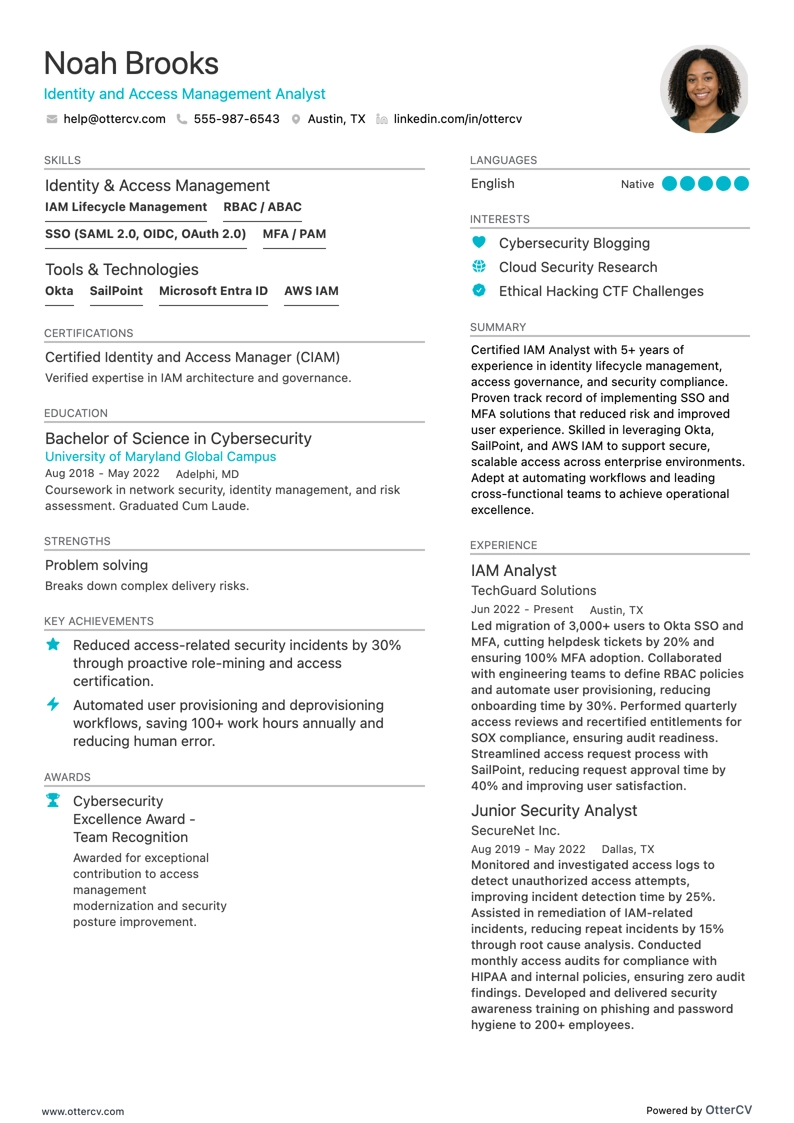
Identity and Access Management Analyst

Identity and Access Management Analyst resume preview

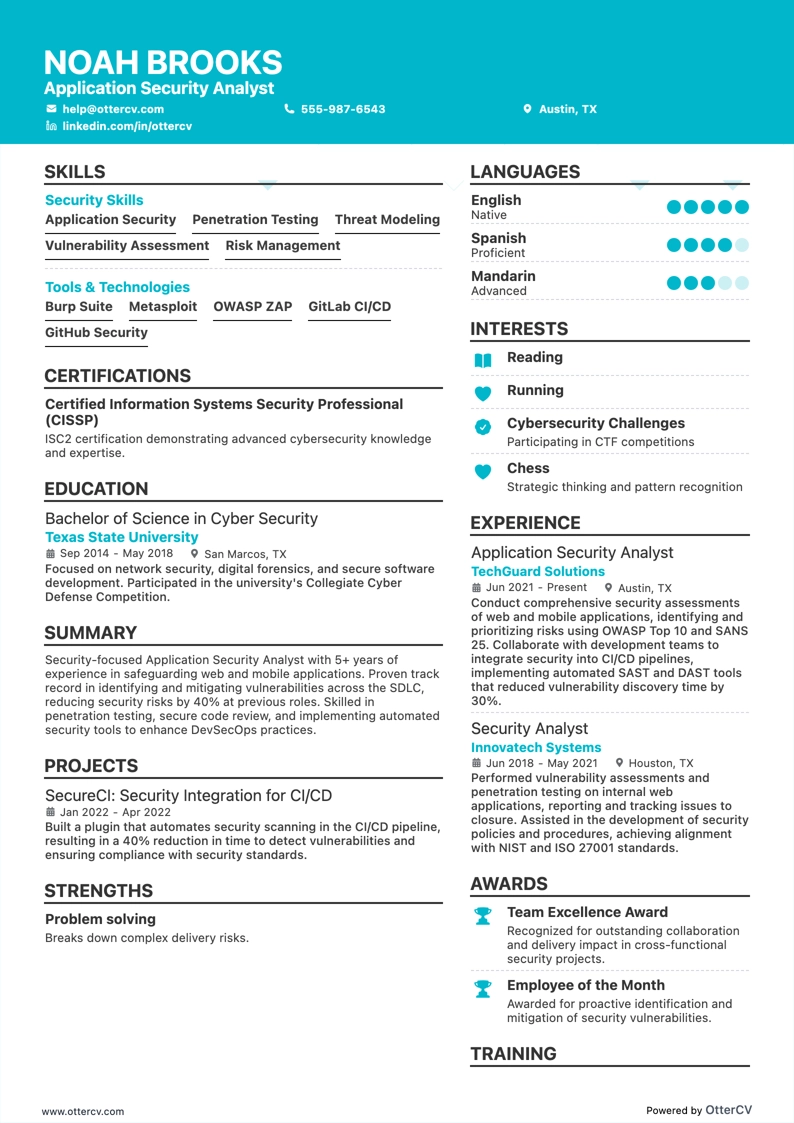
Application Security Analyst

Application Security Analyst resume preview

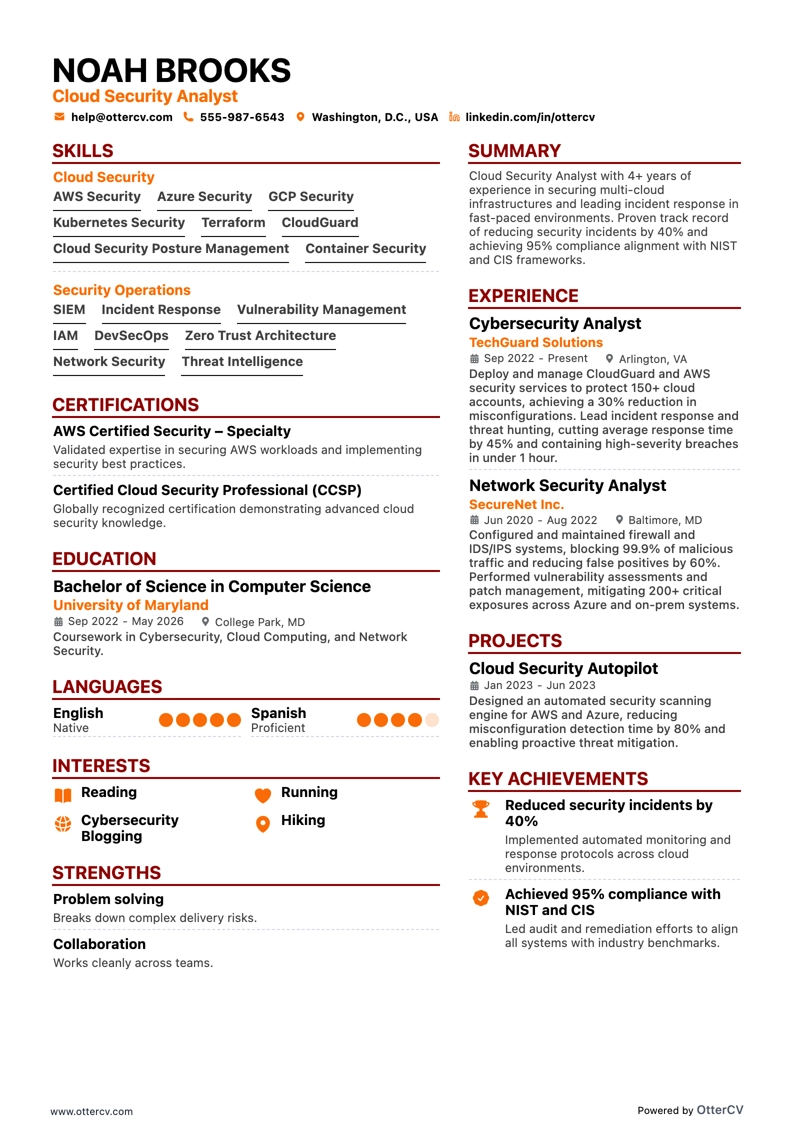
Cloud Security Analyst

Cloud Security Analyst resume preview

Vulnerability Management Analyst

Vulnerability Management Analyst resume preview

Incident Response Analyst

Incident Response Analyst resume preview

Cyber Threat Analyst

Cyber Threat Analyst resume preview

Security Operations Center Analyst

Security Operations Center Analyst resume preview

Information Security Analyst

Information Security Analyst resume preview

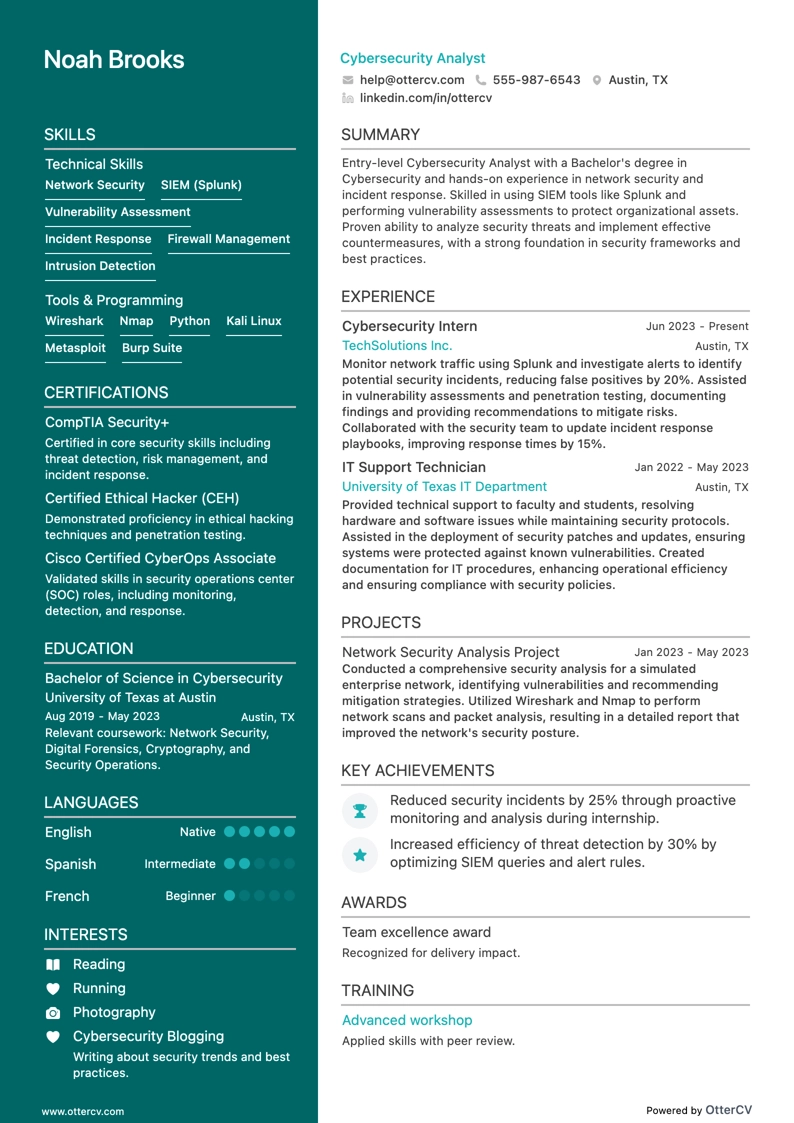
Cybersecurity Analyst

Cybersecurity Analyst resume preview