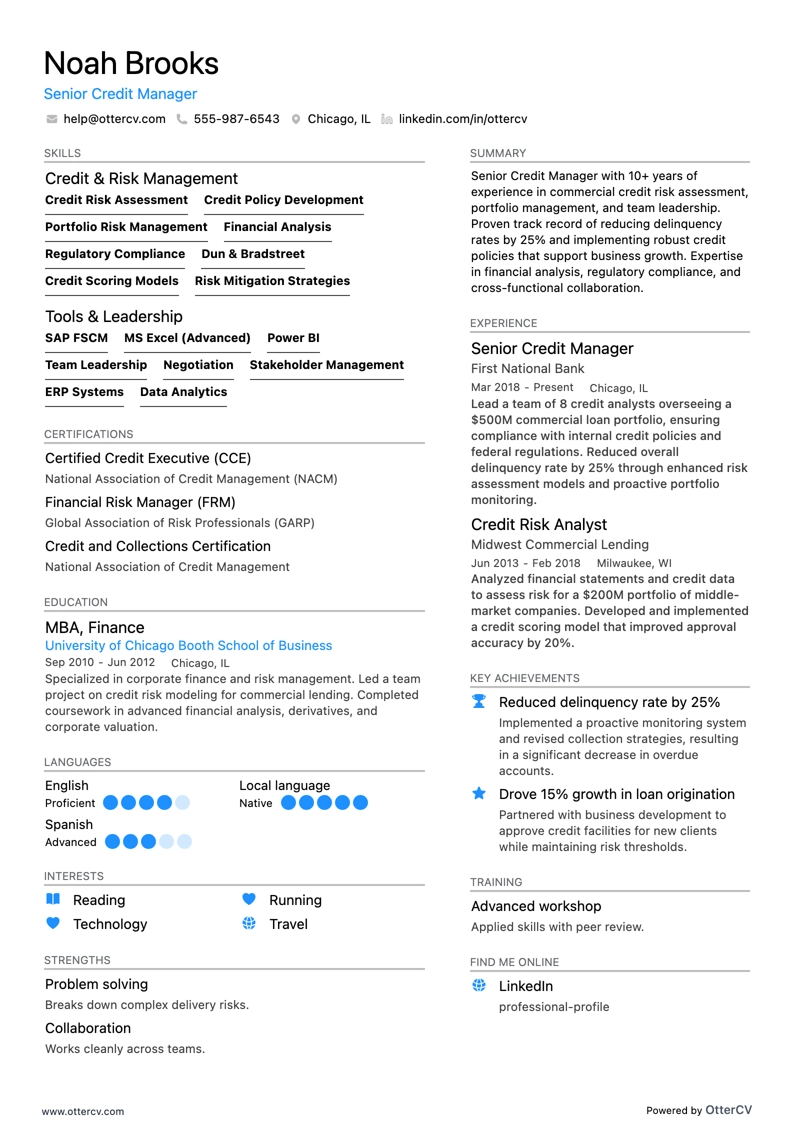
Senior Credit Manager full preview

10 Credit Manager Resume Examples

OtterCV

Written by The OtterCV Team

Updated: 12/26/2024•8 min read

See all resume examples in this guide, or generate your own resume example with your personalized prompt

Senior Credit Manager resume example

Senior Credit Manager

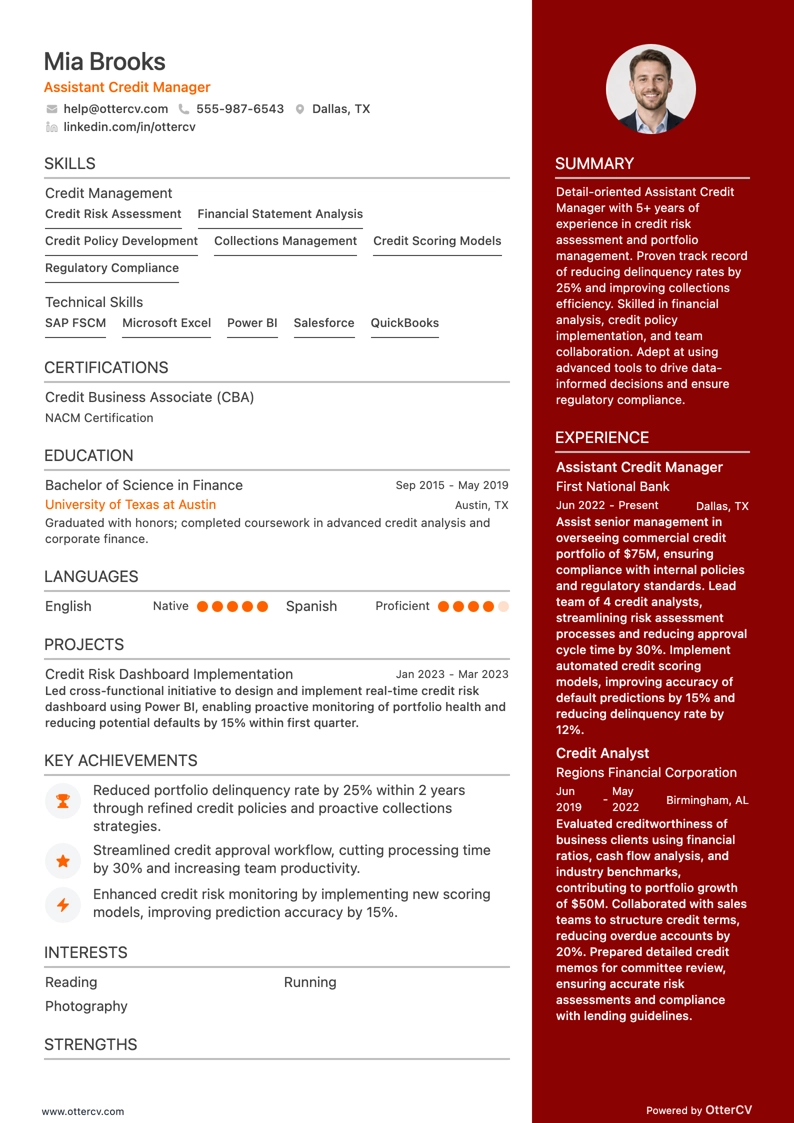
Assistant Credit Manager resume example

Assistant Credit Manager

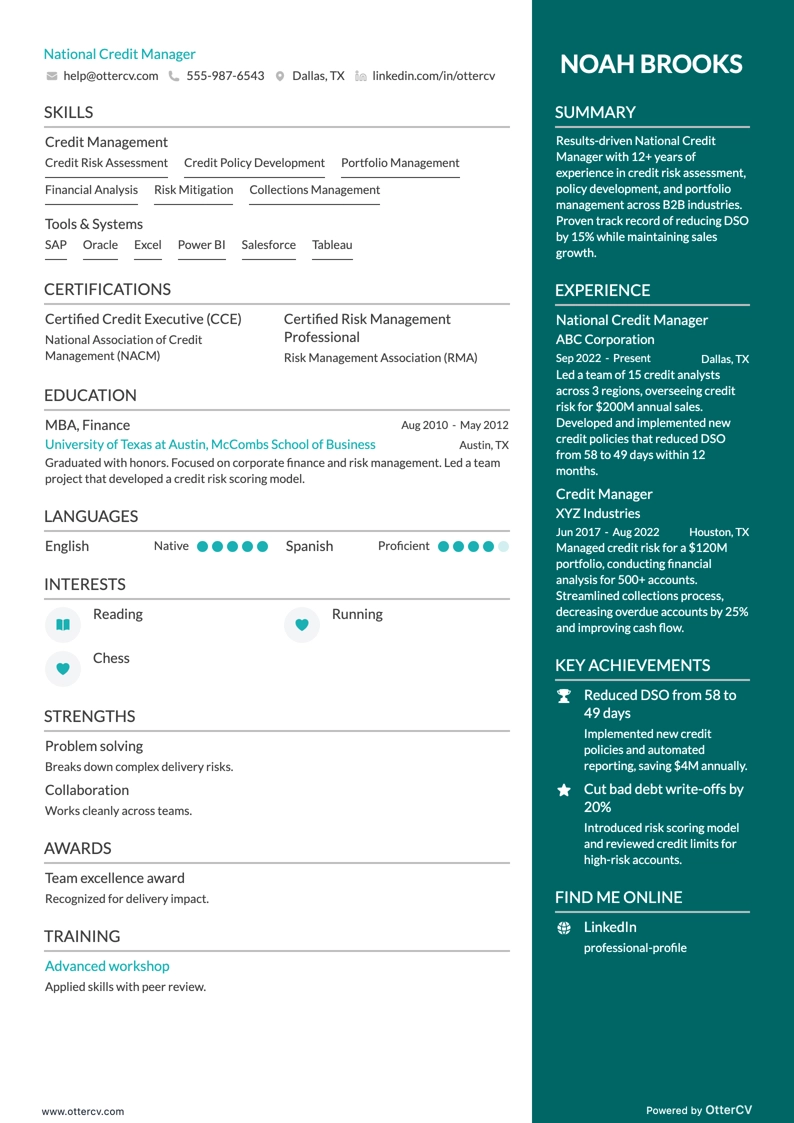
National Credit Manager resume example

National Credit Manager

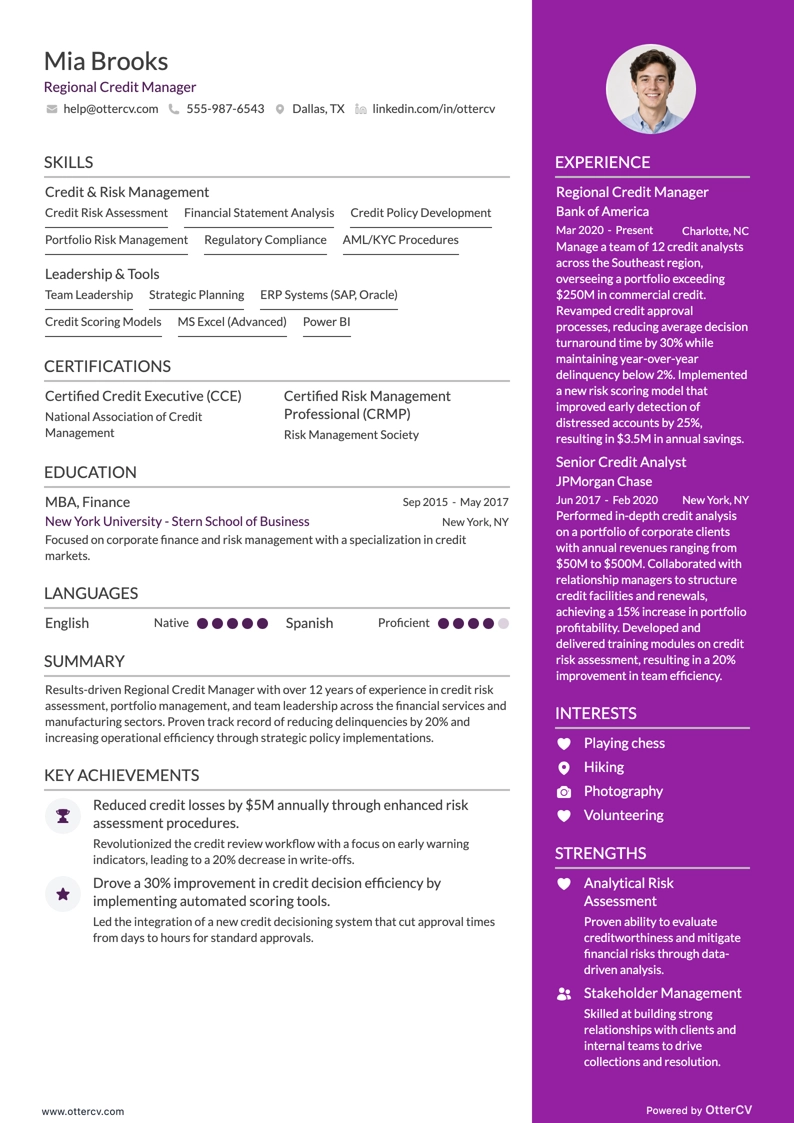
Regional Credit Manager resume example

Regional Credit Manager

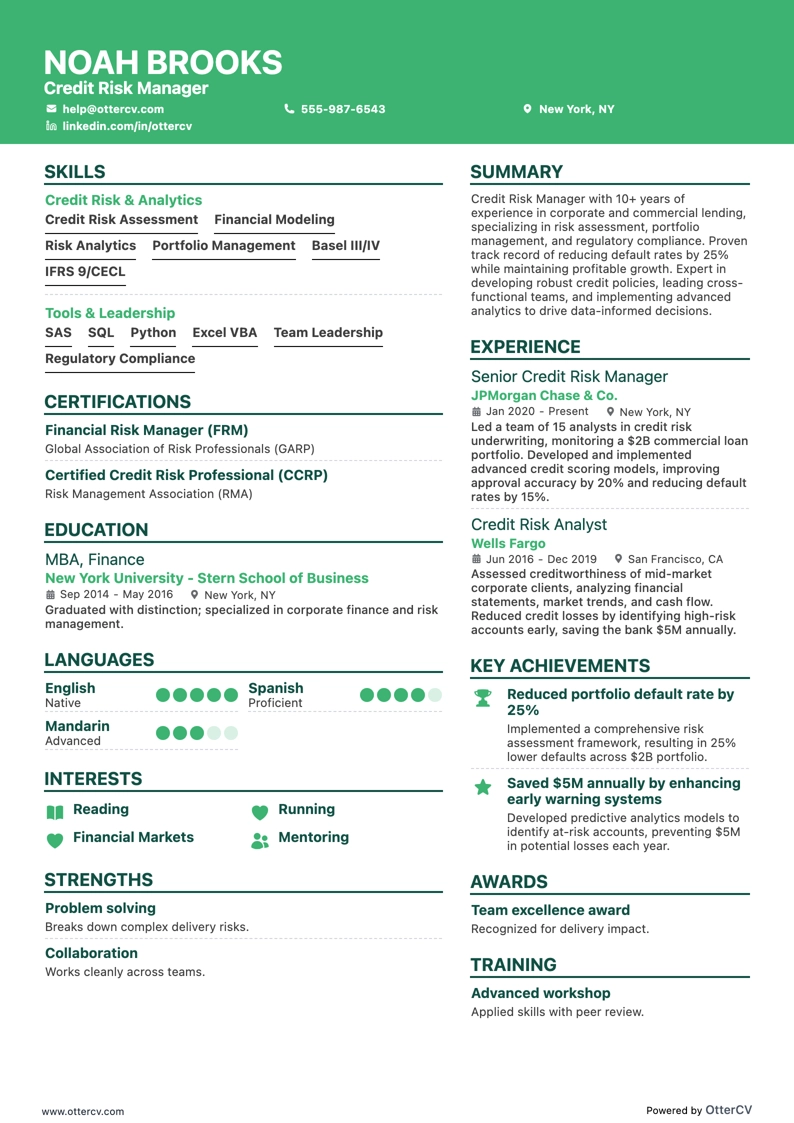
Credit Risk Manager resume example

Credit Risk Manager

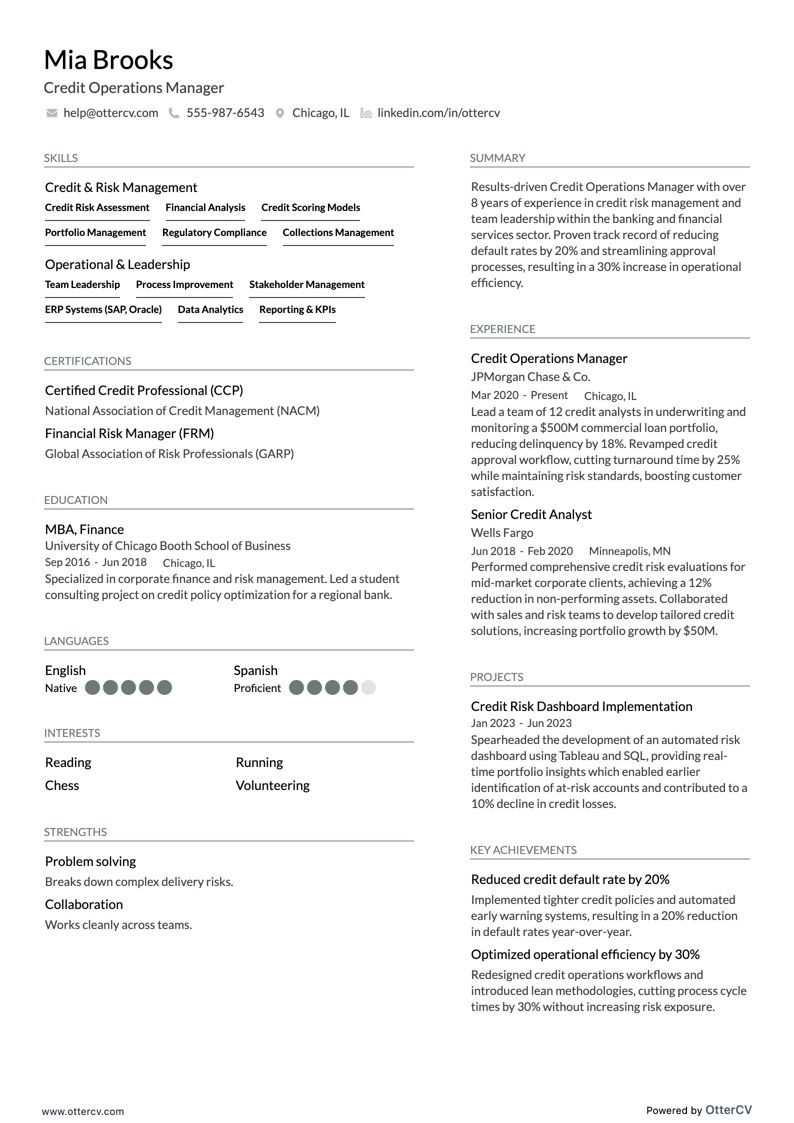
Credit Operations Manager resume example

Credit Operations Manager

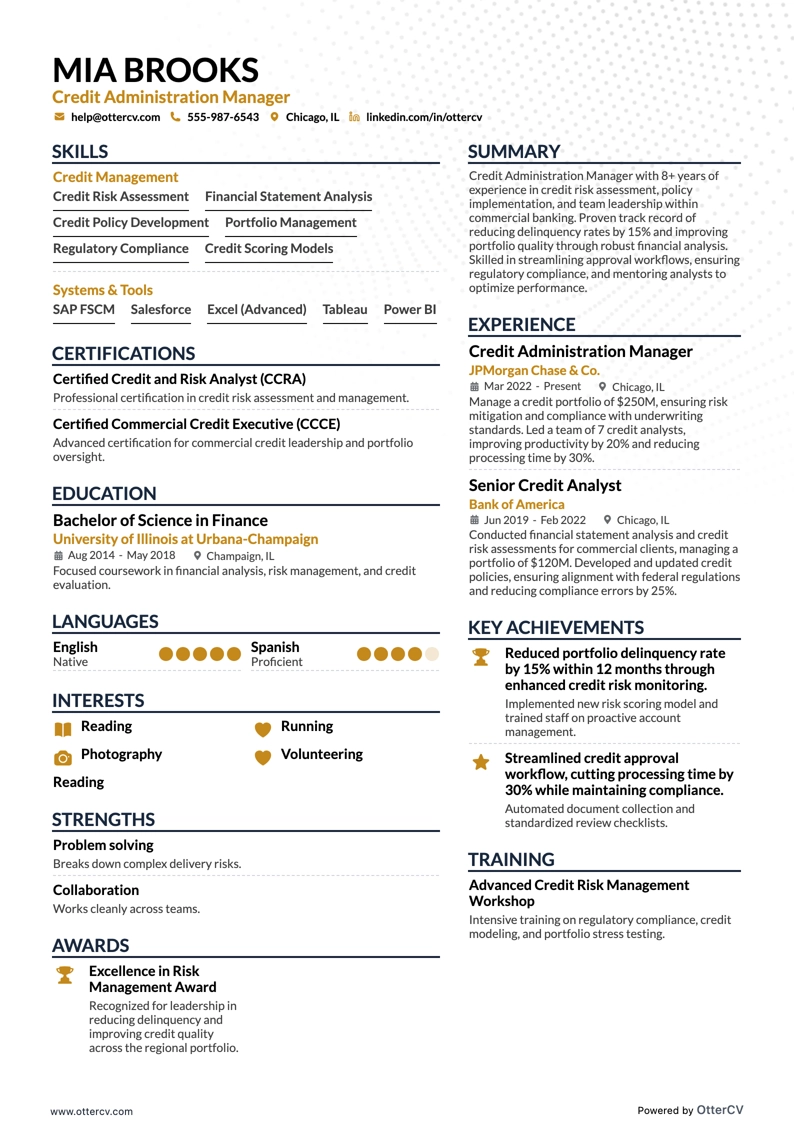
Credit Administration Manager resume example

Credit Administration Manager

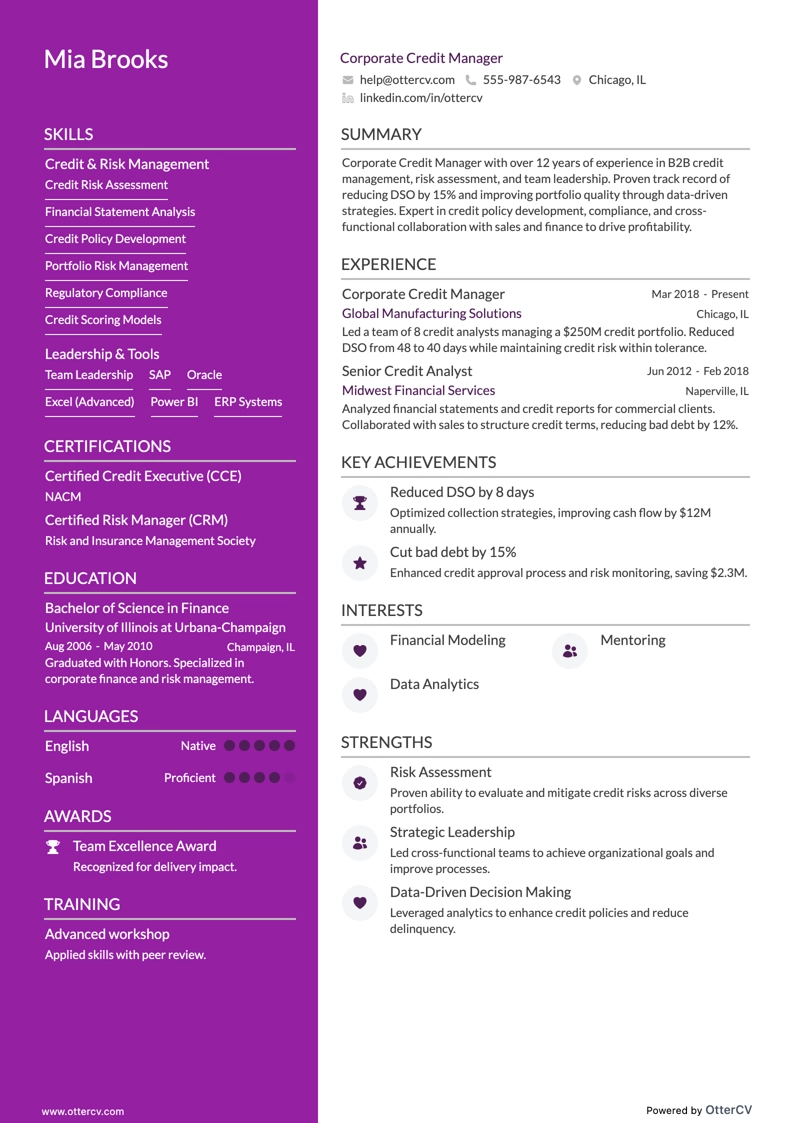
Corporate Credit Manager resume example

Corporate Credit Manager

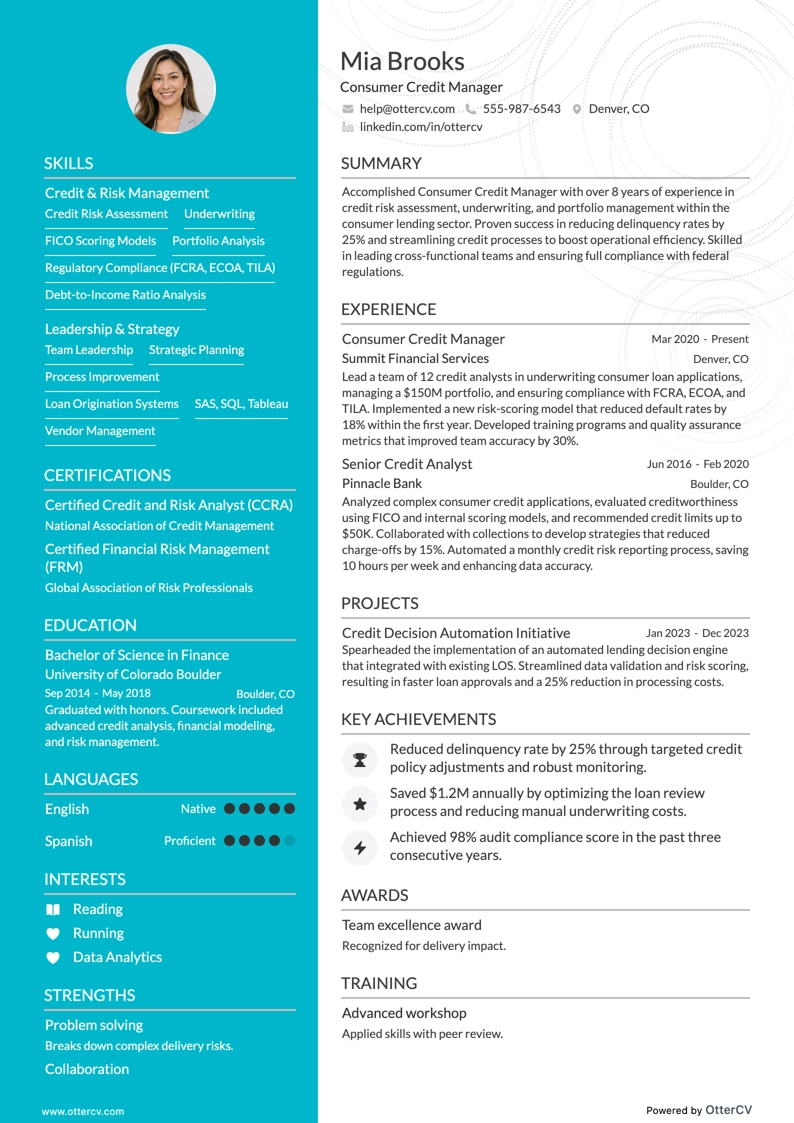
Consumer Credit Manager resume example

Consumer Credit Manager

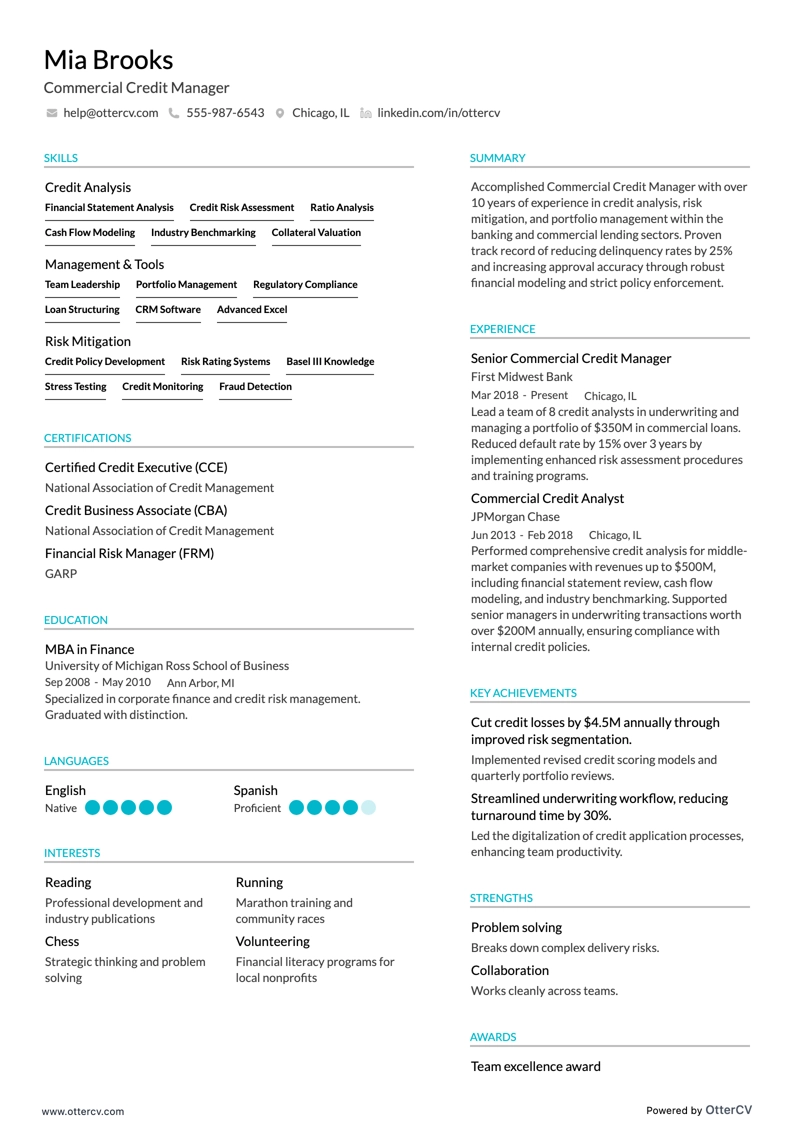
Commercial Credit Manager resume example

Commercial Credit Manager

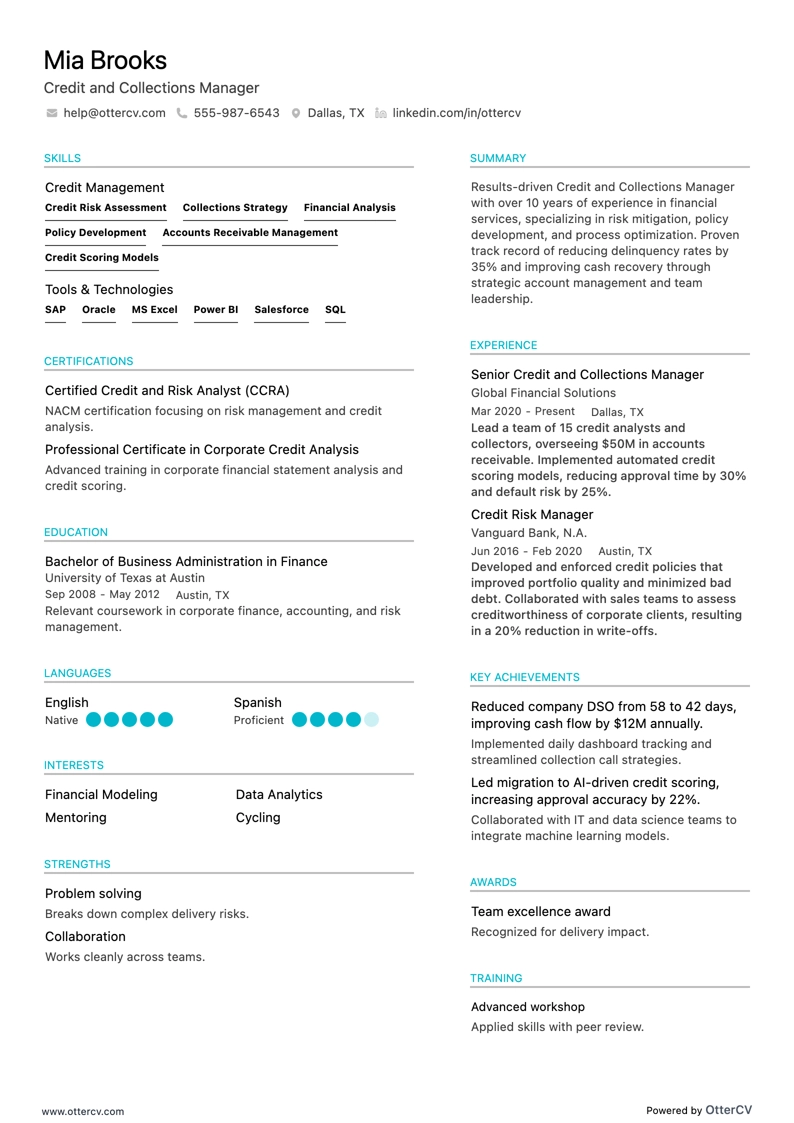
Credit and Collections Manager resume example

Credit and Collections Manager

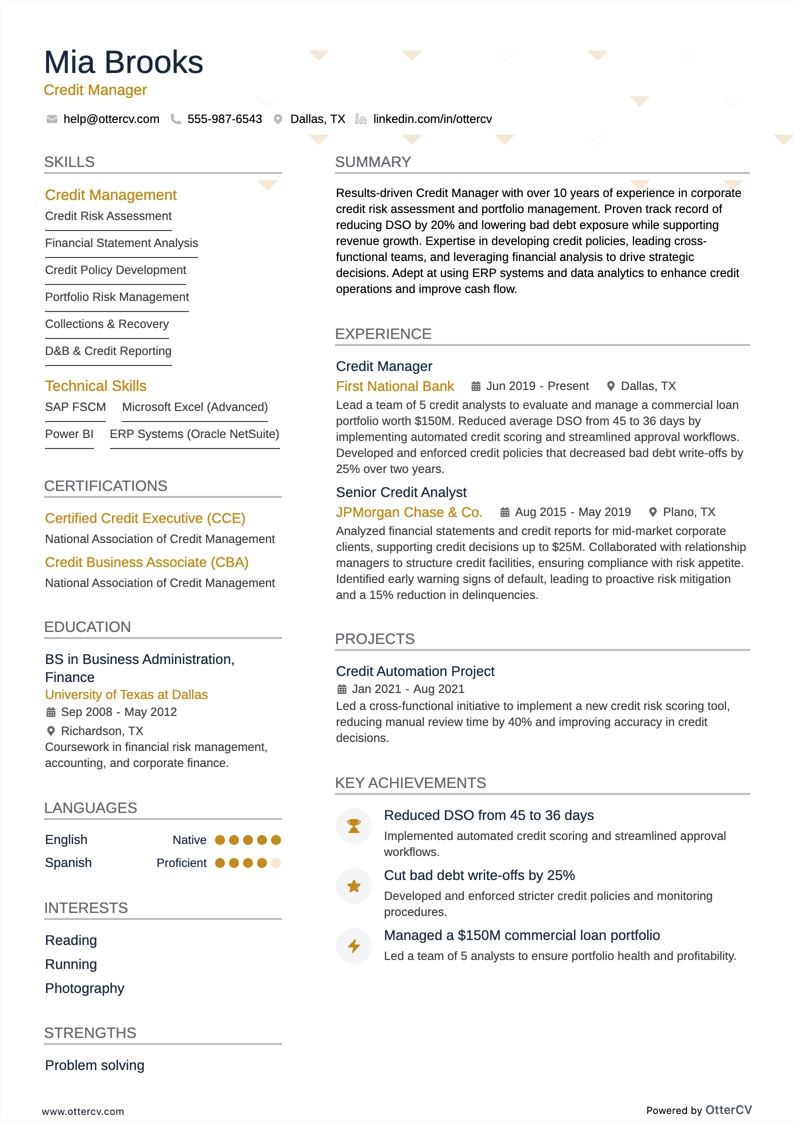
Credit Manager resume example

Credit Manager

Many credit manager resumes fall short because they do not quantify risk decisions, exposure limits, or portfolio impact. That gap can hurt during ATS screening and quick recruiter reviews in a crowded market. Knowing how to make your resume stand out begins with measurable results rather than a list of responsibilities.

A strong resume shows what you improved, not just what tools or processes you used. Highlight reduced days sales outstanding, lower bad-debt write-offs, faster approval speed, management of larger credit limits, improved dispute resolution cycle time, stronger collections recovery, and margin protection through tighter terms.

Key takeaways

  • Quantify credit decisions with metrics such as DSO reduction, bad-debt write-offs, and recovery rates.

  • Use a reverse-chronological format for senior roles to show leadership progression clearly.

  • Tailor each experience bullet to match the job posting’s terminology and priorities.

  • Show skills through measurable outcomes in your summary and experience sections.

  • List certifications such as CCE or CBA near your education to reinforce specialized credibility.

  • Use AI to tighten language and align keywords, but stop before it inflates claims.

  • Build your resume faster with Echocv to keep structure, metrics, and formatting consistent.

Job market snapshot for credit managers

We analyzed 75 recent credit manager job ads across major US job boards to highlight employment type trends, experience requirements, and regional hotspots at a glance.

What level of experience employers are looking for credit managers

Years of ExperiencePercentage found in job ads
1–2 years5.3% (4)
3–4 years8.0% (6)
5–6 years17.3% (13)
7–8 years6.7% (5)
9–10 years1.3% (1)
10+ years9.3% (7)
Not specified53.3% (40)

Credit manager ads by area of specialization (industry)

Industry (Area)Percentage found in job ads
Finance & Banking93.3% (70)

Role overview stats

These tables outline the most common responsibilities and employment types for credit manager roles. Use them to align your resume with employer expectations and understand how the role is structured across the market.

Day-to-day activities and top responsibilities for a credit manager

ResponsibilityPercentage found in job ads
Excel30.7% (23)
Credit management29.3% (22)
Microsoft office26.7% (20)
Accounting17.3% (13)
Accounts receivable17.3% (13)
Financial analysis16.0% (12)
Ms office12.0% (9)
Reporting12.0% (9)
Loan origination system10.7% (8)
Quality control10.7% (8)
Accounting software9.3% (7)
Communication skills9.3% (7)

Type of employment (remote vs on-site vs hybrid)

Employment typePercentage found in job ads
On-site81.3% (61)
Hybrid17.3% (13)

How to format a credit manager resume

Recruiters reviewing credit manager resumes look for risk assessment expertise, portfolio performance metrics, and a clear record of managing credit policies across expanding teams or business units. A reverse-chronological format makes these signals—especially leadership progression and decision-making scope—easy for both hiring managers and applicant tracking systems to spot right away. Choosing the right resume format is essential for passing both automated screening and manual review.

I have significant experience in this role—which format should I use?

I have significant experience in this role—which format should I use?

Use a reverse-chronological format to show your career progression and the expanding scope of your credit oversight.

  • Start with your most senior role, emphasizing the size of the credit portfolio, team headcount, and organizational scope you managed.
  • Highlight domain-specific expertise such as credit risk modeling, collections strategy, ERP platforms (SAP, Oracle), and regulatory compliance frameworks.
  • Quantify business impact with metrics such as reduced delinquency rates, improved DSO, portfolio loss reduction, or credit policy outcomes.

Example bullet:

  • "Redesigned enterprise credit approval workflow for a $220M portfolio, reducing average DSO by 14 days and cutting write-offs by 32% within 18 months."

I'm junior or switching into this role—what format works best?

I'm junior or switching into this role—what format works best?

A hybrid resume format works best. It lets you highlight relevant credit analysis and financial skills first while still presenting your work history in chronological order.

  • Put a dedicated skills section near the top with credit analysis, accounts receivable management, financial reporting tools, and relevant certifications such as CBA or NACM credentials.
  • Include project-based experience like credit audits, collections process improvements, or risk assessment initiatives, even if it came from adjacent roles.
  • Tie each action to a measurable result so recruiters can quickly see your contribution to financial outcomes.

Example scaffold:

  • Credit risk analysis → conducted quarterly portfolio reviews for 300+ commercial accounts → identified $1.4M in at-risk receivables, enabling proactive collections that recovered 89% before default.

Why hybrid and functional resumes don't work for senior roles

Why hybrid and functional resumes don't work for senior roles

Hybrid and functional resume formats break up your career timeline, which can hide the leadership progression and growing decision-making authority hiring managers need to confirm for senior credit manager roles. They also weaken accountability by making it less clear which results you directly owned versus inherited, and they make it harder to connect your strategic decisions to portfolio-level outcomes.

If you have five or more years of progressive credit management experience, avoid hybrid and functional formats entirely, as they tend to raise more questions than they answer.

  • A functional format may be acceptable only if you are moving into credit management from a closely related field, such as commercial lending or financial risk consulting, if you have a significant employment gap, or if you lack continuous tenure. Even then, every listed skill should be tied to specific projects, portfolios, or measurable outcomes.

Once you’ve established a clean, readable format, the next step is deciding which sections to include and how to organize them for maximum impact.

What sections should go on a credit manager resume

Recruiters expect clear evidence that you can manage credit risk, improve collections performance, and protect cash flow. Understanding which resume sections to include helps ensure your resume reflects the qualifications hiring teams want to see.

Use this structure for maximum clarity:

  • Header
  • Summary
  • Experience
  • Skills
  • Projects
  • Education
  • Certifications
  • Optional sections: Awards, Leadership, Languages

Strong experience bullets should highlight measurable impact, portfolio scope, policy improvements, and results in risk reduction, delinquency control, and cash collections.

Once your resume has the right structure in place, the next step is writing a credit manager experience section that supports your qualifications and aligns with that format.

How to write your credit manager resume experience

Your experience section should show that you have managed credit risk, implemented lending policies, and improved portfolio performance. Hiring managers care more about measurable results—such as reduced delinquency rates, stronger credit controls, and better collections outcomes—than task lists that merely repeat a job description. A targeted resume tailored to the role’s priorities will make this section more effective.

Each entry should include:

  • Job title
  • Company and location (or remote)
  • Dates of employment (month and year)

Add three to five concise bullet points that explain what you owned, how you executed, and what results you delivered:

  • Ownership scope: the credit portfolios, lending products, risk models, policy frameworks, or teams you were directly responsible for.
  • Execution approach: the credit scoring tools, risk assessment frameworks, financial analysis methods, or enterprise platforms you used to evaluate borrower risk and make lending decisions.
  • Value improved: changes to default rates, portfolio quality, underwriting accuracy, collections efficiency, or regulatory compliance resulting from your credit management decisions.
  • Collaboration context: how you worked with sales teams, underwriting staff, legal departments, senior leadership, or external auditors to align credit policies with broader business objectives.
  • Impact delivered: outcomes such as portfolio growth, loss reduction, process optimization, or risk mitigation rather than routine credit review tasks.

Experience bullet formula

Experience bullet formula

Action verb + technology + what you built or fixed + measurable result

A credit manager experience example

Credit Manager

Redwood Industrial Supply | Columbus, OH

2021–Present

Regional distributor serving 2,000+ B2B accounts across manufacturing, construction, and MRO with $180M annual revenue.

  • Overhauled credit policy and scoring model using Experian Business data, Dun & Bradstreet reports, and ERP payment history, reducing bad debt write-offs by 22% year over year while supporting 14% sales growth.
  • Implemented automated credit holds, limit reviews, and dunning workflows in SAP S/4HANA and HighRadius, cutting past-due balances over 60 days by 18% and reducing manual follow-ups by eight hours per week per analyst.
  • Negotiated revised payment terms and security instruments, including personal guarantees, UCC filings, and letters of credit, with Sales and Legal, decreasing high-risk exposure by $3.6M without increasing order cancellations.
  • Built weekly accounts receivable and risk dashboards in Power BI using SAP and Salesforce data, improving collections forecast accuracy by 12% and enabling faster escalation decisions with sales leaders.
  • Led a cross-functional dispute reduction program with Customer Service and Logistics using root-cause analysis and ticket tracking in Jira, lowering invoice disputes by 27% and improving days sales outstanding by five days.

Now that you've seen what a strong experience section looks like, the next step is tailoring yours to a specific credit manager job posting.

How to tailor your credit manager resume experience

Recruiters review your credit manager resume through both applicant tracking systems and manual screening. Tailoring your resume to the job description helps your qualifications stand out in both.

Ways to tailor your credit manager experience:

  • Match the credit analysis software and ERP systems listed in the posting.
  • Use the same terminology for credit risk assessment processes.
  • Reflect the portfolio size or accounts receivable scope mentioned.
  • Include relevant industry experience, such as manufacturing or financial services.
  • Emphasize any regulatory compliance frameworks referenced in the job description.
  • Align your KPIs with the performance metrics the employer prioritizes.
  • Highlight cross-functional collaboration with sales or finance teams when specified.
  • Use the same language for collections strategies or credit policies described in the posting.

Tailoring your resume means aligning your real accomplishments with what the employer values, not forcing in keywords that don't fit.

Resume tailoring examples for credit manager

Job description excerptUntailoredTailored
Manage a portfolio of commercial accounts totaling $50M+, conduct credit analyses using D&B and Moody's RiskCalc, and establish appropriate credit limits based on financial statement review.Responsible for reviewing accounts and setting credit limits for customers.Managed a $55M commercial credit portfolio, using D&B reports and Moody's RiskCalc to perform credit analyses and set risk-based credit limits based on quarterly financial statement reviews.
Lead a team of four credit analysts, develop and enforce credit policies aligned with SOX compliance, and reduce DSO by improving collections workflows in SAP.Supervised team members and helped improve department processes.Led a team of four credit analysts, developed SOX-compliant credit policies, and streamlined collections workflows in SAP, reducing DSO from 48 to 39 days within 12 months.
Partner with sales and finance to evaluate new customer creditworthiness, mitigate bad debt exposure across international markets, and maintain delinquency rates below 2% using Highradius automation tools.Worked cross-functionally to support business goals and reduce risk.Partnered with sales and finance to assess new customer creditworthiness across 12 international markets, using Highradius automation tools to keep delinquency rates at 1.7% and reduce bad debt exposure by 22% year over year.

Once you’ve aligned your experience with the role’s priorities, quantify your credit manager achievements to show the measurable impact of your work.

How to quantify your credit manager achievements

Quantifying your achievements shows how your credit decisions protected cash flow and reduced risk. Focus on days sales outstanding, delinquency, bad debt, credit limit accuracy, dispute cycle time, collections recovery, and compliance outcomes.

Quantifying examples for credit manager

MetricExample
Risk reductionCut 90+ day delinquency from 4.8% to 2.9% in nine months by tightening scorecard thresholds and refreshing credit limits in SAP.
Cash flowReduced days sales outstanding from 52 to 44 days by revising payment terms, enforcing hold releases, and partnering with sales on escalations.
Collections recoveryRecovered $1.2M in past-due balances in one quarter using weekly aging reviews, dispute triage, and targeted payment plans for the top twenty accounts.
Process efficiencyShortened credit application turnaround time from three days to one business day by standardizing documentation and automating checks in Salesforce.
Compliance accuracyImproved lien and UCC filing accuracy to 99.5% across 300 accounts by adding a two-step review and monthly audit checklist.

How to list your hard and soft skills on a credit manager resume

With strong bullet points in place, the next step is making sure your skills section highlights the right mix of hard and soft skills for a credit manager role.

Your skills section matters because credit managers balance risk, collections, and customer relationships. Recruiters and ATS scan this section for role-matched keywords and capability signals, so aim for a mix weighted toward hard skills with targeted soft skills.

Credit manager roles require a blend of:

  • Credit policy strategy and risk assessment skills.
  • Data analysis, reporting, and portfolio monitoring skills.
  • Collections execution, process control, and cross-functional coordination discipline.
  • Soft skills.

Your skills section should be:

  • Scannable with bullet-style grouping.
  • Relevant to the job post.
  • Backed by proof in your experience bullets.
  • Updated with current tools.

Place your skills section:

  • Above experience if you're junior or switching careers.
  • Below experience if you're mid/senior with strong achievements.

Hard skills

  • Credit risk assessment.
  • Credit policy development.
  • Financial statement analysis.
  • Credit scoring models.
  • Accounts receivable management.
  • Collections strategy.
  • Order-to-cash controls.
  • Aging, DSO, and CEI reporting.
  • Portfolio monitoring and segmentation.
  • ERP systems: SAP, Oracle, and NetSuite.
  • Credit bureau data: Experian, Equifax, and TransUnion.
  • Excel modeling and Power BI dashboards.

Soft skills

  • Make risk-based credit decisions.
  • Negotiate payment terms and plans.
  • Escalate issues with clear options.
  • Partner with sales on deal structure.
  • Influence stakeholders without formal authority.
  • Lead difficult customer conversations.
  • Document decisions and their rationale.
  • Quickly prioritize high-risk accounts.
  • Hold teams accountable to policies.
  • Communicate trade-offs to leadership.
  • Resolve disputes with diplomacy.
  • Stay calm under delinquency pressure.

How to show your credit manager skills in context

Skills shouldn’t appear only in a bulleted list on your resume. Reviewing resume skills examples can help you see how strong candidates weave their competencies throughout the document.

Your skills should be demonstrated in:

  • Your summary (high-level professional identity)
  • Your experience (proof through outcomes)

Here’s what both look like in practice.

Summary example

Senior credit manager with 12 years of experience in wholesale distribution, with expertise in credit risk modeling, SAP FSCM, and cross-functional negotiation. Reduced portfolio write-offs by 34% while maintaining approval rates that supported $180M in annual revenue growth.

  • Clearly reflects senior-level experience
  • Mentions industry-specific tools and methods
  • Opens with a measurable financial outcome
  • Emphasizes negotiation as a soft skill

Senior Credit Manager

Bowman & Kendall Distribution | Charlotte, NC

March 2018–Present

  • Redesigned credit scoring criteria using SAP FSCM, cutting average approval turnaround from five days to two and reducing defaults by 22%.
  • Partnered with sales and finance teams to build tiered credit limits, supporting a 15% increase in new account acquisitions year over year.
  • Led quarterly portfolio reviews using Dun & Bradstreet analytics, identifying $2.4M in at-risk receivables and recovering 89% through early intervention strategies.
  • Every bullet includes measurable proof.
  • Skills appear naturally within real outcomes.

Once you’ve shown your credit management strengths through specific responsibilities and outcomes, the next step is structuring a credit manager resume with no experience so those strengths still come through clearly.

How do I write a credit manager resume with no experience

Even without full-time experience, you can still show readiness through relevant work, projects, and technical exposure. Our guide on writing a resume without work experience covers additional strategies for making a strong impression.

  • Accounts receivable internships or rotations
  • Credit analysis course projects
  • Collections and dispute resolution work
  • ERP invoice and aging reports
  • Credit policy and SOP drafts
  • Customer credit application reviews
  • Financial statement ratio analysis
  • DSO and delinquency dashboards

Focus on highlighting:

  • Credit decisions backed by data
  • Clear limits, terms, and controls
  • Clean aging, DSO, and risk
  • Tools: Excel, ERP, reporting

Resume format tip for entry-level credit manager

Resume format tip for entry-level credit manager

Use a combination resume format. This format puts relevant skills and projects first while still showing work history, even if your experience is limited.

Do:

  • Lead with a skills summary tied to metrics.
  • Add two to four project bullets under education.
  • List tools such as Excel, ERP, and Power Query.
  • Quantify results with DSO, aging, and write-offs.
  • Mirror credit manager keywords from job postings.

Example project bullet:

  • Built an Excel aging and DSO dashboard from ERP exports, flagged thirty past-due accounts, and reduced simulated delinquency by eighteen percent in a course project.

Even without direct experience, your education section can show the financial knowledge and analytical foundation needed for a credit manager role.

How to list your education on a credit manager resume

Your education section helps hiring teams confirm that you have the core background in finance, accounting, or business required to succeed as a credit manager.

Include:

  • Degree name
  • Institution
  • Location
  • Graduation year
  • Relevant coursework (for juniors or entry-level candidates)
  • Honors and GPA (if 3.5 or higher)

Skip the month and day details, and list only the graduation year.

Here’s a strong education entry tailored for a credit manager resume.

Example education entry

Bachelor of Science in Finance

University of Illinois at Urbana-Champaign, Champaign, IL

Graduated 2019

GPA: 3.7/4.0

  • Relevant Coursework: Credit Risk Analysis, Corporate Finance, Financial Statement Analysis, Managerial Accounting
  • Honors: Dean's List, Magna Cum Laude

How to list your certifications on a credit manager resume

Certifications can show a credit manager’s commitment to learning, proficiency with financial tools, and relevance in a regulated industry. They also add credibility when you make decisions involving risk, collections, and customer credit. Learn more about how to list certifications on your resume to maximize their impact.

Include the following details:

  • Certificate name
  • Issuing organization
  • Year
  • Optional: credential ID or URL
  • Place certifications below education if your degree is recent and the certifications are older or less relevant to credit manager work.
  • Place certifications above education if they are recent, relevant to the role, or required for the credit manager job you want.

Best certifications for your credit manager resume

  • Certified Credit Executive (CCE)
  • Credit Business Associate (CBA)
  • Credit Business Fellow (CBF)
  • Certified Accounts Receivable Professional (CARP)
  • Certified Treasury Professional (CTP)
  • Certified Fraud Examiner (CFE)
  • Certified Internal Auditor (CIA)

How to write your credit manager resume summary

Once your credentials are easy for hiring teams to verify, use your resume summary to show how those qualifications translate into value.

Your resume summary is often the first thing a recruiter reads. A strong summary quickly shows that you are a qualified credit manager worth interviewing.

Keep it to three to four lines and include:

  • Your title and total years of credit management experience.
  • The industry or domain you have worked in, such as commercial lending or trade credit.
  • Core skills such as credit analysis, risk assessment, or financial modeling.
  • One or two quantified achievements, such as reduced delinquency rates or the size of the portfolio you managed.
  • Soft skills connected to real results, such as cross-functional collaboration that improved approval turnaround.

PRO TIP

At the mid-level credit manager stage, emphasize hands-on portfolio management, process improvements, and measurable risk reduction.

Highlight team coordination and your decision-making authority over credit limits.

Avoid vague phrases like “passionate professional” or “results-driven individual.” Recruiters want specifics, not motivation.

Example summary for a credit manager

Credit manager with six years of experience in commercial lending, with expertise in risk assessment and SAP credit module management. Reduced portfolio delinquency by 18% while overseeing $45M in receivables across 200+ accounts.

Once your summary clearly shows your value, make sure your resume header presents your contact details clearly so recruiters can reach you.

What to include in a credit manager resume header

A resume header is the top section of your resume that contains your key contact details. For a credit manager role, it helps improve visibility, credibility, and recruiter screening.

Essential resume header elements:

  • Full name
  • Tailored job title and headline
  • Location
  • Phone number
  • Professional email
  • GitHub link
  • Portfolio link
  • LinkedIn

A LinkedIn link helps recruiters quickly verify your experience and supports screening.

Do not include a photo on a credit manager resume unless the role is explicitly front-facing or appearance-dependent.

Match your header job title to the posting, and align your headline with credit policy, collections, and risk control responsibilities.

Example

With your contact details and role identifiers established at the top, you can strengthen the rest of your resume by adding sections that support your credit management qualifications.

Additional sections for credit manager resumes

When your core qualifications are similar to those of other applicants, well-chosen additional sections can help your credit manager resume stand out by showing deeper expertise. For example, listing language skills on your resume can show your ability to manage credit relationships across international markets.

  • Languages
  • Certifications and licenses
  • Professional affiliations
  • Publications
  • Awards and honors
  • Volunteer experience
  • Continuing education

Once you've strengthened your resume with the right supporting sections, pairing it with a strong cover letter can help you make a bigger impact.

Do credit manager resumes need a cover letter

A cover letter is not required for a credit manager role, but it can help when the position is competitive or the employer expects one. If you're unsure where to begin, learning what a cover letter is and how it supports your resume can make its value clearer. It can be especially useful when your resume does not fully show your fit, scope, or context.

Use a cover letter to add context your resume cannot:

  • Explain your fit for the role and team by aligning your experience with credit manager priorities such as risk controls, collections strategy, or stakeholder management.
  • Highlight one or two results, such as reducing days sales outstanding, improving bad debt, or tightening credit policy without hurting sales.
  • Show that you understand the product, users, and business context, including customer segments, payment terms, and how credit decisions affect revenue.
  • Address career transitions or less obvious experience by connecting earlier roles, such as underwriting, accounts receivable, or customer operations, to credit manager work.

Using AI to improve your credit manager resume

Once you’ve decided whether a cover letter adds value for the role, the next step is using AI to improve your credit manager resume so it aligns more closely with the job requirements.

AI can improve your resume’s clarity, structure, and overall impact. It can tighten language and highlight measurable results, but overusing it can make your resume feel less authentic. Once your content is clear and aligned with the role, step away from AI. If you’re wondering which AI is best for writing resumes, the answer depends on how much control and customization you need.

Here are 10 practical prompts to strengthen specific sections of your credit manager resume:

  1. Strengthen your summary. “Rewrite my credit manager resume summary to emphasize leadership in credit risk assessment and collections strategy in under four sentences.”
  2. Quantify your achievements. “Add measurable results to these credit manager experience bullets using metrics like DSO reduction, recovery rates, or portfolio size.”
  3. Tighten bullet points. “Shorten each credit manager experience bullet to one concise line that leads with a strong action verb.”
  4. Align with job postings. “Compare my credit manager resume experience section to this job description and suggest missing keywords or responsibilities.”
  5. Refine your skills. “Reorganize my credit manager skills section into hard skills and soft skills, removing anything generic or outdated.”
  6. Improve project descriptions. “Rewrite this credit manager project description to highlight scope, tools used, and business outcomes clearly.”
  7. Clarify certifications. “Format my credit manager certifications section consistently, listing credential name, issuing body, and year earned.”
  8. Upgrade education details. “Revise my credit manager education section to feature relevant coursework, honors, or finance-related specializations.”
  9. Remove filler language. “Identify and remove vague or redundant phrases across my entire credit manager resume without changing factual content.”
  10. Enhance action verbs. “Replace weak or repetitive verbs in my credit manager experience bullets with precise alternatives that convey ownership and impact.”

Stop using AI once your resume sounds accurate, specific, and aligned with your real experience. AI should never invent experience or inflate claims—if it didn’t happen, it doesn’t belong here.

Conclusion

A strong credit manager resume shows impact through measurable outcomes, such as lower days sales outstanding, reduced bad debt, and improved cash flow. It also highlights role-specific skills, including credit risk analysis, collections strategy, and policy compliance.

A clear, consistent structure makes responsibilities and results easy to scan, helping hiring teams quickly assess your fit for today’s and near-future market. When your credit manager resume demonstrates outcomes, skills, and clarity, it signals readiness to lead credit decisions with confidence.

Credit Manager resume examples

Explore additional Credit Manager resume samples and guides and see what works for your level of experience or role.

By Experience

Senior Credit Manager

Senior Credit Manager resume preview

Assistant Credit Manager

Assistant Credit Manager resume preview

Credit Manager resume examples

Explore additional Credit Manager resume samples and guides and see what works for your level of experience or role.

By Role

National Credit Manager

National Credit Manager resume preview

Regional Credit Manager

Regional Credit Manager resume preview

Credit Risk Manager

Credit Risk Manager resume preview

Credit Operations Manager

Credit Operations Manager resume preview

Credit Administration Manager

Credit Administration Manager resume preview

Corporate Credit Manager

Corporate Credit Manager resume preview

Consumer Credit Manager

Consumer Credit Manager resume preview

Commercial Credit Manager

Commercial Credit Manager resume preview

Credit and Collections Manager

Credit and Collections Manager resume preview

Credit Manager

Credit Manager resume preview