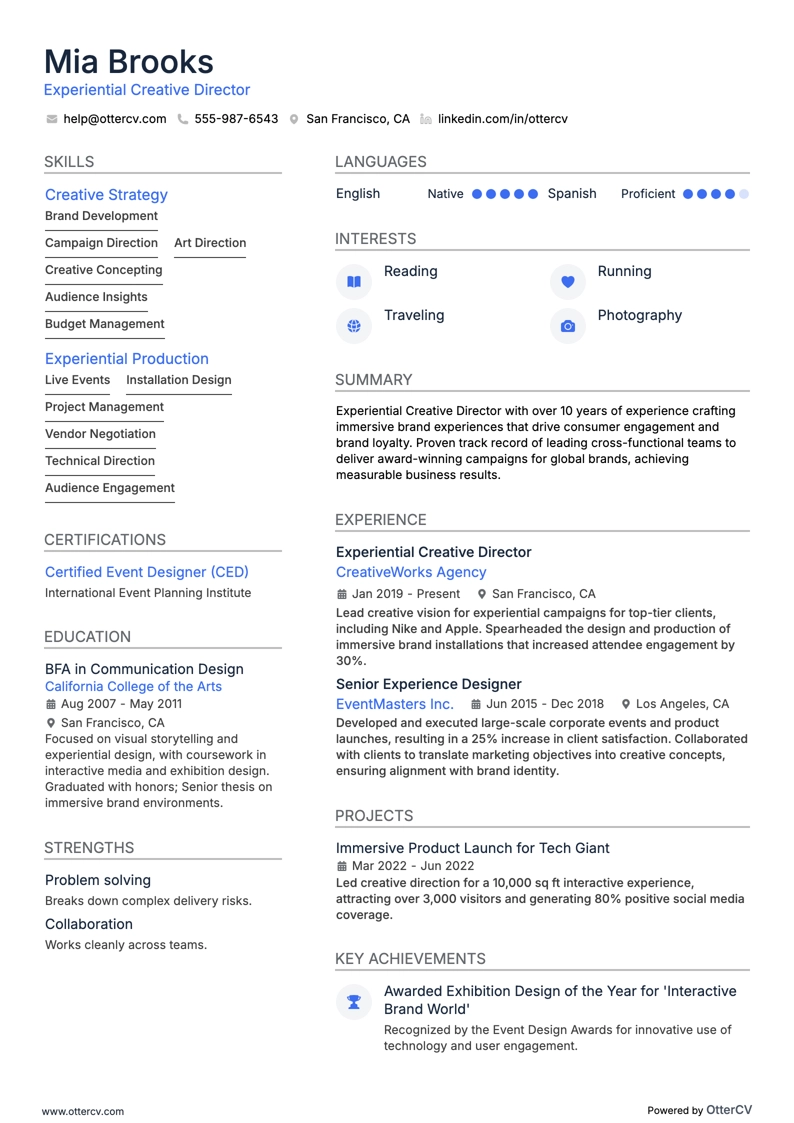
Experiential Creative Director full preview

12 Creative Director Resume Examples

OtterCV

Written by The OtterCV Team

Updated: 11/18/2023•8 min read

See all resume examples in this guide, or generate your own resume example with your personalized prompt

Experiential Creative Director resume example

Experiential Creative Director

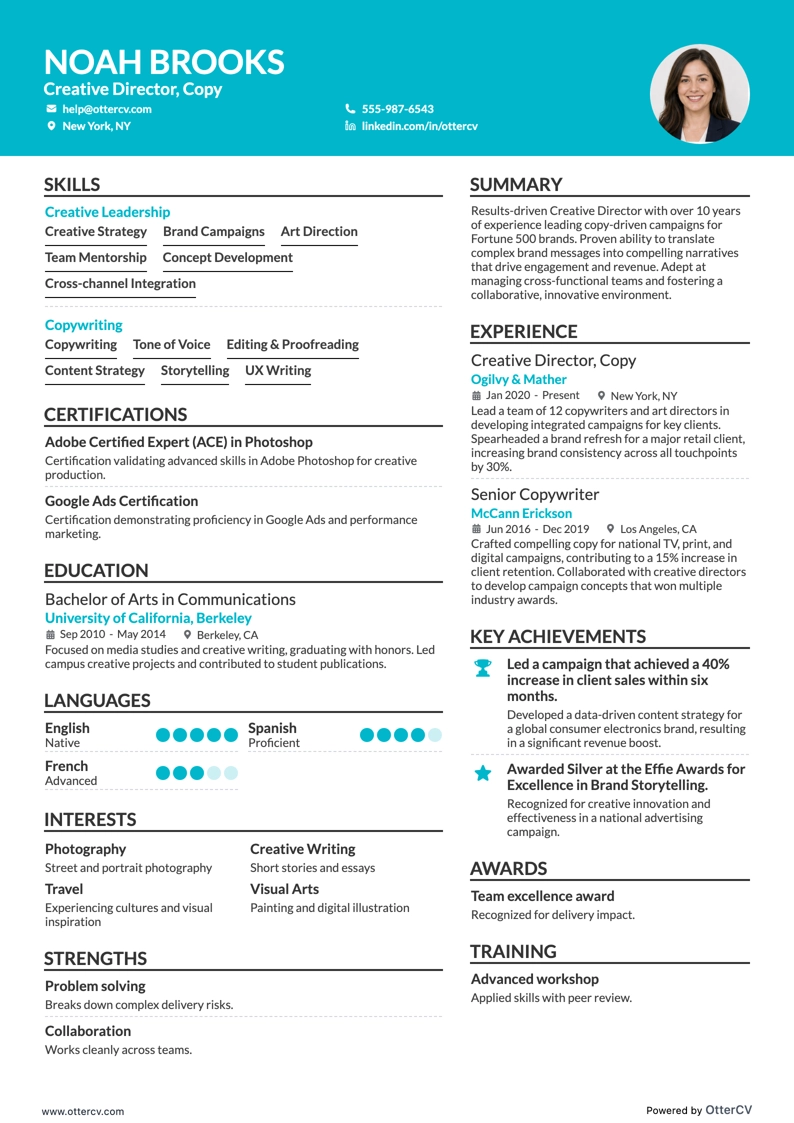
Creative Director, Copy resume example

Creative Director, Copy

Creative Director, Art resume example

Creative Director, Art

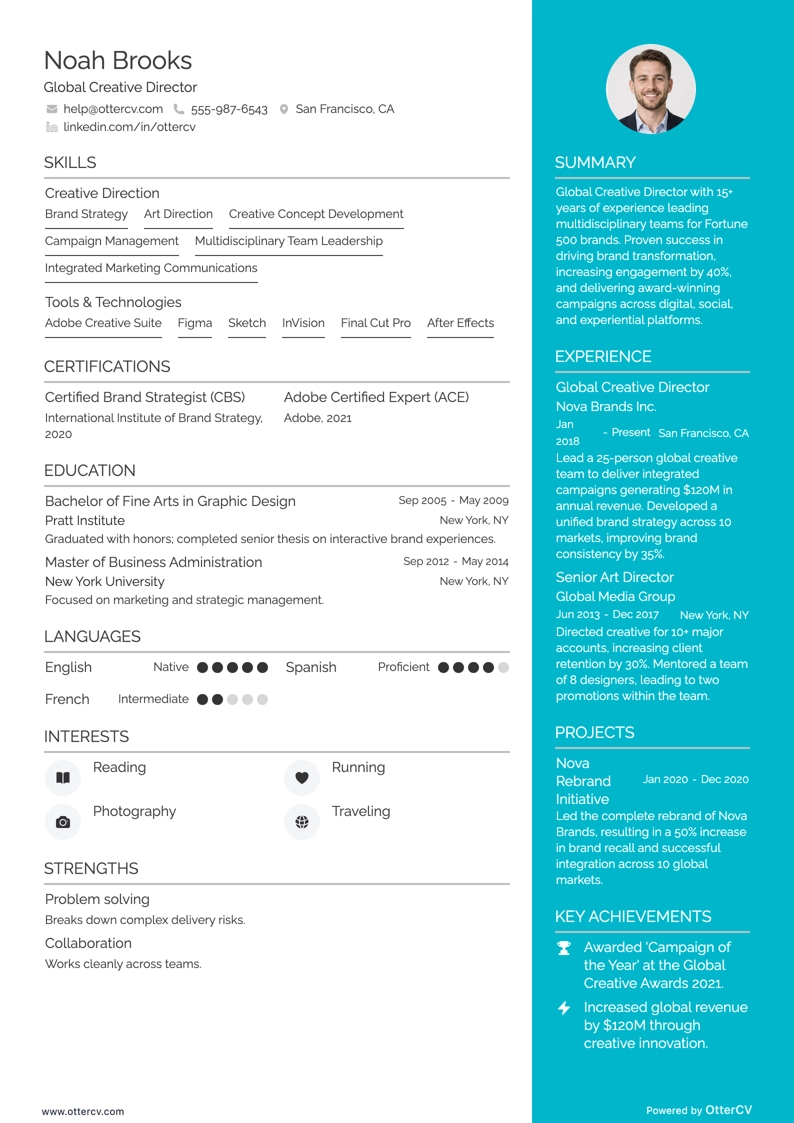
Global Creative Director resume example

Global Creative Director

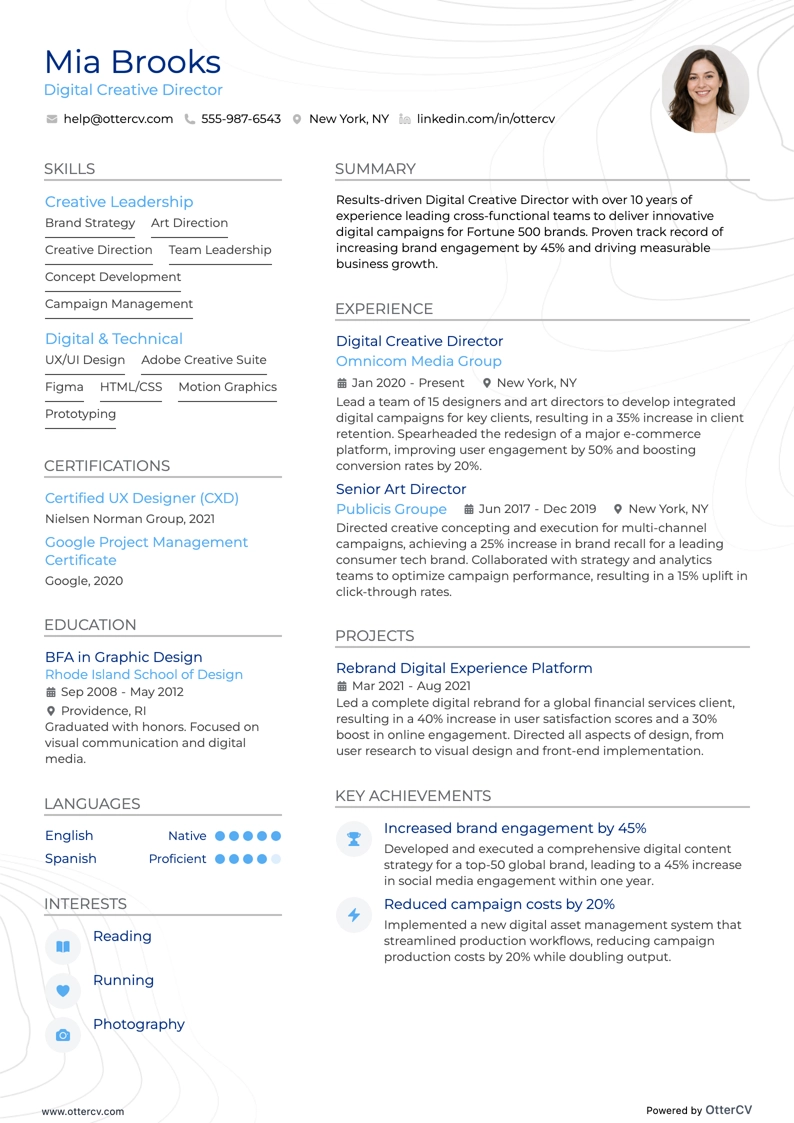
Digital Creative Director resume example

Digital Creative Director

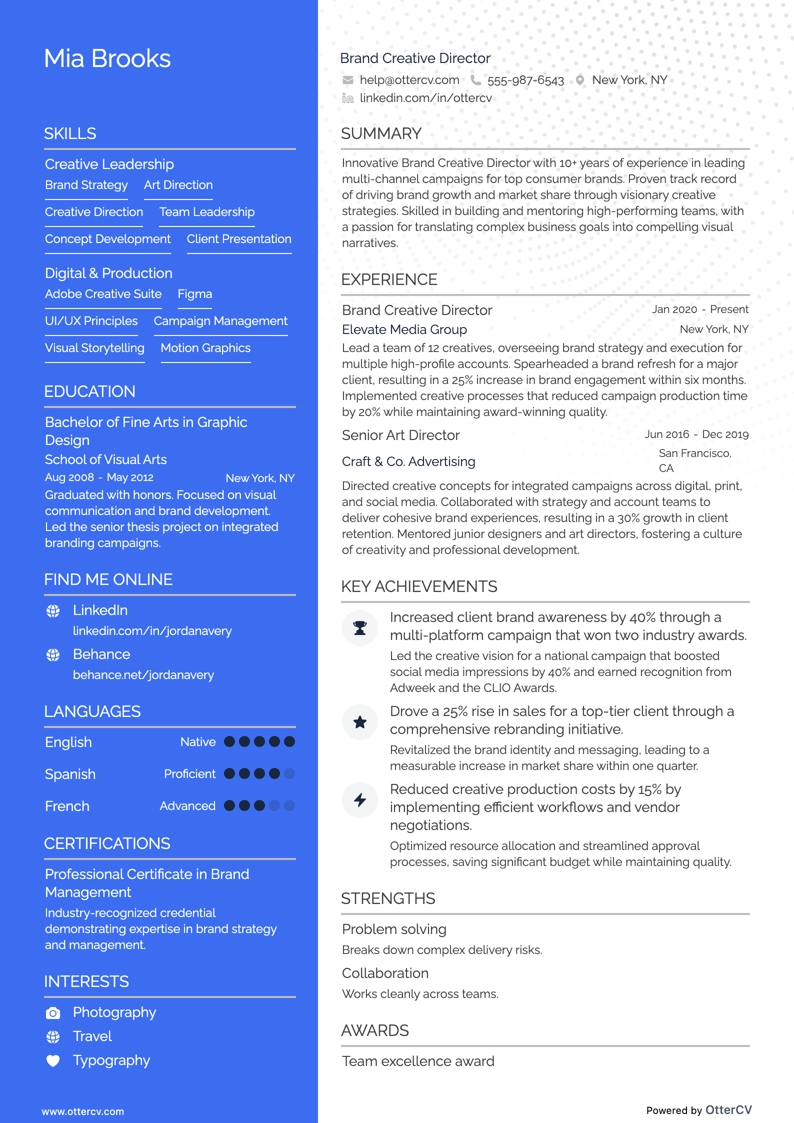
Brand Creative Director resume example

Brand Creative Director

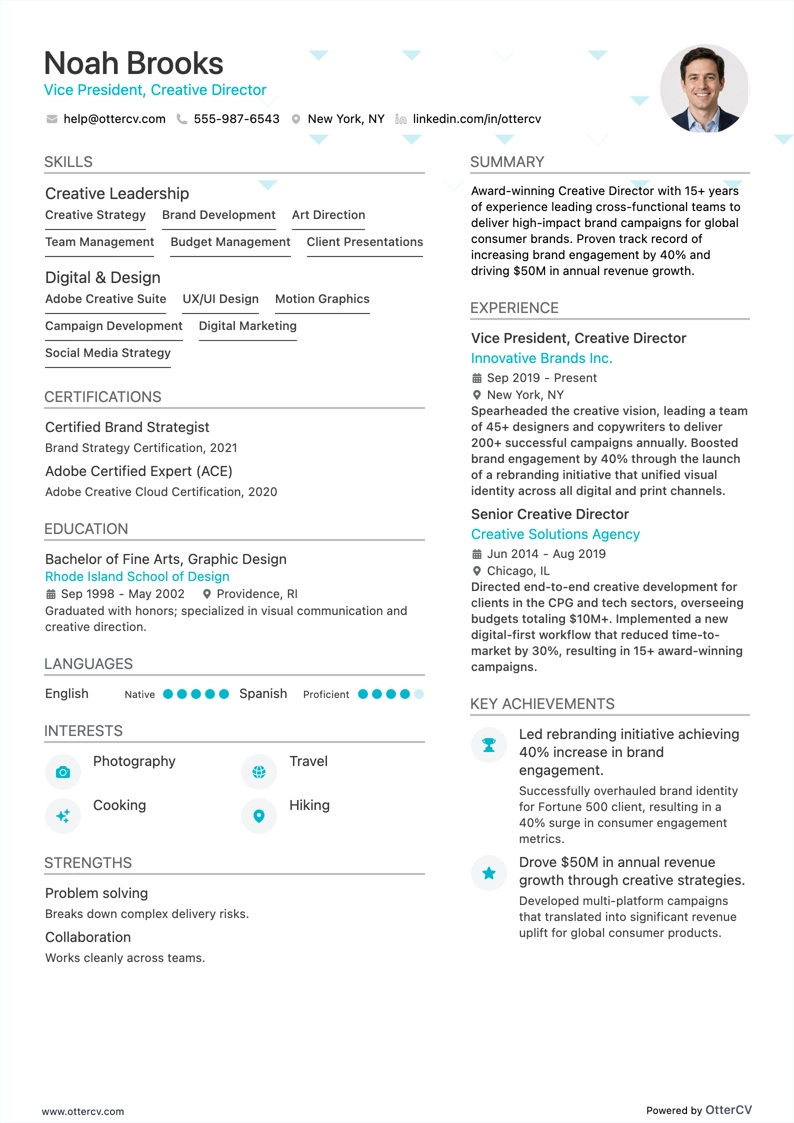
Vice President, Creative Director resume example

Vice President, Creative Director

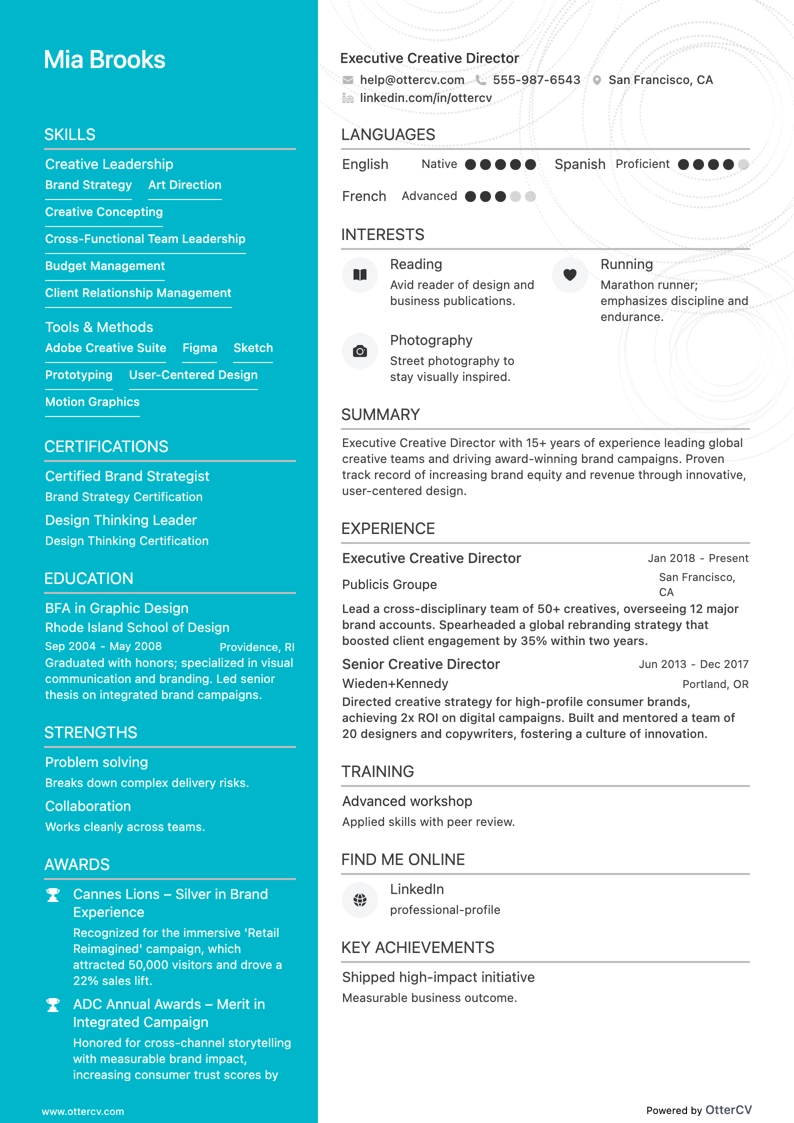
Executive Creative Director resume example

Executive Creative Director

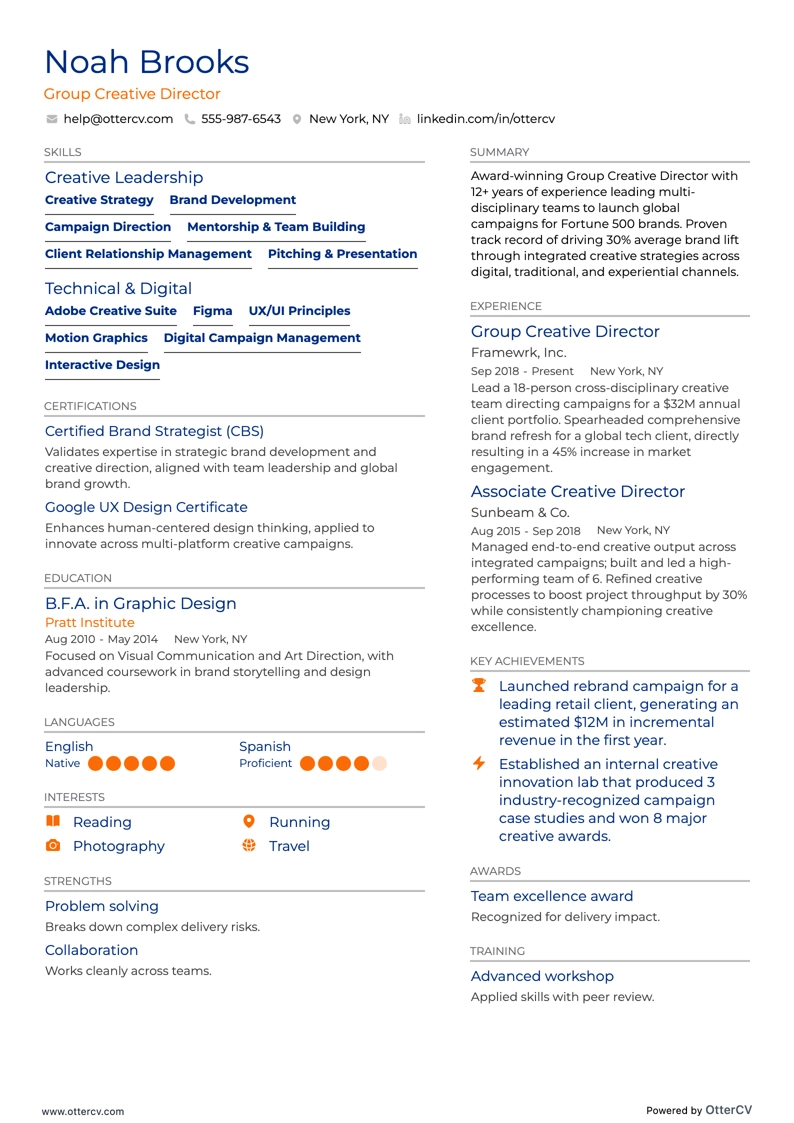
Group Creative Director resume example

Group Creative Director

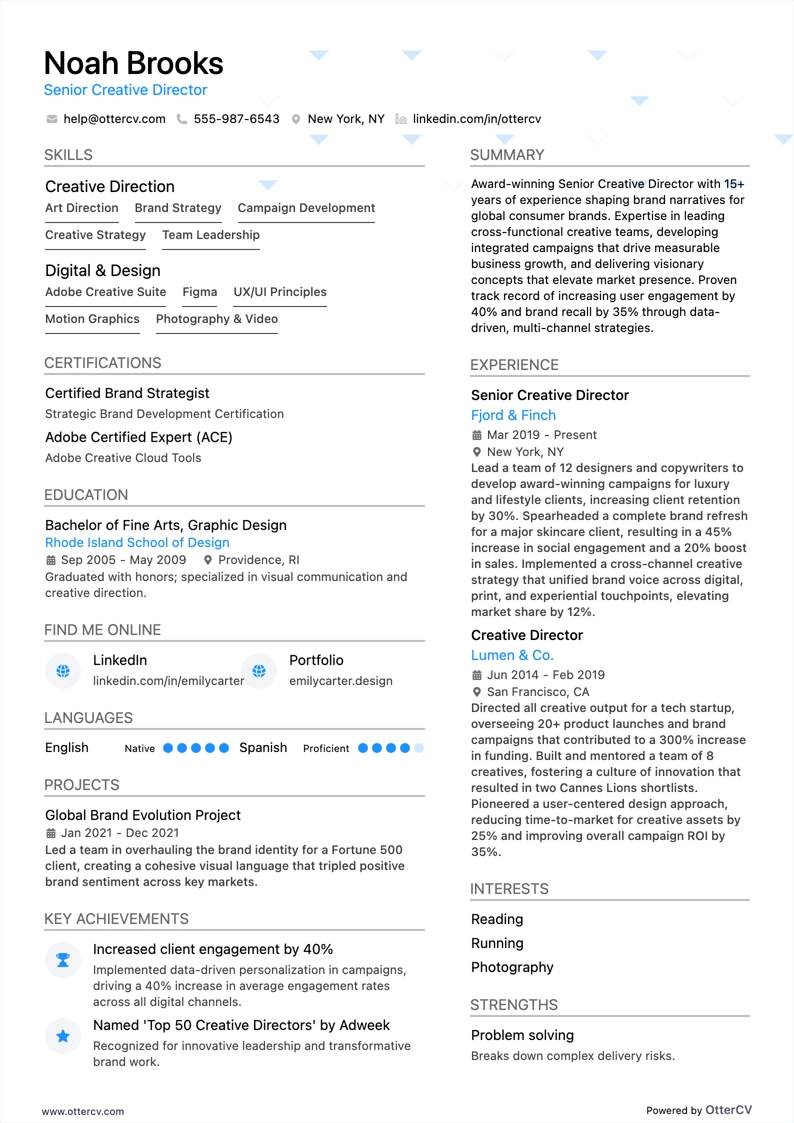
Senior Creative Director resume example

Senior Creative Director

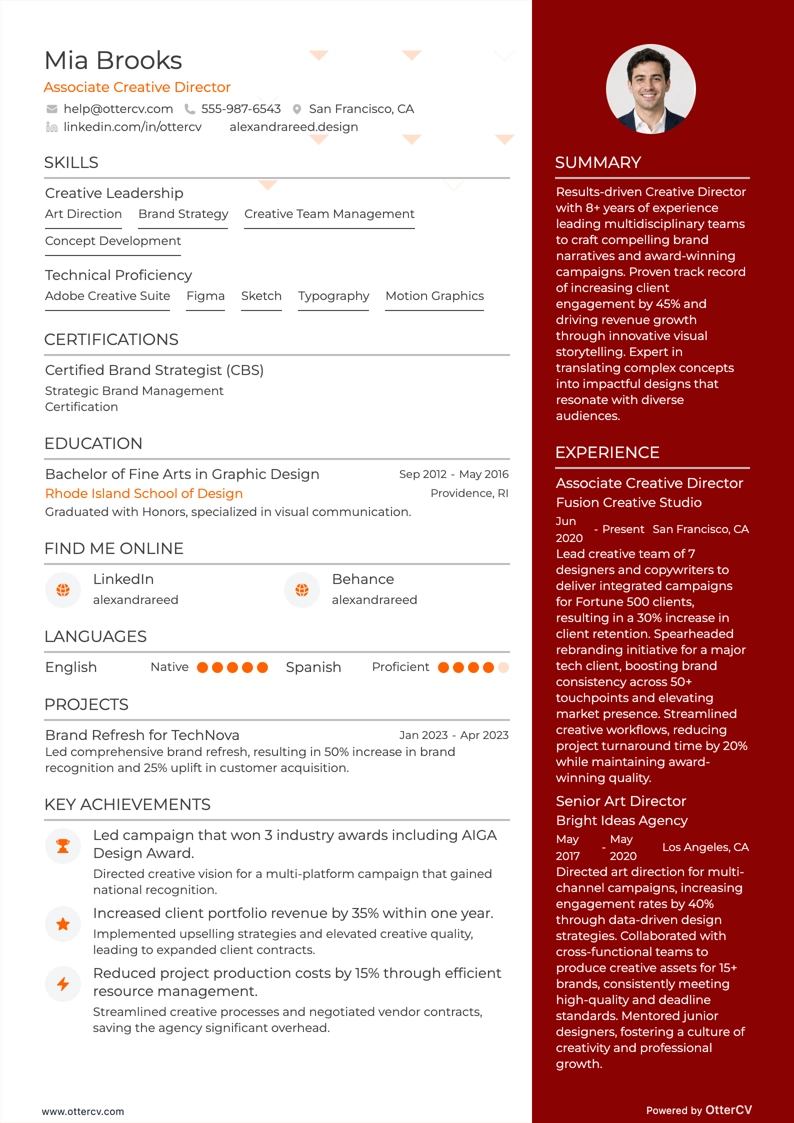
Associate Creative Director resume example

Associate Creative Director

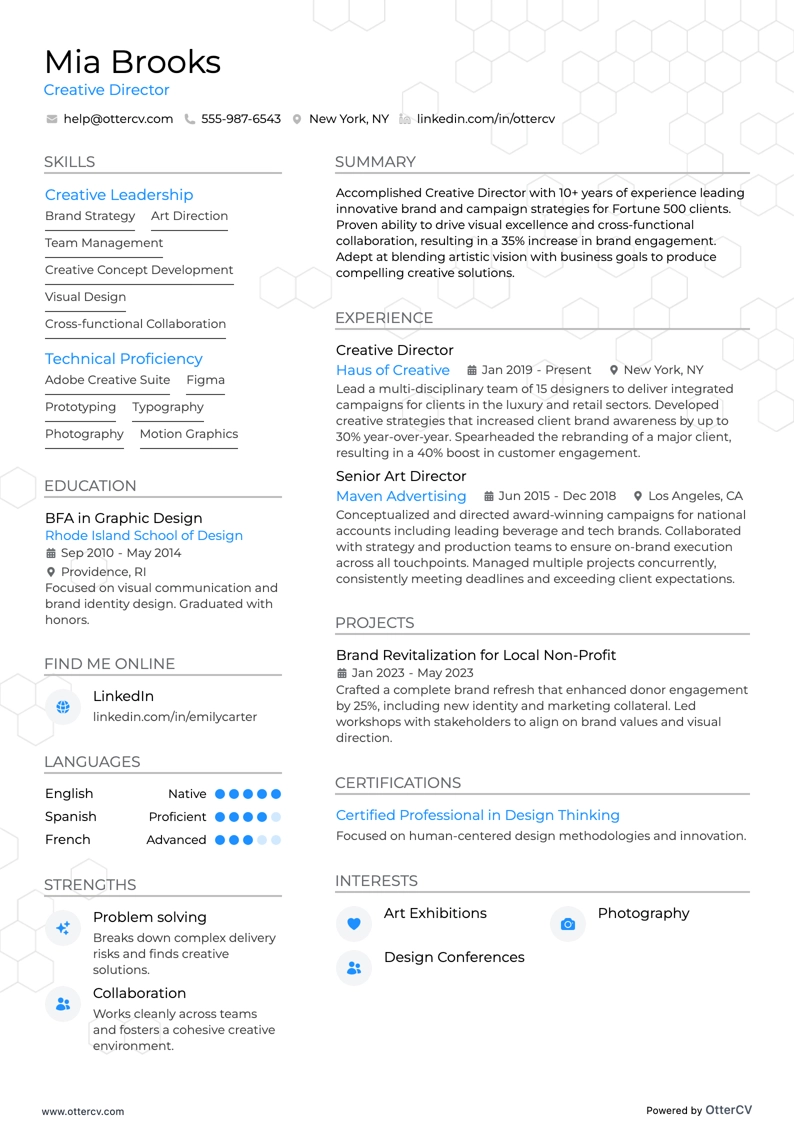
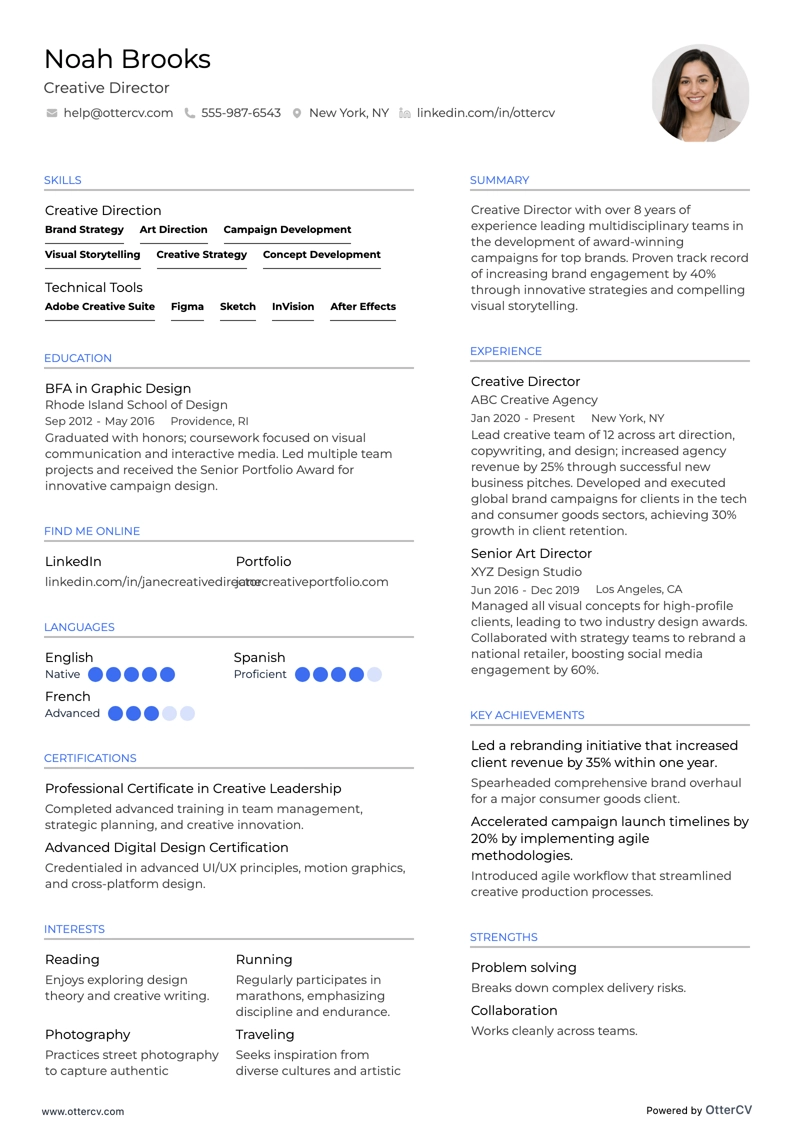
Creative Director resume example

Creative Director

You have an eye for what sells, strong marketing expertise, and the ability to inspire creative teams. After rising to the top of your field as a creative director, your resume may not have needed attention for quite some time. If you are back on the market, now is the time to update it.

If you want to turn a drab resume into an eye-catching one, this guide offers a step-by-step approach. It also covers how to tailor your resume to pass Applicant Tracking Systems (ATS) and how to clearly demonstrate your value and skill set.

In this guide, you’ll learn:

  • How to format your resume properly and which sections to include.
  • The best way to present your creative director work experience.
  • Which creative director skills are most effective to highlight.
  • How to strengthen your resume with education and professional certifications.
  • Why an impactful and eye-catching creative director summary or objective matters.

You may also find these related resume guides useful:

Creative director resume example

Let’s start with a well-written creative director resume.

Experiential Creative Director resume preview

Here’s what the applicant does well in their resume:

  • Highlights leadership and team management skills through specific examples, such as leading a multidisciplinary team and mentoring designers, which are crucial for a creative director role.
  • Quantifies achievements to demonstrate impact, including increasing user engagement by 25% and achieving record-breaking pre-sales figures, which makes the resume more compelling.
  • Showcases expertise in relevant software and tools such as Figma and AI tools, aligning with the job description and emphasizing proficiency in essential digital tools for design and marketing.

Common problems facing a creative director

As a creative director, creating a successful resume comes with a few distinct challenges. Here are some of the main obstacles you may need to overcome:

  • Demonstrating aesthetic understanding: A creative director must communicate their aesthetic sense and grasp of design principles through text and simple formatting alone. Unlike a portfolio, which visually showcases skills, a resume needs to use concise details and strategic structure to imply those abilities.
  • Tech skills representation: You’ll be expected to show proficiency in design tools such as Adobe Creative Suite, Sketch, and InVision. Presenting these skills clearly without overcrowding the resume can be difficult.
  • Showcasing leadership and collaboration skills: A creative director often leads teams and coordinates across departments. Balancing these soft skills alongside technical proficiencies is not always easy in a resume.
  • Proof of trend awareness: As a creative leader, you need to stay current with trends in graphic design, visual communications, and marketing. Demonstrating that knowledge on a resume can be challenging, since resumes usually focus on past experience and measurable achievements.
  • Tailoring for each role: The creative director role can vary significantly across industries and companies. That means each application often requires a tailored resume, and managing multiple customized versions can be especially demanding.

With that said, let’s move on to the task at hand: developing your best possible resume, starting with the foundation.

A creative director’s role is to take the spotlight and shine it on others, guiding creativity where it needs to go. It’s not about being the creative genius, but about making genius creative work happen.

—Lee Clow, Chairman of TBWA\Worldwide

How to format a creative director resume for success

Choosing the right resume format depends on your job history. Because creative roles place strong emphasis on skills and achievements, it’s usually best to use a format that highlights both while still supporting them with solid work history and education.

The hybrid format works especially well because it combines elements of functional resumes and reverse-chronological resumes. That makes it a strong choice if you have employment gaps, are changing careers, or bring a mix of diverse experiences.

Here are additional tips for formatting your resume:

  • Choose a clean layout: Use a simple, elegant design that keeps the focus on your content instead of distracting graphics. Keep it professional and easy to read, with a resume length of no more than one page, or two pages at most.
  • Highlight your portfolio: As a creative director, your portfolio could be your greatest ally. Include a link to your online portfolio near the top of your resume header.
  • Professional experience: Use a reverse-chronological format to list your creative experience, starting with your most recent role.
  • Specialize your skills section: Go beyond broad strengths and highlight specialized techniques, proficiency with specific programs, and similar qualifications.
  • Education and certifications: Include formal education, workshops, and certifications relevant to creative work.
  • Customize for the job: Tailor your resume for each application based on the job description. Emphasize the experience and skills that match the role, and use relevant keywords.
  • Use professional language: Keep a professional tone throughout and use action verbs to describe your responsibilities and achievements.
  • Proofread: Make sure your resume is free of typos and grammatical errors, since mistakes can undermine your professionalism.
  • PDF format and fonts: If you’re deciding between PDF or Word, PDF is always the better choice because it preserves your layout across devices and platforms. Also choose the right resume font—Rubik, Lato, Montserrat, Raleway, Exo 2, Volkhov, serif, and sans-serif fonts are all strong options.
  • ATS compatibility: Applicant tracking system (ATS) software scans resumes and cover letters to filter applicants based on employer-defined criteria. These may include resume keywords, design, resume layout, length, and salary requirements.

How Echocv Templates Compare

We recently conducted a study comparing our Echocv resume templates with standard Microsoft templates. The result: our templates were much easier for ATS software to scan, thanks to their stronger formatting and readability.

As a creative director, you’ll need to pay special attention to the following:

The top sections on a creative director resume

  • Professional summary: Briefly outline your career path and the qualifications that make you a strong fit for a creative director role.
  • Portfolio showcase: Highlight your work, accomplishments, and creative style with a clear summary of your portfolio.
  • Key skills: Show your core competencies, such as team leadership, design skills, and strategic thinking.
  • Work experience: Describe your previous roles, the responsibilities you handled, and how that experience applies to a creative director position.
  • Education & certifications: Confirm your technical expertise and field knowledge, especially in art direction and marketing.

In addition to organizing your resume into clear sections, make sure it also communicates these key elements effectively:

What recruiters want to see on your resume

  • Demonstrated leadership: Recruiters want proof that you can lead a team of artists and designers as a creative director.
  • Strong portfolio: A creative director needs a portfolio that shows the ability to create compelling visual narratives.
  • Understanding of design principles: Proficiency in core design elements shows you can guide the creative process effectively.
  • Industry experience: Experience in the target industry gives candidates an advantage because they understand its demands and challenges.
  • Communication skills: Creative directors must communicate their vision clearly to teams and stakeholders.

Including a creative director portfolio

As a creative director, your portfolio is a powerful way to showcase your creativity and design skills. Include a link to your online portfolio or attach a PDF with samples of your work, and make sure it is well organized and visually appealing.

PRO TIP

Keep your portfolio well organized, up to date, and focused on your best work for the specific job or opportunity you’re applying for.

This helps demonstrate your professionalism and dedication to your craft.

Where you should put your portfolio link

Placing your portfolio link in a prominent position on your creative director resume is important if you want potential employers to notice it quickly. The most effective places to include it are:

  • Header: Place it alongside your contact information. This is one of the first places employers look, so it helps ensure visibility even if they only scan your resume briefly.
  • Top of your resume: Add it just below your name and contact details. Putting it here invites employers to view your work before they review your experience or skills.
  • Summary or objective section: If your resume begins with a summary or objective, add the portfolio link at the end. This naturally encourages readers to explore your work after reading a quick overview of your background.
  • End of your resume: Include it in your closing remarks or in a separate section labeled Portfolio or Online Portfolio. This can help leave a lasting impression.

Wherever you place it, make sure the link is easy to read and type into a browser. If needed, consider using a URL shortener.

Listing creative director resume experience

This section lets you demonstrate your value through a well-organized list of your professional experience on your resume. It is your opportunity to show how your career has developed over time, so present it carefully and strategically.

When listing previous roles on a creative director resume, use a format that shows career progression, emphasizes creative accomplishments, and highlights leadership and project management skills.

  1. Use reverse chronological order: Start with your most recent role and work backward. This helps recruiters quickly understand your career growth and current level of responsibility.
  2. Include job title, company, location, and dates: Clearly list your job title, the company name, its location, and the dates you worked there, including month and year.
  3. Highlight key responsibilities and achievements:
    • For each role, include a brief list of your primary responsibilities. Focus on work relevant to a creative director position, such as leading creative teams, developing branding strategies, and overseeing the production of creative materials.
    • Emphasize achievements with measurable outcomes, such as successful campaigns, awards, increases in brand engagement, or improvements in creative workflow.
  4. Tailor your experience to the job description: Identify keywords and required skills in the job posting, and include experience that demonstrates them.
  5. Showcase leadership and collaboration:
    • Highlight leadership roles you have held, even if they were not directly tied to creative direction.
    • Mention successful collaboration with other departments, clients, or external partners to show your ability to work cross-functionally and move projects to completion.
  6. Include relevant tools and technologies: Mention your proficiency with industry-standard tools and software, such as Adobe Creative Suite, Sketch, and Figma, that are important for creating and managing creative work.
  7. Mention professional development:
    • If you moved into creative leadership from a different background, include courses, certifications, or training that helped you build relevant skills.
    • Also mention participation in industry conferences, workshops, or seminars that shows your commitment to staying current with creative trends and leadership practices.

Here are a couple of examples so you can better visualize what you should and should not do.

Experience

Assistant Creative Director

A friend’s creative agency

  • Supported creative tasks.
  • Worked on a couple of projects.
  • Attended team meetings.
WRONG

Why the Listing Is Ineffective

  • Vagueness and lack of detail: The listing does not provide enough specific information about the employer, the nature of the projects, or the candidate’s role in them. Phrases such as “helped out with creative tasks” are too vague.
  • Absence of quantifiable results: Without measurable outcomes, it is difficult to evaluate the candidate’s contributions or the value they brought to the company.
  • Lack of professionalism: The casual wording does not convey a strong professional image or a meaningful level of responsibility, which may cause recruiters to question the candidate’s experience and capabilities.

Experience

Assistant Creative Director

Digital Dreams Agency

02/2015 - Present | New York, NY

Innovative digital solutions agency focused on creativity, technology, and marketing strategy.

  • Helped lead the creative team in developing and executing innovative advertising campaigns for key accounts, contributing to a 25% increase in client retention.
  • Played a key role in the concept development and launch of a multimedia campaign for a tech startup that increased online engagement by 40% in three months.
  • Coordinated across departments to ensure seamless brand messaging integration, improving consistency in client communications across all platforms.
  • Led workshops and training sessions on the latest design software and creative trends, improving team productivity and creative output by 30%.
RIGHT

Why the listing is effective

  • Specificity and clarity: It clearly states the job title, employer, location, and employment duration, creating a clear professional timeline.
  • Quantifiable achievements: The example includes measurable results, such as a 25% increase in client retention and a 40% boost in online engagement, showing the candidate’s direct impact.
  • Leadership and collaboration: It demonstrates the candidate’s ability to lead and collaborate across teams, highlighting important skills for an assistant creative director.
  • Skill development and innovation: Mentioning leadership in workshops and training sessions for new software and trends shows a commitment to innovation and team development.

We talk a lot about quantifying your impact and achievements on your resume, so let’s take a closer look at that.

Measure your achievements not by the tasks you've completed, but by the impact you've made. Articulate this impact on your resume.

—Lou Adler, CEO and founder of The Adler Group

Effectively quantifying impact on a creative director resume

  • Include the budget size you handled in previous roles: This shows you can manage high-value creative projects responsibly.
  • List the number of campaigns you led that exceeded target metrics: Strong past performance helps demonstrate your ability to drive results and revenue.
  • Mention the percentage increase in social media engagement from your strategy: This highlights your understanding of digital platforms and how to use them to support business goals.
  • Share audience reach figures from successful campaigns: This shows your ability to target and engage broad demographics with a brand message.
  • Include customer conversion rate data under your creative leadership: Improved conversion rates reinforce your strategic thinking and your ability to create impactful designs and narratives.
  • Discuss costs saved: Showing resource optimization and cost-effectiveness highlights financial awareness and budget management skills.
  • Include specific engagement metrics from any viral content you directed: Virality can demonstrate your ability to create standout content with high visibility.
  • Document major growth in subscriptions or follower counts during your leadership: This shows you can build an engaged community and support customer loyalty.

A creative director resume with no experience

Is it time to take the next step from being an experienced graphic designer or marketing assistant?

If the answer is yes, don’t let your lack of creative director experience hold you back. Treat it as a new chapter and a chance to prove what you can do. Everyone starts somewhere.

First, make sure you understand exactly what a creative director does and start learning the language of the role. Read as much as possible about the job so you can get familiar with its buzzwords and expectations.

PRO TIP

Focus on transferable skills and your willingness to learn. Highlight abilities that apply across many jobs, such as problem-solving, communication, and teamwork, and show that you are eager to learn and adapt.

Here are a few additional tips to keep in mind when applying for a creative director position without direct experience:

  • Focus on showcasing your leadership skills, creative vision, and project management abilities.
  • Highlight relevant experience where you led teams, managed projects, or made significant creative contributions, even if your title was not creative director.
  • Show your understanding of the industry, your strategic and creative thinking, and your commitment to driving brand growth through innovative ideas.
  • Tailor your resume and cover letter to emphasize your strengths in creativity, leadership, and your ability to inspire and direct a team toward creative excellence.
  • Networking and personal branding through online portfolios or social media that showcase your creative work can also be pivotal.

Most importantly, don’t get cold feet—be proud of your achievements and land that job!

Hard skills and soft skills on your resume

List skills on your resume to showcase your creative vision, leadership, and technical capabilities. Include both hard skills, such as software proficiency, and soft skills, such as communication and leadership. Hard skills show your ability to execute projects, while soft skills reflect how you manage teams and collaborate.

This balance is crucial in a creative leadership role because it shows you can not only produce innovative work but also lead and inspire a team effectively. Tailor your skills to match the job description and emphasize the ones most relevant to the position.

Hard Skills

Also commonly referred to as technical skills, hard skills on a resume are usually job-specific tasks that are easy to demonstrate in a quantifiable way.

Best hard skills for your creative director resume

  • Graphic design is a core hard skill for a creative director resume.
  • Adobe Creative Suite proficiency is highly relevant.
  • Art direction shows leadership in visual execution.
  • Copywriting highlights strong messaging skills.
  • Web design demonstrates digital design capability.
  • User interface design supports strong product visuals.
  • User experience design reflects audience-focused thinking.
  • Illustration adds visual storytelling ability.
  • Brand development shows strategic creative expertise.
  • Video production is valuable for multimedia projects.
  • Photography strengthens visual content skills.
  • 3D modeling can expand creative production capabilities.
  • Digital marketing connects creative work to campaign goals.
  • HTML/CSS knowledge supports collaboration with web teams.
  • Motion graphics adds dynamic visual communication skills.
  • InDesign proficiency is useful for layout and print work.
  • Typography demonstrates attention to visual detail.
  • Sketching helps communicate early creative concepts.
  • Storyboarding supports planning for visual narratives.
  • Animation software proficiency can strengthen multimedia leadership.

Soft skills

Soft skills on your resume, also called people skills, are not specific to one workplace and include abilities such as communication and leadership. Employees with strong soft skills can thrive in the interpersonal side of the workplace.

Best soft skills for your creative director resume

  • Leadership helps guide teams and creative direction.
  • Communication keeps ideas clear and teams aligned.
  • Creativity shows your ability to develop original concepts.
  • Problem-solving helps you overcome creative and business challenges.
  • Time management supports deadlines and priorities.
  • Empathy helps you understand audiences, clients, and team members.
  • Decision making shows confidence in choosing the best direction.
  • Strategic thinking connects creative work to broader goals.
  • Networking helps build valuable professional relationships.
  • Adaptability shows you can adjust to changing needs.
  • Collaboration helps you work effectively across teams.
  • Critical thinking supports smart creative and business choices.
  • Conflict resolution helps maintain productive working relationships.
  • Vision and foresight show long-term creative perspective.
  • Flexibility helps you respond to feedback and change.
  • Negotiation supports alignment with clients, stakeholders, and teams.
  • Intuition helps guide creative judgment.
  • Attention to detail improves the quality and consistency of your work.
  • Patience supports thoughtful leadership and creative development.
  • Motivational skills help inspire teams and maintain momentum.

Including skills on your creative director resume is essential. It highlights your mix of creative, technical, and leadership abilities, showing employers that you have the well-rounded skill set needed to succeed in this dynamic role.

How to list your certifications and education on your resume

Education is the next key section to consider. On a creative director resume, listing your formal education and certifications helps show your foundational knowledge, specialized skills, and commitment to continued learning in the creative field.

Certifications can be especially important for creative directors. They show that you make a proactive effort to stay current with industry trends, tools, and methodologies, which matters in a fast-evolving creative landscape.

The relative importance of education versus certifications can vary based on the role and the employer’s preferences, so read the job description carefully.

How to list your education

The best way to list your formal education on a resume is to clearly include your degree, the institution where you earned it, your field of study, and your dates of attendance or graduation. Here’s an example of a strong listing:

Education

Master of Fine Arts in Graphic Design

Yale University

09/2014 - 06/2021 · New Haven, CT

  • Specialized in digital design and visual communication, aligning with the creative and technical demands of a Creative Director role.
  • Completed a capstone project on The Future of Digital Branding, demonstrating the ability to think strategically about brand evolution in the digital age.
  • Participated in a collaborative internship with a leading design agency, providing real-world experience in creative leadership and project management.
RIGHT

Why it’s effective:

  • Specific and concise: Clearly outlines the degree, institution, location, and graduation date.
  • Relevance: Shows specialization in areas directly applicable to a creative director's responsibilities.
  • Practical experience: Highlights hands-on experience and projects that directly relate to the role, demonstrating not just academic knowledge but practical application of skills.

A couple of last things to note:

  1. GPA: Including your GPA on a resume is typically not necessary, especially if you have significant work experience in the creative field. Focus on your professional achievements, creative portfolio, and skills relevant to the role. Grade Point Average is more relevant for recent graduates with limited work experience to show academic prowess.
  2. Major and minor: Listing your major and/or minor on your resume education section is important. It gives insight into your academic background and the areas of study that equipped you with foundational knowledge and skills relevant to the creative industry. This can be especially valuable if your major or minor is directly related to creative design, marketing, or communications.

How to list certifications

The best way to list a certification on a resume is to clearly state the certification name, the issuing organization, and the date of completion or expiration, if applicable. Here's an example of a good listing:

Certified Brand Strategist (CBS)

  • Brand Strategy Institute, September 2020

This particular certification:

  • Demonstrates a deep understanding of brand development and strategy, which is directly relevant to a creative director’s role in shaping brand identity.
  • Is earned from a recognized industry authority, adding credibility and professional validation to your expertise.
  • Shows a commitment to professional development and staying current with industry standards and practices.

Here are some of the more recognized certifications related to a creative director role:

We saved the best for last: the resume summary. It is one of the most important parts of a resume and can determine whether a recruiter keeps reading or sets your resume aside.

How to write your creative director resume summary or objective

PRO TIP

Tailor your summary to the specific job you’re applying for. Highlight how your skills, experience, and career goals align with the employer’s needs and objectives.

Focus on what you can offer the employer rather than on what you want from your next job.

A resume summary or objective on your resume matters because it quickly highlights your most relevant skills, experience, and career goals. It shows potential employers your value and fit for the role right at the top of your resume.

Use concise, impactful language to present your strongest achievements and qualifications. A personalized summary helps capture a hiring manager’s attention and sets a strong, positive tone for the rest of your resume.

First, we’ll show you what not to do.

Summary

I've done creative work and want a job where I can use my skills. I'm looking for a creative director position to make engaging, creative work.

WRONG

Why this isn’t a good example

  • Lacks specificity: It does not mention specific skills, achievements, or what the candidate can bring to the role.
  • Unprofessional tone: It uses casual language that does not reflect a serious professional attitude.
  • No value proposition: It does not explain how the candidate’s experience or skills would benefit the employer.

Now, let’s look at how it should be done.

Summary

Dynamic Creative Director with over 10 years of experience leading innovative design teams and developing compelling brand strategies. Proven success in elevating brand presence through creative excellence and strategic vision. Skilled in multimedia campaigns, digital transformation, and fostering collaborative environments that drive organizational growth and brand loyalty.

RIGHT

Key Strengths

  • Specific experience: Clearly states the amount of experience and the role, establishing credibility.
  • Quantifiable achievements: Mentions a track record of success, implying measurable results in past positions.
  • Skills and impact: Highlights key skills and their impact on brand and organizational growth.
  • Professional tone: Uses professional and industry-relevant language that conveys seriousness and competence.

Summary vs objective

A resume summary highlights your relevant achievements, skills, and experience, focusing on what you bring to the role from your past. A resume objective explains your career goals and what you hope to achieve in the position, often showing how you plan to contribute to the company in the future.

Additional sections for a creative director resume

  • Awards and recognitions: Any industry awards or recognitions you’ve received.

  • Projects: Highlight specific projects on a resume that you led or contributed to significantly, along with outcomes.

  • Professional development: Workshops, seminars, or courses relevant to creative direction.

  • Languages: Multiple language skills on a resume , if applicable, can be a strong asset in global companies.

  • Interests: Personal interests and hobbies that align with creative industries can help present a more rounded picture of you as a candidate.

  • Creating a resume for a creative director role comes with challenges, but with proper execution and dedication, your resume can impress.

  • The best format for a resume aimed at the creative industry is one that prioritizes skills and achievements. The hybrid format is the strongest choice because it emphasizes both while being supported by solid work history and education.

  • Including a link to your creative portfolio is imperative, as it provides visual proof of your talents and abilities.

  • It’s not enough to say you made an impact or achieved results—you need to quantify them with numbers.

  • Include a wide range of skills, both hard and soft, to show that you have the creative nuances needed for the role.

  • Detailed education and certification sections are important both as a formal job requirement and as proof of your dedication and commitment to the industry.

  • Set aside time to focus on writing your professional summary or objective. Without an effective one, the rest of your resume may lose impact.

Creative Director resume examples

Explore additional Creative Director resume samples and guides and see what works for your level of experience or role.

By Experience

Vice President, Creative Director

Vice President, Creative Director resume preview

Executive Creative Director

Executive Creative Director resume preview

Group Creative Director

Group Creative Director resume preview

Senior Creative Director

Senior Creative Director resume preview

Associate Creative Director

Associate Creative Director resume preview

Creative Director resume examples

Explore additional Creative Director resume samples and guides and see what works for your level of experience or role.

By Role

Experiential Creative Director

Experiential Creative Director resume preview

Creative Director, Copy

Creative Director, Copy resume preview

Creative Director, Art

Creative Director, Art resume preview

Global Creative Director

Global Creative Director resume preview

Digital Creative Director

Digital Creative Director resume preview

Brand Creative Director

Brand Creative Director resume preview

Creative Director

Creative Director resume preview